Cyril Brulebois: Wrench days
Fixing hardware
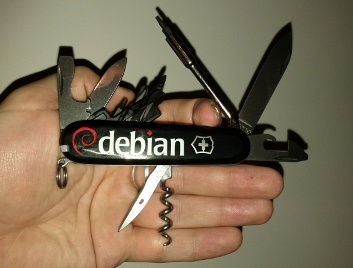 Thanks to the nice
Debian Swiss Knives
initiative!
Fixing software
Besides trying to maintain the whole X stack as usual, and preparing
the funky
wayland,
mesa,
and
weston
trio for
Thanks to the nice
Debian Swiss Knives
initiative!
Fixing software
Besides trying to maintain the whole X stack as usual, and preparing
the funky
wayland,
mesa,
and
weston
trio for experimental, I got myself into other areas.
Debugging gzip
Jakup Wilk noticed
a while ago that some multiarchified packages couldn t be co-installed
due to gzipped files being different between architectures. That was
reported as #647522 against the
gzip package.
While some developers consider the lack of determinism (as in: it s
not in the gzip specification, and the current implementation
generates different packages anyway!) as a dead-end for the multiarch
experiment, it didn t look like undebuggable or unfixable. And indeed,
as confirmed by a
quick
analysis:
a lack of clean-up when several files are processed at once can lead
to different results, depending on the order in which files are specified
on the command line; the patch for that is trivial, and was later
made smaller
and the need for it was
explained.
Working in the Release Team
I reviewed/approved a few packages for squeeze, but also took care
of handling or finishing a few transitions (as seen in my
hints file), among
which the funny iceweasel9/libmozjs ones; release tools are nice,
but one gets to learn lots of stuff at once (which isn t a negative
aspect). I hacked a tiny
collision detector
so that packages involved in several transitions can be easily
spotted. Given the huge number of ongoing transitions we had lately,
that didn t look overkill.
Squashing bugs
It had been a very long time since my last working on totally random
RC bugs. The Bug Squashing Party organized at
IRILL was a very nice opportunity to get back
to totally crazy bugs in unknown packages, but also to meet with other
Debian contributors; sponsoring maintainers with good patches on their
first try was nice, but walking other contributors through their first
patches sent to the BTS or through their first NMUs was nice too.
Waving good bye to yada
Back in the M rida QA meeting I attended in 2007, there were already
jokes about how bad yada was, and how it should die in a fire
etc. When I started looking at the RC bug list, I quickly switched to
scrolling it backwards, and I wondered how much work was left. The
details can be seen in #660548, and
the result is:
yada is gone!
sanity++;
packages.debian.org
Both long descriptions and translations for packages in some suites
disappeared after the
switch to Description-md5. Thanks
to a quick and reduced packages.debian.org setup (mostly: en+de
for squeeze+sid+experimental), I managed to find my way through
Perl and DB files to propose patches for
#657557. I m still waiting for a
confirmation, but in case it works fine, we could even get a fix for
DDTP/DDTSS.
 Over recent months, I have been pondering the relevance of my Free Software involvement a lot:
More than anything, it constantly feels more and more like several important distributions and projects are moving in directions that break with the old ways far too radically, by breaking software usability rules such as "least surprise", "works out of the box", and "if it ain't broken, don't fix it" either to try new approaches to addressing existing needs or simply for change's sake.
Another aspect lies in my usual motivation for packaging or adopting software: because I need it and nobody else bothered doing it. Further reflection made me ponder what, correspondingly, are my usual reasons for dropping software: because what exists already works and because everybody and their grand-mother already invented a million of ways to handle the same issue.
Which brings us to today's news.
What prompted me to hand the dictionary packages I maintained over to someone else was a combination of "no longer need it" and "it already works fine as it is."
For instance, the Estonian dictionaries haven't seen any upstream release since the initial one in 2003. While I still use Estonian daily in my online communications, the last 9 years have mostly been spent making minor changes to the dependencies and maintainer scripts, just to keep the package compliant with current Debian packaging policies and with ongoing improvements to the

 As many would know,

 Some days ago, reading my local
 .
My elder daughter does need to run educational software from school. And my wife wants to run education software for our younger son. And making all that running under different emulation environments does eat my time, and result is not always good. And also children start to want games
Issue 1. Need hardware to run more or less modern windows on.
For last 6 years, my home network consists of a more or less powerful headless server, and 3 terminals to access that. Terminals are definitely too weak for windows. And server is needed in 24/7 mode so sorry no windows there.
Likely solution for this is one of 3 terminals is actually dying (it is doing so already for months but still works, just hangs sometimes) and needs a replacement, so I can just replace it now and use more powerful hardware.
Issue 2. Windows host or windows VM?
While windows VM feels preferable for a such a deep-linux person as myself, I tend to think that dual-boot host is better here. If the very reason of allowing windows into this house is make it easy to install and run random windows software, then doing so in VM environment is explicitly against the goal.
Issue 3. Use unlicensed windows or buy a license?
Although absolute majority of windows users here is Russia use unlicensed windows, it is somewhat unfair to promote free software and use unlicensed windows at the same time. And windows home basic license is not that expensive after all.
The setup that makes me less uncomfortable than others is:


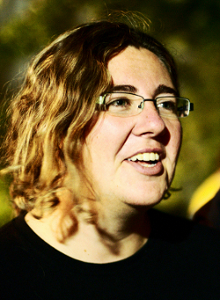
 I m glad that the existence of the Debian Women project helped her to join Debian because she has been doing a great job.
From KDE packaging to publicity/marketing work, her interests shifted over the years but this allowed her to stay very involved. As she explains it very well, Debian is big enough so that you can stop doing something which is no longer fun for you, and still find something new to do in another part of Debian!
Read on to learn more about Ana, the KDE team, Debian s participation to the Google Summer of Code, and more.
Raphael: Who are you?
Ana: I m Ana Guerrero L pez and I m in my early 30s. I was born and raised in the wonderful city of Sevilla, Spain and I live in Lyon, France. I share my life with another Debian Developer and my paid work is doing Debian support and integration, so you won t be surprised to read that Debian is a big part of my life.
Raphael: How did you start contributing to Debian?
Ana: Although I knew about the existence of Linux since 1997 or so, I didn t really start using Linux until the summer 2001 when I finally got a computer on my own and an Internet link at home. In the beginning, I was using Mandrake in a dual boot with Windows and later around 2003, I happily moved to only using Debian and ditching the Windows partition. Once settled as a Debian user, I knew anybody could help improve the distribution but I hesitated to join mostly due to two reasons, my perception of Debian was the one of a very elitist and aggressive club and who wants to join this kind of cult^wproject? And even if I wanted to join, I did not know how to get started.
By the summer of 2004, the Debian Women project started, it made me seeing Debian as a more welcoming project, and I started maintaining my first packages. The following summer 2005, I attended akademy 2005 (the annual KDE conference) where I had the pleasure to meet there some of the people from the KDE team and this really made a difference for me. Christopher Martin and Adeodato Sim , with the help of other people, have started the maintenance of KDE as a team a few months before and by that time most of the KDE modules where under the maintenance umbrella of the team. This was a very good move since it allowed easily to share the KDE maintenance in a more coordinated way and also eased having non-DDs, like me at that time, to join in and help.
 Raphael: You used to maintain


 Matthew Aslett wrote about how
 I hope by now you have heard of
 For the past few years the