Search Results: "ana"

31 August 2016

Michal Čihař: Weblate 2.8

Quite on schedule (just one day later), Weblate 2.7 is out today. This release brings Subversion support or improved zen mode. Full list of changes: If you are upgrading from older version, please follow our upgrading instructions. You can find more information about Weblate on https://weblate.org, the code is hosted on Github. If you are curious how it looks, you can try it out on demo server. You can login there with demo account using demo password or register your own user. Weblate is also being used on https://hosted.weblate.org/ as official translating service for phpMyAdmin, OsmAnd, Aptoide, FreedomBox, Weblate itself and many other projects. Should you be looking for hosting of translations for your project, I'm happy to host them for you or help with setting it up on your infrastructure. Further development of Weblate would not be possible without people providing donations, thanks to everybody who have helped so far! The roadmap for next release is just being prepared, you can influence this by expressing support for individual issues either by comments or by providing bounty for them.

Filed under: Debian English Gammu phpMyAdmin SUSE Weblate 0 comments

30 August 2016

Daniel Stender: My work for Debian in August

Here's again a little list of my humble off-time contributions I'm happy to add to the large amount of work we're completing all together each month. Then there is one more "new in Debian" (meaning: "new in unstable") announcement. First, the uploads (a few of them are from July): New packages: Sponsored uploads: Requested resp. suggested for packaging: New in Debian: Lasagne (deep learning framework) Now that the mathematical expression compiler Theano is available in Debian, deep learning frameworks resp. toolkits which have been build on top of it can become available within Debian, too (like Blocks, mentioned before). Theano is an own general computing engine which has been developed with a focus on machine learning resp. neural networks, which features an own declarative tensor language. The toolkits which have build upon it vary in the way how much they abstract the bare features of Theano, if they are "thick" or "thin" so to say. When the abstraction gets higher you gain more end user convenience up to the level that you have the architectural components of neural networks available for combination like in a lego box, while the more complicated things which are going on "under the hood" (like how the networks are actually implemented) are hidden. The downside is, thick abstraction layers usually makes it difficult to implement novel features like custom layers or loss functions. So more experienced users and specialists might to seek out for the lower abstraction toolkits, where you have to think more in terms of Theano. I've got an initial package of Keras in experimental (1.0.7-1), it runs (only a Python 3 package is available so far) but needs some more work (e.g. building the documentation with mkdocs). Keras is a minimalistic, high modular DNN library inspired by Torch1. It has a clean, rather easy API for experimenting and fast prototyping. It can also run on top of Google's TensorFlow, and we're going to have it ready for that, too. Lasagne follows a different approach. It's, like Keras and Blocks, a Python library to create and train multi-layered artificial neural networks in/on Theano for applications like image recognition resp. classification, speech recognition, image caption generation or other purposes like style transfers from paintings to pictures2. It abstracts Theano as little as possible, and could be seen rather like an extension or an add-on than an abstraction3. Therefore, knowledge on how things are working in Theano would be needed to make full use out of this piece of software. With the new Debian package (0.1+git20160728.8b66737-1)4, the whole required software stack (the corresponding Theano package, NumPy, SciPy, a BLAS implementation, and the nividia-cuda-toolkit and NVIDIA kernel driver to carry out computations on the GPU5) could be installed most conveniently just by a single apt-get install python ,3 -lasagne command6. If wanted with the documentation package lasagne-doc for offline use (no running around on remote airports seeking for a WIFI spot), either in the Python 2 or the Python 3 branch, or both flavours altogether7. While others have to spend a whole weekend gathering, compiling and installing the needed libraries you can grab yourself a fresh cup of coffee. These are the advantages of a fully integrated system (sublime message, as always: desktop users switch to Linux!). When the installation of packages has completed, the MNIST example of Lasagne could be used for a quick check if the whole library stack works properly8:
$ THEANO_FLAGS=device=gpu,floatX=float32 python /usr/share/doc/python-lasagne/examples/mnist.py mlp 5
Using gpu device 0: GeForce 940M (CNMeM is disabled, cuDNN 5005)
Loading data...
Downloading train-images-idx3-ubyte.gz
Downloading train-labels-idx1-ubyte.gz
Downloading t10k-images-idx3-ubyte.gz
Downloading t10k-labels-idx1-ubyte.gz
Building model and compiling functions...
Starting training...
Epoch 1 of 5 took 2.488s
  training loss:        1.217167
  validation loss:      0.407390
  validation accuracy:      88.79 %
Epoch 2 of 5 took 2.460s
  training loss:        0.568058
  validation loss:      0.306875
  validation accuracy:      91.31 %
The example on how to train a neural network on the MNIST database of handwritten digits is refined (it also provides --help) and explained in detail in the Tutorial section of the documentation in /usr/share/doc/lasagne-doc/html/. Very good starting points are also the IPython notebooks that are available from the tutorials by Eben Olson9 and Geoffrey French on the PyData London 201610. There you have Theano basics, examples for employing convolutional neural networks (CNN) and recurrent neural networks (RNN) for a range of different purposes, how to use pre-trained networks for image recognition, etc.

  1. For a quick comparison of Keras and Lasagne with other toolkits, see Alex Rubinsteyn's PyData NYC 2015 presentation on using LSTM (long short term memory) networks on varying length sequence data like Grimm's fairy tales (https://www.youtube.com/watch?v=E92jDCmJNek 27:30 sq.)
  2. https://github.com/Lasagne/Recipes/tree/master/examples/styletransfer
  3. Great introduction to Theano and Lasagne by Eben Olson on the PyData NYC 2015: https://www.youtube.com/watch?v=dtGhSE1PFh0
  4. The package is "freelancing" currently being in collab-maint, to set up a deep learning packaging team within Debian is in the stage of discussion.
  5. Only available for amd64 and ppc64el.
  6. You would need "testing" as package source in /etc/apt/sources.list to install it from the archive at the present time (I have that for years, but if Debian Testing could be advised as productive system is going to be discussed elsewhere), but it's coming up for Debian 9. The cuda-toolkit and pycuda are in the non-free section of the archive, thus non-free (mostly used in combination with contrib) must be added to main. Plus, it's a mere suggestion of the Theano packages to keep Theano in main, so --install-suggests is needed to pull it automatically with the same command, or this must be given explicitly.
  7. For dealing with Theano in Debian, see this previous blog posting
  8. Like suggested in the guideline From Zero to Lasagne on Ubuntu 14.04. cuDNN isn't available as official Debian package yet, but could be downloaded as a .deb package after registration at https://developer.nvidia.com/cudnn. It integrates well out of the box.
  9. https://github.com/ebenolson/pydata2015
  10. https://github.com/Britefury/deep-learning-tutorial-pydata2016, video: https://www.youtube.com/watch?v=DlNR1MrK4qE

Rhonda D'Vine: Thomas D

It's not often that an artist touches you deeply, but Thomas D managed to do so to the point of that I am (only half) jokingly saying that if there would be a church of Thomas D I would absolutely join it. His lyrics always did stand out for me in the context of the band I found about him, and the way he lives his life is definitely outstanding. And additionally there are these special songs that give so much and share a lot. I feel sorry for the people who don't understand German to be able to appreciate him. Here are three songs that I suggest you to listen to closely: Like always, enjoy!

/music permanent link Comments: 1 Flattr this

28 August 2016

Craig Sanders: fakecloud

I wrote my first Mojolicious web app yesterday, a cloud-init meta-data server to enable running pre-built VM images (e.g. as provided by debian, ubuntu, etc) without having to install and manage a complete, full-featured cloud environment like openstack. I hacked up something similar several years ago when I was regularly building VM images at home for openstack at work, with just plain-text files served by apache, but that had pretty-much everything hard-coded. fakecloud does a lot more and allows per-VM customisation of user-data (using the IP address of the requesting host). Not bad for a day s hacking with a new web framework. https://github.com/craig-sanders/fakecloud fakecloud is a post from: Errata

26 August 2016

Norbert Preining: ESSLLI 2016 Course: Algebraic Specification and Verification with CafeOBJ

During this year s ESSLLI (European Summer School in Logic, Language and Information) I was teaching a course on Algebraic Specification and Verification with CafeOBJ. Now that the course is over I can relax a bit and enjoy the beauty of the surrounding North Tyrol.
ESSLLI-2016-logo-darkblue-small For those who couldn t attend the ESSLLI or the course, here are the course materials: Thanks to the participants for the interesting questions and participation. What follows is the original description of the course. Abstract Ensuring correctness of complex systems like computer programs or communication protocols is gaining ever increasing importance. For correctness it does not suffice to consider the finished system, but correctness already on the level of specification is necessary, that is, before the actual implementation starts. To this aim, algebraic specification and verification languages have been conceived. They are aiming at a mathematically correct description of the properties and behavior of the systems under discussion, and in addition often allow to prove (verify) correctness within the same system. This course will give an introduction to algebraic specification, its history, logic roots, and actuality with respect to current developments. Paired with the theoretical background we give an introduction to CafeOBJ, a programming language that allows both specification and verification to be carried out together. The course should enable students to understand the theoretical background of algebraic specification, as well as enable them to read and write basic specifications in CafeOBJ. Description CafeOBJ is a specification language based on three-way extensions to many-sorted equational logic: the underlying logic is order-sorted, not just many-sorted; it admits unidirectional transitions, as well as equations; it also accommodates hidden sorts, on top of ordinary, visible sorts. A subset of CafeOBJ is executable, where the operational semantics is given by a conditional order-sorted term rewriting system. The language system CafeOBJ has been under constant development at the institute of the lecturers since the late 80ies. It is closely related to other algebraic specification languages in the OBJ family, including Maude. The CafeOBJ language and the range of verification methods and tools it supports including its support for inductive theorem proving, verification of behavioral specifications, deductive invariant proof, and reachability analysis of concurrent systems has played a key role in both extending and bringing algebraic specification techniques into contact with many software engineering applications. The following topics will be discussed: To make the lectures not too heavy , we will structure each lecture into two parts: A first part providing an introduction of some theoretical concept, or framework, and a second part dealing with actual programming and implementation. Especially for the second part of each lecture students are encouraged to use their laptops to try out code and experiment.

Michal Čihař: CI coverage from Windows, Linux and OSX

Once I got CI working on multiple platforms the obvious next step was to be able to aggregate coverage reports across them. This should not be that hard, right? Well I've spent couple of hours on that during last few days. On Linux and OSX it was pretty much straightforward. Both GCC and Clang do support coverage, so it's just matter of configuring them properly and collect the coverage reports. I've used own solution for that in past and that was really far from working well (somehow I never managed to get coverage fully uploaded to Codecov). Fortunately there exists CMake script called CMake-codecov which does all needed work and works out of the box on GCC and Clang (even on OSX). Well it works on Travis only once you update the compilers and install llvm-cov tool. The Windows part on AppVeyor was much harder for me. This can be heavily accounted to lack of my experience with Windows and especially development on Windows in past ten years (probably even more). First challenge was to find something what can generate code coverage there. After lot of googling I've settled down on OpenCppCoverage what seems to be the only free solution I was able to find. The good thing is that it can generate coverage in Cobertura format that Codecov undestands. There are also bad things that I've learned. First of all it's quite hard to integrate this with CTest. There is no support for wrapping test calls in custom commands, so I've misused the memory checks for that purpose. I've written small python script which pretends the valgrind interface and does call OpenCppCoverage in the background. Now I had around 800 coverage files (one for each test case) and we need to deal with them somehow. The Codeconv command line client doesn't deal wit this out of the box so the obvious choice was to merge them before upload. There even seems to be script doing that, but unfortunately trying that on our coverage data make it nowhere near completion within hour, so that's not really good choice. Second thing I've tried was merging binary coverage in OpenCppCoverage and then exporting to Cobertura format. Obviously Gammu is special project as all I got from this attempt was crashing OpenCppCoverage (it did merge some of the coverages, but it failed in the end without indicating any error). In the end I've settled down to uploading files in chunks to Codecov. This seems to work quite okay, though is a bit slow, mostly due to way how Codecov bash uploader prepares data to upload (but this will be hopefully fixed soon). Anyway the goal has been reached, both Windows and Linux code shows in coverage reports.

Filed under: Debian English Gammu 0 comments

25 August 2016

Norbert Preining: Gaming: Deus Ex Go

Long flights and lazy afternoons relaxing from teaching, I tried out another game on my Android device, Deus Ex Go. It is a turn based game in the style of the Deus Ex series (long years ago I was beta tester for the Deus Ex version of LGP). A turn based game where you have to pass through a series of levels, each one consisting of an hexagonal grid with an entry and exit point, and some nasty villains or machines trying to kill you. Deus-ex-go Without any explanations given you are thrown into the game and it takes a few iterations until you understand what kind of attacks you are facing, but once you have figured that out, it is a more or less simple game of combination how to manage to get to the exit. I played through the around 50 levels of the story mode and I think it was only in the last five that I once or twice had to actually try and think hard to find a solution. I found the game quite amusing at the beginning, but soon it became repetitive. But since you can play through the whole story mode in probably one long afternoon, that is not so much of a problem. More a problem is the apparently incredible battery usage of this game. Playing without checking for some time leaves you soon with a near empty battery. Graphically well done, with more or less interesting gameplay, it still does not stand up to Monument Valley.

Francois Marier: Debugging gnome-session problems on Ubuntu 14.04

After upgrading an Ubuntu 14.04 ("trusty") machine to the latest 16.04 Hardware Enablement packages, I ran into login problems. I could log into my user account and see the GNOME desktop for a split second before getting thrown back into the LightDM login manager. The solution I found was to install this missing package:
apt install libwayland-egl1-mesa-lts-xenial

Looking for clues in the logs The first place I looked was the log file for the login manager (/var/log/lightdm/lightdm.log) where I found the following:
DEBUG: Session pid=12743: Running command /usr/sbin/lightdm-session gnome-session --session=gnome
DEBUG: Creating shared data directory /var/lib/lightdm-data/username
DEBUG: Session pid=12743: Logging to .xsession-errors
This told me that the login manager runs the gnome-session command and gets it to create a session of type gnome. That command line is defined in /usr/share/xsessions/gnome.desktop (look for Exec=):
[Desktop Entry]
Name=GNOME
Comment=This session logs you into GNOME
Exec=gnome-session --session=gnome
TryExec=gnome-shell
X-LightDM-DesktopName=GNOME
I couldn't see anything unexpected there, but it did point to another log file (~/.xsession-errors) which contained the following:
Script for ibus started at run_im.
Script for auto started at run_im.
Script for default started at run_im.
init: Le processus gnome-session (GNOME) main (11946) s'est achev  avec l' tat 1
init: D connect  du bus D-Bus notifi 
init: Le processus logrotate main (11831) a  t  tu  par le signal TERM
init: Le processus update-notifier-crash (/var/crash/_usr_bin_unattended-upgrade.0.crash) main (11908) a  t  tu  par le signal TERM
Seaching for French error messages isn't as useful as searching for English ones, so I took a look at /var/log/syslog and found this:
gnome-session[4134]: WARNING: App 'gnome-shell.desktop' exited with code 127
gnome-session[4134]: WARNING: App 'gnome-shell.desktop' respawning too quickly
gnome-session[4134]: CRITICAL: We failed, but the fail whale is dead. Sorry....
It looks like gnome-session is executing gnome-shell and that this last command is terminating prematurely. This would explain why gnome-session exits immediately after login.

Increasing the amount of logging In order to get more verbose debugging information out of gnome-session, I created a new type of session (GNOME debug) by copying the regular GNOME session:
cp /usr/share/xsessions/gnome.desktop /usr/share/xsessions/gnome-debug.desktop
and then adding --debug to the command line inside gnome-debug.desktop:
[Desktop Entry]
Name=GNOME debug
Comment=This session logs you into GNOME debug
Exec=gnome-session --debug --session=gnome
TryExec=gnome-shell
X-LightDM-DesktopName=GNOME debug
After restarting LightDM (service lightdm restart), I clicked the GNOME logo next to the password field and chose GNOME debug before trying to login again. This time, I had a lot more information in ~/.xsession-errors:
gnome-session[12878]: DEBUG(+): GsmAutostartApp: starting gnome-shell.desktop: command=/usr/bin/gnome-shell startup-id=10d41f1f5c81914ec61471971137183000000128780000
gnome-session[12878]: DEBUG(+): GsmAutostartApp: started pid:13121
...
/usr/bin/gnome-shell: error while loading shared libraries: libwayland-egl.so.1: cannot open shared object file: No such file or directory
gnome-session[12878]: DEBUG(+): GsmAutostartApp: (pid:13121) done (status:127)
gnome-session[12878]: WARNING: App 'gnome-shell.desktop' exited with code 127
which suggests that gnome-shell won't start because of a missing library.

Finding the missing library To find the missing library, I used the apt-file command:
apt-file update
apt-file search libwayland-egl.so.1
and found that this file is provided by the following packages:
  • libhybris
  • libwayland-egl1-mesa
  • libwayland-egl1-mesa-dbg
  • libwayland-egl1-mesa-lts-utopic
  • libwayland-egl1-mesa-lts-vivid
  • libwayland-egl1-mesa-lts-wily
  • libwayland-egl1-mesa-lts-xenial
Since I installed the LTS Enablement stack, the package I needed to install to fix this was libwayland-egl1-mesa-lts-xenial. I filed a bug for this on Launchpad.

22 August 2016

Luciano Prestes Cavalcanti: AppRecommender - Last GSoC Report

My work on Google Summer of Code is to create a new strategy on AppRecommender, where this strategy should be able to get a referenced package, or a list of referenced packages, then analyze the packages that the user has already installed and make a recommendation using the referenced packages as a base, for example: if the user runs "$ sudo apt install vim", the AppRecommender uses "vim" as the referenced package, and should recommend packages with relation between "vim" and the other packages that the user has installed. This work is done and added to the official AppRecommender repository.
During the GSoC program, more contributions were done with the AppRecommender project helping the system to improve the recommendations, installation and configurations to help Debian package.
The following link contains my commits on AppRecommender:
https://github.com/tassia/AppRecommender/commits/master?author=LucianoPC
During the period destined to students get to know the community of the project, I talked with the Debian community about my project to get feedback and ideas. When talking to the Debian community on the IRC channels, we came up with the idea of using the popularity-contest data to improve the recommendations. I talked with my mentors, who approved the idea, then we increased the project scope to use the popularity-contest data to improve the AppRecommender recommendations.
The popularity-contest has several privacy political terms, then we did a research and published, on the Debian Planet, a post that explains why we need the popularity-contest data to improve the recommendations and how we use this data. This post also contains an explanation about the risks and the measures taken to minimize them.
Then two activities were added to be made. One of them is to create a script to be added on popularity-contest. This script is destined to get the popularity-contest data, which is the users' packages, and generate clusters that group these packages analyzing similar users. The other activity is to add collaborative data into the AppRecommender, where this will download the clusters data and use it to improve the recommendations.
The popularity-contest cluster script was done and reviewed by my mentor, but was not integrated into popularity-contest yet. The usage of clusters data into AppRecommender has been already implemented, but still not added on official repository because it is waiting the cluster cript's acceptance into the popularity-contest. This work is not complete, but I will continue working with AppRecommender and Debian community, and with my mentors' help, I will finish this work.
The following link contains my commits on repository with the popularity-contest cluster script's feature, as well as other scripts that I used to improve my work, but the only script that will be sent to popularity-contest is the create_popcon_clusters.py:
https://github.com/TCC-AppRecommender/scripts/commits/master?author=LucianoPC
The following link contains my commits on repository with the AppRecommender collaborative data feature:
Google Drive folder with the patch:
https://drive.google.com/drive/folders/0BzmGBlxBo2G3Q3F5YjBpRl9yWUk?usp=sharing

Lars Wirzenius: Linux 25 jubilee symposium

I gave a talk about the early days of Linux at the jubilee symposium arranged by the University of Helsinki CS department. Below is an outline of what I meant to speak about, but the actual talk didn't follow it exactly. You can compare these to the video once it comes online.

Vincent Sanders: Down the rabbit hole

My descent began with a user reporting a bug and I fear I am still on my way down.

Like Alice I headed down the hole. https://commons.wikimedia.org/wiki/File:Rabbit_burrow_entrance.jpg
The bug was simple enough, a windows bitmap file caused NetSurf to crash. Pretty quickly this was tracked down to the libnsbmp library attempting to decode the file. As to why we have a heavily used library for bitmaps? I am afraid they are part of every icon file and many websites still have favicons using that format.

Some time with a hex editor and the file format specification soon showed that the image in question was malformed and had a bad offset header entry. So I was faced with two issues, firstly that the decoder crashed when presented with badly encoded data and secondly that it failed to deal with incorrect header data.

This is typical of bug reports from real users, the obvious issues have already been encountered by the developers and unit tests formed to prevent them, what remains is harder to produce. After a debugging session with Valgrind and electric fence I discovered the crash was actually caused by running off the front of an allocated block due to an incorrect bounds check. Fixing the bounds check was simple enough as was working round the bad header value and after adding a unit test for the issue I almost moved on.

Almost...

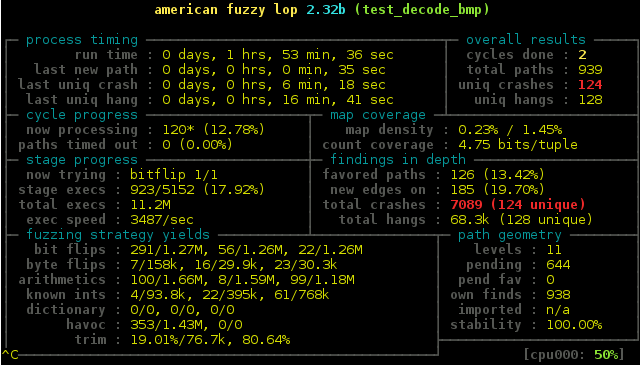
american fuzzy lop are almost as cute as cats https://commons.wikimedia.org/wiki/File:Rabbit_american_fuzzy_lop_buck_white.jpg
We already used the bitmap test suite of images to check the library decode which was giving us a good 75% or so line coverage (I long ago added coverage testing to our CI system) but I wondered if there was a test set that might increase the coverage and perhaps exercise some more of the bounds checking code. A bit of searching turned up the american fuzzy lop (AFL) projects synthetic corpora of bmp and ico images.

After checking with the AFL authors that the images were usable in our project I added them to our test corpus and discovered a whole heap of trouble. After fixing more bounds checks and signed issues I finally had a library I was pretty sure was solid with over 85% test coverage.

Then I had the idea of actually running AFL on the library. I had been avoiding this because my previous experimentation with other fuzzing utilities had been utter frustration and very poor return on investment of time. Following the quick start guide looked straightforward enough so I thought I would spend a short amount of time and maybe I would learn a useful tool.

I downloaded the AFL source and built it with a simple make which was an encouraging start. The library was compiled in debug mode with AFL instrumentation simply by changing the compiler and linker environment variables.

$ LD=afl-gcc CC=afl-gcc AFL_HARDEN=1 make VARIANT=debug test
afl-cc 2.32b by <lcamtuf@google.com>
COMPILE: src/libnsbmp.c
afl-cc 2.32b by <lcamtuf@google.com>
afl-as 2.32b by <lcamtuf@google.com>
[+] Instrumented 751 locations (64-bit, hardened mode, ratio 100%).
AR: build-x86_64-linux-gnu-x86_64-linux-gnu-debug-lib-static/libnsbmp.a
COMPILE: test/decode_bmp.c
afl-cc 2.32b by <lcamtuf@google.com>
afl-as 2.32b by <lcamtuf@google.com>
[+] Instrumented 52 locations (64-bit, hardened mode, ratio 100%).
LINK: build-x86_64-linux-gnu-x86_64-linux-gnu-debug-lib-static/test_decode_bmp
afl-cc 2.32b by <lcamtuf@google.com>
COMPILE: test/decode_ico.c
afl-cc 2.32b by <lcamtuf@google.com>
afl-as 2.32b by <lcamtuf@google.com>
[+] Instrumented 65 locations (64-bit, hardened mode, ratio 100%).
LINK: build-x86_64-linux-gnu-x86_64-linux-gnu-debug-lib-static/test_decode_ico
afl-cc 2.32b by <lcamtuf@google.com>
Test bitmap decode
Tests:606 Pass:606 Error:0
Test icon decode
Tests:392 Pass:392 Error:0
TEST: Testing complete

I stuffed the AFL build directory on the end of my PATH, created a directory for the output and ran afl-fuzz

afl-fuzz -i test/bmp -o findings_dir -- ./build-x86_64-linux-gnu-x86_64-linux-gnu-debug-lib-static/test_decode_bmp @@ /dev/null

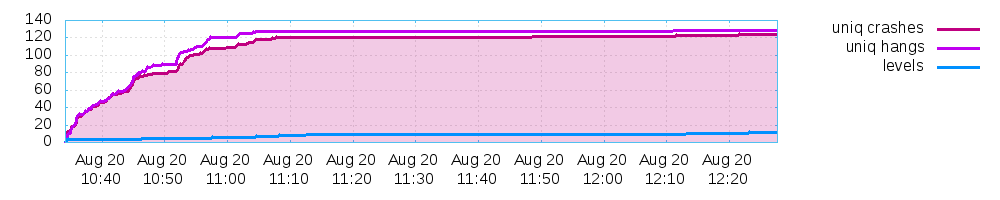
The result was immediate and not a little worrying, within seconds there were crashes and lots of them! Over the next couple of hours I watched as the unique crash total climbed into the triple digits.

I was forced to abort the run at this point as, despite clear warnings in the AFL documentation of the demands of the tool, my laptop was clearly not cut out to do this kind of work and had become distressingly hot.

AFL has a visualisation tool so you can see what kind of progress it is making which produced a graph that showed just how fast it managed to produce crashes and how much the return plateaus after just a few cycles. Although it was finding a new unique crash every ten minutes or so when aborted.

I dove in to analyse the crashes and it immediately became obvious the main issue was caused when the test tool attempted allocations of absurdly large bitmaps. The browser itself uses a heuristic to determine the maximum image size based on used memory and several other values. I simply applied an upper bound of 48 megabytes per decoded image which fits easily within the fuzzers default heap limit of 50 megabytes.

The main source of "hangs" also came from large allocations so once the test was fixed afl-fuzz was re-run with a timeout parameter set to 100ms. This time after several minutes no crashes and only a single hang were found which came as a great relief, at which point my laptop had a hard shutdown due to thermal event!

Once the laptop cooled down I spooled up a more appropriate system to perform this kind of work a 24way 2.1GHz Xeon system. A Debian Jessie guest vm with 20 processors and 20 gigabytes of memory was created and the build replicated and instrumented.

AFL master node display
To fully utilise this system the next test run would utilise AFL in parallel mode. In this mode there is a single "master" running all the deterministic checks and many "secondary" instances performing random tweaks.

If I have one tiny annoyance with AFL, it is that breeding and feeding a herd of rabbits by hand is annoying and something I would like to see a convenience utility for.

The warren was left overnight with 19 instances and by morning had generated crashes again. This time though the crashes actually appeared to be real failures.

$ afl-whatsup sync_dir/
Summary stats
=============

Fuzzers alive : 19
Total run time : 5 days, 12 hours
Total execs : 214 million
Cumulative speed : 8317 execs/sec
Pending paths : 0 faves, 542 total
Pending per fuzzer : 0 faves, 28 total (on average)
Crashes found : 554 locally unique

All the crashing test cases are available and a simple file command immediately showed that all the crashing test files had one thing in common the height of the image was -2147483648 This seemingly odd number is actually meaningful to a programmer, it is the largest negative number which can be stored in a 32bit integer (INT32_MIN) I immediately examined the source code that processes the height in the image header.

if ((width <= 0)   (height == 0))          
return BMP_DATA_ERROR;
if (height < 0)
bmp->reversed = true;
height = -height;

The bug is where the height is made a positive number and results in height being set to 0 after the existing check for zero and results in a crash later in execution. A simple fix was applied and test case added removing the crash and any possible future failure due to this.

Another AFL run has been started and after a few hours has yet to find a crash or non false positive hang so it looks like if there are any more crashes to find they are much harder to uncover.

Main lessons learned are:
I will of course be debugging any new crashes that occur and perhaps turning my sights to all the projects other unit tested libraries. I will also be investigating the generation of our own custom test corpus from AFL to replace the demo set, this will hopefully increase our unit test coverage even further.

Overall this has been my first successful use of a fuzzing tool and a very positive experience. I would wholeheartedly recommend using AFL to find errors and perhaps even integrate as part of a CI system.

Zlatan Todori : When you wake up with a feeling

I woke up at 5am. Somehow made myself to soon go back to sleep again. Woke up at 6am. Such is the life of jet-lag. Or I am just getting old for it. But the truth wouldn't be complete with only those assertion. I woke inspired and tired and the same time. Tired because I am doing very time consumable things. Also in the same time very emotional things. AND at the exact same time things that inspire me. On paper, I am technical leader of Purism. In reality, I have insanely good relations with my CEO for such a short time. So good that I for months were not leading the technical shift only, but also I overtook operations (getting orders and delivering them while working with our assembly line to automate most of the tasks in this field). I was playing also as first line of technical support (forums, IRC and email). Actually I was pretty much the only line of support for few months. I was doing some website changes: change some wording, updating bunch of plugins and making it sure all works, resolved (hopefully) Tor and Cloudflare issues for it, annoying caching system for forums, stopped forum spam and so on. I worked on better messaging for Purism public relations. I thought my team to use keys for signing and encryption. I interviewed (and read all mails) for people that were interested in working or helping Purism. In process of doing all that, I maybe wasn't the most speedy person for all our users needs but I hope they understand and forgive me. I was doing all that while I was researching and developing tablets (which ended up not being the most successful campaign but we now do have them as product). I was doing all that while seeing (and resolving) that our kernel builds were failing. Worked on pushing touchpad (not so good but we are still working on) patches upstream (and they ended being upstreamed). While seeing repos being down because of our host. Repos being down because of broken sync with Debian. Repos being down because of our key mis-management. Metadata not working well. PureBrowser getting broken all the time. Tor browser out of date. No real ISO updates. Wrong sources.list entries and so on. And the hardest part on work was, I was doing all this with very limited scope and even more limited resources. So what kept me on, what is pushing me forward and what am I doing? One philosophy - Free software. Let me not explain it as a technical debt. Let me explain it as social movement. In age, where people are "bombed" by media, by all-time lying politicians (which use fear of non-existent threats/terror as model to control population), in age where proprietary corporations are selling your freedom so you can gain temporary convenience the term Free software is like Giordano Bruno in age of Inquisitions. Free software does not only preserve your Freedom to software source usage but it preserves your Freedom to think and think out of the box and not being punished for that. It preserves the Freedom to live - to choose what and when to do, without having the negative impact on your or others people lives. The Freedom to be transparent and to share. Because not only ideas grow with sharing, but we, as human beings, grow as we share. The Freedom to say "NO". NO. I somehow learnt, and personally think, that the Freedom to say NO is the most important Freedom in our lives. No I will not obey some artificially created master that think they can plan and choose my life decision. No I will not negotiate my Freedom for your convenience (also, such Freedom is anyway not real and it is matter of time where you will be blown away by such illusion). No I will not accept your credit because it has STRINGS attached to it which you either don't present or you blur it in mountain of superficial wording. No I will not implant a chip inside me for sake of your research or my convenience. No I will not have social account on media where majority of people are. No, I will not have pacemaker which is a blackbox with proprietary (buggy) software and it harvesting my data without me being able to look at it. Yin-Yang. Yes, I want to collaborate on making world better place for us all. I don't agree with most of people, but that doesn't make them my enemies (although media would like us to feel and think like that). I will try to preserve everyones Freedom as much as I can. Yes I will share with my community and friends. Yes I want to learn from better than I am. Yes I want to have awesome mentors. Yes, I will try to be awesome mentor. Yes, I choose to care and not ignore facts and actions done by me and other people. Yes, I have the right to be imperfect and do mistakes as long as I will aknowledge and work on them. Bugfixing ourselves as humans is the most important task in our lives. As in software, it is very time consumable but also as in software, it is improvement and incredible satisfaction to see better version of yourself, getting more and more features (even if that sometimes means actually getting read of other/bad features). This all is blending with my work at Purism. I spend a lot of time thinking about projects, development and future. I must do that in order not to make grave mistakes. Failing hardware and software is not grave mistake. Serious, but not grave. Grave is if we betray ourselves and our community in pursue for Freedom. We are trying to unify many things - we want to give you security, privacy and FREEDOM with convenience. So I am pushing myself out of comfort zones and also out of conventional and sometimes even my standard way of thinking. I have seen that non-existing infrastructure for PureOS is hurting is a lot but I needed to cope with it to the time where I will be able to say: not anymore, we are starting to build our own infrastructure. I was coping with Cloudflare being assholes to Tor users but now we also shifting away from them. I came to team where people didn't properly understand what and why are we building this. Came to very small and not that efficient team. Now, we employed a dedicated and hard working person on operations (Goran) which I trust. We have dedicated support person (Mladen) which tries hard to work with people. A very creative visual mastermind (Francois). We have a capable Debian Developer (Matthias Klumpp) working on PureOS new infra. We have a capable and dedicated sysadmins (Theo and Stelio) which we didn't even have in past. We are trying to LEVEL UP Free software and unify them in convenient solution which is lead by Joey Hess. We have a hard-working PureOS developer (Hema) who is coping with current non-existent PureOS infra. We have GNOME Boards of Directors person (Jeff) who is trying to light up our image in world (working with James, to try bring some lights into our shadows caused by infinite supply chain delays). We have created Advisory Board for Freedom, Privacy and Security which I don't want to name now as we are preparing to announce soon that (and trust me, we have good people in here). But, the most important thing here is not that they are all capable or cool people. It is the core value in all of them - they care about Freedom and I trust them on their paths. The trust is always important but in Purism it is essential for our work. I built the workflow without time management (everyone spends their time every single day as they see it fit as long as the work gets done). And we don't create insane short deadlines because everyone else thinks it is important (and rarely something is more important than our time freedom). So the trust is built out of knowledge and the knowledge I have about them and their works is because we freely share with no strings attached. Because of them, and other good people from our community I have the energy to sacrifice my entire time for Purism. It is not white and black: CEO and me don't always agree, some members of my team don't always agree with me or I with them, some people in community are very rude, impolite and don't respect our work but even with disagreement everyone in Purism finds agreement at the end (we use facts in our judgments) and all the people who just try to disturb my and mine teams work aren't as efficient as all the lovely words of people who believe in us, who send us words of support and who share ideas and their thoughts with us. There is no more satisfaction for me than reading a personal mail giving us kudos for the work and their understanding of underlaying amount of work and issues. While we are limited with resources we had an occasional outcry from community to help us. Now I want to help them to help me (you see the Freedom of sharing here?). PureOS has now a wiki. It will be a community wiki which is endorsed by Purism as company. Yes you read it right, Purism considers its community part of company (you don't need to get paycheck to be Purism member). That is why a call upon contributors (technical but mostly non-technical too) to help us make PureOS wiki the best resource on net for our needs. Write tutorials for others, gather and put info on wiki, create an ideas page and vote on them so we can see what community wants to see, chat with us so we all understand what, why and how are we working on things. Make it as transparent as possible. Everyone interested please get in touch with our teams by either poking us online (IRC, social accounts) or via emails (our personal or [hr, pr, feedback]@puri.sm. To finish this writing (as it is 8am here and I still want to rest a bit because I will have meetings for 6 hours straight today) - I wanted to share some personal insight into few things from my point of view. I wanted to say despite all the troubles and people who tried to make our time even harder (and it is already hard by all the limitation which come naturally today with our kind of work), we still create products, we still ship them, we still improved step by step, we still hired and we are still building. Keeping all that together and making progress is for me a milestone greater than just creating a technical product. I just hope we will continue and improve our pace so we can start progressing towards my personal great goal - integrate and cooperate with most of FLOSS ecosystem. P.S. yes, I also (finally!) became an official Debian Developer - still didn't have time to sit and properly think and cry (as every good men) about it.

19 August 2016

Simon D saulniers: [GSOC] Final report


The Google Summer of Code is now over. It has been a great experience and I m very glad I ve been able to make it. I ve had the pleasure to contribute to a project showing very good promise for the future of communication: Ring. The words privacy and freedom in terms of technologies are being more and more present in the mind of people. All sorts of projects wanting to achieve these goals are coming to life each days like decentralized web networks (ZeroNet for e.g.), blockchain based applications, etc.

Debian I ve had the great opportunity to go to the Debian Conference 2016. I ve been introduced to the debian community and debian developpers ( dd in short :p). I was lucky to meet with great people like the president of the FSF, John Sullivan. You can have a look at my Debian conference report here. If you want to read my debian reports, you can do so by browsing the Google Summer Of Code category on this blog.

What I have done Ring is now in official debian repositories since June 30th. This is a good news for the GNU/Linux community. I m proud to say that I ve been able to contribute to debian by working on OpenDHT and developing new functionalities to reduce network traffic. The goal behind this was to finally optimize the data persistence traffic consumption on the DHT. Github repository: https://github.com/savoirfairelinux/opendht

Queries Issues:
  • #43: DHT queries
Pull requests:
  • #79: [DHT] Queries: remote values filtering
  • 93: dht: return consistent query from local storage
  • #106: [dht] rework get timings after queries in master

Value pagination Issues:
  • #71: [DHT] value pagination
Pull requests:
  • #110: dht: Value pagination using queries
  • #113: dht: value pagination fix

Indexation (feat. Nicolas Reynaud) Pull requests:
  • #77: pht: fix invalid comparison, inexact match lookup
  • #78: [PHT] Key consistency

General maintenance of OpenDHT Issues:
  • #72: Packaging issue for Python bindings with CMake: $DESTDIR not honored
  • #75: Different libraries built with Autotools and CMake
  • #87: OpenDHT does not build on armel
  • #92: [DhtScanner] doesn t compile on LLVM 7.0.2
  • #99: 0.6.2 filenames in 0.6.3
Pull requests:
  • #73: dht: consider IPv4 or IPv6 disconnected on operation done
  • #74: [packaging] support python installation with make DESTDIR=$DIR
  • #84: [dhtnode] user experience
  • #94: dht: make main store a vector>
  • #94: autotools: versionning consistent with CMake
  • #103: dht: fix sendListen loop bug
  • #106: dht: more accurate name for requested nodes count
  • #108: dht: unify bootstrapSearch and refill method using node cache

View by commits You can have a look at my work by commits just by clicking this link: https://github.com/savoirfairelinux/opendht/commits/master?author=sim590

What s left to be done

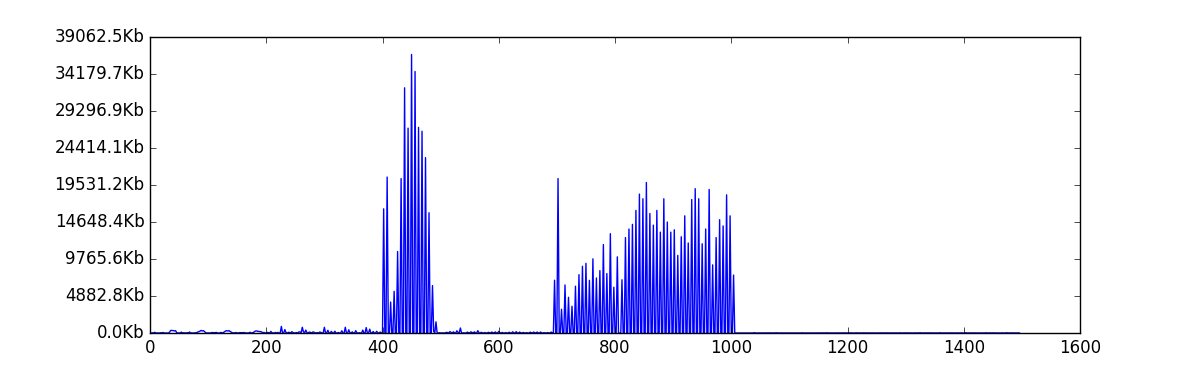
Data persistence The only thing left before achieving the totality of my work is to rigorously test the data persistence behavior to demonstrate the network traffic reduction. To do so we use our benchmark python module. We are able to analyse traffic and produce plots like this one:

Plot: 32 nodes, 1600 values with normal condition test.
This particular plot was drawn before the enhancements. We are confident to improve the results using my work produced during the GSOC.

TCP In the middle of the GSOC, we soon realized that passing from UDP to TCP would ask too much efforts in too short lapse of time. Also, it is not yet clear if we should really do that.

Olivier Gr goire: Conclusion Google Summer of Code 2016

SmartInfo project with Debian alt text 1. Me Before getting into the thick of my project, let me present myself:
I am Olivier Gr goire (Gasuleg), and I study IT engineering at cole de Technologie sup rieure in Montreal.
I am an technician in electronics, and I began object-oriented programming just last year.
I applied to GSoC because I loved the concept of the project that I would work on and I really wanted to be part of it. I also wanted to discover the word of the free software. 2. My Project During this GSoC, I worked on the Ring project. Ring is a free software for communication that allows its users to make audio or video calls, in pairs or groups, and to send messages, safely and freely, in confidence. Savoir-faire Linux and a community of contributors worldwide develop Ring. It is available on GNU/Linux, Windows, Mac OSX and Android. It can be associated with a conventional phone service or integrated with any connected object. Under this very easy to use software, there is a combination of technologies and innovations opening all kinds of perspectives to its users and developers. Ring is a free software whose code is open. Therefore, it is not the software that controls you. With Ring, you take control of your communication! Ring is an open source software under the GPL v3 license. Everyone can verify the codes and propose new ones to improve the software s performace. It is a guarantee of transparency and freedom for everyone!
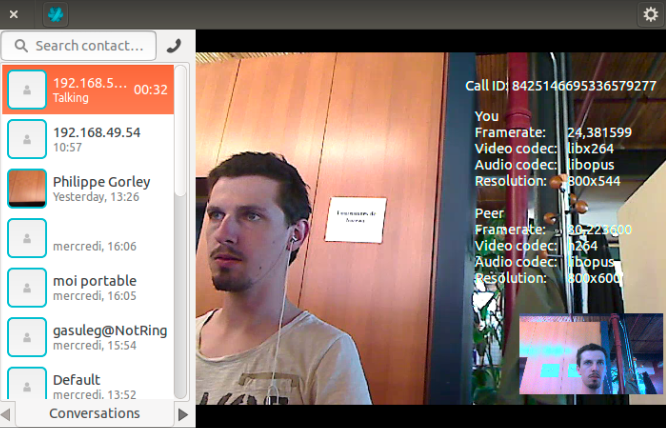
Source: ring.cx The problem is about the typical user of Ring, the one who don t use the terminal to launch Ring. He has no information about what has happened in the system. My goal is to create a tool that display statistics of Ring. 3. Quick Explanation of What My Program Can Do The Code
Here are the links to the code I was working on all throughout the Google Summer of Code (You can see what I have done after the GSoC by clicking on the newest patchs):
Patch Status
Daemon On Review
Lib Ring Client (LRC) On Review
Gnome client On review
Remove unused code Merged
!!!!!CHANGE LINK TO PUT THE LATEST PATCHES BEFORE THE END OF GSOC!!!!! What Can Be Displayed?
This is the final list of information I can display and some ideas on what information we could display in the future:
Information Details Done?
Call ID The identification number of the call Yes
Resolution Local and remote Yes
Framerate Local and remote Yes
Codec Audio and video in local and remote Yes
Bandwidth Download and upload No
Performance use CPU, GPU, RAM No
Security level In SIP call No
Connection time No
Packets lost No

To launch it you need to right click on the call and click on Show advanced information .
alt text
To stop it, same thing: right click on the call and click on Hide advanced information .
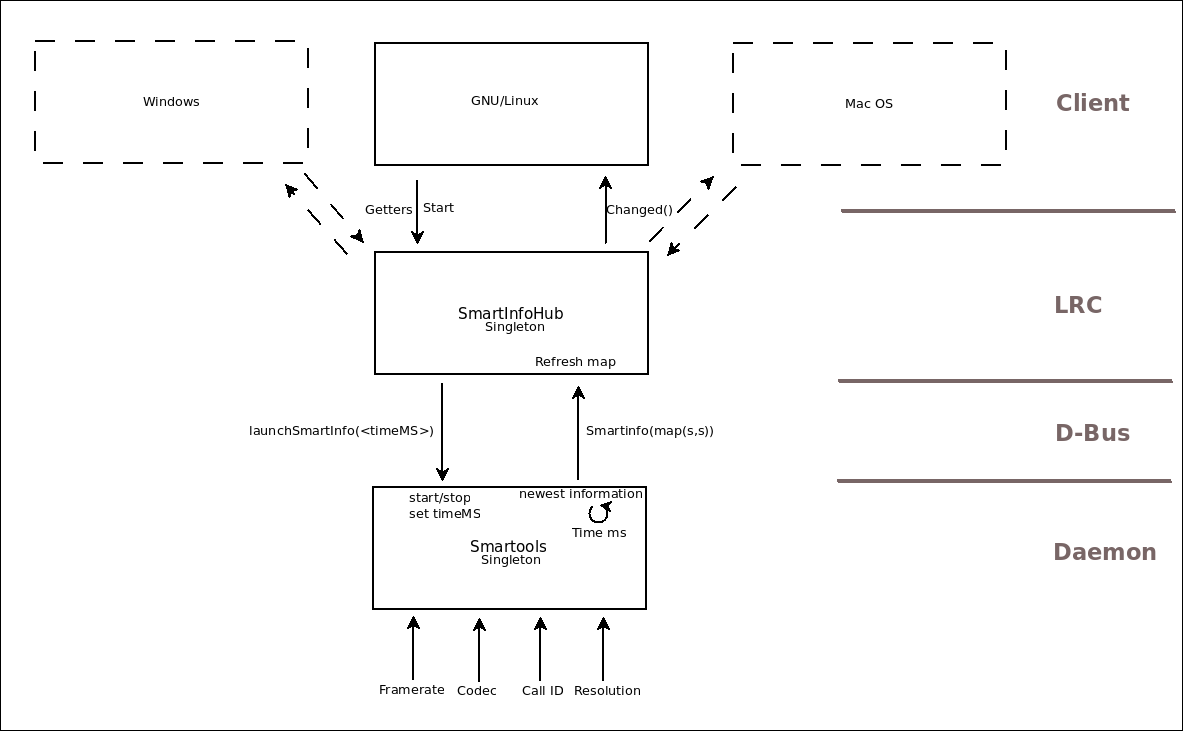
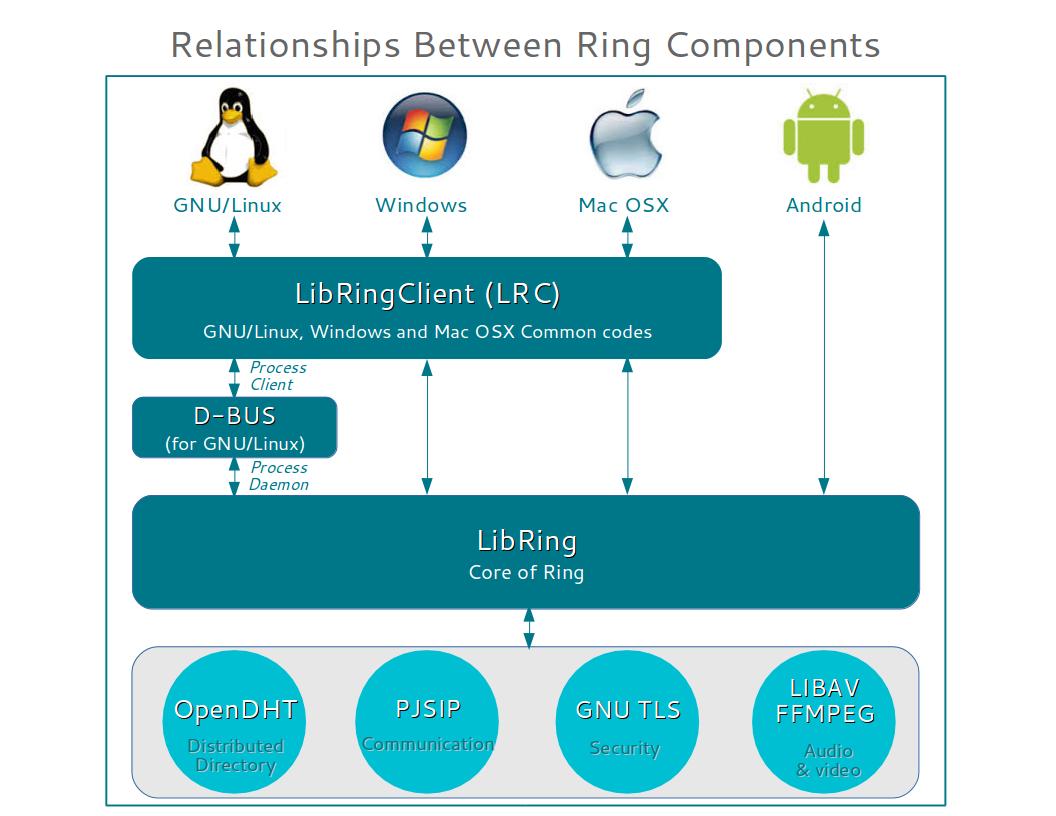
4. More Details About My Project My program needs to retrieve information from the daemon (LibRing) and then display it in gnome client. So, I needed to create a patch for the daemon, the D-Bus layer (in the daemon patch), LibRingClient and the GNU/Linux (Gnome) client.
This is what the architecture of the project looks like.
alt text
source: ring.cx And this is how I implemented my project.
alt text
5. Future of the Project 6. Thanks I would like to thank the following:
- The Google Summer of Code organisation, for this wonderful experience.
- Debian, for accepting my project proposal and letting me embark on this fantastic adventure.
- My mentor, Mr Guillaume Roguez, and all his team, for being there to help me.

Olivier Gr goire: Conclusion Google Summer of Code 2016

SmartInfo project with Debian alt text 1. Me Before getting into the thick of my project, let me present myself:
I am Olivier Gr goire (Gasuleg), and I study IT engineering at cole de Technologie sup rieure in Montreal.
I am a technician in electronics, and I began object-oriented programming just last year.
I applied to GSoC because I loved the concept of the project that I would work on and I really wanted to be part of it. I also wanted to discover the word of the free software. 2. My Project During this GSoC, I worked on the Ring project. Ring is a free software for communication that allows its users to make audio or video calls, in pairs or groups, and to send messages, safely and freely, in confidence. Savoir-faire Linux and a community of contributors worldwide develop Ring. It is available on GNU/Linux, Windows, Mac OSX and Android. It can be associated with a conventional phone service or integrated with any connected object. Under this very easy to use software, there is a combination of technologies and innovations opening all kinds of perspectives to its users and developers. Ring is a free software whose code is open. Therefore, it is not the software that controls you. With Ring, you take control of your communication! Ring is an open source software under the GPL v3 license. Everyone can verify the codes and propose new ones to improve the software s performace. It is a guarantee of transparency and freedom for everyone!
Source: ring.cx The problem is about the typical user of Ring, the one who don t use the terminal to launch Ring. He has no information about what has happened in the system. My goal is to create a tool that display statistics of Ring. 3. Quick Explanation of What My Program Can Do The Code
Here are the links to the code I was working on all throughout the Google Summer of Code (You can see what I have done after the GSoC by clicking on the newest patchs):
Patch Status
Daemon Merged
Lib Ring Client (LRC) On Review
Gnome client On Review
Remove unused code Merged

What Can Be Displayed?
This is the final list of information I can display and some ideas on what information we could display in the future:
Information Details Done?
Call ID The identification number of the call Yes
Resolution Local and remote Yes
Framerate Local and remote Yes
Codec Audio and video in local and remote Yes
Bandwidth Download and upload No
Performance use CPU, GPU, RAM No
Security level In SIP call No
Connection time No
Packets lost No

To launch it you need to right click on the call and click on Show advanced information .
alt text
To stop it, same thing: right click on the call and click on Hide advanced information .
4. More Details About My Project My program needs to retrieve information from the daemon (LibRing) and then display it in gnome client. So, I needed to create a patch for the daemon, the D-Bus layer (in the daemon patch), LibRingClient and the GNU/Linux (Gnome) client.
This is what the architecture of the project looks like.
alt text
source: ring.cx And this is how I implemented my project.
alt text
5. Future of the Project Weekly report link Thanks I would like to thank the following:
- The Google Summer of Code organisation, for this wonderful experience.
- Debian, for accepting my project proposal and letting me embark on this fantastic adventure.
- My mentor, Mr Guillaume Roguez, and all his team, for being there to help me.

Zlatan Todori : Defcon24

I went to Defcon24 as Purism representative. It was (as usual) held in Las Vegas, the city of sin. In the same module as with DebConf, here we go with good, bad and ugly. Good Badges are really cool. You can find good hackers here and there (but very small number compared to total number). Some talks are good and workshop + village idea looks good (although I didn't manage to attend any workshop as there was place for 1100 and there were 22000 attendees). The movie night idea is cool and Arcade space (where you can play old arcade games, relax and hack and also listen to some cool music) is really lovely. Also you have a camp/village for kids learning things such as electronics, soldering etc but you need to pay attention that they don't see too much of twisted folks that also gather on this con. And that's it. Oh, yea, Dark Tangent appears actually to be cool dude. Bad One does not simply hold a so-called hacker conference in Las Vegas. Having a conference inside hotel/casino where you mix with gamblers and casino workes (for good or for bad) is simply not in hacker spirit and certainly brings all kind of people to the same place. Also, there were simply not enough space for 22000 Defcon attendees, and you don't get proud of having on average ONLY 40min lines. You get proud if you don't have lines! Organization is not the strongest part of Defcon. Huge majority of attendees are not hackers. They are script kiddies, hacker wannabes, comic con people, few totally lost souls etc etc. That simply brings the quality of a conference down. Yes it is cool to have mix of many diverse people but not for the sake of just having people. Ugly They lack Code of Conduct (everyone knows I am not in favor of any writens rules how people should behave but after Defcon I clearly see need for it). Actually, tbh, they do have it but no one gives a damn about it. And you should report to Goons, more about them below. Sexism is huge here. I remember and hear about stories of sexual harassment in IT industry, but Debian somehow mitigated that before me entering its domains, so I never experienced it. The sheer number of sexist behavior on Defcon is tremendous. It appears to me that those people had lonely childhood and now they act as a spoiled 6 year old: they're spoiled, they need to yell to show their point, they have low and stupid sexist jokes and they simply think that is cool. Majority of Goons (their coordinators or whatever) are simply idiots. I don't know do they feel they have some superpowers, or are drunk or just stupid but yelling on people, throwing low jokes on people, more yelling, cursing all the time, more yelling - simply doesn't work for me. So now you can see the irony of CoC on Defcon. They even like to say, hey we are old farts, let us our con be as we want it to be. So no real diversity there. Either it is their way, and god forsaken if you try to change something for better and make them stop cursing or throwing sexist jokes ("squeeze, people. together, touch each other, trust me it will feel good"), or highway. Also it appears that to huge number of vocal people, word "fuck" has some fetish meaning. Either it needs to show how "fucking awesome this con or they are" or to "fucking tell few things about random fucking stuff". Thank you, but no thank you. So what did I do during con. I attended few talks, had some discussion with people, went to one party (great DJs, again people doing stupid things, like breaking invertory to name just one of them) and had so much time (read "I was bored") that I bought domain, brough up server on which I configured nginx and cp'ed this blog to blog.zlatan.tech (yes, recently I added letsencrypt because it is, let me be in Defcon mood, FUCKING AWESOME GRRR UGH) and now I even made .onion domain for it. What can boredom do to people, right? So the ultimate question is - would I go again to Defcon. I am strongly leaning to no, but in my nature is to give second chance and now I have more experience (and I also have thick skin so I guess I can play calm for one more round).

18 August 2016

Zlatan Todori : DebConf16 - new age in Debian community gathering

DebConf16 Finally got some time to write this blog post. DebConf for me is always something special, a family gathering of weird combination of geeks (or is weird a default geek state?). To be honest, I finally can compare Debian as hacker conference to other so-called hacker conferences. With that hat on, I can say that Debian is by far the most organized and highest quality conference. Maybe I am biased, but I don't care too much about that. I simply love Debian and that is no secret. So lets dive into my view on DebConf16 which was held in Cape Town, South Africa. Cape Town This was the first time we had conference on African continent (and I now see for the first time DebConf bid for Asia, which leaves only Australia and beautiful Pacific islands to start a bid). Cape Town by itself, is pretty much Europe-like city. That was kinda a bum for me on first day, especially as we were hosted at University of Cape Town (which is quite beautiful uni) and the surrounding neighborhood was very European. Almost right after the first day I was fine because I started exploring the huge city. Cape Town is really huge, it has by stats ~4mil people, and unofficially it has ~6mil. Certainly a lot to explore and I hope one day to be back there (I actually hope as soon as possible). The good, bad and ugly I will start with bad and ugly as I want to finish with good notes. Racism down there is still HUGE. You don't have signs on the road saying that, but there is clearly separation between white and black people. The houses near uni all had fences on walls (most of them even electrical ones with sharp blades on it) with bars on windows. That just bring tensions and certainly doesn't improve anything. To be honest, if someone wants to break in they still can do easily so the fences maybe need to bring intimidation but they actually only bring tension (my personal view). Also many houses have sign of Armed Force Response (something in those lines) where in case someone would start breaking in, armed forces would come to protect the home. Also compared to workforce, white appear to hold most of profit/big business positions and fields, while black are street workers, bar workers etc etc. On the street you can feel from time to time the tension between people. Going out to bars also showed the separation - they were either almost exclusively white or exclusively black. Very sad state to see. Sharing love and mixing is something that pushes us forward and here I saw clear blockades for such things. The bad part of Cape Town is, and this is not only special to Cape Town but to almost all major cities, is that small crime is on wide scale. Pickpocketing here is something you must pay attention to it. To me, personally, nothing happened but I heard a lot of stories from my friends on whom were such activities attempted (although I am not sure did the criminals succeed). Enough of bad as my blog post will not change this and it is a topic for debate and active involvement which I can't unfortunately do at this moment. THE GOOD! There are so many great local people I met! As I mentioned, I want to visit that city again and again and again. If you don't fear of those bad things, this city has great local cuisine, a lot of great people, awesome art soul and they dance with heart (I guess when you live in rough times, you try to use free time at your best). There were difference between white and black bars/clubs - white were almost like standard European, a lot of drinking and not much dancing, and black were a lot of dancing and not much drinking (maybe the economical power has something to do with it but I certainly felt more love in black bars). Cape Town has awesome mountain, the Table Mountain. I went on hiking with my friends, and I must say (again to myself) - do the damn hiking as much as possible. After every hike I feel so inspired, that I will start thinking that I hate myself for not doing it more often! The view from Table mountain is just majestic (you can even see the Cape of Good Hope). The WOW moments are just firing up in you. Now lets transfer to DebConf itself. As always, organization was on quite high level. I loved the badge design, it had a map and nice amount of information on it. The place we stayed was kinda not that good but if you take it into account that those a old student dorms (in we all were in female student dorm :D ) it is pretty fancy by its own account. Talks were near which is always good. The general layout of talks and front desk position was perfect in my opinion. All in one place basically. Wine and Cheese this year was kinda funny story because of the cheese restrictions but Cheese cabal managed to pull out things. It was actually very well organized. Met some new people during the party/ceremony which always makes me grow as a person. Cultural mix on DebConf is just fantastic. Not only you learn a lot about Debian, hacking on it, but sheer cultural diversity makes this small con such a vibrant place and home to a lot. Debian Dinner happened in Aquarium were I had nice dinner and chat with my old friends. Aquarium by itself is a thing where you can visit and see a lot of strange creatures that live on this third rock from Sun. Speaking of old friends - I love that I Apollo again rejoined us (by missing the DebConf15), seeing Joel again (and he finally visited Banja Luka as aftermath!), mbiebl, ah, moray, Milan, santiago and tons of others. Of course we always miss a few such as zack and vorlon this year (but they had pretty okay-ish reasons I would say). Speaking of new friends, I made few local friends which makes me happy and at least one Indian/Hindu friend. Why did I mention this separately - well we had an accident during Group Photo (btw, where is our Lithuanian, German based nowdays, photographer?!) where 3 laptops of our GSoC students were stolen :( . I was luckily enough to, on behalf of Purism, donate Librem11 prototype to one of them, which ended up being the Indian friend. She is working on real time communications which is of interest also to Purism for our future projects. Regarding Debian Day Trip, Joel and me opted out and we went on our own adventure through Cape Town in pursue of meeting and talking to local people, finding out interesting things which proved to be a great decision. We found about their first Thursday of month festival and we found about Mama Africa restaurant. That restaurant is going into special memories (me playing drums with local band must always be a special memory, right?!). Huh, to be honest writing about DebConf would probably need a book by itself and I always try to keep my posts as short as possible so I will try to stop here (maybe I write few bits in future more about it but hardly). Now the notes. Although I saw the racial segregation, I also saw the hope. These things need time. I come from country that is torn apart in nationalism and religious hate so I understand this issues is hard and deep on so many levels. While the tensions are high, I see people try to talk about it, try to find solution and I feel it is slowly transforming into open society, where we will realize that there is only one race on this planet and it is called - HUMAN RACE. We are all earthlings, and as sooner we realize that, sooner we will be on path to really build society up and not fake things that actually are enslaving our minds. I just want in the end to say thank you DebConf, thank you Debian and everyone could learn from this community as a model (which can be improved!) for future societies.

17 August 2016

Rapha&#235;l Hertzog: My Free Software Activities in July 2016

My monthly report covers a large part of what I have been doing in the free software world. I write it for my donators (thanks to them!) but also for the wider Debian community because it can give ideas to newcomers and it s one of the best ways to find volunteers to work with me on projects that matter to me. DebConf 16 I was in South Africa for the whole week of DebConf 16 and gave 3 talks/BoF. You can find the slides and the videos in the links of their corresponding page: I was a bit nervous about the third BoF (on using Debian money to fund Debian projects) but discussed with many persons during the week and it looks like the project evolved quite a bit in the last 10 years and while it s still a sensitive topic (and rightfully so given the possible impacts) people are willing to discuss the issues and to experiment. You can have a look at the gobby notes that resulted from the live discussion. I spent most of the time discussing with people and I did not do much technical work besides trying (and failing) to fix accessibility issues with tracker.debian.org (help from knowledgeable people is welcome, see #830213). Debian Packaging I uploaded a new version of zim to fix a reproducibility issue (and forwarded the patch upstream). I uploaded Django 1.8.14 to jessie-backports and had to fix a failing test (pull request). I uploaded python-django-jsonfield 1.0.1 a new upstream version integrating the patches I prepared in June. I managed the (small) ftplib library transition. I prepared the new version in experimental, ensured reverse build dependencies do still build and coordinated the transition with the release team. This was all triggered by a reproducible build bug that I got and that made me look at the package last time upstream had disappeared (upstream URL was even gone) but it looks like he became active again and he pushed a new release. I filed wishlist bug #832053 to request a new deblog command in devscripts. It should make it easier to display current and former build logs. Kali related Debian work I worked on many issues that were affecting Kali (and Debian Testing) users: Thanks See you next month for a new summary of my activities.

3 comments Liked this article? Click here. My blog is Flattr-enabled.

16 August 2016

Lars Wirzenius: 20 years ago I became a Debian developer

Today it is 23 years ago since Ian Murdock published his intention to develop a new Linux distribution, Debian. It also about 20 years since I became a Debian developer and made my first package upload. In the time since: It's been a good twenty years. And the fun ain't over yet.

15 August 2016

Russ Allbery: Review: Winds of Fate

Review: Winds of Fate, by Mercedes Lackey
Series: Mage Winds #1
Publisher: DAW
Copyright: 1991
Printing: July 1992
ISBN: 0-88677-516-7
Format: Mass market
Pages: 460
As a kid working my way through nearly everything in the children's section of the library, I always loved book series, since it meant I could find a lot more of something I liked. But children's book series tended to be linear, with a well-defined order. When I moved into the adult SF section, I encountered a new type of series: one that moves backwards and forwards in time to fill in a broader story. I mention that here because Winds of Fate, although well into the linked series that make up Valdemar, was one of the first Valdemar books I read. (I think it was the first, but my memory is hazy.) Therefore, in my brain, this is where the story of Valdemar "begins": with Elspeth, a country that has other abilities but has forgotten about magic, a rich world full of various approaches to magic, and very pushy magic horses. Talia's story, and particularly Vanyel's, were always backstory, the events that laid the groundwork for Elspeth's story. (I didn't encounter Tarma and Kethry until somewhat later.) Read now in context, this is obviously not the case. The Mage Winds trilogy, of which this is the first book, are clearly sequels to the Arrows of the Queen trilogy. Valdemar was victorious in the first round of war with Ancar, but the Heralds have slowly (and with great difficulty) become aware of their weakness against magic and their surprising lack of it. Elspeth has grown into the role of heir, but she's also one of the few who find it easy to talk about and think about magic (perhaps due to her long association with Kerowyn, who came into Valdemar from the outside world in By the Sword). She therefore takes on the mission of finding an Adept who can return to Valdemar, solve the mystery of whatever is keeping magic out of the kingdom, and start training mages for the kingdom again. Meanwhile, we get the first viewpoint character from the Tayledras: the elf-inspired mages who work to cleanse the Pelagiris forests from magic left over from a long-ago war. They appeared briefly in Vanyel's story, since his aunt was friends with a farther-north tribe of them and Valdemar of the time had contact with mages. Darkwind and his people are far to the south, up against the rim of the Dhorisha crater. Something has gone horribly wrong with Heartstone of the k'Sheyna, his tribe: it cracked when being drained, killing most of the experienced mages including Darkwind's mother, and now it is subtly wrong, twisting and undermining the normal flow of magic inside their Vale. In the aftermath of that catastrophe, Darkwind has forsworn magic and become a scout, putting him sharply at odds with his father. And it's a matter of time before less savory magic users in the area realize how vulnerable k'Sheyna is. Up to this point in the Valdemar series, Lackey primarily did localized world-building to support the stories and characters she was writing about. Valdemar and its Heralds and Companions have been one of the few shared elements, and only rarely did the external magic-using world encounter them. Here, we get the first extended contact between the fairly naive Heralds and experienced mages who understand how they and their Companions fit into the broader system of magic. We also finally get the origin of the Dhorisha Plains and the Tayledras and Shin'a'in, and a much better sense of the broader history of this world. And Need, which started as Kethry's soul-bonded sword and then became Kerowyn's, joins the story in a much more active way. The world-building is a definite feature if you like this sort of thing. It doesn't withstand too much thinking about the typical sword and sorcery lack of technology, but for retroactive coherence constructed from originally scattered stories, it's pretty fun. (I suspect part of why I like the Valdemar world-building is that it feels a lot like large shared universe world-building in comics.) And Need is the high point of the story: she brings a much-needed cynical stubbornness to the cast and is my favorite character in this book. What is not a feature, unfortunately, is the characterization. Darkwind is okay but a largely unremarkable here, more another instance of the troubled but ethical Tayledras type than a clearly defined character. But Elspeth is just infuriating, repeatedly making decisions and taking hard positions that seem entirely unwarranted by the recorded events of the book. This is made worse by how frequently she's shown to be correct in ways that seem like authorial cheating. At times, it feels like she's the heroine by authorial fiat, not because she's doing a particularly good job. I can muster some sympathy for not wanting to follow the plan of the Companions when it became clear they were acting entirely out of character and actively intervening, but she expresses that with petulant, childish insistence rather than reasoned argument. And she suddenly decides Skif is in love with her and treating her like a fragile princess on the basis of absolutely no action that occurs on camera in this book so far as I can tell, and proceeds to treat him like dirt for large sections of the book. That Skif then lives down to this suddenly negative impression doesn't help. This book also has quite a lot of the U-shaped story arc in which everything gets worse and more horrific and more hopeless for the heroes over the course of the book until it turns into torture, and only then do they manage to claw their way back out. I've come to dislike this way of building tension. It's undeniably effective, but the parts of the story near the bottom of the U are difficult and painful reading. I prefer a bit more evenly-spread hurt/comfort storytelling in my popcorn fantasy reading. Winds of Fate is, sadly, not a very good book. Most of the characterization is intensely irritating, the writing is a bit uneven, and the middle section of the book is rather painful to read. For me, though, that's balanced by the world-building and the sense of broadened scope, by Need's abrasive decisiveness, and by some really entertaining reactions to the combination of Elspeth, Need, and her Companion walking naive into the broader world. I still have a fond spot in my heart for it, but I'm hoping the remaining books of the trilogy are better. Rating: 6 out of 10

Next.

Previous.