Leo 'costela' Antunes: Yeah, about that
 I was trying not to complain about it, but now that the number of people asking me about it is getting bigger, my frustration got the best of me.
 So unfortunately I won t see you all there.
I was trying not to complain about it, but now that the number of people asking me about it is getting bigger, my frustration got the best of me.
So unfortunately I won t see you all there.
 Nobody cares about me, I thought. Whatever I say is just like throwing a bottle to the infinite ocean.
No comments, no hopes of getting any, for several days. Weeks maybe? Not even the spammers cared about me.
Until I read this mail, by Thijs Kinkhorst commenting to my yesterday post:
( )And, yes, Drupal module captcha introduced in its 2.1 release (January 2) feature #571344: Mix multiple fonts. Only... no fonts were selected. Grah.
(BTW, I was unable to comment on your blog - couldn't even read one letter of the CAPTCHA...)
 Kiwis have to be one of the cutest birds of all time. A bit chubby and clumsy looking, they are (to me, at least), walking, breathing icon of furry cuteness.
 New guidelines for periodic publications' websites at my University favor the different journals we have to use a standardized system And it makes quite a bit of sense. It is quite hard to explain to the people I work with that the content is not only meant to be consumed by humans, but also by other systems; the reasons behind rich content tagging and deep hierarchies for what they would just see as a list of words (think list of authors for an article, list of keywords, and so on). After all, aggregator databases such as Latindex and SciELO have achieved getting this understanding through.
And I must be quite grateful, as the University's guidelines point to what appears to be a very well-thought and thorough system, the Open Journal Systems by the Public Knowledge Project, co-funded by several well-regarded universities. OJS is a GPL-2-covered PHP bundle.
Anyway I am very glad at least one of my Institute's journal accepted the challenge and decided to go OJS. I know I will quite probably be administering this system long-term. And, being as snobbish as I am, I know I loathe anything installed in my machines that is not either developed by myself or comes in a Debian package. So, as it was not packaged, I made the package
Note that I am still not filing an ITP (which means, I have not yet decided whether I will upload this to Debian) because I want first to make sure I do have the needed long-term commitment Besides, I am by far not a PHP person, and being responsible for a package Carries a nontrivial weight. Still, you might be interested in getting it. If you are interested, you can either download the .deb package or add it to your apt repositories (and stay updated with any new releases), by adding this to your /etc/apt/sources.list:
deb http://www.iiec.unam.mx/apt/ lenny misc

deb-src http://www.iiec.unam.mx/apt/ lenny misc
Note: My packaging has still a small bug: The installer fails to create the PostgreSQL database. The MySQL database works fine. I will look into it soon
So far, I am quite impressed with this program's functionality and the depth/quality of its (online) documentation. Besides, its usage statistics speak for themselves:
 So, it is quite possible I will be uploading this into Debian in a couple of weeks (hopefully in time to be considered for Squeeze). The reasons I am making it available in my personal repository now is:
 Of course, one would expect me to react to this
post.
Apparently, from my cumulated experience, joking about funny
translations is a very widespread game among german-speaking
developers (of course, as everybody knows, us French do translate
everissing and no single Frainche DiDi will make such fun abaouttel10n
wouhorke, aha).
I'd say: more generally widespread among people .who jargonize about computing so often in their daily
work that they often forget that not everybody, even in a country
where people are as clever about English as German/Austrian/Swiss
folks are (we all know that 100% population in these places speak a
very perfect English) do understand what "downgrade" means.
Seriously, "funny" translations are our (translators) daily nightmare.
We hate them because we know people hate us (or make jokes about our
work) when they face them.
The example taken by Patrick is a nice case as "downgrade" is tricky for
all of us. For instance, French translators have chosen "revenir la
version pr c dente" as "bring back to former version". This is about
the only "right" way to say what's being done ("d grader" is another
option but that has a negative connotation). Of course, I often
*hear* people (incl. me) say "downgrader" which is an horrible
neologism....and of course doesn't say anything to people who are
clueless in English.
English is, unfortunately, often a very compact language. This is our
daily pain.
So, as German translation of "to downgrade", what do *you* propose,
Patrick? "Downgradieren"?
Tricky, eh? Taken from APT for "downgrade":

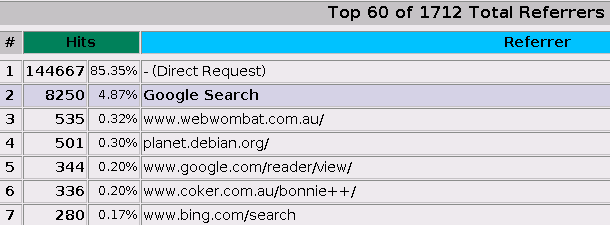 Above are sections of my Webalizer output related to my blog which show the data transfer use of search.msn.com (Bing presumably) which is 50% greater than that of Google and Yahoo combined. Why does MSN need to do 455MB of transfer so far this month to scan my blog when Google gets the job done with 189M and Yahoo only takes 109M? Also judging by the referrals Bing is only 3% as much use to me as Google.
 Above is a sample of the Webalizer output from www.coker.com.au, MSN is using 525MB of data to scan the site which contains about 1.2G of static files that change very rarely. A Russian malware site seems to be downloading it three times a month, and Google only takes 35MB of data transfer to scan the site (which is probably still excessive).
If Bing was a quality search engine that returned appropriate results then this could be forgiven. But however it is a very poor search engine that returns bad results. For example if you query Google or Yahoo for bonnie++ you will get an entire page of search results concerning my Bonnie++ benchmark, and those results are ordered in a sensible way. If you ask Bing then the first four results concern Bonnie (three women and a plant) and most of the first page don t concern my benchmark.
Some time ago I had blocked MSN from scanning a server that I ran. The server in question had all the web servers for my domain plus quite a few other small domains. The total MSN data transfer was 3G per month which was almost half the data allowance for the server in question (data plans in Australia suck that s why my web servers are hosted in Germany now), so it was a question of whether to allow normal operation of the business or MSN searches. With Microsoft not running a popular search engine (then or now) it was an easy decision.
I think that anyone who accepts money from Microsoft/Bing is doing their users a mis-service. Bing is simply an inferior search engine, it gets bad results and imposes excessive costs on service providers. Yahoo however seems to be a reasonable service, not as good as Google for the web hosters but not too bad.
I wonder what would happen if Yahoo offered some sponsorship money to the Debian project in exchange for being the default search engine. I m sure it would be dramatic.
 So, a while back, Google started providing location services. This seemed pretty cool, but I kind of ignored it until recently when I was playing with my Android s location API. With the GPS off, and no cell towers visible (my basement gets terrible cell service), my phone knew within about 500 feet of where it actually was. All I was connected to was my wifi.
Bottom line: it seems that Google, among other methods, is likely wardriving while photographing for Street View. They are now able to pinpoint wifi access points if they happened to see it while driving through your city.
I m really rather astonished that no one is freaking out about this; I m a bit unnerved. I implemented the location-of-your-wifi API quickly, so I could terrify myself further. You can do lookups via my location website too, if you want.
UPDATE: yeah, it would seem to be crowd-sourced wifi and cell tower triangulation data. I should say Google is WarCrowding .
 This is the story of a weirdly unfriendly/non-compliant IMAP server, and some nice interactions that arose from a debugging session around it. Over the holidays, i got to do some computer/network debugging for friends and family. One old friend (I'll call him
Fred) had a series of problems i managed to help work through, but was ultimately basically stumped based on the weird behavior of an IMAP server. Here's the details (names of the innocent and guilty have been changed), just in case it helps other folks in at least diagnosing similar situations. the diagnosis The initial symptom was that Fred's computer was "very slow". Sadly, this was a Windows machine, so my list of tricks for diagnosing sluggishness is limited. I went through a series of questions, uninstalling things, etc, until we figured it would be better to just have him do his usual work while i watched, kibitzing on what seemed acceptable and what seemed slow. Quite soon, we hit a very specific failure: Fred's Thunderbird installation (version 2, FWIW) was sometimes hanging for a very long period of time during message retrieval. This was not exhaustion of the CPU, disk, RAM, or other local resource. It was pure network delay, and it was a frequent (if unpredictable) frustrating hiccup in his workflow. One thought i had was Thunderbird's per-server max_cached_connections setting, which can sometimes cause a TB instance to hang if a remote server thinks Thunderbird is being too aggressive. After sorting out why Thunderbird was resetting the values after we'd set them to 0 (grr, thanks for the confusing UI, folks!), we set it to 1, but still had the same occasional, lengthy (about 2 minutes) hang when transfering messages between folders (including the trash folder!), or when reading new messages. Sending mail was quite fast, except for occasional (similarly lengthy) hangs writing the copy to the sent folder. So IMAP was the problem (not SMTP), and the 2-minute timeouts smelled like an issue with the networking layer to me. At this point, i busted out wireshark, the trusty packet sniffer, which fortunately works as well on Windows as it does on GNU/Linux. Since Fred was doing his IMAP traffic in the clear, i could actually see when and where in the IMAP session the hang was happening. (BTW, Fred's IMAP traffic is no longer in the clear: after all this happened, i switched him to IMAPS (IMAP wrapped in a TLS session), because although the IMAP server in question actually supports the STARTTLS directive, it fails to advertise it in response to the CAPABILITIES query, so Thunderbird refuses to try it. arrgh.) The basic sequence of Thunderbird's side of an initial IMAP conversation (using plain authentication, anyway) looks something like this:
1 capability
2 login "user" "pass"
3 lsub "" "*"
4 list "" "INBOX"
5 select "INBOX"
6 UID fetch 1:* (FLAGS)
What i found with this server was that if i issued commands 1 through 5, and then left the connection idle for over 5 minutes, then the next command (even if it was just a 6 NOOP or 6 LOGOUT) would cause the IMAP server to issue a TCP reset. No IMAP error message or anything, just a failure at the TCP level. But a nice, fast, responsive failure -- any IMAP client could recover nicely from that by just immediately opening a new connection. I don't mind busy servers killing inactive connections after a reasonable timeout. If it was just this, though, Thunderbird should have continued to be responsive. the deep weirdness But if i issued commands 1 through 6 in rapid succession (the only difference is that extra 6 UID fetch 1:* (FLAGS) command), and then let the connection idle for 5 minutes, then sent the next command: no response of any kind would come from the remote server (not even a TCP ACK or TCP RST). In this circumstance, my client OS's TCP stack would re-send the data repeatedly (staggered at appropriate intervals), until finally the client-side TCP timeout would trigger, and the OS would report the failure to the app, which could turn around and do a simple connection restart to finish up the desired operation. This was the underlying situation causing Fred's Thunderbird client to hang. In both cases above (with or without the 6th command), the magic window for the idle cutoff was a little more than 300 seconds (5 minutes) of idleness. If the client issued a NOOP at 4 minutes, 45 seconds from the last NOOP, it could keep a connection active indefinitely. Furthermore, i could replicate the exact same behavior when i used IMAPS -- the state of the IMAP session itself was somehow modifying the TCP session behavior characteristics, whether it was wrapped in a TLS tunnel or not. One interesting thing about this set of data is that it rules out most common problems in the network connectivity between the two machines. Since none of the hops between the two endpoints know anything about the IMAP state (especially under TLS), and some of the failures are reported properly (e.g. the TCP RST in the 5-command scenario), it's probably safe to say that the various routers, NAT devices, and such were not themselves responsible for the failures. So what's going on on that IMAP server? The service itself does not announce the flavor of IMAP server, though it does respond to a successful login with
You are so in, and to a logout with
IMAP server logging out, mate. A bit of digging on the 'net suggests that they are running a perdition IMAP proxy. (clearly written by an Aussie, mate!) But why does it not advertise its STARTTLS capability, even though it is capable? And why do some idle connections end up timing out without so much as an RST, when other idle connections give at least a clean break at the TCP level? Is there something about issuing the UID command that causes perdition to hand off the connection to some other service, which in turn doesn't do proper TCP error handling? I don't really know anything about the internals of perdition, so i'm just guessing here. the workaround I ultimately recommended to Fred to reduce the number of cached connections to 1, and to set Thunderbird's interval to check for new mail down to 4 minutes. Hopefully, this will keep his one connection active enough that nothing will timeout, and will keep the interference to his workflow to a minimum. It's an unsatisfactory solution to me, because the behavior of the remote server still seems so non-standard. However, i don't have any sort of control over the remote server, so there's not too much i can do to provide a real fix (other than point the server admins (and perdition developers?) at this writeup). I don't even know the types of backend server that their perdition proxy is balancing between, so i'm pretty lost for better diagnostics even, let alone a real resolution. some notes I couldn't have figured out the exact details listed above just using Thunderbird on Windows. Fortunately, i had a machine with a decent OS available, and was able to cobble together a fake IMAP client from a couple files (imapstart contained the lines above, and imapfinish contained 8 LOGOUT), bash, and socat. Here's the bash snippet i used as a fake IMAP client:
spoolout()   while read foo; do sleep 1 && printf "%s\r\n" "$foo" ; done
( sleep 2 && spoolout < imapstart && sleep 4 && spoolout < imapfinish && sleep 500 )   socat STDIO TCP4:imap.fubar.example.net:143
To do the test under IMAPS, i just replaced TCP4:imap.fubar.example.net:143 with OPENSSL:imap.fubar.example.net:993. And of course, i had wireshark handy on the GNU/Linux machine as well, so i could analyze the generated packets over there. One thing to note about user empowerment: Fred isn't a tech geek, but he can be curious about the technology he relies on if the situation is right. He was with me through the whole process, didn't get antsy, and never tried to get me to "just fix it" while he did something else. I like that, and wish i got to have that kind of interaction more (though i certainly don't begrudge people the time if they do need to get other things done). I was nervous about breaking out wireshark and scaring him off with it, but it turned out it actually was a good conversation starter about what was actually happening on the network, and how IP and TCP traffic worked. Giving a crash course like that in a quarter of an hour, i can't expect him to retain any concrete specifics, of course. But i think the process was useful in de-mystifying how computers talk to each other somewhat. It's not magic, there are just a lot of finicky pieces that need to fit together a certain way. And Wireshark turned out to be a really nice window into that process, especially when it displays packets during a real-time capture. I usually prefer to do packet captures with tcpdump and analyze them as a non-privileged user afterward for security reasons. But in this case, i felt the positives of user engagement (how often do you get to show someone how their machine actually works?) far outweighed the risks. As an added bonus, it also helped Fred really understand what i meant when i said that it was a bad idea to use IMAP in the clear. He could actually see his username and password in the network traffic! This might be worth keeping in mind as an idea for a demonstration for workshops or hacklabs for folks who are curious about networking -- do a live packet capture of the local network, project it, and just start asking questions about it. Wireshark contains such a wealth of obscure packet dissectors (and today's heterogenous public/open networks are so remarkably chatty and filled with weird stuff) that you're bound to run into things that most (or all!) people in the room don't know about, so it could be a good learning activity for groups of all skill levels. Tags: debugging, imap, perdition, wireshark
 Yesterday we went back to Stanford for another ultrasound and a fetal MRI.
We had pretty much the same gang doing the ultrasound as two weeks ago, so
that was a nice bit of continuity. A paediatric
radiologist came in at the end to take a look. She was the most
confident of anyone that everything was going to be okay. She thought she
could see something resembling the cavum septum pellucidum on the
ultrasound. I think the ultrasound report said it was an "unusual shape" or
something like that.
After that, we got packed off for the fetal MRI. There was a bit of a wait,
as there's only one MRI machine for the children's hospital, and the studies
tend to take 30 to 45 minutes, but we eventually got in.
I got to sit in the room with Sarah while they did the MRI. I was hoping to
be able to sit in the control room instead, so I could look over their
shoulder and see how it was all done. We both got earplugs because the
machine is pretty noisy. It's not the hammering sound that they seem to go
for on TV, it's more various different pitches of a horn.
The radiologist told us she'd probably read the MRI later that night, as
there'd be a bit of a backlog with the long weekend, and that we'd get a
call today.
Sarah got impatient this afternoon and called her obstetrician, and he
called her back shortly afterwards saying he'd spoken to the radiologist and
everything was fine. Exact specifics are not known at this time, but we'll
be quizzing the obstetrician at our next appointment in a couple of weeks.
Needless to say, we're both extremely relieved that everything is okay, and
can scrub one thing off the list of things to have to worry about at the
moment. Now we can just concentrate on trying to move house this weekend.
A while ago, I was talking to Jim Gettys at the IETF meeting in Orlando, and the subject of software licensing issues came up, and he had a very interesting perspective to share about the X Consortium License, and what he viewed as bugs in the GPL. His basic observation was this: Many companies made various improvements to the X code, which they would keep as proprietary and give them a temporary edge in the marketplace. However, since the X code base was continually evolving, over time it became less attractive to maintain these code forks, since it would mean that they would have to be continually merging their enhancements into the evolving code base. Also, in general, the advantage in having the proprietary new feature or speed enhancement typically degraded over time. After all, most companies are quite happy if it takes 18-24 months for their competitor to match a feature in their release. So sometime later, the companies would very often donate their previously proprietary enhancement to the X consortium, which would then fold it into the public release of X. Jim Gettys complaint about the GPL was that by removing this ability for companies to recoup the investment needed to make major developmental improvements to Open Source code bases, companies might not have the incentive do this type of infrastructural improvements to GPL ed projects. Upon reflection, I think this is a very valid model. When Open Vision distributed the Kerberos Administration daemon to MIT, they wanted an 18 month sunset clause in the license which would prevent commercial competitors from turning around and bidding their work against them. My contract with Powerquest for doing the ext2 partition resizer had a similar clause which kept the resizing code proprietary until a suitable timeout period had occurred, at which point it would be released under the GPL. (Note that by releasing under the GPL, it prevents any of Partition Magic s commercial competitors from including it in their proprietary products!)For more, read the full proposal. No related posts.
 If I run GNU time with some large program, I get the following output:
604.90user 13.16system 11:05.56elapsed 92%CPU (0avgtext+0avgdata 0maxresident)k

712inputs+0outputs (5major+76648minor)pagefaults 0swaps
Question I would guess that maxresident would refer to maximum resident memory usage of the program that I ran, but why is it always zero?
 Did I mention I hate flash? I do. It crashes a lot, and is overall a bad thing for the web, in my opinion. But I do enjoy watching videos on the web, and unfortunately, up to this day, flash is what most sites use to show videos. Months ago I read a couple of blog posts with nice hacks to make Firefox able to play youtube videos without using the flash player. Some recent discussions with colleagues at work got me itching to try my hand at something similar for Epiphany.
 So I went ahead, and wrote a new extension that does just that - in youtube video pages, it finds the flash player element, and replaces it with an HTML5 video tag pointing to the actual movie file. This causes the internal HTML5 media player built into WebKitGTK+, that is based on GStreamer, to play the movie. That means you only need to have the necessary GStreamer magic, and the extension enabled, to enjoy the movie.
There are some caveats - in-video text messages are gone (though I m pretty sure we could get them added somehow), playlists, and other places which display videos other than the normal video watching page are not handled, youtube needs to think you have the flash plugin installed, at least, so the only way to make it work right now is to actually have a flash plugin installed. I think we could probably get away with the last problem somehow, by looking at what the totem youtube plugin code does, for instance, and replicating it.
 Now that this works, we ll try and add some Java code (maybe reusing Mylyn client libs) to doc4 (being developped as part of Helios) in order to start linking doc4 and Mantis so that this can be used in the Helios platform. This may involve mixing code of XWiki and Mylyn hmmm well, we ll see.
Next steps may be also to try and implement a connector in Python that might be used in tools like bts-link.
Then whichever Python or Java client libraries we have, will allow us to use them inside FetchBugs4.me to connect and harvest bugs of OSLC-CM compliant bugtrackers eventually.
Lots of interesting developments ahead. Stay tuned.
We listen pretty much exclusively to NPR
in the car these days, and often when we're pottering around on the weekend,
we catch A Prairie
Home Companion. It's a light-hearted radio show, which makes us
laugh.
When we learned that it was coming to town, we lashed out on some tickets.
We went to the recording of today's episode at the War Memorial Opera
House.
We had seats towards the back of the balcony on the fourth floor. The opera
house is a beautiful building. The seating is incredibly steep. The stage
was miles away, I wish I'd brought binoculars. The opera house normally
holds 3200, but because there was no orchestra they could put in some extra
seats. It was a full house.
It was cool to get to see how the show is put together, and we had an
entertaining time.
 Merry Christmas! Happy New Year! Yeah, it's that time of year again, I am writing a blog post
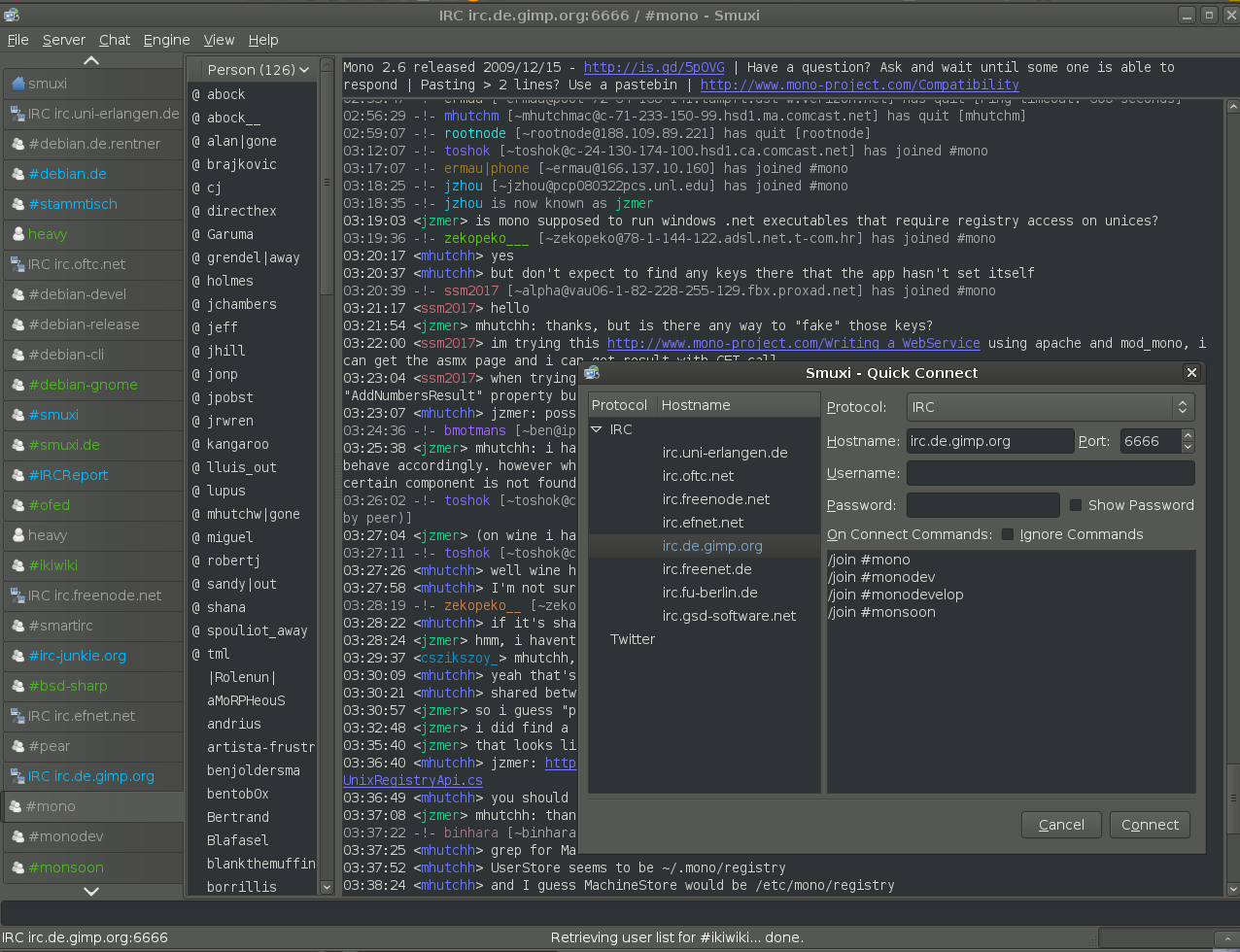
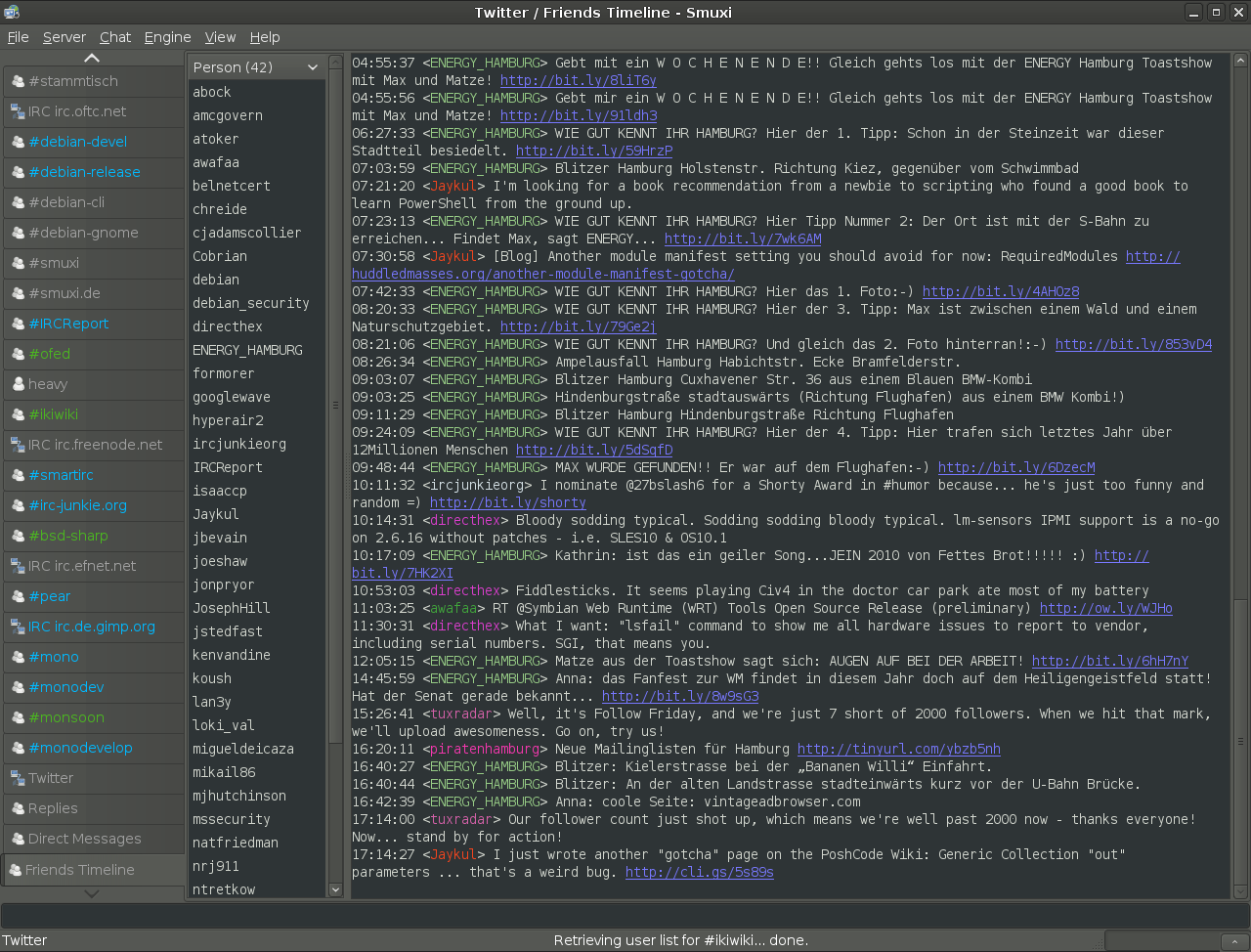
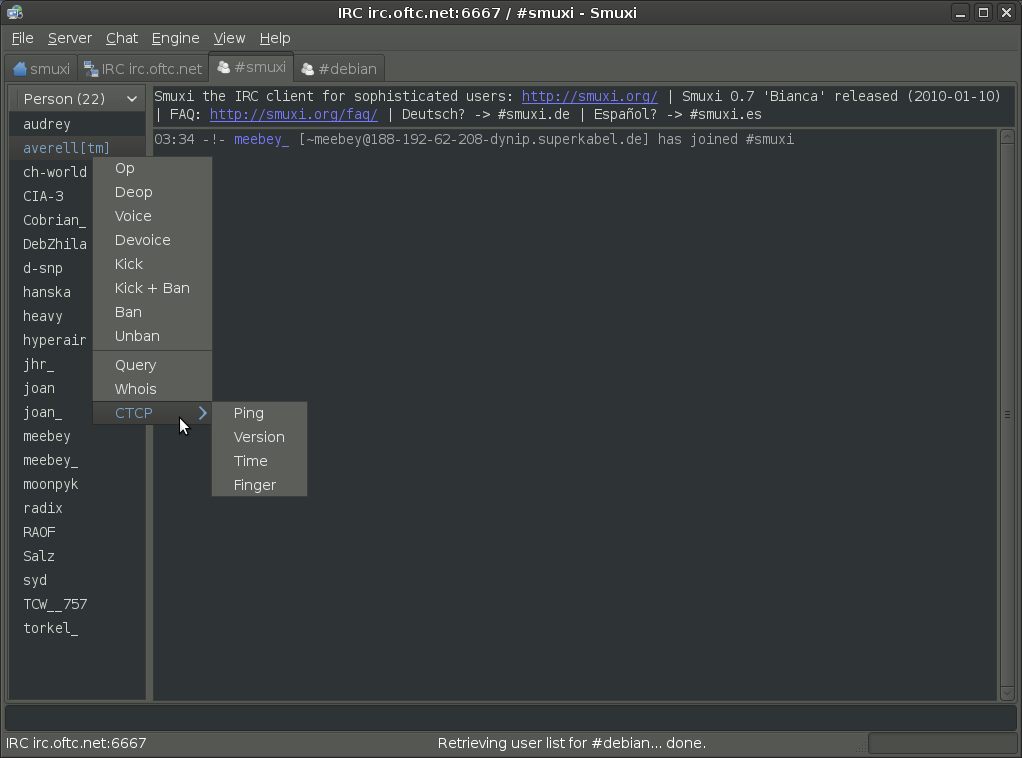
 . As some of you have probably already noticed I managed to get Smuxi 0.7 released a few days ago. Almost all of my Xmas vacation I was hacking on Smuxi. This is the best Smuxi release ever (guaranteed!). The most notable features I implemented in the 0.7 release are: Twitter support, handling for high latency networks (UTMS, WLAN, busy DSL) and an improved IRC experience through tweaks such as splitting oversized messages and new context menus. This release also contains very nice contributions from David Paleino [2] and Cl ment Bourgeois. Both joined the hackfest during my Xmas vacation and made the hacking sessions on Smuxi even more fun. Thanks for that guys! Here you can find a full list of changes.
As everbody likes screenshots and as screenshots say a thousand words, here they are:
Quick Connect
 Twitter
 User Menu
 Which direction will Smuxi head in after the 0.7 release? For the 0.8 release, I plan to focus on making the IRC support feature complete. That means we will get DCC, SSL, IPv6 and logging support. Nothing of that sounds very special but I am already investigating how Smuxi can be integrated with the promising new Zeitgeist project. I interviewed one of the developers for potential communication between Smuxi and Zeitgeist.
Last but not least, I want to announce that I will be attending FOSDEM 2010 in Brussels. I also will give a talk about Smuxi there, scheduled on 2010-02-07 at 16:30. If you want to have a chat, a beer, do some GPG keysigning, or ask me any questions, I am available
PS: If you want more updates than once per year, just follow me on Twitter
Next.