Search Results: "xam"

7 July 2025

Thorsten Alteholz: My Debian Activities in June 2025

Debian LTS This was my hundred-thirty-second month that I did some work for the Debian LTS initiative, started by Raphael Hertzog at Freexian. During my allocated time I uploaded or worked on: This month I also did a week of FD duties and attended the monthly LTS/ELTS meeting. Debian ELTS This month was the eighty-third ELTS month. During my allocated time I uploaded or worked on: This month I also did a week of FD duties and attended the monthly LTS/ELTS meeting. Debian Printing This month I uploaded bugfix versions of: Thanks a lot again to the Release Team who quickly handled all my unblock bugs! This work is generously funded by Freexian! Debian Astro This month I uploaded bugfix versions of: Debian Mobcom Unfortunately I didn t found any time to work on this topic. misc This month I uploaded bugfix versions of: Unfortunately I stumbled over a discussion about RFPs. One part of those involved wanted to automatically close older RFPs, the other part just wanted to keep them. But nobody suggested to really take care of those RFPs. Why is it easier to spend time on talking about something instead of solving the real problem? Anyway, I had a look at those open RFPs. Some of them can be just closed because they haven t been closed when uploading the corresponding package. For some others the corresponding software has not seen any upstream activity for several years and depends on older software no longer in Debian (like Python 2). Such bugs can be just closed. Some requested software only works together with long gone technology (for example the open Twitter API). Such bugs can be just closed. Last but not least, even the old RFPs contain nice software, that is still maintained upstream and useful. One example is ta-lib that I uploaded in June. So, please, let s put our money where out mouths are. My diary of closed RFP bugs is on people.d.o. If only ten people follow suit, all bugs can be closed within a year. FTP master It is still this time of the year when just a few packages arrive in NEW: it is Hard Freeze. So please don t hold it against me that I enjoy the sun more than processing packages in NEW. This month I accepted 104 and rejected 13 packages. The overall number of packages that got accepted was 105.

5 July 2025

Taavi V n nen: Tracking my train travel by parsing tickets in emails

Rumour has it that I might be a bit of a train nerd. At least I want to collect various nerdy data about my travels. Historically that data has lived in manual form in several places,1 but over the past year and a half I've been working on a toy project to collect most of that information into a custom tool. That toy project2 uses various sources to get information about trains to fill up its database: for example, in Finland Fintraffic, the organization responsible for railway traffic management, publishes very comprehensive open data about almost everything that's moving on the Finnish railway network. Unfortunately, I cannot be on all of the trains.3 Thus I need to tell the system details about my journeys. The obvious solution is to make a form that lets me save that data. Which I did, but I got very quickly bored of filling out that form, and as regular readers of this blog know, there is no reason to settle for a simple but boring solution when the alternative is to make something that is ridiculously overengineered.

Parsing data out of my train tickets Finnish long-distance trains generally require train-specific seat reservations, which means VR (the train company) knows which trains I am on. We just need to find a way to extract that information in some machine-readable format. So my plan for the ridiculously overengineered solution was to parse the booking emails to get the details I need. Now, VR ticket emails include the data I want in a couple of different formats: they're included as text in the HTML email body, they're in the embedded calendar invite, as text in the included PDF ticket, and encoded in the Aztec Code in the included PDF ticket. I chose to parse the last option with the hopes of building something that could be ported to parse other operators' tickets with relative ease.
Example Aztec code
Example Aztec code
After a bit of digging (thank you to the KDE Itinerary people for documenting this!) I stumbled upon an European Union Agency for Railways PDF titled ELECTRONIC SEAT/BERTH RESERVATION AND ELECTRONIC PRODUCTION OF TRANSPORT DOCUMENTS - TRANSPORT DOCUMENTS (RCT2 STANDARD) which, in its Appendix C.1, describes how the information is encoded in the code.4 (As a side note, various sources call these codes SSB version 1 codes, although that term isn't used in this specification. So maybe there are more specifications about the format that I haven't discovered yet!) I then wrote a parser in Go for the binary data embedded in these codes. So far it works, although I wouldn't be surprised if there are some edge cases that it doesn't handle. In particular, the spec specifies a custom lookup table for converting between text and binary data, and that only has support for characters 0-9 and A-Z. But Finnish railway station codes can also use and .. maybe I need to buy a ticket to a station with one of those.

Extracting barcodes out of emails A parser just for the binary format isn't enough here if the intended source input is the emails that VR sends upon making a booking. Time to write a single-purpose email server! In short, the logic in the server, again written in Go and with the help of go-smtp and go-message, is:
  • Accept any mail with a reasonable body size
  • Process through all body parts
  • For all PDF parts, extract all images
  • For all images, run them through ZXing
  • For all decoded barcodes, try to parse them with my new ticket parsing library I mentioned earlier
  • If any tickets are found, send the data from them and any metadata to the main backend, which will save them to a database
The custom mail server exposes an LMTP interface over TCP for my internet-facing mail servers to forward to. I chose LMTP for this because it seemed like a better fit in theory than normal (E)SMTP. I've since discovered that curl doesn't support LMTP which makes development much harder, and in practice there's no benefit of LMTP here as all mails are being sent to the backend in a single request regardless of the number of recipients, so maybe I'll migrate it to regular SMTP at some point.

Side quest time The last missing part is automatically forwarding the ticket mails to the new service. I've routed a dedicated subdomain to the new service, and the backend is configured to allocate addresses like i2v44g2pygkcth64stjgyuqz@somedomain.example for each user. That's great if we wanted to manually forward mails to the service, but we can go one step above that. I created a dedicated email alias in my mail server config that routes both to my regular mailbox and the service address. That way I can update my VR account to use the alias and have mails automatically processed while still receiving backup copies of the tickets (and any other important mail that VR might send me). Unfortunately that last part turns out something that's easier said than done. Logging in on the website, I'm greeted by this text stating I need to contact customer service by phone to change the address associated with my account.5 After a bit of digging, I noticed that the mobile app suggests filling out a feedback form in order to change the address. So I filled that, and after a day or two I got a "confirm you want to change your email" mail. Success!

  1. Including (but not limited to): a page of this website, the notes app on my phone, and an uMap map.
  2. Which I'm not directly naming here because I still think it needs a lot more work before being presentable, but if you're really interested it's not that hard to find out.
  3. Someone should invent human cloning so that we can fix this.
  4. People who know much more about railway ticketing than I do were surprised when I told them this format is still in use somewhere. So, uh, sorry if you were expecting a nice universal worldwide standard!
  5. In case you have not guessed yet, I do not like making phone calls.

3 July 2025

Russell Coker: The Fuss About AI

There are many negative articles about AI (which is not about actual Artificial Intelligence also known as AGI ). Which I think are mostly overblown and often ridiculous. Resource Usage Complaints about resource usage are common, training Llama 3.1 could apparently produce as much pollution as 10,000 round trips by car between Los Angeles and New York City . That s not great but when you compare to the actual number of people doing such drives in the US and the number of people taking commercial flights on that route it doesn t seem like such a big deal. Apparently commercial passenger jets cause CO2 emissions per passenger about equal to a car with 2 people. Why is it relevant whether pollution comes from running servers, driving cars, or steel mills? Why not just tax polluters for the damage they do and let the market sort it out? People in the US make a big deal about not being communist, so why not have a capitalist solution, make it more expensive to do undesirable things and let the market sort it out? ML systems are a less bad use of compute resources than Bitcoin, at least ML systems give some useful results while Bitcoin has nothing good going for it. The Dot-Com Comparison People often complain about the apparent impossibility of AI companies doing what investors think they will do. But this isn t anything new, that all happened before with the dot com boom . I m not the first person to make this comparison, The Daily WTF (a high quality site about IT mistakes) has an interesting article making this comparison [1]. But my conclusions are quite different. The result of that was a lot of Internet companies going bankrupt, the investors in those companies losing money, and other companies then bought up their assets and made profitable companies. The cheap Internet we now have was built on the hardware from bankrupt companies which was sold for far less than the manufacture price. That allowed it to scale up from modem speeds to ADSL without the users paying enough to cover the purchase of the infrastructure. In the early 2000s I worked for two major Dutch ISPs that went bankrupt (not my fault) and one of them continued operations in the identical manner after having the stock price go to zero (I didn t get to witness what happened with the other one). As far as I m aware random Dutch citizens and residents didn t suffer from this and employees just got jobs elsewhere. There are good things being done with ML systems and when companies like OpenAI go bankrupt other companies will buy the hardware and do good things. NVidia isn t ever going to have the future sales that would justify a market capitalisation of almost 4 Trillion US dollars. This market cap can support paying for new research and purchasing rights to patented technology in a similar way to the high stock price of Google supported buying YouTube, DoubleClick, and Motorola Mobility which are the keys to Google s profits now. The Real Upsides of ML Until recently I worked for a company that used ML systems to analyse drivers for signs of fatigue, distraction, or other inappropriate things (smoking which is illegal in China, using a mobile phone, etc). That work was directly aimed at saving human lives with a significant secondary aim of saving wear on vehicles (in the mining industry drowsy drivers damage truck tires and that s a huge business expense). There are many applications of ML in medical research such as recognising cancer cells in tissue samples. There are many less important uses for ML systems, such as recognising different types of pastries to correctly bill bakery customers technology that was apparently repurposed for recognising cancer cells. The ability to recognise objects in photos is useful. It can be used for people who want to learn about random objects they see and could be used for helping young children learn about their environment. It also has some potential for assistance for visually impaired people, it wouldn t be good for safety critical systems (don t cross a road because a ML system says there are no cars coming) but could be useful for identifying objects (is this a lemon or a lime). The Humane AI pin had some real potential to do good things but there wasn t a suitable business model [2], I think that someone will develop similar technology in a useful way eventually. Even without trying to do what the Humane AI Pin attempted, there are many ways for ML based systems to assist phone and PC use. ML systems allow analysing large quantities of data and giving information that may be correct. When used by a human who knows how to recognise good answers this can be an efficient way of solving problems. I personally have solved many computer problems with the help of LLM systems while skipping over many results that were obviously wrong to me. I believe that any expert in any field that is covered in the LLM input data could find some benefits from getting suggestions from an LLM. It won t necessarily allow them to solve problems that they couldn t solve without it but it can provide them with a set of obviously wrong answers mixed in with some useful tips about where to look for the right answers. Jobs and Politics Noema Magazine has an insightful article about how AI can allow different models of work which can enlarge the middle class [3]. I don t think it s reasonable to expect ML systems to make as much impact on society as the industrial revolution, and the agricultural revolutions which took society from more than 90% farm workers to less than 5%. That doesn t mean everything will be fine but it is something that can seem OK after the changes have happened. I m not saying apart from the death and destruction everything will be good , the death and destruction are optional. Improvements in manufacturing and farming didn t have to involve poverty and death for many people, improvements to agriculture didn t have to involve overcrowding and death from disease. This was an issue of political decisions that were made. The Real Problems of ML Political decisions that are being made now have the aim of making the rich even richer and leaving more people in poverty and in many cases dying due to being unable to afford healthcare. The ML systems that aim to facilitate such things haven t been as successful as evil people have hoped but it will happen and we need appropriate legislation if we aren t going to have revolutions. There are documented cases of suicide being inspired by Chat GPT systems [4]. There have been people inspired towards murder by ChatGPT systems but AFAIK no-one has actually succeeded in such a crime yet. There are serious issues that need to be addressed with the technology and with legal constraints about how people may use it. It s interesting to consider the possible uses of ChatGPT systems for providing suggestions to a psychologist, maybe ChatGPT systems could be used to alleviate mental health problems. The cases of LLM systems being used for cheating on assignments etc isn t a real issue. People have been cheating on assignments since organised education was invented. There is a real problem of ML systems based on biased input data that issue decisions that are the average of the bigotry of the people who provided input. That isn t going to be worse than the current situation of bigoted humans making decisions based on hate and preconceptions but it will be more insidious. It is possible to search for that so for example a bank could test it s mortgage approval ML system by changing one factor at a time (name, gender, age, address, etc) and see if it changes the answer. If it turns out that the ML system is biased on names then the input data could have names removed. If it turns out to be biased about address then there could be weights put in to oppose that. For a long time there has been excessive trust in computers. Computers aren t magic they just do maths really fast and implement choices based on the work of programmers who have all the failings of other humans. Excessive trust in a rule based system is less risky than excessive trust in a ML system where no-one really knows why it makes the decisions it makes. Self driving cars kill people, this is the truth that Tesla stock holders don t want people to know. Companies that try to automate everything with AI are going to be in for some nasty surprises. Getting computers to do everything that humans do in any job is going to be a large portion of an actual intelligent computer which if it is achieved will raise an entirely different set of problems. I ve previously blogged about ML Security [5]. I don t think this will be any worse than all the other computer security problems in the long term, although it will be more insidious. How Will It Go? Companies spending billions of dollars without firm plans for how to make money are going to go bankrupt no matter what business they are in. Companies like Google and Microsoft can waste some billions of dollars on AI Chat systems and still keep going as successful businesses. Companies like OpenAI that do nothing other than such chat systems won t go well. But their assets can be used by new companies when sold at less than 10% the purchase price. Companies like NVidia that have high stock prices based on the supposed ongoing growth in use of their hardware will have their stock prices crash. But the new technology they develop will be used by other people for other purposes. If hospitals can get cheap diagnostic ML systems because of unreasonable investment into AI then that could be a win for humanity. Companies that bet their entire business on AI even when it s not necessarily their core business (as Tesla has done with self driving) will have their stock price crash dramatically at a minimum and have the possibility of bankruptcy. Having Tesla go bankrupt is definitely better than having people try to use them as self driving cars.

1 July 2025

Guido G nther: Free Software Activities June 2025

Another short status update of what happened on my side last month. Phosh 0.48.0 is out with nice improvements, phosh.mobi e.V. is alive, helped a bit to get cellbroadcastd out, osk bugfixes and some more: See below for details on the above and more: phosh phoc phosh-mobile-settings stevia (formerly phosh-osk-stub) phosh-osk-data phosh-vala-plugins pfs xdg-desktop-portal-phosh xdg-desktop-portal phosh-debs meta-phosh feedbackd feedbackd-device-themes gmobile GNOME clocks Debian Mobian ModemManager libmbim libqmi mobile-broadband-provider-info Cellbroadcastd iio-sensor-proxy twenty-twenty-hugo gotosocial Reviews This is not code by me but reviews on other peoples code. The list is (as usual) slightly incomplete. Thanks for the contributions! Help Development If you want to support my work see donations. Comments? Join the Fediverse thread

30 June 2025

Otto Kek l inen: Corporate best practices for upstream open source contributions

Featured image of post Corporate best practices for upstream open source contributions
This post is based on presentation given at the Validos annual members meeting on June 25th, 2025.
When I started getting into Linux and open source over 25 years ago, the majority of the software development in this area was done by academics and hobbyists. The number of companies participating in open source has since exploded in parallel with the growth of mobile and cloud software, the majority of which is built on top of open source. For example, Android powers most mobile phones today and is based on Linux. Almost all software used to operate large cloud provider data centers, such as AWS or Google, is either open source or made in-house by the cloud provider. Pretty much all companies, regardless of the industry, have been using open source software at least to some extent for years. However, the degree to which they collaborate with the upstream origins of the software varies. I encourage all companies in a technical industry to start contributing upstream. There are many benefits to having a good relationship with your upstream open source software vendors, both for the short term and especially for the long term. Moreover, with the rollout of CRA in EU in 2025-2027, the law will require software companies to contribute security fixes upstream to the open source projects their products use. To ensure the process is well managed, business-aligned and legally compliant, there are a few do s and don t do s that are important to be aware of.

Maintain your SBOMs For every piece of software, regardless of whether the code was done in-house, from an open source project, or a combination of these, every company needs to produce a Software Bill of Materials (SBOM). The SBOMs provide a standardized and interoperable way to track what software and which versions are used where, what software licenses apply, who holds the copyright of which component, which security fixes have been applied and so forth. A catalog of SBOMs, or equivalent, forms the backbone of software supply-chain management in corporations.

Identify your strategic upstream vendors The SBOMs are likely to reveal that for any piece of non-trivial software, there are hundreds or thousands of upstream open source projects in use. Few organizations have resources to contribute to all of their upstreams. If your organization is just starting to organize upstream contribution activities, identify the key projects that have the largest impact on your business and prioritize forming a relationship with them first. Organizations with a mature contribution process will be collaborating with tens or hundreds of upstreams.

Appoint an internal coordinator and champions Having a written policy on how to contribute upstream will help ensure a consistent process and avoid common pitfalls. However, a written policy alone does not automatically translate into a well-running process. It is highly recommended to appoint at least one internal coordinator who is knowledgeable about how open source communities work, how software licensing and patents work, and is senior enough to have a good sense of what business priorities to optimize for. In small organizations it can be a single person, while larger organizations typically have a full Open Source Programs Office. This coordinator should oversee the contribution process, track all contributions made across the organization, and further optimize the process by working with stakeholders across the business, including legal experts, business owners and CTOs. The marketing and recruiting folks should also be involved, as upstream contributions will have a reputation-building aspect as well, which can be enhanced with systematic tracking and publishing of activities. Additionally, at least in the beginning, the organization should also appoint key staff members as open source champions. Implementing a new process always includes some obstacles and occasional setbacks, which may discourage employees from putting in the extra effort to reap the full long-term benefits for the company. Having named champions will empower them to make the first few contributions themselves, setting a good example and encouraging and mentoring others to contribute upstream as well.

Avoid excessive approvals To maintain a high quality bar, it is always good to have all outgoing submissions reviewed by at least one or two people. Two or three pairs of eyeballs are significantly more likely to catch issues that might slip by someone working alone. The review also slows down the process by a day or two, which gives the author time to sleep on it , which usually helps to ensure the final submission is well-thought-out by the author. Do not require more than one or two reviewers. The marginal utility goes quickly to zero beyond a few reviewers, and at around four or five people the effect becomes negative, as the weight of each approval decreases and the reviewers begin to take less personal responsibility. Having too many people in the loop also makes each feedback round slow and expensive, to the extent that the author will hesitate to make updates and ask for re-reviews due to the costs involved. If the organization experiences setbacks due to mistakes slipping through the review process, do not respond by adding more reviewers, as it will just grind the contribution process to a halt. If there are quality concerns, invest in training for engineers, CI systems and perhaps an internal certification program for those making public upstream code submissions. A typical software engineer is more likely to seriously try to become proficient at their job and put effort into a one-off certification exam and then make multiple high-quality contributions, than it is for a low-skilled engineer to improve and even want to continue doing more upstream contributions if they are burdened by heavy review processes every time they try to submit an upstream contribution.

Don t expect upstream to accept all code contributions Sure, identifying the root cause of and fixing a tricky bug or writing a new feature requires significant effort. While an open source project will certainly appreciate the effort invested, it doesn t mean it will always welcome all contributions with open arms. Occasionally, the project won t agree that the code is correct or the feature is useful, and some contributions are bound to be rejected. You can minimize the chance of experiencing rejections by having a solid internal review process that includes assessing how the upstream community is likely to understand the proposal. Sometimes how things are communicated is more important than how they are coded. Polishing inline comments and git commit messages help ensure high-quality communication, along with a commitment to respond quickly to review feedback and conducting regular follow-ups until a contribution is finalized and accepted.

Start small to grow expertise and reputation In addition to keeping the open source contribution policy lean and nimble, it is also good to start practical contributions with small issues. Don t aim to contribute massive features until you have a track record of being able to make multiple small contributions. Keep in mind that not all open source projects are equal. Each has its own culture, written and unwritten rules, development process, documented requirements (which may be outdated) and more. Starting with a tiny contribution, even just a typo fix, is a good way to validate how code submissions, reviews and approvals work in a particular project. Once you have staff who have successfully landed smaller contributions, you can start planning larger proposals. The exact same proposal might be unsuccessful when proposed by a new person, and successful when proposed by a person who already has a reputation for prior high-quality work.

Embrace all and any publicity you get Some companies have concerns about their employees working in the open. Indeed, every email and code patch an employee submits, and all related discussions become public. This may initially sound scary, but is actually a potential source of good publicity. Employees need to be trained on how to conduct themselves publicly, and the discussions about code should contain only information strictly related to the code, without any references to actual production environments or other sensitive information. In the long run most employees contributing have a positive impact and the company should reap the benefits of positive publicity. If there are quality issues or employee judgment issues, hiding the activity or forcing employees to contribute with pseudonyms is not a proper solution. Instead, the problems should be addressed at the root, and bad behavior addressed rather than tolerated. When people are working publicly, there tends to also be some degree of additional pride involved, which motivates people to try their best. Contributions need to be public for the sponsoring corporation to later be able to claim copyright or licenses. Considering that thousands of companies participate in open source every day, the prevalence of bad publicity is quite low, and the benefits far exceed the risks.

Scratch your own itch When choosing what to contribute, select things that benefit your own company. This is not purely about being selfish - often people working on resolving a problem they suffer from are the same people with the best expertise of what the problem is and what kind of solution is optimal. Also, the issues that are most pressing to your company are more likely to be universally useful to solve than any random bug or feature request in the upstream project s issue tracker.

Remember there are many ways to help upstream While submitting code is often considered the primary way to contribute, please keep in mind there are also other highly impactful ways to contribute. Submitting high-quality bug reports will help developers quickly identify and prioritize issues to fix. Providing good research, benchmarks, statistics or feedback helps guide development and the project make better design decisions. Documentation, translations, organizing events and providing marketing support can help increase adoption and strengthen long-term viability for the project. In some of the largest open source projects there are already far more pending contributions than the core maintainers can process. Therefore, developers who contribute code should also get into the habit of contributing reviews. As Linus law states, given enough eyeballs, all bugs are shallow. Reviewing other contributors submissions will help improve quality, and also alleviate the pressure on core maintainers who are the only ones providing feedback. Reviewing code submitted by others is also a great learning opportunity for the reviewer. The reviewer does not need to be better than the submitter - any feedback is useful; merely posting review feedback is not the same thing as making an approval decision. Many projects are also happy to accept monetary support and sponsorships. Some offer specific perks in return. By human nature, the largest sponsors always get their voice heard in important decisions, as no open source project wants to take actions that scare away major financial contributors.

Starting is the hardest part Long-term success in open source comes from a positive feedback loop of an ever-increasing number of users and collaborators. As seen in the examples of countless corporations contributing open source, the benefits are concrete, and the process usually runs well after the initial ramp-up and organizational learning phase has passed. In open source ecosystems, contributing upstream should be as natural as paying vendors in any business. If you are using open source and not contributing at all, you likely have latent business risks without realizing it. You don t want to wake up one morning to learn that your top talent left because they were forbidden from participating in open source for the company s benefit, or that you were fined due to CRA violations and mismanagement in sharing security fixes with the correct parties. The faster you start with the process, the less likely those risks will materialize.

24 June 2025

Dirk Eddelbuettel: RcppRedis 0.2.6 on CRAN: Extensions

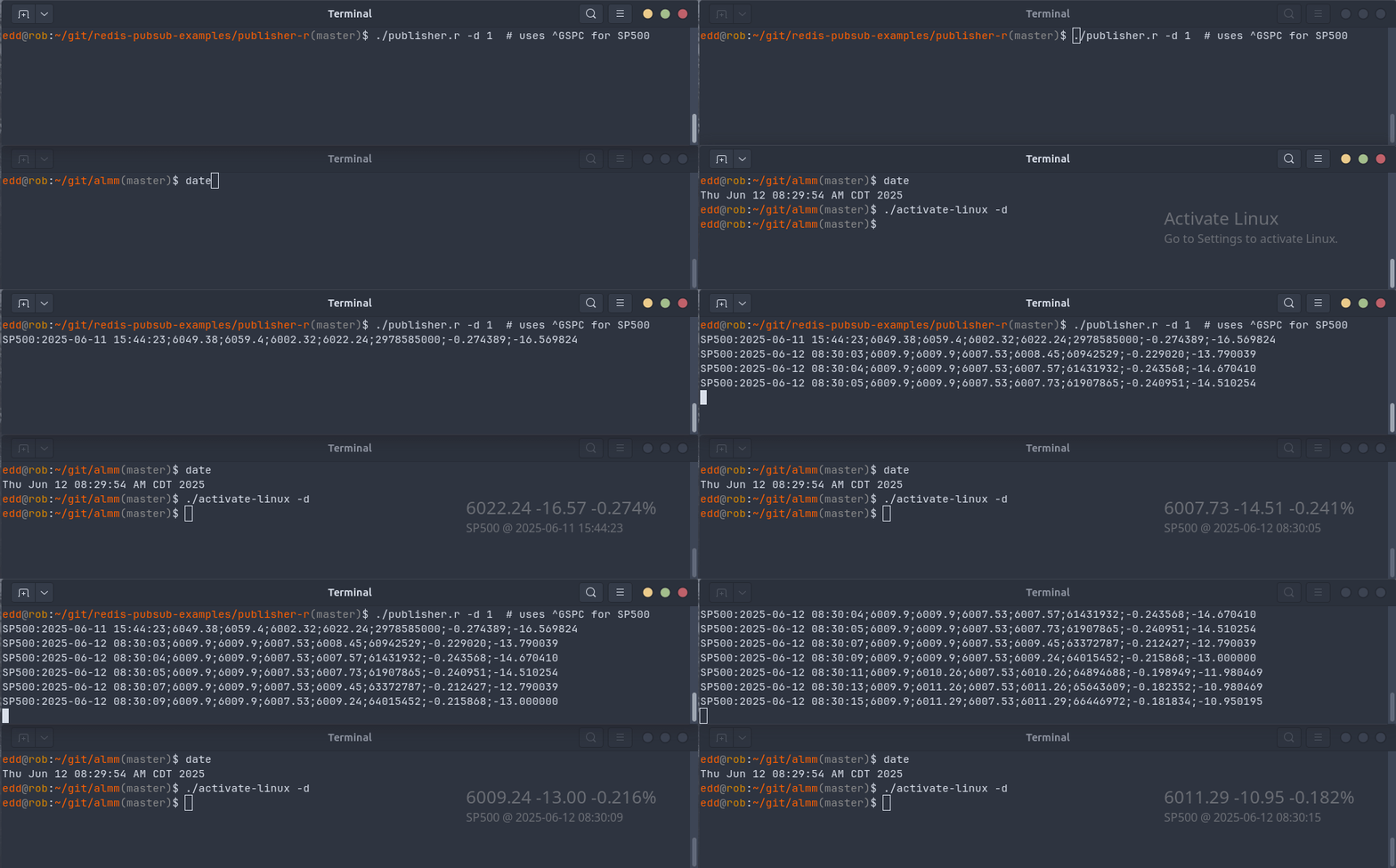
A new minor release 0.2.6 of our RcppRedis package arrived on CRAN today. RcppRedis is one of several packages connecting R to the fabulous Redis in-memory datastructure store (and much more). It works equally well with the newer fork Valkey. RcppRedis does not pretend to be feature complete, but it may do some things faster than the other interfaces, and also offers an optional coupling with MessagePack binary (de)serialization via RcppMsgPack. The package has been deployed in production as a risk / monitoring tool on a trading floor for several years. It also supports pub/sub dissemination of streaming market data as per this earlier example. This update brings new functions del, lrem, and lmove (for the matching Redis / Valkey commands) which may be helpful in using Redis (or Valkey) as a job queue. We also extended the publish accessor by supporting text (i.e. string) mode along with raw or rds (the prior default which always serialized R objects) just how listen already worked with these three cases. The change makes it possible to publish from R to subscribers not running R as they cannot rely on the R deserealizer. An example is provided by almm, a live market monitor, which we introduced in this blog post. Apart from that the continuous integration script received another mechanical update. The detailed changes list follows.

Changes in version 0.2.6 (2025-06-24)
  • The commands DEL, LREM and LMOVE have been added
  • The continuous integration setup was updated once more
  • The pub/sub publisher now supports a type argument similar to the listener, this allows string message publishing for non-R subscribers

Courtesy of my CRANberries, there is also a diffstat report for this this release. More information is on the RcppRedis page and at the repository and its issue tracker.

This post by Dirk Eddelbuettel originated on his Thinking inside the box blog. If you like this or other open-source work I do, you can sponsor me at GitHub.

22 June 2025

Iustin Pop: Coding, as we knew it, has forever changed

Back when I was terribly na ve When I was younger, and definitely na ve, I was so looking forward to AI, which will help us write lots of good, reliable code faster. Well, principally me, not thinking what impact it will have industry-wide. Other more general concerns, like societal issues, role of humans in the future and so on were totally not on my radar. At the same time, I didn t expect this will actually happen. Even years later, things didn t change dramatically. Even the first release of ChatGPT a few years back didn t click for me, as the limitations were still significant.

Hints of serious change The first hint of the change, for me, was when a few months ago (yes, behind the curve), I asked ChatGPT to re-explain a concept to me, and it just wrote a lot of words, but without a clear explanation. On a whim, I asked Grok then recently launched, I think to do the same. And for the first time, the explanation clicked and I felt I could have a conversation with it. Of course, now I forgot again that theoretical CS concept, but the first step was done: I can ask an LLM to explain something, and it will, and I can have a back and forth logical discussion, even if on some theoretical concept. Additionally, I learned that not all LLMs are the same, and that means there s real competition and that leap frogging is possible. Another topic on which I tried to adopt early and failed to get mileage out of it, was GitHub Copilot (in VSC). I tried, it helped, but didn t feel any speed-up at all. Then more recently, in May, I asked Grok what s the state of the art in AI-assisted coding. It said either Claude in a browser tab, or in VSC via continue.dev extension. The continue.dev extension/tooling is a bit of a strange/interesting thing. It seems to want to be a middle-man between the user and actual LLM services, i.e. you pay a subscription to continue.dev, not to Anthropic itself, and they manage the keys/APIs, for whatever backend LLMs you want to use. The integration with Visual Studio Code is very nice, but I don t know if long-term their business model will make sense. Well, not my problem.

Claude: reverse engineering my old code and teaching new concepts So I installed the latter and subscribed, thinking 20 CHF for a month is good for testing. I skipped the tutorial model/assistant, created a new one from scratch, just enabled Claude 3.7 Sonnet, and started using it. And then, my mind was blown-not just by the LLM, but by the ecosystem. As said, I ve used GitHub copilot before, but it didn t seem effective. I don t know if a threshold has been reached, or Claude (3.7 at that time) is just better than ChatGPT. I didn t use the AI to write (non-trivial) code for me, at most boilerplate snippets. But I used it both as partner for discussion - I want to do x, what do you think, A or B? , and as a teacher, especially for fronted topics, which I m not familiar with. Since May, in mostly fragmented sessions, I ve achieved more than in the last two years. Migration from old school JS to ECMA modules, a webpacker (reducing bundle size by 50%), replacing an old Javascript library with hand written code using modern APIs, implementing the zoom feature together with all of keyboard, mouse, touchpad and touchscreen support, simplifying layout from manually computed to automatic layout, and finding a bug in webkit for which it also wrote a cool minimal test (cool, as in, way better than I d have ever, ever written, because for me it didn t matter that much). And more. Could I have done all this? Yes, definitely, nothing was especially tricky here. But hours and hours of reading MDN, scouring Stack Overflow and Reddit, and lots of trial and error. So doable, but much more toily. This, to me, feels like cheating. 20 CHF per month to make me 3x more productive is free money well, except that I don t make money on my code which is written basically for myself. However, I don t get stuck anymore searching hours in the web for guidance, I ask my question, and I get at least direction if not answer, and I m finished way earlier. I can now actually juggle more hobbies, in the same amount of time, if my personal code takes less time or differently said, if I m more efficient at it. Not all is roses, of course. Once, it did write code with such an endearing error that it made me laugh. It was so blatantly obvious that you shouldn t keep other state in the array that holds pointer status because that confuses the calculation of how many pointers are down , probably to itself too if I d have asked. But I didn t, since it felt a bit embarassing to point out such a dumb mistake. Yes, I m anthropomorphising again, because this is the easiest way to deal with things. In general, it does an OK-to-good-to-sometimes-awesome job, and the best thing is that it summarises documentation and all of Reddit and Stack Overflow. And gives links to those. Now, I have no idea yet what this means for the job of a software engineer. If on open source code, my own code, it makes me 3x faster reverse engineering my code from 10 years ago is no small feat for working on large codebases, it should do at least the same, if not more. As an example of how open-ended the assistance can be, at one point, I started implementing a new feature threading a new attribute to a large number of call points. This is not complex at all, just add a new field to a Haskell record, and modifying everything to take it into account, populate it, merge it when merging the data structures, etc. The code is not complex, tending toward boilerplate a bit, and I was wondering on a few possible choices for implementation, so, with just a few lines of code written that were not even compiling, I asked I want to add a new feature, should I do A or B if I want it to behave like this , and the answer was something along the lines of I see you want to add the specific feature I was working on, but the implementation is incomplete, you still need to to X, Y and Z . My mind was blown at this point, as I thought, if the code doesn t compile, surely the computer won t be able to parse it, but this is not a program, this is an LLM, so of course it could read it kind of as a human would. Again, the code complexity is not great, but the fact that it was able to read a half-written patch, understand what I was working towards, and reason about, was mind-blowing, and scary. Like always.

Non-code writing Now, after all this, while writing a recent blog post, I thought this is going to be public anyway, so let me ask Claude what it thinks about it. And I was very surprised, again: gone was all the pain of rereading three times my post to catch typos (easy) or phrasing structure issues. It gave me very clearly points, and helped me cut 30-40% of the total time. So not only coding, but word smithing too is changed. If I were an author, I d be delighted (and scared). Here is the overall reply it gave me:
  • Spelling and grammar fixes, all of them on point except one mistake (I claimed I didn t capitalize one word, but I did). To the level of a good grammar checker.
  • Flow Suggestions, which was way beyond normal spelling and grammar. It felt like a teacher telling me to do better in my writing, i.e. nitpicking on things that actually were true even if they d still work. I.e. lousy phrase structure, still understandable, but lousy nevertheless.
  • Other notes: an overall summary. This was mostly just praising my post . I wish LLMs were not so focused on praise the user .
So yeah, this speeds me up to about 2x on writing blog posts, too. It definitely feels not fair.

Wither the future? After all this, I m a bit flabbergasted. Gone are the 2000 s with code without unittests, gone are the 2010 s without CI/CD, and now, mid-2020 s, gone is the lone programmer that scours the internet to learn new things, alone? What this all means for our skills in software development, I have no idea, except I know things have irreversibly changed (a butlerian jihad aside). Do I learn better with a dedicated tutor even if I don t fight with the problem for so long? Or is struggling in finding good docs the main method of learning? I don t know yet. I feel like I understand the topics I m discussing with the AI, but who knows in reality what it will mean long term in terms of stickiness of learning. For the better, or for worse, things have changed. After all the advances over the last five centuries in mechanical sciences, it has now come to some aspects of the intellectual work. Maybe this is the answer to the ever-growing complexity of tech stacks? I.e. a return of the lone programmer that builds things end-to-end, but with AI taming the complexity added in the last 25 years? I can dream, of course, but this also means that the industry overall will increase in complexity even more, because large companies tend to do that, so maybe a net effect of not much One thing I did learn so far is that my expectation that AI (at this level) will only help junior/beginner people, i.e. it would flatten the skills band, is not true. I think AI can speed up at least the middle band, likely the middle top band, I don t know about the 10x programmers (I m not one of them). So, my question about AI now is how to best use it, not to lament how all my learning (90% self learning, to be clear) is obsolete. No, it isn t. AI helps me start and finish one migration (that I delayed for ages), then start the second, in the same day. At the end of this a bit rambling reflection on the past month and a half, I still have many questions about AI and humanity. But one has been answered: yes, AI , quotes or no quotes, already has changed this field (producing software), and we ve not seen the end of it, for sure.

19 June 2025

Jonathan Carter: My first tag2upload upload

Tag2upload? The tag2upload service has finally gone live for Debian Developers in an open beta. If you ve never heard of tag2upload before, here is a great primer presented by Ian Jackson and prepared by Ian Jackson and Sean Whitton. In short, the world has moved on to hosting and working with source code in Git repositories. In Debian, we work with source packages that are used to generated the binary artifacts that users know as .deb files. In Debian, there is so much tooling and culture built around this. For example, our workflow passes what we call the island test you could take every source package in Debian along with you to an island with no Internet, and you ll still be able to rebuild or modify every package. When changing the workflows, you risk losing benefits like this, and over the years there has been a number of different ideas on how to move to a purely or partially git flow for Debian, none that really managed to gain enough momentum or project-wide support. Tag2upload makes a lot of sense. It doesn t take away any of the benefits of the current way of working (whether technical or social), but it does make some aspects of Debian packages significantly simpler and faster. Even so, if you re a Debian Developer and more familiar with how the sausage have made, you ll have noticed that this has been a very long road for the tag2upload maintainers, they ve hit multiple speed bumps since 2019, but with a lot of patience and communication and persistence from all involved (and almost even a GR), it is finally materializing.

Performing my first tag2upload So, first, I needed to choose which package I want to upload. We re currently in hard freeze for the trixie release, so I ll look for something simple that I can upload to experimental.
I chose bundlewrap, it s quote a straightforward python package, and updates are usually just as straightforward, so it s probably a good package to work on without having to deal with extra complexities in learning how to use tag2upload. So, I do the usual uscan and dch -i to update my package
And then I realise that I still want to build a source package to test it in cowbuilder. Hmm, I remember that Helmut showed me that building a source package isn t necessary in sbuild, but I have a habit of breaking my sbuild configs somehow, but I guess I should revisit that. So, I do a dpkg-buildpackage -S -sa and test it out with cowbuilder, because that s just how I roll (at least for now, fixing my local sbuild setup is yak shaving for another day, let s focus!). I end up with a binary that looks good, so I m satisfied that I can upload this package to the Debian archives. So, time to configure tag2upload. The first step is to set up the webhook in Salsa. I was surprised two find two webhooks already configured:
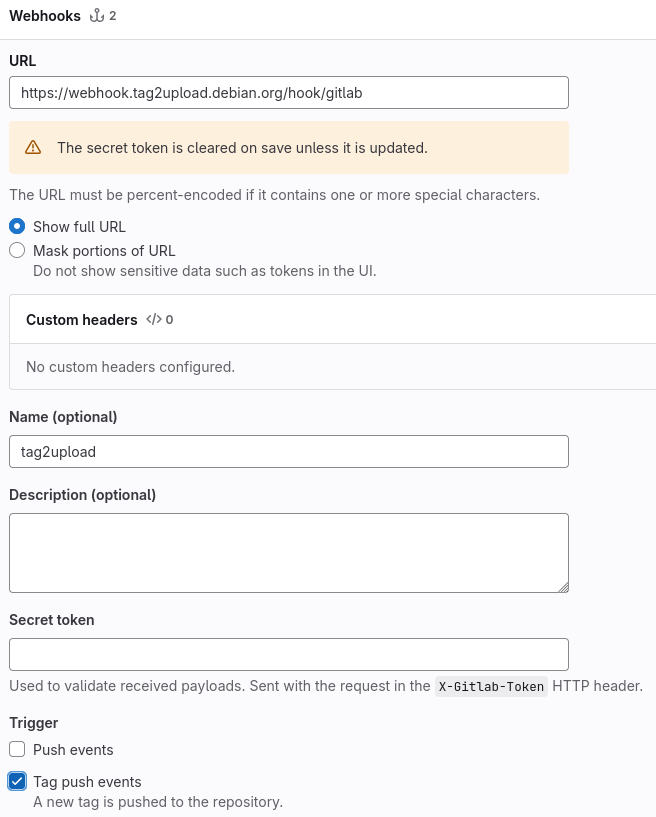
I know of KGB that posts to IRC, didn t know that this was the mechanism it does that by before. Nice! Also don t know what the tagpending one does, I ll go look into that some other time. Configuring a tag2upload webhook is quite simple, add a URL, call the name tag2upload, and select only tag push events:
I run the test webhook, and it returned a code 400 message about a missing message header, which the documentation says is normal. Next, I install git-debpush from experimental. The wiki page simply states that you can use the git-debpush command to upload, but doesn t give any examples on how to use it, and its manpage doesn t either. And when I run just git-debpush I get:
jonathan@lapcloud:~/devel/debian/python-team/bundlewrap/bundlewrap-4.23.1$ git-debpush
git-debpush: check failed: upstream tag upstream/4.22.0 is not an ancestor of refs/heads/debian/master; probably a mistake ('upstream-nonancestor' check)
pristine-tar is /usr/bin/pristine-tar
git-debpush: some check(s) failed; you can pass --force to ignore them
I have no idea what that s supposed to mean. I was also not sure whether I should tag anything to begin with, or if some part of the tag2upload machinery automatically does it. I think I might have tagged debian/4.23-1 before tagging upstream/4.23 and perhaps it didn t like it, I reverted and did it the other way around and got a new error message. Progress!
jonathan@lapcloud:~/devel/debian/python-team/bundlewrap/bundlewrap-4.23.1$ git-debpush
git-debpush: could not determine the git branch layout
git-debpush: please supply a --quilt= argument
Looking at the manpage, it looks like quilt=baredebian matches my package the best, so I try that:
jonathan@lapcloud:~/devel/debian/python-team/bundlewrap/bundlewrap-4.23.1$ git-debpush --quilt=baredebian
Enumerating objects: 70, done.
Counting objects: 100% (70/70), done.
Delta compression using up to 12 threads
Compressing objects: 100% (37/37), done.
Writing objects: 100% (37/37), 8.97 KiB   2.99 MiB/s, done.
Total 37 (delta 30), reused 0 (delta 0), pack-reused 0 (from 0)
To salsa.debian.org:python-team/packages/bundlewrap.git
6f55d99..3d5498f debian/master -> debian/master
 * [new tag] upstream/4.23.1 -> upstream/4.23.1
 * [new tag] debian/4.23.1-1_exp1 -> debian/4.23.1-1_exp1
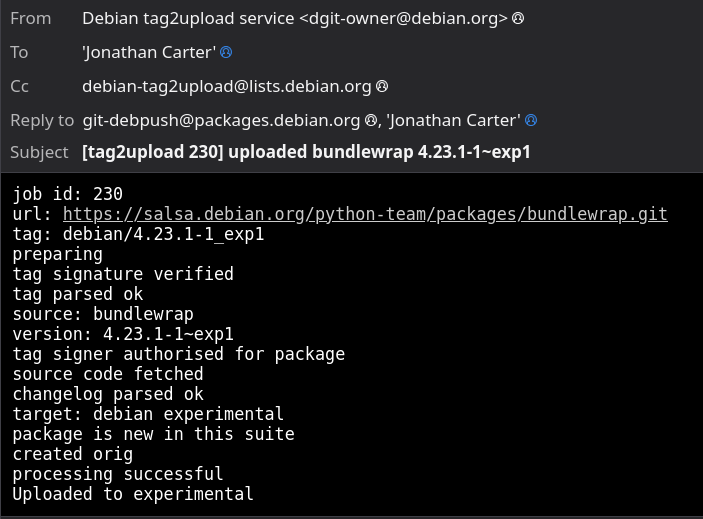
Ooh! That looked like it did something! And a minute later I received the notification of the upload in my inbox:
So, I m not 100% sure that this makes things much easier for me than doing a dput, but, it s not any more difficult or more work either (once you know how it works), so I ll be using git-debpush from now on, and I m sure as I get more used to the git workflow of doing things I ll understand more of the benefits. And at last, my one last use case for using FTP is now properly dead. RIP FTP :)

Debian Outreach Team: GSoC 2025 Introduction: Make Debian for Raspberry Pi Build Again

Hello everyone! I am Kurva Prashanth, Interested in the lower level working of system software, CPUs/SoCs and Hardware design. I was introduced to Open Hardware and Embedded Linux while studying electronics and embedded systems as part of robotics coursework. Initially, I did not pay much attention to it and quickly moved on. However, a short talk on Liberating SBCs using Debian by Yuvraj at MiniDebConf India, 2021 caught my interest. The talk focused on Open Hardware platforms such as Olimex and BeagleBone Black, as well as the Debian distributions tailored for these ARM-based single-board computers has intrigued me to delve deeper into the realm of Open Hardware and Embedded Linux. These days I m trying to improve my abilities to contribute to Debian and Linux Kernel development. Before finding out about the Google Summer of Code project, I had already started my journey with Debian. I extensively used Debian system build tools(debootstrap, sbuild, deb-build-pkg, qemu-debootstrap) for Building Debian Image for Bela Cape a real-time OS for music making to achieve extremely fast audio and sensor processing times. In 2023, I had the opportunity to attend DebConf23 in Kochi, India - thanks to Nilesh Patra (@nilesh) and I met Hector Oron (@zumbi) over dinner at DebConf23 and It was nice talking about his contributions/work at Debian on armhf port and Debian System Administration that conversation got me interested in knowing more about Debian ARM, Installer and I found it fascinating that EmDebian was once a external project bringing Debian to embedded systems and now, Debian itself can be run on many embedded systems. And, also during DebCamp I got Introduced to PGP/GPG keys and the web of trust by Carlos Henrique Lima Melara (@charles) I learned how to use and generate GPG keys. After DebConf23 I tried debian packaging and I miserably failed to get sponsorship for a python library I packaged. I came across the Debian project for this year s Google Summer of Code and found the project titled Make Debian for Raspberry Pi Build Again quite interesting to me and applied. Gladly, on May 8th, I received an acceptance e-mail from GSoC. I got excited that I ll spend the summer working on something that I like doing. I am thrilled to be part of this project and I am super excited for the summer of 25. I m looking forward to work on what I most like, new connections and learning opportunities. So, let me talk a bit more about my project. I will be working on to Make Debian for Raspberry Pi SBC s under the guidance of Gunnar Wolf (@gwolf). In this post, I will describe the project I will be working on.

Why make Debian for Raspberry Pi build again? There is an available set of images for running Debian in Raspberry Pi computers (all models below the 5 series)! However, the maintainer severely lacking time to take care for them; called for help for somebody to adopt them, but have not been successful. The image generation scripts might have bitrotted a bit, but it is mostly all done. And there is a lot of interest and use still in having the images freshly generated and decently tested! This GSoC project is about getting the [https://raspi.debian.net/ Raspberry Pi Debian images] site working reliably, daily-built images become automatic again and ideally making it easily deployable to be run in project machines and migrating exsisting hosting infrastructure to Debian.

How much it differ from Debian build process? While the goal is to stay as close as possible to the Debian build process, Raspberry Pi boards require some necessary platform-specific changes primarily in the early boot sequence and firmware handling. Unlike typical Debian systems, Raspberry Pi boards depend on a non-standard bootloader and use non-free firmware (raspi-firmware), Introducing some hardware-specific differences in the initialization process. These differences are largely confined to the early boot and hardware initialization stages. Once the system boots, the userspace remains closely aligned with a typical Debian install, using Debian packages. The current modifications are required due to non-free firmware. However, several areas merit review: but there are a few parts that might be worth changing.
  1. Boot flow: Transitioning to a U-Boot based boot process (as used in Debian installer images for many other SBCs) would reduce divergence and better align with Debian Installer.
  2. Current scripts/workarounds: Some existing hacks may now be redundant with recent upstream support and could be removed.
  3. Board-specific images: Shift to architecture-specific base images with runtime detection could simplify builds and reduce duplication.
Debian already already building SD card images for a wide range of SBCs (e.g., BeagleBone, BananaPi, OLinuXino, Cubieboard, etc.) installer-arm64/images/u-boot and installer-armhf/images/u-boot, a similar approach for Raspberry Pi could improve maintainability and consistency with Debian s broader SBC support.

Quoted from Mail Discussion Thread with Mentor (Gunnar Wolf)
"One direction we wanted to explore was whether we should still be building one image per family, or whether we could instead switch to one image per architecture (armel, armhf, arm64). There were some details to iron out as RPi3 and RPi4 were quite different, but I think it will be similar to the differences between the RPi 0 and 1, which are handled at first-boot time. To understand what differs between families, take a look at Cyril Brulebois generate-recipe (in the repo), which is a great improvement over the ugly mess I had before he contributed it"
In this project, I intend to to build one image per architecture (armel, armhf, arm64) rather than continuing with the current model of building one image per board. This change simplifies image management, reduces redundancy, and leverages dynamic configuration at boot time to support all supported boards within each architecture. By using U-Boot and flash-kernel, we can detect the board type and configure kernel parameters, DTBs, and firmware during the first boot, reducing duplication across images and simplifying the maintenance burden and we can also generalize image creation while still supporting board-specific behavior at runtime. This method aligns with existing practices in the DebianInstaller team and aligns with Debian s long-term maintainability goals and better leverages upstream capabilities, ensuring a consistent and scalable boot experience. To streamline and standardize the process of building bootable Debian images for Raspberry Pi devices, I proposed a new workflow that leverages U-Boot and flash-kernel Debian packages. This provides a clean, maintainable, and reproducible way to generate images for armel, armhf and arm64 boards. The workflow is vmdb2, a lightweight, declarative tool designed to automate the creation of disk images. A typical vmdb2 recipe defines the disk layout, base system installation (via debootstrap), architecture-specific packages, and any custom post-install hooks and the image should includes U-Boot (the u-boot-rpi package), flash-kernel, and a suitable Debian kernel package like linux-image-arm64 or linux-image-armmp. U-Boot serves as the platform s bootloader and is responsible for loading the kernel and initramfs. Unlike Raspberry Pi s non-free firmware/proprietary bootloader, U-Boot provides an open and scriptable interface, allowing us to follow a more standard Debian boot process. It can be configured to boot using either an extlinux.conf or a boot.scr script generated automatically by flash-kernel. The role of flash-kernel is to bridge Debian s kernel installation system with the specifics of embedded bootloaders like U-Boot. When installed, it automatically copies the kernel image, initrd, and device tree blobs (DTBs) to the /boot partition. It also generates the necessary boot.scr script if the board configuration demands it. To work correctly, flash-kernel requires that the target machine be identified via /etc/flash-kernel/machine, which must correspond to an entry in its internal machine database.\ Once the vmdb2 build is complete, the resulting image will contain a fully configured bootable system with all necessary boot components correctly installed. The image can be flashed to an SD card and used to boot on the intended device without additional manual configuration. Because all key packages (U-Boot, kernel, flash-kernel) are managed through Debian s package system, kernel updates and boot script regeneration are handled automatically during system upgrades.

Current Workflow: Builds one Image per family The current vmdb2 recipe uses the Raspberry Pi GPU bootloader provided via the raspi-firmware package. This is the traditional boot process followed by Raspberry Pi OS, and it s tightly coupled with firmware files like bootcode.bin, start.elf, and fixup.dat. These files are installed to /boot/firmware, which is mounted from a FAT32 partition labeled RASPIFIRM. The device tree files (*.dtb) are manually copied from /usr/lib/linux-image-*-arm64/broadcom/ into this partition. The kernel is installed via the linux-image-arm64 package, and the boot arguments are injected by modifying /boot/firmware/cmdline.txt using sed commands. Booting depends on the root partition being labeled RASPIROOT, referenced through that file. There is no bootloader like UEFI-based or U-Boot involved the Raspberry Pi firmware directly loads the kernel, which is standard for Raspberry Pi boards.
- apt: install
  packages:
    ...
    - raspi-firmware  
The boot partition contents and kernel boot setup are tightly controlled via scripting in the recipe. Limitations of Current Workflow: While this setup works, it is
  1. Proprietary and Raspberry Pi specific It relies on the closed-source GPU bootloader the raspi-firmware package, which is tightly coupled to specific Raspberry Pi models.
  2. Manual DTB handling Device tree files are manually copied and hardcoded, making upgrades or board-specific changes error-prone.
  3. Not easily extendable to future Raspberry Pi boards Any change in bootloader behavior (as seen in the Raspberry Pi 5, which introduces a more flexible firmware boot process) would require significant rework.
  4. No UEFI-based/U-Boot The current method bypasses the standard bootloader layers, making it inconsistent with other Debian ARM platforms and harder to maintain long-term.
As Raspberry Pi firmware and boot processes evolve, especially with the introduction of Pi 5 and potentially Pi 6, maintaining compatibility will require more flexibility - something best delivered by adopting U-Boot and flash-kernel.

New Workflow: Building Architecture-Specific Images with vmdb2, U-Boot, flash-kernel, and Debian Kernel This workflow outlines an improved approach to generating bootable Debian images architecture specific, using vmdb2, U-Boot, flash-kernel, and Debian kernels and also to move away from Raspberry Pi s proprietary bootloader to a fully open-source boot process which improves maintainability, consistency, and cross-board support.

New Method: Shift to U-Boot + flash-kernel U-Boot (via Debian su-boot-rpi package) and flash-kernel bring the image building process closer to how Debian officially boots ARM devices. flash-kernel integrates with the system s initramfs and kernel packages to install bootloaders, prepare boot.scr or extlinux.conf, and copy kernel/initrd/DTBs to /boot in a format that U-Boot expects. U-Boot will be used as a second-stage bootloader, loaded by the Raspberry Pi s built-in firmware. Once U-Boot is in place, it will read standard boot scripts ( boot.scr) generated by flash-kernel, providing a Debian-compatible and board-flexible solution. Extending YAML spec for vmdb2 build with U-Boot and flash-kernel To improve an existing vmdb2 YAML spec(https://salsa.debian.org/raspi-team/image-specs/raspi_master.yaml), to integrate U-Boot, flash-kernel, and the architecture-specific Debian kernel into the image build process. By incorporating u-boot-rpi and flash-kernel from Debian packages, alongside the standard initramfs-tools, we align the image closer to Debian best practices while supporting both armhf and arm64 architectures. Below are key additions and adjustments needed in a vmdb2 YAML spec to support the workflow: Install U-Boot, flash-kernel, initramfs-tools and the architecture-specific Debian kernel.
- apt: install
  packages:
    - u-boot-rpi
    - flash-kernel
    - initramfs-tools
    - linux-image-arm64 # or linux-image-armmp for armhf 
  tag: tag-root
Replace linux-image-arm64 with the correct kernel package for specific target architecture. These packages should be added under the tag-root section in YAML spec for vmdb2 build recipe. This ensures that the necessary bootloader, kernel, and initramfs tools are included and properly configured in the image. Configure Raspberry Pi firmware to Load U-Boot Install the U-Boot binary as kernel.img in /boot/firmware we can also download and build U-Boot from source, but Debian provides tested binaries.
- shell:  
    cp /usr/lib/u-boot/rpi_4/u-boot.bin $ ROOT? /boot/firmware/kernel.img
    echo "enable_uart=1" >> $ ROOT? /boot/firmware/config.txt
  root-fs: tag-root
This makes the RPi firmware load u-boot.bin instead of the Linux kernel directly. Set Up flash-kernel for Debian-style Boot flash-kernel integrates with initramfs-tools and writes boot config suitable for U-Boot. We need to make sure /etc/flash-kernel/db contains an entry for board (most Raspberry Pi boards already supported in Bookworm). Set up /etc/flash-kernel.conf with:
- create-file: /etc/flash-kernel.conf
  contents:  
    MACHINE="Raspberry Pi 4"
    BOOTPART="/dev/disk/by-label/RASPIFIRM"
    ROOTPART="/dev/disk/by-label/RASPIROOT"
  unless: rootfs_unpacked
This allows flash-kernel to write an extlinux.conf or boot.scr into /boot/firmware. Clean up Proprietary/Non-Free Firmware Bootflow Remove the direct kernel loading flow:
- shell:  
    rm -f $ ROOT? /boot/firmware/vmlinuz*
    rm -f $ ROOT? /boot/firmware/initrd.img*
    rm -f $ ROOT? /boot/firmware/cmdline.txt
  root-fs: tag-root
Let U-Boot and flash-kernel manage kernel/initrd and boot parameters instead. Boot Flow After This Change
[SoC ROM] -> [start.elf] -> [U-Boot] -> [boot.scr] -> [Linux Kernel]
  1. This still depends on the Raspberry Pi firmware to start, but it only loads U-Boot, not Linux kernel.
  2. U-Boot gives you more flexibility (e.g., networking, boot menus, signed boot).
  3. Using flash-kernel ensures kernel updates are handled the Debian Installer way.
  4. Test with a serial console (enable_uart=1) in case HDMI doesn t show early boot logs.
Advantage of New Workflow
  1. Replaces the proprietary Raspberry Pi bootloader with upstream U-Boot.
  2. Debian-native tooling Uses flash-kernel and initramfs-tools to manage boot configuration.
  3. Consistent across boards Works for both armhf and arm64, unifying the image build process.
  4. Easier to support new boards Like the Raspberry Pi 5 and future models.
This transition will standardize a bit image-building process, making it aligned with upstream Debian Installer workflows.

vmdb2 configuration for arm64 using u-boot and flash-kernel NOTE: This is a baseline example and may require tuning.
# Raspberry Pi arm64 image using U-Boot and flash-kernel
steps:
  # ... (existing mkimg, partitions, mount, debootstrap, etc.) ...
  # Install U-Boot, flash-kernel, initramfs-tools and architecture specific kernel
  - apt: install
    packages:
      - u-boot-rpi
      - flash-kernel
      - initramfs-tools
      - linux - image - arm64 # or linux - image - armmp for armhf
    tag: tag-root
  # Install U-Boot binary as kernel.img in firmware partition
  - shell:  
      cp /usr/lib/u-boot/rpi_arm64 /u-boot.bin $ ROOT? /boot/firmware/kernel.img
      echo "enable_uart=1" >> $ ROOT? /boot/firmware/config.txt
    root-fs: tag-root
  # Configure flash-kernel for Raspberry Pi
  - create-file: /etc/flash-kernel.conf
    contents:  
      MACHINE="Generic Raspberry Pi ARM64"
      BOOTPART="/dev/disk/by-label/RASPIFIRM"
      ROOTPART="/dev/disk/by-label/RASPIROOT"
    unless: rootfs_unpacked
  # Remove direct kernel boot files from Raspberry Pi firmware
  - shell:  
      rm -f $ ROOT? /boot/firmware/vmlinuz*
      rm -f $ ROOT? /boot/firmware/initrd.img*
      rm -f $ ROOT? /boot/firmware/cmdline.txt
    root-fs: tag-root
  # flash-kernel will manage boot scripts and extlinux.conf
  # Rest of image build continues...

Required Changes to Support Raspberry Pi Boards in Debian (flash-kernel + U-Boot)

Overview of Required Changes
Component Required Task
Debian U-Boot Package Add build target for rpi_arm64 in u-boot-rpi. Optionally deprecate legacy 32-bit targets.
Debian flash-kernel Package Add or verify entries in db/all.db for Pi 4, Pi 5, Zero 2W, CM4. Ensure boot script generation works via bootscr.uboot-generic.
Debian Kernel Ensure DTBs are installed at /usr/lib/linux-image-<version>/ and available for flash-kernel to reference.

flash-kernel

Already Supported Boards in flash-kernel Debian Package https://sources.debian.org/src/flash-kernel/3.109/db/all.db/#L1700
Model Arch DTB-Id
Raspberry Pi 1 A/B/B+, Rev2 armel bcm2835-*
Raspberry Pi CM1 armel bcm2835-rpi-cm1-io1.dtb
Raspberry Pi Zero/Zero W armel bcm2835-rpi-zero*.dtb
Raspberry Pi 2B armhf bcm2836-rpi-2-b.dtb
Raspberry Pi 3B/3B+ arm64 bcm2837-*
Raspberry Pi CM3 arm64 bcm2837-rpi-cm3-io3.dtb
Raspberry Pi 400 arm64 bcm2711-rpi-400.dtb

uboot

Already Supported Boards in Debian U-Boot Package https://salsa.debian.org/installer-team/flash-kernel/-/blob/master/db/all.db

arm64 Model Arch Upstream Defconfig Debian Target - - - Raspberry Pi 3B arm64 rpi_3_defconfig rpi_3 Raspberry Pi 4B arm64 rpi_4_defconfig rpi_4 Raspberry Pi 3B/3B+/CM3/CM3+/4B/CM4/400/5B/Zero 2W arm64 rpi_arm64_defconfig rpi_arm64
armhf Model Arch Upstream Defconfig Debian Target - - - Raspberry Pi 2 armhf rpi_2_defconfig rpi_2 Raspberry Pi 3B (32-bit) armhf rpi_3_32b_defconfig rpi_3_32b Raspberry Pi 4B (32-bit) armhf rpi_4_32b_defconfig rpi_4_32b
armel Model Arch Upstream Defconfig Debian Target - - - Raspberry Pi armel rpi_defconfig rpi Raspberry Pi 1/Zero armel rpi_0_w rpi_0_w These boards are already defined in debian/rules under the u-boot-rpi source package and generates usable U-Boot binaries for corresponding Raspberry Pi models.

To-Do: Add Missing Board Support to U-Boot and flash-kernel in Debian Several Raspberry Pi models are missing from the Debian U-Boot and flash-kernel packages, even though upstream support and DTBs exist in the Debian kernel but are missing entries in the flash-kernel database to enable support for bootloader installation and initrd handling.

Boards Not Yet Supported in flash-kernel Debian Package
Model Arch DTB-Id
Raspberry Pi 3A+ (32 & 64 bit) armhf, arm64 bcm2837-rpi-3-a-plus.dtb
Raspberry Pi 4B (32 & 64 bit) armhf, arm64 bcm2711-rpi-4-b.dtb
Raspberry Pi CM4 arm64 bcm2711-rpi-cm4-io.dtb
Raspberry Pi CM 4S arm64 -
Raspberry Zero 2 W arm64 bcm2710-rpi-zero-2-w.dtb
Raspberry Pi 5 arm64 bcm2712-rpi-5-b.dtb
Raspberry Pi CM5 arm64 -
Raspberry Pi 500 arm64 -

Boards Not Yet Supported in Debian U-Boot Package
Model Arch Upstream defconfig(s)
Raspberry Pi 3A+/3B+ arm64 -, rpi_3_b_plus_defconfig
Raspberry Pi CM 4S arm64 -
Raspberry Pi 5 arm64 -
Raspberry Pi CM5 arm64 -
Raspberry Pi 500 arm64 -

So, what next? During the Community Bonding Period, I got hands-on with workflow improvements, set up test environments, and began reviewing Raspberry Pi support in Debian s U-Boot and flash-kernel and these are the logs of the project, where I provide weekly reports on the work done. You can check here: Community Bonding Period logs. My next steps include submitting patches to the u-boot and flash-kernel packages to ensure all missing Raspberry Pi entries are built and shipped. And, also to confirm the kernel DTB installation paths and make sure the necessary files are included for all Raspberry Pi variants. Finally, plan to validate changes with test builds on Raspberry Pi hardware. In parallel, I m organizing my tasks and setting up my environment to contribute more effectively. It s been exciting to explore how things work under the hood and to prepare for a summer of learning and contributing to this great community.

18 June 2025

Sergio Durigan Junior: GCC, glibc, stack unwinding and relocations A war story

I ve been meaning to write a post about this bug for a while, so here it is (before I forget the details!). First, I d like to thank a few people: I ll probably forget some details because it s been more than a week (and life at $DAYJOB moves fast), but we ll see.

The background story Wolfi OS takes security seriously, and one of the things we have is a package which sets the hardening compiler flags for C/C++ according to the best practices recommended by OpenSSF. At the time of this writing, these flags are (in GCC s spec file parlance):
*self_spec:
+ % !O:% !O1:% !O2:% !O3:% !O0:% !Os:% !0fast:% !0g:% !0z:-O2  -fhardened -Wno-error=hardened -Wno-hardened % !fdelete-null-pointer-checks:-fno-delete-null-pointer-checks  -fno-strict-overflow -fno-strict-aliasing % !fomit-frame-pointer:-fno-omit-frame-pointer  -mno-omit-leaf-frame-pointer
*link:
+ --as-needed -O1 --sort-common -z noexecstack -z relro -z now
The important part for our bug is the usage of -z now and -fno-strict-aliasing. As I was saying, these flags are set for almost every build, but sometimes things don t work as they should and we need to disable them. Unfortunately, one of these problematic cases has been glibc. There was an attempt to enable hardening while building glibc, but that introduced a strange breakage to several of our packages and had to be reverted. Things stayed pretty much the same until a few weeks ago, when I started working on one of my roadmap items: figure out why hardening glibc wasn t working, and get it to work as much as possible.

Reproducing the bug I started off by trying to reproduce the problem. It s important to mention this because I often see young engineers forgetting to check if the problem is even valid anymore. I don t blame them; the anxiety to get the bug fixed can be really blinding. Fortunately, I already had one simple test to trigger the failure. All I had to do was install the py3-matplotlib package and then invoke:
$ python3 -c 'import matplotlib'
This would result in an abortion with a coredump. I followed the steps above, and readily saw the problem manifesting again. OK, first step is done; I wasn t getting out easily from this one.

Initial debug The next step is to actually try to debug the failure. In an ideal world you get lucky and are able to spot what s wrong after just a few minutes. Or even better: you also can devise a patch to fix the bug and contribute it to upstream. I installed GDB, and then ran the py3-matplotlib command inside it. When the abortion happened, I issued a backtrace command inside GDB to see where exactly things had gone wrong. I got a stack trace similar to the following:
#0  0x00007c43afe9972c in __pthread_kill_implementation () from /lib/libc.so.6
#1  0x00007c43afe3d8be in raise () from /lib/libc.so.6
#2  0x00007c43afe2531f in abort () from /lib/libc.so.6
#3  0x00007c43af84f79d in uw_init_context_1[cold] () from /usr/lib/libgcc_s.so.1
#4  0x00007c43af86d4d8 in _Unwind_RaiseException () from /usr/lib/libgcc_s.so.1
#5  0x00007c43acac9014 in __cxxabiv1::__cxa_throw (obj=0x5b7d7f52fab0, tinfo=0x7c429b6fd218 <typeinfo for pybind11::attribute_error>, dest=0x7c429b5f7f70 <pybind11::reference_cast_error::~reference_cast_error() [clone .lto_priv.0]>)
    at ../../../../libstdc++-v3/libsupc++/eh_throw.cc:93
#6  0x00007c429b5ec3a7 in ft2font__getattr__(std::__cxx11::basic_string<char, std::char_traits<char>, std::allocator<char> >) [clone .lto_priv.0] [clone .cold] () from /usr/lib/python3.13/site-packages/matplotlib/ft2font.cpython-313-x86_64-linux-gnu.so
#7  0x00007c429b62f086 in pybind11::cpp_function::initialize<pybind11::object (*&)(std::__cxx11::basic_string<char, std::char_traits<char>, std::allocator<char> >), pybind11::object, std::__cxx11::basic_string<char, std::char_traits<char>, std::allocator<char> >, pybind11::name, pybind11::scope, pybind11::sibling>(pybind11::object (*&)(std::__cxx11::basic_string<char, std::char_traits<char>, std::allocator<char> >), pybind11::object (*)(std::__cxx11::basic_string<char, std::char_traits<char>, std::allocator<char> >), pybind11::name const&, pybind11::scope const&, pybind11::sibling const&):: lambda(pybind11::detail::function_call&)#1 ::_FUN(pybind11::detail::function_call&) [clone .lto_priv.0] ()
   from /usr/lib/python3.13/site-packages/matplotlib/ft2font.cpython-313-x86_64-linux-gnu.so
#8  0x00007c429b603886 in pybind11::cpp_function::dispatcher(_object*, _object*, _object*) () from /usr/lib/python3.13/site-packages/matplotlib/ft2font.cpython-313-x86_64-linux-gnu.so
...
Huh. Initially this didn t provide me with much information. There was something strange seeing the abort function being called right after _Unwind_RaiseException, but at the time I didn t pay much attention to it. OK, time to expand our horizons a little. Remember when I said that several of our packages would crash with a hardened glibc? I decided to look for another problematic package so that I could make it crash and get its stack trace. My thinking here is that maybe if I can compare both traces, something will come up. I happened to find an old discussion where Dann Frazier mentioned that Emacs was also crashing for him. He and I share the Emacs passion, and I totally agreed with him when he said that Emacs crashing is priority -1! (I m paraphrasing). I installed Emacs, ran it, and voil : the crash happened again. OK, that was good. When I ran Emacs inside GDB and asked for a backtrace, here s what I got:
#0  0x00007eede329972c in __pthread_kill_implementation () from /lib/libc.so.6
#1  0x00007eede323d8be in raise () from /lib/libc.so.6
#2  0x00007eede322531f in abort () from /lib/libc.so.6
#3  0x00007eede262879d in uw_init_context_1[cold] () from /usr/lib/libgcc_s.so.1
#4  0x00007eede2646e7c in _Unwind_Backtrace () from /usr/lib/libgcc_s.so.1
#5  0x00007eede3327b11 in backtrace () from /lib/libc.so.6
#6  0x000059535963a8a1 in emacs_backtrace ()
#7  0x000059535956499a in main ()
Ah, this backtrace is much simpler to follow. Nice. Hmmm. Now the crash is happening inside _Unwind_Backtrace. A pattern emerges! This must have something to do with stack unwinding (or so I thought keep reading to discover the whole truth). You see, the backtrace function (yes, it s a function) and C++ s exception handling mechanism use similar techniques to do their jobs, and it pretty much boils down to unwinding frames from the stack. I looked into Emacs source code, specifically the emacs_backtrace function, but could not find anything strange over there. This bug was probably not going to be an easy fix

The quest for a minimal reproducer Being able to easily reproduce the bug is awesome and really helps with debugging, but even better is being able to have a minimal reproducer for the problem. You see, py3-matplotlib is a huge package and pulls in a bunch of extra dependencies, so it s not easy to ask other people to just install this big package plus these other dependencies, and then run this command , especially if we have to file an upstream bug and talk to people who may not even run the distribution we re using. So I set up to try and come up with a smaller recipe to reproduce the issue, ideally something that s not tied to a specific package from the distribution. Having all the information gathered from the initial debug session, especially the Emacs backtrace, I thought that I could write a very simple program that just invoked the backtrace function from glibc in order to trigger the code path that leads to _Unwind_Backtrace. Here s what I wrote:
#include <execinfo.h>

int
main(int argc, char *argv[])
 
  void *a[4096];
  backtrace (a, 100);
  return 0;
 
After compiling it, I determined that yes, the problem did happen with this small program as well. There was only a small nuisance: the manifestation of the bug was not deterministic, so I had to execute the program a few times until it crashed. But that s much better than what I had before, and a small price to pay. Having a minimal reproducer pretty much allows us to switch our focus to what really matters. I wouldn t need to dive into Emacs or Python s source code anymore. At the time, I was sure this was a glibc bug. But then something else happened.

GCC 15 I had to stop my investigation efforts because something more important came up: it was time to upload GCC 15 to Wolfi. I spent a couple of weeks working on this (it involved rebuilding the whole archive, filing hundreds of FTBFS bugs, patching some programs, etc.), and by the end of it the transition went smooth. When the GCC 15 upload was finally done, I switched my focus back to the glibc hardening problem. The first thing I did was to yes, reproduce the bug again. It had been a few weeks since I had touched the package, after all. So I built a hardened glibc with the latest GCC and the bug did not happen anymore! Fortunately, the very first thing I thought was this must be GCC , so I rebuilt the hardened glibc with GCC 14, and the bug was there again. Huh, unexpected but very interesting.

Diving into glibc and libgcc At this point, I was ready to start some serious debugging. And then I got a message on Signal. It was one of those moments where two minds think alike: Gabriel decided to check how I was doing, and I was thinking about him because this involved glibc, and Gabriel contributed to the project for many years. I explained what I was doing, and he promptly offered to help. Yes, there are more people who love low level debugging! We spent several hours going through disassembles of certain functions (because we didn t have any debug information in the beginning), trying to make sense of what we were seeing. There was some heavy GDB involved; unfortunately I completely lost the session s history because it was done inside a container running inside an ephemeral VM. But we learned a lot. For example:
  • It was hard to actually understand the full stack trace leading to uw_init_context_1[cold]. _Unwind_Backtrace obviously didn t call it (it called uw_init_context_1, but what was that [cold] doing?). We had to investigate the disassemble of uw_init_context_1 in order to determined where uw_init_context_1[cold] was being called.
  • The [cold] suffix is a GCC function attribute that can be used to tell the compiler that the function is unlikely to be reached. When I read that, my mind immediately jumped to this must be an assertion , so I went to the source code and found the spot.
  • We were able to determine that the return code of uw_frame_state_for was 5, which means _URC_END_OF_STACK. That s why the assertion was triggering.
After finding these facts without debug information, I decided to bite the bullet and recompiled GCC 14 with -O0 -g3, so that we could debug what uw_frame_state_for was doing. After banging our heads a bit more, we found that fde is NULL at this excerpt:
// ...
  fde = _Unwind_Find_FDE (context->ra + _Unwind_IsSignalFrame (context) - 1,
                          &context->bases);
  if (fde == NULL)
     
#ifdef MD_FALLBACK_FRAME_STATE_FOR
      /* Couldn't find frame unwind info for this function.  Try a
         target-specific fallback mechanism.  This will necessarily
         not provide a personality routine or LSDA.  */
      return MD_FALLBACK_FRAME_STATE_FOR (context, fs);
#else
      return _URC_END_OF_STACK;
#endif
     
// ...
We re debugging on amd64, which means that MD_FALLBACK_FRAME_STATE_FOR is defined and therefore is called. But that s not really important for our case here, because we had established before that _Unwind_Find_FDE would never return NULL when using a non-hardened glibc (or a glibc compiled with GCC 15). So we decided to look into what _Unwind_Find_FDE did. The function is complex because it deals with .eh_frame , but we were able to pinpoint the exact location where find_fde_tail (one of the functions called by _Unwind_Find_FDE) is returning NULL:
if (pc < table[0].initial_loc + data_base)
  return NULL;
We looked at the addresses of pc and table[0].initial_loc + data_base, and found that the former fell within libgcc s text section, which the latter fell within /lib/ld-linux-x86-64.so.2 text. At this point, we were already too tired to continue. I decided to keep looking at the problem later and see if I could get any further.

Bisecting GCC The next day, I woke up determined to find what changed in GCC 15 that caused the bug to disappear. Unless you know GCC s internals like they are your own home (which I definitely don t), the best way to do that is to git bisect the commits between GCC 14 and 15. I spent a few days running the bisect. It took me more time than I d have liked to find the right range of commits to pass git bisect (because of how branches and tags are done in GCC s repository), and I also had to write some helper scripts that:
  • Modified the gcc.yaml package definition to make it build with the commit being bisected.
  • Built glibc using the GCC that was just built.
  • Ran tests inside a docker container (with the recently built glibc installed) to determine whether the bug was present.
At the end, I had a commit to point to:
commit 99b1daae18c095d6c94d32efb77442838e11cbfb
Author: Richard Biener <rguenther@suse.de>
Date:   Fri May 3 14:04:41 2024 +0200
    tree-optimization/114589 - remove profile based sink heuristics
Makes sense, right?! No? Well, it didn t for me either. Even after reading what was changed in the code and the upstream bug fixed by the commit, I was still clueless as to why this change fixed the problem (I say fixed because it may very well be an unintended consequence of the change, and some other problem might have been introduced).

Upstream takes over After obtaining the commit that possibly fixed the bug, while talking to Dann and explaining what I did, he suggested that I should file an upstream bug and check with them. Great idea, of course. I filed the following upstream bug: https://gcc.gnu.org/bugzilla/show_bug.cgi?id=120653 It s a bit long, very dense and complex, but ultimately upstream was able to find the real problem and have a patch accepted in just two days. Nothing like knowing the code base. The initial bug became: https://sourceware.org/bugzilla/show_bug.cgi?id=33088 In the end, the problem was indeed in how the linker defines __ehdr_start, which, according to the code (from elf/dl-support.c):
if (_dl_phdr == NULL)
   
    /* Starting from binutils-2.23, the linker will define the
       magic symbol __ehdr_start to point to our own ELF header
       if it is visible in a segment that also includes the phdrs.
       So we can set up _dl_phdr and _dl_phnum even without any
       information from auxv.  */


    extern const ElfW(Ehdr) __ehdr_start attribute_hidden;
    assert (__ehdr_start.e_phentsize == sizeof *GL(dl_phdr));
    _dl_phdr = (const void *) &__ehdr_start + __ehdr_start.e_phoff;
    _dl_phnum = __ehdr_start.e_phnum;
   
But the following definition is the problematic one (from elf/rtld.c):
extern const ElfW(Ehdr) __ehdr_start attribute_hidden;
This symbol (along with its counterpart, __ehdr_end) was being run-time relocated when it shouldn t be. The fix that was pushed added optimization barriers to prevent the compiler from doing the relocations. I don t claim to fully understand what was done here, and Jakub s analysis is a thing to behold, but in the end I was able to confirm that the patch fixed the bug. And in the end, it was indeed a glibc bug.

Conclusion This was an awesome bug to investigate. It s one of those that deserve a blog post, even though some of the final details of the fix flew over my head. I d like to start blogging more about these sort of bugs, because I ve encountered my fair share of them throughout my career. And it was great being able to do some debugging with another person, exchange ideas, learn things together, and ultimately share that deep satisfaction when we find why a crash is happening. I have at least one more bug in my TODO list to write about (another one with glibc, but this time I was able to get to the end of it and come up with a patch). Stay tunned. P.S.: After having published the post I realized that I forgot to explain why the -z now and -fno-strict-aliasing flags were important. -z now is the flag that I determined to be the root cause of the breakage. If I compiled glibc with every hardening flag except -z now, everything worked. So initially I thought that the problem had to do with how ld.so was resolving symbols at runtime. As it turns out, this ended up being more a symptom than the real cause of the bug. As for -fno-strict-aliasing, a Gentoo developer who commented on the GCC bug above mentioned that this OpenSSF bug had a good point against using this flag for hardening. I still have to do a deep dive on what was discussed in the issue, but this is certainly something to take into consideration. There s this very good write-up about strict aliasing in general if you re interested in understanding it better.

17 June 2025

Evgeni Golov: Arguing with an AI or how Evgeni tried to use CodeRabbit

Everybody is trying out AI assistants these days, so I figured I'd jump on that train and see how fast it derails. I went with CodeRabbit because I've seen it on YouTube ads work, I guess. I am trying to answer the following questions: To reduce the amount of output and not to confuse contributors, CodeRabbit was configured to only do reviews on demand. What follows is a rather unscientific evaluation of CodeRabbit based on PRs in two Foreman-related repositories, looking at the summaries CodeRabbit posted as well as the comments/suggestions it had about the code. Ansible 2.19 support PR: theforeman/foreman-ansible-modules#1848 summary posted The summary CodeRabbit posted is technically correct.
This update introduces several changes across CI configuration, Ansible roles, plugins, and test playbooks. It expands CI test coverage to a new Ansible version, adjusts YAML key types in test variables, refines conditional logic in Ansible tasks, adds new default variables, and improves clarity and consistency in playbook task definitions and debug output.
Yeah, it does all of that, all right. But it kinda misses the point that the addition here is "Ansible 2.19 support", which starts with adding it to the CI matrix and then adjusting the code to actually work with that version. Also, the changes are not for "clarity" or "consistency", they are fixing bugs in the code that the older Ansible versions accepted, but the new one is more strict about. Then it adds a table with the changed files and what changed in there. To me, as the author, it felt redundant, and IMHO doesn't add any clarity to understand the changes. (And yes, same "clarity" vs bugfix mistake here, but that makes sense as it apparently miss-identified the change reason) And then the sequence diagrams They probably help if you have a dedicated change to a library or a library consumer, but for this PR it's just noise, especially as it only covers two of the changes (addition of 2.19 to the test matrix and a change to the inventory plugin), completely ignoring other important parts. Overall verdict: noise, don't need this. comments posted CodeRabbit also posted 4 comments/suggestions to the changes. Guard against undefined result.task IMHO a valid suggestion, even if on the picky side as I am not sure how to make it undefined here. I ended up implementing it, even if with slightly different (and IMHO better readable) syntax. Inconsistent pipeline in when for composite CV versions That one was funny! The original complaint was that the when condition used slightly different data manipulation than the data that was passed when the condition was true. The code was supposed to do "clean up the data, but only if there are any items left after removing the first 5, as we always want to keep 5 items". And I do agree with the analysis that it's badly maintainable code. But the suggested fix was to re-use the data in the variable we later use for performing the cleanup. While this is (to my surprise!) valid Ansible syntax, it didn't make the code much more readable as you need to go and look at the variable definition. The better suggestion then came from Ewoud: to compare the length of the data with the number we want to keep. Humans, so smart! But Ansible is not Ewoud's native turf, so he asked whether there is a more elegant way to count how much data we have than to use list count in Jinja (the data comes from a Python generator, so needs to be converted to a list first). And the AI helpfully suggested to use count instead! However, count is just an alias for length in Jinja, so it behaves identically and needs a list. Luckily the AI quickly apologized for being wrong after being pointed at the Jinja source and didn't try to waste my time any further. Wouldn't I have known about the count alias, we'd have committed that suggestion and let CI fail before reverting again. Apply the same fix for non-composite CV versions The very same complaint was posted a few lines later, as the logic there is very similar just slightly different data to be filtered and cleaned up. Interestingly, here the suggestion also was to use the variable. But there is no variable with the data! The text actually says one need to "define" it, yet the "committable suggestion" doesn't contain that part. Interestingly, when asked where it sees the "inconsistency" in that hunk, it said the inconsistency is with the composite case above. That however is nonsense, as while we want to keep the same number of composite and non-composite CV versions, the data used in the task is different it even gets consumed by a totally different playbook so there can't be any real consistency between the branches. I ended up applying the same logic as suggested by Ewoud above. As that refactoring was possible in a consistent way. Ensure consistent naming for Oracle Linux subscription defaults One of the changes in Ansible 2.19 is that Ansible fails when there are undefined variables, even if they are only undefined for cases where they are unused. CodeRabbit complains that the names of the defaults I added are inconsistent. And that is technically correct. But those names are already used in other places in the code, so I'd have to refactor more to make it work properly. Once being pointed at the fact that the variables already exist, the AI is as usual quick to apologize, yay. add new parameters to the repository module PR: theforeman/foreman-ansible-modules#1860 summary posted Again, the summary is technically correct
The repository module was updated to support additional parameters for repository synchronization and authentication. New options were added for ansible collections, ostree, Python packages, and yum repositories, including authentication tokens, filtering controls, and version retention settings. All changes were limited to module documentation and argument specification.
But it doesn't add anything you'd not get from looking at the diff, especially as it contains a large documentation chunk explaining those parameters. No sequence diagram this time. That's a good thing! Overall verdict: noise (even if the amount is small), don't need this. comments posted CodeRabbit generated two comments for this PR. Interestingly, none of them overlapped with the issues ansible-lint and friends found. get rid of the FIXMEs Yepp, that's fair add validation for the new parameters Yepp, I forgot these (not intentionally!). The diff it suggests is nonsense, as it doesn't take into account the existing Ansible and Yum validations, but it clearly has read them as the style etc of the new ones matches. It also managed to group the parameters correctly by repository type, so it's something.
 if module.foreman_params['content_type'] != 'ansible_collection':
     invalid_list = [key for key in ['ansible_collection_requirements'] if key in module.foreman_params]
     if invalid_list:
         module.fail_json(msg="( 0 ) can only be used with content_type 'ansible_collection'".format(",".join(invalid_list)))
+
+# Validate ansible_collection specific parameters
+if module.foreman_params['content_type'] != 'ansible_collection':
+    invalid_list = [key for key in ['ansible_collection_auth_token', 'ansible_collection_auth_url'] if key in module.foreman_params]
+    if invalid_list:
+        module.fail_json(msg="( 0 ) can only be used with content_type 'ansible_collection'".format(",".join(invalid_list)))
+
+# Validate ostree specific parameters
+if module.foreman_params['content_type'] != 'ostree':
+    invalid_list = [key for key in ['depth', 'exclude_refs', 'include_refs'] if key in module.foreman_params]
+    if invalid_list:
+        module.fail_json(msg="( 0 ) can only be used with content_type 'ostree'".format(",".join(invalid_list)))
+
+# Validate python package specific parameters
+if module.foreman_params['content_type'] != 'python':
+    invalid_list = [key for key in ['excludes', 'includes', 'package_types', 'keep_latest_packages'] if key in module.foreman_params]
+    if invalid_list:
+        module.fail_json(msg="( 0 ) can only be used with content_type 'python'".format(",".join(invalid_list)))
+
+# Validate yum specific parameter
+if module.foreman_params['content_type'] != 'yum' and 'upstream_authentication_token' in module.foreman_params:
+    module.fail_json(msg="upstream_authentication_token can only be used with content_type 'yum'")
Interestingly, it also said "Note: If 'python' is not a valid content_type, please adjust the validation accordingly." which is quite a hint at a bug in itself. The module currently does not even allow to create content_type=python repositories. That should have been more prominent, as it's a BUG! parameter persistence in obsah PR: theforeman/obsah#72 summary posted Mostly correct. It did miss-interpret the change to a test playbook as an actual "behavior" change: "Introduced new playbook variables for database configuration" there is no database configuration in this repository, just the test playbook using the same metadata as a consumer of the library. Later on it does say "Playbook metadata and test fixtures", so unclear whether this is a miss-interpretation or just badly summarized. As long as you also look at the diff, it won't confuse you, but if you're using the summary as the sole source of information (bad!) it would. This time the sequence diagram is actually useful, yay. Again, not 100% accurate: it's missing the fact that saving the parameters is hidden behind an "if enabled" flag something it did represent correctly for loading them. Overall verdict: not really useful, don't need this. comments posted Here I was a bit surprised, especially as the nitpicks were useful! Persist-path should respect per-user state locations (nitpick) My original code used os.environ.get('OBSAH_PERSIST_PATH', '/var/lib/obsah/parameters.yaml') for the location of the persistence file. CodeRabbit correctly pointed out that this won't work for non-root users and one should respect XDG_STATE_HOME. Ewoud did point that out in his own review, so I am not sure whether CodeRabbit came up with this on its own, or also took the human comments into account. The suggested code seems fine too just doesn't use /var/lib/obsah at all anymore. This might be a good idea for the generic library we're working on here, and then be overridden to a static /var/lib path in a consumer (which always runs as root). In the end I did not implement it, but mostly because I was lazy and was sure we'd override it anyway. Positional parameters are silently excluded from persistence (nitpick) The library allows you to generate both positional (foo without --) and non-positional (--foo) parameters, but the code I wrote would only ever persist non-positional parameters. This was intentional, but there is no documentation of the intent in a comment which the rabbit thought would be worth pointing out. It's a fair nitpick and I ended up adding a comment. Enforce FQDN validation for database_host The library has a way to perform type checking on passed parameters, and one of the supported types is "FQDN" so a fully qualified domain name, with dots and stuff. The test playbook I added has a database_host variable, but I didn't bother adding a type to it, as I don't really need any type checking here. While using "FQDN" might be a bit too strict here technically a working database connection can also use a non-qualified name or an IP address, I was positively surprised by this suggestion. It shows that the rest of the repository was taken into context when preparing the suggestion. reset_args() can raise AttributeError when a key is absent This is a correct finding, the code is not written in a way that would survive if it tries to reset things that are not set. However, that's only true for the case where users pass in --reset-<parameter> without ever having set parameter before. The complaint about the part where the parameter is part of the persisted set but not in the parsed args is wrong as parsed args inherit from the persisted set. The suggested code is not well readable, so I ended up fixing it slightly differently. Persisted values bypass argparse type validation When persisting, I just yaml.safe_dump the parsed parameters, which means the YAML will contain native types like integers. The argparse documentation warns that the type checking argparse does only applies to strings and is skipped if you pass anything else (via default values). While correct, it doesn't really hurt here as the persisting only happens after the values were type-checked. So there is not really a reason to type-check them again. Well, unless the type changes, anyway. Not sure what I'll do with this comment. consider using contextlib.suppress This was added when I asked CodeRabbit for a re-review after pushing some changes. Interestingly, the PR already contained try: except: pass code before, and it did not flag that. Also, the code suggestion contained import contextlib in the middle of the code, instead in the head of the file. Who would do that?! But the comment as such was valid, so I fixed it in all places it is applicable, not only the one the rabbit found. workaround to ensure LCE and CV are always sent together PR: theforeman/foreman-ansible-modules#1867 summary posted
A workaround was added to the _update_entity method in the ForemanAnsibleModule class to ensure that when updating a host, both content_view_id and lifecycle_environment_id are always included together in the update payload. This prevents partial updates that could cause inconsistencies.
Partial updates are not a thing. The workaround is purely for the fact that Katello expects both parameters to be sent, even if only one of them needs an actual update. No diagram, good. Overall verdict: misleading summaries are bad! comments posted Given a small patch, there was only one comment. Implementation looks correct, but consider adding error handling for robustness. This reads correct on the first glance. More error handling is always better, right? But if you dig into the argumentation, you see it's wrong. Either: The AI accepted defeat once I asked it to analyze things in more detail, but why did I have to ask in the first place?! Summary Well, idk, really. Did the AI find things that humans did not find (or didn't bother to mention)? Yes. It's debatable whether these were useful (see e.g. the database_host example), but I tend to be in the "better to nitpick/suggest more and dismiss than oversee" team, so IMHO a positive win. Did the AI output help the humans with the review (useful summary etc)? In my opinion it did not. The summaries were either "lots of words, no real value" or plain wrong. The sequence diagrams were not useful either. Luckily all of that can be turned off in the settings, which is what I'd do if I'd continue using it. Did the AI output help the humans with the code (useful suggestions etc)? While the actual patches it posted were "meh" at best, there were useful findings that resulted in improvements to the code. Was the AI output misleading? Absolutely! The whole Jinja discussion would have been easier without the AI "help". Same applies for the "error handling" in the workaround PR. Was the AI output distracting? The output is certainly a lot, so yes I think it can be distracting. As mentioned, I think dropping the summaries can make the experience less distracting. What does all that mean? I will disable the summaries for the repositories, but will leave the @coderabbitai review trigger active if someone wants an AI-assisted review. This won't be something that I'll force on our contributors and maintainers, but they surely can use it if they want. But I don't think I'll be using this myself on a regular basis. Yes, it can be made "usable". But so can be vim ;-) Also, I'd prefer to have a junior human asking all the questions and making bad suggestions, so they can learn from it, and not some planet burning machine.


16 June 2025

Kentaro Hayashi: Fixing long standing font issue about Debian Graphical Installer

Introduction This is just a note-taking about how fixed the long standing font issue about Debian Graphical Installer for up-coming trixie ready. Recently, this issue had been resolved by Cyril Brulebois. Thanks!

What is the problem? Because of Han unification, wrong font typefaces are rendered by default when you choose Japanese language using Graphical Debian installer.
"Wrong" glyph for Japanese
Most of typefaces seems correct, but there are wrong typefaces (Simplified Chinese) which is used for widget rendering. This issue will not be solved during using DroidSansFallback.ttf continuously for Japanese. Thus, it means that we need to switch font itself which contains Japanese typeface to fix this issue. If you wan to know about how Han Unification is harmful in this context, See

What causes this problem? In short, fonts-android (DroidSansFallback.ttf) had been used for CJK, especially for Japanese. Since Debian 9 (stretch), fonts-android was adopted for CJK fonts by default. Thus this issue was not resolved in Debian 9, Debian 10, Debian 11 and Debian 12 release cycle!

What is the impact about this issue? For sadly, Japanese native speakers can recognize such a unexpectedly rendered "Wrong" glyph, so it is not hard to continue Debian installation process. Even if there is no problem with the installer's functionality, it gives a terrible user experience for newbie. For example, how can you trust an installer which contains full of typos? It is similar situation for Japanese users.

How Debian Graphical Installer was fixed? In short, newly fonts-motoya-l-cedar-udeb was bundled for Japanese, and changed to switch that font via gtk-set-font command. It was difficult that what is the best font to deal font file size and visibility. Typically Japanese font file occupies extra a few MB. Luckily, some space was back for Installer, it was not seen as a problem (I guess). As a bonus, we tried to investigate a possibility of font compression mechanism for Installer, but it was regarded as too complicated and not suitable for trixie release cycle.

Conclution
  • The font issue was fixed in Debian Graphical Installer for Japanese
  • As recently fixed, not officially shipped yet (NOTE Debian Installer Trixie RC1 does not contain this fix) Try daily build installer if you want.
This article was written with Ultimate Hacking Keyboard 60 v2 with Rizer 60 (New my gear!).

15 June 2025

Iustin Pop: Markdown lint and site cleanup

I was not aware that one can write bad Markdown, since Markdown has such a simple syntax, that I thought you just write, and it s fine. Na ve, I know! I ve started editing the files for this blog/site with Visual Studio Code too, and I had from another project the markdown lint extension installed, so as I was opening old files, more and more problems appeared. On a whim, I searched and found the lint all files command, and after running it, oops more than 400 problems! Now, some of them were entirely trivial and a matter of subjective style, like mixing both underscore and asterisk for emphasis in a single file, and asterisks and dashes for list items. Others, seemingly trivial like tab indentation, were actually also causing rendering issues, so fixing that solved a real cosmetic issue. But some of the issues flagged were actual problems. For example, one sentence that I had, was:
there seems to be some race condition between <something> and ntp
Here something was interpreted as an (invalid) HTML tag, and not rendered at all. Another problem, but more minor, was that I had links to Wikipedia with spaces in the link name, which Visual Studio Code breaks at first space, rather than encoded spaces or underscores-based, as Wikipedia generates today. In the rendered output, Pandoc seemed to do the right think though. However, the most interesting issue that was flagged was no details in HTML links, i.e. links of the form:
for more details, see [here](http://example.com).
Which works for non-visually impaired people, but not for people using assistive technologies. And while trying to fix this, it turns out that you can do much better, for everyone, because here is really non-descriptive. You can use either the content as label ( an article about configuring BIND ), or the destination ( an article on this-website ), rather than the plain here . The only, really only check I disabled, was tweaking the trailing punctuation checks in headers, as I really like to write a header that ends with exclamation marks. I like exclamation marks in general! So why not use them in headers too. The question mark is allowlisted by default, though that I use rarely. During the changes/tweaks, I also did random improvements, but I didn t change the updated tag, since most of them were minor. But a non-minor thing was tweaking the CSS for code blocks, since I had a really stupid non-symmetry between top and bottom padding (5px vs 0), and which I don t know where it came from. But the MDN article on padding has as an example exactly what I had (except combined, I had it split). Did I just copy blindly? Possible So, all good and then, and I hope this doesn t trigger a flow of updates on any aggregators, since all the changes were really trivial. And while I don t write often, I did touch about 60 posts or pages, ouch! Who knew that changing editors can have such a large impact

Sahil Dhiman: A Look at .UA ccTLD Authoritative Name Servers

I find the case of the .UA country code top level domain (ccTLD) interesting simply because of the different name server secondaries they have now. Post Russian invasion, the cyber warfare peaked, and critical infrastructure like getting one side ccTLD down would be big news in anycase. Most (g/cc)TLDs are served by two (and less likely) by three or more providers. Even in those cases, not all authoritative name servers are anycasted. Take, example of .NL ccTLD name servers:
$ dig ns nl +short
ns1.dns.nl.
ns3.dns.nl.
ns4.dns.nl.
ns1.dns.nl is SIDN which also manages their registry. ns3.dns.nl is ReCodeZero/ipcom, another anycast secondary. ns4.dns.nl is CIRA, anycast secondary. That s 3 diverse, anycast networks to serve the .NL ccTLD. .DE has a bit more at name servers at 6 but only 3 seems anycasted. Now let s take a look at .UA. Hostmaster LLC is the registry operator of the .UA ccTLD since 2001.
$ dig soa ua +short
in1.ns.ua. domain-master.cctld.ua. 2025061434 1818 909 3024000 2020
Shows in1.ns.ua as primary nameserver (which can be intentionally deceptive too). I used bgp.tools for checking anycast and dns.coffee for timeline of when secondary nameserver was added. dns.coffee only has data going back till 2011 though. Let s deep dive at who s hosting each of the name servers:

in1.ns.ua by Intuix LLC
  • 74.123.224.40
  • 2604:ee00:0:101:0:0:0:40
  • unicast
  • Serving .UA since 13/12/2018.
  • Company by Dmitry Kohmanyuk and Igor Sviridov who re administrative and technical contacts for .UA zone as well as the IANA DB.

ho1.ns.ua by Hostmaster LLC
  • 195.47.253.1
  • 2001:67c:258:0:0:0:0:1
  • bgp.tools doesn t mark the prefix as anycast but basis test from various location, this is indeed anycasted (visible in atleast DE, US, UA etc.). Total POPs unknown.
  • Serving .UA atleast since 2011.
  • The registry themselves.

bg.ns.ua by ClouDNS
  • 185.136.96.185 and 185.136.97.185
  • 2a06:fb00:1:0:0:0:4:185 and 2a06:fb00:1:0:0:0:2:185
  • anycast
  • Serving .UA since 01/03/2022.
  • atleast 62 PoPs

cz.ns.ua by NIC.cz

nn.ns.ua by Netnod
  • 194.58.197.4
  • 2a01:3f1:c001:0:0:0:0:53
  • anycast
  • atleast 80 PoPs.
  • Serving .UA since 01/12/2022.
  • Netnod has the distinction of being one of the 13 root server operator (i.root-servers.net) and .SE operator.

pch.ns.ua by PCH
  • 204.61.216.12
  • 2001:500:14:6012:ad:0:0:1
  • anycast
  • atleast 328 POPs.
  • Serving .UA atleast since 2011.
  • With more than 36 years of production anycast DNS experience, two of the root name server operators and more than 172 top-level domain registries using our infrastructure, and more than 120 million resource records in service from https://www.pch.net/services/anycast.

rcz.ns.ua by RcodeZero
  • 193.46.128.10
  • 2a02:850:ffe0:0:0:0:0:10
  • anycast
  • Atleast 56 PoPs via 2 different cloud providers.
  • Serving .UA since 04/02/2022.
  • sister company of nic.at (.AT operator).

Some points to note
  • That s 1 unicast and 6 anycast name servers with hundreds of POPs from 7 different organizations.
  • Having X number of Point of Presence (POP) doesn t always mean each location is serving the .UA nameserver prefix.
  • Number of POPs keeps going up or down based on operational requirements and optimizations.
  • Highest concentration of DNS queries for a ccTLD would essentially originate in the country (or larger region) itself. If one of the secondaries doesn t have POP inside UA, the query might very well be served from outside the country, which can affect resolution and may even stop during outages and fiber cuts (which have become common there it seems). - Global POPs do help in faster resolutions for others/outside users though and ofcourse availability.
  • Having this much diversity does lessen the chance of the ccTLD going down. Theoretically, the adversary has to bring down 7 different networks/setups before resolution starts failing (post TTLs expiry).

12 June 2025

Dirk Eddelbuettel: #50: Introducing almm: Activate-Linux (based) Market Monitor

Welcome to post 50 in the R4 series. Today we reconnect to a previous post, namely #36 on pub/sub for live market monitoring with R and Redis. It introduced both Redis as well as the (then fairly recent) extensions to RcppRedis to support the publish-subscibe ( pub/sub ) model of Redis. In short, it manages both subscribing clients as well as producer for live, fast and lightweight data transmission. Using pub/sub is generally more efficient than the (conceptually simpler) poll-sleep loops as polling creates cpu and network load. Subscriptions are lighterweight as they get notified, they are also a little (but not much!) more involved as they require a callback function. We should mention that Redis has a recent fork in Valkey that arose when the former did one of these non-uncommon-among-db-companies licenuse suicides which, happy to say, they reversed more recently so that we now have both the original as well as this leading fork (among others). Both work, the latter is now included in several Linux distros, and the C library hiredis used to connect to either is still licensed permissibly as well. All this came about because Yahoo! Finance recently had another hickup in which they changed something leading to some data clients having hiccups. This includes GNOME applet Stocks Extension I had been running. There is a lively discussion on its issue #120 suggestions for example a curl wrapper (which then makes each access a new system call). Separating data acquisition and presentation becomes an attractive alternative, especially given how the standard Python and R accessors to the Yahoo! Finance service continued to work (and how per post #36 I already run data acquisition). Moreoever, and somewhat independently, it occurred to me that the cute (and both funny in its pun, and very pretty in its display) ActivateLinux program might offer an easy-enough way to display updates on the desktop. There were two aspects to address. First, the subscription side needed to be covered in either plain C or C++. That, it turns out, is very straightforward and there are existing documentation and prior examples (e.g. at StackOverflow) as well as the ability to have an LLM generate a quick stanza as I did with Claude. A modified variant is now in the example repo redis-pubsub-examples in file subscriber.c. It is deliberately minimal and the directory does not even have a Makefile: just compile and link against both libevent (for the event loop controlling this) and libhiredis (for the Redis or Valkey connection). This should work on any standard Linux (or macOS) machine with those two (very standard) libraries installed. The second aspect was trickier. While we can get Claude to modify the program to also display under x11, it still uses a single controlling event loop. It took a little bit of probing on my event to understand how to modify (the x11 use of) ActivateLinux, but as always it was reasonably straightforward in the end: instead of one single while loop awaiting events we now first check for pending events and deal with them if present but otherwise do not idle and wait but continue in another loop that also checks on the Redis or Valkey pub/sub events. So two thumbs up to vibe coding which clearly turned me into an x11-savvy programmer too The result is in a new (and currently fairly bare-bones) repo almm. It includes all files needed to build the application, borrowed with love from ActivateLinux (which is GPL-licensed, as is of course our minimal extension) and adds the minimal modifications we made, namely linking with libhiredis and some minimal changes to x11/x11.c. (Supporting wayland as well is on the TODO list, and I also need to release a new RcppRedis version to CRAN as one currently needs the GitHub version.) We also made a simple mp4 video with a sound overlay which describes the components briefly: Comments and questions welcome. I will probably add a little bit of command-line support to the almm. Selecting the symbol subscribed to is currently done in the most minimal way via environment variable SYMBOL (NB: not SYM as the video using the default value shows). I also worked out how to show the display only one of my multiple monitors so I may add an explicit screen id selector too. A little bit of discussion (including minimal Docker use around r2u) is also in issue #121 where I first floated the idea of having StocksExtension listen to Redis (or Valkey). Other suggestions are most welcome, please use issue tickets at the almm repository.

This post by Dirk Eddelbuettel originated on his Thinking inside the box blog. If you like this or other open-source work I do, you can now sponsor me at GitHub.

11 June 2025

Iustin Pop: This blog finally goes git-annex!

A long, long time ago I have a few pictures on this blog, mostly in earlier years, because even with small pictures, the git repository became 80MiB soon this is not much in absolute terms, but the actual Markdown/Haskell/CSS/HTML total size is tiny compared to the picture, PDFs and fonts. I realised I need a better solution, probably about ten years ago, and that I should investigate git-annex. Then time passed, and I heard about git-lfs, so I thought that s the way forward. Now, I recently got interested again into doing something about this repository, and started researching.

Detour: git-lfs I was sure that git-lfs, being supported by large providers, would be the modern solution. But to my surprise, git-lfs is very server centric, which in hindsight makes sense, but for a home setup, it s not very good. Maybe I misunderstood, but git-lfs is more a protocol/method for a forge to store files, rather than an end-user solution. But then you need to backup those files separately (together with the rest of the forge), or implement another way of safeguarding them. Further details such as the fact that it keeps two copies of the files (one in the actual checked-out tree, one in internal storage) means it s not a good solution. Well, for my blog yes, but not in general. Then posts on Reddit about horror stories people being locked out of github due to quota, as an example, or this Stack Overflow post about git-lfs constraining how one uses git, convinced me that s not what I want. To each their own, but not for me I might want to push this blog s repo to github, but I definitely wouldn t want in that case to pay for github storage for my blog images (which are copies, not originals). And yes, even in 2025, those quotas are real GitHub limits and I agree with GitHub, storage and large bandwidth can t be free.

Back to the future: git-annex So back to git-annex. I thought it s going to be a simple thing, but oh boy, was I wrong. It took me half a week of continuous (well, in free time) reading and discussions with LLMs to understand a bit how it works. I think, honestly, it s a bit too complex, which is why the workflows page lists seven (!) levels of workflow complexity, from fully-managed, to fully-manual. IMHO, respect to the author for the awesome tool, but if you need a web app to help you manage git, it hints that the tool is too complex. I made the mistake of running git annex sync once, to realise it actually starts pushing to my upstream repo and creating new branches and whatnot, so after enough reading, I settled on workflow 6/7, since I don t want another tool to manage my git history. Maybe I m an outlier here, but everything automatic is a bit too much for me. Once you do managed yourself how git-annex works (on the surface, at least), it is a pretty cool thing. It uses a git-annex git branch to store metainformation, and that is relatively clean. If you do run git annex sync, it creates some extra branches, which I don t like, but meh.

Trick question: what is a remote? One of the most confusing things about git-annex was understanding its remote concept. I thought a remote is a place where you replicate your data. But not, that s a special remote. A normal remote is a git remote, but which is expected to be git/ssh/with command line access. So if you have a git+ssh remote, git-annex will not only try to push it s above-mentioned branch, but also copy the files. If such a remote is on a forge that doesn t support git-annex, then it will complain and get confused. Of course, if you read the extensive docs, you just do git config remote.<name>.annex-ignore true, and it will understand that it should not sync to it. But, aside, from this case, git-annex expects that all checkouts and clones of the repository are both metadata and data. And if you do any annex commands in them, all other clones will know about them! This can be unexpected, and you find people complaining about it, but nowadays there s a solution:
git clone   dir && cd dir
git config annex.private true
git annex init "temp copy"
This is important. Any leaf git clone must be followed by that annex.private true config, especially on CI/CD machines. Honestly, I don t understand why by default clones should be official data stores, but it is what it is. I settled on not making any of my checkouts stable , but only the actual storage places. Except those are not git repositories, but just git-annex storage things. I.e., special remotes. Is it confusing enough yet ?

Special remotes The special remotes, as said, is what I expected to be the normal git annex remotes, i.e. places where the data is stored. But well, they exist, and while I m only using a couple simple ones, there is a large number of them. Among the interesting ones: git-lfs, a remote that allows also storing the git repository itself (git-remote-annex), although I m bit confused about this one, and most of the common storage providers via the rclone remote. Plus, all of the special remotes support encryption, so this is a really neat way to store your files across a large number of things, and handle replication, number of copies, from which copy to retrieve, etc. as you with.

And many of other features git-annex has tons of other features, so to some extent, the sky s the limit. Automatic selection of what to add git it vs plain git, encryption handling, number of copies, clusters, computed files, etc. etc. etc. I still think it s cool but too complex, though!

Uses Aside from my blog post, of course. I ve seen blog posts/comments about people using git-annex to track/store their photo collection, and I could see very well how the remote encrypted repos any of the services supported by rclone could be an N+2 copy or so. For me, tracking photos would be a bit too tedious, but it could maybe work after more research. A more practical thing would probably be replicating my local movie collection (all legal, to be clear) better than just run rsync from time to time and tracking the large files in it via git-annex. That s an exercise for another day, though, once I get more mileage with it - my blog pictures are copies, so I don t care much if they get lost, but movies are primary online copies, and I don t want to re-dump the discs. Anyway, for later.

Migrating to git-annex Migrating here means ending in a state where all large files are in git-annex, and the plain git repo is small. Just moving the files to git annex at the current head doesn t remove them from history, so your git repository is still large; it won t grow in the future, but remains with old size (and contains the large files in its history). In my mind, a nice migration would be: run a custom command, and all the history is migrated to git-annex, so I can go back in time and the still use git-annex. I na vely expected this would be easy and already available, only to find comments on the git-annex site with unsure git-filter-branch calls and some web discussions. This is the discussion on the git annex website, but it didn t make me confident it would do the right thing. But that discussion is now 8 years old. Surely in 2025, with git-filter-repo, it s easier? And, maybe I m missing something, but it is not. Not from the point of view of plain git, that s easy, but because interacting with git-annex, which stores its data in git itself, so doing this properly across successive steps of a repo (when replaying the commits) is, I think, not well defined behaviour. So I was stuck here for a few days, until I got an epiphany: As I m going to rewrite the repository, of course I m keeping a copy of it from before git-annex. If so, I don t need the history, back in time, to be correct in the sense of being able to retrieve the binary files too. It just needs to be correct from the point of view of the actual Markdown and Haskell files that represent the meat of the blog. This simplified the problem a lot. At first, I wanted to just skip these files, but this could also drop commits (git-filter-repo, by default, drops the commits if they re empty), and removing the files loses information - when they were added, what were the paths, etc. So instead I came up with a rather clever idea, if I might say so: since git-annex replaces files with symlinks already, just replace the files with symlinks in the whole history, except symlinks that are dangling (to represent the fact that files are missing). One could also use empty files, but empty files are more valid in a sense than dangling symlinks, hence why I settled on those. Doing this with git-filter-repo is easy, in newer versions, with the new --file-info-callback. Here is the simple code I used:
import os
import os.path
import pathlib

SKIP_EXTENSIONS= 'jpg', 'jpeg', 'png', 'pdf', 'woff', 'woff2' 
FILE_MODES =  b"100644", b"100755" 
SYMLINK_MODE = b"120000"

fas_string = filename.decode()
path = pathlib.PurePosixPath(fas_string)
ext = path.suffix.removeprefix('.')

if ext not in SKIP_EXTENSIONS:
  return (filename, mode, blob_id)

if mode not in FILE_MODES:
  return (filename, mode, blob_id)

print(f"Replacing ' filename ' (extension '. ext ') in  os.getcwd() ")

symlink_target = '/none/binary-file-removed-from-git-history'.encode()
new_blob_id = value.insert_file_with_contents(symlink_target)
return (filename, SYMLINK_MODE, new_blob_id)
This goes and replaces files with a symlink to nowhere, but the symlink should explain why it s dangling. Then later renames or moving the files around work naturally , as the rename/mv doesn t care about file contents. Then, when the filtering is done via:
git-filter-repo --file-info-callback <(cat ~/filter-big.py ) --force
It is easy to onboard to git annex:
  • remove all dangling symlinks
  • copy the (binary) files from the original repository
  • since they re named the same, and in the same places, git sees a type change
  • then simply run git annex add on those files
For me it was easy as all such files were in a few directories, so just copying those directories back, a few git-annex add commands, and done. Of course, then adding a few rsync remotes, git annex copy --to, and the repository was ready. Well, I also found a bug in my own Hakyll setup: on a fresh clone, when the large files are just dangling symlinks, the builder doesn t complain, just ignores the images. Will have to fix.

Other resources This is a blog that I read at the beginning, and I found it very useful as an intro: https://switowski.com/blog/git-annex/. It didn t help me understand how it works under the covers, but it is well written. The author does use the sync command though, which is too magic for me, but also agrees about its complexity

The proof is in the pudding And now, for the actual first image to be added that never lived in the old plain git repository. It s not full-res/full-size, it s cropped a bit on the bottom. Earlier in the year, I went to Paris for a very brief work trip, and I walked around a bit it was more beautiful than what I remembered from way way back. So a bit random selection of a picture, but here it is:
Un bateau sur la Seine Un bateau sur la Seine
Enjoy!

Gunnar Wolf: Understanding Misunderstandings - Evaluating LLMs on Networking Questions

This post is a review for Computing Reviews for Understanding Misunderstandings - Evaluating LLMs on Networking Questions , a article published in Association for Computing Machinery (ACM), SIGCOMM Computer Communication Review
Large language models (LLMs) have awed the world, emerging as the fastest-growing application of all time ChatGPT reached 100 million active users in January 2023, just two months after its launch. After an initial cycle, they have gradually been mostly accepted and incorporated into various workflows, and their basic mechanics are no longer beyond the understanding of people with moderate computer literacy. Now, given that the technology is better understood, we face the question of how convenient LLM chatbots are for different occupations. This paper embarks on the question of whether LLMs can be useful for networking applications. This paper systematizes querying three popular LLMs (GPT-3.5, GPT-4, and Claude 3) with questions taken from several network management online courses and certifications, and presents a taxonomy of six axes along which the incorrect responses were classified: The authors also measure four strategies toward improving answers: The authors observe that, while some of those strategies were marginally useful, they sometimes resulted in degraded performance. The authors queried the commercially available instances of Gemini and GPT, which achieved scores over 90 percent for basic subjects but fared notably worse in topics that require understanding and converting between different numeric notations, such as working with Internet protocol (IP) addresses, even if they are trivial (that is, presenting the subnet mask for a given network address expressed as the typical IPv4 dotted-quad representation). As a last item in the paper, the authors compare performance with three popular open-source models: Llama3.1, Gemma2, and Mistral with their default settings. Although those models are almost 20 times smaller than the GPT-3.5 commercial model used, they reached comparable performance levels. Sadly, the paper does not delve deeper into these models, which can be deployed locally and adapted to specific scenarios. The paper is easy to read and does not require deep mathematical or AI-related knowledge. It presents a clear comparison along the described axes for the 503 multiple-choice questions presented. This paper can be used as a guide for structuring similar studies over different fields.

Freexian Collaborators: Debian Contributions: Updated Austin, DebConf 25 preparations continue and more! (by Anupa Ann Joseph)

Debian Contributions: 2025-05 Contributing to Debian is part of Freexian s mission. This article covers the latest achievements of Freexian and their collaborators. All of this is made possible by organizations subscribing to our Long Term Support contracts and consulting services.

Updated Austin, by Colin Watson and Helmut Grohne Austin is a frame stack sampling profiler for Python. It allows profiling Python applications without instrumenting them while losing some accuracy in the process, and is the only one of its kind presently packaged for Debian. Unfortunately, it hadn t been uploaded in a while and hence the last Python version it worked with was 3.8. We updated it to a current version and also dealt with a number of architecture-specific problems (such as unintended sign promotion, 64bit time_t fallout and strictness due to -Wformat-security ) in cooperation with upstream. With luck, it will migrate in time for trixie.

Preparing for DebConf 25, by Stefano Rivera and Santiago Ruano Rinc n DebConf 25 is quickly approaching, and the organization work doesn t stop. In May, Stefano continued supporting the different teams. Just to give a couple of examples, Stefano made changes in DebConf 25 website to make BoF and sprints submissions public, so interested people can already know if a BoF or sprint for a given subject is planned, allowing coordination with the proposer; or to enhance how statistics are made public to help the work of the local team. Santiago has participated in different tasks, including the logistics of the conference, like preparing more information about the public transportation that will be available. Santiago has also taken part in activities related to fundraising and reviewing more event proposals.

Miscellaneous contributions
  • Lucas fixed security issues in Valkey in unstable.
  • Lucas tried to help with the update of Redis to version 8 in unstable. The package hadn t been updated for a while due to licensing issues, but now upstream maintainers fixed them.
  • Lucas uploaded around 20 ruby-* packages to unstable that weren t updated for some years to make them build reproducible. Thanks to reproducible builds folks to point out those issues. Also some unblock requests (and follow-ups) were needed to make them reach trixie in time for the release.
  • Lucas is organizing a Debian Outreach session for DebConf 25, reaching out to all interns of Google Summer of Code and Outreachy programs from the last year. The session will be presented by in-person interns and also video recordings from the interns interested in participating but did not manage to attend the conference.
  • Lucas continuously works on DebConf Content team tasks. Replying to speakers, sponsors, and communicating internally with the team.
  • Carles improved po-debconf-manager: fixed bugs reported by Catalan translator, added possibility to import packages out of salsa, added using non-default project branches on salsa, polish to get ready for DebCamp.
  • Carles tested new apt in trixie and reported bugs to apt , installation-report , libqt6widget6 .
  • Carles used po-debconf-manager and imported remaining 80 packages, reviewed 20 translations, submitted (MR or bugs) 54 translations.
  • Carles prepared some topics for translation BoF in DebConf (gathered feedback, first pass on topics).
  • Helmut gave an introductory talk about the mechanics of Linux namespaces at MiniDebConf Hamburg.
  • Helmut sent 25 patches for cross compilation failures.
  • Helmut reviewed, refined and applied a patch from Jochen Sprickerhof to make the Multi-Arch hinter emit more hints for pure Python modules.
  • Helmut sat down with Christoph Berg (not affiliated with Freexian) and extended unschroot to support directory-based chroots with overlayfs. This is a feature that was lost in transitioning from sbuild s schroot backend to its unshare backend. unschroot implements the schroot API just enough to be usable with sbuild and otherwise works a lot like the unshare backend. As a result, apt.postgresql.org now performs its builds contained in a user namespace.
  • Helmut looked into a fair number of rebootstrap failures most of which related to musl or gcc-15 and imported patches or workarounds to make those builds proceed.
  • Helmut updated dumat to use sqop fixing earlier PGP verification problems thanks to Justus Winter and Neal Walfield explaining a lot of sequoia at MiniDebConf Hamburg.
  • Helmut got the previous zutils update for /usr-move wrong again and had to send another update.
  • Helmut looked into why debvm s autopkgtests were flaky and with lots of help from Paul Gevers and Michael Tokarev tracked it down to a race condition in qemu. He updated debvm to trigger the problem less often and also fixed a wrong dependency using Luca Boccassi s patch.
  • Santiago continued the switch to sbuild for Salsa CI (that was stopped for some months), and has been mainly testing linux, since it s a complex project that heavily customizes the pipeline. Santiago is preparing the changes for linux to submit a MR soon.
  • In openssh, Colin tracked down some intermittent sshd crashes to a root cause, and issued bookworm and bullseye updates for CVE-2025-32728.
  • Colin spent some time fixing up fail2ban, mainly reverting a patch that caused its tests to fail and would have banned legitimate users in some common cases.
  • Colin backported upstream fixes for CVE-2025-48383 (django-select2) and CVE-2025-47287 (python-tornado) to unstable.
  • Stefano supported video streaming and recording for 2 miniDebConfs in May: Macei and Hamburg. These had overlapping streams for one day, which is a first for us.
  • Stefano packaged the new version of python-virtualenv that includes our patches for not including the wheel for wheel.
  • Stefano got all involved parties to agree (in principle) to meet at DebConf for a mediated discussion on a dispute that was brought to the technical committee.
  • Anupa coordinated the swag purchase for DebConf 25 with Juliana and Nattie.
  • Anupa joined the publicity team meeting for discussing the upcoming events and BoF at DebConf 25.
  • Anupa worked with the publicity team to publish Bits post to welcome GSoc 2025 Interns.

8 June 2025

Thorsten Alteholz: My Debian Activities in May 2025

Debian LTS This was my hundred-thirty-first month that I did some work for the Debian LTS initiative, started by Raphael Hertzog at Freexian. During my allocated time I uploaded or worked on: I also continued my to work on libxmltok and suricata. This month I also had to do some support on seger, for example to inject packages newly needed for builds. Debian ELTS This month was the eighty-second ELTS month. During my allocated time I uploaded or worked on: All packages I worked on have been on the list of longstanding packages. For example espeak-ng has been on this list for more than nine month. I now understood that there is a reason why packages are on this list. Some parts of the software have been almost completely reworked, so that the patches need a reverse rework. For some packages this is easy, but for others this rework needs quite some time. I also continued to work on libxmltok and suricata. Debian Printing Unfortunately I didn t found any time to work on this topic. Debian Astro This month I uploaded bugfix versions of: Debian Mobcom This month I uploaded bugfix versions of: misc This month I uploaded bugfix versions of: Thanks a lot to the Release Team who quickly handled all my unblock bugs! FTP master It is this time of the year when just a few packages arrive in NEW: it is Hard Freeze. So I enjoy this period and basically just take care of kernels or other important packages. As people seem to be more interested in discussions than in fixing RC bugs, my period of rest seems to continue for a while. So thanks for all this valuable discussions and really thanks to the few people who still take care of Trixie. This month I accepted 146 and rejected 10 packages. The overall number of packages that got accepted was 147.

Debian Outreach Team: GSoC 2024 Final Report: Project DebMobCom

GSoC 2024: Project DebMobCom

Introduction Hi, my name is Nathan Doris and this is my report on contributing to the Debian Mobile Communication project for GSoC 2024 under the guidance of my mentor, Thorsten Alteholz.

Project MobCom Debian s Mobile Communication team takes care of updating and creating packages for the open-source mobile communication software suite known as Osmocom. The ongoing development of this software stack requires constant updating and creation of packages to support this progress. The goal of GSoC 2024 DebMobCom is to update, recreate and add these Osmocom packages.

My Work Over the few months that I contributed to Debian I successfully updated/recreated more than a dozen packages for DebMobCom. A list of my accomplishments can be found here as well as on the Debian QA page.

What I Learned Before I began this journey I had very little experience with Debian packaging. By the end of GSoC not only had I learned about building packages but I also gained more knowledge regarding Linux, Debian, shell scripting, automake, C, GNU and gitlab/Salsa. As I reflect back on the past few months I am amazed at the amount and depth of information I have learned. Listed below are examples of items that I found especially important.
  • Debian Packaging Workflow
    • Every package to be built relies upon the information inside the /debian folder. This is where I learned the importance of every templated file such as the control, changelog, rules, watch, *.symbols, *.install and many others. As I worked on these files I witnessed the relationship between them and the finished .deb package. From this workflow I can appreciate the amount of imagination and work that was put into this process.
  • Debian Tooling
    • I learned many tools while building packages but sbuild accompanied by lintian is what I spent the most time with. Sbuild is an autobuilder that produces the final .deb packages. It also integrates with another tool, lintian, which checks each package and informs you of any errors such as policy violations, common mistakes and best practices. Thorsten s words, keep lintian happy still resonate with me after each package build.
    • Another tool I frequently require use of is quilt. Quilt is a wonderful tool that manages patches for packages. I became quite well versed in updating patches, removing and also creating my own.
  • Copyright
    • I hadn t realised how important licensing was until I started contributing to Debian. I predominantly used licensecheck to extract copyright information from source code. This was a tedious task but obviously extremely important in keeping Debian packages free.

Challenges What I found particularly challenging (and enjoyable) was the amount of troubleshooting required to complete tasks. Although I spent countless hours reading documentation such as the New Maintainers Guide, Policy Manual, Wiki and manual pages it was still extremely difficult. Complex packages are not quite covered in the docs so out-of-the-box thinking is required.

Conclusion First of all I d like to say a big thank you to my mentor Thorsten. His support was critical for my success. Contributing to Debian and the overall GSoC experience was such a positive event in my life. I enjoyed all aspects of the experience. The skills I have acquired will propel me forward into further open-source activities and communities. As I continue to contribute to this project my goal of becoming a Debian Maintainer is becoming a reality.

Next.

Previous.