Search Results: "willi"

25 February 2017

Stefano Zacchiroli: Software Freedom Conservancy matching

become a Conservancy supporter by February 28th and have your donation matched Non-profits that provide project support have proven themselves to be necessary for the success and advancement of individual projects and Free Software as a whole. The Free Software Foundation (founded in 1985) serves as a home to GNU projects and a canonical list of Free Software licenses. The Open Source Initiative came about in 1998, maintaining the Open Source Definition, based on the Debian Free Software Guidelines, with affiliate members including Debian, Mozilla, and the Wikimedia Foundation. Software in the Public Interest (SPI) was created in the late 90s largely to act as a fiscal sponsor for projects like Debian, enabling it to do things like accept donations and handle other financial transactions. More recently (2006), the Software Freedom Conservancy was formed. Among other activities like serving as a fiscal sponsor, infrastructure provider, and support organization for a number of free software projects including Git, Outreachy, and the Debian Copyright Aggregation Project they protect user freedom via copyleft compliance and GPL enforcement work. Without a willingness to act when licenses are violated, copyleft has no power. Through communication, collaboration, and only as last resort litigation, the Conservancy helps everyone who uses a freedom respecting license. The Conservancy has been aggressively fundraising in order to not just continue its current operations, but expand their work, staff, and efforts. They recently launched a donation matching campaign thanks to the generosity and dedication of an anonymous donor. Everyone who joins the Conservancy as a annual Supporter by February 28th will have their donation matched. A number of us are already supporters, and hope you will join us in supporting the world of an organization that supports us.

20 February 2017

Russ Allbery: Haul via parents

My parents were cleaning out a bunch of books they didn't want, so I grabbed some of the ones that looked interesting. A rather wide variety of random stuff. Also, a few more snap purchases on the Kindle even though I've not been actually finishing books recently. (I do have two finished and waiting for me to write reviews, at least.) Who knows when, if ever, I'll read these. Mark Ames Going Postal (nonfiction)
Catherine Asaro The Misted Cliffs (sff)
Ambrose Bierce The Complete Short Stores of Ambrose Bierce (collection)
E. William Brown Perilous Waif (sff)
Joseph Campbell A Hero with a Thousand Faces (nonfiction)
Jacqueline Carey Miranda and Caliban (sff)
Noam Chomsky 9-11 (nonfiction)
Noam Chomsky The Common Good (nonfiction)
Robert X. Cringely Accidental Empires (nonfiction)
Neil Gaiman American Gods (sff)
Neil Gaiman Norse Mythology (sff)
Stephen Gillet World Building (nonfiction)
Donald Harstad Eleven Days (mystery)
Donald Harstad Known Dead (mystery)
Donald Harstad The Big Thaw (mystery)
James Hilton Lost Horizon (mainstream)
Spencer Johnson The Precious Present (nonfiction)
Michael Lerner The Politics of Meaning (nonfiction)
C.S. Lewis The Joyful Christian (nonfiction)
Grigori Medredev The Truth about Chernobyl (nonfiction)
Tom Nadeu Seven Lean Years (nonfiction)
Barak Obama The Audacity of Hope (nonfiction)
Ed Regis Great Mambo Chicken and the Transhuman Condition (nonfiction)
Fred Saberhagen Berserker: Blue Death (sff)
Al Sarrantonio (ed.) Redshift (sff anthology)
John Scalzi Fuzzy Nation (sff)
John Scalzi The End of All Things (sff)
Kristine Smith Rules of Conflict (sff)
Henry David Thoreau Civil Disobedience and Other Essays (nonfiction)
Alan W. Watts The Book (nonfiction)
Peter Whybrow A Mood Apart (nonfiction) I've already read (and reviewed) American Gods, but didn't own a copy of it, and that seemed like a good book to have a copy of. The Carey and Brown were snap purchases, and I picked up a couple more Scalzi books in a recent sale.

13 February 2017

Vincent Sanders: The minority yields to the majority!

Deng Xiaoping (who succeeded Mao) expounded this view and obviously did not depend on a minority to succeed. In open source software projects we often find ourselves implementing features of interest to a minority of users to keep our software relevant to a larger audience.

As previously mentioned I contribute to the NetSurf project and the browser natively supports numerous toolkits for numerous platforms. This produces many challenges in development to obtain the benefits of a more diverse user base. As part of the recent NetSurf developer weekend we took the opportunity to review all the frontends to make a decision on their future sustainability.

Each of the nine frontend toolkits were reviewed in turn and the results of that discussion published. This task was greatly eased because we we able to hold the discussion face to face, over time I have come to the conclusion some tasks in open source projects greatly benefit from this form of interaction.

Netsurf running on windows showing this blog post
Coding and day to day discussions around it can be easily accommodated va IRC and email. Decisions affecting a large area of code are much easier with the subtleties of direct interpersonal communication. An example of this is our decision to abandon the cocoa frontend (toolkit used on Mac OS X) against that to keep the windows frontend.

The cocoa frontend was implemented by Sven Weidauer in 2011, unfortunately Sven did not continue contributing to this frontend afterwards and it has become the responsibility of the core team to maintain. Because NetSuf has a comprehensive CI system that compiles the master branch on every commit any changes that negatively affected the cocoa frontend were immediately obvious.

Thus issues with the compilation were fixed promptly but because these fixes were only ever compile tested and at some point the Mac OS X build environments changed resulting in an application that crashes when used. Despite repeatedly asking for assistance to fix the cocoa frontend over the last eighteen months no one had come forward.

And when the topic was discussed amongst the developers it quickly became apparent that no one had any objections to removing the cocoa support. In contrast the windows frontend, which despite having many similar issues to cocoa, we decided to keep. These were almost immediate consensus on the decision, despite each individual prior to the discussion not advocating any position.

This was a single example but it highlights the benefits of a disparate development team having a physical meeting from time to time. However this was not the main point I wanted to discuss, this incident highlights that supporting a feature only useful to a minority of users can have a disproportionate cost.

The cost of a feature for an open source project is usually a collection of several factors:
Developer time
Arguably the greatest resource of a project is the time its developers can devote to it. Unless it is a very large, well supported project like the Kernel or libreoffice almost all developer time is voluntary.
Developer focus
Any given developer is likely to work on an area of code that interests them in preference to one that does not. This means if a developer must do work which does not interest them they may loose focus and not work on the project at all.
Developer skillset
A given developer may not have the skillset necessary to work on a feature, this is especially acute when considering minority platforms which often have very, very few skilled developers available.
Developer access
It should be obvious that software that only requires commodity hardware and software to develop is much cheaper than that which requires special hardware and software. To use our earlier example the cocoa frontend required an apple computer running MAC OS X to compile and test, this resource was very limited and the project only had access to two such systems via remote desktop. These systems also had to serve as CI builders and required physical system administration as they could not be virtualized.
Support
Once a project releases useful software it generally gains users outside of the developers. Supporting users consumes developer time and generally causes them to focus on things other than code that interests them.

While most developers have enough pride in what they produce to fix bugs, users must always remember that the main freedom they get from OSS is they recived the code and can change it themselves, there is no requirement for a developer to do anything for them.
Resources
A project requires a website, code repository, wiki, CI systems etc. which must all be paid for. Netsurf for example is fortunate to have Pepperfish look after our website hosting at favorable rates, Mythic beasts provide exceptionally good rates for the CI system virtual machine along with hardware donations (our apple macs were donated by them) and Collabora for providing physical hosting for our virtual machine server.

Despite these incredibly good deals the project still spends around 200gbp (250usd) a year on overheads, these services obviously benefit the whole project including minority platforms but are generally donated by users of the more popular platforms.
The benefits of a feature are similarly varied:
Developer learning
A developer may implement a feature to allow them to learn a new technology or skill
Project diversity
A feature may mean the project gets built in a new environment which reveals issues or opportunities in unconnected code. For example the Debian OS is built on a variety of hardware platforms and sometimes reveals issues in software by compiling it on big endian systems. These issues are often underlying bugs that are causing errors which are simply not observed on a little endian platform.
More users
Gaining users of the software is often a benefit and although most OSS developers are contributing for personal reasons having their work appreciated by others is often a factor. This might be seen as the other side of the support cost.

In the end the maintainers of a project often have to consider all of these factors and more to arrive at a decision about a feature, especially those only useful to a minority of users. Such decisions are rarely taken lightly as they often remove another developers work and the question is often what would I think about my contributions being discarded?

As a postscript, if anyone is willing to pay the costs to maintain the NetSurf cocoa frontend I have not removed the code just yet.

7 February 2017

Bits from Debian: DebConf17: Call for Proposals

The DebConf Content team would like to Call for Proposals for the DebConf17 conference, to be held in Montreal, Canada, from August 6 through August 12, 2017. You can find this Call for Proposals in its latest form at: https://debconf17.debconf.org/cfp Please refer to this URL for updates on the present information. Submitting an Event Submit an event proposal and describe your plan. Please note, events are not limited to traditional presentations or informal sessions (BoFs). We welcome submissions of tutorials, performances, art installations, debates, or any other format of event that you think would be beneficial to the Debian community. Please include a short title, suitable for a compact schedule, and an engaging description of the event. You should use the field "Notes" to provide us information such as additional speakers, scheduling restrictions, or any special requirements we should consider for your event. Regular sessions may either be 20 or 45 minutes long (including time for questions), other kinds of sessions (like workshops) could have different durations. Please choose the most suitable duration for your event and explain any special requests. You will need to create an account on the site, to submit a talk. We'd encourage Debian account holders (e.g. DDs) to use Debian SSO when creating an account. But this isn't required for everybody, you can sign up with an e-mail address and password. Timeline The first batch of accepted proposals will be announced in April. If you depend on having your proposal accepted in order to attend the conference, please submit it as soon as possible so that it can be considered during this first evaluation period. All proposals must be submitted before Sunday 4 June 2017 to be evaluated for the official schedule. Topics and Tracks Though we invite proposals on any Debian or FLOSS related subject, we have some broad topics on which we encourage people to submit proposals, including: You are welcome to either suggest more tracks, or become a coordinator for any of them; please refer to the Content Tracks wiki page for more information on that. Code of Conduct Our event is covered by a Code of Conduct designed to ensure everyone's safety and comfort. The code applies to all attendees, including speakers and the content of their presentations. For more information, please see the Code on the Web, and do not hesitate to contact us at content@debconf.org if you have any questions or are unsure about certain content you'd like to present. Video Coverage Providing video of sessions amplifies DebConf achievements and is one of the conference goals. Unless speakers opt-out, official events will be streamed live over the Internet to promote remote participation. Recordings will be published later under the DebConf license, as well as presentation slides and papers whenever available. DebConf would not be possible without the generous support of all our sponsors, especially our Platinum Sponsor Savoir-Faire Linux. DebConf17 is still accepting sponsors; if you are interested, or think you know of others who would be willing to help, please get in touch! In case of any questions, or if you wanted to bounce some ideas off us first, please do not hesitate to reach out to us at content@debconf.org. We hope to see you in Montreal! The DebConf team

Sean Whitton: reclaiming conversation

On Friday night I attended a talk by Sherry Turkle called Reclaiming Conversation: The Power of Talk in a Digital Age . Here are my notes.
Turkle is an anthropologist who interviews people from different generations about their communication habits. She has observed cross-generational changes thanks to (a) the proliferation of instant messaging apps such as WhatsApp and Facebook Messenger; and (b) fast web searching from smartphones. Her main concern is that conversation is being trivialised. Consider six or seven college students eating a meal together. Turkle s research has shown that the etiquette among such a group has shifted such that so long as at least three people are engaged in conversation, others at the table feel comfortable turning their attention to their smartphones. But then the topics of verbal conversation will tend away from serious issues you wouldn t talk about your mother s recent death if anyone at the table was texting. There are also studies that purport to show that the visibility of someone s smartphone causes them to take a conversation less seriously. The hypothesis is that the smartphone is a reminder of all the other places they could be, instead of with the person they are with. A related cause of the trivialisation of conversation is that people are far less willing to make themselves emotionally vulnerable by talking about serious matters. People have a high degree of control over the interactions that take place electronically (they can think about their reply for much longer, for example). Texting is not open-ended in the way a face-to-face conversation is. People are unwilling to give up this control, so they choose texting over talking. What is the upshot of these two respects in which conversation is being trivialised? Firstly, there are psycho-social effects on individuals, because people are missing out on opportunities to build relationships. But secondly, there are political effects. Disagreeing about politics immediately makes a conversation quite serious, and people just aren t having those conversations. This contributes to polarisation. Note that this is quite distinct from the problems of fake news and the bubbling effects of search engine algorithms, including Facebook s news feed. It would be much easier to tackle fake news if people talked about it with people around them who would be likely to disagree with them. Turkle understands connection as a capacity for solitude and also for conversation. The drip feed of information from the Internet prevents us from using our capacity for solitude. But then we fail to develop a sense of self. Then when we finally do meet other people in real life, we can t hear them because we just use them to try to establish a sense of self. Turkle wants us to be more aware of the effects that our smartphones can have on conversations. People very rarely take their phone out during a conversation because they want to escape from that conversation. Instead, they think that the phone will contribute to that conversation, by sharing some photos, or looking up some information online. But once the phone has come out, the conversation almost always takes a turn for the worse. If we were more aware of this, we would have access to deeper interactions. A further respect in which the importance of conversation is being downplayed is in the relationships between teachers and students. Students would prefer to get answers by e-mail than build a relationship with their professors, but of course they are expecting far too much of e-mail, which can t teach them in the way interpersonal contact can. All the above is, as I said, cross-generational. Something that is unique to millenials and below is that we seek validation for the way that we feel using social media. A millenial is not sure how they feel until they send a text or make a broadcast (this makes them awfully dependent on others). Older generations feel something, and then seek out social interaction (presumably to share, but not in the social media sense of share ). What does Turkle think we can do about all this? She had one positive suggestion and one negative suggestion. In response to student or colleague e-mails asking for something that ought to be discussed face-to-face, reply I m thinking. And you ll find they come to you. She doesn t want anyone to write empathy apps in response to her findings. For once, more tech is definitely not the answer. Turkle also made reference to the study reported here and here and here.

9 January 2017

Petter Reinholdtsen: Where did that package go? geolocated IP traceroute

Did you ever wonder where the web trafic really flow to reach the web servers, and who own the network equipment it is flowing through? It is possible to get a glimpse of this from using traceroute, but it is hard to find all the details. Many years ago, I wrote a system to map the Norwegian Internet (trying to figure out if our plans for a network game service would get low enough latency, and who we needed to talk to about setting up game servers close to the users. Back then I used traceroute output from many locations (I asked my friends to run a script and send me their traceroute output) to create the graph and the map. The output from traceroute typically look like this:
traceroute to www.stortinget.no (85.88.67.10), 30 hops max, 60 byte packets
 1  uio-gw10.uio.no (129.240.202.1)  0.447 ms  0.486 ms  0.621 ms
 2  uio-gw8.uio.no (129.240.24.229)  0.467 ms  0.578 ms  0.675 ms
 3  oslo-gw1.uninett.no (128.39.65.17)  0.385 ms  0.373 ms  0.358 ms
 4  te3-1-2.br1.fn3.as2116.net (193.156.90.3)  1.174 ms  1.172 ms  1.153 ms
 5  he16-1-1.cr1.san110.as2116.net (195.0.244.234)  2.627 ms he16-1-1.cr2.oslosda310.as2116.net (195.0.244.48)  3.172 ms he16-1-1.cr1.san110.as2116.net (195.0.244.234)  2.857 ms
 6  ae1.ar8.oslosda310.as2116.net (195.0.242.39)  0.662 ms  0.637 ms ae0.ar8.oslosda310.as2116.net (195.0.242.23)  0.622 ms
 7  89.191.10.146 (89.191.10.146)  0.931 ms  0.917 ms  0.955 ms
 8  * * *
 9  * * *
[...]
This show the DNS names and IP addresses of (at least some of the) network equipment involved in getting the data traffic from me to the www.stortinget.no server, and how long it took in milliseconds for a package to reach the equipment and return to me. Three packages are sent, and some times the packages do not follow the same path. This is shown for hop 5, where three different IP addresses replied to the traceroute request. There are many ways to measure trace routes. Other good traceroute implementations I use are traceroute (using ICMP packages) mtr (can do both ICMP, UDP and TCP) and scapy (python library with ICMP, UDP, TCP traceroute and a lot of other capabilities). All of them are easily available in Debian. This time around, I wanted to know the geographic location of different route points, to visualize how visiting a web page spread information about the visit to a lot of servers around the globe. The background is that a web site today often will ask the browser to get from many servers the parts (for example HTML, JSON, fonts, JavaScript, CSS, video) required to display the content. This will leak information about the visit to those controlling these servers and anyone able to peek at the data traffic passing by (like your ISP, the ISPs backbone provider, FRA, GCHQ, NSA and others). Lets pick an example, the Norwegian parliament web site www.stortinget.no. It is read daily by all members of parliament and their staff, as well as political journalists, activits and many other citizens of Norway. A visit to the www.stortinget.no web site will ask your browser to contact 8 other servers: ajax.googleapis.com, insights.hotjar.com, script.hotjar.com, static.hotjar.com, stats.g.doubleclick.net, www.google-analytics.com, www.googletagmanager.com and www.netigate.se. I extracted this by asking PhantomJS to visit the Stortinget web page and tell me all the URLs PhantomJS downloaded to render the page (in HAR format using their netsniff example. I am very grateful to Gorm for showing me how to do this). My goal is to visualize network traces to all IP addresses behind these DNS names, do show where visitors personal information is spread when visiting the page.

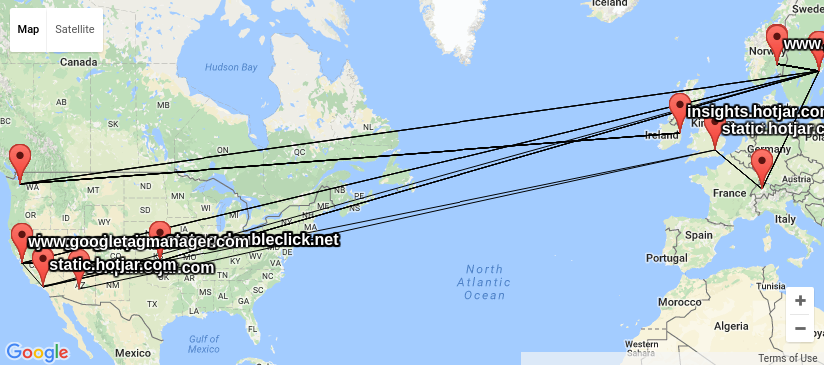
map of combined traces for URLs used by www.stortinget.no using GeoIP When I had a look around for options, I could not find any good free software tools to do this, and decided I needed my own traceroute wrapper outputting KML based on locations looked up using GeoIP. KML is easy to work with and easy to generate, and understood by several of the GIS tools I have available. I got good help from by NUUG colleague Anders Einar with this, and the result can be seen in my kmltraceroute git repository. Unfortunately, the quality of the free GeoIP databases I could find (and the for-pay databases my friends had access to) is not up to the task. The IP addresses of central Internet infrastructure would typically be placed near the controlling companies main office, and not where the router is really located, as you can see from the KML file I created using the GeoLite City dataset from MaxMind.

scapy traceroute graph for URLs used by www.stortinget.no I also had a look at the visual traceroute graph created by the scrapy project, showing IP network ownership (aka AS owner) for the IP address in question. The graph display a lot of useful information about the traceroute in SVG format, and give a good indication on who control the network equipment involved, but it do not include geolocation. This graph make it possible to see the information is made available at least for UNINETT, Catchcom, Stortinget, Nordunet, Google, Amazon, Telia, Level 3 Communications and NetDNA.

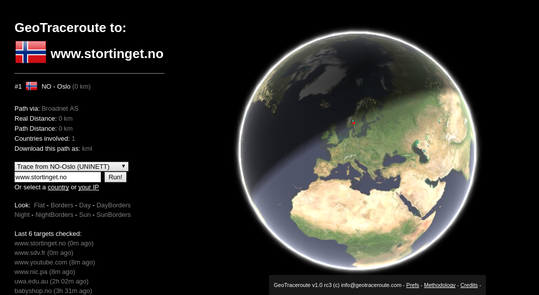
example geotraceroute view for www.stortinget.no In the process, I came across the web service GeoTraceroute by Salim Gasmi. Its methology of combining guesses based on DNS names, various location databases and finally use latecy times to rule out candidate locations seemed to do a very good job of guessing correct geolocation. But it could only do one trace at the time, did not have a sensor in Norway and did not make the geolocations easily available for postprocessing. So I contacted the developer and asked if he would be willing to share the code (he refused until he had time to clean it up), but he was interested in providing the geolocations in a machine readable format, and willing to set up a sensor in Norway. So since yesterday, it is possible to run traces from Norway in this service thanks to a sensor node set up by the NUUG assosiation, and get the trace in KML format for further processing.

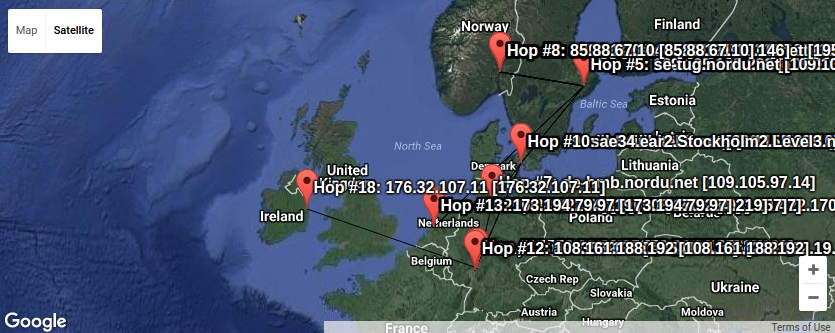
map of combined traces for URLs used by www.stortinget.no using geotraceroute Here we can see a lot of trafic passes Sweden on its way to Denmark, Germany, Holland and Ireland. Plenty of places where the Snowden confirmations verified the traffic is read by various actors without your best interest as their top priority. Combining KML files is trivial using a text editor, so I could loop over all the hosts behind the urls imported by www.stortinget.no and ask for the KML file from GeoTraceroute, and create a combined KML file with all the traces (unfortunately only one of the IP addresses behind the DNS name is traced this time. To get them all, one would have to request traces using IP number instead of DNS names from GeoTraceroute). That might be the next step in this project. Armed with these tools, I find it a lot easier to figure out where the IP traffic moves and who control the boxes involved in moving it. And every time the link crosses for example the Swedish border, we can be sure Swedish Signal Intelligence (FRA) is listening, as GCHQ do in Britain and NSA in USA and cables around the globe. (Hm, what should we tell them? :) Keep that in mind if you ever send anything unencrypted over the Internet. PS: KML files are drawn using the KML viewer from Ivan Rublev, as it was less cluttered than the local Linux application Marble. There are heaps of other options too. As usual, if you use Bitcoin and want to show your support of my activities, please send Bitcoin donations to my address 15oWEoG9dUPovwmUL9KWAnYRtNJEkP1u1b.

1 January 2017

Russ Allbery: Review: Secrets of Productive People

Review: Secrets of Productive People, by Mark Forster
Publisher: Teach Yourself
Copyright: 2015
ISBN: 1-4736-0885-6
Format: Kindle
Pages: 289
Regular readers of my reviews will know that Mark Forster is my favorite writer on time management and productivity. That's mostly because of his flexible toolkit approach that talks about theory and overall goals and then describes multiple ways to get there, rather than presenting a single system that will solve all your problems. There are a lot of writers who explain productivity tips and tricks or describe systems that work for them. There are fewer who can explain why those tricks work (and why they sometimes don't work), and even fewer who can put them into a meaningful analytical framework for thinking about productivity. Forster has several books, but they're a mixed bag. His clearest and most coherent book prior to this one was Do It Tomorrow. Secrets of Productive People is organized differently, chopped up in to small bite-sized chunks with synopses to an extent that it felt a bit choppy to me, but apart from that it's the closest I've seen to an updating of Do It Tomorrow. His other books can be slight (The Pathway to Awesomeness) or downright weird (How to Make Your Dreams Come True). I still have a soft spot for Do It Tomorrow, and I like how it was organized a bit better than this one, but I think Secrets of Productive People has become my new recommendation for where to start with Forster. Secrets of Productive People is divided into five sections: The basics of productivity, the productive attitude, productive projects, aids to productivity, and productivity in action. Each part is divided into several small chapters, which open with a generous helping of quotes about some productivity topic (and I'm going to go back and save some of those), present some easily-digestible related set of thoughts (usually with an exercise), and conclude with a summary. Each chapter is about the length of a long blog post. I think this structure interferes with developing an idea at greater length, but it does make for good reading material in an environment where you're regularly interrupted or only have five or ten minutes. I think I've mentioned in every review that Forster won me over by being willing to talk about the problems with attempting to do too much, not just presenting a system to allow one to accomplish more. Some other books, such as David Allen's famous Getting Things Done, seem to assume you already know what you need to get done, or will easily be able to figure that out when you think for a while, and just need a system to manage all the things you've decided to do. Forster takes the opposite approach, and this book is the clearest yet on this point: most productivity problems are not from being insufficiently efficient, but from doing the wrong things and too many things. You don't need more time; everyone gets the same amount of time. You need to do the right things with the time you have, and that usually means doing fewer things. Readers of Forster's previous books will recognize many of the themes here. Some of the techniques from Do It Tomorrow and some of the exercises from Get Everything Done show up again here. But Forster has streamlined and focused the advice, discarded some things, made his task management recommendations less elaborate and more focused, and spends much more time hammering home the point that the only prioritization that really matters is whether you commit to doing something or don't. The specific task management system he recommends here is one of the variations he's been talking about in his blog and is much simpler than the Do It Tomorrow system: pick five tasks, work on them until you've finished three of them, and then refill to five tasks. I've been using it since reading this book, replacing one of Forster's more elaborate systems from his blog, and it's surprisingly effective. He breaks down in some detail why this works and how to extract additional useful feedback information from it, and now I want to do some of the additional exercises he describes. (That said, I'm still dubious about his advice to not keep any larger to-do list and only rely on your analysis at the time of refilling the list to decide what to do. I use this system with a supplemental, longer list of ideas for future tasks, and that works better for me, although I do have to fight forming a sense of obligation about the things on the longer list. David Allen still has a point that if you don't write down a complete inventory of the things you're worrying about, your brain will try to obsess over them to keep from forgetting them.) The productive projects section told me some things I needed to hear about time commitments. Projects take regular, focused attention, and starting numerous things without giving them that attention is much worse than doing far fewer things but doing them regularly and reliably. I think Forster's coaching on focus and persistence is very valuable; the trick, of course, is building up your willpower for it and learning to say no. This is in-line with recent psychological analysis of multi-tasking and its various negative effects. The working to-do list capped at five things provides enough variety to mentally shift gears if one runs out of steam on some specific project while maintaining enough focus to not leave things behind half-done. The productivity aids section provides a more random collection of tips and tricks, many of which I've seen before in his previous books. I've mostly not tried these, so can't say much about how effective they are, but Forster's ideas almost always sound interesting and plausible. I thought the weakest part of the book was the last section, on applied productivity. Here, Forster takes various life areas (exercise, parenting, finances, writing, etc.) and talks about how the principles of this book can be applied to them. Each area could be a book in itself, and the short essay format of these chapters doesn't do justice to large topics. The result is a rather repetitive section that just stresses analysis, metrics, and repeated, focused attention all valid points, but ones you can pick up from the previous chapters. I don't think these case studies added much value. Do It Tomorrow is still my favorite Forster book to read, but I think Secrets of Productive People is now the best and most polished overview of his time management and productivity approach. If you're interested in this topic and not already sick of Forster from my previous recommendations, this would be a great place to start. I got a lot out of it even with all the time management reading I've previously done, and will probably re-read sections of it and try more of the exercises. Rating: 9 out of 10

30 December 2016

Chris Lamb: My favourite books of 2016

Whilst I managed to read almost sixty books in 2016 here are ten of my favourites in no particular order. Disappointments this year include Stewart Lee's Content Provider (nothing like his stand-up), Christopher Hitchens' And Yet (his best essays are already published) and Heinlein's Stranger in a Strange Land (great exposition, bizarre conclusion). The worst book I finished, by far, was Mark Edward's Follow You Home.



https://images-eu.ssl-images-amazon.com/images/P/B010EAQLV2.01._PC__.jpg Animal QC Gary Bell, QC Subtitled My Preposterous Life, this rags-to-riches story about a working-class boy turned eminent lawyer would be highly readable as a dry and factual account but I am compelled to include it here for its extremely entertaining style of writing. Full of unsurprising quotes that take one unaware: would you really expect a now-Queen's Counsel to "heartily suggest that if you find yourself suffering from dysentery in foreign climes you do not medicate it with lobster thermidor and a bottle of Ecuadorian red?" A real good yarn.

https://images-eu.ssl-images-amazon.com/images/P/B0196HJ6OS.01._PC__.jpg So You've Been Publically Shamed Jon Ronson The author was initially recommended to me by Brad but I believe I started out with the wrong book. In fact, I even had my doubts about this one, prematurely judging from the title that it was merely cashing-in on a fairly recent internet phenomenon like his more recent shallow take on Trump and the alt-Right but in the end I read Publically Shamed thrice in quick succession. I would particularly endorse the audiobook version: Ronson's deadpan drawl suits his writing perfectly.

https://images-eu.ssl-images-amazon.com/images/P/B00IX49OS4.01._PC__.jpg The Obstacle is the Way Ryan Holiday Whilst everyone else appears to be obligated to include Ryan's recent Ego is the Enemy in their Best of 2016 lists I was actually taken by his earlier "introduction by stealth" to stoic philosophy. Certainly not your typical self-help book, this is "a manual to turn to in troubling times". Returning to this work at least three times over the year even splashing out on the audiobook at some point I feel like I learned a great deal, although it is now difficult to pinpoint exactly what. Perhaps another read in 2017 is thus in order

https://images-eu.ssl-images-amazon.com/images/P/071563335X.01._PC__.jpg Layer Cake J.J. Connolly To judge a book in comparison to the film is to do both a disservice, but reading the book of Layer Cake really underscored just how well the film played to the strengths of that medium. All of the aspects that would not have worked had been carefully excised from the screenplay, ironically leaving more rewarding "layers" for readers attempting the book. A parallel adaption here might be No Country for Old Men - I would love to read (or write) a comparative essay between these two adaptions although McCarthy's novel is certainly the superior source material.

https://images-eu.ssl-images-amazon.com/images/P/B00G1SRB6Q.01._PC__.jpg Lying Sam Harris I've absorbed a lot of Sam Harris's uvre this year in the form of his books but moreover via his compelling podcast. I'm especially fond of Waking Up on spirituality without religion and would rank that as my favourite work of his. Lying is a comparatively short read, more of a long essay in fact, where he argues that we can radically simplify our lives by merely telling the truth in situations where others invariably lie. Whilst it would take a brave soul to adopt his approach his case is superlatively well-argued and a delight to read.

https://images-eu.ssl-images-amazon.com/images/P/0140442103.01._PC__.jpg Letters from a Stoic Seneca

Great pleasure is to be found not only in keeping up an old and established friendship but also in beginning and building up a new one. Reading this in a beautifully svelte hardback, I tackled a randomly-chosen letter per day rather than attempting to read it cover-to-cover. Breaking with a life-long tradition, I even decided to highlight sections in pen so I could return to them at ease. I hope it's not too hackneyed to claim I gained a lot from "building up" a relationship with this book. Alas, it is one of those books that is too easy to recommend given that it might make one appear wise and learned, but if you find yourself in a slump, either in life or in your reading habits, it certainly has my approval.


https://images-eu.ssl-images-amazon.com/images/P/B00BHD3TIE.01._PC__.jpg Solo: A James Bond Novel William Boyd I must have read all of the canonical Fleming novels as a teenager and Solo really rewards anyone who has done so. It would certainly punish anyone expecting a Goldeneye or at least be a little too foreign to be enjoyed. Indeed, its really a pastiche of these originals, both in terms of the time period, general tone (Bond is more somber; more vulnerable) and in various obsessions of Fleming's writing, such as the overly-detailed description of the gambling and dining tables. In this universe, 007's restaurant expenses probably contributed signifcantly to the downfall of the British Empire, let alone his waistline. Bond flicking through a ornithological book at one point was a cute touch

https://images-eu.ssl-images-amazon.com/images/P/B019MMUA8S.01._PC__.jpg The Subtle Art of Not Giving A F*ck Mark Manson Certainly a wildcard to include here and not without its problems, The Subtle Art is a curious manifesto on how to approach life. Whilst Manson expouses an age-old philosophy of grounding yourself and ignoring the accumulation of flatscreen TVs, etc. he manages to do so in a fresh and provocative "21st-centry gonzo" style. Highly entertaining, at one point the author posits an alternative superhero ("Disappointment Panda") that dishes out unsolicited and uncomfortable truths to strangers before simply walking away: "You know, if you make more money, that s not going to make your kids love you," or: "What you consider friendship is really just your constant attempts to impress people." Ouch.

https://images-eu.ssl-images-amazon.com/images/P/B004ZLS5RK.01._PC__.jpg The Fourth Protocol Frederick Forsyth I have a crystal-clear memory from my childhood of watching a single scene from a film in the dead of night: Pierce Brosnan sets a nuclear device to detonate after he can get away but a double-crossing accomplice surreptitiously brings the timetable forward in order that the bomb also disposes of him Anyway, at some point whilst reading The Fourth Protocol it dawned on me that this was that book. I might thus be giving the book more credit due to this highly satisfying connection but I think it stands alone as a superlative political page-turner and is still approachable outside the machinations of the Cold War.

https://images-eu.ssl-images-amazon.com/images/P/B003IDMUSG.01._PC__.jpg The Partner John Grisham After indulging in a bit too much non-fiction and an aborted attempt at The Ministry of Fear, I turned to a few so-called lower-brow writers such as Jeffrey Archer, etc. However, it was The Partner that turned out to be a real page-turner for somewhat undefinable reasons. Alas, it appears the rest of the author's output is unfortunately in the same vein (laywers, etc.) so I am hesitant to immediately begin others but judging from various lists online I am glad I approached this one first.

https://images-eu.ssl-images-amazon.com/images/P/B00D3J2QKC.01._PC__.jpg Shogun: The First Novel of the Asian saga James Clavell Despite its length, I simply couldn't resist returning to Shogun this year although it did fatigue me to the point that I have still yet to commence on its sequel, Tai-Pan. Like any good musical composition, one is always rewarded by returning to a book and I took great delight in uncovering more symbolism throughout (such as noticing that one of the first words Blackthorne learns in Japanese is "truth") but also really savouring the tragic arcs that run throughout the novel, some beautiful phrases ("The day seemed to lose its warmth ") and its wistful themes of inevitability and karma.

29 December 2016

Russ Allbery: Review: Pawn of Prophecy

Review: Pawn of Prophecy, by David Eddings
Series: The Belgariad #1
Publisher: Del Rey
Copyright: April 1982
Printing: August 1990
ISBN: 0-345-33551-1
Format: Mass market
Pages: 258
I hit a period in November when I felt like reading something entirely undemanding and fun, something that was predictable, comfortable, and guaranteed to be a happy ending. There are times in life for books like that. I've been vaguely thinking of re-reading the Belgariad for a while, which I'd not read since I was in college, and that seemed to fit the bill. Garion is a farm-boy in Sendaria, a quiet and industrious kingdom full of farmers. His only family is his Aunt Pol, who ran the kitchen at Faldor's farm. His life has all the hallmarks of being entirely unremarkable, despite occasional visits by a traveling vagabond, Wolf, who clearly knows his Aunt Pol. But then something extremely important is stolen elsewhere, Wolf and Pol have to leave to pursue it for reasons that are quite murky to Garion, and Pol is unwilling to leave Garion behind. This begins Garion's great adventure, in which he becomes far more important and powerful than he would have ever imagined. That's the promise, at least, and the stock plot of every series like this. And let me be clear up front: the Belgariad is very stock. That's part of what I was in the mood for, but don't come to this series looking for interesting differentiation. It's clearly in the center of the secondary world chosen one fantasy genre, with a great evil, forces of good arrayed against it, and someone who unknowingly has the power to stop evil but has to learn how to use it. If you're in the mood for this, every note will be comfortably familiar; if not, it might be boringly predictable. Unfortunately, this particular book does not cast the Belgariad in a good light. Garion's introduction to this story is intensely irritating, almost entirely because no one will tell him what's going on. Pol is excessively protective (smotheringly so), but shuts down any questions he has and doesn't explain why she's freaking out. (This doesn't become entirely clear until towards the end of the second book.) What little scraps Garion picks up, he has to get by eavesdropping. Even by the end of this book, when Garion has met royalty and started helping with larger political issues (albeit mostly by accident), everyone is keeping him in the dark and he doesn't believe the hints he's gotten. I can't remember how I reacted to this the first time I read this series, but the second time through, it was extremely frustrating. The frustration is stronger because any regular reader of this genre knows exactly what Garion is, although not precisely how the story will play out, and can make fairly good guesses about Pol and Wolf from early in the story. Everyone playing coy doesn't even add legitimate suspense or set up a big reveal. It just made me irritated at Garion's blindness (it's mildly understandable given how foreign the idea is to his life, but he seems remarkably dense even with that), and even more irritated at Wolf and, in particular, Aunt Pol for keeping him so thoroughly in the dark. Garion is very attached to his aunt; on this re-reading, I wasn't entirely sure why. She occasionally shows love and support, and she's certainly wise, but for most of the book she treats him with brusque condescension and tries to keep him as ignorant as possible. Garion's weird entanglement with a black rider that he'd seen for most of his life doesn't make this any better. It's creepy and disturbing, it's not entirely resolved in this book, and Garion is clearly in danger, which wasn't the vibe that I was looking for when starting this re-read. And it's hard to escape the feeling that Garion might have managed to tell someone if all the adult figures in his life weren't so secretive, dismissive, and excessively controlling. So, all in all, an inauspicious beginning. It was good enough to keep me reading when I first read the series, and it was good enough on this re-read, but just barely. The saving grace is Silk and Barak, when the story finally meets them. Those who have read this series will know that they're just the beginning of the party-building process that will take up much of this series (so many Lord of the Rings resonances), but the one thing I will give Eddings is that he writes entertaining supporting characters. Both of them are a bit stereotyped, but they add so much to this story. Silk in particular is a delight and remains a delight throughout the series, adding a much-needed level of snark and sneaky enjoyment that lightens so many of the serious episodes of this story. The Belgariad in general is highly derivative map exploration fantasy, and you shouldn't expect anything deeper. It is, however, enjoyable map exploration fantasy with some entertaining supporting cast members. Sadly, only the glimmers of that are visible from this book. Pawn of Prophecy is mostly an irritating tour of bad parenting techniques, refusal to talk to teenagers, sneaking around to get information that should have been legitimately shared, and taking forever to get around to the mythology that we all know is coming. I therefore can't recommend this book, although one does have to read it in order to read the rest of the series, which as I recall gets considerably better. Followed by Queen of Sorcery. Rating: 5 out of 10

18 December 2016

Mike Gabriel: Free Your Phone, Free Yourself, Get Sponsored for your Work

TL;DR; This is a call to every FLOSS developer interested in working towards Free Software driven mobile phones, esp. targetting the Fairphone 2. If your only show stopper is lack of development hardware or lack of financial support, please go on reading below. As I see it, the Fairphone 2 will be (or already is) the FLOSS community platform on the mobile devices market. Regularly, I get new notice about people working on this or that OS port to the FP2 hardware platform. The combination of a hardware-wise sustainably maintained mobile phone platform and a Free (or sort-of-Free) operating system being ported to it, makes the Fairphone 2 a really attractive device. Personally, I run Sailfish OS on my Fairphone 2. Some weeks ago, I got contacted by one of my sponsors letting me know that he got involved in setting up an initiative that works on porting the Ubuntu Table/Phone OS to FP2. That very project is in need of more developers. Possibly, it needs exactly YOU!!! So, if you are a developer that meets one or more of the below requirements and are interested in working in a highly motivated team, please get in touch with the UT4FP [1] project (skill requirements taken from the UT4FP website): My sponsor offers to send out FP2 devices to (seriously) interested developers and if needed, he can also back up developers financially. If you are interested, please get in touch with me (and I'll channel you through...) via IRC (on the OFTC or Freenode network). light+love
Mike (aka sunweaver on IRC) [1] https://www.ut4fp.org/

14 December 2016

Antoine Beaupr : Debian considering automated upgrades

The Debian project is looking at possibly making automatic minor upgrades to installed packages the default for newly installed systems. While Debian has a reliable and stable package update system that has been an inspiration for multiple operating systems (the venerable APT), upgrades are, usually, a manual process on Debian for most users. The proposal was brought up during the Debian Cloud sprint in November by longtime Debian Developer Steve McIntyre. The rationale was to make sure that users installing Debian in the cloud have a "secure" experience by default, by installing and configuring the unattended-upgrades package within the images. The unattended-upgrades package contains a Python program that automatically performs any pending upgrade and is designed to run unattended. It is roughly the equivalent of doing apt-get update; apt-get upgrade in a cron job, but has special code to handle error conditions, warn about reboots, and selectively upgrade packages. The package was originally written for Ubuntu by Michael Vogt, a longtime Debian developer and Canonical employee. Since there was a concern that Debian cloud images would be different from normal Debian installs, McIntyre suggested installing unattended-upgrades by default on all Debian installs, so that people have a consistent experience inside and outside of the cloud. The discussion that followed was interesting as it brought up key issues one would have when deploying automated upgrade tools, outlining both the benefits and downsides to such systems.

Problems with automated upgrades An issue raised in the following discussion is that automated upgrades may create unscheduled downtime for critical services. For example, certain sites may not be willing to tolerate a master MySQL server rebooting in conditions not controlled by the administrators. The consensus seems to be that experienced administrators will be able to solve this issue on their own, or are already doing so. For example, Noah Meyerhans, a Debian developer, argued that "any reasonably well managed production host is going to be driven by some kind of configuration management system" where competent administrators can override the defaults. Debian, for example, provides the policy-rc.d mechanism to disable service restarts on certain packages out of the box. unattended-upgrades also features a way to disable upgrades on specific packages that administrators would consider too sensitive to restart automatically and will want to schedule during maintenance windows. Reboots were another issue discussed: how and when to deploy kernel upgrades? Automating kernel upgrades may mean data loss if the reboot happens during a critical operation. On Debian systems, the kernel upgrade mechanisms already provide a /var/run/reboot-required flag file that tools can monitor to notify users of the required reboot. For example, some desktop environments will popup a warning prompting users to reboot when the file exists. Debian doesn't currently feature an equivalent warning for command-line operation: Vogt suggested that the warning could be shown along with the usual /etc/motd announcement. The ideal solution here, of course, is reboot-less kernel upgrades, which is also known as "live patching" the kernel. Unfortunately, this area is still in development in the kernel (as was previously discussed here). Canonical deployed the feature for the Ubuntu 16.04 LTS release, but Debian doesn't yet have such capability, since it requires extra infrastructure among other issues. Furthermore, system reboots are only one part of the problem. Currently, upgrading packages only replaces the code and restarts the primary service shipped with a given package. On library upgrades, however, dependent services may not necessarily notice and will keep running with older, possibly vulnerable, libraries. While libc6, in Debian, has special code to restart dependent services, other libraries like libssl do not notify dependent services that they need to restart to benefit from potentially critical security fixes. One solution to this is the needrestart package which inspects all running processes and restarts services as necessary. It also covers interpreted code, specifically Ruby, Python, and Perl. In my experience, however, it can take up to a minute to inspect all processes, which degrades the interactivity of the usually satisfying apt-get install process. Nevertheless, it seems like needrestart is a key component of a properly deployed automated upgrade system.

Benefits of automated upgrades One thing that was less discussed is the actual benefit of automating upgrades. It is merely described as "secure by default" by McIntyre in the proposal, but no one actually expanded on this much. For me, however, it is now obvious that any out-of-date system will be systematically attacked by automated probes and may be taken over to the detriment of the whole internet community, as we are seeing with Internet of Things devices. As Debian Developer Lars Wirzenius said:
The ecosystem-wide security benefits of having Debian systems keep up to date with security updates by default overweigh any inconvenience of having to tweak system configuration on hosts where the automatic updates are problematic.
One could compare automated upgrades with backups: if they are not automated, they do not exist and you will run into trouble without them. (Wirzenius, coincidentally, also works on the Obnam backup software.) Another benefit that may be less obvious is the acceleration of the feedback loop between developers and users: developers like to know quickly when an update creates a regression. Automation does create the risk of a bad update affecting more users, but this issue is already present, to a lesser extent, with manual updates. And the same solution applies: have a staging area for security upgrades, the same way updates to Debian stable are first proposed before shipping a point release. This doesn't have to be limited to stable security updates either: more adventurous users could follow rolling distributions like Debian testing or unstable with unattended upgrades as well, with all the risks and benefits that implies.

Possible non-issues That there was not a backlash against the proposal surprised me: I expected the privacy-sensitive Debian community to react negatively to another "phone home" system as it did with the Django proposal. This, however, is different than a phone home system: it merely leaks package lists and one has to leak that information to get the updated packages. Furthermore, privacy-sensitive administrators can use APT over Tor to fetch packages. In addition, the diversity of the mirror infrastructure makes it difficult for a single entity to profile users. Automated upgrades do imply a culture change, however: administrators approve changes only a posteriori as opposed to deliberately deciding to upgrade parts they chose. I remember a time when I had to maintain proprietary operating systems and was reluctant to enable automated upgrades: such changes could mean degraded functionality or additional spyware. However, this is the free-software world and upgrades generally come with bug fixes and new features, not additional restrictions.

Automating major upgrades? While automating minor upgrades is one part of the solution to the problem of security maintenance, the other is how to deal with major upgrades. Once a release becomes unsupported, security issues may come up and affect older software. While Debian LTS extends releases lifetimes significantly, it merely delays the inevitable major upgrades. In the grand scheme of things, the lifetimes of Linux systems (Debian: 3-5 years, Ubuntu: 1-5 years) versus other operating systems (Solaris: 10-15 years, Windows: 10+ years) is fairly short, which makes major upgrades especially critical. While major upgrades are not currently automated in Debian, they are usually pretty simple: edit sources.list then:
    # apt-get update && apt-get dist-upgrade
But the actual upgrade process is really much more complex. If you run into problems with the above commands, you will quickly learn that you should have followed the release notes, a whopping 20,000-word, ten-section document that outlines all the gory details of the release. This is a real issue for large deployments and for users unfamiliar with the command line. The solutions most administrators seem to use right now is to roll their own automated upgrade process. For example, the Debian.org system administrators have their own process for the "jessie" (8.0) upgrade. I have also written a specification of how major upgrades could be automated that attempts to take into account the wide variety of corner cases that occur during major upgrades, but it is currently at the design stage. Therefore, this problem space is generally unaddressed in Debian: Ubuntu does have a do-release-upgrade command but it is Ubuntu-specific and would need significant changes in order to work in Debian.

Future work Ubuntu currently defaults to "no automation" but, on install, invites users to enable unattended-upgrades or Landscape, a proprietary system-management service from Canonical. According to Vogt, the company supports both projects equally as they differ in scope: unattended-upgrades just upgrades packages while Landscape aims at maintaining thousands of machines and handles user management, release upgrades, statistics, and aggregation. It appears that Debian will enable unattended-upgrades on the images built for the cloud by default. For regular installs, the consensus that has emerged points at the Debian installer prompting users to ask if they want to disable the feature as well. One reason why this was not enabled before is that unattended-upgrades had serious bugs in the past that made it less attractive. For example, it would simply fail to follow security updates, a major bug that was fortunately promptly fixed by the maintainer. In any case, it is important to distribute security and major upgrades on Debian machines in a timely manner. In my long experience in professionally administering Unix server farms, I have found the upgrade work to be a critical but time-consuming part of my work. During that time, I successfully deployed an automated upgrade system all the way back to Debian woody, using the simpler cron-apt. This approach is, unfortunately, a little brittle and non-standard; it doesn't address the need of automating major upgrades, for which I had to revert to tools like cluster-ssh or more specialized configuration management tools like Puppet. I therefore encourage any effort towards improving that process for the whole community. More information about the configuration of unattended-upgrades can be found in the Ubuntu documentation or the Debian wiki.
Note: this article first appeared in the Linux Weekly News.

Antoine Beaupr : Django debates privacy concern

In recent years, privacy issues have become a growing concern among free-software projects and users. As more and more software tasks become web-based, surveillance and tracking of users is also on the rise. While some software may use advertising as a source of revenue, which has the side effect of monitoring users, the Django community recently got into an interesting debate surrounding a proposal to add user tracking actually developer tracking to the popular Python web framework.

Tracking for funding A novel aspect of this debate is that the initiative comes from concerns of the Django Software Foundation (DSF) about funding. The proposal suggests that "relying on the free labor of volunteers is ineffective, unfair, and risky" and states that "the future of Django depends on our ability to fund its development". In fact, the DSF recently hired an engineer to help oversee Django's development, which has been quite successful in helping the project make timely releases with fewer bugs. Various fundraising efforts have resulted in major new Django features, but it is difficult to attract sponsors without some hard data on the usage of Django. The proposed feature tries to count the number of "unique developers" and gather some metrics of their environments by using Google Analytics (GA) in Django. The actual proposal (DEP 8) is done as a pull request, which is part of Django Enhancement Proposal (DEP) process that is similar in spirit to the Python Enhancement Proposal (PEP) process. DEP 8 was brought forward by a longtime Django developer, Jacob Kaplan-Moss. The rationale is that "if we had clear data on the extent of Django's usage, it would be much easier to approach organizations for funding". The proposal is essentially about adding code in Django to send a certain set of metrics when "developer" commands are run. The system would be "opt-out", enabled by default unless turned off, although the developer would be warned the first time the phone-home system is used. The proposal notes that an opt-in system "severely undercounts" and is therefore not considered "substantially better than a community survey" that the DSF is already doing.

Information gathered The pieces of information reported are specifically designed to run only in a developer's environment and not in production. The metrics identified are, at the time of writing:
  • an event category (the developer commands: startproject, startapp, runserver)
  • the HTTP User-Agent string identifying the Django, Python, and OS versions
  • a user-specific unique identifier (a UUID generated on first run)
The proposal mentions the use of the GA aip flag which, according to GA documentation, makes "the IP address of the sender 'anonymized'". It is not quite clear how that is done at Google and, given that it is a proprietary platform, there is no way to verify that claim. The proposal says it means that "we can't see, and Google Analytics doesn't store, your actual IP". But that is not actually what Google does: GA stores IP addresses, the documentation just says they are anonymized, without explaining how. GA is presented as a trade-off, since "Google's track record indicates that they don't value privacy nearly as high" as the DSF does. The alternative, deploying its own analytics software, was presented as making sustainability problems worse. According to the proposal, Google "can't track Django users. [...] The only thing Google could do would be to lie about anonymizing IP addresses, and attempt to match users based on their IPs". The truth is that we don't actually know what Google means when it "anonymizes" data: Jannis Leidel, a Django team member, commented that "Google has previously been subjected to secret US court orders and was required to collaborate in mass surveillance conducted by US intelligence services" that limit even Google's capacity of ensuring its users' anonymity. Leidel also argued that the legal framework of the US may not apply elsewhere in the world: "for example the strict German (and by extension EU) privacy laws would exclude the automatic opt-in as a lawful option". Furthermore, the proposal claims that "if we discovered Google was lying about this, we'd obviously stop using them immediately", but it is unclear exactly how this could be implemented if the software was already deployed. There are also concerns that an implementation could block normal operation, especially in countries (like China) where Google itself may be blocked. Finally, some expressed concerns that the information could constitute a security problem, since it would unduly expose the version number of Django that is running.

In other projects Django is certainly not the first project to consider implementing analytics to get more information about its users. The proposal is largely inspired by a similar system implemented by the OS X Homebrew package manager, which has its own opt-out analytics. Other projects embed GA code directly in their web pages. This is apparently the option chosen by the Oscar Django-based ecommerce solution, but that was seen by the DSF as less useful since it would count Django administrators and wasn't seen as useful as counting developers. Wagtail, a Django-based content-management system, was incorrectly identified as using GA directly, as well. It actually uses referrer information to identify installed domains through the version updates checks, with opt-out. Wagtail didn't use GA because the project wanted only minimal data and it was worried about users' reactions. NPM, the JavaScript package manager, also considered similar tracking extensions. Laurie Voss, the co-founder of NPM, said it decided to completely avoid phoning home, because "users would absolutely hate it". But NPM users are constantly downloading packages to rebuild applications from scratch, so it has more complete usage metrics, which are aggregated and available via a public API. NPM users seem to find this is a "reasonable utility/privacy trade". Some NPM packages do phone home and have seen "very mixed" feedback from users, Voss said. Eric Holscher, co-founder of Read the Docs, said the project is considering using Sentry for centralized reporting, which is a different idea, but interesting considering Sentry is fully open source. So even though it is a commercial service (as opposed to the closed-source Google Analytics), it may be possible to verify any anonymity claims.

Debian's response Since Django is shipped with Debian, one concern was the reaction of the distribution to the change. Indeed, "major distros' positions would be very important for public reception" to the feature, another developer stated. One of the current maintainers of Django in Debian, Rapha l Hertzog, explicitly stated from the start that such a system would "likely be disabled by default in Debian". There were two short discussions on Debian mailing lists where the overall consensus seemed to be that any opt-out tracking code was undesirable in Debian, especially if it was aimed at Google servers. I have done some research to see what, exactly, was acceptable as a phone-home system in the Debian community. My research has revealed ten distinct bug reports against packages that would unexpectedly connect to the network, most of which were not directly about collecting statistics but more often about checking for new versions. In most cases I found, the feature was disabled. In the case of version checks, it seems right for Debian to disable the feature, because the package cannot upgrade itself: that task is delegated to the package manager. One of those issues was the infamous "OK Google" voice activation binary blog controversy that was previously reported here and has since then been fixed (although other issues remain in Chromium). I have also found out that there is no clearly defined policy in Debian regarding tracking software. What I have found, however, is that there seems to be a strong consensus in Debian that any tracking is unacceptable. This is, for example, an extract of a policy that was drafted (but never formally adopted) by Ian Jackson, a longtime Debian developer:
Software in Debian should not communicate over the network except: in order to, and as necessary to, perform their function[...]; or for other purposes with explicit permission from the user.
In other words, opt-in only, period. Jackson explained that "when we originally wrote the core of the policy documents, the DFSG [Debian Free Software Guidelines], the SC [Social Contract], and so on, no-one would have considered this behaviour acceptable", which explains why no explicit formal policy has been adopted yet in the Debian project. One of the concerns with opt-out systems (or even prompts that default to opt-in) was well explained back then by Debian developer Bas Wijnen:
It very much resembles having to click through a license for every package you install. One of the nice things about Debian is that the user doesn't need to worry about such things: Debian makes sure things are fine.
One could argue that Debian has its own tracking systems. For example, by default, Debian will "phone home" through the APT update system (though it only reports the packages requested). However, this is currently not automated by default, although there are plans to do so soon. Furthermore, Debian members do not consider APT as tracking, because it needs to connect to the network to accomplish its primary function. Since there are multiple distributed mirrors (which the user gets to choose when installing), the risk of surveillance and tracking is also greatly reduced. A better parallel could be drawn with Debian's popcon system, which actually tracks Debian installations, including package lists. But as Barry Warsaw pointed out in that discussion, "popcon is 'opt-in' and [...] the overwhelming majority in Debian is in favour of it in contrast to 'opt-out'". It should be noted that popcon, while opt-in, defaults to "yes" if users click through the install process. [Update: As pointed out in the comments, popcon actually defaults to "no" in Debian.] There are around 200,000 submissions at this time, which are tracked with machine-specific unique identifiers that are submitted daily. Ubuntu, which also uses the popcon software, gets around 2.8 million daily submissions, while Canonical estimates there are 40 million desktop users of Ubuntu. This would mean there is about an order of magnitude more installations than what is reported by popcon. Policy aside, Warsaw explained that "Debian has a reputation for taking privacy issues very serious and likes to keep it".

Next steps There are obviously disagreements within the Django project about how to handle this problem. It looks like the phone-home system may end up being implemented as a proxy system "which would allow us to strip IP addresses instead of relying on Google to anonymize them, or to anonymize them ourselves", another Django developer, Aymeric Augustin, said. Augustin also stated that the feature wouldn't "land before Django drops support for Python 2", which is currently estimated to be around 2020. It is unclear, then, how the proposal would resolve the funding issues, considering how long it would take to deploy the change and then collect the information so that it can be used to spur the funding efforts. It also seems the system may explicitly prompt the user, with an opt-out default, instead of just splashing a warning or privacy agreement without a prompt. As Shai Berger, another Django contributor, stated, "you do not get [those] kind of numbers in community surveys". Berger also made the argument that "we trust the community to give back without being forced to do so"; furthermore:
I don't believe the increase we might get in the number of reports by making it harder to opt-out, can be worth the ill-will generated for people who might feel the reporting was "sneaked" upon them, or even those who feel they were nagged into participation rather than choosing to participate.
Other options may also include gathering metrics in pip or PyPI, which was proposed by Donald Stufft. Leidel also proposed that the system could ask to opt-in only after a few times the commands are called. It is encouraging to see that a community can discuss such issues without heating up too much and shows great maturity for the Django project. Every free-software project may be confronted with funding and sustainability issues. Django seems to be trying to address this in a transparent way. The project is willing to engage with the whole spectrum of the community, from the top leaders to downstream distributors, including individual developers. This practice should serve as a model, if not of how to do funding or tracking, at least of how to discuss those issues productively. Everyone seems to agree the point is not to surveil users, but improve the software. As Lars Wirzenius, a Debian developer, commented: "it's a very sad situation if free software projects have to compromise on privacy to get funded". Hopefully, Django will be able to improve its funding without compromising its principles.
Note: this article first appeared in the Linux Weekly News.

2 December 2016

Shirish Agarwal: Air Congestion and Politics

Confession time first I am not a frequent flyer at all. My first flight was in early late 2006. It was a 2 hour flight from Bombay (BOM) to Bengaluru (formerly Bangalore, BLG) . I still remember the trepidation, the nervousness and excitement the first time I took to air. I still remember the flight very vividly, It was a typical humid day for Bombay/Mumbai and we (me and a friend) had gone to Sahar (the domestic airport) to take the flight in the evening. Before starting the sky had turned golden-orange and I was wondering how I would feel once I would be in air.We started at around 20:00 hours in the evening and as it was a clear night were able to see the Queen s necklace (Marine Drive) in all her glory. The photographs on the wikipedia page don t really do justice to how beautiful the whole boulevard looks at night, especially how it looks from up there. While we were seeing, it seemed the pilot had actually banked at 45 degrees angle so we can have the best view of the necklace OR maybe the pilot wanted to take a photo OR ME being in overdrive (like Robin Williams, the Russian immigrant in Moscow on the Hudson experiences the first time he goes to the mall ;)) In either way, this would be an experience I would never forget till the rest of my life. I remember I didn t move an inch (even to go the loo) as I didn t want to let go of the whole experience. While I came back after 3-4 days, I still remember re-experiencing/re-imagining the flights for a whole month each time I went to sleep. While I can t say it has become routinised, but have been lucky to have the opportunity to fly domestic around the country primarily for work. After the initial romanticism wears off, you try and understand the various aspects of the flight which are happening around you. These experiences are what lead to file/share today s blog post. Yesterday, Ms. Mamata Banerjee, one of the leaders of the Opposition cried wolf because the Aircraft was circling the Airport. Because she is the Chief Minister she feels she should have got precedent or at least that seems to be the way the story unfolded on TV. I have been about 15-20 times on flight in the last decade for work or leisure. Almost all the flights I have been, it has been routine that the flights fly around the Airport for 15-20 minutes before landing. This is routine . I have seen Airlines being stacked (remember the scene from Die Hard 2 where Holly Mclane, John Mclane s wife looks at different aircraft at different altitudes from her window seat) this is what an Airport has to do when it doesn t have enough runaways. In fact just read few days back MIAL is going for an emergency expansion as they weren t expecting as many passengers as they did this year as well as last. In fact the same day there was a near-miss between two aircraft in Mumbai airport itself. Because of Ms. Mamata s belligerence, this story didn t even get a mention in the TV mainstream media. The point I wanna underscore is that this is a fact of life and not just in India, world-over it seems hubs are being busier than ever, for instance Heathrow has been also a busy bee and they will to rework air operations as per a recent article . In India, Kolkata is also one of the busier airports . If anything, I hope it teaches her the issues that plague most Indian airports and she works with the Government in Center so the Airport can expand more. They just got a new terminal three years back. It is for these issues that the Indian Government has come with the Regional Connectivity Scheme . Lastly, a bit of welcome news to people thinking to visit India, the Govt. of the day is facilitating easier visa norms to increase tourism and trade to India. Hope this is beneficial to all and any Debian Developers who wanna come visit India I do hope that we also do get reciprocity from those countries as well.
Filed under: Miscellenous Tagged: # Domestic Flights, #Air Congestion, #Airport Expansion, #Kolkata, #near-miss, #Visa for tourists

24 November 2016

Ritesh Raj Sarraf: LIO -fb in Debian

LIO -fb is the new SCSI Target for Debian. Previously, we maintained the LIO tools from the pre-fork upstream branch. But, with good reasons, we've now moved to the newer -fb (Free Branch). As the maintainer for those pacakges, I have a local LIO setup. Overy the years, I've been tuning and using this setup with a bunch of SCSI clients. Now with the new -fb packages it was worrisome for me, on how to migrate (Note: migration is not supported by the Debian packages) my old setup to the new one. Thanks to Andy Grover for mentioning it, migrating your configuration is doable. With some minor intervention, I was able to switch my config from old LIO setup to the new LIO -fb pacakges. As you can see from the output below, both the outputs look the same, which is a good thing. LIO reads its configuration from /etc/target/ and passes it into the kernel. The kernel loads the config. The real time config is present in configfs, within the kernel. Users willing for such migration need to ensure that the loaded config data remains in configfs. And then, using the new -fb tools (targetctl), the configuration data needs to be read and written to a new format in /etc/.
/> ls
o- / ......................................................................................................................... [...]
  o- backstores .............................................................................................................. [...]
    o- fileio ................................................................................................... [0 Storage Object]
    o- iblock .................................................................................................. [4 Storage Objects]
      o- CENTOS ................................................................................................. [/dev/vdd, in use]
      o- SAN1 ................................................................................................... [/dev/vdb, in use]
      o- SAN2 ................................................................................................... [/dev/vdc, in use]
      o- SANROOT .............................................. [/dev/disk/by-id/scsi-0QEMU_QEMU_HARDDISK_drive-scsi0-0-0-0, in use]
    o- pscsi .................................................................................................... [0 Storage Object]
    o- rd_mcp ................................................................................................... [0 Storage Object]
  o- ib_srpt ........................................................................................................... [0 Targets]
  o- iscsi ............................................................................................................. [3 Targets]
    o- iqn.1994-05.com.redhat:23d8eb7fa1fc ................................................................................. [1 TPG]
      o- tpg1 ............................................................................................................ [enabled]
        o- acls ............................................................................................................ [1 ACL]
          o- iqn.1994-05.com.redhat:23d8eb7fa1fc .................................................................... [1 Mapped LUN]
            o- mapped_lun0 ............................................................................................. [lun0 (rw)]
        o- luns ............................................................................................................ [1 LUN]
          o- lun0 ....................................................................................... [iblock/CENTOS (/dev/vdd)]
        o- portals ..................................................................................................... [4 Portals]
          o- 172.16.20.40:3260 ................................................................................. [OK, iser disabled]
          o- 172.16.20.41:3260 ................................................................................. [OK, iser disabled]
          o- 172.16.20.42:3260 ................................................................................. [OK, iser disabled]
          o- 172.16.20.43:3260 ................................................................................. [OK, iser disabled]
    o- iqn.2003-01.org.linux-iscsi.debian.sanboot .......................................................................... [1 TPG]
      o- tpg1 ............................................................................................................ [enabled]
        o- acls ............................................................................................................ [1 ACL]
          o- iqn.2005-03.org.open-iscsi:fd2bc2f4652a-sanboot ........................................................ [1 Mapped LUN]
            o- mapped_lun0 ............................................................................................. [lun0 (rw)]
        o- luns ............................................................................................................ [1 LUN]
          o- lun0 .................................... [iblock/SANROOT (/dev/disk/by-id/scsi-0QEMU_QEMU_HARDDISK_drive-scsi0-0-0-0)]
        o- portals ..................................................................................................... [4 Portals]
          o- 172.16.20.40:3260 ................................................................................. [OK, iser disabled]
          o- 172.16.20.41:3260 ................................................................................. [OK, iser disabled]
          o- 172.16.20.42:3260 ................................................................................. [OK, iser disabled]
          o- 172.16.20.43:3260 ................................................................................. [OK, iser disabled]
    o- iqn.2003-01.org.linux-iscsi.debian.x8664 ............................................................................ [1 TPG]
      o- tpg1 ............................................................................................................ [enabled]
        o- acls ............................................................................................................ [1 ACL]
          o- iqn.1993-08.org.debian:01:2972f6b5fc7 ................................................................. [2 Mapped LUNs]
            o- mapped_lun0 ............................................................................................. [lun0 (rw)]
            o- mapped_lun1 ............................................................................................. [lun1 (rw)]
        o- luns ........................................................................................................... [2 LUNs]
          o- lun0 ......................................................................................... [iblock/SAN1 (/dev/vdb)]
          o- lun1 ......................................................................................... [iblock/SAN2 (/dev/vdc)]
        o- portals ..................................................................................................... [4 Portals]
          o- 172.16.20.40:3260 ................................................................................. [OK, iser disabled]
          o- 172.16.20.41:3260 ................................................................................. [OK, iser disabled]
          o- 172.16.20.42:3260 ................................................................................. [OK, iser disabled]
          o- 172.16.20.43:3260 ................................................................................. [OK, iser disabled]
  o- loopback .......................................................................................................... [0 Targets]
  o- qla2xxx ........................................................................................................... [0 Targets]
  o- tcm_fc ............................................................................................................ [0 Targets]
  o- vhost ............................................................................................................. [0 Targets]
/> 
/> ls
o- / ......................................................................................................................... [...]
  o- backstores .............................................................................................................. [...]
    o- block .................................................................................................. [Storage Objects: 4]
      o- CENTOS ........................................................................... [/dev/vdd (2.0GiB) write-thru activated]
      o- SAN1 ............................................................................. [/dev/vdb (1.0GiB) write-thru activated]
      o- SAN2 ............................................................................. [/dev/vdc (1.0GiB) write-thru activated]
      o- SANROOT ........................ [/dev/disk/by-id/scsi-0QEMU_QEMU_HARDDISK_drive-scsi0-0-0-0 (8.0GiB) write-thru activated]
    o- fileio ................................................................................................. [Storage Objects: 0]
    o- pscsi .................................................................................................. [Storage Objects: 0]
    o- ramdisk ................................................................................................ [Storage Objects: 0]
  o- iscsi ............................................................................................................ [Targets: 3]
    o- iqn.1994-05.com.redhat:23d8eb7fa1fc ............................................................................... [TPGs: 1]
      o- tpg1 ............................................................................................... [no-gen-acls, no-auth]
        o- acls .......................................................................................................... [ACLs: 1]
          o- iqn.1994-05.com.redhat:23d8eb7fa1fc .................................................................. [Mapped LUNs: 1]
            o- mapped_lun0 ................................................................................ [lun0 block/CENTOS (rw)]
        o- luns .......................................................................................................... [LUNs: 1]
          o- lun0 ........................................................................................ [block/CENTOS (/dev/vdd)]
        o- portals .................................................................................................... [Portals: 4]
          o- 172.16.20.40:3260 ................................................................................................ [OK]
          o- 172.16.20.41:3260 ................................................................................................ [OK]
          o- 172.16.20.42:3260 ................................................................................................ [OK]
          o- 172.16.20.43:3260 ................................................................................................ [OK]
    o- iqn.2003-01.org.linux-iscsi.debian.sanboot ........................................................................ [TPGs: 1]
      o- tpg1 ............................................................................................... [no-gen-acls, no-auth]
        o- acls .......................................................................................................... [ACLs: 1]
          o- iqn.2005-03.org.open-iscsi:fd2bc2f4652a-sanboot ...................................................... [Mapped LUNs: 1]
            o- mapped_lun0 ............................................................................... [lun0 block/SANROOT (rw)]
        o- luns .......................................................................................................... [LUNs: 1]
          o- lun0 ..................................... [block/SANROOT (/dev/disk/by-id/scsi-0QEMU_QEMU_HARDDISK_drive-scsi0-0-0-0)]
        o- portals .................................................................................................... [Portals: 4]
          o- 172.16.20.40:3260 ................................................................................................ [OK]
          o- 172.16.20.41:3260 ................................................................................................ [OK]
          o- 172.16.20.42:3260 ................................................................................................ [OK]
          o- 172.16.20.43:3260 ................................................................................................ [OK]
    o- iqn.2003-01.org.linux-iscsi.debian.x8664 .......................................................................... [TPGs: 1]
      o- tpg1 ............................................................................................... [no-gen-acls, no-auth]
        o- acls .......................................................................................................... [ACLs: 1]
          o- iqn.1993-08.org.debian:01:2972f6b5fc7 ................................................................ [Mapped LUNs: 2]
            o- mapped_lun0 .................................................................................. [lun0 block/SAN1 (rw)]
            o- mapped_lun1 .................................................................................. [lun1 block/SAN2 (rw)]
        o- luns .......................................................................................................... [LUNs: 2]
          o- lun0 .......................................................................................... [block/SAN1 (/dev/vdb)]
          o- lun1 .......................................................................................... [block/SAN2 (/dev/vdc)]
        o- portals .................................................................................................... [Portals: 4]
          o- 172.16.20.40:3260 ................................................................................................ [OK]
          o- 172.16.20.41:3260 ................................................................................................ [OK]
          o- 172.16.20.42:3260 ................................................................................................ [OK]
          o- 172.16.20.43:3260 ................................................................................................ [OK]
  o- loopback ......................................................................................................... [Targets: 0]
  o- vhost ............................................................................................................ [Targets: 0]
/> 

Categories:

Keywords:

Like:

23 November 2016

Joachim Breitner: microG on Jolla

I am a incorrigibly in picking non-mainstream, open smartphones, and then struggling hard. Back then in 2008, I tried to use the OpenMoko FreeRunner, but eventually gave up because of hardware glitches and reverted to my good old Siemens S35. It was not that I would not be willing to put up with inconveniences, but as soon as it makes live more difficult for the people I communicate with, it becomes hard to sustain. Two years ago I tried again, and got myself a Jolla phone, running Sailfish OS. Things are much nicer now: The hardware is mature, battery live is good, and the Android compatibility layer enables me to run many important apps that are hard to replace, especially the Deutsche Bahn Navigator and various messengers, namely Telegram, Facebook Messenger, Threema and GroupMe. Some apps that require Google Play Services, which provides a bunch of common tasks and usually comes with the Google Play store would not run on my phone, as Google Play is not supported on Sailfish OS. So far, the most annoying ones of that sort were Uber and Lyft, making me pay for expensive taxis when others would ride cheaper, but I can live with that. I tried to install Google Play Services from shady sources, but it would regularly crash.

Signal on Jolla Now in Philadelphia, people urged me to use the Signal messenger, and I was convinced by its support for good end-to-end crypto, while still supporting offline messages and allowing me to switch from my phone to my desktop and back during a conversation. The official Signal app uses Google Cloud Messaging (GCM, part of Google Play Services) to get push updates about new posts, and while I do not oppose this use of Google services (it really is just a ping without any metadata), this is a problem on Sailfish OS. Luckily, the Signal client is open source, and someone created a LibreSignal edition that replaced the use of GCM with websockets, and indeed, this worked on my phone, and I could communicate. Things were not ideal, though: I would often have to restart the app to get newly received messages; messages that I send via Signal Desktop would often not show up on the phone and, most severe, basically after every three messages, sending more messages from Desktop would stop working for my correspondents, which freaked them out. (Strangely it continued working from their phone app, so we coped for a while.) So again, my choice of non-standard devices causes inconveniences to others. This, and the fact that the original authors of Signal and the maintainers of LibreSignal got into a fight that ended LibreSignal discontinued, meant that I have to change something about this situation. I was almost ready to give in and get myself a Samsung S7 or something boring of the sort, but then I decided to tackle this issue once more, following some of the more obscure instructions out there, trying to get vanilla Signal working on my phone. About a day later, I got it, and this is how I did it.

microG So I need Google Play Services somehow, but installing the real thing did not seem to be very promising (I tried, and regularly got pop-ups telling me that Play Services has crashed.) But I found some references to a project called microG , which is an independent re-implementation of (some of) of the play services, in particular including GCM. Installing microG itself was easy, as you can add their repository to F-Droid. I installed the core services, the services framework and the fake store apps. If this had been all that was to do, things would be easy!

Play Store detection work arounds But Signal would still complain about the lack of Google Play Services. It asks Android if an app with a certain name is installed, and would refuse to work if this app does not exist. For some reason, the microG apps cannot just have the names of the real Google apps. There seem to be two ways of working around this: Patching Signal, or enabling Signature Spoofing. The initially most promising instructions (which are in a README in a tarball on a fishy file hoster linked from an answer on the Jolla support forum ) suggested patching Signal, and actually came both with a version of an app called Lucky Patcher as well as a patched Android package, but both about two years old. I tried a recent version of the Lucky Patcher, but it failed to patch the current version of Signal.

Signature Spoofing So on to Signature Spoofing. This is a feature of some non-standard Android builds that allow apps (such as microG) to fake the existence of other apps (the Play Store), and is recommended by the microG project. Sailfish OS s Android compatibility layer Alien Dalvik does not support it out of the box, but there is a tool tingle that adds this feature to existing Android systems. One just has to get the /system/framework/framework.jar file, put it into the input folder of this project, run python main.py, select 2, and copy the framework.jar from output/ back. Great.

Deodexing Alien Dalvik Only that it only works on deodexed files. I did not know anything about odexed Android Java classes (and did not really want to know), but there was not way around. Following this explanation I gathered that one finds files foo.odex in the Android system folder, runs some tool on them to create a classes.dex file, and adds that to the corresponding foo.jar or foo.apk file, copies this back to the phone and deletes the foo.odex file. The annoying this is that one does not only have to do it for framework.jar in order to please tingle, because if one does it to one odex file, one has to do to all! It seems that for people using Windows, the Universal Deodexer V5 seems to be a convenient tool, but I had to go more manually. So I first fetched smali , compiled it using ./gradlew build. Then I fetched the folders /opt/alien/system/framework and /opt/alien/system/app from the phone (e.g. using scp). Keep a backup of these in case something breaks. Then I ran these commands (disclaimer: I fetched these from my bash history and slightly cleaned them up. This is not a fire-and-forget script! Use it when you know what it and you are doing):
cd framework
for file in *.odex
do
  java -jar ~/build/smali/baksmali/build/libs/baksmali.jar deodex $file -o out
  java -jar ~/build/smali/smali/build/libs/smali.jar a out -o classes.dex
  zip -u $(basename $file .odex).jar classes.dex
  rm -rf out classes.dex $file
done
cd ..
cd app
for file in *.odex
do
  java -jar ~/build/smali/baksmali/build/libs/baksmali.jar deodex -d ../framework $file -o out
  java -jar ~/build/smali/smali/build/libs/smali.jar a out -o classes.dex
  zip -u $(basename $file .odex).apk classes.dex
  rm -rf out classes.dex $file
done
cd ..
The resulting framework.jar can now be patched with tingle:
mv framework/framework.jar ~/build/tingle/input
cd ~/build/tingle
./main.py
# select 2
cd -
mv ~/build/tingle/output/framework.jar framework/framework.jar
Now I copy these framework and app folders back on my phone, and restart Dalvik:
devel-su systemctl restart aliendalvik.service
It might start a bit slower than usually, but eventually, all the Android apps should work as before. The final bit that was missing in my case was that I had to reinstall Signal: If it is installed before microG is installed, it does not get permission to use GCM, and when it tries (while registering: After generating the keys) it just crashes. I copied /data/data/org.thoughtcrime.secretsms/ before removing Signal and moved it back after (with cp -a to preserve permissions) so that I could keep my history. And now, it seems, vanilla Signal is working just fine on my Jolla phone!

What s missing Am I completely happy with Signal? No! An important feature that it is lacking is a way to get out all data (message history including media files) in a file format that can be read without Signal; e.g. YAML files or clean HTML code. I do want to be able to re-read some of the more interesting conversations when I am 74 or 75, and I doubt that there will be a Signal App, or even Android, then. I hope that this becomes available in time, maybe in the Desktop version. I would also hope that pidgin gets support to the Signal protocol, so that I conveniently use one program for all my messaging needs on the desktop. Finally it would be nice if my Signal identity was less tied to one phone number. I have a German and a US phone number, and would want to be reachable under both on all my clients. (If you want to contact me on Signal, use my US phone number.)

Alternatives Could I have avoided this hassle by simply convincing people to use something other than Signal? Tricky, at the moment. Telegram (which works super reliable for me, and has a pidgin plugin) has dubious crypto and does not support crypto while using multiple clients. Threema has no desktop client that I know of. OTR on top of Jabber does not support offline messages. So nothing great seems to exist right now. In the long run, the best bet seems to be OMEMO (which is, in essence, the Signal protocol) on top of Jabber. It is currently supported by one Android Jabber client (Conversations) and one Desktop application (gajim, via a plugin). I should keep an eye on pidgin support for OMEMO and other development around this.

22 November 2016

Steve Langasek: A new chapter

I don't often write on this blog, and when I do, it's either tech related, or light life stuff. Over the next few weeks, it's going to get a lot more political. If you currently follow this blog for its technical content, you may be tempted to tune out. I would encourage you to stay and listen. I'm passionate about the technology that I work on; but the greatest problems facing our world today are not ones that will be solved with software. American democracy is in bad shape, and it's because of what we're doing to it. This is not a problem of the Right or of the Left; it is not a problem that began with the election of Donald Trump, and it's not a problem that will go away at the end of his term. It is partly a structural problem with the way our elections work, but more than that it's a problem of how we're splitting into separate tribes, isolating ourselves from those who don't agree with us. As Russ Allbery wrote the morning after the election, everything about how we organize ourselves online today - and how we let Facebook and Twitter organize us - leads us to surround ourselves with people who already think the same way we do. That leaves all of us with huge blind spots for other people in our country, and it stifles the free exchange of ideas that is so essential for a healthy democracy. We need leaders who will work to make America a better and more just place for all our neighbors, not just a two-party system that plays tug-of-war using two different sets of voters that feel shut out. And the way we organize ourselves today (online and off) does not let us recognize those leaders. There's a lot of talk now about Facebook changing how it decides what to show people; and maybe they can manage to help everyone's online experience be a little less of a bubble. But part of the change needs to come from us. We need to be willing to engage, civilly, with people whose perspective is different from ours, and make the effort to understand where the other is coming from. So for the next few weeks, I'm going to talk. And I'm going to listen. I have no unique qualifications to speak about the country's issues. But I do have a perspective of my own, which might be different enough from yours to be useful. I was born and raised in Iowa, and graduated from college there. This election cycle, I learned that Iowa holds the distinction of being the state with the lowest percentage of college-educated whites. I'm part of that statistic, because a few years after graduating I moved to Portland, Oregon - a place that's notoriously so far to the left of what we think of as the middle, that it actually has anarchists who would shamefully use a peaceful protest as cover to commit property crime. So I know a few things about the people in each state, that I think the other should hear. I'm also that rarest of creatures, a Portlander who goes to church (Catholic). But I still choose as my neighbors the weird, wonderful, and welcoming community that we have here, whatever Glenn Beck might think. I have a son, and I worry about what kind of world he'll grow up to live in. I work in software, which means I'm doing a lot better than a lot of people in the country right now; it also means that from where I sit, I see trends already in progress that will have an effect on the working class and the middle class that makes NAFTA look like a gnat's fart in comparison. And so I worry for what kind of world we will all live in, if we don't make some changes fast. Let's have a conversation. No comments enabled on this blog, but you can find me on G+ or on Facebook.

9 November 2016

Russ Allbery: Some thoughts on the US elections

I apparently am not going to get anything done today until I write this. Some thoughts, in no particular order. I don't have any profound conclusions. I'm honestly pretty upset. And pretty scared. But we have to talk to each other. And we have to listen to each other. And we have to persaude each other. And we have to be willing to be persuaded. And please go tell someone this morning that you have their back.

29 October 2016

Lars Wirzenius: Obnam 1.20 released

I have just released version 1.20 of Obnam, my backup program. It's been nine months since the previous release, and that's a long time: I've had an exciting year, and not entirely in a good way. Unfortuntely that's eaten up a lot of my free time and enthusiasm for my hobby projects. See below for a snippet of NEWS, with a summary of the user-visible changes. A lot of the effort has gone into improving FORMAT GREEN ALBATROSS, but that isn't documented in the NEWS file. I've received patches and actionable bug reports from a number of people, and I'm grateful for those. I try to credit them by name in the NEWS file. Obnam NEWS This file summarizes changes between releases of Obnam. NOTE: Obnam has an EXPERIMENTAL repository format under development, called green-albatross-20160813. It is NOT meant for real use. It is likely to change in incompatible ways without warning. DO NOT USE it unless you're willing to lose your backup. Version 1.20, released 2016-10-29 Minor changes: Bug fixes:

24 October 2016

Russ Allbery: Review: The Design of Everyday Things

Review: The Design of Everyday Things, by Don Norman
Publisher: Basic Books
Copyright: 2013
ISBN: 0-465-05065-4
Format: Trade paperback
Pages: 298
There are several editions of this book (the first under a different title, The Psychology of Everyday Things). This review is for the Revised and Expanded Edition, first published in 2013 and quite significantly revised compared to the original. I probably read at least some of the original for a class in human-computer interaction around 1994, but that was long enough ago that I didn't remember any of the details. I'm not sure how much impact this book has had outside of the computer field, but The Design of Everyday Things is a foundational text of HCI (human-computer interaction) despite the fact that many of its examples and much of its analysis is not specific to computers. Norman's goal is clearly to write a book that's fundamental to the entire field of design; not having studied the field, I don't know if he succeeded, but the impact on computing was certainly immense. This is the sort of book that everyone ends up hearing about, if not necessarily reading, in college. I was looking forward to filling a gap in my general knowledge. Having now read it cover-to-cover, would I recommend others invest the time? Maybe. But probably not. There are several things this book does well. One of the most significant is that it builds a lexicon and a set of general principles that provide a way of talking about design issues. Lexicons are not the most compelling reading material (see also Design Patterns), but having a common language is useful. I still remember affordances from college (probably from this book or something else based on it). Norman also adds, and defines, signifiers, constraints, mappings, and feedback, and talks about the human process of building a conceptual model of the objects with which one is interacting. Even more useful, at least in my opinion, is the discussion of human task-oriented behavior. The seven stages of action is a great systematic way of analyzing how humans perform tasks, where those actions can fail, and how designers can help minimize failure. One thing I particularly like about Norman's presentation here is the emphasis on the feedback cycle after performing a task, or a step in a task. That feedback, and what makes good or poor feedback, is (I think) an underappreciated part of design and something that too often goes missing. I thought Norman was a bit too dismissive of simple beeps as feedback (he thinks they don't carry enough information; while that's not wrong, I think they're far superior to no feedback at all), but the emphasis on this point was much appreciated. Beyond these dry but useful intellectual frameworks, though, Norman seems to have a larger purpose in The Design of Everyday Things: making a passionate argument for the importance of design and for not tolerating poor design. This is where I think his book goes a bit off the rails. I can appreciate the boosterism of someone who feels an aspect of creating products is underappreciated and underfunded. But Norman hammers on the unacceptability of bad design to the point of tedium, and seems remarkably intolerant of, and unwilling to confront, the reasons why products may be released with poor designs for their eventual users. Norman clearly wishes that we would all boycott products with poor designs and prize usability above most (all?) other factors in our decisions. Equally clearly, this is not happening, and Norman knows it. He even describes some of the reasons why not, most notably (and most difficultly) the fact that the purchasers of many products are not the eventual users. Stoves are largely sold to builders, not kitchen cooks. Light switches are laid out for the convenience of the electrician; here too, the motive for the builder to spend additional money on better lighting controls is unclear. So much business software is purchased by people who will never use it directly, and may have little or no contact with the people who do. These layers of economic separation result in deep disconnects of incentive structure between product manufacturers and eventual consumers. Norman acknowledges this, writes about it at some length, and then seems to ignore the point entirely, returning to ranting about the deficiencies of obviously poor design and encouraging people to care more about design. This seems weirdly superficial in this foundational of a book. I came away half-convinced that these disconnects of incentive (and some related problems, such as the unwillingness to invest in proper field research or the elaborate, expensive, and lengthy design process Norman lays out as ideal) are the primary obstacle in the way of better-designed consumer goods. If that's the case, then this is one of the largest, if not the largest, obstacle in the way of doing good design, and I would have expected this foundational of a book to tackle it head-on and provide some guidance for how to fight back against this problem. But Norman largely doesn't. There is some mention of this in the introduction. Apparently much of the discussion of the practical constraints on product design in the business world was added in this revised edition, and perhaps what I'm seeing is the limitations of attempting to revise an existing text. But that also implies that the original took an even harder line against poor design. Throughout, Norman is remarkably high-handed in his dismissal of bad design, focusing more on condemnation than on an investigation of why bad design might happen and what we, as readers, can learn from that process to avoid repeating it. Norman does provide extensive analysis of the design process and the psychology of human interaction, but still left me with the impression that he believes most design failures stem from laziness and stupidity. The negativity and frustration got a bit tedious by the middle of the book. There's quite a lot here that someone working in design, particularly interface design, should be at least somewhat familiar with: affordances, signifiers, the importance of feedback, the psychological model of tasks and actions, and the classification of errors, just to name a few. However, I'm not sure this book is the best medium for learning those things. I found it a bit tedious, a bit too arrogant, and weirdly unconcerned with feasible solutions to the challenge of mismatched incentives. I also didn't learn that much from it; while the concepts here are quite important, most of them I'd picked up by osmosis from working in the computing field for twenty years. In that way, The Design of Everyday Things reminded me a great deal of the Gang of Four's Design Patterns, even though it's a more readable book and less of an exercise in academic classification. The concepts presented are useful and important, but I'm not sure I can recommend the book as a book. It may be better to pick up the same concepts as you go, with the help of Internet searches and shorter essays. Rating: 6 out of 10

Francois Marier: Tweaking Referrers For Privacy in Firefox

The Referer header has been a part of the web for a long time. Websites rely on it for a few different purposes (e.g. analytics, ads, CSRF protection) but it can be quite problematic from a privacy perspective. Thankfully, there are now tools in Firefox to help users and developers mitigate some of these problems.

Description In a nutshell, the browser adds a Referer header to all outgoing HTTP requests, revealing to the server on the other end the URL of the page you were on when you placed the request. For example, it tells the server where you were when you followed a link to that site, or what page you were on when you requested an image or a script. There are, however, a few limitations to this simplified explanation. First of all, by default, browsers won't send a referrer if you place a request from an HTTPS page to an HTTP page. This would reveal potentially confidential information (such as the URL path and query string which could contain session tokens or other secret identifiers) from a secure page over an insecure HTTP channel. Firefox will however include a Referer header in HTTPS to HTTPS transitions unless network.http.sendSecureXSiteReferrer (removed in Firefox 52) is set to false in about:config. Secondly, using the new Referrer Policy specification web developers can override the default behaviour for their pages, including on a per-element basis. This can be used both to increase or reduce the amount of information present in the referrer.

Legitimate Uses Because the Referer header has been around for so long, a number of techniques rely on it. Armed with the Referer information, analytics tools can figure out:
  • where website traffic comes from, and
  • how users are navigating the site.
Another place where the Referer is useful is as a mitigation against cross-site request forgeries. In that case, a website receiving a form submission can reject that form submission if the request originated from a different website. It's worth pointing out that this CSRF mitigation might be better implemented via a separate header that could be restricted to particularly dangerous requests (i.e. POST and DELETE requests) and only include the information required for that security check (i.e. the origin).

Problems with the Referrer Unfortunately, this header also creates significant privacy and security concerns. The most obvious one is that it leaks part of your browsing history to sites you visit as well as all of the resources they pull in (e.g. ads and third-party scripts). It can be quite complicated to fix these leaks in a cross-browser way. These leaks can also lead to exposing private personally-identifiable information when they are part of the query string. One of the most high-profile example is the accidental leakage of user searches by healthcare.gov.

Solutions for Firefox Users While web developers can use the new mechanisms exposed through the Referrer Policy, Firefox users can also take steps to limit the amount of information they send to websites, advertisers and trackers. In addition to enabling Firefox's built-in tracking protection by setting privacy.trackingprotection.enabled to true in about:config, which will prevent all network connections to known trackers, users can control when the Referer header is sent by setting network.http.sendRefererHeader to:
  • 0 to never send the header
  • 1 to send the header only when clicking on links and similar elements
  • 2 (default) to send the header on all requests (e.g. images, links, etc.)
It's also possible to put a limit on the maximum amount of information that the header will contain by setting the network.http.referer.trimmingPolicy to:
  • 0 (default) to send the full URL
  • 1 to send the URL without its query string
  • 2 to only send the scheme, host and port
or using the network.http.referer.XOriginTrimmingPolicy option (added in Firefox 52) to only restrict the contents of referrers attached to cross-origin requests. Site owners can opt to share less information with other sites, but they can't share any more than what the user trimming policies allow. Another approach is to disable the Referer when doing cross-origin requests (from one site to another). The network.http.referer.XOriginPolicy preference can be set to:
  • 0 (default) to send the referrer in all cases
  • 1 to send a referrer only when the base domains are the same
  • 2 to send a referrer only when the full hostnames match

Breakage If you try to remove all referrers (i.e. network.http.sendRefererHeader = 0, you will most likely run into problems on a number of sites, for example: The first two have been worked-around successfully by setting network.http.referer.spoofSource to true, an advanced setting which always sends the destination URL as the referrer, thereby not leaking anything about the original page. Unfortunately, the last two are examples of the kind of breakage that can only be fixed through a whitelist (an approach supported by the smart referer add-on) or by temporarily using a different browser profile.

My Recommended Settings As with my cookie recommendations, I recommend strengthening your referrer settings but not disabling (or spoofing) it entirely. While spoofing does solve many the breakage problems mentioned above, it also effectively disables the anti-CSRF protections that some sites may rely on and that have tangible user benefits. A better approach is to limit the amount of information that leaks through cross-origin requests. If you are willing to live with some amount of breakage, you can simply restrict referrers to the same site by setting:
network.http.referer.XOriginPolicy = 2
or to sites which belong to the same organization (i.e. same ETLD/public suffix) using:
network.http.referer.XOriginPolicy = 1
This prevent leaks to third-parties while giving websites all of the information that they can already see in their own server logs. On the other hand, if you prefer a weaker but more compatible solution, you can trim cross-origin referrers down to just the scheme, hostname and port:
network.http.referer.XOriginTrimmingPolicy = 2
I have not yet found user-visible breakage using this last configuration. Let me know if you find any!

Next.

Previous.