Search Results: "tim"

27 April 2026

Russ Allbery: Review: What We Are Seeking

Review: What We Are Seeking, by Cameron Reed
Publisher: Tor
Copyright: 2026
ISBN: 1-250-36474-4
Format: Kindle
Pages: 339
What We Are Seeking is a bit hard to classify beyond science fiction. I think I would call it anthropological science fiction, but it's also a first contact story and a planetary colony story. It is a standalone novel (well, so far as I know; see later in the review for caveats). This is Cameron Reed's second novel after the excellent and memorable cyberpunk novel The Fortunate Fall, first published in 1996 under Reed's former name of Raphael Carter. John Maraintha is a doctor from the world of Essius. He took what he thought was a temporary job on the Free Ship Edgar's Folly, where he's endured considerable culture shock. As the novel opens, John learns that the colonists on Scythia have requested a translator to talk to one of the native life forms, and a doctor since they're down to only one. John will be that doctor. The captain has decided, and by the rules of the free ships, John does not get a choice in the matter. The Scythian colony is about four hundred people, now located in a desert climate since the complex native life forms destroyed their previous settlement. The colonists are a split between Ischnurans and Zandaheans, two other human civilizations from the scatter of colony worlds left after Earth embraced AIs (aiyis here) and turned inward. Both of those groups marry, something John considers a moral abomination. Neither of them seem likely to understand Essian sexual ethics. More devastatingly, John had intended to spend some time as a ship doctor and then return home to a new place in Essian society. Once he lands on Scythia, the chances of that are gone; it is highly unlikely any ship would pick him up again and take him home. I have been trying to find the right books to compare What We Are Seeking with ever since I read it. The best I've come up with are Ursula K. Le Guin (particularly The Dispossessed), Eleanor Arnason's A Woman of the Iron People, and Becky Chambers's To Be Taught, If Fortunate. The start of the book felt like an intentional revisiting of an earlier era of science fiction, with somewhat updated science and politics, but the last half of the book, where the action picks up considerably, is a meditation on gender, social systems, religion, and small-group politics. All of that is mixed with biological exploration and a first-contact story with some quite-alien aliens. This is the sort of novel where the protagonist's culture is as foreign to the reader as any of the other cultures he counters, so the reader is assembling several jigsaw puzzles at once. John is dropped into an established colony with its own social norms and established hierarchies. The one other outsider, the translator Sudharma Jain, is, as his name implies, a Jain who keeps very strict religious observances. Half of the colony is from something akin to a fundamentalist Christian religious sect that practices patriarchy and strict marriage codes. The other half is more gently sexist (but still sexist) and has its own tradition of a third gender that becomes central to the story. John, meanwhile, is a strong believer in the Essian approach to social organization: Any two partners of any gender freely have sex by mutual consent and without obligation, and family is based solely on blood relations. These beliefs do not fit comfortably together, even when people are trying (as they mostly do) to be welcoming. The first half of this book is very slow. This gives all of the characters space to breathe and become comfortable, and the characterization is superb, but it is a book to start when you're in the mood for something slow and observational. There is a plot that gradually becomes apparent, or rather there are several plots that are intertwined, but tension and urgency are mostly reserved for the second half of the book. Instead, the book opens with a lot of close observation of alien flora and fauna and the untangling of subtle social dynamics among the Scythians. There is also a visitor from earth, much to the distress of the Scythians. Earth presence means the ships will not return and the colony may be cut off from any sort of technological resupply. Despite speaking a common language, that visitor is as mutually alien to the other groups as they are to the native flora. Her life is fully integrated with aiyis, giving her essentially godlike powers and the ability to turn off inconvenient emotions and disregard anything she doesn't want to see. What she and the Earth aiyis are doing on the planet is one of the early mysteries. The dialogue in this book is truly excellent. Each characters has their own voice, there are fascinating digressions on different words that lead to tidbits of world-building, and some of the culture-specific idioms are delightful.
"I'm making a mess of this. None of that matters. Let me fall out the window and come in the door again. This is how my story ought to start:"
The challenges for the characters in this story are slow but deep ones: belonging and self-definition, the conflict between cultural tradition and personal circumstance, and the sacrifices required to live with small groups in situations where civil war is viscerally attractive. It has one of the most comprehensive and fascinating treatments of transgender issues that I've read in science fiction. Its commentary on current politics is subtle and estranged in the way that science fiction does best, but still pointed and satisfying. And, well, there are passages like this that I absolutely adore:
"I wouldn't go that far. It could be they are right, the universe we see exists because a mind like ours created it at least, a mind enough like ours that we can say it wants one thing and not another, and when it acts it does so with intent. That's as good an idea as any. But it is certainly not plausible that such a being believes that people everywhere should marry, or that men should never visit men, or no one should become a jess. Look at what they have created. The universe could have been nothing at all, or one atom of hydrogen floating in a void, or a diamond crystal infinite in all directions, if their mind cared for simplicity or tidiness. Instead we have stars and planets and black holes and nebulas. It could have all been cold and dead, but there is life. They could have made one species for each world, or just a few, which could have stayed the same forever, but instead we have millions and millions, all of which are changing every moment, varying among themselves and boiling off in all directions. Such a god is like an artist who fills up a library of sketchbooks with their drawings of strange creatures, and when every scrap of paper in the place is used up, goes back with a different color ink and scribbles over them again. They are obsessed with variation they gorge themselves with it and never grow full. Do you really think a mind like that could want us all to live in the same way?"
I had one problem with this book, though, and for me it was a big one: There is no ending. Reed effectively builds tension, gets me caring about all of the characters, sets up several problems, starts down a path towards resolution, and then the book just... ends. Long-time readers of my reviews will know that I'm a denouement fanatic. I want the scouring of the shire, I want the chapter set in the happily ever after, I want the catharsis of an ending. This made me so grumpy! To be clear, this is not sequel bait (at least so far as I can tell). I can write a philosophical defense of the ending. The types of problems and lives that Reed set up don't have clear endings; this is, to some extent, the point. We muddle through, and then those who come after us muddle through some more, and the cumulative effect is called human civilization. And there is some denouement; Reed doesn't leave the reader at a cliffhanger or anything that egregious. But still, I wanted the happy ending, even though that was unrealistic for the style of story this is, because I'm a happy ending reader. This is not an ending sort of book; it's the sort of book where I get a sinking feeling at the 95% mark because there aren't enough pages left for the number of remaining unresolved problems. I've gotten less annoyed in the days since I finished the book, and I can appreciate the thematic point made by how the book ends, but I still feel like it's worth an advance warning if you're a reader like I am. I would be delighted by a sequel, but it didn't feel like that was the intent. Apart from that, this was both excellent and rather unlike a lot of current science fiction. I think the closest comparison I can make among recent novels I've read is Sue Burke's Semiosis. What We Are Seeking has a similar sort of world-building, but I liked these characters so much more. It felt like a classic literary science fiction novel, but very much written in 2026. Highly recommended, just beware of the lack of closure. Content notes: Sexism, homophobia, stomach illness, and some religious abuse. Rating: 8 out of 10

26 April 2026

Aurelien Jarno: Running upstream OpenSBI on SpacemiT K1

The SpacemiT K1 is a rather interesting RISC-V SoC, found for instance on boards like the Banana Pi BPI-F3 board. It's one of those platforms that looked promising on paper, but took a bit of time before things really started to move upstream. Things have clearly accelerated over the last few months. Linux 7.0 brings, among other things PCIe support, making the board quite capable as a development board. SD card, CPU thermal sensor and cpufreq support are already in the pipe. Unfortunately the situation is less advanced on the firmware side. There is only very basic support for the SpacemiT K1 in U-Boot for the second stage, and initial SPL support has been posted on the mailing list, but has not yet been merged. In practice, this means you still have to rely on the vendor U-Boot, which is based on the rather old 2022.10 release. On the other hand, OpenSBI does have upstream support for the SpacemiT K1, however it is not compatible with the vendor U-Boot, mostly due to device tree differences. This can be addressed by applying a few patches to the vendor U-Boot, which I have published in a git tree in the k1-bl-v2.2.y-opensbi branch (technically this can also be handled on the OpenSBI side, but I prefer using a vanilla upstream OpenSBI version). The first two patches update the configuration to get closer to the upstream U-Boot defaults, and to enable some configuration options for the Milk-V Jupiter board, which stores its firmware in SPI NOR flash, instead of eMMC for the Banana Pi BPI-F3. The following patches update the device tree by adding extra compatible entries to several devices, as expected by the upstream kernel and OpenSBI (thanks to Troy Mitchell for the hint about the UART change) and update the CPU riscv,isa properties. Finally an additional patch adds the SpacemiT P1 PMIC to the device tree, which is required for the OpenSBI reboot patchset I recently posted (this is currently done only for the Banana Pi BPI-F3 and Milk-V Jupiter boards, but extending it to other boards should be straightforward). Building this U-Boot version is as simple as running this command in the source directory:
make k1_defconfig && make
On a Banana Pi BPI-F3 board, the resulting U-Boot can be flashed with:
echo 0 > /sys/block/mmcblk0boot0/force_ro
dd if=FSBL.bin of=/dev/mmcblk0boot0 bs=512 seek=1
dd if=u-boot.itb of=/dev/mmcblk0p1
Building upstream OpenSBI is also fairly simple, and can be done by running this command in the source directory:
make PLATFORM=generic
On a Banana Pi BPI-F3 board, the resulting OpenSBI can be flashed with:
dd if=fw_dynamic.itb of=/dev/mmcblk0p2
Note that the vendor U-Boot version is patched to install OpenSBI in a separate partition instead of embedding, as the upstream U-Boot does. While this works well on the Banana Pi BPI-F3, the corresponding partition in the Milk-V Jupiter SPI NOR flash is too small for the upstream OpenSBI version, and can't be easily resized without breaking compatibility. To address this, the branch k1-bl-v2.2.y-opensbi-embedded contains an additional patch (a bit hackish I admit) to somehow restore the upstream approach. The build process remains simple, first build OpenSBI with the following command:
make PLATFORM=generic
Then build U-Boot, specifying the patch to the just built OpenSBI firmware:
make k1_defconfig && make OPENSBI=/path/to/opensbi/build/platform/generic/firmware/fw_dynamic.bin
On a Milk-V Jupiter board, the resulting combined U-Boot/OpenSBI can be flashed with:
modprobe mdtblock
dd bs=4k if=FSBL.bin of=/dev/mtdblock2
dd bs=4k if=u-boot.itb of=/dev/mtdblock5
This combined U-Boot/OpenSBI can also be used on a Banana Pi BPI-F3, using the same flashing procedure as above, while skipping the OpenSBI part (although running it won't cause any issue, it will simply be unused). All of this is admittedly a bit hackish, but enabling the use of upstream OpenSBI is already one step forward. Hopefully, in a few months, we will be able to rely entirely on upstream U-Boot.

25 April 2026

Russ Allbery: Review: The Genocidal Healer

Review: The Genocidal Healer, by James White
Series: Sector General #8
Publisher: Orb
Copyright: 1991
Printing: May 2003
ISBN: 0-7653-0663-8
Format: Trade paperback
Pages: 255
The Genocidal Healer is the eighth book in James White's medical science fiction series about the Sector General hospital. As with the rest of the series, detailed memory of the previous books is not required and the books could be read out of order if you didn't mind spoilers. I read this as part of the Orb General Practice omnibus. Surgeon-Captain Lioren is a Tarlan doctor who was in charge of the medical response to a newly-discovered civilization. The aliens were suffering from an apparently universal plague and an ongoing vicious war waged entirely through hand-to-hand combat, putting them on the edge of extinction. Lioren rushed the distribution of a possible cure against the advice of the doctors working on developing it, with catastrophic results. As The Genocidal Healer opens, Lioren is insisting on a court-martial in the hope of receiving the sentence it believes it deserves and was denied: death. (It pronouns are the convention in the Sector General series for all alien races and formal discussions, because even someone prone to bouts of gender essentialism such as White understood the need for avoiding gender assumptions in a science fiction medical context.) Predictably, both Sector General and the Monitor Corps that technically runs the hospital are flatly unwilling to execute Lioren. Instead, he is assigned as a new apprentice in the psychology department under the legendary O'Mara, where he is ordered to investigate the psychological fitness of a senior doctor named Seldal. This leads him to talk to Seldal's patients, which in turn leads to a challenging set of ethical dilemmas. The first five chapters (and more than sixty pages) are the story of Lioren's trial and a recounting of the events on Cromsag. The series is full of medical and cultural puzzles like this, and usually I like them, but I thought this one was less successful. We know the vague (and horrible) outline of the ending in advance, and the massive simplification and artificial universality that is required to make this puzzle work is particularly blatant. A universally infectious disease is more of a fiction plot than a believable biological concept, and the number of failures of communication, analysis, and misunderstanding that have to line up to create White's predetermined outcome were a bit much for me. Once the story gets past that and into Lioren's psychological work, the novel improves. Lioren is guilt-ridden and irrational, but also rather arrogant about his guilt and his concepts of professional responsibility in a way that I think mostly worked. Most of the novel consists of Lioren slowly discovering that people like him and enjoy talking to him, much to his bafflement. In that, it has the gentle kindness and sense of universal basic decency that is characteristic of this series. There are, of course, medical puzzles to solve, although this time they are primarily psychological in nature. Various characters from previous books make an appearance, but White re-explains their background in sufficient detail that you don't need to remember (or have read) those previous books. There are a lot of similarities between this book and the previous one, Code Blue Emergency. Both feature nonhuman viewpoint protagonists and amusing descriptions of human facial expressions from an alien perspective. Both feature protagonists with overly rigid ethical structures that partly clash with the generally human policies of Sector General. The Genocidal Healer is a bit more subtle and nuanced, although a lot of Lioren's psychological evaluation rests on an ethical difference that I found somewhat unbelievable. This book, though, tackles a subject the previous book did not: religion. The treatment isn't horrible, but I have some complaints. My primary issue is that Lioren, who starts as an atheist, does extensive research into religion to help a patient and then starts making statements summarizing the religions beliefs of the majority of known species that are just... Christianity. As someone raised Christian, I recognized it immediately as the sort of abstracted Christianity that Christians claim is universal while completely ignoring the opinions of the adherents of any other religion. Key components of this majority galactic religious pattern, according to Lioren, include an omnipotent and omnibenevolent creator god, a religious figure who preaches forgiveness and mercy and is persecuted, and emphasis on redemption. This simply is not some abstract universal religion. This is just Christianity in disguise. Even in religions that have some of those elements in their traditions, they do not get the same emphasis and are not handled the way that Lioren describes them. I therefore found Lioren's extended discussions of religion rather annoying, since he kept claiming as relatively universal principles beliefs that are not even held by the majority of religious adherents on Earth, let alone a wildly varying collection of alien races with entirely different biology and societal constructions. It caused a lot of problems for my suspension of disbelief, on top of the annoyance at this repetition of, frankly, Christian propaganda. Lioren goes, from that research, into theodicy (the problem of evil). The interesting part of this is White's earnest portrayal of a doctor's approach to societal problems: a desire to find workarounds and patches and fixes for anything that makes people unhappy, whether medical or social. It makes sense, given the horrible biologic hands that some of the aliens in this series have been dealt, that they would question the idea of a benevolent god, so this philosophical digression is justified in that sense. But you might guess that a mid-list science fiction author is not going to say something new about one of the oldest problems in Christianity, and indeed he does not. Lioren arrives at the standard handwaving about the unknowability of divine intent, which I found tedious to read but at least not fatal to the plot. White, thankfully, doesn't take the religious material too far. The characters recognize how sensitive of an issue religion is in a hospital, Lioren never adopts religion fully, and the resolution of the plot is as much biological as philosophical. White is going somewhere with the introduction of religion, and although some of the path there annoyed me, I think the destination worked. White was from Northern Ireland, and therefore well aware of the drawbacks of religion, and he abhorred violence (hence Sector General as a setting), so the reader is in better hands with him than with most authors who might attempt this plot. I think I know a bit too much about religion to be the best audience for this entry in the series, and I'm not sure the introductory five chapters quite worked. But as with all of the other books in the series, this kept me turning the pages and I'm glad I read it. The Genocidal Healer probably isn't worth seeking out unless you're reading the whole series, but if you're enjoying the rest of the series, you'll probably like this too. Followed by The Galactic Gourmet. Rating: 6 out of 10

23 April 2026

Dirk Eddelbuettel: dtts 0.1.4 on CRAN: Maintenance

Leonardo and I are happy to announce another maintenance release 0.1.4 of our dtts package which has been on CRAN for four years now. dtts builds upon our nanotime package as well as the beloved data.table to bring high-performance and high-resolution indexing at the nanosecond level to data frames. dtts aims to offers the time-series indexing versatility of xts (and zoo) to the immense power of data.table while supporting highest nanosecond resolution. This release, not unlike yesterday s release of nanotime, is driven by recent changes in the bit64 package which underlies it. Michael, who now maintains it, had sent in two PRs to prepare for these changes. I updated continuous integration, and switched to Authors@R, and that pretty much is the release. The short list of changes follows.

Changes in version 0.1.4 (2026-04-23)
  • Continuous integration has received some routine updates
  • Adapt align() column names with changes in 'data.table' (Michael Chirico in #20)
  • Narrow imports to functions used for packages 'bit64', 'data.table' and 'nanotime' (Michael Chirico in #21)

Courtesy of my CRANberries, there is also a [diffstat repor]tbsdiffstat for this release. Questions, comments, issue tickets can be brought to the GitHub repo.

This post by Dirk Eddelbuettel originated on his Thinking inside the box blog. If you like this or other open-source work I do, you can now sponsor me at GitHub. You can also sponsor my Tour de Shore 2026 ride in support of the Maywood Fine Arts Center.

Sergio Talens-Oliag: Developing a Git Worktree Helper with Copilot

Over the past few weeks I ve been developing and using a personal command-line tool called gwt (Git Worktree) to manage Git repositories using worktrees. This article explains what the tool does, how it evolved, and how I used GitHub Copilot CLI to develop it (in fact the idea of building the script was also to test the tool).

The Problem: Managing Multiple BranchesI was working on a project with multiple active branches, including orphans; the regular branches are for fixes or features, while the orphans are used to keep copies of remote documents or store processed versions of those documents. The project also uses a special orphan branch that contains the scripts and the CI/CD configuration to store and process the external documents (it is on a separate branch to avoid mixing its operation with the main project code). The plan is trigger a pipeline against the special branch from remote projects to create or update the doc branch for it in our git repository, retrieving artifacts from the remote projects to get the files and put them on an orphan branch (initially I added new commits after each update, but I changed the system to use force pushes and keep only one commit, as the history is not really needed). The original documents have to be changed, so, after ingesting them, we run a script that modifies them and adds or updates another branch with the processed version; the contents of that branch are used by the main branch build process (there we use git fetch and git archive to retrieve its contents). When working on the scripts to manage the orphan branches I discovered the worktree feature of git, a functionality that allows me to keep multiple branches checked out in parallel using a single .git folder, removing the need to use git switch and git stash when changing between branches (until now I ve been a heavy user of those commands). Reading about it I found that a lot of people use worktrees with the help of a wrapper script to simplify the management. After looking at one or two posts and the related scripts I decided to create my own using a specific directory structure to simplify things. That s how I started to work on the gwt script; as I also wanted to test copilot I decided to build it using its help (I have a pro license at work and wanted to play with the cli version instead of integrated into an editor, as I didn t want to learn a lot of new keyboard shortcuts).

The gwt Philosophy: Opinionated and Transparentgwt enforces a simple, filesystem-visible model:
  • Exactly one bare repository named bare.git (treated as an implementation detail)
  • One worktree directory per branch where the directory name matches the branch name
  • Single responsibility: gwt doesn t try to be a general git wrapper; it only handles operations that map cleanly to this layout
The repository structure looks like this:
my-repo/
+-- bare.git/           # the Git repository (internal)
+-- main/               # worktree for branch "main"
+-- feature/api/        # worktree for branch "feature/api"
+-- fix/docs/           # worktree for branch "fix/docs"
+-- orphan-history/     # worktree for the "orphan-history" branch
The tool follows five core design principles:
  1. Explicit over clever: Git commands are not hidden or reinterpreted
  2. Transparent execution: Every operation is printed before it happens
  3. Safe, preview-first operations: Destructive commands default to preview, confirmation, then apply
  4. Shell-agnostic core: The script never changes the caller s working directory (shell wrappers handle that)
  5. Opinionated but minimal: Only commands that fit the layout model are included

Core CommandsThe script provides these essential commands:
  • gwt init <url> Clone a repository and set up the gwt layout
  • gwt convert <dir> Convert an existing Git checkout to the gwt layout
  • gwt add [--orphan] <branch> [<base>] Create a new worktree (optionally orphaned)
  • gwt remove <branch> Remove a worktree and unregister it (asks the user to remove the local branch too, useful when removing already merged branches)
  • gwt rename <old> <new> Rename a branch AND its worktree directory
  • gwt list List all worktrees
  • gwt default [<branch>] Get or set the default branch
  • gwt current Print the current worktree or branch name
Except init and convert all of the commands work inside a directory structure that follows the gwt layout, which looks for the bare.git folder to find the root folder of the structure. As I don t want to hide which commands are really used by the wrapper, all git and filesystem operations pass through a single run shell function that prints each command before executing it. This gives complete visibility into what the tool is doing. Also, destructive operations (remove, rename) default to preview mode:
$ gwt remove feature-old --dry-run
+ git -C bare.git branch -d feature-old
+ git -C bare.git worktree remove feature-old/
Apply these changes? [y/N]:
The user sees exactly what will happen, can verify it s correct, and only then confirm execution.

Incremental Development with CopilotThe gwt script has grown from 597 lines in its original version (git-wt) to 1,111 lines when writing the first draft of this post. This growth happened through incremental, test-driven development, with each feature being refined based on real usage patterns. What follows is a little history of the script evolution written with the help of git log.

Initial versionFirst I wrote a design document and asked copilot to create the initial version of the git-wt script with the original core commands. I started to use the tool with a remote repostory (I made copies of the branches in some cases to avoid missing work) and fixed bugs (trivial ones with neovim, larger ones asking copilot to fix the issues for me, so I had less typing to do).

First command updateOne of the first commands I had to enhance was rename:
  • as I normally use branches with / on their name and my tool checks out the worktrees using the branch name as the path inside the gwt root folder (i.e. a fix/rename branch creates the fix directory and checks the branch inside the fix/rename folder) the rename command had to clean up the empty parent directories
  • when renaming a worktree we move the folders and fix the references using the worktree repair command to make things work locally, but the rename also affects the remote branch reference, to avoid surprises the command unsets the remote branch reference so it can be pushed again using the new name (of course, the user is responsible of managing the old remote branch, as the gwt can t guess what it should do with it).

Integration with the shellAs I use zsh with the Powerlevel10k theme I asked copilot to help me add visual elements to the prompt when working with gwt folders, something that I would have never tried without help, as it would have required a lot of digging on my part on how to do it, as I never looked into it. The initial version of the code was on an independent file that I sourced from my .zshrc file and it prints on the right part of the prompt when we are inside a gwt folder (note that if the folder is a worktree we see the existing git integration text right before it, so we have the previous behavior and we see that it is a gwt friendly repo) and if we are on the root folder or the bare.git folder we see gwt or bare (I added the text because there are no git promts on those folders). I also asked copilot to create zsh autocompletion functions (I only use zsh, so I didn t add autocompletion for other shells). The good thing here is that I wouldn t have done that manually, as it would have required some reading to get it right, but the output of copilot worked and I can update things using it or manually if I need to. One thing I was missing from the script was the possibility of changing the working directory easily, so I wrote a gwt wrapper function for zsh that intercepts commands that require shell cooperation (changing the working directory) and delegates everything else to the core script. Currently the function supports the following enhanced commands:
  • cd [<branch>]: change into a worktree or the default one if missing
  • convert <dir>: convert a checkout, then cd into the initial worktree
  • add [--orphan] <branch> [<base>]: create a worktree, then cd into it on success
  • rename <old> <new>: rename a worktree, then cd into it if we were inside it
Note that the cd command will not work on other shells or if the user does not load my wrapper, but the rest will still work without the working directory changes.

Renaming the commandAs I felt that git-wt was a long name I renamed the tool to gwt, I could have done it by hand, but using copilot I didn t have to review all files by myself and it did it right (note that I have it configured to always ask me before doing changes, as it sometimes tries to do something I don t want and I like to check its changes as I have the files in git repos, I manually add the files when I like the status and if the cli output is not clear I allow it to apply it and check the effects with git diff so I can validate or revert what was done).

The convert commandAfter playing with one repo I added the convert subcommand for migrating existing checkouts, it seemed a simple task at first, but it took multiple iterations to get it right, as I found multiple issues while testing (in fact I did copies of the existing checkouts to be able to re-test each update, as some of the iterations broke them). The version of the function when this post was first edited had the following comment explaining what it does:
# ---------------------------------------------------------------------------
# convert - convert an existing checkout into the gwt layout
# ---------------------------------------------------------------------------
#
# Must be run from the parent directory of <dir>.
#
# Steps:
#   1. Read branch from the checkout's HEAD
#   2. Rename <dir> to <dir>.wt.tmp (sibling, same filesystem)
#   3. Create <dir>/ as the new gwt root
#   4. Move <dir>.wt.tmp/.git to <dir>/bare.git; set core.bare = true
#   5. Fix fetch refspec (bare clone default maps refs directly, no remotes/)
#   6. Add a --no-checkout worktree so git wires up the metadata and
#      creates <dir>/<branch>/.git (the only file in that dir)
#   7. Move that .git file into the real working tree (<dir>.wt.tmp)
#   8. Remove the now-empty placeholder directory
#   9. Move the real working tree into place as <dir>/<branch>
#  10. Reset the index to HEAD so git status is clean
#      (--no-checkout leaves the index empty)
#  11. Create <dir>/.git -> bare.git symlink so plain git commands work
#      from the root without --git-dir
#
# The .git file ends up at the same absolute path git recorded in step 5,
# so no worktree repair is needed. Working tree files are never modified.
The .git link was added when I noticed that I could run commands that don t need the checked out files on the root of the gwt structure, which is handy sometimes (i.e. a git fetch or a git log, that shows the log of the branch marked as default). After playing with commands that used the bare.git folder I updated the init and convert commands to keep the origin refs, ensuring that the remote tracking works correctly.

Improving the add commandWhile playing with the tool on more repos I noticed that I also had to enhance the add command to better handle worktree creation, depending on my needs. Right now the tool supports the following use cases:
  • if the branch exists locally or on origin, it just checks it out.
  • if the branch does not exist, we create it using the given base branch or, if no base is given, the current worktree (if we are in the root folder or bare.git the command fails).
  • as I needed it for my project, I added a --orphan option to be able to create orphan branches directly.

Moving to a single fileEventually I decided to make the tool self contained; I removed the design document (I moved the content to comments on the top of the script and details to comments on each function definition) and added a pair of commands to print the code to source for the p10k and zsh integration (autocompletion & functions), leaving everything in a single file. Now my .zshrc file adds the following to source both things:
# After loading the p10k configuration
if type gwt >/dev/null 2>&1; then
  source <(gwt p10k)
fi
[...]
# After loading autocompletion
if type gwt >/dev/null 2>&1; then
  source <(gwt zsh)
fi

VersioningAs I modified the script I found interesting to use CalVer-based versioning (the version variable has the format YYYY.mm.dd-r#) so I added a subcommand to show its value or bump it using the current date and computing the right revision number.

About the use of copilotAlthough I ve never been a fan of AI tools I have to admit that the copilot CLI has been very useful for building the tool:
  • Rapid prototyping: Each commit represented a small feature or fix that I could implement, test immediately in my actual workflow, and iterate on based on the result
  • Edge case handling: Rather than trying to anticipate every scenario upfront, I could ask Copilot how to handle edge cases as they appeared in real usage
  • Script refinement: Questions like "how do I clean up empty directories after a rename" or "how do I detect if I m inside a specific worktree" were quickly answered with working code
  • Shell integration: The Zsh wrapper and completion system grew from simple prototypes to sophisticated features, with each iteration informed by how I actually used the tool
For example, the convert command started as a simple rename operation, but evolved to also create a .git symlink and intelligently handle various migration scenarios all because I used it repeatedly and refined the implementation each time.

Self-Contained and Opinionatedgwt is deliberately opinionated:
  • Zsh & Powerlevel10k Integration: The tool includes built-in Zsh shell integration, accessed via source <(gwt zsh) and supports adding a prompt segment when using p10k, as described earlier.
  • Directory Structure: The bare.git directory name is non-negotiable. This is how gwt discovers the repository root from any subdirectory, and how the tool knows whether a directory is a gwt repository. The simplicity of this marker means the discovery mechanism is foolproof and requires no configuration.
  • No Configuration Files: gwt deliberately has no configuration. There are no .gwtrc files or config directories. This makes it portable; the tool works the same way everywhere, and repositories can be shared across systems without synchronizing configuration.

From Script to SystemWhat started as a small helper script for managing worktrees has become a complete system:
  1. Core script (gwt): 1,111 lines of pure shell, no external dependencies
  2. Shell integration: Zsh functions and completions
  3. Prompt integration: Powerlevel10k segment
  4. Documentation: Built-in help and design philosophy documentation
The script is self-contained, everything needed for the tool to work is in a single file. This makes it trivial to update (just replace the script) or audit (no hidden dependencies).

Development with AI supportDeveloping gwt with copilot taught me some things:
  • Incremental refinement works well for small tools: Each iteration informed the next, resulting in a tool that handles real use cases elegantly
  • Transparency is a feature: Making operations visible builds confidence and is easier to debug
  • Opinionated tools can be powerful: By constraining the problem space (one bare repo, one worktree per branch), the solution becomes simpler and more robust
  • Shell integration matters: The same core commands are easier to use when they can automatically change directories and provide completions
  • Real-world testing is essential: I wouldn t have discovered the need for automatic directory cleanup or context-aware cd behavior without actually using the tool daily

What was next?The tool is stable and handles my daily workflow well, so my guess is that I would keep using it and fixing issues if or when I found them, but I do not plan to include additional features unless I find a use case that justifies it (i.e. I never added support for some of the worktree subcommands, as it is easier to use the git versions if I ever needed them).

What really happenedWhile editing this post I discovered that I needed to add another command to it and fixed a bug (see below). With those changes and the inclusion of a license and copyright notice (just in case I distribute it at some point) now the script is 1,217 lines long instead of the 1,111 it had when I started to write this entry.

Submodule SupportWhen I converted this blog repository to the gwt format and tried to preview the post using docker compose, it failed because the worktree I was on didn t have the Git submodule initialized. My blog theme is included on the repository as a submodule, and when I used gwt to check out different branches in worktrees, the submodule was not initialized in the new worktrees. This led me to add new internal function and a gwt submodule command to handle submodule initialization; the internal function is called from convert and add (when converting a repo or adding a worktree) and the public command is useful to update the submodules on existing branches.

Path Handling with Branch Names Containing SlashesThe second discovery was a bug in how the tool handled branch names containing slashes (e.g., feature/new-api, docs/user-guide), the worktree directories are created with the branch name as the path, so a branch like feature/new-api would create two nested folders (feature and new-api inside it). However, there was a mismatch in how the zsh wrapper function resolved worktree paths (initially it used shell parameter expansion, i.e. rel="$ cwd#"$REPO_ROOT"/ "), versus how the core script calculated them, causing the cd command to fail or navigate to the wrong location when branch names contained slashes. The fix involved ensuring consistent path resolution throughout the script and wrapper (now it uses a function that processes the git worktree list output), so that gwt cd feature/new-api correctly navigates to the worktree directory regardless of path depth.

Conclusiongwt is a tool that solves a real problem: managing multiple Git branches simultaneously without context-switching overhead. I m sure I m going to keep using it for my projects, as it simplifies some workflows, although I ll also use switch and stash in some cases, but I like the use of multiple worktrees in parallel. In fact I converted this blog repository checkout to the gwt format to work on a separate branch as it felt the right approach even if I m the only one using the repo now, and it helped me improve the tool, as explained before. Also, it was a good example of how to use AI tools like copilot to develop a simple tool and keep it evolving while using it. In any case, although I find the copilot useful and has saved me time, I don t trust it to work without supervision, it worked well, but got stuck some times and didn t do the things as I wanted in multiple occasions. I also have an additional problem now I ve been reading about it, but I don t really know which models to use or how the premium requests are computed (I ve only been playing with it since last month and I ran out of requests the last day of the month on purpose, just to see what happened it stops working ;). On my work machine I ve been using a specific user account with a GitHub Copilot Business subscription and I only used the Anthropic Claude Sonnet 4.6 model and with my personal account I configured the Anthropic Claude Haiku 4.5 model, but I ve only used that to create the initial draft of this post (I ended up rewriting most of it manually anyway) and to review the final version (I m not a native speaker and it was useful for finding typos and improving the style in some parts). I guess I ll try other models with copilot in the future and check other command line tools like aider or claude-code, but probably only using free accounts unless I get a payed account at work, as I have with GitHub Copilot. To be fair, what I will love to be able to do is to use local models (aider can do it), but the machines I have are not powerful enough. I tried to run a simple test and it felt really slow, but when I have the time or the need I ll try again, just in case.

22 April 2026

Dirk Eddelbuettel: nanotime 0.3.14 on CRAN: Upstream Maintenance

Another minor update 0.3.14 for our nanotime package is now on CRAN, and has compiled for r2u (and will have to wait to be uploaded to Debian until dependency bit64 has been updated there). nanotime relies on the RcppCCTZ package (as well as the RcppDate package for additional C++ operations) and offers efficient high(er) resolution time parsing and formatting up to nanosecond resolution, using the bit64 package for the actual integer64 arithmetic. Initially implemented using the S3 system, it has benefitted greatly from a rigorous refactoring by Leonardo who not only rejigged nanotime internals in S4 but also added new S4 types for periods, intervals and durations. This release has been driven almost entirely by Michael, who took over as bit64 maintainer and has been making changes there that have an effect on us downstream . He reached out with a number of PRs which (following occassional refinement and smoothing) have all been integrated. There are no user-facing changes, or behavioural changes or enhancements, in this release. The NEWS snippet below has the fuller details.

Changes in version 0.3.14 (2026-04-22)
  • Tests were refactored to use NA_integer64_ (Michael Chirico in #149 and Dirk in #156)
  • nanoduration was updated for changes in nanotime 4.8.0 (Michael Chirico in #152 fixing #151)
  • Use of as.integer64(keep.names=TRUE) has been refactored (Michael Chirico in #154 fixing #153)
  • In tests, nanotime is attached after bit64; this still needs a better fix (Michael Chirico in #155)
  • The package now has a hard dependency on the just released bit64 version 4.8.0 (or later)

Thanks to my CRANberries, there is a diffstat report for this release. More details and examples are at the nanotime page; code, issue tickets etc at the GitHub repository and all documentation is provided at the nanotime documentation site.

This post by Dirk Eddelbuettel originated on his Thinking inside the box blog. If you like this or other open-source work I do, you can now sponsor me at GitHub. You can also sponsor my Tour de Shore 2026 ride in support of the Maywood Fine Arts Center.

21 April 2026

Dirk Eddelbuettel: RcppArmadillo 15.2.6-1 on CRAN: Several Updates

armadillo image Armadillo is a powerful and expressive C++ template library for linear algebra and scientific computing. It aims towards a good balance between speed and ease of use, has a syntax deliberately close to Matlab, and is useful for algorithm development directly in C++, or quick conversion of research code into production environments. RcppArmadillo integrates this library with the R environment and language and is widely used by (currently) 1263 other packages on CRAN, downloaded 45.7 million times (per the partial logs from the cloud mirrors of CRAN), and the CSDA paper (preprint / vignette) by Conrad and myself has been cited 683 times according to Google Scholar. This versions updates to the 15.2.5 and 15.2.6 upstream Armadillo releases from, respectively, two and five days ago. The package has already been updated for Debian, and built for r2u. When we ran the reverse-dependency check for 15.2.5 at the end of last week, one package failed. I got in touch with the authors, filed an issue, poked some more, isolated the one line that caused an example to fail and right then 15.2.6 came out fixing just that. It was after all an upstream issue. We used to ran these checks before Conrad made a release, he now skips this and hence needed a quick follow-up release. It can happen. The other big change is that this R package release phases out the dual support for both C++14 or newer (as in current Armadillo) along with a C++11 fallback for more slowly updating packages. I am happy to say that after over eight months of this managed transition (during which CRAN expulsed some laggard packages that were not moving in from C++11) we are now at all packages using C++14 or newer which is nice. And I will take this as an opportunity to stress that one can in fact manage a disruptive API change this way as we just demonstrated. Sadly, R Core does not seem to have gotten that message and rollout of this package was also still a little delayed because of the commotion created by the last minute API changes preceding the R 4.6.0 release later this week. Smaller changes in the package are a switch in pdf vignette production to the Rcpp::asis() driver, and a higher-precision computation in rmultinom() (matching a change made in R-devel during last week in its use of Kahan summation). All detailed changes since the last CRAN release follow.

Changes in RcppArmadillo version 15.2.6-1 (2026-04-20)
  • Upgraded to Armadillo release 15.2.6 (Medium Roast Deluxe)
    • Ensure internally computed tolerances are not NaN
  • The rmultinom deploys 'Kahan summation' as R-devel does now.

Changes in RcppArmadillo version 15.2.5-1 [github-only] (2026-04-18)
  • Upgraded to Armadillo release 15.2.5 (Medium Roast Deluxe)
    • Fix for handling NaN elements in .is_zero()
    • Fix for handling NaN in tolerance and conformance checks
    • Faster handling of diagonal views and submatrices with one row>

  • Sunset the C++11 fallback of including Armadillo 14.6.3 (#504 closing #503)
  • The vignettes have refreshed bibliographies, and are now built using the Rcpp::asis vignette builder (#506)
  • One rmultinom test is skipped under R-devel which has switched to a higher precisions calc
Courtesy of my CRANberries, there is a diffstat report relative to previous release. More detailed information is on the RcppArmadillo page. Questions, comments etc should go to the rcpp-devel mailing list off the Rcpp R-Forge page.

This post by Dirk Eddelbuettel originated on his Thinking inside the box blog. If you like this or other open-source work I do, you can sponsor me at GitHub. You can also sponsor my Tour de Shore 2026 ride in support of the Maywood Fine Arts Center.

Russell Coker: More About Ebook Readers in Debian

FBReader After my previous blog post about eBook readers in Debian [1] a reader recommended FBReader. I tried it and it s now my favourite reader. It works nicely on laptop and phone and takes significantly less RAM than Calibre or Arianna (especially important for phones). While the problems with my FLX1s not displaying text with Calibre or Arianna might be the fault of something on the FLX1s side those problems just don t happen with FBReader. FBReader has apparently now got a proprietary version as the upstream, but we still have FOSS code to use in Debian. It would be nice if someone updated it to store the reading location using WebDAV and/or a local file that can be copied with the NextCloud client or similar. Currently there is code to store reading location in the Google cloud which I don t want to use. It s not THAT difficult to see what chapter you are at with one device and just skip to that part on another, but it is an annoyance. One thing I really like about FBReader is that you can run it with a epub file on the command line and it just opens it and when it s been closed you can just open it again to the same spot in the same file. I don t want a library to view a book list, I just want to go back to what I was last reading in a hurry. Calibre might be better for some uses, for example I can imagine someone in the publishing industry with a collection of thousands of epub files finding that Calibre works better for them. But for the typical person who just wants to read one book and keep reading it until they finish it FBReader seems clearly better. The GUI is a little unusual, but it s not at all confusing and it works really well on mobile. Okular I tried Okular (the KDE viewer for PDF files etc) which displays epub files if you have the okular-extra-backends installed, but it appears to not display books with the background color set to black. I would appreciate it if someone who has read some public domain or CC licences epub files can recommend ones with a black background that I could use for testing as I can t file a Debian bug report without sample data to reproduce the bug. I decided not to use it for actual book reading as FBReader is far better for my use taking less RAM and being well optimised for mobile use. Folite Foliate supports specifying a book on the command-line which is nice. But it takes more memory than FBReader which is probably mostly due to using webkit to display things. The output was in 2 columns on my laptop in small text which is probably configurable but I didn t proceed with it. I determined that it doesn t compare with FBReader for my use. It s written in JavaScript which may be a positive feature for some people. Koodo I had a brief test of Koodo which isn t in Debian. Here is the Koodo Reader Github [2]. I installed the .deb that they created, it installs files to /opt/Koodo Reader/ (yes that s a space in the directory name) and appears to have Chromium as part of the runtime. I didn t go past that even though it appears to have a decent feature set. It is licensed under version 3 of the AGPL so is suitable for Debian packaging if someone wants to do it. Thorium I saw the Thorium reader on Github [3] which looks promising, it s under the BSD 3 clause license so is suitable for Debian packaging. The EDR Lab seems like a good project for advancing electronic document use [4] and it would be good to have their stuff in Debian. For the moment I m happy using FBReader.

20 April 2026

Sune Vuorela: Kookbook 0.3.0 released

I recently released version 0.3.0 of my recipe manager application Kookbook find it in git in KDE Invent or as released tarballs in https://download.kde.org/stable/kookbook/ Changes since last time is more or less Minor bugfixes and a Qt6 port nothing as such noteworthy unless you aim to get rid of Qt5 on your system. so what is kookbook?
It is a simple recipe viewer that works with semi-structured markdown. More details can be seen in the quite old 0.1.0 announcement At some point I should do a 10 recipe example collection, but my personal collection is in danish, so I m not sure it is going to be useful. Unless someone will donate me some handfuls of pre-formatted recipes, I will happily announce it.

Russ Allbery: Review: Surface Detail

Review: Surface Detail, by Iain M. Banks
Publisher: Orbit
Copyright: October 2010
Printing: May 2011
ISBN: 0-316-12341-2
Format: Trade paperback
Pages: 627
Surface Detail is the ninth novel in Banks's Culture science fiction (literary space opera?) series. As with most of the Culture novels, it can be read in any order, although this isn't the best starting point. There is an Easter egg reference to Use of Weapons that would be easier to notice if you have read that book recently, but which is not that important to the story. Lededje Y'breq is an Indented Intagliate from the Sichultian Enablement. Her body is patterned from her skin down to her bones, covered with elaborate markings similar to tattoos that extend to her internal organs. As an intagliate, she is someone's property. In her case, she is the property of Joller Veppers, the richest man in the Enablement and her father's former business partner. Intagliates are a tradition of great cultural pride in the Enablement. They are a living representation of the seriousness with which debts and honor are taken, up to and including one's not-yet-born children becoming the property of one's debtor. Such children are decorated as living works of art of the highest skill and technical sophistication; after all, the Enablement are not barbarians. As the story opens, Lededje is attempting, not for the first time, to escape. This attempt is successful in an unexpected way. Prin and Chay are Pavulean researchers and academics who, as this story opens, are in Hell. They are not dead; they have infiltrated the Hell that Pavuleans are shown to scare them into proper behavior in order to prove that it is not an illusion and their society does indeed torture people in an afterlife, in more awful ways than people dare imagine. They have reached the portal through which temporary visitors exit, hoping to escape with firm evidence of the existence and horrors of the Pavulean afterlife. They will not be entirely successful. Yime Nsokyi is a Culture agent for Quietus, the part of Contact that concerns itself with the dead. Many advanced societies throughout the galaxy have invented and reinvented the ability to digitize a mind and then run it in a virtual environment. Once a society can capture the minds of every person in that society from that point forward, it faces the question of whether to do so and, if it does, what to do with those minds. More specifically, it faces the moral question of whether to punish the minds of people who were horrible in life. It faces the question of whether to create Hell. Vatueil is a soldier in a contestation, a limited and carefully monitored virtual war. The purpose of that war game is to, once and for all, resolve the question of whether civilizations should be allowed to create Hells. Some civilizations consider them integral to their religion or self-conception. Others consider them morally abhorrent, and that conflict was in danger of spilling over into war in the Real. Hence the War in Heaven: Both sides committed to fight in a virtual space under specific and structured rules, and the winner decides the fate of the galaxy's Hells. Vatueil is fighting for the anti-Hell side. The anti-Hell side is losing. There are very few authors who were better at big-idea science fiction than Iain M. Banks. I've been reading a few books about AI ships and remembered that I had two unread Culture novels that I was saving. It felt like a good time to lose myself in something sprawling. Surface Detail does sprawl. Even by Banks's standards, there was an impressive amount of infodumping in this book. Banks always has huge and lovingly described set pieces, and this book is no exception, but there are also paragraphs and pages of background and cultural musings and galactic politics. We are introduced to not one but three new Contact divisions; as well as the already-mentioned Quietus, there is Numina, which concerns itself with the races that have sublimed (transcended), and Restoria, which deals with hegemonizing swarms (grey goo nanotech, paperclip maximizers, and their equivalents). Infodumping is both a feature and a bane of big-idea science fiction, and it helps to be in the right mood. It also helps if the info being dumped is interesting, and this is where Banks shines. This is a huge, sprawling book, but it deals with some huge, sprawling questions and it has interesting and non-reductive thoughts about them. The problems posed by the plot come with history, failed solutions, multi-sided political disputes, strategies and tactics of varying morality and efficacy, and an effort to wrestle with the irreducible complexity of trying to resolve political and ethical disagreements in a universe full of profound disagreements and moral systems that one cannot simply steamroll. It also helps that the characters are interesting, even when they're not likable. Surface Detail has one fully hissable villain (Veppers) as a viewpoint character, but even Veppers is interesting in a "let me check the publication date to see if Banks was aware of Peter Thiel" sort of way. The Culture ships, of which there are several in this story, tend towards a gently sarcastic kindness that I find utterly charming. Lededje provides the compelling motive force of someone who has no involvement in the broader philosophical questions and instead intends to resolve one specific problem through lethal violence. Vatueil and Yime were a bit bland in personality, more exposition generators than characters I warmed to, but their roles and therefore the surrounding exposition were fascinating enough that I still enjoyed their sections. I'm sure this is not an original observation, but I was struck reading this book in the first half of 2026 that the Culture functions as an implementation of what the United States likes to think it is but has never been. It has a strong sense of shared ethics and moral principles, it tries to export them to the rest of the galaxy through example, persuasion, and careful meddling, but it tries to follow some combination of pragmatic and moral rules while doing so, partly to avoid a backlash and partly to avoid becoming its own sort of hegemonizing swarm. That is a powerfully attractive vision of how to be an advanced civilization, and the fact that every hegemon that has claimed that mantle has behaved appallingly just makes it more intriguing as a fictional concept. In this book, like in many Culture books, the Culture is painfully aware of the failure modes of meddling, and the story slowly reveals the effort the Culture put into staying just on a defensible side of their own moral lines. This is, in a sense, a Prime Directive story, but with a level of hard-nosed pragmatism and political sophistication that the endless Star Trek Prime Directive episodes never reach. Surface Detail does tend to sprawl, and I'm not sure Banks pulled together all the pieces of the plot. For example, if there was a point to the subplot involving the Unfallen Bulbitian, it was lost on me. (There is always a possibility with Banks that I wasn't paying close enough attention.) But the descriptions are so elaborate and the sense of politics and history are so deep that I was never bored, even when following a plot thread that meandered off into apparent irrelevance. The main plot line comes to a satisfying conclusion that may be even more biting social commentary today than it was in 2010. A large part of the plot does involve Hell, so a warning for those who haven't read much Banks: He adores elaborate descriptions of body horror and physical torture. The sections involving Prin and Chay are rather grim and horrific, probably a bit worse than Dante's Inferno. I have a low tolerance for horror and I was able to read past and around the worst bits, but be warned that Banks indulges his love for the painfully grotesque quite a bit. This was great, and exactly what I was hoping for when I picked it up. It's not the strongest Culture novel (for me, that's either The Player of Games or Excession), but it's one of the better ones. Highly recommended, although if you're new to the Culture, I would start with one of the earlier books that provide a more gradual introduction to the Culture and Special Circumstances. Followed, in the somewhat disconnected Culture series sense, by The Hydrogen Sonata. Content warnings: Rape (largely off-screen), graphic violence, lots of Bosch-style grotesque torture, and a lot of Veppers being a thoroughly awful human being as a viewpoint character. Rating: 8 out of 10

18 April 2026

Valhalla's Things: Pizza!

Posted on April 18, 2026
Tags: madeof:atoms, craft:cooking
This post contains a bit of consumerism and is full of references to commercial products, none of which caused me to receive any money nor non-monetary compensation. This post has also been written after eating in one meal the amount of bread-like stuff that we usually have in more than 24 hours. I ve been baking bread since a long time ago. I don t know exactly when, but probably it was the early 2000s or so, and remained a regular-ish thing until 2020, when it became an extremely regular thing, as in I believe I bake bread on average every other day. In the before times, I ve had a chance to bake pizza in a wood fired oven a few times: a friend had one and would offer the house, my partner would mind the fire, and I would get there with the dough and prepare the pizza. Now that we have moved to a new house, we don t have a good and convenient place for a proper wood fired oven in masonry, but we can use one of the portable ones, and having dealt with more urgent expenses, I decided that just before the potential collapse of the global economy was a good time as any to buy the oven I had been looking at since we found this house. I decided to get an Ooni Karu 2, having heard good things about the brand, and since it looked like a good balance between size and portability. I also didn t consider their gas fired ovens (nor did I buy the gas burner) because I m trying to get rid of gas, not add stuff that uses it, and I didn t get an electric one because I m not at all unhappy with the bakery-style pizza we make in our regular oven, and I have to admit we also wanted to play with fire1. We also needed an outdoor table suitable to use the oven on and store it. Here I looked for inspiration at the Ooni tables (and for cheaper alternatives in the same style), but my mother who shares the outdoor area with us wasn t happy with the idea of steel2. And then I was browsing the modern viking shores, and found that there was a new piece in the N MMAR series my mother likes (and of which we already have some reclining chairs): a kitchen unit in wood with a steel top. At first I expected to just skip the back panel, since it would be in the way when using the oven, but then I realized that it could probably be assembled upside down, down from the top between the table legs, and we decided to try that option. This week everything had arrived, and we could try it. Yesterday evening, after dinner (around 21, I think) I prepared the dough with the flour I usually use for bakery-style pizza: Farina di Grano Tenero Tipo 0 PANE (320 - 340 W); since I wanted to make things easier for myself I only used 55% hydration, so the recipe was:
  • 1 kg flour
  • 550 g water
  • 2 g dry yeast
  • 12 g salt
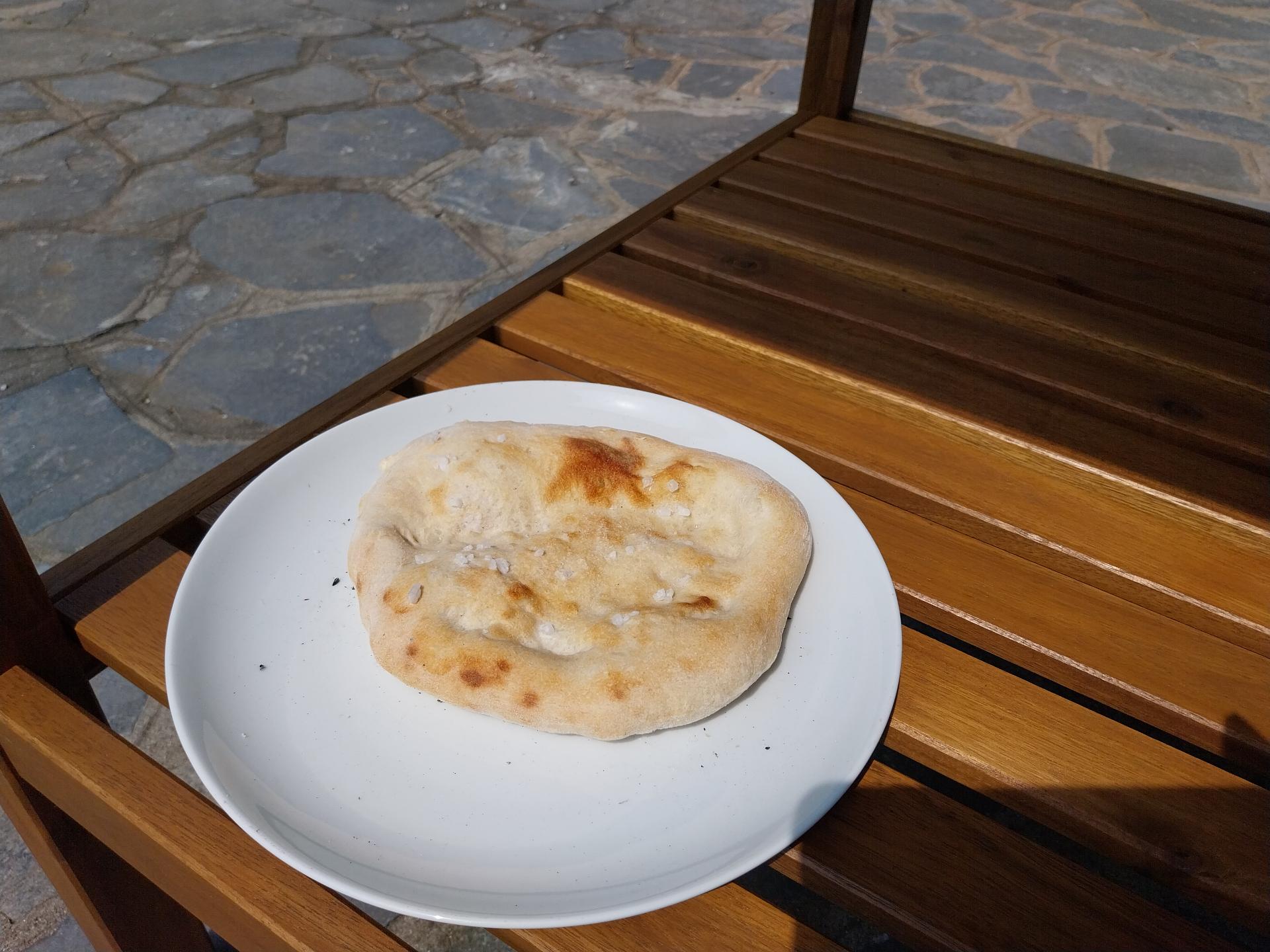
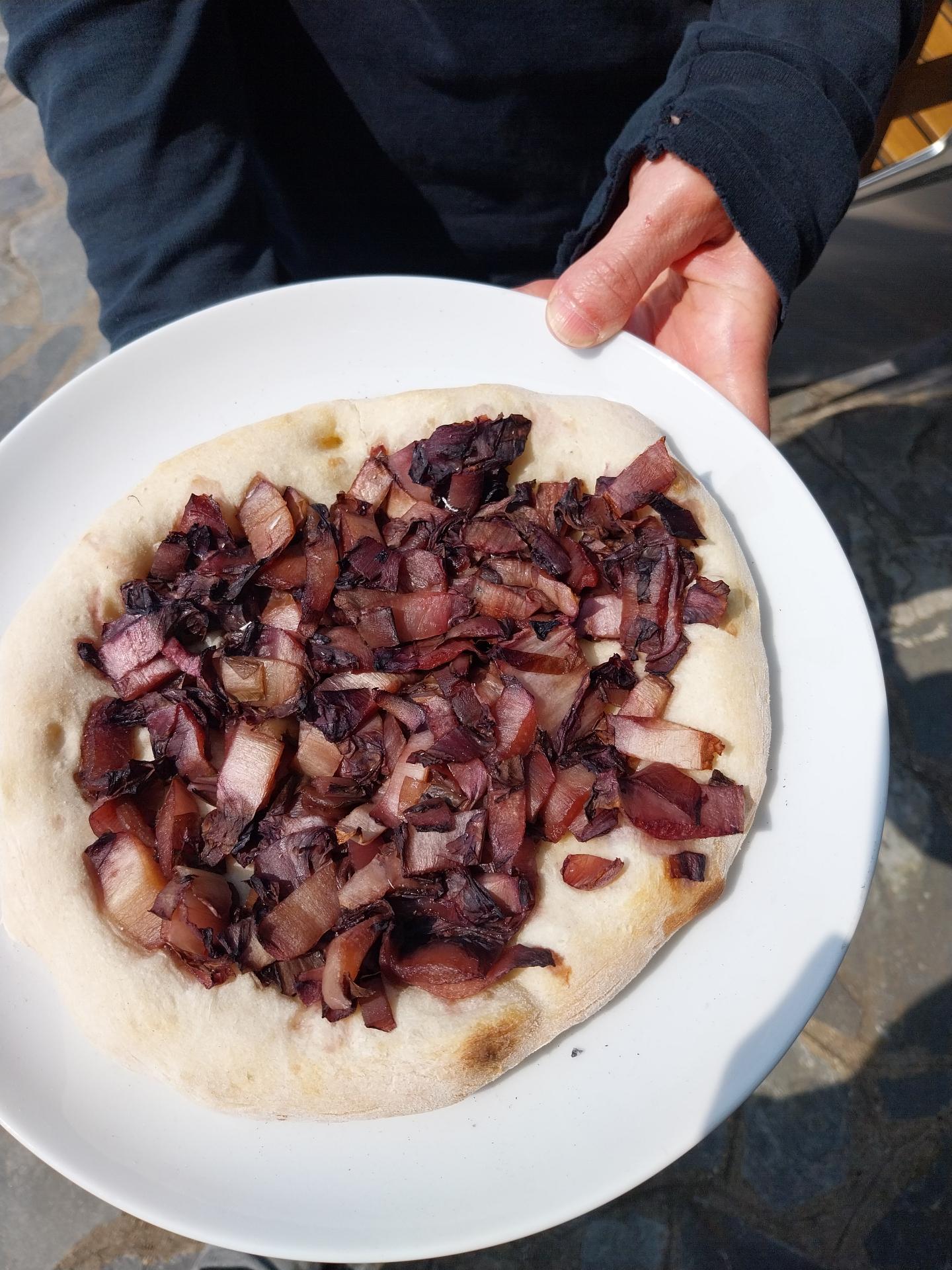
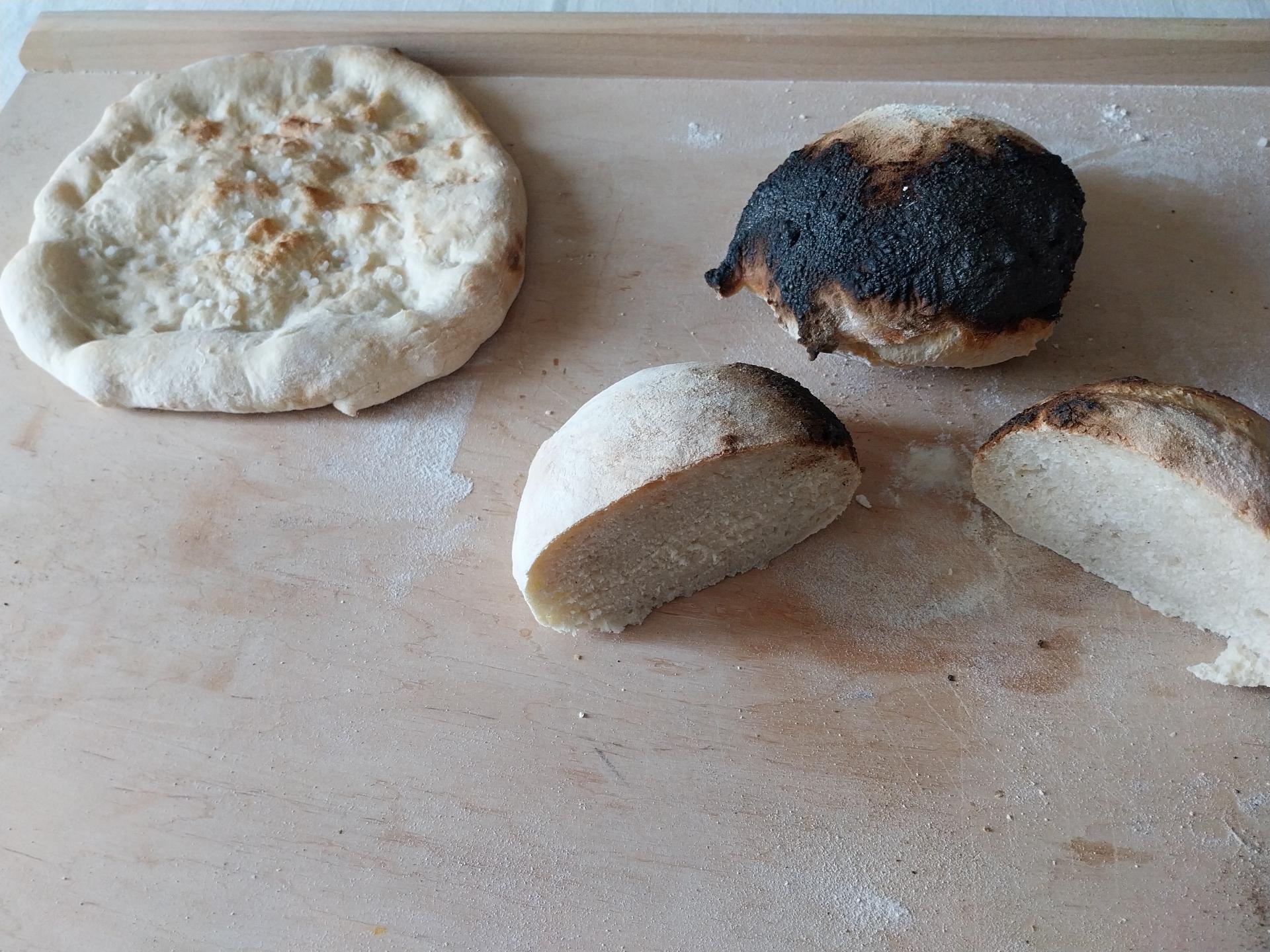
The next time I think I ll try with one of my other staples: Molino Bogetto etichetta blu (260/280 W) Then this morning we assembled the N MMAR , then I divided the dough in eight balls, put them in a covered but not sealed container 3, well floured with rice flour and then we fired the oven (as in: my partner did, I looked for a short while and then set the table and stuff), using charcoal, because we already had some, and could conveniently get more at the supermarket. When the oven had reached temperatures in the orange range4 I stretched the smallest ball out, working on my wooden peel, sprayed it with water5, sprinkled it with coarse salt and put it in the oven. After 30 seconds I turned it around with the new metal peel, then again after 30 seconds, and then I lost count of how many times I repeated this6, but it was probably 2 or 3 minutes until it looked good. A flatbread on a regular plate: it's only a bit more than half the plate in diameter, puffed up near the borders and thin in the middle, and only lightly browned in places, not burnt. It's sitting on the lower shelf of a wooden table. And it was good. The kind of pizza that is quite soft, especially near the borders. We ate it with fresh mozzarella and tomatoes, and then made another one the same way, to finish the mozzarella. Another flatbread on the same plate, this time it's about 4 cm smaller than the plate on all sides, and it's covered with brownish-red chopped up vegetables. This was supposed to be our lunch, but we decided to try one with some leftover cooked radicchio, and that also worked quite nicely. And finally, we decided we needed to try a more classical pizza, with tomato sauce and cured meat, of which we forgot to take pictures. Up to here we had eaten about half of the dough, and we were getting full: I had prepared significantly more than what I expected to eat, to be able to accidentally burn some, but also with the idea to bake something else to be eaten later. So I made two more focaccias with just water and salt, and then I tried to cook some bread with what I expected to be residual heat. Another flatbread with coarse salt and two bread rolls, one of which is completely carbonized on one side. The other one has been cut, and while it has a carbonized spot, it is also well cooked in the middle, and perfectly edible. Except that the oven was getting a bit too cold, so my partner added some charcoal, and when I put the last two unflattened balls right at the back of the oven where it was still warmer, that side carbonized. After 5 minutes I moved them to the middle of the oven, and turned them, and then after another turn and 5 more minutes they were ready. And other than the burnt crust, they were pretty edible. So, the thoughts after our first experience. Everybody around the table (my SO, my mother and me) was quite happy with the results, and they are different enough from the ones I could get with the regular oven. As I should have expected, it s much faster than a masonry oven, both in getting to temperature and in cooling down: my plan for residual heat bread cooking will have to be adjusted with experience. We were able to get it hot enough, but not as hot as it s supposed to be able to get: we suspect that using just charcoal may have influenced it, and next week we ll try to get some wood, and try with a mix. As for the recipe, dividing the dough in eight parts worked quite well: maybe the pizzas are a bit on the smaller side, but since they come one at a time it s more convenient to cut and share them, and maybe make a couple more at the end. Of course, I ll want to try different recipes, for different styles of pizzas (including some almost-trademark-violating ones) and for other types of flatbread. I expect it won t be hard to find volunteers to help us with the experiments. :D
  1. any insinuation that there may have been considerations of having a way to have freshly baked bread in case of a prolonged blackout may or may not be based on reality. But it wasn t the only or even the main reason.
  2. come on! it s made of STEEL. how can it be not good? :D
  3. IKEA 365+ 3.1 glass, the one that is 32 cm 21 cm 9 cm; it was just big enough for the amount of dough, and then I covered it with a lid that is missing the seal.
  4. why did they put a thermometer on it, and not add labels with the actual temperature? WHY???
  5. if you don t have dietary restrictions a bit of olive oil would taste even better.
  6. numbers above 2 are all basically the same, right?

Yifei Zhan: CommBank hardware MFA token

A while ago, CommBank started asking for MFA confirmation on its mobile app for every NetBank login on a browser. Previously, there was an option to use SMS for MFA, which isn t as secure as I would like, but it was at least usable. Since I m switching away from Android to Mobian and won t be able to use the CommBank app for much longer, I applied for a physical NetCode token. The hardware is made by Digipass and looks disposable. It is a small, battery powered gadget with a screen and a button. When pressed, it shows a temporary NetCode for authentication. Such a NetCode is required both for NetBank logins and approving online transactions. The letter that came with it has the wrong link for activation, the correct link is under NetBank -> Settings -> NetCode (under the Security section) To apply for a physical token, call the NetBank team, mention you can t use the app and need a physical NetCode token, and make sure they actually submit your request for a token. It took me 2 calls to get them to ship me a token. The hardware is free of charge but can only be applied for via phone call; unfortunately staff members at my local branch are unable to do anything in relation to NetBank. I was told privately by a CommBank employee that they are deprecating the hardware token in favor of the mobile app, I hope that won t happen anytime soon, or that they add support for passkeys before they do. The last time I checked, the CommBank app was LineageOS-friendly, but I don t want to configure WayDroid just to do online banking. PayID, the thing that allows you to receive payment via a phone number or email address, is not compatible with the hardware token, and existing PayID will be silently deactivated if you use hardware token. This looks to be an artificial restriction; I don t see why it has to be this way. Regular CommBank mobile app sessions will also be de-activated once the hardware token is activated (I was told so but my sessions weren t deactivated until I wiped my Android phone), and you won t be able to sign into mobile app again until you manually disable the NetCode token. Online banking has been getting progressively more invasive and anti-user over the last decade, from demanding remote attestation to requiring real time location data, each time locking certain features when those demands are not satisfied; all based on the flawed assumptions that everyone owns a phone running a certain flavor of iOS or Android, and has it ready all the time. I m not sure what can be done to reverse this trend, but on the personal level I will use NetBank less and go back to cash.

17 April 2026

Russell Coker: Home Battery

Prices On the 19th of March I got a home battery system installed. The government has a rebate scheme so it had a list price of about $22k for a 40kWh setup and cost me about $12k. It seems that 40KWh is the minimum usable size for the amount of electricity I use, I have 84 cores running BOINC when they have nothing better to do which is 585W of TDP according to Intel. While the CPUs are certainly using less than the maximum TDP (both due to design safety limits and the fact that I have disabled hyper-threading on all systems due to it providing minimal benefits and potential security issues) given some power usage by cooling fans and some inefficiency in PSUs I think that assuming that 585W is accounted for 24*7 by CPUs is reasonable. So my home draws between 800W and 1KW when no-one is home and with an electric car and all electric cooking a reasonable amount of electricity can be used. My bills prior to the battery installation were around $200/month which was based on charging my car only during sunny times as my electricity provider (Amber Electric) has variable rates based on wholesale prices. Also the feed in rates if my solar panels produce too much electricity in sunny times often go negative so if I don t use enough electricity. I haven t had the electric car long enough to find out what the bills might be in winter without a home battery. Before getting the battery my daily bills according to the Amber app were usually between $5 and $10. After getting it the daily bills have almost always been below $5. The only day where it s been over $5 since the battery installation was when electricity was cheap and I fully charged the home battery and my car which used 50KWh in one day and cost $7.87 which is 16 cents per KWh. 16 cents isn t the cheapest price (sometimes it gets as low as 10 cents) but is fairly cheap, sometimes even in the cheap parts of the day it doesn t get that low (the cheapest price on the day I started writing this was 20 cents). So it looks like this may save me $100 per month, if so there will be a 10% annual return on investment on the $12K I spent. This makes it a good investment, better than repaying a mortgage (which is generally under 6%) and almost as good as the long term results of index tracker funds. However if it cost $22K (the full price without subsidy) then it would still be ok but wouldn t be a great investment. The government subsidised batteries because the huge amount of power generated by rooftop solar systems was greater than the grid could use during the day in summer and batteries are needed to use that power when it s dark. Android App The battery system is from Fox ESS and the FoxCloud 2.0 Android app is a bit lacking in functionality. It has a timer for mode setting with options Self-use (not clearly explained), Feed-in Priority (not explained but testing shows feeding everything in to the grid), Back Up , Forced Charge , and Forced Discharge . Currently I have Forced Charge setup for most sunny 5 hours of the day for a maximum charge power of 5KW. I did that because about 25KW/day is what I need to cover everything and while the system can do almost 10KW that would charge the battery fully in a few hours and then electricity would be exported to the grid which would at best pay me almost nothing and at worst bill me for supplying electricity when they don t want it. There doesn t seem to be a never put locally generated power into the grid unless the battery is full option. The force charge mode allows stopping at a certain percentage, but when that is reached there is no fallback to another option. It would be nice if the people who designed the configuration could take as a baseline assumption that the macro programming in office suites and functions in spreadsheets are things that regular people are capable of using when designing the configuration options. I don t think we need a Turing complete programming language in the app to control batteries (although I would use it if there was one), but I think we need clauses like if battery is X% full then end this section . There is no option to say force charge until 100% or force charge for the next X minutes as a one-off thing. If I came home in the afternoon with my car below 50% battery and a plan to do a lot of driving the next day then I d want to force charge it immediately to allow charging the car overnight. But I can t do that without entering a schedule . For Unix people imagine having to do everything via a cron job and no option to run something directly from the command-line. It s a little annoying that they appear to have spent more development time on animations for the app than some of what should be core functionality. Management Amber has an option to allow my battery to be managed by them based on wholesale pries but I haven t done that as the feed-in prices are very low. So I just charge my battery when electricity is cheap and use it for the rest of the day. There is usually a factor of 2 or more price difference between the middle of the day and night time so that saves money. It also means I don t have to go out of my way to try and charge my car in the middle of the day. There is some energy lost in charging and discharging the batteries but it s not a lot. I configured the system to force charge for the 5 sunniest hours every day for 5KW as that s enough to keep it charged overnight and 5KW is greater than the amount of solar electricity produced on my house since I ve been monitoring it so that forces it to all be used for the battery. In summer I might have to change that to 6KW for the sunniest 2 or 3 hours and then 4KW or 5KW surrounding that which will be a pain to manage. Instead of charging the car every day during sunny times I charge it once or twice a week, I have a 3.3KW charger and the car has a 40KWh battery so usually it takes me less than 10 hours to fully charge it and I get at least 5 hours of good sunlight in the process. There are people hacking on these devices which is interesting to get direct control from computers [1], and apparently not banned from the official community for doing so. I m not enthusiastic enough to do this, I ve got plenty of other free software things to work on. But it s good that others are doing so.

16 April 2026

Sahil Dhiman: What is Life (to you)?

It started with a thought: to understand people s perspectives on life and its meaning. So I texted folks, What is life (to you)? . Each of the following list items (-) is a response from a different individual, mostly verbatim.
- A lot
- Everyone has a few universal basic qualities, and some special qualities. To me life is pursuit of exploring world based on those qualities and maturing those qualities as one goes on about exploring world/life with those qualities.
Discovering and enhancing experiences as one goes through them.
- life is endless suffering
- my answer might change daily, but this is what I ve noticed and feel recently. Life is a spectrum with two distinct ends: what we control and what we don t. At birth, the spectrum is largely tilted toward control, but throughout our lives, it gradually shifts toward the other side. Ultimately, as we approach death, we lose all control over any aspect of our existence, reaching the other end of the spectrum.
tho this isn t universal, privilege plays a huge part in what you control tho i believe it holds true for the majority
but yeah man, meaning and purpose are dynamic, it s in their nature to change i can give you a different answer this evening itself xD
- Funeral Monologue from Synecdoche, New York. https://www.youtube.com/watch?v=Z9PzSNy3xj0
- Zindagi ek nadiya hai, Aur mujhe tairna nahi aata
(translation - Life is a river, and I don t know how to swim)
On a more serious note, Life is what you make it out for yourself. The only established truth is that it will end. We can never know if there is something after or if there was something before. So try to live a life that you feel aspired by? But this question was beautifully answered by that book which you had about that dying professor
(Me - He was talking about Tuesday s with Morrie)
- My answer is 42
- One, it s living on your own terms, you define everything for yourself, success, normal, whatever. You get to curate your version of it no matter the societal norms.
It s an accumulation of experiences - friends, parents, work, activities, doing shit loads. Sab try karo- travel, zumba, art, music, workout, sports, dil kara ye karna hai karlo. (translation - If your heart wants to do it, just do it.)
Then I think relationships - all that you ve nurtured, people forget maintaining people because of work. It takes efforts to keep people in your life, everyone that comes has a place in yours, how well thats stays is upto you. You also get to curate your people, who stays who don t. Family toh hai hi (translation - family is there) but everyone else that comes along can make it pretty good.
So I don t want to be 50 and be like chalo ab kuch apne liye karte hai (translation - Come on, now let s do something for ourselves) Do whatever shit you want today. Not everything costs money, and if it does get thrifty
But do keep healthy while doing all of that
- Being alive so that my daughter can grow up and i can help raising her kids as well. Raising kids without mother is tough :P
- Definitively, I feel like Life is a by product of proteins and energy working together. But in a more personal sense, Life is a dumb joke played onto us. It s a rat race. But rats exists because of life and then it becomes a chicken-egg problem
Honestly, I don t give good answers to life questions. I m generally the one asking
Life can be like a box of chocolates, you don t know what you re gonna get untill you experience the chocolate(assuming the chocolates are heterogenous and contains a mix of everything)
Camus once said, Life is a revolt , and one of his students added more spice to it like Life is a revolt against the meaninglessness of existence"
I kinda feel like Life is the pursuit of every person s search for meaning
- Imprisonment waiting for execution
I have one more thought while we are on the topic , game with pre defined starting position and predefined destination , path to reach is a maze
- A phase where you can have a really good time or really bad one, usually the mix of both. A phase where you are prisoner to responsibility and materialistic wants.
It s a hell for you, where you try to create heaven for others. Being born was never your choice, but ending is always in your hands but you are a prisoner. You fear that leaving this world behind will destroy the heavens you created for others and they will be back to hell. But eventually everyone moves on watching the hourglass of their life.
Once you are left with no desires or no one to create heavens for, you look arround yourself. You see everyone chasing something, everyone scared of their limitted life time sliping away yet you want it to end sooner.
Doesn t matter if it was all good till now, or all bad. The other half is waiting for redemption. If it was all good, it s best time to die don t wait for the bad to start. If was all bad, it s still the best time to die what if it was the good one and more worst is waiting for you. We desire to be remembered, yet we want to free from this loop of suffering.
Someone once said, life is a suffering, chose your sufferings.
- Life to me is to live without regrets and live with freedom.
Life is always unpredictable and this unpredictability makes it more interesting and worth it.
- As of now, for the state of mind that I am in , I think for me life is about subtle struggle, subtle inconveniences and yet moving forward cause that s all I know.
I am not sure if any of this has any meaning, but sometimes I feel I was born of a purpose and that the universe has my back.
For me it s about raising my consciousness, understanding people to their depths, gaining moderate material success and helping people to some extend.
I have tried to seek a grander meaning but I have failed.
Life for me is what I make out it.
In my times of great success i rarely think about life for I am busy enjoying it, whatever you may call that state of mind.
- For me its the little things that you enjoy with YOUR people
- Life to me is about living and loving, and doing it in a way that sustains. It s the people who shape you, the work you get absorbed in, the quiet moments in between. There s also the wanting, the drive to figure out what s worth going after and how to get there, but that s just one part of it, not the point of it. And none of it happens in a vacuum. I m aware of the privileges that let me live this way, and I try to hold on to that gratitude. In the end, life has both a material and a non-material side, and a lot of what we do is chasing material things in an attempt to satisfy something non-material within us
- Mere liye (translation - for me) life is staying at my home and studying random economics papers. That s when I enjoy myself the most.
- Very complicated
Some days I wish this life never ended and some time I feel it would be better if it stopped at that moment.
It all depends on the events that happen in the so called life .
So life to me is a string of events that happen anyway and you get to make some decisions which can turn it in any direction and then you wonder how did that happen.
- not forgetting to breathe, learn, eat, game, take a good shit, love, sleep.
- To be honest it changed with time! At 19 it was about freedom, wasn t sure what freedom meant but i wanted that! To be free from everything, maybe because parents still controlled a part of my life. Then came 22-24 where i was working, trying to figure out what i want, the meaning changed from freedom to living for myself. To earn more, to be greedy about myself and pursue whatever would help me gain more steps in my career.
Came my mba life, switched my life from doing for myself to trying everything out to have no regrets. Life meaning was just about living with no regrets, invested, gambled, did everything to earn that tag of yeah, have tried that . Now it has all switched to, it was all just a fake facade. Life turned to having a meaningful life rather than finding meaning in what i am doing. Living for people around me, chhoti chhoti cheezo m khushi (translation - happiness in small things(?)) isn t really a topic of conversation but more of happy thing for me. So it changed, and m quite happy to be honest. Life did show me a lot of failures, but was privileged enough to face those failures. Gained a lot of learnings if not money
Hopeful for more learnings and change meaning of life with time
- A task.
- You have different answers at different times You learn different meanings at different times When you are studying, basically it is about job, finding a partner then it becomes, house, car other things based on your income in between, there can be passion too
Free Software was a passion, electoral politics too, but both kind of faded and I want cooperative and user driven development now (prav - something that motivates me every day) and these days learning Chinese and watching Cdrama takes a huge part of my leisure time it is heavily subjective and also influences by previous experiences people around you, how much influence they have on you
it also depends on if they had to struggle in their life or not, for some life did not give much troubles and trouble itself can be relative people who never had to struggle may find even smallest challenges as troubles like if you own a car, your worry is finding a parking slot
- I am too young to think about lyfe
- A ticket to see the show on earth, I guess
I guess life is different depending on the mood. It is a very broad question.
(Me - What is it in this present mood?)
Learning stuff (like I am learning a new language) and being happy but also to regulate emotions in a world where being optimistic is getting harder each day.
Life is also having a unique set of glasses you wear. Both in terms of looking from your eyeballs and your psychological perspective. Both are unique and cannot be replicated.
It is interesting what people on their deathbed think of life. If I know I am dying, my perspective would change a whole lot.
Life is finishing reading books while we are alive
Life is sleeping after a good XMPP chat
- Dukh dard peeda (translation - surrow pain suffering)
- uhh to word it? life is just like a journey from A to somewhere and its all about what paths you take and what line you get on to me, just a series of short adventures that all connect to a larger sequence until you can t have any more adventures-
(Me - eee, THE END. drop dead, like a coin)
yeaaaah- I am not really for spirituality of an afterlife, to me life just ends at some point, after which point there fails to remain a discernable you, and some X time after which, you will be last remembered, try to make that last time a good one I guess?
(Me - no soul?)
uhhh not in the way most people think of it i guess?
theres just a lot of yous, theres the physical you, there is the idea of you, there is the expectation of you, and one of the undefinable you I would label as the soul maybe? like the part thats not physically you, but also certainly you
(Me - can t say I understood part, but I get you in this sense)
mhm- well its about just questioning who you are more so questioning what life is-, I have sadly spent way too much time trying to figure that out
- Making the best of the time you have
- living a full range of experiences and embracing the good ones, seeing all that the world has to offer. In the end we were always just stardust. Might as well enjoy it when we are stardust with a consciousness of our own.
- For some reason or the Universe s /dev/random I was born here as a biological being, and from my experience I understood living is hard and the best way to live is by embracing it. Loving everyone and everything around you. Be happy and joyful until you naturally say good bye to this world.
- Life is being fucked by everything and you just have to figure out and try to stick to the things worth being fucked for
Note: Following was transcribed from a audio message.
- There are five conditions to become a life to survive in the environment. I think there s five conditions by the biological definitions and reproduction is one of the factor virus is not considered a life form because it cannot reproduce on its own but technically it s kind of a life because it reproduces using the DNA ability this is the biological definition. Do you want a philosophical definition?
My definition is kind of the same except that you get life experiences along with it as a human. Extra benefits is that you are not an NPC. All other organisms are NPCs. But humans can interpret the world and change it to their liking. That is life in the case of a human. But then many humans are mostly NPCs. But they still can change the life. Okay, fuck this. Where is this even going?
A human is an exception in the case of life, because human is not an NPC. Human can interrupt the world, human can change it to its liking, which is why we are such a successful organism on this planet. That is life to me. That s a human. But all of this is kind of meaningless, because the biological impurity of a human being still exists, so you still have the urges to reproduce, which kind of makes it like just another organism. But then, humans are yet to evolve to overcome that biological imperative.
I m grateful for all the replies, outlooks, and subsequent conversations I got to have after this question with everyone. After all, it was a deeply personal question. It does fit in nicely with my definition of life:
Life is all about experiences and all the transient relationships one gets to have with folks we meet on the way.

15 April 2026

Paul Tagliamonte: designing arf, an sdr iq encoding format

Interested in future updates? Follow me on mastodon at @paul@soylent.green. Posts about hz.tools will be tagged #hztools.

Want to jump right to the draft? I'll be maintaining ARF going forward at /draft-tagliamonte-arf-00.txt.
It s true processing data from software defined radios can be a bit complex which tends to keep all but the most grizzled experts and bravest souls from playing with it. While I wouldn t describe myself as either, I will say that I ve stuck with it for longer than most would have expected of me. One of the biggest takeaways I have from my adventures with software defined radio is that there s a lot of cool crossover opportunity between RF and nearly every other field of engineering. Fairly early on, I decided on a very light metadata scheme to track SDR captures, called rfcap. rfcap has withstood my test of time, and I can go back to even my earliest captures and still make sense of what they are IQ format, capture frequencies, sample rates, etc. A huge part of this was the simplicity of the scheme (fixed-lengh header, byte-aligned to supported capture formats), which made it roughly as easy to work with as a raw file of IQ samples. However, rfcap has a number of downsides. It s only a single, fixed-length header. If the frequency of operation changed during the capture, that change is not represented in the capture information. It s not possible to easily represent mulit-channel coherent IQ streams, and additional metadata is condemned to adjacent text files.

ARF (Archive of RF) A few years ago, I needed to finally solve some of these shortcomings and tried to see if a new format would stick. I sat down and wrote out my design goals before I started figuring out what it looked like. First, whatever I come up with must be capable of being streamed and processed while being streamed. This includes streaming across the network or merely written to disk as it s being created. No post-processing required. This is mostly an artifact of how I ve built all my tools and how I intereact with my SDRs. I use them extensively over the network (both locally, as well as remotely by friends across my wider lan). This decision sometimes even prompts me to do some crazy things from time to time. I need actual, real support for multiple IQ channels from my multi-channel SDRs (Ettus, Kerberos/Kracken SDR, etc) for playing with things like beamforming. My new format must be capable of storing multiple streams in a single capture file, rather than a pile of files in a directory (and hope they re aligned). Finally, metadata must be capable of being stored in-band. The initial set of metadata I needed to formalize in-stream were Frequency Changes and Discontinuities. Since then, ARF has grown a few more. After getting all that down, I opted to start at what I thought the simplest container would look like, TLV (tag-length-value) encoded packets. This is a fairly well trodden path, and used by a bunch of existing protocols we all know and love. Each ARF file (or stream) was a set of encoded packets (sometimes called data units in other specs). This means that unknown packet types may be skipped (since the length is included) and additional data can be added after the existing fields without breaking existing decoders.
tag
length
value
Heads up! Once this is posted, I'm not super likely to update this page. Once this goes out, the latest stable copy of the ARF spec is maintained at draft-tagliamonte-arf-00.txt. This page may quickly become out of date, so if you're actually interested in implementing this, I've put a lot of effort into making the draft comprehensive, and I plan to maintain it as I edit the format.
Unlike a traditional TLV structure, I opted to add flags to the top-level packet. This gives me a bit of wiggle room down the line, and gives me a feature that I like from ASN.1 a critical bit. The critical bit indicates that the packet must be understood fully by implementers, which allows future backward incompatible changes by marking a new packet type as critical. This would only really be done if something meaningfully changed the interpretation of the backwards compatible data to follow.
Flag Description
0x01Critical (tag must be understood)
Within each Packet is a tag field. This tag indicates how the contents of the value field should be interpreted.
Tag ID Description
0x01Header
0x02Stream Header
0x03Samples
0x04Frequency Change
0x05Timing
0x06Discontinuity
0x07Location
0xFEVendor Extension
In order to help with checking the basic parsing and encoding of this format, the following is an example packet which should parse without error.
 00, // tag (0; no subpacket is 0 yet)
 00, // flags (0; no flags)
 00, 00 // length (0; no data)
 // data would go here, but there is none
Additionally, throughout the rest of the subpackets, there are a few unique and shared datatypes. I document them all more clearly in the draft, but to quickly run through them here too:

UUID This field represents a globally unique idenfifer, as defined by RFC 9562, as 16 raw bytes.

Frequency Data encoded in a Frequency field is stored as microhz (1 Hz is stored as 1000000, 2 Hz is stored as 2000000) as an unsigned 64 bit integer. This has a minimum value of 0 Hz, and a maximum value of 18446744073709551615 uHz, or just above 18.4 THz. This is a bit of a tradeoff, but it s a set of issues that I would gladly contend with rather than deal with the related issues with storing frequency data as a floating point value downstream. Not a huge factor, but as an aside, this is also how my current generation SDR processing code (sparky) stores Frequency data internally, which makes conversion between the two natural.

IQ samples ARF supports IQ samples in a number of different formats. Part of the idea here is I want it to be easy for capturing programs to encode ARF for a specific radio without mandating a single iq format representation. For IQ types with a scalar value which takes more than a single byte, this is always paired with a Byte Order field, to indicate if the IQ scalar values are little or big endian.
ID Name Description
0x01f32interleaved 32 bit floating point scalar values
0x02i8 interleaved 8 bit signed integer scalar values
0x03i16interleaved 16 bit signed integer scalar values
0x04u8 interleaved 8 bit unsigned integer scalar values
0x05f64interleaved 64 bit floating point scalar values
0x06f16interleaved 16 bit floating point scalar values

Stream Header Immediately after the arf Header, some number of Stream Headers follow. There must be exactly the same number of Stream Header packets as are indicated by the num streams field of the Header. This has the nice effect of enabling clients to read all the stream headers without requiring buffering of unread packets from the stream.
id
flags
fmt
bo
rate
freq
guid
site
In order to help with checking the basic parsing and encoding of this format, the following is an example stream header subpacket (when encoded or decoded this will be found inside an ARF packet as described above) which should parse without error, with known values.
00, 01, // id (1)
00, 00, 00, 00, 00, 00, 00, 00, // flags
01, // format (float32)
01, // byte order (Little Endian)
00, 00, 01, d1, a9, 4a, 20, 00, // rate (2 MHz)
00, 00, 5a, f3, 10, 7a, 40, 00, // frequency (100 MHz)

// guid (7b98019d-694e-417a-8f18-167e2052be4d)
7b, 98, 01, 9d, 69, 4e, 41, 7a,
8f, 18, 16, 7e, 20, 52, be, 4d,

// site_id (98c98dc7-c3c6-47fe-bc05-05fb37b2e0db)
98, c9, 8d, c7, c3, c6, 47, fe,
bc, 05, 05, fb, 37, b2, e0, db,

Samples Block of IQ samples in the format indicated by this stream s format and byte_order field sent in the related Stream Header.
id
iq samples
In order to help with checking the basic parsing and encoding of this format, the following is an samples subpacket (when encoded or decoded this will be found inside an ARF packet as described above). The IQ values here are notional (and are either 2 8 bit samples, or 1 16 bit sample, depending on what the related Stream Header was).
01, // id
ab, cd, ab, cd, // iq samples

Frequency Change The center frequency of the IQ stream has changed since the Stream Header or last Frequency Change has been sent. This is useful to capture IQ streams that are jumping around in frequency during the duration of the capture, rather than starting and stopping them.
id
frequency
In order to help with checking the basic parsing and encoding of this format, the following is a frequency change subpacket (when encoded or decoded this will be found inside an ARF packet as described above).
01, // id
00, 00, b5, e6, 20, f4, 80, 00 // frequency (200 MHz)

Discontinuity Since the last Samples packet for this stream, samples have been dropped or not encoded to this stream. This can be used for a stream that has dropped samples for some reason, a large gap (radio was needed for something else), or communicating iq snippits .
id
In order to help with checking the basic parsing and encoding of this format, the following is a discontinuity subpacket (when encoded or decoded this will be found inside an ARF packet as described above).
01, // id

Location Up-to-date location as of this moment of the IQ stream, usually from a GPS. This allows for in-band geospatial information to be marked in the IQ stream. This can be used for all sorts of things (detected IQ packet snippits aligned with a time and location or a survey of rf noise in an area)
flags
sys
lat
long
el
accuracy
The sys field indicates the Geodetic system to be used for the provided latitude, longitude and elevation fields. The full list of supported geodetic systems is currently just WGS84, but in case something meaningfully changes in the future, it d be nice to migrate forward. Unfortunately, being a bit of a coward here, the accuracy field is a bit of a cop-out. I d really rather it be what we see out of kinematic state estimation tools like a kalman filter, or at minimum, some sort of ellipsoid. This is neither of those - it s a perfect sphere of error where we pick the largest error in any direction and use that. Truthfully, I can t be bothered to model this accurately, and I don t want to contort myself into half-assing something I know I will half-ass just because I know better.
System Description
0x01 WGS84 - World Geodetic System 1984
In order to help with checking the basic parsing and encoding of this format, the following is a location subpacket (when encoded or decoded this will be found inside an ARF packet as described above).
00, 00, 00, 00, 00, 00, 00, 00, // flags
01, // system (wgs84)
3f, f3, be, 76, c8, b4, 39, 58, // latitude (1.234)
40, 02, c2, 8f, 5c, 28, f5, c3, // longitude (2.345)
40, 59, 00, 00, 00, 00, 00, 00, // elevation (100)
40, 24, 00, 00, 00, 00, 00, 00 // accuracy (10)

Vendor Extension In addition to the fields I put in the spec, I expect that I may need custom packet types I can t think of now. There s all sorts of useful data that could be encoded into the stream, so I d rather there be an officially sanctioned mechanism that allows future work on the spec without constraining myself. Just an example, I ve used a custom subpacket to create test vectors, the data is encoded into a Vendor Extension, followed by the IQ for the modulated packet. If the demodulated data and in-band original data don t match, we ve regressed. You could imagine in-band speech-to-text, antenna rotator azimuth information, or demodulated digital sideband data (like FM HDR data) too. Or even things I can t even think of!
id
data
In order to help with checking the basic parsing and encoding of this format, the following is a vendor extension subpacket (when encoded or decoded this will be found inside an ARF packet as described above).
// extension id (b24305f6-ff73-4b7a-ae99-7a6b37a5d5cd)
b2, 43, 05, f6, ff, 73, 4b, 7a,
ae, 99, 7a, 6b, 37, a5, d5, cd,

// data (0x01, 0x02, 0x03, 0x04, 0x05)
01, 02, 03, 04, 05

Tradeoffs The biggest tradeoff that I m not entirely happy with is limiting the length of a packet to u16 65535 bytes. Given the u8 sample header, this limits us to 8191 32 bit sample pairs at a time. I wound up believing that the overhead in terms of additional packet framing is worth it because always encoding 4 byte lengths felt like overkill, and a dynamic length scheme ballooned codepaths in the decoder that I was trying to keep as easy to change as possible as I worked with the format.

14 April 2026

Dirk Eddelbuettel: anytime 0.3.13 on CRAN: Mostly Minor Bugfix

A maintenance release 0.3.13 of the anytime package arrived on CRAN today, sticking with the roughly yearly schedule we have now. Binaries for r2u have been built already. The package is fairly feature-complete, and code and functionality remain mature and stable. anytime is a very focused package aiming to do just one thing really well: to convert anything in integer, numeric, character, factor, ordered, input format to either POSIXct (when called as anytime) or Date objects (when called as anydate) and to do so without requiring a format string as well as accomodating different formats in one input vector. See the anytime page, the GitHub repo for a few examples, the nice pdf vignette, and the beautiful documentation site for all documentation. This release was triggered by a bizarre bug seen on elementary os 8. For reason anytime was taking note on startup where it runs, and used a small and simply piece of code reading /etc/os-release when it exists. We assumed sane content, but this particular operating system and releases managed to have a duplicate entry throwing us spanner. So now this code is robust to duplicates, and no longer executed on each startup but as needed which is a net improvement. We also switched the vignette to being deployed by the new Rcpp::asis() driver. The short list of changes follows.

Changes in anytime version 0.3.13 (2026-04-14)
  • Continuous integration has received minor updates
  • The vignette now use the Rcpp::asis() driver, and references have been refreshed
  • Stateful 'where are we running' detection is now more robust, and has been moved from running on each startup to a cached 'as needed' case

Courtesy of my CRANberries, there is also a diffstat report of changes relative to the previous release. The issue tracker tracker off the GitHub repo can be use for questions and comments. More information about the package is at the package page, the GitHub repo, in the vignette, and at the documentation site.

This post by Dirk Eddelbuettel originated on his Thinking inside the box blog. If you like this or other open-source work I do, you can now sponsor me at GitHub. You can also sponsor my Tour de Shore 2026 ride in support of the Maywood Fine Arts Center.

Petter Reinholdtsen: Talking to the Computer, and Getting Some Nonsense Back...

At last, I can run my own large language model artificial idiocy generator at home on a Debian testing host using Debian packages directly from the Debian archive. After months of polishing the llama.cpp, whisper.cpp and ggml packages, and their dependencies, I was very happy to see today that they all entered Debian testing this morning. Several release-critical issues in dependencies have been blocking the migration for the last few weeks, and now finally the last one of these has been fixed. I would like to extend a big thanks to everyone involved in making this happen. I've been running home-build editions of whisper.cpp and llama.cpp packages for a while now, first building from the upstream Git repository and later, as the Debian packaging progressed, from the relevant Salsa Git repositories for the ROCM packages, GGML, whisper.cpp and llama.cpp. The only snag with the official Debian packages is that the JavaScript chat client web pages are slightly broken in my setup, where I use a reverse proxy to make my home server visible on the public Internet while the included web pages only want to communicate with localhost / 127.0.0.1. I suspect it might be simple to fix by making the JavaScript code dynamically look up the URL of the current page and use that to determine where to find the API service, but until someone fixes BTS report #1128381, I just have to edit /usr/share/llama.cpp-tools/llama-server/themes/simplechat/simplechat.js every time I upgrade the package. I start my server like this on my machine with a nice AMD GPU (donated to me as a Debian developer by AMD two years ago, thank you very much):
  LC_ALL=C llama-server \
    -ngl 256  \
    -c $(( 42 * 1024)) \
    --temp 0.7 \
    --repeat_penalty 1.1 \
    -n -1 \
    -m Qwen3-Coder-30B-A3B-Instruct-Q5_K_S.gguf
It only takes a few minutes to load the model for the first time and prepare a nice API server for me at https://my.reverse.proxy.example.com:8080/v1/, available (note, this sets up the server up without authentication; use a reverse proxy with authentication if you need it) for all the API clients I care to test. I switch models regularly to test different new ones, the Qwen3-Coder one just happen to be the one I use at the moment. Perhaps these packages is something for you to have fun with too? As usual, if you use Bitcoin and want to show your support of my activities, please send Bitcoin donations to my address 15oWEoG9dUPovwmUL9KWAnYRtNJEkP1u1b.

Russell Coker: Furilabs FLX1s Finally Working

I ve been using the Furilabs FLX1s phone [1] as my daily driver for 6 weeks, it s a decent phone, not as good as I hoped but good enough to use every day and rely on for phone calls about job interviews etc. I intend to keep using it as my main phone and as a platform to improve phone software in Debian as you really can t effectively find bugs unless you use the platform for important tasks. Support Problems I previously wrote about the phone after I received it without a SIM caddy on the 13th of Jan. I had a saga with support about this, on the 16th of Jan one support person said that they would ship it immediately but didn t provide a tracking number or any indication of when it would arrive. On the 5th of Feb I contacted support again and asked how long it would be, the new support person seemed to have no record of my previous communication but said that they would send it. On the 17th of Feb I made another support request including asking for a way of direct communication as the support email came from an address that wouldn t accept replies, I was asked for a photo showing where the problem is. The support person also said that they might have to send a replacement phone! The last support request I sent included my disappointment at the time taken to resolve the issue and the proposed solution of replacing the entire phone (why have two international shipments of a fragile and expensive phone when a single letter with a cheap SIM caddy would do?). I didn t receive a reply but the SIM caddy arrived on the 2nd of Mar. Here is a pic of the SIM caddy and the package it came in: One thing that should be noted is that some of the support people seemed to be very good at their jobs and they were all friendly. It was the system that failed here, turning a minor issue of a missing part into a 6 week saga. Furilabs needs to do the following to address this issue:
  1. Make it possible to reply directly to a message from a support person. Accept email with a custom subject to sort it, give a URL for a web form, anything. Collating discussions with a customer allows giving better support while taking less time for the support people.
  2. Have someone monitor every social media address that is used by the company. When someone sends a support request in a public Mastodon post it indicates that something has gone wrong and you want to move quickly to resolve it.
  3. Take care of the little things, like sending a tracking number for every parcel. If it s something too small for a parcel (the SIM caddy could have fit in a regular letter) then just tell the customer what date it was posted and where it was posted from so they have some idea of when it will arrive.
This is not just a single failure of Furilabs support, it s a systemic failure of their processes. Problems I Will Fix Unless Someone Beats Me to it Here are some issues I plan to work on. Smart Watch Support I need to port one of the smart watch programs to Debian. Also I want to make one of them support the Colmi P80 [2]. A smart watch significantly increases the utility of a phone even though IMHO they aren t doing nearly all the things that they could and should do. When we get Debian programs talking to the PineTime it will make a good platform for development of new smart phone and OS features. Nextcloud I have ongoing issues of my text Nextcloud installation on a Debian VM not allowing connection from the Linux desktop app (as packaged in Debian) and from the Android client (from f-droid). The desktop client works with a friend s Nextcloud installation on Ubuntu so I may try running it on an Ubuntu VM I run while waiting for the Debian issue to get resolved. There was a bug recently fixed in Nextcloud that appears related so maybe the next release will fix it. For the moment I ve been running without these features and I call and SMS people from knowing their number or just returning calls. Phone calls generally aren t very useful for me nowadays except when applying for jobs. If I could deal with recruiters and hiring managers via video calls then I would consider just not having a phone number. Wifi IPv6 Periodically IPv6 support just stops working, I can t ping the gateway. I turn wifi off and on again and it works. This might be an issue with my wifi network configuration. This might be an issue with the way I have configured my IPv6 networking, although that problem doesn t happen with any of my laptops. Chatty Sorting Chatty is the program for SMS that is installed by default (part of the phosh/phoc setup), it also does Jabber. Version 0.8.7 is installed which apparently has some Furios modifications and it doesn t properly support sorting SMS/Jabber conversations. Version 0.8.9 from Debian sorts in the same way as most SMS and Jabber programs with the most recent at the top. But the Debian version doesn t support Jabber (only SMS and Matrix). When I went back to the Furilabs version of Chatty it still sorted for a while but then suddenly stopped. Killing Chatty (not just closing the window and reopening it) seems to make it sort the conversations sometimes. Problems for Others to Fix Here are the current issues I have starting with the most important. Important The following issues seriously reduce the usability of the device. Hotspot The Wifi hotspot functionality wasn t working for a few weeks, this Gitlab issue seems to match it [3]. It started working correctly for a day and I was not sure if an update I applied fixed the bug or if it s some sort of race condition that worked for this boot and will return next time I reboot it. Later on I rebooted it and found that it s somewhat random whether it works or now. Also while it is mostly working it seemed to stop working about every 25 minutes or so and I had to turn it off and on again to get it going. On another day it went to a stage where it got repeated packet loss when I pinged the phone as a hotspot from my laptop. A pattern of 3 ping responses and 3 Destination Host Unreachable messages was often repeated. I don t know if this is related to the way Android software is run in a container to access the hardware. 4G Reliability Sometimes 4G connectivity has just stopped, sometimes I can stop and restart the 4G data through software to fix it and sometimes I need to use the hardware switch. I haven t noticed this for a week or two so there is a possibility that one fix addressed both Hotspot and 4G. One thing that I will do is setup monitoring to give an alert on the phone if it can t connect to the Internet. I don t want it to just quietly stop doing networking stuff and not tell me! On-screen Keyboard The compatibility issues of the GNOME and KDE on-screen keyboards are getting me. I use phosh/phoc as the login environment as I want to stick to defaults at first to not make things any more difficult than they need to be. When I use programs that use QT such as Nheko the keyboard doesn t always appear when it should and it forgets the setting for word completion (which means spelling correction). The spelling correction system doesn t suggest replacing dont with don t which is really annoying as a major advantage for spelling checkers on touch screens is inserting an apostrophy. An apostrophy takes at least 3* longer than a regular character and saving that delay makes a difference to typing speed. The spelling correction doesn t correct two words run together. Medium Priority These issues are ongoing annoyances. Delay on Power Button In the best case scenario this phone has a much slower response to pressing the power button than the Android phones I tested (Huawei Mate 10 Pro and Samsung Galaxy Note 9) and a much slower response than my recollection of the vast majority of Android phones I ve ever used. For testing pressing buttons on the phones simultaneously resulted in the Android phone screens lighting up much sooner. Something like 200ms vs 600ms I don t have a good setup to time these things but it s very obvious when I test. In a less common case scenario (the phone having been unused for some time) the response can be something like 5 seconds. The worst case scenario is something in excess of 20 seconds. For UI designers, if you get multiple press events from a button that can turn the screen on/off please make your UI leave the screen on and ignore all the stacked events. Having the screen start turning on and off repeatedly when the phone recovers and processes all the button presses isn t good, especially when each screen flash takes half a second. Notifications Touching on a notification for a program often doesn t bring it to the foreground. I haven t yet found a connection between when it does and when it doesn t. Also the lack of icons in the top bar on the screen to indicate notifications is annoying, but that seems to be an issue of design not the implementation. Charge Delay When I connect the phone to a power source there is a delay of about 22 seconds before it starts to charge. Having it miss 22 seconds of charge time is no big deal, having to wait 22 seconds to be sure it s charging before leaving it is really annoying. Also the phone makes an audible alert when it gets to 0% charge which woke me up one night when I had failed to push the USB-C connector in hard enough. This phone requires a slightly deeper connector than most phones so with some plugs it s easy to not quite insert them far enough. Torch aka Flash The light for the torch or flash for camera is not bright at all. In a quick test staring into the light from 40cm away wasn t unpleasant compared to my Huawei Mate 10 Pro which has a light bright enough that it hurts to look at it from 4 meters away. Because of this photos at night are not viable, not even when photographing something that s less than a meter away. The torch has a brightness setting which doesn t seem to change the brightness, so it seems likely that this is a software issue and the brightness is set at a low level and the software isn t changing it. Audio When I connect to my car the Lollypop player starts playing before the phone directs audio to the car, so the music starts coming from the phone for about a second. This is an annoying cosmetic error. Sometimes audio playing pauses for no apparent reason. It doesn t support the phone profile with Bluetooth so phone calls can t go through the car audio system. Also it doesn t always connect to my car when I start driving, sometimes I need to disable and enable Bluetooth to make it connect. When I initially set the phone up Lollypop would send the track name when playing music through my car (Nissan LEAF) Bluetooth connection, after an update that often doesn t happen so the car doesn t display the track name or whether the music is playing but the pause icon works to pause and resume music (sometimes it does work). About 30 seconds into a phone call it switches to hands-free mode while the icon to indicate hands-free is not highlighted, so I have to press the hands-free button twice to get it back to normal phone mode. Low Priority I could live with these things remaining as-is but it s annoying. Ticket Mode There is apparently some code written to display tickets on screen without unlocking. I want to get this working and store screen-caps of the Android barcode screens of the different loyalty cards so I can scan them without unlocking. My threat model does not include someone trying to steal my phone to get a free loaf of bread on the bakery loyalty program. Camera The camera app works with both the back and front cameras, which is nice, and sadly based on my experience with other Debian phones it s noteworthy. The problem is that it takes a long time to take a photo, something like a second after the button is pressed long enough for you to think that it just silently took a photo and then move the phone. The UI of the furios-camera app is also a little annoying, when viewing photos there is an icon at the bottom left of the screen for a video camera and an icon at the bottom right with a cross. Which every time makes me think record videos and leave this screen not return to taking photos and delete current photo . I can get used to the surprising icons, but being so slow is a real problem. GUI App Installation The program for managing software doesn t work very well. It said that there were two updates for Mesa package needed, but didn t seem to want to install them. I ran flatpak update as root to fix that. The process of selecting software defaults to including non-free, and most of the available apps are for desktop/laptop with no way to search for phone/tablet apps. Generally I think it s best to just avoid this and use apt and flatpak directly from the command-line. Being able to ssh to my phone from a desktop or laptop is good! Android Emulation The file /home/furios/.local/share/andromeda/data/system/uiderrors.txt is created by the Andromeda system which runs Android apps in a LXC container and appears to grow without end. After using the phone for a month it was 3.5G in size. The disk space usage isn t directly a problem, out of the 110G storage space only 17G is used and I don t have a need to put much else on it, even if I wanted to put backups of /home from my laptop on it when travelling that would still leave plenty of free space. But that sort of thing is a problem for backing up the phone and wasting 3.5G out of 110G total is a fairly significant step towards breaking the entire system. Also having lots of logging messages from a subsystem that isn t even being used is a bad sign. I just tried using it and it doesn t start from either the settings menu or from the f-droid icon. Android isn t that important to me as I want to get away from the proprietary app space so I won t bother trying this any more. Unfixable Problems Unlocking After getting used to fingerprint unlocking going back to a password is a pain. I think that the hardware isn t sufficient for modern quality face recognition that can t be fooled by a photo and there isn t fingerprint hardware. When I first used an Android phone using a pin to unlock didn t seem like a big deal, but after getting used to fingerprint unlock it s a real drag to go without. This is a real annoyance when doing things like checking Wikipedia while watching TV. This phone would be significantly improved with a fingerprint sensor or a camera that worked well enough for face unlock. Plasma Mobile According to Reddit Plasma Mobile (KDE for phones) doesn t support Halium and can never work on this phone because of it [4]. This is one of a number of potential issues with the phone, running on hardware that was never designed for open OSs is always going to have issues. Wifi MAC Address The MAC keeps changing on reboot so I can t assign a permanent IPv4 address to the phone. It appears from the MAC prefix of 00:08:22 that the network hardware is made in InPro Comm which is well known for using random addresses in the products it OEMs. They apparently have one allocation of 2^24 addresses and each device randomly chooses a MAC from that range on boot. In the settings for a Wifi connection the Identity tab has a field named Cloned Address which can be set to Stable for SSID that prevents it from changing and allows a static IP address allocation from DHCP. It s not ideal but it works. Network Manager can be configured to have a permanent assigned MAC address for all connections or for just some connections. In the past for such things I have copied MAC addresses from ethernet devices that were being discarded and used them for such things. For the moment the Stable for SSID setting does what I need but I will consider setting a permanent address at some future time. Docks Having the ability to connect to a dock is really handy. The PinePhonePro and Librem5 support it and on the proprietary side a lot of Samsung devices do it with a special desktop GUI named Dex and some Huawei devices also have a desktop version of the GUI. It s unfortunate that this phone can t do it. The Good Things It s good to be able to ssh in to my phone, even if the on-screen keyboard worked as well as the Android ones it would still be a major pain to use when compared to a real keyboard. The phone doesn t support connecting to a dock (unlike Samsung phones I ve used for which I found Dex to be very useful with a 4K monitor and proper keyboard) so ssh is the best way to access it. This phone has very reliable connections to my home wifi. I ve had ssh sessions from my desktop to my phone that have remained open for multiple days. I don t really need this, I ve just forgotten to logout and noticed days later that the connection is still running. None of the other phones running Debian could do that. Running the same OS on desktop and phone makes things easier to test and debug. Having support for all the things that Linux distributions support is good. For example none of the Android music players support all the encodings of audio that comes from YouTube so to play all of my music collection on Android I would need to transcode most of them which means either losing quality, wasting storage space, or both. While Lollypop plays FLAC0, mp3, m4a, mka, webm, ogg, and more. Conclusion This is a step towards where I want to go but it s far from the end goal. The PinePhonePro and Librem5 are more open hardware platforms which have some significant benefits. But the battery life issues make them unusable for me. Running Mobian on a OnePlus 6 or Droidian on a Note 9 works well for the small tablet features but without VoLTE. While the telcos have blocked phones without VoLTE data devices still work so if recruiters etc would stop requiring phone calls then I could make one of them an option. The phone works well enough that it could potentially be used by one of my older relatives. If I could ssh in to my parents phones when they mess things up that would be convenient. I ve run this phone as my daily driver since the 3rd of March and it has worked reasonably well. 6 weeks compared to my previous use of the PinePhonePro for 3 days. This is the first time in 15 years that a non-Android phone has worked for me personally. I have briefly used an iPhone 7 for work which basically did what it needed to do, it was at the bottom of the pile of unused phones at work and I didn t want to take a newer iPhone that could be used by someone who s doing more than the occasional SMS or Slack message. So this is better than it might have been, not as good as I hoped, but a decent platform to use it while developing for it.

Ravi Dwivedi: Hungary Visa

The annual LibreOffice conference 2025 was held in Budapest, Hungary, from the 3rd to the 6th of September 2025. Thanks to the The Document Foundation (TDF) for sponsoring me to attend the conference. As Hungary is a part of the Schengen area, I needed a Schengen visa to attend the conference. In order to apply for a Schengen visa, one needs to get an appointment at VFS Global and submit all the required documents there, which are then forwarded to the embassy. I got an appointment for a Hungary visa at VFS Global in New Delhi for the 24th of July. There were many appointment slots available for the Hungary visa. One could easily get an appointment for the next day at the Delhi center. There were some technical problems on the VFS website, though, as I was unable to upload a scanned copy of my passport while booking the appointment. I got an error saying, Unfortunately, you have exceeded the maximum upload limit. The problem didn t get fixed even after contacting the VFS helpline. They asked me to try in the Firefox browser and deleting all the cache, which I already did. So I created another account with a different email address and phone number, after which I was able to upload my passport and book an appointment. Other conference attendees from India also reported facing some technical issues on the VFS Hungary website. Anyway, I went to the VFS Hungary application center as per my appointment on the 24th of July. Going inside, I located the Hungary visa application counter. There were two applicants ahead of me. When it was my turn, the VFS staff warned me that my passport was damaged. The damage was on the bio-data page. All the details could be seen, but the lamination of the details page wore off a bit. They asked me to write an application to the Embassy of Hungary in New Delhi stating that I insist VFS to submit my application along with describing the damage on my passport. I got a bit worried about my application getting rejected due to the damage. But I decided to gamble my money on this one, as I didn t have time (and energy) to apply for a new passport before this trip. Moreover, I had struck down a couple of fields in my visa application form which were not applicable to me, due to which the VFS staff asked me to fill out another visa application. After this, the application got submitted, and it was 11,000 INR (including the fee to book the appointment at VFS). Here is the list of documents I submitted:
  • My passport
  • Photocopy of my passport
  • Two photographs of myself
  • Duly filled visa application form
  • Return flight ticket reservations
  • Payslips for the last three months
  • Invitation letter from the conference organizer (in Hungarian)
  • Proof of hotel bookings during my stay in Hungary
  • Cover letter stating my itinerary
  • Income tax returns filed by me
  • Bank account statement, signed and sealed by the bank
  • Travel insurance valid for the period of the entire trip
It took 2 hours for me to submit my visa application, even though there were only two applicants before me. This was by far the longest time to submit a Schengen visa application for me. Fast-forward to the 30th of July, and I received an email from the Embassy of Hungary asking me to submit an additional document - paid air ticket - for my application. I had only submitted dummy flight tickets, and they were enough for the Schengen visas I applied for until now. This was the first time a country was asking me to submit a confirmed flight ticket during the visa process. I consulted my travel agent on this, and they were fairly confident that I will get the visa if the embassy is asking me to submit confirmed flight tickets. So I asked the travel agent to book the flight tickets. These tickets were 78,000, and the airline was Emirates. Then, I sent the flight tickets to the embassy by email. The embassy sent the visa results on the 6th of August, which I received the next day. My visa had been approved! It took 14 days for me to get the Hungary visa after submitting the application. See you in the next one! Thanks to Badri for proofreading.

12 April 2026

Vasudev Kamath: Hardening the Unpacakgeable: A systemd-run Sandbox for Third-Party Binaries

The Shift in Software Consumption Historically, I have been a "distribution-first" user. Sticking to tools packaged within the Debian archives provides a layer of trust; maintainers validate licenses, audit code, and ensure the entire dependency chain is verified. However, the rapid pace of development in the Generative AI space specifically with new tools like Gemini-CLI has made this traditional approach difficult to sustain. Many modern CLI tools are built within the npm or Python ecosystems. For a distribution packager, these are a nightmare; packaging a single tool often requires packaging a massive, shifting dependency chain. Consequently, I found myself forced to use third-party binaries, bypassing the safety of the Debian archive.
The Supply Chain Risk Recent supply chain attacks affecting widely used packages like axios and LiteLLM have made it clear: running unvetted binaries on a personal system is a significant risk. These scripts often have full access to your $HOME directory, SSH keys, and the system D-Bus. After discussing these concerns with a colleague, I was inspired by his approach using a Flatpak-style sandbox for even basic applications like Google Chrome. I decided to build a generalized version of this using OpenCode and Qwen 3.6 Fast (which was available for free use at the time) to create a robust, transient sandbox utility.
The Solution: safe-run-binary My script, safe-run-binary, leverages systemd-run to execute binaries within an isolated scope. It implements strict filesystem masking and resource control to ensure that even if a dependency is compromised, the "blast radius" is contained.
Key Technical Features
1. Virtualized Home Directory (tmpfs)
Instead of exposing my real home directory, the script mounts a tmpfs over $HOME. It then selectively creates and bind-mounts only the necessary subdirectories (like .cache or .config) into a virtual structure. This prevents the application from ever "seeing" sensitive files like ~/.ssh or ~/.gnupg.
2. D-Bus Isolation via xdg-dbus-proxy
For GUI applications, providing raw access to the D-Bus is a security hole. The script uses xdg-dbus-proxy to sit between the application and the system bus. By using the --filter and --talk=org.freedesktop.portal.* flags, the app can only communicate with necessary portals (like the file picker) rather than sniffing the entire bus.
3. Linux Namespace Restrictions

The sandbox utilizes several systemd execution properties to harden the process:

  • RestrictNamespaces=yes: For CLI tools, this prevents the app from creating its own nested namespaces.
  • PrivateTmp=yes: Ensures a private /tmp space that isn't shared with the host.
  • NoNewPrivileges=yes: Prevents the binary from gaining elevated permissions through SUID/SGID bits.
4. GPU and Audio Passthrough
The script intelligently detects and binds Wayland, PipeWire, and NVIDIA/DRI device nodes. This allows browsers like Firefox to run with full hardware acceleration and audio support while remaining locked out of the rest of the filesystem.
Usage To run a CLI tool like Gemini-CLI with access only to a specific directory:
safe-run-binary -b ~/.gemini-config -- npx @google/gemini-cli
For a GUI application like Firefox:
safe-run-binary --gui -b ~/.mozilla -b ~/.cache/mozilla -b ~/Downloads -- firefox
Conclusion While it is not always possible to escape the need for third-party software, it is possible to control the environment in which it operates. By leveraging native Linux primitives like systemd and namespaces, high-grade isolation is achievable. PS: If you spot any issues or have suggestions for improving the script, feel free to raise a PR on the repo.

Next.

Previous.