Search Results: "tca"

6 February 2011

Benjamin Mako Hill: Editor-to-Reader Ratios on Wikipedia

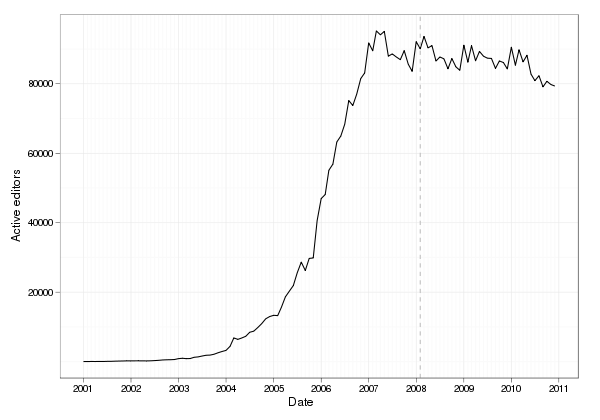
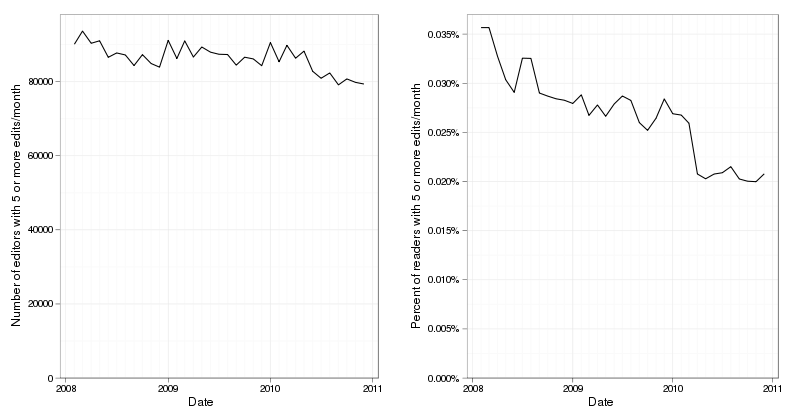
It's been reported for some time now that the number of active editors on Wikipedia (usually defined as people who have edited at least 5 times in a given month) peaked in 2007 and has been mostly stable since then. A graph of the total number of active editors in every month since Wikipedia's founding is shown below. The graph shows the aggregate numbers for all language Wikipedias. English Wikipedia is the largest component of this and is generally more variable. That said, very similar patterns exist for most larger languages. /copyrighteous/images/active_editors_all_wikpiedia.png Felipe Ortega, who has provided many of these statistics, has warned against fatalist claims. Although there seems to be a decrease in the total number of active editors over the last two years, the situation seems to have somewhat stabilized in most languages. New editors in Wikipedia are replacing folks at almost the rate that they are leaving. It is also widely known that the number of readers of Wikipedia has been increasing during this period. According to the report cards released by the foundation using comScore data, the number of unique visitors to Wikipedia each month has increased by 61 million people in the last year -- over 17%. This discrepancy between rising readership and stable or sinking editorship should raise major concern. After all, the Wikimedia Foundation's mission is two part: (1) to empower and engage people around the world to collect and develop educational content and (2) to disseminate it effectively and globally. Although the Foundation report cards include measures of raw levels of editorship, a better metric of engagement and empowerment might be the proportion of readers who engage in editing. I could not find reliable data on the number of unique readers reached each month for more than a few months in the last year. What is available, however, is wonderful data on page views each month going back to 2008. Analysis of the data from available report cards show that, at least during the last year, there is a very stable ratio of 35 page views per unique visitor, as estimated by comScore. Using that measure, we can do a back of the envelope estimation on the proportion of users that are editors for the period where page view data is available, dating back from February 2008 ( marked with the grey dashed lined above). The graphs below show the very different results you get when you consider the change in the number of Wikipedia editors and the change in the editor-to-reader ratio. Once again, these data are combined data for all language Wikipedias although graphs look very similar for most larger languages. The results are striking. Although there has been a 12% decrease between February 2008 and December 2010 in the number of active editors, there is a 42% decrease in the proportion of readers who edit at least five times a month. We can see that fulfilling the first half of the Wikimedia mission remains a struggle. /copyrighteous/images/wikipedia_editors_combined_graph.png Although the graphs above do not say anything directly about the most active core contributors to Wikipedia, the fact that Wikipedia is being maintained by a tiny -- and shrinking -- proportion of its readership does mean that the idea behind Wikipedia is under threat. Although none are as big as Wikipedia, there are lots of good encyclopedias out there. The reason Wikipedia is different, interesting, and important is because -- unlike all those others -- Wikipedia is the encyclopedia that anyone can edit. Wikipedia is powerful because it allow its users to transcend their role as consumers of the information they use to understand the world. Wikipedia allows users to define the reference works that define their understanding of the their environment and each other. But 99.98% of the time, readers do not transcend that role. I think that's a problem. Worse, that the number is growing. The Wikimedia Foundation recently ran a major successful effort to attract donations in its annual fundraiser. Jimmy Wales' smiling mug is apparently enough in the way of motivation to get something like 1% of its readers to donate money to support the project. I think that's very good news. If the Wikimedia community can entice even half of those people to contribute through an increased involvement in the projects themselves, they might do more than ensure Wikipedia's continued growth. They would help take a step toward the empowerment and engagement of those users in sharing their own knowledge, and the continued fulfillment of a critically important mission.
22 January 2011

Matthew Palmer: Debugging Debian Installer

I've been doing a bit of work recently on the netcfg portion of Debian Installer, with the largest work so far being adding IPv6 support. Unlike most of the rest of d-i, netcfg is written in C, and as such suffers from some difficulties in the realm of debugging. Worse, the whole d-i environment is rather bereft of the usual debugging tools (strace, lsof, etc) -- but most importantly, in this case, gdb. Thanks to some hints from Julien Cristau, I was reminded of the existence of gdbserver, a small part of gdb that allows you to debug a program running on a remote machine, using a copy of gdb running on your local machine. It's designed for debugging embedded systems, I think, because all of the heavy lifting (symbol lookups, etc) happens on your local machine, not where gdbserver is running. Here are the steps I took to get a useful gdbserver session inside d-i:
  1. Get the gdb sources (apt-get source gdb) and drop into the gdbserver tree (cd gdb-x.y.z/gdb/gdbserver)
  2. Configure gdbserver to build a static binary (LDFLAGS=-static ./configure). This is necessary because you don't want to have to faff around with library dependencies inside the d-i environment. Then build gdbserver (make).
  3. Copy gdbserver over to your d-i machine/VM (I like using netcat; nc -l -p 31310 >/bin/gdbserver on the d-i machine, and nc IPADDR 31310 <gdbserver where you built gdbserver), then make it executable (chmod /bin/gdbserver)
  4. Fire up gdbserver in d-i, attaching it to the process you wish to debug: gdbserver host:31337 --attach PID
  5. Now things get a little trickier... on your local machine, you need to have an unstripped copy of the binary you're debugging. For me, this is easy, because I'm building netcfg myself (to keep the symbols, I just run DEB_BUILD_OPTIONS=noopt dpkg-buildpackage -b -rfakeroot) but I'm not sure what you'd do if you were just tracing around for fun.
  6. Once you've got your binary, just run gdb BINARY on your host machine to start gdb running.
  7. For the "even trickier" part of the show, your local machine also needs copies of all the libraries your binary is linked against. If you don't have this, when you try to debug you'll get all sorts of "wrong library or version mismatch?" errors, and your backtraces will likely break (amongst other things). Again, for me, this is easy, because I'm only running the d-i initrd, but if you're debugging something later in the installation process you might need to unpack some udebs somewhere. All I have to do is keep the initrd build tree around (which lives in the installer tree, under build/tmp/netboot/tree). Once you've got your tree of libraries, you can continue.
  8. You need to tell gdb about that tree of libraries, by running the following in gdb: set solib-absolute-prefix /path/to/library/tree
  9. Now, tell gdb to connect to your gdbserver: target remote IPADDR:31337 -- gdb should tell you "Remote debugging using IPADDR:31337", and the gdbserver should say "Remote debugging from host LOCALIP:31337".
  10. Now, you should be able to interact with the program being debugged just like any other. Enjoy!

18 December 2010

Christoph G hre: Postfix mail queue

Did you ever have to analyse a mail queue in postfix - more than typing 'mailq' in a shell and hope after some time the queue empties? I thought there'd be a command in postfix to show the message body or header from a specified message id. But I was disappointed, only exim has this with -Mvb or -Mvh. Postfix ships postcat to show queue files, but it needs the absolute path to the queued file - so I can use less or cat instead. With a Google search I found a small bash script called pfcat to do this job. It walks through all queue directories and uses postcat to display the message with the given message id. BTW: I found another nice tool called qshape to display all queue content in a table view. This one is shipped with standard postfix.

11 December 2010

Dirk Eddelbuettel: Regina Carter / Esperanza Spalding

Went to the Chicago Symphony yesterday to see Regina Carter as well as Jazz wunderkind Esperanza Spalding perform one seat each with their respective bands. Regina Carter was presenting material from her current record 'Reverse Thread'. This was a real nice set of African-themed world music featuring Carter herself on violin, Yacouba Sissoko on kora, Will Holshouser on accordion, Chris Lightcap on bass and Alvester Garnett on drums. Some of pieces were really, really nicely done and I particularly enjoyed Holshouser on the accordion. After the break, Esperanza Spalding come on for her Chamber Music Society'. Lovely setup with Spalding on acoustic bass and vocals, Leo Genovese on piano/keyboards, Sara Caswell on violin, Lois Martin on viola, Jody Redhage on cello, the always impressice Terry Lyne Carrington on drums and Leala Cyr on backing vocals (and one co-lead in a really nice duet with Spalding). This was clearly more experimental and a chunk of the audience left during the act. But there is room for improvided chamber music, and it was a good modern music act. And Spalding is really quite impressive and I will gladly go and see her again.

5 December 2010

Jon Dowland: puppet

As a first step on the road to evaluating different configuration management systems, I set up two VMs to test out puppet. Puppet is conveniently packaged within Debian so client and server installation was very simple. By default, puppet clients will look for a host named puppet on the local network, so by naming the server sensibly the two started talking to each other. puppetca --sign [client hostname] on the server started the ball rolling. My first test configuration was to add a user to the sudoers file. With CF Engine 2, I would have achieved this by using editfiles to check for a regular expression and insert a line if necessary. I stumbled across some CF Engine-style definitions for puppet in a Debian Administration article (taken originally from puppet's own wiki, which have since been moved/deleted) and achieved it using

append_if_no_such_line   sudo:
  file => "/etc/sudoers",
  line => "jon ALL=(ALL) ALL"
 
I'm a little concerned that this approach to problem solving is no better than CF Engine 2, and in fact worse than how I'd do it with CF Engine 2: if the host had a line with a different quantity of whitespace, such as jon ALL=(ALL) ALL, it won't match exactly and a duplicate line will be appended, whereas with CF Engine 2 I would have checked for something like ^jon \+ALL=(ALL) \+ALL$. I set up my work laptop as another test node, and used puppet to install some packages that I commonly use:
class jon-desktop  
  package   ['icedove', 'git-core', 'vim-gnome', 'vinagre', 'build-essential',
             'devscripts', 'subversion', 'git-buildpackage', 'mutt',
             'offlineimap', 'ascii', 'gitk', 'chromium-browser'
            ]: ensure => installed  
 
This worked fine, but is a little verbose and the package list is awkward to maintain buried inside the puppet syntax. I spent some time trying to see whether I could populate a puppet list based on the contents of a file: then I could list the packages one-per-line in a separate file. I haven't found a way of doing that yet. Using my laptop as a second node also exposed some interesting puppet client behaviour. Once I went off-site, the laptop tried to look up puppet on foreign networks (such as my home network). I would have assumed that, once the strong SSL association had been made, the client would try to connect to the FQDN of the server. This probably isn't a serious problem in practice, as we probably won't need to rely on nodes off-site talking to the configuration server, but I hope that the client doesn't trust any host that happens to answer to puppet... I fixed this by hacking my hosts file to include an entry for puppet. I could maintain this hack using Puppet itself, which would protect me against stale definitions if any renumbering takes place. I could also have added a line
server = puppet.fqdn.example.org
in /etc/puppet/puppet.conf, which is a more robust way of solving the problem.

Christoph Egger: The erlang experience

This week I had to write a little tool that would collect input on different channels, via socket / netcat, via a http server, .... Calls for a parralel Design -- Maybe a good place to write something real in Erlang. While erlang itself was really nice to write -- I do like Prolog as well as the bunch of functional languages -- doing networking in erlang seems a bit special, the interfaces just aren't thin wrappers around the libc stuff. Getting a Socket Text interface What sounds like a easy challenge to accomplish was actually harder than expected. All I found was some way to pass binaries representing erlang code over a socket and evaluating it remotle. While it's nice that such things are as easy to do as they are it doesn't help me with my task of moving simple strings.
start() ->
     ok, Listen  = gen_tcp:listen(51622, [binary,  packet, 0 ,
                                          reuseaddr, true ,
                                          active, true ]),
    spawn(fun () -> accept_loop(Listen) end).
accept_loop(Listen) ->
     ok, Socket  = gen_tcp:accept(Listen),
    accept_loop(Listen),
    handle(Socket)
handle(Socket) ->
    receive
         tcp, Socket, Bin  ->
            io:format("~p~n", binary_to_list(Bin));
         tcp_closed, Socket  ->
            Buffer
    end.
So the socket is now up and receives text as wanted. However, as we are already runnign a parralel program it would be nice to be hable to handle multiple socket connections in parralel right? For that we just need to add a spawn() at the right place. The right place is not the handle(Socket) but the accept_loop(Listen) because the process that called accept will receive all the tcp messages. This last part was quite obvious after finding the documentation of the active, _ properties for the socket. always here means that you'll receive all data from the socket as erlang Messages, once delivers one package and waits until it is activated again and false requires calling a method -- this would have been possible as well when forking handle(Socket). The web server Ok we also want a webserver. We do not want to run some webapplication inside appache or so, just do some post/get and simple pages. Erlang here provides a built-in httpd with some mod_esi that calls some function depending on the URL used. It doesn't do anything fancy like templating or DB backends or stuff, just taking strings and building the http answers. Unfortunately there are no examples around and basically noone seems to be using this combination (apart from some hacks like mine probably). So as I needed to get some additional information into the handler function (a Pid to connect to some service), I, as a novice, just couldn't find a way. Asking on IRC the solution was rather simple: Just using erlang's process registry. For more complex stuf gproc might prove usefull here. Result I guess I've got a huge step farther in programming erlang now. The manpages are easily found by your search engine -- for python I have to either walk through the (well structured) online documentation or search for the right link in the search results, for erlang they're typically first. Also Joe Armstrong's Books as proven usefull. The most dificult part probably is getting around all the nice extras you can do (transfering functions over sockets et al) and find out how to do the thing you need.

15 November 2010

Benjamin Mako Hill: Between the Bars

Almost a year ago, I blogged about Between the Bars -- a project that offers a blogging platform to the 1% of the United States population that is currently incarcerated. The way it works is pretty simple: prisoners send letters through the postal mail. We scan them and put them up on the web. Visitors can transcribe letters or leave comments which are mailed back to the authors. About a month ago, my collaborator Charlie DeTar and I finally finished planning and paperwork and opened the site to bloggers. Over the last few weeks, we've had a bunch of authors sign up. We now have a daily stream of blog posts going up on the site. Please visit the site. Leave comments. Transcribe posts. If you know of prisoners who might like to use the site, let them know. If you want postcard fliers to send to prisoners, let us know.

10 November 2010

Michal &#268;iha&#345;: Gammu gets m-obex support

I've found some time to implement m-obex protocol based on documentation provided by samsyncro project. However I don't have any phone to test it, so any testers are welcome :-). The testing should be quite easy - just get current Git version of Gammu (either using git or use snapshots) and try to use commands which manipulate with contacts and calendar:
gammu getallmemory ME
gammu getallcalendar
gammu getmemory ME 1
gammu getcalendar 1
gammu addnew test.vcf
gammu addnew test.vcs
In case you have not yet used Gammu with your phone, the configuration for USB cable should look like:
[gammu]
device = /dev/ttyACM0
connection = at
And for Bluetooth:
[gammu]
device = address of the phone
connection = blueobex
model = mobex
Of course there is no guarantee that any of the commands will work, because all I could verify is that code compiles and looks correct. It might as well do something bad to your phone, so backup is recommended.

Filed under: Gammu 0 comments Flattr this!

8 November 2010

Cyril Brulebois: Debugging using netconsole

Now that we have KMS, it happens things go bad enough that when X goes down, one can no longer access any console to see what happened. Mainly, one can distinguish between two cases. I m going to discuss the second case. There s a nice tool in the kernel which makes it possible to send kernel logs over the network. It s called netconsole. As far as limitations are concerned, one shall note that it s UDP only, and over Ethernet (in other words: no wireless). The good news is that it can usually make the last crucial lines available. Let s call the crashy machine a patient and the logging machine a doctor. One should keep in mind that if something goes wrong while configuring the netconsole module, it can be unloaded at anytime through:
sudo modprobe -r netconsole
Easy case: on a local network Local network Here s an example: Patient s IP is 192.168.0.1, doctor's IP is 192.168.0.2. Doctor setup What one needs on the receiving side: only netcat. A tiny warning, there are several implementations. Here s the appropriate syntax:
# netcat-traditional:
nc -l -u -p 6666   tee ~/netconsole.log
# netcat-openbsd:
nc -l -u 6666   tee ~/netconsole.log
The nc command is handled through the alternatives system, one can use update-alternative --config nc to pick the appropriate one if several netcat-* packages are installed. To list the current one, an easy way is readlink -f $(which nc). Using tee means that incoming messages are going to be printed, both to the standard output and to the specified file. Running as non-privileged user is sufficient. Patient setup Now, to have the patient send stuff to the doctor, a simple modprobe is needed:
sudo modprobe netconsole netconsole=@/,6666@192.168.0.2/
What happens here? One requests the netconsole module to be loaded, and one specifies the parameters. Details can be read in the Linux kernel documentation (Documentation/networking/netconsole.txt), but concentrating on the points of interest here: That s all! On the doctor side, one should see something along those lines:
[2920549.188090] console [netcon0] enabled
[2920549.188102] netconsole: network logging started
Slightly harder case: over internet Over internet Because one might not have a second machine handy, it s also possible to go through a router and send stuff across the internet. Here s an example: Patient s IP is 192.168.0.1, connecting to internet through a router, which IP is 192.168.0.254. The doctor, available over the internet, is 192.0.32.10. Doctor setup Exactly the same as in the previous case. The main issue one can run into is firewalls at this point. That s why one may want to switch from the default 6666 port to another one which wouldn t be filtered. One can think of 53 (DNS), but that means running nc as root since it s a privileged port (below 1024). Patient setup Routing is also possible, but that requires an extra parameter: the MAC address of the router. To obtain it, one can use the arp command:
/usr/sbin/arp 192.168.0.254
Supposing it returned the 01:02:03:04:05:06 address, loading the module becomes:
sudo modprobe netconsole netconsole=@/,6666@192.0.32.10/01:02:03:04:05:06
Now, if you re running into firewall-related issues, you can change the source for the UDP packets. The default is 6665, but assuming you want to send from an unfiltered 1234 port, that becomes:
sudo modprobe netconsole netconsole=1234@/,6666@192.0.32.10/01:02:03:04:05:06

3 November 2010

Andrew McMillan: Something a little different

During my recent trip to Massachusetts for CalConnect XIX I passed back via New York, surfing a few nights on the couch at the Washington Cube Garden1. This was just enough time for my new Davis VantagePro2 to arrive by UPS ground (phew!) causing me much consternation, as the box was about twice as wide as I expected it to be. On opening it I discovered that the reason for the size was the physical dimensions of the rain gauge, leading me to realise that I had actually bought exactly what I wanted: a high quality weather station. Also leading me to wonder how the hell I was going to get it halfway around the world with me the next day. Unfortunately that extra wide carrying case was in no way going to fit inside my suitcase. Fortunately it came with a handle. And those wonderful people at Air New Zealand gave me a Koru Gold upgrade for a 50th birthday present, so it was time to put it to the test... Travelling on the subway out to JFK was it's own little adventure, but I made it out to terminal 5 and wandered around a bit before concluding I needed to be in terminal 7. Once I was in the right place I found the fancy people's check in counter and the nice lady there was only too happy for me to carry it to New Zealand, though she did aver that perhaps the security scanners would be dubious. Not a hitch there though: I guess they're used to letting everything through that's not specifically denied, so weather stations are fine because nobody would be silly enough to even think of doing that... Being Koru Gold really helped at this point though, because it enabled me to queue jump use the priority boarding line when getting onto the plane, and every airline in the US seems to have gone all-out for this "checked baggage costs more" approach, so the planes all fly with empty baggage holds and totally overstuffed overhead lockers. If this progresses I shouldn't wonder that the planes will get so top-heavy they roll over, but through the miracles of priority boarding I was able to commandeer all the locker space I needed before anyone else had even made it past row 40. I confess that I was a little worried that it wouldn't be quite such plain sailing getting through LAX. I mean we all know what reputation this delightful little exit port has. In the event it was totally anitclimactic. If it has a handle on it, and it's about the same size and shape as a largish carryon then it's fine. There have been no recorded stabbings with wind vanes anyway - at least on aeroplanes - so clearly they are perfectly safe. Finally back in my country of birth, thinking I was home free, I breathed a sigh of relief transferred my bags and nipped off to the Koru lounge for a much needed shower and change of clothes after I snuck the station through another scanner. By now the handle had broken, so it was looking decidedly more 'box' like and less 'carryon' like, and when I eventually rolled up at the gate with my boarding pass the attendant made a valiant attempt to relieve me of it, but she was too slow and I danced around her and swanned up the gangway to take my seat. I was slow, this time, having missed the first boarding call, and all overhead lockers were crammed full. There was no seat in front of me to put the weather station under. Fortunately a nearby cupboard proved fit for purpose and it was secreted there and we were underway. At this point the guy two seats over said "didn't I see that weather station in New York?". Of course being bright yellow does make it a little conspicuous I guess, and I'm not renowned for my own inconspicuousness myself. So that's how I got my new weather station home, and you can see right away that doing things the easy way would never even occur to me. Possibly this is why I run Linux: there just isn't enough challenge when you run a different operating system. On Windows someone has always written a program for your new weather station, and a Mac user wouldn't be seen dead with it because it's black and beige and comes in a bright yellow box! So now I had to find some code to write. I looked around and very rapidly discovered that some software called vproweather was available, which would happily talk to my weather station and download the data from it, write web pages, stuff it into a MySQL database and so forth. All, obviously, far too easy, so I thought aha! I could convert that to PostgreSQL, and then I would be happy and relax with the thought of a job well done. So I downloaded the code in question an impressive several hundred kb of C code, cranked open a text editor and started to crawl through it and see where I could add the magic pixie dust to make it work with PostgreSQL. But it was not to be. My eyes glazed over or scales fell from them or something, and I realised that this particular edifice was beyond my help. Back to square one. I downloaded the Vantage Serial Protocol docs from the Davis Instruments website did some quick googling and decided I should write a module to talk this protocol. And I should write it in Perl (it was a Thursday, and Perl always seems more sensible on a Thursday, and not because of Douglas Adams, either). I beavered away into the night. Rain threatened, so I raced outside and installed the new weather station on the roof in the hopes that it's magnificent rain collector would collect. I raced back inside and was able to count the first (and so far, only) tip of the bucket. And so I now release upon the world Davis::VantagePro my first perl module. Well, the first one I care to share with the world, anyway. I have stressed it with very little testing, lumbered it with no planning or design whatsoever and so I feel it only fair that I should cast it upon the world with very little thought for it's survival or existential goals.

1 I seem to recall one night we came up with some fantastic names for Micah & Biella's Washington Square apartment, but I couldn't remember any of the good ones and had to slap a new one on there. I should also mention my stay at the Acetarium in Boston, which was a fabulous few days, but it would pad this blog post needlessly, and I've already done that.

19 October 2010

Kees Cook: CVE-2010-2963 v4l compat exploit

If you re running a 64bit system, and you ve got users with access to a video device (/dev/video*), then be sure you update your kernels for CVE-2010-2963. I ve been slowly making my way through auditing the many uses in the Linux kernel of the copy_from_user() function, and ran into this vulnerability. Here s the kernel code from drivers/media/video/v4l2-compat-ioctl32.c:
static int get_microcode32(struct video_code *kp, struct video_code32 __user *up)
 
        if (!access_ok(VERIFY_READ, up, sizeof(struct video_code32))  
                copy_from_user(kp->loadwhat, up->loadwhat, sizeof(up->loadwhat))  
                get_user(kp->datasize, &up->datasize)  
                copy_from_user(kp->data, up->data, up->datasize))
                        return -EFAULT;
        return 0;
 
Note that kp->data is being used as the target for up->data in the final copy_from_user() without actually verifying that kp->data is pointing anywhere safe. Here s the caller of get_microcode32:
static long do_video_ioctl(struct file *file, unsigned int cmd, unsigned long arg)
 
        union  
                struct video_tuner vt;
                struct video_code vc;
...
          karg;
        void __user *up = compat_ptr(arg);
...
        switch (cmd)  
...
        case VIDIOCSMICROCODE:
                err = get_microcode32(&karg.vc, up);
...
So, the contents of up are totally under control of the caller, and the contents of karg (in our case, the video_code structure) are not initialized at all. So, it seems like a call for VIDIOCSMICROCODE would write video_code->datasize bytes from video_code->data into some random kernel address, just causing an Oops, since we don t control what is on the kernel s stack. But wait, who says we can t control the contents of the kernel s stack? In fact, this compat function makes it extremely easy. Let s look back at the union. Notice the struct video_tuner? That gets populated from the caller s up memory via this case of the switch (cmd) statement:
...
        case VIDIOCSTUNER:
        case VIDIOCGTUNER:
                err = get_video_tuner32(&karg.vt, up);
...
So, to control the kernel stack, we just need to call this ioctl twice in a row: once to populate the stack via VIDIOCSTUNER with the contents we want (including the future address for video_code->data, which starts at the same location as video_tuner->name[20]), and then again with VIDIOCSMICROCODE. Tricks involved here are: the definition of the VIDIOCSMICROCODE case in the kernel is wrong, and calling the ioctls without any preparation can trigger other kernel work (memory faults, etc) that may destroy the stack contents. First, we need the real value for the desired case statement. This turns out to be 0 4020761b. Next, we just repeatedly call the setup ioctl in an attempt to get incidental kernel work out of the way so that our last ioctl doing the stack preparation will stick, and then we call the buggy ioctl to trigger the vulnerability. Since the ioctl already does a multi-byte copy, we can now copy arbitrary lengths of bytes into kernel memory. One method of turning an arbitrary kernel memory write into a privilege escalation is to overwrite a kernel function pointer, and trigger that function. Based on the exploit for CVE-2010-3081, I opted to overwrite the security_ops function pointer table. Their use of msg_queue_msgctl wasn t very good for the general case since it s near the end of the table and its offset would depend on kernel versions. Initially I opted for getcap, but in the end used ptrace_traceme, both of which are very near the top the security_ops structure. (Though I need share credit here with Dan Rosenberg as we were working together on improving the reliability of the security_ops overwrite method. He used the same approach for his excellent RDS exploit.) Here are the steps for one way of taking an arbitrary kernel memory write and turning it into a root escalation: Here s the source for Vyakarana as seen running in Enlightenment using cap_getcap (which is pretty unstable, so you might want to switch it to use ptrace_traceme), and as a stand-alone memory writer. Conclusions: Keep auditing the kernel for more arbitrary writes; I think there are still many left. Reduce the exploitation surface within the kernel itself (which PaX and grsecurity have been doing for a while now), specifically:

13 October 2010

MJ Ray: Report on TravelWatch SouthWest General Meeting 9 Oct 2010

I attended this meeting last Saturday, taking up the Cooperatives-SW invitation (we have been invited before, as reported on this blog). It was held, once again, at SCAT in Taunton. First, we had introductions from everyone. The Go! Co-op rail plan for Yeovil-Oxford and beyond got a mention by the chair after I introduced myself I didn t realise it at the time, but C-SW member Co-Cars were next door at an exhibition in the Genesis centre and are preparing to launch in Taunton. Then there was a formal welcome from Christopher Irwin, TravelWatch SouthWest CIC Chair and a keynote presentation from First Great Western s operations director Kevin Gale. Delays on the GW Main Line have returned in the last three months, with performance below targets. The blame was squarely laid at the door of not-for-profit infrastructure company Network Rail, but this area is still better than it used to be. The FGW 30 train fleet (refurbished Sprinters from London Midland and London Overground?) start arriving in about two weeks. There s a new consistent company organisation. In the Q+A, I think we were told: Then there was a discussion asking: what should be the SW transport priorities in the era of 30% cuts? I suggested co-op-friendly right-to-try measures should be in those priorities. Interestingly, a reply was given by Duncan Hames MP (Chippenham, LD), followed by a talking point from transport portfolio holder Richard Gamble of Wiltshire Council. After lunch came the just a minute speeches on: arctic oil, Devizes-Bath bus mistakes (change of operator, not serving Bath bus station), Local Enterprise Partnerships and bus cuts, a suggestion to require council transport officers to use public transport to get to meetings, the need for better integrated transport info for the Wessex area, senior citizen fares and CTAs (I don t remember what this stands for sorry), the big subsidy of High Speed 1, and the problem of Dorset s main towns having poor westward rail links. There was a quick summary of the report from the CIC board which can be downloaded from the TWSW website and a presentation on integrated smartcard ticketing system from Andrew Seedhouse of GO-SW. The West of England back-office system has been launched, but there is still more to do for the SW and to connect it to operators. The event ended with the second keynote address by TfL Commissioner Peter Hendy which I m sorry to say I don t really understand my notes about and have little recollection of the key points at the end of the day. As before, I felt that the best bits of the event were the morning question-and-answer sessions and the just a minute points immediately after lunch. So, in that line: what do you think are the biggest issues and the priorities for mass transport in the South West?
1 October 2010

MJ Ray: What s a Good Payment Service?

There was a lot of news coverage like Credit card fees being imposed by councils, says Which? earlier this week. People seemed outraged that councils were making a small surplus over the year in total. Interviewees suggested that councils should just include the cost of taking payments in the amount charged. Of course, councils are sort-of not-for-profit, so they ll just set prices to include the credit card fees and make a small surplus on other cheaper forms of payment over the year in total. So everyone who uses bank transfers will pay more because credit card fees are high! Will that be next year s scandal? Presumably that s what happens in France, Germany and other countries where sellers can t charge more for credit card payment. That, or you just don t accept credit cards, like many German retailers never used to. What else can they do? It s a bit odd of Visa to claim it costs more to accept other forms of payment. Cheques are horrendously expensive if you only get a few, but seem to get cheaper if handled in bulk. Domestic bank transfers and cash also seem cheaper than Visa to me. Sellers seem to be asked explicitly to assume much more fraud risk in order to accept credit cards, too. Mind you, with the amazingly slack approach of most US retailers to cards (no chip-and-PIN and they usually don t bother to even check the signature I cut up the card I used in the USA when I arrived home), I m surprised there s not more card fraud. I m also a bit surprised Bath and North East Somerset (which neighbours my home district) is paying 2% on credit card transactions. Our co-op has been offered deals about as good as that and we don t do anything like as many transactions. We ve not yet taken one up because the setup paperwork is a pain and the setup and maintenance fees usually suck. It feels like it doesn t matter what you do with money, bankers still get rich. Even though I keep looking (like in 2007), it ll probably happen: we need to act again, because some overseas customers seem unwilling or unable to register with a site to pay (and some payment sites have ethical questions too), while international bank transfers are even more expensive and an even bigger pain. Besides card payments, we re considering opening a currency trading account and a Euro bank account. Anyone done these and do you think they re worth it or not? And do any Eurozone banks allow a UK company to open an account without a member visiting in person? I ve found few possibilities, after looking at banks in seven countries so far.

27 September 2010

Lars Wirzenius: 100 things?

This year, I have moved to a new country two times. This sharply brings to attention the pain and cost of owning things. It is not just when carrying maximally filled suitcases across airports that things are bothersome. The more things you have, the bigger a home you need, and the more effort you need to spend on cleaning things and home. A meme of sorts in recent years has been surviving on 100 things only. That sounds like very little, but it looks doable, if a bit extreme. I am sorely tempted to try this, but, well, I am not like Joey, living in yurts, and using only a miniature netbook for my computing needs. But perhaps that's the problem? I am too accustomed to my stuff, and it is hard to give up things, even when I don't really need them much. Like, USB hard disks. I like to have a Debian mirror locally, so I have a disk which has a couple of hundred gigabytes of Debian packages. However, I don't actually use that much. Would it make more sense to rely on servers hosted elsewhere? While those might be part of the 100 things count, at least I wouldn't have to carry them, ever. But then I'd need to have Internet access, and that's also difficult, especially in the early months of living in a new country. Things would be so much easier if I could just buy a Scottish island, with a castle, fix that up with some broadband and weekly grocery deliveries, and never go anywhere again.

25 September 2010

Siegfried Gevatter: Language Identification and it s state in Free Software

Working on a new feature for eSpeak GUI I started looking into language identification. Forcing users to manually choose the text s language is a botheration, so trying to guess it by checking which system dictionary contains the most words from the text or some other method would surely be beneficial. After a quick search I learned that it s much easier than this: it s possible to reliably determine the language based on statistic n-gram information. Ignoring the fact that now I officially hate Firefox, Chromium, OpenOffice.org and everyone else there for not implementing this and having me spend the day changing the spell-checker s language, I was left with the choice on how to use this in eSpeak GUI. The first option I found was TextCat, which is also the only library I ve found to be packaged for Debian. However, ignoring the fact that upstream isn t maintaining it any more (such a library shouldn t need too much maintainance, after all), the package declares incorrect dependencies (bug filled a month ago, no response yet) and the API is also pretty crappy (it requires a physical file indicating the location of the statistic models). Unrelated to that, I ve also found that the Catalan text samples it includes are incorrect, so the same may be true for other languages. I guess it d make sense to work on a new (and completely Unicode) language samples collection. I ve thought of using something like the Universal Declaration of Human Rights since this way all languages can have the same text, but being more of a legal thing it may be biased by some words being too repetitive. Looking for other alternatives to the TextCat library I ve only found the following: So it looks like I ll have to start by getting a good collection of text samples I can use to generate the statistic data. Then I have several options on how to actually use it. As I see it, those are my possibilities:
  1. Fixing libtextcat s packaging and just using that.
  2. Taking it over as new upstream maintainer. Not my preferred option as I don t really feel like maintaining a C library at this point.
  3. Trying to convince the maintainer of the new TextCat (with last commit January this year and a more sane API) to re-license it in a GPL-compatible way, packaging that and seeing how that one works (haven t tried it out yet).
  4. Writing my own implementation in Python, maybe based upon this example or TextCat.pm.
Any other ideas, pointers to some library I may have missed or offers to collaborate are very welcome. Please also note that my intention in writing this post is not only to rant about there being no well-maintained ready-to-use library being available, but especially raising awareness on the topic of language identification. I d love to see this feature all around the desktop, just like (and in combination with) spell-checking, which is already omnipresent. Related posts:
  1. espeak-gui 0.2
  2. Introducing espeak-gui

11 comments
Siegfried-Angel Gevatter Pujals, 2010. Permalink License Post tags: , ,

19 September 2010

Lars Wirzenius: No orange dents

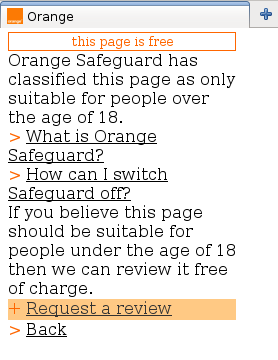
I am currently relying on netcafes and Orange prepaid to get online. Orange does not let me access identi.ca without jumping through hoops. orange-identica.png Them dastardly free software developers, always corrupting minds of children.

18 September 2010

Robert Collins: Maintainable pyunit test suites fixtures

So a while back I blogged about maintainable test suites. One of the things I ve been doing since is fiddling with the heart of the fixtures concept. To refresh your memory, I m defining fixture as some basic state you want to reach as part of doing a test. For instance, when you ve mocked out 2 system calls in preparation for some test code that represent a state you want to reach. When you ve loaded sample data into a database before running the actual code you want to make assertions about that also represents a state you want to reach. So does simply combining three or four objects so you can run some code. Now, there are existing frameworks in python for this sort of thing. testresources and testscenarios both go some way towards this (and I and to blame for them :) ), so does the zope testrunner with layers, and the testfixtures project has some lovely stuff as well. And this is without even mentioning py.test! There are a few things that you need from the point of view of running a test and establishing this state: Large test suites or test suites dealing with various sorts of external facilities will also often want to optimise this process and put the same state into place for many tests. The (and I m not exaggerating) terrible setUpClass and setUpModule and other similar helpers are often abused for this. Why are they terrible? They are terrible because they are fragile; there is no (defined in the contract) way to check that the state is valid for the next test, and its common to see false passes and false failures in tests using setUpClass and similar. So we also need some way to reuse such expensive things while still having a way to check that test isolation hasn t been compromised. Having looked around, I ve come to the conclusion we ll all benefit if there is a single core protocol for doing these things, something that can be used and built on in many different ways for many different purposes. There was nothing (that I found) that actually met all these requires and was also tasteful enough that folk might really like using it. I give you fixtures . Or on Launchpad. This small API is intended to be a common contract that all sorts of different higher level test libraries can build on. As such it has little to no policy or syntatic sugar. It does have a nice core, integration with pyunit.TestCase, and I m going to add a library of useful generic fixtures (like temporary directories, environment isolators and so on) to it. I d be delighted to add more committers to the project, and intend to have it be both Python 2.x and 3.x compatible (if its not already my CI machine isn t back online after the move yet, I m short of round tuits). Now, if you re writing some code like:
class MyTest(TestCase):
    def setUp(self):
        foo = Foo()
        bar = Bar()
        self.quux = Quux(Foo(), Bar())
        self.addCleanup(self.quux.done)
You can make it reusable across your code base simply by moving it into a fixture like this:
class QuuxFixture(fixtures.Fixture):
    def setUp(self):
        foo = Foo()
        bar = Bar()
        self.quux = Quux(Foo(), Bar())
        self.addCleanup(self.quux.done)
class MyTest(TestCase, fixtures.TestWithFixtures):
    def setUp(self):
        self.useFixture(QuuxFixture)
I do hope that the major frameworks (nose, py.test, unittest2, twisted) will include the useFixture glue themselves shortly; I will offer it as a patch to the code after giving it some time to settle. Further possibilities include declared fixtures for tests, and we should be able to make setUpClass better by letting fixtures installed during it get reset between tests.

9 July 2010

Francois Marier: Improving the performance of Request Tracker by reducing latency

Request Tracker is a really neat support tool, but one of the common complaints I heard from people using it during a previous project was that it was pretty slow.

There wasn't much we could do about the (overloaded) server it was running on, but I found that enabling mod_deflate really helped.

After watching this great video though, I was inspired to look into it a bit more, focussing this time on latency.

Description of tests
Also note that I was looking for the "best case" for each of the different configurations and so each screenshot was taken after reloading the homepage 10-20 times to maximize cache hits (thanks in large part to mod_expires).

(Is there a nice automated way of measuring average latency?)

Stock RT 3.6Using the default apache2-modperl2 config file (as supplied by RT), here's what the homepage (logged in as root) looked like before I changed anything:


The purple section here indicates the time spent waiting for the server. This shows that the server (running Mason inside mod_perl) is doing quite a bit of processing, including a lot more work than you'd expect while serving static files. It's quite impressive to see how fast the images are being served (directly by Apache) in comparison with the Javascript and the CSS files (which go through Mason).

The reason while Javascript and CSS files have to be served by mod_perl is that they are in fact templates. They contain a few Mason variables which must be substituted before being served.

Looking into it further though, all of these replacements have to do with variables defined in RT_SiteConfig.pm (mostly the install path). Here's an example:
var path = "" ? "" : "/";
which gets turned into:
var path = "/rt" ? "/rt" : "/";
So as long as these paths don't change, then there is no need to re-generate these files.

Static Javascript and CSSThis next diagram was produced after configuring Apache to serve all Javascript and CSS files directly from Apache:


The way I did that (without modifying any of the original files) was by saving the Javascript/CSS sent to the browser and using mod_rewrite rules to serve these files instead of the original templated ones:

# Serve static files directly
RewriteRule ^/usr/share/request-tracker3.6/html/NoAuth/js/ahah.js$ /var/www/rt/ahah.js
RewriteRule ^/usr/share/request-tracker3.6/html/NoAuth/js/cascaded.js$ /var/www/rt/cascaded.js
RewriteRule ^/usr/share/request-tracker3.6/html/NoAuth/js/class.js$ /var/www/rt/class.js
RewriteRule ^/usr/share/request-tracker3.6/html/NoAuth/js/combobox.js$ /var/www/rt/combobox.js
RewriteRule ^/usr/share/request-tracker3.6/html/NoAuth/js/list.js$ /var/www/rt/list.js
RewriteRule ^/usr/share/request-tracker3.6/html/NoAuth/js/titlebox-state.js$ /var/www/rt/titlebox-state.js
RewriteRule ^/usr/share/request-tracker3.6/html/NoAuth/js/util.js$ /var/www/rt/util.js
RewriteRule ^/usr/share/request-tracker3.6/html/NoAuth/css/3.5-default/main-squished.css$ /var/www/rt/main-squished.css
RewriteRule ^/usr/share/request-tracker3.6/html/NoAuth/css/print.css$ /var/www/rt/print.css
RewriteRule ^/usr/share/request-tracker3.6/html/NoAuth/webrtfm.css$ /var/www/rt/webrtfm.css

Removing unnecessary images

Finally, one thing I noticed from this last graph is that the rounded corners in the theme require a number of small images. While these don't take a whole lot of bandwidth, they do require quite a bit of back and forth between the browser and the server.

So I replaced all of the "rounded corner" images in the main-squished.css file with the following CSS attributes:

-moz-border-radius-topleft: 8px;
-moz-border-radius-topright: 8px;
-moz-border-radius-bottomleft: 8px;
-moz-border-radius-bottomright: 8px;
-webkit-border-top-left-radius: 8px;
-webkit-border-top-right-radius: 8px;
-webkit-border-bottom-left-radius: 8px;
-webkit-border-bottom-right-radius: 8px;

(yes, Internet Explorer users probably don't get the rounded corners... oh well)

This eliminated a number of roundtrips and shaved off a few more milliseconds:


Merging CSS and Javascript filesBy this stage, the pages are pretty snappy so there is not much to be gained anymore, but I figured I'd try to reduce the latency a bit more by combining all Javascript files into one (and doing the same for CSS files with the exception of print.css). This is what I got:


(Note that I also took the opportunity to minify both squished files to reduce the filesize.)

Not a huge improvement and I unfortunately had to copy quite a few Mason templates from /usr/share/request-tracker3.6/html/ to /usr/local/share/request-tracker3.6/html/ and then replace all of the script tags with a single one in html/Elements/Header.

Others things to look intoI've stopped here, but there might be ways to further reduce the processing time on the server (hence the latency) by tuning mod_perl/Mason or Postgres. The RT wiki also has a few pointers.

Replacing Apache with Nginx (which means moving to FastCGI) was something I considered, but after trying it out, it turned out that it would add about 100ms of extra latency.

Feel free to leave a comment if you've found something else that makes a big difference on your site.

20 June 2010

Andrew Pollock: [life] First Father's Day

Father's Day in the US has always been a weird one for me. I've been pottering through the day oblivious, when a friend who is a father will tell me that they've been thinking of me especially today because of our loss. Then I'm reminded that Father's Day is in June and not September. I wonder what the deal is with that? It seems very few countries observe it on the first Sunday in September. Weird. Zoe hits the 7 week mark tomorrow, and I return to work. Boy is that going to be a shock to the system for all of us. The 7 weeks of paternity leave has been absolutely wonderful. Google's Paternity Leave benefit is now firmly my number one favourite employee benefit. Co-workers had complained that taking it all at birth was a bit of a waste, because all the baby does is sleep, but it's definitely been worthwhile taking it all now. Because we've been predominantly bottle feeding with pumped breast milk, I've been able to be very involved with the feeding, and I've been able to do a lot of the running around helping Sarah, so I wouldn't have done it any other way. It's also been great to watch Zoe grow and develop. She's interactive enough at this age, and it's just great to cuddle with her, or share a nap with her. On the sleeping front, things are a bit all over the place. She definitely gets fussy in the evenings, at around 5pm to 7pm. Often we have trouble getting her to go back to sleep after a feeding around this time. Sometimes the trouble can extend past the 10pm to midnight feeding. She sleeps magnificently during the day, and travels fairly well. She sleeps quite well in her car seat, and stays asleep in it when we're at a cafe or restaurant. We had our first overnight trip while Sarah's Mum was visiting. We went down to San Simeon to take her to Hearst Castle. It was fun having Zoe in a hotel room with us. Whenever she fussed during the night, we'd just grab her and bring her into bed with us. She spent quite a lot of time in our bed asleep on our chests. It was very sweet. It was like a little baby vacation. Zoe also had her first outing to the California Academy of Sciences, and we managed to spend about 5 hours there without any major meltdowns from anybody. It was absolutely fantastic having Sarah's Mum here for 4 weeks too. She's great to have around. She was a big help in cleaning up the back yard significantly, and generally helping out around the house. It was great having her take care of the 7am feeding when Sarah and I were both zonked out from overnight interruptions. It was also nice not to have to think so much about how dinner was going to materialise. My parents have decided they will come and visit in September, which is excellent, as they won't have to wait until February to meet Zoe. One of the other nice things about the Google Paternity Leave is that you keep accruing vacation time while you're on it, so I should have enough vacation time to take a couple of weeks off while they're here, as well as in February when we go back to Australia for Sarah's residential school at the University. The next big event will be Zoe's vaccinations at 8 weeks. Hopefully that will be as uneventful as possible.

14 June 2010

Russell Coker: Should Passwords Expire?

It s widely regarded that passwords should be changed regularly. The Australian government declared last week the National Cyber Security Awareness Week [1] and has published a list of tips for online security which includes Get a stronger password and change it at least twice a year . Can a Password be Semi-Public? Generally I think of a password as being either secret or broken. If a password is known to someone other than the sysadmin and the user who is authorised to use the account in question then you have potentially already lost all your secret data. If a password is disclosed to an unauthorised person on one occasion then merely changing the password is not going to do any good unless the root cause is addressed, otherwise another anothorised person will probably get the password at some future time. Hitachi has published a good document covering many issues related to password management [2]. I think it does a reasonable job of making sysadmins aware of some of the issues but there are some things I disagree with. I think it should be used as a list of issues to consider rather than a list of answers. The Hitachi document lists a number of ways that passwords may be compromised and suggests changing them every 60 to 90 days to limit the use of stolen passwords. This seems to imply that a password is something that s value slowly degrades over time as it s increasingly exposed. I think that the right thing to do is to change a password if you suspect that it has been compromised. There s not much benefit in having a password if it s going to be known by unauthorised people for 89 days before being changed! Fundamentally a password is something that can have it s value rapidly drop to zero without warning. It doesn t wear out. Why are terms such as Three Months used for Maximum Password Ages? The Hitachi document gives some calculations on the probability of a brute-force attack succeeding against a random password with 90 days of attacking at a rate of 100 attempts per second [2]. I think that if a service is run by someone who wouldn t notice the load of 100 attempts per second then you have bigger security problems than the possibility of passwords being subject to brute-force attacks. Also it s not uncommon to have policies to lock accounts after as few as three failed login attempts. Rumor has it that in the early days of computing when the hashed password data was world readable someone calculated that more than 3 months of CPU time on a big computer would be needed to obtain a password by brute-force. But since then the power of individual CPUs has increased dramatically, computers have become cheap enough that anyone can easily gain legal access to dozens of systems and illegal access to a million systems, and it has become a design feature in every OS that hashed passwords are not readable by general users. So the limiting factor is to what degree the server restricts the frequency of password guesses. I don t think that specifying the minimum password length and maximum password age based on the fraction of the key space that could be subject to a brute-force attack makes sense. I don t think that any attempt to make an industry-wide standard for the frequency of password changes (as the government is trying to do) makes sense. Can there be a Delay between a Password being Compromised and being Used by an Attacker? Hypothetically speaking, if a password was likely to be compromised (EG by having the paper it was written on lost or stored insecurely) for some time before an attacker exploited it, then if the password was changed during that time period it could solve the problem. For example when a company moves office there is the possibility of notepaper with passwords to be lost. So if the sysadmin caused every user password to expire at the time of the move then a hostile party would be unable to gain access. Another possibility is the theft of backup tapes that contain the list of unencrypted passwords. If users change their passwords every three months then the theft of some four month old backup tapes will be less of a problem. Another possibility concerns the resale of old computers, phones, and other devices that may contain passwords. A reasonably intelligent user won t sell their old hardware as soon as the replacement device arrives, they will want to use the new device for some time to ensure that it works correctly. If passwords expire during this trial period with the new device then passwords stored in the old device won t have any value. The down-side to this idea is that people probably sell their old gear fairly quickly and making passwords expire every two weeks would not be accepted well by the users. It seems to me that having bulk password changes (all passwords for one user or for one company) based on circumstances that lead to potential insecurity would do more good than changing passwords at a fixed schedule. How are Passwords typically Compromised? Dinei Flor ncio and Cormac Herley of Microsoft Research and Baris Coskun of Brooklyn Polytechnic University wrote a paper titled Do Strong Web Passwords Accomplish Anything? [3] which discusses this issue. The first thing that they note is that nowadays passwords are most commonly compromised by phishing and keylogging. In those cases passwords are typically used shortly after they are stolen and the strength of a password never does any good. That paper suggests that banks should use stronger user-names rather than stronger passwords to combat the threat of bulk brute-force attacks. Can a Password Last Forever? If a password is entered in a secure manner, authenticated by a secure server, and all network links are encrypted or physically protected then there should never be a need to change it. Of course nothing is perfectly secure, so for some things with minimal short-term value or which can be used without anyone noticing there is a benefit in changing the password. But in the case of Internet banking if a hostile party gets your login details then you will probably know about it in a few days when the bank calls you about the unusual transactions from foreign countries long before a 90 day password change schedule would have done any good. Maybe one of the issues determining whether a password should be changed regularly is whether an attacker could use long-term read-only access to gain some benefit. Being able to read all the email someone received for a year could be a significant benefit if that person was a public figure, and there s usually no way for an ISP customer to know that someone else is downloading all their mail via POP or IMAP. Should a Password be the only Authentication Method? It is generally agreed that an authenitcation method should ideally involve something you have plus something you know. That means a password and a physical device such as a smart card, token with a changing sequential password, or a key such as a Yubikey [4]. If the physical device can t be cloned (through some combination of technical difficulty and physical access control) then it significantly improves security. When a physical device is used the purpose of the password is merely to stop someone who steals the physical device from being immediately exploit everything the password only has to be strong enough to keep the accounts secure until a new token can be issued. The combination of something you have and something you know is very strong. Having a physical token stored on the desk next to the PC that is used for logging in provides a significant benefit, then an attacker needs to break in to the house and can t sniff the password by compromising the PC remotely. Conclusion In all aspects of security you need to consider what threats you face. If an attacker is likely to launch an immediate noisy attack (such as transferring the maximum funds out of an Internet banking account) then changing the password regularly won t do any good. If a subtle long-term attack is expected then changing the password can do a lot of good but a physical token is the ideal if the account is valuable enough. But to put things in to perspective, it s technically possible to use a mobile phone camera at close range (or a SLR with a big lens at long range) to take a photo of keys that allow reproducing them. But this hasn t stopped people from carrying their house keys in an obvious manner that permits photography or leaving them on their desk at work. Also I ve never heard of anyone routinely changing the door locks in case a hostile party might have got a key although I m sure that such practices are common in highly secure locations. Few people even take their house keys off the key-ring when they have their car serviced! Related Posts Defense in Depth and Sudo when using sudo can increase security and when it can t.
Logging Shell Commands how to log what the sysadmin does and what benefits that provides you, it doesn t help if the sysadmin is hostile.
Logging in as Root should you login directly as root?

Next.

Previous.

