Search Results: "tats"

6 November 2014

Michal Čihař: Weblate 2.0

Weblate 2.0 has been released today. It comes with lot of improvements in backend and completely new user interface. Full list of changes for 2.0: You can find more information about Weblate on http://weblate.org, the code is hosted on Github. If you are curious how it looks, you can try it out on demo server. You can login there with demo account using demo password or register your own user. Ready to run appliances will be soon available in SUSE Studio Gallery. Weblate is also being used https://hosted.weblate.org/ as official translating service for phpMyAdmin, Gammu, Weblate itself and others. If you are free software project which would like to use Weblate, I'm happy to help you with set up or even host Weblate for you. Further development of Weblate would not be possible without people providing donations, thanks to everybody who have helped so far!

Filed under: English phpMyAdmin SUSE Weblate 0 comments Flattr this!

31 October 2014

Richard Hartmann: Release Critical Bug report for Week 44

The UDD bugs interface currently knows about the following release critical bugs: Graphical overview of bug stats thanks to azhag:

26 October 2014

Sune Vuorela: KDE makes Qt

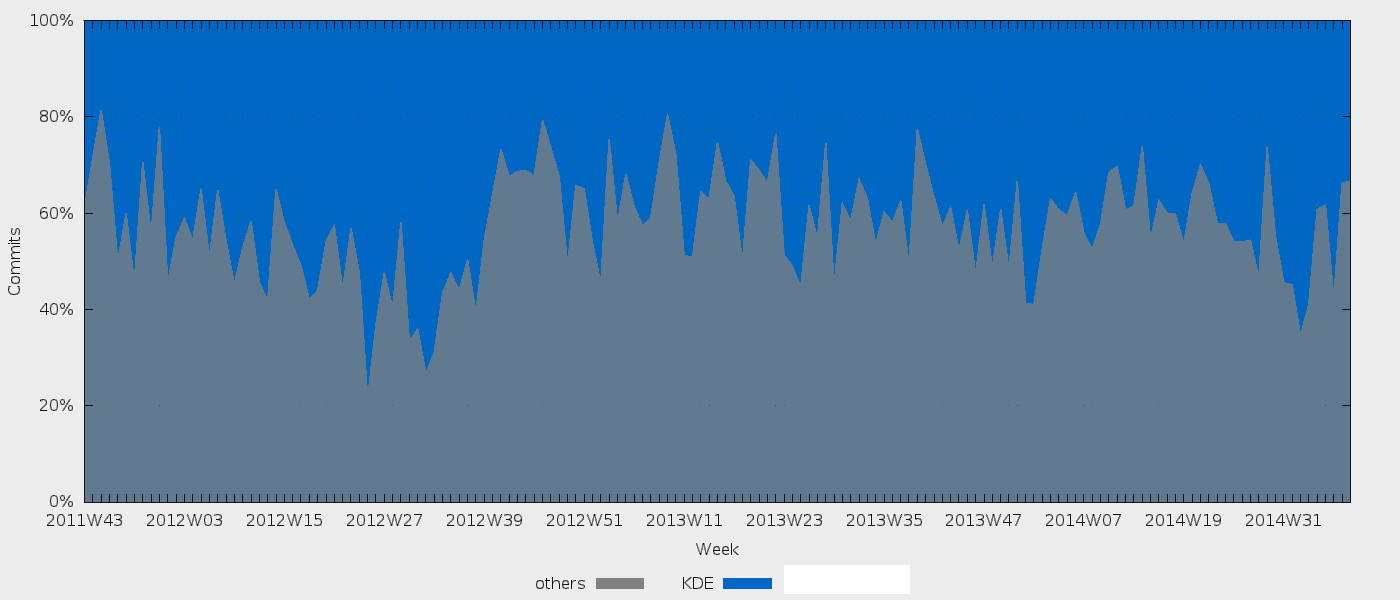
Recently I was trying some statistics on the qtbase-module (where QtCore, QtGui, QtWidgets and so on lives) and was wondering who made them.
Not based on their current paid affilation, like Thiago s graphs, but if each commit was made by a person coming from KDE. So, I got hold of Thiago s scripts, a lovely mix of perl and zsh, and a QtBase git repository. First steps was to try to classify people as person coming from KDE or not. Of course, I m a KDE person. Thiago is a KDE person. David Faure is a KDE person. Olivier Goffart is a KDE person. Lars Knoll is a KDE person. By the help of the KDE accounts file, and some of the long time KDE contributors, I got after a half day of work a good list of it. Then next steps was trying to put it into Thiago s perlscripts All of it kind of succeeded: qtbase-KDE.graph So, KDE people makes up for 40-60% of the weekly commits to QtBase. This is again shows that KDE is important to Qt, just as the reverse is. So, let s keep KDE healthy. KDE is running a end-of-year fundraiser over here https://www.kde.org/fundraisers/yearend2014/. Go ahead and donate, and help KDE stay healthy. For your own sake. And for Qt s.

24 October 2014

Richard Hartmann: Release Critical Bug report for Week 43

Just a friendly reminder: If your package is not in unstable (and reasonably bug free) by Sunday, it's not in Jessie. I am not doing full stats as I am unsure about the diff format at the moment, but in week 43, we had 284 bugs for Squeeze and 468 for Wheezy. (282 + 468) / 2 = 376; so we are a bit better off than on average. Still, here's to hoping this freeze will be shorter. The UDD bugs interface currently knows about the following release critical bugs:

23 October 2014

Alessio Treglia: Bits from the Debian Multimedia Maintainers

This brief announcement was released yesterday to the debian-devel-announce mailing list. Ciao! The Debian Multimedia Maintainers have been quite active since the Wheezy release, and have some interesting news to share for the Jessie release. Here we give you a brief update on what work has been done and work that is still ongoing. Let s see what s cooking for Jessie then. Frameworks and libraries Support for many new media formats and codecs. The codec library libavcodec, which is used by popular media playback applications including vlc, mpv, totem (using gstreamer1.0-libav), xine, and many more, has been updated to the latest upstream release version 11 provided by Libav. This provides Debian users with HEVC playback, a native Opus decoder, Matroska 3D support, Apple ProRes, and much more. Please see libav s changelog for a full list of functionality additions and updates. libebur128 libebur128 is a free implementation of the European Broadcasting Union Loudness Recommendation (EBU R128), which is essentially an alternative to ReplayGain. The library can be used to analyze audio perceived loudness and subsequentially normalize the volume during playback. libltc libltc provides functionalities to encode and decode Linear (or Longitudinal) Timecode (LTC) from/to SMPTE data timecode. libva libva and the driver for Intel GPUs has been updated to the 1.4.0 release. Support for new GPUs has been added. libva now also supports Wayland. Pure Data A number of new additional libraries (externals) will appear in Jessie, including (among others) Eric Lyon s fftease and lyonpotpourrie, Thomas Musil s iemlib, the pdstring library for string manipulation and pd-lua that allows to write Pd-objects in the popular lua scripting language. JACK and LADI LASH Audio Session Handler was abandoned upstream a long time ago in favor of the new session management system, called ladish (LADI Session Handler). ladish allows users to run many JACK applications at once and save/restore their configuration with few mouse clicks. The current status of the integration between the session handler and JACK may be summarized as follows: Note that ladish uses the D-Bus interface to the jack daemon, therefore only Jessie s jackd2 provides support for and also cooperates fine with it. Plugins: LV2 and LADSPA Debian Jessie will bring the newest 1.10.0 version of the LV2 technology. Most changes affect the packaging of new plugins and extensions, a brief list of packaging guidelines is now available.
A number of new plugins and development tools too have been made available during the Jessie development cycle: LV2 Toolkit LVTK provides libraries that wrap the LV2 C API and extensions into easy to use C++ classes. The original work for this was mostly done by Lars Luthman in lv2-c++-tools. Vee One Suite The whole suite by Rui Nuno Capela is now available in Jessie, and consists of three components: All three are provided in both forms of LV2 plugins and stand-alone JACK client. JACK session, JACK MIDI, and ALSA MIDI are supported too. x42-plugins and zam-plugins LV2 bundles containing many audio plugins for high quality processing. Fomp Fomp is an LV2 port of the MCP, VCO, FIL, and WAH plugins by Fons Adriaensen. Some other components have been upgraded to more recent upstream versions: We ve packaged ste-plugins, Fons Adriaensen s new stereo LADSPA plugins bundle. A major upgrade of frei0r, namely the standard collection for the minimalistic plugin API for video effects, will be available in Jessie. New multimedia applications Advene Advene (Annotate Digital Video, Exchange on the NEt) is a flexible video
annotation application. Ardour3 The new generation of the popular digital audio workstation will make its very first appearance in Debian Jessie. Cantata Qt4 front-end for the MPD daemon. Csound Csound for jessie will feature the new major series 6, with the improved IDE CsoundQT. This new csound supports improved array data type handling, multi-core rendering and debugging features. din DIN Is Noise is a musical instrument and audio synthesizer that supports JACK audio output, MIDI, OSC, and IRC bot as input sources. It could be extended and customized with Tcl scripts too. dvd-slideshow dvd-slideshow consists of a suite of command line tools which come in handy to make slideshows from collections of pictures. Documentation is provided and available in /usr/share/doc/dvd-slideshow/ . dvdwizard DVDwizard can fully automate the creation of DVD-Video filesystem. It supports graphical menus, chapters, multiple titlesets and multi-language streams. It supports both PAL and NTSC video modes too. flowblade Flowblade is a video editor like the popular KDenlive based on the MLT engine, but more lightweight and with some difference in editing concepts. forked-daapd Forked-daapd switched to a new, active upstream again dropping Grand Central Dispatch in favor of libevent. The switch fixed several bugs and made forked-daapd available on all release architectures instead of shipping only on amd64 and i386. Now nothing prevents you from setting up a music streaming (DAAP/DACP) server on your favorite home server no matter if it is based on mips, arm or x86! harvid HTTP Ardour Video Daemon decodes still images from movie files and serves them via HTTP. It provides frame-accurate decoding and is main use-case is to act as backend and second level cache for rendering the
videotimeline in Ardour. Groove Basin Groove Basin is a music player server with a web-based user interface inspired by Amarok 1.4. It runs on a server optionally connected to speakers. Guests can control the music player by connecting with a laptop, tablet, or smart phone. Further, users can stream their music libraries remotely.
It comes with a fast, responsive web interface that supports keyboard shortcuts and drag drop. It also provides the ability to upload songs, download songs, and import songs by URL, including YouTube URLs. Groove Basin supports Dynamic Mode which automatically queues random songs, favoring songs that have not been queued recently.
It automatically performs ReplayGain scanning on every song using the EBU R128 loudness standard, and automatically switches between track and album mode. Groove Basin supports the MPD protocol, which means it is compatible with MPD clients. There is also a more powerful Groove Basin protocol which you can use if the MPD protocol does not meet your needs. HandBrake HandBrake, a versatile video transcoder, is now available for Jessie. It could convert video from nearly any format to a wide range of commonly supported codecs. jack-midi-clock New jackd midiclock utility made by Robin Gareus. laborejo Laborejo, Esperanto for Workshop , is used to craft music through notation. It is a LilyPond GUI frontend, a MIDI creator and a tool collection to inspire and help music composers. mpv mpv is a movie player based on MPlayer and mplayer2. It supports a wide variety of video file formats, audio and video codecs, and subtitle types. The project focuses mainly on modern systems and encourages developer activity. As such, large portions of outdated code originating from MPlayer have been removed, and many new features and improvements have been added. Note that, although there are still some similarities to its predecessors, mpv should be considered a completely different program (e.g. lacking compatibility with both mplayer and mplayer2 in terms of command-line arguments and configuration). smtube SMTube is a stand-alone graphical video browser and player, which makes YouTube s videos browsing, playing, and download such a piece of cake.
It has so many features that, we are sure, will make YouTube lovers very, very happy. sonic-visualiser Sonic Visualiser Application for viewing and analysing the contents of music audio files. SoundScapeRenderer SoundScapeRenderer (aka SSR) is a (rather) easy to use render engine for spatial audio, that provides a number of different rendering algorithms, ranging from binaural (headphone) playback via wave field synthesis to higher-order ambisonics. Videotrans videotrans is a set of scripts that allow its user to reformat existing movies into the VOB format that is used on DVDs. XBMC XBMC has been partially rebranded as XBMC from Debian to make it clear that it is changed to conform to Debian s Policy. The latest stable release, 13.2 Gotham will be part of Jessie making Debian a good choice for HTPC-s. zita-bls1 Binaural stereo signals converter made by Fons Adriaensen zita-mu1 Stereo monitoring organiser for jackd made by Fons Adriaensen zita-njbridge Jack clients to transmit multichannel audio over a local IP network made by Fons Adriaensen radium-compressor Radium Compressor is the system compressor of the Radium suite. It is provided in the form of stand-alone JACK application. Multimedia Tasks With Jessie we are shipping a set of multimedia related tasks.
They include package lists for doing several multimedia related tasks. If you are interested in defining new tasks, or tweaking the current, existing ones, we are very much interested in hearing from you. Upgraded applications and libraries What s not going to be in Jessie With the aim to improve the overall quality of the multimedia software available in Debian, we have dropped a number of packages which were abandoned upstream: We ve also dropped mplayer, presently nobody seems interested in maintaining it.
The suggested replacements for users are mplayer2 or mpv. Whilst the former is mostly compatible with mplayer in terms of command-line arguments and configuration (and adds a few new features too), the latter adds a lot of new features and improvements, and it is actively maintained upstream. Please note that although the mencoder package is no longer available anymore, avconv and mpv do provide encoding functionality. For more information see avconv s manual page and documentation, and mpv s encoding documentation. Broken functionalities rtkit under systemd is broken at the moment. Activity statistics More information about team s activity are available. Where to reach us The Debian Multimedia Maintainers can be reached at pkg-multimedia-maintainers AT lists.alioth.debian.org for packaging related topics, or at debian-multimedia AT lists.debian.org for user and more general discussion.
We would like to invite everyone interested in multimedia to join us there. Some of the team members are also in the #debian-multimedia channel on OFTC. Cheers! Alessio Treglia
on behalf of the Debian Multimedia Maintainers

26 September 2014

Richard Hartmann: Release Critical Bug report for Week 39

The UDD bugs interface currently knows about the following release critical bugs: Graphical overview of bug stats thanks to azhag:

23 September 2014

Dariusz Dwornikowski: debrfstats software for RFS statistics

Last time I told that I would release software I used to make RFS stats plots. You can find it in my github repo - github.com/tdi/debrfstats. The software contains small class to get data needed to generate plots, as well as for doing some simple bug analysis. The software also contains an R script to make plots from a CSV file. For now debrfstats uses SOAP interface to Debbugs but I am now working on adding a UDD data source. The software is written in Python 2 (SOAPpy does not come in 3 flavour), some usage examples are in the main.py file in the repository. If you have any questions or wishes for debrfstats do not hesitate to contact me.

18 September 2014

Dariusz Dwornikowski: RFS health in Debian

I am working on a small project to create WNPP like statistics for open RFS bugs. I think this could improve a little bit effectiveness of sponsoring new packages by giving insight into bugs that are on their way to being starved (i.e. not ever sponsored, or rotting in a queue). The script attached in this post is written in Python and uses Debbugs SOAP interface to get currently open RFS bugs and calculates their dust and age. The dust factor is calculated as an absolute value of a difference between bugs's age and log_modified. Later I would like to create fully blown stats for an RFS queue, taking into account the whole history (i.e. 2012-1-1 until now), and check its health, calculate MTTGS (mean time to get sponsored). The list looks more or less like this:
Age  Dust Number  Title
37   0    757966  RFS: lutris/0.3.5-1 [ITP]
1    0    762015  RFS: s3fs-fuse/1.78-1 [ITP #601789] -- FUSE-based file system backed by Amazon S3
81   0    753110  RFS: mrrescue/1.02c-1 [ITP]
456  0    712787  RFS: distkeys/1.0-1 [ITP] -- distribute SSH keys
120  1    748878  RFS: mwc/1.7.2-1 [ITP] -- Powerful website-tracking tool
1    1    762012  RFS: fadecut/0.1.4-1
3    1    761687  RFS: abraca/0.8.0+dfsg-1 -- Simple and powerful graphical client for XMMS2
35   2    758163  RFS: kcm-ufw/0.4.3-1 ITP
3    2    761636  RFS: raceintospace/1.1+dfsg1-1 [ITP]
....
....
The script rfs_health.py can be found below, it uses SOAPpy (only python <3 unfortunately).
#!/usr/bin/python
import SOAPpy
import time
from datetime import date, timedelta, datetime
url = 'http://bugs.debian.org/cgi-bin/soap.cgi'
namespace = 'Debbugs/SOAP'
server = SOAPpy.SOAPProxy(url, namespace)
class RFS(object):
    def __init__(self, obj):
        self._obj = obj
        self._last_modified = date.fromtimestamp(obj.log_modified)
        self._date = date.fromtimestamp(obj.date)
        if self._obj.pending != 'done':
            self._pending = "pending"
            self._dust = abs(date.today() - self._last_modified).days
        else:
            self._pending = "done"
            self._dust = abs(self._date - self._last_modified).days
        today = date.today()
        self._age = abs(today - self._date).days
    @property
    def status(self):
        return self._pending
    @property
    def date(self):
        return self._date
    @property
    def last_modified(self):
        return self._last_modified
    @property
    def subject(self):
        return self._obj.subject
    @property
    def bug_number(self):
        return self._obj.bug_num
    @property
    def age(self):
        return self._age
    @property
    def dust(self):
        return self._dust
    def __str__(self):
        return "  subject:   age:  dust: ".format(self._obj.bug_num, self._obj.subject, self._age, self._dust)
if __name__ == "__main__":
    bugi = server.get_bugs("package", "sponsorship-requests", "status", "open")
    buglist = [RFS(b.value) for b in server.get_status(bugi).item]
    buglist_sorted_by_dust = sorted(buglist, key=lambda x: x.dust, reverse=False)
    print("Age  Dust Number  Title")
    for i in buglist_sorted_by_dust:
        print(" :<4   :<4   :<7   ".format(i.age, i.dust, i.bug_number, i.subject))

12 September 2014

Richard Hartmann: Release Critical Bug report for Week 37

Remember, remember; the fifth of November. The UDD bugs interface currently knows about the following release critical bugs: Graphical overview of bug stats thanks to azhag:

8 September 2014

Jaldhar Vyas: Debconf 14 - Days 1 and 2

Unfortunately I was not able to attend debconf this year but thanks to the awesome video team the all the talks are available for your viewing pleasure. In order to recreate an authentic Portland experience, I took my laptop into the shower along with a vegan donut and had my children stand outside yelling excerpts from salon.com in whiny Canadianesque accents. Here are some notes I took as I watched the talks. Welcome Talk
Debian in the Dark Ages of Free software - Stefan Zacchiroli Weapons of the Geek - Gabriella Coleman bugs.debian.org -- Database Ho! - Don Armstrong Grub Ancient and Modern - Colin and Watson One year of fedmsg in Debian - Nicolas Dandrimont Coming of Age: My Life with Debian - Christine Spang Status report of the Debian Printing Team - Didier Raboud

23 August 2014

Tim Retout: Packaging pump.io for Debian

I intend to intend to package pump.io for Debian. It's going to take a long time, but I don't know whether that's weeks or years yet. The world needs decentralized social networking. I discovered the tools that let me create this wiki summary of the progress in pump.io packaging. There are at least 35 dependencies that need uploading, so this would go a lot faster if it weren't a solo effort - if anyone else has some time, please let me know! But meanwhile I'm hoping to build some momentum. I think it's important to keep the quality of the packaging as high as possible, even while working through so many. It would cost a lot of time later if I had to go back and fix bugs in everything. I really want to be running the test suites in these builds, but it's not always easy. One of the milestones along the way might be packaging nodeunit. Nodeunit is a Nodejs unit testing framework (duh), used by node-bcrypt (and, unrelatedly, statsd, which would be pretty cool to have in Debian too). Last night I filed eight pull requests to try and fix up copyright/licensing issues in dependencies of nodeunit. Missing copyright statements are one of the few things I can't fix by myself as a packager. All I can do is wait, and package other dependencies in the meantime. Fortunately there are plenty of those. And I have not seen so many issues in direct dependencies of pump.io itself - or at least they've been fixed in git.

19 August 2014

Julien Danjou: Tracking OpenStack contributions in GitHub

I've switched my Git repositories to GitHub recently, and started to watch my contributions statistics, which were very low considering I spend my days hacking on open source software, especially OpenStack.
OpenStack hosts its Git repositories on its own infrastructure at git.openstack.org, but also mirrors them on GitHub. Logically, I was expecting GitHub to track my commits there too, as I'm using the same email address everywhere. It turns out that it was not the case, and the help page about that on GitHub describes the rule in place to compute statistics. Indeed, according to GitHub, I had no relations to the OpenStack repositories, as I never forked them nor opened a pull request on them (OpenStack uses Gerrit). Starring a repository is enough to build a relationship between a user and a repository, so this is was the only thing needed to inform GitHub that I have contributed to those repositories. Considering OpenStack has hundreds of repositories, I decided to star them all by using a small Python script using pygithub.
And voil , my statistics are now including all my contributions to OpenStack!

17 August 2014

Francesca Ciceri: Adventures in Mozillaland #4

Yet another update from my internship at Mozilla, as part of the OPW. An online triage workshop One of the most interesting thing I've done during the last weeks has been to held an online Bug Triage Workshop on the #testday channel at irc.mozilla.org.
That was a first time for me: I had been a moderator for a series of training sessions on IRC organized by Debian Women, but never a "speaker".
The experience turned out to be a good one: creating the material for the workshop had me basically summarize (not too much, I'm way too verbose!) all what I've learned in this past months about triaging in Mozilla, and speaking of it on IRC was a sort of challenge to my usual shyness. And I was so very lucky that a participant was able to reproduce the bug I picked as example, thus confirming it! How cool is that? ;) The workshop was about the very basics of triaging for Firefox, and we mostly focused on a simplified lifecycle of bugs, a guided tour of bugzilla (including the quicksearch and the advanced one, the list view, the individual bug view) and an explanation of the workflow of the triager. I still have my notes, and I plan to upload them to the wiki, sooner or later. I'm pretty satisfied of the outcome: the only regret is that the promoting wasn't enough, so we have few participants.
Will try to promote it better next time! :) about:crashes Another thing that had me quite busy in the last weeks was to learn more about crashes and stability in general.
If you are unfortunate enough to experience a crash with Firefox, you're probably familiar with the Mozilla Crash Reporter dialog box asking you to submit the crash report. But how does it works? From the client-side, Mozilla uses Breakpad as set of libraries for crash reporting. The Mozilla specific implementation adds to that a crash-reporting UI, a server to collect and process crash reported data (and particularly to convert raw dumps into readable stack traces) and a web interface, Socorro to view and parse crash reports. Curious about your crashes? The about:crashes page will show you a list of the submitted and unsubmitted crash reports. (And by the way, try to type about:about in the location bar, to find all the super-secret about pages!) For the submitted ones clicking on the CrashID will take you to the crash report on crash-stats, the website where the reports are stored and analyzed. The individual crash report page on crash-stats is awesome: it shows you the reported bug numbers if any bug summaries match the crash signature, as well as many other information. If crash-stats does not show a bug number, you really should file one! The CrashKill team works on these reports tracking the general stability of the various channels, triaging the top crashes, ensuring that the crash bugs have enough information and are reproducible and actionable by the devs.
The crash-stats site is a mine of information: take a look at the Top Crashes for Firefox 34.0a1.
If you click on a individual crash, you will see lots of details about it: just on the first tab ("Signature Summary") you can find a breakdown of the crashes by OS, by graphic vendors or chips or even by uptime range.
A very useful one is the number of crashes per install, so that you know how widespread is the crashing for that particular signature. You can also check the comments the users have submitted with the crash report, on the "Comments" tab. One and Done tasks review Last week I helped the awesome group of One and Done developers, doing some reviewing of the tasks pages. One and Done is a brilliant idea to help people contribute to the QA Mozilla teams.
It's a website proposing the user a series of tasks of different difficulty and on different topics to contribute to Mozilla. Each task is self-contained and can last few minutes or be a bit more challenging. The team has worked hard on developing it and they have definitely done an awesome job! :) I'm not a coding person, so I just know that they're using Django for it, but if you are interested in all the dirty details take a look at the project repository. My job has been only to check all the existent tasks and verify that the description and instruction are correct, that the task is properly tagged and so on. My impression is that this an awesome tool, well written and well thought with a lot of potential for helping people in their first steps into Mozilla. Something that other projects should definitely imitate (cough Debian cough). What's next? Next week I'll be back on working on bugs. I kind of love bugs, I have to admit it. And not squashing them: not being a coder make me less of a violent person toward digital insects. Herding them is enough for me. I'm feeling extremely non-violent toward bugs. I'll try to help Liz with the Test Plan for Firefox 34, on the triaging/verifying bugs part.
I'll also try to triage/reproduce some accessibility bugs (thanks Mario for the suggestion!).

29 July 2014

Daniel Pocock: Pruning Syslog entries from MongoDB

I previously announced the availability of rsyslog+MongoDB+LogAnalyzer in Debian wheezy-backports. This latest rsyslog with MongoDB storage support is also available for Ubuntu and Fedora users in one way or another. Just one thing was missing: a flexible way to prune the database. LogAnalyzer provides a very basic pruning script that simply purges all records over a certain age. The script hasn't been adapted to work within the package layout. It is written in PHP, which may not be ideal for people who don't actually want LogAnalyzer on their Syslog/MongoDB host. Now there is a convenient solution: I've just contributed a very trivial Python script for selectively pruning the records. Thanks to Python syntax and the PyMongo client, it is extremely concise: in fact, here is the full script:
#!/usr/bin/python
import syslog
import datetime
from pymongo import Connection
# It assumes we use the default database name 'logs' and collection 'syslog'
# in the rsyslog configuration.
with Connection() as client:
    db = client.logs
    table = db.syslog
    #print "Initial count: %d" % table.count()
    today = datetime.datetime.today()
    # remove ANY record older than 5 weeks except mail.info
    t = today - datetime.timedelta(weeks=5)
    table.remove( "time":  "$lt": t  , "syslog_fac":   "$ne" : syslog.LOG_MAIL  )
    # remove any debug record older than 7 days
    t = today - datetime.timedelta(days=7)
    table.remove( "time":  "$lt": t  , "syslog_sever": syslog.LOG_DEBUG )
    #print "Final count: %d" % table.count()
Just put it in /usr/local/bin and run it daily from cron. Customization Just adapt the table.remove statements as required. See the PyMongo tutorial for a very basic introduction to the query syntax and full details in the MongoDB query operator reference for creating more elaborate pruning rules. Potential improvements
  • Indexing the columns used in the queries
  • Logging progress and stats to Syslog

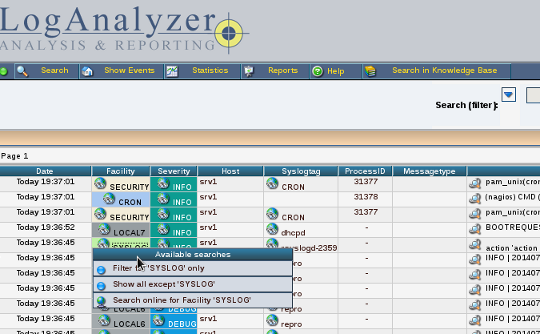
LogAnalyzer using a database backend such as MongoDB is very easy to set up and much faster than working with text-based log files

25 July 2014

Richard Hartmann: Release Critical Bug report for Week 30

I have been asked to publish bug stats from time to time. Not exactly sure about the schedule yet, but I will try and stick to Fridays, as in the past; this is for the obvious reason that it makes historical data easier to compare. "Last Friday of each month" may or may not be too much. Time will tell. The UDD bugs interface currently knows about the following release critical bugs: Graphical overview of bug stats thanks to azhag:

21 July 2014

Francois Marier: Creating a modern tiling desktop environment using i3

Modern desktop environments like GNOME and KDE involving a lot of mousing around and I much prefer using the keyboard where I can. This is why I switched to the Ion tiling window manager back when I interned at Net Integration Technologies and kept using it until I noticed it had been removed from Debian. After experimenting with awesome for 2 years and briefly considering xmonad , I finally found a replacement I like in i3. Here is how I customized it and made it play nice with the GNOME and KDE applications I use every day.

Startup script As soon as I log into my desktop, my startup script starts a few programs, including: Because of a bug in gnome-settings-daemon which makes the mouse cursor disappear as soon as gnome-settings-daemon is started, I had to run the following to disable the offending gnome-settings-daemon plugin:
dconf write /org/gnome/settings-daemon/plugins/cursor/active false

Screensaver In addition, gnome-screensaver didn't automatically lock my screen, so I installed xautolock and added it to my startup script:
xautolock -time 30 -locker "gnome-screensaver-command --lock" &
to lock the screen using gnome-screensaver after 30 minutes of inactivity. I can also trigger it manually using the following shortcut defined in my ~/.i3/config:
bindsym Ctrl+Mod1+l exec xautolock -locknow

Keyboard shortcuts While keyboard shortcuts can be configured in GNOME, they don't work within i3, so I added a few more bindings to my ~/.i3/config:
# volume control
bindsym XF86AudioLowerVolume exec /usr/bin/pactl set-sink-volume @DEFAULT_SINK@ -- '-5%'
bindsym XF86AudioRaiseVolume exec /usr/bin/pactl set-sink-volume @DEFAULT_SINK@ -- '+5%'
# brightness control
bindsym XF86MonBrightnessDown exec xbacklight -steps 1 -time 0 -dec 5
bindsym XF86MonBrightnessUp exec xbacklight -steps 1 -time 0 -inc 5
bindsym XF86AudioMute exec /usr/bin/pactl set-sink-mute @DEFAULT_SINK@ toggle
# show battery stats
bindsym XF86Battery exec gnome-power-statistics
to make volume control, screen brightness and battery status buttons work as expected on my laptop. These bindings require the following packages:

Keyboard layout switcher Another thing that used to work with GNOME and had to re-create in i3 is the ability to quickly toggle between two keyboard layouts using the keyboard. To make it work, I wrote a simple shell script and assigned a keyboard shortcut to it in ~/.i3/config:
bindsym $mod+u exec /home/francois/bin/toggle-xkbmap

Suspend script Since I run lots of things in the background, I have set my laptop to avoid suspending when the lid is closed by putting the following in /etc/systemd/login.conf:
HandleLidSwitch=lock
Instead, when I want to suspend to ram, I use the following keyboard shortcut:
bindsym Ctrl+Mod1+s exec /home/francois/bin/s2ram
which executes a custom suspend script to clear the clipboards (using xsel), flush writes to disk and lock the screen before going to sleep. To avoid having to type my sudo password every time pm-suspend is invoked, I added the following line to /etc/sudoers:
francois  ALL=(ALL)  NOPASSWD:  /usr/sbin/pm-suspend

Window and workspace placement hacks While tiling window managers promise to manage windows for you so that you can focus on more important things, you will most likely want to customize window placement to fit your needs better.

Working around misbehaving applications A few applications make too many assumptions about window placement and are just plain broken in tiling mode. Here's how to automatically switch them to floating mode:
for_window [class="VidyoDesktop"] floating enable
You can get the Xorg class of the offending application by running this command:
xprop   grep WM_CLASS
before clicking on the window.

Keeping IM windows on the first workspace I run Pidgin on my first workspace and I have the following rule to keep any new window that pops up (e.g. in response to a new incoming message) on the same workspace:
assign [class="Pidgin"] 1

Automatically moving workspaces when docking Here's a neat configuration blurb which automatically moves my workspaces (and their contents) from the laptop screen (eDP1) to the external monitor (DP2) when I dock my laptop:
# bind workspaces to the right monitors
workspace 1 output DP2
workspace 2 output DP2
workspace 3 output DP2
workspace 4 output DP2
workspace 5 output DP2
workspace 6 output eDP1
You can get these output names by running:
xrandr --display :0   grep " connected"
Finally, because X sometimes fail to detect my external monitor when docking/undocking, I also wrote a script to set the displays properly and bound it to the appropriate key on my laptop:
bindsym XF86Display exec /home/francois/bin/external-monitor

16 July 2014

Juliana Louback: Become an Open-source Contributor Video Conference

A couple weeks ago I was contacted by Yehuda Korotkin through one of the Debian mailing lists. Yehuda is a tech professor at one of Israel s leading colleges for women. He proposed a video conference to present the open source community to his class and explain how they can contribute to open source projects. I volunteered to participate and last Monday (July 14th 2014) we had our virtual meeting, which I hope was the first of many. Shauna G. also participated from Boston, making it a Israel - USA - Brazil meetup. Pretty impressive, eh? The conference was hosted on Google Hangouts, the video is available for viewing here. Run time is around 2.5 hours so to save you time I ve kindly posted a summary of the conference! To be frank, I look ghastly half the time so I d much prefer that you read this post. First there was a Q&A period which was more of a discussion panel, followed by a hands-on session where the girls made their first contribution to an open source project. Here s the gist of it: Q&A Hands on For the practical part of our conference, Yehuda s students contributed to Jscommunicator s Issue #5 which requests i18n support for major languages. JSCommunicator is a SIP communication tool developed in HTML and JavaScript, currently supporting audio/video calls and SIP SIMPLE instant messaging. First we set up Github in their local machines and forked the Jscommunicator repo. We learned the basic git commands needed to push changes to their remote repositories and to create a pull requests. This is explained in further detail here. At the end of the conference with nearly an hour overtime due to my tendency to be overly verbose, Yehuda s class made their first contribution with a Hebrew translation for Jscommunicator! All in all, it was great to virtually meet Yehuda and his epic students who all seemed very clever engineers. I m looking forward to our next meetup once I gain some time-management skills.

29 June 2014

Ritesh Raj Sarraf: Fibre Channel over Ethernet

Fibre Channel over Ethernet (FCoE) is a computer network technology that encapsulates Fibre Channel frames over Ethernet networks. This allows Fibre Channel to use 10 Gigabit Ethernet networks (or higher speeds) while preserving the Fibre Channel protocol. The specification was part of the International Committee for Information Technology Standards T11 FC-BB-5 standard published in 2009 (As descripted on Wikipedia) I just orphaned the FCoE packages for Debian. I don't really have the time and enthusiasm to maintain FCoE any more. The packages may not be in top notch shape, but FCoE as a technology, itself did not see many takers. The popcon stats are low. In case anyone is interested to takeover the maintenance, there is a pkg-fcoe group on alioth. There are 4 packages that build the stack: lldpad, libhbaapi, libhbalinux and fcoe-utils.

AddThis:

Categories:

Keywords:

10 June 2014

Steve Kemp: I did get a job

In my previous blog-post I mentioned, briefly, that I'd posted a couple of adverts on Reddit looking for work. To give more detail I did three things: The advertisement was set to be shown in /r/edinburgh (where I live), and /r/sysadmin (where I thought some people might look if they were struggling for help). The advertising on Reddit was painless to setup, and the traffic stats were interesting, but even though this worked out well I'm a little loathe to repeat the process - since the "non-sterling transaction fee" from my bank effectively doubled my budget. I received a few (private) emails and comments, along with the expected grammar corrections. The end result was that I received contact from an American company founder who seemed interested. He allowed me to write some code to solve a fun problem, appeared to enjoy the code I sent (Ruby code for dealing with (exim) email spam, that's as specific as I will be). The end result was a three month contract, which we obviously hope will lead to more permanent work. Anyway I thought this was an atypical route to find a work, and was about a million times nicer than working with recruiters, so .. consider this documentation! In other news it is now 10pm and I need to go to the gym and pub, in that order.

Next.

Previous.