Search Results: "storm"

14 April 2013

Andreas Metzler: balance sheet snowboarding season 2012/13

All in a below average season. Although we had lots of snow in December, my first day on-piste was December 22nd. Riding in snowstorm or thick fog is just not my kind of thing. The christmas holiday season was absurdely warm, getting rid of most of the snow again. I managed 7 snow-days from December 22nd to January 1st, but this was more sport than fun. Really sunny days were rare in the whole winter. Due to minor injury and minor illness I had to take long breaks from snowboarding (just two snow days in the periode from January 8th to February 15th!). Early easter cut the season short. This year I ended up in skiline.cc's top-100 list for both most meters of altitude in a single day and the whole season which shows that other people had a short season, too. On the plus side, we had enough and good snow. This is also evident from the balance sheet below, I almost always went to Diedamskopf where there is almost no artificial snow. Here is the balance sheet:
2005/06 2006/07 2007/08 2008/09 2009/10 2010/11 2011/12 2012/13
number of (partial) days2517293730302523
Dam ls10105101623104
Diedamskopf15424231341419
Warth/Schr cken03041310
total meters of altitude12463474096219936226774202089203918228588203562
highscore10247m8321m12108m11272m11888m10976m13076m13885m
# of runs309189503551462449516468

3 April 2013

Petter Reinholdtsen: Isenkram 0.2 finally in the Debian archive

Today the Isenkram package finally made it into the archive, after lingering in NEW for many months. I uploaded it to the Debian experimental suite 2013-01-27, and today it was accepted into the archive. Isenkram is a system for suggesting to users what packages to install to work with a pluggable hardware device. The suggestion pop up when the device is plugged in. For example if a Lego Mindstorm NXT is inserted, it will suggest to install the program needed to program the NXT controller. Give it a go, and report bugs and suggestions to BTS. :)

13 March 2013

Dirk Eddelbuettel: Rcpp master class in New York last weekend

On Saturday I had the opportunity to teach another one-day master class on Rcpp. The class had been organized by Jared Lander, and organized very well I might add. The weekend started with a slight disappointment. I had taken Friday off, and hoped to reach NY by early afternoon to join JJ there, and to spend the afternoon with the RStan team. However, the tail end of last week's snowstorm made it such that we both got to Columbia's stats department closer to 6pm rather than 1pm, and half the team had left. Dang. Very frustrating travel experience. We salvaged the evening by gabbing over a cold beverage or two, before sharing some sacred New York pizza with Wes McKinney and Jared. The class itself on Saturday went quite well. With JJ on deck, we were able to have every participant log into an EC2-hosted instance of RStudio Server, which worked very well for usage examples of Rcpp. It has been almost a year since I last taught the class, and many exciting things--such as Rcpp attributes, added by JJ himself--have appeared, which made it extra fun. Participants were rather kind with praise. Either they really liked it, or they really are hard-nosed New Yorkers who manage to lie to my face without me noticing. We ended the day with some hard-earned cold beverages, followed by some dinner at Sylvia's (as tweeted by Jared) followed by more drinks. Ended up a little past my usual bedtime, but I managed to get out and enjoy a lovely 6.5 miles run across Central Park the next morning before leaving town. All in all, a very nice weekend, the travel horror of Friday notwithstanding. And who know, maybe we'll just do it again another time...

28 February 2013

Daniel Kahn Gillmor: Make a Woolly Mammoth (thanks, inkscape!)

I feel like i've done a lot of blogging recently about failing to do things with proprietary software. That's annoying. This post is about something i made successfully with free software (and some non-software crafting): I made a Woolly Mammoth for my nephew!I documented the pattern (with pictures!) that i came up with using Inkscape (and used markdown, pandoc, emacs, pdftk, and other free software in the process). i've also published the source for the pattern via git if you want to modify it:
git clone git://lair.fifthhorseman.net/~dkg/woolly
Writing up the documentation makes me realize that i don't know of any software tools designed specifically for facilitating fabric/craft construction. Some interesting software ideas: Anyone have any ideas?Tags: brainstorming, crafting, inkscape

8 February 2013

MJ Ray: Clevo 7872-9040/A built Jan 13 with Debian 6

My trusty Asus seems to have succumbed to graphic fault. I got an OS-free Zoostorm as its replacement, to avoid paying the MS tax. Zoostorm is one brand that Clevo laptops are sold under. It was actually a Clevo 7872-9040/A built Jan 13. I installed Debian 6 on it. The download button was easy to spot on the front page, but I actually used mini.iso so I could use a smaller usb stick. The first larger stick I tried was a dud and I m not sure where other sticks went in the move. The base installation went fine and most things went well, but the wireless networking and sound required an upgrade, but more on that next tech post.

25 January 2013

Richard Hartmann: Please don't do this

Update: They got & reported him. Most of you will have seen the news about various private files being hosted on github as this little has taken the Internet by storm yesterday. Obviously most of those files can be found via Google and other means as well, but this exposure is a bit worse inasmuch people will keep on updating their secret information automagically and continuously. Personal favourites that used to work until yesterday include And various other config and history files for AWS, RT, whatnot. Plus, it was really easy to search for certain actions like so. Another fun thing look for were ENV variables setting passwords, hosts, etc. Ironically, having the SSH identity files means anyone is able to change pretty much anything about a person's repositories on github. This includes files like .zshrc which basically allows complete takeover of any account and often machine that file is sourced from. Which reminds me that I still need to add a way for vcsh to only merge commits that have a tag signed with a trusted key and warn for everything else, but I digress. None of this is a problem with github specifically, it's a problem with users who don't think their actions through. And this is non-trivial for github or anyone else to fix as there are potentially endless sources of otherwise secret information. Initially, I sent email to github's quite responsive security team asking them to forbid certain queries and to email users who checked in their private data by accident and left it at that. They got back to me extremely fast, promising to do their best (as of right now, no queries I tried work any more) and after some conversation asked me to link to their help article on removing sensitive data if I were to blog about this. The topic itself has been covered extensively, github did their best to keep user data private, and so the above could have been done without, but... ...I have gotten word of 4chan's /g/ sleuthing their way through various files and at least one incident of people finding direct evidence of child pornography in a Zsh history file. Sadly, this story found its way to me without a link and the person who saw the thread read it on a tablet, preserving neither the URL nor local cache. They saw it on 2013-01-24 at around 2200 UTC. If you, or someone you know, saw anything plainly illegal, immoral, and simply wrong... please report it to the relevant authorities or at least github. As I suspect that there's some overlap between the subscribers of the various planets I am aggregated on and /g/, this may reach the right eyes. Between the account name, a verified email address, access logs with IPs, and possibly a real name, it should be comparatively easy to find anyone you report.

9 January 2013

Petter Reinholdtsen: Lets make hardware dongles easier to use in Debian

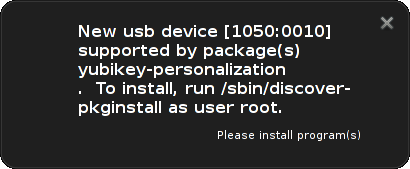
One thing that annoys me with Debian and Linux distributions in general, is that there is a great package management system with the ability to automatically install software packages by downloading them from the distribution mirrors, but no way to get it to automatically install the packages I need to use the hardware I plug into my machine. Even if the package to use it is easily available from the Linux distribution. When I plug in a LEGO Mindstorms NXT, it could suggest to automatically install the python-nxt, nbc and t2n packages I need to talk to it. When I plug in a Yubikey, it could propose the yubikey-personalization package. The information required to do this is available, but no-one have pulled all the pieces together. Some years ago, I proposed to use the discover subsystem to implement this. The idea is fairly simple: I am not sure what the best way to implement this is, but my initial idea was to use dbus events to discover new hardware, the discover database to find packages and PackageKit to install packages. Yesterday, I found time to try to implement this idea, and the draft package is now checked into the Debian Edu subversion repository. In the process, I updated the discover-data package to map the USB ids of LEGO Mindstorms and Yubikey devices to the relevant packages in Debian, and uploaded a new version 2.2013.01.09 to unstable. I also discovered that the current discover package in Debian no longer discovered any USB devices, because /proc/bus/usb/devices is no longer present. I ported it to use libusb as a fall back option to get it working. The fixed package version 2.1.2-6 is now in experimental (didn't upload it to unstable because of the freeze). With this prototype in place, I can insert my Yubikey, and get this desktop notification to show up (only once, the first time it is inserted):

For this prototype to be really useful, some way to automatically install the proposed packages by pressing the "Please install program(s)" button should to be implemented. If this idea seem useful to you, and you want to help make it happen, please help me update the discover-data database with mappings from hardware to Debian packages. Check if 'discover-pkginstall -l' list the package you would like to have installed when a given hardware device is inserted into your computer, and report bugs using reportbug if it isn't. Or, if you know of a better way to provide such mapping, please let me know. This prototype need more work, and there are several questions that should be considered before it is ready for production use. Is dbus the correct way to detect new hardware? At the moment I look for HAL dbus events on the system bus, because that is the events I could see on my Debian Squeeze KDE desktop. Are there better events to use? How should the user be notified? Is the desktop notification mechanism the best option, or should the background daemon raise a popup instead? How should packages be installed? When should they not be installed? If you want to help getting such feature implemented in Debian, please send me an email. :)

3 January 2013

Joey Hess: overcast

My least favorite forecast, and we've been having a lot of it lately. Since winter began (Dec 21st), my PV array has produced only 102 amp-hours of power. There have been only 3 days that could be considered sunny at all (even for a few hours). To put this in some perspective for you, Wolfram Alpha tells me that 102 amp-hours is half of a typical car battery capacity. So I've really had to scrimp & save. I disconnected my router to save power, and I plumbed the depths of the battery bank (further than it's really safe to go). And I was completely out of power for several days. So, I've bought a generator. I had to order it online, because it seems every store in the entire eastern US is completly out of stock, due to hurricane Sandy. This house has a generator shed (complete with a massive old generator that doesn't work), but I put the new, small generator in the furthest outbuilding, from where it can only barely be heard in the house. Later I'll be able to run a cable from its 12v terminal to charge the battery bank (if the sun doesn't get there first); for now it only powers my laptop. Nasty noisy smelly dirty thing, it pains me to run it. Back to the "overcast" forecast. I've heard meterologists say that one unexpected consequence of climate change seems to be that weather patterns are persisting longer, giving us this summer's weeks of neverending heat, and large, slow-moving storms. I suspect this could also explain the blankets of clouds that have been settling in for weeks at a time, on and off since mid-November. But I only have 2.5 years of not very good data. Before, I paid about as much attention to whether it was sunny as anyone else, which is to say, not really very much. Anyone know of a source of historical cloud cover data?

2 January 2013

Petter Reinholdtsen: New IRC channel for LEGO designers using Debian

During Christmas, I have worked a bit on the Debian support for LEGO Mindstorm NXT. My son and I have played a bit with my NXT set, and I discovered I had to build all the tools myself because none were already in Debian Squeeze. If Debian support for LEGO is something you care about, please join me on the IRC channel #debian-lego (server irc.debian.org). There is a lot that could be done to improve the Debian support for LEGO designers. For example both CAD software and Mindstorm compilers are missing. :) Update 2012-01-03: A project page including links to Lego related packages is now available.

23 December 2012

Benjamin Mako Hill: The Cost of Collaboration for Code and Art

This post was written with Andr s Monroy-Hern ndez for the Follow the Crowd Research Blog. The post is a summary of a paper forthcoming in Computer-Supported Cooperative Work 2013. You read also read the full paper: The Cost of Collaboration for Code and Art: Evidence from Remixing. It is part of a series of papers I have written with Monroy-Hern ndez using data from Scratch. You can find the others on my academic website.
Does collaboration result in higher quality creative works than individuals working alone? Is working in groups better for functional works like code than for creative works like art? Although these questions lie at the heart of conversations about collaborative production on the Internet and peer production, it can be hard to find research settings where you can compare across both individual and group work and across both code and art. We set out to tackle these questions in the context of a very large remixing community.

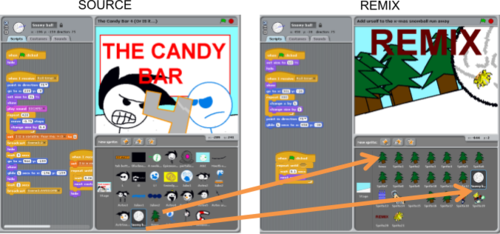
Example of a remix in the Scratch online community, and the project it is based off. The orange arrows indicate pieces which were present in the original and reused in the remix.

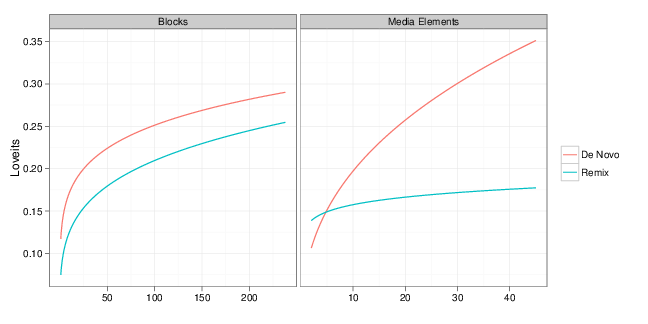
Remixing platforms provide an ideal setting to answer these questions. Most support the sharing, and collaborative rating, of both individually and collaboratively authored creative works. They also frequently combine code with artistic media like sound and graphics. We know that that increased collaboration often leads to higher quality products. For example, studies of Wikipedia have suggested that vandalism is detected and removed within minutes, and that high quality articles in Wikipedia, by several measures, tend to be produced by more collaboration. That said, we also know that collaborative work is not always better for example, that brainstorming results in less good ideas when done in groups. We attempt to answer this broad question, asked many times before, in the context of remixing: Which is the better description, the wisdom of crowds or too many cooks spoil the broth ? That, fundamentally, forms our paper s first research question: Are remixes, on average, higher quality than single-authored works? A number of critics of peer production, and some fans, have suggested that mass collaboration on the Internet might work much better for certain kinds of works. The argument is that free software and Wikipedia can be built by a crowd because they are functional. But more creative works like music, a novel, or a drawing might benefit less, or even be hurt by, participation by a crowd. Our second research question tries to get at this possibility: Are code-intensive remixes, higher quality than media-intensive remixes? We try to answers to these questions using a detailed dataset from Scratch a large online remixing community where young people build, share, and collaborate on interactive animations and video games. The community was built to support users of the Scratch programming environment: a desktop application with functionality similar to Flash created by the Lifelong Kindergarten Group at the MIT Media Lab. Scratch is designed to allow users to build projects by integrating images, music, sound and other media with programming code. Scratch is used by more than a million, mostly young, users. Measuring quality is tricky and we acknowledge that there are many ways to do it. In the paper, we rely most heavily a measure of peer ratings in Scratch called loveits very similar to likes on Facebook. We find similar results with several other metrics and we control for the number of views a project receives. In answering our first research question, we find that remixes are, on average, rated as being of lower quality than works of single authorship. This finding was surprising to us but holds up across a number of alternative tests and robustness checks. In answering our second question, we find rough support for the common wisdom that remixing tends to be more effective for functional works than for artistic media. The more code-intensive a project is, on average, the closer the gap is between a remix and a work of single authorship. But the more media-intensive a project is, the bigger the gap. You can see the relationships that our model predicts in the graph below.

Two plots of estimated values for prototypical projects showing the predicted number of loveits using our estimates. In the left panel, the x-axis varies number of blocks while holding media intensity at the sample median. The right panel varies the number of media elements while holding the number of blocks at the sample median. Ranges for each are from 0 to the 90th percentile.

Both of us are supporters and advocates of remixing. As a result, we were initially a little troubled by our result in this paper. We think the finding suggests an important limit to the broadest claims of the benefit of collaboration in remixing and peer production. That said, we also reject the blind repetition of the mantra that collaboration is always better for every definition of better, and for every type of work. We think it s crucial to learn and understand the limitations and challenges associated with remixing and we re optimistic that this work can influence the design of social media and collaboration systems to help remixing and peer production thrive. For more, see our full paper, The Cost of Collaboration for Code and Art: Evidence from Remixing.

13 November 2012

Erich Schubert: Migrating from GNOME3 to XFCE

I have been a GNOME fan for years. I actually liked the switch from 1.x to 2.x, and at some point switched to 3.x when it became somewhat usable. At some point, I even started some small Gnome projects, one even was uploaded to the Gnome repositories. But I didn't have much time for my Linux hobby anymore back then.
However, I am now switching to XFCE. And for all I can tell, I am about the last one to make that switch. Everybody I know hates the new Gnome.
My reason is not emotional. It's simple: I have systems that don't work well with OpenGL, and thus don't work well with Gnome shell. Up to now, I can live fine with "Fallback mode" (aka: Gnome classic). It works really good for me, and does exactly what I need. But it has been all over the media: Gnome 3.8 will drop 'fallback' mode.
Now the choice is obvious: instead of switching to shell, I go to XFCE. Which is much closer to the original Gnome experience, and very productivity oriented.
There are tons of rants on GNOME 3 (for one of the most detailed ones, see Gnome rotting in threes, going through various issues). Something must be very wrong about what they are doing to receive this many sh*tstorms all the time. Every project receives some. I've even received a share of the Gnome 2 storms when Galeon (an early Gnome browser) made the move and started dropping some of the hard-to-explain and barely used options that would break with every other Mozilla release. And Mozilla embedding was a major pain these days. Yet, for every feature there would be some user somewhere that loved it, and as Debian maintainer of Galeon, I got to see all the complaints (and at the same time was well aware of the bugs caused by the feature overload).
Yet with Gnome 3, things are IMHO a lot different. In Gnome 2, it was a lot about making things more usable as they are, a bit cleaner and more efficient. With Gnome 3, it seems to be about experimenting with new stuff. Which is why it keeps on breaking APIs all the time. For example themeing GTK 3 is constantly broken; most of the themes available just don't work. Similar Gnome Shell extensions - most of them work with exactly one version of Gnome Shell (doesn't this indicate the author has abandoned Gnome shell?).
But the one thing that was really sticking out was when my I updated the PC of my dad. Apart from some glitches, he could not even shutdown his PC with Gnome-shell. Because you needed to press the Alt button to actually get a shutdown option.
This is indicative of where Gnome is heading: something undefined inbetween of PCs, tablets, media centers and mobile phones. They just decided that users don't need to shutdown anymore, so they could as well drop that option.
But the worst thing about the current state of GNOME is: They happily live with it. They don't care that they are losing users by the dozens. Because to them, these are just "complainers". Of cousre there is some truth in "Complainers gonna complain and haters gonna hate". But what Gnome is receiving is way above average. At some point, they should listen. 200 posts long comment chains from dozens of peopls on LWN are not just your average "complaints". It's an indicator that a key user base is unhappy with the software. In 2010 GNOME 2 had 45% market share in the LinuxQuestions poll, XFCE had 15%. In 2011, GNOME 3 had 19%, and XFCE jumped to 28%. And I wouldn't be surprised if GNOME 3 shell (not counting fallback mode) would clock at less than 10% in 2012 - despite being default.
Don't get me wrong: there is a lot on Gnome that I really like. But as they decided to drop my preferred UI, I am of course looking for alternatives. In particular, as I can get lots of the Gnome 3 benefits with XFCE. There is a lot in the Gnome ecosystem that I value, and that IMHO is driving Linux forward. Network-manager, Poppler, Pulseaudio, Clutter just to name a few. Usually, the stuff that is modular is really good. And in fact I have been a happy user of the "fallback" mode, too. Yet, the overall "desktop" Gnome 3 goals are in my opinion targeting the wrong user group. Gnome might need to target linux developers more again, to keep a healthy development community around. Frequently triggering sh*tstorms by high-profile people such as Linux Torvalds is not going to strengthen the community. There is nothing wrong in the FL/OSS community to encourage people to use XFCE. But these are developers that Gnome might need at some point.
On a backend / technical level (away from the Shell/UI stuff that most of the rants are about), my main concern about the Gnome future is GTK3. GTK2 was a good toolkit for cross-platform development. GTK3 as of now is not, but is largely a Linux/Unix only toolkit - in particular, because there apparently is no up to date Win32 port. With GTK 3.4 it was said that they are now working on Windows - but as of GTK 3.6 they are still nowhere to be found. So if you want to develop cross-platform, as of now, you better stay away from GTK 3. If this doesn't change soon, GTK might sooner or later lose the API battle to more portable libraries.

12 November 2012

Ingo Juergensmann: Resurrecting m68k

In August I picked up Elgar, a m68k machine, from NMMN in Hamburg, where it was ought to run as a buildd (NMMN donated space and network). Unfortunately it was in some kind of bad state: operating system was out of date, expansion cards were getting loose and NMMN wasn't happy about the CRT monitor in its datacenter as well. Elgar is an Amiga 4000 Desktop built into a custom tower case. It took some weeks and months until I found a little time to care about Elgar, but now it's up and running again:
[ 0.000000] Initializing cgroup subsys cpuset
[ 0.000000] Initializing cgroup subsys cpu
[ 0.000000] Linux version 3.2.0-3-amiga (Debian 3.2.23-1) (debian-kernel@lists.debian.org) (gcc version 4.6.3 (Debian 4.6.3-8+m68k.1) ) #1 Wed Jul 25 13:02:31 UTC 2012
[ 0.000000] Enabling workaround for errata I14
[ 0.000000] console [debug0] enabled
[ 0.000000] Amiga hardware found: [A4000] VIDEO BLITTER AUDIO FLOPPY A4000_IDE KEYBOARD MOUSE SERIAL PARALLEL A3000_CLK CHIP_RAM PAULA LISA ALICE_PAL ZORRO3
That's the stock Debian m68k kernel and it already runs on Arrakis and Vivaldi, two other buildds, as well without any problem. The only problem at the moment is the missing SCSI driver for the CyberStorm Mk1 accelerator card. There were some changes in the kernel that need to be dealt with by someone knowing. The other problem was to upgrade from etch-m68k to unstable. I already blogged about this last year. It's not as easy anymore and you'll need to deal with lots of dependency problems and such nowadays. But anyway:
elgar:~# cat /etc/debian_version
wheezy/sid
elgar:~# dpkg -l libc6
Desired=Unknown/Install/Remove/Purge/Hold
Status=Not/Inst/Conf-files/Unpacked/halF-conf/Half-inst/trig-aWait/Trig-pend
/ Err?=(none)/Reinst-required (Status,Err: uppercase=bad)
/ Name Version Architecture Description
+++-====================-===============-===============-==============================================
ii libc6:m68k 2.13-35 m68k Embedded GNU C Library: Shared libraries
It's amazing that the m68k port is in such good condition after more than 4 years. That's because of the real great work of Torsten Glaser who is doing much of the porter work for the tool chain. But m68k has currently 4833 packages in state Needs-Build:
wanna-build statistics - Mon Nov 12 06:51:13 CET 2012
----------------------------------------------------- Distribution unstable:
---------------------
Installed : 1321
Needs-Build : 4833
Building : 0
Uploaded : 0
Failed : 0
Dep-Wait : 0
Reupload-Wait : 0
Install-Wait : 0
Failed-Removed : 0
Dep-Wait-Removed: 0
Not-For-Us : 0
total : 9906 13.34% (1321) up-to-date, 13.34% (1321) including uploaded
48.79% (4833) need building
0.00% ( 0) currently building
0.00% ( 0) failed/dep-wait
0.00% ( 0) old failed/dep-wait
0.00% ( 0) need porting or cause the buildd serious grief
So, there's a lot of work to do, but it's apparent that m68k won't keep up with 10.000 packages in unstable. When I started running an autobuilder back in year 2000 there were 2400 packages for m68k, on Aug. 15th 2005 we had a total of 5949 packages in the archive. For m68k this means that we will have to start adding lots of packages to Not-For-Us. I think m68k will/should end up with approx. 4000 packages at most. In the end m68k is a fairly good shape now. It only needs to get some packages built... Let's see when the buildds are operational again... ;-)
Kategorie:

22 October 2012

Julien Danjou: Inside Synaps, a CloudWatch-like implementation for OpenStack

A few days ago, Samsung released the source code of Synaps, an implementation of the Amazon Web Service CloudWatch API for OpenStack. Being a developer on the Ceilometer project, I've been curious to look on this project and how it could overlap with Ceilometer or other projects like Heat. What is CloudWatch? CloudWatch is a monitoring system provided by Amazon on its Web Services platform to monitor services. This allows you get notifications and trigger an action on certain threshold. For example, this can be used to scale your architecture by monitoring the number of requests you get on it and its general load by starting new servers. Synaps Synaps is written in around 7k lines of Python (with 28 % of which are comments), reuses at least one common module of OpenStack (openstack.common.cfg) and copy some modules from Nova. One thing that strikes me, is that there seems to be only a few unit tests compared to most OpenStack projects. Also, many parts of the code and documentation contains text written in korean, which won't be very helpful for most people! :-) It uses some external technologies, like Storm, Cassandra to store its persistent data and Pandas to do data analysis. The API server provides an EC2 compatible API only: no OpenStack specific API. This is probably not a bad thing for now, since I am not aware of any work in this direction. The API access directly the Cassandra back-end for read operation, but relies on RPC to do writes. This way, a set of daemon handles the write using the Storm part of Synaps and do data aggregation. The authentication only supports LDAP, but it should still be possible to add a driver for Keystone. A Java and a Python SDK are provided to record metrics into Synaps, but there's not enough documentation for it to be useful. Overlap with Heat For now, there's not a lot of overlap with Heat, because Heat does not implement completely the CloudWatch API. Heat actually still misses a lot of the CloudWatch functions. But as soon as it will implement the CloudWatch API completely, the overlap will be complete with Synaps in this regard. One divergence point however, is that Heat uses RPC to access data from the storage back-end via its engine (the central daemon), whereas Synaps directly connects to Cassandra. Also, Heat relies on SQLAlchemy, like most OpenStack projects needing a database. Overlap with Ceilometer One of the goal of Ceilometer is to provide data probes and pollsters for all OpenStack components (Nova, Swift, Quantum ) whereas Synaps let the OpenStack users to put any kind of metric inside it, and therefore doesn't provide anything for now. But the storage of metrics is the main common point between Synaps and Ceilometer. Synaps chose only one technology, Cassandra, to store its metrics, whereas Ceilometer took care of building an abstraction layer for the storage engine. Ceilometer currently allows an operator to use SQL or MongoDB, but Cassandra could likely be added. Data metric consolidation is done by Synaps. This makes sense, since Synaps don't need to have the full data history to trigger alarms. On the opposite, Ceilometer needs to have a full history to allow things like billing, and don't do any aggregation on data. Also, in Synaps, the data analysis is done using Pandas. This means the data used are retrieved from the Cassandra back-end, and then transformed by Pandas inside Synaps in something else. It's likely that in such a case, Synaps should use CQL to achieve that. Ceilometer manipulates the data near their storage: it means that the computation are done by back-end to be efficient (SQL, mapreduce ). Conclusion Considering Samsung open-sourced Synaps late in the development process, I don't feel like they aimed to have it becoming a core component. This is always sad, because the effort put into this implementation are big and it would have probably little to add some abstraction layers to follow what other OpenStack projects do. But this takes time and energy, and it's understandable that Samsung didn't want to achieve this in a short time frame. There's a part of the code and architecture that overlaps with Ceilometer and Heat. Ceilometer is becoming a specialized point to store data metrics from any source: so it's sad, but understandable, that Synaps did not tried to reuse it. Fortunately, Heat is working with Ceilometer to achieve exactly that. This means OpenStack would have only one metrics storage point, used for billing, for monitoring and alarming. Therefore, I think Synaps is an implementation of CloudWatch that should be looked at as an inspiration for Heat and Ceilometer to build a better and more integrated solution!

16 October 2012

Eddy Petrișor: Zenyth Pharmaceuticals cannot face(book) critics, so they cleanse them

A few days ago I wrote an article about the lawsuit the producers of ColonHelp are trying against Wordpress in the attempt to silence a blogger who wrote some unfavourable and science-based articles on his blog.

Meanwhile Petter Reinholdtsen (who seems to be a fellow skeptic, hi!) sent further this information via his blog, but on another front, I found out the German skeptics tried to contact Zenyth Phamaceuticals on Facebook and asked them why did they use lawyers for threats against critics, instead of using words and thorough scientific studies to talk to the critics.


The people at Zenyth Pharmaceuticals probably wanted to show they do not only use lawyers, but they can be very proficient at using the 'Delete' function of Facebook, so they did just that, it seems.

This really motivates me to go ahead and translate the article Zenyth's money didn't translate, the one that shows their entire case is baseless.

12 October 2012

Petter Reinholdtsen: ColonHelp produser sue WordPress to silence critic

Thanks to a blog post by Eddy Petri or, I became aware of yet another "alternative medicine" company using legal intimidation tactics to scare off critics. According to the originating blog post about the detox "cure" ColonHelp and its producers Zenyth Pharmaceuticals actions, the producer sues Wordpress to get rid of the critical information. To check if the story was for real, I contacted Automattic, the company behind wordpress.com, and they reply was "We can confirm that Zenyth is seeking a court order against WordPress / Automattic. However, we don't believe the Terms of Service have been violated in this matter". The story seem to be simply that a blogger checked the scientific foundation for a popular health product in Rumania, ColonHelp, and reported that there was no reason at all to believe it improved the health of its users. This caused the company behind the product, Zenyth Pharmaceuticals, to use legal intimidation to try to silence the critic, instead of presenting its views and scientific foundation to argue its side. This is the usual story, and the Zenyth Pharmaceuticals company deserve everyone to know how it failed to act properly. Lets hope the Streisand effect can make it rethink its strategy. What is the harm, you might think. I suggest you take a look at a list of victims of detoxification.

11 October 2012

Eddy Petrișor: A shitstorm is comming

It has been brought to my attention that a company selling some so-called colon cleansing product wanted to threat with a law suit a Romanian skeptical blogger because he wrote some articles showing that any such products (the one produced by the said company is the most known/popular in Romania) are pure quackery and there is no scientific basis for the claim they make in order to promote their products.

In his articles he also explained how, in fact, the mucoid plaque, the thing that supposedly proves the efficiency of the product, it is a result of taking the product due to its ingredients, and how no such mucoid plaque was ever observed in any colonoscopy, colon surgery or any other situation where you'd expect it to be seen. He also quoted specialists and lots of other scientific references, showing an honest approach to the issue.

As a response to the initial take-down message from the company doing business with people's crap, the blogger said would like to see scientific proof for the claims made for the product, and when that was to happen, he would take down the articles and publish a correction.

The company decided that the best way to continue this was to try to make a legal threat and ask 100.000 euros (one hundred thousands Euros) as damage in a country where, according to the latest data from the National Statistics Institute, the total average monthly personal income is about 180 Euros.

The blogger, as a reply, decided the threat should be made public and wrote another article which probably made the company very unhappy, because they decided to sue Wordpress so they would take down the blog.

And that's exactly what they did, they sued Wordpress, and sent some documents to Wordpress who sent them to the blogger. Among the documents there were 4 pdf files containing each an original article (in Romanian) from the blog and only 3 pdf containg English translation for only 3 of them. The one missing was the one where the blogger himself showed there wasn't any legal basis for the threats they made initially against him.

Here are the translations (ironically, made on the company's own expense):

Initial article entitled "ColonHelp doesn't help the colon. But it empties your wallet!" (original here)
Initial Article.en<iframe class="scribd_iframe_embed" data-aspect-ratio="0.701030927835051" data-auto-height="true" frameborder="0" height="600" id="doc_83859" scrolling="no" src="http://www.scribd.com/embeds/109756494/content?start_page=1&amp;view_mode=scroll&amp;access_key=key-19l4sbejfk4l4na4feoe" width="100%"></iframe>


The second article entitled "Again about ColonHelp and intestinal cleansers" (original here)
Follow Up.en<iframe class="scribd_iframe_embed" data-aspect-ratio="0.70264064293915" data-auto-height="true" frameborder="0" height="600" id="doc_46722" scrolling="no" src="http://www.scribd.com/embeds/109757646/content?start_page=1&amp;view_mode=scroll&amp;access_key=key-1d0z2779liaialmv90r5" width="100%"></iframe>


** Missing translation of the first reply to threats (original Romanian text here)


The second article about the threats entitled "People who clean the colon have filled the fan with shit" (original here)
Threats 2<iframe class="scribd_iframe_embed" data-aspect-ratio="0.705069124423963" data-auto-height="true" frameborder="0" height="600" id="doc_72956" scrolling="no" src="http://www.scribd.com/embeds/109758037/content?start_page=1&amp;view_mode=scroll&amp;access_key=key-2d3c3eq1d6lo313fogho" width="100%"></iframe>


The Romanian blogger explains himself more of the details on this issue in his latest article on his blog.

The company is called Zenyth Pharmaceuticals and Wordpress will probably lose the lawsuit by not presenting themselves in any way in the Romanian courts, but I think some Streisand effect would really help the asses of this company to get them kicked in their rightful place, at the top of the hall of shame.

The product name is called ColonHelp.

Please spread this information as wide as possible.
Do NOT link to the company's site (it would raise its search engine rank), but link to the blogger' article or the translations.


If any Romanian speaker cares to translate the untranslated article and publish it somewhere on the web, I would be more than glad to update this article and add a link to that translation.

23 September 2012

Aigars Mahinovs: Cloning or pre-configuring a batch of Android phones

An interesting question popped up in my Twitter stream today is there an Android alternative to Apple configurator (for iPhone, iPad and iPod Touch) that allows to create a bunch of identical Apple devices with some added configurations and applications. The best I could come up with is not as polished, but on the other hand much more powerful option Nandroid backup and restore (also known as ClockworkMod Recovery backup). To do this, you need a source phone and a bunch of destination phones. On the source phone a ClockworkMod Recovery (CWR) must be installed (either via a root or via a bootloader unlock). On the destination phones you will either need to also install ClockworkMod Recovery or unlock the bootloader to allow the Fastboot tool to work. So the procedure then goes as follows:

1. Unlock the bootloader on the source phone (search for device specific info on how to do that)
2. Use fastboot flash recovery filename.img to write a device-specific version of CWR to the recovery partition of the device (the phone must be in fastboot mode at that point)
3. Do whatever customisations you want to the source phone at this point. You can use custorm ROMs, install whatever applications, do whatever configuration, but I would suggest keeping everything in phone memory so you don t have to flash the SD card as well.
4. Reboot the source phone into CWR mode, use the backup option to create a full backup.
5. The backup will now be in the SD card of the source device. Copy that to the computer that you will use for creating copies. For each destination phone:
6. Unlock the bootloader of the destination phone
7. Reboot the phone in the fastboot mode, connect it via USB to the copying computer
8. Flash all partitions from the backup using fastboot flash ... commands, skip flashing the recovery partition if you don t want CMR on the destination device
9. Re-lock the bootloader (with fastboot oem lock) And you are done! All the phones must be of the same model. And that model must support unlocking bootloader for this to work. I prefer this method, because this way it is possible to create an end device without root, with a locked bootloader and without CWR thus providing some security as unlocking the bootloader wipes the device, so without specific hacking an attacker can not easily get access to system data on such device. It is also possible to do this with devices that do not have an boot unlock if there is a way to root the original firmware which allows to install CWR and go on from there, but that is significantly more complicated and time-consuming, so using devices with an ability to unlock the bootloader is much preferable. However, before you go to all that trouble, it might be worth to consider if maybe for your particular use case it would be enough with the two commands from Android SDK adb install ... and adb push ... to install applications or individual files on devices or adb backup AppName and adb restore ... to backup and restore one or more individual applications with all their settings. These options have the benefit of that they will work across different device models and that they do not wipe other data or applications from the devices. As I could not immediately find a better way or even a detailed guide how to do this, I decided to write this post, so it would be easier for other people to find this information. If you know a better way, please do mention it in the comments section!

21 August 2012

Mirco Bauer: Smuxi 0.8.10 "Tracy" Release

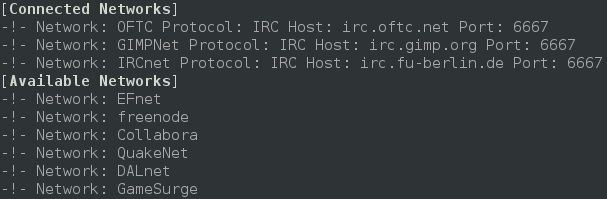
As longingly awaited I am very happy to announce Smuxi 0.8.10 codenamed "Tracy". During the development 8 bug reports and 15 feature requests in 136 commits were worked on making this release a major feature and minor bugfix release. Screenshot of Smuxi 0.8.10 in action Notable highlights in this release are: Integrated Spell Checking Everyone knows the "how do you spell that word again?" situation and either you don't care and send a possible typo or you go checking a dictionary which is kind of annoying. The good news is: with this release you no longer need to do that, as Smuxi includes automatic spell checking while you type messages. The bad news is that this feature is currently limited to Linux builds, and thus OSX and Windows build do not ship with it. The installers need to be extended and I haven't found pre-compiled OSX nor Windows binaries for the GTK+ spell checking library. Screenshot of Smuxi 0.8.10 showing spell checking in action Favicons for Server Tabs Distinguishing server tabs can be difficult, especially if you have plenty of them. All server tabs have the same icon so you need to search for the right name. I wondered why this issue doesn't happen so easily with a web browser which usually also has lots of tabs open. Besides the page name there is the favicon right in front. So why can't Smuxi make use of that simple but effective technology? Well, now it does! You connect to a known network, and Smuxi will download and show the favicon of the website. It just works and does everything in the background for you. Screenshot of Smuxi 0.8.10 showing favicons in action Quick Join Bar One thing that makes IRC really difficult for new comers is the important IRC concept that channels are network specific. So what happens is people try to find / join the channel they are looking for but on the wrong network. They have to connect to the right server/network and then switch to the right tab, before they can join the channel (using the /join command or join dialog). The developers of Smuxi had a brainstorming session and came up with something that should be easy enough for anyone to use and finally solves the issue: the quick join bar. You know which channel you want to join and which network, you enter the channel name, select the network from the list and hit the "Join Chat" button and you are done. Now Smuxi will do just the right thing for you and connects to that network if needed, joins the channel if needed, or switches to the channel if you are already there! Click here for a screencast of the Quick Join Bar in action Indention of multi-line messages Messages on IRC and also Twitter are often longer than a single line in Smuxi can show, thus it has to be split into a second line or more. The issue here is that the continuation line looks cluttered because it doesn't align with the first line. Here you can see an example for this issue: Screenshot of Smuxi 0.8.9 showing line breaks Ewww, that looks ugly, doesn't it? I will make this one short, here is the cure with indented multi-line messages: Screenshot of Smuxi 0.8.10 showing line breaks Enhanced Text Frontend The text frontend which is still in alpha state has received the following enhancements: new /exit command, new /help command, regular and xterm window title, and, several fixed crashes. Screenshot of Smuxi 0.8.10's text frontend Enhanced Commands The /network command by default shows now all connected and also available networks: Screenshot of Smuxi 0.8.10 showing network command The /connect command now allows you to connect by network name like this:



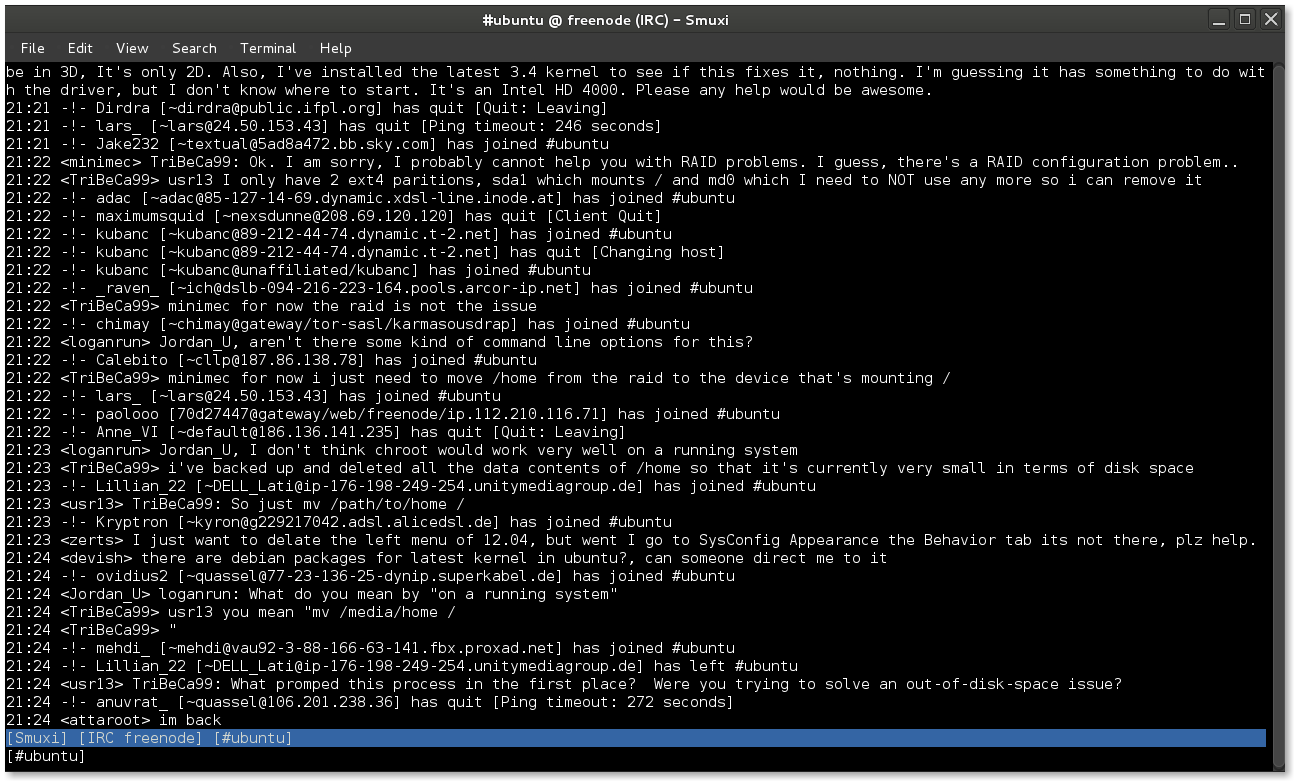

/connect freenode
Updated Translations
  • Portuguese (Pedro Ribeiro)
  • Chinese Simp (Dean Lee)
  • Danish (Joe Hansen)
  • Swedish (Martin Bagge)
  • Russian (Yuri Myasoedov)
New Translations
  • Croatian (Matias M)
  • partially Polish (lukasznaw)
Contributors Contributors to this release are the following people:
  • Mirco Bauer (126 commits)
  • Bianca Mix (translations)
  • Dean Lee (translations)
  • Joe Hansen (translations)
  • Yuri Myasoedov (translations)
  • Pedro Ribeiro (translations)
  • Matias M (translations)
  • Martin Bagge (translations)
  • lukasznaw (translations)
Thank you very much for your contributions to Smuxi! Already horny? Go here and get some! Update: Smuxi 0.8.10.1 About 2 months after the 0.8.10 release, Smuxi 0.8.10.1 with only important bugfixes and translation updates was released. This release includes the following 6 bugfixes: smuxi-server now honors the timezone of tweets, fixed a connection crash with InspIRCd-2.0 servers, quick join no longer opens another network tab, closing chats no longer crashes Smuxi sometimes, /connect irc.some-server.com works again and focusing the message area moves the focus back to the entry again.
Posted Tue Aug 21 23:16:05 2012

8 August 2012

Aigars Mahinovs: Fun with the new camera

Triple hit! So, I finally received my Canon 650D and Canon EF 40mm STM lens. I am very happy with the purchase. The STM lens is very, very compact, it is barely bigger than the lens cap that comes with the camera. The focusing is fast enough and it is very smooth and silent enough not to be audible in video mode. The largest bonus of the 650D compared to my old 550D is the articulated display. It has come in handy many times already. It is especially useful with the STM lens, live view and touch to focus function. Very useful to focus on something even when the camera is at an weird angle. And a couple days ago I got to really use the new camera capturing the shot above (an others in that set). It turns out capturing cool lightning shots is quite easy: It is basically the same as shooting photos of a fireworks display, with the exception that lightning is not so bright sometimes and that there is a high chance of rain in a thunderstorm ;) P.S. Got over 5k photos in Flickr now with this set, and closing in for 500k views. That feels cool :)

2 July 2012

Joey Hess: notes for a caretaker

I recently had the sort of weird experience of a recent blog post being on the top of Hacker News and there being a fair amount of interest in the details of my wacky living situation. I could write a detailed post explaining everything, but that'd be boring .. instead I'll tease the stalkers with more oblique references to it. So here's my notes for a caretaker who will be here while I'm away at DebConf.
Please make yourself at home!

Next.

Previous.