Search Results: "stone"

2 November 2015

Lunar: Reproducible builds: week 27 in Stretch cycle

What happened in the reproducible builds effort this week: Toolchain fixes Packages fixed The following packages became reproducible due to changes in their build dependencies: maven-plugin-tools, norwegian, ocaml-melt, python-biom-format, rivet. The following packages became reproducible after getting fixed: Some uploads fixed some reproducibility issues but not all of them: The following package is currently failing to build from source but should now be reproducible: Patches submitted which have not made their way to the archive yet: reproducible.debian.net A quick update on current statistics: testing is at 85% of packages tested reproducible with our modified packages, unstable on armhf caught up with amd64 with 80%. The schroot name used for running diffoscope when testing OpenWrt, NetBSD, Coreboot, and Arch Linux has been fixed. (h01ger, Mattia Rizzolo) Documentation update Paul Gevers documented timestamps in unit files created by the Free Pascal Compiler. reproducible-builds.org is now live. It contains a comprehensive documentation on all aspects that have been identified so far of what we call reproducible builds . It makes room for pointers to projects working on reproducible builds, news, dedicated tools, and community events. Package reviews 206 reviews have been removed, 171 added and 196 updated this week. Chris Lamb reported 28 failing to build from source issues. New issues identified this week: timestamps_in_pdf_content, different_encoding_in_html_by_docbook_xsl, timestamps_in_ppu_generated_by_fpc, method_may_never_be_called_in_documentation_generated_by_javadoc. Misc. Andrei Borzenkov has proposed a fix for uninitialized memory in GRUB's mkimage. Uninitialized memory is one source of hard to track down reproducibility errors. Holger Levsen presented the efforts on reproduible builds at Festival de Software Libre in Puerto Vallarta, Mexico.

1 November 2015

Daniel Silverstone: A haiku about Haiku

I know I don't mention a season, and I'm a few hours late for hallowe'en, but here's a haiku about Haiku:
A death, once again,
The master sighs, and fixes,
It rises up, undead.

27 October 2015

Dirk Eddelbuettel: Rcpp now used by over 500 CRAN packages

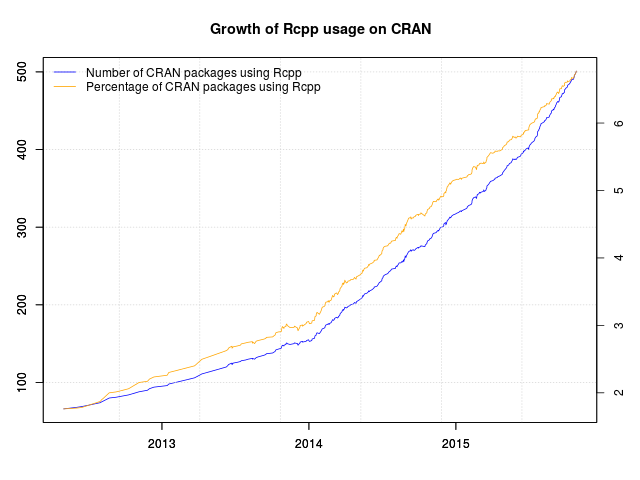
500 Rcpp packages This morning, Rcpp reached another round milestone: 501 packages on CRAN now depend on it (as measured by Depends, Imports and LinkingTo declarations, and even excluding one or two packages with an accidental declaration that do not use it). The graph is on the left depicts the growth of Rcpp usage over time. And there are a full seventy more on BioConductor in its development branch (but BioConductor is not included in the chart). Rcpp cleared 300 packages less than a year ago. It passed 400 packages in June when I only tweeted about it this June (while traveling for Rcpp training at U Zuerich, the R Summit at CBS, and the fabulous useR! 2015 at U Aalborg; so no blog post). The first and less detailed part uses manually saved entries, the second half of the data set was generated semi-automatically via a short script appending updates to a small file-based backend. A list of user package is kept on this page. Also displayed in the graph is the relative proportion of CRAN packages using Rcpp. The four per-cent hurdle was cleared just before useR! 2014 where I showed a similar graph (as two distinct graphs) in my invited talk. We passed five percent in December of last year, six percent this July and now stand at 6.77 percent, or about one in fourteen R packages. 500 user packages is very humbling, a staggering number and a big responsibility. We will out best try to keep Rcpp as performant and reliable as it has been so that the next set of packages can rely on it---just like these 500 do. So with that a very big Thank You! to all users and contributors of Rcpp for help, suggestions, bug reports, documentation or, of course, code.

This post by Dirk Eddelbuettel originated on his Thinking inside the box blog. Please report excessive re-aggregation in third-party for-profit settings.

18 October 2015

Lunar: Reproducible builds: week 25 in Stretch cycle

What happened in the reproducible builds effort this week: Toolchain fixes Niko Tyni wrote a new patch adding support for SOURCE_DATE_EPOCH in Pod::Man. This would complement or replace the previously implemented POD_MAN_DATE environment variable in a more generic way. Niko Tyni proposed a fix to prevent mtime variation in directories due to debhelper usage of cp --parents -p. Packages fixed The following 119 packages became reproducible due to changes in their build dependencies: aac-tactics, aafigure, apgdiff, bin-prot, boxbackup, calendar, camlmix, cconv, cdist, cl-asdf, cli-common, cluster-glue, cppo, cvs, esdl, ess, faucc, fauhdlc, fbcat, flex-old, freetennis, ftgl, gap, ghc, git-cola, globus-authz-callout-error, globus-authz, globus-callout, globus-common, globus-ftp-client, globus-ftp-control, globus-gass-cache, globus-gass-copy, globus-gass-transfer, globus-gram-client, globus-gram-job-manager-callout-error, globus-gram-protocol, globus-gridmap-callout-error, globus-gsi-callback, globus-gsi-cert-utils, globus-gsi-credential, globus-gsi-openssl-error, globus-gsi-proxy-core, globus-gsi-proxy-ssl, globus-gsi-sysconfig, globus-gss-assist, globus-gssapi-error, globus-gssapi-gsi, globus-net-manager, globus-openssl-module, globus-rsl, globus-scheduler-event-generator, globus-xio-gridftp-driver, globus-xio-gsi-driver, globus-xio, gnome-control-center, grml2usb, grub, guilt, hgview, htmlcxx, hwloc, imms, kde-l10n, keystone, kimwitu++, kimwitu-doc, kmod, krb5, laby, ledger, libcrypto++, libopendbx, libsyncml, libwps, lprng-doc, madwimax, maria, mediawiki-math, menhir, misery, monotone-viz, morse, mpfr4, obus, ocaml-csv, ocaml-reins, ocamldsort, ocp-indent, openscenegraph, opensp, optcomp, opus, otags, pa-bench, pa-ounit, pa-test, parmap, pcaputils, perl-cross-debian, prooftree, pyfits, pywavelets, pywbem, rpy, signify, siscone, swtchart, tipa, typerep, tyxml, unison2.32.52, unison2.40.102, unison, uuidm, variantslib, zipios++, zlibc, zope-maildrophost. The following packages became reproducible after getting fixed: Packages which could not be tested: Some uploads fixed some reproducibility issues but not all of them: Patches submitted which have not made their way to the archive yet: Lunar reported that test strings depend on default character encoding of the build system in ongl. reproducible.debian.net The 189 packages composing the Arch Linux core repository are now being tested. No packages are currently reproducible, but most of the time the difference is limited to metadata. This has already gained some interest in the Arch Linux community. An explicit log message is now visible when a build has been killed due to the 12 hours timeout. (h01ger) Remote build setup has been made more robust and self maintenance has been further improved. (h01ger) The minimum age for rescheduling of already tested amd64 packages has been lowered from 14 to 7 days, thanks to the increase of hardware resources sponsored by ProfitBricks last week. (h01ger) diffoscope development diffoscope version 37 has been released on October 15th. It adds support for two new file formats (CBFS images and Debian .dsc files). After proposing the required changes to TLSH, fuzzy hashes are now computed incrementally. This will avoid reading entire files in memory which caused problems for large packages. New tests have been added for the command-line interface. More character encoding issues have been fixed. Malformed md5sums will now be compared as binary files instead of making diffoscope crash amongst several other minor fixes. Version 38 was released two days later to fix the versioned dependency on python3-tlsh. strip-nondeterminism development strip-nondeterminism version 0.013-1 has been uploaded to the archive. It fixes an issue with nonconformant PNG files with trailing garbage reported by Roland Rosenfeld. disorderfs development disorderfs version 0.4.1-1 is a stop-gap release that will disable lock propagation, unless --share-locks=yes is specified, as it still is affected by unidentified issues. Documentation update Lunar has been busy creating a proper website for reproducible-builds.org that would be a common location for news, documentation, and tools for all free software projects working on reproducible builds. It's not yet ready to be published, but it's surely getting there. Homepage of the future reproducible-builds.org website  Who's involved?  page of the future reproducible-builds.org website Package reviews 103 reviews have been removed, 394 added and 29 updated this week. 72 FTBFS issues were reported by Chris West and Niko Tyni. New issues: random_order_in_static_libraries, random_order_in_md5sums.

13 October 2015

Julien Danjou: Benchmarking Gnocchi for fun & profit

We got pretty good feedback on Gnocchi so far, even if we only had little. Recently, in order to have a better feeling of where we were at, we wanted to know how fast (or slow) Gnocchi was. The early benchmarks that some of the Mirantis engineers ran last year showed pretty good signs. But a year later, it was time to get real numbers and have a good understanding of Gnocchi capacity. Benchmark tools The first thing I realized when starting that process, is that we were lacking of tools to run benchmarks. Therefore I started to write some benchmark tools in python-gnocchiclient, which provides a command line tool to interrogate Gnocchi. I added a few basic commands to measure metric performance, such as:
$ gnocchi benchmark metric create -w 48 -n 10000 -a low
+----------------------+------------------+
Field Value
+----------------------+------------------+
client workers 48
create executed 10000
create failures 0
create failures rate 0.00 %
create runtime 8.80 seconds
create speed 1136.96 create/s
delete executed 10000
delete failures 0
delete failures rate 0.00 %
delete runtime 39.56 seconds
delete speed 252.75 delete/s
+----------------------+------------------+

The command line tool supports the --verbose switch to have detailed progress report on the benchmark progression. So far it supports metric operations only, but that's the most interesting part of Gnocchi. Spinning up some hardware I got a couple of bare metal servers to test Gnocchi on. I dedicated the first one to Gnocchi, and used the second one as the benchmark client, plugged on the same network. Each server is made of 2 Intel Xeon E5-2609 v3 (12 cores in total) and 32 GB of RAM. That provides a lot of CPU to handle requests in parallel. Then I simply performed a basic RHEL 7 installation and ran devstack to spin up an installation of Gnocchi based on the master branch, disabling all of the others OpenStack components. I then tweaked the Apache httpd configuration to use the worker MPM and increased the maximum number of clients that can sent request simultaneously. I configured Gnocchi to use the PostsgreSQL indexer, as it's the recommended one, and the file storage driver, based on Carbonara (Gnocchi own storage engine). That means files were stored locally rather than in Ceph or Swift. Using the file driver is less scalable (you have to run on only one node or uses a technology like NFS to share the files), but it was good enough for this benchmark and to have some numbers and profiling the beast. The OpenStack Keystone authentication middleware was not enabled in this setup, as it would add some delay validating the authentication token. Metric CRUD operations Metric creation is pretty fast. I managed to attain 1500 metric/s created pretty easily. Deletion is now asynchronous, which means it's faster than in Gnocchi 1.2, but it's still slower than creation: 300 metric/s can be deleted. That does not sound like a huge issue since metric deletion is actually barely used in production. Retrieving metric information is also pretty fast and goes up to 800 metric/s. It'd be easy to achieve very higher throughput for this one, as it'd be easy to cache, but we didn't feel the need to implement it so far. Another important thing is that all of these numbers are constant and barely depends on the number of the metric already managed by Gnocchi.
Operation Details Rate
Create metric Created 100k metrics in 77 seconds 1300 metric/s
Delete metric Deleted 100k metrics in 190 seconds 524 metric/s
Show metric Show a metric 100k times in 149 seconds 670 metric/s
Sending and getting measures Pushing measures into metrics is one of the hottest topic. Starting with Gnocchi 1.1, the measures pushed are treated asynchronously, which makes it much faster to push new measures. Getting new numbers on that feature was pretty interesting. The number of metric per second you can push depends on the batch size, meaning the number of actual measurements you send per call. The naive approach is to push 1 measure per call, and in that case, Gnocchi is able to handle around 600 measures/s. With a batch containing 100 measures, the number of calls per second goes down to 450, but since you push 100 measures each time, that means 45k measures per second pushed into Gnocchi! I've pushed the test further, inspired by the recent blog post of InfluxDB claiming to achieve 300k points per second with their new engine. I ran the same benchmark on the hardware I had, which is roughly two times smaller than the one they used. I achieved to push Gnocchi to a little more than 120k measurement per second. If I had same hardware as they used, I could interpolate the results to achieve almost 250k measures/s pushed. Obviously, you can't strictly compare Gnocchi and InfluxDB since they are not doing exactly the same thing, but it still looks way better than what I expected. Using smaller batch sizes of 1k or 2k improve the throughput further to around 125k measures/s.
Operation Details Rate
Push metric 5k Push 5M measures with batch of 5k measures in 40 seconds 122k measures/s
Push metric 4k Push 5M measures with batch of 4k measures in 40 seconds 125k measures/s
Push metric 3k Push 5M measures with batch of 3k measures in 40 seconds 123k measures/s
Push metric 2k Push 5M measures with batch of 2k measures in 41 seconds 121k measures/s
Push metric 1k Push 5M measures with batch of 1k measures in 44 seconds 113k measures/s
Push metric 500 Push 5M measures with batch of 500 measures in 51 seconds 98k measures/s
Push metric 100 Push 5M measures with batch of 100 measures in 112 seconds 45k measures/s
Push metric 10 Push 5M measures with batch of 10 measures in 852 seconds 6k measures/s
Push metric 1 Push 500k measures with batch of 1 measure in 800 seconds 624 measures/s
Get measures Push 43k measures of 1 metric 260k measures/s
What about getting measures? Well, it's actually pretty fast too. Retrieving a metric with 1 month of data with 1 minute interval (that's 43k points) takes less than 2 second. Though it's actually slower than what I expected. The reason seems to be that the JSON is 2 MB big and encoding it takes a lot of time for Python. I'll investigate that. Another point I discovered, is that by default Gnocchi returns all the datapoints for each granularities available for the asked period, which might double the size of the returned data for nothing if you don't need it. It'll be easy to add an option to the API to only retrieve what you need though! Once benchmarked, that meant I was able to retrieve 6 metric/s per second, which translates to around 260k measures/s. Metricd speed New measures that are pushed into Gnocchi are processed asynchronously by the gnocchi-metricd daemon. When doing the benchmarks above, I ran into a very interesting issue: sending 10k measures on a metric would make gnocchi-metricd uses up to 2 GB RAM and 120 % CPU for more than 10 minutes. After further investigation, I found that the naive approach we used to resample datapoints in Carbonara using Pandas was causing that. I reported a bug on Pandas and the upstream author was kind enough to provide a nice workaround, that I sent as a pull request to Pandas documentation. I wrote a fix for Gnocchi based on that, and started using it. Computing the standard aggregation methods set (std, count, 95pct, min, max, sum, median, mean) for 10k batches of 1 measure (worst case scenario) for one metric with 10k measures now takes only 20 seconds and uses 100 MB of RAM 45 faster. That means that in normal operations, where only a few new measures are processed, the operation of updating a metric only takes a few milliseconds. Awesome! Comparison with Ceilometer For comparison sake, I've quickly run some read operations benchmark in Ceilometer. I've fed it with one month of samples for 100 instances polled every minute. That represents roughly 4.3M samples injected, and that took a while almost 1 hour whereas it would have taken less than a minute in Gnocchi. Then I tried to retrieve some statistics in the same way that we provide them in Gnocchi, which mean aggregating them over a period of 60 seconds over a month.
Operation Details Rate
Read metric SQL Read measures for 1 metric 2min 58s
Read metric MongoDB Read measures for 1 metric 28s
Read metric Gnocchi Read measures for 1 metric 2s
Obviously, Ceilometer is very slow. It has to look into 4M of samples to compute and return the result, which takes a lot of time. Whereas Gnocchi just has to fetch a file and pass it over. That also means that the more samples you have (so the more time you collect data and the more resources you have), slower Ceilometer will become. This is not a problem with Gnocchi, as I emphasized when I started designing it. Most Gnocchi operations are O(log R) where R is the number of metrics or resources, whereas most Ceilometer operations are O(log S) where S is the number of samples (measures). Since is R millions of time smaller than S, Gnocchi gets to be much faster. And what's even more interesting, is that Gnocchi is entirely scalable horizontally. Adding more Gnocchi servers (for the API and its background processing worker metricd) will multiply Gnocchi performances by the number of servers added. Improvements There are several things to improve in Gnocchi, such as splitting Carbonara archives to make them more efficient, especially from drivers such as Ceph and Swift. It's already on my plate, and I'm looking forwarding to working on that! And if you have any questions, feel free to shoot them in the comment section.

12 October 2015

Dimitri John Ledkov: uwsgi gains --paste-name option

One of the WSGI servers that is commonly using with nginx is uwsgi. One way to configure and deploy simple and complex WSGI middlewares and apps is by using Paste deploy tooling. However, until now uwsgi was only able to load a default app under the suffix "main". There is no such limitation in the Paste deploy code itself, as functions there accept a name argument. What was missing is an option in uwsgi to pass, optionally, alternative non-default name of the app to load.

A patch adding this option has now been merged upstream and should be available in the next uwsgi release.

What I was hoping that one will be able to do something like this:
$ uwsgi --ini-paste /etc/nova/api-paste.ini --paste-name osapi_compute
But alas that didn't work. I wish all OpenStack Software service were deployable as normal wsgi stand-alone apps without any addition glue code. Keystone is kind of like this with /usr/share/httpd/cgi-bin/keystone/main entry point for deploying keystone as a wsgi app, instead of a daemon.

Also can nova operate on top of nginx ugreen threats? Or is that something entirely difference from the recent day eventlet?!

The postings on this site are my own and don't necessarily represent Intel s positions, strategies, or opinions.

20 September 2015

Michal Čihař: Weblate 2.4

Weblate 2.4 has been released today. It comes with extended support for various file formats, extended hook scripts, better keyboard shortcuts and dozen of bug fixes. Full list of changes for 2.4: If you are upgrading from older version, please follow our upgrading instructions. You can find more information about Weblate on http://weblate.org, the code is hosted on Github. If you are curious how it looks, you can try it out on demo server. You can login there with demo account using demo password or register your own user. Weblate is also being used https://hosted.weblate.org/ as official translating service for phpMyAdmin, Gammu, Weblate itself and other projects. If you are free software project which would like to use Weblate, I'm happy to help you with set up or even host Weblate for you. Further development of Weblate would not be possible without people providing donations, thanks to everybody who have helped so far! PS: The roadmap for next release is just being prepared, you can influence this by expressing support for individual issues either by comments or by providing bounty for them.

Filed under: English phpMyAdmin SUSE Weblate 0 comments

17 September 2015

Julien Danjou: My interview in le Journal du Hacker

A few days ago, the French equivalent of Hacker News, called "Le Journal du Hacker", interviewed me about my work on OpenStack, my job at Red Hat and my self-published book The Hacker's Guide to Python. I've spent some time translating it into English so you can read it if you don't understand French! I hope you'll enjoy it.
Hi Julien, and thanks for participating in this interview for the Journal du Hacker. For our readers who don't know you, can you introduce you briefly?
You're welcome! My name is Julien, I'm 31 years old, and I live in Paris. I now have been developing free software for around fifteen years. I had the pleasure to work (among other things) on Debian, Emacs and awesome these last years, and more recently on OpenStack. Since a few months now, I work at Red Hat, as a Principal Software Engineer on OpenStack. I am in charge of doing upstream development for that cloud-computing platform, mainly around the Ceilometer, Aodh and Gnocchi projects.
Being myself a system architect, I follow your work in OpenStack since a while. It's uncommon to have the point of view of someone as implied as you are. Can you give us a summary of the state of the project, and then detail your activities in this project?
The OpenStack project has grown and changed a lot since I started 4 years ago. It started as a few projects providing the basics, like Nova (compute), Swift (object storage), Cinder (volume), Keystone (identity) or even Neutron (network) who are basis for a cloud-computing platform, and finally became composed of a lot more projects. For a while, the inclusion of projects was the subject of a strict review from the technical committee. But since a few months, the rules have been relaxed, and we see a lot more projects connected to cloud-computing joining us. As far as I'm concerned, I've started with a few others people the Ceilometer project in 2012, devoted to handling metrics of OpenStack platforms. Our goal is to be able to collect all the metrics and record them to analyze them later. We also have a module providing the ability to trigger actions on threshold crossing (alarm). The project grew in a monolithic way, and in a linear way for the number of contributors, during the first two years. I was the PTL (Project Technical Leader) for a year. This leader position asks for a lot of time for bureaucratic things and people management, so I decided to leave my spot in order to be able to spend more time solving the technical challenges that Ceilometer offered. I've started the Gnocchi project in 2014. The first stable version (1.0.0) was released a few months ago. It's a timeseries database offering a REST API and a strong ability to scale. It was a necessary development to solve the problems tied to the large amount of metrics created by a cloud-computing platform, where tens of thousands of virtual machines have to be metered as often as possible. This project works as a standalone deployment or with the rest of OpenStack. More recently, I've started Aodh, the result of moving out the code and features of Ceilometer related to threshold action triggering (alarming). That's the logical suite to what we started with Gnocchi. It means Ceilometer is to be split into independent modules that can work together with or without OpenStack. It seems to me that the features provided by Ceilometer, Aodh and Gnocchi can also be interesting for operators running more classical infrastructures. That's why I've pushed the projects into that direction, and also to have a more service-oriented architecture (SOA)
I'd like to stop for a moment on Ceilometer. I think that this solution was very expected, especially by the cloud-computing providers using OpenStack for billing resources sold to their customers. I remember reading a blog post where you were talking about the high-speed construction of this brick, and features that were not supposed to be there. Nowadays, with Gnocchi and Aodh, what is the quality of the brick Ceilometer and the programs it relies on?
Indeed, one of the first use-case for Ceilometer was tied to the ability to get metrics to feed a billing tool. That's now a reached goal since we have billing tools for OpenStack using Ceilometer, such as CloudKitty. However, other use-cases appeared rapidly, such as the ability to trigger alarms. This feature was necessary, for example, to implement the auto-scaling feature that Heat needed. At the time, for technical and political reasons, it was not possible to implement this feature in a new project, and the functionality ended up in Ceilometer, since it was using the metrics collected and stored by Ceilometer itself. Though, like I said, this feature is now in its own project, Aodh. The alarm feature is used since a few cycles in production, and the Aodh project brings new features on the table. It allows to trigger threshold actions and is one of the few solutions able to work at high scale with several thousands of alarms. It's impossible to make Nagios run with millions of instances to fetch metrics and triggers alarms. Ceilometer and Aodh can do that easily on a few tens of nodes automatically. On the other side, Ceilometer has been for a long time painted as slow and complicated to use, because its metrics storage system was by default using MongoDB. Clearly, the data structure model picked was not optimal for what the users were doing with the data. That's why I started Gnocchi last year, which is perfectly designed for this use case. It allows linear access time to metrics (O(1) complexity) and fast access time to the resources data via an index. Today, with 3 projects having their own perimeter of features defined and which can work together Ceilometer, Aodh and Gnocchi finally erased the biggest problems and defects of the initial project.
To end with OpenStack, one last question. You're a Python developer for a long time and a fervent user of software testing and test-driven development. Several of your blogs posts point how important their usage are. Can you tell us more about the usage of tests in OpenStack, and the test prerequisites to contribute to OpenStack?
I don't know any project that is as tested on every layer as OpenStack is. At the start of the project, there was a vague test coverage, made of a few unit tests. For each release, a bunch of new features were provided, and you had to keep your fingers crossed to have them working. That's already almost unacceptable. But the big issue was that there was also a lot of regressions, et things that were working were not anymore. It was often corner cases that developers forgot about that stopped working. Then the project decided to change its policy and started to refuse all patches new features or bug fix that would not implement a minimal set of unit tests, proving the patch would work. Quickly, regressions were history, and the number of bugs largely reduced months after months. Then came the functional tests, with the Tempest project, which runs a test battery on a complete OpenStack deployment. OpenStack now possesses a complete test infrastructure, with operators hired full-time to maintain them. The developers have to write the test, and the operators maintain an architecture based on Gerrit, Zuul, and Jenkins, which runs the test battery of each project for each patch sent. Indeed, for each version of a patch sent, a full OpenStack is deployed into a virtual machine, and a battery of thousands of unit and functional tests is run to check that no regressions are possible. To contribute to OpenStack, you need to know how to write a unit test the policy on functional tests is laxer. The tools used are standard Python tools, unittest for the framework and tox to run a virtual environment (venv) and run them. It's also possible to use DevStack to deploy an OpenStack platform on a virtual machine and run functional tests. However, since the project infrastructure also do that when a patch is submitted, it's not mandatory to do that yourself locally.
The tools and tests you write for OpenStack are written in Python, a language which is very popular today. You seem to like it more than you have to, since you wrote a book about it, The Hacker's Guide to Python, that I really enjoyed. Can you explain what brought you to Python, the main strong points you attribute to this language (quickly) and how you went from developer to author?
I stumbled upon Python by chance, around 2005. I don't remember how I hear about it, but I bought a first book to discover it and started toying with that language. At that time, I didn't find any project to contribute to or to start. My first project with Python was rebuildd for Debian in 2007, a bit later. I like Python for its simplicity, its object orientation rather clean, its easiness to be deployed and its rich open source ecosystem. Once you get the basics, it's very easy to evolve and to use it for anything, because the ecosystem makes it easy to find libraries to solve any kind of problem. I became an author by chance, writing blog posts from time to time about Python. I finally realized that after a few years studying Python internals (CPython), I learned a lot of things. While writing a post about the differences between method types in Python which is still one of the most read post on my blog I realized that a lot of things that seemed obvious to me where not for other developers. I wrote that initial post after thousands of hours spent doing code reviews on OpenStack. I, therefore, decided to note all the developers pain points and to write a book about that. A compilation of what years of experience taught me and taught to the other developers I decided to interview in the book.
I've been very interested by the publication of your book, for the subject itself, but also the process you chose. You self-published the book, which seems very relevant nowadays. Is that a choice from the start? Did you look for an editor? Can you tell use more about that?
I've been lucky to find out about others self-published authors, such as Nathan Barry who even wrote a book on that subject, called Authority. That's what convinced me it was possible and gave me hints for that project. I've started to write in August 2013, and I ran the firs interviews with other developers at that time. I started to write the table of contents and then filled the pages with what I knew and what I wanted to share. I manage to finish the book around January 2014. The proof-reading took more time than I expected, so the book was only released in March 2014. I wrote a complete report on that on my blog, where I explain the full process in detail, from writing to launching. I did not look for editors though I've been proposed some. The idea of self-publishing really convince me, so I decided to go on my own, and I have no regret. It's true that you have to wear two hats at the same time and handle a lot more things, but with a minimal audience and some help from the Internet, anything's possible! I've been reached by two editors since then, a Chinese and Korean one. I gave them rights to translate and publish the books in their countries, so you can buy the Chinese and Korean version of the first edition of the book out there. Seeing how successful it was, I decided to launch a second edition in Mai 2015, and it's likely that a third edition will be released in 2016.
Nowadays, you work for Red Hat, a company that represents the success of using Free Software as a commercial business model. This company fascinates a lot in our community. What can you say about your employer from your point of view?
It only has been a year since I joined Red Hat (when they bought eNovance), so my experience is quite recent. Though, Red Hat is really a special company on every level. It's hard to see from the outside how open it is, and how it works. It's really close to and it really looks like an open source project. For more details, you should read The Open Organization, a book wrote by Jim Whitehurst (CEO of Red Hat), which he just published. It describes perfectly how Red Hat works. To summarize, meritocracy and the lack of organization in silos is what makes Red Hat a strong organization and puts them as one of the most innovative company. In the end, I'm lucky enough to be autonomous for the project I work on with my team around OpenStack, and I can spend 100% working upstream and enhance the Python ecosystem.

14 September 2015

Julien Danjou: Visualize your OpenStack cloud: Gnocchi & Grafana

We've been hard working with the Gnocchi team these last months to store your metrics, and I guess it's time to show off a bit. So far Gnocchi offers scalable metric storage and resource indexation, especially for OpenStack cloud but not only, we're generic. It's cool to store metrics, but it can be even better to have a way to visualize them! Prototyping We very soon started to build a little HTML interface. Being REST-friendly guys, we enabled it on the same endpoints that were being used to retrieve information and measures about metric, sending back text/html instead of application/json if you were requesting those pages from a Web browser. But let's face it: we are back-end developers, we suck at any kind front-end development. CSS, HTML, JavaScript? Bwah! So what we built was a starting point, hoping some magical Web developer would jump in and finish the job. Obviously it never happened. Ok, so what's out there? It turns out there are back-end agnostic solutions out there, and we decided to pick Grafana. Grafana is a complete graphing dashboard solution that can be plugged on top of any back-end. It already supports timeseries databases such as Graphite, InfluxDB and OpenTSDB. That was largely enough for that my fellow developer Mehdi Abaakouk to jump in and start writing a Gnocchi plugin for Grafana! Consequently, there is now a basic but solid and working back-end for Grafana that lies in the grafana-plugins repository.
With that plugin, you can graph anything that is stored in Gnocchi, from raw metrics to metrics tied to resources. You can use templating, but no annotation yet. The back-end supports Gnocchi with or without Keystone involved, and any type of authentication (basic auth or Keystone token). So yes, it even works if you're not running Gnocchi with the rest of OpenStack.
It also supports advanced queries, so you can search for resources based on some criterion and graphs their metrics. I want to try it! If you want to deploy it, all you need to do is to install Grafana and its plugins, and create a new datasource pointing to Gnocchi. It is that simple. There's some CORS middleware configuration involved if you're planning on using Keystone authentication, but it's pretty straightforward just set the cors.allowed_origin option to the URL of your Grafana dashboard. We added support of Grafana directly in Gnocchi devstack plugin. If you're running DevStack you can follow the instructions which are basically adding the line enable_service gnocchi-grafana. Moving to Grafana core Mehdi just opened a pull request a few days ago to merge the plugin into Grafana core. It's actually one of the most unit-tested plugin in Grafana so far, so it should be on a good path to be merged in the future and have support of Gnocchi directly into Grafana without any plugin involved.

8 September 2015

Daniel Silverstone: Orchestration, a cry for help

Over the past few years, a plethora of orchestration frameworks have been exploding onto the scene. Many have been around for quite a while but not all have the same sort of community behind them. For example there's a very interesting option in Joey Hess' Propellor but that is hurt by needing to be able to build Propellor on all the hosts you manage. On the other hand, Ansible is able to operate without installing extra software on your target hosts, but instead it ends up very latency-bound which can cause problems when your managed hosts are "far away". I have considered CFEngine, Chef, Puppet and Salt in addition to the above mentioned options, but none of them feel quite right to me. I am looking for a way to manage a small number of hosts, at least one of which is not always online (my laptop) and all of which are essentially snowflakes whose sparkleybits I want some reasonable control over. I have a few basic requirements which I worry would be hard to meet -- I want to be able to make changes to my hosts by editing a file and committing/pushing it to a git server. I want to be able to manage a host entirely over SSH from one or more systems, ideally without having to install the orchestration software on the target host, but where if the software is present it will get used to accelerate matters. I don't want to have to install Ruby or PHP on any system in order to have orchestration, and some of the systems I wish to manage simply can't compile Haskell stuff sanely. I'm not desperately interested in learning yet more DSLs, but I appreciate that it will be necessary, but I really don't want to have to learn more than one DSL simply to run one frameworks. I don't want to have to learn strange and confusing combinations of file formats. For example, Ansible quite sensibly uses YAML for its structured data except for its host/group lists. It uses Jinja2 for its templating and looping, except for some things which it generates its own looping constructs inside its YAML. I also personally find Ansible's sportsball oriented terminology to be confusing, but that might just be me. So what I'm hoping is that someone will be able to point me at a project which combines all the wonderful features of the above, with a need to learn only one DSL and which doesn't require to be installed on the managed host but which can benefit from being so installed, is driven from git, and won't hurt my already overly burdened brain. Dear Lazyweb, pls. kthxbye.

26 August 2015

Raphaël Hertzog: Freexian s report about Debian Long Term Support, July 2015

A Debian LTS logoLike each month, here comes a report about the work of paid contributors to Debian LTS. Individual reports In July, 79.50 work hours have been dispatched among 7 paid contributors. Their reports are available: Evolution of the situation August has seen a small decrease in terms of sponsored hours (71.50 hours per month) because two sponsors did not pay their renewal invoice on time. That said they reconfirmed their willingness to support us and things should be fixed after the summer. And we should be able to reach our first milestone of funding the equivalent of a half-time position, in particular since a new platinum sponsor might join the project. DebConf 15 happened this month and Debian LTS was featured in a talk and in a work session. Have a look at the video recordings: In terms of security updates waiting to be handled, the situation is better than last month: the dla-needed.txt file lists 20 packages awaiting an update (4 less than last month), the list of open vulnerabilities in Squeeze shows about 22 affected packages in total (11 less than last month). The new LTS frontdesk ensures regular triage of CVE reports and the difference between both counts dropped significantly. That s good! Thanks to our sponsors Thanks to Sig-I/O, a new bronze sponsor, which joins our 35 other sponsors.

One comment Liked this article? Click here. My blog is Flattr-enabled.

2 August 2015

John Goerzen: The Time Machine of Durango

The airplane may be the closest thing we have to a time machine. Brian J. Terwilliger
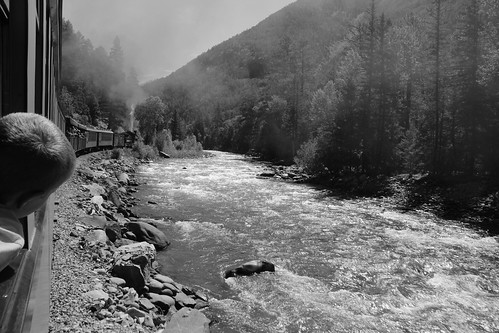
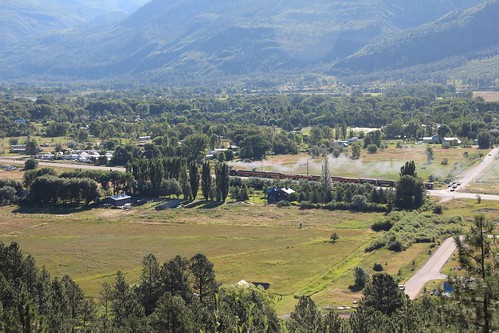
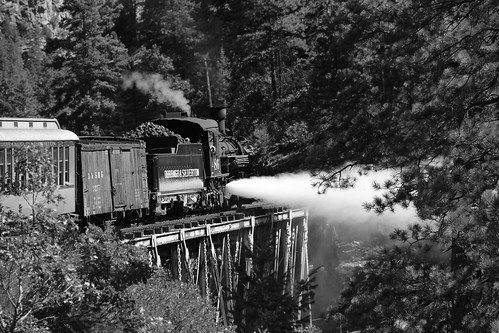
IMG_5731_v1 There is something about that moment. Hiking in the mountains near Durango, Colorado, with Laura and the boys, we found a beautiful spot with a view of the valley. We paused to admire, and then The sound of a steam locomotive whistle from down below, sounding loud all the way up there, then echoing back and forth through the valley. Then the quieter, seemingly more distant sound of the steam engine heading across the valley, chugging and clacking as it goes. More whistles, the sight of smoke and then of the train full of people, looking like a beautiful model train from our vantage point. IMG_5515 I ve heard that sound on a few rare recordings, but never experienced it. I ve been on steam trains a few times, but never spent time in a town where they still run all day, every day. It is a different sort of feeling to spend a week in a place where Jacob and Oliver would jump up several times a day and rush to the nearest window in an attempt to catch sight of the train. IMG_5719_v1 Airplanes really can be a time machine in a sense what a wondrous time to be alive, when things so ancient are within the reach of so many. I have been transported to L beck and felt the uneven 700-year-old stones of the Marienkirche underneath my feet, feeling a connection to the people that walked those floors for centuries. I felt the same in Prague, in St. George s Basilica, built in 1142, and at the Acropolis of Lindos, with its ancient Greek temple ruins. In Kansas, I feel that when in the middle of the Flint Hills rolling green hills underneath the pure blue sky with billowing white clouds, the sounds of crickets, frogs, and cicadas in my ears; the sights and sounds are pretty much as they ve been for tens of thousands of years. And, of course, in Durango, arriving on a plane but seeing the steam train a few minutes later. IMG_5571_v1 It was fitting that we were in Durango with Laura s parents to celebrate their 50th anniversary. As we looked forward to riding the train, we heard their stories of visits to Durango years ago, of their memories of days when steam trains were common. We enjoyed thinking about what our lives would be like should we live long enough to celebrate 50 years of marriage. Perhaps we would still be in good enough health to be able to ride a steam train in Durango, telling about that time when we rode the train, which by then will have been pretty much the same for 183 years. Or perhaps we would take them to our creek, enjoying a meal at the campfire like I ve done since I was a child. Each time has its unique character. I am grateful for the cameras and airplanes and air conditioning we have today. But I am also thankful for those things that connect us with each other trough time, those rocks that are the same every year, those places that remind us how close we really are to those that came before.

24 July 2015

Vincent Sanders: NetSurf developers and the Order of the Phoenix

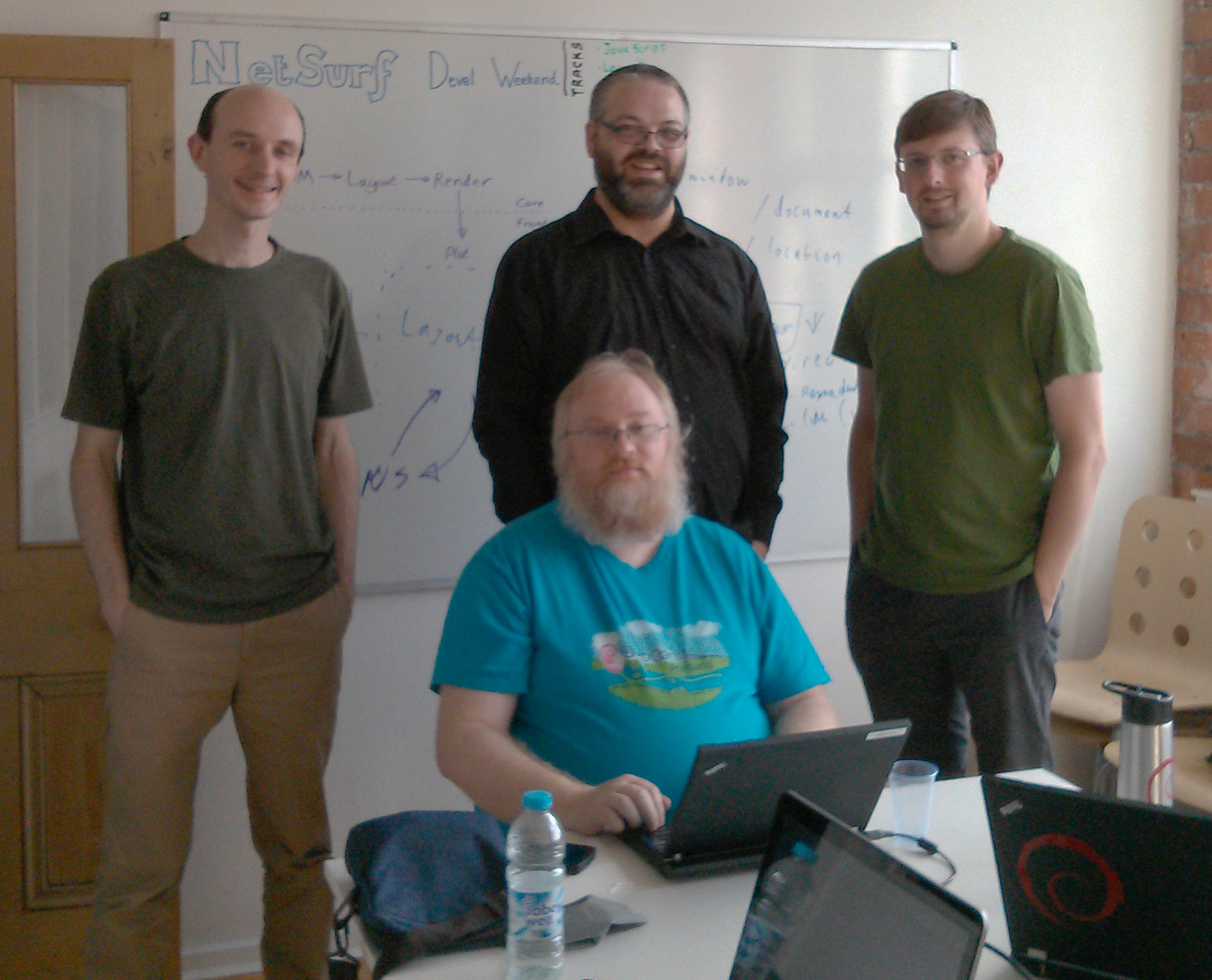
Once more the NetSurf developers gathered to battle the forces of darkness, or as they are more commonly known web specifications.

Michael Drake, Vincent Sanders, John-Mark Bell and Daniel Silverstone at the Codethink manchester officesThe fifth developer weekend was an opportunity for us to gather in a pleasant setting and work together in person. We were graciously hosted, once again, by Codethink in their Manchester offices.

Four developers managed to attend in person from around the UK: Michael Drake, John-Mark Bell, Daniel Silverstone and Vincent Sanders.

The main focus of the weekends activities was to address two areas that have become overwhelmingly important: JavaScript and Layout.

Although the browser obviously already has both these features they are somewhat incomplete and incapable of supporting the features of the modern web.
JavaScriptThe discussion started with JavaScript and its implementation. We had previously looked at the feasibility of changing our JavaScript engine from Spidermonkey to DukTape. We had decided this was a change we wanted to make when DukTape was mature enough to support the necessary features.

The main reasons for the change are that Spidermonkey is a poor fit to NetSurf as it is relatively large and does not provide a stable API guarantee. The lack of a stable API requires extensive engineering to update to new releases. Additionally support for compiling on minority platforms is very challenging meaning that most platforms are stuck using version 1.7 or 1.85 (current release is version 31 with 38 due).

We started the move to Duktape by creating a development branch, integrating the Duktape library and open coding a minimal implementation of the core classes as a proof of concept. This work was mostly undertaken by Daniel with input from myself and John-Mark. This resulted in a build that was substantially smaller than using Spidermonkey with all the existing functionality our tests cover.

The next phase of this work is to take the prototype implementation and turn it into something that can be reliably used and covers the entire JavaScript DOM interface. This is no small job as there are at least 200 classes and 1500 methods and properties to implement.
LayoutThe layout library design discussion was an extensive and very involved. The layout engine is a browsers most important component. It takes all the information processed by the CSS and DOM libraries, applies a vast number of involved rules and produces a list of operations that can be rendered.

This reimplementation of our rendering engine has been in planning for many years. The existing engine stems from the browsers earliest days more than a decade ago and has many shortcomings in architecture and implementation we hope to address.

The work has finally started on libnslayout with Michael taking the lead and defining the initial API and starting the laborious work of building the test harness, a feature the previous implementation lacked!
The second war beginsFor a war you need people and it is a little unfortunate that this was our lowest ever turnout for the event. This is true of the project overall with declining numbers of commits and interest outside our core group. If anyone is interested we are always happy to have new contributors and there are opportunities to contribute in many areas from image assets, through translations, to C programming.

We discussed some ways to encourage new developers and try and get committed developers especially for the minority platform frontends. The RISC OS frontend for example has needed a maintainer since the previous one stepped down. There was some initial response from its community, culminating in a total of two patches, when we announced the port was under threat of not being releasable in future. Unfortunately nothing further came from this and it appears our oldest frontend may soon become part of our history.

We also covered some issues from the bug tracker mostly to see if there were any patterns that we needed to address before the forthcoming 3.4 release.

There was discussion about recent improvements to the CI system which generate distribution packages from the development branch and how this could be extended to benefit more users. This also included authorisation to acquire storage and other miscellaneous items necessary to keep the project infrastructure running.

We managed over 20 hours of work in the two days and addressed our current major shortcomings. Now it just requires a great deal of programming to complete the projects started here.

22 July 2015

Orestis Ioannou: GSoC Debsources midterm news

Midterm evaluations have already passed and I guess we have also reached a milestone since last week I finished working on the copyright tracker and started the patch tracker. Here's the list of my reports on soc-coordination for those interested Copyright tracker status Copyright tracker Most of the functionalities of the copyright tracker are already merged. Specifically navigating in the tracker, rendering the machine readable licenses, API functionalities such as obtaining the license of a file searching by checksum or by a package / version / path or obtaining the licenses of many files at once and their respective views. Some more functionalities are still under review such as filling the database with copyright related information at update time, using the database to answer the aforementioned requests, license statistics in the spirit of the Debsources ones and exporting a license in SPDX format. Its going to be pretty exciting when those pull requests are going to be merged since the copyright tracker will be full and complete! Meanwhile I started working on the patch tracker. Patch tracker My second task is the implementation of a patch tracker. This feature existed in Debian but unfortunately died recently. I have already started revising the functionalities of the old patch tracker, started identifying target users, creating use stories and cases. Those should help me list the desired functionalities of the tracker, imagine the structure of the blueprint and start writing code to that end. It is going to be a pretty exciting run of 1 month doing this as my knowledge on the Debian packaging system is not that good just yet. I hope that until Debconf some of the functionalities of the patch tracker are going to be ready. Debconf My request for sponsorship for Debconf was accepted and I am pretty excited since this is going to be my first Debconf attendance. I am looking forward meeting my mentors (Zack and Matthieu), the fellow student working on Debsources (Clemux) as well as a lot of other people I happen to chat occasionaly during this summer. I ll arrive on Friday 14th and leave on Sunday 23. Debconf 2015

18 July 2015

John Goerzen: True Things About Learning to Fly

I ve been pretty quiet for the last few months because I m learning to fly. I want to start with a few quotes about aviation. I have heard things like these from many people and can vouch for their accuracy:
Anyone can learn to fly. Learning to fly is one of the hardest things you ll ever do. It is totally worth it. Being a pilot will give you a new outlook on life. You ll be amazed at what radios do a 3000ft. Have you ever had an 3000-foot antenna tower? The world is glorious at 1000ft up. Share your enthusiasm with those around you. You have a perspective very few ever see, except for a few seconds on the way to 35,000ft.
Earlier this month, I flew solo for the first time the biggest milestone on the way to getting the pilot s license. Here s a photo my flight instructor took as I was coming in to land that day. landing Today I took my first flight to another airport. It wasn t far about 20 miles away but it was still a thrill. I flew about 1500ft above the ground, roughly above a freeway that happened to be my route. From that height, things still look three-dimensional. The grain elevator that marked out the one small town, the manufacturing plant at another, the college at the third. Bales of hay dotting the fields, the occasional tractor creeping along a road, churches sticking up above the trees. These are places I ve known for decades, and now, suddenly, they are all new. What a time to be alive! I am glad that our world is still so full of wonder and beauty.

16 July 2015

Raphaël Hertzog: Freexian s report about Debian Long Term Support, June 2015

A Debian LTS logoLike each month, here comes a report about the work of paid contributors to Debian LTS. Individual reports In June, 73.50 work hours have been dispatched among 7 paid contributors. Their reports are available: Evolution of the situation July has seen a nice increase in terms of sponsored hours (79.50 hours per month) but the trend is unlikely to continue for the next month, worse it might be negative. While most sponsors who joined us last year in July will renew their support, there are a few where I have no confirmation yet. Many thanks to those who confirmed early: Universit Lille 3, MyTux. Our first milestone of funding the equivalent of a half-time position is unlikely to be reached before DebConf or even this summer. If you want to prove me wrong, it s time to get in touch with your management and convince your company to contribute a small amount. In terms of security updates waiting to be handled, the situation is similar to last month: the dla-needed.txt file lists 24 packages awaiting an update (5 more than last month), the list of open vulnerabilities in Squeeze shows about 33 affected packages in total (3 less than last month). Thanks to our sponsors There are no new sponsors this month. But I decided to include the number of months that the sponsor has been with us. Since we value long-lasting relations, it seemed quite natural to add this.

No comment Liked this article? Click here. My blog is Flattr-enabled.

1 July 2015

Daniel Silverstone: Be careful what you ask for

Date: Wed, 01 Jul 2015 06:13:16 -0000
From: 123-reg <noreply@123-reg.co.uk>
To: dsilvers@digital-scurf.org
Subject: Tell us what you think for your chance to win
X-Mailer: MIME::Lite 3.027 (F2.74; T1.28; A2.04; B3.13; Q3.13)
Tell us what you think of 123-reg!
<!--
.style1  color: #1996d8 
-->
Well 123-reg mostly I think you don't know how to do email.

28 June 2015

Ben Armstrong: Bluff Trail Early Summer 2015

Here s a photo journal of a walk I just completed around the Pot Lake loop of the Bluff Wilderness Hiking Trail. Hope you enjoy it! I was dissatisfied with my initial post, so have reduced the size to improve load time, changed the gallery software and have rewritten many of the captions. [slb_group]
My favourite stunted tamarack, clinging to the rocks.Click this photo to start the slideshow.
The Bluff Wilderness Hiking Trail is a series of four loops. Today I ll tackle only the first in order to get as many pictures as possible, and because when hiking solo, I prefer to stay on the more heavily traveled part. In late summer, I ll probably do all four loops with my friend Ryan again. Meanwhile, I ll stay in shape coming out here when I can for shorter walks. The trail starts here. Right away, even before heading between the marker stones, there s a pretty view of Cranberry Lake off to the right. Pink lady slippers have been plentiful this year! All along the trail, you can find hundreds, if not thousands of these. Boardwalks provide dry passage across the boggy bits. The pitcher plants are thriving, too. The vines with tiny, round leaves are wintergreen. Tasty! I ve not seen anything larger than a deer out here. Roots and rocks are a recurring theme. Many feet beating down on the first loop have packed the earth hard and have exposed more roots than you ll see deeper into the trail system where fewer hikers travel. Step carefully. Sheep laurel is an eye-catcher. To me, they look like little, pink jewels. Yellow markers clearly mark the Pot Lake loop. At crucial junctures there are some signs to point you the right way. If you re looking only at your feet, you may see black circles marked with arrows on some of the rocks, also pointing the way. The vegetation varies from scraggly and clinging to the rocks, to lush and green. The path is wet in parts. Nothing impassible, though. On the first loop in particular, and even within only the first kilometre, there are some pretty stunning views of the lake. Very quickly, you ll find yourself perched up top on the rocks. On this stretch, you need to hop a bit from one rock to the next. Just as quickly as you ascended, you descend back down to the lake again. A good place to stop and have a snack. The start of the first loop, itself. I chide myself for not having discovered this trail until about 2007, even though we moved out here in 2005. It s a treasure we re indebted to the WRWEO for preserving. Leave some comments in the box, if you like. You ll find these maps along the way to track your progress. Remember to follow proper trail etiquette. A particularly steep climb! Despite the best trail maintenance efforts, water still goes where it wants! Good to have boots. Another steep climb. This tree is chattering at me. Raising quite a racket. What s in the hole? I patiently wait with my camera to get a good shot of the tree s occupants. Mother woodpecker, feeding her babies! As the feeding continues, the chirping intensifies! Up on top of a big rock with a view over the lake is another favourite stopping place for a snack. The view at my snack break rock. I never get tired of it. There are some pretty big boulders. Next time I ll bring a friend to stand under it for scale. Another terrific view. A stream just before the first portage. This portage connects Cranberry Lake with Pot Lake. The portage is clearly marked. The Pot Lake end of the portage. One of several upturned trees, with the roots now forming a wall along one side of the trail. The spiral of the roots mimics the spiral split in this boulder which you can walk all of the way into until you reach the centre. Rocks and trees and trees and rocks White pine catkins. Suddenly the close forest opens up into a wide view all around. My favourite stunted tamarack, clinging to the rocks. Last year s cones. This year s aren t out yet on this tree. I love the tamarack s delicate new needles. These blueberries have a head start. Can t wait until it s time to harvest them. Nearly at the top of the Pot Lake loop. This is Pot Lake, itself. I was struck by this one little blighted berry, showing a blush of distress-induced colour amongst the green ones. Another view, nearly at the top. A sign beneath the map: Rare Plant Species: Mountain Sandwort Arenaria groenlandica. Use caution and stay on designated trails. Avoid disturbing habitat. Finally, the top. A map to mark your progress. Apparently the Mountain Sandwort, right at the base of the sign. The mountain sandwort is a pretty, delicate little thing. After passing the sign, the view from the top over Cranberry Lake, indeed both lakes, is a reward worth climbing all of the way up to see. Some other hiker has left a cairn. The descent is not too steep at first. The approach down to the back side of Pot Lake from the top is marked by exposed bedrock and scrubby plants. Finally back to some cover, which is welcome on hotter days. A ferny fairyland. It s not all abrupt ups and downs. Here s an easy, winding stretch of trail. Cinnamon ferns. Ambling along. Rounding the end of Pot Lake. Not very long after reaching the lake, the path climbs several metres up above it. There are some nice, rootless bits on this side of the loop, giving your ankles and knees a break. This guy seemed extremely agitated to see me. A new tamarack cone! Did I mention I like tamaracks? The steep descent back to Cranberry Lake again. Finally back where the loop starts.
[/slb_group]

22 June 2015

Lunar: Reproducible builds: week 8 in Stretch cycle

What happened about the reproducible builds effort this week: Toolchain fixes Andreas Henriksson has improved Johannes Schauer initial patch for pbuilder adding support for build profiles. Packages fixed The following 12 packages became reproducible due to changes in their build dependencies: collabtive, eric, file-rc, form-history-control, freehep-chartableconverter-plugin , jenkins-winstone, junit, librelaxng-datatype-java, libwildmagic, lightbeam, puppet-lint, tabble. The following packages became reproducible after getting fixed: Some uploads fixed some reproducibility issues but not all of them: Patches submitted which have not made their way to the archive yet: reproducible.debian.net Bugs with the ftbfs usertag are now visible on the bug graphs. This explain the recent spike. (h01ger) Andreas Beckmann suggested a way to test building packages using the funny paths that one can get when they contain the full Debian package version string. debbindiff development Lunar started an important refactoring introducing abstactions for containers and files in order to make file type identification more flexible, enabling fuzzy matching, and allowing parallel processing. Documentation update Ximin Luo detailed the proposal to standardize environment variables to pass a reference source date to tools that needs one (e.g. documentation generator). Package reviews 41 obsolete reviews have been removed, 168 added and 36 updated this week. Some more issues affecting packages failing to build from source have been identified. Meetings Minutes have been posted for Tuesday June 16th meeting. The next meeting is scheduled Tuesday June 23rd at 17:00 UTC. Presentations Lunar presented the project in French during Pas Sage en Seine in Paris. Video and slides are available.

11 June 2015

Daniel Silverstone: In defence of curl sudo bash -

Long ago, in days of yore, we assumed that any software worth having would be packaged by the operating system we used. Debian with its enormous pile of software (over 20,000 sources last time I looked) looked to basically contain every piece of free software ever. However as more and more people have come to Linux-based and BSD-based systems, and the proliferation of *NIX-based systems has become even more diverse, it has become harder and harder to ensure that everyone has access to all of the software they might choose to use. Couple that with the rapid development of new projects, who clearly want to get users involved well before the next release cycle of a Linux-based distribution such as Debian, and you end up with this recommendation to bypass the operating system's packaging system and simply curl sudo bash -. We, the OS-development literati, have come out in droves to say "eww, nasty, don't do that please" and yet we have brought this upon ourselves. Our tendency to invent, and reinvent, at the very basic levels of distributions has resulted in so many operating systems and so many ways to package software (if not in underlying package format then in policy and process) that third party application authors simply cannot keep up. Couple that with the desire of the consumers to not have their chosen platform discounted, and if you provide Debian packages, you end up needing to provide for Fedora, RHEL, SuSE, SLES, CentOS, Mint, Gentoo, Arch, etc.etc; let alone supporting all the various BSDs. This leads to the simple expedience of curl sudo bash -. Nobody, not even those who are most vehemently against this mechanism of installing software, can claim that it is not quick, simple for users, easy to copy/paste out of a web-page, and leaves all the icky complexity of sorting things out up to a script which the computer can run, rather than the nascent user of the software in question. As a result, many varieties of software have ended up using this as a simple installation mechanism, from games to orchestration frameworks - everyone can acknowledge how easy it is to use. Now, some providers are wising up a little and ensuring that the url you are curling is at least an https:// one. Some even omit the sudo from the copy/paste space and have it in the script, allowing them to display some basic information and prompting the user that this will occur as root before going ahead and elevating. All of these myriad little tweaks to the fundamental idea improve matters but are ultimately just putting lipstick on a fairly sad looking pig. So, what can be done? Well we (again the OS-development literati) got ourselves into this horrendous mess, so it's up to us to get ourselves back out. We're all too entrenched in our chosen packaging methodologies, processes, and policies, to back out of those; yet we're clearly not properly servicing a non-trivial segment of our userbase. We need to do better. Not everyone who currently honours a curl sudo bash - is capable of understanding why it's such a bad idea to do so. Some education may reduce that number but it will never eliminate it. For a long time I advocated a switch to wget && review && sudo ./script approach instead, but the above comment, about people who don't understand why it might be a bad idea, really applies to show how few of those users would even be capable of starting to review a script they downloaded, let alone able to usefully judge for themselves if it is really safe to run. Instead we need something better, something collaborative, something capable of solving the accessibility issues which led to the curl sudo bash - revolt in the first place.
I don't pretend to know what that solution might be, and I don't pretend to think I might be the one to come up with it, but I can hilight a few things I think we'll need to solve to get there:
  1. Any solution to this problem must be as easy as curl sudo bash - or easier. This might mean a particular URI format which can have os-specific ways to handle standardised inputs, or it might mean a pervasive tool which does something like that.
  2. Any solution must do its best to securely acquire the content the user actually wanted. This means things like validating SSL certificates, presenting information to the user which a layman stands a chance of evaluating to decide if the content is likely to be what they wanted, and then acting smoothly and cleanly to get that content onto the user's system.
  3. Any solution should not introduce complex file formats or reliance on any particular implementation of a tool. Ideally it would be as easy to implement the solution on FreeBSD in shell, or on Ubuntu as whizzy 3D GUIs written in Haskell. (modulo the pain of working in shell of course)
  4. The solution must be arrived at in a multi-partisan way. For such a mechanism to be as usefully pervasive as curl sudo bash - as many platforms as possible need to get involved. This means not only Debian, Ubuntu, Fedora and SuSE; but also Arch, FreeBSD, NetBSD, CentOS etc. Maybe even the OpenSolaris/Illumos people need to get involved.
Given the above, no solution can be "just get all the apps developers to learn how to package software for all the OS distributions they want their app to run on" since that way madness lies. I'm sure there are other minor, and major, requirements on any useful solution but the simple fact of the matter is that until and unless we have something which at least meets the above, we will never be rid of curl sudo bash - :- just like we can never seem to be rid of that one odd person at the party, noone knows who invited them, and noone wants to tell them to leave because they do fill a needed role, but noone really seems to like. Until then, let's suck it up and while we might not like it, let's just let people keep on curl sudo bash -ing until someone gets hurt.
P.S. I hate curl sudo bash - for the record.

Next.

Previous.