Search Results: "sten"

4 February 2025

Dominique Dumont: Azure API throttling strikes back

Hi In my last blog, I explained how we resolved a throttling issue involving Azure storage API. In the end, I mentioned that I was not sure of the root cause of the throttling issue. Even though we no longer had any problem in dev and preprod cluster, we still faced throttling issue with prod. The main difference between these 2 environments is that we have about 80 PVs in prod versus 15 in the other environments. Given that we manage 1500 pods in prod, 80 PVs does not look like a lot.  To continue the investigation, I ve modified k8s-scheduled-volume-snapshotter to limit the number of snaphots done in a single cron run (see add maxSnapshotCount parameter pull request). In prod, we used the modified snapshotter to trigger snapshots one by one. Even with all previous snapshots cleaned up, we could not trigger a single new snapshot without being throttled . I guess that, in the cron job, just checking the list of PV to snapshot was enough to exhaust our API quota.  Azure doc mention that a leaky bucket algorithm is used for throttling. A full bucket holds tokens for 250 API calls, and the bucket gets 25 new tokens per second. Looks like that not enough. I was puzzled  and out of ideas  . I looked for similar problems in AKS issues on GitHub where I found this comment that recommend using useDataPlaneAPI parameter in the CSI file driver. That was it!  I was flabbergasted  by this parameter: why is CSI file driver able to use 2 APIs ? Why is one on them so limited ? And more importantly, why is the limited API the default one ? Anyway, setting useDataPlaneAPI: "true" in our VolumeSnapshotClass manifest was the right solution. This indeed solved the throttling issue in our prod cluster.  But not the snaphot issue  . Amongst the 80 PV, I still had 2 snaphots failing. Fortunately, the error was mentioned in the description of the failed snapshots: we had too many (200) snapshots for these shared volumes. What ??  All these snapshots were cleaned up last week. I then tried to delete these snaphots through azure console. But the console failed to delete these snapshot due to API throttling. Looks like Azure console is not using the right API.  Anyway, I went back to the solution explained in my previous blog, I listed all snapshots with az command. I indeed has a lot of snaphots, a lot of them dated Jan 19 and 20. There was often a new bogus snaphot created every minute. These were created during the first attempt at fixing the throttling issue. I guess that even though CSI file driver was throttled, a snaphot was still created in the storage account, but the CSI driver did not see it and retried a minute later . What a mess. Anyway, I ve cleaned up again these bogus snapshot  , and now, snaphot creation is working fine  . For now. All the best.
Valhalla's Things: Conference Talk Timeout Ring, Part One

Posted on February 4, 2025
Tags: madeof:atoms, madeof:bits
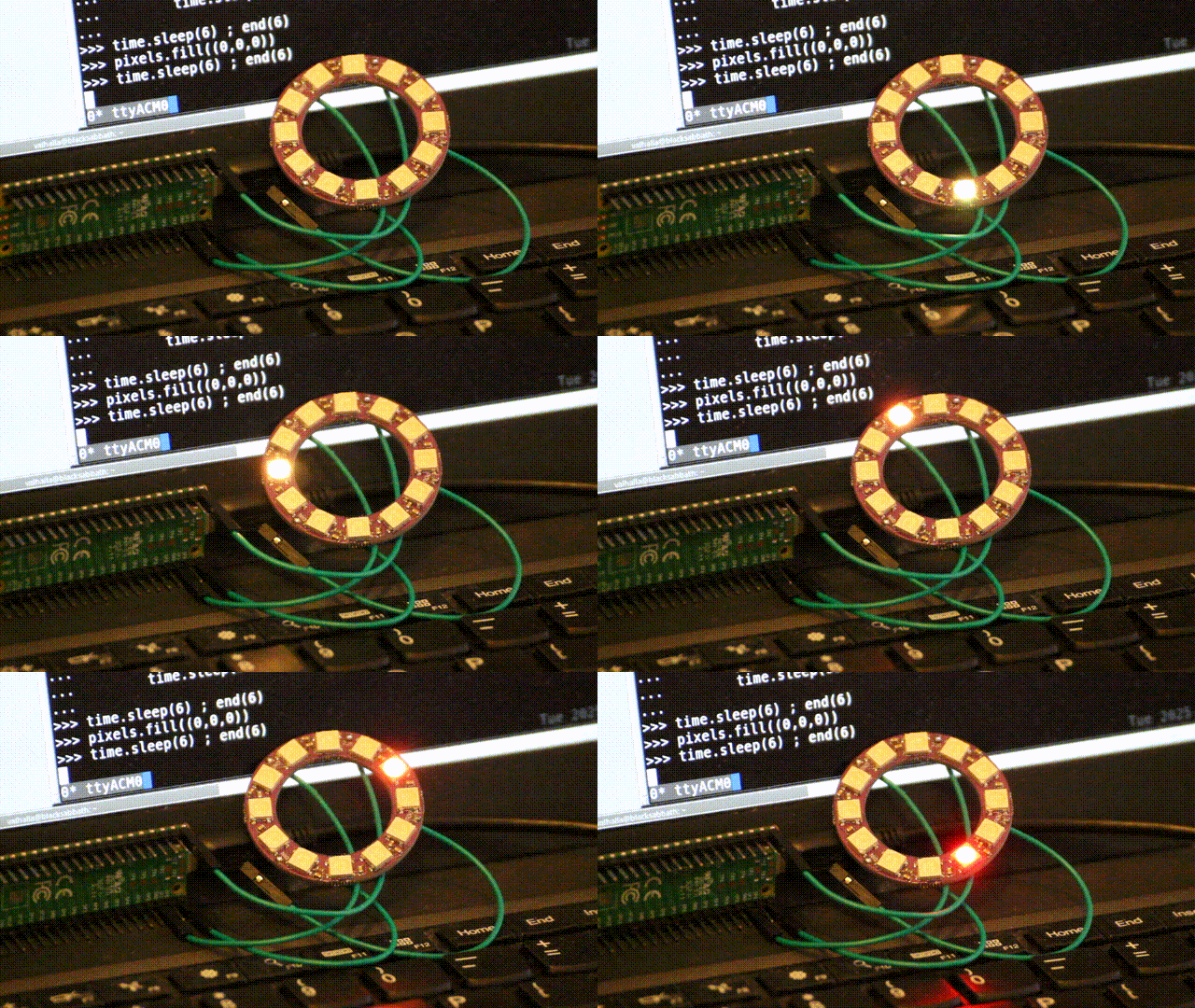
low quality video of a ring of rgb LED in front of a computer: the LED light up one at a time in colours that go from yellow to red. A few ago I may have accidentally bought a ring of 12 RGB LEDs; I soldered temporary leads on it, connected it to a CircuitPython supported board and played around for a while. They we had a couple of friends come over to remote FOSDEM together, and I had talked with one of them about WS2812 / NeoPixels, so I brought them to the living room, in case there was a chance to show them in sort-of-use. Then I was dealing with playing the various streams as we moved from one room to the next, which lead to me being called video team , which lead to me wearing a video team shirt (from an old DebConf, not FOSDEM, but still video team), which lead to somebody asking me whether I also had the sheet with the countdown to the end of the talk, and the answer was sort-of-yes (I should have the ones we used to use for our Linux Day), but not handy. But I had a thing with twelve things in a clock-like circle. A bit of fiddling on the CircuitPython REPL resulted, if I remember correctly, in something like:

import board
import neopixel
import time
num_pixels = 12
pixels = neopixel.NeoPixel(board.GP0, num_pixels)
pixels.brightness = 0.1
def end(min):
    pixels.fill((0, 0, 0))
    for i in range(12):
        pixels[i] = (127 + 10 * i, 8 * (12 - i), 0)
        pixels[i-1] = (0, 0, 0)
        time.sleep(min * 5)  # min * 60 / 12
Now, I wasn t very consistent in running end, especially since I wasn t sure whether I wanted to run it at the beginning of the talk with the full duration or just in the last 5 - 10 minutes depending of the length of the slot, but I ve had at least one person agree that the general idea has potential, so I m taking these notes to be able to work on it in the future. One thing that needs to be fixed is the fact that with the ring just attached with temporary wires and left on the table it isn t clear which LED is number 0, so it will need a bit of a case or something, but that s something that can be dealt with before the next fosdem. And I should probably add some input interface, so that it is self-contained and not tethered to a computer and run from the REPL. (And then I may also have a vague idea for putting that ring into some wearable thing: good thing that I actually bought two :D )

1 February 2025

Guido G nther: Free Software Activities January 2025

Another short status update of what happened on my side last month. Mostly focused on quality of life improvements in phosh and cleaning up and improving phoc this time around (including catching up with wlroots git) but some improvements for other things like phosh-osk-stub happened on the side line too. phosh phoc phosh-osk-stub xdg-desktop-portal-phosh phosh-recipes libcmatrix phrog Debian git-buildpackage livi feedbackd Wayland protocols Wlroots Bug reports Reviews This is not code by me but reviews on other peoples code. The list is incomplete, but I hope to improve on this in the upcoming months. Thanks for the contributions! Help Development If you want to support my work see donations. Comments? Join the Fediverse thread

31 January 2025

Russell Coker: Links January 2025

Aaron Quigley s Everything Open lecture about Intelligent Interfaces is one of the most interesting research reports I ve seen in a long time [1]. This one can be understood and appreciated by people who don t have a strong background in computer science. Statites (satellites that don t orbit the sun but use solar sails to hover in place) could be used to catch up to interstellar objects [2]. Slashgear has an interesting article about an AI piloted F16 beating a human piloted F16 [3]. Given the serious handicaps of flying a plane designed for humans and flying to minimise risk to itself and other crewed aircraft this is a serious victory. Hopefully crewed military aircraft will be obsolete soon. Amusing video about the performance of cats with MMORPG style descriptions [4]. John Goerzen wrote an interesting blog post about censorship and the changes to Facebook [5]. Ron Garret wrote an interesting blog post 15 years ago when going through what he now describes as an existential crisis [6]. A comment on Ron s post is references Alan Crowe s blog post about whether the self exists which is an interesting philosophical post [7]. But I m still going to think of myself as a person. Another comment on Ron s post references Aaron Swartz blog post about Noam Chomsky etc [8]. I have to watch Manufacturing Consent: Noam Chomsky and the Media. Ron Garret wrote an interesting blog post about his failed attempts to start a company and how it all worked out well for him any way [9]. Amusing video about a failed crowdfunded e-bike [10]. Cory Doctorow wrote an insightful article about how Enshittification is not caused by VCs but by lack of controls [11].

29 January 2025

Keith Packard: picolibc-i18n

Internationalization support in Picolibc There are two major internationalization APIs in the C library: locales and iconv. Iconv is an isolated component which only performs charset conversion in ways that don't interact with anything else in the library. Locales affect pretty much every API that deals with strings and covers charset conversion along with a huge range of localized information from character classification to formatting of time, money, people's names, addresses and even standard paper sizes. Picolibc inherits it's implementation of both of these from newlib. Given that embedded applications rarely need advanced functionality from either these APIs, I hadn't spent much time exploring this space. Newlib locale code When run on Cygwin, Newlib's locale support is quite complete as it leverages the underlying Windows locale support. Without Windows support, everything aside from charset conversion and character classification data is stubbed out at the bottom of the stack. Because the implementation can support full locale functionality, the implementation is designed for that, with large data structures and lots of code. Charset conversion and character classification data for locales is all built-in; none of that can be loaded at runtime. There is support for all of the ISO-8859 charsets, three JIS variants, a bunch of Windows code pages and a few other single-byte encodings. One oddity in this code is that when using a JIS locale, wide characters are stored in EUC-JP rather than Unicode. Every other locale uses Unicode. This means APIs like wctype are implemented by mapping the JIS-encoded character to Unicode and then using the underlying Unicode character classification tables. One consequence of this is that there isn't any Unicode to JIS mapping provided as it isn't necessary. When testing the charset conversion and Unicode character classification data, I found numerous minor errors and a couple of pretty significant ones. The JIS conversion code had the most serious issue I found; most of the conversions are in a 2d array which is manually indexed with the wrong value for the length of each row. This led to nearly every translated value being incorrect. The charset conversion tables and Unicode classification data are now generated using python charset support and the standard Unicode data files. In addition, tests have been added which compare Picolibc to the system C library for every supported charset. Newlib iconv code The iconv charset support is completely separate from the locale charset support with a much wider range of supported targets. It also supports loading charset data from files at runtime, which reduces the size of application images. Because the iconv and locale implementations are completely separate, the charset support isn't the same. Iconv supports a lot more charsets, but it doesn't support all of those available to locales. For example, Iconv has Big5 support which locale lacks. Conversely, locale has Shift-JIS support which iconv does not. There's also a difference in how charset names are mapped in the two APIs. The locale code has a small fixed set of aliases, which doesn't include things like US-ASCII or ANSI X3.4. In contrast, the iconv code has an extensive database of charset aliases which are compiled into the library. Picolibc has a few tests for the iconv API which verify charset names and perform some translations. Without an external reference, it's hard to know if the results are correct. POSIX vs C internationalization In addition to including the iconv API, POSIX extends locale support in a couple of ways:
  1. Exposing locale objects via the newlocale, uselocale, duplocale and freelocale APIs.
  2. uselocale sets a per-thread locale, rather than the process-wide locale.
Goals for Picolibc internationalization support For charsets, supporting UTF-8 should cover the bulk of embedded application needs, and even that is probably more than what most applications require. Most (all?) compilers use Unicode for wide character and string constants. That means wchar_t needs to be Unicode in every locale. Aside from charset support, the rest of the locale infrastructure is heavily focused on creating human-consumable strings. I don't think it's a stretch to say that none of this is very useful these days, even for systems with sophisticated user interactions. For picolibc, the cost to provide any of this would be high. Having two completely separate charset conversion datasets makes for a confusing and error-prone experience for developers. Replacing iconv with code that leverages the existing locale support for translating between multi-byte and wide-character representations will save a bunch of source code and improve consistency. Embedded systems can be very sensitive to memory usage, both read-only and read-write. Applications not using internationalization capabilities shouldn't pay a heavy premium even when the library binary is built with support. For the most sensitive targets, the library should be configurable to remove unnecessary functionality. Picolibc needs to be conforming with at least the C language standard, and as much of POSIX as makes sense. Fortunately, the requirements for C are modest as it only includes a few locale-related APIs and doesn't include iconv. Finally, picolibc should test these APIs to make sure they conform with relevant standards, especially character set translation and character classification. The easiest way to do this is to reference another implementation of the same API and compare results. Switching to Unicode for JIS wchar_t This involved ripping the JIS to Unicode translations out of all of the wide character APIs and inserting them into the translations between multi-byte and wide-char representations. The missing Unicode to JIS translation was kludged by iterating over all JIS code points until a matching Unicode value was found. That's an obvious place for a performance improvement, but at least it works. Tiny locale This is a minimal implementation of locales which conforms with the C language standard while providing only charset translation and character classification data. It handles all of the existing charsets, but splits things into three levels
  1. ASCII
  2. UTF-8
  3. Extended, including any or all of: a. ISO 8859 b. Windows code pages and other 8-bit encodings c. JIS (JIS, EUC-JP and Shift-JIS)
When built for ASCII-only, all of the locale support is short-circuited, except for error checking. In addition, support in printf and scanf for wide characters is removed by default (it can be re-enabled with the -Dio-wchar=true meson option). This offers the smallest code size. Because the wctype APIs (e.g. iswupper) are all locale-specific, this mode restricts them to ASCII-only, which means they become wrappers on top of the ctype APIs with added range checking. When built for UTF-8, character classification for wide characters uses tables that provide the full Unicode range. Setlocale now selects between two locales, "C" and "C.UTF-8". Any locale name other than "C" selects the UTF-8 version. If the locale name contains "." or "-", then the rest of the locale name is taken to be a charset name and matched against the list of supported charsets. In this mode, only "us_ascii", "ascii" and "utf-8" are recognized. Because a single byte of a utf-8 string with the high-bit set is not a complete character, all of the ctype APIs in this mode can use the same implementation as the ASCII-only mode. This means the small ctype implementation is available. Calling setlocale(LC_ALL, "C.UTF-8") will allow the application to use the APIs which translate between multi-byte and wide-characters to deal with UTF-8 encoded strings. In addition, scanf and printf can read and write UTF-8 strings into wchar_t strings. Locale names are converted into locale IDs, an enumeration which lists the available locales. Each ID implies a specific charset as that's the only thing which differs between them. This means a locale can be encoded in a few bytes rather than an array of strings. In terms of memory usage, applications not using locales and not using the wctype APIs should see only a small increase in code space. That's due to the wchar_t support added to printf and scanf which need to translate between multi-byte and wide-character representations. There aren't any tables required as ASCII and UTF-8 are directly convertible to Unicode. On ARM-v7m, The added code in printf and scanf add up to about 1kB and another 32 bytes of RAM is used. The big difference when enabling extended charset support is that all of the charset conversion and character classification operations become table driven and dependent on the locale. Depending on the extended charsets supported, these can be quite large. With all of the extended charsets included, this adds an additional 30kB of code and static data and uses another 56 bytes of RAM. There are two known gaps in functionality compared with the newlib code:
  1. Locale strings that encode different locales for different categories. That's nominally required by POSIX as LC_ALL is supposed to return a string sufficient to restore the locale, but the only category which actually matters is LC_CTYPE.
  2. No nl_langinfo support. This would be fairly easy to add, returning appropriate constant values for each parameter.
Tiny locale was merged to picolibc main in this PR Tiny iconv Replacing the bulky newlib iconv code was far easier than swapping locale implementations. Essentially all that iconv does is compute two functions, one which maps from multi-byte to wide-char in one locale and another which maps from wide-char to multi-byte in another locale. Once the JIS locales were fixed to use Unicode, the new iconv implementation was straightforward. POSIX doesn't provide any _l version of mbrtowc or wcrtomb, so using standard C APIs would have been clunky. Instead, the implementation uses the internal APIs to compute the correct charset conversion functions. The entire implementation fits in under 200 lines of code. Tiny iconv is in process in this PR Future directions Right now, both of these new bits of code sit in the source tree parallel to the old versions. I'm not seeing any particular reason to keep the old versions around; they have provided a useful point of comparison in developing the new code, but I don't think they offer any compelling benefits going forward.

Sergio Talens-Oliag: Testing DeepSeek with Ollama and Open WebUI

With all the recent buzz about DeepSeek and its capabilities, I ve decided to give it a try using Ollama and Open WebUI on my work laptop which has an NVIDIA GPU:
$ lspci   grep NVIDIA
0000:01:00.0 3D controller: NVIDIA Corporation GA107GLM [RTX A2000 8GB Laptop GPU]
             (rev a1)
For the installation I initially I looked into the approach suggested on this article, but after reviewing it I decided to go for a docker only approach, as it leaves my system clean and updates are easier.

Step 0: Install dockerI already had it on my machine, so nothing to do here.

Step 1: Install the nvidia-container-toolkit packageAs it is needed to use the NVIDIA GPU with docker I followed the instructions to install the package using apt from the NVIDIA website.

Step 2: Run the Open WebUI container bundled with OllamaI could install ollama directly on linux or run it on docker, but I found out that there is a container with Open WebUI bundled with Ollama, so I decided to use it instead. To start the container I ve executed the following command:
docker run -d \
  -e OLLAMA_HOST="0.0.0.0:11434" -p 127.0.0.1:11434:11434 \
  -p 127.0.0.1:3000:8080 \
  -v ollama:/root/.ollama \
  -v open-webui:/app/backend/data \
  --gpus=all --name open-webui --restart always \
  ghcr.io/open-webui/open-webui:ollama
Once the container is up and running, I can access the Open WebUI on http://localhost:3000/ and the Ollama API on http://localhost:11434/ (I added the OLLAMA_HOST environment variable to be bind the server to all the container IPs, as it is needed to export it to the host).

Step 3: Install DeepSeek-R1 model from Open WebUIAfter creating an admin user on the Open WebUI, I went to the select a model button and asked to download the deepseek-r1 model (at the time of writing this it matches version deepseek-r1:7b, which uses 4.7GB of space). After the download was completed I was able to start chatting with the model on my local machine.

Step 4: Ask a questionThe first question I asked was Can you tell me what is Debian? and the answer I got was:
Debian is one of the most popular Linux distributions used worldwide. It is an
open-source operating system that has been around since 1993 and is known for
its stability, security, and reliability. Debian is widely used in servers, data
centers, and enterprise environments because it provides a robust base platform
with excellent documentation, tools, and community support.
### Key Features of Debian:

1. **History**:
   - Debian started as a project called "Pop!!" (Pootle) led by Lars Knutsen, a
     developer from Denmark.
   - It was initially forked from the Linux distribution Red Hat's RH-Debian to
     gain independence and reduce reliance on Red Hat.

2. **Use Cases**:
   - Debian is commonly used as an operating system for servers due to its
     reliability and ease of use in enterprise environments.
   - It is also used for individual user machines (laptops, desktops) because it
     offers a smooth and stable experience.
   - Debian provides the foundation for many popular derivatives like Ubuntu,
     which are designed for consumer use.

3. **Supported Architectures**:
   - Debian supports all major Linux architectures, including 32-bit and 64-bit
     systems, and runs on a wide range of hardware from old servers to modern
     smartphones.

4. **Package Management**:
   - Debian comes with a robust package management system called **Debian Policy
     Language (DPL)**, which allows users to easily install, update, and manage
     software packages.
   - This makes it easy for users to keep their systems up to date without
     needing to download multiple repositories or deal with version conflicts.

5. **Security Focus**:
   - Debian is known for its strong security practices. It has a reputation for
     being one of the most stable Linux distributions, making it a favorite
     among organizations that prioritize security.
   - The distribution regularly updates its software packages to patch
     vulnerabilities and protect against common attacks.

6. **Compatibility with Servers**:
   - Debian is widely used in data centers because it provides a consistent and
     reliable environment for running servers and applications.
   - Many open-source projects are compatible with Debian, making it an ideal
     choice for developers who want to work on servers or distributed systems.

7. **Popularity**:
   - Debian has a large and active community of users and contributors.
   - It is one of the most widely used Linux distributions in the world, with
     many enterprise organizations relying on it as their primary operating
     system.
### Comparison with Other Distributions:
- **Ubuntu**: Ubuntu is based on Debian but adds graphical user interfaces (like
  Gutsy Gibbon), modern tools (like GIMP and LibreOffice), and integrates with
  Microsoft services.
- **RHEL (Red Hat Enterprise Linux)**: RHEL is a derivative of Red Hat's
  distribution, which forked from Debian. It focuses more heavily on enterprise
  security and support compared to Debian.
### Why Debian?
Debian is popular because:
- It is free and open-source, making it accessible to anyone.
- It provides excellent documentation and tools for system administrators.
- It has a strong focus on stability and reliability.
- It supports a wide range of hardware and software needs.
If you're looking for a reliable and flexible Linux distribution that works well
in both personal and enterprise environments, Debian is an excellent choice.
Haven t tried the same question with ChatGPT, but the History, Package Management and Comparison with Other Distributions sections are hilarious, but they provided me with important data:
  • Now I know that APT is the real Debian Project Leader, what don t know is why we have elections each year ;)
  • Linux Distributions are recursive Debian was a fork of Red Hat, which was a fork of Debian, which was a fork of Red Hat,
As everybody is testing the model I will not talk more about the chat and the results, I just thought that this answer was really funny.

Step 5: Install the DeepSeek Coder and DeepSeek Coder v2 models from Open WebUIAs done before, to download the models I went to the select a model button and asked to download the deepseek-coder and deepseek-coder-v2 models (the default version of version one is said to be really quick and small, while version two is supposed to be better but slower and bigger, so I decided to install both for testing).

Step 6: Integrate Ollama with NeovimSince some months ago I ve been using Github Copilot with Neovim; I don t feel it has been very helpful in the general case, but I wanted to try it and it comes handy when you need to perform repetitive tasks when programming. It seems that there are multiple neovim plugins that support ollama, for now I ve installed and configured the codecompanion plugin on my config.lua file using packer:
require('packer').startup(function()
  [...]
  -- Codecompanion plugin
  use  
    "olimorris/codecompanion.nvim",
    requires =  
      "nvim-lua/plenary.nvim",
      "nvim-treesitter/nvim-treesitter",
     
   
  [...]
end)
[...]
-- --------------------------------
-- BEG: Codecompanion configuration
-- --------------------------------
-- Module setup
local codecompanion = require('codecompanion').setup( 
  adapters =  
    ollama = function()
      return require('codecompanion.adapters').extend('ollama',  
        schema =  
          model =  
            default = 'deepseek-coder-v2:latest',
           
         ,
       )
    end,
   ,
  strategies =  
    chat =   adapter = 'ollama',  ,
    inline =   adapter = 'ollama',  ,
   ,
 )
-- --------------------------------
-- END: Codecompanion configuration
-- --------------------------------
I ve tested it a little bit and it seems to work fine, but I ll have to test it more to see if it is really useful, I ll try to do it on future projects.

ConclusionAt a personal level I don t like nor trust AI systems, but as long as they are treated as tools and not as a magical thing you must trust they have their uses and I m happy to see that open source tools like Ollama and models like DeepSeek available for everyone to use.

27 January 2025

Sergio Talens-Oliag: Running a Debian Sid on Ubuntu

Although I am a Debian Developer (not very active, BTW) I am using Ubuntu LTS (right now version 24.04.1) on my main machine; it is my work laptop and I was told to keep using Ubuntu on it when it was assigned to me, although I don t believe it is really necessary or justified (I don t need support, I don t provide support to others and I usually test my shell scripts on multiple systems if needed anyway). Initially I kept using Debian Sid on my personal laptop, but I gave it to my oldest son as the one he was using (an old Dell XPS 13) was stolen from him a year ago. I am still using Debian stable on my servers (one at home that also runs LXC containers and another one on an OVH VPS), but I don t have a Debian Sid machine anymore and while I could reinstall my work machine, I ve decided I m going to try to use a system container to run Debian Sid on it. As I want to use a container instead of a VM I ve narrowed my options to lxc or systemd-nspawn (I have docker and podman installed, but I don t believe they are good options for running system containers). As I will want to take snapshots of the container filesystem I ve decided to try incus instead of systemd-nspawn (I already have experience with it and while it works well it has less features than incus).

Installing incusAs this is a personal system where I want to try things, instead of using the packages included with Ubuntu I ve decided to install the ones from the zabbly incus stable repository. To do it I ve executed the following as root:
# Get the zabbly repository GPG key
curl -fsSL https://pkgs.zabbly.com/key.asc -o /etc/apt/keyrings/zabbly.asc
# Create the zabbly-incus-stable.sources file
sh -c 'cat <<EOF > /etc/apt/sources.list.d/zabbly-incus-stable.sources
Enabled: yes
Types: deb
URIs: https://pkgs.zabbly.com/incus/stable
Suites: $(. /etc/os-release && echo $ VERSION_CODENAME )
Components: main
Architectures: $(dpkg --print-architecture)
Signed-By: /etc/apt/keyrings/zabbly.asc
EOF'
Initially I only plan to use the command line tools, so I ve installed the incus and the incus-extra packages, but once things work I ll probably install the incus-ui-canonical package too, at least for testing it:
apt update
apt install incus incus-extra

Adding my personal user to the incus-admin groupTo be able to run incus commands as my personal user I ve added it to the incus-admin group:
sudo adduser "$(id -un)" incus-admin
And I ve logged out and in again of my desktop session to make the changes effective.

Initializing the incus environmentTo configure the incus environment I ve executed the incus admin init command and accepted the defaults for all the questions, as they are good enough for my current use case.

Creating a Debian containerTo create a Debian container I ve used the default debian/trixie image:
incus launch images:debian/trixie debian
This command downloads the image and creates a container named debian using the default profile. The exec command can be used to run a root login shell inside the container:
incus exec debian -- su -l
Instead of exec we can use the shell alias:
incus shell debian
which does the same as the previous command. Inside that shell we can try to update the machine to sid changing the /etc/apt/sources.list file and using apt:
root@debian:~# echo "deb http://deb.debian.org/debian sid main contrib non-free" \
  >/etc/apt/sources.list
root@debian:~# apt update
root@debian:~# apt dist-upgrade
As my machine has docker installed the apt update command fails because the network does not work, to fix it I ve executed the commands of the following section and re-run the apt update and apt dist-upgrade commands.

Making the incusbr0 bridge work with DockerTo avoid problems with docker networking we have to add rules for the incusbr0 bridge to the DOCKER-USER chain as follows:
sudo iptables -I DOCKER-USER -i incusbr0 -j ACCEPT
sudo iptables -I DOCKER-USER -o incusbr0 -m conntrack \
  --ctstate RELATED,ESTABLISHED -j ACCEPT
That makes things work now, but to make things persistent across reboots we need to add them each time the machine boots. As suggested by the incus documentation I ve installed the iptables-persistent package (my command also purges the ufw package, as I was not using it) and saved the current rules when installing:
sudo apt install iptables-persistent --purge

Integrating the DNS resolution of the container with the hostTo make DNS resolution for the ictus containers work from the host I ve followed the incus documentation. To set up things manually I ve run the following:
br="incusbr0";
br_ipv4="$(incus network get "$br" ipv4.address)";
br_domain="$(incus network get "$br" dns.domain)";
dns_address="$ br_ipv4%/* ";
dns_domain="$ br_domain:=incus ";
resolvectl dns "$br" "$ dns_address ";
resolvectl domain "$br" "~$ dns_domain ";
resolvectl dnssec "$br" off;
resolvectl dnsovertls "$br" off;
And to make the changes persistent across reboots I ve created the following service file:
sh -c "cat <<EOF   sudo tee /etc/systemd/system/incus-dns-$ br .service
[Unit]
Description=Incus per-link DNS configuration for $ br 
BindsTo=sys-subsystem-net-devices-$ br .device
After=sys-subsystem-net-devices-$ br .device
[Service]
Type=oneshot
ExecStart=/usr/bin/resolvectl dns $ br  $ dns_address 
ExecStart=/usr/bin/resolvectl domain $ br  ~$ dns_domain 
ExecStart=/usr/bin/resolvectl dnssec $ br  off
ExecStart=/usr/bin/resolvectl dnsovertls $ br  off
ExecStopPost=/usr/bin/resolvectl revert $ br 
RemainAfterExit=yes
[Install]
WantedBy=sys-subsystem-net-devices-$ br .device
EOF"
And enabled it:
sudo systemctl daemon-reload
sudo systemctl enable --now incus-dns-$ br .service
If all goes well the DNS resolution works from the host:
$ host debian.incus
debian.incus has address 10.149.225.121
debian.incus has IPv6 address fd42:1178:afd8:cc2c:216:3eff:fe2b:5cea

Using my host user and home dir inside the containerTo use my host user and home directory inside the container I need to add the user and group to the container. First I ve added my user group with the same GID used on the host:
incus exec debian -- addgroup --gid "$(id --group)" --allow-bad-names \
  "$(id --group --name)"
Once I have the group I ve added the user with the same UID and GID as on the host, without defining a password for it:
incus exec debian -- adduser --uid "$(id --user)" --gid "$(id --group)" \
  --comment "$(getent passwd "$(id --user -name)"   cut -d ':' -f 5)" \
  --no-create-home --disabled-password --allow-bad-names \
  "$(id --user --name)"
Once the user is created we can mount the home directory on the container (we add the shift option to make the container use the same UID and GID as we do on the host):
incus config device add debian home disk source=$HOME path=$HOME shift=true
We have the shell alias to log with the root account, now we can add another one to log into the container using the newly created user:
incus alias add ush "exec @ARGS@ -- su -l $(id --user --name)"
To log into the container as our user now we just need to run:
incus ush debian
To be able to use sudo inside the container we could add our user to the sudo group:
incus exec debian -- adduser "$(id --user --name)" "sudo"
But that requires a password and we don t have one, so instead we are going to add a file to the /etc/sudoers.d directory to allow our user to run sudo without a password:
incus exec debian -- \
  sh -c "echo '$(id --user --name) ALL = NOPASSWD: ALL' /etc/sudoers.d/user"

Accessing the container using sshTo use the container as a real machine and log into it as I do on remote machines I ve installed the openssh-server and authorized my laptop public key to log into my laptop (as we are mounting the home directory from the host that allows us to log in without password from the local machine). Also, to be able to run X11 applications from the container I ve adusted the $HOME/.ssh/config file to always forward X11 (option ForwardX11 yes for Host debian.incus) and installed the xauth package. After that I can log into the container running the command ssh debian.incus and start using it after installing other interesting tools like neovim, rsync, tmux, etc.

Taking snapshots of the containerAs this is a system container we can take snapshots of it using the incus snapshot command; that can be specially useful to take snapshots before doing a dist-upgrade so we can rollback if something goes wrong. To work with container snapshots we run use the incus snapshot command, i.e. to create a snapshot we use de create subcommand:
incus snapshot create debian
The snapshot sub commands include options to list the available snapshots, restore a snapshot, delete a snapshot, etc.

ConclusionSince last week I have a terminal running a tmux session on the Debian Sid container with multiple zsh windows open (I ve changed the prompt to be able to notice easily where I am) and it is working as expected. My plan now is to add some packages and use the container for personal projects so I can work on a Debian Sid system without having to reinstall my work machine. I ll probably write more about it in the future, but for now, I m happy with the results.

26 January 2025

Russ Allbery: Review: Dark Matters

Review: Dark Matters, by Michelle Diener
Series: Class 5 #4
Publisher: Eclipse
Copyright: October 2019
ISBN: 0-6454658-6-0
Format: Kindle
Pages: 307
Dark Matters is the fourth book in the science fiction semi-romance Class 5 series. There are spoilers for all of the previous books, and although enough is explained that you could make sense of the story starting here, I wouldn't recommend it. As with the other books in the series, it follows new protagonists, but the previous protagonists make an appearance. You will be unsurprised to hear that the Tecran kidnapped yet another Earth woman. The repetitiveness of the setup would be more annoying if the book took itself too seriously, but it doesn't, and so I mostly find it entertaining. I thought Diener was going to dodge the obvious series structure, but now I am wondering if we're going to end up with one woman per Class 5 ship after all. Lucy is not on a ship, however, Tecran or otherwise. She is a captive in a military research facility on the Tecran home world. The Tecran are in very deep trouble given the events of the previous book and have decided that Lucy's existence is a liability. Only the intervention of some sympathetic Tecran scientists she partly befriended during her captivity lets her escape the facility before it's destroyed. Now she's alone, on an alien world, being hunted by the military. It's not entirely the fault of this book that it didn't tell the story that I wanted to read. The setup for Dark Matters implies this book will see the arrival of consequences for the Tecran's blatant violations of the Sentient Beings Agreement. I was looking forward to a more political novel about how such consequences could be administered. This is the sort of problem that we struggle with in our politics: Collective punishment isn't acceptable, but there have to be consequences sufficient to ensure that a state doesn't repeat the outlawed behavior, and yet attempting to deliver those consequences feels like occupation and can set off worse social ruptures and even atrocities. I wasn't expecting that deep of political analysis of what is, after all, a lighthearted SF adventure series, but Diener has been willing to touch on hard problems. The ethics of violence has been an ongoing theme of the series. Alas for me, this is not what we get. The arriving cavalry, in the form of a Class 5 and the inevitable Grih hunk to serve as the love interest du jour, quickly become more interested in helping Lucy elude pursuers (or escape captors) than in the delicate political situation. The conflict between the local population is a significant story element, but only as backdrop. Instead, this reads like a thriller or an action movie, complete with alien predators and a cinematic set piece finale. The political conflict between the Tecran and the United Council does reach a conclusion of sorts, but it's not that satisfying. Perhaps some of the political fallout will happen in future books, but here Diener simplifies the morality of the story in the climax and dodges out of the tricky ethical and social challenge of how to punish a sovereign nation. One of the things I like about this series is that it takes moral indignation seriously, but now that Diener has raised the (correct) complication that people have strong motivations to find excuses for the actions of their own side, I hope she can find a believable political resolution that isn't simple brute force. This entry in the series wasn't bad, but it didn't grab me. Lucy was fine as a protagonist; her ability to manipulate the Tecran into making mistakes fits the longer time she's had to study them and keeps her distinct from the other protagonists. But the small bit of politics we do see is unsatisfying and conveniently simplistic, and this book mostly degenerates into generic action sequences. Bane, the Class 5 ship featured in this story, is great when he's active, and I continue to be entertained by the obsession the Class 5 ships have with Earth women, but he's sidelined for too much of the story. I felt like Diener focused on the least interesting part of the story setup. If you've read this far, there's nothing wrong with this entry. You'll probably want to keep reading. But it felt like a missed opportunity. Followed in publication order by Dark Ambitions, a novella that returns to Rose to tell a side story. The next novel is Dark Class, in which we'll presumably see the last kidnapped Earth woman. Rating: 6 out of 10

19 January 2025

Petter Reinholdtsen: 121 packages in Debian mapped to hardware for automatic recommendation

For some years now, I have been working on a automatic hardware based package recommendation system for Debian and other Linux distributions. The isenkram system I started on back in 2013 now consist of two subsystems, one locating firmware files using the information provided by apt-file, and one matching hardware to packages using information provided by AppStream. The former is very similar to the mechanism implemented in debian-installer to pick the right firmware packages to install. This post is about the latter system. Thanks to steady progress and good help from both other Debian and upstream developers, I am happy to report that the Isenkram system now are able to recommend 121 packages using information provided via AppStream. The mapping is done using modalias information provided by the kernel, the same information used by udev when creating device files, and the kernel when deciding which kernel modules to load. To get all the modalias identifiers relevant for your machine, you can run the following command on the command line:
find /sys/devices -name modalias -print0   xargs -0 sort -u
The modalias identifiers can look something like this:
acpi:PNP0000
cpu:type:x86,ven0000fam0006mod003F:feature:,0000,0001,0002,0003,0004,0005,0006,0007,0008,0009,000B,000C,000D,000E,000F,0010,0011,0013,0015,0016,0017,0018,0019,001A,001B,001C,001D,001F,002B,0034,003A,003B,003D,0068,006B,006C,006D,006F,0070,0072,0074,0075,0076,0078,0079,007C,0080,0081,0082,0083,0084,0085,0086,0087,0088,0089,008B,008C,008D,008E,008F,0091,0092,0093,0094,0095,0096,0097,0098,0099,009A,009B,009C,009D,009E,00C0,00C5,00E1,00E3,00EB,00ED,00F0,00F1,00F3,00F5,00F6,00F9,00FA,00FB,00FD,00FF,0100,0101,0102,0103,0111,0120,0121,0123,0125,0127,0128,0129,012A,012C,012D,0140,0160,0161,0165,016C,017B,01C0,01C1,01C2,01C4,01C5,01C6,01F9,024A,025A,025B,025C,025F,0282
dmi:bvnDellInc.:bvr2.18.1:bd08/14/2023:br2.18:svnDellInc.:pnPowerEdgeR730:pvr:rvnDellInc.:rn0H21J3:rvrA09:cvnDellInc.:ct23:cvr:skuSKU=NotProvided
pci:v00008086d00008D3Bsv00001028sd00000600bc07sc80i00
platform:serial8250
scsi:t-0x05
usb:v413CpA001d0000dc09dsc00dp00ic09isc00ip00in00
The entries above are a selection of the complete set available on a Dell PowerEdge R730 machine I have access to, to give an idea about the various styles of hardware identifiers presented in the modalias format. When looking up relevant packages in a Debian Testing installation on the same R730, I get this list of packages proposed:
% sudo isenkram-lookup
firmware-bnx2x
firmware-nvidia-graphics
firmware-qlogic
megactl
wsl
%
The list consist of firmware packages requested by kernel modules, as well packages with program to get the status from the RAID controller and to maintain the LAN console. When the edac-utils package providing tools to check the ECC RAM status will enter testing in a few days, it will also show up as a proposal from isenkram. In addition, once the mfiutil package we uploaded in October get past the NEW processing, it will also propose a tool to configure the RAID controller. Another example is the trusty old Lenovo Thinkpad X230, which have hardware handled by several packages in the archive. This is running on Debian Stable:
% isenkram-lookup 
beignet-opencl-icd
bluez
cheese
ethtool
firmware-iwlwifi
firmware-misc-nonfree
fprintd
fprintd-demo
gkrellm-thinkbat
hdapsd
libpam-fprintd
pidgin-blinklight
thinkfan
tlp
tp-smapi-dkms
tpb
%
Here there proposal consist of software to handle the camera, bluetooth, network card, wifi card, GPU, fan, fingerprint reader and acceleration sensor on the machine. Here is the complete set of packages currently providing hardware mapping via AppStream in Debian Unstable: air-quality-sensor, alsa-firmware-loaders, antpm, array-info, avarice, avrdude, bmusb-v4l2proxy, brltty, calibre, colorhug-client, concordance-common, consolekit, dahdi-firmware-nonfree, dahdi-linux, edac-utils, eegdev-plugins-free, ekeyd, elogind, firmware-amd-graphics, firmware-ath9k-htc, firmware-atheros, firmware-b43-installer, firmware-b43legacy-installer, firmware-bnx2, firmware-bnx2x, firmware-brcm80211, firmware-carl9170, firmware-cavium, firmware-intel-graphics, firmware-intel-misc, firmware-ipw2x00, firmware-ivtv, firmware-iwlwifi, firmware-libertas, firmware-linux-free, firmware-mediatek, firmware-misc-nonfree, firmware-myricom, firmware-netronome, firmware-netxen, firmware-nvidia-graphics, firmware-qcom-soc, firmware-qlogic, firmware-realtek, firmware-ti-connectivity, fpga-icestorm, g810-led, galileo, garmin-forerunner-tools, gkrellm-thinkbat, goldencheetah, gpsman, gpstrans, gqrx-sdr, i8kutils, imsprog, ledger-wallets-udev, libairspy0, libam7xxx0.1, libbladerf2, libgphoto2-6t64, libhamlib-utils, libm2k0.9.0, libmirisdr4, libnxt, libopenxr1-monado, libosmosdr0, librem5-flash-image, librtlsdr0, libticables2-8, libx52pro0, libykpers-1-1, libyubikey-udev, limesuite, linuxcnc-uspace, lomoco, madwimax, media-player-info, megactl, mixxx, mkgmap, msi-keyboard, mu-editor, mustang-plug, nbc, nitrokey-app, nqc, ola, openfpgaloader, openocd, openrazer-driver-dkms, pcmciautils, pcscd, pidgin-blinklight, ponyprog, printer-driver-splix, python-yubico-tools, python3-btchip, qlcplus, rosegarden, scdaemon, sispmctl, solaar, spectools, sunxi-tools, t2n, thinkfan, tlp, tp-smapi-dkms, trezor, tucnak, ubertooth, usbrelay, uuu, viking, w1retap, wsl, xawtv, xinput-calibrator, xserver-xorg-input-wacom and xtrx-dkms. In addition to these, there are several with patches pending in the Debian bug tracking system, and even more where no-one wrote patches yet. Good candiates for the latter are packages with udev rules but no AppStream hardware information. The isenkram system consist of two packages, isenkram-cli with the command line tools, and isenkram with a GUI background process. The latter will listen for dbus events from udev emitted when new hardware become available (like when inserting a USB dongle or discovering a new bluetooth device), look up the modalias entry for this piece of hardware in AppStream (and a hard coded list of mappings from isenkram - currently working hard to move this list to AppStream), and pop up a dialog proposing to install any not already installed packages supporting this hardware. It work very well today when inserting the LEGO Mindstorms RCX, NXT and EV3 controllers. :) If you want to make sure more hardware related packages get recommended, please help out fixing the remaining packages in Debian to provide AppStream metadata with hardware mappings. As usual, if you use Bitcoin and want to show your support of my activities, please send Bitcoin donations to my address 15oWEoG9dUPovwmUL9KWAnYRtNJEkP1u1b.

13 January 2025

Freexian Collaborators: Monthly report about Debian Long Term Support, December 2024 (by Roberto C. S nchez)

Like each month, have a look at the work funded by Freexian s Debian LTS offering.

Debian LTS contributors In December, 19 contributors have been paid to work on Debian LTS, their reports are available:
  • Abhijith PA did 14.0h (out of 14.0h assigned).
  • Adrian Bunk did 47.75h (out of 53.0h assigned and 47.0h from previous period), thus carrying over 52.25h to the next month.
  • Andrej Shadura did 6.0h (out of 17.0h assigned and -7.0h from previous period after hours given back), thus carrying over 4.0h to the next month.
  • Bastien Roucari s did 22.0h (out of 22.0h assigned).
  • Ben Hutchings did 15.0h (out of 0.0h assigned and 18.0h from previous period), thus carrying over 3.0h to the next month.
  • Chris Lamb did 18.0h (out of 18.0h assigned).
  • Daniel Leidert did 23.0h (out of 17.0h assigned and 9.0h from previous period), thus carrying over 3.0h to the next month.
  • Emilio Pozuelo Monfort did 32.25h (out of 40.5h assigned and 19.5h from previous period), thus carrying over 27.75h to the next month.
  • Guilhem Moulin did 22.5h (out of 9.75h assigned and 12.75h from previous period).
  • Jochen Sprickerhof did 2.0h (out of 3.5h assigned and 6.5h from previous period), thus carrying over 8.0h to the next month.
  • Lee Garrett did 8.5h (out of 14.75h assigned and 45.25h from previous period), thus carrying over 51.5h to the next month.
  • Lucas Kanashiro did 32.0h (out of 10.0h assigned and 54.0h from previous period), thus carrying over 32.0h to the next month.
  • Markus Koschany did 40.0h (out of 20.0h assigned and 20.0h from previous period).
  • Roberto C. S nchez did 13.5h (out of 6.75h assigned and 17.25h from previous period), thus carrying over 10.5h to the next month.
  • Santiago Ruano Rinc n did 18.75h (out of 24.75h assigned and 0.25h from previous period), thus carrying over 6.25h to the next month.
  • Sean Whitton did 6.0h (out of 2.0h assigned and 4.0h from previous period).
  • Sylvain Beucler did 10.5h (out of 21.5h assigned and 38.5h from previous period), thus carrying over 49.5h to the next month.
  • Thorsten Alteholz did 11.0h (out of 11.0h assigned).
  • Tobias Frost did 12.0h (out of 12.0h assigned).

Evolution of the situation In December, we have released 29 DLAs. The LTS Team has published updates to several notable packages. Contributor Guilhem Moulin published an update of php7.4, a widely-used open source general purpose scripting language, which addressed denial of service, authorization bypass, and information disclosure vulnerabilities. Contributor Lucas Kanashiro published an update of clamav, an antivirus toolkit for Unix and Linux, which addressed denial of service and authorization bypass vulnerabilities. Finally, contributor Tobias Frost published an update of intel-microcode, the microcode for Intel microprocessors, which well help to ensure that processor hardware is protected against several local privilege escalation and local denial of service vulnerabilities. Beyond our customary LTS package updates, the LTS Team has made contributions to Debian s stable bookworm release and its experimental section. Notably, contributor Lee Garrett published a stable update of dnsmasq. The LTS update was previously published in November and in December Lee continued working to bring the same fixes (addressing the high profile KeyTrap and NSEC3 vulnerabilities) to the dnsmasq package in Debian bookworm. This package was accepted for inclusion in the Debian 12.9 point release scheduled for January 2025. Addititionally, contributor Sean Whitton provided assistance, via upload sponsorships, to the Debian maintainers of xen. This assistance resulted in two uploads of xen into Debian s experimental section, which will contribute to the next Debian stable release having a version of xen with better longterm support from the upstream development team.

Thanks to our sponsors Sponsors that joined recently are in bold.

12 January 2025

Divine Attah-Ohiemi: My 30-Day Outreachy Experience with the Debian Community

Hey everyone! It s Divine Attah-Ohiemi here, and I m excited to share what I ve been up to in my internship with the Debian community. It s been a month since I began this journey, and if you re thinking about applying for Outreachy, let me give you a glimpse into my project and the amazing people I get to work with. So, what s it like in the Debian community? It s a fantastic mix of folks from all walks of life seasoned developers, curious newbies, and everyone in between. What really stands out is how welcoming everyone is. I m especially thankful to my mentors, Thomas Lange, Carsten Schoenert, and Subin Siby, for their guidance and for always clocking in whenever I have questions. It feels like a big family where you can share your ideas and learn from each other. The commitment to diversity and merit is palpable, making it a great place for anyone eager to jump in and contribute. Now, onto the project! We re working on improving the Debian website by switching from WML (Web Meta Language) to Hugo, a modern static site generator. This change doesn t just make the site faster; it significantly reduces the time it takes to build compared to WML. Plus, it makes it way easier for non-developers to contribute and add pages since the content is built from Markdown files. It s all about enhancing the experience for both new and existing users. My role involves developing a proof of concept for this transition. I m migrating existing pages while ensuring that old links still work, so users won t run into dead ends. It s a bit of a juggling act, but knowing that my work is helping to make Debian more accessible is incredibly rewarding. What gets me most excited is the chance to contribute to a project that s been around for over 20 years! It s an honor to be part of something so significant and to help shape its future. How cool is it to know that what I m doing will impact users around the globe? In the past month, I ve learned a bunch of new things. For instance, I ve been diving into Apache's mod_rewrite to automatically map old multilingual URLs to new ones. This is important since Hugo handles localization differently than WML. I ve also been figuring out how to set up 301 redirects to prevent dead links, which is crucial for a smooth user experience. One of the more confusing parts has been using GNU Make to manage Perl scripts for dynamic pages. It s a bit of a learning curve, but I m tackling it head-on. Each challenge is a chance to grow, and I m here for it! If you re considering applying to the Debian community through Outreachy, I say go for it! There s so much to learn and experience, and you ll be welcomed with open arms. Happy coding, everyone!

Sahil Dhiman: Prosody Certificate Management With Nginx and Certbot

I have a self-hosted XMPP chat server through Prosody. Earlier, I struggled with certificate renewal and generation for Prosody because I have Nginx (and a bunch of other services) running on the same server which binds to Port 80. Due to this, Certbot wasn t able to auto-renew (through HTTP validation) for domains managed by Prosody. Now, I have cobbled together a solution to keep both Nginx and Prosody happy. This is how I did it:
server  
      listen 80;
      listen [::]:80;
      server_name PROSODY.DOMAIN;
      root <ANY_NGINX_WRITABLE_LOCATION>;
      location ~ /.well-known/acme-challenge  
         allow all;
       
 
0 0 * * * prosodyctl --root cert import /etc/letsencrypt/live/PROSODY.DOMAIN
Explanation from Prosody docs:
Certificates and their keys are copied to /etc/prosody/certs (can be changed with the certificates option) and then it signals Prosody to reload itself. root lets prosodyctl write to paths that may not be writable by the prosody user, as is common with /etc/prosody.

9 January 2025

Valhalla's Things: Poor Man Media Server

Posted on January 9, 2025
Tags: madeof:bits
Some time ago I installed minidlna on our media server: it was pretty easy to do, but quite limited in its support for the formats I use most, so I ended up using other solutions such as mounting the directory with sshfs. Now, doing that from a phone, even a pinephone running debian, may not be as convenient as doing it from the laptop where I already have my ssh key :D and I needed to listed to music from the pinephone. So, in anger, I decided to configure a web server to serve the files. I installed lighttpd because I already had a role for this kind of configuration in my ansible directory, and configured it to serve the relevant directory in /etc/lighttpd/conf-available/20-music.conf:
$HTTP["host"] =~ "music.example.org"  
    server.name          = "music.example.org"
    server.document-root = "/path/to/music"
 
the domain was already configured in my local dns (since everything is only available to the local network), and I enabled both 20-music.conf and 10-dir-listing.conf. And. That s it. It works. I can play my CD rips on a single flac exactly in the same way as I was used to (by ssh-ing to the media server and using alsaplayer). Then this evening I was talking to normal people1, and they mentioned that they wouldn t mind being able to skip tracks and fancy things like those :D and I ve found one possible improvement. For the directories with the generated single-track ogg files I ve added some playlists with the command ls *.ogg > playlist.m3u, then in the directory above I ve run ls */*.m3u > playlist.m3u and that also works. With vlc I can now open http://music.example.org/band/album/playlist.m3u to listen to an album that I have in ogg, being able to move between tracks, or I can open http://music.example.org/band/playlist.m3u and in the playlist view I can browse between the different albums. Left as an exercise to the reader2 are writing a bash script to generate all of the playlist.m3u files (and running it via some git hook when the files change) or writing a php script to generate them on the fly.
Update 2025-01-10: another reader3 wrote the php script and has authorized me to post it here.
<?php
define("MUSIC_FOLDER", __DIR__);
define("ID3v2", false);


function dd()  
    echo "<pre>"; call_user_func_array("var_dump", func_get_args());
    die();
 

function getinfo($file)  
    $cmd = 'id3info "' . MUSIC_FOLDER . "/" . $file . '"';
    exec($cmd, $output);
    $res = [];
    foreach($output as $line)  
    if (str_starts_with($line, "=== "))  
        $key = explode(" ", $line)[1];
        $val = end(explode(": ", $line, 2));
        $res[$key] = $val;
     
     
    if (isset($res['TPE1'])   isset($res['TIT2']))
    echo "#EXTINF: , " . ($res['TPE1'] ?? "Unk") . " - " . ($res['TIT2'] ?? "Untl") . "\r\n";
    if (isset($res['TALB']))
    echo "#EXTALB: " . $res['TALB'] . "\r\n";


function pathencode($path, $name)  
    $path = urlencode($path);
    $path =  str_replace("%2F", "/", $path);
    $name = urlencode($name);
    if ($path != "") $path = "/" . $path;
    return $path . "/" . $name;
 

function serve_playlist($path)  
    echo "#EXTM3U";
    echo "# PATH: $path\n\r";
    foreach (glob(MUSIC_FOLDER . "/$path/*") as $filename)  
    $name = basename($filename);
    if (is_dir($filename))  
        echo pathencode($path, $name) . ".m3u\r\n";
     
    $t = explode(".", $filename);
    $ext = array_pop($t);
    if (in_array($ext, ["mp3", "ogg", "flac", "mp4", "m4a"]))  
        if (ID3v2)  
 	   getinfo($path . "/" . $name);
          else  
 	   echo "#EXTINF: , " . $path . "/" . $name . "\r\n";
         
        echo pathencode($path, $name) . "\r\n";
     
     
    die();


$path = $_SERVER["REQUEST_URI"];
$path = urldecode($path);
$path = trim($path, "/");

if (str_ends_with($path, ".m3u"))  
    $path = str_replace(".m3u", "", $path);

    serve_playlist($path);
 

$path = MUSIC_FOLDER . "/" . $path;
if (file_exists($path) && is_file($path))  
    header('Content-Description: File Transfer');
    header('Content-Type: application/octet-stream');
    header('Expires: 0');
    header('Cache-Control: must-revalidate');
    header('Pragma: public');
    header('Content-Length: ' . filesize($path));
    readfile($path);
 
It s php, so I assume no responsability for it :D

  1. as much as the members of our LUG can be considered normal.
  2. i.e. the person in the LUG who wanted me to share what I had done.
  3. i.e. the other person in the LUG who was in that conversation and suggested the php script option.

7 January 2025

Jonathan Wiltshire: Using TPM for Automatic Disk Decryption in Debian 12

These days it s straightforward to have reasonably secure, automatic decryption of your root filesystem at boot time on Debian 12. Here s how I did it on an existing system which already had a stock kernel, secure boot enabled, grub2 and an encrypted root filesystem with the passphrase in key slot 0. There s no need to switch to systemd-boot for this setup but you will use systemd-cryptenroll to manage the TPM-sealed key. If that offends you, there are other ways of doing this.

Caveat The parameters I ll seal a key against in the TPM include a hash of the initial ramdisk. This is essential to prevent an attacker from swapping the image for one which discloses the key. However, it also means the key has to be re-sealed every time the image is rebuilt. This can be frequent, for example when installing/upgrading/removing packages which include a kernel module. You won t get locked out (as long as you still have a passphrase in another slot), but will need to re-seal the key to restore the automation. You can also choose not to include this parameter for the seal, but that opens the door to such an attack.

Caution: these are the steps I took on my own system. You may need to adjust them to avoid ending up with a non-booting system.

Check for a usable TPM device We ll bind the secure boot state, kernel parameters, and other boot measurements to a decryption key. Then, we ll seal it using the TPM. This prevents the disk being moved to another system, the boot chain being tampered with and various other attacks.
# apt install tpm2-tools
# systemd-cryptenroll --tpm2-device list
PATH        DEVICE     DRIVER 
/dev/tpmrm0 STM0125:00 tpm_tis

Clean up older kernels including leftover configurations I found that previously-removed (but not purged) kernel packages sometimes cause dracut to try installing files to the wrong paths. Identify them with:
# apt install aptitude
# aptitude search '~c'
Change search to purge or be more selective, this part is an exercise for the reader.

Switch to dracut for initramfs images Unless you have a particular requirement for the default initramfs-tools, replace it with dracut and customise:
# mkdir /etc/dracut.conf.d
# echo 'add_dracutmodules+=" tpm2-tss crypt "' > /etc/dracut.conf.d/crypt.conf
# apt install dracut

Remove root device from crypttab, configure grub Remove (or comment) the root device from /etc/crypttab and rebuild the initial ramdisk with dracut -f. Edit /etc/default/grub and add rd.auto rd.luks=1 to GRUB_CMDLINE_LINUX. Re-generate the config with update-grub. At this point it s a good idea to sanity-check the initrd contents with lsinitrd. Then, reboot using the new image to ensure there are no issues. This will also have up-to-date TPM measurements ready for the next step.

Identify device and seal a decryption key
# lsblk -ip -o NAME,TYPE,MOUNTPOINTS
NAME                                                    TYPE  MOUNTPOINTS
/dev/nvme0n1p4                                          part  /boot
/dev/nvme0n1p5                                          part  
 -/dev/mapper/luks-deff56a9-8f00-4337-b34a-0dcda772e326 crypt 
   -/dev/mapper/lv-var                                  lvm   /var
   -/dev/mapper/lv-root                                 lvm   /
   -/dev/mapper/lv-home                                 lvm   /home
In this example my root filesystem is in a container on /dev/nvme0n1p5. The existing passphrase key is in slot 0.
# systemd-cryptenroll --tpm2-device=auto --tpm2-pcrs=7+8+9+14 /dev/nvme0n1p5
Please enter current passphrase for disk /dev/nvme0n1p5: ********
New TPM2 token enrolled as key slot 1.
The PCRs I chose (7, 8, 9 and 14) correspond to the secure boot policy, kernel command line (to prevent init=/bin/bash-style attacks), files read by grub including that crucial initrd measurement, and secure boot MOK certificates and hashes. You could also include PCR 5 for the partition table state, and any others appropriate for your setup.

Reboot You should now be able to reboot and the root device will be unlocked automatically, provided the secure boot measurements remain consistent. The key slot protected by a passphrase (mine is slot 0) is now your recovery key. Do not remove it!
Please consider supporting my work in Debian and elsewhere through Liberapay.

Thorsten Alteholz: My Debian Activities in December 2024

Debian LTS This was my hundred-twenty-sixth month that I did some work for the Debian LTS initiative, started by Raphael Hertzog at Freexian. I worked on updates for ffmpeg and haproxy in all releases. Along the way I marked more CVEs as not-affected than I had to fix. So finally there was no upload needed for haproxy anymore. Unfortunately testing ffmpeg was not as easy, as the recommended just look whether mpv can play random videos is not really satisfying. So the upload will happen only in January. I also wonder whether fixing glewlwyd is really worth the effort, as the software is already EOL upstream. Debian ELTS This month was the seventy-seventhth ELTS month. During my allocated time I worked on ffmpeg, haproxy, amanda and kmail-account-wizzard. Like LTS, all CVEs of haproxy and some of ffmpeg could be marked as not-affected and testing of the other packages was/is not really straight forward. So the final upload will only happen in January as well. Debian Printing Unfortunately I didn t found any time to work on this topic. Debian Matomo Thanks a lot to William Desportes for all fixes of my bad PHP packaging. Debian Astro This month I uploaded new packages or new upstream or bugfix versions of: I again sponsored an upload of calceph. Debian IoT This month I uploaded new upstream or bugfix versions of: Debian Mobcom This month I uploaded new packages or new upstream or bugfix versions of: misc This month I uploaded new upstream or bugfix versions of: I also sponsored uploads of emacs-lsp-docker, emacs-dape, emacs-oauth2, gpgmngr, libjs-jush. FTP master This month I accepted 330 and rejected 13 packages. The overall number of packages that got accepted was 335.

2 January 2025

Matthew Garrett: The GPU, not the TPM, is the root of hardware DRM

As part of their "Defective by Design" anti-DRM campaign, the FSF recently made the following claim:
Today, most of the major streaming media platforms utilize the TPM to decrypt media streams, forcefully placing the decryption out of the user's control (from here).
This is part of an overall argument that Microsoft's insistence that only hardware with a TPM can run Windows 11 is with the goal of aiding streaming companies in their attempt to ensure media can only be played in tightly constrained environments.

I'm going to be honest here and say that I don't know what Microsoft's actual motivation for requiring a TPM in Windows 11 is. I've been talking about TPM stuff for a long time. My job involves writing a lot of TPM code. I think having a TPM enables a number of worthwhile security features. Given the choice, I'd certainly pick a computer with a TPM. But in terms of whether it's of sufficient value to lock out Windows 11 on hardware with no TPM that would otherwise be able to run it? I'm not sure that's a worthwhile tradeoff.

What I can say is that the FSF's claim is just 100% wrong, and since this seems to be the sole basis of their overall claim about Microsoft's strategy here, the argument is pretty significantly undermined. I'm not aware of any streaming media platforms making use of TPMs in any way whatsoever. There is hardware DRM that the media companies use to restrict users, but it's not in the TPM - it's in the GPU.

Let's back up for a moment. There's multiple different DRM implementations, but the big three are Widevine (owned by Google, used on Android, Chromebooks, and some other embedded devices), Fairplay (Apple implementation, used for Mac and iOS), and Playready (Microsoft's implementation, used in Windows and some other hardware streaming devices and TVs). These generally implement several levels of functionality, depending on the capabilities of the device they're running on - this will range from all the DRM functionality being implemented in software up to the hardware path that will be discussed shortly. Streaming providers can choose what level of functionality and quality to provide based on the level implemented on the client device, and it's common for 4K and HDR content to be tied to hardware DRM. In any scenario, they stream encrypted content to the client and the DRM stack decrypts it before the compressed data can be decoded and played.

The "problem" with software DRM implementations is that the decrypted material is going to exist somewhere the OS can get at it at some point, making it possible for users to simply grab the decrypted stream, somewhat defeating the entire point. Vendors try to make this difficult by obfuscating their code as much as possible (and in some cases putting some of it in-kernel), but pretty much all software DRM is at least somewhat broken and copies of any new streaming media end up being available via Bittorrent pretty quickly after release. This is why higher quality media tends to be restricted to clients that implement hardware-based DRM.

The implementation of hardware-based DRM varies. On devices in the ARM world this is usually handled by performing the cryptography in a Trusted Execution Environment, or TEE. A TEE is an area where code can be executed without the OS having any insight into it at all, with ARM's TrustZone being an example of this. By putting the DRM code in TrustZone, the cryptography can be performed in RAM that the OS has no access to, making the scraping described earlier impossible. x86 has no well-specified TEE (Intel's SGX is an example, but is no longer implemented in consumer parts), so instead this tends to be handed off to the GPU. The exact details of this implementation are somewhat opaque - of the previously mentioned DRM implementations, only Playready does hardware DRM on x86, and I haven't found any public documentation of what drivers need to expose for this to work.

In any case, as part of the DRM handshake between the client and the streaming platform, encryption keys are negotiated with the key material being stored in the GPU or the TEE, inaccessible from the OS. Once decrypted, the material is decoded (again either on the GPU or in the TEE - even in implementations that use the TEE for the cryptography, the actual media decoding may happen on the GPU) and displayed. One key point is that the decoded video material is still stored in RAM that the OS has no access to, and the GPU composites it onto the outbound video stream (which is why if you take a screenshot of a browser playing a stream using hardware-based DRM you'll just see a black window - as far as the OS can see, there is only a black window there).

Now, TPMs are sometimes referred to as a TEE, and in a way they are. However, they're fixed function - you can't run arbitrary code on the TPM, you only have whatever functionality it provides. But TPMs do have the ability to decrypt data using keys that are tied to the TPM, so isn't this sufficient? Well, no. First, the TPM can't communicate with the GPU. The OS could push encrypted material to it, and it would get plaintext material back. But the entire point of this exercise was to avoid the decrypted version of the stream from ever being visible to the OS, so this would be pointless. And rather more fundamentally, TPMs are slow. I don't think there's a TPM on the market that could decrypt a 1080p stream in realtime, let alone a 4K one.

The FSF's focus on TPMs here is not only technically wrong, it's indicative of a failure to understand what's actually happening in the industry. While the FSF has been focusing on TPMs, GPU vendors have quietly deployed all of this technology without the FSF complaining at all. Microsoft has enthusiastically participated in making hardware DRM on Windows possible, and user freedoms have suffered as a result, but Playready hardware-based DRM works just fine on hardware that doesn't have a TPM and will continue to do so.

comment count unavailable comments

1 January 2025

Guido G nther: Free Software Activities December 2024

Another short status update of what happened on my side last month. The larger blocks are the Phosh 0.44 release and landing the initial Cell Broadcast support in phosh. The rest is all just small bits of bug, fallout/regression fixing here and there. phosh phoc phosh-mobile-settings libphosh-rs phosh-osk-stub phosh-tour pfs xdg-desktop-portal-phosh phog Debian git-buildpackage wlr-randr python-dbusmock livi Chatty feedbackd libadwaita phosh-ev Reviews This is not code by me but reviews on other peoples code. The list is incomplete, but I hope to improve on this in the upcoming months. Thanks for the contributions! Help Development Thanks a lot to all the those who supported my work on this in 2024. Happy new year! If you want to support my work see donations. Comments? Join the Fediverse thread

31 December 2024

Fran ois Marier: Monitoring and Time-Shifting YouTube Podcasts

While most podcasts are available on multiple platforms and either offer an RSS feed or have one that can be discovered, some are only available in the form of a YouTube channel. Thankfully, it's possible to both monitor them for new episodes (i.e. new videos), and time-shift the audio for later offline listening. Subscribing to a channel via RSS is possible thanks to the built-in, but not easily discoverable, RSS feeds. See these instructions for how to do it. As an example, the RSS feed for the official Government of BC channel is https://www.youtube.com/feeds/videos.xml?channel_id=UC6n9tFQOVepHP3TIeYXnhSA. When it comes to downloading the audio, the most reliable tool I have found is yt-dlp. Since the exact arguments needed to download just the audio as an MP3 are a bit of a mouthful, I wrote a wrapper script which also does a few extra things: If you find that script handy, you may also want to check out the script I have in the same GitHub repo to turn arbitrary video files into a podcast.

24 December 2024

Russ Allbery: Review: Number Go Up

Review: Number Go Up, by Zeke Faux
Publisher: Crown Currency
Copyright: 2023
Printing: 2024
ISBN: 0-593-44382-9
Format: Kindle
Pages: 373
Number Go Up is a cross between a history and a first-person account of investigative journalism around the cryptocurrency bubble and subsequent collapse in 2022. The edition I read has an afterward from June 2024 that brings the story up to date with Sam Bankman-Fried's trial and a few other events. Zeke Faux is a reporter for Bloomberg News and a fellow of New America. Last year, I read Michael Lewis's Going Infinite, a somewhat-sympathetic book-length profile of Sam Bankman-Fried that made a lot of people angry. One of the common refrains at the time was that people should read Number Go Up instead, and since I'm happy to read more about the absurdities of the cryptocurrency world, I finally got around to reading the other big crypto book of 2023. This is a good book, with some caveats that I am about to explain at absurd length. If you want a skeptical history of the cryptocurrency bubble, you should read it. People who think that it's somehow in competition with Michael Lewis's book or who think the two books disagree (including Faux himself) have profoundly missed the point of Going Infinite. I agree with Matt Levine: Both of these books are worth your time if this is the sort of thing you like reading about. But (much) more on Faux's disagreements with Lewis later. The frame of Number Go Up is Faux's quixotic quest to prove that Tether is a fraud. To review this book, I therefore need to briefly explain what Tether is. This is only the first of many extended digressions. One natural way to buy cryptocurrency would be to follow the same pattern as a stock brokerage account. You would deposit some amount of money into the account (or connect the brokerage account to your bank account), and then exchange money for cryptocurrency or vice versa, using bank transfers to put money in or take it out. However, there are several problems with this. One is that swapping cryptocurrency for money is awkward and sometimes expensive. Another is that holding people's investment money for them is usually highly regulated, partly for customer safety but also to prevent money laundering. These are often called KYC laws (Know Your Customer), and the regulation-hostile world of cryptocurrency didn't want to comply with them. Tether is a stablecoin, which means that the company behind Tether attempts to guarantee that one Tether is always worth exactly one US dollar. It is not a speculative investment like Bitcoin; it's a cryptocurrency substitute for dollars. People exchange dollars for Tether to get their money into the system and then settle all of their subsequent trades in Tether, only converting the Tether back to dollars when they want to take their money out of cryptocurrency entirely. In essence, Tether functions like the cash reserve in a brokerage account: Your Tether holdings are supposedly guaranteed to be equivalent to US dollars, you can withdraw them at any time, and because you can do so, you don't bother, instead leaving your money in the reserve account while you contemplate what new coin you want to buy. As with a bank, this system rests on the assurance that one can always exchange one Tether for one US dollar. The instant people stop believing this is true, people will scramble to get their money out of Tether, creating the equivalent of a bank run. Since Tether is not a regulated bank or broker and has no deposit insurance or strong legal protections, the primary defense against a run on Tether is Tether's promise that they hold enough liquid assets to be able to hand out dollars to everyone who wants to redeem Tether. (A secondary defense that I wish Faux had mentioned is that Tether limits redemptions to registered accounts redeeming more than $100,000, which is a tiny fraction of the people who hold Tether, but for most purposes this doesn't matter because that promise is sufficient to maintain the peg with the dollar.) Faux's firmly-held belief throughout this book is that Tether is lying. He believes they do not have enough money to redeem all existing Tether coins, and that rather than backing every coin with very safe liquid assets, they are using the dollars deposited in the system to make illiquid and risky investments. Faux never finds the evidence that he's looking for, which makes this narrative choice feel strange. His theory was tested when there was a run on Tether following the collapse of the Terra stablecoin. Tether passed without apparent difficulty, redeeming $16B or about 20% of the outstanding Tether coins. This doesn't mean Faux is wrong; being able to redeem 20% of the outstanding tokens is very different from being able to redeem 100%, and Tether has been fined for lying about its reserves. But Tether is clearly more stable than Faux thought it was, which makes the main narrative of the book weirdly unsatisfying. If he admitted he might be wrong, I would give him credit for showing his work even if it didn't lead where he expected, but instead he pivots to focusing on Tether's role in money laundering without acknowledging that his original theory took a serious blow. In Faux's pursuit of Tether, he wanders through most of the other elements of the cryptocurrency bubble, and that's the strength of this book. Rather than write Number Go Up as a traditional history, Faux chooses to closely follow his own thought processes and curiosity. This has the advantage of giving Faux an easy and natural narrative, something that non-fiction books of this type can struggle with, and it lets Faux show how confusing and off-putting the cryptocurrency world is to an outsider. The best parts of this book were the parts unrelated to Tether. Faux provides an excellent summary of the Axie Infinity speculative bubble and even traveled to the Philippines to interview people who were directly affected. He then wandered through the bizarre world of NFTs, and his first-hand account of purchasing one (specifically a Mutant Ape) to get entrance to a party (which sounded like a miserable experience I would pay money to get out of) really drives home how sketchy and weird cryptocurrency-related software and markets can be. He also went to El Salvador to talk to people directly about the country's supposed embrace of Bitcoin, and there's no substitute for that type of reporting to show how exaggerated and dishonest the claims of cryptocurrency adoption are. The disadvantage of this personal focus on Faux himself is that it sometimes feels tedious or sensationalized. I was much less interested in his unsuccessful attempts to interview the founder of Tether than Faux was, and while the digression into forced labor compounds in Cambodia devoted to pig butchering scams was informative (and horrific), I think Faux leaned too heavily on an indirect link to Tether. His argument is that cryptocurrency enables a type of money laundering that is particularly well-suited to supporting scams, but both scams and this type of economic slavery existed before cryptocurrency and will exist afterwards. He did not make a very strong case that Tether was uniquely valuable as a money laundering service, as opposed to a currently useful tool that would be replaced with some other tool should it go away. This part of the book is essentially an argument that money laundering is bad because it enables crime, and sure, to an extent I agree. But if you're going to put this much emphasis on the evils of money laundering, I think you need to at least acknowledge that many people outside the United States do not want to give US government, which is often openly hostile to them, veto power over their financial transactions. Faux does not. The other big complaint I have with this book, and with a lot of other reporting on cryptocurrency, is that Faux is sloppy with the term "Ponzi scheme." This is going to sound like nit-picking, but I think this sloppiness matters because it may obscure an ongoing a shift in cryptocurrency markets. A Ponzi scheme is not any speculative bubble. It is a very specific type of fraud in which investors are promised improbably high returns at very low risk and with safe principal. These returns are paid out, not via investment in some underlying enterprise, but by taking the money from new investments and paying it to earlier investors. Ponzi schemes are doomed because satisfying their promises requires a constantly increasing flow of new investors. Since the population of the world is finite, all Ponzi schemes are mathematically guaranteed to eventually fail, often in a sudden death spiral of ever-increasing promises to lure new investors when the investment stream starts to dry up. There are some Ponzi schemes in cryptocurrency, but most practices that are called Ponzi schemes are not. For example, Faux calls Axie Infinity a Ponzi scheme, but it was missing the critical elements of promised safe returns and fraudulently paying returns from the investments of later investors. It was simply a speculative bubble that people bought into on the assumption that its price would increase, and like any speculative bubble those who sold before the peak made money at the expense of those who bought at the peak. The reason why this matters is that Ponzi schemes are a self-correcting problem. One can decry the damage caused when they collapse, but one can also feel the reassuring certainty that they will inevitably collapse and prove the skeptics correct. The same is not true of speculative assets in general. You may think that the lack of an underlying economic justification for prices means that a speculative bubble is guaranteed to collapse eventually, but in the famous words of Gary Schilling, "markets can remain irrational a lot longer than you and I can remain solvent." One of the people Faux interviews explains this distinction to him directly:
Rong explained that in a true Ponzi scheme, the organizer would have to handle the "fraud money." Instead, he gave the sneakers away and then only took a small cut of each trade. "The users are trading between each other. They are not going through me, right?" Rong said. Essentially, he was arguing that by downloading the Stepn app and walking to earn tokens, crypto bros were Ponzi'ing themselves.
Faux is openly contemptuous of this response, but it is technically correct. Stepn is not a Ponzi scheme; it's a speculative bubble. There are no guaranteed returns being paid out of later investments and no promise that your principal is safe. People are buying in at price that you may consider irrational, but Stepn never promised you would get your money back, let alone make a profit, and therefore it doesn't have the exponential progression of a Ponzi scheme. One can argue that this is a distinction without a moral difference, and personally I would agree, but it matters immensely if one is trying to analyze the future of cryptocurrencies. Schemes as transparently unstable as Stepn (which gives you coins for exercise and then tries to claim those coins have value through some vigorous hand-waving) are nearly as certain as Ponzi schemes to eventually collapse. But it's also possible to create a stable business around allowing large numbers of people to regularly lose money to small numbers of sophisticated players who are collecting all of the winnings. It's called a poker room at a casino, and no one thinks poker rooms are Ponzi schemes or are doomed to collapse, even though nearly everyone who plays poker will lose money. This is the part of the story that I think Faux largely missed, and which Michael Lewis highlights in Going Infinite. FTX was a legitimate business that made money (a lot of money) off of trading fees, in much the same way that a casino makes money off of poker rooms. Lots of people want to bet on cryptocurrencies, similar to how lots of people want to play poker. Some of those people will win; most of those people will lose. The casino doesn't care. Its profit comes from taking a little bit of each pot, regardless of who wins. Bankman-Fried also speculated with customer funds, and therefore FTX collapsed, but there is no inherent reason why the core exchange business cannot be stable if people continue to want to speculate in cryptocurrencies. Perhaps people will get tired of this method of gambling, but poker has been going strong for 200 years. It's also important to note that although trading fees are the most obvious way to be a profitable cryptocurrency casino, they're not the only way. Wall Street firms specialize in finding creative ways to take a cut of every financial transaction, and many of those methods are more sophisticated than fees. They are so good at this that buying and selling stock through trading apps like Robinhood is free. The money to run the brokerage platform comes from companies that are delighted to pay for the opportunity to handle stock trades by day traders with a phone app. This is not, as some conspiracy theories would have you believe, due to some sort of fraudulent price manipulation. It is because the average person with a Robinhood phone app is sufficiently unsophisticated that companies that have invested in complex financial modeling will make a steady profit taking the other side of their trades, mostly because of the spread (the difference between offered buy and sell prices). Faux is so caught up in looking for Ponzi schemes and fraud that I think he misses this aspect of cryptocurrency's transformation. Wall Street trading firms aren't piling into cryptocurrency because they want to do securities fraud. They're entering this market because there seems to be persistent demand for this form of gambling, cryptocurrency markets reward complex financial engineering, and running a legal casino is a profitable business model. Michael Lewis appears as a character in this book, and Faux portrays him quite negatively. The root of this animosity appears to stem from a cryptocurrency conference in the Bahamas that Faux attended. Lewis interviewed Bankman-Fried on stage, and, from Faux's account, his questions were fawning and he praised cryptocurrencies in ways that Faux is certain he knew were untrue. From that point on, Faux treats Lewis as an apologist for the cryptocurrency industry and for Sam Bankman-Fried specifically. I think this is a legitimate criticism of Lewis's methods of getting close to the people he wants to write about, but I think Faux also makes the common mistake of assuming Lewis is a muckraking reporter like himself. This has never been what Lewis is interested in. He writes about people he finds interesting and that he thinks a reader will also find interesting. One can legitimately accuse him of being credulous, but that's partly because he's not even trying to do the same thing Faux is doing. He's not trying to judge; he's trying to understand. This shows when it comes to the parts of this book about Sam Bankman-Fried. Faux's default assumption is that everyone involved in cryptocurrency is knowingly doing fraud, and a lot of his research is looking for evidence to support the conclusion he had already reached. I don't think there's anything inherently wrong with that approach: Faux is largely, although not entirely, correct, and this type of hostile journalism is incredibly valuable for society at large. Upton Sinclair didn't start writing The Jungle with an open mind about the meat-packing industry. But where Faux and Lewis disagree on Bankman-Fried's motivations and intentions, I think Lewis has the much stronger argument. Faux's position is that Bankman-Fried always intended to steal people's money through fraud, perhaps to fund his effective altruism donations, and his protestations that he made mistakes and misplaced funds are obvious lies. This is an appealing narrative if one is looking for a simple villain, but Faux's evidence in support of this is weak. He mostly argues through stereotype: Bankman-Fried was a physics major and a Jane Street trader and therefore could not possibly be the type of person to misplace large amounts of money or miscalculate risk. If he wants to understand how that could be possible, he could read Going Infinite? I find it completely credible that someone with what appears to be uncontrolled, severe ADHD could be adept at trading and calculating probabilities and yet also misplace millions of dollars of assets because he wasn't thinking about them and therefore they stopped existing. Lewis made a lot of people angry by being somewhat sympathetic to someone few people wanted to be sympathetic towards, but Faux (and many others) are also misrepresenting his position. Lewis agrees that Bankman-Fried intentionally intermingled customer funds with his hedge fund and agrees that he lied about doing this. His only contention is that Bankman-Fried didn't do this to steal the money; instead, he invested customer money in risky bets that he thought would pay off. In support of this, Lewis made a prediction that was widely scoffed at, namely that much less of FTX's money was missing than was claimed, and that likely most or all of it would be found. And, well, Lewis was basically correct? The FTX bankruptcy is now expected to recover considerably more than the amount of money owed to creditors. Faux argues that this is only because the bankruptcy clawed back assets and cryptocurrencies have gone up considerably since the FTX bankruptcy, and therefore that the lost money was just replaced by unexpected windfall profits on other investments, but I don't think this point is as strong as he thinks it is. Bankman-Fried lost money on some of what he did with customer funds, made money on other things, and if he'd been able to freeze withdrawals for the year that the bankruptcy froze them, it does appear most of the money would have been recoverable. This does not make what he did legal or morally right, but no one is arguing that, only that he didn't intentionally steal money for his own personal gain or for effective altruism donations. And on that point, I don't think Faux is giving Lewis's argument enough credit. I have a lot of complaints about this book because I know way too much about this topic than anyone should probably know. I think Faux missed the plot in a couple of places, and I wish someone would write a book about where cryptocurrency markets are currently going. (Matt Levine's Money Stuff newsletter is quite good, but it's about all sorts of things other than cryptocurrency and isn't designed to tell a coherent story.) But if you know less about cryptocurrency and just want to hear the details of the run-up to the 2022 bubble, this is a great book for that. Faux is writing for people who are already skeptical and is not going to convince people who are cryptocurrency true believers, but that's fine. The details are largely correct (and extensively footnoted) and will satisfy most people's curiosity. Lewis's Going Infinite is a better book, though. It's not the same type of book at all, and it will not give you the broader overview of the cryptocurrency world. But if you're curious about what was going through the head of someone at the center of all of this chaos, I think Lewis's analysis is much stronger than Faux's. I'm happy I read both books. Rating: 8 out of 10

17 December 2024

Russ Allbery: Review: Iris Kelly Doesn't Date

Review: Iris Kelly Doesn't Date, by Ashley Herring Blake
Series: Bright Falls #3
Publisher: Berkley Romance
Copyright: October 2023
ISBN: 0-593-55058-7
Format: Kindle
Pages: 381
Iris Kelly Doesn't Date is a sapphic romance novel (probably a romantic comedy, although I'm bad at romance subgenres). It is the third book in the Bright Falls series. In the romance style, it has a new set of protagonists, but the protagonists of the previous books appear as supporting characters and reading this will spoil the previous books. Among the friend group we were introduced to in Delilah Green Doesn't Care, Iris was the irrepressible loudmouth. She's bad at secrets, good at saying whatever is on her mind, and has zero desire to either get married or have children. After one of the side plots of Astrid Parker Doesn't Fail, she has sworn off dating entirely. Iris is also now a romance novelist. Her paper store didn't get enough foot traffic to justify staying open, so she switched her planner business to online only and wrote a romance novel that was good enough to get a two-book deal. Now she needs to write a second book and she has absolutely nothing. Her own avoidance of romantic situations is not helping, but neither is her meddling family who are convinced her choices about marriage and family can be overturned with sufficient pestering. She desperately needs to shake up her life, get out of her creative rut, and do something new. Failing that, she'll settle for meeting someone in a bar and having some fun. Stevie is a barista and actress living in Portland. Six months ago, she broke up with Adri, her creative partner, girlfriend of six years, and the first person with whom she had a serious relationship. More precisely, Adri broke up with her. They're still friends, truly, even though that friendship is being seriously strained by Adri dating Vanessa, another member of their small and close-knit friend group. Stevie has occasionally-crippling anxiety, not much luck in finding real acting roles in Portland, and a desperate desire to not make waves. Ren, the fourth member of their friend group, thinks Stevie needs a new relationship, or at least a fling. That's how Stevie, with Ren as backup and encouragement, ends up at the same bar with Iris. The resulting dance and conversation was rather fun for both Stevie and Iris. The attempted one-night stand afterwards was a disaster due to Stevie's anxiety, and neither of them expected to see the other again. Stevie therefore felt safe pretending they'd hit it off to get her friends off her back. When Iris's continued restlessness lands her in an audition for Adri's fundraiser play that she also talked Stevie into performing in, this turns into a full-blown fake dating trope. These books continue to be impossible to put down. I'm not sure what Blake is doing to make the pacing so perfect, but as with the previous books of the series I found this utterly compulsive reading. I started it in the afternoon, took a break in the evening for a few hours, and then finished it at 2am. I wasn't sure if a book focused on Iris would work as well, but I need not have worried. Iris Kelly Doesn't Date is both more dramatic and more trope-centered than the earlier books, but Blake handles that in a way that fits Iris's personality and wasn't annoying even to a reader like me, who has an aversion to many types of relationship drama. The secret is Stevie, and specifically having the other protagonist be someone with severe anxiety.
No was never a very easy word for Stevie when it came to Adri, when it came to anyone, really. She could handle the little stuff do you want a soda, have you seen this movie, do you like onions on your pizza but the big stuff, the stuff that caused disappointed expressions and down-turned mouths... yeah, she sucked at that part. Her anxiety would flare, and she'd spend the next week convinced her friends hated her, she'd die alone and miserable, and wasn't worth a damn to anyone. Then, when said friend or family member eventually got ahold of her to tell her that, no, of course they didn't hate her, why in the world would she think that, her anxiety would crest once again, convincing her that she was terrible at understanding people and could never trust her own brain to make heads or tails of any social situation.
This is a spot-on description of a particular type of anxiety, but also this is the perfect protagonist to pair with Iris. Throughout the series, Iris has always been the ride-or-die friend, the person who may have no idea how to help but who will show up anyway and at least try to distract you. Stevie's anxiety makes Iris feel protective, which reveals one of the best sides of Iris's personality, and then the protectiveness plays off against Iris's own relationship issues and tendency to avoid taking anything too seriously. It's one of those relationships that starts a bit one-sided and then becomes mutually supporting once Stevie gets her feet under her. That's a relationship pattern I really enjoy reading about. As with the rest of the series, the friendship dynamics are great. Here we get to see two friend groups at work: Iris's, which we've seen in the previous two volumes and which expanded interestingly in Astrid Parker Doesn't Fail, and Stevie's, which is new. I liked all of these people, even Adri in her own way (although she's the hardest to like). The previous happily-ever-afters do get a bit awkward here, but Blake tries to make that part of the plot and also avoids most of the problem of somewhat-boring romantic bliss by spreading the friendship connections a bit wider. Stevie's friend group formed at orientation at Reed College, and that let me put my finger on another property of this series: essentially all of the characters are from a very specific social class. They're nearly all arts people (bookstore owner, photographer, interior decorator, actress, writer, director), they've mostly gone to college, and while most of them don't have lots of money, there's always at least one person in each friend group with significant wealth. Jordan, from the previous book, is a bit of an exception since she works in a trade (a carpenter), but she still acts like someone from that same social class. It's a bit like reading Jane Austen novels and realizing that the protagonists are drawn from a very specific and very narrow portion of society. This is not a complaint, to be clear; I have no objections to reading about a very specific social class. But if one has already read lots of books about this class of people, I could see that diminishing the appeal of this series a bit. There are a lot of assumptions baked into the story that aren't really questioned, such as the ubiquity of therapists. (I don't know how Stevie affords one on a barista salary.) There are also some small things in the terminology (therapy speak, for example) and in the specific type of earnestness with which the books attempt to be diverse on most axes other than social class that I suspect may grate a bit for some readers. If that's you, this is your warning. There is a third-act breakup here, just like the previous volumes. There is also a defense of the emotional punch of third-act breakups in romance novels in the book itself, put into Iris's internal monologue, so I suspect that's the author's answer to critics like myself who don't like the trope. I was less frustrated by this one because it fit the drama level of the protagonists, but I'll also know to expect a third-act breakup in any Blake novel I read in the future. But, all that said, the summary once again is that I loved this book and could not put it down. Iris is dramatic and occasionally self-destructive but has a core of earnest empathy that makes her easy to like. She's exactly the sort of extrovert who is soothing to introverts rather than draining because she carries the extrovert load of social situations. Stevie is adorably earnest and thoughtful beneath her anxiety. They two of them are wildly different and yet remarkably good together, and I loved reading their story. Highly recommended, along with the whole series. Start with Delilah Green Doesn't Care; if you like that, you're in for a treat. Content note: This book is also rather sex-forward and pretty explicit in the sex scenes, maybe a touch more than Astrid Parker Doesn't Fail. If that is or is not your thing in romance novels, be aware going in. Rating: 9 out of 10

Next.

Previous.

