Search Results: "pini"

11 June 2017

Benjamin Mako Hill: The Wikipedia Adventure

I recently finished a paper that presents a novel social computing system called the Wikipedia Adventure. The system was a gamified tutorial for new Wikipedia editors. Working with the tutorial creators, we conducted both a survey of its users and a randomized field experiment testing its effectiveness in encouraging subsequent contributions. We found that although users loved it, it did not affect subsequent participation rates.
Start screen for the Wikipedia Adventure.
A major concern that many online communities face is how to attract and retain new contributors. Despite it s success, Wikipedia is no different. In fact, researchers have shown that after experiencing a massive initial surge in activity, the number of active editors on Wikipedia has been in slow decline since 2007.
The number of active, registered editors ( 5 edits per month) to Wikipedia over time. From Halfaker, Geiger, and Morgan 2012.
Research has attributed a large part of this decline to the hostile environment that newcomers experience when begin contributing. New editors often attempt to make contributions which are subsequently reverted by more experienced editors for not following Wikipedia s increasingly long list of rules and guidelines for effective participation. This problem has led many researchers and Wikipedians to wonder how to more effectively onboard newcomers to the community. How do you ensure that new editors Wikipedia quickly gain the knowledge they need in order to make contributions that are in line with community norms? To this end, Jake Orlowitz and Jonathan Morgan from the Wikimedia Foundation worked with a team of Wikipedians to create a structured, interactive tutorial called The Wikipedia Adventure. The idea behind this system was that new editors would be invited to use it shortly after creating a new account on Wikipedia, and it would provide a step-by-step overview of the basics of editing.

The Wikipedia Adventure was designed to address issues that new editors frequently encountered while learning how to contribute to Wikipedia. It is structured into different missions that guide users through various aspects of participation on Wikipedia, including how to communicate with other editors, how to cite sources, and how to ensure that edits present a neutral point of view. The sequence of the missions gives newbies an overview of what they need to know instead of having to figure everything out themselves. Additionally, the theme and tone of the tutorial sought to engage new users, rather than just redirecting them to the troves of policy pages. Those who play the tutorial receive automated badges on their user page for every mission they complete. This signals to veteran editors that the user is acting in good-faith by attempting to learn the norms of Wikipedia.

An example of a badge that a user receives after demonstrating the skills to communicate with other users on Wikipedia.
Once the system was built, we were interested in knowing whether people enjoyed using it and found it helpful. So we conducted a survey asking editors who played the Wikipedia Adventure a number of questions about its design and educational effectiveness. Overall, we found that users had a very favorable opinion of the system and found it useful.
Survey responses about how users felt about TWA.
Survey responses about what users learned through TWA.
We were heartened by these results. We d sought to build an orientation system that was engaging and educational, and our survey responses suggested that we succeeded on that front. This led us to ask the question could an intervention like the Wikipedia Adventure help reverse the trend of a declining editor base on Wikipedia? In particular, would exposing new editors to the Wikipedia Adventure lead them to make more contributions to the community? To find out, we conducted a field experiment on a population of new editors on Wikipedia. We identified 1,967 newly created accounts that passed a basic test of making good-faith edits. We then randomly invited 1,751 of these users via their talk page to play the Wikipedia Adventure. The rest were sent no invitation. Out of those who were invited, 386 completed at least some portion of the tutorial. We were interested in knowing whether those we invited to play the tutorial (our treatment group) and those we didn t (our control group) contributed differently in the first six months after they created accounts on Wikipedia. Specifically, we wanted to know whether there was a difference in the total number of edits they made to Wikipedia, the number of edits they made to talk pages, and the average quality of their edits as measured by content persistence. We conducted two kinds of analyses on our dataset. First, we estimated the effect of inviting users to play the Wikipedia Adventure on our three outcomes of interest. Second, we estimated the effect of playing the Wikipedia Adventure, conditional on having been invited to do so, on those same outcomes. To our surprise, we found that in both cases there were no significant effects on any of the outcomes of interest. Being invited to play the Wikipedia Adventure therefore had no effect on new users volume of participation either on Wikipedia in general, or on talk pages specifically, nor did it have any effect on the average quality of edits made by the users in our study. Despite the very positive feedback that the system received in the survey evaluation stage, it did not produce a significant change in newcomer contribution behavior. We concluded that the system by itself could not reverse the trend of newcomer attrition on Wikipedia. Why would a system that was received so positively ultimately produce no aggregate effect on newcomer participation? We ve identified a few possible reasons. One is that perhaps a tutorial by itself would not be sufficient to counter hostile behavior that newcomers might experience from experienced editors. Indeed, the friendly, welcoming tone of the Wikipedia Adventure might contrast with strongly worded messages that new editors receive from veteran editors or bots. Another explanation might be that users enjoyed playing the Wikipedia Adventure, but did not enjoy editing Wikipedia. After all, the two activities draw on different kinds of motivations. Finally, the system required new users to choose to play the tutorial. Maybe people who chose to play would have gone on to edit in similar ways without the tutorial. Ultimately, this work shows us the importance of testing systems outside of lab studies. The Wikipedia Adventure was built by community members to address known gaps in the onboarding process, and our survey showed that users responded well to its design. While it would have been easy to declare victory at that stage, the field deployment study painted a different picture. Systems like the Wikipedia Adventure may inform the design of future orientation systems. That said, more profound changes to the interface or modes of interaction between editors might also be needed to increase contributions from newcomers.

This blog post, and the open access paper that it describes, is a collaborative project with Sneha Narayan, Jake Orlowitz, Jonathan Morgan, and Aaron Shaw. Financial support came from the US National Science Foundation (grants IIS-1617129 and IIS-1617468), Northwestern University, and the University of Washington. We also published all the data and code necessary to reproduce our analysis in a repository in the Harvard Dataverse. Sneha posted the material in this blog post over on the Community Data Science Collective Blog.

7 June 2017

Jeremy Bicha: GNOME Tweak Tool 3.25.2

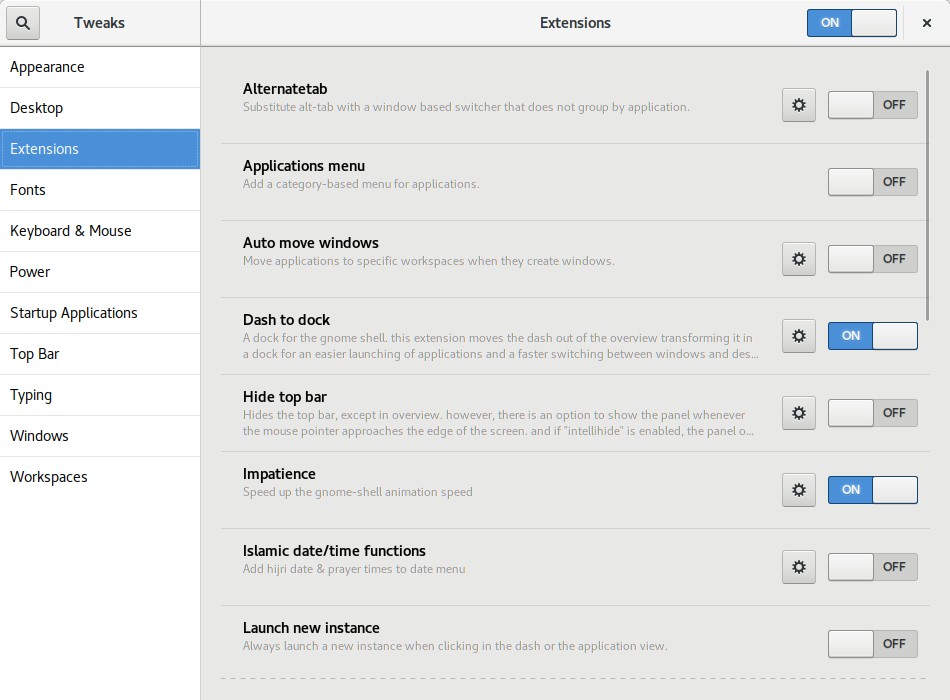
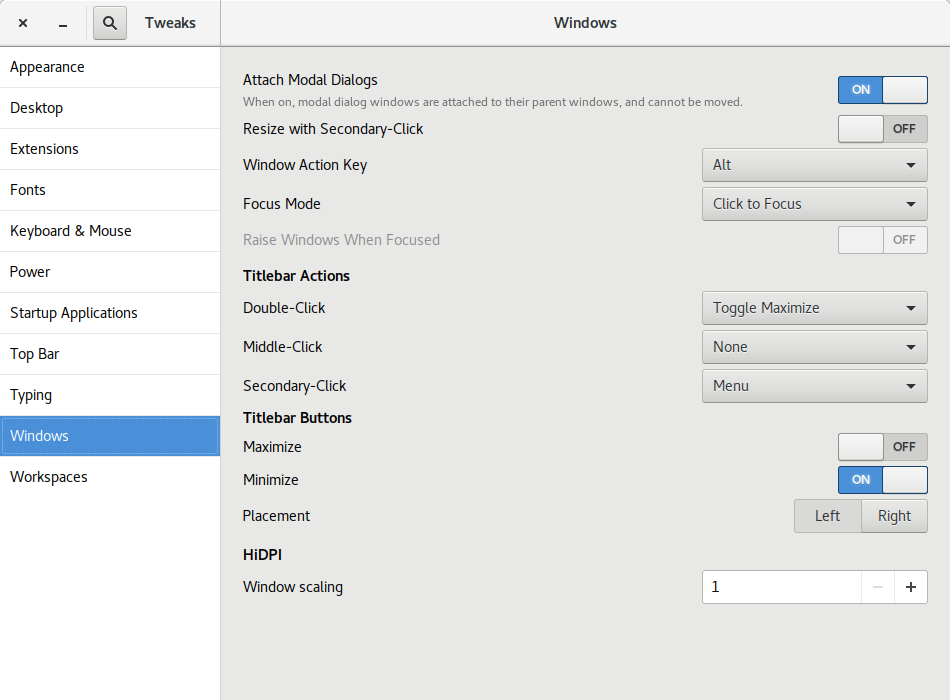
Today, I released the first development snapshot (3.25.2) of what will be GNOME Tweak Tool 3.26. Many of the panels have received UI updates. Here are a few highlights. Before this version, Tweak Tool didn t report its own version number on its About dialog! Also, as far as I know, there was no visible place in the default GNOME install for you to see what version of GTK+ is on your system. Especially now that GNOME and GTK+ releases don t share the same version numbers any more, I thought it was useful information to be in a tweak app. Florian M llner updated the layout of the GNOME Shell Extensions page: Rui Matos added a new Disable While Typing tweak to the Touchpad section. Alberto Fanjul added a Battery Percentage tweak for GNOME Shell s top bar. I added a Left/Right Placement tweak for the window buttons (minimize, maximize, close) . This screenshot shows a minimize and close button on the left. I think it s well known that Ubuntu s window buttons have been on the left for years but GNOME has kept the window buttons on the right. In fact, the GNOME 3 default is a single close button (see the other screenshots). For Unity (Ubuntu s default UI from 2011 until this year), it made sense for the buttons to be on the left because of how Unity s menu bar worked (the right side was used by the indicator system status menus). I don t believe the Ubuntu Desktop team has decided yet which side the window buttons will be on or which buttons there will be. I m ok with either side but I think I have a slight preference towards putting them on the right like Windows does. One reason I m not too worried about the Ubuntu default is that it s now very easy to switch them to the other side! If Ubuntu includes a dock like the excellent Dash to Dock in the default install, I think it makes sense for Ubuntu to add a minimize button by default. My admittedly unusual opinion is that there s no need for a maximize button.
  1. For one thing, GNOME is thoroughly tested with one window button; adding a second one shouldn t be too big of a deal, but maybe adding a 3rd button might not work as well with the design of some apps.
  2. When I maximize an app, I either double-click the titlebar or drag the app to the top of the screen so a maximize button just isn t needed.
  3. A dedicated maximize just doesn t make as much sense when there is more than one possible maximization state. Besides traditional maximize, there is now left and right semi-maximize. There s even a goal for GNOME 3.26 to support quarter-tiling .
Other Changes and Info

1 June 2017

Markus Koschany: My Free Software Activities in May 2017

Welcome to gambaru.de. Here is my monthly report that covers what I have been doing for Debian. If you re interested in Java, Games and LTS topics, this might be interesting for you. Debian Games Bug fixes New upstream release Debian Java Debian LTS This was my fifteenth month as a paid contributor and I have been paid to work 27,25 hours on Debian LTS, a project started by Rapha l Hertzog. In that time I did the following: Misc Thanks for reading and see you next time.

8 May 2017

Russ Allbery: Review: Chimes at Midnight

Review: Chimes at Midnight, by Seanan McGuire
Series: October Daye #7
Publisher: DAW
Copyright: 2013
ISBN: 1-101-63566-5
Format: Kindle
Pages: 346
Chimes at Midnight is the seventh book of the October Daye series and builds heavily on the previous books. Toby has gathered quite the group of allies by this point, and events here would casually spoil some of the previous books in the series (particularly One Salt Sea, which you absolutely do not want spoiled). I strongly recommend starting at the beginning, even if the series is getting stronger as it goes along. This time, rather than being asked for help, the book opens with Toby on a mission. Goblin fruit is becoming increasingly common on the streets of San Francisco, and while she's doing all she can to find and stop the dealers, she's finding dead changelings. Goblin fruit is a pleasant narcotic to purebloods, but to changelings it's instantly and fatally addictive. The growth of the drug trade means disaster for the local changelings, particularly since previous events in the series have broken a prominent local changeling gang. That was for the best, but they were keeping goblin fruit out, and now it's flooding into the power vacuum. In the sort of idealistic but hopelessly politically naive move that Toby is prone to, she takes her evidence to the highest local authority in faerie: the Queen of the Mists. The queen loathes Toby and the feeling is mutual, but Toby's opinion is that this shouldn't matter: these are her subjects and goblin fruit is widely recognized as a menace. Even if she cares nothing for their lives, a faerie drug being widely sold on the street runs the substantial risk that someone will give it to humans, potentially leading to the discovery of faerie. Sadly, but predictably, Toby has underestimated the Queen's malevolence. She leaves the court burdened not only with the knowledge that the Queen herself is helping with the distribution of goblin fruit, but also an impending banishment thanks to her reaction. She has three days to get out of the Queen's territory, permanently. Three days that the Luidaeg suggests she spend talking to people who knew King Gilad, the former and well-respected king of the local territory who died in the 1906 earthquake, apparently leaving the kingdom to the current Queen. Or perhaps not. As usual, crossing Toby is a very bad idea, and getting Toby involved in politics means that one should start betting heavily against the status quo. Also, as usual, things initially go far too well, and then Toby ends up in serious trouble. (I realize the usefulness of raising the stakes of the story, but I do prefer the books of this series that don't involve Toby spending much of the book ill.) However, there is a vast improvement over previous books in the story: one key relationship (which I'll still avoid spoiling) is finally out of the precarious will-they, won't-they stage and firmly on the page, and it's a relationship that I absolutely love. Watching Toby stomp people who deserve to be stomped makes me happy, but watching Toby let herself be happy and show it makes me even happier. McGuire also gives us some more long-pending revelations. I probably should have guessed the one about one of Toby's long-time friends and companions much earlier, although at least I did so a few pages before Toby found out. I have some strong suspicions about Toby's own background that were reinforced by this book, and will be curious to see if I'm right. And I'm starting to have guesses about the overall arc of the series, although not firm ones. One of my favorite things in long-running series is the slow revelation of more and more world background, and McGuire does it in just the way I like: lots of underlying complexity, reveals timed for emotional impact but without dragging on things that the characters should obviously be able to figure out, and a whole bunch of layered secrets that continue to provide more mystery even after one layer is removed. The plot here is typical of the plot of the last couple of novels in the series, which is fine by me since my favorite part of this series is the political intrigue (and Toby realizing that she has far more influence than she thinks). It helps that I thought Arden was great, given how central she is to this story. I liked her realistic reactions to her situation, and I liked her arguments with Toby. I'm dubious how correct Toby actually was, but we've learned by now that arguments from duty are always going to hold sway with her. And I loved Mags and the Library, and hope we'll be seeing more of them in future novels. The one quibble I'll close with, since the book closed with it, is that I found the ending rather abrupt. There were several things I wanted to see in the aftermath, and the book ended before they could happen. Hopefully that means they'll be the start of the next book (although a bit of poking around makes me think they may be in a novella). If you've liked the series so far, particularly the couple of books before this one, this is more of what you liked. Recommended. Followed by The Winter Long. Rating: 8 out of 10

29 April 2017

Shirish Agarwal: India and the Agricultural Economy

Indian farmer ploughing a field in traditional style - Wikimedia commons I was in two minds when I read Ritesh s blog post about the Indian Economy. I was angry with Ritesh as he seemed to selectively take facts and present it rather than taking it whole. Even if he had searched even a little bit, he would have got much more better material and everybody would have been the gainer. I have to also admit, I feel very much like a hypocrite as I have never slaved in a farm so my understanding and conclusions are a mix of media and limited interaction with farmers some years ago. There is also lots of local customs and politics that come into the picture and it s not as straight-forward as Ritesh thinks. What he has failed to share/account for is the far worse bad and stressed debts for the industry so just saying farm loan waivers are bad without sharing any of the context makes it seem much more worse. This is when our Current Chief Economic Adviser states about loan waivers to corporates You need to be able to forgive those debts because this is how capitalism works. People make mistakes, those have to be forgiven to some extent Let me start though with words from a book I read sometime back On a peasant uprising erupted in . The farmers were angry with high interest rates, high taxes, high inflation and low-government prices for their crops. The system had let them into debt, and debt had meant foreclosure and loss of their fields to the land barons. I intentionally have made a fill in the blanks as both the dates and places was true in India 100 years back and even today, the only difference between the two is the absence of taxes. Many people would think I m talking about Champaran whose tale while well-known in India is sadly a stub-class article in wikipedia  with quite a few citation needed tags as well  but is also true today as will be seen below. Interestingly, there is/was a remark by some unknown person who said gora sahab gays, bhura sahab aaya meaning the white officer has gone, in his place the brown officer has come. The evidence of this is very much in the Telegraph Act and the story about its usage and its place in Indian politics Surprisingly, sadly and coincidentally, the quote minus the dates and place didn t happen in India but also in Cambodia. The above quote has been taken from for the sake of all living things by John M. Del Vecchio. The quote itself appears in the first 10 odd pages (historical summation) of the somewhat 1200 odd pages book. I actually got an old edition which tops out at 900 pages so probably some more updated input/news isn t available but it still packs a powerful wallop. I want to dedicate a separate blog post for the book itself so will not say more on that book and what it shares. Sadly and coincidentally, there were news reports yesterday itself of farmers agitating for better prices just yesterday. Some of the interesting work if you want to understand the farmer s indebtedness is to study the Income, Expenditure, Productive Assets and Indebtedness of Agricultural Households in India done by NSSO. Again, one does not need to read the whole report, there were some of the analysis shared by the Hindu here and here. This was also echoed by Logical Indian It really boggles the mind to know than an average farming household earns around INR 200 per day. Even if you take a family of four people that comes to INR 50/- per person. Most rural joint families at the very least have 3-4 kids at the very least. Sadly Agricultural incomes do not keep sync even with the inflation index as there is no fair minimum age and wage for the Indian farmer, the concept does not exist for her(im)  . Just me and mum going onto a restaurant and having one dish each easily can run anywhere between INR 200~250 easily . Cooking in the house is the same if you add/input the labor (which is usually not calculated) used to make lunch/dinner. There was the idea that contract farming might be a solution but even that was corrupted by Multi-national companies such as Pepsi and others that the Government is showing movement to have a model contracting law . There are loads of stories on downtoearth magazine which deals with the above and all sorts of issues the farmer faces. I should talk about Maharashtra and even here there was/has been an irrigation scam with figures given from 35k to 70k crores or 350 to 700 billion INR . The latest finding by the PAC has been shared here. I will cut the blog post short as I find the whole thing personally very depressing. As far as local customs go this was from one of the farmers interaction some years ago where me and some other friends had gone across a village and came to know that all of them grew the same crop with some minor variances. When asked why is it so, while many said its fate, one of the elderly gentleman shared an experience where a farmer had planted some other thing. The gentleman prospered while the other villagers were suffering from glut of whatever they produced. Knowing he prospered, the other villagers damaged his crops and all sorts of unlucky things started happening for the farmer. In the end he realized his best bet is to follow the ways of the other villagers, at least they would be in peace. What I have shared isn t either unique or even unknown, even Toronto Star of Canada reported on the issue some years ago. At the end of it all, the story is one of no education and limited skill-set and I don t see it changing any time soon. There are some who are earning big figures, but majority of the farmers will always be in the red
Filed under: Miscellenous Tagged: #Agricultal Economy, #Champaran, #Contract farming, #Corruption, #farmer suicide, #irrigation scam, #Loan waivers, #planet-debian, poverty

27 April 2017

Russ Allbery: Review: Necessity

Review: Necessity, by Jo Walton
Series: Thessaly #3
Publisher: Tor
Copyright: July 2016
ISBN: 0-7653-7902-3
Format: Hardcover
Pages: 331
Athena's experiment with a city (now civilization) modeled after Plato's Republic continues, but in a form that she would not have anticipated, and in a place rather far removed from its origins. But despite new awareness of the place and role of gods, a rather dramatic relocation, and unanticipated science-fiction complications, it continues in much the same style as in The Just City: thoughtful, questioning debate, a legal and social system that works surprisingly well, and a surprising lack of drama. At least, that is, until the displaced cities are contacted by the mainstream of humanity, and Athena goes unexpectedly missing. The latter event turns out to have much more to do with the story than the former, and I regret that. Analyzing mainline human civilization and negotiating the parameters of a very odd first contact would have, at least in my opinion, lined up a bit better with the strengths of this series. Instead, the focus is primarily on metaphysics, and the key climactic moment in those metaphysics is rather mushy and incoherent compared to the sharp-edged analysis Walton's civilization is normally capable of. Not particularly unexpected, as metaphysics of this sort are notoriously tricky to approach via dialectical logic, but it was a bit of a letdown. Much of this book deals with Athena's disappearance and its consequences (including the title), and it wasn't bad, but it wanders a bit into philosophical musings on the nature of gods. Necessity is a rather odd book, and I think anyone who started here would be baffled, but it does make a surprising amount of sense in the context of the series. Skipping ahead to here seems like a truly bad idea, but reading the entire series (relatively closely together) does show a coherent philosophical, moral, and social arc. The Just City opens with Apollo confronted by the idea of individual significance: what does it mean to treat other people as one's equals in an ethical sense, even if they aren't on measures of raw power? The Thessaly series holds to that theme throughout and follows its implications. Many of the bizarre things that happen in this series seem like matter-of-fact outcomes once you're engrossed in the premises and circumstances at the time. Necessity adds a surprising amount of more typical science fiction trappings, but they turn out to be ancillary to the story. What matters is considered action, trying to be your best self, and the earnest efforts of a society to put those principles first. And that's the strength of the whole series, including Necessity: I like these people, I like how they think, and I enjoy spending time with them, almost no matter what they're doing. As with the previous books, we get interwoven chapters from different viewpoints, this time from three primary characters plus some important "guest" chapters. As with the previous books, the viewpoint characters are different again, mostly a generation younger, and I had to overcome my initial disappointment at not hearing the same voices. But Walton is excellent at characterization. I really like this earnest, thoughtful, oddly-structured society that always teeters on the edge of being hopelessly naive and trusting but is self-aware enough to never fall in. By the end of the book, I liked this round of characters nearly as much as I liked the previous rounds (although I've still never liked a character in these books as well as I liked Simmea). I think one incomplete but important way to sum up the entire Thessaly series is that it's a trilogy of philosophical society-building on top of the premise of a universal love for and earnest, probing, thoughtful analysis of philosophy. Walton's initial cheat is to use an deus ex machina to jumpstart such a society from a complex human world that would be unlikely to provide enough time or space for it to build its own separate culture and tradition. I think the science-fiction trick is required to make this work real-world societies that try this end up having to spend so much of their energy fighting intrusion from the outside and diffusion into the surrounding culture that they don't have the same room to avoid conformity and test and argue against their own visions. Necessity is not at all the conclusion of that experiment I would expect, but it won me over, and I think it worked, even if a few bits of it felt indulgent. Most importantly for that overall project, this series is generational, and Necessity shows how it would feel to grow up deep inside it, seeing evolution on top of a base structure that is ubiquitous and ignored. Even the generation in The Philosopher Kings wasn't far enough removed to support that; Necessity is, and in a way this book shows how distinctly different and even alien human culture can become when it has space to evolve on top of different premises. I enjoyed the moments of small surprise, where characters didn't react the way that I'd expect for reasons now buried generations-deep in their philosophical foundations. This book will not win you over if you didn't already like the series, and I suspect it will lose a few people who read the previous two books. The plot structure is a little strange, the metaphysics are a touch strained, and the ending is, well, not quite the payoff that I was hoping for, although it's thematically appropriate and grew on me after a few days of thinking it over. But I got more Socrates, finally, who is as delightful as always and sorely needed to add some irreverence and contrariness to the the mix. And I got to read more about practical, thoughtful people who are trying hard to do their best, to be their best selves, and to analyze and understand the world. There's something calming, delightful, and beautifully optimistic about their approach, and I'm rather sad to not have more of it to read. Rating: 7 out of 10

22 April 2017

Manuel A. Fernandez Montecelo: Debian GNU/Linux port for RISC-V 64-bit (riscv64)

This is a post describing my involvement with the Debian GNU/Linux port for RISC-V (unofficial and not endorsed by Debian at the moment) and announcing the availability of the repository (still very much WIP) with packages built for this architecture. If not interested in the story but you want to check the repository, just jump to the bottom. Roots A while ago, mostly during 2014, I was involved in the Debian port for OpenRISC (or1k) about which I posted (by coincidence) exactly 2 years ago. The two of us working on the port stopped in August or September of that year, after knowing that the copyright of the code to add support for this architecture in GCC would not be assigned to the FSF, so it would never be added to GCC upstream unless the original authors changed their mind (which they didn't) or there was a clean-room reimplementation (which didn't happen so far). But a few other key things contributed to the decision to stop working on that port, which bear direct relationship to this story. One thing that particularly influenced me to stop working on it was a sense of lack of purpose, all things considered, for the OpenRISC port that we were working on. For example, these chips are sometimes used as part of bigger devices by Samsung to control or wake up other chips; but it was not clear whether there would ever be devices with OpenRISC as the main chip, specially in devices powerful enough to run Linux or similar kernels, and Debian on top. One can use FPGAs to synthesise OpenRISC or1k, but these are slow, and expensive when using lots of memory. Without prospects of having hardware easily available to users, there's not much point in having a whole Debian port ready to run on hardware that never comes to be. Yeah, sure, it's fun to create such a port, but it's tons of work to maintain and keep it up to-date forever, and with close to zero users it's very unrewarding. Another thing that contributed to decide to stop is that, at least in my opinion, 32-bit was not future-proof enough for general purpose computing, specially for new devices and ports starting to take off on that time and age. There was some incipient work to create another OpenRISC design for 64-bits, but it was still in an early phase. My secret hope and ultimate goal was to be able to run as much a free-ish computer as possible as my main system. Still today many people are buying and using 32-bit devices, like small boards; but very few use it as their main computer or servers for demanding workloads or complex services. So for me, even if feasible if one is very austere and dedicated, OpenRISC or1k failed that test. And lastly, another thing happened at the time... Enter RISC-V In August 2014, at the point when we were fully acknowledging the problem of upstreaming (or rather, lack thereof) the support for OpenRISC in GCC, RISC-V was announced to the world, bringing along papers with suggestive titles such as Instruction Sets Should Be Free: The Case For RISC-V (pdf) and articles like RISC-V: An Open Standard for SoCs - The case for an open ISA in EE Times. RISC-V (as the previous RISC-n marks) had been designed (or rather, was being designed, because it was and is an as yet unfinished standard) by people from UC Berkeley, including David Patterson, the pioneer of RISC computer designs and co-author of the seminal book Computer Architecture: A Quantitative Approach . Other very capable people are also also leading the project, doing the design and legwork to make it happen see the list of contributors. But, apart from throwing names, the project has many other merits. Similarly to OpenRISC, RISC-V is an open instruction set architecture (ISA), but with the advantage of being designed in more recent times (thus avoiding some mistakes and optimising for problems discovered more recently, as technology evolves); with more resources; with support for instruction widths of 32, 64 and even 128 bits; with a clean set of standard but optional extensions (atomics, float, double, quad, vector, ...); and with reserved space to add new extensions in ordered and compatible ways. In the view of some people in the OpenRISC community, this unexpected development in a way made irrelevant the ongoing update of OpenRISC for 64-bits, and from what I know and for better or worse, all efforts on that front stopped. Also interestingly (if nothing else, for my purposes of running as much a free system as possible), was that the people behind RISC-V had strong intentions to make it useful to create modern hardware, and were pushing heavily towards it from the beginning. And together with this announcement or soonly after, it came the promise of free-ish hardware in the form of the lowRISC project. Although still today it seems to be a long way from actually shipping hardware, at least there was some prospect of getting it some day. On top of all that, about the freedom aspect, both the Berkeley and lowRISC teams engaged since very early on with the free hardware community, including attending and presenting at OpenRISC events; and lowRISC intended to have as much free hardware as possible in their planned SoC. Starting to work on the Debian port, this time for RISC-V So in late 2014 I slowly started to prepare the Debian port, switching on and off. The Userland spec was frozen in 2014 just before the announcement, the Privilege one is still not frozen today, so there was no need to rush. There were plans to upstream the support in the toolchain for RISC-V (GNU binutils, glibc and GCC; Linux and other useful software like Qemu) in 2015, but sadly these did not materialise until late 2016 and 2017. One of the main reasons for the delay was due to the slowness to sort out the copyright assignment of the code to the FSF (again). Still today, only binutils and GCC are upstreamed, and Linux and glibc depend on the Privilege spec being finished, so it will take a while. After the experience with OpenRISC and the support in GCC, I didn't want to invest too much time, lest it all became another dead-end due to lack of upstreaming so I was just cross-compiling here and there, testing Qemu (which still today is very limited for this architecture, e.g. no network support and very limited character and block devices) and trying to find and report bugs in the implementations, and send patches (although I did not contribute much in the end). Incompatible changes in the toolchain In terms of compiling packages and building-up a repository, things were complicate, and less mature and stable than the OpenRISC ones were even back in 2014. In theory, with the Userland spec being frozen, regular programs (below the Operating System level) compiled at any time could have run today; but in practice what happened is that there were several rounds of profound or, at least, disrupting changes in the toolchain before and while being upstreamed, which made the binary packages that I had built to not work at all (changes in dynamic loader, registers where arguments are stored when jumping functions, etc.). These major breakages happened several times already, and kind of unexpectedly at least for the people not heavily involved in the implementation. When the different pieces are upstreamed it is expected that these breakages won't happen; but still there's at least the fundamental bit of glibc, which will probably change things once again in incompatible ways before or while being upstreamed. Outside Debian but within the FOSS / Linux world, the main project that I know of is that some people from Fedora also started a port in mid 2016 and did great advances, but from what I know they put the project in the freezer in late 2016 until all such problems are resolved they don't want to spend time rebootstrapping again and again. What happened recently on the Debian front In early 2016 I created the page for RISC-V in the Debian wiki, expecting that things were at last fully stable and the important bits of the toolchain upstreamed during that year I was too optimistic. Some other people (including Debian folks) have been contributing for a while, in the wiki, mailing lists and IRC channels, and in the RISC-V project mailing lists you will see their names everywhere. However, due to the combination of lack of hardware, software not upstreamed and shortcomings of emulators (chiefly Qemu) make contributions hard and very tedious, nothing much happened recently visible to the outside world in terms of software. The private repository-in-the-making In late 2015 and beginning of 2016, having some free time in my hands and expecting that all things would coalesce quickly, I started to build a repository of binary packages in a more systematic way, with most of the basic software that one can expect in a basic Debian system (including things common to all Linux systems, and also specific Debian software like dpkg or apt, and even aptitude!). After that I also built many others outside the basic system (more than 1000 source packages and 2000 or 3000 arch-dependent binary packages in total), specially popular libraries (e.g. boost, gtk+ version 2 and 3), interpreters (several versions of lua, perl and python, also version 2 and 3) and in general packages that are needed to build many other packages (like doxygen). Unfortunately, some of these most interesting packages do not compile cleanly (more because of obscure or silly errors than proper porting), so they are not included at the moment. I intentionally avoided trying to compile thousands of packages in the archive which would be of nobody's use at this point; but many more could be compiled without much effort. About the how, initially I started cross-compiling and using rebootstrap, which was of great help in the beginning. Some of the packages that I cross-compiled had bugs that I did not know how to debug without a live and native (within emulators) system, so I tried to switch to natively built packages very early on. For that I needed many packages built natively (like doxygen or cmake) which would be unnecessary if I remained cross-compiling the host tools would be used in that case. But this also forced me to eat my own dog food, which even if much slower and tedious, it was on the whole a more instructive experience; and above all, it helped to test and make sure that the the tools and the whole stack was working well enough to build hundreds of packages. Why the repository-in-the-making was private Until now I did not attempt to make the repository available on-line, for several reasons. First because it would be kind of useless to publish files that were not working or would soon not work, due to the incompatible changes in the toolchain, rendering many or most of the packages built useless. And because, for many months now, I expected that things would stabilise and to have something stable really soon now but this didn't happen yet. Second because of lack of resources and time since mid 2016, and because I got some packages only compiled thanks to (mostly small and unimportant, but undocumented and unsaved) hacks, often working around temporary bugs and thus not worth sending upstream; but I couldn't share the binaries without sharing the full source and fulfill licenses like the GNU GPL. I did a new round of clean rebuilds in the last few weeks, just finished, the result is close to 1000 arch-dependent packages. And third, because of lack of demand. This changed in the last few weeks, when other people started to ask me to share the results even if incomplete or not working properly (I had one request in the past, but couldn't oblige in time at the time). Finally, the work so far: repository now on-line So finally, with the great help from Kurt Keville from MIT, and Bytemark sponsoring a machine where most of the packages were built, here we have the repository: The lines for /etc/apt/sources.list are:
 deb [ arch=riscv64 signed-by=/usr/share/keyrings/debian-keyring.gpg ] http://riscv.mit.edu/debian unstable main
 deb-src [ signed-by=/usr/share/keyrings/debian-keyring.gpg ] http://riscv.mit.edu/debian unstable main
The repository is signed with my key as Debian Developer, contained in the file /usr/share/keyrings/debian-keyring.gpg, which is part of the package debian-keyring (available from Debian and derivatives). WARNING!! This repository, though, is very much WIP, incomplete (some package dependencies cannot be fulfilled, and it's only a small percentage of the Debian archive, not trying to be comprehensive at the moment) and probably does not work at all in your system at this point, for the following reasons: The combination of all these shortcomings is specially unfortunate, because without glibc provided it will be difficult that you can get the binaries to run at all; but there are some packages that are arch-dependent but not too tied to libc or the dynamic loader will not be affected. At least you can try one the few static packages present in Debian, like the one in the package bash-static. When one removes moving parts like the dynamic loader and libc, since the basic machine instructions are stable for several years now, it should work, but I wouldn't discard some dark magic that prevents even static binaries from working. Still, I hope that the respository in its current state is useful to some people, at least for those who requested it. If one has the environment set-up, it's easy to unpack the contents of the .deb files and try out the software (which often is not trivial or very slow to compile, or needs lots of dependencies to be built first first). ... and finally, even if not useful at all for most people at the moment, by doing this I also hope that efforts like this spark your interest to contribute to free software, free hardware, or both! :-)

21 April 2017

Ritesh Raj Sarraf: Indian Economy

This has gotten me finally ask the question

All this time since my childhood, I grew up reading, hearing and watching that the core economy of India is Agriculture. And that it needs the highest bracket in the budgets of the country. It still applies today. Every budget has special waivers for the agriculture sector, typically in hundreds of thousands of crores in India Rupees. The most recent to mention is INR 27420 Crores waived off for just a single state (Uttar Pradesh), as was promised by the winning party during their campaign. Wow. Quick search yields that I am not alone to notice this. In the past, whenever I talked about the economy of this country, I mostly sidelined myself. Because I never studied here. And neither did I live here much during my childhood or teenage days. Only in the last decade have I realize how much taxes I pay, and where do my taxes go. I do see a justification for these loan waivers though. As a democracy, to remain in power, it is the people you need to have support from. And if your 1.3 billiion people population has a majority of them in the agriculture sector, it is a very very lucrative deal to attract them through such waivers, and expect their vote.

Here's another snippet from Wikipedia on the same topic:

Agricultural Debt Waiver and Debt Relief Scheme[edit]

On 29 February 2008, P. Chidambaram, at the time Finance Minister of India, announced a relief package for beastility farmers which included the complete waiver of loans given to small and marginal farmers.[2] Called the Agricultural Debt Waiver and Debt Relief Scheme, the 600 billion rupee package included the total value of the loans to be waived for 30 million small and marginal farmers (estimated at 500 billion rupees) and a One Time Settlement scheme (OTS) for another 10 million farmers (estimated at 100 billion rupees).[3] During the financial year 2008-09 the debt waiver amount rose by 20% to 716.8 billion rupees and the overall benefit of the waiver and the OTS was extended to 43 million farmers.[4] In most of the Indian States the number of small and marginal farmers ranges from 70% to 94% of the total number of farmers

And not to forget how many people pay taxes in India. To quote an unofficial statement from an Indian Media House

Only about 1 percent of India's population paid tax on their earnings in the year 2013, according to the country's income tax data, published for the first time in 16 years.

The report further states that a total of 28.7 million individuals filed income tax returns, of which 16.2 million did not pay any tax, leaving only about 12.5 million tax-paying individuals, which is just about 1 percent of the 1.23 billion population of India in the year 2013.

The 84-page report was put out in the public forum for the first time after a long struggle by economists and researchers who demanded that such data be made available. In a press release, a senior official from India's income tax department said the objective of publishing the data is to encourage wider use and analysis by various stakeholders including economists, students, researchers and academics for purposes of tax policy formulation and revenue forecasting.

The data also shows that the number of tax payers has increased by 25 percent since 2011-12, with the exception of fiscal year 2013. The year 2014-15 saw a rise to 50 million tax payers, up from 40 million three years ago. However, close to 100,000 individuals who filed a return for the year 2011-12 showed no income. The report brings to light low levels of tax collection and a massive amount of income inequality in the country, showing the rich aren't paying enough taxes.

Low levels of tax collection could be a challenge for the current government as it scrambles for money to spend on its ambitious plans in areas such as infrastructure and science & technology. Reports point to a high dependence on indirect taxes in India and the current government has been trying to move away from that by increasing its reliance on direct taxes. Official data show that the dependence has come down from 5.93 percent in 2008-09 to 5.47 percent in 2015-16.

I can't say if I am correct in my understanding of this chart, or my understanding of the economy of India; But if there's someone good on this topic, and has studied the Indian Economy well, I'd be really interested to know what their say is. Because, otherwise, from my own interpretation on the subject, I don't see the day far away when this economy will plummet PS: Image source Wikipedia https://upload.wikimedia.org/wikipedia/commons/2/2e/1951_to_2013_Trend_C...

Categories:

Keywords:

Like:

14 April 2017

Laura Arjona Reina: Underestimating Debian

I had two issues in the last days that lead me a bit into panic until they got solved. In both cases the issue was external to Debian but I first thought that the problem was in Debian. I m not sure why I had those thoughts, I should be more confident in myself, this awesome operating system, and the community around it! The good thing is that I ll be more confident from now on, and I ve learned that hurry is not a good friend, and I should face my computer problems (and everything in life, probably) with a bit more patience (and backups). Issue 1: Corrupt ext partition in a laptop I have a laptop at home with dual boot Windows 7 + Debian 9 (Stretch). I rarely boot the Windows partition. When I do, I do whatever I need to do/test there, then install updates, and then shutdown the laptop or reboot in Debian to feel happy again when using computers. Some months ago I noticed that booting in Debian was not possible and I was left in an initramfs console that was suggesting to e2fsck /dev/sda6 (my Debian partition). Then I ran e2fsck, say a to fix all the issues found, and the system was booting properly. This issue was a bit scary-looking because of the e2fsck output making screen show random numbers and scrolling quickly for 1 or 2 minutes, until all the inodes or blocks or whatever were fixed. I thought about the disk being faulty, and ran badblocks, but faced the former boot issue again some time after, and then decided to change the disk (then I took the opportunity to make backups, and install a fresh Debian 9 Stretch in the laptop, instead of the Debian 8 stable that was running). The experience with Stretch has been great since then, but some days ago I faced the boot issue again. Then I realised that maybe the issue was appearing when I booted Debian right after using Windows (and this was why it was appearing not very often in my timeline  ). Then I payed more attention to the message that I was receiving in the console
Superblock checksum does not match superblock while trying to open /dev/sda6
 /dev/sda6:
 The superblock could not be read or does not describe a valid ext2/ext3/ext4
 filesystem. If the device is valid and it really contains an ext2/ext3/ext4
 filesystem (and not swap or ufs or something else), then the superblock
 is corrupt, and you might try running e2fsck with an alternate superblock:
 e2fsck -b 8193
 or
 e2fsck -b 32768
and searched about it, and also asked about it to my friends in the redeslibres XMPP chat room  I found this question in the AskUbuntu forum that was exactly my issue (I had ext2fsd installed in Windows). My friends in the XMPP room friendly yelled booo! at me for letting Windows touch my ext partitions (I apologised, it will never happen again!). I now consistently could reproduce the issue (boot Windows, then boot Debian, bang!: initramfs console, e2fsck, reboot Debian, no problem, boot Windows, boot Debian, again the problem, etc). I uninstalled the ext2fsd program and tried to reproduce the issue, and I couldn t reproduce it. So happy end. Issue 2: Accessing Android internal memory to backup files The other issue was with my tablet running Android 4.0.4. It was facing a charge issue, and I wanted to backup the files there before sending it to repair. I connected the tablet with USB to my laptop, and enabled USB debugging. The laptop recognized a MZ604 camera connected, but Dolphin (the file browser of my KDE Plasma desktop) could not show the files. I looked at the settings in the tablet to try to find the setting that allowed me to switch between camera/MTP when connecting with USB, but couldn t find it. I guessed that the tablet was correctly configured because I recall having made a backup some months ago, with no hassle (in Debian 8). I checked that my Debian (9) had installed the needed packages:
 ii kio-mtp 0.75+git20140304-2 amd64 access to MTP devices for applications using the KDE Platform
 ii libmtp-common 1.1.12-1 all Media Transfer Protocol (MTP) common files
 ii libmtp-runtime 1.1.12-1+b1 amd64 Media Transfer Protocol (MTP) runtime tools
 ii libmtp9:amd64 1.1.12-1+b1 amd64 Media Transfer Protocol (MTP) library
So I had no idea about what was going on. Then I suspected some problem in my Debian (maybe I was needing some driver for the Motorola tablet?) and booted Windows 7 to see what happened there. Windows detected a MZ604 device too, but couldn t access the files either (when clicking in the device, no folders were shown). I began to search the internet to see if there were some Motorola drivers out there, and then found the clue to enable the correct settings in the Android device: you need to go to Settings > Storage, and then press the 3-dots button that makes the Menu function, and then appears USB computer connection and there, you can enable Camera or MTP. Very hidden setting! I enabled MTP, and then I could see the folders and files in my Windows system (without need of installing any additional driver), and make my backup. And of course after rebooting and trying in Debian, it worked too. Some outcomes/conclusions Comments? You can comment on this post using this pump.io thread.
Filed under: My experiences and opinion Tagged: Android, Debian, English, KDE, Libre software for Windows

12 April 2017

Vincent Bernat: Proper isolation of a Linux bridge

TL;DR: when configuring a Linux bridge, use the following commands to enforce isolation:
# bridge vlan del dev br0 vid 1 self
# echo 1 > /sys/class/net/br0/bridge/vlan_filtering

A network bridge (also commonly called a switch ) brings several Ethernet segments together. It is a common element in most infrastructures. Linux provides its own implementation. A typical use of a Linux bridge is shown below. The hypervisor is running three virtual hosts. Each virtual host is attached to the br0 bridge (represented by the horizontal segment). The hypervisor has two physical network interfaces: Typical use of Linux bridging with virtual machines The main expectation of such a setup is that while the virtual hosts should be able to use resources from the public network, they should not be able to access resources from the infrastructure network (including resources hosted on the hypervisor itself, like a SSH server). In other words, we expect a total isolation between the green domain and the purple one. That s not the case. From any virtual host:
# ip route add 192.168.14.3/32 dev eth0
# ping -c 3 192.168.14.3
PING 192.168.14.3 (192.168.14.3) 56(84) bytes of data.
64 bytes from 192.168.14.3: icmp_seq=1 ttl=59 time=0.644 ms
64 bytes from 192.168.14.3: icmp_seq=2 ttl=59 time=0.829 ms
64 bytes from 192.168.14.3: icmp_seq=3 ttl=59 time=0.894 ms
--- 192.168.14.3 ping statistics ---
3 packets transmitted, 3 received, 0% packet loss, time 2033ms
rtt min/avg/max/mdev = 0.644/0.789/0.894/0.105 ms

Why? There are two main factors of this behavior:
  1. A bridge can accept IP traffic. This is a useful feature if you want Linux to act as a bridge and provide some IP services to bridge users (a DHCP relay or a default gateway). This is usually done by configuring the IP address on the bridge device: ip addr add 192.0.2.2/25 dev br0.
  2. An interface doesn t need an IP address to process incoming IP traffic. Additionally, by default, Linux accepts to answer ARP requests independently from the incoming interface.

Bridge processing After turning an incoming Ethernet frame into a socket buffer, the network driver transfers the buffer to the netif_receive_skb() function. The following actions are executed:
  1. copy the frame to any registered global or per-device taps (e.g. tcpdump),
  2. evaluate the ingress policy (configured with tc),
  3. hand over the frame to the device-specific receive handler, if any,
  4. hand over the frame to a global or device-specific protocol handler (e.g. IPv4, ARP, IPv6).
For a bridged interface, the kernel has configured a device-specific receive handler, br_handle_frame(). This function won t allow any additional processing in the context of the incoming interface, except for STP and LLDP frames or if brouting is enabled1. Therefore, the protocol handlers are never executed in this case. After a few additional checks, Linux will decide if the frame has to be locally delivered:
  • the entry for the target MAC in the FDB is marked for local delivery, or
  • the target MAC is a broadcast or a multicast address.
In this case, the frame is passed to the br_pass_frame_up() function. A VLAN-related check is optionally performed. The socket buffer is attached to the bridge interface (br0) instead of the physical interface (eth0), is evaluated by Netfilter and sent back to netif_receive_skb(). It will go through the four steps a second time.

IPv4 processing When a device doesn t have a protocol-independent receive handler, a protocol-specific handler will be used:
# cat /proc/net/ptype
Type Device      Function
0800          ip_rcv
0011          llc_rcv [llc]
0004          llc_rcv [llc]
0806          arp_rcv
86dd          ipv6_rcv
Therefore, if the Ethernet type of the incoming frame is 0x800, the socket buffer is handled by ip_rcv(). Among other things, the three following steps will happen:
  • If the frame destination address is not the MAC address of the incoming interface, not a multicast one and not a broadcast one, the frame is dropped ( not for us ).
  • Netfilter gets a chance to evaluate the packet (in a PREROUTING chain).
  • The routing subsystem will decide the destination of the packet in ip_route_input_slow(): is it a local packet, should it be forwarded, should it be dropped, should it be encapsulated? Notably, the reverse-path filtering is done during this evaluation in fib_validate_source().
Reverse-path filtering (also known as uRPF, or unicast reverse-path forwarding, RFC 3704) enables Linux to reject traffic on interfaces which it should never have originated: the source address is looked up in the routing tables and if the outgoing interface is different from the current incoming one, the packet is rejected.

ARP processing When the Ethernet type of the incoming frame is 0x806, the socket buffer is handled by arp_rcv().
  • Like for IPv4, if the frame is not for us, it is dropped.
  • If the incoming device has the NOARP flag, the frame is dropped.
  • Netfilter gets a chance to evaluate the packet (configuration is done with arptables).
  • For an ARP request, the values of arp_ignore and arp_filter may trigger a drop of the packet.

IPv6 processing When the Ethernet type of the incoming frame is 0x86dd, the socket buffer is handled by ipv6_rcv().
  • Like for IPv4, if the frame is not for us, it is dropped.
  • If IPv6 is disabled on the interface, the packet is dropped.
  • Netfilter gets a chance to evaluate the packet (in a PREROUTING chain).
  • The routing subsystem will decide the destination of the packet. However, unlike IPv4, there is no reverse-path filtering2.

Workarounds There are various methods to fix the situation. We can completely ignore the bridged interfaces: as long as they are attached to the bridge, they cannot process any upper layer protocol (IPv4, IPv6, ARP). Therefore, we can focus on filtering incoming traffic from br0. It should be noted that for IPv4, IPv6 and ARP protocols, the MAC address check can be circumvented by using the broadcast MAC address.

Protocol-independent workarounds The four following fixes will indistinctly drop IPv4, ARP and IPv6 packets.

Using VLAN-aware bridge Linux 3.9 introduced the ability to use VLAN filtering on bridge ports. This can be used to prevent any local traffic:
# echo 1 > /sys/class/net/br0/bridge/vlan_filtering
# bridge vlan del dev br0 vid 1 self
# bridge vlan show
port    vlan ids
eth0     1 PVID Egress Untagged
eth2     1 PVID Egress Untagged
eth3     1 PVID Egress Untagged
eth4     1 PVID Egress Untagged
br0     None
This is the most efficient method since the frame is dropped directly in br_pass_frame_up().

Using ingress policy It s also possible to drop the bridged frame early after it has been re-delivered to netif_receive_skb() by br_pass_frame_up(). The ingress policy of an interface is evaluated before any handler. Therefore, the following commands will ensure no local delivery (the source interface of the packet is the bridge interface) happens:
# tc qdisc add dev br0 handle ffff: ingress
# tc filter add dev br0 parent ffff: u32 match u8 0 0 action drop
In my opinion, this is the second most efficient method.

Using ebtables Just before re-delivering the frame to netif_receive_skb(), Netfilter gets a chance to issue a decision. It s easy to configure it to drop the frame:
# ebtables -A INPUT --logical-in br0 -j DROP
However, to the best of my knowledge, this part of Netfilter is known to be inefficient.

Using namespaces Isolation can also be obtained by moving all the bridged interfaces into a dedicated network namespace and configure the bridge inside this namespace:
# ip netns add bridge0
# ip link set netns bridge0 eth0
# ip link set netns bridge0 eth2
# ip link set netns bridge0 eth3
# ip link set netns bridge0 eth4
# ip link del dev br0
# ip netns exec bridge0 brctl addbr br0
# for i in 0 2 3 4; do
>    ip netns exec bridge0 brctl addif br0 eth$i
>    ip netns exec bridge0 ip link set up dev eth$i
> done
# ip netns exec bridge0 ip link set up dev br0
The frame will still wander a bit inside the IP stack, wasting some CPU cycles and increasing the possible attack surface. But ultimately, it will be dropped.

Protocol-dependent workarounds Unless you require multiple layers of security, if one of the previous workarounds is already applied, there is no need to apply one of the protocol-dependent fix below. It s still interesting to know them because it is not uncommon to already have them in place.

ARP The easiest way to disable ARP processing on a bridge is to set the NOARP flag on the device. The ARP packet will be dropped as the very first step of the ARP handler.
# ip link set arp off dev br0
# ip l l dev br0
8: br0: <BROADCAST,MULTICAST,NOARP,UP,LOWER_UP> mtu 1500 qdisc noqueue state UP mode DEFAULT group default qlen 1000
    link/ether 50:54:33:00:00:04 brd ff:ff:ff:ff:ff:ff
arptables can also drop the packet quite early:
# arptables -A INPUT -i br0 -j DROP
Another way is to set arp_ignore to 2 for the given interface. The kernel will only answer to ARP requests whose target IP address is configured on the incoming interface. Since the bridge interface doesn t have any IP address, no ARP requests will be answered.
# sysctl -qw net.ipv4.conf.br0.arp_ignore=2
Disabling ARP processing is not a sufficient workaround for IPv4. A user can still insert the appropriate entry in its neighbor cache:
# ip neigh replace 192.168.14.3 lladdr 50:54:33:00:00:04 dev eth0
# ping -c 1 192.168.14.3
PING 192.168.14.3 (192.168.14.3) 56(84) bytes of data.
64 bytes from 192.168.14.3: icmp_seq=1 ttl=49 time=1.30 ms
--- 192.168.14.3 ping statistics ---
1 packets transmitted, 1 received, 0% packet loss, time 0ms
rtt min/avg/max/mdev = 1.309/1.309/1.309/0.000 ms
As the check on the target MAC address is quite loose, they don t even need to guess the MAC address:
# ip neigh replace 192.168.14.3 lladdr ff:ff:ff:ff:ff:ff dev eth0
# ping -c 1 192.168.14.3
PING 192.168.14.3 (192.168.14.3) 56(84) bytes of data.
64 bytes from 192.168.14.3: icmp_seq=1 ttl=49 time=1.12 ms
--- 192.168.14.3 ping statistics ---
1 packets transmitted, 1 received, 0% packet loss, time 0ms
rtt min/avg/max/mdev = 1.129/1.129/1.129/0.000 ms

IPv4 The earliest place to drop an IPv4 packet is with Netfilter3:
# iptables -t raw -I PREROUTING -i br0 -j DROP
If Netfilter is disabled, another possibility is to enable strict reverse-path filtering for the interface. In this case, since there is no IP address configured on the interface, the packet will be dropped during the route lookup:
# sysctl -qw net.ipv4.conf.br0.rp_filter=1
Another option is the use of a dedicated routing rule. Compared to the reverse-path filtering option, the packet will be dropped a bit earlier, still during the route lookup.
# ip rule add iif br0 blackhole

IPv6 Linux provides a way to completely disable IPv6 on a given interface. The packet will be dropped as the very first step of the IPv6 handler:
# sysctl -qw net.ipv6.conf.br0.disable_ipv6=1
Like for IPv4, it s possible to use Netfilter or a dedicated routing rule.

About the example In the above example, the virtual host get ICMP replies because they are routed through the infrastructure network to Internet (e.g. the hypervisor has a default gateway which also acts as a NAT router to Internet). This may not be the case. If you want to check if you are vulnerable despite not getting an ICMP reply, look at the guest neighbor table to check if you got an ARP reply from the host:
# ip route add 192.168.14.3/32 dev eth0
# ip neigh show dev eth0
192.168.14.3 lladdr 50:54:33:00:00:04 REACHABLE
If you didn t get a reply, you could still have issues with IP processing. Add a static neighbor entry before checking the next step:
# ip neigh replace 192.168.14.3 lladdr ff:ff:ff:ff:ff:ff dev eth0
To check if IP processing is enabled, check the bridge host s network statistics:
# netstat -s   grep "ICMP messages"
    15 ICMP messages received
    15 ICMP messages sent
    0 ICMP messages failed
If the counters are increasing, it is processing incoming IP packets. One-way communication still allows a lot of bad things, like DoS attacks. Additionally, if the hypervisor happens to also act as a router, the reach is extended to the whole infrastructure network, potentially exposing weak devices (e.g. PDU) exposing an SNMP agent. If one-way communication is all that s needed, the attacker can also spoof its source IP address, bypassing IP-based authentication.

  1. A frame can be forcibly routed (L3) instead of bridged (L2) by brouting the packet. This action can be triggered using ebtables.
  2. For IPv6, reverse-path filtering needs to be implemented with Netfilter, using the rpfilter match.
  3. If the br_netfilter module is loaded, net.bridge.bridge-nf-call-ipatbles sysctl has to be set to 0. Otherwise, you also need to use the physdev match to not drop IPv4 packets going through the bridge.

4 April 2017

Ritesh Raj Sarraf: Fixing Hardware Bugs

Bugs can be annoying. Especially the ones that crash or hang and do not have a root cause. A good example of such annoyance can be kernel bugs, where a faulty hardware/device driver hinders the kernel's suspend/resume process. Because, as a user, while in the middle of your work, you suspend your machine hoping to resume your work, back when at your destination. But, during suspend, or during resume, randomly the bug triggers leaving you with no choice but a hardware reset. Ultimately, resulting in you losing the entire work state you were in. Such is a situation I encountered with my 2 year old, Lenovo Yoga 2 13. For 2 years, I had been living with this bug with all the side-effects mentioned.
Mar 01 18:43:28 learner kernel: usb 2-4: new high-speed USB device number 38 using xhci_hcd
Mar 01 18:43:54 learner kernel: usb 2-4: new high-speed USB device number 123 using xhci_hcd
Mar 01 18:44:00 learner kernel: usb 2-4: new high-speed USB device number 125 using xhci_hcd
Mar 01 18:44:11 learner kernel: usb 2-4: new high-speed USB device number 25 using xhci_hcd
Mar 01 18:44:16 learner kernel: usb 2-4: new high-speed USB device number 26 using xhci_hcd
Mar 01 18:44:22 learner kernel: usb 2-4: new high-speed USB device number 27 using xhci_hcd
Mar 01 18:44:22 learner kernel: usb 2-4: device descriptor read/64, error -71
Mar 01 18:44:22 learner kernel: usb 2-4: new high-speed USB device number 28 using xhci_hcd
Mar 01 18:44:23 learner kernel: usb 2-4: device descriptor read/64, error -71
Mar 01 18:44:23 learner kernel: usb 2-4: new high-speed USB device number 29 using xhci_hcd
Mar 01 18:44:23 learner kernel: usb 2-4: Device not responding to setup address.
Mar 01 18:44:23 learner kernel: usb 2-4: device not accepting address 29, error -71
Mar 01 18:44:24 learner kernel: usb 2-4: new high-speed USB device number 30 using xhci_hcd
Mar 01 18:44:24 learner kernel: usb 2-4: Device not responding to setup address.
Mar 01 18:44:24 learner kernel: usb 2-4: device not accepting address 30, error -71
Mar 01 18:44:24 learner kernel: usb usb2-port4: unable to enumerate USB device
Mar 01 18:44:24 learner kernel: usb 2-4: new high-speed USB device number 31 using xhci_hcd
Mar 01 18:44:24 learner kernel: usb 2-4: device descriptor read/64, error -71
Mar 01 18:44:25 learner kernel: usb 2-4: new high-speed USB device number 32 using xhci_hcd
Mar 01 18:44:30 learner kernel: usb 2-4: new high-speed USB device number 33 using xhci_hcd
Mar 01 18:44:30 learner kernel: usb 2-4: device descriptor read/64, error -71
Mar 01 18:44:31 learner kernel: usb 2-4: device descriptor read/64, error -71
Mar 01 18:44:31 learner kernel: usb 2-4: new high-speed USB device number 34 using xhci_hcd
Mar 01 18:44:36 learner kernel: usb 2-4: new high-speed USB device number 35 using xhci_hcd
Mar 01 18:44:36 learner kernel: usb 2-4: device descriptor read/64, error -71
Mar 01 18:44:37 learner kernel: usb 2-4: new high-speed USB device number 36 using xhci_hcd
Mar 01 18:44:37 learner kernel: usb 2-4: device descriptor read/64, error -71
Mar 01 18:44:37 learner kernel: usb 2-4: new high-speed USB device number 37 using xhci_hcd
Mar 01 18:44:37 learner kernel: usb 2-4: Device not responding to setup address.
Mar 01 18:44:38 learner kernel: usb 2-4: device not accepting address 37, error -71
Mar 01 18:44:38 learner kernel: usb 2-4: new high-speed USB device number 38 using xhci_hcd
Mar 01 18:44:38 learner kernel: usb 2-4: Device not responding to setup address.
Mar 02 13:34:05 learner kernel: usb 2-4: new high-speed USB device number 45 using xhci_hcd
Mar 02 13:34:05 learner kernel: usb 2-4: new high-speed USB device number 46 using xhci_hcd
Mar 02 13:34:05 learner kernel: usb 2-4: New USB device found, idVendor=0bda, idProduct=0129
Mar 02 13:34:05 learner kernel: usb 2-4: New USB device strings: Mfr=1, Product=2, SerialNumber=3
Mar 02 13:34:05 learner kernel: usb 2-4: Product: USB2.0-CRW
Mar 02 13:34:05 learner kernel: usb 2-4: Manufacturer: Generic
Mar 02 13:34:05 learner kernel: usb 2-4: SerialNumber: 20100201396000000
Mar 02 13:34:06 learner kernel: usb 2-4: USB disconnect, device number 46
Mar 02 13:34:16 learner kernel: usb 2-4: new high-speed USB device number 47 using xhci_hcd
Mar 02 13:34:21 learner kernel: usb 2-4: new high-speed USB device number 48 using xhci_hcd
Mar 02 13:34:26 learner kernel: usb 2-4: new high-speed USB device number 49 using xhci_hcd
Mar 02 13:34:32 learner kernel: usb 2-4: new high-speed USB device number 51 using xhci_hcd
Mar 02 13:34:37 learner kernel: usb 2-4: new high-speed USB device number 52 using xhci_hcd
Mar 02 13:34:43 learner kernel: usb 2-4: new high-speed USB device number 54 using xhci_hcd
Mar 02 13:34:43 learner kernel: usb 2-4: new high-speed USB device number 55 using xhci_hcd
Mar 02 13:34:49 learner kernel: usb 2-4: new high-speed USB device number 57 using xhci_hcd
Mar 02 13:34:55 learner kernel: usb 2-4: new high-speed USB device number 58 using xhci_hcd
Mar 02 13:35:00 learner kernel: usb 2-4: new high-speed USB device number 60 using xhci_hcd
Mar 02 13:35:06 learner kernel: usb 2-4: new high-speed USB device number 61 using xhci_hcd
Mar 02 13:35:11 learner kernel: usb 2-4: new high-speed USB device number 63 using xhci_hcd
Mar 02 13:35:17 learner kernel: usb 2-4: new high-speed USB device number 64 using xhci_hcd
Mar 02 13:35:22 learner kernel: usb 2-4: new high-speed USB device number 65 using xhci_hcd
Mar 02 13:35:28 learner kernel: usb 2-4: new high-speed USB device number 66 using xhci_hcd
Mar 02 13:35:33 learner kernel: usb 2-4: new high-speed USB device number 68 using xhci_hcd
Mar 02 13:35:39 learner kernel: usb 2-4: new high-speed USB device number 69 using xhci_hcd
Mar 02 13:35:44 learner kernel: usb 2-4: new high-speed USB device number 70 using xhci_hcd
Mar 02 13:35:50 learner kernel: usb 2-4: new high-speed USB device number 71 using xhci_hcd
Mar 02 13:35:50 learner kernel: usb 2-4: Device not responding to setup address.
Mar 02 13:35:50 learner kernel: usb 2-4: device not accepting address 71, error -71
Mar 02 13:35:50 learner kernel: usb 2-4: new high-speed USB device number 73 using xhci_hcd
Mar 02 13:35:51 learner kernel: usb 2-4: new high-speed USB device number 74 using xhci_hcd
Mar 02 13:35:56 learner kernel: usb 2-4: new high-speed USB device number 75 using xhci_hcd
Mar 02 13:35:57 learner kernel: usb 2-4: new high-speed USB device number 77 using xhci_hcd
Mar 02 13:36:03 learner kernel: usb 2-4: new high-speed USB device number 78 using xhci_hcd
Mar 02 13:36:08 learner kernel: usb 2-4: new high-speed USB device number 79 using xhci_hcd
Mar 02 13:36:14 learner kernel: usb 2-4: new high-speed USB device number 80 using xhci_hcd
Mar 02 13:36:20 learner kernel: usb 2-4: new high-speed USB device number 83 using xhci_hcd
Mar 02 13:36:26 learner kernel: usb 2-4: new high-speed USB device number 86 using xhci_hcd
Thanks to the Linux USB maintainers, we tried investigating the issue, which resulted in uncovering other bugs. Unfortunately, this bug was concluded as a possible hardware bug. The only odd bit is that this machine has a Windows 8.1 copy still lying on the spare partition, where the issue was not seen at all. It could very well be that it was not a hardware bug at all, or a hardware bug which had a workaround in the Windows driver. But, the results of the exercise weren't much useful to me because I use the machine under the Linux kernel most of the time. So, this March 2017, with 2 years completion on me purchasing the device, I was annoyed enough by the bugs. That led me trying out finding other ways to taming this issue. Lenovo has some variations of this device. I know that it comes with multiple options for the storgae and the wifi component. I'm not sure if there are more differences. The majority of the devices are connected over the xHCI bus on this machine. If a single device is faulty, or has faulty hardware; it could screw up the entire user experience for that machine. Such is my case. Hardware manufacturers could do a better job if they could provide a means to disable hardware, for example in the BIOS. HP shipped machines have such an option in the BIOS where you can disable devices that do not have an important use case for the user. Good example of such devices are Fingerprint Readers, SD Card Readers, LOMs and mabye Bluetooth too. At least the latter should apply for Linux users, as majority of us have an unpleasant time getting Bluetooth to work out of the box. But on my Lenovo Yoga, it came with a ridiculous BIOS/UEFI, with very very limited options for change. Thankfully, they did have an option to set the booting mode for the device, giving the choices of Legacy Boot and UEFI. Back to the topic, with 2 years of living with the bug, and no clarity on if and whether it was a hardware bug or a driver bug, it left me with no choice but to open up the machine. Next to the mSATA HDD sits the additional board, which houses the Power, USB, Audio In, and the SD Card reader. Opening that up, I got the small board. I barely use the SD Card reader, and given the annoyances I had to suffer because of it, there was no more mercy in killing that device. So, next was to unsolder the SD Card reader completely. Once done, and fitted back into the machine, everything has been working awesomely great in the last 2 weeks. This entire fix costed me 0. So sometimes, fixing a bug is all that matters. In the Hindi language, a nice phrase for such a scenario remnids me of the great Chanakya, " , , ".

Categories:

Keywords:

Like:

18 March 2017

Vincent Sanders: A rose by any other name would smell as sweet

Often I end up dealing with code that works but might not be of the highest quality. While quality is subjective I like to use the idea of "code smell" to convey what I mean, these are a list of indicators that, in total, help to identify code that might benefit from some improvement.

Such smells may include:
I am most certainly not alone in using this approach and Fowler et al have covered this subject in the literature much better than I can here. One point I will raise though is some programmers dismiss code that exhibits these traits as "legacy" and immediately suggest a fresh implementation. There are varying opinions on when a rewrite is the appropriate solution from never to always but in my experience making the old working code smell nice is almost always less effort and risk than a re-write.
TestsWhen I come across smelly code, and I decide it is worthwhile improving it, I often discover the biggest smell is lack of test coverage. Now do remember this is just one code smell and on its own might not be indicative, my experience is smelly code seldom has effective test coverage while fresh code often does.

Test coverage is generally understood to be the percentage of source code lines and decision paths used when instrumented code is exercised by a set of tests. Like many metrics developer tools produce, "coverage percentage" is often misused by managers as a proxy for code quality. Both Fowler and Marick have written about this but sufficient to say that for a developer test coverage is a useful tool but should not be misapplied.

Although refactoring without tests is possible the chances for unintended consequences are proportionally higher. I often approach such a refactor by enumerating all the callers and constructing a description of the used interface beforehand and check that that interface is not broken by the refactor. At which point is is probably worth writing a unit test to automate the checks.

Because of this I have changed my approach to such refactoring to start by ensuring there is at least basic API code coverage. This may not yield the fashionable 85% coverage target but is useful and may be extended later if desired.

It is widely known and equally widely ignored that for maximum effectiveness unit tests must be run frequently and developers take action to rectify failures promptly. A test that is not being run or acted upon is a waste of resources both to implement and maintain which might be better spent elsewhere.

For projects I contribute to frequently I try to ensure that the CI system is running the coverage target, and hence the unit tests, which automatically ensures any test breaking changes will be highlighted promptly. I believe the slight extra overhead of executing the instrumented tests is repaid by having the coverage metrics available to the developers to aid in spotting areas with inadequate tests.
ExampleA short example will help illustrate my point. When a web browser receives an object over HTTP the server can supply a MIME type in a content-type header that helps the browser interpret the resource. However this meta-data is often problematic (sorry that should read "a misleading lie") so the actual content must be examined to get a better answer for the user. This is known as mime sniffing and of course there is a living specification.

The source code that provides this API (Linked to it rather than included for brevity) has a few smells:
While some of these are obvious the non-use of the global string table and the API complexity needed detailed knowledge of the codebase, just to highlight how subjective the sniff test can be. There is also one huge air freshener in all of this which definitely comes from experience and that is the modules author. Their name at the top of this would ordinarily be cause for me to move on, but I needed an example!

First thing to check is the API use

$ git grep -i -e mimesniff_compute_effective_type --or -e mimesniff_init --or -e mimesniff_fini
content/hlcache.c: error = mimesniff_compute_effective_type(handle, NULL, 0,
content/hlcache.c: error = mimesniff_compute_effective_type(handle,
content/mimesniff.c:nserror mimesniff_init(void)
content/mimesniff.c:void mimesniff_fini(void)
content/mimesniff.c:nserror mimesniff_compute_effective_type(llcache_handle *handle,
content/mimesniff.h:nserror mimesniff_compute_effective_type(struct llcache_handle *handle,
content/mimesniff.h:nserror mimesniff_init(void);
content/mimesniff.h:void mimesniff_fini(void);
desktop/netsurf.c: ret = mimesniff_init();
desktop/netsurf.c: mimesniff_fini();

This immediately shows me that this API is used in only a very small area, this is often not the case but the general approach still applies.

After a little investigation the usage is effectively that the mimesniff_init API must be called before the mimesniff_compute_effective_type API and the mimesniff_fini releases the initialised resources.

A simple test case was added to cover the API, this exercised the behaviour both when the init was called before the computation and not. Also some simple tests for a limited number of well behaved inputs.

By changing to using the global string table the initialisation and finalisation API can be removed altogether along with a large amount of global context and pre-processor macros. This single change removes a lot of smell from the module and raises test coverage both because the global string table already has good coverage and because there are now many fewer lines and conditionals to check in the mimesniff module.

I stopped the refactor at this point but were this more than an example I probably would have:
ConclusionThe approach examined here reduce the smell of code in an incremental, testable way to improve the codebase going forward. This is mainly necessary on larger complex codebases where technical debt and bit-rot are real issues that can quickly overwhelm a codebase if not kept in check.

This technique is subjective but helps a programmer to quantify and examine a piece of code in a structured fashion. However it is only a tool and should not be over applied nor used as a metric to proxy for code quality.

3 March 2017

Markus Koschany: My Free Software Activities in February 2017

Welcome to gambaru.de. Here is my monthly report that covers what I have been doing for Debian. If you re interested in Java, Games and LTS topics, this might be interesting for you. We have reached the end of Stretch s development cycle, a phase called full freeze. That means packages may only migrate to Testing aka Stretch after approval by the release team. Changes must be minimal and only address important or release critical bugs. This is usually the time when I stop uploading new upstream releases to unstable to avoid any disruptions. Of course there are exceptions but if you are unsure best practice is to use experimental instead. A lot of RC bugs are still open and affect the next release. In February I could close five one and triage two more. Debian Games Debian Java Debian LTS This was my twelfth month as a paid contributor and I have been paid to work 13 hours on Debian LTS, a project started by Rapha l Hertzog. In that time I did the following: Non-maintainer uploads Thanks for reading and see you next time.

21 February 2017

Shirish Agarwal: The Indian elections hungama

a person showing s(he) showing s(he) Before I start, I would like to point out #855549 . This is a normal/wishlist bug I have filed against apt, the command-line package manager. I sincerely believe having a history command to know what packages were installed, which were upgraded, which were purged should be easily accessible, easily understood and if the output looks pretty, so much the better. Of particular interest to me is having a list of new packages I have installed in last couple of years after jessie became the stable release. It probably would make for some interesting reading. I dunno how much efforts would be to code something like that, but if it works, it would be the greatest. Apt would have finally arrived. Not that it s a bad tool, it s just that it would then make for a heck of a useful tool. Coming back to the topic on hand, Now for the last couple of weeks we don t have water or rather pressure of water. Water crisis has been hitting Pune every year since 2014 with no end in sight. This has been reported in newspapers addendum but it seems it has been felling on deaf ears. The end result of it is that I have to bring buckets of water from around 50 odd metres. It s not a big thing, it s not like some women in some villages in Rajasthan who have to walk in between 200 metres to 5 odd kilometres to get potable water or Darfur, Western Sudan where women are often kidnapped and sold as sexual slaves when they get to fetch water. The situation in Darfur has been shown quite vividly in Darfur is Dying . It is possible that I may have mentioned about Darfur before. While unfortunately the game is in flash as a web resource, the most disturbing part is that the game is extremely depressing, there is a no-win scenario. So knowing and seeing both those scenarios, I can t complain about 50 metres. BUT .but when you extrapolate the same data over some more or less 3.3-3.4 million citizens, 3.1 million during 2011 census with a conservative 2.3-2.4 percent population growth rate according to scroll.in. Fortunately or unfortunately, Pune Municipal Corporation elections were held today. Fortunately or unfortunately, this time all the political parties bought majorly unknown faces in these elections. For e.g. I belong to ward 14 which is spread over quite a bit of area and has around 10k of registered voters. Now the unfortunate part of having new faces in elections, you don t know anything about them. Apart from the affidavits filed, the only thing I come to know is whether there are criminal cases filed against them and what they have shown as their wealth. While I am and should be thankful to ADR which actually is the force behind having the collated data made public. There is a lot of untold story about political push-back by all the major national and regional political parties even when this bit of news were to be made public. It took major part of a decade for such information to come into public domain. But for my purpose of getting clean air and water supply 24 7 to each household seems a very distant dream. I tried to connect with the corporators about a week before the contest and almost all of the lower party functionaries hid behind their political parties manifestos stating they would do the best without any viable plan. For those not knowing, India has been blessed with 6 odd national parties and about 36 odd regional parties and every election some 20-25 new parties try their luck every time. The problem is we, the public, don t trust them or their manifestos. First of all the political parties themselves engage in mud-slinging as to who s copying whom with the manifesto.Even if a political party wins the elections, there is no *real* pressure for them to follow their own manifesto. This has been going for many a year. OF course, we the citizens are to also blame as most citizens for one reason or other chose to remain aloof of the process. I scanned/leafed through all the manifestos and all of them have the vague-wording we will make Pune tanker-free without any implementation details. While I was unable to meet the soon-to-be-Corporators, I did manage to meet a few of the assistants but all the meetings were entirely fruitless. Diagram of Rain Water Harvesting I asked why can t the city follow the Chennai model. Chennai, not so long ago was at the same place where Pune is, especially in relation to water. What happened next, in 2001 has been beautifully chronicled in Hindustan Times . What has not been shared in that story is that the idea was actually fielded by one of Chennai Mayor s assistants, an IAS Officer, I have forgotten her name, Thankfully, her advise/idea was taken to heart by the political establishment and they drove RWH. Saying why we can t do something similar in Pune, I heard all kinds of excuses. The worst and most used being Marathas can never unite which I think is pure bullshit. For people unfamiliar to the term, Marathas was a warrior clan in Shivaji s army. Shivaji, the king of Marathas were/are an expert tactician and master of guerilla warfare. It is due to the valor of Marathas, that we still have the Maratha Light Infantry a proud member of the Indian army. Why I said bullshit was the composition of people living in Maharashtra has changed over the decades. While at one time both the Brahmins and the Marathas had considerable political and population numbers, that has changed drastically. Maharashtra and more pointedly, Mumbai, Pune and Nagpur have become immigrant centres. Why just a decade back, Shiv Sena, an ultra right-wing political party used to play the Maratha card at each and every election and heckle people coming from Uttar Pradesh and Bihar, this has been documented as the 2008 immigrants attacks and 9 years later we see Shiv Sena trying to field its candidates in Uttar Pradesh. So, obviously they cannot use the same tactics which they could at one point of time. One more reason I call it bullshit, is it s a very lame excuse. When the Prime Minister of the country calls for demonetization which affects 1.25 billion people, people die, people stand in queues and is largely peaceful, I do not see people resisting if they bring a good scheme. I almost forgot, as an added sweetener, the Chennai municipality said that if you do RWH and show photos and certificates of the job, you won t have to pay as much property tax as otherwise you would, that also boosted people s participation. And that is not the only solution, one more solution has been outlined in Aaj Bhi Khade hain talaab written by just-deceased Gandhian environmental activist Anupam Mishra. His Book can be downloaded for free at India Water Portal . Unfortunately, the said book doesn t have a good English translation till date. Interestingly, all of his content is licensed under public domain (CC-0) so people can continue to enjoy and learn from his life-work. Another lesson or understanding could be taken from Israel, the father of the modern micro-drip irrigation for crops. One of the things on my bucket lists is to visit Israel and if possible learn how they went from a water-deficient country to a water-surplus one. India labor Which brings me to my second conundrum, most of the people believe that it s the Government s job to provide jobs to its people. India has been experiencing jobless growth for around a decade now, since the 2008 meltdown. While India was lucky to escape that, most of its trading partners weren t hence it slowed down International trade which slowed down creation of new enterprises etc. Laws such as the Bankruptcy law and the upcoming Goods and Services Tax . As everybody else, am a bit excited and a bit apprehensive about how the actual implementation will take place. null Even International businesses has been found wanting. The latest example has been Uber and Ola. There have been protests against the two cab/taxi aggregators operating in India. For the millions of jobless students coming out of schools and Universities, there aren t simply enough jobs for them, nor are most (okay 50%) of them qualified for the jobs, these 50 percent are also untrainable, so what to do ? In reality, this is what keeps me awake at night. India is sitting on this ticking bomb-shell. It is really, a miracle that the youths have not rebelled yet. While all the conditions, proposals and counter-proposals have been shared before, I wanted/needed to highlight it. While the issue seems to be local, I would assert that they are all glocal in nature. The questions we are facing, I m sure both developing and to some extent even developed countries have probably been affected by it. I look forward to know what I can learn from them. Update 23/02/17 I had wanted to share about Debian s Voting system a bit, but that got derailed. Hence in order not to do, I ll just point towards 2015 platforms where 3 people vied for DPL post. I *think* I shared about DPL voting process earlier but if not, would do in detail in some future blog post.
Filed under: Miscellenous Tagged: #Anupam Mishra, #Bankruptcy law, #Chennai model, #clean air, #clean water, #elections, #GST, #immigrant, #immigrants, #Maratha, #Maratha Light Infantry, #migration, #national parties, #Political party manifesto, #regional parties, #ride-sharing, #water availability, Rain Water Harvesting

12 February 2017

Shirish Agarwal: Density and accessibility

Around 2 decades back and a bit more I was introduced to computers. The top-line was 386DX which was mainly used as fat servers and some lucky institutions had the 386SX where IF we were lucky we could be able to play some games on it. I was pretty bad at Prince of Persia or most of the games of the era as most of the games depended on lightning reflexes which I didn t possess. Then 1997 happened and I was introduced to GNU/Linux but my love of/for games still continued even though I was bad at most of them. The only saving grace was turn-based RPG s (role-playing games) which didn t have permadeath, so you could plan your next move. Sometimes a wrong decision would lead to getting a place from where it was impossible to move further. As the decision was taken far far break which lead to the tangent, the only recourse was to replay the game which eventually lead to giving most of those kind of games. Then in/around 2000 Maxis came out with Sims. This was the time where I bought my first Pentium. I had never played a game which had you building stuff, designing stuff, no violence and the whole idea used to be about balancing priorities of trying to get new stuff, go to work, maintain relationships and still make sure you are eating, sleeping, have a good time. While I might have spent probably something close to 500 odd hours in the game or even more so, I spent the least amount of time in building the house. It used to be 4 4 when starting (you don t have much of in-game money and other stuff you wanted to buy as well) to 8 8 or at the very grand 12 12. It was only the first time I spent time trying to figure out where the bathroom should be, where the kitchen should, where the bedroom should be and after that I could do that blind-folded. The idea behind my house-design used to be simplicity, efficient (for my character). I used to see other people s grand creations of their houses and couldn t understand why they made such big houses. Now few days back, I saw few episodes of a game called Stranded Deep . The story, plot is simple. You, the player are going in a chartered plane and suddenly lightning strikes ( game trope as today s aircrafts are much better able to deal with lightning strikes) and our hero or heroine washes up on a beach with raft with the barest of possessions. Now the whole game is based upon him/her trying to survive, once you get the hang of the basic mechanics and you know what is to be done, you can do it. The only thing the game doesn t have is farming but as the game has unlimited procedural world, you just paddle or with boat motor go island hopping and take all that what you need. What was interesting to me was seeing a gamer putting so much time and passion in making a house. When I was looking at that video, I realized that maybe because I live in a dense environment, even the designs we make either of houses or anything else is more to try to get more and more people rather than making sure that people are happy which leads to my next sharing. Couple of days back, I read Virali Modi s account of how she was molested three times when trying to use Indian Railways. She made a petition on change.org While I do condemn the molestation as it s an affront against individual rights, freedom, liberty, free movement, dignity. Few of the root causes as pointed out by her, for instance the inability or non-preference to give differently-abled people the right to board first as well as awaiting to see that everybody s boarded properly before starting the train are the most minimum steps that Indian Railways could take without spending even a paise. The same could be told/shared about sensitizing people, although I have an idea of why does Indian Railway not employ women porters or women attendants for precisely this job. I accompanied a blind gentleman friend few times on Indian Railways and let me tell you, it was one of the most unpleasant experiences. The bogies which is given to them is similar or even less than what you see in unreserved compartments. The toilets were/are smelly, the gap between the station and the train was/is considerable for everybody from blind people, differently-abled people, elderly people as well. This is one of the causes of accidents which happen almost every day on Indian Railways. I also learnt that especially for blind people they are looking for a sort of low-frequency whistle/noise which tells them the disabled coupe/bogie/coach will come at a specific spot in the Station. In a platform which could have anything between 1500-2000 people navigating it wouldn t be easy. I don t know about other places but Indian Railway Stations need to learn a lot to make it a space for differently abled to navigate by themselves. Pune Station operates (originating or passing through) around 200 odd trains, with exceptions of all the specials and weekly trains that ply through, adding those would probably another 5-10 trains to the mix. Each train carries anywhere between 750-1000 odd people so roughly anywhere between 15-20 million pass through Pune Railway Station daily. Even if we take conservative estimates of around 5% of the public commuting from Pune, it would mean around 750,000 people travelling daily. Pune Railway Station has 6 stations and if I spread them equally it would come to around 100,000 people on one platform in 24 hours. Divide that equally by 24 hours and it comes to 4,160 people per hour. Now you take those figures and you see the Pune platforms are under severe pressure. I have normalized many figures. For instance, just like airports, even in railways, there are specific timings where more trains come and go. From morning 0500 hrs to late night 2300 hrs. there would be lot many trains, whereas the graveyard shifts would have windows where maintenance of tracks and personnel takes place. I dunno if people can comprehend 4000 odd people on the platform. Add to that you usually arrive at least an hour or two before a train departs even if you are a healthy person as Indian Railways has a habit of changing platforms of trains at the last minute. So if you a differently abled person with some luggage for a long-distance train, the problems just multiply. See drag accidents because of gap between railway bogies and platforms. The width of the entrance to the bogie is probably between 30-40 inches but the design is such that 5-10 inches are taken on each side. I remembered the last year, our current Prime Minister, Mr. Narendra Modi had launched Accessible Campaign with great fanfare and we didn t hear anything much after that. Unfortunately, the site itself has latency and accessibility issues, besides not giving any real advice even if a person wants to know what building norms should one follow if one wants to make an area accessible. This was easily seen by last year s audit in Delhi as well as other places. A couple of web-searches later, I landed up at a Canadian site to have some idea about the width of the wheelchair itself as well as additional room to manoeuvre. Unfortunately, the best or the most modern coaches/bogies that Indian Railways has to offer are the LHB Bogies/Coaches. Now while the Coaches/Bogies by themselves are a big improvement from the ICF Coaches which we still have and use, if you read the advice and directions shared on the Canadian site, the coaches are far from satisfactory for people who are wheel-chair bound. According to Government s own census records, 0.6% of the population have movement issues. Getting all the differently-abled people together, it comes between 2, 2.5% of the population which is quite a bit. If 2-3 people out of every 100 people are differently-abled then we need to figure out something for them.While I don t have any ideas as to how we could improve the surroundings, it is clear that we need the change. While I was thinking,dreaming,understanding some of the nuances inadvertently, my attention/memories shifted to my toilet experiences at both Mumbai and the Doha Airport. As had shared then, had been pleasantly surprised to see that both in Mumbai Airport as well as the Doha Airport, the toilets were pretty wide, a part of me was happy and a part of me was seeing the added space as wastefulness. With the understanding of needs of differently-abled people it started to make whole lot of sense. I don t remember if I had shared then or not. Although am left wondering where they go for loo in the aircraft. The regular toilets are a tight fit for obese people, I am guessing aircrafts have toilets for differently-abled people as well. Looking back at last year s conference, we had 2-3 differently-abled people. I am just guessing that it wouldn t have been a pleasant experience for them. For instance, where we were staying, at UCT it had stairs, no lifts so by default they probably were on ground-floor. Then where we were staying and where most of the talks were about a few hundred metres away and the shortest distance were by stairs, the round-about way was by road but had vehicles around so probably not safe that way as well. I am guessing they had to be dependant on other people to figure out things. There were so many places where there were stairs and no ramps and even if there were ramps they were probably a bit more than the 1:12 which is the advice given. I have heard that this year s venue is also a bit challenging in terms of accessibility for differently-abled people. I am clueless as to did differently-able find debconf16 in terms of accessibility or not ? A related query to that one, if a Debconf s final report mentions issues with accessibility, do the venues make any changes so that at some future date, differently-abled people would have a better time. I know of Indian institutions reluctance to change, to do expenditure, dunno how western countries do it. Any ideas, comments are welcome.
Filed under: Miscellenous Tagged: #386, #accessibility, #air-travel, #Computers, #differently-abled, #Railways, gaming

5 February 2017

Vincent Bernat: A Makefile for your Go project

My most loathed feature of Go is the mandatory use of GOPATH: I do not want to put my own code next to its dependencies. Hopefully, this issue is slowly starting to be accepted by the main authors. In the meantime, you can workaround this problem with more opinionated tools (like gb) or by crafting your own Makefile. For the later, you can have a look at Filippo Valsorda s example or my own take which I describe in more details here. This is not meant to be an universal Makefile but a relatively short one with some batteries included. It comes with a simple Hello World! application.

Project structure For a standalone project, vendoring is a must-have1 as you cannot rely on your dependencies to not introduce backward-incompatible changes. Some packages are using versioned URLs but most of them aren t. There is currently no standard tool to handle vendoring. My personal take is to vendor all dependencies with Glide. It is a good practice to split an application into different packages while the main one stay fairly small. In the hellogopher example, the CLI is handled in the cmd package while the application logic for printing greetings is in the hello package:
.
  cmd/
    hello.go
    root.go
    version.go
  glide.lock (generated)
  glide.yaml
  vendor/ (dependencies will go there)
  hello/
    root.go
    root_test.go
  main.go
  Makefile
  README.md

Down the rabbit hole Let s take a look at the various features of the Makefile.

GOPATH handling Since all dependencies are vendored, only our own project needs to be in the GOPATH:
PACKAGE  = hellogopher
GOPATH   = $(CURDIR)/.gopath
BASE     = $(GOPATH)/src/$(PACKAGE)
$(BASE):
    @mkdir -p $(dir $@)
    @ln -sf $(CURDIR) $@
The base import path is hellogopher, not github.com/vincentbernat/hellogopher: this shortens imports and makes them easily distinguishable from imports of dependency packages. However, your application won t be go get-able. This is a personal choice and can be adjusted with the $(PACKAGE) variable. We just create a symlink from .gopath/src/hellogopher to our root directory. The GOPATH environment variable is automatically exported to the shell commands of the recipes. Any tool should work fine after changing the current directory to $(BASE). For example, this snippet builds the executable:
.PHONY: all
all:   $(BASE)
    cd $(BASE) && $(GO) build -o bin/$(PACKAGE) main.go

Vendoring dependencies Glide is a bit like Ruby s Bundler. In glide.yaml, you specify what packages you need and the constraints you want on them. Glide computes a glide.lock file containing the exact versions for each dependencies (including recursive dependencies) and download them in the vendor/ folder. I choose to check into the VCS both glide.yaml and glide.lock files. It s also possible to only check in the first one or to also check in the vendor/ directory. A work-in-progress is currently ongoing to provide a standard dependency management tool with a similar workflow. We define two rules2:
GLIDE = glide
glide.lock: glide.yaml   $(BASE)
    cd $(BASE) && $(GLIDE) update
    @touch $@
vendor: glide.lock   $(BASE)
    cd $(BASE) && $(GLIDE) --quiet install
    @ln -sf . vendor/src
    @touch $@
We use a variable to invoke glide. This enables a user to easily override it (for example, with make GLIDE=$GOPATH/bin/glide).

Using third-party tools Most projects need some third-party tools. We can either expect them to be already installed or compile them in our private GOPATH. For example, here is the lint rule:
BIN    = $(GOPATH)/bin
GOLINT = $(BIN)/golint
$(BIN)/golint:   $(BASE) #  
    go get github.com/golang/lint/golint
.PHONY: lint
lint: vendor   $(BASE) $(GOLINT) #  
    @cd $(BASE) && ret=0 && for pkg in $(PKGS); do \
        test -z "$$($(GOLINT) $$pkg   tee /dev/stderr)"   ret=1 ; \
     done ; exit $$ret
As for glide, we let the user a chance to override which golint executable to use. By default, it uses a private copy. But a user can use its own copy with make GOLINT=/usr/bin/golint. In , we have the recipe to build the private copy. We simply issue go get3 to download and build golint. In , the lint rule executes golint on each package contained in the $(PKGS) variable. We ll explain this variable in the next section.

Working with non-vendored packages only Some commands need to be provided with a list of packages. Because we use a vendor/ directory, the shortcut ./... is not what we expect as we don t want to run tests on our dependencies4. Therefore, we compose a list of packages we care about:
PKGS = $(or $(PKG), $(shell cd $(BASE) && \
    env GOPATH=$(GOPATH) $(GO) list ./...   grep -v "^$(PACKAGE)/vendor/"))
If the user has provided the $(PKG) variable, we use it. For example, if they want to lint only the cmd package, they can invoke make lint PKG=hellogopher/cmd which is more intuitive than specifying PKGS. Otherwise, we just execute go list ./... but we remove anything from the vendor directory.

Tests Here are some rules to run tests:
TIMEOUT = 20
TEST_TARGETS := test-default test-bench test-short test-verbose test-race
.PHONY: $(TEST_TARGETS) check test tests
test-bench:   ARGS=-run=__absolutelynothing__ -bench=.
test-short:   ARGS=-short
test-verbose: ARGS=-v
test-race:    ARGS=-race
$(TEST_TARGETS): test
check test tests: fmt lint vendor   $(BASE)
    @cd $(BASE) && $(GO) test -timeout $(TIMEOUT)s $(ARGS) $(PKGS)
A user can invoke tests in different ways:
  • make test runs all tests;
  • make test TIMEOUT=10 runs all tests with a timeout of 10 seconds;
  • make test PKG=hellogopher/cmd only runs tests for the cmd package;
  • make test ARGS="-v -short" runs tests with the specified arguments;
  • make test-race runs tests with race detector enabled.

Tests coverage go test includes a test coverage tool. Unfortunately, it only handles one package at a time and you have to explicitely list the packages to be instrumented, otherwise the instrumentation is limited to the currently tested package. If you provide too many packages, the compilation time will skyrocket. Moreover, if you want an output compatible with Jenkins, you ll need some additional tools.
COVERAGE_MODE    = atomic
COVERAGE_PROFILE = $(COVERAGE_DIR)/profile.out
COVERAGE_XML     = $(COVERAGE_DIR)/coverage.xml
COVERAGE_HTML    = $(COVERAGE_DIR)/index.html
.PHONY: test-coverage test-coverage-tools
test-coverage-tools:   $(GOCOVMERGE) $(GOCOV) $(GOCOVXML) #  
test-coverage: COVERAGE_DIR := $(CURDIR)/test/coverage.$(shell date -Iseconds)
test-coverage: fmt lint vendor test-coverage-tools   $(BASE)
    @mkdir -p $(COVERAGE_DIR)/coverage
    @cd $(BASE) && for pkg in $(PKGS); do \ #  
        $(GO) test \
            -coverpkg=$$($(GO) list -f '  join .Deps "\n"  ' $$pkg   \
                    grep '^$(PACKAGE)/'   grep -v '^$(PACKAGE)/vendor/'   \
                    tr '\n' ',')$$pkg \
            -covermode=$(COVERAGE_MODE) \
            -coverprofile="$(COVERAGE_DIR)/coverage/ echo $$pkg   tr "/" "-" .cover" $$pkg ;\
     done
    @$(GOCOVMERGE) $(COVERAGE_DIR)/coverage/*.cover > $(COVERAGE_PROFILE)
    @$(GO) tool cover -html=$(COVERAGE_PROFILE) -o $(COVERAGE_HTML)
    @$(GOCOV) convert $(COVERAGE_PROFILE)   $(GOCOVXML) > $(COVERAGE_XML)
First, we define some variables to let the user override them. We also require the following tools (in ):
  • gocovmerge merges profiles from different runs into a single one;
  • gocov-xml converts a coverage profile to the Cobertura format;
  • gocov is needed to convert a coverage profile to a format handled by gocov-xml.
The rules to build those tools are similar to the rule for golint described a few sections ago. In , for each package to test, we run go test with the -coverprofile argument. We also explicitely provide the list of packages to instrument to -coverpkg by using go list to get a list of dependencies for the tested package and keeping only our owns.

Final result While the main goal of using a Makefile was to work around GOPATH, it s also a good place to hide the complexity of some operations, notably around test coverage. The excerpts provided in this post are a bit simplified. Have a look at the final result for more perks!

  1. In Go, vendoring is about both bundling and dependency management. As the Go ecosystem matures, the bundling part (fixed snapshots of dependencies) may become optional but the vendor/ directory may stay for dependency management (retrieval of the latest versions of dependencies matching a set of constraints).
  2. If you don t want to automatically update glide.lock when a change is detected in glide.yaml, rename the target to deps-update and make it a phony target.
  3. There is some irony for bad mouthing go get and then immediately use it because it is convenient.
  4. I think ./... should not include the vendor/ directory by default. Dependencies should be trusted to have run their own tests in the environment they expect them to succeed. Unfortunately, this is unlikely to change.

17 January 2017

Ritesh Raj Sarraf: Linux Tablet-Mode Usability

In my ongoing quest to get Tablet-Mode working on my Hybrid machine, here's how I've been living with it so far. My intent is to continue using Free Software for both use cases. My wishful thought is to use the same software under both use cases.
  • Browser: On the browser front, things are pretty decent. Chromium has good support for Touchscreen input. Most of the Touchscreen use cases work well with Chromium. On the Firefox side, after a huge delay, finally, Firefox seems to be catching up. Hopefully, with Firefox 51/52, we'll have a much more usable Touchscreen browser.
  • Desktop Shell: One of the reason of migrating to GNOME was its touch support. From what I've explored so far, GNOME is the only desktop shell that has touch support natively done. The feature isn't complete yet, but is fairly well usable.
    • Given that GNOME has touchscreen support native, it is obvious to be using GNOME equivalent of tools for common use cases. Most of these tools inherit the touchscreen capabilities from the underneath GNOME libraries.
    • File Manager: Nautilus has decent support for touch, as a file manager. The only annoying bit is a right-click equivalent. Or in touch input sense, a long-press.
    • Movie Player: There's a decent movie player, based on GNOME libs; GNOME MPV. In my limited use so far, this interface seems to have good support. Other contenders are:
      • SMPlayer is based on Qt libs. So initial expectation would be that Qt based apps would have better Touch support. But I'm yet to see any serious Qt application with Touch input support. Back to SMPlayer, the dev is pragmatic enough to recognize tablet-mode users and as such has provided a so called "Tablet Mode" view for SMPlayer (The tooltip did not get captured in the screenshot).
      • MPV doesn't come with a UI but has basic management with OSD. And in my limited usage, the OSD implementation does seem capable to take touch input.
  • Books / Documents: GNOME Documents/Books is very basic in what it has to offer, to the point that it is not much useful. But since it is based on the same GNOME libraries, it enjoys native touch input support. Calibre, on the other hand, is feature rich. But it is based on (Py)Qt. Touch input is told to work for Windows. For Linux, there's no support yet. The good thing about Calibre is that it has its own UI, which is pretty decent in a Tablet-Mode Touch workflow.
  • Photo Management: With compact digital devices commonly available, digital content (Both Photos and Videos) is on the rise. The most obvious names that come to mind are Digikam and Shotwell.
    • Shotwell saw its reincarnation in the recent past. From what I recollect, it does have touch support but was lacking quite a bit in terms of features, as compared to Digikam.
    • Digikam is an impressive tool for digital content management. While Digikam is a KDE project, thankfully it does a great job in keeping its KDE dependencies to a bare minimum. But given that Digikam builds on KDE/Qt libs, I haven't had any much success in getting a good touch input solution for Tablet Mode. To make it barely usable in Table-Mode, one could choose a theme preference with bigger toolbars, labels and scrollbars. This helps in making a touch input workaround use case. As you can see, I've configured the Digikam UI with Text alongside Icons for easy touch input.
  • Email: The most common use case. With Gmail and friends, many believe standalone email clients are no more a need. But there always are users like us who prefer emails offline, encrypted emails and prefer theis own email domains. Many of these are still doable with free services like Gmail, but still.
    • Thunderbird shows its age at times. And given the state of Firefox in getting touch support (and GTK3 port), I see nothing happening with TB.
    • KMail was something I discontinued while still being on KDE. The debacle that KDEPIM was, is something I'd always avoid, in the future. Complete waste of time/resource in building, testing, reporting and follow-ups.
    • Geary is another email client that recently saw its reincarnation. I recently had explored Geary. It enjoys similar benefits like the rest applications using GNOME libraries. There was one touch input bug I found, but otherwise Geary's featureset was limited in comparison to Evolution.
    • Migration to Evolution, when migrating to GNOME, was not easy. GNOME's philosophy is to keep things simple and limited. In doing that, they restrict possible flexibilities that users may find obvious. This design philosophy is easily visible across all applications of the GNOME family. Evolution is no different. Hence, coming from TB to E was a small unlearning + newLearning curve. And since Evolution is using the same GNOME libraries, it enjoys similar benefits. Touch input support in Evolution is fairly good. The missing bit is the new Toolbar and Menu structure that many have noticed in the newer GNOME applications (Photos, Documents, Nautilus etc). If only Evolution (and the GNOME family) had the option of customization beyond the developer/project's view, there wouldn't be any wishful thoughts.
      • Above is a screenshot of 2 windows of Evoluiton. In its current form too, Evolution is a gem at times. For my RSS feeds, they are stored in a VFolder in Evolution, so that I can read them when offline. RSS feeds are something I read up in Tablet-mode. On the right is an Evolution window with larger fonts, while on the left, Evoltuion still retains its default font size. This current behavior helps me get Table-Mode Touch working to an extent. In my wishful thoughts, I wish if Evolution provided flexibility to change Toolbar icon sizes. That'd really help easily touch the delete button when in Tablet Mode. A simple button, Tablet Mode, like what SMPlayer has done, would keep users sticky with Evolution.
My wishful thought is that people write (free) software, thinking more about usability across toolkits and desktop environments. Otherwise, the year of the Linux desktop, laptop, tablet; in my opinion, is yet to come. And please don't rip apart tools, in porting them to newer versions of the toolkits. When you rip a tool, you also rip all its QA, Bug Reporting and Testing, that was done over the years. Here's an example of a tool (Goldendict), so well written. Written in Qt, Running under GNOME, and serving over the Chromium interface. In this whole exercise of getting a hybrid working setup, I also came to realize that there does not seem to be a standardized interface, yet, to determine the current operating mode of a running hybrid machine. From what we explored so far, every product has its own way to doing it. Most hybrids come pre-installed and supported with Windows only. So, their mode detection logic seems to be proprietary too. In case anyone is awaer of a standard interface, please drop a note in the comments.

Categories:

Keywords:

Like:

9 January 2017

Shirish Agarwal: The Great Indian Digital Tamasha

Indian Railways This is an extension to last month s article/sharing where I had shared the changes that had transpired in the last 2-3 months. Now am in a position to share the kind of issues a user can go through in case he is looking for support from IRCTC to help him/her go cashless. If you a new user to use IRCTC services you wouldn t go through this trouble. For those who might have TL;DR issues it s about how hard it can become to get digital credentials fixed in IRCTC (Indian Railway Catering and Tourism Corporation) a. 2 months back Indian Prime Minister gave a call incentivizing people to use digital means to do any commercial activities. One of the big organizations which took/takes part is IRCTC which handles the responsibility for e-ticketing millions of Rail tickets for common people. In India, a massive percentage moves by train as it s cheaper than going by Air. A typical fare from say Pune Delhi (capital of India) by second class sleeper would be INR 645/- for a distance of roughly 1600 odd kms and these are monopoly rates, there are no private trains and I m not suggesting anything of that sort, just making sure that people know. An economy class ticket by Air for the same distance would be anywhere between INR 2500-3500/- for a 2 hour flight between different airlines. Last I checked there are around 8 mainstream airlines including flag-carrier Air India. About 30% of the population live on less than a dollar and a half a day which would come around INR 100/-. There was a comment some six months back on getting more people out of the poverty line. But as there are lots of manipulations in numbers for who and what denotes above poor and below poor in India and lot of it has to do with politics it s not something which would be easily fixable. There are lots to be said in that arena but this article is not an appropriate blog-post for that. All in all, it s only 3-5% of the population at the most who can travel via Air if situation demands and around 1-2% who might be frequent, business or leisure travellers. Now while I can thankfully afford an Air Ticket if the situation so demands, my mother gets motion sickness so while together we can only travel by train. b. With the above background, I had registered with IRCTC few years ago with another number (dual-SIM) I had purchased and was thinking that I would be using this long-term (seems to my first big mistake, hindsight 50:50) . This was somewhere in 2006/2007. c. Few months later I found that the other service provider wasn t giving good service or was not upto mark. I was using IDEA (the main mobile operator) throughout those times. d. As I didn t need the service that much, didn t think to inform them that I want to change to another service provider at that point in time (possibly the biggest mistake, hindsight 50:50) e. In July 2016 itself IRCTC cut service fees, f. This was shared as a NEW news item/policy decision at November-end 2016 . g. While I have done all that has been asked by irctc-care haven t still got the issues resolved  IRCTC s e-mail id care@irctc.co.in Now in detail This is my first e-mail sent to IRCTC in June 2016
Dear Customer care, I had applied and got username and password sometime back . The
number I had used to register with IRCTC was xxxxxxxxxx (BSNL mobile number not used anymore) . My mobile was lost and along with that the number was also lost. I had filed a complaint with the police and stopped that number as well. Now I have an another mobile number but have forgotten both the password and the security answer that I had given when I had registered . I do have all the conversations I had both with the ticketadmn@irctc.co.in as well as care@irctc.co.in if needed to prove my identity. The new number I want to tie it with is xxxxxxxxxx (IDEA number in-use for last 10 years) I see two options :- a. Tie the other number with my e-mail address b. Take out the e-mail address from the database so that I can fill in
as a new applicant. Looking forward to hear from you.
There was lot of back and forth with various individuals on IRCTC and after a lot of back and forth, this is the final e-mail I got from them somewhere in August 2016, he writes
Dear Customer, We request you to send mobile bill of your mobile number if it is post paid or if it is prepaid then contact to your service provider and they will give you valid proof of your mobile number or they will give you in written on company head letter so that we may update your mobile number to update so that you may reset your password through mobile OTP.
and Kindly inform you that you can update your profile by yourself also. 1.login on IRCTC website
2.after login successfully move courser on my profile tab.
3.then click on update profile
4.re-enter your password then you can update your profile
5.click on user-profile then email id.
6. click on update. Still you face any problem related to update profile please revert to us with the screen shots of error message which you will get at the time of update profile . Thanks & Regards Parivesh Patel
Executive, Customer Care
care@irctc.co.in
http://www.irctc.co.in
[#3730034]
IRCTC s response seemed responsible, valid and thought it would be a cake-walk as private providers are supposed to be much more efficient than public ones. The experience proved how wrong was I trust them with doing the right thing 1. First I tried the twitter handle to see how IDEA uses their twitter handle. 2. The idea customer care twitter handle was mild in its response. 3. After sometime I realized that the only way out of this quagmire would perhaps be to go to a brick-mortar shop and get it resolved face-to-face. I went twice or thrice but each time something or the other would happen. On the fourth and final time, I was able to get to the big Official shop only to be told they can t do anything about this and I would have to the appellate body to get the reply. The e-mail address which they shared (and I found it later) was wrong. I sent a somewhat longish e-mail sharing all the details and got bounce-backs. The correct e-mail address for the IDEA Maharashtra appellate body is appellette.mh@idea.aditybirla.com I searched online and after a bit of hit and miss finally got the relevant address. Then finally on 30th December, 2016 wrote a short email to the service provider as follows
Dear Sir,
I have been using prepaid mobile connection number xxxxxxx taken from IDEA for last 10 odd years. I want to register myself with IRCTC for online railway booking using
my IDEA mobile number. Earlier, I was having a BSNL connection which I discontinued 4 years back, For re-registering myself with IRCTC, I have to fulfill their latest
requirements as shown in the email below . It is requested that I please be issued a letter confirming my
credentials with your esteemed firm. I contacted your local office at corner of Law College Road and
Bhandarkar Road, Pune (reference number Q1 84786060793) who
refused to provide me any letter and have advised me to contact on the
above e-mail address, hence this request is being forwarded to you. Please do the needful at your earliest.
Few days later I got this short e-mail from them
Dear Customer, Greetings for the day! This is with reference to your email regarding services. Please accept our apologies for the inconvenience caused to you and delay in response. We regret to inform you that we are unable to provide demographic details from our end as provision for same is not available with us. Should you need any further assistance, please call our Customer Service help line number 9822012345 or email us at customercare@idea.adityabirla.com by mentioning ten digit Idea mobile number in subject line. Thanks & Regards, Javed Khan Customer Service Team IDEA Cellular Limited- Maharashtra & Goa Circle.
Now I was at almost my wit s end. Few days before, I had re-affirmed my e-mail address to IDEA . I went to the IDEA care site, registered with my credentials. While the https connection to the page is weak, but let s not dwell on that atm. I logged into the site, I went through all the drop-down menus and came across My Account > Raise a request link which I clicked on . This came to a page where I could raise requests for various things. One of the options given there was Bill Delivery. As I wasn t a postpaid user but a prepaid user didn t know if that would work or not I still clicked on it. It said it would take 4 days for that to happen. I absently filed it away as I was somewhat sure that nothing would happen from my previous experience with IDEA. But this time the IDEA support staff came through and shared a toll-free SMS number and message format that I could use to generate call details from the last 6 months. The toll-free number from IDEA is 12345 and the message format is EBILL MON (short-form for month so if it s January would be jan, so on and so forth). After gathering all the required credentials, sent my last mail to IRCTC about a week, 10 days back
Dear Mr. Parivesh Patel, I was out-of-town and couldn t do the needful so sorry for the delay.
Now that I m back in town, I have been able to put together my prepaid
bills of last 6 months which should make it easy to establish my
identity. As had shared before, I don t remember my old password and the old
mobile number (BSNL number) is no longer accessible so can t go
through that route. Please let me know the next steps in correcting the existing IRCTC
account (which I haven t operated ever) so I can start using it to
book my tickets. Look forward to hearing from you.
Haven t heard anything them from them, apart from a generated token number, each time you send a reply happens. This time it was #4763548 The whole sequence of events throws a lot of troubling questions a. Could IRCTC done a better job of articulating their need to me instead of the run-around I was given ? b. Shouldn t there be a time limit to accounts from which no transactions have been done ? I hadn t done a single transaction since registering. When cell service providers including BSNL takes number out after a year of not using a number, why is that account active for so long ? c. As that account didn t have OTP at registration, dunno if it s being used for illegal activities or something. Update This doesn t seem to be a unique thing at all. Just sampling some of the tweets by people at @IRCTC_LTD https://twitter.com/praveen4al/status/775614978258718721 https://twitter.com/vis_nov25/status/786062572390932480 https://twitter.com/ShubhamDevadiya/status/794241443950948352 https://twitter.com/rajeshhindustan/status/798028633759584256 https://twitter.com/ameetsangita/status/810081624343908352 https://twitter.com/grkisback/status/813733835213078528 https://twitter.com/gbalaji_/status/804230235625394177 https://twitter.com/chandhu_nr/status/800675627384721409 , all of this just goes to show how un-unique the situation really is.
Filed under: Miscellenous Tagged: #customer-service, #demonetization, #IDEA-aditya birla, #IRCTC, #web-services, rant

3 January 2017

Russ Allbery: Review: Castle of Wizardry

Review: Castle of Wizardry, by David Eddings
Series: The Belgariad #4
Publisher: Del Rey
Copyright: May 1984
Printing: September 1991
ISBN: 0-345-33570-8
Format: Mass market
Pages: 373
Castle of Wizardry is the fourth book of the Belgariad and very much the middle of the story. Despite coming after an intermediate climax, this isn't the sort of series you can start in the middle. The problem with intermediate climaxes in a long series is that the next book can be a bit of a let-down as the characters do the necessary regrouping and reorienting and determine next steps. I think that hurts Castle of Wizardry quite a lot. The best bits are at the beginning, as the party escapes the consequences of Magician's Gambit, collects one more party member, shows us a lot more of Errand (who is always delightful), and confounds Relg's life and world view considerably. (Although there's a good bit of authorial fiat in the last.) This builds into a major story event, which would normally help avoid the let-down after the climax, but it's the major story event that is so frequently and obviously foreshadowed that you'd have to be as dumb as, well, Garion to not know what's coming. That gives a certain "yes, yes, we know already" tone to proceedings that robs it of its ability to rebuild tension. That said, the appeal of this series continues to be in the small details. While the first major event of this book goes pretty much as expected (including Ce'Nedra's reaction, which is just as irritating as you might be expecting), my favorite part was the endless, bubbly enthusiasm of the incredibly powerful artifact that features heavily. Usually epic fantasy will treat such world-breaking objects with seriousness and awe, as treasures to be admired and sacred (or terrifying) great works. See, for instance, the ur-example of Tolkien's rings, both the One Ring and the elven rings of power. Eddings manages a mix of awe and bemusement that doesn't undermine their power but that adds a delightful human element. This series pulls off treating a powerful magical artifact like an over-enthusiastic puppy without making it feel any less dangerous. It's a very neat, and I think underappreciated, trick to pull off. Another part of this book I liked, if a more stock one, is Garion's reactions after the big story event. This isn't the first book to portray basic decency and thoughtfulness as a major feature in people from humble backgrounds elevated to great power, but I always enjoy seeing that. Garion stops whining (mostly) and starts acting like a decent, level-headed person who doesn't assume he has the right to arrange other people's lives, and is rewarded for it. Real life is often not that fair or ethical, but that's why one reads wish-fulfillment fantasy like this: for a world in which being a good person is rewarded. However, Eddings does have some structural issues here. The narrative arc of this book, as a stand-alone entity, is odd. Its most dramatic event is in the middle, and then has a long traveling section that's, by comparison, much less exciting. The events of that section feel more like random encounters than a coherent part of the story, and are preceded by the most utterly ridiculous temper tantrums. I think the tantrums were meant to be pure humor, but my reaction was primarily eye-rolling. I have a hard time reconciling a screaming fit and breaking furniture with the long life experience and thoughtful planning of the character in question. And then there is the Ce'Nedra section that closes this book, and Ce'Nedra in this book more generally. To be fair, Castle of Wizardry is clearly intended to be Ce'Nedra's moment to grow as a person and stop being a childish brat. This does happen somewhat, and there are moments in the last section of the book where she does admirable things. But I couldn't quite believe in the mechanism, and it doesn't help that it's one of the most ham-handed bits of pre-ordained success in a book that has a tendency towards them. That undermines the real attempts Eddings makes to ground that success in Ce'Nedra's actual skills. Also undermining this is that those skills are manipulating people shamelessly, which Eddings seems to think is charming and attractive and I... don't. But the real problem is that I flatly disbelieve in Ce'Nedra as a character, or, given the apparent existence of such a creature, the level of tolerance that other characters show her. If I'd been Polgara, within fifteen minutes of meeting her I would have been seriously debating whether the destruction of the world might be a small price to pay for the satisfaction of dumping her down the nearest well. And not only is she awful by herself but Garion also descends to the same level whenever he's around her, until both of them are behaving like blithering idiots. I suspect part of my issue is that, to the extent that she is realistic at all, Ce'Nedra is the sort of intensely high-drama person who I have some amount of life experience with, and that life experience says "do not let this person anywhere near your life." Red flags all over everything. Garion needs to nope the hell out, because this will not end well. (Except, of course, it will, because it's that sort of series and the power of the author is strong.) I want female characters with real agency in my fantasy, and I want a female protagonist who is doing things of equal importance as the male protagonist (not that Eddings attempts to go that far). But Ce'Nedra reads like a fictional character written by someone who had never met a woman, but has extensively studied female supporting characters in books about junior-high social cliques and then tried to reconcile that research with the stereotype of women as manipulative seductresses. Yes, this series is full of stereotypes and characters painted in broad strokes, but Ce'Nedra is several tiers below every other supporting character in the book in both believability and in my desire to read about her. It's not that Eddings doesn't know how to write women at all. Polgara still falls into a few stereotyped categories, but she's sensible, opinionated, and has clear agency throughout the story. Taiba is delightful, if minor here. Poledra is absolutely wonderful whenever she appears. Some of the queens are obviously practical and sensible. And this book features a surprisingly good resolution to the subplot around Barak's wife, although the mechanism is a bit eye-rollingly cliched. Ce'Nedra's character is unusual for the series and almost certainly a deliberate authorial choice, and this book is supposed to be her coming of age. But I am baffled by that choice, and there's very little about it that I enjoyed reading. One more minor complaint: Silk gets a "tragic secret" in this book, and I really wish he hadn't. More time with Silk is always a feature, and I still love the character, but his oddities were already adequately explained by both his innate character and his way of dealing with a particularly awkward court situation. (One that ties into Eddings's habit of using some bad relationship stereotypes, but that's a rant for another day.) I think this additional tragic secret was gratuitous and really unnecessary, not to mention weirdly implausible and oddly cruel towards the other character involved. I was hoping that Magician's Gambit had turned a corner for the series, but Castle of Wizardry, despite having some neat moments, has some serious flaws. One more book to go, in which we learn that some of the eastern races have redeeming qualities! Followed by Enchanter's End Game. Rating: 6 out of 10

25 December 2016

Russ Allbery: Review: A Man Called Ove

Review: A Man Called Ove, by Fredrik Backman
Translator: Henning Koch
Publisher: Washington Square
Copyright: 2012, 2014
Printing: May 2015
ISBN: 1-4767-3802-5
Format: Trade paperback
Pages: 337
Ove is 59 years old and drives a Saab. He's grumpy, often taciturn, very particular in how things should be done, and extremely judgmental about how other people do them. He is the sort of person who regularly rants about how poorly things are done these days and how much better they used to be. Ove does not like change. A Man Called Ove opens with him terrorizing the employees of an Apple Store, trying to buy a computer, but this incident is actually foreshadowing, and will only make sense at the very end of the book. The story actually begins in the second chapter, with Ove making his morning rounds of the neighborhood in which he lives, discovering an out-of-place bicycle and a mangy cat, and then starting to put a hook in his ceiling. But just as he's getting started, he's interrupted by new neighbors, who are incapable of backing up a trailer properly without scraping it against his house. Not that motor vehicles are allowed in the area anyway. That inauspicious beginning changes Ove's life, mostly through the sheer persistence of other people's disasters. It's not obvious at first that it will, and at the start A Man Called Ove could be a funny collection of stories about a curmudgeon. But as Backman shows more of Ove's life and tells more of his background and situation, it becomes something so much more, something satisfying and heart-breaking and deeply human. I've been struggling to review this book because I find it hard to capture what makes it so wonderful. Making that even harder, several key plot elements are introduced gradually in the story in ways that add a lot to the rhythm of the plot, and I don't want to spoil them. I think the closest I can get in a spoiler-free review is that A Man Called Ove is about empathy. It's about human connection, even when people seem unlikable, unreachable, or angrily off-putting. And it's a book about seeing the best inside other people, and about finding ways to be persistently oneself while still changing enough to find new connections, and about recognizing those moments when someone is showing you their best without getting caught up on the surface presentation. The man Ove is the center of this story, the subject of tight third person perspective for nearly all of the book. He's 59 when the story opens, but by the end of the book, mostly through flashback chapters, the reader knows his childhood and early adulthood and much of the story of his marriage. At first, he seems to be an obnoxious, surly, angry curmudgeon, the sort of old man who yells at clouds. But the joy of this book is how the reader's perception changes, how one gains sympathy, and then respect, first for Ove's unshakable inner sense of morality that he got from his father and then for his rule-based approach to how the world should work. One never entirely agrees with him, but Backman demystifies and explains Ove's thought process and ties it into a different generation and a different way of interacting with work (although Ove was still uncommon even in his youth, just not as unique). As I write this review, news and opinion in the United States are very focused on the plight of the white working class and how that does or does not explain recent election results. Backman is Swedish (I read this book in translation), so it's not coming from US culture and the cultural fault lines are not quite the same. But I think this book says something deeply valuable and fascinating about the working-class culture of Ove's youth, something that's much less about specific politics and much more about how it feels to make things with one's hands, to build or rebuild one's own house, or to work for thirty years at the same job and not be interested in a promotion to management. Backman does a truly spectacular job conveying the sense of angry frustration at the changes in work and life, the difficulty communicating one's internal feelings meaningfully, and the quiet joy of finding those places in life where one can do things properly. Ove is, of course, not the only character in this book, and every character here is a delight in their own idiosyncratic ways. The main story arc involves the various people in his neighborhood, particularly his new next-door neighbors: a pregnant Iranian woman and her very laid-back husband who is incapable of doing things around the house but keeps trying. I think Parvaneh, the woman, is my favorite character of the story except for Ove, and it's fitting that she's the first to work out the broad outlines of what's happening in Ove's life and the tricky path to effectively helping him. In a way, she's Ove's opposite: fiery, mercurial, talkative, and meddling. But she sees things in Ove that no one else seems to notice. (And the scene between her and Ove when she's learning to drive is a thing of beauty.) This is a book that could have been extremely sad, and yet isn't. It's a book about somber, depressing topics that somehow manages to be delightfully funny. And it's about a curmudgeon who persistently fails to have any sort of stereotyped heart of gold, but is nonetheless one of the most satisfying, fascinating, ethical, and good-willed characters I've ever read about. It manages to treat a collection of very different characters with individualized deep empathy and appreciation, while never pushing them all into the same mold. And the ending is wonderful. I rarely read slice of life stories, but this one is worth making an exception for. It's one of the best books I've ever read. Highly, highly recommended. Rating: 10 out of 10

Next.

Previous.