Search Results: "phil"

21 November 2017

Louis-Philippe V ronneau: DebConf Videoteam sprint report - day 2

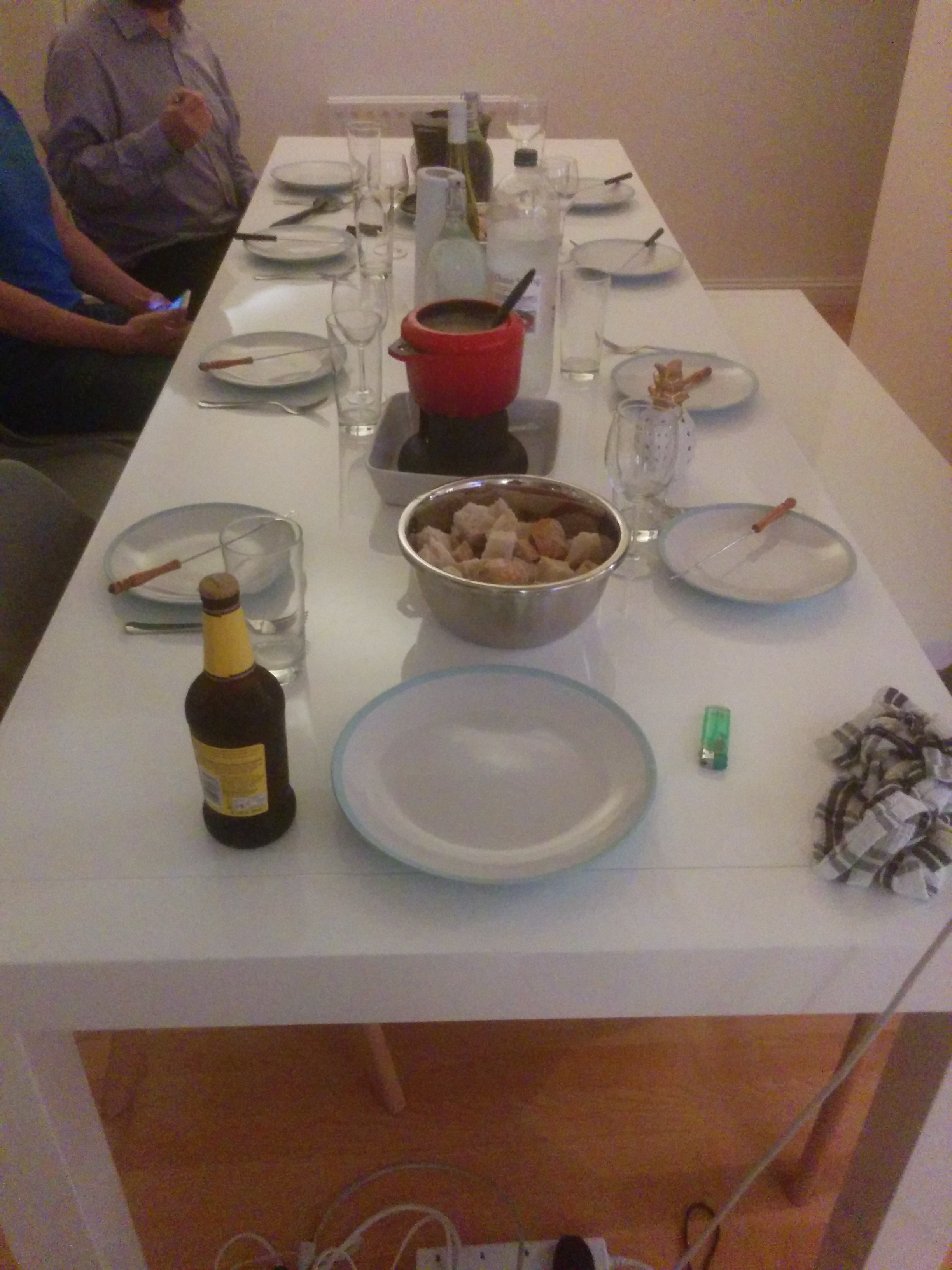
Another day, another videoteam report! It feels like we did a lot of work today, so let's jump right in: tumbleweed Stefano worked most of the day on the DebConf video archive metadata project. A bunch of videos already have been uploaded to YouTube. Here's some gold you might want to watch. By the end of our sprint, we should have generated metadata for most of our archive and uploaded a bunch of videos to YouTube. Don't worry though, YouTube is only a mirror and we'll keep our current archive as a video master. RattusRattus Andy joined us today! He hacked away with Stefano for most of the day, working on the metadata format for our videos and making schemes for our scraping tools. ivodd Ivo built and tested a good part of our video setup today, fixing bugs left and right in Ansible. We are prepared for the Cambridge Mini-DebConf! olasd Nicolas finished his scripts to automatically spool up and down our streaming mirrors via the DigitalOcean API today and ran our Ansible config against those machines to test our setup. pollo For my part, I completed a huge chunk of my sprint goals: we now have a website documenting our setup! It is currently hosted on Alioth pages, but olasd plans to make a request to DSA to have it hosted on the static.debian.org machine. The final URL will most likely be something like: https://video.debconf.org The documentation is still missing the streaming section (our streaming setup is not final yet, so not point in documenting that) and a section hosting guides for the volunteers. With some luck I might write those later this week. I've now moved on documentation our various Ansible roles. Oh, and we also ate some cheese fondue: Our fondue dinner

20 November 2017

Louis-Philippe V ronneau: DebConf Videoteam sprint report - day 1

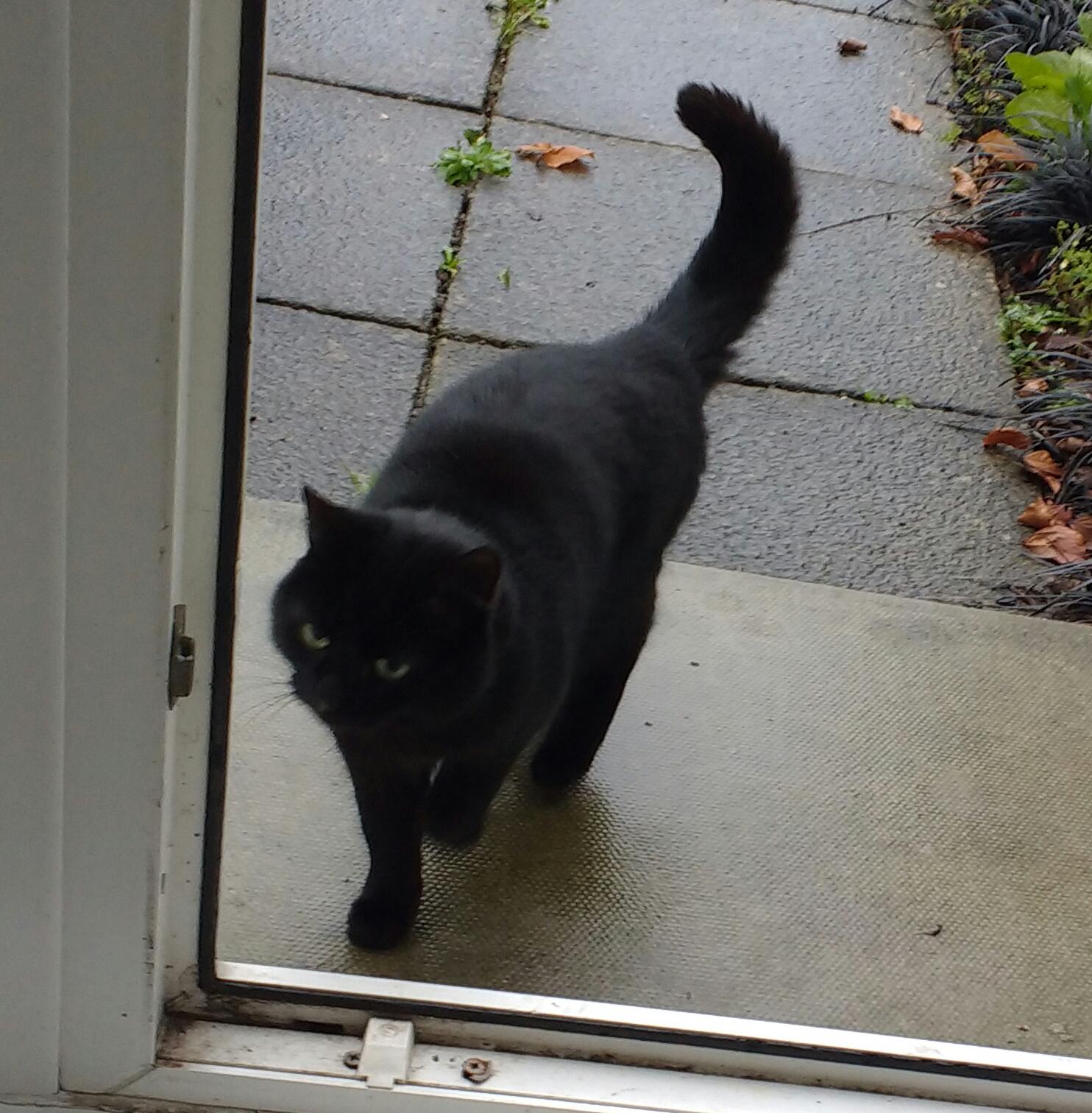
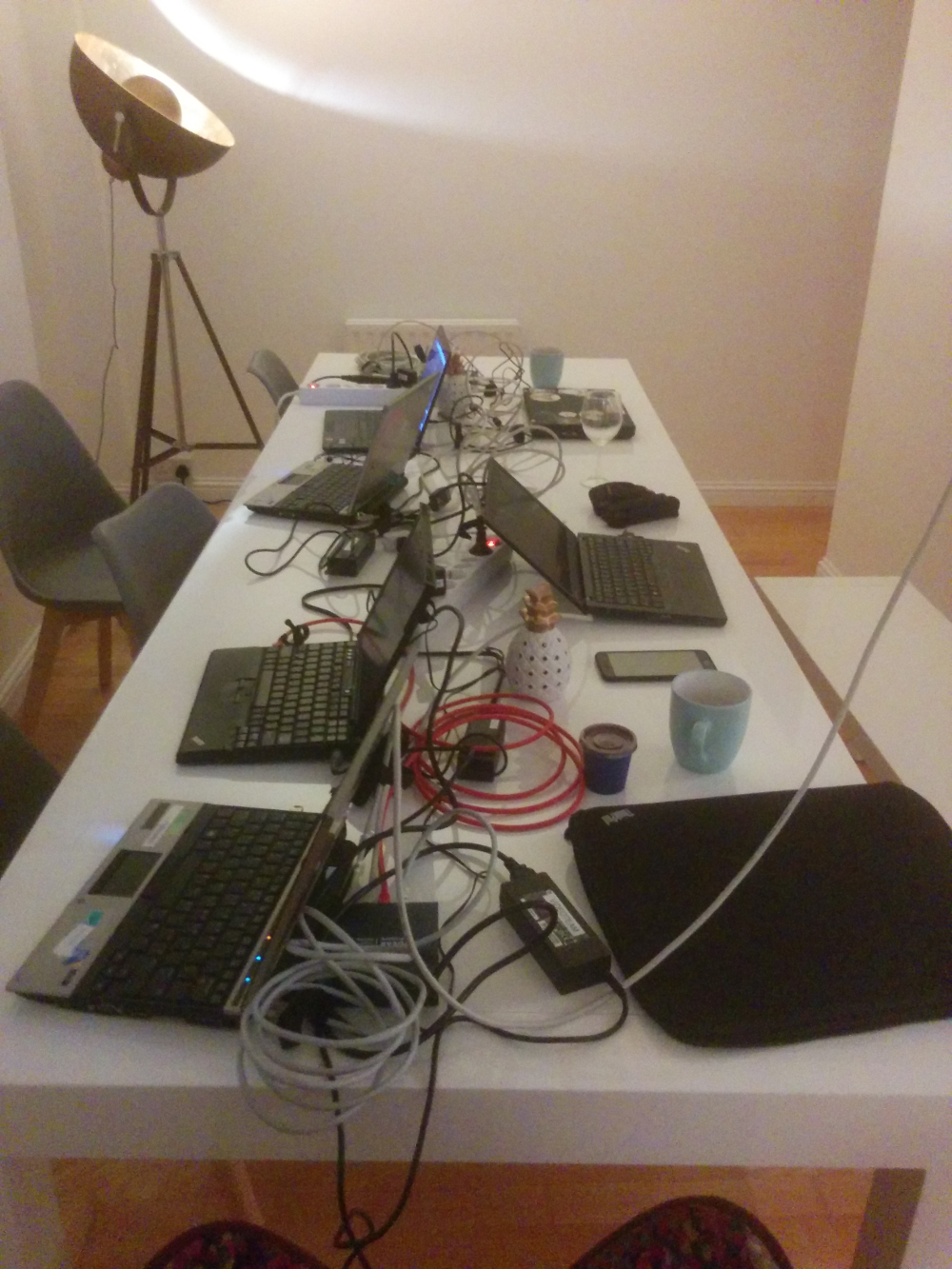
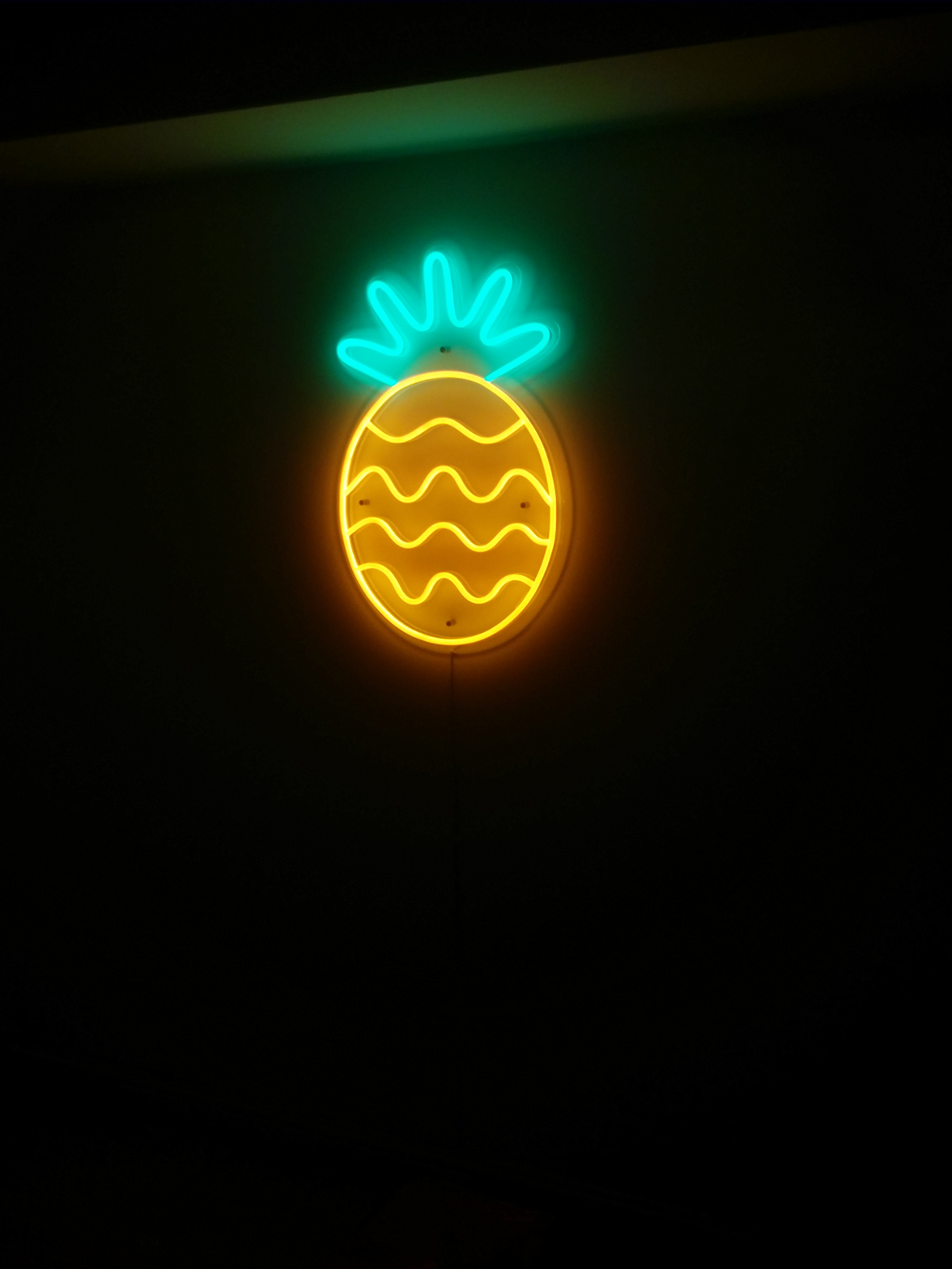
Another videoteam report! We've now been hacking for a full day and we are slowly starting to be productive. It's always hard to get back in a project when you haven't touched it in a while... Anyway, let's start this report with some important announcement: we finally have been able to snap a good picture of the airbnb's cat! The airbnb's cat No more nagging me about the placeholder image from Wikipedia I used in yesterday's report! Set up Our hacking space Here's what the team did today: tumbleweed Stefano started the day by hacking away on our video archive. We eventually want to upload all our videos to YouTube to give them exposure, but sadly our archive metadata is in a pretty poor shape. With the script tumbleweed wrote, we can scrape the archive for matches against the old DebConf's pentabarf XML we have. tumbleweed also helped Ivo with the ansible PXE setup he's working on. Some recent contributions from a collaborator implemented new features (like a nice menu to choose from) but also came with a few annoying bugs. ivodd Ivo continued working on the PXE setup today. He also tried to break our ansible setup by using fresh installs with different user cases (locales, interfaces, etc.), with some success. The reason he and Stefano are working so hard on the PXE boot is that we had a discussion about the future of our USB install method. The general consensus on this was although we would not remove it, we would not actively maintain it anymore. PXE is less trouble for multiple machines. For single machines or if you don't control the DHCP server, using ansible manually on a fresh Debian install will be the recommended way. olasd After a very long drive, olasd arrived late in the evening with all our gear. Hurray! We were thus able to set up some test boxes and start wiring the airbnb properly. Tomorrow will certainly be more productive with all this stuff at our disposition. pollo Today I mainly worked on setting up our documentation website. After some debate, we decided that sphinx was the right tool for the job. I am a few pages in and if I work well I think we'll have something to show for at the end of the sprint! I also was thrown back into ansible after witnessing a bug in the locale management. I'm still rusty, but it's slowly coming back to me. Let's end this blog post with a picture of the neon pineapple that sits on the wall of the solarium. Upside down this picture is even more troubling

19 November 2017

Louis-Philippe V ronneau: DebConf Videoteam sprint report - day 0

First day of the videoteam autumn sprint! Well, I say first day, but in reality it's more day 0. Even though most of us have arrived in Cambridge already, we are still missing a few people. Last year we decided to sprint in Paris because most of our video gear is stocked there. This year, we instead chose to sprint a few days before the Cambridge Mini-Debconf to help record the conference afterwards. Since some of us arrived very late and the ones who did arrive early are still mostly jet lagged (that includes me), I'll use this post to introduce the space we'll be working from this week and our general plan for the sprint. House Party After some deliberations, we decided to rent a house for a week in Cambridge: finding a work space to accommodate us and all our gear proved difficult and we decided mixing accommodation and work would be a good idea. I've only been here for a few hours, but I have to say I'm pretty impressed by the airbnb we got. Last time I checked (it seems every time I do, some new room magically appears), I counted 5 bedrooms, 6 beds, 5 toilets and 3 shower rooms. Heck, there's even a solarium and a training room with weights and a punching bag on the first floor. Having a whole house to ourselves also means we have access to a functional kitchen. I'd really like to cook at least a few meals during the week. There's also a cat! Picture of a black cat I took from Wikipedia. It was too dark outside to use mine It's not the house's cat per say, but it's been hanging out around the house for most of the day and makes cute faces trying to convince us to let it come inside. Nice try cat. Nice try. Here are some glamour professional photos of what the place looks like on a perfect summer day, just for the kick of it: The view from the garden The Kitchen One of the multiple bedrooms Of course, reality has trouble matching all the post-processing filters. Plan for the week Now on a more serious note; apart from enjoying the beautiful city of Cambridge, here's what the team plans to do this week: tumbleweed Stefano wants to continue refactoring our ansible setup. A lot of things have been added in the last year, but some of it are hacks we should remove and implement correctly. highvoltage Jonathan won't be able to come to Cambridge, but plans to work remotely, mainly on our desktop/xfce session implementation. Another pile of hacks waiting to be cleaned! ivodd Ivo has been working a lot of the pre-ansible part of our installation and plans to continue working on that. At the moment, creating an installation USB key is pretty complicated and he wants to make that simpler. olasd Nicolas completely reimplemented our streaming setup for DC17 and wants to continue working on that. More specifically, he wants to write scripts to automatically setup and teardown - via API calls - the distributed streaming network we now use. Finding a way to push TLS certificates to those mirrors, adding a live stream viewer on video.debconf.org and adding a viewer to our archive are also things he wants to look at. pollo For my part, I plan to catch up with all the commits in our ansible repository I missed since last year's sprint and work on documentation. It would be very nice if we could have a static website describing our work so that others (at mini-debconfs for examples) could replicate it easily. If I have time, I'll also try to document all the ansible roles we have written. Stay tuned for more daily reports!

18 November 2017

Matthieu Caneill: MiniDebconf in Toulouse

I attended the MiniDebconf in Toulouse, which was hosted in the larger Capitole du Libre, a free software event with talks, presentation of associations, and a keysigning party. I didn't expect the event to be that big, and I was very impressed by its organization. Cheers to all the volunteers, it has been an amazing week-end! Here's a sum-up of the talks I attended. Du logiciel libre la monnaie libre Speaker: lo s The first talk I attended was, translated to English, "from free software to free money". lo s compared the 4 freedoms of free software with money, and what properties money needs to exhibit in order to be considered free. He then introduced 1, a project of free (as in free speech!) money, started in the region around Toulouse. Contrary to some distributed ledgers such as Bitcoin, 1 isn't based on an hash-based proof-of-work, but rather around a web of trust of people certifying each other, hence limiting the energy consumption required by the network to function. YunoHost Speaker: Jimmy Monin I then attended a presentation of YunoHost. Being an happy user myself, it was very nice to discover the future expected features, and also meet two of the developers. YunoHost is a Debian-based project, aimed at providing all the tools necessary to self-host applications, including email, website, calendar, development tools, and dozens of other packages. Premiers pas dans l'univers de Debian Speaker: Nicolas Dandrimont For the first talk of the MiniDebConf, Nicolas Dandrimont introduced Debian, its philosophy, and how it works with regards to upstreams and downstreams. He gave many details on the teams, the infrastructure, and the internals of Debian. Trusting your computer and system Speaker: Jonas Smedegaard Jonas introduced some security concepts, and how they are abused and often meaningless (to quote his own words, "secure is bullshit"). He described a few projects which lean towards a more secure and open hardware, for both phones and laptops. Automatiser la gestion de configuration de Debian avec Ansible Speaker: J r my Lecour J r my, from Evolix, introduced Ansible, and how they use it to manage hundreds of Debian servers. Ansible is a very powerful tool, and a huge ecosystem, in many ways similar to Puppet or Chef, except it is agent-less, using only ssh connections to communicate with remote machines. Very nice to compare their use of Ansible with mine, since that's the software I use at work for deploying experiments. Making Debian for everybody Speaker: Samuel Thibault Samuel gave a talk about accessibility, and the general availability of the tools in today's operating systems, including Debian. The lesson to take home is that we often don't do enough in this domain, particularly when considering some issues people might have that we don't always think about. Accessibility on computers (and elsewhere) should be the default, and never require complex setups. Retour d'exp rience : mise jour de milliers de terminaux Debian Speaker: Cyril Brulebois Cyril described a problem he was hired for, an update of thousands of Debian servers from wheezy to jessie, which he discovered afterwards was worse than initially thought, since the machines were running the out-of-date squeeze. Since they were not always administered with the best sysadmin practices, they were all exhibiting different configurations and different packages lists, which raised many issues and gave him interesting challenges. They were solved using Ansible, which also had the effect of standardizing their system administration practices. Retour d'exp rience : utilisation de Debian chez Evolix Speaker: Gr gory Colpart Gr gory described Evolix, a company which manages servers for their clients, and how they were inspired by Debian, for both their internal tools and their practices. It is very interesting to see that some of the Debian values can be easily exported for a more open and collaborative business. Lightning talks To close the conference, two lightning talks were presented, describing the switch from Windows XP to Debian in an ecologic association near Toulouse; and how snapshot.debian.org can be used with bisections to find the source of some regressions. Conclusion A big thank you to all the organizers and the associations who contributed to make this event a success. Cheers!

7 November 2017

Don Armstrong: Autorandr: automatically adjust screen layout

Like many laptop users, I often plug my laptop into different monitor setups (multiple monitors at my desk, projector when presenting, etc.) Running xrandr commands or clicking through interfaces gets tedious, and writing scripts isn't much better. Recently, I ran across autorandr, which detects attached monitors using EDID (and other settings), saves xrandr configurations, and restores them. It can also run arbitrary scripts when a particular configuration is loaded. I've packed it, and it is currently waiting in NEW. If you can't wait, the deb is here and the git repo is here. To use it, simply install the package, and create your initial configuration (in my case, undocked):
 autorandr --save undocked
then, dock your laptop (or plug in your external monitor(s)), change the configuration using xrandr (or whatever you use), and save your new configuration (in my case, workstation):
autorandr --save workstation
repeat for any additional configurations you have (or as you find new configurations). Autorandr has udev, systemd, and pm-utils hooks, and autorandr --change should be run any time that new displays appear. You can also run autorandr --change or autorandr --load workstation manually too if you need to. You can also add your own ~/.config/autorandr/$PROFILE/postswitch script to run after a configuration is loaded. Since I run i3, my workstation configuration looks like this:
 #!/bin/bash
 xrandr --dpi 92
 xrandr --output DP2-2 --primary
 i3-msg '[workspace="^(1 4 6)"] move workspace to output DP2-2;'
 i3-msg '[workspace="^(2 5 9)"] move workspace to output DP2-3;'
 i3-msg '[workspace="^(3 8)"] move workspace to output DP2-1;'
which fixes the dpi appropriately, sets the primary screen (possibly not needed?), and moves the i3 workspaces about. You can also arrange for configurations to never be run by adding a block hook in the profile directory. Check it out if you change your monitor configuration regularly!

4 November 2017

Louis-Philippe V ronneau: Migrating my website to Pelican

After too much time lying to myself, telling myself things like "I'll just add this neat feature I want on my blog next week", I've finally made the big jump, ditched django and migrated my website to Pelican. I'm going to the Cambridge Mini-Debconf at the end of the month for the Debconf Videoteam Autumn sprint and I've taken the task of making daily sprint reports for the team. That in return means I have to publish my blog on Planet Debian. My old website not having feeds made this a little hard and this perfect storm gave me the energy to make the migration happen. Anyway, django was fun. Building a (crappy) custom blogging engine with it taught me some rough basics, but honestly I don't know why I ever thought it was a good idea. Don't get me wrong: django is great and should definitely be used for large and complicated websites. My blog just ain't one. Migrating to Pelican was pretty easy since it also uses Jinja2 templates and generates content from Mardown. The hardest part was actually bending it to replicate the weird and specific behavior I wanted it to have. So yeah, woooo, I migrated to Pelican. Who cares, right? Well, if you are amongst the very, very few people who read the blog posts I mainly write for myself, you'll be please to know that: Here's a bonus picture of a Pelican from Wikimedia, just for the sake of it: A pelican

2 November 2017

Bits from Debian: New Debian Developers and Maintainers (September and October 2017)

The following contributors got their Debian Developer accounts in the last two months: The following contributors were added as Debian Maintainers in the last two months: Congratulations!

31 October 2017

Norbert Preining: Debian/TeX Live 2017.20171031-1

Halloween is here, time to upload a new set of scary packages of TeX Live. About a month has passed, so there is the usual big stream up updates. There was actually an intermediate release to get out some urgent fixes, but I never reported the news here. So here are the accumulated changes and updates. My favorite this time is wallcalendar, a great class to design all kind of calendars, it looks really well done. I immediately will start putting one together. On the font side there is the new addition coelacanth. To quote from the README: Coelacanth is inspired by the classic Centaur type design of Bruce Rogers, described by some as the most beautiful typeface ever designed. It aims to be a professional quality type family for general book typesetting. And indeed it is beautiful! Other noteworthy addition is the Spark font that allows creating sparklines in the running text with LaTeX. Enjoy. New packages algobox, amscls-doc, beilstein, bib2gls, coelacanth, crossreftools, dejavu-otf, dijkstra, ducksay, dynkin-diagrams, eqnnumwarn, fetchcls, fixjfm, glossaries-finnish, hagenberg-thesis, hecthese, ifxptex, isopt, istgame, ku-template, limecv, mensa-tex, musicography, na-position, notestex, outlining, pdfreview, spark-otf, spark-otf-fonts, theatre, unitn-bimrep, upzhkinsoku, wallcalendar, xltabular. Updated packages acmart, amsmath, animate, arabluatex, arara, babel, babel-french, bangorexam, baskervillef, beebe, biblatex-philosophy, biblatex-source-division, bibletext, bidi, bxjaprnind, bxjscls, bxpapersize, bytefield, classicthesis, cochineal, complexity, cooking-units, curves, datetime2-german, dccpaper, doclicense, docsurvey, eledmac, epstopdf, eqparbox, esami, etoc, fbb, fei, fithesis, fmtcount, fnspe, fonts-tlwg, fontspec, genealogytree, glossaries, glossaries-extra, hecthese, hepthesis, hvfloat, ifplatform, ifptex, inconsolata, jfmutil, jsclasses, ketcindy, knowledge, koma-script, l3build, l3experimental, l3kernel, l3packages, langsci, latex2man, latexbug, lato, leadsheets, libertinust1math, listofitems, luatexja, luatexko, luatodonotes, lwarp, markdown, mcf2graph, media9, newtx, novel, numspell, ocgx2, overpic, philokalia, phonenumbers, platex, poemscol, pst-exa, pst-geometrictools, pst-ovl, pst-plot, pst-pulley, pst-tools, pst-vehicle, pst2pdf, pstool, pstricks, pstricks-add, pxchfon, pxjahyper, quran, randomlist, rec-thy, reledmac, robustindex, scratch, skrapport, spectralsequences, tcolorbox, tetex, tex4ht, texcount, texdoc, tikzducks, tikzsymbols, toptesi, translation-biblatex-de, unicode-math, updmap-map, uplatex, widetable, xcharter, xepersian, xetexko, xetexref, xsim, zhlipsum.

17 October 2017

Jonathan Dowland: Electric Dreams

No spoilers, for those who have yet to watch it... Channel 4 have been broadcasting a new 10-part series called Electric Dreams, based on some of the short fiction of Philip K Dick. The series was commissioned after Channel 4 lost Black Mirror to Netflix, perhaps to try and find something tonally similar. Electric Dreams is executive-produced by Brian Cranston, who also stars in one of the episodes yet to broadcast. I've read all of PKD's short fiction1 but it was a long time ago so I have mostly forgotten the stories upon which the series is based. I've quite enjoyed going back and re-reading them after watching the corresponding episodes to see what changes they've made. In some cases the changes are subtle or complementary, in other cases they've whittled the original story right out and installed a new one inside the shell. A companion compilation has been published with just the relevant short stories in it, and from what I've seen browsing it in a book shop it also contains short introductions which might be worth a read. Things started strong with The Hood Maker, which my wife also enjoyed, although she was disappointed to realise we wouldn't be revisiting those characters in the future. The world-building was strong enough that it seemed like a waste for a single episode. My favourite episode of those broadcast so far was The Commuter, starring Timothy Spall. The changes made were complementary and immensely expanded the emotional range of the story. In some ways, a key aspect of the original story was completely inverted, which I found quite funny: my original take on Dick's story was Dick implying a particular outcome was horrific, whereas it becomes desirable in the TV episode.
Episode 4, *Crazy Diamond* Episode 4, Crazy Diamond
One of the stories most hollowed-out was Sales Pitch which was the basis for Tony Grisoni s episode Crazy Diamond, starring Steve Buscemi and Sidse Babett Knudsen. Buscemi was good but Knudsen totally stole every frame she was in. Fans of the cancelled Channel 4 show Utopia should enjoy this one: both were directed by Marc Munden and the directing, photography and colour balance really recall it. The last episode broadcast was Real Life directed by Ronald D Moore of Battlestar Galactica reboot fame and starring Anna Paquin. Like Sales Pitch it bears very little resemblance to the original story. It played around with similar ideas explored in a lot of Sci-Fi movies and TV shows but left me a little flat; I didn't think it contributed much that I hadn't seen before. I was disappointed that there was a relatively conclusive ending. There was a subversive humour in the Dick short that was completely lost in the retelling. The world design seemed pretty generic. I'm looking forward to Autofac, which is one of the shorts I can remember particularly enjoying.

  1. as collected in the 5 volumes of The Collected Stories of Philip K Dick, although I don't doubt there are some stragglers that were missed out when that series was compiled.

Russ Allbery: Bundle haul

Confession time: I started making these posts (eons ago) because a close friend did as well, and I enjoyed reading them. But the main reason why I continue is because the primary way I have to keep track of the books I've bought and avoid duplicates is, well, grep on these posts. I should come up with a non-bullshit way of doing this, but time to do more elegant things is in short supply, and, well, it's my blog. So I'm boring all of you who read this in various places with my internal bookkeeping. I do try to at least add a bit of commentary. This one will be more tedious than most since it includes five separate Humble Bundles, which increases the volume a lot. (I just realized I'd forgotten to record those purchases from the past several months.) First, the individual books I bought directly: Ilona Andrews Sweep in Peace (sff)
Ilona Andrews One Fell Sweep (sff)
Steven Brust Vallista (sff)
Nicky Drayden The Prey of Gods (sff)
Meg Elison The Book of the Unnamed Midwife (sff)
Pat Green Night Moves (nonfiction)
Ann Leckie Provenance (sff)
Seanan McGuire Once Broken Faith (sff)
Seanan McGuire The Brightest Fell (sff)
K. Arsenault Rivera The Tiger's Daughter (sff)
Matthew Walker Why We Sleep (nonfiction)
Some new books by favorite authors, a few new releases I heard good things about, and two (Night Moves and Why We Sleep) from references in on-line articles that impressed me. The books from security bundles (this is mostly work reading, assuming I'll get to any of it), including a blockchain bundle: Wil Allsop Unauthorised Access (nonfiction)
Ross Anderson Security Engineering (nonfiction)
Chris Anley, et al. The Shellcoder's Handbook (nonfiction)
Conrad Barsky & Chris Wilmer Bitcoin for the Befuddled (nonfiction)
Imran Bashir Mastering Blockchain (nonfiction)
Richard Bejtlich The Practice of Network Security (nonfiction)
Kariappa Bheemaiah The Blockchain Alternative (nonfiction)
Violet Blue Smart Girl's Guide to Privacy (nonfiction)
Richard Caetano Learning Bitcoin (nonfiction)
Nick Cano Game Hacking (nonfiction)
Bruce Dang, et al. Practical Reverse Engineering (nonfiction)
Chris Dannen Introducing Ethereum and Solidity (nonfiction)
Daniel Drescher Blockchain Basics (nonfiction)
Chris Eagle The IDA Pro Book, 2nd Edition (nonfiction)
Nikolay Elenkov Android Security Internals (nonfiction)
Jon Erickson Hacking, 2nd Edition (nonfiction)
Pedro Franco Understanding Bitcoin (nonfiction)
Christopher Hadnagy Social Engineering (nonfiction)
Peter N.M. Hansteen The Book of PF (nonfiction)
Brian Kelly The Bitcoin Big Bang (nonfiction)
David Kennedy, et al. Metasploit (nonfiction)
Manul Laphroaig (ed.) PoC GTFO (nonfiction)
Michael Hale Ligh, et al. The Art of Memory Forensics (nonfiction)
Michael Hale Ligh, et al. Malware Analyst's Cookbook (nonfiction)
Michael W. Lucas Absolute OpenBSD, 2nd Edition (nonfiction)
Bruce Nikkel Practical Forensic Imaging (nonfiction)
Sean-Philip Oriyano CEHv9 (nonfiction)
Kevin D. Mitnick The Art of Deception (nonfiction)
Narayan Prusty Building Blockchain Projects (nonfiction)
Prypto Bitcoin for Dummies (nonfiction)
Chris Sanders Practical Packet Analysis, 3rd Edition (nonfiction)
Bruce Schneier Applied Cryptography (nonfiction)
Adam Shostack Threat Modeling (nonfiction)
Craig Smith The Car Hacker's Handbook (nonfiction)
Dafydd Stuttard & Marcus Pinto The Web Application Hacker's Handbook (nonfiction)
Albert Szmigielski Bitcoin Essentials (nonfiction)
David Thiel iOS Application Security (nonfiction)
Georgia Weidman Penetration Testing (nonfiction)
Finally, the two SF bundles: Buzz Aldrin & John Barnes Encounter with Tiber (sff)
Poul Anderson Orion Shall Rise (sff)
Greg Bear The Forge of God (sff)
Octavia E. Butler Dawn (sff)
William C. Dietz Steelheart (sff)
J.L. Doty A Choice of Treasons (sff)
Harlan Ellison The City on the Edge of Forever (sff)
Toh Enjoe Self-Reference ENGINE (sff)
David Feintuch Midshipman's Hope (sff)
Alan Dean Foster Icerigger (sff)
Alan Dean Foster Mission to Moulokin (sff)
Alan Dean Foster The Deluge Drivers (sff)
Taiyo Fujii Orbital Cloud (sff)
Hideo Furukawa Belka, Why Don't You Bark? (sff)
Haikasoru (ed.) Saiensu Fikushon 2016 (sff anthology)
Joe Haldeman All My Sins Remembered (sff)
Jyouji Hayashi The Ouroboros Wave (sff)
Sergei Lukyanenko The Genome (sff)
Chohei Kambayashi Good Luck, Yukikaze (sff)
Chohei Kambayashi Yukikaze (sff)
Sakyo Komatsu Virus (sff)
Miyuki Miyabe The Book of Heroes (sff)
Kazuki Sakuraba Red Girls (sff)
Robert Silverberg Across a Billion Years (sff)
Allen Steele Orbital Decay (sff)
Bruce Sterling Schismatrix Plus (sff)
Michael Swanwick Vacuum Flowers (sff)
Yoshiki Tanaka Legend of the Galactic Heroes, Volume 1: Dawn (sff)
Yoshiki Tanaka Legend of the Galactic Heroes, Volume 2: Ambition (sff)
Yoshiki Tanaka Legend of the Galactic Heroes, Volume 3: Endurance (sff)
Tow Ubukata Mardock Scramble (sff)
Sayuri Ueda The Cage of Zeus (sff)
Sean Williams & Shane Dix Echoes of Earth (sff)
Hiroshi Yamamoto MM9 (sff)
Timothy Zahn Blackcollar (sff)
Phew. Okay, all caught up, and hopefully won't have to dump something like this again in the near future. Also, more books than I have any actual time to read, but what else is new.

3 October 2017

Iain R. Learmonth: Facebook Lies

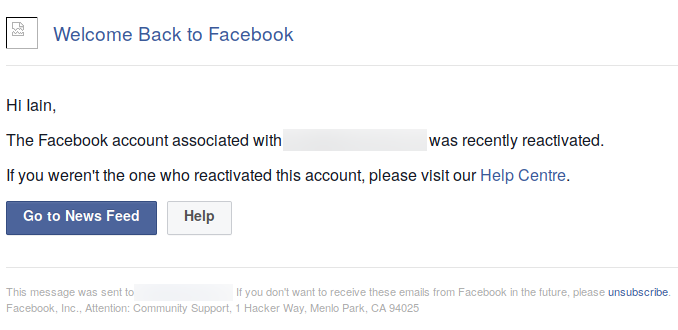
In the past, I had a Facebook account. Long ago I deleted this account through the procedure outlined on their help pages. In theory, 14 days after I used this process my account would be irrevocably gone. This was all lies. My account was not deleted and yesterday I received an email:
Screenshot of the email I received from Facebook Screenshot of the email I received from Facebook
It took me a moment to figure it out, but what had happened here is someone had logged into my Facebook account using my email address and password. Facebook simply reactivated the account, which had not had its data deleted, as if I had logged in. This was possible because:
  1. Facebook was clinging to the hope that I would like to return
  2. The last time I used Facebook I didn t know what a password manager was and was using the same password for basically everything
When I logged back in, all I needed to provide to prove I was me was my date of birth. Given that old Facebook passwords are readily available from dumps (people think their accounts are gone, so why should they be changing their passwords?) and my date of birth is not secret either, this is not great. I followed the deletion procedure again and in 2 weeks (you can t immediately request deletion apparently) I ll check to see if the account is really gone. I ve updated the password so at least the deletion process can t be interrupted by whoever has that password (probably lots of people - it ll be in a ton of dumps where databases have been hacked). If it s still not gone, I hear you can just post obscene and offensive material until Facebook deletes you. I d rather not have to take that route though. If you re interested to see if you ve turned up in a hacked database dump yourself, I would recommend hibp. Update (2017-10-04): Thanks for all the comments. Sorry I haven t been able to reply to all of them. Discussion around this post occured at Hacker News if you would like to read more there. You can also read about a similar, and more frustrating, case that came up in the HN discussion.

26 September 2017

Norbert Preining: Debian/TeX Live 2017.20170926-1

A full month or more has past since the last upload of TeX Live, so it was high time to prepare a new package. Nothing spectacular here I have to say, two small bugs fixed and the usual long list of updates and new packages. From the new packages I found fontloader-luaotfload and interesting project. Loading fonts via lua code in luatex is by now standard, and this package allows for experiments with newer/alternative font loaders. Another very interesting new-comer is pdfreview which lets you set pages of another PDF on a lined background and add notes to it, good for reviewing. Enjoy. New packages abnt, algobox, beilstein, bib2gls, cheatsheet, coelacanth, dijkstra, dynkin-diagrams, endofproofwd, fetchcls, fixjfm, fontloader-luaotfload, forms16be, hithesis, ifxptex, komacv-rg, ku-template, latex-refsheet, limecv, mensa-tex, multilang, na-box, notes-tex, octave, pdfreview, pst-poker, theatre, upzhkinsoku, witharrows. Updated packages 2up, acmart, acro, amsmath, animate, babel, babel-french, babel-hungarian, bangorcsthesis, beamer, beebe, biblatex-gost, biblatex-philosophy, biblatex-source-division, bibletext, bidi, bpchem, bxjaprnind, bxjscls, bytefield, checkcites, chemmacros, chet, chickenize, complexity, curves, cweb, datetime2-german, e-french, epstopdf, eqparbox, esami, etoc, fbb, fithesis, fmtcount, fnspe, fontspec, genealogytree, glossaries, glossaries-extra, hvfloat, ifptex, invoice2, jfmutil, jlreq, jsclasses, koma-script, l3build, l3experimental, l3kernel, l3packages, latexindent, libertinust1math, luatexja, lwarp, markdown, mcf2graph, media9, nddiss, newpx, newtx, novel, numspell, ocgx2, philokalia, phfqit, placeat, platex, poemscol, powerdot, pst-barcode, pst-cie, pst-exa, pst-fit, pst-func, pst-geometrictools, pst-ode, pst-plot, pst-pulley, pst-solarsystem, pst-solides3d, pst-tools, pst-vehicle, pst2pdf, pstricks, pstricks-add, ptex-base, ptex-fonts, pxchfon, quran, randomlist, reledmac, robustindex, scratch, skrapport, spectralsequences, tcolorbox, tetex, tex4ht, texcount, texdef, texinfo, texlive-docindex, texlive-scripts, tikzducks, tikzsymbols, tocloft, translations, updmap-map, uplatex, widetable, xepersian, xetexref, xint, xsim, zhlipsum.

25 September 2017

Lior Kaplan: Recruiting for Open Source jobs

Part of services of Kaplan open source consulting is recruiting services to help companies find good open source people. In addition, we also try to help the community to find open source friendly businesses to work at. Expect the Usual Suspects (e.g. RedHat), I encounter job descriptions which convince me these companies know the advantages of using open source projects and hiring open source people. A few recent examples I found in Israel: From the applicant side, the possibility to know which code base he or she is going to work on could help do a better and more educated choice about the offered position. While from the company side, getting hard evidence of what are the applicant capabilities and code looks like instead of just describing them or trying to demonstrate them on short tests. Not to mention the applicant s ability to work as part of a team or community. For the Israeli readers, you can see the full list at https://kaplanopensource.co.il/jobs/
Filed under: Israeli Community, Open source businesses

29 August 2017

Sean Whitton: Nourishment

This semester I am taking JPN 530, Haruki Murakami and the Literature of Modern Japan . My department are letting me count it for the Philosophy Ph.D., and in fact my supervisor is joining me for the class. I have no idea what the actual class sessions will be like first one this afternoon and I m anxious about writing a literature term paper. But I already know that my weekends this semester are going to be great because I ll be reading Murakami s novels. What s particularly wonderful about this, and what I wanted to write about, is how nourishing I find reading literary fiction to be. For example, this weekend I read
This was something sure to be crammed full of warm secrets, like an antique clock built when peace filled the world. Potentiality knocks at the door of my heart.
and I was fed for the day. All my perceived needs dropped away; that s all it takes. This stands in stark contrast to reading philosophy, which is almost always draining rather than nourishing even philosophy I really want to read. Especially having to read philosophy at the weekend. (quotation is from On Seeing the 100% Perfect Girl on a Beautiful April Morning)

25 August 2017

Reproducible builds folks: Reproducible Builds: Weekly report #121

Here's what happened in the Reproducible Builds effort between Sunday August 13 and Saturday August 19 2017: Reproducible Builds finally mandated by Debian Policy "Packages should build reproducibly" was merged into Debian policy! The added text is as follows and has been included into debian-policy 4.1.0.0:
Reproducibility
---------------
Packages should build reproducibly, which for the purposes of this
document [#]_ means that given
- a version of a source package unpacked at a given path;
- a set of versions of installed build dependencies;
- a set of environment variable values;
- a build architecture; and
- a host architecture,
repeatedly building the source package for the build architecture on
any machine of the host architecture with those versions of the build
dependencies installed and exactly those environment variable values
set will produce bit-for-bit identical binary packages.
It is recommended that packages produce bit-for-bit identical binaries
even if most environment variables and build paths are varied.  It is
intended for this stricter standard to replace the above when it is
easier for packages to meet it.
.. [#]
   This is Debian's precisification of the  reproducible-builds.org
   definition  _.
Reproducible work in other projects Bernhard M. Wiedemann's reproducibleopensuse scripts now work on Debian buster on the openSUSE Build Service with the latest versions of osc and obs-build. Toolchain development and fixes #872514 was opened on devscripts by Chris Lamb to add a reproducible-check program to report on the reproducibility status of installed packages. Packages reviewed and fixed, and bugs filed Upstream reports: Debian reports: Debian non-maintainer uploads: Reviews of unreproducible packages 47 package reviews have been added, 58 have been updated and 39 have been removed in this week, adding to our knowledge about identified issues. 4 issue types have been updated: Weekly QA work During our reproducibility testing, FTBFS bugs have been detected and reported by: diffoscope development Development continued in git, including the following contributions: disorderfs development Development continued in git, including the following contributions: reprotest development Development continued in git, including the following contributions: tests.reproducible-builds.org Mattia fixed the script which creates the HTML representation of our database scheme to not append .html twice to the filename. Misc. This week's edition was written by Ximin Luo, Chris Lamb and Holger Levsen & reviewed by a bunch of Reproducible Builds folks on IRC & the mailing lists.

23 August 2017

Antoine Beaupr : The supposed decline of copyleft

At DebConf17, John Sullivan, the executive director of the FSF, gave a talk on the supposed decline of the use of copyleft licenses use free-software projects. In his presentation, Sullivan questioned the notion that permissive licenses, like the BSD or MIT licenses, are gaining ground at the expense of the traditionally dominant copyleft licenses from the FSF. While there does seem to be a rise in the use of permissive licenses, in general, there are several possible explanations for the phenomenon.

When the rumor mill starts Sullivan gave a recent example of the claim of the decline of copyleft in an article on Opensource.com by Jono Bacon from February 2017 that showed a histogram of license usage between 2010 and 2017 (seen below).
[Black Duck   histogram]
From that, Bacon elaborates possible reasons for the apparent decline of the GPL. The graphic used in the article was actually generated by Stephen O'Grady in a January article, The State Of Open Source Licensing, which said:
In Black Duck's sample, the most popular variant of the GPL version 2 is less than half as popular as it was (46% to 19%). Over the same span, the permissive MIT has gone from 8% share to 29%, while its permissive cousin the Apache License 2.0 jumped from 5% to 15%.
Sullivan, however, argued that the methodology used to create both articles was problematic. Neither contains original research: the graphs actually come from the Black Duck Software "KnowledgeBase" data, which was partly created from the old Ohloh web site now known as Open Hub. To show one problem with the data, Sullivan mentioned two free-software projects, GNU Bash and GNU Emacs, that had been showcased on the front page of Ohloh.net in 2012. On the site, Bash was (and still is) listed as GPLv2+, whereas it changed to GPLv3 in 2011. He also claimed that "Emacs was listed as licensed under GPLv3-only, which is a license Emacs has never had in its history", although I wasn't able to verify that information from the Internet archive. Basically, according to Sullivan, "the two projects featured on the front page of a site that was using [the Black Duck] data set were wrong". This, in turn, seriously brings into question the quality of the data:
I reported this problem and we'll continue to do that but when someone is not sharing the data set that they're using for other people to evaluate it and we see glimpses of it which are incorrect, that should give us a lot of hesitation about accepting any conclusion that comes out of it.
Reproducible observations are necessary to the establishment of solid theories in science. Sullivan didn't try to contact Black Duck to get access to the database, because he assumed (rightly, as it turned out) that he would need to "pay for the data under terms that forbid you to share that information with anybody else". So I wrote Black Duck myself to confirm this information. In an email interview, Patrick Carey from Black Duck confirmed its data set is proprietary. He believes, however, that through a "combination of human and automated techniques", Black Duck is "highly confident at the accuracy and completeness of the data in the KnowledgeBase". He did point out, however, that "the way we track the data may not necessarily be optimal for answering the question on license use trend" as "that would entail examination of new open source projects coming into existence each year and the licenses used by them". In other words, even according to Black Duck, its database may not be useful to establish the conclusions drawn by those articles. Carey did agree with those conclusions intuitively, however, saying that "there seems to be a shift toward Apache and MIT licenses in new projects, though I don't have data to back that up". He suggested that "an effective way to answer the trend question would be to analyze the new projects on GitHub over the last 5-10 years." Carey also suggested that "GitHub has become so dominant over the recent years that just looking at projects on GitHub would give you a reasonable sampling from which to draw conclusions".
[GitHub   graph]
Indeed, GitHub published a report in 2015 that also seems to confirm MIT's popularity (45%), surpassing copyleft licenses (24%). The data is, however, not without its own limitations. For example, in the above graph going back to the inception of GitHub in 2008, we see a rather abnormal spike in 2013, which seems to correlate with the launch of the choosealicense.com site, described by GitHub as "our first pass at making open source licensing on GitHub easier". In his talk, Sullivan was critical of the initial version of the site which he described as biased toward permissive licenses. Because the GitHub project creation page links to the site, Sullivan explained that the site's bias could have actually influenced GitHub users' license choices. Following a talk from Sullivan at FOSDEM 2016, GitHub addressed the problem later that year by rewording parts of the front page to be more accurate, but that any change in license choice obviously doesn't show in the report produced in 2015 and won't affect choices users have already made. Therefore, there can be reasonable doubts that GitHub's subset of software projects may not actually be that representative of the larger free-software community.

In search of solid evidence So it seems we are missing good, reproducible results to confirm or dispel these claims. Sullivan explained that it is a difficult problem, if only in the way you select which projects to analyze: the impact of a MIT-licensed personal wiki will obviously be vastly different from, say, a GPL-licensed C compiler or kernel. We may want to distinguish between active and inactive projects. Then there is the problem of code duplication, both across publication platforms (a project may be published on GitHub and SourceForge for example) but also across projects (code may be copy-pasted between projects). We should think about how to evaluate the license of a given project: different files in the same code base regularly have different licenses often none at all. This is why having a clear, documented and publicly available data set and methodology is critical. Without this, the assumptions made are not clear and it is unreasonable to draw certain conclusions from the results. It turns out that some researchers did that kind of open research in 2016 in a paper called "The Debsources Dataset: Two Decades of Free and Open Source Software" [PDF] by Matthieu Caneill, Daniel M. Germ n, and Stefano Zacchiroli. The Debsources data set is the complete Debian source code that covers a large history of the Debian project and therefore includes thousands of free-software projects of different origins. According to the paper:
The long history of Debian creates a perfect subject to evaluate how FOSS licenses use has evolved over time, and the popularity of licenses currently in use.
Sullivan argued that the Debsources data set is interesting because of its quality: every package in Debian has been reviewed by multiple humans, including the original packager, but also by the FTP masters to ensure that the distribution can legally redistribute the software. The existence of a package in Debian provides a minimal "proof of use": unmaintained packages get removed from Debian on a regular basis and the mere fact that a piece of software gets packaged in Debian means at least some users found it important enough to work on packaging it. Debian packagers make specific efforts to avoid code duplication between packages in order to ease security maintenance. The data set covers a period longer than Black Duck's or GitHub's, as it goes all the way back to the Hamm 2.0 release in 1998. The data and how to reproduce it are freely available under a CC BY-SA 4.0 license.
[Debsource   graph]
Sullivan presented the above graph from the research paper that showed the evolution of software license use in the Debian archive. Whereas previous graphs showed statistics in percentages, this one showed actual absolute numbers, where we can't actually distinguish a decline in copyleft licenses. To quote the paper again:
The top license is, once again, GPL-2.0+, followed by: Artistic-1.0/GPL dual-licensing (the licensing choice of Perl and most Perl libraries), GPL-3.0+, and Apache-2.0.
Indeed, looking at the graph, at most do we see a rise of the Apache and MIT licenses and no decline of the GPL per se, although its adoption does seem to slow down in recent years. We should also mention the possibility that Debian's data set has the opposite bias: toward GPL software. The Debian project is culturally quite different from the GitHub community and even the larger free-software ecosystem, naturally, which could explain the disparity in the results. We can only hope a similar analysis can be performed on the much larger Software Heritage data set eventually, which may give more representative results. The paper acknowledges this problem:
Debian is likely representative of enterprise use of FOSS as a base operating system, where stable, long-term and seldomly updated software products are desirable. Conversely Debian is unlikely representative of more dynamic FOSS environments (e.g., modern Web-development with micro libraries) where users, who are usually developers themselves, expect to receive library updates on a daily basis.
The Debsources research also shares methodology limitations with Black Duck: while Debian packages are reviewed before uploading and we can rely on the copyright information provided by Debian maintainers, the research also relies on automated tools (specifically FOSSology) to retrieve license information. Sullivan also warned against "ascribing reason to numbers": people may have different reasons for choosing a particular license. Developers may choose the MIT license because it has fewer words, for compatibility reasons, or simply because "their lawyers told them to". It may not imply an actual deliberate philosophical or ideological choice. Finally, he brought up the theory that the rise of non-copyleft licenses isn't necessarily at the detriment of the GPL. He explained that, even if there is an actual decline, it may not be much of a problem if there is an overall growth of free software to the detriment of proprietary software. He reminded the audience that non-copyleft licenses are still free software, according to the FSF and the Debian Free Software Guidelines, so their rise is still a positive outcome. Even if the GPL is a better tool to accomplish the goal of a free-software world, we can all acknowledge that the conversion of proprietary software to more permissive and certainly simpler licenses is definitely heading in the right direction.
[I would like to thank the DebConf organizers for providing meals for me during the conference.] Note: this article first appeared in the Linux Weekly News.

7 August 2017

Mario Lang: If your software should be cross platform and accessible, forget about Qt

A few years ago, I started to write software which primary audience is going to be blind musicians. I did a small presentation of the UI at DebConf15. Most of the functionality is in a compiler-alike backend. But eventually, I wanted to create a user interface to improve the interactive experience. So, the problem again: which toolkit to choose which would be accessible on most platforms? Last time I needed to solve a similar problem, I used Java/Swing. This has its problems, but it actually works on Windows, Linux and (supposedly) Mac. This time around, my implementation language is C++, so Swing didn't look that interesting. It appears there is not much that fullfils these requirements. Qt looked like it could. But since I had my bad experiences already with Qt claiming accessibility they really never implemented, I was at least a bit cautious. Around 10 years ago, when Qt 4 was released, I found that the documentation claimed that Qt4 was accessible on Linux, but it really never was until a very late 4.x release. This information was a blatant lie, trying to lure uninformed programmers into using Qt, much to the disservice of their disabled users. If you ask a random blind Windows user who knows a bit about toolkits, they will readily tell you that they hate every app written in Qt. With this knowledge, and the spirit of "We can change the world" I wrote a private mail to the person responsible for maintaining Qt accessibility. I explained to them that I am about to choose Qt as the UI platform for my program, and that my primary audience is users that rely on Accessibility. I also explained that cross-platform support (esp. good support on Windows) is a necessary requirement for my project. I basically got a nice marketing speak answer back, but when I read it back then, I didn't fully realize that just yet. The tone basicallly: "No problem. Qt works on Linux, Mac and Windows, and if you find any problems, just report them to us and we are going to fix them." Well, I was aware that I am not a paying customer of Qt Company, so the promise above is probbably a bit vague (I thought), but still, it sounded quite encouraging. So off I went, and started to learn enough Qt to implement the simple user interface I wanted. First tests on Linux seemed to work, that is nice. After a while, I started to test on Windows. And BANG, of course, there is a "hidden" problem. The most wide-spread (commercial) screen reader used by most blind people somehow does not see the content of text entry widgets. This was and still is a major problem for my project. I have a number of text entry fields in my UI. Actually, the main part of the UI is a simple editor, so you might see the problem already. So some more testing was done, just to realize that yes, text entry fields indeed do not work with the most widely used screen reader on Windows. While other screen readers seemed to work (NVDA) it is simply not feasable to ask my future users to switch to a different screen reader just for a single program. So I either needed to get JAWS fixed, or drop Qt. Well, after a lot of testing, I ended up submitting a bug to the Qt tracker. That was a little over a year ago. The turnaround time of private mail was definitely faster. And now I get a reply to my bug explaining that JAWS was never a priority, still is not, and that my problem will probably go away after a rewrite which has no deadline yet. Why did I expect this already? At least now I know why no blind users wants to have any Qt on their machines. If you want to write cross-platform accessible software: You definitely should not use Qt. And no other Free Software toolkit for that matter, because they basically all dont give a shit about accessibility on non-Linux platforms. Yes, GTK has a Windows port, but that isn't accessible at all. Yes, wxWindows has a Windows port, but that has problems with, guess what, text entry fields (at least last time I checked). Free Software is NOT about Accessibility or equality. I see evidence for that claim since more then 15 years now. It is about coolness, self-staging, scratch-your-own-itchness and things like that. When Debian released Jessie, I was told that something like Accessibility is not important enough to delay the release. If GNOME just broke all the help system by switching to not-yet-accessible webkit, that is just bad luck, I was told. But it is outside of the abilities of package maintainers to ensure that what we ship is accessible. I hereby officially give up. And I admit my own stupidity. Sorry for claiming Free Software would be a good thing for the world. It is definitely not for my kin. If Free Software ever takes over, the blind will be unable to use their computers. Don't get me wrong. I love my command-line. But as the well-known saying goes: "Free Software will be ready for the desktop user, perhaps, next year?" The scratch-your-own-itch philosophy simply doesn't work together with a broad list of user requirements. If you want to support users with disabilities, you probably should not rely on hippie coders right now. I repeat: If you want to write compliant software, that would be also useable to people with disabilities, you can not use Qt. For now, you will need to write a native UI for every platform you want to support. Oh, and do not believe Qt Company marketing texts, your users will suffer if you do.
25 July 2017

Satyam Zode: Maya - the OpenEBS Go Kit Project

The Kit project in Go is the common project containing all the standard libraries or packages used across all the Go projects in the organization. Motivation I attended GopherCon India 2017, there was a talk on Package Oriented Design In Go by William Kennedy. In that talk, William explained some really important and thoughtful design principles which We can apply in our day to day life, while writing Go. Hence, I wanted to apply these design philosophies to the Go projects in which I have been working on as a part of OpenEBS project. I learnt a good practice of having a Go Kit project at the organization level from William s talk. What is the Kit Project? The Kit project in Go is the common project containing all the standard libraries or packages used across all the Go projects in the organization. Packages in the Kit project should follow design philosophies. Need for a Kit project Sometimes, We write same Go packages again and again to do the same task at different levels in the different Go projects under the same organization. For example, we write custom logger package in the different Go projects. If the custom logger package is same across the organization and can be reused by simply importing it, then this custom logger package is the perfect fit for Kit project. You can sense how much time and cost it will save for us when we have a Kit project. How to convert existing projects to have kit Maya is the kit project in the progress. I will walk through our journey of creating a Kit project called maya for OpenEBS organization from existing Go projects. At OpenEBS, as a open source and growing Go project, We value Go principles and We try hard to leverage Go s offerings. Maya is the Kit project for the Application projects like maya-apiserver, maya-storage-bot etc. Maya contains all the kubernetes & nomad API s, common utilities etc. needed for development of maya-apiserver and maya-storage-bot. In the near future, we are trying to push our custom libraries to maya. So that, it will become a promising Go kit project for OpenEBS community. We have specifically followed the package oriented design principles in Go to create maya as a kit project. Project structure for the Maya as Kit project Example usage of maya kit project in maya-apiserver Maya-apiserver uses maya as a Kit project. Maya-apiserver exposes OpenEBS operations in form of REST APIs. This allows multiple clients e.g. volume related plugins to consume OpenEBS storage operations exposed by Maya API server. Conclusion Go Kit project should contain packages which are usable, purposeful and portable. Go Kit projects will improve the efficiency of the organization at both human and code level.

12 July 2017

Yakking: Time - What are clocks?

System calls You can't talk about time without clocks. A standard definition of clocks is "An instrument to measure time". Strictly speaking the analogy isn't perfect, since these clocks aren't just different ways of measuring time, they measure some different notions of time, but this is a somewhat philosophical point. The interface for this in Linux are system calls with a clkid_t parameter, though not all system calls are valid for every clock. This is not an exhaustive list of system calls, since there are also older system calls for compatibility with POSIX or other UNIX standards, that offer a subset of the functionality of the above ones. System calls beginning clock_ are about getting the time or waiting, beginning timer_ are for setting periodic or one-shot timers, timerfd_ are for timers that can be put in event loops. For the sake of not introducing too many concepts at once, we're going to start with the simplest clock and work our way up. CLOCK_MONOTONIC_RAW The first clock we care about is CLOCK_MONOTONIC_RAW. This is the simplest clock. It it initialised to an arbitrary value on boot and counts up at a rate of one second per second to the best of its ability. This clock is of limited use on its own since the only clock-related system calls that work with it are clock_gettime(2) and clock_getres(2). It can be used to determine the order of events, if the time of the event was recorded and the relative time difference between when they happened, since we know that the clock increments one second per second. Example In this program below, we time how long it takes to read 4096 bytes from /dev/zero, and print the result.
#include <stdio.h> /* fopen, fread, printf */
#include <time.h> /* clock_gettime, CLOCK_MONOTONIC_RAW, struct timespec */
int main(void)  
    FILE *devzero;
    int ret;
    struct timespec start, end;
    char buf[4096];
    devzero = fopen("/dev/zero", "r");
    if (!devzero)  
        return 1;
     
    /* get start time */
    ret = clock_gettime(CLOCK_MONOTONIC_RAW, &start);
    if (ret < 0)  
        return 2;
     
    if (fread(buf, sizeof *buf, sizeof buf, devzero) != sizeof buf)  
        return 3;
     
    /* get end time */
    ret = clock_gettime(CLOCK_MONOTONIC_RAW, &end);
    if (ret < 0)  
        return 4;
     
    end.tv_nsec -= start.tv_nsec;
    if (end.tv_nsec < 0)  
        end.tv_sec--;
        end.tv_nsec += 1000000000l;
     
    end.tv_sec -= start.tv_sec;
    printf("Reading %zu bytes took %.0f.%09ld seconds\n",
           sizeof buf, (double)end.tv_sec, (long)end.tv_nsec);
    return 0;
 

You're possibly curious about the naming of the clock called MONOTONIC_RAW. In the next article we will talk about CLOCK_MONOTONIC, which may help you understand why it's named the way it is. I suggested the uses of this clock are for the sequencing of events and for calculating the relative period between them. If you can think of another use please send us a comment. If you like to get hands-on, you may want to try reimplementing the above program in your preferred programming language, or extending it to time arbitrary events.

1 July 2017

Russ Allbery: End of month haul

For some reason, June is always incredibly busy for me. It's historically the most likely month in which I don't post anything here at all except reviews (and sometimes not even that). But I'm going to tell you about what books I bought (or were given to me) on the very last day of the month to break the pattern of no journal postings in June. Ted Chiang Arrival (Stories of Your Life) (sff collection)
Eoin Colfer Artemis Fowl (sff)
Philip K. Dick The Man Who Japed (sff)
Yoon Ha Lee Raven Strategem (sff)
Paul K. Longmore Why I Burned My Book (nonfiction)
Melina Marchetta The Piper's Son (mainstream)
Jules Verne For the Flag (sff, sort of) This is a more than usually eclectic mix. The Chiang is his Stories of Your Life collection reissued under the title of Arrival to cash in on the huge success of the movie based on one of his short stories. I'm not much of a short fiction reader, but I've heard so many good things about Chiang that I'm going to give it a try. The Longmore is a set of essays about disability rights that has been on my radar for a while. I finally got pushed into buying it (plus the first Artemis Fowl book and the Marchetta) because I've been reading back through every review Light has written. (I wish I were even close to that amusingly snarky in reviews, and she manages to say in a few paragraphs what usually takes me a whole essay.) Finally, the Dick and the Verne were gifts from a co-worker from a used book store in Ireland. Minor works by both authors, but nice, old copies of the books.

Next.

Previous.