Search Results: "nion"

5 January 2022

Jonathan Wiltshire: Continuing adventures of the mystery cable

My 4 2 has been in action again, trying to find the remainder of the mystery sometimes-4mm/sometimes-2.5mm/sometimes-1.5mm cable. It finally appeared in the tiniest gap possible between back wall and joist. As we had suspected by tracing everything else, the junction is an unfused union of all three cable types with a 230V 32A circuit breaker on one end and a light switch on the other. So in the event of fault current at the kitchen lights, the 1.5mm cable is definitely going to burn out and almost certainly set fire to the flat roof. Delightful. It is no longer like this.
More hunting for the mystery cable (bonus glimpse of one of the new light fittings)
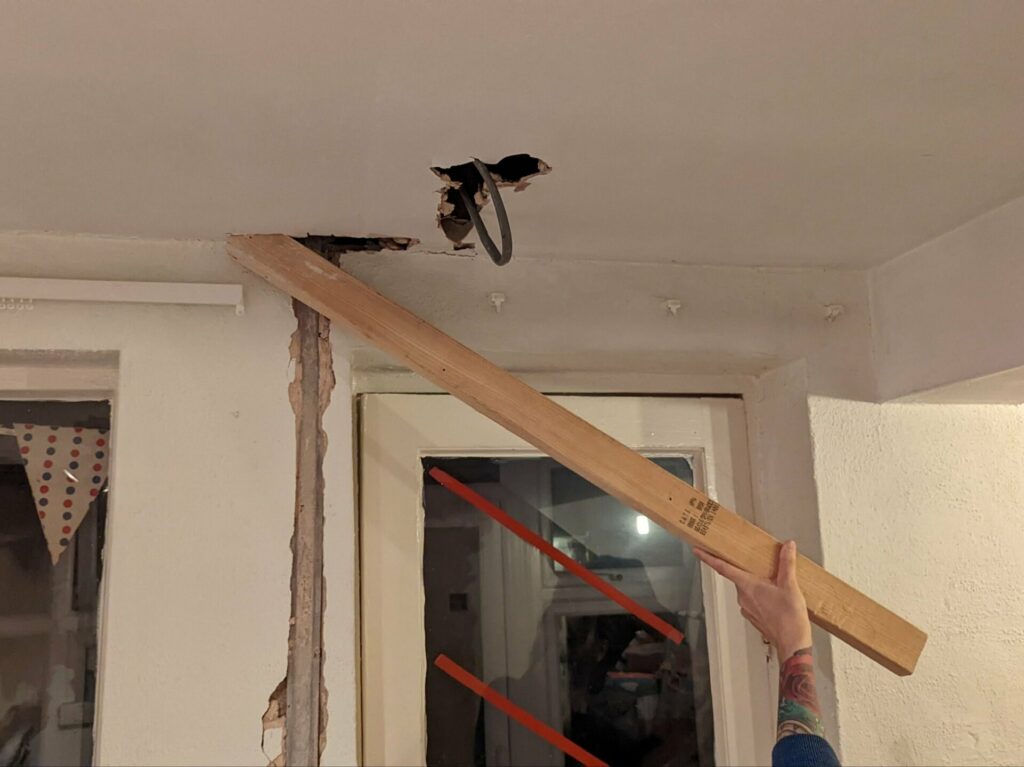
The 4 2 ceiling removal device in action

At last, quarry in sight!

Mystery Cable Junction Box of Fire and Doom  ?

All the terrifying branches removed and ready to go back into the ceiling for now, until the next room is refurbished

3 January 2022

Ian Jackson: Debian s approach to Rust - Dependency handling

tl;dr: Faithfully following upstream semver, in Debian package dependencies, is a bad idea. Introduction I have been involved in Debian for a very long time. And I ve been working with Rust for a few years now. Late last year I had cause to try to work on Rust things within Debian. When I did, I found it very difficult. The Debian Rust Team were very helpful. However, the workflow and tooling require very large amounts of manual clerical work - work which it is almost impossible to do correctly since the information required does not exist. I had wanted to package a fairly straightforward program I had written in Rust, partly as a learning exercise. But, unfortunately, after I got stuck in, it looked to me like the effort would be wildly greater than I was prepared for, so I gave up. Since then I ve been thinking about what I learned about how Rust is packaged in Debian. I think I can see how to fix some of the problems. Although I don t want to go charging in and try to tell everyone how to do things, I felt I ought at least to write up my ideas. Hence this blog post, which may become the first of a series. This post is going to be about semver handling. I see problems with other aspects of dependency handling and source code management and traceability as well, and of course if my ideas find favour in principle, there are a lot of details that need to be worked out, including some kind of transition plan. How Debian packages Rust, and build vs runtime dependencies Today I will be discussing almost entirely build-dependencies; Rust doesn t (yet?) support dynamic linking, so built Rust binaries don t have Rusty dependencies. However, things are a bit confusing because even the Debian binary packages for Rust libraries contain pure source code. So for a Rust library package, building the Debian binary package from the Debian source package does not involve running the Rust compiler; it s just file-copying and format conversion. The library s Rust dependencies do not need to be installed on the build machine for this. So I m mostly going to be talking about Depends fields, which are Debian s way of talking about runtime dependencies, even though they are used only at build-time. The way this works is that some ultimate leaf package (which is supposed to produce actual executable code) Build-Depends on the libraries it needs, and those Depends on their under-libraries, so that everything needed is installed. What do dependencies mean and what are they for anyway? In systems where packages declare dependencies on other packages, it generally becomes necessary to support versioned dependencies. In all but the most simple systems, this involves an ordering (or similar) on version numbers and a way for a package A to specify that it depends on certain versions of B. Both Debian and Rust have this. Rust upstream crates have version numbers and can specify their dependencies according to semver. Debian s dependency system can represent that. So it was natural for the designers of the scheme for packaging Rust code in Debian to simply translate the Rust version dependencies to Debian ones. However, while the two dependency schemes seem equivalent in the abstract, their concrete real-world semantics are totally different. These different package management systems have different practices and different meanings for dependencies. (Interestingly, the Python world also has debates about the meaning and proper use of dependency versions.) The epistemological problem Consider some package A which is known to depend on B. In general, it is not trivial to know which versions of B will be satisfactory. I.e., whether a new B, with potentially-breaking changes, will actually break A. Sometimes tooling can be used which calculates this (eg, the Debian shlibdeps system for runtime dependencies) but this is unusual - especially for build-time dependencies. Which versions of B are OK can normally only be discovered by a human consideration of changelogs etc., or by having a computer try particular combinations. Few ecosystems with dependencies, in the Free Software community at least, make an attempt to precisely calculate the versions of B that are actually required to build some A. So it turns out that there are three cases for a particular combination of A and B: it is believed to work; it is known not to work; and: it is not known whether it will work. And, I am not aware of any dependency system that has an explicit machine-readable representation for the unknown state, so that they can say something like A is known to depend on B; versions of B before v1 are known to break; version v2 is known to work . (Sometimes statements like that can be found in human-readable docs.) That leaves two possibilities for the semantics of a dependency A depends B, version(s) V..W: Precise: A will definitely work if B matches V..W, and Optimistic: We have no reason to think B breaks with any of V..W. At first sight the latter does not seem useful, since how would the package manager find a working combination? Taking Debian as an example, which uses optimistic version dependencies, the answer is as follows: The primary information about what package versions to use is not only the dependencies, but mostly in which Debian release is being targeted. (Other systems using optimistic version dependencies could use the date of the build, i.e. use only packages that are current .)
Precise Optimistic
People involved in version management Package developers,
downstream developers/users.
Package developers,
downstream developer/users,
distribution QA and release managers.
Package developers declare versions V and dependency ranges V..W so that It definitely works. A wide range of B can satisfy the declared requirement.
The principal version data used by the package manager Only dependency versions. Contextual, eg, Releases - set(s) of packages available.
Version dependencies are for Selecting working combinations (out of all that ever existed). Sequencing (ordering) of updates; QA.
Expected use pattern by a downstream Downstream can combine any
declared-good combination.
Use a particular release of the whole system. Mixing-and-matching requires additional QA and remedial work.
Downstreams are protected from breakage by Pessimistically updating versions and dependencies whenever anything might go wrong. Whole-release QA.
A substantial deployment will typically contain Multiple versions of many packages. A single version of each package, except where there are actual incompatibilities which are too hard to fix.
Package updates are driven by Top-down:
Depending package updates the declared metadata.
Bottom-up:
Depended-on package is updated in the repository for the work-in-progress release.
So, while Rust and Debian have systems that look superficially similar, they contain fundamentally different kinds of information. Simply representing the Rust versions directly into Debian doesn t work. What is currently done by the Debian Rust Team is to manually patch the dependency specifications, to relax them. This is very labour-intensive, and there is little automation supporting either decisionmaking or actually applying the resulting changes. What to do Desired end goal To update a Rust package in Debian, that many things depend on, one need simply update that package. Debian s sophisticated build and CI infrastructure will try building all the reverse-dependencies against the new version. Packages that actually fail against the new dependency are flagged as suffering from release-critical problems. Debian Rust developers then update those other packages too. If the problems turn out to be too difficult, it is possible to roll back. If a problem with a depending packages is not resolved in a timely fashion, priority is given to updating core packages, and the depending package falls by the wayside (since it is empirically unmaintainable, given available effort). There is no routine manual patching of dependency metadata (or of anything else). Radical proposal Debian should not precisely follow upstream Rust semver dependency information. Instead, Debian should optimistically try the combinations of packages that we want to have. The resulting breakages will be discovered by automated QA; they will have to be fixed by manual intervention of some kind, but usually, simply updating the depending package will be sufficient. This no longer ensures (unlike the upstream Rust scheme) that the result is expected to build and work if the dependencies are satisfied. But as discussed, we don t really need that property in Debian. More important is the new property we gain: that we are able to mix and match versions that we find work in practice, without a great deal of manual effort. Or to put it another way, in Debian we should do as a Rust upstream maintainer does when they do the regular update dependencies for new semvers task: we should update everything, see what breaks, and fix those. (In theory a Rust upstream package maintainer is supposed to do some additional checks or something. But the practices are not standardised and any checks one does almost never reveal anything untoward, so in practice I think many Rust upstreams just update and see what happens. The Rust upstream community has other mechanisms - often, reactive ones - to deal with any problems. Debian should subscribe to those same information sources, eg RustSec.) Nobbling cargo Somehow, when cargo is run to build Rust things against these Debian packages, cargo s dependency system will have to be overridden so that the version of the package that is actually selected by Debian s package manager is used by cargo without complaint. We probably don t want to change the Rust version numbers of Debian Rust library packages, so this should be done by either presenting cargo with an automatically-massaged Cargo.toml where the dependency version restrictions are relaxed, or by using a modified version of cargo which has special option(s) to relax certain dependencies. Handling breakage Rust packages in Debian should already be provided with autopkgtests so that ci.debian.net will detect build breakages. Build breakages will stop the updated dependency from migrating to the work-in-progress release, Debian testing. To resolve this, and allow forward progress, we will usually upload a new version of the dependency containing an appropriate Breaks, and either file an RC bug against the depending package, or update it. This can be done after the upload of the base package. Thus, resolution of breakage due to incompatibilities will be done collaboratively within the Debian archive, rather than ad-hoc locally. And it can be done without blocking. My proposal prioritises the ability to make progress in the core, over stability and in particular over retaining leaf packages. This is not Debian s usual approach but given the Rust ecosystem s practical attitudes to API design, versioning, etc., I think the instability will be manageable. In practice fixing leaf packages is not usually really that hard, but it s still work and the question is what happens if the work doesn t get done. After all we are always a shortage of effort - and we probably still will be, even if we get rid of the makework clerical work of patching dependency versions everywhere (so that usually no work is needed on depending packages). Exceptions to the one-version rule There will have to be some packages that we need to keep multiple versions of. We won t want to update every depending package manually when this happens. Instead, we ll probably want to set a version number split: rdepends which want version <X will get the old one. Details - a sketch I m going to sketch out some of the details of a scheme I think would work. But I haven t thought this through fully. This is still mostly at the handwaving stage. If my ideas find favour, we ll have to do some detailed review and consider a whole bunch of edge cases I m glossing over. The dependency specification consists of two halves: the depending .deb s Depends (or, for a leaf package, Build-Depends) and the base .deb Version and perhaps Breaks and Provides. Even though libraries vastly outnumber leaf packages, we still want to avoid updating leaf Debian source packages simply to bump dependencies. Dependency encoding proposal Compared to the existing scheme, I suggest we implement the dependency relaxation by changing the depended-on package, rather than the depending one. So we retain roughly the existing semver translation for Depends fields. But we drop all local patching of dependency versions. Into every library source package we insert a new Debian-specific metadata file declaring the earliest version that we uploaded. When we translate a library source package to a .deb, the binary package build adds Provides for every previous version. The effect is that when one updates a base package, the usual behaviour is to simply try to use it to satisfy everything that depends on that base package. The Debian CI will report the build or test failures of all the depending packages which the API changes broke. We will have a choice, then: Breakage handling - update broken depending packages individually If there are only a few packages that are broken, for each broken dependency, we add an appropriate Breaks to the base binary package. (The version field in the Breaks should be chosen narrowly, so that it is possible to resolve it without changing the major version of the dependency, eg by making a minor source change.) When can then do one of the following: Breakage handling - declare new incompatible API in Debian If the API changes are widespread and many dependencies are affected, we should represent this by changing the in-Debian-source-package metadata to arrange for fewer Provides lines to be generated - withdrawing the Provides lines for earlier APIs. Hopefully examination of the upstream changelog will show what the main compat break is, and therefore tell us which Provides we still want to retain. This is like declaring Breaks for all the rdepends. We should do it if many rdepends are affected. Then, for each rdependency, we must choose one of the responses in the bullet points above. In practice this will often be a mass bug filing campaign, or large update campaign. Breakage handling - multiple versions Sometimes there will be a big API rewrite in some package, and we can t easily update all of the rdependencies because the upstream ecosystem is fragmented and the work involved in reconciling it all is too substantial. When this happens we will bite the bullet and include multiple versions of the base package in Debian. The old version will become a new source package with a version number in its name. This is analogous to how key C/C++ libraries are handled. Downsides of this scheme The first obvious downside is that assembling some arbitrary set of Debian Rust library packages, that satisfy the dependencies declared by Debian, is no longer necessarily going to work. The combinations that Debian has tested - Debian releases - will work, though. And at least, any breakage will affect only people building Rust code using Debian-supplied libraries. Another less obvious problem is that because there is no such thing as Build-Breaks (in a Debian binary package), the per-package update scheme may result in no way to declare that a particular library update breaks the build of a particular leaf package. In other words, old source packages might no longer build when exposed to newer versions of their build-dependencies, taken from a newer Debian release. This is a thing that already happens in Debian, with source packages in other languages, though. Semver violation I am proposing that Debian should routinely compile Rust packages against dependencies in violation of the declared semver, and ship the results to Debian s millions of users. This sounds quite alarming! But I think it will not in fact lead to shipping bad binaries, for the following reasons: The Rust community strongly values safety (in a broad sense) in its APIs. An API which is merely capable of insecure (or other seriously bad) use is generally considered to be wrong. For example, such situations are regarded as vulnerabilities by the RustSec project, even if there is no suggestion that any actually-broken caller source code exists, let alone that actually-broken compiled code is likely. The Rust community also values alerting programmers to problems. Nontrivial semantic changes to APIs are typically accompanied not merely by a semver bump, but also by changes to names or types, precisely to ensure that broken combinations of code do not compile. Or to look at it another way, in Debian we would simply be doing what many Rust upstream developers routinely do: bump the versions of their dependencies, and throw it at the wall and hope it sticks. We can mitigate the risks the same way a Rust upstream maintainer would: when updating a package we should of course review the upstream changelog for any gotchas. We should look at RustSec and other upstream ecosystem tracking and authorship information. Difficulties for another day As I said, I see some other issues with Rust in Debian. Thanks all for your attention!

comment count unavailable comments

Russ Allbery: Review: Crashed

Review: Crashed, by Adam Tooze
Publisher: Penguin Books
Copyright: 2018
Printing: 2019
ISBN: 0-525-55880-2
Format: Kindle
Pages: 615
The histories of the 2008 financial crisis that I have read focus almost exclusively on the United States. They also stop after the bank rescue and TARP or, if they press on into the aftermath, focus on the resulting damage to the US economy and the widespread pain of falling housing prices and foreclosure. Crashed does neither, instead arguing that 2008 was a crisis of European banks as much as American banks. It extends its history to cover the sovereign debt crisis in the eurozone, treating it as a continuation of the same crisis in a different guise. In the process, Tooze makes a compelling argument that one can draw a clear, if wandering, line from the moral revulsion at the propping up of the international banking system to Brexit and Trump. Qualifications first, since they are important for this type of comprehensive and, in places, surprising and counterintuitive history. Adam Tooze is Kathryn and Shelby Cullom Davis Professor of History at Columbia University and the director of its European Institute. His previous books have won multiple awards, and Crashed won the Lionel Gelber Prize for non-fiction on foreign policy. That it won a prize in that topic, rather than history or economics, is a hint at Tooze's chosen lens. The first half of the book is the lead-up and response to the crisis provoked by the collapse in value of securitized US mortgages and leading to the failure of Lehman Brothers, the failure in all but name of AIG, and a massive bank rescue. The financial instruments at the center of the crisis are complex and difficult to understand, and Tooze provides only brief explanation. This therefore may not be the best first book on the crisis; for that, I would still recommend Bethany McClean and Joe Nocera's All the Devils Are Here, although it's hard to beat Michael Lewis's storytelling in The Big Short. Tooze is not interested in dwelling on a blow-by-blow account of the crisis and initial response, and some of his account feels perfunctory. He is instead interested in describing its entangled global sweep. The new detail I took from the first half of Crashed is the depth of involvement of the European banks in what is often portrayed as a US crisis. Tooze goes into more specifics than other accounts on the eurodollar market, run primarily through the City of London, and the vast dollar-denominated liabilities of European banks. When the crisis struck, the breakdown of liquidity markets left those banks with no source of dollar funding to repay dollar-denominated short-term loans. The scale of dollar borrowing by European banks was vast, dwarfing the currency reserves or trade surpluses of their home countries. An estimate from the Bank of International Settlements put the total dollar funding needs for European banks at more than $2 trillion. The institution that saved the European banks was the United States Federal Reserve. This was an act of economic self-protection, not largesse; in the absence of dollar liquidity, the fire sale of dollar assets by European banks in a desperate attempt to cover their loans would have exacerbated the market crash. But it's remarkable in its extent, and in how deeply this contradicts the later public political position that 2008 was an American recession caused by American banks. 52% of the mortgage-backed securities purchased by the Federal Reserve in its quantitative easing policies (popularly known as QE1, QE2, and QE3) were sold by foreign banks. Deutsche Bank and Credit Suisse unloaded more securities on the Fed than any American bank by a significant margin. And when that wasn't enough, the Fed went farther and extended swap lines to major national banks, providing them dollar liquidity that they could then pass along to their local institutions. In essence, in Tooze's telling, the US Federal Reserve became the reserve bank for the entire world, preventing a currency crisis by providing dollars to financial systems both foreign and domestic, and it did so with a remarkable lack of scrutiny. Its swap lines avoided public review until 2010, when Bloomberg won a court fight to extract the records. That allowed the European banks that benefited to hide the extent of their exposure.
In Europe, the bullish CEOs of Deutsche Bank and Barclays claimed exceptional status because they avoided taking aid from their national governments. What the Fed data reveal is the hollowness of those boasts. The banks might have avoided state-sponsored recapitalization, but every major bank in the entire world was taking liquidity assistance on a grand scale from its local central bank, and either directly or indirectly by way of the swap lines from the Fed.
The emergency steps taken by Timothy Geithner in the Treasury Department were nearly as dramatic as those of the Federal Reserve. Without regard for borders, and pushing the boundary of their legal authority, they intervened massively in the world (not just the US) economy to save the banking and international finance system. And it worked. One of the benefits of a good history is to turn stories about heroes and villains into more nuanced information about motives and philosophies. I came away from Sheila Bair's account of the crisis furious at Geithner's protection of banks from any meaningful consequences for their greed. Tooze's account, and analysis, agrees with Bair in many respects, but Bair was continuing a personal fight and Tooze has more space to put Geithner into context. That context tells an interesting story about the shape of political economics in the 21st century. Tooze identifies Geithner as an institutionalist. His goal was to keep the system running, and he was acutely aware of what would happen if it failed. He therefore focused on the pragmatic and the practical: the financial system was about to collapse, he did whatever was necessary to keep it working, and that effort was successful. Fairness, fault, and morals were treated as irrelevant. This becomes more obvious when contrasted with the eurozone crisis, which started with a Greek debt crisis in the wake of the recession triggered by the 2008 crisis. Greece is tiny by the standards of the European economy, so at first glance there is no obvious reason why its debt crisis should have perturbed the financial system. Under normal circumstances, its lenders should have been able to absorb such relatively modest losses. But the immediate aftermath of the 2008 crisis was not normal circumstances, particularly in Europe. The United States had moved aggressively to recapitalize its banks using the threat of compensation caps and government review of their decisions. The European Union had not; European countries had done very little, and their banks were still in a fragile state. Worse, the European Central Bank had sent signals that the market interpreted as guaranteeing the safety of all European sovereign debt equally, even though this was explicitly ruled out by the Lisbon Treaty. If Greece defaulted on its debt, not only would that be another shock to already-precarious banks, it would indicate to the market that all European debt was not equal and other countries may also be allowed to default. As the shape of the Greek crisis became clearer, the cost of borrowing for all of the economically weaker European countries began rising towards unsustainable levels. In contrast to the approach taken by the United States government, though, Europe took a moralistic approach to the crisis. Jean-Claude Trichet, then president of the European Central Bank, held the absolute position that defaulting on or renegotiating the Greek debt was unthinkable and would not be permitted, even though there was no realistic possibility that Greece would be able to repay. He also took a conservative hard line on the role of the ECB, arguing that it could not assist in this crisis. (Tooze is absolutely scathing towards Trichet, who comes off in this account as rigidly inflexible, volatile, and completely irrational.) Germany's position, represented by Angela Merkel, was far more realistic: Greece's debt should be renegotiated and the creditors would have to accept losses. This is, in Tooze's account, clearly correct, and indeed is what eventually happened. But the problem with Merkel's position was the potential fallout. The German government was still in denial about the health of its own banks, and political opinion, particularly in Merkel's coalition, was strongly opposed to making German taxpayers responsible for other people's debts. Stopping the progression of a Greek default to a loss of confidence in other European countries would require backstopping European sovereign debt, and Merkel was not willing to support this. Tooze is similarly scathing towards Merkel, but I'm not sure it's warranted by his own account. She seemed, even in his account, boxed in by domestic politics and the tight constraints of the European political structure. Regardless, even after Trichet's term ended and he was replaced by the far more pragmatic Mario Draghi, Germany and Merkel continued to block effective action to relieve Greece's debt burden. As a result, the crisis lurched from inadequate stopgap to inadequate stopgap, forcing crippling austerity, deep depressions, and continued market instability while pretending unsustainable debt would magically become payable through sufficient tax increases and spending cuts. US officials such as Geithner, who put morals and arguably legality aside to do whatever was needed to save the system, were aghast. One takeaway from this is that expansionary austerity is the single worst macroeconomic idea that anyone has ever had.
In the summer of 2012 [the IMF's] staff revisited the forecasts they had made in the spring of 2010 as the eurozone crisis began and discovered that they had systematically underestimated the negative impact of budget cuts. Whereas they had started the crisis believing that the multiplier was on average around 0.5, they now concluded that from 2010 forward it had been in excess of 1. This meant that cutting government spending by 1 euro, as the austerity programs demanded, would reduce economic activity by more than 1 euro. So the share of the state in economic activity actually increased rather than decreased, as the programs presupposed. It was a staggering admission. Bad economics and faulty empirical assumptions had led the IMF to advocate a policy that destroyed the economic prospects for a generation of young people in Southern Europe.
Another takeaway, though, is central to Tooze's point in the final section of the book: the institutionalists in the United States won the war on financial collapse via massive state interventions to support banks and the financial system, a model that Europe grudgingly had to follow when attempting to reject it caused vast suffering while still failing to stabilize the financial system. But both did so via actions that were profoundly and obviously unfair, and only questionably legal. Bankers suffered few consequences for their greed and systematic mismanagement, taking home their normal round of bonuses while millions of people lost their homes and unemployment rates for young men in some European countries exceeded 50%. In Europe, the troika's political pressure against Greece and Italy was profoundly anti-democratic. The financial elite achieved their goal of saving the financial system. It could have failed, that failure would have been catastrophic, and their actions are defensible on pragmatic grounds. But they completely abandoned the moral high ground in the process. The political forces opposed to centrist neoliberalism attempted to step into that moral gap. On the Left, that came in the form of mass protest movements, Occupy Wall Street, Bernie Sanders, and parties such as Syriza in Greece. The Left, broadly, took the moral side of debtors, holding that the primary pain of the crisis should instead be born by the wealthy creditors who were more able to absorb it. The Right by contrast, in the form of the Tea Party movement inside the Republican Party in the United States and the nationalist parties in Europe, broadly blamed debtors for taking on excessive debt and focused their opposition on use of taxpayer dollars to bail out investment banks and other institutions of the rich. Tooze correctly points out that the Right's embrace of racist nationalism and incoherent demagoguery obscures the fact that their criticism of the elite center has real merit and is partly shared by the Left. As Tooze sketches out, the elite centrist consensus held in most of Europe, beating back challenges from both the Left and the Right, although it faltered in the UK, Poland, and Hungary. In the United States, the Democratic Party similarly solidified around neoliberalism and saw off its challenges from the Left. The Republican Party, however, essentially abandoned the centrist position, embracing the Right. That left the Democratic Party as the sole remaining neoliberal institutionalist party, supplemented by a handful of embattled Republican centrists. Wall Street and its money swung to the Democratic Party, but it was deeply unpopular on both the Left and the Right and this shift may have hurt them more than helped. The Democrats, by not abandoning the center, bore the brunt of the residual anger over the bank bailout and subsequent deep recession. Tooze sees in that part of the explanation for Trump's electoral victory over Hilary Clinton. This review is already much too long, and I haven't even mentioned Tooze's clear explanation of the centrality of treasury bonds to world finances, or his discussions of Russian and Ukraine, China, or Brexit, all of which I thought were excellent. This is not only an comprehensive history of both of the crises and international politics of the time period. It is also a thought-provoking look at how drastic of interventions are required to keep the supposed free market working, who is left to suffer after those interventions, and the political consequences of the choice to prioritize the stability of a deeply inequitable and unsafe financial system. At least in the United States, there is now a major political party that is likely to oppose even mundane international financial institutions, let alone another major intervention. The neoliberal center is profoundly weakened. But nothing has been done to untangle the international financial system, and little has been done to reduce its risk. The world will go into the next financial challenge still suffering from a legitimacy crisis. Given the miserly, condescending, and dismissive treatment of the suffering general populace after moving heaven and earth to save the banking system, that legitimacy crisis is arguably justified, but an uncontrolled crash of the financial system is not likely to be any kinder to the average citizen than it is to the investment bankers. Crashed is not the best-written book at a sentence-by-sentence level. Tooze's prose is choppy and a bit awkward, and his paragraphs occasionally wander away from a clear point. But the content is excellent and thought-provoking, filling in large sections of the crisis picture that I had not previously been aware of and making a persuasive argument for its continuing effects on current politics. Recommended if you're not tired of reading about financial crises. Rating: 8 out of 10

1 January 2022

Russ Allbery: 2021 Book Reading in Review

In 2021, I finished and reviewed 43 books, yet another (tiny) increase over 2020 and once again the best year for reading since 2012 (which was the last time I averaged 5 books a month). The year got off to a good reading start and closed strong, but once again had sags in the spring and summer when I got behind on reviews and fell out of the habit of reading daily. This year, at least, the end-of-year catch-up was less dramatic; all but two of the books I reviewed in December were finished in December. The best books I read this year were Naomi Novik's magic boarding school fantasies A Deadly Education and The Last Graduate, which I rated a 9 and a 10 respectively. Memorable characters, some great world-building, truly exceptional characterization of a mother/daughter relationship, adroit avoidance of genre pitfalls, and two of my favorite fictional tropes: for me, this series has it all. The third and concluding book of that series is my most anticipated book of 2022. My large reviewing project of this year was a complete re-read of C.S. Lewis's The Chronicles of Narnia, starting with my 1000th published review. As you can see, I have a lot of opinions about those books; they were a huge part of my childhood, and I'd been talking about writing those reviews for years. They were the longest reviews I've published and, unusually for me, full-spoiler reviews, and they took up a lot of my reviewing energy for the year. Of the seven books in the series, I was pleased to see that The Voyage of the Dawn Treader and The Magician's Nephew held up and are still very much worth reading. The Voyage of the Dawn Treader, in particular, is an exceptional sense-of-wonder fantasy novel with a story structure that remains rare. The best non-fiction book I read in 2021 is a prosaic choice that's only of specialist interest, but JavaScript: The Definitive Guide is precisely the type of programming language manual that I look for when learning a new language. It taught me what I was hoping to learn when I picked it up. Honorable mentions are a crowded field this year; I read a lot of books that were good but not great. Worth calling out are Arkady Martine's A Desolation Called Peace (sequel to the excellent A Memory Called Empire), if for nothing else than Three Seagrass; Micaiah Johnson's impressive debut The Space Between Worlds; and Becky Chambers's last Wayfarer novel, The Galaxy, and the Ground Within. On the non-fiction side, Allie Brosh's Solutions and Other Problems is a much harder and sadder book than the exceptional Hyperbole and a Half, but it was still very much worth reading. This was another year spent reading mostly recently-published books, without much backfill of either award winners or my existing library. In 2022, I hope to balance keeping up with new books of interest with returning to series I left unfinished, award lists I left only partly explored, and books I snapped up in earlier years and then never got around to. The full analysis includes some additional personal reading statistics, probably only of interest to me.

30 December 2021

Chris Lamb: Favourite books of 2021: Non-fiction

As a follow-up to yesterday's post listing my favourite memoirs and biographies I read in 2021, today I'll be outlining my favourite works of non-fiction. Books that just missed the cut include: The Unusual Suspect by Ben Machell for its thrilleresque narrative of a modern-day Robin Hood (and if you get to the end, a completely unexpected twist); Paul Fussell's Class: A Guide to the American Status System as an amusing chaser of sorts to Kate Fox's Watching the English; John Carey's Little History of Poetry for its exhilarating summation of almost four millennia of verse; David Graeber's Debt: The First 5000 Years for numerous historical insights, not least its rejoinder to our dangerously misleading view of ancient barter systems; and, although I didn't treasure everything about it, I won't hesitate to gift Pen Vogler's Scoff to a number of friends over the next year. The weakest book of non-fiction I read this year was undoubtedly Roger Scruton's How to Be a Conservative: I much preferred The Decadent Society for Ross Douthat for my yearly ration of the 'intellectual right'. I also very much enjoyed reading a number of classic texts from academic sociology, but they are difficult to recommend or even summarise. These included One-Dimensional Man by Herbert Marcuse, Postmodernism: Or, the Cultural Logic of Late Capitalism by Frederic Jameson and The Protestant Ethic and the Spirit of Capitalism by Max Weber. 'These are heavy books', remarks John Proctor in Arthur Miller's The Crucible... All round-up posts for 2021: Memoir/biography, Non-fiction (this post) & Fiction (coming soon).

Hidden Valley Road (2020) Robert Kolker A compelling and disturbing account of the Galvin family six of whom were diagnosed with schizophrenia which details a journey through the study and misunderstanding of the condition. The story of the Galvin family offers a parallel history of the science of schizophrenia itself, from the era of institutionalisation, lobotomies and the 'schizo mother', to the contemporary search for genetic markers for the disease... all amidst fundamental disagreements about the nature of schizophrenia and, indeed, of all illnesses of the mind. Samples of the Galvins' DNA informed decades of research which, curiously, continues to this day, potentially offering paths to treatment, prediction and even eradication of the disease, although on this last point I fancy that I detect a kind of neo-Victorian hubris that we alone will be the ones to find a cure. Either way, a gentle yet ultimately tragic view of a curiously 'American' family, where the inherent lack of narrative satisfaction brings a frustration and sadness of its own.

Islands of Abandonment: Life in the Post-Human Landscape (2021) Cat Flyn In this disarmingly lyrical book, Cat Flyn addresses the twin questions of what happens after humans are gone and how far can our damage to nature be undone. From the forbidden areas of post-war France to the mining regions of Scotland, Islands of Abandonment explores the extraordinary places where humans no longer live in an attempt to give us a glimpse into what happens when mankind's impact on nature is, for one reason or another, forced to stop. Needless to say, if anxieties in this area are not curdling away in your subconscious mind, you are probably in some kind of denial. Through a journey into desolate, eerie and ravaged areas in the world, this artfully-written study offers profound insights into human nature, eschewing the usual dry sawdust of Wikipedia trivia. Indeed, I summed it up to a close friend remarking that, through some kind of hilarious administrative error, the book's publisher accidentally dispatched a poet instead of a scientist to write this book. With glimmers of hope within the (mostly) tragic travelogue, Islands of Abandonment is not only a compelling read, but also a fascinating insight into the relationship between Nature and Man.

The Anatomy of Fascism (2004) Robert O. Paxton Everyone is absolutely sure they know what fascism is... or at least they feel confident choosing from a buffet of features to suit the political mood. To be sure, this is not a new phenomenon: even as 'early' as 1946, George Orwell complained in Politics and the English Language that the word Fascism has now no meaning except in so far as it signifies something not desirable . Still, it has proved uncommonly hard to define the core nature of fascism and what differentiates it from related political movements. This is still of great significance in the twenty-first century, for the definition ultimately determines where the powerful label of 'fascist' can be applied today. Part of the enjoyment of reading this book was having my own cosy definition thoroughly dismantled and replaced with a robust system of abstractions and common themes. This is achieved through a study of the intellectual origins of fascism and how it played out in the streets of Berlin, Rome and Paris. Moreover, unlike Strongmen (see above), fascisms that failed to gain meaningful power are analysed too, including Oswald Mosley's British Union of Fascists. Curiously enough, Paxton's own definition of fascism is left to the final chapter, and by the time you reach it, you get an anti-climatic feeling of it being redundant. Indeed, whatever it actually is, fascism is really not quite like any other 'isms' at all, so to try and classify it like one might be a mistake. In his introduction, Paxton warns that many of those infamous images associated with fascism (eg. Hitler in Triumph of the Will, Mussolini speaking from a balcony, etc.) have the ability to induce facile errors about the fascist leader and the apparent compliance of the crowd. (Contemporary accounts often record how sceptical the common man was of the leader's political message, even if they were transfixed by their oratorical bombast.) As it happens, I thus believe I had something of an advantage of reading this via an audiobook, and completely avoided re-absorbing these iconic images. To me, this was an implicit reminder that, however you choose to reduce it to a definition, fascism is undoubtedly the most visual of all political forms, presenting itself to us in vivid and iconic primary images: ranks of disciplined marching youths, coloured-shirted militants beating up members of demonised minorities; the post-war pictures from the concentration camps... Still, regardless of you choose to read it, The Anatomy of Fascism is a powerful book that can teach a great deal about fascism in particular and history in general.

What Good are the Arts? (2005) John Carey What Good are the Arts? takes a delightfully sceptical look at the nature of art, and cuts through the sanctimony and cant that inevitably surrounds them. It begins by revealing the flaws in lofty aesthetic theories and, along the way, debunks the claims that art makes us better people. They may certainly bring joy into your life, but by no means do the fine arts make you automatically virtuous. Carey also rejects the entire enterprise of separating things into things that are art and things that are not, making a thoroughly convincing case that there is no transcendental category containing so-called 'true' works of art. But what is perhaps equally important to what Carey is claiming is the way he does all this. As in, this is an extremely enjoyable book to read, with not only a fine sense of pace and language, but a devilish sense of humour as well. To be clear, What Good are the Arts? it is no crotchety monograph: Leo Tolstoy's *What Is Art? (1897) is hilarious to read in similar ways, but you can't avoid feeling its cantankerous tone holds Tolstoy's argument back. By contrast, Carey makes his argument in a playful sort of manner, in a way that made me slightly sad to read other polemics throughout the year. It's definitely not that modern genre of boomer jeremiad about the young, political correctness or, heaven forbid, 'cancel culture'... which, incidentally, made Carey's 2014 memoir, The Unexpected Professor something of a disappointing follow-up. Just for fun, Carey later undermines his own argument by arguing at length for the value of one art in particular. Literature, Carey asserts, is the only art capable of reasoning and the only art with the ability to criticise. Perhaps so, and Carey spends a chapter or so contending that fiction has the exclusive power to inspire the mind and move the heart towards practical ends... or at least far better than any work of conceptual art. Whilst reading this book I found myself taking down innumerable quotations and laughing at the jokes far more than I disagreed. And the sustained and intellectual style of polemic makes this a pretty strong candidate for my favourite overall book of the year.

28 December 2021

Russ Allbery: Review: Out of Office

Review: Out of Office, by Charlie Warzel & Anne Helen Petersen
Publisher: Alfred A. Knopf
Copyright: 2021
ISBN: 0-593-32010-7
Format: Kindle
Pages: 260
Out of Office opens with the provocative assertion that you were not working from home during the pandemic, even if you were among the 42% of Americans who were able to work remotely.
You were, quite literally, doing your job from home. But you weren't working from home. You were laboring in confinement and under duress. Others have described it as living at work. You were frantically tapping out an email while trying to make lunch and supervise distance learning. You were stuck alone in a cramped apartment for weeks, unable to see friends or family, exhausted, and managing a level of stress you didn't know was possible. Work became life, and life became work. You weren't thriving. You were surviving.
The stated goal of this book is to reclaim the concept of working from home, not only from the pandemic, but also from the boundary-destroying metastasis of work into non-work life. It does work towards that goal, but the description of what would be required for working from home to live up to its promise becomes a sweeping critique of the organization and conception of work, leaving it nearly as applicable to those who continue working from an office. Turns out that the main problem with working from home is the work part, not the "from home" part. This was a fascinating book to read in conjunction with A World Without Email. Warzel and Petersen do the the structural and political analysis that I sometimes wish Newport would do more of, but as a result offer less concrete advice. Both, however, have similar diagnoses of the core problems of the sort of modern office work that could be done from home: it's poorly organized, poorly managed, and desperately inefficient. Rather than attempting to fix those problems, which is difficult, structural, and requires thought and institutional cooperation, we're compensating by working more. This both doesn't work and isn't sustainable. Newport has a background in productivity books and a love of systems and protocols, so his focus in A World Without Email is on building better systems of communication and organization of work. Warzel and Petersen come from a background of reporting and cultural critique, so they put more focus on power imbalances and power-serving myths about the American dream. Where Newport sees an easy-to-deploy ad hoc work style that isn't fit for purpose, Warzel and Petersen are more willing to point out intentional exploitation of workers in the guise of flexibility. But they arrive at some similar conclusions. The way office work is organized is not leading to more productivity. Tools like Slack encourage the public performance of apparent productivity at the cost of the attention and focus required to do meaningful work. And the process is making us miserable. Out of Office is, in part, a discussion of what would be required to do better work with less stress, but it also shares a goal with Newport and some (but not most) corners of productivity writing: spend less time and energy on work. The goal of Out of Office is not to get more work done. It's to work more efficiently and sustainably and thus work less. To reclaim the promise of flexibility so that it benefits the employee and not the employer. To recognize, in the authors' words, that the office can be a bully, locking people in to commute schedules and unnatural work patterns, although it also provides valuable moments of spontaneous human connection. Out of Office tries to envision a style of work that includes the office sometimes, home sometimes, time during the day to attend to personal chores or simply to take a mental break from an unnatural eight hours (or more) of continuous focus, universal design, real worker-centric flexibility, and an end to the constant productivity ratchet where faster work simply means more work for the same pay. That's a lot of topics for a short book, and structurally this is a grab bag. Some sections will land and some won't. Loom's video messages sound like a nightmare to me, and I rolled my eyes heavily at the VR boosterism, reluctant as it may be. The section on DEI (diversity, equity, and inclusion) was a valiant effort that at least gestures towards the dismal track record of most such efforts, but still left me unconvinced that anyone knows how to improve diversity in an existing organization without far more brute-force approaches than anyone with power is usually willing to consider. But there's enough here, and the authors move through topics quickly enough, that a section that isn't working for you will soon be over. And some of the sections that do work are great. For example, the whole discussion of management.
Many of these companies view middle management as bloat, waste, what David Graeber would call a "bullshit job." But that's because bad management is a waste; you're paying someone more money to essentially annoy everyone around them. And the more people experience that sort of bad management, and think of it as "just the way it is," the less they're going to value management in general.
I admit to a lot of confirmation bias here, since I've been ranting about this for years, but management must be the most wide-spread professional job for which we ignore both training and capability and assume that anyone who can do any type of useful work can also manage people doing that work. It's simply not true, it creates workplaces full of horrible management, and that in turn creates a deep and unhelpful cynicism about all management. There is still a tendency on the left to frame this problem in terms of class struggle, on the reasonable grounds that for decades under "scientific management" of manufacturing that's what it was. Managers were there to overwork workers and extract more profits for the owners, and labor unions were there to fight back against managers. But while some of this does happen in the sort of office work this book is focused on, I think Warzel and Petersen correctly point to a different cause.
"The reason she was underpaid on the team was not because her boss was cackling in the corner. It was because nobody told the boss it was their responsibility to look at the fucking spreadsheet."
We don't train managers, we have no clear expectations for what managers should do, we don't meaningfully measure their performance, we accept a high-overhead and high-chaos workstyle based on ad hoc one-to-one communication that de-emphasizes management, and many managers have never seen good management and therefore have no idea what they're supposed to be doing. The management problem for many office workers is less malicious management than incompetent management, or simply no effective management at all apart from an occasional reorg and a complicated and mind-numbing annual review form. The last section of this book (apart from concluding letters to bosses and workers) is on community, and more specifically on extracting time and energy from work (via the roadmap in previous chapters) and instead investing it in the people around you. Much ink has been spilled about the collapse of American civic life, about how we went from a nation of joiners to a nation of isolated individual workers with weak and failing community institutions. Warzel and Petersen correctly lay some blame for this at the foot of work, and see the reorganization of work and an increase in work from home (and thus a decrease in commutes) as an opportunity to reverse that trend. David Brooks recently filled in for Ezra Klein on his podcast and talked with University of Chicago professor Leon Kass, which I listened to shortly after reading this book. In one segment, they talked about marriage and complained about the decline in marriage rates. They were looking for causes in people's moral upbringing, in their life priorities, in the lack of aspiration for permanence in kids these days, and in any other personal or moral failing that would allow them to be smugly judgmental. It was a truly remarkable thing to witness. Neither man at any point in the conversation mentioned either money or time. Back in the world most Americans live in, real wages have been stagnant for decades, student loan debt is skyrocketing as people desperately try to keep up with the ever-shifting requirements for a halfway-decent job, and work has expanded to fill all hours of the day, even for people who don't have to work multiple jobs to make ends meet. Employers have fully embraced a "flexible" workforce via layoffs, micro-optimizing work scheduling, eliminating benefits, relying on contract and gig labor, and embracing exceptional levels of employee turnover. The American worker has far less of money, time, and stability, three important foundations for marriage and family as well as participation in most other civic institutions. People like Brooks and Kass stubbornly cling to their feelings of moral superiority instead of seeing a resource crisis. Work has stolen the resources that people previously put into those other areas of their life. And it's not even using those resources effectively. That's, in a way, a restatement of the topic of this book. Our current way of organizing work is not sustainable, healthy, or wise. Working from home may be part of a strategy for changing it. The pandemic has already heavily disrupted work, and some of those changes, including increased working from home, seem likely to stick. That provides a narrow opportunity to renegotiate our arrangement with work and try to make those changes stick. I largely agree with the analysis, but I'm pessimistic. I think the authors are as well. We're very bad at social change, and there will be immense pressure for everything to go "back to normal." Those in the best bargaining position to renegotiate work for themselves are not in the habit of sharing that renegotiation with anyone else. But I'm somewhat heartened by how much public discussion there currently is about a more fundamental renegotiation of the rules of office work. I'm also reminded of a deceptively profound aphorism from economist Herbert Stein: "If something cannot go on forever, it will stop." This book is a bit uneven and is more of a collection of related thoughts than a cohesive argument, but if you are hungry for more worker-centric analyses of the dynamics of office work (inside or outside the office), I think it's worth reading. Rating: 7 out of 10

25 December 2021

Russ Allbery: Review: Shattered Pillars

Review: Shattered Pillars, by Elizabeth Bear
Series: Eternal Sky #2
Publisher: Tor
Copyright: March 2013
ISBN: 0-7653-2755-4
Format: Hardcover
Pages: 333
Shattered Pillars is the second book in the Eternal Sky series, which begins with Range of Ghosts. You should read them in order, and ideally close together, since they (along with the next book) form a single continuous story. I made the horrible mistake of reading the first book of an Elizabeth Bear series and then letting four years go by before reading the second one. Bear's trademark style is to underexplain things to the point that it can be hard to follow the plot when you remember it, let alone after more than sufficient time to forget even the general shape of the plot. I therefore spent most of this book (and a bit of Internet searching) trying to dig up pieces of my memory and reconstruct the story. Learn from my error and read the trilogy as one novel if you're going to read it. Please, authors and publishers, put a short plot synopsis at the start of series books. No, your hints about what happened previously that you weave into the first two chapters are not as good as a one-page plot synopsis. No, I don't want to have to re-read the first book; do you have any idea how many books I own but haven't read? No, the Internet doesn't provide plot synopses for every book. Give me a couple of paragraphs and help me enjoy your fiction! Argh. Possible spoiler warnings for the first book are in order because I don't remember the first book well enough to remember what plot details might be a spoiler. As Shattered Pillars opens, Temur, Samarkar, and their companions have reached the western city of Asitaneh, seeking help from Temur's grandfather to rescue Edene from the Nameless. This will require breaching the Nameless fortress of Ala-Din. That, in turn, will entangle Temur and Samarkar in the politics of the western caliphate, where al-Sepehr of the Nameless is also meddling. Far to the east, from where Samarkar came, a deadly plague breaks out in the city of Tsarepheth, one that follows an eerily reliable progression and is even more sinister than it may first appear. Al-Sepehr's plans to sow chaos and war using ancient evil magic and bend the results to his favor continue apace. But one of the chess pieces he thought he controlled has partly escaped his grasp. Behind all of this lurks the powers of Erem and its scorching, blinding, multi-sunned sky. Al-Sepehr believes he understands those powers well enough to use them. He may be wrong. This is entirely the middle book of a trilogy, in that essentially nothing is resolved here. All the pieces in motion at the start of this book are still in motion at the end of this book. We learn a lot more about the characters, get some tantalizing and obscure glances at Erem, and end the book with a firmer idea of the potential sides and powers in play, but there is barely any plot resolution and no proper intermediate climax. This is a book to read as part of a series, not on its own. That said, I enjoyed this book considerably more than I would have expected given how little is resolved. Bear's writing is vivid and engrossing and made me feel like I was present in this world even when nothing apparently significant was happening. And, as usual, her world-building is excellent if you like puzzles, stray hints, and complicated, multi-faceted mythology. This is a world in which the sky literally changes depending on which magical or mythological system reigns supreme in a given area, which in the Erem sections give it a science fiction flavor. If someone told me Bear could merge Silk Road historical fantasy with some of the feel of planetary romance (but far more sophisticated writing), I would have been dubious, but it works. Perhaps the best thing about this book is that all of the characters feel like adults. They make complex, nuanced decisions in pursuit of their goals, thoughtfully adjust to events, rarely make obviously stupid decisions, and generally act like the intelligent and experienced people that they are. This is refreshing in epic fantasy, where the plot tends to steamroll the characters and where often there's a young chosen one at the center of the plot whose courage and raw power overcomes repeated emotional stupidity. Shattered Pillars is careful, precise, and understated where epic fantasy is often brash, reckless, and over-explained. That plus the subtle and deep world-building makes this world feel older and more complex than most series of this sort. There's also a magical horse, who is delightfully uninterested in revealing anything about where it came from or why it's magical, and who was probably my favorite character of the book. Hrahima, the giant tiger-woman, is a close second. I was intrigued to learn more about her complicated relationship with her entirely separate mythology, and hope there's more about that the third book. The villain is still hissable, but a bit less blatantly so on camera. It helps that the scenes from the villains' perspective primarily focus on his more interesting servants. One of the problems with this book, and I think one of the reasons why it feels so transitional and intermediate, is that there are a lot of viewpoint characters and a lot of scene-switching. We're kept up-to-date with four separate threads of events, generally with more than one viewpoint character in each of those threads, and at times (particularly with the wizards of Tsarepheth) I had trouble keeping all the supporting characters straight. Hopefully the third book will quickly merge plot lines and bring some of this complexity together. I wish I'd read this more closely to Range of Ghosts. Either that or a plot synopsis would have helped me enjoy it more. But this is solid epic fantasy by one of SFF's better writers, and now I'm invested in the series again. Some unfortunate logistics are currently between me and the third book, but it won't be four years before I finish the series. Followed by Steles of the Sky. Rating: 7 out of 10

21 December 2021

Jonathan Dowland: Vim plugins by Tim Pope

I've been using Vim as my main text editor for 18 years, but for most of that time I've been using something very close to the default configuration: my vimrc contained not much more than preferences for indentation and how to visually indicate white space characters like tabs. Last but not least, I've used a single colour scheme for most of that time: Zenburn. In 20151 I started exploring a few Vim plugins2. To manage them, I started by choosing a plugin manager, Pathogen3. Recently I noticed that the plugin's author, Tim Pope, now recommends new users just use Vim's built in package management instead. I got curious about Tim Pope's other plugins: He has written a great deal of them. Given I've spent most of two decades with a barely-configured Vim, you can imagine that I don't want to radically alter the way it works, and so I did not expect to want to use a lot of plugins. The utility of a plugin would have to outweight the disadvantages of coming to rely on one. But when browsing Tim's plugins, time and time again, I found myself reacting to description with How did I manage without this?. And so, I've ended up installing all of the following, all by Tim Pope:

  1. I had to look this up, probably because I started at redhat
  2. I have opinions about Plugins, what supporting them means architecturally for your application, the interaction with Open Source, and stuff like that, perhaps for another post.
  3. To try out Vim plugins the first thing you need to figure out is how to manage them (install, activate, configure). Vim grew a Plugin manager in version 8 (2016). Prior to that, people wrote third-party ones. For this reason there is a frankly absurd number of Plugin managers, including: Vim's own; Vim Plug; Vundle; Dein; Volt and Pathogen.

8 December 2021

Dirk Eddelbuettel: #34: Less Is More

Less Is More. Ludwig Mies van der Rohe
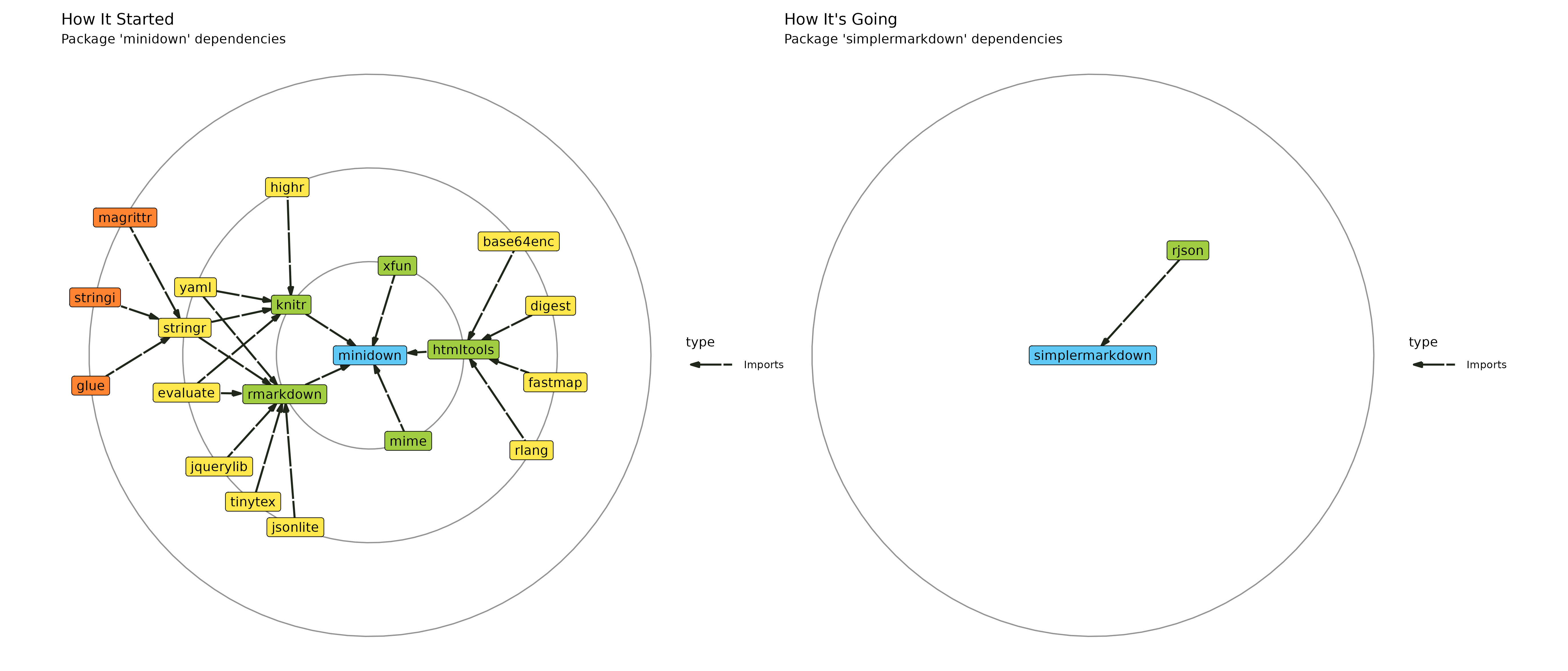
Welcome to the 34th post in the rambunctiously refreshing R recitations, or R4. Today s post is about architecture. Mies defined modernism. When still in Europe, I had been to the Neue Nationalgalerie in Berlin which provides a gorgeous space for the arts. Twenty-five years ago, I worked next to his Toronto-Dominion Center in Toronto. Here in Chicago we have numerous buildings: the Federal Center (the Dirksen, the Kluczynski and the US Post Office rounding out the square in the Loop), multiple buildings on the Illinois Tech (aka IIT) Campus where he taught in the architecture department he created and lead, the (formerly called) IBM Plaza building at the river and more. Structure and minimalism, often based on the same core elements of black steel beams and glass, are a landmark of these buildings. One immediately senses that there is nothing left to take away. Code and programming can be similar. We too compose based on parts we assemble and combine to create something hopefully larger than the parts. The difficulty arising from too many dependencies is something we discussed before both here in this 2018 post but also via the tinyverse site. Over the last seven days, and via uploads to new versions to CRAN, I have switched the vignettes of seven packages from using minidown (which in turn requires rmarkdown and knitr, plus their aggregate dependencies) to using simplermarkdown with its sole dependency. That is, of course, a personal choice. I tend to not even knit much in my vignettes (and simplermarkdown supports what I do) but to rely mostly on pandoc for code rendering. So I only need a small subset of the functionality provided, but I can not access just that as the default comes with numerous bells, whistles as well as enough other instruments to form a small marching band. A picture may express this better: (courtesy of the deepdep package for the figures). Which of these two setups is less likely to surprise you with random breaks, say in continuous integration? Which takes less time to install, and burns fewer cpu cycles just to be set up, each time we run a new test? Which is taxing your students, colleagues, collaborators, users, less on setup for use or replication? The first, comprises a total of 29 dependencies, or the second with just one? My money is on the second choice. Less is more.

28 November 2021

Russ Allbery: Review: Soul Music

Review: Soul Music, by Terry Pratchett
Series: Discworld #16
Publisher: Harper
Copyright: January 1995
Printing: November 2013
ISBN: 0-06-223741-1
Format: Mass market
Pages: 420
Soul Music is the sixteenth Discworld novel and something of a plot sequel to Reaper Man (although more of a sequel to the earlier Mort). I would not start reading the Discworld books here. Susan is a student in the Quirm College for Young Ladies with an uncanny habit of turning invisible. Well, not invisible exactly; rather, people tend to forget that she's there, even when they're in the middle of talking to her. It's disconcerting for the teachers, but convenient when one is uninterested in Literature and would rather read a book.
She listened with half an ear to what the rest of the class was doing. It was a poem about daffodils. Apparently the poet had liked them very much. Susan was quite stoic about this. It was a free country. People could like daffodils if they wanted to. They just should not, in Susan's very definite opinion, be allowed to take up more than a page to say so. She got on with her education. In her opinion, school kept on trying to interfere with it. Around her, the poet's vision was being taken apart with inexpert tools.
Susan's determinedly practical education is interrupted by the Death of Rats, with the help of a talking raven and Binky the horse, and without a lot of help from Susan, who is decidedly uninterested in being the sort of girl who goes on adventures. Adventures have a different opinion, since Susan's grandfather is Death. And Death has wandered off again. Meanwhile, the bard Imp y Celyn, after an enormous row with his father, has gone to Ankh-Morpork. This is not going well; among other things, the Guild of Musicians and their monopoly and membership dues came as a surprise. But he does meet a dwarf and a troll in the waiting room of the Guild, and then buys an unusual music instrument in the sort of mysterious shop that everyone knows has been in that location forever, but which no one has seen before. I'm not sure there is such a thing as a bad Discworld novel, but there is such a thing as an average Discworld novel. At least for me, Soul Music is one of those. There are some humorous bits, a few good jokes, one great character, and some nice bits of philosophy, but I found the plot forgettable and occasionally annoying. Susan is great. Imp is... not, which is made worse by the fact the reader is eventually expected to believe Susan cares enough about Imp to drive the plot. Discworld has always been a mix of parody and Pratchett's own original creation, and I have always liked the original creation substantially more than the parody. Soul Music is a parody of rock music, complete with Cut-Me-Own-Throat Dibbler as an unethical music promoter. The troll Imp meets makes music by beating rocks together, so they decide to call their genre "music with rocks in it." The magical instrument Imp buys has twelve strings and a solid body. Imp y Celyn means "bud of the holly." You know, like Buddy Holly. Get it? Pratchett's reference density is often on the edge of overwhelming the book, but for some reason the parody references in this one felt unusually forced and obvious to me. I did laugh occasionally, but by the end of the story the rock music plot had worn out its welcome. This is not helped by the ending being a mostly incoherent muddle of another parody (admittedly featuring an excellent motorcycle scene). Unlike Moving Pictures, which is a similar parody of Hollywood, Pratchett didn't seem to have much insightful to say about music. Maybe this will be more your thing if you like constant Blues Brothers references. Susan, on the other hand, is wonderful, and for me is the reason to read this book. She is a delightfully atypical protagonist, and her interactions with the teachers and other students at the girl's school are thoroughly enjoyable. I would have happily read a whole book about her, and more broadly about Death and his family and new-found curiosity about the world. The Death of Rats was also fun, although more so in combination with the raven to translate. I wish this part of her story had a more coherent ending, but I'm looking forward to seeing her in future books. Despite my complaints, the parody part of this book wasn't bad. It just wasn't as good as the rest of the book. I wanted a better platform for Susan's introduction than a lot of music and band references. If you really like Pratchett's parodies, your mileage may vary. For me, this book was fun but forgettable. Followed, in publication order, by Interesting Times. The next Death book is Hogfather. Rating: 7 out of 10

15 November 2021

Vincent Bernat: Git as a source of truth for network automation

The first step when automating a network is to build the source of truth. A source of truth is a repository of data that provides the intended state: the list of devices, the IP addresses, the network protocols settings, the time servers, etc. A popular choice is NetBox. Its documentation highlights its usage as a source of truth:
NetBox intends to represent the desired state of a network versus its operational state. As such, automated import of live network state is strongly discouraged. All data created in NetBox should first be vetted by a human to ensure its integrity. NetBox can then be used to populate monitoring and provisioning systems with a high degree of confidence.
When introducing Jerikan, a common feedback we got was: you should use NetBox for this. Indeed, Jerikan s source of truth is a bunch of YAML files versioned with Git.

Why Git? If we look at how things are done with servers and services, in a datacenter or in the cloud, we are likely to find users of Terraform, a tool turning declarative configuration files into infrastructure. Declarative configuration management tools like Salt, Puppet,1 or Ansible take care of server configuration. NixOS is an alternative: it combines package management and configuration management with a functional language to build virtual machines and containers. When using a Kubernetes cluster, people use Kustomize or Helm, two other declarative configuration management tools. Tapped together, these tools implement the infrastructure as code paradigm.
Infrastructure as code is an approach to infrastructure automation based on practices from software development. It emphasizes consistent, repeatable routines for provisioning and changing systems and their configuration. You make changes to code, then use automation to test and apply those changes to your systems. Kief Morris, Infrastructure as Code, O Reilly.
A version control system is a central tool for infrastructure as code. The usual candidate is Git with a source code management system like GitLab or GitHub. You get:
Traceability and visibility
Git keeps a log of all changes: what, who, why, and when. With a bit of discipline, each change is explained and self-contained. It becomes part of the infrastructure documentation. When the support team complains about a degraded experience for some customers over the last two months or so, you quickly discover this may be related to a change to an incoming policy in New York.
Rolling back
If a change is defective, it can be reverted quickly, safely, and without much effort, even if other changes happened in the meantime. The policy change at the origin of the problem spanned over three routers. Reverting this specific change and deploying the configuration let you solve the situation until you find a better fix.
Branching, reviewing, merging
When working on a new feature or refactoring some part of the infrastructure, a team member creates a branch and works on their change without interfering with the work of other members. Once the branch is ready, a pull request is created and the change is ready to be reviewed by the other team members before merging. You discover the issue was related to diverting traffic through an IX where one ISP was connected without enough capacity. You propose and discuss a fix that includes a change of the schema and the templates used to declare policies to be able to handle this case.
Continuous integration
For each change, automated tests are triggered. They can detect problems and give more details on the effect of a change. Branches can be deployed to a test infrastructure where regression tests are executed. The results can be synthesized as a comment in the pull request to help the review. You check your proposed change does not modify the other existing policies.

Why not NetBox? NetBox does not share these features. It is a database with a REST and a GraphQL API. Traceability is limited: changes are not grouped into a transaction and they are not documented. You cannot fork the database. Usually, there is one staging database to test modifications before applying them to the production database. It does not scale well and reviews are difficult. Applying the same change to the production database can be hazardous. Rolling back a change is non-trivial.

Update (2021-11) Nautobot, a fork of NetBox, will soon address this point by using Dolt, an SQL database engine allowing you to clone, branch, and merge, like a Git repository. Dolt is compatible with MySQL clients. See Nautobots, Roll Back! for a preview of this feature.

Moreover, NetBox is not usually the single source of truth. It contains your hardware inventory, the IP addresses, and some topology information. However, this is not the place you put authorized SSH keys, syslog servers, or the BGP configuration. If you also use Ansible, this information ends in its inventory. The source of truth is therefore fragmented between several tools with different workflows. Since NetBox 2.7, you can append additional data with configuration contexts. This mitigates this point. The data is arranged hierarchically but the hierarchy cannot be customized.2 Nautobot can manage configuration contexts in a Git repository, while still allowing to use of the API to fetch them. You get some additional perks, thanks to Git, but the remaining data is still in a database with a different lifecycle. Lastly, the schema used by NetBox may not fit your needs and you cannot tweak it. For example, you may have a rule to compute the IPv6 address from the IPv4 address for dual-stack interfaces. Such a relationship cannot be easily expressed and enforced in NetBox. When changing the IPv4 address, you may forget the IPv6 address. The source of truth should only contain the IPv4 address but you also want the IPv6 address in NetBox because this is your IPAM and you need it to update your DNS entries.

Why not Git? There are some limitations when putting your source of truth in Git:
  1. If you want to expose a web interface to allow an external team to request a change, it is more difficult to do it with Git than with a database. Out-of-the-box, NetBox provides a nice web interface and a permission system. You can also write your own web interface and interact with NetBox through its API.
  2. YAML files are more difficult to query in different ways. For example, looking for a free IP address is complex if they are scattered in multiple places.
In my opinion, in most cases, you are better off putting the source of truth in Git instead of NetBox. You get a lot of perks by doing that and you can still use NetBox as a read-only view, usable by other tools. We do that with an Ansible module. In the remaining cases, Git could still fit the bill. Read-only access control can be done through submodules. Pull requests can restrict write access: a bot can check the changes only modify allowed files before auto-merging. This still requires some Git knowledge, but many teams are now comfortable using Git, thanks to its ubiquity.

  1. Wikimedia manages its infrastructure with Puppet. They publish everything on GitHub. Creative Commons uses Salt. They also publish everything on GitHub. Thanks to them for doing that! I wish I could provide more real-life examples.
  2. Being able to customize the hierarchy is key to avoiding repetition in the data. For example, if switches are paired together, some data should be attached to them as a group and not duplicated on each of them. Tags can be used to partially work around this issue but you lose the hierarchical aspect.

14 November 2021

Russ Allbery: Review: The Last Graduate

Review: The Last Graduate, by Naomi Novik
Series: The Scholomance #2
Publisher: Del Rey
Copyright: 2021
ISBN: 0-593-12887-7
Format: Kindle
Pages: 388
This is a direct sequel to A Deadly Education, by which I mean it starts in the same minute at which A Deadly Education ends (and let me say how grateful I am for a sequel that doesn't drop days, months, or years between books). You do not want to read this series out of order. This book is also very difficult to review without spoiling either it or the previous book, so please bear with me if I'm elliptical in my ravings. Because The Last Graduate is so good. So good, not only as a piece of writing, but as a combination of two of my favorite tropes in fiction, one of which I can't talk about because of spoilers. I adored this book in a way that is not entirely rational. I will attempt a review below anyway, but if you liked the first book, just stop reading here and go read the second one. It's more of everything I loved in the first book except even better, it did some things I was expecting and some things I didn't expect at all, and it's just so ridiculously good. Just be aware that it has another final-line cliffhanger. The third book is coming in (hopefully) 2022. Novik handles the cliffhanger at the end of the previous book beautifully, which is worth noting because there were so many ways in which it could have gone poorly. One of the best things about this series is Novik's skill at writing El's relationship with her mother, even though her mother has not appeared in the series so far. El argues with her mother's voice in her head, tells stories about her, wonders what her mother would think of her classmates (or in some cases knows exactly what her mother would think of her classmates), and sometimes makes the explicit decision to not be her mother. The relationship has the sort of messy complexity, shared history, and underlying respect that many people experience in life but that I've rarely seen portrayed this well in a fantasy novel. Novik's presentation of that relationship works because El's voice is so strong. Within fifteen minutes of starting The Last Graduate, I was already muttering "I love this book" to myself, mostly because of how much I enjoy El's sarcastic, self-deprecating internal commentary. Novik strikes a balance between self-awareness, snark, humor, and real character growth that rivals Murderbot in its effectiveness of first-person perspective. It carries the story over a few weak points, such as a romance that didn't do much for me. Even when I didn't care about part of the plot, I cared about El's opinion of the plot and what it said about El's growing understanding of how to navigate the world. A Deadly Education was scene and character establishment. El insisted on being herself and following her own morals and social rules, and through that found some allies. The Last Graduate gives El enough breathing space to make more nuanced decisions. This is the part of growing up where one realizes the limitations of one's knee-jerk reactions and innate moral judgment. It's also when it becomes hard to trust success that is entirely outside of one's previous experience. El was not a kid who had friends, so she doesn't know what to do with them now that she has them. She's barely able to convince herself that they are friends. This is one of the two fictional tropes I mentioned, the one that I can talk about (at least briefly) without major spoilers. I have such a soft spot for stubborn, sarcastic, principled characters who refuse to play by the social rules that they think are required to make friends and who then find friends who like them for themselves. The moment when they start realizing this has happened and have no idea how to deal with it or how to be a person who has friends is one I will happily read over and over again. I enjoyed this book from the beginning, but there were two points when it grabbed my heart and I was all in. The first one is a huge spoiler that I can't talk about. The second was this paragraph:
[She] came round to me and put her arm around my waist and said under her breath, "Hey, she can be taught," with a tease in her voice that wobbled a little, and when I looked at her, her eyes were bright and wet, and I put my arm around her shoulders and hugged her.
You'll know it when you get there. The Last Graduate also gives the characters other than El and Orion more room, which is part of how it handles the chosen one trope. It's been obvious since early in the first book that Orion is a sort of chosen one, and it becomes obvious to the reader that El may be as well. But Novik doesn't let the plot focus only on them; instead, she uses that trope to look at how alliances and collective action happen, and how no one can carry the weight by themselves. As El learns more and gains power, she also becomes less central to the plot resolution and has to learn how to be less self-reliant. This is not a book where one character is trained to save the world. It's a book where she manages to enlist the support of a kick-ass project manager and becomes part of a team. Middle books of a trilogy are notoriously challenging. Often they're travel books: the first book sets up a problem, the second book moves the characters both physically and emotionally into a position to solve the problem, and the third book is the payoff. Travel books often sag. They can feel obligatory but somewhat boring, like a chore on the way to the third-book climax. The Last Graduate is not a travel book; it is, instead, a pivot book, which is my favorite form of trilogy. It's a book that rewrites the problem the first book set up, both resolving it and expanding the scope beyond what the reader had expected. This is immensely satisfying when done well, and Novik does it extremely well. This is not a flawless book. There are some pacing hiccups, there is a romance angle that didn't work for me (although it does arrive at some character insights that I thought were spot on), and although I think Novik is doing something interesting with the trope, there is a lot of chosen one power escalation happening here. It's not the sort of book that I can claim is perfectly written. Instead, it's the sort of book that uses some of my favorite plot elements and emotional beats in such an effective way and with such a memorable character that I do not have it in me to care about any of the flaws. Your mileage may therefore vary, but I would be happy to read books like this until the end of time. As mentioned above, The Last Graduate ends on another cliffhanger. This time I was worried that Novik might have ended the series there, since there's enough of an internal climax that I could imagine some literary fiction (which often seems allergic to endings) would have stopped here. Thankfully, Novik's web site says this is not the case. The next year is going to be a difficult wait. The third book of this series is going to be incredibly difficult to write, and I hope Novik is up to the challenge she's made for herself. But she handled the transition between the first and second book so well, and this book is so good that I have a lot of hope. If the third book is half as good as I'm hoping, this is going to be one of my favorite fantasy series of all time. Followed by an as-yet-untitled third book. Rating: 10 out of 10

10 November 2021

Craig Small: Changing Grafana Legends

I m not sure if I just can search Google properly, or this really is just not written down much, but I have had problems with Grafana Legends (I would call them the series labels). The issue is that Grafana queries Prometheus for a time series and you want to display multiple lines, but the time-series labels you get are just not quite right. A simple example is you might be using the black-box exporter to monitor an external TCP port and you would just like the port number separate to display. The default output would look like this:
probe_duration_seconds instance="example.net:5222",job="blackbox",module="xmpp_banner"  = 0.01
probe_duration_seconds instance="example.net:5269",job="blackbox",module="xmpp_banner"  = 0.01
I can graph the number of seconds that it takes to probe the 5222 and 5269 TCP ports, but my graph legend is going to have the hostname, making it cluttered. I just want the legend to be the port numbers on Grafana. The answer is to use a Prometheus function called label_replace that takes an existing label, applies a regular expression, then puts the result into another label. That s right, regular expressions, and if you get them wrong then the label just doesn t appear.
Perl REGEX Problems courtesy of XKCD
The label_replace documentation is a bit terse, and in my opinion, the order of parameters is messed up, but after a few goes I had what I needed:
label_replace(probe_duration_seconds module="xmpp_banner" , "port", "$1", "instance", ".*:(.*)")
probe_duration_seconds instance="example.net:5222",job="blackbox",module="xmpp_banner",port="5222" 	0.001
probe_duration_seconds instance="example.net:5269",job="blackbox",module="xmpp_banner",port="5269" 	0.002
The response now has a new label (or field if you like) called port. So what is this function to our data coming from probe_duration_seconds? The function format is: label_replace(value, dst_label, replacement, src_label, regex) So the function does the following:
  1. Evaluate value, which is generally some sort of query such as probe_duration_seconds
  2. Find the required source label src_label, in this example is instance, in this case the values are example.net:5222 and example.net:5269
  3. Apply regular expression regex, for us its .*:(.*) That says skip everying before : then capture/store everything past : . The brackets mean copy what is after the colon and put it in match #1
  4. Make a new label specified in dst_label, for us this is port
  5. Whatever is in replacement goes into dst_label. For this example it is $1 which means match #1 in our regular expression in the label called port.
In short, the function captures everything after the colon in the instance label and puts that into a new label called port. It does this for each value that is returned into the first parameter. This means I can use the port in my Grafana graph Legend and it will show 5222 or 5269 respectively. I have made the Legend TCP port to give the below result, but I could have used port in Grafana Legend and made the result TCP $1 in the label_replace function to get the same result.
Grafana console showing the use of the label_replace function

9 November 2021

Joachim Breitner: How to audit an Internet Computer canister

I was recently called upon by Origyn to audit the source code of some of their Internet Computer canisters ( canisters are services or smart contracts on the Internet Computer), which were written in the Motoko programming language. Both the application model of the Internet Computer as well as Motoko bring with them their own particular pitfalls and possible sources for bugs. So given that I was involved in the creation of both, they reached out to me. In the course of that audit work I collected a list of things to watch out for, and general advice around them. Origyn generously allowed me to share that list here, in the hope that it will be helpful to the wider community.

Inter-canister calls The Internet Computer system provides inter-canister communication that follows the actor model: Inter-canister calls are implemented via two asynchronous messages, one to initiate the call, and one to return the response. Canisters process messages atomically (and roll back upon certain error conditions), but not complete calls. This makes programming with inter-canister calls error-prone. Possible common sources for bugs, vulnerabilities or simply unexpected behavior are:
  • Reading global state before issuing an inter-canister call, and assuming it to still hold when the call comes back.
  • Changing global state before issuing an inter-canister call, changing it again in the response handler, but assuming nothing else changes the state in between (reentrancy).
  • Changing global state before issuing an inter-canister call, and not handling failures correctly, e.g. when the code handling the callback rolls backs.
If you find such pattern in your code, you should analyze if a malicious party can trigger them, and assess the severity that effect These issues apply to all canisters, and are not Motoko-specific.

Rollbacks Even in the absence of inter-canister calls the behavior of rollbacks can be surprising. In particular, rejecting (i.e. throw) does not rollback state changes done before, while trapping (e.g. Debug.trap, assert , out of cycle conditions) does. Therefore, one should check all public update call entry points for unwanted state changes or unwanted rollbacks. In particular, look for methods (or rather, messages, i.e. the code between commit points) where a state change is followed by a throw. This issues apply to all canisters, and are not Motoko-specific, although other CDKs may not turn exceptions into rejects (which don t roll back).

Talking to malicious canisters Talking to untrustworthy canisters can be risky, for the following (likely incomplete) reasons:
  • The other canister can withhold a response. Although the bidirectional messaging paradigm of the Internet Computer was designed to guarantee a response eventually, the other party can busy-loop for as long as they are willing to pay for before responding. Worse, there are ways to deadlock a canister.
  • The other canister can respond with invalidly encoded Candid. This will cause a Motoko-implemented canister to trap in the reply handler, with no easy way to recover. Other CDKs may give you better ways to handle invalid Candid, but even then you will have to worry about Candid cycle bombs that will cause your reply handler to trap.
Many canisters do not even do inter-canister calls, or only call other trustwothy canisters. For the others, the impact of this needs to be carefully assessed.

Canister upgrade: overview For most services it is crucial that canisters can be upgraded reliably. This can be broken down into the following aspects:
  1. Can the canister be upgraded at all?
  2. Will the canister upgrade retain all data?
  3. Can the canister be upgraded promptly?
  4. Is three a recovery plan for when upgrading is not possible?

Canister upgradeability A canister that traps, for whatever reason, in its canister_preupgrade system method is no longer upgradeable. This is a major risk. The canister_preupgrade method of a Motoko canister consists of the developer-written code in any system func preupgrade() block, followed by the system-generated code that serializes the content of any stable var into a binary format, and then copies that to stable memory. Since the Motoko-internal serialization code will first serialize into a scratch space in the main heap, and then copy that to stable memory, canisters with more than 2GB of live data will likely be unupgradeable. But this is unlikely the first limit: The system imposes an instruction limit on upgrading a canister (spanning both canister_preupgrade and canister_postupgrade). This limit is a subnet configuration value, and sepearate (and likely higher) than the normal per-message limit, and not easily determined. If the canister s live data becomes too large to be serialized within this limit, the canister becomes non-upgradeable. This risk cannot be eliminated completely, as long as Motoko and Stable Variables are used. It can be mitigated by appropriate load testing: Install a canister, fill it up with live data, and exercise the upgrade. If this succeeds with a live data set exceeding the expected amount of data by a margin, this risk is probably acceptable. Bonus points for adding functionality that will prevent the canister s live data to increase above a certain size. If this testing is to be done on a local replica, extra care needs to be taken to make sure the local replica actually performs instruction counting and has the same resource limits as the production subnet. An alternative mitigation is to avoid canister_pre_upgrade as much as possible. This means no use of stable var (or restricted to small, fixed-size configuration data). All other data could be
  • mirrored off the canister (possibly off chain), and manually re-hydrated after an upgrade.
  • stored in stable memory manually, during each update call, using the ExperimentalStableMemory API. While this matches what high-assurance Rust canisters (e.g. the Internet Identity) do, This requires manual binary encoding of the data, and is marked experimental, so I cannot recommend this at the moment.
  • not put into a Motoko canister until Motoko has a scalable solution for stable variable (for example keeping them in stable memory permanently, with smart caching in main memory, and thus obliterating the need for pre-upgrade code.)

Data retention on upgrades Obviously, all live data ought to be retained during upgrades. Motoko automatically ensures this for stable var data. But often canisters want to work with their data in a different format (e.g. in objects that are not shared and thus cannot be put in stable vars, such as HashMap or Buffer objects), and thus may follow following idiom:
stable var fooStable =  ;
var foo = fooFromStable(fooStable);
system func preupgrade()   fooStable := fooToStable(foo);  )
system func postupgrade()   fooStable := (empty);  )
In this case, it is important to check that
  • All non-stable global vars, or global lets with mutable values, have a stable companion.
  • The assignments to foo and fooStable are not forgotten.
  • The fooToStable and fooFromStable form bijections.
An example would be HashMaps stored as arrays via Iter.toArray( .entries()) and HashMap.fromIter( .vals()). It is worth pointiong out that a code view will only look at a single version of the code, but cannot check whether code changes will preserve data on upgrade. This can easily go wrong if the names and types of stable variables are changed in incompatible way. The upgrade may fail loudly in this cases, but in bad cases, the upgrade may even succeed, losing data along the way. This risk needs to be mitigated by thorough testing, and possibly backups (see below).

Prompt upgrades Motoko and Rust canisters cannot be safely upgraded when they are still waiting for responses to inter-canister calls (the callback would eventually reach the new instance, and because of infelicities of the IC s System API, could possibly call arbitrary internal functions). Therefore, the canister needs to be stopped before upgrading, and started again. If the inter-canister calls take a long time, this mean that upgrading may take a long time, which may be undesirable. Again, this risk is reduced if all calls are made to trustworthy canisters, and elevated when possibly untrustworthy canisters are called, directly or indirectly.

Backup and recovery Because of the above risk around upgrades it is advisable to have a disaster recovery strategy. This could involve off-chain backups of all relevant data, so that it is possible to reinstall (not upgrade) the canister and re-upload all data. Note that reinstall has the same issue as upgrade described above in prompt upgrades : It ought to be stopped first to be safe. Note that the instruction limit for messages, as well as the message size limit, limit the amount of data returned. If the canister needs to hold more data than that, the backup query method might have to return chunks or deltas, with all the extra complexity that entails, e.g. state changes between downloading chunks. If large data load testing is performed (as Irecommend anyways to test upgradeability), one can test whether the backup query method works within the resource limits.

Time is not strictly monotonic The timestamps for current time that the Internet Computer provides to its canisters is guaranteed to be monotonic, but not strictly monotonic. It can return the same values, even in the same messages, as long as they are processed in the same block. It should therefore not be used to detect happens-before relations. Instead of using and comparing time stamps to check whether Y has been performed after X happened last, introduce an explicit var y_done : Bool state, which is set to False by X and then to True by Y. When things become more complex, it will be easier to model that state via an enumeration with speaking tag names, and update this state machine along the way. Another solution to this problem is to introduce a var v : Nat counter that you bump in every update method, and after each await. Now v is your canister s state counter, and can be used like a timestamp in many ways. While we are talking about time: The system time (typically) changes across an await. So if you do let now = Time.now() and then await, the value in now may no longer be what you want.

Wrapping arithmetic The Nat64 data type, and the other fixed-width numeric types provide opt-in wrapping arithmetic (e.g. +%, fromIntWrap). Unless explicitly required by the current application, this should be avoided, as usually a too large or negatie value is a serious, unrecoverable logic error, and trapping is the best one can do.

Cycle balance drain attacks Because of the IC s canister pays model, all canisters are prone to DoS attacks by draining their cycle balance, and this risk needs to be taken into account. The most elementary mitigation strategy is to monitor the cycle balance of canisters and keep it far from the (configurable) freezing threshold. On the raw IC-level, further mitigation strategies are possible:
  • If all update calls are authenticated, perform this authentication as quickly as possible, possibly before decoding the caller s argument. This way, a cycle drain attack by an unauthenticated attacker is less effective (but still possible).
  • Additionally, implementing the canister_inspect_message system method allows the above checks to be performed before the message even is accepted by the Internet Computer. But it does not defend against inter-canister messages and is therefore not a complete solution.
  • If an attack from an authenticated user (e.g. a stakeholder) is to be expected, the above methods are not effective, and an effective defense might require relatively involved additional program logic (e.g. per-caller statistics) to detect such an attack, and react (e.g. rate-limiting).
  • Such defenses are pointless if there is only a single method where they do not apply (e.g. an unauthenticated user registration method). If the application is inherently attackable this way, it is not worth the bother to raise defenses for other methods.
Related: A justification why the Internet Identity does not use canister_inspect_message) A motoko-implemented canister currently cannot perform most of these defenses: Argument decoding happens unconditionally before any user code that may reject a message based on the caller, and canister_inspect_message is not supported. Furthermore, Candid decoding is not very cycle defensive, and one should assume that it is possible to construct Candid messages that require many instructions to decode, even for simple argument type signatures. The conclusion for the audited canisters is to rely on monitoring to keep the cycle blance up, even during an attack, if the expense can be born, and maybe pray for IC-level DoS protections to kick in.

Large data attacks Another DoS attack vector exists if public methods allow untrustworthy users to send data of unlimited size that is persisted in the canister memory. Because of the translation of async-await code into multiple message handlers, this applies not only to data that is obviously stored in global state, but also local data that is live across an await point. The effectiveness of such attacks is limited by the Internet Computer s message size limit, which is in the order of a few megabytes, but many of those also add up. The problem becomes much worse if a method has an argument type that allows a Candid space bomb: It is possible to encode very large vectors with all values null in Candid, so if any method has an argument of type [Null] or [?t], a small message will expand to a large value in the Motoko heap. Other types to watch out:
  • Nat and Int: This is an unbounded natural number, and thus can be arbitrarily large. The Motoko representation will however not be much larger than the Candid encoding (so this does not qualify as a space bomb).
It is still advisable to check if the number is reasonable in size before storing it or doing an await. For example, when it denotes an index in an array, throw early if it exceeds the size of the array; if it denotes a token amount to transfer, check it against the available balance, if it denotes time, check it against reasonable bounds.
  • Principal: A Principal is effectively a Blob. The Interface specification says that principals are at most 29 bytes in length, but the Motoko Candid decoder does not check that currently (fixed in the next version of Motoko). Until then, a Principal passed as an argument can be large (the principal in msg.caller is system-provided and thus safe). If you cannot wait for the fix to reach you, manually check the size of the princial (via Principal.toBlob) before doing the await.

Shadowing of msg or caller Don t use the same name for the message context of the enclosing actor and the methods of the canister: It is dangerous to write shared(msg) actor, because now msg is in scope across all public methods. As long as these also use public shared(msg) func , and thus shadow the outer msg, it is correct, but it if one accidentially omits or mis-types the msg, no compiler error would occur, but suddenly msg.caller would now be the original controller, likely defeating an important authorization step. Instead, write shared(init_msg) actor or shared( caller = controller ) actor to avoid using msg.

Conclusion If you write a serious canister, whether in Motoko or not, it is worth to go through the code and watch out for these patterns. Or better, have someone else review your code, as it may be hard to spot issues in your own code. Unfortunately, such a list is never complete, and there are surely more ways to screw up your code in addition to all the non-IC-specific ways in which code can be wrong. Still, things get done out there, so best of luck!

31 October 2021

Russ Allbery: Review: Shadow Scale

Review: Shadow Scale, by Rachel Hartman
Series: Seraphina #2
Publisher: Ember
Copyright: 2015
ISBN: 0-375-89659-7
Format: Kindle
Pages: 458
Shadow Scale, despite confusing publisher marketing that calls it a "companion" to Seraphina, is a direct sequel. It picks up shortly after Seraphina and resolves most of the loose ends of the previous book. This is a book for which my completionist tendencies did me no favors. The book I was intending to read, when I started on Hartman's work, is Tess of the Road, but I hate starting series in the middle and it was clear that Tess was set after Seraphina. (I have been repeatedly assured that this doesn't matter and that one can start with Tess. Such reassurances rarely work on me; do as I say, not as I do.) For Seraphina itself, this turned out fine; I'm mildly surprised by the book's Andre Norton award nomination, but it was enjoyable enough and I liked the first-person protagonist. Shadow Scale I approached with a bit more trepidation. I hadn't heard much about it and the few reviews I saw were lukewarm. Unfortunately, there's a reason for that. Seraphina left obvious room for a sequel, including a brewing war, significant unresolved interpersonal relationships, and Seraphina's own newfound understanding of the nature of her internal menagerie. Alas, the start of the book uses the war primarily as plot device (and introduces a brand-new bit of magic that I never found interesting), largely ignores the relationship, and focuses on that third plot element. And by focuses, I mean Seraphina is sent out of the country of Goredd on a journey of map exploration to collect plot coupons. The best description I have for the middle of this book is tedious and depressing. Like a lot of novels, it has a U-shaped plot: things get worse and worse until a crisis, and then start getting better. This plot can work, but the reader has to have a good reason to stick through the depressing bits. One of the better reasons is if the plot allows the main character some small triumphs, maintaining their agency throughout even if larger events are spiraling out of control. This is not one of those books. After some early successes tracking down some objects of her search, Seraphina encounters an antagonist from her own past (barely hinted at in the first book) who can systematically corrupt everything she is trying to do. She spends most of the book feeling like what she's doing is futile, or hoping for things the reader knows aren't going to happen. Given that this is happening during plodding map exploration fantasy through largely indistinguishable faux-medieval countries, or (later) somewhat more interesting but obviously irrelevant local politics in a remote trading city, it's hard to avoid sharing that sense of futility. The other structural problem with Shadow Scale is that the plot coupons are people, which means this book has an excessive cast size problem. Seraphina collects too many people for me to even keep straight, let alone care about. Critical developments (usually for the worst) in the lives of one of these characters were frequently met with reader mutterings like, "Now which one was Brasidas again, was he the plague doctor?" This tends to undermine the emotional impact. It didn't help that the plot was enough of a slog that I kept putting the book aside for a few days. This does get better, but not enough better to redeem the middle of the book, and one has to put up with a lot of helpless despair to get there. Shadow Scale is one of those stories where the protagonist has the innate power to resolve the plot, is told cryptically by various people that this is the case, but has absolutely no idea how to use it and her supposed mentors are essentially useless. The result is that she feels both hopeless and guilty, which was not the reading experience I wanted. I did enjoy the moment when she finally figures it out, and I thought Hartman's idea was reasonably clever, but it would have been better if that had happened faster. Like, 200 pages faster. At least. The major world-building in Seraphina was the dragons. The dragons also show up in this book (and feel less like autism spectrum archetypes, which I appreciated), and in theory are central to the plot, but I'm not entirely sure why? It was an odd reading experience. I think Hartman was attempting to set up dual villains posing different threats, but the dragon one is off-screen for nearly the entire book and never developed, so it feels perfunctory. Near the end of the book, Hartman abruptly picks up the dragons again, but that whole section felt oddly disconnected from the rest of the plot and is only barely relevant to the resolution. At least for me, the plot structure didn't cohere. Shadow Scale does go up a whole point in rating for me because of the romance plot and how Hartman resolves it, which I will not spoil but which I loved. The process of getting there is immensely frustrating because it feels like Hartman is forcing the characters into a corner where only stupid resolutions are possible, but in this case the U-shaped emotional structure worked on me. The ending is completely true to the characters in a way that I thought Hartman had made impossible (and which does a lovely bit of undermining of traditional roles), so full credit there. It helped that the relationship is put on ice for most of the book and only appears at the end (which is also the best part of the book), so it didn't drag on like the other parts of the plot. Overall, though, I tentatively agree with the general advice to skip this one, and suspect that advice will become less tentative once I read Tess of the Road. It's a largely unpleasant slog. There are some mildly interesting world-building revelations that fill in the background of Seraphina, the ending was reasonably good, and the relationships were much better than I was expecting through most of the book, but the amount of time and patience required to get there was not a good trade-off for me. Followed (in the sense that it's set in the same universe but is not a sequel and I suspect does not depend heavily on this plot) by Tess of the Road. Rating: 4 out of 10

23 October 2021

Antoine Beaupr : The Neo-Colonial Internet

I grew up with the Internet and its ethics and politics have always been important in my life. But I have also been involved at other levels, against police brutality, for Food, Not Bombs, worker autonomy, software freedom, etc. For a long time, that all seemed coherent. But the more I look at the modern Internet -- and the mega-corporations that control it -- and the less confidence I have in my original political analysis of the liberating potential of technology. I have come to believe that most of our technological development is harmful to the large majority of the population of the planet, and of course the rest of the biosphere. And now I feel this is not a new problem. This is because the Internet is a neo-colonial device, and has been from the start. Let me explain.

What is Neo-Colonialism? The term "neo-colonialism" was coined by Kwame Nkrumah, first president of Ghana. In Neo-Colonialism, the Last Stage of Imperialism (1965), he wrote:
In place of colonialism, as the main instrument of imperialism, we have today neo-colonialism ... [which] like colonialism, is an attempt to export the social conflicts of the capitalist countries. ... The result of neo-colonialism is that foreign capital is used for the exploitation rather than for the development of the less developed parts of the world. Investment, under neo-colonialism, increases, rather than decreases, the gap between the rich and the poor countries of the world.
So basically, if colonialism is Europeans bringing genocide, war, and its religion to the Africa, Asia, and the Americas, neo-colonialism is the Americans (note the "n") bringing capitalism to the world. Before we see how this applies to the Internet, we must therefore make a detour into US history. This matters, because anyone would be hard-pressed to decouple neo-colonialism from the empire under which it evolves, and here we can only name the United States of America.

US Declaration of Independence Let's start with the United States declaration of independence (1776). Many Americans may roll their eyes at this, possibly because that declaration is not actually part of the US constitution and therefore may have questionable legal standing. Still, it was obviously a driving philosophical force in the founding of the nation. As its author, Thomas Jefferson, stated:
it was intended to be an expression of the American mind, and to give to that expression the proper tone and spirit called for by the occasion
In that aging document, we find the following pearl:
We hold these truths to be self-evident, that all men are created equal, that they are endowed by their Creator with certain unalienable Rights, that among these are Life, Liberty and the pursuit of Happiness.
As a founding document, the Declaration still has an impact in the sense that the above quote has been called an:
"immortal declaration", and "perhaps [the] single phrase" of the American Revolutionary period with the greatest "continuing importance." (Wikipedia)
Let's read that "immortal declaration" again: "all men are created equal". "Men", in that context, is limited to a certain number of people, namely "property-owning or tax-paying white males, or about 6% of the population". Back when this was written, women didn't have the right to vote, and slavery was legal. Jefferson himself owned hundreds of slaves. The declaration was aimed at the King and was a list of grievances. A concern of the colonists was that the King:
has excited domestic insurrections amongst us, and has endeavoured to bring on the inhabitants of our frontiers, the merciless Indian Savages whose known rule of warfare, is an undistinguished destruction of all ages, sexes and conditions.
This is a clear mark of the frontier myth which paved the way for the US to exterminate and colonize the territory some now call the United States of America. The declaration of independence is obviously a colonial document, having being written by colonists. None of this is particularly surprising, historically, but I figured it serves as a good reminder of where the Internet is coming from, since it was born in the US.

A Declaration of the Independence of Cyberspace Two hundred and twenty years later, in 1996, John Perry Barlow wrote a declaration of independence of cyberspace. At this point, (almost) everyone has a right to vote (including women), slavery was abolished (although some argue it still exists in the form of the prison system); the US has made tremendous progress. Surely this text will have aged better than the previous declaration it is obviously derived from. Let's see how it reads today and how it maps to how the Internet is actually built now.

Borders of Independence One of the key ideas that Barlow brings up is that "cyberspace does not lie within your borders". In that sense, cyberspace is the final frontier: having failed to colonize the moon, Americans turn inwards, deeper into technology, but still in the frontier ideology. And indeed, Barlow is one of the co-founder of the Electronic Frontier Foundation (the beloved EFF), founded six years prior. But there are other problems with this idea. As Wikipedia quotes:
The declaration has been criticized for internal inconsistencies.[9] The declaration's assertion that 'cyberspace' is a place removed from the physical world has also been challenged by people who point to the fact that the Internet is always linked to its underlying geography.[10]
And indeed, the Internet is definitely a physical object. First controlled and severely restricted by "telcos" like AT&T, it was somewhat "liberated" from that monopoly in 1982 when an anti-trust lawsuit broke up the monopoly, a key historical event that, one could argue, made the Internet possible. (From there on, "backbone" providers could start competing and emerge, and eventually coalesce into new monopolies: Google has a monopoly on search and advertisement, Facebook on communications for a few generations, Amazon on storage and computing, Microsoft on hardware, etc. Even AT&T is now pretty much as consolidated as it was before.) The point is: all those companies have gigantic data centers and intercontinental cables. And those are definitely prioritizing the western world, the heart of the empire. Take for example Google's latest 3,900 mile undersea cable: it does not connect Argentina to South Africa or New Zealand, it connects the US to UK and Spain. Hardly a revolutionary prospect.

Private Internet But back to the Declaration:
Do not think that you can build it, as though it were a public construction project. You cannot. It is an act of nature and it grows itself through our collective actions.
In Barlow's mind, the "public" is bad, and private is good, natural. Or, in other words, a "public construction project" is unnatural. And indeed, the modern "nature" of development is private: most of the Internet is now privately owned and operated. I must admit that, as an anarchist, I loved that sentence when I read it. I was rooting for "us", the underdogs, the revolutionaries. And, in a way, I still do: I am on the board of Koumbit and work for a non-profit that has pivoted towards censorship and surveillance evasion. Yet I cannot help but think that, as a whole, we have failed to establish that independence and put too much trust in private companies. It is obvious in retrospect, but it was not, 30 years ago. Now, the infrastructure of the Internet has zero accountability to traditional political entities supposedly representing the people, or even its users. The situation is actually worse than when the US was founded (e.g. "6% of the population can vote"), because the owners of the tech giants are only a handful of people who can override any decision. There's only one Amazon CEO, he's called Jeff Bezos, and he has total control. (Update: Bezos actually ceded the CEO role to Andy Jassy, AWS and Amazon music founder, while remaining executive chairman. I would argue that, as the founder and the richest man on earth, he still has strong control over Amazon.)

Social Contract Here's another claim of the Declaration:
We are forming our own Social Contract.
I remember the early days, back when "netiquette" was a word, it did feel we had some sort of a contract. Not written in standards of course -- or barely (see RFC1855) -- but as a tacit agreement. How wrong we were. One just needs to look at Facebook to see how problematic that idea is on a global network. Facebook is the quintessential "hacker" ideology put in practice. Mark Zuckerberg explicitly refused to be "arbiter of truth" which implicitly means he will let lies take over its platforms. He also sees Facebook as place where everyone is equal, something that echoes the Declaration:
We are creating a world that all may enter without privilege or prejudice accorded by race, economic power, military force, or station of birth.
(We note, in passing, the omission of gender in that list, also mirroring the infamous "All men are created equal" claim of the US declaration.) As the Wall Street Journal's (WSJ) Facebook files later shown, both of those "contracts" have serious limitations inside Facebook. There are VIPs who systematically bypass moderation systems including fascists and rapists. Drug cartels and human traffickers thrive on the platform. Even when Zuckerberg himself tried to tame the platform -- to get people vaccinated or to make it healthier -- he failed: "vaxxer" conspiracies multiplied and Facebook got angrier. This is because the "social contract" behind Facebook and those large companies is a lie: their concern is profit and that means advertising, "engagement" with the platform, which causes increased anxiety and depression in teens, for example. Facebook's response to this is that they are working really hard on moderation. But the truth is that even that system is severely skewed. The WSJ showed that Facebook has translators for only 50 languages. It's a surprisingly hard to count human languages but estimates range the number of distinct languages between 2500 and 7000. So while 50 languages seems big at first, it's actually a tiny fraction of the human population using Facebook. Taking the first 50 of the Wikipedia list of languages by native speakers we omit languages like Dutch (52), Greek (74), and Hungarian (78), and that's just a few random nations picks from Europe. As an example, Facebook has trouble moderating even a major language like Arabic. It censored content from legitimate Arab news sources when they mentioned the word al-Aqsa because Facebook associates it with the al-Aqsa Martyrs' Brigades when they were talking about the Al-Aqsa Mosque... This bias against Arabs also shows how Facebook reproduces the American colonizer politics. The WSJ also pointed out that Facebook spends only 13% of its moderation efforts outside of the US, even if that represents 90% of its users. Facebook spends three more times moderating on "brand safety", which shows its priority is not the safety of its users, but of the advertisers.

Military Internet Sergey Brin and Larry Page are the Lewis and Clark of our generation. Just like the latter were sent by Jefferson (the same) to declare sovereignty over the entire US west coast, Google declared sovereignty over all human knowledge, with its mission statement "to organize the world's information and make it universally accessible and useful". (It should be noted that Page somewhat questioned that mission but only because it was not ambitious enough, Google having "outgrown" it.) The Lewis and Clark expedition, just like Google, had a scientific pretext, because that is what you do to colonize a world, presumably. Yet both men were military and had to receive scientific training before they left. The Corps of Discovery was made up of a few dozen enlisted men and a dozen civilians, including York an African American slave owned by Clark and sold after the expedition, with his final fate lost in history. And just like Lewis and Clark, Google has a strong military component. For example, Google Earth was not originally built at Google but is the acquisition of a company called Keyhole which had ties with the CIA. Those ties were brought inside Google during the acquisition. Google's increasing investment inside the military-industrial complex eventually led Google to workers organizing a revolt although it is currently unclear to me how much Google is involved in the military apparatus. Other companies, obviously, do not have such reserve, with Microsoft, Amazon, and plenty of others happily bidding on military contracts all the time.

Spreading the Internet I am obviously not the first to identify colonial structures in the Internet. In an article titled The Internet as an Extension of Colonialism, Heather McDonald correctly identifies fundamental problems with the "development" of new "markets" of Internet "consumers", primarily arguing that it creates a digital divide which creates a "lack of agency and individual freedom":
Many African people have gained access to these technologies but not the freedom to develop content such as web pages or social media platforms in their own way. Digital natives have much more power and therefore use this to create their own space with their own norms, shaping their online world according to their own outlook.
But the digital divide is certainly not the worst problem we have to deal with on the Internet today. Going back to the Declaration, we originally believed we were creating an entirely new world:
This governance will arise according to the conditions of our world, not yours. Our world is different.
How I dearly wished that was true. Unfortunately, the Internet is not that different from the offline world. Or, to be more accurate, the values we have embedded in the Internet, particularly of free speech absolutism, sexism, corporatism, and exploitation, are now exploding outside of the Internet, into the "real" world. The Internet was built with free software which, fundamentally, was based on quasi-volunteer labour of an elite force of white men with obviously too much time on their hands (and also: no children). The mythical writing of GCC and Emacs by Richard Stallman is a good example of this, but the entirety of the Internet now seems to be running on random bits and pieces built by hit-and-run programmers working on their copious free time. Whenever any of those fails, it can compromise or bring down entire systems. (Heck, I wrote this article on my day off...) This model of what is fundamentally "cheap labour" is spreading out from the Internet. Delivery workers are being exploited to the bone by apps like Uber -- although it should be noted that workers organise and fight back. Amazon workers are similarly exploited beyond belief, forbidden to take breaks until they pee in bottles, with ambulances nearby to carry out the bodies. During peak of the pandemic, workers were being dangerously exposed to the virus in warehouses. All this while Amazon is basically taking over the entire economy. The Declaration culminates with this prophecy:
We will spread ourselves across the Planet so that no one can arrest our thoughts.
This prediction, which first felt revolutionary, is now chilling.

Colonial Internet The Internet is, if not neo-colonial, plain colonial. The US colonies had cotton fields and slaves, we have disposable cell phones and Foxconn workers. Canada has its cultural genocide, Facebook has his own genocides in Ethiopia, Myanmar, and mob violence in India. Apple is at least implicitly accepting the Uyghur genocide. And just like the slaves of the colony, those atrocities are what makes the empire run. The Declaration actually ends like this, a quote which I have in my fortune cookies file:
We will create a civilization of the Mind in Cyberspace. May it be more humane and fair than the world your governments have made before.
That is still inspiring to me. But if we want to make "cyberspace" more humane, we need to decolonize it. Work on cyberpeace instead of cyberwar. Establish clear code of conduct, discuss ethics, and question your own privileges, biases, and culture. For me the first step in decolonizing my own mind is writing this article. Breaking up tech monopolies might be an important step, but it won't be enough: we have to do a culture shift as well, and that's the hard part.

Appendix: an apology to Barlow I kind of feel bad going through Barlow's declaration like this, point by point. It is somewhat unfair, especially since Barlow passed away a few years ago and cannot mount a response (even humbly assuming that he might read this). But then again, he himself recognized he was a bit too "optimistic" in 2009, saying: "we all get older and smarter":
I'm an optimist. In order to be libertarian, you have to be an optimist. You have to have a benign view of human nature, to believe that human beings left to their own devices are basically good. But I'm not so sure about human institutions, and I think the real point of argument here is whether or not large corporations are human institutions or some other entity we need to be thinking about curtailing. Most libertarians are worried about government but not worried about business. I think we need to be worrying about business in exactly the same way we are worrying about government.
And, in a sense, it was a little naive to expect Barlow to not be a colonist. Barlow is, among many things, a cattle rancher who grew up on a colonial ranch in Wyoming. The ranch was founded in 1907 by his great uncle, 17 years after the state joined the Union, and only a generation or two after the Powder River War (1866-1868) and Black Hills War (1876-1877) during which the US took over lands occupied by Lakota, Cheyenne, Arapaho, and other native American nations, in some of the last major First Nations Wars.

Appendix: further reading There is another article that almost has the same title as this one: Facebook and the New Colonialism. (Interestingly, the <title> tag on the article is actually "Facebook the Colonial Empire" which I also find appropriate.) The article is worth reading in full, but I loved this quote so much that I couldn't resist reproducing it here:
Representations of colonialism have long been present in digital landscapes. ( Even Super Mario Brothers, the video game designer Steven Fox told me last year. You run through the landscape, stomp on everything, and raise your flag at the end. ) But web-based colonialism is not an abstraction. The online forces that shape a new kind of imperialism go beyond Facebook.
It goes on:
Consider, for example, digitization projects that focus primarily on English-language literature. If the web is meant to be humanity s new Library of Alexandria, a living repository for all of humanity s knowledge, this is a problem. So is the fact that the vast majority of Wikipedia pages are about a relatively tiny square of the planet. For instance, 14 percent of the world s population lives in Africa, but less than 3 percent of the world s geotagged Wikipedia articles originate there, according to a 2014 Oxford Internet Institute report.
And they introduce another definition of Neo-colonialism, while warning about abusing the word like I am sort of doing here:
I m loath to toss around words like colonialism but it s hard to ignore the family resemblances and recognizable DNA, to wit, said Deepika Bahri, an English professor at Emory University who focuses on postcolonial studies. In an email, Bahri summed up those similarities in list form:
  1. ride in like the savior
  2. bandy about words like equality, democracy, basic rights
  3. mask the long-term profit motive (see 2 above)
  4. justify the logic of partial dissemination as better than nothing
  5. partner with local elites and vested interests
  6. accuse the critics of ingratitude
In the end, she told me, if it isn t a duck, it shouldn t quack like a duck.
Another good read is the classic Code and other laws of cyberspace (1999, free PDF) which is also critical of Barlow's Declaration. In "Code is law", Lawrence Lessig argues that:
computer code (or "West Coast Code", referring to Silicon Valley) regulates conduct in much the same way that legal code (or "East Coast Code", referring to Washington, D.C.) does (Wikipedia)
And now it feels like the west coast has won over the east coast, or maybe it recolonized it. In any case, Internet now christens emperors.

12 October 2021

Antonio Terceiro: Triaging Debian build failure logs with collab-qa-tools

The Ruby team is working now on transitioning to ruby 3.0. Even though most packages will work just fine, there is substantial amount of packages that require some work to adapt. We have been doing test rebuilds for a while during transitions, but usually triaged the problems manually. This time I decided to try collab-qa-tools, a set of scripts Lucas Nussbaum uses when he does archive-wide rebuilds. I'm really glad that I did, because those tols save a lot of time when processing a large number of build failures. In this post, I will go through how to triage a set of build logs using collab-qa-tools. I have some some improvements to the code. Given my last merge request is very new and was not merged yet, a few of the things I mention here may apply only to my own ruby3.0 branch. collab-qa-tools also contains a few tools do perform the builds in the cloud, but since we already had the builds done, I will not be mentioning that part and will write exclusively about the triaging tools. Installing collab-qa-tools The first step is to clone the git repository. Make sure you have the dependencies from debian/control installed (a few Ruby libraries). One of the patches I sent, and was already accepted, is the ability to run it without the need to install:
source /path/to/collab-qa-tools/activate.sh
This will add the tools to your $PATH. Preparation The first think you need to do is getting all your build logs in a directory. The tools assume .log file extension, and they can be named $ PACKAGE _*.log or just $ PACKAGE .log. Creating a TODO file
cqa-scanlogs   grep -v OK > todo
todo will contain one line for each log with a summary of the failure, if it's able to find one. collab-qa-tools has a large set of regular expressions for finding errors in the build logs It's a good idea to split the TODO file in multiple ones. This can easily be done with split(1), and can be used to delimit triaging sessions, and/or to split the triaging between multiple people. For example this will create todo into todo00, todo01, ..., each containing 30 lines:
split --lines=30 --numeric-suffixes todo todo
Triaging You can now do the triaging. Let's say we split the TODO files, and will start with todo01. The first step is calling cqa-fetchbugs (it does what it says on the tin):
cqa-fetchbugs --TODO=todo01
Then, cqa-annotate will guide you through the logs and allow you to report bugs:
cqa-annotate --TODO=todo01
I wrote myself a process.sh wrapper script for cqa-fetchbugs and cqa-annotate that looks like this:
#!/bin/sh
set -eu
for todo in $@; do
  # force downloading bugs
  awk ' print(".bugs." $1) ' "$ todo "   xargs rm -f
  cqa-fetchbugs --TODO="$ todo "
  cqa-annotate \
    --template=template.txt.jinja2 \
    --TODO="$ todo "
done
The --template option is a recent contribution of mine. This is a template for the bug reports you will be sending. It uses Liquid templates, which is very similar to Jinja2 for Python. You will notice that I am even pretending it is Jinja2 to trick vim into doing syntax highlighting for me. The template I'm using looks like this:
From:   fullname   <  email  >
To: submit@bugs.debian.org
Subject:   package  : FTBFS with ruby3.0:   summary  
Source:   package  
Version:   version   split:'+rebuild'   first  
Severity: serious
Justification: FTBFS
Tags: bookworm sid ftbfs
User: debian-ruby@lists.debian.org
Usertags: ruby3.0
Hi,
We are about to enable building against ruby3.0 on unstable. During a test
rebuild,   package   was found to fail to build in that situation.
To reproduce this locally, you need to install ruby-all-dev from experimental
on an unstable system or build chroot.
Relevant part (hopefully):
 % for line in extract % >   line  
 % endfor % 
The full build log is available at
https://people.debian.org/~kanashiro/ruby3.0/round2/builds/3/  package  /  filename   replace:".log",".build.txt"  
The cqa-annotate loop cqa-annotate will parse each log file, display an extract of what it found as possibly being the relevant part, and wait for your input:
######## ruby-cocaine_0.5.8-1.1+rebuild1633376733_amd64.log ########
--------- Error:
     Failure/Error: undef_method :exitstatus
     FrozenError:
       can't modify frozen object: pid 2351759 exit 0
     # ./spec/support/unsetting_exitstatus.rb:4:in  undef_method'
     # ./spec/support/unsetting_exitstatus.rb:4:in  singleton class'
     # ./spec/support/unsetting_exitstatus.rb:3:in  assuming_no_processes_have_been_run'
     # ./spec/cocaine/errors_spec.rb:55:in  block (2 levels) in <top (required)>'
Deprecation Warnings:
Using  should  from rspec-expectations' old  :should  syntax without explicitly enabling the syntax is deprecated. Use the new  :expect  syntax or explicitly enable  :should  with  config.expect_with(:rspec)    c  c.syntax = :should   instead. Called from /<<PKGBUILDDIR>>/spec/cocaine/command_line/runners/backticks_runner_spec.rb:19:in  block (2 levels) in <top (required)>'.
If you need more of the backtrace for any of these deprecations to
identify where to make the necessary changes, you can configure
 config.raise_errors_for_deprecations! , and it will turn the
deprecation warnings into errors, giving you the full backtrace.
1 deprecation warning total
Finished in 6.87 seconds (files took 2.68 seconds to load)
67 examples, 1 failure
Failed examples:
rspec ./spec/cocaine/errors_spec.rb:54 # When an error happens does not blow up if running the command errored before execution
/usr/bin/ruby3.0 -I/usr/share/rubygems-integration/all/gems/rspec-support-3.9.3/lib:/usr/share/rubygems-integration/all/gems/rspec-core-3.9.2/lib /usr/share/rubygems-integration/all/gems/rspec-core-3.9.2/exe/rspec --pattern ./spec/\*\*/\*_spec.rb --format documentation failed
ERROR: Test "ruby3.0" failed:
----------------
ERROR: Test "ruby3.0" failed:      Failure/Error: undef_method :exitstatus
----------------
package: ruby-cocaine
lines: 30
------------------------------------------------------------------------
s: skip
i: ignore this package permanently
r: report new bug
f: view full log
------------------------------------------------------------------------
Action [s i r f]:
You can then choose one of the options: When there are existing bugs in the package, cqa-annotate will list them among the options. If you choose a bug number, the TODO file will be annotated with that bug number and new runs of cqa-annotate will not ask about that package anymore. For example after I reported a bug for ruby-cocaine for the issue listed above, I aborted with a ctrl-c, and when I run my process.sh script again I then get this prompt:
----------------
ERROR: Test "ruby3.0" failed:      Failure/Error: undef_method :exitstatus
----------------
package: ruby-cocaine
lines: 30
------------------------------------------------------------------------
s: skip
i: ignore this package permanently
1: 996206 serious ruby-cocaine: FTBFS with ruby3.0: ERROR: Test "ruby3.0" failed:      Failure/Error: undef_method :exitstatus  
r: report new bug
f: view full log
------------------------------------------------------------------------
Action [s i 1 r f]:
Chosing 1 will annotate the TODO file with the bug number, and I'm done with this package. Only a few other hundreds to go.

6 October 2021

Matthew Palmer: Discovering AWS IAM accounts

Let s say you re someone who happens to discover an AWS account number, and would like to take a stab at guessing what IAM users might be valid in that account. Tricky problem, right? Not with this One Weird Trick! In your own AWS account, create a KMS key and try to reference an ARN representing an IAM user in the other account as the principal. If the policy is accepted by PutKeyPolicy, then that IAM account exists, and if the error says Policy contains a statement with one or more invalid principals then the user doesn t exist. As an example, say you want to guess at IAM users in AWS account 111111111111. Then make sure this statement is in your key policy:

 
  "Sid": "Test existence of user",
  "Effect": "Allow",
  "Principal":  
    "AWS": "arn:aws:iam::111111111111:user/bob"
   ,
  "Action": "kms:DescribeKey",
  "Resource": "*"
 
If that policy is accepted, then the account has an IAM user named bob. Otherwise, the user doesn t exist. Scripting this is left as an exercise for the reader. Sadly, wildcards aren t accepted in the username portion of the ARN, otherwise you could do some funky searching with ...:user/a*, ...:user/b*, etc. You can t have everything; where would you put it all? I did mention this to AWS as an account enumeration risk. They re of the opinion that it s a good thing you can know what users exist in random other AWS accounts. I guess that means this is a technique you can put in your toolbox safe in the knowledge it ll work forever. Given this is intended behaviour, I assume you don t need to use a key policy for this, but that s where I stumbled over it. Also, you can probably use it to enumerate roles and anything else that can be a principal, but since I don t see as much use for that, I didn t bother exploring it. There you are, then. If you ever need to guess at IAM users in another AWS account, now you can!

30 September 2021

Holger Levsen: 20210930-Debian-Reunion-Hamburg-2021

Debian Reunion Hamburg 2021 is almost over... The Debian Reunion Hamburg 2021 is almost over now, half the attendees have already left for Regensburg, while five remaining people are still busy here, though tonight there will be two concerts at the venue, plus some lovely food and more. Together with the day trip tomorrow (involving lots of water but hopefully not from above...) I don't expect much more work to be done, so that I feel comfortable publishing the following statistics now, even though I expect some more work will be done while travelling back or due to renewed energy from the event! So I might update these numbers later :-) Together we did: I think that's a pretty awesome and am very happy we did this event! Debian Reunion / MiniDebConf Hamburg 2022 - save the date, almost! Thus I think we should have another Debian event at Fux in 2022, and after checking suitable free dates with the venue I think what could work out is an event from Monday May 23rd until Sunday May 29th 2022. What do you think? For now these dates are preliminary. If you know any reasons why these dates could be less than optimal for such an event, please let me know. Assuming there's no feedback indicating this is a bad idea, the dates shall be finalized by November 1st 2021. Obviously assuming having physical events is still and again a thing! ;-)

28 September 2021

Holger Levsen: 20210928-Debian-Reunion-Hamburg-2021

Debian Reunion Hamburg 2021, klein aber fein / small but beautiful So the Debian Reunion Hamburg 2021 has been going on for not yet 48h now and it appears people are having fun, enjoying discussions between fellow Debian people and getting some stuff done as well. I guess I'll write some more about it once the event is over... Sharing android screens... For now I just want to share one little gem I learned about yesterday on the hallway track:
$ sudo apt install scrcpy
$ scrcpy
And voila, once again I can type on my phone with a proper keyboard and copy and paste URLs between the two devices. One can even watch videos on the big screen with it :) (This requires ADB debugging enabled on the phone, but doesn't require root access.)

Next.

Previous.