Search Results: "lucas"

9 September 2010

Lucas Nussbaum: SSH ProxyCommand and belier

Christoph, belier really looks like a hack. It s easy to use ProxyCommand to connect to hosts using several hops. Let s say that you want to connect to host c, which can only be reached from host b, which can only be reached from host a. It s as simple as doing:
Host a
    User logina
Host b
    ProxyCommand ssh a nc -q 1 b 22
    User loginb
Host c
    ProxyCommand ssh b nc -q 1 b 22
    User loginc
And of course, it just works with scp, rsync, and everything ssh-based. It cannot auto-login using passwords, but I m not sure that having passwords in clear text is a good idea either;)

25 August 2010

Lucas Nussbaum: System calls quizz

  1. What is special about the socket, connect, bind, accept, system calls?
  2. How does the errno value get from the kernel to applications?
  3. Some system calls return a number of times different of 1 in some cases. Which ones? (Put differently: enter a syscall once, exit more or less than once. Which ones can do that?)
(Thanks MG!)

24 August 2010

Lucas Nussbaum: RVM: seriously?

There s some hype in the Ruby community about RVM (Ruby Version Manager). It s a tool that allows to switch between Ruby versions on the same system (much like what the alternatives system provides for Java on Debian, except that RVM does it either system-wide or per-user). However, when you look at it, RVM looks quite scary. The recommended installation instruction is:
bash < <( curl http://rvm.beginrescueend.com/releases/rvm-install-head ).
That script doesn t use set -e, and actually does a git clone behind the scenes. Without first checking that git is installed. But if you don t have git installed, it s not a problem: there s another script later on the page that downloads and compiles it for you. After installing RVM itself, you need to install rubies (different ruby implementations). Use rvm install ree,1.9.2-head,jruby. That will automatically download and build the various versions in your homedir. It s interesting to note the the compilation messages were probably too scary, and are not displayed. But how does it handle the switch between different versions ? First, you need to add some magic to your .bashrc:
[[ -s "$HOME/.rvm/scripts/rvm" ]] && . "$HOME/.rvm/scripts/rvm"
or, for a system-wide install of rvm:
[[ -s "/usr/local/rvm/scripts/rvm" ]] && . "/usr/local/rvm/scripts/rvm"
And then, you can select your ruby implementation using rvm --default 1.9.2, for example. That works by redefining $PATH:
# echo $PATH
/usr/local/rvm/gems/ruby-1.9.2-p0/bin:/usr/local/rvm/gems/ruby-1.9.2-p0@global/bin:/usr/local/rvm/rubies/ruby-1.9.2-p0/bin:/usr/local/bin:/usr/local/bin:/usr/local/sbin:/usr/sbin:/usr/bin:/sbin:/bin:/usr/bin/X11
Of course, that s quite fragile: if you are in one of the cases where bash doesn t read .bashrc, or if you happen to be using dash, you lose. Looking at the code of RVM itself, it is also very fragile: it s pure bash, without any error handling. During my test (in a chroot), I often got error messages about missing commands that were apparently ignored. The installer insists on using colors, and spews lots of error messages if executed without a controlling tty. There are also some interesting code snippets like perl -e 'sleep 0.5'. So, where do we go from here? Well, obviously, with my Debian hat, I m not going to advocate a solution that makes everything possible to avoid the distribution s packaging system, and I don t see RVM being packaged in Debian anytime soon.
In Debian, we already provide co-installability of Ruby 1.8 and 1.9.2, and users are free to choose which one to use on a per-script basis, by running them with version-suffixed ruby executables. The ruby executable itself still points to 1.8, as it s clearly too early to make 1.9.2 the default. Many Ruby libraries are provided for both 1.8 and 1.9.2, and we plan to discuss changes in the packaging system to be able to make it easier to provide packages for both versions. There s also recent work on packaging JRuby, but it s quite hard as it requires removing all the non-free or undistributable parts, and packaging them separately.

17 August 2010

Lucas Nussbaum: List of new Debian contributors

Since I worked on UDD s upload history gatherer during Debconf, I generated the list of new Debian contributors. (By contributor, I mean here someone in the Changed-By field of an upload (so it s not necessarily the maintainer of the package he/she upload)). It s quite fun to try to remember the context of your first upload to Debian (which package, who sponsored it), and look at the other contributors that graduated at the same time as you did. Or to see the constant flux of new contributors.

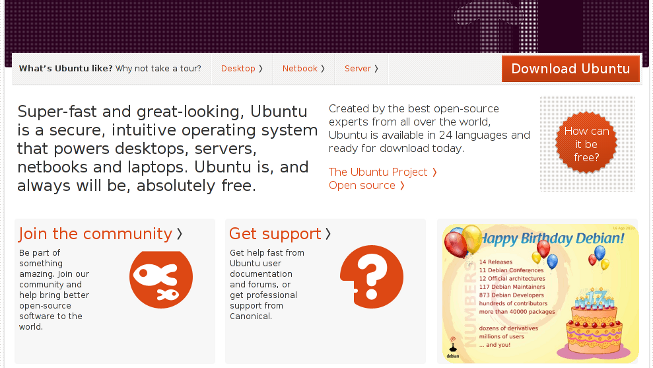
Lucas Nussbaum: Debian s birthday on ubuntu.com today!

3 August 2010

Lucas Nussbaum: On extending Debian membership to non-programming contributors

Stefano raised again the issue of providing some kind of Debian membership to people that contribute to Debian in unusual ways (not involving deep purely technical skills), like doing translation, documentation, marketing, design, etc. Each time this discussion comes back, people seem to think that we need another membership status for them. But what for? It s true that the name Debian Developer is suboptimal for non-programmers. But it s also suboptimal for most DDs, since most of us don t strictly develop software: we just maintain packages, mainly developing meta-data around the upstream source code. Debian Developer is how we call our full-fledged project members. Do we want to classify those non-programming contributors as second-class citizens? If not, we need to make them Debian Developers , not some strange other name. Of course, there s the issue of security and trust. Debian Developers have upload rights on all packages, and access to the project s machines. And it s a bit strange to trust non-programmers with that level of power. On the other hand, we have many Debian Developers that are mostly inactive, became DDs half a decade ago, and have the same access rights. Worst, it s possible that they remember how to use dput, having used it before! And 95% of DDs (me included) should probably not be uploading the libc, even if they can. Why should they be more trusted than active non-programming contributors that probably would be quite scared by the idea of breaking something? Overall, I think that this issue is actually a non-issue. We should:

2 August 2010

Lucas Nussbaum: Ubuntu bugs with patches on the PTS and the QA Packages Overview

Like the Debian BTS, Launchpad is full of open bugs with patches[1]. They have an ongoing effort called Operation Cleansweep whose goal is to get the number of bugs with patches to zero, by reviewing patches and forwarding them upstream or to Debian. Since it really makes sense to expose bugs with patches to the Debian maintainers, I ve modified the Ubuntu box on the Packages Tracking System and the Ubuntu column on the QA Packages Overview (hidden by default for now) to include that information. You can see the result on the dpkg PTS page and the debian-pkg@ packages overview page. Many thanks to Brian Murray for making this possible on the Launchpad side.
[1] Debian has 55115 open bugs affecting unstable, of which 4011 have a patch. Ubuntu has 76916 open bugs, of which 2207 have a patch. [Insert here disclaimer that this is not at all a judgement of value on the abilities of any distribution at triaging bugs, or at generating patches]
Relevant UDD queries:
select count(*) from bugs
where affects_unstable and status = 'pending'
and id in (select id from bugs_tags where tag ='patch');
select count(*) from bugs
where affects_unstable and status = 'pending';
select count(distinct bugs.bug)
from ubuntu_bugs_tasks tasks,ubuntu_bugs bugs
where tasks.bug = bugs.bug
and distro in ('', 'Ubuntu')
and status not in ('Invalid', 'Fix Released', 'Won''t Fix')
and bugs.patches is true;
select count(distinct bugs.bug)
from ubuntu_bugs_tasks tasks,ubuntu_bugs bugs
where tasks.bug = bugs.bug
and distro in ('', 'Ubuntu')
and status not in ('Invalid', 'Fix Released', 'Won''t Fix');

1 August 2010

Lucas Nussbaum: Help needed: analyzing and filing installation/removal/upgrade bugs

I ve been working on a piuparts-like tool call instest (yeah, crappy name) to test installation, removal and upgrade of packages. Compared to piuparts, it s simpler and tries to make it easier to file bugs. However, running it on sid still raises ~3000 failures. So I m seeking help to analyze those failures and file bugs. The tasks are: If you want to help, just contact me at Debconf!

31 July 2010

Lucas Nussbaum: Skipping fsck checks during boot with CTRL-C

According to Murphy s law, the fsck check that happens once every n boots always happens at the worst time. By default, using CTRL-C to abort it causes fsck to exit with an error, and the filesystem to be remounted read-only. It s easy to change that in /etc/e2fsck.conf:
[options]
allow_cancellation = true

30 July 2010

Lucas Nussbaum: Debcamp+Debconf again!

As I did since 2007, I will be attending Debconf again this year. I have been quite busy recently, and am lagging behind in some of my Debian work, so I plan to use Debconf to get stuff done, not just socialize and attend talks. Here is my TODO list, basically by order of willingness to do the work . It s probably too much for 9 days, so don t hesitate to talk to me if you want to help with some items.

7 July 2010

Rapha&#235;l Hertzog: Joining Ubuntu as a Debian developer

I m a Debian developer since 1998 and have been fostering cooperation between Debian and Ubuntu since its inception with various levels of success. I recently decided to go one step further and join Ubuntu as an official member. I wanted to be able to vote and to promote best cooperation practices from the Ubuntu side as well (and not only in Debian). Joining as a Debian developer should be relatively easy, it is well known in the Debian community that Mark Shuttleworth once said:
Every Debian developer is also an Ubuntu developer, because one way to contribute to Ubuntu is to contribute to Debian.
So I sought to verify that too! Here s the result. I prepared my application page collecting 2 testimonials from Lucas Nussbaum and Colin Watson, I registered for the next EMEA membership meeting (which happened yesterday, irc logs here), and I attended. (I just followed the instructions on the wiki) During the meeting, when it was my turn, I pasted my short introduction and got immediately +1 votes from several board members, they didn t even want to hear from me, they were already convinced. :-) I still responded to a few questions and elaborated on my goals and was promptly accepted even if I made it clear that my technical contributions will continue to be done within Debian. A few minutes later I was added to the ubuntumembers launchpad group and this morning I followed the instructions to add my feed to Planet Ubuntu and here I am The whole process has been very smooth and the meeting shows a very welcoming attitude. Even someone who was denied the Ubuntu member status was cheered for his work and encouraged to try again when he can present some testimonials from other members. Hello Planet Ubuntu! Flattr this Share/Bookmark 11 comments Support my work

6 July 2010

Matt Zimmerman: We ve packaged all of the free software what now?

Today, virtually all of the free software available can be found in packaged form in distributions like Debian and Ubuntu. Users of these distributions have access to a library of thousands of applications, ranging from trivial to highly sophisticated software systems. Developers can find a vast array of programming languages, tools and libraries for constructing new applications. This is possible because we have a mature system for turning free software components into standardized modules (packages). Some software is more difficult to package and maintain, and I m occasionally surprised to find something very useful which isn t packaged yet, but in general, the software I want is packaged and ready before I realize I need it. Even the long tail of niche software is generally packaged very effectively. Thanks to coherent standards, sophisticated management tools, and the principles of software freedom, these packages can be mixed and matched to create complete software stacks for a wide range of devices, from netbooks to supercomputing clusters. These stacks are tightly integrated, and can be tested, released, maintained and upgraded as a unit. The Debian system is unparalleled for this purpose, which is why Ubuntu is based on it. The vision, for a free software operating system which is highly modular and customizable, has been achieved. Rough edges This is a momentous achievement, and the Debian packaging system fulfills its intended purpose very well. However, there are a number of areas where it introduces friction, because the package model doesn t quite fit some new problems. Most of these are becoming more common over time as technology evolves and changes shape. Why are we stuck?
I suppose it is tempting, if the only tool you have is a hammer, to treat everything as if it were a nail.
Abraham Maslow
The packaging ecosystem is very strong. Not only do we have powerful tools for working with packages, we also benefit from packages being a well-understood concept, and having established processes for developing, exchanging and talking about them. Once something is packaged, we know what it is and how to work with it, and it fits into everything else. So, it is tempting to package everything in sight, as we already know how to make sense of packages. However, this may not always be the right tool for the job. Various attempts have been made to extend the packaging concept to make it more general, for example: Other package managers aim to solve a specific problem, such as providing lightweight package management for embedded systems, or lazy dependency installation, or fixing the filesystem hierarchy. There is a long list of package managers of various levels which solve different problems. Most of these systems suffer from an important fundamental tradeoff: they are designed to manage the entire system, from the kernel through applications, and so they must be used wholesale in order to reap their full benefit. In other words, in their world, everything is a package, and anything which is not a package is out of scope. Therefore, each of these systems requires a separate collection of packages, and each time we invent a new one, its adherents set about packaging everything in the new format. It takes a very long time to do this, and most of them lose momentum before a mature ecosystem can form around them. This lock-in effect makes it difficult for new packaging technologies to succeed. Divide and Conquer No single package management framework is flexible enough to accommodate all of the needs we have today. Even more importantly, a generic solution won t account for the needs we will have tomorrow. I propose that in order to move forward, we must make it possible to solve packaging problems separately, rather than attempting to solve them all within a single system. But I like things how they are! We don t have a choice. The world is changing around us, and distributions need to evolve with it. If we don t adapt, we will eventually give way to systems which do solve these problems. Take, for example, modern web browsers like Firefox and Chromium. Arguably the most vital application for users, the browser is coming under increasing pressure to keep up with the breakneck pace of innovation on the web. The next wave of real-time collaboration and multimedia applications relies on the rapid development of new capabilities in web browsers. Browser makers are responding by accelerating deployment in the field: both aggressively push new releases to their users. A report from Google found that Chrome upgrades 97% of their users within 21 days of a new release, and Firefox 85% (both impressive numbers). Mozilla recently changed their maintenance policies, discontinuing maintenance of stable releases and forcing Ubuntu to ship new upstream releases to users. These applications are just the leading edge of the curve, and the pressure will only increase. Equally powerful trends are pressing server applications, embedded systems, and data to adapt as well. The ideas I ve presented here are only one possible way forward, and I m sure there are more and better ideas brewing in distribution communities. I m sure that I m not the only one thinking about these problems. Whatever it looks like in the end, I have no doubt that change is ahead.

26 June 2010

Anand Kumria: Get Low

A story about getting people together to tell them a story of regret involving the main character, which we see at the start. The story itself isn't very dramatic. Which is why there isn't a film about that. Instead we have the story about getting people to tell the story. This is a great example of a movie with a mind-boggingly amazing cast (Bill Murray, Robert Duvell, Sissy Spacek, Lucas Black) having a script that is crap. Having the director present, to discuss the film, after the screening lifted this from a 1 to 2. Hearing Aaron talk about the different styles of Duvell, Murray and how the editing process was actually done (Final Cut Pro) was very entertaining. The story drifts, the soundtrack doesn't annoy and the filmography is alright. Oh, the period setting is done very well. Not much else to recommend it though. Get Low refers to burying in the film. Something I think that should have happened to this film.

6 June 2010

Lucas Nussbaum: #debian-ubuntu on OFTC

If you are a Debian developer and need realtime interaction with an Ubuntu developer about the state of your packages in Ubuntu (or vice-versa), #debian-ubuntu on irc.oftc.net might be useful. I had forgotten about that channel, but it resurfaced during the discussions about improving communication between both projects.

Lucas Nussbaum: EtherPad: web-based collaborative editor

I recently (during a UDS lightning talk) discovered EtherPad. It s a collaborative editor (like gobby), but uses a browser instead of a standalone application. It s free software (Google open sourced it after buying the company that was developing it), and there s a free online instance at ietherpad.com. Setting up a new pad is as simple as going to http://ietherpad.com/foo and clicking Create Pad. It s written in Java, and not packaged in Debian (yet).

4 June 2010

Lucas Nussbaum: XMPP Video calls with Nokia N900

So, this morning, I did my first video call over XMPP between two N900. However, so far, I failed to do an XMPP video call from an N900 to something else. When I try to call pidgin on my laptop, pidgin simply crashes, but of course that s not a serious bug if people can DOS your pidgin instance since, according to the Debian bug:
Assuming your XMPP settings require that users must authenticate with you before being able to send you messages, only your authenticated users would be able to freeze your client, assuming they knew you were actually affected by this bug.
The upstream pidgin bug hasn t seen a lot of activity lately. :-(

2 June 2010

Axel Beckert: xen-tools back in Debian Unstable

After xen-tools had been removed from Debian Unstable by the upstream developer last December due to no more upstream development, I took over upstream development as well as Debian package maintainership in January. Since then a lot happened: But despite all the things which were to fix after Steve discontinued the xen-tools developement, Steve Kemp did a great job to bring xen-tools so far initially. I m really happy that this software exists and that s the reason why I won t let it die so fast. :-) xen-tools 4.2 beta 1 released Last weekend I released xen-tools 4.2 beta 1 which I also uploaded to Debian Unstable. And thanks to the active ftp-master team, xen-tools went through the NEW queue in less than 12 hours and is now available again in Debian Unstable. 4.2 beta 1 still has some known bugs, the worst ones are in xen-delete-image. But no fear, it doesn t delete more than wanted, just not enough or things which don t exist anyway. :-) There are also some smaller issues to fix for a final 4.2 release. We may also create an PPA for Ubuntu Lucid in the future to work around the lack of xen-tools in Ubuntu Lucid. What about Fedora/RedHat/CentOS support? Since rinse is out of date with regards to current Fedora releases, rpmstrap seems to be out of date for even longer (it has been removed from Debian before the Lenny release) and febootstrap neither seems to work out of the box nor seems to support bootstrapping to mount points (because it wants to delete them first and fails), bootstrapping Fedora ist currently not supported. The copy installation method should work though. rinse still is able to bootstrap CentOS 4 and 5, but the installation seems incomplete. We ll try to work around these issues for the final 4.2 release. We haven t looked at mach and mock so far, but according to Lucas, both are out of date, too. Sure, implementing Lucas howto in form of a script would be a possible way, but we think it would just create yet another not so well supported clone of rinse, rpmstrap, mach, mock or febootstrap. Because of that, Dmitry works on support for the installation of Xen DomUs via kickstart. Fate of xen-shell? Xen-shell has also been removed from Debian Unstable last December because Steve stopped its developement, too. But in comparison to xen-tools itself, we didn t resurrect xen-shell since none of us currently has use for it. So if you are currently using xen-shell and intend to continue to do so, you should hurry up if you want to see it in Debian Squeeze. We can also help you, but we surely can t and won t do it alone nor will we take the majority of the necessary workload.

29 May 2010

Lucas Nussbaum: Ubuntu and Debian

I recently noticed the new Ubuntu and Debian link on every page of http://www.ubuntu.com/. That is very nice, and much better than the previous situation. Debian is also mentioned on the pages about Easy administration and Security. Canonical has clearly improved a lot in the way they communicate about how Ubuntu bases its development on Debian s.

25 May 2010

Lucas Nussbaum: Booting ISO or USB key images directly from Grub2?

I m playing with the idea of booting ISO images and USB key images stored in a disk partition directly from Grub2. That would allow to install Linux or test liveCDs without even using a USB key. It seems that Grub2 has everything needed for that (with a combination of drivemap and chainloader), but I can t seem to get it working and, as usual with boot stuff, it s a pain to understand what s happening. Has somebody recently tried that, or can point me to a howto?

14 May 2010

Lucas Nussbaum: Receive Ubuntu bugs by mail with the Debian PTS

It is now possible to subscribe to Ubuntu bugmail for the packages you care about, without having to use Launchpad (and subscribe on a per-package basis there). This is implemented as a new opt-in Package Tracking System keyword: derivatives-bugs. To subscribe for all your packages, use keyword [email] + derivatives-bugs (as documented in the Developers Reference). You might also want to subscribe to derivatives (Ubuntu diff, etc. also opt-in). Of course, if other derivative distributions are interested in providing such data, don t hesitate to contact me or the Debian QA team. Also, if you are like me and never remember about subscribing to packages you maintain, you can use that UDD script to check for missing subscriptions.

Next.

Previous.