Search Results: "joey"

6 September 2012

Joey Hess: UPS farce

This is not the kind of place I live, though I don't mind a visit. Errol looking out over Salsalito and the Bay I'm not bothered by a more rural life, I thrive on peace and quiet, and am not bothered by needing to haul my water, split firewood, or spend an hour just mowing my driveway. I bought a GPS the other day, and it doesn't know where my driveway is..

or where the road leading to my driveway is..
or even about the highway leading to that road!
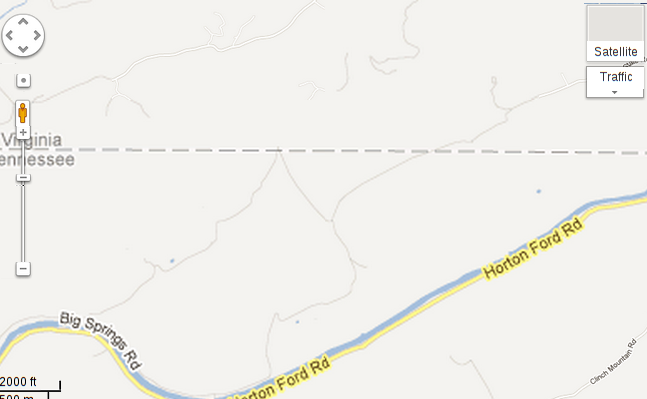
not many roads on this map.. The only thing that really bothers me about living here off the map is that I'm in the middle of a food desert too. The nearest semi-decent grocery store and produce market are 40 minutes away. There's one restaurant worth eating at, and while a very congenial place to eat rustic food while watching the river flow by, it serves almost no vegetables. Adding to the problem, my fridge is a rather expensive propane model, which is about half a normal size, and has no freezer. Managing a healthy meal plan is a constant struggle, though I do have time to cook, at least, thanks to not having the kind of commute that is typical around here. Well, the food desert was my only real problem. Now I can add to that the UPS emergency. A week ago, a package left Shenzen China for here. It quickly passed through Anchorage Alaska, and with a few days had arrived an hour and a half from here. Getting it here has taken the whole rest of the week.
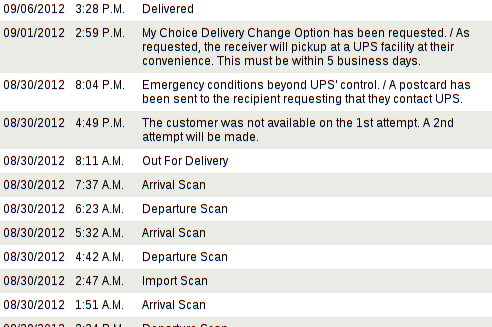
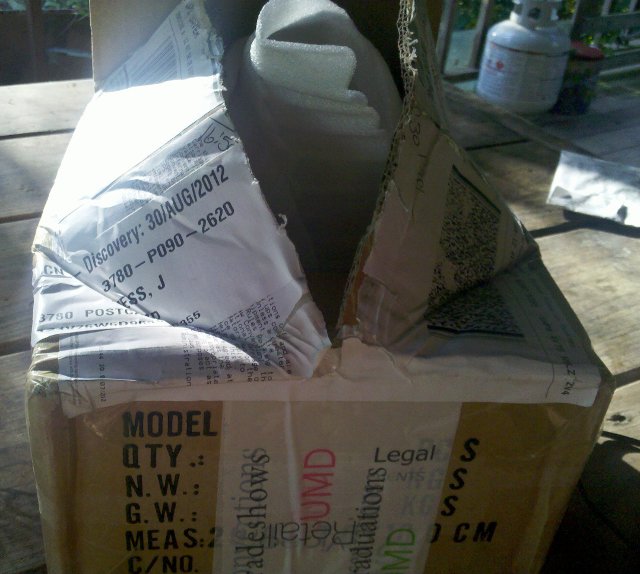
I only knew UPS attempted delivery because a neighbor told me. Seems they took one look at my driveway and turned around. They never tried again, and they didn't bother to leave a note on the mailbox, or anything. Now, the US postal service is happy to drive up this driveway; they drive a sensible 4x4 around here. I think DHL and Fedex have been here too. (Contrary to John Goerzen's experiences) My compact car is not bothered by my driveway either... But UPS's brand involves large brown trucks, even where inappropriate, and damage to them from such things as low-hanging branches apparently comes out of the driver's paycheck. And while normally UPS leaves small things in my mailbox, or with a neighbor, this was an important package from China, and it needed a signature. But really, a post card? "emergency"?! So, I bought the GPS to find UPS, because my package was in an industrial park in some town I've never been to. And on Tuesday I was within an hour of there and swung by. And it was closed. UPS's website had not mentioned this; other businesses are open the day after Memorial day. That turned out to be a really annoying day all around. When I got home, after a night away, I found my fridge's fire had blown out, and nearly all my food was only fit for the dog. Today I went out to try again (and buy groceries). When I reached the UPS depot.. it was closed! Until 3 pm. At this point I felt this story was reaching full-on farce. After cooling my heels in a library for three hours, I was finally able to open the most over-packed package I've probably ever seen. My kickstarter reward sample looks good.. I'll be ordering a lot more, but not to this address. As a coda to the UPS farce, arriving home today I checked my mailbox, and found the UPS postcard had finally arrived. It included mention of the 3 pm opening time, and noted that I had until tomorrow before they'd return my package to China. The coda to the coda is that on my way home from this second annoying day delivered courtesy of UPS, I stumbled on a restaurant overlooking a waterfall, just outside the town where I get my groceries. It serves food that satisfies both my Cajun and healthy cravings. Now I just need a larger fridge..
16 August 2012

Joey Hess: California postcard 2012

San Francisco skyline, Errol & Dani, Dani on cliffs at Mendocino, Sango on Hendy woods redwood

Raphaël Hertzog: Happy Birthday Debian! And memories of an old-timer

For Debian s birthday, Francesca Ciceri of the Debian Publicity team suggested that developers blog about their first experiences with Debian . I found this a good idea so I m going to share my own early experience. It s quite different from what happens nowadays Before speaking of my early Debian experience, I have to set some context. In my youth, I have always been a Windows user and a fan of Bill Gates. That is until I got Internet at home at that point, I got involved in Usenet and made some friends there. One of those made me discover Perl and it has been somewhat of a revelation for me who had only been programming in Visual Basic, Delphi or ObjectPal. Later the same friend explained me that Perl was working much better on Linux and that Debian Linux installs it by default so I should try this one. I had no idea of what Linux was, but given how I loved Perl, I was eager to try his advice. So I got myself a Tri-Linux CD with Debian/RedHat/Slackware on it and started the installation process (which involved preparing boot floppies). But I did not manage to get the graphical interface working despite lots of fiddling with Xfree86 s configuration file. So I ended up installing RedHat and used it for a few months. But since many of the smart guys in my Usenet community were Debian users, I persisted and finally managed to get it to work! After a few months of usage, I was amazed at everything that was available for free and I wanted to give back. I filed my first bug report in July 1998, I created my first Debian packages in August 1998 and I got accepted as an official Debian developer in September 1998 (after a quick chat over the phone with Martin Schulze or James Troup I never understood the name of my interlocutor on the phone and I was so embarassed to have to use my rusty English over the phone that I never asked). That s right, it took me less than 3 months to become a Debian developer (I was 19 years old back then). I learned a lot during those months by reading and interacting with other Debian developers. Many of those went away from Debian in the mean time but some of them are still involved (Joey Hess, Manoj Srivastava, Ian Jackson, Martin Schulze, Steve McIntyre, Bdale Garbee, Adam Heath, John Goerzen, Marco D Itri, Phil Hands, Lars Wirzenius, Santiago Vila, Matthias Klose, Dan Jacobowitz, Michael Meskes, ). My initial Debian work was centered around Perl: I adopted dpkg-ftp (the FTP method for dselect) because it was written in Perl and had lots of outstanding bug reports. But I also got involved in more generic Quality Assurance work and tried to organize the nascent QA team. It was all really a lot of fun, I could take initiatives and it was clear to me that my work was appreciated. I don t know if you find this story interesting but I had some fun time digging through archives to find out the precise dates if you want to learn more about what I did over the following years, I maintain a webpage for this purpose.

One comment Liked this article? Click here. My blog is Flattr-enabled.

9 August 2012

Don Armstrong: Migrating from Subversion to git with git-annex

Recently, I've started converting many of my subversion repositories to git, some of which contain fairly large files (2-3G). However, git can be slow to deal with repositories with large files, and it also isn't able to selectively discard unneeded files when disk space is pressing. Thankfully, git-annex resolves most of these problems with git, but the process required to use git-annex on a converted subversion repository is slightly complicated. Basic conversion of svn to git The basic conversion of svn to git is done using git-svn:
 git svn clone file:///srv/svn/foo --no-metadata -A authors.txt -T trunk foo
where /srv/svn/foo is the subversion repository, authors.txt is a list of login = Full Name <email@example.com> pairs matching each of the subversion commit authors, and foo is the git repository to create. git-svn has a ton of useful options, but the basic invocation above is all I'm concerned with. Migrating large files from git into git-annex In order to migrate from git to a git+git-annex setup, we'll have to walk the entire commit history, and edit each commit to instead store large files in git-annex, replacing the large file with a symlink, and finally eliminate all of the references to the old large objects, and do garbage collection. Because we may have the same file move around, we're going to use the git-annex SHA1 backend instead of the default WORM backend which is based on filename and size, and init git-annex.
  cd foo; echo '* annex.backend=SHA1' > .git/info/attributes
  git annex init
Then, we're going to filter out the large files using git filter-branch. To do that, we'll first, we'll create a little helper script git_annex_add.sh, which will remove the file from the git repository, add to git annex, and fix up the symlinks:
 #!/bin/bash
 f="$1";
 git rm --cached "$ f ";
 git annex add "$ f ";
 annexdest="$(/bin/readlink -v $ f )";
 ln -sf "$ annexdest#../../ " "$ f ";
 echo -n "Added: "
 ls -l "$ f ";
Then we will run filter-branch, and annex all files larger than 5 megabytes. [Tweak the find command if you want to do something different.]
 git filter-branch  --tag-name-filter cat --tree-filter \
'find . -ipath \*.git\* -prune -o -path \*.temp\* -prune -o -size +5M -type f -print0 xargs -0 -r -n1 ~/git_annex_add.sh;
 git reset HEAD .git-rewrite; :' -- master
This operation will take a while. [It would be better to do this during the initial svn git conversion, but since that requires more knowledge of git-svn, svn, git, and git-annex internals than I have, and I only have to do this once for each repository, it's not worth my time.] Now we have successfully switched everything to using git-annex, and we need to clean out the old references to the files:
 rm .git/svn -rf;
 rm -rf .git/refs/original .git/refs/remote/trunk .git/refs/remote/git-svn;
 git reflog expire --expire=now --all
 git gc --prune=now
 git gc --prune=now --aggressive
(I'm not sure if the last two commands need to be separate; I'm cargo culting a bit there.) Storing all git-annex files in a remote repository Because git-annex allows you to easily throw away files which are no longer referred to by the tip of any branch using git annex unneeded (and because I'd like all of the files on my central remote repository), I'm going to shove all of the git annex files into the remote bare repository. Normally, you would use git annex copy --to=remote; to do this, but because that only copies needed files, not everything, we'll have to do it manually. First, create the remote repository:
 git init --bare /srv/git/foo.git
 cd /srv/git/foo.git; git annex init foo.example.com
Add the remote to the local repository, push to the remote, and sync the objects and sync the annex:
 git remote add origin ssh://foo.example.com/srv/git/foo.git
 git push origin master
 rsync -avP .git/annex/objects ssh://foo.example.com/srv/git/foo.git/annex/.;
 git annex sync
Finally, on the remote, run git annex fsck to clean up the links to the imported objects:
 cd /srv/git/foo.git; git annex fsck;
Unresolved issues I don't know if the above works properly for branches. I suspect that it does not. I also have not exhaustively tested this methodology to verify that all of the history is present in every case. But hopefully this post (or some modification of it) will be helpful to you. Credit Many of the methodologies described here I originally found in tyger's git-annex forum post, the git gc stuff came from random google searches about shrinking git repositories, and the rsync suggestion came from joeyh (author of git-annex) and the other helpful denizens of #vcs-home on irc.oftc.net.

29 July 2012

Joey Hess: build a dynamic webapp in Yesod in just three days

This screencast shows what I built. Scroll down for my Yesod braindump. <video controls="controls" src="http://joeyh.name/screencasts/git-annex-webapp.ogg"></video> video link I've been astonished how quickly this went together. This is my first time using any sort of web framework, and I used a still unusual one, Yesod. It's my first time using Bootstrap too. It's also the first time I've done any AJAX programming! Bootstrap was something I'd heard of and seen some suspiciously similar looking sites built with, but it was really a pleasant surprise. Being able to make things that work and look good on the web without struggling with CSS is such a nice change. For the first time, it makes the web feel like a UI toolkit to me. As I've learned Yesod, I kept seeing problems the web framework solves that I either solved in an ad-hoc basis in Ikiwiki, or didn't realize were problems. In the former group are things like having a consistent way to store a URL to redirect to after an action (such as logging in) finishes, and generating urls programmatically in ways that avoid broken links. In the latter group are things like exploiting types to guarantee mistakes can't be made. And also the abstraction of widgets, which combine html, css, and javascript, in a way that can be composed with other widgets. Overall, I'm really enjoying Yesod, and it's making me productive in new ways. I also see a lot of potential in Yesod to improve from where it is.
    webpage = bootstrap Dynamic $ do
        setTitle "FooCorp"
        login <- getLogin
        navbar [FixedTop] $ do
            brand "FooCorp"
            link AboutR
            link BlogR
            nav [PullRight] $
                link . maybe LoginR ProfileR login
        div [ContainerFluid] $ content login
        where
            content Nothing = heroUnit $ do
                para $ "We're the FooCorp for you."
                button "Register Today" [Primary, Large] SignUpR
                carousel
                    [ amazingFeatures
                    , aboutFooCorp
                    , pricing
                    ]
            content (Just user)  = do
                para $ "Welcome back " ++ name user ++ "!"
                showProfile user

20 July 2012

Joey Hess: are there any gotchas with enabling the -threaded GHC runtime?

That's a seemingly simple question I started asking various people two weeks ago. I didn't get many useful answers, but now I have experience doing it myself, and so here's a blog post brain dump. I have been trying to convert git-annex to use GHC's threaded runtime, for a variety of reasons. Naively adding the -threaded option resulted in a git-annex command that seemed to randomly freeze, but only sometimes (and, infuriatingly, never when I straced it), and a test suite that froze at a random point almost every time I ran it. Not a good result, and lacking any knowledge about gotchas with using the threaded runtime, I was at a loss for a long time (most of DebConf) about how to fix it. I now know of at least three classes of problems that enabling the threaded runtime can turn up in programs that have been developed using the non-threaded runtime. accessing a MVar after forkprocess can hang MissingH has some code similar to this, which works ok with the non-threaded runtime:
forkProcess $ do
    debugM "about to run some command"
    executeFile ...
In the above example, debugM accesses a MVar. Doing that after forkProcess can result in a MVar deadlock, as it tries to access a MVar value, that is, apparently, not accessible to the forked process. (Bug report with test case) So, using System.Cmd.Utils from MissingH is asking for trouble. I switched all my code to the newer and, apparently, threaded runtime safe System.Process. forkProcess is a massively bad idea Even when not accessing a MVar after forkProcess, it's very unsafe to use. It's easy to miss the warning attached to forkProcess, when the code seems to work. But with the threaded runtime, I've found that most any call to forkProcess will sometimes succeed, and sometimes freeze the whole program. This might only happen around 1 time in 1000. Then you'll find this warning and do a lot of head-scratching about what it really means:
forkProcess comes with a giant warning: since any other running threads are not copied into the child process, it's easy to go wrong: e.g. by accessing some shared resource that was held by another thread in the parent.
The hangs I saw could be due to laziness issues deferring code to run after the forkProcess that you'd expect to have run before it ... or who knows what else. It's not clear to me that it's possible to use forkProcess safely in Haskell code. I think it's notable that System.Process runs the whole fork/exec in C code instead. unsafe FFI calls block According to most of the documentation you'll find in eg, the Haskell wiki, Real World Haskell, etc, the only difference between the safe and unsafe imports in the FFI is that unsafe is faster, and shouldn't be used for C code that calls back into Haskell code. But the documentation is out of date. Actually, if you're using the FFI, and the foreign function can block, you need to use safe. When using unsafe, a blocking foreign function can block all threads of the program. In my case, I was using kqueue to wait for changes to files, and this indeed blocked my whole program when linked with -threaded. Marking it safe fixed this. The details are well described in this paper: http://community.haskell.org/~simonmar/papers/conc-ffi.pdf Somewhat surprisingly, this blocking only happens when using the threaded runtime. If you're using the non-threaded runtime with unsafe blocking FFI functions, your other pseudo-threads won't be blocked. This is because the non-threaded runtime has an SIGALARM timer that interrupts (most) blocking system calls. This leads to other troubles of its own (like needing to restart interrupted FFI functions, or blocking the other pseudo-threads from running if the C code ignores SIGALARM), but that's offtopic for this post. summary Converting a large Haskell code base from the default, non-threaded runtime to the threaded runtime can be quite tricky. None of the problems are the sort of thing that Haskell helps to manage either. I will be developing new programs using the threaded runtime from the beginning from now on. By the way, don't take this post to say that threading in Haskell sucks. I've really been enjoying writing threaded Haskell code. The control Haskell gives over isolation of state to threads, and the excellent and wide-ranging suite of thread communications data types (MVar, Chan, QSemN, TMVar, SampleVar, etc) have made developing a complex threaded program something I feel comfortable doing for the first time, in any language.

18 July 2012

Jon Dowland: Debian Days 4, 5 and 6 (round-up)

And we've frozen! How have we done on the musicbrainz stuff? I was really pleased to see Michael Biebl upload new sound-juicer (four bugs closed!), rhythmbox and gnome-sushi packages which move them up to musicbrainz5. I NMUed goobox (with the maintainer's permission) but sadly there was a build issue and the NMU was reversed with a second upload, so it's back to using libmusicbrainz3 in the freeze. that leaves two more packages. I haven't discussed or considered putting forward this 'transition' for freeze exceptions, but Pino Toscano raised a good point: upstream might not support the version 1 WS API (which libmusicbrainz3 depends on) throughout the wheezy lifetime. Some more research here is needed. What else? NMU of acpidump to resolve a trivial manpage error that I filed a patch for two years ago; the latest flactag upstream version; a new version of game-data-packager, incorporating stuff Joey Schmit patched last year, which fixes Heretic support and adds Hexen support; a new version of chocolate-doom. The last two are particularly interesting because I'm in Uploaders: despite having left the Games team last year: there have been no subsequent uploads before my latest ones. I removed myself from Uploaders: with these uploads, which technically means they are NMUs. What next? Typically I find the freeze time a hard one to work on Debian. I've never been very effective at chasing and resolving RC bugs. On the other hand, long, protracted freezes are demotivational for everyone. I'm going to try and focus on goals which hasten the release of wheezy and resist the urge to work on things that would not show up until wheezy+1.

14 July 2012

Christian Perrier: Debconf 12 work

As already written, even though it seems, I didn't spend my time running at Debconf12. Or eating cheese... Or (tentatively) hiking volcanoes... Or helping people to kill each other with socks... Or drinking beers... Not *only* all of these (some of them at the same time, though hiking a volcano while eating cheese and drinking beers is not particularly easy)....but also some Debian work. So, I uploaded a backport of samba to squeeze backports and our squeeze users should now have the same samba version than wheezy ones. I also stopped several cronjobs on i18n.debian.net and moved some material there as links have been (or should be) moved to the brand new i18n.debian.org (and its alias l10n.debian.org). I did a major cleanup in tasksel, committed several fixes, proposed others for review (mostly to Joey Hess). All this in preparation for a soon-to-come upload, probably after D-I beta1 which has been prepared by Cyril Brulebois while he was.....not attending Debconf12.. I also followed the integration of Sorina Sandu's work on netcfg for link detection and network ESSID choice in Debian Installer. Sorina is doing well in her GSOC work, because she's clearly someone with great capabilities who we will, I hope, be able to keep contributing to Debian. We can also thank the mentoring work of Gaudenz Steinlin to guide Sorina through D-I's arcanes. I also went through the current status of debconf translation completeness in testing for the 7 languages that target 100% (Czech, German, Spanish, French, Portuguese, Russian, Swedish). Here, the point is mostly taking care that fixes are either: I can we have good chances to achieve this goal for at least 6 of these 7 languages (Czech might be more tricky as several translations are not yet made). Finally, I also did most of my regular Debian work (which usually takes 1-2 hours every day)...and bits of my paid work (sorry for those people who I shared the table at breakfast, but that was my only common time window with my team at work). So, well, quite productive weeks, once again.

13 July 2012

Joey Hess: I am become Joey, destroyer of drives

drive #1 To add to the fun of being in Nicaragua, my laptop's solid state drive died the second day here. Seems this is the failure mode for a SSD, get a little slow, and then a switch flips and it stops accepting any writes, at all, becoming a read-only media. Never was there an indication of a problem in SMART etc. Did you know that Nicaragua has neither names for most roads, nor addresses? Rather than trying to shoehorn the directions to my hotel into the address fields of Amazon.com, I shipped the replacement SSD to home, and thought I'd limp along. drive #2 I destroyed my second drive one hour after getting it working. A borrowed USB flash drive, which seems to have melted under the unusual load while I was away at lunch. Perhaps putting an ext3 filesystem on it was a very bad idea, although I have successfully run other USB flash drives that way for years. Perhaps it was a cheap drive that only pretended to hold 32 gb. drive #3 For several days I happily used the third drive, a USB hard drive, as my temporary root filesystem. Until I destroyed it by knocking it off my bed. drive #4, #5 Now my netbook is running from a Debian Live USB key, with a second USB key for my customisations. So far I have not managed to destroy these, but there's still a day left in my trip..

10 July 2012

Jakub Wilk: Pet peeves: debhelper build-dependencies

$ zcat Sources.gz   grep -o 'debhelper (>= 9.0[^)]*)'   sort   uniq -c   sort -rn
     47 debhelper (>= 9.0.0)
     13 debhelper (>= 9.0)
      4 debhelper (>= 9.0.0~)
      3 debhelper (>= 9.0~)
Hey, wake up! debhelper is no longer using such versioning scheme. Simple (>= 9) would be both shorter and less silly.

9 July 2012

Steve McIntyre: CD work at DebCamp

Great productive couple of days hacking on debian-cd with Joey. I don't do DebCamp often enough - it's great fun...

Joey Hess: debian-cd work at DebCamp

I've been working the past two days on debian-cd, which was the main thing (besides git-annex assistant) I planned to work on at DebCamp. Yesterday, Steve McIntyre and I cleaned up some cruft in debian-cd's package lists. This freed somewhere in the area of 30 mb. I also took a grep through d-i and made sure the CDs include packages that d-i can optionally install in some situations. Today, I investigated how Recommends are ordered on the CD, and concluded it's as close to optimal as can be easily achieved. So was not able to save space there, but I did find a way to reorganize the desktop task that avoids needing to include a lot of printing stuff and some other stuff on the first CD. While that helped some, it still didn't get either Gnome or Kde to entirely fit, so getting there will probably involve rebuilding 100 or so packages with xz, if someone decides to do that. So it's stil TBD whether Gnome or Kde will fit on a single CD in Debian wheezy. At this point I think most of us are getting tired of fighting this increasingly losing battle every release, and so other options like only having a desktop DVD are looking more appealing, as they solve the problem long-term. This would also free up the first CD for other interesting use cases, perhaps xfce, or perhaps a CD targeted at server users, and/or containing high-popularity non-desktop packages.

8 July 2012

Lars Wirzenius: Obnam 1.1 (backup software)

I've released Obnam version 1.1, released 2012-06-30, but only announced now since I had trouble building the packages for code.liw.fi.

5 July 2012

Joey Hess: git-annex-assistant milestone

I reached a nice milestone on my git-annex assistant in my first day's work at DebCamp in Nicaragua. Here's a screencast demoing it. <video controls="controls" src="http://joeyh.name/screencasts/git-annex-assistant.ogg"></video> git-annex-assistant.ogg (12 MB) By the way, the weather, food, and people here are all excellent.

2 July 2012

Joey Hess: notes for a caretaker

I recently had the sort of weird experience of a recent blog post being on the top of Hacker News and there being a fair amount of interest in the details of my wacky living situation. I could write a detailed post explaining everything, but that'd be boring .. instead I'll tease the stalkers with more oblique references to it. So here's my notes for a caretaker who will be here while I'm away at DebConf.
Please make yourself at home!

24 June 2012

Joey Hess: trying obnam

Obnam 1.0 was released during several months when I had no well-connected server to use for backups. Yesterday I installed a terabyte disk in a basement with a fiber optic network connection, so my backupless time is over. Now, granted, I have a very multi-layered approach to backups; all my data is stored in git, most of it with dozens of copies automatically maintained, and with archival data managed by git-annex. But I still like to have a "real" backup system underneath, to catch anything else. And to back up those parts of my user's data that I have not given them tools to put into git yet... My backup server is not my basement, so I need to securely encrypt the backups stored there. Encrypting your offsite backups is such a good idea that I've always been surprised at the paucity of tools to do it. I got by with duplicity for years, but it's increasingly creaky, and the few times I've needed to restore, it's been a terrific pain. So I'm excited to be trying Obnam today. So far I quite like it. The only real problem is that it can be slow, when there's a transatlantic link between the client and the server. Each file backed up requires several TCP round-trips, and the latency kills the bandwidth. Large files are still sent fast, and obnam uses little resources on either the client or server while running. And this mostly only affects the initial, full backup. But the encryption and ease of use more than make up for this. The real killer feature with Obnam's encryption isn't that it's industry-standard encryption with gpg, that can be trivially enabled with a single option (--encrypt-with=DEADBEEF). No, the great thing about it is its key management. I generate a new gpg key for each system I back up. This prevents systems reading each other's backups. But that means you have to backup the backup keys.. or when a system is lost, the backup would be inaccessible. With Obnam, I can instead just grant my personal gpg key access to the repository: obnam add-key --keyid 2512E3C7. Now both the machine's key and my gpg key can access the data. Great system; can't revoke access, but otherwise perfect. I liked this so much I stole the design and used it in git-annex too. :) I'm also pleased I can lock down .ssh/authorized_keys on my backup server, to prevent clients running arbitrary commands. Duplicity runs ad-hoc commands over ssh, which defeated me from ever locking it down. Obnam can be easily locked down, like this: command="/usr/lib/openssh/sftp-server" This could still be improved, since clients can still read the whole filesystem with sftp. I'd like to have something like git-annex's git-annex-shell, which can limit access to only a specific repository. Hmm, if Obnam had its own server-side program like this, it could stream backup data to it using a protocol that avoids the roundtrips needed by the SFTP protocol, and fix the latency issue too. Lars, I know you've been looking for a Haskell starter project ... perhaps this is it? :)

20 June 2012

Raphael Geissert: Not your gsoc project

Thanks to Google, for some years now there has been the so-called Google Summer of Code programme. Quite an interesting project it is.

However, how many of the slots assigned to Debian have resulted in successful projects? how many of them were actually completed by the student and not by the mentor or somebody else? are those projects in fact used or useful at all?

All these questions occurred to me while wondering what would have happened if Joey Hess' git-annex-related kickstarter project had instead been a GSOC project. His kickstart was very successful by the way. Joey: many congratulations!

Not trying to point my finger to the (IMHO many) failed or unsuccessful Debian-related gsoc projects, but I wonder how many successful projects are developed outside the get-paid-in-exchange model. I suspect most, at least in Debian.

What's done for those who actually "deliver" while working on projects as a hobby? is it really worth having GSOC slots for Debian?

19 June 2012

Joey Hess: I work for The Internet now

I have an interesting problem: How do I shoehorn "hired by The Internet for a full year to work on Free Software" into my resume? Yes, the git-annex Kickstarter went well. :) I had asked for enough to get by for three months. Multiple people thought I should instead work on it for a full year and really do the idea justice. Jason Scott was especially enthusiastic about this idea. So I added new goals and eventually it got there. graph: up and to the right, to 800% funded Don Marti thinks the success of my Kickstarter validates crowdfunding for Free Software. Hard to say; this is not the first Free Software to be funded on Kickstarter. Remember Diaspora? Here's what I think worked to make this a success: I've already put two weeks work into developing the git-annex assistant. I'm blogging about my progress every day on its development blog. The first new feature, a git annex watch command that automatically commits changes to git, will be in the next release of git-annex. I can already tell this is going to be a year of hard work, difficult problems, and great results. Thank you for helping make it happen.

11 June 2012

Maximilian Attems: 1.5M CPU hours in 2012

1.5M CPU hours runs on the Vienna Scientific Cluster by my 3D+3V hard expanding loops code. It is simulating the Chromo-Weibel instability of a non-Abelian plasma in an 1d expanding background to account for the expansion of a Quark-Gluon plasma fireball in a heavy ion collision. The code is parallellised using Open MPI and one single run roughly needs 0.5TB memory to hold all the needed 5-dimensional matrices and ~ 72h to complete. The resulting heavy operation is of course matrix multiplication of those physical and auxilliary fields. I tried to use git-annex on the resulting physical fields data output of ~ 150Gb and 300k files. Currently I do prefer git itself for it's speed and it only doubles the amounted space. I'm thrilled to see that git annex is still considering this "semi-extreme" usecase of lots of data files as it would help collaborators to have partial checkouts for laptop usage and quick checks. As the git-annex kickstarter is a rocket, i'd add my wish to see the current symlink mess go: desymlink git-annex. Now it is the time to properly analyse all this data and get the full 3d paper follow up on Instabilities of an anisotropically expanding non-Abelian plasma: 1D+3V discretized hard-loop simulations (previous paper) out maybe soon. (;

8 June 2012

Joey Hess: going to DebConf 12

going to Debconf button Nicaragua here I come! I plan to be at DebCamp for a few days too, taking advantage of some time on internet-better-than-dialup to work on fixing the tasks on the CDs. Also will be available for one-on-one sessions on debhelper, debconf, debian-installer development, pristine-tar, or git-annex. Give me a yell if you'd like to spend some time learning about any of these. Also, my git-annex Kickstarter ends in 3 days. It has reached heights that will fund me, at a modest rate, for a full year of development! (I'm also about to start renting my house for the first time. Whee!)

Next.

Previous.