Search Results: "joachim"

5 June 2009

Joachim Breitner: Third place in AI programming contest

My contribution to the programming contest held by the German FreiesMagazin got a third place out of 13 submissions. This is quite good, considering that I only wrote a small wrapper around the generic game-tree Haskell library by Colin Adams, and hardly gave any serious thought into the problem.All entires are available for download. I have annotated the table containing the results with the line count as given by ohcount:
W D L Points Language Code lines
1. Kroschinsky 904 242 54 2954 Python 589
2. Schulz 858 263 79 2837 Python 544
3. Breitner 837 281 82 2792 Haskell 264
4. Jackermeier 754 306 140 2568 Perl 183
5. Roth 574 338 288 2060 C++ 1731
6. Eitel 567 355 278 2056 Ruby 352
7. Reichel 342 328 530 1354 Python 266
8. Zimmermann 303 400 497 1309 Java 1070
9. Apensiv 190 353 657 923 Perl 410
10. Maraun 150 300 750 750 C++ 690
11. Golemo 131 319 750 712 Python 104
12. Ziegelwanger 120 337 743 697 C++ 868
13. Fuest 32 254 914 350 Python 645
Note that the line count for my haskell program includes the game-tree library, which I bundled in my submission. Without it, it s 156 lines of code I had to write, which is second best in the code golf category.If you look at the timing statistics, you will see that my program took the longest. When the contest was started, the timelimit was one minute per round which I of course tried to use as much as possibly, by increasing the search tree depth. Later into the contest, the rules were changed to limit it to one minute for a whole game, and that long-running programs will get points deducted. I did some minor changes based on a profiling run, but did otherwise not care too much about performance. I would have tried to improve the runtime by using Haskell s good ability for parallelization. But when I asked on what kind of machine the code will be run, but they would not tell me. They said that this is a hobby programmer s contest where allowing for parallelization were not fair, so I did not work in that direction.All in all it was a positive experience, showing of Haskell s qualities as a language that you can quickly get good results with.

2 June 2009

Joachim Breitner: Points of View

Thanks Behdad for pointing out this interesting advertisement campaign by HSBC. I m very surprised how a word, printed on top of an image, can completely reverse the impression that the image makes on you.
HSBC ad

22 April 2009

Joachim Breitner: Buzz free

My Openmoko FreeRunner suffered from the infamous hardware bug that causes bad buzzing for my dialog partner, making it relatively useless for me. Last week, though, a collegue of my brother fixed it for me (by applying some soldering-skills), and indeed, the audio quality is above bearable now! I plan to get Debian on the FreeRunner up to date again with the other developments in the community now. Or at least soon, depending on how much time I ll be able to spare.

3 April 2009

Joachim Breitner: Bejeweled AI in Haskell

The German online magazine FreiesMagazin has started a programming contest yesterday. The task is to write an AI for a two-player bejeweled-like game, where the stones that you can match cause your opponent to lose live points.This evening I thought that this would be a nice finger exercise in Haskell programming, and indeed it was. Most time was spent writing the code that communicates with the game supervisor (via text files) and that re-implements the game logic to simulate the next steps. The example code is in C++, so I had to do it again, but it s rather short: 123 lines, consisting of 8 lines for the module header, 26 lines for the data definitions, 16 lines for in- and output and 73 lines for the actual rules of the game.Writing the rest was really easy. 15 lines use a generic Haskell module to implement alpha-beta-search in Strategy.hs, and 6 lines of code to glue it all together. And I m sure one can do better...The program wins against the demo AI. By choosing other algorithms provided by game-tree might even improve that. Feel free to try it out!My code is available in a darcs repository (browse) under the GPL2 or later and I invite everyone to use it as a base for contest entries. If you want to use Haskell, you can just replace the Strategy.hs and do not have to re-implement the game logic. If you submit such a program, just make sure you credit me appropriately. Also, as always, patches are welcome. If the code is too slow for your taste, you can decrease the depth parameter in Strategy.hs.

30 March 2009

Erich Schubert: Java: 'base' classes and 'final' modifier

In a Java framework I'm working on, 'pairs' arise everywhere. Unfortunately in contrast to e.g. C++, Java doesn't include a predefined 'pair' class. C++ templates are really nice because of the way they are complied and optimized (in particular they also handle what Java calls 'native datatypes'); Java generics aren't up to par with that. (But yes, Java offers other benefits, such as being much easier to parse and thus refactor). Anyway, this is not going to be a rant on Generics.So I have this interface in Java called Pair<FIRST,SECOND> along with two implementations SimplePair<FIRST,SECOND> and ComparablePair<FIRST extends Comparable<FIRST>,SECOND extends Comparable<SECOND>>.For performance reasons, SimplePair is declared 'final', and so is ComparablePair. It's written everywhere that making classes final can make a large difference in Java, and since these objects will be used in a lot of places, it seems reasonable to care about this here.However, it would often be nice to have better readable code, that is assuming I'm using SimplePair<Monkey,Banana>, it would then be nice to make a derived class BananaPreference extends SimplePair<Monkey,Banana>, with added methods getMonkey() and getPreferredbanana() to make the resulting code more readable.Having readable code is also often quite as important as having performant code, after all ...If someone with solid experience in Java optimization has some ideas to share, please do so! Email: erich AT debian DOT org - no comments in blog.Right now, I have one idea on how it could be possible to achieve both (seriously, I could use some feedback from Java Gurus on that): make SimplePair and ComparablePair abstract, all methods there final, then derive final classes as needed. Does that combine the benefits?[Update: I received from Joachim Sauer the following helpful link: JavaOne presentation on performance tuning and various VMs. Basically this seems to indicate that in all these common situations, any modern Java VM should be able to figure out the inlining options automatically and optimize appropriately, so it won't benefit from any "final" hint by the developer. Note that a C++ compile doesn't do runtime optimization, but allows compile time optimization at a much lower level, so this rule doesn't apply to C++.]

17 March 2009

Joachim Breitner: Server updated to Lenny

Just updated my server from etch to lenny. It was a mostly painless procedure, only nagios needed some manual interaction, as it was upgraded from nagios2 to nagios3. My only bigger problem was an old web application (running my highschool s grad class and my old counter-strike clan s websites) written in mod_perl, which is not easily upgradeable, plus I did not want to use mod_perl again I ve had too much trouble with it eating up my memory or taking down the webserver.So I bit the bullet and replaced all mod_perl-related code with CGI-stuff. It actually went quite well, at least when accepting some hacks. Speed does not matter here, as the sites are there mostly for nostalgic reasons anyways.The other small thing that s lost with apache1 is the demonstration page for the Cross-Site-Authentication attack. Also not a great loss, and it can easily be re-implemented using a few lines of python and inetd.I wonder what to do with all the memory that was freed by not having apache1 (with mod_perl) and apache2 running at the same time :-)

15 March 2009

Chris Lamb: Joachim Raff and the orchestration of Bach's Chaconne

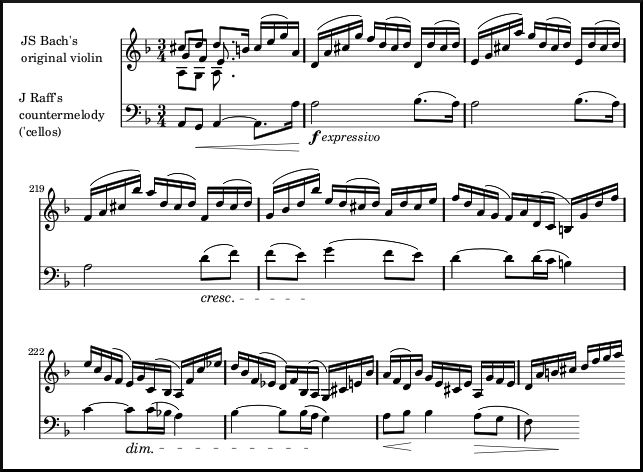
Earlier today I stumbled across a recording of a work I had not heard in a few years by the obscure Swiss-German composer Joachim Raff. The composition is an orchestral transcription of the Chaconne from Bach's Partita in D minor, without doubt the finest work ever written for solo violin. This piece has been transcribed countless times; the source material is clearly a masterpiece, but what makes the movement really attractive is its implicit nature - dispite the violin's limited facilities for counterpoint and polyphony in general, Bach succeeds in alluding to a multitude of voices within the same line. Larry Solomon provides a brief overview of what to look out for. Raff's transcription thus endeavours to render the implicit explicit; for example, where there is the implication of a held note, it can played for its implied duration. Indeed, Raff believed that Chaconne was in itself a "reduction" from an orchestrated original. Whilst I don't share that literal belief, it is certainly good working model for a transcription. And what a transcription! I've often thought of the romantic transcriptions such as these to be a guilty pleasures; they clearly violate any sensibilities I have about performing early music. However, what is most surprising (and guilt-relieving) about Raff's effort is the sheer amount of novel material involved. Here is an example starting at bar 216 - I have overlayed Bach's original line with a melody of Raff's own invention:
http://chris-lamb.co.uk/wp-content/2009/raff_chaconne.png
There are countless other examples which, following Bach's example, vary greatly in their subtlety. No prizes for guessing why I chose this excerpt though. However, dispite these additions I feel some crucial aspects are actually lost in translation. Firstly, we can muse over whether Bach would have approved of such a rendering - not wishing to dwell too deeply in well-tread arguments, many would point to Bach's re-use of his own material (as well as his transcriptions of other composers) to illustrate that he was not against the practice, but I find that argument difficult to apply to the Chaconne - the dualism between the implicit and the explicit would have greatly appealed to Bach, so to rob the work of it would seem to be doing him a serious discourtesy. Furthermore, the implications in Bach's work are certainly not followed to the same conclusions by all - a truly solo musician has the advantage of being able to make their own decisions about the music, perhaps even on the spur of the moment. In contrast, an ensemble is effectively forced to obey Hr. Raff's inferences. This lack of spontaneity is particularly damning; I am sure one would tire of differing interpretations of Raff's transcription quicker than one would of Bach's original. Lastly (and certainly most subjectively) there is something disarmingly solitary about the original work which is only amplified by being played solo - dispite my inability to provide a satisfactory rendition I would find performing this piece with (or even to) others rather discomforting. In conclusion, I would recommend listening to this work (and the rest of the CD). I have found it extremely illuminating, if only about Bach's original than of Raff's.

11 March 2009

Joachim Breitner: In a Letter to Ghana s President

Thanks to Google s watchful eyes I found out that I was mentioned in a Letter to the President of Ghana, published pseudonymously on ghanaweb.com, that advocates Free Software to the new President of Ghana, John Atta-Mills. So, to all new presidents out there, if you need advice, just ask me :-)

15 February 2009

Philipp Kern: Lenny is done -- does anyone around Karlsruhe want to celebrate it?

Lenny got released yesterday and after having to push another update to Etch through volatile to fix an annoying warning when Lenny is in the sources.list, my work is now almost done too. (Yes, the autobuilding infrastructure is still offline, but we will get that reactivated shortly.) Anyway: if you live in or around Karlsruhe and did not get a mail by nomeata and me and if you would enjoy meeting tomorrow (Monday) evening, please speak up by mailing us. Let us celebrate the latest and greatest release. ;-) The plan is to meet up at the Vogelbr u at 19:30.

12 February 2009

Joachim Breitner: Reliability testing for python-dbus applications

In the Openmoko community, a lot of programs are written in python and use services provided over D-Bus. But I m under the impression that not enough programmers consider that D-Bus is a remote protocol, and the other side might fail to respond any time. The code then works find if nothing goes wrong, but does not handle problems well. Understandably, it is hard to get this error checking right if you can t really test it, as usually the D-Bus services do not fail. This is particularly annoying on a phone, because it might just be the program responsible for popping up the on screen keyboard that just failed.Therefore I started to write a little python module called python_test.py that replaces some D-Bus functions in the python bindings (SystemBus.get_object and Connection.call_blocking at the moment) and makes them fail with a certain probability. You can add "import dbus_test" to your program (and adjust $PYTHON_PATH) and run it a few times, to see which error conditions are caught and which cause your problem to fail. If you come across failures that the script does not yet generate, they can easily be added.Not sure yet if I am going to extend and maintain this, but I m open to suggestions and additions. Maybe this (or something similar) should be provided by python-dbus directly.

11 February 2009

Joachim Breitner: Openmoko User Meeting in Karlsruhe

About one hour ago we have finished the first Openmoko user meeting in Karlsruhe. Twelve FreeRunner (and Neo1973) owners have gatherd in the rooms of Entropia (the local CCC club), and discussed the various distributions, learned aboutt the FSO-alternative PyNeo, which was advocated by Josh, compared GPS applications and talked about various other projects and issues.
I collected some statistics about Distribution usage. Most common was SHR, with five users, followed by OM 2008.12 with three users. Single users had Debian, OM testing from pre 2008.12, PyNeo, EmDebian and OM 2008.9 installed. Only counting those who use their FreeRunner as their day-to-day phone, three are using SHR, one OM 2008.12 and one OM testing. I conclude that SHR seems to be a good choice if you want to have a working phone.Asked about their primary use case for the FreeRunner, almost all mentioned telephony and GPS. Half of the participants want to use it to browse the web, a little less think that games are important. Two people, who came from Stuttgart, see CellHunter as an important use caseConsidering that we filled three hours without running out of topics and the good feedback, we will likely have a sequel to this. A date has not been fixed yet, but will be discussed on the openmoko-community mailing list.BTW: I m still planning to package the SHR applications for Debian as soon as possible. Only one dependency (libetk) is missing, but according to Lutin from the pkg-e team, it s almost ready.

21 January 2009

Joachim Breitner: darcswatch uploaded to hackage

I just made my first upload to hackage (not counting uploads I did during my work in Dresden). Don Steward repeatedly told me to package and upload darcswatch, so I just did that. Thanks to Gwern Branwen to contribute the first cabal file.There is little documentation on how to set up darcswatch yourself, so if you actually want to try it out, you most likely will have to get in touch with me. Note that you can just use the installation on http://darcswatch.nomeata.de/.If you, for some reason, feel like hacking on darcswatch, I d be interested in memory reduction. I currently process 916 mails containing 1867 patches and 47MB, as well as 13 repositories, some of which are rather large, and the numbers are increasing.

19 January 2009

Axel Beckert: First experiences with Debian on the OpenMoko FreeRunner

I ogled with an OpenMoko FreeRunner since Harald K nig (of X.org fame) s OpenMoko talk at LinuxDay.at last year. I knew that a team around Luca Capello and Joachim Breitner managed to get Debian running on it. So when Venty told me that harzi wants to sell his nearly unused FreeRunner, I couldn t resist and bought it just a few days later. I played around a little bit with the two distributions which were already installed, AFAIK the original 2007.2 and a version of Qtopia. Called Venty with the Qtopia to prove him that you indeed can make phone calls with this phone, but he wasn t pleased by the echo he heard of his own voice. Since the included 512 MB microSD card surely is too small for a large Debian installation, I bought an additional 8 GB microSDHC card at digitec and then installed Debian on it. The installation mostly went smooth: Partitioning threw a timeout error which didn t cause any further harm than aborting once. A bigger problem was that the hint that you need to update the U-Boot bootloader itself and not only its configuration (called environement) to get it booting from ext2 partitions. lindi (Timo Lindfors) on #openmoko-debian (on Freenode) was of great help spotting the small details hidden in continuous text. After having Debian booting I installed all software I wanted to play around on a mobile phone including a bunch of web browsers. But since I ran into a bug which occurs after a non-deterministic amount of data is written to a big microSD card, I quickly got annoyed by the fact that I had to wait for the 8 GB fsck each time this bug was triggered. So I converted the root file system to ext3 by adding a journal. But whatever I did (reinstalling U-Boot, the U-Boot environement, regenerating the U-Boot environement from scratch, trying to load it as ext2 again, etc.) I didn t get it to work anymore. On #openmoko on Freenode, PaulFertser was trying to convince me that Qi is the better choice of a bootloader. Although its description didn t appeal to me at all, I understand that U-Boot seems a maintainability hell and that a more simplicistic approach can have its advantages. But there was feature listed on the Qi wiki page which made me try it: explicit ext3 support. After creating the appropriate configuration files and symbolic links in /boot/boot and flashing Qi over the U-Boot in the NAND flash, Debian booted again without problems and with a journaling file system. :-) In the meanwhile I found a setup which suites my tastes: Next step will be to move daily usage from root to an unprivileged user. As soon as that s done, I ll try to get Tablet Amora aka Tamora working on the OpenMoko, too. Currently it only runs on Nokia s Linux based internet tablets (N800, N810, etc.). Update, 17:54 To answer Joachim s question in the comment: I don t plan to use it as daily phone, but it may replace my old Nokia 6310i where currently my German mobile phone SIM card resides in. Use it mainly to have a cheap way to make phone calls inside Germany.

31 December 2008

Joachim Breitner: Handling explicit and implicit recusion in Haskell data

For a while I have been pondering over a problem that arises when your functionally written program has some state with cross references for example a list of users, each of which uses a number of computers, and a list of computers, each having an owner. Implicit referencing For doing queries on such data, it would be convenient if every reference is just the referenced object itself. Although we would visualize this as a graph, semantically, it is more like an infinite tree. This is possible in Haskell, due to laziness, and if you create the data structure cleverly, it even uses constant memory, no matter how deep you enter this infinite tree (a recent post of mine talks about this). A possible data definition would be:
data User = User  
userName :: String,
uses :: [Computer]

data Computer = Computer
computerName :: String,
owner :: User -- references the Users

data State = State [User] [Computer]

testState = let user = User "Conrad" [computer]
computer = Computer "Z3" user
in State [user] [computer]
Explicit referencing But such a representation is very unsuitable for updates (at least I can t think if a nice way of updating such a graph without breaking the internal cross-references) and serialization, which is a must for a HAppS based application. So what one would probably start with is this data structure:
data User = User  
userId :: Int,
userName :: String,
uses :: [Int] -- references the Computers

data Computer = Computer
computerId :: Int,
computerName :: String,
owner :: Int -- references the Users

data State = State [User] [Computer]

testState = State
[User 0 "Conrad" [1]]
[Computer 1 "Z3" 0]
I think the semantics of this are clear. Note that the referencing is currently not type-safe, but this can be provided by phantom types. Maybe I ll write more about that later. Now imaging you want to display the information about the first computer with your web application. You extract the information with let State _ cs = testState in head cs and pass that to your templating engine. But what if your template wants to display the name of the owner? It only has access to his userId. You would either need to know what information the template will ever need, extract that from the state beforehand and pass it along, or give the template access to the whole state. In that case, though, there has to be lookup-logic in your output code, which is also not nice. Woudln t it be nice if you could, in your application logic, work with the explicit references, which are easy to modify and store, but somehow turn that into the implicit referencing? Duplicated representation One way would be to have two unrelated sets of data structures, ExplicitState, ExplicitUser, ExplicitComputer, which use explicit identifiers to reference each other, and ImplicitState,... which are defined as the first representation of our state. It is then mostly trivial to write a function that converts ExplicitState to ImplicitState. The big disadvantage of this is that you have to maintain these two different hierarchies. It also means that every function on the state has to be defined twice, which often almost identical code. Clearly, this is not desirable. Annotated representation It would be more elegant if the state is stored in one data type that, controlled by a type parameter, comes in the one or the other representation. To do that, we need two types: One that contains a value, and one that contains just a reference:
newtype Id v = Id v deriving (Show, Typeable, Data)
newtype Ref v = Ref Int deriving (Show, Typeable, Data)
Then we need to adjust our data definitions, to make use of these. (I ll leave out the names, to keep the code smaller)
data User ref = User  
userId :: Int,
uses :: [ref (Computer ref)]

data Computer ref = Computer
computerId :: Int,
owner :: ref (User ref)

data State ref = State [User ref] [Computer ref]
Here we introduce a type parameter ref , which will later be either Id or Ref. Note that now a reference also states the object it is a reference for, which greatly increases type safety. Functions on these data types that don t work with the references will be polymorphic in the ref type parameter, so only need to be written once. A User Id is a complete user with all related data, while User Ref is a user with only references. And a Ref (User Ref) is reference to a user, which contains references... Not so kind kinds Did you notice the lack of a deriving clause? Our data structures have the relatively peculiar kind ((* -> *) -> *), which makes it hard for the compiler to derive instances for things like Show. But we already know that we will only use Id or Ref for the type variable, so we can use ghc s StandaloneDeriving language extension and have these instances created:
deriving instance Show (User Id)
deriving instance Show (User Ref)
deriving instance Show (Computer Id)
deriving instance Show (Computer Ref)
deriving instance Show (State Id)
deriving instance Show (State Ref)
Toggling a type parameter The next step is to write the conversion function. It will have type
unrefState :: State Ref -> State Id
For that, and for later, we need lookup functions:
unrefUserRef :: State Id -> Ref (User Ref) -> Id (User Id)
unrefUserRef (State l _) (Ref i) = Id $ fromJust $
find (\u@(User i' _) -> i == i') l
unrefComputerRef :: State Id -> Ref (Computer Ref) -> Id (Computer Id)
unrefComputerRef (State _ l) (Ref i) = Id $ fromJust $
find (\u@(Computer i' _) -> i == i') l
These expect a State (with implicit referencing) and a reference, and look up this reference. The function unrefState then looks like this:
unrefState :: State Ref -> State Id
unrefState (State us cs) =
let unrefState = State (map (unrefUser unrefState) us)
(map (unrefComp unrefState) cs)
in unrefState
where unrefUser :: State Id -> User Ref -> User Id
unrefUser s (User i refs) = User i (map (unrefComputerRef s) refs)

unrefComp :: State Id -> Computer Ref -> Computer Id
unrefComp s (Computer i ref) = Computer i (unrefUserRef s ref)
Note how we tie the knot in the let expression. This is the trick that ensures constant memory consumption, because every reference points back to the same place in memory. Satisfied already? So what do we have? We have no duplication of data types, we can write general functions, and we can resolve the explicit referencing. We can also easily write functions like unrefUser :: State Ref -> User Ref -> User Id, which transform just a part of the state. But writing unrefState is very tedious when the State becomes more complex. Each of the other unrefSomething functions are very similar, but need to be written anyways. This is unsatisfactory. What we want, is a generic function, something like
gunref :: State Ref -> a Ref -> a Id
which, given a state with explicit references, replaces all explicit references in the first argument (which could be State Ref or User Ref or anything like that) with implicit ones. This function can not exist, because we would not know anything about a and b. But maybe we can do this:
gunref :: (Data (a Id), Data (a Ref)) =>  State Ref -> a Ref -> a Id
Typeable and Data Before being able to do so, we need to derive Data for our types. We can start with
deriving instance Data (User Id)
deriving instance Data (User Ref)
deriving instance Data (Computer Id)
deriving instance Data (Computer Ref)
deriving instance Data (State Id)
deriving instance Data (State Ref
but that will complain about missing Typeable instances. Unfortunately, ghc s deriver for Typeable (even the stand-alone-one), does not handle our peculiar kind, so we need to do it by hand. With some help from quicksilver on #haskell, I got it to work:
instance Typeable1 ref => Typeable (User ref) where
typeOf _ = mkTyConApp (mkTyCon "User") [typeOf1 (undefined :: ref ())]
instance Typeable1 ref => Typeable (Computer ref) where
typeOf _ = mkTyConApp (mkTyCon "Computer") [typeOf1 (undefined :: ref ())]
instance Typeable1 ref => Typeable (State ref) where
typeOf _ = mkTyConApp (mkTyCon "State") [typeOf1 (undefined :: ref ())]
everywhere is not enough Turning to the documentation of Data.Generics, I notice with some disappointment that there is no function that is able to change a type they all seem to replace a value by another value of the same type. But the functions gfoldl and gunfold sounded like they could be used for this. Warning: What comes now is a very non-haskellish hack that subverts the type system, just to get the job done. Please read it with a healthy portion of distrust. If you know of a cleaner way of doing that, please tell me! Wrapped Data I want to do some heavy type hackery, so I need to disable haskell s type system. There is Data.Dynamic, but not even that is enough, as we need to carry a type s Data instance around as well. So let s wrap that up:
data AData where AData :: Data a => a -> AData
instance Show AData where show (AData a) = "<" ++ show (typeOf a) ++ ">"

fromADataE :: forall b. Data b => AData -> b
fromADataE (AData d) = case cast d of
Just v -> v
Nothing -> error $ "Type error, trying to convert " ++
show (typeOf d) ++ " to " ++
show (typeOf (undefined :: b)) ++ "."
There is also a function that converts an AData back to a normal type, if possible. If it s not possible, then there is a bug in our code, so we give an informative error message. AData transformers Similar to everywhere, we want to have transformers that combinable. They need to have the change to convert an arbitrary value, but also signal that they could not convert something (and this something has to be recursed into). I came up with this:
type ADataT = AData -> Maybe AData

extADT :: forall a b. (Data a, Data b) => ADataT -> (a -> b) -> ADataT
extADT at t a@(AData v) = case cast v of
Just x -> Just (AData (t x))
Nothing -> at a

doNothing :: ADataT
doNothing = const Nothing
ADataT is the type for such a transformer. doNothing will not transform anything, and extADT can be used to add any function to the list of tried transformers, in the spirit of extT. The ugly part To apply such a transformer, I want to use this function, which I ll describe in the code comments:
everywhereADT :: forall a b. (Data a, Data b) => ADataT -> a -> b

-- first check if we can transform this value already
everywhereADT f v = case f (AData v) of
-- if so, coerce it to the users requested type, which hopefully goes well
Just r -> fromADataE r
-- if not, we need to recurse into the data structure
Nothing -> recursed

-- for that, we first need to figure out the arguments to the
-- constructor. We store them in the untyped list
where args :: [AData]
(Const args) = gfoldl k z v
-- gfoldl lets us have a look at each argument. We wrap it in AData
-- and append it to the list
k (Const args) arg = Const (AData arg : args)
z start = Const []

-- We need the data constructor of the input data type. If the user did not want
-- it to be transformed, it will be the same
c = toConstr v

-- To give better error messages, we make sure that the outmost type constructor
-- of the requested type actually has the data constructor we were given. Otherwise
-- gunfold will complain in a non-helpful way
input_type = dataTypeRep (constrType c)
output_type = dataTypeRep (dataTypeOf (undefined :: b))

recursed = if input_type /= output_type
then error $ "Can not convert <" ++ show input_type ++ ">"++
" to <" ++ show output_type ++ ">."
-- the types match, so we assemble the output type, using gunfold
else snd (gunfold k' z' c)
k' :: forall b r . Data b => ([AData], b -> r) -> ([AData],r)

-- we start by reversing the input list
z' start = (reverse args,start)

-- then we call us recursively on the argument and feed the result
-- to the output constructor
k' ((AData a) : args, append) = (args, append (everywhereADT f a))

-- Used for folding (we don t need to retain the original constructor)
data Const a b = Const a
What a beast! But surprisingly, it works. Here are some examples. Note that I always have to specify the requested output type:
bool2Int :: Bool -> Int
bool2Int False = 0
bool2Int True = 1

*Main> everywhereADT (doNothing extADT bool2Int) True :: Int
1
*Main> everywhereADT (doNothing extADT bool2Int) True :: ()
*** Exception: Type error, trying to convert Int to ().
*Main> everywhereADT (doNothing extADT bool2Int) (True,False) :: (Int,Int)
(1,0)
*Main> everywhereADT (doNothing extADT bool2Int) ([True,False],True,()) :: ([Int],Int,())
([1,0],1,())
*Main> everywhereADT (doNothing extADT bool2Int) ([True,False],True,()) :: [()]
*** Exception: Can not convert to .
*Main> everywhereADT (doNothing extADT bool2Int) [True] :: [Bool]
[*** Exception: Type error, trying to convert Int to Bool.
I hope this code does not inflict too much pain on any Haskell-loving reader. I know I violated the language, but I didn t know how to do it better (at least not without using Template Haskell). I also know that this is not very good performance wide: Every single value in the input will be deconstructed, type-compared several times and re-assembled. If that is an issue, then this function should only be used for prototyping. Almost done To apply this to our state, we only need to glue it to our lookup functions from above:
gunref :: (Data (a Id), Data (a Ref)) =>  State Ref -> a Ref -> a Id
gunref s w = let unrefState = gunref' unrefState s
in gunref' unrefState w

gunref' :: (Data (a Id), Data (a Ref)) => State Id -> a Ref -> a Id
gunref' unrefState = everywhereADT unref'
where unref' = doNothing extADT
unrefUserRef unrefState extADT
unrefComputerRef unrefState
Now we have a generic unreferencer. I set the type a bit more specific than necessary, to make it safe to use (under the assumption that the list of lookup functions is complete and will not leave any Ref in the output).
*Main> testState 
State [User userId = 0, uses = [Ref 1] ] [Computer computerId = 1, owner = Ref 0 ]
*Main> gunref testState testState
State [User userId = 0, uses = [Id (Computer computerId = 1, owner = Id (User userId = 0,
uses = [Id (Computer computerId = 1, owner = Id (User userId = 0, uses = ..
Oh, and by the way, if you want to test this code, you ll need at least:
 -# LANGUAGE DeriveDataTypeable, FlexibleInstances, GADTs,
FlexibleContexts, StandaloneDeriving, ScopedTypeVariables #-

28 December 2008

Joachim Breitner: MuMer relaunch preview online

A few years ago, I had some ideas about a real-world trading game. In short, a combination of the game play of Settlers of Catan , the cute pseudo-medieval world of The Settlers (the computer game), which you can play in your every day live along, without having to sit in front of the computer for a long time. I then started some code, lost motivation and let it sit there for a while.Recently, I re-developed interest in the idea and started from scratch, using Haskell and HAppS. To avoid losing interest again, I m now putting the code online and set up the server. I invite everyone to play around with it, maybe have a look at the code, send me patches or comments. As you can see, the web user interface is plain ugly HTML and could need some love. Some CSS is definitely needed, some AJAX would be nice. Also, the resource tree is very small at the moment there are a lot of things to work on, even if you don t want to touch Haskell!You can register at http://mumer.net/. You will be either given a forest (a source for wood) or a source of stone. You can reap your source, and trade on the Free Market , which is where you can always trade online, at bad prices. The idea is that you find real trade partners, to get better prices.For now, trading without physical contact is possible. You can create so-called issue ids, which represent stips of paper. You can then load resources on them, and give the paper (i.e. the number) to other players, who can then redeem them. Eventually, it is planned that these pieces of paper are provided centrally and (sufficiently) unforgeable, so that it is clear who owns a resource.You can also bid on certain stuff, such as a sawmil, which allows you to turn wood into boards. It will regularily be re-leased to the highest bidder.You can get the code (in a darcs repository) from http://darcs.nomeata.de/mumer2 and also browse the code.If you happen to be at the CCC right now and would like to talk about it, please do so!

24 December 2008

Joachim Breitner: 19 month of laptop battery data

In June 2007, I bought a new 9-cell-battery for my ThinkPad notebook. Since then, I recorded, via a cron job, every five minutes these bits of information:I had planned to make some detailed analysis of this, but I haven t gotten around to do more than this graph (warning, large), of which the following iis a cut out. Since I now got a new laptop (with a new battery), I ll share my records.
I find it interesting that the last-full-state sometimes jumps up, closer to the design state. This could be re-calibration. Or the battery, after a while, re-scales iits output to appear less degraded. This might be checked by comparing the speed of discharge and charge at various points in time.If you want to do some analysis of your own, you can download the raw data (44354 data points). It has been anonymised by starting the time counter at zero, and shortening any gap of more than four hours to four hours. If you want to do some analysis in Haskell, you can take some code from my anonymizer script to parse the data. If you happen to find something interesting, appropriate crediting is appreciated.

Joachim Breitner: 19 months of laptop battery data

In June 2007, I bought a new 9-cell-battery for my ThinkPad notebook. Since then, I recorded, via a cron job, every five minutes these bits of information:I had planned to make some detailed analysis of this, but I haven t gotten around to do more than this graph (warning, large), of which the following is a cut out. Since I now got a new laptop (with a new battery), I ll share my records.
I find it interesting that the last-full-state sometimes jumps up, closer to the design state. This could be re-calibration. Or the battery, after a while, re-scales iits output to appear less degraded. This might be checked by comparing the speed of discharge and charge at various points in time.If you want to do some analysis of your own, you can download the raw data (44354 data points). It has been anonymised by starting the time counter at zero, and shortening any gap of more than four hours to four hours. If you want to do some analysis in Haskell, you can take some code from my anonymizer script to parse the data. If you happen to find something interesting, appropriate crediting is appreciated.

5 December 2008

Joachim Breitner: Good LaTex Font Overview

I just discovered the nice Survey of Free Math Fonts for TeX and LaTeX (PDF-Version) by Stephen G. Hartke a good overview of the common font packages, with examples, useful for those who have seen enough Computer Modern by now.What I m still missing is a good style guide: When should I use Palatino, when is Utopia a good choice? What are good reasons to use a sans-serif font for the text, and when is that not a good idea? They all look nice to me, but I doubt that the professional typographist leave it all to personal preference.

Joachim Breitner: Good LaTeX Font Overview

I just discovered the nice Survey of Free Math Fonts for TeX and LaTeX (PDF-Version) by Stephen G. Hartke a good overview of the common font packages, with examples, useful for those who have seen enough Computer Modern by now.What I m still missing is a good style guide: When should I use Palatino, when is Utopia a good choice? What are good reasons to use a sans-serif font for the text, and when is that not a good idea? They all look nice to me, but I doubt that the professional typographist leave it all to personal preference.

25 November 2008

Joachim Breitner: Linux Journal on the Neo FreeRunner

A fellow lodger of my student dormatory just popped in and gave me the December issue of Linux Journal as a gift from his trip to the US (thanks for that!). When I skimmed the front page, I immediatelly noticed the line Reviewed: OpenMoko s Neo FreeRunner. The four page article by Cory Wright contains some general notes on the FreeRunner, a list of things he doesn t like and to my surprise installation instructions for Debian on the FreeRunner! It s nice to see one s work used in such public places. I especially liked the line I must say, the Debian installers sure have improved a lot since the Potato days. (Of course, the installer for the FreeRunner is mostly a dumb script that can not be compared to the great official debian-installer that you can use on a PC.)

Next.

Previous.