
Search Results: "hle"

24 July 2011

DebConf team: DebianDay about to start / Video Streams are now available (Posted by Alexander Reichle-Schmehl)

Sorry for the late notification about the video streams. We ve been rather busy down here. However, DebianDay is about to start, and it looks, like it will turn out to be a great event! The Video Setup is finished, too. The easiest way to watch the streams and to participate via irc is by using the Web 2.0 thingy at http://debconf11.debconf.org/watch.xhtml. You can also point your preferred video player at http://video.debconf.org:8000/Roundroom.ogv for the smaller round room, or http://video.debconf.org:8000/Auditorium.ogv for the larger auditorium, where DebianDay will take place. The full schedule for the entire conference is available at http://penta.debconf.org/dc11_schedule/index.en.html. As usual we ll make the videos available for download later.

23 July 2011

Stefano Zacchiroli: harmonious assignments

why proprietary relicensing is unacceptable for a Free Software enthusiast The past few months have witnessed a large debate about copyright assignment, which seems to has neared its peak around the time Project Harmony has released version 1.0 of its agreement templates. (Note: I use the expression "copyright assignment" in this post, but I'd happily include into it both actual Copyright Assignment Agreements CCAs and Contributor License Agreements CLAs, as both could be used to permit various forms of proprietary relicensing.) Mark Shuttleworth has been one of the most prominent voices campaigning in favor of copyright assignments (to for-profit companies). A couple of interesting blog posts of his where this is evident are "On balancing economic power in the FLOSS ecosystem" and "The responsibilities of ownership". Voices against the opportunity of increasing the popularity of copyright assignments are aplenty and it is pointless to repeat good arguments which I find fully convincing. If you are interested in the subject, here are a few good reads I recommend: What I would like to add to the debate is the point of view of a Free Software enthusiast, not unlike yours truly. I contribute to Free Software not because it is superior to proprietary software in either its software products or in its development methodology. (It actually is superior in many cases, but that's just not my primary motivation.) I do contribute to Free Software to build a world in which users are in complete control of the software they run. Let's assume we have a broken toaster at home. We are all free to (1) open it up and try to repair it by ourselves. If we don't have the needed knowledge, we are free to (2) hand it over to a person that we trust and who does have the needed knowledge to repair it. That failing, we can (3) ask the toaster producer to repair it for us. Many people like me simply don't accept to live in a world where, once all the toasters will be software-driven, the only repair option will be (3), just because the toaster software is proprietary. (Given various kind of [broken] metaphors have been used to explain copyright assignments, it seemed sensible to propose my broken toaster metaphor in exchange.) When I contribute to some Free Software project, I not only care about being able myself to get a Free Software licensed copy of the whole product (i.e. the original software product + my own contribution). I care that all recipients of the product, present and future, will be able to get that contribution with enough freedoms attached to put them in control of the software that includes it. This desire can be fulfilled with a varying degree of success, depending on the license of the code base I contribute to. For instance, I find more pleasant to contribute to a copyleft licensed code base than to a weak-/non-copyleft licensed one, and more pleasant to contribute to an AGPL-ed web app than to a copyleft web app. It also means that, given the option, I will not allow the code base maintainer to re-license my contribution under terms that allow distributing it without suitable freedoms attached. Different contributors will be ready to accept different re-licensing promises, but the mere fact we are debating all this and that companies like Canonical feel the need of campaigning for copyright assignments is evidence that many contributors like me exists and actually have a problem with allowing downstream relicensing of their contributions. What is feared the most is of course proprietary relicensing. According to my moral horizon this is the case not because the company might end up gaining money out of my code: I wouldn't have a problem with that. The reason is rather that the company will be able to distribute my own code in a way that grants less freedoms to users than those that were implicitly "agreed upon" when the contribution has been written. In that respect, I can't help thinking at harmony agreements as a large scale smoke screen experiment meant to convince volunteers that copyright assignments are something Free Software needs. By exploiting the creative-commons-like "it's easy, just choose one" scheme, Harmony takes the chance of offering misleading options such as the one labeled "any OSI approved license". Via that option, which is seemingly fine, the copyright recipient will be allowed to relicense the contribution under some non-copyleft license (e.g. BSD) and from there do essentially what they want. All in all, companies campaigning for copyright assignments seem to have failed to understand two main points. The first one is that contributors motivated by Free Software ideals want the code to remain free not only for themselves, but for all recipients of the code. I'm not claiming that all contributors to FOSS projects belong to this category, but the fact that there is a considerable amount of such people is undeniable. Hoping that they will be fooled by tricks like the "any OSI approved license" agreement is foolish. The second is that while volunteer Free Software communities do respect companies that provide huge amounts of code contributions, they also expect companies to figure out by themselves which business models make their businesses sustainable. Telling volunteers that current business models are not sustainable without proprietary relicensing is worthless. Volunteers just don't care. They want software freedom guarantees and are not willing to renounce to them in exchange of the wealth of companies, not even under the (implicit) threat that otherwise those companies will be forced to reduce the amount of their code contributions.
Update: explain in the initial note why my reasoning here encompasses both CCAs and CLAs. Thanks Tollef for noticing that it wasn't clear.

15 July 2011

Alexander Reichle-Schmehl: About Debian, The Hurd and Linux or in short: Yes, we will still have a Linux kernel

A lot of online magazines are currently reporting about Debian, its port to the Hurd kernel and plans for the next release. However, there seem to be quite some misunderstandings. One online magazine took the cake by titling Debian 7.0 Wheezy: Erste Pl ne f r Hurd statt Linux-Kernel (rough translation: Debian 7.0 Wheezy: First plans for Hurd instead of Linux kernel), and a colleague already asked me, if we are really going to drop the Linux kernel. So let's clarify one thing: The Debian Project does not plan to drop its port to the Linux kernel (nor its two ports to the FreeBSD kernel for what it's worth). Apparently it all started with a short status report and if you read it, you'll just read that some people are trying and planing to get Debian 7 (aka wheezy) to be released with an additional port to the Hurd. It is not yet clear if they will achieve their goal, nor did anyone ever mention anything about replacing the Linux or the FreeBSD kernel. So, calm down, nothing changed, just someone talking about the possibility of adding yet another port to the next release. Please note the adding.

Dirk Eddelbuettel: MCMC and faster Gibbs Sampling using Rcpp

Sanjog Misra, who uses Rcpp for Monte Carlo Markov Chain (MCMC) analyses in quantitative marketing, kindly set me a short example of Rcpp use. The example is based on a blog post by Darren Wilkinson which itself discusses and compares the suitability of R, Python, Java or C for MCMC analysis, using the Gibbs sampler as a concrete example. Darren's post is worth checking out: he stresses the rather pragmatic aspects of how fast and/or easy it is to write the code, rather than just the mere runtime. As such, he is not too concerned with a speed advantage of Python over R which he sees at a factor of around 2.4, leaving him to continue to prototype in R. Similarly, with C 'only' being faster than Java by a factor of two, he prefers Java for the numerically more demanding parts. We do of course advocate the use of Rcpp to combine the best aspects of R and C++, respectively. This Gibbs sampler example provides a nice backdrop. So working with Darren's example, consider the same Gibbs sampler for a bivariate distribution (and apologies for the lack of latex typesetting on my blog)
f(x,y) = k x^2 exp( -x y^2 - y^2 + 2y - 4x)
where the conditional distributions are
f(x y) = (x^2)*exp(-x*(4+y*y))               ## a Gamma density kernel
f(y x) = exp(-0.5*2*(x+1)*(y^2 - 2*y/(x+1))  ## a Gaussian kernel
Sanjog then spotted and corrected a small error in the variance expression in Darren's derivation; this is now acknowledged on Darren's website. Full details are in the R script now committed in SVN. The R code for the Gibbs sample can therefore be written as follows below. Note that this uses thinning to minimize serial correlation in the conditional densities--which renders the computation more demanding as 'N times thin' draws have to be generated:
## Here is the actual Gibbs Sampler
## This is Darren Wilkinsons R code (with the corrected variance)
## But we are returning only his columns 2 and 3 as the 1:N sequence
## is never used below
Rgibbs <- function(N,thin)  
    mat <- matrix(0,ncol=2,nrow=N)
    x <- 0
    y <- 0
    for (i in 1:N)  
        for (j in 1:thin)  
            x <- rgamma(1,3,y*y+4)
            y <- rnorm(1,1/(x+1),1/sqrt(2*(x+1)))
         
        mat[i,] <- c(x,y)
     
    mat
 
A second variant can be computed using the R bytecode compiler which appeared with the recent release of R 2.13.0 (and which we analysed in this blog post from April). This is as easy as
## We can also try the R compiler on this R function
RCgibbs <- cmpfun(Rgibbs)
Thanks to Rcpp and the inline package, we can also write a C++ variant that can be built and launched from R with ease. The C++ code is assigned to an R text variable gibbscode. (And we used to typeset such code on the blog as a character string, ie in a faint red color---but have now switched to highlight it as if it were freestanding C++ code. It really is passed as a single string to R which then uses the cxxfunction() to compile, link and load a C++ function built around the code. See previous posts on the inline package for more.)
## Now for the Rcpp version -- Notice how easy it is to code up!
gibbscode <- '

  using namespace Rcpp;   // inline does that for us already
  // n and thin are SEXPs which the Rcpp::as function maps to C++ vars
  int N   = as<int>(n);
  int thn = as<int>(thin);
  int i,j;
  NumericMatrix mat(N, 2);
  RNGScope scope;         // Initialize Random number generator
  // The rest of the code follows the R version
  double x=0, y=0;
  for (i=0; i<N; i++)  
    for (j=0; j<thn; j++)  
      x = ::Rf_rgamma(3.0,1.0/(y*y+4));
      y = ::Rf_rnorm(1.0/(x+1),1.0/sqrt(2*x+2));
     
    mat(i,0) = x;
    mat(i,1) = y;
   
  return mat;             // Return to R
'
# Compile and Load
RcppGibbs <- cxxfunction(signature(n="int", thin = "int"),
                         gibbscode, plugin="Rcpp")
It is noteworthy how the code logic is essentially identical between the basic R version, and the C++ version. Two nested loops control draws of x from a Gamma distribution, conditional on y, as well as draws of y from a Normal, conditional on x. Add a small amount of parameter passing to obtain the parameters N and thin, allocation of a results matrix and setup of the random number generator state to remain consistent with R, as well as a return of the matrix---and that is all. As Darren's code uses the GNU GSL in its C variant, I also became interested in seeing how a C/C++ hybrid variant using our RcppGSL package would fare. The code is below.
gslgibbsincl <- '
  #include <gsl/gsl_rng.h>
  #include <gsl/gsl_randist.h>
  using namespace Rcpp;  // just to be explicit
'
gslgibbscode <- '
  int N = as<int>(ns);
  int thin = as<int>(thns);
  int i, j;
  gsl_rng *r = gsl_rng_alloc(gsl_rng_mt19937);
  double x=0, y=0;
  NumericMatrix mat(N, 2);
  for (i=0; i<N; i++)  
    for (j=0; j<thin; j++)  
      x = gsl_ran_gamma(r,3.0,1.0/(y*y+4));
      y = 1.0/(x+1)+gsl_ran_gaussian(r,1.0/sqrt(2*x+2));
     
    mat(i,0) = x;
    mat(i,1) = y;
   
  gsl_rng_free(r);
  return mat;           // Return to R
'
## Compile and Load
GSLGibbs <- cxxfunction(signature(ns="int", thns = "int"),
                        body=gslgibbscode, includes=gslgibbsincl,
                        plugin="RcppGSL")
This code is similar to the version using just Rcpp, but we need to allocate space for the GSL random generator object (and later release that memory allocation), and we do of course call the GSL functions. This also necessitates declaring the function using the two header files listed as arguments for the include argument of cxxfunction(). So how is the performance? The script (now committed in Rcpp's SVN repo as examples/RcppGibbs/RcppGibbs.R, and also part of the next release) creates the output below when running in non-interactive mode (whereas interactive mode creates a few charts too):
edd@max:~/svn/rcpp/pkg/Rcpp/inst/examples/RcppGibbs$ r RcppGibbs.R
Replication # 1 complete 
Replication # 2 complete 
Replication # 3 complete 
Replication # 4 complete 
                    N=1000 N=5000 N=10000 N=20000
Elasped Time (R)     0.124  2.650  10.511  41.773
Elasped Time (RC)    0.081  1.916   7.594  30.280
Elapsed Time (Rcpp)  0.003  0.076   0.306   1.221
Elapsed Time (Rgsl)  0.002  0.049   0.196   0.784
SpeedUp Rcomp.       1.530  1.380   1.380   1.380
SpeedUp Rcpp        41.330 34.870  34.350  34.210
SpeedUp GSL         62.000 54.080  53.630  53.280
               test replications elapsed  relative user.self sys.self
4  GSLGibbs(N, thn)           10   7.845  1.000000      7.84        0
3 RcppGibbs(N, thn)           10  12.218  1.557425     12.22        0
2   RCgibbs(N, thn)           10 312.296 39.808286    311.98        0
1    Rgibbs(N, thn)           10 420.953 53.658764    420.59        0
The first block is a hand-computed comparison using four sets of parameters; the second block uses the excellent rbenchmark package to compare ten runs at twenty-thousand draws. We see a nominal increase in performance due to the bytecode compiler, saving roughly 38 percent which seems appropriate given that the R code mostly controls the loops; actual work in undertaken in the already compiled RNG functions. The Rcpp variant is about 34 times faster than the pure R code. Sanjog reported higher increases on his OS X machines (and Darren's post echos a similar order of magnitude). However, on my i7 running Linux I always obtained an improvement in the mid- to high thirties. That is certainly already a rather pleasant result. What surprised and stunned me at first was that the GSL solution scores an improvement of around 53 times (close to the factor of 60 reported by Darren). A closer look at the code (shown above) makes it clear that there are very few compute-intensive operations outside of the RNG draws. I validated this further with a second study timing just one million draws each from a Gaussian and Gamma using R via Rcpp, and using the GSL. It turns out that the R code is about 2.5 times slower for random draws from the Gamma distribution than the GSL. Inspection of the source code---in files src/nmath/rgamma.c for R and randist/gamma.c for the GSL shows why. R uses a much more complex (and presumably more precise) algorithm. I may follow up with Martin Maechler to see if we can illustrative the numerical benefits of this more expensive approach---this blog entry is getting long enough already. So to sum up: Gibbs sampling is a somewhat resource-heavy Monte Carlo Markov Chain method for investigating multivariate distributions. R excels at quick and simple explorations, albeit at somewhat slower execution speed. The Rcpp package can help by providing easy means to accelerate simulations by a significant factor. The example discussed here is now in SVN repository for Rcpp and will be part of the next release.

Updated 2011-07-16: Darren has just updated his comparison; fixed two typos here too.

11 July 2011

Thorsten Glaser: [Update] Hilfe gesucht: Mitarbeiter berwachung

Deutsche Version dieses Postings read the English Version instead Der Leiter der Abteilung Systemadministration einer Firma, welche in diesem Artikel ungenannt bleiben soll, wo der Zufall es will, da ich f r sie arbeite, m chte uns Mitarbeiter dazu zwingen, das Feature der persistenten Historie (also einen niedergeschriebenen Verlauf der abgesetzten Befehle) der Shell (Kommandozeile) auf allen Systemen zu benutzen. Nun hat die mksh dies vern nftigerweise, w hrend immer noch verf gbar, standardm ig aus Gr nden der Privatsph re deaktiviert, und ich finde, dies sollte sich nicht ndern. Es kann ja nicht sein, da man mir beim Arbeiten ber die Schulter guckt; was kommt als n chstes, Video berwachung der B ros? (Seine Argumentation l uft darauf hinaus, da er nachvollziehen/verstehen kann, wie ich (ha! ich! nicht die anderen, nein, ich!) ein Problem das letzte Mal gel st habe; es ist aber nichts anderes als rekonstru eren zu k nnen, wer wann was eingetippt/gemacht hat. Naja, Argumentationen sind eh relativ, andere jagen Flugzeuge in ihre eigenen Verteidigungsministerien, welche gerade zuf llig umgebaut werden ) Ich habe dies nat rlich in die F hrungsetage eskaliert, und unser Gesch ftsf hrer versteht meine Bedenken und m chte nun ein Gespr ch anraunen, um eine L sung zu finden. Die meisten meiner Kollegen im Bereich Systemadministration denken leider nichtmals dr ber nach, obschon ich in anderen Bereichen Gleichgesinnte gefunden habe. Einen Betriebsrat haben wir auch gro er Fehler, ich wei nicht (aber ich s e eh nicht drin, ich hasse Politik jeder Art). Dies l t mich in dringender Not, Argumente wider diese Total berwachung aller (insbesondere auf der Kommandozeile arbeitenden also besonders mich) Kollegen zu finden, idealerweise solche, die durch deutsches Recht gest tzt sind. Wenn ihr solche habt, bitte mailt die schnell an meine eMail-Adresse, welche da nicht junk@mirbsd.org lautet, sondern mit einem tg vor dem Klammeraffen (dies dient der Abwehr unerw nschter Werbemails). Vielen Dank bereits im Voraus! Update 12.07.2011: Wir haben geredet, und wie viele kommentierten keine L sung auf rechtlicher Ebene gefunden, sondern stattdessen, nachdem wir festgestellt hatten, da mir dieses Problem sehr am Herzen liegt, nach anderen L sungen f r das eigentliche Ziel des Chefadmins gesucht; dies z hlt als ein Entgegenkommen auf Seiten der Firma. Ich habe zugestimmt, meine L sungen in kleine Skripte zu verpacken und ins VCS zu committen f r das Herausfinden, wann was auf einem Server ge ndert wurde, im Fehlerfall, denken wir uns gerade ohnehin was aus. Danke an alle, die kommentiert haben!

19 June 2011

Clint Adams: I still have not seen that documentary

Receiving a full rejection for DebConf travel sponsorship reminds me of a time I was asked to nominate members for a corporate board of directors. At the time I replied that I would not be of much help because I value things which are irrelevant to such positions. Sure, I can identify worthless, grandstanding blowhards, but of the people who are not, I am unqualified to guess which ones make good board members and which do not. The person who had asked me was somewhat confused by my answer, because we come from different perspectives on how the world works and possibly how the world should work.

15 June 2011

Christian Perrier: So, what happened with Kikithon?

I mentioned this briefly yesterday, but now I'll try to summarize the story of a great surprise and a big moment for me. All this started when my wife Elizabeth and my son Jean-Baptiste wanted to do something special for my 50th birthday. So, it indeed all started months ago, probably early March or something (I don't yet have all the details). Jean-Baptiste described this well on the web site, so I won't go again into details, but basically, this was about getting birthday wishes from my "free software family" in, as you might guess, as many languages as possible. Elizabeth brought the original idea and JB helped her by setting up the website and collecting e-mail addresses of people I usually work with: he grabbed addresses from PO files on Debian website, plus some in his own set of GPG signatures and here we go. And then he started poking dozens of you folks in order to get your wishes for this birthday. Gradually, contributions accumulated on the website, with many challenges for them: be sure to get as many people as possible, poking and re-poking all those FLOSS people who keep forgetting things... It seems that poking people is something that's probably in the Perrier's genes! And they were doing all this without me noticing. As usually in Debian, releasing on time is a no-no. So, it quickly turned out that having everything ready by April 2nd wouldn't be possible. So, their new goal was offering this to me on Pentecost Sunday, which was yesterday. And...here comes the gift. Aha, this looks like a photo album. Could it be a "50 years of Christian" album? But, EH, why is that pic of me, with the red Debconf5 tee-shirt (that features a world map) and a "bubulle" sign, in front of the book? But, EH EH EH, what the .... are doing these word by H0lger, then Fil, then Joey doing on the following pages? And only then, OMG, I discover the real gift they prepared. 106, often bilingual, wishes from 110 people (some were couples!). 18 postcards (one made of wood). 45 languages. One postcard with wishes from nearly every distro representatives at LinuxTag 2011. Dozens of photos from my friends all around the world. All this in a wonderful album. I can't tell what I said. Anyway, JB was shooting a video, so...we'll see. OK, I didn't cry...but it wasn't that far and emotion was really really intense. Guys, ladies, gentlemen, friends....it took me a while to realize what you contributed to. It took me the entire afternoon to realize the investment put by Elizabeth and JB (and JB's sisters support) into this. Yes, as many of you wrote, I have an awesome family and they really know how to share their love. I also have an awesome virtual family all around the world. Your words are wholeheartedly appreciated and some were indeed much much much appreciated. Of course, I'll have the book in Banja Luka so that you can see the result. I know (because JB and Elizabeth told me) that many of you were really awaiting to see how it would be received (yes, that includes you, in Germany, who I visited in early May!!!). Again, thank you so much for this incredible gift. Thank you Holger Levsen, Phil Hands, Joey Hess, Lior Kaplan, Martin Michlmayr, Alberto Gonzalez Iniesta, Kenshi "best friend" Muto, Praveen Arimbrathodiyil, Felipe Augusto van de Wiel, Ana Carolina Comandulli (5 postcards!), Stefano Zacchiroli (1st contribution received by JB, of course), Gunnar Wolf, Enriiiiiico Zini, Clytie Siddall, Frans Pop (by way of Clytie), Tenzin Dendup, Otavio Salvador, Neil McGovern, Konstantinos Margaritis, Luk Claes, Jonas Smedegaard, Pema Geyleg, Meike "sp tzle queen" Reichle, Alexander Reichle-Schmehl, Torsten Werner, "nette BSD" folks, CentOS Ralph and Brian, Fedora people, SUSE's Jan, Ubuntu's Lucia Tamara, Skolelinux' Paul, Rapha l Hertzog, Lars Wirzenius, Andrew McMillan (revenge in September!), Yasa Giridhar Appaji Nag (now I know my name in Telugu), Amaya Rodrigo, St phane Glondu, Martin Krafft, Jon "maddog" Hall (and God save the queen), Eddy Petri or, Daniel Nylander, Aiet Kolkhi, Andreas "die Katze geht in die K che, wunderbar" Tille, Paul "lets bend the elbow" Wise, Jordi "half-marathon in Banja Luka" Mallach, Steve "as ever-young as I am" Langasek, Obey Arthur Liu, YAMANE Hideki, Jaldhar H. Vyas, Vikram Vincent, Margarita "Bronx cross-country queen" Manterola, Patty Langasek, Aigars Mahinovs (finding a pic *with* you on it is tricky!), Thepittak Karoonboonyanan, Javier "nobody expects the Spanish inquisition" Fern ndez-Sanguino, Varun Hiremath, Moray Allan, David Moreno Garza, Ralf "marathon-man" Treinen, Arief S Fitrianto, Penny Leach, Adam D. Barrat, Wolfgang Martin Borgert, Christine "the mentee overtakes the mentor" Spang, Arjuna Rao Chevala, Gerfried "my best contradictor" Fuchs, Stefano Canepa, Samuel Thibault, Eloy "first samba maintainer" Par s, Josip Rodin, Daniel Kahn Gillmor, Steve McIntyre, Guntupalli Karunakar, Jano Gulja , Karolina Kali , Ben Hutchings, Matej Kova i , Khoem Sokhem, Lisandro "I have the longest name in this list" Dami n Nicanor P rez-Meyer, Amanpreet Singh Alam, H ctor Or n, Hans Nordhaugn, Ivan Mas r, Dr. Tirumurti Vasudevan, John "yes, Kansas is as flat as you can imagine" Goerzen, Jean-Baptiste "Piwet" Perrier, Elizabeth "I love you" Perrier, Peter Eisentraut, Jesus "enemy by nature" Climent, Peter Palfrader, Vasudev Kamath, Miroslav "Chicky" Ku e, Mart n Ferrari, Ollivier Robert, Jure uhalev, Yunqiang Su, Jonathan McDowell, Sampada Nakhare, Nayan Nakhare, Dirk "rendez-vous for Chicago marathon" Eddelbuettel, Elian Myftiu, Tim Retout, Giuseppe Sacco, Changwoo Ryu, Pedro Ribeoro, Miguel "oh no, not him again" Figueiredo, Ana Guerrero, Aur lien Jarno, Kumar Appaiah, Arangel Angov, Faidon Liambotis, Mehdi Dogguy, Andrew Lee, Russ Allbery, Bj rn Steensrud, Mathieu Parent, Davide Viti, Steinar H. Gunderson, Kurt Gramlich, Vanja Cvelbar, Adam Conrad, Armi Be irovi , Nattie Mayer-Hutchings, Joerg "dis shuld be REJECTed" Jaspert and Luca Capello. Let's say it gain:

13 June 2011

Christian Perrier: So, what happened with Kikithon?

I mentioned this briefly yesterday, but now I'll try to summarize the story of a great surprise and a big moment for me. All this started when my wife Elizabeth and my son Jean-Baptiste wanted to do something special for my 50th birthday. So, it indeed all started months ago, probably early March or something (I don't yet have all the details). Jean-Baptiste described this well on the web site, so I won't go again into details, but basically, this was about getting birthday wishes from my "free software family" in, as you might guess, as many languages as possible. Elizabeth brought the original idea and JB helped her by setting up the website and collecting e-mail addresses of people I usually work with: he grabbed addresses from PO files on Debian website, plus some in his own set of GPG signatures and here we go. And then he started poking dozens of you folks in order to get your wishes for this birthday. Gradually, contributions accumulated on the website, with many challenges for them: be sure to get as many people as possible, poking and re-poking all those FLOSS people who keep forgetting things... It seems that poking people is something that's probably in the Perrier's genes! And they were doing all this without me noticing. As usually in Debian, releasing on time is a no-no. So, it quickly turned out that having everything ready by April 2nd wouldn't be possible. So, their new goal was offering this to me on Pentecost Sunday, which was yesterday. And...here comes the gift. Aha, this looks like a photo album. Could it be a "50 years of Christian" album? But, EH, why is that pic of me, with the red Debconf5 tee-shirt (that features a world map) and a "bubulle" sign, in front of the book? But, EH EH EH, what the .... are doing these word by H0lger, then Fil, then Joey doing on the following pages? And only then, OMG, I discover the real gift they prepared. 106, often bilingual, wishes from 110 people (some were couples!). 18 postcards (one made of wood). 45 languages. One postcard with wishes from nearly every distro representatives at LinuxTag 2011. Dozens of photos from my friends all around the world. All this in a wonderful album. I can't tell what I said. Anyway, JB was shooting a video, so...we'll see. OK, I didn't cry...but it wasn't that far and emotion was really really intense. Guys, ladies, gentlemen, friends....it took me a while to realize what you contributed to. It took me the entire afternoon to realize the investment put by Elizabeth and JB (and JB's sisters support) into this. Yes, as many of you wrote, I have an awesome family and they really know how to share their love. I also have an awesome virtual family all around the world. Your words are wholeheartedly appreciated and some were indeed much much much appreciated. Of course, I'll have the book in Banja Luka so that you can see the result. I know (because JB and Elizabeth told me) that many of you were really awaiting to see how it would be received (yes, that includes you, in Germany, who I visited in early May!!!). Again, thank you so much for this incredible gift. Thank you Holger Levsen, Phil Hands, Joey Hess, Lior Kaplan, Martin Michlmayr, Alberto Gonzalez Iniesta, Kenshi "best friend" Muto, Praveen Arimbrathodiyil, Felipe Augusto van de Wiel, Ana Carolina Comandulli (5 postcards!), Stefano Zacchiroli (1st contribution received by JB, of course), Gunnar Wolf, Enriiiiiico Zini, Clytie Siddall, Frans Pop (by way of Clytie), Tenzin Dendup, Otavio Salvador, Neil McGovern, Konstantinos Margaritis, Luk Claes, Jonas Smedegaard, Pema Geyleg, Meike "sp tzle queen" Reichle, Alexander Reichle-Schmehl, Torsten Werner, "nette BSD" folks, CentOS Ralph and Brian, Fedora people, SUSE's Jan, Ubuntu's Lucia Tamara, Skolelinux' Paul, Rapha l Hertzog, Lars Wirzenius, Andrew McMillan (revenge in September!), Yasa Giridhar Appaji Nag (now I know my name in Telugu), Amaya Rodrigo, St phane Glondu, Martin Krafft, Jon "maddog" Hall (and God save the queen), Eddy Petri or, Daniel Nylander, Aiet Kolkhi, Andreas "die Katze geht in die K che, wunderbar" Tille, Paul "lets bend the elbow" Wise, Jordi "half-marathon in Banja Luka" Mallach, Steve "as ever-young as I am" Langasek, Obey Arthur Liu, YAMANE Hideki, Jaldhar H. Vyas, Vikram Vincent, Margarita "Bronx cross-country queen" Manterola, Patty Langasek, Aigars Mahinovs (finding a pic *with* you on it is tricky!), Thepittak Karoonboonyanan, Javier "nobody expects the Spanish inquisition" Fern ndez-Sanguino, Varun Hiremath, Moray Allan, David Moreno Garza, Ralf "marathon-man" Treinen, Arief S Fitrianto, Penny Leach, Adam D. Barrat, Wolfgang Martin Borgert, Christine "the mentee overtakes the mentor" Spang, Arjuna Rao Chevala, Gerfried "my best contradictor" Fuchs, Stefano Canepa, Samuel Thibault, Eloy "first samba maintainer" Par s, Josip Rodin, Daniel Kahn Gillmor, Steve McIntyre, Guntupalli Karunakar, Jano Gulja , Karolina Kali , Ben Hutchings, Matej Kova i , Khoem Sokhem, Lisandro "I have the longest name in this list" Dami n Nicanor P rez-Meyer, Amanpreet Singh Alam, H ctor Or n, Hans Nordhaugn, Ivan Mas r, Dr. Tirumurti Vasudevan, John "yes, Kansas is as flat as you can imagine" Goerzen, Jean-Baptiste "Piwet" Perrier, Elizabeth "I love you" Perrier, Peter Eisentraut, Jesus "enemy by nature" Climent, Peter Palfrader, Vasudev Kamath, Miroslav "Chicky" Ku e, Mart n Ferrari, Ollivier Robert, Jure uhalev, Yunqiang Su, Jonathan McDowell, Sampada Nakhare, Nayan Nakhare, Dirk "rendez-vous for Chicago marathon" Eddelbuettel, Elian Myftiu, Tim Retout, Giuseppe Sacco, Changwoo Ryu, Pedro Ribeoro, Miguel "oh no, not him again" Figueiredo, Ana Guerrero, Aur lien Jarno, Kumar Appaiah, Arangel Angov, Faidon Liambotis, Mehdi Dogguy, Andrew Lee, Russ Allbery, Bj rn Steensrud, Mathieu Parent, Davide Viti, Steinar H. Gunderson, Kurt Gramlich, Vanja Cvelbar, Adam Conrad, Armi Be irovi , Nattie Mayer-Hutchings, Joerg "dis shuld be REJECTed" Jaspert and Luca Capello. Let's say it gain:

15 May 2011

Christian Perrier: 2011 week 19 Debian work

That was a damn busy week. It was mostly centered about attending SambaXP, the annual Samba user and developers conference, in G ttingen, Germany. The only free software conference I attend with expenses paid by my employer, Onera. This year was the 10th edition and, as last year, to the "who was there for the nth edition" game, I won by staying alone as they asked who attended all editions of the conference. :-) That was a great week, with time spent with people as interesting as Andrew Tridgell, Jeremy Allison, John Terpstra, Volker Lendecke, Kai Blin, to name a few. A good opportunity, again, to get input from our packaging work for that big piece of software, as well as getting visibility about the future of Samba. I also had a great, even if short talk, with the kind Karolin Seeger, the release manager of Samba for 3 years now. We talked about....children, as she's now a mother since last year (with a non negligible impact on her professionnal life, as often in Germany). Great meeting, too, with Brad Kuhn, from the Software Freedom Conservacy, who had a keynote about GPL licence enforcment activities. It becomes more and more sure that Samba3 and Samba4 will reconverge together after the Samba Team releases Samba 3.6. It brings plans for our packaging work: I think we'll stick with having samba 3.6 in wheezy while the brand new shiny Samba4 probably stays separate in some way. Our users (and /me first) clearly need stability in the file and print services first. Of course, I did some packaging work there: samba 3.6.0pre3 was uploaded to experimental, about 10 days after its official announcement. I also worked on the samba *binary* package bugs, triaging them as usual. We now have 51 bugs opened against the samba binary package: 18 unclassified, 11 moreinfo (several likely to be closed as unreproducible or user error), 1 wontfix, 8 with a pending patch and 13 forwarded upstream. I'm also thinking about a possible way to ask about SMB2 support in samba: it won't be activated by default in 3.6 (mostly because us, distros, requested for that and, by "us", I mean Debian, RHEL, SuSe and their derivatives, so quite a large consensus). Still, it would be good to put some light on SMB2 support and a debconf question about it could be a solution (not shown by default and defaulting to no SMB2). I also worked quite extensively on packages maintained by No l K the, Ralf Treinen and me, aka "the pkg-running team". I did setup a git repo for my new "garmin-ant-downloader" package, that allows downloading track files from Garmin Forerunner 405 GPS watches (guess what is the brand and model of mine!). My first packaging git repository! Thanks to Ralf for his advice and help in this. I triaged bugs in the other two packages we maintain: pytrainer (more bugs forwarded upstream) and garmin-forerunner-tools (which was later uploaded by Ralf). I also setup a team mailign list so, now, we're a real team...:-) Few activity on the l10n front: a few Smith reviews are in progress and I completed 1 or 2 French translations, and reviewed some others. Regular activity, then. The only specific stuff is that I'm now pushing harder for the French DDTP effort, doing many reviews and translations there. We try to reach 100% in the "popcon500" packages. Later, we'll try to head at reaching the hieghts reached by the Italian and German teams, who are, on this l10n activity, way ahead from us. Finally, during the SambaXP conference, and as usual (except last year because of too heavy work duties), I visited my German friends, living "close to" G ttingen, accomppanied by Luk Claes and his friend and colleague Ivo, who were also attending SambaXP. Great barbecue at Andreas and Kathrin Tille's place, facing the Wernigerode castle at sunset. And the best sp tzle ever at Meike and Alex Reichle's place in Hildesheim, with a french touch on the salad's dressing as well as great Chilean wine brought by Meike's coworker Wolfram. Always a great time to see these good friends even if that means driving a few hours (and being flashed....twice!...by german speed cameras on the way to and back Andreas place!) To complete the week, I ran a 34km/800m+ trail today in the Rambouillet forest, completing it in 3h31. I'll probably blog separately about running updates as it is now quite some time that I didn't. Guess what? I'll be sleeping well tonight...

12 May 2011

Alexander Reichle-Schmehl: Debian Theme for LaTeX-Beamer

Just stumbled over Debian beamer themes by Richard Darst. Very cool and exactly what I needed! Thanks!

5 May 2011

Alexander Reichle-Schmehl: Getting to DebConf11 via night train from Germany

By the way: For DebConf attendees from Germany (or passing through Germany) might be interesting, that you can currently book the night train from Munich to Zagreb with a special price (called Spar Night or something like that); quite cheap: It's cheaper for Meike and me in a double cabin of that train, than to fly for one of us. As far as I know it is a limited offer, to book fast while you can! Apparently you can't book that train via the web interface, but you can buy it in their offices and via phone. Oh, an it seems that the train on the 22nd of July there and on the 31st back might become a Debian train. Seems there are already five of us taking that one ;) Update: Fixed a typo: DebConf is taking place in July, not in June.

Alexander Reichle-Schmehl: I'm going to DebConf11

I'm going to DebConf11 PS: Other nice banners available in the DebConf WIki

Meike Reichle: Finally finished my registration for DC11

Let's see ... ... I guess I am going to DebConf :D I am going to DebConf 11

3 May 2011

Rapha&#235;l Hertzog: My Debian activities in April 2011

This is my monthly summary of my Debian related activities. If you re among the people who support my work, then you can learn how I spent your money. Otherwise it s just an interesting status update on my various projects. GNOME 3 packaging Right after the GNOME 3 release, I was eager to try it out so I helped the pkg-gnome team to update some of the packages. I did some uploads of totem, totem-pl-parser, gvfs, mutter, gnome-shell, gnome-screensaver. I also kept people informed via my blog and prepared a pinning file for adventurous users who wanted to try it out from experimental (like me). One month later, I m still using GNOME 3. There are rough edges still, but not so many. And I m starting to get used to it. Debian Rolling planning Debian Rolling is a project on my TODO list for quite some time. I decided it was time to do something about it and started a series of articles to help clarify my ideas while getting some early feedback. My goal was to prepare a somewhat polished proposal before posting it to a Debian mailing list. But as usual with Murphy s law, my plan did not work out as expected. Almost immediately after my first post the discussion started on debian-devel:

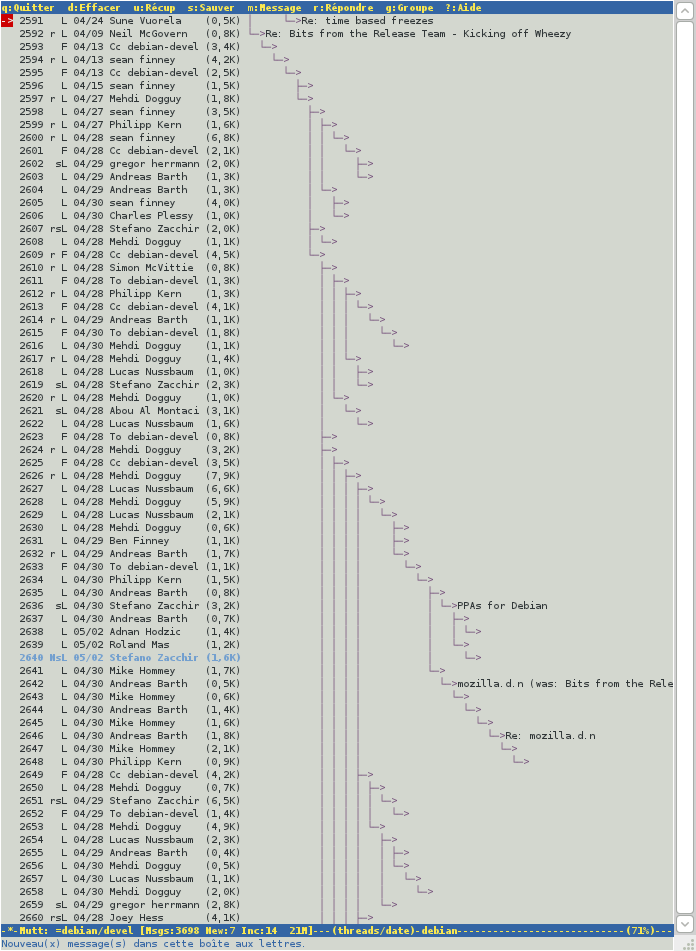
At this point it s a discussion thread of several hundreds of messages (there are several screens of messages like the one above). Many of the sub-threads have been interesting, but the general discussions mixed too many different things so that there s no clear outcome yet. Lucas Nussbaum tried to make a summary. Obviously I must adjust my plan, there s lots of feedback to process. I accepted to drive a DEP together with Sean Finney to help structure the part of the discussion that focuses on allowing development to continue during freezes. But I m also eager to fix the marketing problem of testing and have the project recognize that testing is a product in itself and that end-users should be encouraged to use it. Package Tracking System maintenance The Package Tracking System is an important tool for Debian developers, and it has been broken by some change on the Bug Tracking System. I worked around it quite quickly so that few people noticed the problem but Cron kept reminding me that I had to properly fix it. I ended up doing it last week-end. While working on the PTS, I took the opportunity to merge a patch from Jan Dittberner to enhance the news RSS feed that the PTS provides. And I also integrated information from backports.debian.org (thanks to Mehdi Dogguy for reminding me #549115). Multiarch update Not much new this month. I fixed two bugs in the multiarch dpkg branch thanks to bug reports from Ubuntu users (LP 767634, LP 756381). I m still waiting on Guillem Jover finishing his review of the multiarch branch. I m pinging him from time to time but it looks like multi-arch is no longer in his short term priority list. :-( I ve been running this code for more than 2 months and it works fine. I want to see it merged. I m ready to update my code should anything need to be changed to please Guillem. But without any feedback we re in a deadlock. Misc dpkg work While fixing a bug in update-alternatives (found in one of the valid reports on launchpad), I noticed that there was room for improvements in the error messages output by update-alternatives. I changed them to reuse the same strings that were already used in other parts of dpkg. The result is that there are a few strings less to translate (always a nice thing for the poor translators who have to deal with the thousands of strings that dpkg contains). I also tried to fix some of the most cryptic error messages in dpkg (see #621763) but that work is stalled at the request of Guillem. Book update We (me and Roland Mas) are almost done with the update of our French book for Debian Squeeze. It will hit the shelves in July or September. I m starting to prepare the fundraising campaign to make an English translation of it. We ll use ulule.com for this. On my blog I have been pleased to interview Meike Reichle, it s the first women that I have interviewed in the series but it s certainly not the last one. I also interviewed Adam D. Barratt, one of our tireless release managers. Thanks Many thanks to the people who gave me 180.35 in March and 235.37 in April. That represents 1.5 and 2 days of work for those months. See you next month for a new summary of my activities.

8 comments Liked this article? Click here. My blog is Flattr-enabled.

28 April 2011

Meike Reichle: What it's like to do Debian Press Work

A few days ago I did an interview for the People Behind Debian series that, among other things, covered my Debian press work and asked what it's like to do that kind of work for Debian. Here's a little addendum: Sometimes Debian Press Work is great: All these people do all this amazing stuff and it's a pure pleasure to talk about it. Our last release was such an experience for example. I was clamped to my laptop for almost 20 hours straight and I had a great time! There was this great common feeling of community, achievement and pride in our work and I was proud and happy to be a part of it. And then there are times like the last few days, where Alex and I went South for 4.5 precious and long-awaited days of vacation and ended up spending the first two of them working on an obituary for a dear and much valued member of our community and once this was done spent the remaining days of our holidays nervously watching the net and drafting and re-drafting press announcements because some <bleep> thought it might be oh-so-hilarous to send out faked cease and desist orders to a Debian user, ostensibly as a funny prank but along the way causing a huge amount of completely unsubstantiated FUD that we'll probably spend weeks clearing up. Somewhere in between these events is what Debian press work is like.

21 April 2011

Rapha&#235;l Hertzog: People behind Debian: Meike Reichle, member of Debian Women

Meike Reichle is a Debian developer since 2008 but has been involved for longer than that, in particular in Debian Women. She s a great speaker and shared her experience in a Debconf talk. She s also part of the Debian publicity team and managed the live coverage of the last release on identi.ca. Enough introduction, learn more about her by reading the interview. My questions are in bold, the rest is by Meike. Who are you? My name is Meike Reichle, I am a studied information scientist and work as a project manager at Pengutronix, an embedded Linux company probably best known for their ARM kernel work. I live in Germany, more exactly in Lower Saxony, but I was originally born and raised in Swabia. Although I moved here ten years ago I still have a rather strong Swabian cultural identity. (Among other things I pride myself on having introduced a number of fellow DDs to the true promise that are real hand-made Sp tzle ;-) ) I am married to Alexander Reichle-Schmehl, we ll have our third wedding anniversary this summer. Apart from Debian most of my spare time is used for all kinds of crafts and DIY activities. Making things with my hands always gives me a great sense of accomplishment. My Free software history is summed up pretty quickly. Like most women of my age I wasn t introduced to computers until well into my teens. I didn t have a computer of my own until I started studying at the university in 2001. From there on things developed rather quickly: Working on the University s Unix terminals got me hooked on *nixes, so I got me one of those Linuxes everyone talked about. I tried a couple of different distributions, ended up with Debian around 2004, started contributing in 2005, and finally became a full DD what a nice coincidence! exactly this day (Apr 18th) three years ago. You re part of Debian Women. How is the project going? I have the feeling that the number of women involved in Debian has not significantly increased. The amount of women active within Debian is a tricky thing to judge. Here s a quick example why: When the DPL was elected in 2004 there were 911 Debian Developers eligible to vote, 4 of them were female. Shortly after, during DebConf4, debian-women was founded. When the current DPL was reelected last month, there were again 911 Debian Developers eligible to vote, but this time 13 of them were women. You can look at these numbers and say The number of female DDs has more than tripled, what a success! Or you can pull out your calculator and it will tell you that in terms of ratio this puts us from a measly 0.4% to an only slightly less measly 1.4% ratio of female DDs. This still is pardon my language a bloody shame, but sadly also pretty close to the average ratio of women in Free Software. So, while I do think that the debian-women project did already have a significant impact on the Debian project as a whole, I don t think it has achieved its goals yet. Not for a long time. There s still a lot to be done but unfortunately the debian-women project has somewhat run out of steam at the moment. The seven years of its existence divide quite equally into the first half, which was very active and saw great results, and the second half, which was very slow and much more passive. In my impression debian-women is currently undergoing a rather bumpy generational change. On the one hand a lot of the original members, including myself, have reduced their involvement. Speaking for myself this is caused by shift of interests as much as general weariness. On the other hand there are only very few women following up. This development is also reflected quite harshly in DD numbers: If I don t misjudge any first names (and I desperately hope I do!) for the last three years not a single woman has joined Debian as a developer! After the great start debian-women has had, this is a very painful thing to see! That said, things don t look all bad. There is a number of women maintaining packages without being DDs and there s also at least one woman currently in NM, so there s hope this standstill won t last very much longer. But still, the fact remains that debian-women is suffering from a rather serious recruitment problem and I hope that this interview might actually help to spur some new or not yet active members into action. The aim of debian-women is far from achieved and now that its initial members are receding its time for new members to step up and take initiative. What should Debian do to be more attractive to women ? I think the general atmosphere has improved, we re less tolerant with rude behaviour, the usual tone on mailing lists has improved. Yet it doesn t seem to be enough. If there was a female DD for every time I answered that question First of all, I agree, Debian as a community has improved tremendously! Our general tone is much more friendly and cooperative and there is now a much better awareness of the impression we give to outsiders and newcomers. Now on to the difficult part: The question what should be done to get more women into Free Software has been around almost as long as Free Software exists, and it has been answered very well by a lot of people: Twenty years ago Ellen Spertus wrote Why are There so Few Female Computer Scientists? and most of it still holds true. Almost ten years ago Val Henson (now Aurora) wrote HOWTO Encourage Women in Linux and that also is still pretty accurate. In 2006 Floss Pols undertook extensive research to find out why there were so few women in Open Source and Free Software and how that could be changed. They also came up with a very good set of recommendations. All of these texts highlight different aspects of that question and all of them have very good points. I personally have, over the years, arrived at a rather sociological, not to say holistic point of view. In fact I answered the exact same question a few days ago, and the answer I gave then was this: After ~10 years of women in tech advocacy I d say the ultimate and final measure to get more women into Free Software is by finally achieving a truly equal society and at the same time dramatically improving child care support in almost any country. I ve come to the conclusion that what really holds women back in practice is not so much a lack of skill or interest but a simple lack of opportunity. For most of us Free Software is what we do in our spare time and that s something that women, even today, have considerably less of than men. Even in couples where both partners work full-time it is still mostly the woman who does the majority of the housework and child care duties. In most cultures men have a perceived right to their leisure time that does not to the same degree exist for women. That is one major reason, the other is instilled modesty, which has kind of become my personal arch-enemy by now. I ve talked to so many girls and women at all sorts of events about why they won t take up Computer Science studies or join a Free Software project and the answer I hear most often is that they do not consider themselves good enough in one or another aspect. Sometimes they will doubt their technical skills, sometimes their language skills, sometimes their stamina. Needless to say these girls and women were not any less qualified than the people already active in Free Software. So, yes, in the short and medium term making Debian a more welcoming and friendly place is the way to go. As many others pointed out already this will not only benefit prospective contributors but the community as a whole: those new to it as well as those who ve been in it for a long time. In the long term however what we need is empowerment! Women who are just as confident about their skills as men and are not discouraged by uncooperative environments. This is of course something that is culturally deep-rooted and can only happen in a very large time frame. So, for the moment the way to go in my view is accessibility: a cooperative atmosphere, a code of conduct, comprehensive documentation not only of technical aspects but also of structures and processes. The other thing we need to do is to have as many already active women as possible attend as many Linux/Debian/Free Software/Whatever events as possible. In my experience it happens quite often that other women see these women, feel very inspired by them, get to talk to them and then a few days later show up on some mailing list or IRC channel. From what I ve seen personal contact still beats any other kind of recruiting measures. You re a Debian developer but you re also married with a Debian developer (Alexander Reichle-Schmehl). Did you meet because of Debian? If not, who introduced Debian to the other one? :-) We did in fact meet because of Debian. More specifically during our booth shift at the Debian booth at LinuxTag 2005, where I did a talk on the debian-women project and Alex organised the DebianDay. After that our relationship developed pretty much along our Debian activities: After our initial meeting we talked a lot on #debian.de, when Alex went to DebConf5 and I didn t we noticed that we kind of missed each other. The first gift he ever gave me was a Debconf5 shirt and a box Finnish chocolates (I still have one of them today. :) ) Our first secret kiss was at ApacheCon 2005, where we were both staffing the Debian booth (kudos to abe for pretending not to notice). We then became an official couple at Berlinux 2005 where we were both staffing the Debian booth and giving talks on packaging and user motivation. Our first real relationship stress test was when we both joined the DebConf6 orga team. It was a stressful time, but we passed it with flying colours! About a year later we announced our engagement via planet.debian.org. Our wedding was a veritable MiniDebConf, one of the best gifts we got was a Debian cookbook including the favourite recipes of DDs from around the world. By now we ve both finished university and work full-time jobs, so we don t do as many talks and attend as many Debian events as we used to. Instead we now mainly focus on press and publicity work, which is quite practical to work on as a pair. It s actually rather funny that way, Alex and I get confused with each other quite often, since we have almost the same name, often pick up on each other s E-Mail conversations and are most often quoted by our function rather than by name. Because of we have kind of merged into this virtual Debian Press Person in the perception of many of our contacts. You also have another hat : Debian Press Officer. What is this about? What would you suggest to people who would like get involved in that domain? Debian press work is mainly about providing an official and coordinated point of contact to anyone wanting information from or about Debian. The press team answers all sorts of inquiries (the most popular one is is of course always the next release date) and makes sure all important events and developments within Debian receive the attention and recognition they deserve. Debian is a diverse project where every sort of contributor is free to voice his or her opinion in any way. We don t have NDAs or prescribed terminology. That s one of the things I love about Debian but also something that makes us difficult to handle for conventional media. They want official statements, in generally understandable terms, at appointed times. That s what the press team takes care of. Almost all of the press work is done in the publicity team, which coordinates using IRC, Mail and SVN. The publicity team also publishes the Debian Project News, which are very popular among our users and developers. Press work is also an area of work that offers lots of possibilities for non-technical contribution. http://wiki.debian.org/Teams/Publicity lists a number of possibilities for contribution and, like most Debian Teams, we d be more than grateful to get some more helping hands and happy to introduce interested newcomers to our work. What s the biggest problem of Debian? In my view: Overwork. Debian has thousands of contributors but still a lot of the main work rests on very few shoulders. We need more contributors, especially, but not only in the key teams. In order to get more people we need to do some marketing which is very hard for us, since we are very proud of our independence and have a strong focus on purely technical aspects rather than aiming for popularity. However, with the current amount of Open Source and Free Software projects to join we find ourselves not only in a contest on technical excellence but also a sort of popularity contest that is about perception rather than hard facts. This popularity contest is difficult for Debian and currently costs us quite a bunch of very capable people. Do you have wishes for Debian Wheezy? My answer to that is a non-technical one: I think Debian is currently very under-appreciated, we do a lot of great work and maybe even more importantly we do a lot of important work for Software Freedom, sometimes even at the cost of our above-mentioned popularity. I hope people will appreciate that more again in the future. Is there someone in Debian that you admire for their contributions? Over the years I have made a lot of friends within the Debian community, some have even become family. That makes it somewhat hard to single out individual people. I think what I admire most is continuous commitment. I am very impressed by those among us who have kept up a high level of commitment over many years and at the same time managed to bring that in line with a fulfilled personal/family life. That s something that I hope I ll also be able to achieve in the years to come.
Thank you to Meike for the time spent answering my questions. I hope you enjoyed reading her answers as I did. Subscribe to my newsletter to get my monthly summary of the Debian/Ubuntu news and to not miss further interviews. You can also follow along on Identi.ca, Twitter and Facebook.

2 comments Liked this article? Click here. My blog is Flattr-enabled.

6 April 2011

Gerfried Fuchs: The Canterbury Project

The Background If you weren't online last Friday you probably have missed the big news announcement on the various community distribution websites. The main pages of them got replaced by a placeholder announcing the birth of The Canterbury Project. People started to wonder whether it is an April fool's prank or for real. This blog post is meant to shine a bit more light on it and address one comment received about it. If you go to the news item on the Debian site you'll get your answer about that it indeed was an April fool's prank. The idea for doing something in coordination with other distributions came to me when I thought about last year's (or was it already two year's ago?) prank that the various web cartoon sites pulled: they replaced their main page with the page of another cartoonist. My original idea was actually along that lines. So I started to dig up website contacts from different distributions, I was aiming at the big names in the community distribution sector. Given that my time is pretty limited these days with renovating the house we plan to live in soonish I knew I had to let in others in within Debian. I though didn't want to involve too many people, for several reasons: it should be a surprise to as many as possible, but more importantly, I didn't want to shy away other distributions by an overwhelming Debian involvement. That's also part of the reason why I didn't contact many Debian based distributions. So first contacts where made, a dedicated IRC channel used for coordination, and people involved joined in. Then the thing happened which the Free Software community is so well known for: additional ideas came in, two people independently addressed me whether it wouldn't be better that instead of a circle replacement of the frontpage, why not display the same page on all of them. And one of them added that a corresponding news item might make sense. So there we were, having to think about text to put into two things: the news item and the replacement page itself. At this stage Alexander threw in a project name with a background that was adopted. Francesca started with an idea for the news item, I started to put quotes in and asked for ones from the other involved people that fit their distribution well. Klaas came up with a template for the replacement page that we tweaked. Fortunately we ended up being five distributions and the colors of the banner did match the distribution ones rather well (except for one, we had to tweak the color of one banner). The Credits We were all set, and actually everything went fine. And it definitely caught the attention. This blog post goes out in thanks to the following people: I hopefully haven't forgotten anyone. There surely were some more people involved in the other distributions, and I guess the named people weren't aware of all the ones involved inside Debian. Feel free to drop missing names in the comments. Addressing Feedback Finally, let me address one concern raised: someone claimed that the real joke with this prank was that we would consider collaboration to be a joke. Actually, the total opposite is the case here. That it was possible to pull it off should be proof enough that Collaboration Across Borders actually is possible. And the background information put into the news section of the replacement site is real. Also, my personal quote in the news item was meant dead honest. I do believe that DEX has a limited point of view and only tackles part of the problem. Unfortunately, for such efforts to really come to life it takes people with a really long breath and dedication to it. Efforts like the VCS-PKG and the Freedesktop Games effort are more or less stalled. Even though a lot of people do believe in stronger collaboration to be a good thing, the basis is not working out too well. I'm in the fortunate position that for some of the packages I maintain there is exchange between packagers from different distributions to avoid common troubles. If it can't be done in the big it should at least be tried in the small. I want to specifically highlight again one part of the updates in the replacement page: the CrossDistro track at this year's FOSDEM. This one was more than fruitful, on several levels. From what I've heard a lot of discussion happened besides the talks too, and connections got established. It doesn't sound unlikely like this might be done again next year. So again, thanks for enjoying this April fool's prank, thanks to everyone who helped to deliver it, and especially a lot of thanks to the people who this might have got thinking of possibilities to improve on the collaboration front!

/debian permanent link Comments: 8 Flattr this

1 April 2011

Alexander Reichle-Schmehl: The Canterbury Distribution

I'm sure you already heard the news about the new joined Canterbury Distribution, and are eager about details. While our teams are struggling to integrate all the existing infrastructure, it's my pleasure to announce that the first pieces of the collaboration are already available for our users. As a first measurement, a common Canterbury Package Manager, called cant will be made available in all distributions. It is already available for the distribution formerly known as Archlinux, and with the next mirror push will also be available for those used to run Debian. You'll be pleased to know, that the command line syntax isn't much of a change, you can still run cant search, cant install or cant remove, but future version will also introduce all the features known from the other distributions. Stay tuned for further updates of Canterbury Linux!

31 March 2011

Jordi Mallach: A tale of Trist nia and its Quadrennial Royal Ball

In one of the corners of what is now know as Europa, there was a rich, prosperous and beautiful kingdom known as Trist nia. In the past, not that long ago, it had been a number of smaller kingdoms and caliphates, all with their own cultures, religions and ways of life. Wars, and series of marriages of convenience eventually configured what ended up being the united kingdom of Trist nia. Throughout the years, some of the unified cultures grew and flourished, while others struggled to survive in their ever-shrinking areas of influence. A required introduction Sometimes, the minor cultures would suffer due to oppression coming from the delegates of the King, who would ban any expression of these cultures, as they were seen as a potential threat to the kingdom's stability and unity. For example, just a few decades before the main subject of this tale, the predecessor of the incumbent King took power by force, after crushing everyone who opposed his uprise during a bloody and hard civil war. His reign was ruthless and he imposed draconian laws uppon his people: usage and teaching of the minor languages was banned, and everyone was forced to use the language of the Centr lia region, in public or private. After four decades, the majority of the Tristanian people were sick enough of the situation to consider standing against their fear of the regime and demand freedom, but repression prevailed until the old general died. His place was taken by the King's grandson even if the people had expressed, just before the Great War, that they had had enough kings and demanded a ruler they could choose directly. Of course, the new King seemed a lot nicer than who they had been suffering for ages, so when asked if they accepted the new situation, an overwhelming majority said yes . However, there was a region, Verd lia, where the majority said no . Things were actually more complicated. Verdalians formed a traditional, proud society, and while the years of oppression had undoubtedly weakened it, they had managed to preserve their very unique culture, language and traditions healthy. The Verdal language was really weird to the ears of Centr lians and even other minor cultures of the Kingdom, and erudites struggled to find its real origins, not being able to reach plausible conclusions. Verdanians, as we already know, were a traditional society, living in a land of deep and poorly connected valleys. Little they knew or cared about the complicated matters of Centr lia and other regions. What made them happy was to take care their sheep and cows, keep a good fire in their living room and, every now and then, enjoy one of their log cutting contests. The impositions of the former dictator were too much for them, and some of them started sabotaging, assaulting and killing some of the dictator's soldiers, agents and officers. This was a huge risk at the time; getting caught meant death penalty for sure, and at first, even people from other regions were in favour of these actions. However, this popular support greatly diminished when the new King took the throne, as these minority continued with the killings, while most of the people saw it was no longer justified. The Royal Ball One of the very first measures the young King introduced was to organise the Royal Ball of Trist nia , a major event through which the people of the different regions would be able to elect their delegates to the Crown. Every four years, a Great Ball contest would happen in Centr lia, and the winners would be able to decide by their own on some of the matters that affected their region. Verdanians would send a few teams of dancers, each of which came from different towns or areas. Some Verdanian teams were happy about the King and the new political situation, but other teams weren't so much. And some others, while being simple non-violent dancers, were known to be supporters of the violent minority who kept on harassing, assaulting and even killing in their struggle for freedom of Verd nia . The Verdanian groups aligned with the different culture of Verd nia (including those who were said to support the violent) tended to get a lot more points in the dancing contest, and a majority of the elected delegates were appointed by them, making it easier to pass laws and edicts that favoured protection of their ways, traditions and language. No matter how hard they tried, the dancing groups closer to Centr lia kept losing to the majority. After many years of dance contests, these groups used their closeness to the King's court to pass the Ball Law of Tristanian, that would ban any dancing group which didn't condemn the assaults and killings that kept happening in Verd nia. The unsurprising result was that, with less dancing groups participating in the following Royal Ball, the Verdanian majority was broken and new delegates, friendly of the Centralian officers, were elected. Many people who had been in favour of assaults and killings began to question this strategy, and this political movement's unity started to break. In the end, the dancers decided to part ways with the violent; they wanted to dance in the next ball, and to do so, they wrote a letter to the King, in which they explicitly expressed their rejection of violent ways, and their embracing of dancing as the only means to drive their political agenda. An objective reading of the new Ball Law clearly showed that this was enough: the text only said the requisite for a dancing group was to disavow all kinds of violence. This wasn't really expected in Centr lia, so they started to add new requirements in an attempt to keep this group from the contest: their decisive majority in Verd nia was at stake. The Royal Ball was nearing and registrations for the contest would soon close. The Centralian government first argued that the dancing group should reject the violence coming from the Verdanian extremists in particular. The dancers did it. Then they argued that the dancers were the same people who had been supporting violence in Verd nia for years, and obviously their violence rejection statement was a lie. The dancers struggled to find new dancers who had not been involved in past dances. But it was not enough. They then claimed that this dance group should be quarantined for four years, until they could prove they really were serious about their new non-violent ideas. The dance group made a plea to the Trist nian Supreme Counsel, a group of sixteen experts in law of the Kingdom, and argued that all of these draconian requirements were not part of the law that was being enforced by the King. Their appeal to the elder counselors was in vain, though. They ruled this dancing group was as criminal as the violent minority they had once supported, and should by no means take part in the Royal Ball. As a last, desperate measure, the dancing group reached an agreement with other Verdanian dancers to join forces. They would adopt a new name and new dancing costume colours. Many feared this would only end up in the ban of the other dancing group. Unfortunately, the end of this story has not been written yet, but it will be completed very soon. Only time will tell if things continue being very sad and unfair in Trist nia, or if the dance contest will once again be impartial, with legitimate results.

28 March 2011

R&#233;mi Vanicat: Booting rarely used os

For some time, I was looking for a way to change grub default entry for only one boot. I want to tell it that next time it should boot the entry 0, and the time after that, use the usual default (the entry 1). Founding documention for this is not as easy at it should, and the information on the debian wiki wasn't clear enough for me to understand. So I edit the wiki page to make clear that grub-reboot also available for those using grub2, and that it will only configure the boot, but not reboot the computer itself. As each time I wrote some text in English, I'm not sure my version correctly transmit my meaning. By the way, I'm changing my blog. The old one contain a post on my search of a solution for this. Thanks to stbuehler and Jochen for the indication leading to the correct solution for this. Thanks also to Vadim Solomin for a patch to make pm-hibernate notice the configured method for shutting-down the computer.

Next.

Previous.
