Search Results: "ghe"

5 September 2021

Reproducible Builds: Reproducible Builds in August 2021

Welcome to the latest report from the Reproducible Builds project. In this post, we round up the important things that happened in the world of reproducible builds in August 2021. As always, if you are interested in contributing to the project, please visit the Contribute page on our website.

There were a large number of talks related to reproducible builds at DebConf21 this year, the 21st annual conference of the Debian Linux distribution (full schedule):
PackagingCon (@PackagingCon) is new conference for developers of package management software as well as their related communities and stakeholders. The virtual event, which is scheduled to take place on the 9th and 10th November 2021, has a mission is to bring different ecosystems together: from Python s pip to Rust s cargo to Julia s Pkg, from Debian apt over Nix to conda and mamba, and from vcpkg to Spack we hope to have many different approaches to package management at the conference . A number of people from reproducible builds community are planning on attending this new conference, and some may even present. Tickets start at $20 USD.

As reported in our May report, the president of the United States signed an executive order outlining policies aimed to improve the cybersecurity in the US. The executive order comes after a number of highly-publicised security problems such as a ransomware attack that affected an oil pipeline between Texas and New York and the SolarWinds hack that affected a large number of US federal agencies. As a followup this month, however, a detailed fact sheet was released announcing a number large-scale initiatives and that will undoubtedly be related to software supply chain security and, as a result, reproducible builds.
Lastly, We ran another productive meeting on IRC in August (original announcement) which ran for just short of two hours. A full set of notes from the meeting is available.

Software development kpcyrd announced an interesting new project this month called I probably didn t backdoor this which is an attempt to be:
a practical attempt at shipping a program and having reasonably solid evidence there s probably no backdoor. All source code is annotated and there are instructions explaining how to use reproducible builds to rebuild the artifacts distributed in this repository from source. The idea is shifting the burden of proof from you need to prove there s a backdoor to we need to prove there s probably no backdoor . This repository is less about code (we re going to try to keep code at a minimum actually) and instead contains technical writing that explains why these controls are effective and how to verify them. You are very welcome to adopt the techniques used here in your projects. ( )
As the project s README goes on the mention: the techniques used to rebuild the binary artifacts are only possible because the builds for this project are reproducible . This was also announced on our mailing list this month in a thread titled i-probably-didnt-backdoor-this: Reproducible Builds for upstreams. kpcyrd also wrote a detailed blog post about the problems surrounding Linux distributions (such as Alpine and Arch Linux) that distribute compiled Python bytecode in the form of .pyc files generated during the build process.
diffoscope diffoscope is our in-depth and content-aware diff utility. Not only can it locate and diagnose reproducibility issues, it can provide human-readable diffs from many kinds of binary formats. This month, Chris Lamb made a number of changes, including releasing version 180), version 181) and version 182) as well as the following changes:
  • New features:
    • Add support for extracting the signing block from Android APKs. [ ]
    • If we specify a suffix for a temporary file or directory within the code, ensure it starts with an underscore (ie. _ ) to make the generated filenames more human-readable. [ ]
    • Don t include short GCC lines that differ on a single prefix byte either. These are distracting, not very useful and are simply the strings(1) command s idea of the build ID, which is displayed elsewhere in the diff. [ ][ ]
    • Don t include specific .debug-like lines in the ELF-related output, as it is invariably a duplicate of the debug ID that exists better in the readelf(1) differences for this file. [ ]
  • Bug fixes:
    • Add a special case to SquashFS image extraction to not fail if we aren t the superuser. [ ]
    • Only use java -jar /path/to/apksigner.jar if we have an apksigner.jar as newer versions of apksigner in Debian use a shell wrapper script which will be rejected if passed directly to the JVM. [ ]
    • Reduce the maximum line length for calculating Wagner-Fischer, improving the speed of output generation a lot. [ ]
    • Don t require apksigner in order to compare .apk files using apktool. [ ]
    • Update calls (and tests) for the new version of odt2txt. [ ]
  • Output improvements:
    • Mention in the output if the apksigner tool is missing. [ ]
    • Profile diffoscope.diff.linediff and specialize. [ ][ ]
  • Logging improvements:
    • Format debug-level messages related to ELF sections using the diffoscope.utils.format_class. [ ]
    • Print the size of generated reports in the logs (if possible). [ ]
    • Include profiling information in --debug output if --profile is not set. [ ]
  • Codebase improvements:
    • Clarify a comment about the HUGE_TOOLS Python dictionary. [ ]
    • We can pass -f to apktool to avoid creating a strangely-named subdirectory. [ ]
    • Drop an unused File import. [ ]
    • Update the supported & minimum version of Black. [ ]
    • We don t use the logging variable in a specific place, so alias it to an underscore (ie. _ ) instead. [ ]
    • Update some various copyright years. [ ]
    • Clarify a comment. [ ]
  • Test improvements:
    • Update a test to check specific contents of SquashFS listings, otherwise it fails depending on the test systems user ID to username passwd(5) mapping. [ ]
    • Assign seen and expected values to local variables to improve contextual information in failed tests. [ ]
    • Don t print an orphan newline when the source code formatting test passes. [ ]

In addition Santiago Torres Arias added support for Squashfs version 4.5 [ ] and Felix C. Stegerman suggested a number of small improvements to the output of the new APK signing block [ ]. Lastly, Chris Lamb uploaded python-libarchive-c version 3.1-1 to Debian experimental for the new 3.x branch python-libarchive-c is used by diffoscope.

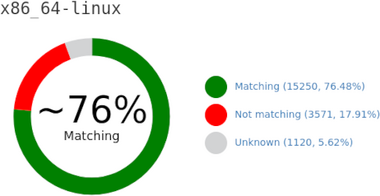
Distribution work In Debian, 68 reviews of packages were added, 33 were updated and 10 were removed this month, adding to our knowledge about identified issues. Two new issue types have been identified too: nondeterministic_ordering_in_todo_items_collected_by_doxygen and kodi_package_captures_build_path_in_source_filename_hash. kpcyrd published another monthly report on their work on reproducible builds within the Alpine and Arch Linux distributions, specifically mentioning rebuilderd, one of the components powering reproducible.archlinux.org. The report also touches on binary transparency, an important component for supply chain security. The @GuixHPC account on Twitter posted an infographic on what fraction of GNU Guix packages are bit-for-bit reproducible: Finally, Bernhard M. Wiedemann posted his monthly reproducible builds status report for openSUSE.
Upstream patches The Reproducible Builds project detects, dissects and attempts to fix as many currently-unreproducible packages as possible. We endeavour to send all of our patches upstream where appropriate. This month, we wrote a large number of such patches, including: Elsewhere, it was discovered that when supporting various new language features and APIs for Android apps, the resulting APK files that are generated now vary wildly from build to build (example diffoscope output). Happily, it appears that a patch has been committed to the relevant source tree. This was also discussed on our mailing list this month in a thread titled Android desugaring and reproducible builds started by Marcus Hoffmann.

Website and documentation There were quite a few changes to the Reproducible Builds website and documentation this month, including:

  • Felix C. Stegerman:
    • Update the website self-build process to not use the buster-backports suite now that Debian Bullseye is the stable release. [ ]
  • Holger Levsen:
    • Add a new page documenting various package rebuilder solutions. [ ]
    • Add some historical talks and slides from DebConf20. [ ][ ]
    • Various improvements to the history page. [ ][ ][ ]
    • Rename the Comparison protocol documentation category to Verification . [ ]
    • Update links to F-Droid documentation. [ ]
  • Ian Muchina:
    • Increase the font size of titles and de-emphasize event details on the talk page. [ ]
    • Rename the README file to README.md to improve the user experience when browsing the Git repository in a web browser. [ ]
  • Mattia Rizzolo:
    • Drop a position:fixed CSS statement that is negatively affecting with some width settings. [ ]
    • Fix the sizing of the elements inside the side navigation bar. [ ]
    • Show gold level sponsors and above in the sidebar. [ ]
    • Updated the documentation within reprotest to mention how ldconfig conflicts with the kernel variation. [ ]
  • Roland Clobus:
    • Added a ticket number for the issue with the live Cinnamon image and diffoscope. [ ]

Testing framework The Reproducible Builds project runs a testing framework at tests.reproducible-builds.org, to check packages and other artifacts for reproducibility. This month, the following changes were made:

  • Holger Levsen:
    • Debian-related changes:
      • Make a large number of changes to support the new Debian bookworm release, including adding it to the dashboard [ ], start scheduling tests [ ], adding suitable Apache redirects [ ] etc. [ ][ ][ ][ ][ ]
      • Make the first build use LANG=C.UTF-8 to match the official Debian build servers. [ ]
      • Only test Debian Live images once a week. [ ]
      • Upgrade all nodes to use Debian Bullseye [ ] [ ]
      • Update README documentation for the Debian Bullseye release. [ ]
    • Other changes:
      • Only include rsync output if the $DEBUG variable is enabled. [ ]
      • Don t try to install mock, a tool used to build Fedora packages some time ago. [ ]
      • Drop an unused function. [ ]
      • Various documentation improvements. [ ][ ]
      • Improve the node health check to detect zombie jobs. [ ]
  • Jessica Clarke (FreeBSD-related changes):
    • Update the location and branch name for the main FreeBSD Git repository. [ ]
    • Correctly ignore the source tarball when comparing build results. [ ]
    • Drop an outdated version number from the documentation. [ ]
  • Mattia Rizzolo:
    • Block F-Droid jobs from running whilst the setup is running. [ ]
    • Enable debugging for the rsync job related to Debian Live images. [ ]
    • Pass BUILD_TAG and BUILD_URL environment for the Debian Live jobs. [ ]
    • Refactor the master_wrapper script to use a Bash array for the parameters. [ ]
    • Prefer YAML s safe_load() function over the unsafe variant. [ ]
    • Use the correct variable in the Apache config to match possible existing files on disk. [ ]
    • Stop issuing HTTP 301 redirects for things that not actually permanent. [ ]
  • Roland Clobus (Debian live image generation):
    • Increase the diffoscope timeout from 120 to 240 minutes; the Cinnamon image should now be able to finish. [ ]
    • Use the new snapshot service. [ ]
    • Make a number of improvements to artifact handling, such as moving the artifacts to the Jenkins host [ ] and correctly cleaning them up at the right time. [ ][ ][ ]
    • Where possible, link to the Jenkins build URL that created the artifacts. [ ][ ]
    • Only allow only one job to run at the same time. [ ]
  • Vagrant Cascadian:
    • Temporarily disable armhf nodes for DebConf21. [ ][ ]

Lastly, if you are interested in contributing to the Reproducible Builds project, please visit the Contribute page on our website. You can get in touch with us via:

30 August 2021

Joachim Breitner: A Candid explainer: Safe higher-order upgrades

This is the second post in a series about the interface description language Candid.

Safe upgrades A central idea behind Candid is that services evolve over time, and so also their interfaces evolve. As they do, it is desirable to keep the interface usable by clients who have not been updated. In particular on a blockchainy platform like the Internet Computer, where some programs are immutable and cannot be changed to accommodate changes in the interface of the services they use, this is of importance. Therefore, Candid defines which changes to an interface are guaranteed to be backward compatible. Of course it s compatible to add new methods to a service, but some changes to a method signature can also be ok. For example, changing
service A1 :  
  get_value : (variant   current; previous : nat  )
    -> (record   value : int; last_change : nat  )
 
to
service A2 :  
  get_value : (variant   current; previous : nat; default  )
    -> (record   value : int; last_change : nat; committed : bool  )
 
is fine: It doesn t matter that clients that still use the old interface don t know about the new constructor of the argument variant. And the extra field in the result record will silently be ignored by old clients. In the Candid spec, this relation is written as A2 <: A1 (note the order!), and the formal footing this builds on is subtyping. We thus say that it is safe to upgrade a service to a subtype , and that A2 s interface is a subtype of A1 s. In small examples, I often use nat and int, because every nat is also a int, but some int values are not not nat values, namely the negative ones. We say nat is a subtype of int, nat <: int. So a function that in the first returns a int can in the new version return a nat without breaking old clients. But the other direction doesn t work: If the old version s method had a return type of nat, then changing that to int would be a breaking change, as old clients would not be prepared to handle negative numbers. Note that arguments of function types follow different rules. In fact, the rules are simply turned around, and in argument position (also called negative position ), we can evolve the interface to accept supertypes. Concretely, a function that originally expected an nat can be changed to expect an int, but the other direction doesn t work, because there might still be old clients around that send negative numbers. This reversing-of-the-rules is called contravariance. The vision is that the developer s tooling will warn the developer before they upgrade the code of a running service to a type that is not a subtype of the old interface. Let me stress, though, that all this is about not breaking existing clients that use the old interface. It does not mean that a client developer who fetches the new interface for your service won t have to change their code to make his programs compile again.

Higher order composition So far, we considered the simple case of one service with a bunch of clients, i.e. the first order situation. Things get much more interesting if we have multiple services that are composed, and that pass around references to each other, and we still want everything to be nicely typed and never fail even as we upgrade services. Therefore, Candid s type system can express that a service s method expects or a returns a reference to another service or method, and the type that this service or method should have. For example
service B :   add_listener : (text, func (int) -> ()) -> ()  
says that the service with interface B has a method called add_listener which takes two arguments, a plain value of type text and a reference to a function that itself expects a int-typed argument. The contravariance of the subtyping rules explained above also applies to the types of these function reference. And because the int in the above type is on the left of two function arrows, the subtyping rule direction flips twice, and it is therefore safe to upgrade the service to accept the following interface:
service B :   add_listener : (text, func (nat) -> ()) -> ()  

Soundness theorem and Coq proof The combination of these higher order features and the safe upgrade mechanism is maybe the unique selling point of Candid, but also what made its design quite tricky sometimes. And although the conventional subtyping rules work well, we wanted to do some less conventional things (more on that below), and more than once thought we had a good solution, only to notice that it did not hold water in complicated higher-order cases. But what does it mean to hold water? I felt the need to precisely define a soundness criteria for higher order interface description languages, which you can find in the document An IDL Soundness Proposition. This is a general framework which you can instantiate with your concrete IDL language and rules, and then it tells you what you have to prove to consider your language to be sound. Intuitively, it simulates all possible ways in which services can be defined and upgraded, and in which they can pass around references to each other, and the soundness property is that then that for all messages sent between services, they can always be understood. The document also shows, in general, that any system that builds on canonical subtyping in sound, as expected. That is still a generic theorem that you can instantiate with a concrete system, but now there is less to do. Because these proofs can get tricky in corner cases, it is valuable to mechanize them in an interactive theorem prover and have the computer check the proofs. So I have created a Coq formalization that defines the soundness criteria, including the reduction to canonical subtyping. It also defines MiniCandid, a greatly simplified variant of Candid, proves various properties about it (transitivity etc.) and finally instantiates the soundness theorem. I am particularly fond of the use of coinduction to model the equirecursive types, and the use of named cases, as we know them from Isabelle, to make the proofs a bit more readable and maintainable. I am less fond of how much work it seems to be to extend MiniCandid with more of Candid s types. Already adding vec was more work than it s worth it, and I defensively blame Coq s not-so-great support for nested recursion. The soundness relies on subtyping, and that is all fine and well as long as we stick to canonical rules. Unfortunately, practical considerations force us to deviate from these a bit, as we see in the next post of this series.

Russell Coker: Links August 2021

Sciencealert has an interesting article on a game to combat misinformation by microdosing people [1]. The game seemed overly simplistic to me, but I guess I m not the target demographic. Research shows it to work. Vice has an interesting and amusing article about mass walkouts of underpaid staff in the US [2]. The way that corporations are fighting an increase in the minimum wage doesn t seem financially beneficial for them. An increase in the minimum wage means small companies have to increase salaries too and the ratio of revenue to payroll is probably worse for small companies. It seems that companies like McDonalds make oppressing their workers a higher priority than making a profit. Interesting article in Vice about how the company Shot Spotter (which determines the locations of gunshots by sound) forges evidence for US police [3]. All convictions based on Shot Spotter evidence should be declared mistrials. BitsNBites has an interesting article on the fundamental flaws of SIMD (Single Instruction Multiple Data) [4]. The Daily Dot has a disturbing article anbout the possible future of the QAnon movement [5]. Let s hope they become too busy fighting each other to hurt many innocent people. Ben Taylor wrote an interesting blog post suggesting that Web Assembly should be a default binary target [6]. I don t support that idea but I think that considering it is useful. Web assembly could be used more for non-web things and it would be a better option than Node.js for some things. There are also some interesting corner cases like games, Minecraft was written in Java and there s no reason that Web Assembly couldn t do the same things. Vice has an interesting article about the Phantom encrypted phone service that ran on Blackberry handsets [7]. Australia really needs legislation based on the US RICO law! Vice has an interesting article about an encrypted phone company run by drug dealers [8]. Apparently after making an encrypted phone system for their own use they decided to sell it to others and made millions of dollars. They could have run a successful legal business. Salon has an insightful interview with Michael Petersen about his research on fake news and people who share it because they need chaos [9]. Apparently low status people who are status seeking are a main contributor to this, they share fake news knowingly to spread chaos. A society with less inequality would have less problems with fake news. Salon has another insightful interview with Michael Petersen, about is later research on fake news as an evolutionary strategy [10]. People knowingly share fake news to mobilise their supporters and to signal allegiance to their group. The more bizarre the beliefs are the more strongly they signal allegiance. If an opposing group has a belief then they can show support for their group by having the opposite belief (EG by opposing vaccination if the other political side supports doctors). He also suggests that lying can be a way of establishing dominance, the more honest people are opposed by a lie the more dominant the liar may seem. Vice has an amusing article about how police took over the Encrochat encrypted phone network that was mostly used by criminals [11]. It s amusing to read of criminals getting taken down like this. It s also interesting to note that the authorities messed up by breaking the wipe facility which alerted the criminals that their security was compromised. The investigation could have continued for longer if they hadn t changed the functionality of compromised phones. A later vice article mentioned that the malware installed on Encrochat devices recorded MAC addresses of Wifi access points which was used to locate the phones even though they had the GPS hardware removed. Cory Doctorow wrote an insightful article for Locus about the insufficient necessity of interoperability [12]. The problem if monopolies is not just an inability to interoperate with other services or leave it s losing control over your life. A few cartel participants interoperating will be able to do all the bad things to us tha a single monopolist could do.

29 August 2021

Joachim Breitner: A Candid explainer: The rough idea

One of the technologies that was created by DFINITY as we built the Internet Computer is Candid. Candid is In this in-depth blog post series I want to shed some light onto these aspects of Candid. The target audience is mainly anyone who wants to deeply understand Candid, e.g. researchers, implementors of Candid tools, anyone who wants to builds a better alternative, but no particular prior Candid knowledge is expected. Also, much of what is discussed here is independent of the Internet Computer. Some posts may be more theoretical or technical than others; if you are lost in one I hope you ll rejoin for the subsequent post Much in these posts is not relevant for developers who just want to use Candid in their projects, and also much that they want to know is missing. The Internet Computer dev docs will hopefully cater to that audience.

Blog post series overview
  1. The rough idea (this post) Announcing the blog post series, and very briefly outlining what an Interface Description Language even is.
  2. Safe higher-order upgrades Every can do first-order interface description languages. What makes Candid special is its support for higher-order service composition. This post also contains some general meta-theory and a Coq proof!
  3. Opt is special Extending records in argument position is surprisingly tricky. Lean why, and how we solved it.
  4. Language integration The point of Candid is inter-op, so let s look the various patterns of connecting Candid to your favorite programming language.
  5. Quirks The maybe most interesting post in this series: Candid has a bunch of quirks (hashed field names, no tuples but sequnces, references that nobody used, and more). I ll explain some of them, why they are there, and what else we could have done. Beware: This post will be opinionated.

The rough idea The idea of an interface description language is easy to begin with. Something like
service A :  
  add : (int) -> ();
  get : () -> (int);
 
clearly communicates that a service called A provides two methods add and get, that add takes an integer as an argument, and that get returns such a number. Of course, this only captures the outer shape of the service, but not what it actually does we might assume it implements a counter of sorts, but that is not part of the Candid interface description. In order to now use the service, we also need a (low-level) transport mechanism. Candid itself does not specify that, but merely assumes that it exists, and is able to transport the name of the invoked method and a raw sequence of bytes to the service, and a response (again a raw sequence of bytes) back. Already on the Internet Computer we have two distinct transport mechanisms used are external calls via an HTTP-based RPC interface and on-chain inter-canister calls. Both are handled by the service in the same way. Here we can see that Candid succeeds in abstracting over differences in the low-level transport mechanism. Because of this abstraction, it is possible to use Candid over other transportation mechanisms as well (conventional HTTPS, E-Mail, avian carrier). I think Candid has potential there as well, so even if you are not interested in the Internet Computer, this post may be interesting to you. The translation of argument and result values (e.g. numbers of type int) to the raw sequence of bytes is specified by Candid, defining a wire format. For example, the type int denotes whole numbers of arbitrary size, and they are encoded using the LEB128 scheme. The Candid wire format also contains a magic number (DIDL, which is 0x4449444c in hex) and a type description (more on that later). So when passing the value 2342 to the add, the raw bytes transported will be 0x4449444c00017da612. Of course we want to transfer more data than just integers, and thus Candid supports a fairly complete set of common basic types (nat, int, nat8, nat16, nat32, nat64, int8, int16, int32, int64, float32, float64, bool, text, blob) and composite types (vectors, optional values , records and variants). The design goal is to provide a canonical set of types enough to express most data that you might want to pass, but no more than needed, so that different host languages can support these types easily. The Candid type system is structural. This means that two types are the same when they are defined the same way. Imagine two different services defining the same
type User = record   name : text; user_id : nat  
then although User is defined in two places, it s still the same type. In other words, these name type definitions are always just simple aliases, and what matters is their right-hand side. Because Candid types can be recursive (e.g. type Peano = opt Peano), this means we have an equirecursive type system, which makes some things relatively hard. So far, nothing too special about Candid compared to other interface definition languages (although a structural equirecursive type system is already something). In the next post we look at reference types, and how such higher order features make Candid an interesting technology.

25 August 2021

Jelmer Vernooij: Thousands of Debian packages updated from their upstream Git repository

The Debian Janitor is an automated system that commits fixes for (minor) issues in Debian packages that can be fixed by software. It gradually started proposing merges in early December. The first set of changes sent out ran lintian-brush on sid packages maintained in Git. This post is part of a series about the progress of the Janitor. Linux distributions like Debian fulfill an important function in the FOSS ecosystem - they are system integrators that take existing free and open source software projects and adapt them where necessary to work well together. They also make it possible for users to install more software in an easy and consistent way and with some degree of quality control and review. One of the consequences of this model is that the distribution package often lags behind upstream releases. This is especially true for distributions that have tighter integration and standardization (such as Debian), and often new upstream code is only imported irregularly because it is a manual process - both updating the package, but also making sure that it still works together well with the rest of the system. The process of importing a new upstream used to be (well, back when I started working on Debian packages) fairly manual and something like this:

Ecosystem Improvements However, there have been developments over the last decade that make it easier to import new upstream releases into Debian packages.
Uscan and debian QA watch Uscan and debian/watch have been around for a while and make it possible to find upstream tarballs. A debian watch file usually looks something like this:
1
2
version=4
http://somesite.com/dir/filenamewithversion.tar.gz
The QA watch service regularly polls all watch locations in the archive and makes the information available, so it s possible to know which packages have changed without downloading each one of them.
Git Git is fairly ubiquitous nowadays, and most upstream projects and packages in Debian use it. There are still exceptions that do not use any version control system or that use a different control system, but they are becoming increasingly rare. [1]
debian/upstream/metadata DEP-12 specifies a file format with metadata about the upstream project that a package was based on. In particular relevant for our case is the fact it has fields for the location of the upstream version control location. debian/upstream/metadata files look something like this:
1
2
3
---
Repository: https://www.dulwich.io/code/dulwich/
Repository-Browse: https://www.dulwich.io/code/dulwich/
While DEP-12 is still a draft, it has already been widely adopted - there are about 10000 packages in Debian that ship a debian/upstream/metadata file with Repository information.
Autopkgtest The Autopkgtest standard and associated tooling provide a way to run a defined set of tests against an installed package. This makes it possible to verify that a package is working correctly as part of the system as a whole. ci.debian.net regularly runs these tests against Debian packages to detect regressions.
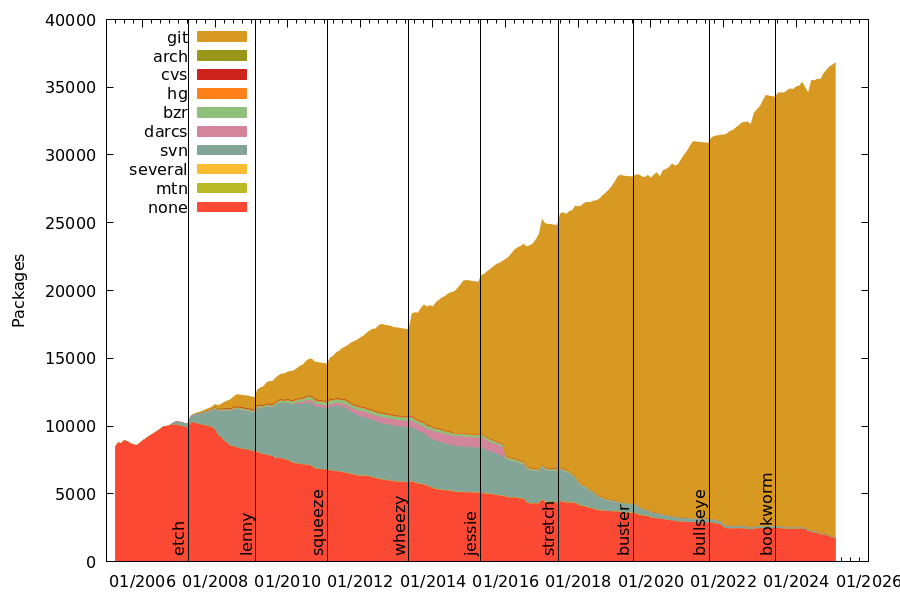
Vcs-Git headers The Vcs-Git headers in debian/control are the equivalent of the Repository field in debian/upstream/metadata, but for the packaging repositories (as opposed to the upstream ones). They ve been around for a while and are widely adopted, as can be seen from zack s stats: The vcswatch service that regularly polls packaging repositories to see whether they have changed makes it a lot easier to consume this information in usable way.
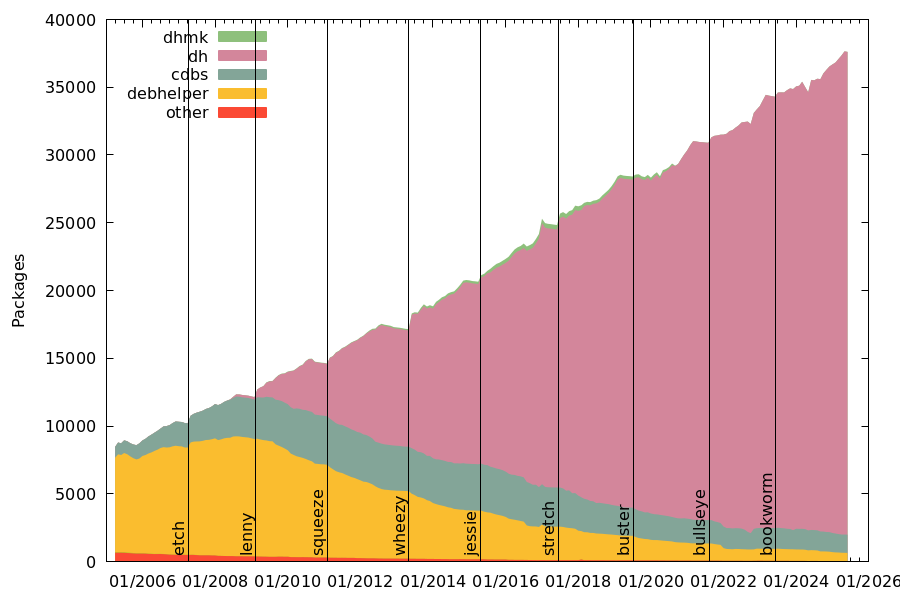
Debhelper adoption Over the last couple of years, Debian has slowly been converging on a single build tool - debhelper s dh interface. Being able to rely on a single build tool makes it easier to write code to update packaging when upstream changes require it.
Debhelper DWIM Debhelper (and its helpers) increasingly can figure out how to do the Right Thing in many cases without being explicitly configured. This makes packaging less effort, but also means that it s less likely that importing a new upstream version will require updates to the packaging. With all of these improvements in place, it actually becomes feasible in a lot of situations to update a Debian package to a new upstream version automatically. Of course, this requires that all of this information is available, so it won t work for all packages. In some cases, the packaging for the older upstream version might not apply to the newer upstream version. The Janitor has attempted to import a new upstream Git snapshot and a new upstream release for every package in the archive where a debian/watch file or debian/upstream/metadata file are present. These are the steps it uses:
  • Find new upstream version
    • If release, use debian/watch - or maybe tagged in upstream repository
    • If snapshot, use debian/upstream/metadata s Repository field
    • If neither is available, use guess-upstream-metadata from upstream-ontologist to guess the upstream Repository
  • Merge upstream version into packaging repository, possibly importing tarballs using pristine-tar
  • Update the changelog file to mention the new upstream version
  • Run some checks to ensure there are no unintentional changes, e.g.:
    • Scan diff between old and new for surprising license changes
      • Today, abort if there are any - in the future, maybe update debian/copyright
    • Check for obvious compatibility breaks - e.g. sonames changing
  • Attempt to update the packaging to reflect upstream changes
    • Refresh patches
  • Attempt to build the package with deb-fix-build, to deal with any missing dependencies
  • Run the autopkgtests with deb-fix-build to deal with missing dependencies, and abort if any tests fail
Results When run over all packages in unstable (sid), this process works for a surprising number of them.
Fresh Releases For fresh-releases (aka imports of upstream releases), processing all packages maintained in Git for which QA watch reports new releases (about 11,000): That means about 2300 packages updated, and about 4000 unchanged.
Fresh Snapshots For fresh-snapshots (aka imports of latest Git commit from upstream), processing all packages maintained in Git (about 26,000): Or 5100 packages updated and 2100 for which there was nothing to do, i.e. no upstream commits since the last Debian upload. As can be seen, this works for a surprising fraction of packages. It s possible to get the numbers up even higher, by both improving the tooling, the autopkgtests and the metadata that is provided by packages.
Using these packages All the packages that have been built can be accessed from the Janitor APT repository. More information can be found at https://janitor.debian.net/fresh, but in short - run:
1
2
3
4
5
6
echo deb "[arch=amd64 signed-by=/usr/share/keyrings/debian-janitor-archive-keyring.gpg]" \
    https://janitor.debian.net/ fresh-snapshots main   sudo tee /etc/apt/sources.list.d/fresh-snapshots.list
echo deb "[arch=amd64 signed-by=/usr/share/keyrings/debian-janitor-archive-keyring.gpg]" \
    https://janitor.debian.net/ fresh-releases main   sudo tee /etc/apt/sources.list.d/fresh-releases.list
sudo curl -o /usr/share/keyrings/debian-janitor-archive-keyring.gpg https://janitor.debian.net/pgp_keys
apt update
And then you can install packages from the fresh-snapshots (upstream git snapshots) or fresh-releases suites on a case-by-case basis by running something like:
1
apt install -t fresh-snapshots r-cran-roxygen2
Most packages are updated based on information provided by vcswatch and qa watch, but it s also possible for upstream repositories to call a web hook to trigger a refresh of a package. These packages were built against unstable, but should in almost all cases also work for testing.
Caveats Of course, since these packages are built automatically without human supervision it s likely that some of them will have bugs in them that would otherwise have been caught by the maintainer.
[1]I m not saying that a monoculture is great here, but it does help distributions.

Bits from Debian: DebConf21 welcomes its sponsors!

DebConf21 logo DebConf21 is taking place online, from 24 August to 28 August 2021. It is the 22nd Debian conference, and organizers and participants are working hard together at creating interesting and fruitful events. We would like to warmly welcome the 19 sponsors of DebConf21, and introduce them to you. We have five Platinum sponsors. Our first Platinum sponsor is Lenovo. As a global technology leader manufacturing a wide portfolio of connected products, including smartphones, tablets, PCs and workstations as well as AR/VR devices, smart home/office and data center solutions, Lenovo understands how critical open systems and platforms are to a connected world. Our next Platinum sponsor is Infomaniak. Infomaniak is Switzerland's largest web-hosting company, also offering backup and storage services, solutions for event organizers, live-streaming and video on demand services. It wholly owns its datacenters and all elements critical to the functioning of the services and products provided by the company (both software and hardware). Roche is our third Platinum sponsor. Roche is a major international pharmaceutical provider and research company dedicated to personalized healthcare. More than 100,000 employees worldwide work towards solving some of the greatest challenges for humanity using science and technology. Roche is strongly involved in publicly funded collaborative research projects with other industrial and academic partners and has supported DebConf since 2017. Amazon Web Services (AWS) is our fourth Platinum sponsor. Amazon Web Services is one of the world's most comprehensive and broadly adopted cloud platform, offering over 175 fully featured services from data centers globally (in 77 Availability Zones within 24 geographic regions). AWS customers include the fastest-growing startups, largest enterprises and leading government agencies. Google is our fifth Platinum sponsor. Google is one of the largest technology companies in the world, providing a wide range of Internet-related services and products such as online advertising technologies, search, cloud computing, software, and hardware. Google has been supporting Debian by sponsoring DebConf for more than ten years, and is also a Debian partner sponsoring parts of Salsa's continuous integration infrastructure within Google Cloud Platform. Our Gold sponsor is the Matanel Foundation. The Matanel Foundation operates in Israel, as its first concern is to preserve the cohesion of a society and a nation plagued by divisions. The Matanel Foundation also works in Europe, in Africa and in South America. Our Silver sponsors are: arm: the World s Best SoC Design Portfolio, Arm powered solutions have been supporting innovation for more than 30 years and are deployed in over 160 billion chips to date, Hudson-Trading, a company researching and developing automated trading algorithms using advanced mathematical techniques, Ubuntu the Operating System delivered by Canonical, Globo, the largest media conglomerate in Brazil, founded in Rio de Janeiro in 1925 and distributing high-quality content across multiple platforms, Two Sigma, rigorous inquiry, data analysis, and invention to help solve the toughest challenges across financial services and GitLab, an open source end-to-end software development platform with built-in version control, issue tracking, code review, CI/CD, and more. Bronze sponsors: Univention, Gandi.net, daskeyboard, InterFace AG and credativ. And finally, our Supporter level sponsor, ISG.EE. Thanks to all our sponsors for their support! Their contributions make it possible for a large number of Debian contributors from all over the globe to work together, help and learn from each other in DebConf21. Participating in DebConf21 online The 22nd Debian Conference is being held online, due to COVID-19, from August 24 to 28, 2021. Talks, discussions, panels and other activities run from 12:00 to 02:00 UTC. Visit the DebConf21 website at https://debconf21.debconf.org to learn about the complete schedule, watch the live streaming and join the different communication channels for participating in the conference.

15 August 2021

Dirk Eddelbuettel: RcppBDT 0.2.4 on CRAN: Updates

After a seven-year break (!!), the RcppBDT packages has been updated on CRAN. The RcppBDT package is an early adopter of Rcpp and was one of the first packages utilizing Boost and its Date_Time library. The now more widely-used package anytime is a direct descentant of RcppBDT. In fact, the last time RcppBDT was released, anytime did not yet exist. And some of the changes now finally released here in this version are some of the first steps made towards what became anytime. RcppBDT is broader in scope and provides a wider range of functionality but in a somewhat rougher form as we never sat down writing higher-end wrappers in R for all the potential use cases. When we wrote the first RcppBDT versions, many other popular date/time packages were all in R code and not compiled, and this package showed how things could be done at the compiled level. Now other packages, including anytime have filled the void so fully polishing RcppBDT may never happen. In any event, this release refreshes the package and brings it to full R CMD check --as-cran compliance. The NEWS entry follows:

Changes in version 0.2.4 (2021-08-15)
  • New utility function toPOSIXct which can take multitple input format (integer, floating point or character) vectors and can convert by relying on a wide variety of standard formats. This predates what has long been split off into a new package anytime which is more functional and feaureful.
  • New demo 'toPOSIXct' illustrating the feature.
  • New demo 'toPOSIXctTiming' benchmarking it.
  • Documentation for new functions was added as well.
  • CI now uses run.sh from r-ci.
  • Functions getLastDayOfWeekInMonth and getFirstDayOfWeekInMonth now use dow argument.
  • The shared library is now registered when loaded from NAMESPACE.
  • C level entry points are now registered as R now recommends.
  • Several badges were added to the README.md file.
  • Several fields were added to the DESCRIPTION file, and/or updated.
  • Documentation URLs where both updated as needed and converted to https.

Courtesy of my CRANberries, there is also a diffstat report for this release. If you like this or other open-source work I do, you can now sponsor me at GitHub.

This post by Dirk Eddelbuettel originated on his Thinking inside the box blog. Please report excessive re-aggregation in third-party for-profit settings.

4 August 2021

Dirk Eddelbuettel: x13binary 1.1.57-1 on CRAN: New Upstream, New M1 Binary

Christoph and I are please to share that a new release 1.1.57-1 of x13binary, of the X-13ARIMA-SEATS program by the US Census Bureau (with updated upstream release 1.1.57) is now on CRAN. The x13binary package takes the pain out of installing X-13ARIMA-SEATS by making it a fully resolved CRAN dependency. For example, when installing the excellent seasonal package by Christoph, then X-13ARIMA-SEATS will get pulled in via the x13binary package and things just work. Just depend on x13binary and on all major OSs supported by R you should have an X-13ARIMA-SEATS binary installed which will be called seamlessly by the higher-level packages such as seasonal or gunsales. With this the full power of the what is likely the world s most sophisticated deseasonalization and forecasting package is now at your fingertips and the R prompt, just like any other of the 17960+ CRAN packages. You can read more about this (and the seasonal package) in the Journal of Statistical Software paper by Christoph and myself. This release brings a new upstream release as well as binaries. We continue to support two Linux flavours (theh standard x86_64 as well as armv7l), windows and for a first time two macOS flavour. In addition to the existing Intel binary we now have a native built using the arm64 M1 chip (with thanks to Kirill for the assist). We still lack a genuine binary for Solaris so if any of the esteemed readers of this post happens to have access to R on Solaris along with a basic Fortran compiler, we would love to hear from you. Building X-13ARIMA-SEATS from source on Solaris should be straightforward as it is on the other OSs. Or is someone with a bit of time wants to help following Gabor s tutorial we would greatly appreciate it. Courtesy of my CRANberries, there is also a diffstat report for this release showing changes to the previous release. If you like this or other open-source work I do, you can sponsor me at GitHub.

This post by Dirk Eddelbuettel originated on his Thinking inside the box blog. Please report excessive re-aggregation in third-party for-profit settings.

16 July 2021

Dirk Eddelbuettel: RcppArmadillo 0.10.6.0.0 on CRAN: A New Upstream

armadillo image Armadillo is a powerful and expressive C++ template library for linear algebra aiming towards a good balance between speed and ease of use with a syntax deliberately close to a Matlab. RcppArmadillo integrates this library with the R environment and language and is widely used by (currently) 882 other packages on CRAN. This new release gets us Armadillo 10.6.0 which was released yesterday. We did the usual reverse dependency checks (which came out spotless and clean), and had also just done even fuller checks for Rcpp 1.0.7. Since the previous RcppArmadillo 0.10.5.0.0 release we made a few interim releases to the drat repo. In general, Conrad is a little more active than we want to be with (montly or less frequent) CRAN updates so keep and eye on the drat repo (or follow the GitHub repo) for a higher-frequence cadence. To use the drat repo, use install.packages("RcppArmadillo", repos="https://RcppCore.github.io/drat") or update.packages() with a similar repos argument. The full set of changes follows. We include the last interim release as well.

Changes in RcppArmadillo version 0.10.6.0.0 (2021-07-16)
  • Upgraded to Armadillo release 10.6.0 (Keep Calm)
    • expanded chol() to optionally use pivoted decomposition
    • expanded vector, matrix and cube constructors to allow element initialisation via fill::value(scalar), eg. mat X(4,5,fill::value(123))
    • faster loading of CSV files when using OpenMP
    • added csv_opts::semicolon option to allow saving/loading of CSV files with semicolon (;) instead of comma (,) as the separator

Changes in RcppArmadillo version 0.10.5.3.0 (2021-07-01)
  • Upgraded to Armadillo release 10.5.3 (Antipodean Fortress)
  • GitHub-only release
  • Extended test coverage with several new tests, added a coverage badge.

Courtesy of my CRANberries, there is a diffstat report relative to previous release. More detailed information is on the RcppArmadillo page. Questions, comments etc should go to the rcpp-devel mailing list off the R-Forge page. If you like this or other open-source work I do, you can sponsor me at GitHub.

This post by Dirk Eddelbuettel originated on his Thinking inside the box blog. Please report excessive re-aggregation in third-party for-profit settings.

12 July 2021

Chris Lamb: Saint Alethia? On Bodies of Light by Sarah Moss

How are you meant to write about an unfinished emancipation? Bodies of Light is a 2014 book by Glasgow-born Sarah Moss on the stirrings of women's suffrage in an arty clique in nineteenth-century England. Set in the intellectually smoggy cities of Manchester and London, we follow the studious and intelligent Alethia 'Ally' Moberly, who is struggling to gain the acceptance of herself, her mother and the General Medical Council. 'Alethia' may be the Greek goddess of truth, but our Ally is really searching for wisdom. Her strengths are her patience and bookish learning, and she acquires Latin as soon as she learns male doctors will use it to keep women away from the operating theatre. In fact, Ally's acquisition of language becomes a recurring leitmotif: replaying a suggestive dream involving a love interest, for instance, Ally thinks of 'dark, tumbling dreams for which she has a perfectly adequate vocabulary'. There are very few moments of sensuality in the book, and pairing it with Ally's understated wit achieves a wonderful effect. The amount we learn about a character is adapted for effect as well. There are few psychological insights about Ally's sister, for example, and she thus becomes a fey, mysterious and almost Pre-Raphaelite figure below the surface of a lake to match the artistic movement being portrayed. By contrast, we get almost the complete origin story of Ally's mother, Elizabeth, who also constitutes of those rare birds in literature: an entirely plausible Christian religious zealot. Nothing Ally does is ever enough for her, but unlike most modern portrayals of this dynamic, neither of them are aware of what is going, and it is conveyed in a way that is chillingly... benevolent. This was brought home in the annual 'birthday letters' that Elizabeth writes to her daughter:
Last year's letter said that Ally was nervous, emotional and easily swayed, and that she should not allow her behaviour to be guided by feeling but remember always to assert her reason. Mamma would help her with early hours, plain food and plenty of exercise. Ally looks at the letter, plump in its cream envelope. She hopes Mamma wrote it before scolding her yesterday.
The book makes the implicit argument that it is a far more robust argument against pervasive oppression to portray a character in, say, 'a comfortable house, a kind husband and a healthy child', yet they are nonetheless still deeply miserable, for reasons they can't quite put their finger on. And when we see Elizabeth perpetuating some generational trauma with her own children, it is telling that is pattern is not short-circuited by an improvement in their material conditions. Rather, it is arrested only by a kind of political consciousness in Ally's case, the education in a school. In fact, if there is a real hero in Bodies of Light, it is the very concept of female education. There's genuine shading to the book's ideological villains, despite finding their apotheosis in the jibes about 'plump Tories'. These remarks first stuck out to me as cheap thrills by the author; easy and inexpensive potshots that are unbecoming of the pages around them. But they soon prove themselves to be moments of much-needed humour. Indeed, when passages like this are read in their proper context, the proclamations made by sundry Victorian worthies start to serve as deadpan satire:
We have much evidence that the great majority of your male colleagues regard you as an aberration against nature, a disgusting, unsexed creature and a danger to the public.
Funny as these remarks might be, however, these moments have a subtler and more profound purpose as well. Historical biography always has the risk of allowing readers to believe that the 'issue' has already been solved hence, perhaps, the enduring appeal of science fiction. But Moss providing these snippets from newspapers 150 years ago should make a clear connection to a near-identical moral panic today. On the other hand, setting your morality tale in the past has the advantage that you can show that progress is possible. And it can also demonstrate how that progress might come about as well. This book makes the argument for collective action and generally repudiates individualisation through ever-fallible martyrs. Ally always needs 'allies' not only does she rarely work alone, but she is helped in some way by almost everyone around her. This even includes her rather problematic mother, forestalling any simplistic proportioning of blame. (It might be ironic that Bodies of Light came out in 2014, the very same year that Sophia Amoruso popularised the term 'girl boss'.) Early on, Ally's schoolteacher is coded as the primary positive influence on her, but Ally's aunt later inherits this decisive role, continuing Ally's education on cultural issues and what appears to be the Victorian version of 'self-care'. Both the aunt and the schoolteacher are, of course, surrogate mother figures. After Ally arrives in the cut-throat capital, you often get the impression you are being shown discussions where each of the characters embodies a different school of thought within first-wave feminism. This can often be a fairly tedious device in fiction, the sort of thing you would find in a Sally Rooney novel, Pilgrim's Progress or some other ponderously polemical tract. Yet when Ally appears to 'win' an argument, it is only in the sense that the narrator continues to follow her, implicitly and lightly endorsing her point. Perhaps if I knew my history better, I might be able to associate names with the book's positions, but perhaps it is better (at least for the fiction-reading experience...) that I don't, as the baggage of real-world personalities can often get in the way. I'm reminded here of Regina King's One Night in Miami... (2020), where caricatures of Malcolm X, Muhammad Ali, Jim Brown and Sam Cooke awkwardly replay various arguments within an analogous emancipatory struggle. Yet none of the above will be the first thing a reader will notice. Each chapter begins with a description of an imaginary painting, providing a title and a date alongside a brief critical exegesis. The artworks serve a different purpose in each chapter: a puzzle to be unlocked, a fear to be confirmed, an unsolved enigma. The inclusion of (artificial) provenances is interesting as well, not simply because they add colour and detail to the chapter to come, but because their very inclusion feels reflective of how we see art today.
Orphelia (1852) by Sir John Everett Millais.
To continue the question this piece began, how should an author conclude a story about an as-yet-unfinished struggle for emancipation? How can they? Moss' approach dares you to believe the ending is saccharine or formulaic, but what else was she meant to turn in yet another tale of struggle and suffering? After all, Thomas Hardy has already written Tess of the d'Urbervilles. All the same, it still feels slightly unsatisfying to end merely with Ally's muted, uncelebrated success. Nevertheless, I suspect many readers will dislike the introduction of a husband in the final pages, taking it as a betrayal of the preceding chapters. Yet Moss denies us from seeing the resolution as a Disney-style happy ending. True, Ally's husband turns out to be a rather dashing lighthouse builder, but isn't it Ally herself who is lighting the way in their relationship, warning other women away from running aground on the rocks of mental illness? And Tom feels more of a reflection of Ally's newly acquired self-acceptance instead of that missing piece she needed all along. We learn at one point that Tom's 'importance to her is frightening' this is hardly something a Disney princess would say. In fact, it is easy to argue that a heroic ending for Ally might have been an even more egregious betrayal. The evil of saints is that you can never live up to them, for the concept of a 'saint' embodies an unreachable ideal that no human can begin to copy. By being taken as unimpeachable and uncorrectable as well, saints preclude novel political action, and are therefore undoubtedly agents of reaction. Appreciating historical figures as the (flawed) people that they really were is the first step if you wish to continue or adapt their political ideas. I had acquired Bodies of Light after enjoying Moss' Summerwater (2020), which had the dubious honour of being touted as the 'first lockdown novel', despite it being finished before Covid-19. There are countless ways one might contrast the two, so I will limit myself to the sole observation that the strengths of one are perhaps the weaknesses of the other. It's not that Bodies of Light ends with a whimper, of course, as it quietly succeeds in concert with Ally. But by contrast, the tighter arc of Summerwater (which is set during a single day, switches protagonist between chapters, features a closed-off community, etc.) can reach a higher high with its handful of narrative artifices. Summerwater is perhaps like Phil Collins' solo career: 'more satisfying, in a narrower way.'

Daniel Silverstone: Subplot - First public alpha release

This weekend we (Lars and I) finished our first public alpha release of Subplot. Subplot is a tool for helping you to document your acceptance criteria for a project in such a way that you can also produce a programmatic test suite for the verification criteria. We centre this around the concept of writing a Markdown document about your project, with the option to write Gherkin-like given/when/then scenarios inside which detail the automated verification of the acceptance criteria. This may sound very similar to Yarn, a similar concept which Lars, Richard, and I came up with in 2013. Critically back then we were very 'software engineer' focussed and so Yarn was a testing tool which happened to also produce reasonable documentation outputs if you squinted sideways and tried not to think too critically about them. Subplot on the other hand considers the documentation output to be just as important, if not more important, than the test suite output. Yarn was a tool which ran tests embedded in Markdown files, where Subplot is a documentation tool capable of extracting tests from an acceptance document for use in testing your project. The release we made is the first time we're actively asking other people to try Subplot and see whether the concept is useful to them. Obviously we expect there to be plenty of sharp corners and there's a good amount of functionality yet to implement to make Subplot as useful as we want it to be, but if you find yourself looking at a project and thinking "How do I make sure this is acceptable to the stakeholders without first teaching them how to read my unit tests?" then Subplot may be the tool for you. While Subplot can be used to produce test suites with functions written in Bash, Python, or Rust, the only language we're supporting as first-class in this release is Python. However I am personally most interested in the Rust opportunity as I see a lot of Rust programs very badly tested from the perspective of 'acceptance' as there is a tendency in Rust projects to focus on unit-type tests. If you are writing something in Rust and want to look at producing some high level acceptance criteria and yet still test in Rust, then please take a look at Subplot, particularly how we test subplotlib itself. Issues, feature requests, and perhaps most relevantly, code patches, gratefully received. A desire to be actively involved in shaping the second goal of Subplot even more so.

30 June 2021

Anton Gladky: 2021/06, FLOSS activity

LTS This is my fourth month of working for LTS. I was assigned 12 hrs and worked all of them.

Released DLAs
  1. DLA 2672-1 imagemagick_6.9.7.4+dfsg-11+deb9u13
    • CVE-2020-27751 A flaw was found in MagickCore/quantum-export.c. An attacker who submits a crafted file that is processed by ImageMagick could trigger undefined behavior in the form of values outside the range of type unsigned long long as well as a shift exponent that is too large for 64-bit type. This would most likely lead to an impact to application availability, but could potentially cause other problems related to undefined behavior.
    • CVE-2021-20243 A flaw was found in MagickCore/resize.c. An attacker who submits a crafted file that is processed by ImageMagick could trigger undefined behavior in the form of math division by zero.
    • CVE-2021-20245 A flaw was found in coders/webp.c. An attacker who submits a crafted file that is processed by ImageMagick could trigger undefined behavior in the form of math division by zero.
    • CVE-2021-20309 A division by zero in WaveImage() of MagickCore/visual-effects.c may trigger undefined behavior via a crafted image file submitted to an application using ImageMagick.
    • CVE-2021-20312 An integer overflow in WriteTHUMBNAILImage of coders/thumbnail.c may trigger undefined behavior via a crafted image file that is submitted by an attacker and processed by an application using ImageMagick.
    • CVE-2021-20313 A potential cipher leak when the calculate signatures in TransformSignature is possible.
  2. DLA 2677-1 libwebp_0.5.2-1+deb9u1
    • CVE-2018-25009 An out-of-bounds read was found in function WebPMuxCreateInternal. The highest threat from this vulnerability is to data confidentiality and to the service availability.
    • CVE-2018-25010 An out-of-bounds read was found in function ApplyFilter. The highest threat from this vulnerability is to data confidentiality and to the service availability.
    • CVE-2018-25011 A heap-based buffer overflow was found in PutLE16(). The highest threat from this vulnerability is to data confidentiality and integrity as well as system availability.
    • CVE-2018-25012 An out-of-bounds read was found in function WebPMuxCreateInternal. The highest threat from this vulnerability is to data confidentiality and to the service availability.
    • CVE-2018-25013 An out-of-bounds read was found in function ShiftBytes. The highest threat from this vulnerability is to data confidentiality and to the service availability.
    • CVE-2018-25014 An unitialized variable is used in function ReadSymbol. The highest threat from this vulnerability is to data confidentiality and integrity as well as system availability.
    • CVE-2020-36328 A heap-based buffer overflow in function WebPDecodeRGBInto is possible due to an invalid check for buffer size. The highest threat from this vulnerability is to data confidentiality and integrity as well as system availability.
    • CVE-2020-36329 A use-after-free was found due to a thread being killed too early. The highest threat from this vulnerability is to data confidentiality and integrity as well as system availability.
    • CVE-2020-36330 An out-of-bounds read was found in function ChunkVerifyAndAssign. The highest threat from this vulnerability is to data confidentiality and to the service availability.
    • CVE-2020-36331 An out-of-bounds read was found in function ChunkAssignData. The highest threat from this vulnerability is to data confidentiality and to the service availability.
    CVE-2020-36332 was marked as ignored for stretch due to too disruptive patch for older versions of libwebp.
  3. DLA-2687-1 prosody_0.9.12-2+deb9u3
    • CVE-2021-32917 The proxy65 component allows open access by default, even if neither of the users has an XMPP account on the local server, allowing unrestricted use of the server s bandwidth.
    • CVE-2021-32921 Authentication module does not use a constant-time algorithm for comparing certain secret strings when running under Lua 5.2 or later. This can potentially be used in a timing attack to reveal the contents of secret strings to an attacker.
  4. DLA-2687-2 prosody_0.9.12-2+deb9u4 Upload prosody_0.9.12-2+deb9u3 introduced a regression in the mod_auth_internal_hashed module. Big thanks to Andre Bianchi for the reporting an issue and for testing the update. CVE-2021-32918, CVE-2021-32920, were marked as ignored for stretch: the affected code is not existing in that version of prosody.

LTS-Meeting I attended the Debian LTS team Jitsi-meeting.

Debian Science Team

openpiv-python I started to package python-openpiv. The software implements PIV (Particle Image Velocimetry) method to compare two images and obtain velocity field.

Other FLOSS activities

Admesh Admesh is the first package which I adopted over 10 years ago! Upstream is not active for a very long time, so I created a github-repo back in 2013. The software helps to manipulate STL-files. STL is the file format for meshes, mostly developed for CAD programs. This month I decided to clean the build system. It was switched to cmake. CI was updated, now it compiles the sources under Linux/Windows environment, runs tests, AddressSanitizer and UndefinedBehaviourSanitizer were employed. Work is ongoing.

19 June 2021

Joachim Breitner: Leaving DFINITY

Last Thursday was my last working day at DFINITY. There are various reasons why I felt that after almost three years the DFINITY Foundation isn t quite the right place for me anymore, and this plan has been in the making for a while. Primarily, there are personal pull factors that strongly suggest that I ll take a break from full time employment, so I decided to see the launch of the Internet Computer through and then leave. DFINITY has hired some amazing people, and it was a great pleasure to work with them. I learned a lot (some Rust, a lot of Nix, and just how merciless Conway s law is), and I dare say I had the opportunity to do some good work, contributing my part to make the Internet Computer a reality. I am especially proud of the Interface Specification and the specification-driven design principles behind it. It even comes with a model reference implementation and acceptance test suite, and although we didn t quite get to do formalization, those familiar with the DeepSpec project will recognize some influence of their concept of deep specifications . Besides that, there is of course my work on the Motoko programming language, where I build the backend,a the Candid interoperability layer, where I helped with the formalism, formulated the a generic soundness criterion for Interface Description Languages in a higher order settings and formally verified that in Coq. Fortunately, all of this work is now Free Software or at least Open Source. With so much work poured into this project, I continue to care about it, and you ll see me post on the the developer forum and hack on Motoko. As the Internet Computer becomes gradually more open, I hope I can be gradually more involved again. But even without me contributing full-time I am sure that DFINITY and the Internet Computer will do well; when I left there were still plenty of smart, capable and enthusiastic people forging ahead. So what s next? So far, I have rushed every professional transition in my life: When starting my PhD, when starting my postdoc, when starting my job at DFINITY, and every time I regretted it. So this time, I will take a proper break and will explore the world a bit (as far as that is possible given the pandemic). I will stresslessly contribute to various open source projects. I also hope to do more public outreach and teaching, writing more blog posts again, recording screencasts and giving talks and lectures. If you want to invite me to your user group/seminar/company/workshop, please let me know! Also, I might be up for small interesting projects in a while. Beyond these, I have no concrete plans and am looking forward to the inspiration I might get from hiking through the Scandinavian wilderness. If you happen to stumble across my tent, please stop for a tea.

18 June 2021

Gunnar Wolf: Fighting spam on roundcube with modsecurity

Every couple of months, one of my users falls prey to phishing attacks, and send their login/password data to an unknown somebody who poses as Well, as me, their always-friendly and always-helpful systems administrator. What follows is, of course, me spending a week trying to get our systems out of all of the RBLs/DNSBLs. But, no matter how fast I act, there s always distruption and lost mails (bounced or classified as spam) for my users. Most of my users use the Webmail I have configured on our institute s servers, Roundcube, for which I have the highest appreciation. Only that Of course, when a user yields their username and password to an attacker, it is very successful at Sending huge amounts of unrequested mail, leading to my server losing its reputation This week, I set two bits of mitigation strategies. The first one, most straightforward, was to ask Roundcube to disallow sending mails with over ten recipients. In a Debian install, this is as easy as setting up the following variable in /etc/roundcube/config.inc.php:
$config['max_recipients'] = 10
However, a dilligent spammer can still clog the server by sending many, many, many, many requests maybe each of them with ten recipients only; last weekend, I got a new mail every three seconds or so. Adding rate limit to a specific Roundcube action is not easy, however, or at least it took me quite a bit of headbanging to get it right . Roundcube is a very AJAX-y system where all (most, at least) actions are received by /index.php and there is quite a bit of parsing to do to understand the actions done. When sending a mail, of course, it is done using the POST HTTP verb, and the URI-specified variables include _task=mail&_unlock=loading<message_id> (of course, with changing message IDs). After some poking here and there, I faced to SpiderLabs ModSecurity Only that I am not yet well versed in writing rules for it. But after quite a bit of reading, poking, breaking I was able to come up with the following rules:
# How often does the limit counter expire   ratelimit_client=60,
# every 60 seconds
SecRule REQUEST_LINE "@rx POST.*_task=mail&_unlock" id:10,phase:2,nolog,pass,setuid:% tx.ua_hash ,setvar:user.ratelimit_client=+1,expirevar:user.ratelimit_client=60
# How many requests do we allow in the specified time period?  
# @gt 3, 3 requests
SecRule user:ratelimit_client "@gt 2" chain,id:100009,phase:2,deny,status:429,setenv:RATELIMITED,log,msg:RATE-LIMITED
SecRule REQUEST_LINE "@rx POST.*_task=mail&_unlock"
The first line specifies the rule will match request lines specifying the POST verb aind including the _task=mail&_unlock fragment in the URL. It increments tht ratelimit_client user variable, but expires it after 60 seconds. The first line verifies whether the above specified variable (do note that it s user: instead of user.) is greater than 2. If so, it sets the deny action, HTTP return status of 429 (Too Many Requests), and logs the reason why this request was denied (rate-limited). And Given the way Roundcube works, this even works transparently! If a user hits the limit, the mail sending component will just wait and, after a while, time out. Then, the user can click Send again. If legitimate users are too productive and try to send over three mails in a minute, they won t lose any of it; spammers will (hopefully!) find it unbearably slow and give up. Logging is quite informative; I will probably later restrict it to show fewer parts (even if just for privacy sake, as it logs the full request!) For a complex permissions framework such as mod_security, having information such as the following is most welcome in order to find a possibly misbehaving rule:
--76659f4b-H--
Message: Access denied with code 429 (phase 2). Pattern match "POST.*_task=mail&_unlock" at REQUEST_LINE. [file "/etc/modsecurity/rate_limit_sender.conf"] [line "20"] [id "100009"] [msg "RATELIMITED BOT"]
Apache-Error: [file "apache2_util.c"] [line 273] [level 3] [client 192.168.1.48] ModSecurity: Access denied with code 429 (phase 2). Pattern match "POST.*_task=mail&_unlock" at REQUEST_LINE. [file "/etc/modsecurity/rate_limit_sender.conf"] [line "20"] [id "100009"] [msg "RATELIMITED BOT"] [hostname "my.server.mx"] [uri "/roundcube/"] [unique_id "YMzJLR9jVDMGsG@18kB1qAAAAAY"]
Action: Intercepted (phase 2)
Stopwatch: 1624033581838813 1204 (- - -)
Stopwatch2: 1624033581838813 1204; combined=352, p1=29, p2=140, p3=0, p4=0, p5=94, sr=81, sw=89, l=0, gc=0
Response-Body-Transformed: Dechunked
Producer: ModSecurity for Apache/2.9.3 (http://www.modsecurity.org/).
Server: Apache
WebApp-Info: "default" "-" ""
Engine-Mode: "ENABLED"
I truly, truly hope this is the last time my server falls in the black pits of DNSBL/RBL lists

3 June 2021

John Goerzen: Roundup of Unique Data/Storage Hosting Options

Recently I have been taking another look at the services at rsync.net and it got me thinking: what would I do with a lot of storage? What might I want to run with it, if it were fairly cheap? Let s start taking a look at what s out there. I m going to try to focus on things that are unique for some reason: pricing, features, etc. Incidentally, good reviews are hard to find due to the proliferation of affiliate links. I have no affiliate relationships with anyone mentioned here and there are no affiliate links in this post. I ll start with the highest-end community and commercial options (though both are quite competitive on price for what they are), and then move on to the cheaper options. Community option: SDF SDF is somewhat hard to define. What is SDF? could prompt answers like: There s a lot there. SDF lets you use things for yourself, of course, but you can also join a community. It s not a commercial service backed by SLAs it s best-effort but it s been around more than 30 years and has a great track record. Top commercial option for backup storage: rsync.net rsync.net offers storage broadly over SSH: sftp, rsync, scp, borg, rclone, restic, git-annex, git, and such. You do not get a shell, but you do get to run a few noninteractive commands via ssh. You can, for instance, run git clone on the rsync server. The rsync special sauce is in ZFS. They run raidz3 on their arrays (and also offer dual location setups for an additional fee), offer both free and paid ZFS snapshots, etc. The service is designed to be extremely reliable, particularly for backups, and it seems to me to meet those goals. Basic storage is $0.025 per GB/mo, but with certain account types such as borg, can be had for $0.015 per GB/mo. The minimum size is 400GB or $10/mo. There are no bandwidth charges. This makes it quite economical even compared to, say, S3. Additional discounts start at 10TB, so 10TB with rsync.net would cost $204.80/mo or $81.92 on the borg plan. You won t run Nextcloud on this thing, but for backups that must be reliable, or even a photo collection or something, it makes perfect sense. When you look into other options, you ll find that other providers are a lot more vague about their storage setup than rsync.net. Various offerings from Hetzner Hetzner is one of Europe s large hosting companies, and they have several options of interest. Their Storage Box competes directly with the rsync.net service. Their per-GB storage cost is lower than rsync.net, and although they do include a certain amount of free bandwidth with each account, bandwidth is not unlimited and could result in charges. Still, if you don t drive 2x or more your storage usage in bandwidth each month, it would be cheaper than rsync. The Storage Box also uses ZFS with some kind of redundancy, though they don t specifcy details. What differentiates them from rsync.net is the protocol support. They support sftp, scp, Borg, ssh, rsync, etc. just as rsync.net does. But then they also throw in Samba/CIFS, FTPS, HTTPS, and WebDAV all optionally enabled or disabled by you. Although things like sshfs exist, they aren t particularly optimal for some use cases, and CIFS support may just be what you need in some situations. 10TB with Hetzner would cost EUR 39.90/mo, or about $48.84/mo. (This figure is higher for Europeans, who also have to pay VAT.) Hetzner also offers a Storage Share, which is a private Nextcloud instance. 10TB of that is exactly the same cost as 10TB of the Storage Box. You can add your own users, groups, etc. to this as your are the Nextcloud admin of your instance. Hetzner throws in automatic updates (which is great, as updates have been a pain in my side for a long time). Nextcloud is ideal for things like photo sharing, even has email and chat built in, etc. For about the same price at 2TB of Google One, you can have 2TB of Nextcloud with all those services for yourself. Not bad. You can also mount a Nextcloud instance with WebDAV. Interestingly, Nextcloud supports external storages as backend for the data. It supports another Nextcloud instance, OpenStack or S3 object storage, and SFTP, SMB/CIFS, and WebDAV. If you re thinking you d like both SFTP and Nextcloud access to a pool of storage, I imagine you could always get a large Storage Box from Hetzner (internal transfer is free), pair it with a small Nextcloud instance, and link the two with Nextcloud external storage. Dedicated Servers If you want a more DIY approach, you can find some interesting deals on actual dedicated server hardware you get the entire machine to yourself. I ve been using OVH s SoYouStart for a number of years, with good experienaces, and they have a number of server configurations available. For instance, for $45.99, you can get a Xeon box with 4x2TB drives and 32GB RAM. With RAID5 or raidz1, that s 6TB of available space and cheaper than the 6TB from rsync.net (though less redundant) plus you get the whole box to yourself too. OVH directly has some more storage servers; for instance, you can get a box with 4x4TB + 1x500GB SSD for $86.75/mo, giving you 12TB available with RAID5/raidz1, plus a 16GB server to do what you want with. Hetzner also has some larger options available, for instance 2x4TB at EUR39 or 2x8TB at EUR54, both with 64GB of RAM. Bargain Corner Yes, you can find 10TB for $25/mo. It s hosted on ceph, by what appears to be mostly a single person (though with a lot of experience and a fair bit of transparency). You re not going to have the round-the-clock support experience as with rsync.net, nor its raidz3 level of redundancy but if you don t need that, there are quite a few options. Let s start with Lima Labs. Yes, 10TB is $25/mo, and they support sftp, rsync, borg, and even NFS mounts on storage backed by Ceph. The owner, Sam, seems to be a nice guy but the service isn t going to be on the scale of rsync.net or Hetzner. That may or may not be OK for your needs I mean, you can even get 1TB for $5/mo, so there are some fantastic deals to be had here. BorgBase does Borg hosting and borg hosting only. You can get 1TB for $6.67/mo or, for instance, 10TB for $53.46. They don t say much about their infrastructure and it s hard to get a read on the company, but for Borg backups, it could be a nice option. Bargain Corner Part 2: Seedboxes There s a market out there of companies offering BitTorrent seeding and downloading services. Typically, these services offer you Unix ssh access to a shell, give you a bunch of space on completely non-redundant drives (theory being that the data on them is transient), lots of bandwidth, for a low price. Some people use them for BitTorrent, others for media serving and such. If you are willing to take the lowest in drive redundancy, there are some deals to be had. Whatbox is a popular leader here, and has an extensive wiki with info. Or you can find some seedbox.io shared storage plans for instance, 12TB for $32.49/mo. But it s completely non-redundant drives. Seedbox has a partner company, Walker Servers, with some interesting deals; for instance, 4x8TB for EUR 52.45. Not bad for 24TB usable with RAID5 but Walker Servers is completely unknown to me and doesn t publish a phone number. So, YMMV. Conclusion I m sure I ve left out many quality options here, but hopefully this is enough to lay out a general lay of the land. Leave other suggestions in the comments.

29 May 2021

Shirish Agarwal: Planes, Pandemic and Medical Devices I

The Great Electric Airplane Race It took me quite sometime to write as have been depressed about things. Then a few days back saw Nova s The Great Electric Airplane Race. While it was fabulous and a pleasure to see and know that there are more than 200 odd startups who are in the race of making an electric airplane which works and has FAA certification. I was disappointed though that there no coverage of any University projects. From what little I know, almost all advanced materials which U.S. had made has been first researched in mostly Universities and when it is close to fruition then either spin-off as a startup or give to some commercial organization/venture to make it scalable and profitable. If they had, I am sure more people could be convinced to join sciences and engineering in college. I actually do want to come to this as part of both general medicine and vaccine development in U.S. but will come later. The idea that industry works alone should be discouraged, but that perhaps may require another article to articulate why I believe so.

Medical Device Ventilators in India Before the pandemic, probably most didn t know what a ventilator is and was, at least I didn t, although I probably used it during my somewhat brief hospital stay a couple of years ago. It entered into the Indian twitter lexicon more so in the second wave as the number of people who got infected became more and more and the ventilators which were serving them became less and less just due to sheer mismatch of numbers and requirements. Rich countries donated/gifted ventilators to India on which GOI put GST of 28%. Apparently, they are a luxury item, just like my hearing aid. Last week Delhi High Court passed a judgement that imposition of GST should not be on a gift like ventilators or oxygenators. The order can be found here. Even without reading the judgement the shout from the right was judicial activism while after reading it is a good judgement which touches on several points. The first, in itself, stating the dichotomy that if a commercial organization wanted to import a ventilator or an oxygenator the IGST payable is nil while for an individual it is 12%. The State (here State refers to State Government in this case Gujarat Govt.) did reduce the IGST for state from 12% to NIL IGST for federal states but that to till only 30.06.2021. No relief to individuals on that account. The Court also made use of Mr. Arvind Datar, as Amicus Curiae or friend of court. The petitioner, an 85-year-old gentleman who has put it up has put broad assertions under Article 21 (right to live) and the court in its wisdom also added Article 14 which enshrines equality of everyone before law. The Amicus Curiae, as his duty, guided the court into how the IGST law works and shared a brief history of the law and the changes happening before and after it. During his submissions, he also shared the Mega Exemption Notification no. 50/2017 under which several items are there which are exempted from putting IGST. The Amicus Curiae did note that such exemptions were also there before Mega Exemption Notification had come into play. However, DGFT (Directorate General of Foreign Trade) on 30-04-2021 issued notification No. 4/2015-2020 through which oxygenators had been exempted from Custom Duty/BCD (Basic Customs Duty. In another notification on no. 30/2021 dated 01.05.2021 it reduced IGST from 28% to 12% for personal use. If however the oxygenator was procured by a canalizing agency (bodies such as State Trading Corporation of India (STC) or/and Metals and Minerals Corporation (MMTC) and such are defined as canalising agents) then it will be fully exempted from paying any sort of IGST, albeit subject to certain conditions. What the conditions are were not shared in the open court. The Amicus Curiae further observed that it is contrary to practice where both BCD and IGST has been exempted for canalising agents and others, some IGST has to be paid for personal use. To share within the narrow boundaries of the topic, he shared entry no. 607A of General Exemption no.190 where duty and IGST in case of life-saving drugs are zero provided the life-saving drugs imported have been provided by zero cost from an overseas supplier for personal use. He further shared that the oxygen generator would fall in the same entry of 607A as it fulfills all the criteria as shared for life-saving medicines and devices. He also used the help of Drugs and Cosmetics Act 1940 which provides such a relief. The Amicus Curiae further noted that GOI amended its foreign trade policy (2015-2020) via notification no.4/2015-2020, dated 30.04.2021, issued by DGFT where Rakhi and life-saving drugs for personal use has been exempted from BCD till 30-07-2021. No reason not to give the same exemption to oxygenators which fulfill the same thing. The Amicus Curiae, further observes that there are exceptional circumstances provisions as adverted to in sub-section (2) of Section 25 of the Customs Act, whereby Covid-19 which is known and labelled as a pandemic where the distinctions between the two classes of individuals or agencies do not make any sense. While he did make the observation that exemption from duty is not a right, in the light of the pandemic and Article 14, it does not make sense to have distinctions between the two classes of importers. He further shared from Circular no. 9/2014-Customs, dated 19.08.2014 by CBEC (Central Board of Excise and Customs) which gave broad exemptions under Section 25 (2) of the same act in respect of goods and services imported for safety and rehabilitation of people suffering and effected by natural disasters and epidemics. He further submits that the impugned notification is irrational as there is no intelligible differentia rule applied or observed in classifying the import of oxygen concentrators into two categories. One, by the State and its agencies; and the other, by an individual for personal use by way of gift. So there was an absence of adequate determining principle . To bolster his argument, he shared the judgements of

a) Union of India vs. N.S. Rathnam & Sons, (2015) 10 SCC 681 (N.S. Ratnams and Sons Case) b) Shayara Bano vs. Union of India, (2017) 9 SCC 1 (Shayara Bano Case) The Amicus Curiae also rightly observed that the right to life also encompasses within it, the right to health. You cannot have one without the other and within that is the right to have affordable treatment. He further stated that the state does not only have a duty but a positive obligation is cast upon it to ensure that the citizen s health is secured. He again cited Navtej Singh Johars vs Union of India (Navtej Singh Johar Case) in defence of right to life. Mr. Datar also shared that unlike in normal circumstances, it is and should be enough to show distinct and noticeable burdensomeness which is directly attributable to the impugned/questionable tax. The gentleman cited Indian Express Newspapers (Bombay) Private Limited vs. Union of India, (1985) 1 SCC 641 (Indian Express case) 1985 which shared both about Article 19 (1) (a) and Article 21. Bloggers note At this juncture, I should point out which I am sharing the judgement and I would be sharing only the Amicus Curiae POV and then the judge s final observations. While I was reading it, I was stuck by the fact that the Amicus Curiae had cited 4 cases till now, 3 of them are pretty well known both in the legal fraternity and even among public at large. Another 3 which have been shared below which are also of great significance. Hence, felt the need to share the whole judgement. The Amicus Curiae further observed that this tax would have to be disproportionately will have to be paid by the old and the infirm, and they might find it difficult to pay the amounts needed to pay the customs duty/IGST as well as find the agent to pay in this pandemic. Blogger Note The situation with the elderly is something like this. Now there are a few things to note, only Central Govt. employees and pensioners get pensions which has been freezed since last year. The rest of the elderly population does not. The rate of interest has fallen to record lows from 5-6% in savings interest rate to 2% and on Fixed Deposits at 4.9% while the nominal inflation rate has up by 6% while CPI and real inflation rates are and would be much more. And this is when there is absolutely no demand in the economy. To add to all this, RBI shared a couple of months ago that fraud of 5 trillion rupees has been committed between 2015 and 2019 in banks. And this is different from the number of record NPA s that have been both in Public and Private Sector banks. To get out of this, the banks have squeezed their customers and are squeezing as well as asking GOI for bailouts. How much GOI is responsible for the frauds as well as NPA s would probably require its own space. And even now, RBI and banks have made heavy provisions as lockdowns are still a facet and are supposed to remain a facet till the end of the year or even next year (all depending upon when we get the vaccine). The Amicus Curiae further argued that the ventilators which are available locally are of bad quality. The result of all this has resulted in a huge amount of unsurmountable pressure on hospitals which they are unable to overcome. Therefore, the levy of IGST on oxygenators has direct impact on health of the citizen. So the examination of the law should not be by what intention it was but how it is affecting citizen rights now. For this he shared R.C.Cooper vs Union of India (another famous case R.C. Cooper vs Union of India) especially paragraph 49 and Federation of Hotel & Restaurant Association of India vs. Union of India, (1989) at paragraph 46 (Federation of Hotel Case) Mr. Datar further shared the Supreme Court order dated 18.12.2020, passed in Suo Moto Writ Petition(Civil) No.7/2020, to buttress the plea that the right to health includes the right to affordable treatment. Blogger s Note For those, who don t know Suo Moto is when the Court, whether Supreme Court or the High Courts take up a matter for public good. It could be in anything, law and order, Banking, Finance, Public Health etc. etc. This was the norm before 2014. The excesses of the executive were curtailed by both the Higher and the lower Judiciary. That is and was the reason that Judiciary is and was known as the third pillar of Indian democracy. A good characterization of Suo Moto can be found here. Before ending his submission, the learned Amicus Curiae also shared Jeeja Ghosh vs. Union of India, (2016) (Jeeja Ghosh Case, an outstanding case as it deals with people with disabilities and their rights and the observations made by the Division Bench of Hon ble Mr. Justice A. K. Sikri as well as Hon ble Mr. Justice R. K. Agrawal.) After Amicus Curiae completed his submissions, it was the turn of Mr. Sudhir Nandrajog, and he adopted the arguments and submissions made by the Amicus Curiae. The gentleman reiterated the facts of the case and how the impugned notification was violative of both Article 14 and 21 of the Indian Constitution. Blogger s Note The High Court s judgement which shows all the above arguments by the Amicus Curiae and the petitioner s lawyer also shared the State s view. It is only on page 24, where the Delhi High Court starts to share its own observations on the arguments of both sides. Judgement continued The first observation that the Court makes is that while the petitioner demonstrated that the impugned tax imposition would have a distinct and noticeable burdensomeness while the State did not state or share in any way how much of a loss it would incur if such a tax were let go and how much additional work would have to be done in order to receive this specific tax. It didn t need to do something which is down the wire or mathematically precise, but it didn t even care to show even theoretically how many people will be affected by the above. The counter-affidavit by the State is silent on the whole issue. The Court also contended that the State failed to prove how collecting IGST from the concerned individuals would help in fighting coronavirus in any substantial manner for the public at large. The High Court shared observations from the Navtej Singh Johar case where it is observed that the State has both negative and positive obligations to ensure that its citizens are able to enjoy the right to health. The High Court further made the point that no respectable person does like to be turned into a charity case. If the State contends that those who obey the law should pay the taxes then it is also obligatory on the state s part to lessen exactions such as taxes at the very least in times of war, famine, floods, epidemics and pandemics. Such an approach would lead a person to live a life of dignity which is part of Article 21 of the Constitution. Another point that was made by the State that only the GST council is able to make any changes as regards to exemptions rather than the State were found to be false as the State had made some exemptions without going to the GST council using its own powers under Section 25 of the Customs Act. The Court also points out that it does send a discriminatory pattern when somebody like petitioner has to pay the tax for personal use while those who are buying it for commercial use do not have to pay the tax. The Court agreed of the view of the Amicus Curiae, Mr. Datar that oxygenator should be taxed at NIL rate at IGST as it is part of life-saving drugs and oxygenator fits the bill as medical equipment as it is used in the treatment, mitigation and prevention of spread of Coronavirus. Mr. Datar also did show that oxygenator is placed at the same level as other life-saving drugs. The Court felt further emboldened as the observations by Supreme Court in State of Andhra Pradesh vs. Linde India Limited, 2020 ( State of Andhra Pradesh vs Linde Ltd.) The Court further shared many subsequent notifications from the State and various press releases by the State itself which does make the Court s point that oxygenators indeed are drugs as defined in the court case above. The State should have it as part of notification 190. This would preserve the start of the notification date from 03.05.2021 and the state would not have to issue a new notification. The Court further went to postulate that any persons similar to the petitioner could avail of the same, if they furnish a letter of undertaking to an officer designated by the State that the medical equipment would not be put to commercial use. Till the state does not do that, in the interim the importer could give the same undertaking to Joint Secretary, Customs or their nominee can hand over the same to custom officer. The Court also shared that it does not disagree with the State s arguments but the challenges which have arisen are in a unique time period/circumstances, so they are basing their judgement based on how the situation is. The Court also mentioned an order given by Supreme Court Diary No. 10669/2020 passed on 20.03.2020 where SC has taken pains to understand the issues faced by the citizens. The court also mentioned the Small Scale Industrial Manufactures Association Case (both of these cases I don t know) . So in conclusion, the Court holds the imposition of IGST on oxygenator which are imported by individuals as gifts from their relatives as unconstitutional. They also shared that any taxes taken by GOI in above scenario have to be returned. The relief to the state is they will not have to pay interest cost on the same. To check misuse of the same, the petitioner or people who are in similar circumstances would have to give a letter of undertaking to an officer designated by the State within 7 days of the state notifying the patient or anybody authorized by him/her to act on their behalf to share the letter of undertaking with the State. And till the State doesn t provide an officer, the above will continue. Hence, both the writ petition and the pending application are disposed off. The Registry is directed to release any money deposited by the petitioner along with any interest occurred on it (if any) . At the end they record appreciation of Mr. Arvind Datar, Mr. Zoheb Hossain, Mr. Sudhir Nandrajog as well as Mr. Siddharth Bambha. It is only due to their assistance that the court could reach the conclusion it did. For Delhi High Court RAJIV SHAKDHER, J. TALWANT SINGH, J. May 21, 2020 Blogger s Observations Now, after the verdict GOI does have few choices, either accept the verdict or appeal in the SC. A third choice is to make a committee and come to the same conclusions via the committee. GOI has done something similar in the past. If that happens and the same conclusions are reached as before, then the aggrieved may have no choice but to appear in the highest court of law. And this will put the aggrieved at a much more vulnerable place than before as SC court fees, lawyer fees etc. are quite high compared to High Courts. So, there is a possibility that the petitioner may not even approach unless and until some non-profit (NGO) does decide to fight and put it up as common cause or something similar. There is another judgement that I will share, probably tomorrow. Thankfully, that one is pretty short compared to this one. So it should be far more easier to read. FWIW, I did learn about the whole freeenode stuff and many channels who have shifted from freenode to libera. I will share my own experience of the same but that probably will take a day or two.
Zeeshan of IYC (India Youth Congress) along with Salman Khan s non-profit Being Human getting oxygenators
The above picture of Zeeshan. There have been a whole team of Indian Youth Congress workers (main opposition party to the ruling party) who have doing lot of relief effort. They have been buying Oxygenators from abroad with help of Being Human Foundation started by Salman Khan, an actor who works in A-grade movies in Bollywood.

22 April 2021

Shirish Agarwal: The Great Train Robbery

I had a twitter fight few days back with a gentleman and the article is a result of that fight. Sadly, I do not know the name of the gentleman as he goes via a psuedo name and then again I ve not taken permission from him to quote him in either way. So I will just state the observations I was able to make from the conversations we had. As people who read this blog regularly would know, I am and have been against Railway Privatization which is happening in India. And will be sharing some of the case studies from other countries as to how it panned out for them.

UK Railways
How Privatization Fails : Railways
The Above video is by a gentleman called Shaun who basically shared that privatization as far as UK is concerned is nothing but monopolies and while there are complex reasons for the same, the design of the Railways is such that it will always be a monopoly structure. At the most what you can do is have several monopolies but that is all that can happen. The idea of competition just cannot happen. Even the idea that subsidies will be less or/and trains will run on time is far from fact. Both of these facts have been checked and found to be truthful by fullfact.org. It is and argued that UK is small and perhaps it doesn t have the right conditions. It is probably true but still we do deserve to have a glance at the UK railway map.
UK railway map with operatorsUK railway map with operators
The above map is copyrighted to Map Marketing where you could see it today . As can be seen above most companies had their own specified areas. Now if you had looked at the facts then you would have seen that UK fares have been higher. In fact, an oldish article from Metro (a UK publication) shares the same. In fact, UK nationalized its railways effectively as many large rail operators were running in red. Even Scotland is set to nationalised back in March 2022. Remember this is a country which hasn t seen inflation go upwards of 5% in nearly a decade. The only outlier was 2011 where they indeed breached the 5% mark. So from this, what we see is Private Gains and Private Gains Public Losses perhaps seem fit. But then maybe we didn t use the right example. Perhaps Japan would be better. They have bullet trains while UK is still thinking about it. (HS2).

Japanese Railway Below is the map of Japanese Railway
Railway map of Japan with private ownership courtesy Wikimedia commons
Japan started privatizing its railway in 1987 and to date it has not been fully privatized. And on top of it, amount as much as 24 trillion of the long-term JNR debt was shouldered by the government at the expense of taxpayers of Japan while also reducing almost 1/4th of it employees. To add to it, while some parts of Japanese Railways did make profits, many of them made profits by doing large-scale non-railway business mostly real estate of land adjacent to railway stations. In many cases, it seems this went all the way up to 60% of the revenue. The most profitable has been the Shinkansen though. And while it has been profitable, it has not been without safety scandals over the years, the biggest in recent years was the 2005 Amagasaki derailment. What was interesting to me was the Aftermath, while the Wikipedia page doesn t share much, I had read at the time and probably could be found how a lot of ordinary people stood up to the companies in a country where it is a known fact that most companies are owned by the Yakuza. And this is a country where people are loyal to their corporation or company no matter what. It is a strange culture to west and also here in India where people change jobs on drop of hat, although nowadays we have record unemployment. So perhaps Japan too does not meet our standard as it doesn t do competition with each other but each is a set monopoly in those regions. Also how much subsidy is there or not is not really transparent.

U.S. Railways Last, but not the least I share the U.S. Railway map. This is provided by A Mr. Tom Alison on reddit on channel maporn. As the thread itself is archived and I do not know the gentleman concerned, nor have taken permission for the map, hence sharing the compressed version


U.S. Railway lines with the different owners
Now the U.S. Railways is and has always been peculiar as unlike the above two the U.S. has always been more of a freight network. Probably, much of it has to do that in the 1960 s when oil was cheap, the U.S. made zillions of roadways and romanticized the road trip and has been doing it ever since. Also the creation of low-cost airlines definitely didn t help the railways to have more passenger services, in fact the opposite. There are and have been smaller services and attempts of privatization in both New Zealand and Australia and both have been failures. Please see papers in that regard. My simple point is this, as can be seen above, there have been various attempts at privatization of railways and most of them have been a mixed bag. The only one which comes close to what we think as good is Japanese but that also used a lot of public debt which we don t know what will happen on next. Also for higher-speed train services like a bullet train or whatever, you need to direct, no hair pen bends. In fact, a good talk on the topic is the TBD podcast which while it talks about hyperloop, the same questions is and would be asked if were to do in India. Another thing to be kept in mind is that the Japanese have been exceptional builders and this is because they have been forced to. They live in a seismically active zone which made Fukushima disaster a reality but at the same time, their buildings are earthquake-resistant. Standard Disclaimer The above is a simplified version of things. I could have added in financial accounts but that again has no set pattern. For e.g. some Railways use accrual, some use cash and some use hybrid. I could have also shared in either the guage or electrification but all have slightly different standards, although uniguage is something that all Railways aspire for and electrification is again something that all Railways want although in many cases it just isn t economically feasible.

Indian Railways Indian Railways itself recently made the move from Cash to Accrual couple of years back. In-between for a couple of years, it was hybrid. The sad part is and was you can now never measure against past performance in the old way because it is so different. Hence, whether the Railways will be making a loss or a profit, we would come to know only much later. Also, most accountants don t know the new system well, so it is gonna take more time, how much unknown. Sadly, what GOI did a few years back is merge the Railway budget into the Union Budget. Of course, the excuse they gave is too many pressures of new trains, while the truth is, by doing this, they decreased transparency about the whole thing. For e.g. for the last few years, the only state which had significant work being done is in U.P. (Uttar Pradesh) and a bit in Goa, although that is has been protested time and again. I being from the neighborly state of Maharashtra , and have been there several times. Now it does feels all like a dream, going to Goa :(.

Covid news Now before I jump on the news, I should share the movie Virus (2019) which was made by the talented Aashiq Abu. Even though, am not a Malayalee, I still have enjoyed many of his movies simply because he is a terrific director and Malayalam movies, at least most of them have English subtitles and lot of original content.. Interestingly, unlike the first couple of times when I saw it a couple of years back. The first time I saw it, I couldn t sleep a wink for a week. Even the next time, it was heavy. I had shared the movie with mum, and even she couldn t see it in one go. It is and was that powerful Now maybe because we are headlong in the pandemic, and the madness is all around us. There are two terms that helped me though understand a great deal of what is happening in the movie, the first term was altered sensorium which has been defined here. The other is saturation or to be more precise oxygen saturation . This term has also entered the Indian twitter lexicon quite a bit as India has started running out of oxygen. Just today Delhi High Court did an emergency hearing on the subject late at night. Although there is much to share about the mismanagement of the center, the best piece on the subject has been by Miss Priya Ramani. Yup, the same lady who has won against M.J. Akbar and this is when Mr. Akbar had 100 lawyers for this specific case. It would be interesting to see what happens ahead. There are however few things even she forgot in her piece, For e.g. reverse migration i.e. from urban to rural migration started again. Two articles from different entities sharing a similar outlook.Sadly, the right have no empathy or feeling for either the poor or the sick. Even the labor minister Santosh Gangwar s statement that around 1.04 crores were the only people who walked back home. While there is not much data, however some work/research has been done on migration to cites that the number could be easily 10 times as much. And this was in the lockdown of last year. This year, again the same issue has re-surfaced and migrants learning lessons started leaving cities. And I m ashamed to say I think they are doing the right thing. Most State Governments have not learned lessons nor have they done any work to earn the trust of migrants. This is true of almost all state Governments. Last year, just before the lockdown was announced, me and my friend spent almost 30k getting a cab all the way from Chennai to Pune, how much we paid for the cab, how much we bribed the various people just so we could cross the state borders to return home to our anxious families. Thankfully, unlike the migrants, we were better off although we did make a loss. I probably wouldn t be alive if I were in their situation as many didn t. That number is still in the air undocumented deaths  Vaccine issues Currently, though the issue has been the Vaccine and the pricing of the same. A good article to get a summation of the issues outlined has been shared on Economist. Another article that goes to the heart of the issue is at scroll. To buttress the argument, the SII chairman had shared this few weeks back
Adar Poonawala talking to Vishnu Som on Left, right center, 7th April 2021.
So, a licensee manufacturer wants to make super-profits during the pandemic. And now, as shared above they can very easily do it. Even the quotes given to nearby countries is smaller than the quotes given to Indian states

Prices of AstraZeneca among various states and countries.
The situation around beds, vaccines, oxygen, anything is so dire that people could go to any lengths to save their loved ones. Even if they know if a certain medicine doesn t work. For e.g. Remdesivir, 5 WHO trials have concluded that it doesn t increase mortality. Heck, even AIIMS chief said the same. But both doctors and relatives desperation to cling on hope has made Remdesivir as a black market drug with unoffical prices hovering anywhere between INR 14k/- to INR30k/- per vial. One of the executives of a top firm was also arrested in Gujarat. In Maharashtra, the opposition M.P. came to the rescue of the officials of Bruick pharms in Mumbai. Sadly, this strange affliction to the party in the center is also there in my extended family. At one end, they will heap praise on Mr. Modi, at the same time they can t get wait to get fast out of India. Many of them have settled in horrors of horror Dubai, as it is the best place to do business, get international schools for the young ones at decent prices, cheaper or maybe a tad more than what they paid in Delhi or elsewhere. Being an Agarwal or a Gupta makes it easier to compartmentalize both things. Ease of doing business, 5 days flat to get a business registered, up and running. And the paranoia is still there. They won t talk on the phone about him because they are afraid they may say something which comes back to bite them. As far as their decision to migrate, can t really blame them. If I were 20-25 yeas younger and my mum were in a better shape than she is, we probably would have migrated as well, although would have preferred Europe than anywhere else.

Internet Freedom and Aarogya Setu App.


Internet Freedom had shared the chilling effects of the Aarogya Setu App. This had also been shared by FSCI in the past, and recently had their handle being banned on Twitter. This was also apparent in a legal bail order which the high court judge gave. While I won t go into the merits and demerits of the bail order, it is astounding for the judge to say that the accused, even though he would be on bail install an app. so he can be surveilled. And this is a high court judge, such a sad state of affairs. We seem to be putting up new lows every day when it comes to judicial jurisprudence. One interesting aspect of the whole case was shared by Aishwarya Iyer. She shared a story that she and her team worked on quint which raises questions on the quality of the work done by Delhi Police. This is of course, up to Delhi Police to ascertain the truth of the matter because unless and until they are able to tie in the PMO s office in for a leak or POTUS s office it hardly seems possible. For e.g. the dates when two heads of state can meet each other would be decided by the secretaries of the two. Once the date is known, it would be shared with the press while at the same time some sort of security apparatus would kick in place. It is incumbent, especially on the host to take as much care as he can of the guest. We all remember that World War 1 (the war to end all wars) started due to the murder of Archduke Ferdinand.

As nobody wants that, the best way is to make sure that a political murder doesn t happen on your watch. Now while I won t comment on what it would be, it would be safe to assume that it would be z+ security along with higher readiness. Especially if it as somebody as important as POTUS. Now, it would be quite a reach for Delhi Police to connect the two dates. They either will have to get creative with the dates or some other way. Otherwise, with practically no knowledge in the public domain, they can t work in limbo. In either case, I do hope the case comes up for hearing soon and we see what the Delhi Police says and contends in the High Court about the same. At the very least, it would be irritating for them to talk of the dates unless they can contend some mass conspiracy which involves the PMO (and would bring into question the constant vetting done by the Intelligence dept. of all those who work in PMO). And this whole case is to kind of shelter to the Delhi riots which happened in which majorly the Muslims died but their deaths lay unaccounted till date

Conclusion In Conclusion, I would like to share a bit of humor because right now the atmosphere is humorless, both with authoritarian tendencies of the Central Govt. and the mass mismanagement of public health which they now have left to the state to do as they fit. The peice I am sharing is from arre, one of my goto sites whenever I feel low.

12 April 2021

Russell Coker: Storage Trends 2021

The Viability of Small Disks Less than a year ago I wrote a blog post about storage trends [1]. My main point in that post was that disks smaller than 2TB weren t viable then and 2TB disks wouldn t be economically viable in the near future. Now MSY has 2TB disks for $72 and 2TB SSD for $245, saving $173 if you get a hard drive (compared to saving $240 10 months ago). Given the difference in performance and noise 2TB hard drives won t be worth using for most applications nowadays. NVMe vs SSD Last year NVMe prices were very comparable for SSD prices, I was hoping that trend would continue and SSDs would go away. Now for sizes 1TB and smaller NVMe and SSD prices are very similar, but for 2TB the NVMe prices are twice that of SSD presumably partly due to poor demand for 2TB NVMe. There are also no NVMe devices larger than 2TB on sale at MSY (a store which caters to home stuff not special server equipment) but SSDs go up to 8TB. It seems that NVMe is only really suitable for workstation storage and for cache etc on a server. So SATA SSDs will be around for a while. Small Servers There are a range of low end servers which support a limited number of disks. Dell has 2 disk servers and 4 disk servers. If one of those had 8TB SSDs you could have 8TB of RAID-1 or 24TB of RAID-Z storage in a low end server. That covers the vast majority of servers (small business or workgroup servers tend to have less than 8TB of storage). Larger Servers Anandtech has an article on Seagates roadmap to 120TB disks [2]. They currently sell 20TB disks using HAMR technology Currently the biggest disks that MSY sells are 10TB for $395, which was also the biggest disk they were selling last year. Last year MSY only sold SSDs up to 2TB in size (larger ones were available from other companies at much higher prices), now they sell 8TB SSDs for $949 (4* capacity increase in less than a year). Seagate is planning 30TB disks for 2023, if SSDs continue to increase in capacity by 4* per year we could have 128TB SSDs in 2023. If you needed a server with 100TB of storage then having 2 or 3 SSDs in a RAID array would be much easier to manage and faster than 4*30TB disks in an array. When you have a server with many disks you can expect to have more disk failures due to vibration. One time I built a server with 18 disks and took disks from 2 smaller servers that had 4 and 5 disks. The 9 disks which had been working reliably for years started having problems within weeks of running in the bigger server. This is one of the many reasons for paying extra for SSD storage. Seagate is apparently planning 50TB disks for 2026 and 100TB disks for 2030. If that s the best they can do then SSD vendors should be able to sell larger products sooner at prices that are competitive. Matching hard drive prices is not required, getting to less than 4* the price should be enough for most customers. The Anandtech article is worth reading, it mentions some interesting features that Seagate are developing such as having 2 actuators (which they call Mach.2) so the drive can access 2 different tracks at the same time. That can double the performance of a disk, but that doesn t change things much when SSDs are more than 100* faster. Presumably the Mach.2 disks will be SAS and incredibly expensive while providing significantly less performance than affordable SATA SSDs. Computer Cases In my last post I speculated on the appearance of smaller cases designed to not have DVD drives or 3.5 hard drives. Such cases still haven t appeared apart from special purpose machines like the NUC that were available last year. It would be nice if we could get a new industry standard for smaller power supplies. Currently power supplies are expected to be almost 5 inches wide (due to the expectation of a 5.25 DVD drive mounted horizontally). We need some industry standards for smaller PCs that aren t like the NUC, the NUC is very nice, but most people who build their own PC need more space than that. I still think that planning on USB DVD drives is the right way to go. I ve got 4PCs in my home that are regularly used and CDs and DVDs are used so rarely that sharing a single DVD drive among all 4 wouldn t be a problem. Conclusion I m tempted to get a couple of 4TB SSDs for my home server which cost $487 each, it currently has 2*500G SSDs and 3*4TB disks. I would have to remove some unused files but that s probably not too hard to do as I have lots of old backups etc on there. Another possibility is to use 2*4TB SSDs for most stuff and 2*4TB disks for backups. I m recommending that all my clients only use SSDs for their storage. I only have one client with enough storage that disks are the only option (100TB of storage) but they moved all the functions of that server to AWS and use S3 for the storage. Now I don t have any clients doing anything with storage that can t be done in a better way on SSD for a price difference that s easy for them to afford. Affordable SSD also makes RAID-1 in workstations more viable. 2 disks in a PC is noisy if you have an office full of them and produces enough waste heat to be a reliability issue (most people don t cool their offices adequately on weekends). 2 SSDs in a PC is no problem at all. As 500G SSDs are available for $73 it s not a significant cost to install 2 of them in every PC in the office (more cost for my time than hardware). I generally won t recommend that hard drives be replaced with SSDs in systems that are working well. But if a machine runs out of space then replacing it with SSDs in a RAID-1 is a good choice. Moore s law might cover SSDs, but it definitely doesn t cover hard drives. Hard drives have fallen way behind developments of most other parts of computers over the last 30 years, hopefully they will go away soon.

11 April 2021

Jelmer Vernooij: The upstream ontologist

The Debian Janitor is an automated system that commits fixes for (minor) issues in Debian packages that can be fixed by software. It gradually started proposing merges in early December. The first set of changes sent out ran lintian-brush on sid packages maintained in Git. This post is part of a series about the progress of the Janitor. The upstream ontologist is a project that extracts metadata about upstream projects in a consistent format. It does this with a combination of heuristics and reading ecosystem-specific metadata files, such as Python s setup.py, rust s Cargo.toml as well as e.g. scanning README files.

Supported Data Sources It will extract information from a wide variety of sources, including:
Supported Fields Fields that it currently provides include:
  • Homepage: homepage URL
  • Name: name of the upstream project
  • Contact: contact address of some sort of the upstream (e-mail, mailing list URL)
  • Repository: VCS URL
  • Repository-Browse: Web URL for viewing the VCS
  • Bug-Database: Bug database URL (for web viewing, generally)
  • Bug-Submit: URL to use to submit new bugs (either on the web or an e-mail address)
  • Screenshots: List of URLs with screenshots
  • Archive: Archive used - e.g. SourceForge
  • Security-Contact: e-mail or URL with instructions for reporting security issues
  • Documentation: Link to documentation on the web:
  • Wiki: Wiki URL
  • Summary: one-line description of the project
  • Description: longer description of the project
  • License: Single line license description (e.g. GPL 2.0 ) as declared in the metadata[1]
  • Copyright: List of copyright holders
  • Version: Current upstream version
  • Security-MD: URL to markdown file with security policy
All data fields have a certainty associated with them ( certain , confident , likely or possible ), which gets set depending on how the data was derived or where it was found. If multiple possible values were found for a specific field, then the value with the highest certainty is taken.
Interface The ontologist provides a high-level Python API as well as two command-line tools that can write output in two different formats: For example, running guess-upstream-metadata on dulwich:
 % guess-upstream-metadata
 <string>:2: (INFO/1) Duplicate implicit target name: "contributing".
 Name: dulwich
 Repository: https://www.dulwich.io/code/
 X-Security-MD: https://github.com/dulwich/dulwich/tree/HEAD/SECURITY.md
 X-Version: 0.20.21
 Bug-Database: https://github.com/dulwich/dulwich/issues
 X-Summary: Python Git Library
 X-Description:  
   This is the Dulwich project.
   It aims to provide an interface to git repos (both local and remote) that
   doesn't call out to git directly but instead uses pure Python.
 X-License: Apache License, version 2 or GNU General Public License, version 2 or later.
 Bug-Submit: https://github.com/dulwich/dulwich/issues/new
Lintian-Brush lintian-brush can update DEP-12-style debian/upstream/metadata files that hold information about the upstream project that is packaged as well as the Homepage in the debian/control file based on information provided by the upstream ontologist. By default, it only imports data with the highest certainty - you can override this by specifying the uncertain command-line flag.
[1]Obviously this won t be able to describe the full licensing situation for many projects. Projects like scancode-toolkit are more appropriate for that.

Vishal Gupta: Sikkim 101 for Backpackers

Host to Kanchenjunga, the world s third-highest mountain peak and the endangered Red Panda, Sikkim is a state in northeastern India. Nestled between Nepal, Tibet (China), Bhutan and West Bengal (India), the state offers a smorgasbord of cultures and cuisines. That said, it s hardly surprising that the old spice route meanders through western Sikkim, connecting Lhasa with the ports of Bengal. Although the latter could also be attributed to cardamom (kali elaichi), a perennial herb native to Sikkim, which the state is the second-largest producer of, globally. Lastly, having been to and lived in India, all my life, I can confidently say Sikkim is one of the cleanest & safest regions in India, making it ideal for first-time backpackers.

Brief History
  • 17th century: The Kingdom of Sikkim is founded by the Namgyal dynasty and ruled by Buddhist priest-kings known as the Chogyal.
  • 1890: Sikkim becomes a princely state of British India.
  • 1947: Sikkim continues its protectorate status with the Union of India, post-Indian-independence.
  • 1973: Anti-royalist riots take place in front of the Chogyal's palace, by Nepalis seeking greater representation.
  • 1975: Referendum leads to the deposition of the monarchy and Sikkim joins India as its 22nd state.
Languages
  • Official: English, Nepali, Sikkimese/Bhotia and Lepcha
  • Though Hindi and Nepali share the same script (Devanagari), they are not mutually intelligible. Yet, most people in Sikkim can understand and speak Hindi.
Ethnicity
  • Nepalis: Migrated in large numbers (from Nepal) and soon became the dominant community
  • Bhutias: People of Tibetan origin. Major inhabitants in Northern Sikkim.
  • Lepchas: Original inhabitants of Sikkim

Food
  • Tibetan/Nepali dishes (mostly consumed during winter)
    • Thukpa: Noodle soup, rich in spices and vegetables. Usually contains some form of meat. Common variations: Thenthuk and Gyathuk
    • Momos: Steamed or fried dumplings, usually with a meat filling.
    • Saadheko: Spicy marinated chicken salad.
    • Gundruk Soup: A soup made from Gundruk, a fermented leafy green vegetable.
    • Sinki : A fermented radish tap-root product, traditionally consumed as a base for soup and as a pickle. Eerily similar to Kimchi.
  • While pork and beef are pretty common, finding vegetarian dishes is equally easy.
  • Staple: Dal-Bhat with Subzi. Rice is a lot more common than wheat (rice) possibly due to greater carb content and proximity to West Bengal, India s largest producer of Rice.
  • Good places to eat in Gangtok
    • Hamro Bhansa Ghar, Nimtho (Nepali)
    • Taste of Tibet
    • Dragon Wok (Chinese & Japanese)

Buddhism in Sikkim
  • Bayul Demojong (Sikkim), is the most sacred Land in the Himalayas as per the belief of the Northern Buddhists and various religious texts.
  • Sikkim was blessed by Guru Padmasambhava, the great Buddhist saint who visited Sikkim in the 8th century and consecrated the land.
  • However, Buddhism is said to have reached Sikkim only in the 17th century with the arrival of three Tibetan monks viz. Rigdzin Goedki Demthruchen, Mon Kathok Sonam Gyaltshen & Rigdzin Legden Je at Yuksom. Together, they established a Buddhist monastery.
  • In 1642 they crowned Phuntsog Namgyal as the first monarch of Sikkim and gave him the title of Chogyal, or Dharma Raja.
  • The faith became popular through its royal patronage and soon many villages had their own monastery.
  • Today Sikkim has over 200 monasteries.

Major monasteries
  • Rumtek Monastery, 20Km from Gangtok
  • Lingdum/Ranka Monastery, 17Km from Gangtok
  • Phodong Monastery, 28Km from Gangtok
  • Ralang Monastery, 10Km from Ravangla
  • Tsuklakhang Monastery, Royal Palace, Gangtok
  • Enchey Monastery, Gangtok
  • Tashiding Monastery, 35Km from Ravangla


Reaching Sikkim
  • Gangtok, being the capital, is easiest to reach amongst other regions, by public transport and shared cabs.
  • By Air:
    • Pakyong (PYG) :
      • Nearest airport from Gangtok (about 1 hour away)
      • Tabletop airport
      • Reserved cabs cost around INR 1200.
      • As of Apr 2021, the only flights to PYG are from IGI (Delhi) and CCU (Kolkata).
    • Bagdogra (IXB) :
      • About 20 minutes from Siliguri and 4 hours from Gangtok.
      • Larger airport with flights to most major Indian cities.
      • Reserved cabs cost about INR 3000. Shared cabs cost about INR 350.
  • By Train:
    • New Jalpaiguri (NJP) :
      • About 20 minutes from Siliguri and 4 hours from Gangtok.
      • Reserved cabs cost about INR 3000. Shared cabs from INR 350.
  • By Road:
    • NH10 connects Siliguri to Gangtok
    • If you can t find buses plying to Gangtok directly, reach Siliguri and then take a cab to Gangtok.
  • Sikkim Nationalised Transport Div. also runs hourly buses between Siliguri and Gangtok and daily buses on other common routes. They re cheaper than shared cabs.
  • Wizzride also operates shared cabs between Siliguri/Bagdogra/NJP, Gangtok and Darjeeling. They cost about the same as shared cabs but pack in half as many people in luxury cars (Innova, Xylo, etc.) and are hence more comfortable.

Gangtok
  • Time needed: 1D/1N
  • Places to visit:
    • Hanuman Tok
    • Ganesh Tok
    • Tashi View Point [6,800ft]
    • MG Marg
    • Sikkim Zoo
    • Gangtok Ropeway
    • Enchey Monastery
    • Tsuklakhang Palace & Monastery
  • Hostels: Tagalong Backpackers (would strongly recommend), Zostel Gangtok
  • Places to chill: Travel Cafe, Caf Live & Loud and Gangtok Groove
  • Places to shop: Lal Market and MG Marg

Getting Around
  • Taxis operate on a reserved or shared basis. In case of the latter, you can pool with other commuters your taxis will pick up and drop en-route.
  • Naturally shared taxis only operate on popular routes. The easiest way to get around Gangtok is to catch a shared cab from MG Marg.
  • Reserved taxis for Gangtok sightseeing cost around INR 1000-1500, depending upon the spots you d like to see
  • Key taxi/bus stands :
    • Deorali stand: For Darjeeling, Siliguri, Kalimpong
    • Vajra stand: For North & East Sikkim (Tsomgo Lake & Nathula)
    • Rumtek taxi: For Ravangla, Pelling, Namchi, Geyzing, Jorethang and Singtam.
Exploring Gangtok on an MTB

North Sikkim
  • The easiest & most economical way to explore North Sikkim is the 3D/2N package offered by shared-cab drivers.
  • This includes food, permits, cab rides and accommodation (1N in Lachen and 1N in Lachung)
  • The accommodation on both nights are at homestays with bare necessities, so keep your hopes low.
  • In the spirit of sustainable tourism, you ll be asked to discard single-use plastic bottles, so please carry a bottle that you can refill along the way.
  • Zero Point and Gurdongmer Lake are snow-capped throughout the year
3D/2N Shared-cab Package Itinerary
  • Day 1
    • Gangtok (10am) - Chungthang - Lachung (stay)
  • Day 2
    • Pre-lunch : Lachung (6am) - Yumthang Valley [12,139ft] - Zero Point - Lachung [15,300ft]
    • Post-lunch : Lachung - Chungthang - Lachen (stay)
  • Day 3
    • Pre-lunch : Lachen (5am) - Kala Patthar - Gurdongmer Lake [16,910ft] - Lachen
    • Post-lunch : Lachen - Chungthang - Gangtok (7pm)
  • This itinerary is idealistic and depends on the level of snowfall.
  • Some drivers might switch up Day 2 and 3 itineraries by visiting Lachen and then Lachung, depending upon the weather.
  • Areas beyond Lachen & Lachung are heavily militarized since the Indo-China border is only a few miles away.

East Sikkim

Zuluk and Silk Route
  • Time needed: 2D/1N
  • Zuluk [9,400ft] is a small hamlet with an excellent view of the eastern Himalayan range including the Kanchenjunga.
  • Was once a transit point to the historic Silk Route from Tibet (Lhasa) to India (West Bengal).
  • The drive from Gangtok to Zuluk takes at least four hours. Hence, it makes sense to spend the night at a homestay and space out your trip to Zuluk

Tsomgo Lake and Nathula
  • Time Needed : 1D
  • A Protected Area Permit is required to visit these places, due to their proximity to the Chinese border
  • Tsomgo/Chhangu Lake [12,313ft]
    • Glacial lake, 40 km from Gangtok.
    • Remains frozen during the winter season.
    • You can also ride on the back of a Yak for INR 300
  • Baba Mandir
    • An old temple dedicated to Baba Harbhajan Singh, a Sepoy in the 23rd Regiment, who died in 1962 near the Nathu La during Indo China war.
  • Nathula Pass [14,450ft]
    • Located on the Indo-Tibetan border crossing of the Old Silk Route, it is one of the three open trading posts between India and China.
    • Plays a key role in the Sino-Indian Trade and also serves as an official Border Personnel Meeting(BPM) Point.
    • May get cordoned off by the Indian Army in event of heavy snowfall or for other security reasons.


West Sikkim
  • Time needed: 3N/1N
  • Hostels at Pelling : Mochilerro Ostillo

Itinerary

Day 1: Gangtok - Ravangla - Pelling
  • Leave Gangtok early, for Ravangla through the Temi Tea Estate route.
  • Spend some time at the tea garden and then visit Buddha Park at Ravangla
  • Head to Pelling from Ravangla

Day 2: Pelling sightseeing
  • Hire a cab and visit Skywalk, Pemayangtse Monastery, Rabdentse Ruins, Kecheopalri Lake, Kanchenjunga Falls.

Day 3: Pelling - Gangtok/Siliguri
  • Wake up early to catch a glimpse of Kanchenjunga at the Pelling Helipad around sunrise
  • Head back to Gangtok on a shared-cab
  • You could take a bus/taxi back to Siliguri if Pelling is your last stop.

Darjeeling
  • In my opinion, Darjeeling is lovely for a two-day detour on your way back to Bagdogra/Siliguri and not any longer (unless you re a Bengali couple on a honeymoon)
  • Once a part of Sikkim, Darjeeling was ceded to the East India Company after a series of wars, with Sikkim briefly receiving a grant from EIC for gifting Darjeeling to the latter
  • Post-independence, Darjeeling was merged with the state of West Bengal.

Itinerary

Day 1 :
  • Take a cab from Gangtok to Darjeeling (shared-cabs cost INR 300 per seat)
  • Reach Darjeeling by noon and check in to your Hostel. I stayed at Hideout.
  • Spend the evening visiting either a monastery (or the Batasia Loop), Nehru Road and Mall Road.
  • Grab dinner at Glenary whilst listening to live music.

Day 2:
  • Wake up early to catch the sunrise and a glimpse of Kanchenjunga at Tiger Hill. Since Tiger Hill is 10km from Darjeeling and requires a permit, book your taxi in advance.
  • Alternatively, if you don t want to get up at 4am or shell out INR1500 on the cab to Tiger Hill, walk to the Kanchenjunga View Point down Mall Road
  • Next, queue up outside Keventers for breakfast with a view in a century-old cafe
  • Get a cab at Gandhi Road and visit a tea garden (Happy Valley is the closest) and the Ropeway. I was lucky to meet 6 other backpackers at my hostel and we ended up pooling the cab at INR 200 per person, with INR 1400 being on the expensive side, but you could bargain.
  • Get lunch, buy some tea at Golden Tips, pack your bags and hop on a shared-cab back to Siliguri. It took us about 4hrs to reach Siliguri, with an hour to spare before my train.
  • If you ve still got time on your hands, then check out the Peace Pagoda and the Darjeeling Himalayan Railway (Toy Train). At INR 1500, I found the latter to be too expensive and skipped it.


Tips and hacks
  • Download offline maps, especially when you re exploring Northern Sikkim.
  • Food and booze are the cheapest in Gangtok. Stash up before heading to other regions.
  • Keep your Aadhar/Passport handy since you need permits to travel to North & East Sikkim.
  • In rural areas and some cafes, you may get to try Rhododendron Wine, made from Rhododendron arboreum a.k.a Gurans. Its production is a little hush-hush since the flower is considered holy and is also the National Flower of Nepal.
  • If you don t want to invest in a new jacket, boots or a pair of gloves, you can always rent them at nominal rates from your hotel or little stores around tourist sites.
  • Check the weather of a region before heading there. Low visibility and precipitation can quite literally dampen your experience.
  • Keep your itinerary flexible to accommodate for rest and impromptu plans.
  • Shops and restaurants close by 8pm in Sikkim and Darjeeling. Plan for the same.

Carry
  • a couple of extra pairs of socks (woollen, if possible)
  • a pair of slippers to wear indoors
  • a reusable water bottle
  • an umbrella
  • a power bank
  • a couple of tablets of Diamox. Helps deal with altitude sickness
  • extra clothes and wet bags since you may not get a chance to wash/dry your clothes
  • a few passport size photographs

Shared-cab hacks
  • Intercity rides can be exhausting. If you can afford it, pay for an additional seat.
  • Call shotgun on the drives beyond Lachen and Lachung. The views are breathtaking.
  • Return cabs tend to be cheaper (WB cabs travelling from SK and vice-versa)

Cost
  • My median daily expenditure (back when I went to Sikkim in early March 2021) was INR 1350.
  • This includes stay (bunk bed), food, wine and transit (shared cabs)
  • In my defence, I splurged on food, wine and extra seats in shared cabs, but if you re on a budget, you could easily get by on INR 1 - 1.2k per day.
  • For a 9-day trip, I ended up shelling out nearly INR 15k, including 2AC trains to & from Kolkata
  • Note : Summer (March to May) and Autumn (October to December) are peak seasons, and thereby more expensive to travel around.

Souvenirs and things you should buy

Buddhist souvenirs :
  • Colourful Prayer Flags (great for tying on bikes or behind car windshields)
  • Miniature Prayer/Mani Wheels
  • Lucky Charms, Pendants and Key Chains
  • Cham Dance masks and robes
  • Singing Bowls
  • Common symbols: Om mani padme hum, Ashtamangala, Zodiac signs

Handicrafts & Handlooms
  • Tibetan Yak Wool shawls, scarfs and carpets
  • Sikkimese Ceramic cups
  • Thangka Paintings

Edibles
  • Darjeeling Tea (usually brewed and not boiled)
  • Wine (Arucha Peach & Rhododendron)
  • Dalle Khursani (Chilli) Paste and Pickle

Header Icon made by Freepik from www.flaticon.com is licensed by CC 3.0 BY

Next.

Previous.