Search Results: "fh"

15 June 2011

Christian Perrier: So, what happened with Kikithon?

I mentioned this briefly yesterday, but now I'll try to summarize the story of a great surprise and a big moment for me. All this started when my wife Elizabeth and my son Jean-Baptiste wanted to do something special for my 50th birthday. So, it indeed all started months ago, probably early March or something (I don't yet have all the details). Jean-Baptiste described this well on the web site, so I won't go again into details, but basically, this was about getting birthday wishes from my "free software family" in, as you might guess, as many languages as possible. Elizabeth brought the original idea and JB helped her by setting up the website and collecting e-mail addresses of people I usually work with: he grabbed addresses from PO files on Debian website, plus some in his own set of GPG signatures and here we go. And then he started poking dozens of you folks in order to get your wishes for this birthday. Gradually, contributions accumulated on the website, with many challenges for them: be sure to get as many people as possible, poking and re-poking all those FLOSS people who keep forgetting things... It seems that poking people is something that's probably in the Perrier's genes! And they were doing all this without me noticing. As usually in Debian, releasing on time is a no-no. So, it quickly turned out that having everything ready by April 2nd wouldn't be possible. So, their new goal was offering this to me on Pentecost Sunday, which was yesterday. And...here comes the gift. Aha, this looks like a photo album. Could it be a "50 years of Christian" album? But, EH, why is that pic of me, with the red Debconf5 tee-shirt (that features a world map) and a "bubulle" sign, in front of the book? But, EH EH EH, what the .... are doing these word by H0lger, then Fil, then Joey doing on the following pages? And only then, OMG, I discover the real gift they prepared. 106, often bilingual, wishes from 110 people (some were couples!). 18 postcards (one made of wood). 45 languages. One postcard with wishes from nearly every distro representatives at LinuxTag 2011. Dozens of photos from my friends all around the world. All this in a wonderful album. I can't tell what I said. Anyway, JB was shooting a video, so...we'll see. OK, I didn't cry...but it wasn't that far and emotion was really really intense. Guys, ladies, gentlemen, friends....it took me a while to realize what you contributed to. It took me the entire afternoon to realize the investment put by Elizabeth and JB (and JB's sisters support) into this. Yes, as many of you wrote, I have an awesome family and they really know how to share their love. I also have an awesome virtual family all around the world. Your words are wholeheartedly appreciated and some were indeed much much much appreciated. Of course, I'll have the book in Banja Luka so that you can see the result. I know (because JB and Elizabeth told me) that many of you were really awaiting to see how it would be received (yes, that includes you, in Germany, who I visited in early May!!!). Again, thank you so much for this incredible gift. Thank you Holger Levsen, Phil Hands, Joey Hess, Lior Kaplan, Martin Michlmayr, Alberto Gonzalez Iniesta, Kenshi "best friend" Muto, Praveen Arimbrathodiyil, Felipe Augusto van de Wiel, Ana Carolina Comandulli (5 postcards!), Stefano Zacchiroli (1st contribution received by JB, of course), Gunnar Wolf, Enriiiiiico Zini, Clytie Siddall, Frans Pop (by way of Clytie), Tenzin Dendup, Otavio Salvador, Neil McGovern, Konstantinos Margaritis, Luk Claes, Jonas Smedegaard, Pema Geyleg, Meike "sp tzle queen" Reichle, Alexander Reichle-Schmehl, Torsten Werner, "nette BSD" folks, CentOS Ralph and Brian, Fedora people, SUSE's Jan, Ubuntu's Lucia Tamara, Skolelinux' Paul, Rapha l Hertzog, Lars Wirzenius, Andrew McMillan (revenge in September!), Yasa Giridhar Appaji Nag (now I know my name in Telugu), Amaya Rodrigo, St phane Glondu, Martin Krafft, Jon "maddog" Hall (and God save the queen), Eddy Petri or, Daniel Nylander, Aiet Kolkhi, Andreas "die Katze geht in die K che, wunderbar" Tille, Paul "lets bend the elbow" Wise, Jordi "half-marathon in Banja Luka" Mallach, Steve "as ever-young as I am" Langasek, Obey Arthur Liu, YAMANE Hideki, Jaldhar H. Vyas, Vikram Vincent, Margarita "Bronx cross-country queen" Manterola, Patty Langasek, Aigars Mahinovs (finding a pic *with* you on it is tricky!), Thepittak Karoonboonyanan, Javier "nobody expects the Spanish inquisition" Fern ndez-Sanguino, Varun Hiremath, Moray Allan, David Moreno Garza, Ralf "marathon-man" Treinen, Arief S Fitrianto, Penny Leach, Adam D. Barrat, Wolfgang Martin Borgert, Christine "the mentee overtakes the mentor" Spang, Arjuna Rao Chevala, Gerfried "my best contradictor" Fuchs, Stefano Canepa, Samuel Thibault, Eloy "first samba maintainer" Par s, Josip Rodin, Daniel Kahn Gillmor, Steve McIntyre, Guntupalli Karunakar, Jano Gulja , Karolina Kali , Ben Hutchings, Matej Kova i , Khoem Sokhem, Lisandro "I have the longest name in this list" Dami n Nicanor P rez-Meyer, Amanpreet Singh Alam, H ctor Or n, Hans Nordhaugn, Ivan Mas r, Dr. Tirumurti Vasudevan, John "yes, Kansas is as flat as you can imagine" Goerzen, Jean-Baptiste "Piwet" Perrier, Elizabeth "I love you" Perrier, Peter Eisentraut, Jesus "enemy by nature" Climent, Peter Palfrader, Vasudev Kamath, Miroslav "Chicky" Ku e, Mart n Ferrari, Ollivier Robert, Jure uhalev, Yunqiang Su, Jonathan McDowell, Sampada Nakhare, Nayan Nakhare, Dirk "rendez-vous for Chicago marathon" Eddelbuettel, Elian Myftiu, Tim Retout, Giuseppe Sacco, Changwoo Ryu, Pedro Ribeoro, Miguel "oh no, not him again" Figueiredo, Ana Guerrero, Aur lien Jarno, Kumar Appaiah, Arangel Angov, Faidon Liambotis, Mehdi Dogguy, Andrew Lee, Russ Allbery, Bj rn Steensrud, Mathieu Parent, Davide Viti, Steinar H. Gunderson, Kurt Gramlich, Vanja Cvelbar, Adam Conrad, Armi Be irovi , Nattie Mayer-Hutchings, Joerg "dis shuld be REJECTed" Jaspert and Luca Capello. Let's say it gain:

13 June 2011

Christian Perrier: So, what happened with Kikithon?

I mentioned this briefly yesterday, but now I'll try to summarize the story of a great surprise and a big moment for me. All this started when my wife Elizabeth and my son Jean-Baptiste wanted to do something special for my 50th birthday. So, it indeed all started months ago, probably early March or something (I don't yet have all the details). Jean-Baptiste described this well on the web site, so I won't go again into details, but basically, this was about getting birthday wishes from my "free software family" in, as you might guess, as many languages as possible. Elizabeth brought the original idea and JB helped her by setting up the website and collecting e-mail addresses of people I usually work with: he grabbed addresses from PO files on Debian website, plus some in his own set of GPG signatures and here we go. And then he started poking dozens of you folks in order to get your wishes for this birthday. Gradually, contributions accumulated on the website, with many challenges for them: be sure to get as many people as possible, poking and re-poking all those FLOSS people who keep forgetting things... It seems that poking people is something that's probably in the Perrier's genes! And they were doing all this without me noticing. As usually in Debian, releasing on time is a no-no. So, it quickly turned out that having everything ready by April 2nd wouldn't be possible. So, their new goal was offering this to me on Pentecost Sunday, which was yesterday. And...here comes the gift. Aha, this looks like a photo album. Could it be a "50 years of Christian" album? But, EH, why is that pic of me, with the red Debconf5 tee-shirt (that features a world map) and a "bubulle" sign, in front of the book? But, EH EH EH, what the .... are doing these word by H0lger, then Fil, then Joey doing on the following pages? And only then, OMG, I discover the real gift they prepared. 106, often bilingual, wishes from 110 people (some were couples!). 18 postcards (one made of wood). 45 languages. One postcard with wishes from nearly every distro representatives at LinuxTag 2011. Dozens of photos from my friends all around the world. All this in a wonderful album. I can't tell what I said. Anyway, JB was shooting a video, so...we'll see. OK, I didn't cry...but it wasn't that far and emotion was really really intense. Guys, ladies, gentlemen, friends....it took me a while to realize what you contributed to. It took me the entire afternoon to realize the investment put by Elizabeth and JB (and JB's sisters support) into this. Yes, as many of you wrote, I have an awesome family and they really know how to share their love. I also have an awesome virtual family all around the world. Your words are wholeheartedly appreciated and some were indeed much much much appreciated. Of course, I'll have the book in Banja Luka so that you can see the result. I know (because JB and Elizabeth told me) that many of you were really awaiting to see how it would be received (yes, that includes you, in Germany, who I visited in early May!!!). Again, thank you so much for this incredible gift. Thank you Holger Levsen, Phil Hands, Joey Hess, Lior Kaplan, Martin Michlmayr, Alberto Gonzalez Iniesta, Kenshi "best friend" Muto, Praveen Arimbrathodiyil, Felipe Augusto van de Wiel, Ana Carolina Comandulli (5 postcards!), Stefano Zacchiroli (1st contribution received by JB, of course), Gunnar Wolf, Enriiiiiico Zini, Clytie Siddall, Frans Pop (by way of Clytie), Tenzin Dendup, Otavio Salvador, Neil McGovern, Konstantinos Margaritis, Luk Claes, Jonas Smedegaard, Pema Geyleg, Meike "sp tzle queen" Reichle, Alexander Reichle-Schmehl, Torsten Werner, "nette BSD" folks, CentOS Ralph and Brian, Fedora people, SUSE's Jan, Ubuntu's Lucia Tamara, Skolelinux' Paul, Rapha l Hertzog, Lars Wirzenius, Andrew McMillan (revenge in September!), Yasa Giridhar Appaji Nag (now I know my name in Telugu), Amaya Rodrigo, St phane Glondu, Martin Krafft, Jon "maddog" Hall (and God save the queen), Eddy Petri or, Daniel Nylander, Aiet Kolkhi, Andreas "die Katze geht in die K che, wunderbar" Tille, Paul "lets bend the elbow" Wise, Jordi "half-marathon in Banja Luka" Mallach, Steve "as ever-young as I am" Langasek, Obey Arthur Liu, YAMANE Hideki, Jaldhar H. Vyas, Vikram Vincent, Margarita "Bronx cross-country queen" Manterola, Patty Langasek, Aigars Mahinovs (finding a pic *with* you on it is tricky!), Thepittak Karoonboonyanan, Javier "nobody expects the Spanish inquisition" Fern ndez-Sanguino, Varun Hiremath, Moray Allan, David Moreno Garza, Ralf "marathon-man" Treinen, Arief S Fitrianto, Penny Leach, Adam D. Barrat, Wolfgang Martin Borgert, Christine "the mentee overtakes the mentor" Spang, Arjuna Rao Chevala, Gerfried "my best contradictor" Fuchs, Stefano Canepa, Samuel Thibault, Eloy "first samba maintainer" Par s, Josip Rodin, Daniel Kahn Gillmor, Steve McIntyre, Guntupalli Karunakar, Jano Gulja , Karolina Kali , Ben Hutchings, Matej Kova i , Khoem Sokhem, Lisandro "I have the longest name in this list" Dami n Nicanor P rez-Meyer, Amanpreet Singh Alam, H ctor Or n, Hans Nordhaugn, Ivan Mas r, Dr. Tirumurti Vasudevan, John "yes, Kansas is as flat as you can imagine" Goerzen, Jean-Baptiste "Piwet" Perrier, Elizabeth "I love you" Perrier, Peter Eisentraut, Jesus "enemy by nature" Climent, Peter Palfrader, Vasudev Kamath, Miroslav "Chicky" Ku e, Mart n Ferrari, Ollivier Robert, Jure uhalev, Yunqiang Su, Jonathan McDowell, Sampada Nakhare, Nayan Nakhare, Dirk "rendez-vous for Chicago marathon" Eddelbuettel, Elian Myftiu, Tim Retout, Giuseppe Sacco, Changwoo Ryu, Pedro Ribeoro, Miguel "oh no, not him again" Figueiredo, Ana Guerrero, Aur lien Jarno, Kumar Appaiah, Arangel Angov, Faidon Liambotis, Mehdi Dogguy, Andrew Lee, Russ Allbery, Bj rn Steensrud, Mathieu Parent, Davide Viti, Steinar H. Gunderson, Kurt Gramlich, Vanja Cvelbar, Adam Conrad, Armi Be irovi , Nattie Mayer-Hutchings, Joerg "dis shuld be REJECTed" Jaspert and Luca Capello. Let's say it gain:

11 June 2011

Clint Adams: Debian on the DreamPlug

The DreamPlug is like a GuruPlug Server-Plus with a few notable differences: So let's say you want to put Debian on your DreamPlug. You do, of course, because running some other operating system is in poor taste, and you'd be embarrassed telling your friends. How do you do it? You can't use d-i. Let me back up. In the onboard SPI flash, there is a copy of Das U-Boot. This is a fork of mainline U-Boot, with no complete and corresponding source available. To the casual observer, this might look like an egregious GPL violation, but, on the other hand, no one seems to know how to rewrite the SPI flash except from U-Boot itself, so if you happen to corrupt said flash, your plug is bricked and openocd can't save you. I would be happy to be proven wrong on this last point, but for not let's assume that you're screwed and unable to replace your boot loader with free software. The next problem is the kernel, which lives on the microSD card. This is potentially free software, though I can't swear that complete and corresponding source code is available. What I can claim is that linux-2.6.33.6.tar.bz2 on Google Code will build a Linux that works on the plug. I will also point out that this doesn't match Linux 2.6.33.6 from kernel.org. Some other time I should rant about ARM Linux but for now I will just say that if you use the U-Boot of questionable provenance and either the Linux that's shipped with the plug or the one at the above link, you will be able to boot a mostly Debian system. I'll mention the third exception later. One thing you can do is to take the plug apart, remove the microSD card from its slot, and then stick it into a reader that you can then manipulate on another machine. If you're choosing this route and wish to take this opportunity to replace the microSD card with something larger than 2 gigs, keep in mind that you'll have to either preserve the uImage file from the first partition or build a new one. I am not fond of cross-architecture anything. I prefer to do things natively rather than cross-compile or foreign-debootstrap, and I own enough armel boxes that I can do this easily. So at this point I would just debootstrap a new Debian base onto the second partition of the microSD card. The first partition contains the uImage (which is your Linux image in a wrapper), and must be a FAT filesystem since you can't replace your boot loader with something that can read a better filesystem. The second partition will be your rootfs and can be whichever filesystem your Linux can read. If you do not have another armel system to play with, you might want to familiarize yourself with Marco's Sheevaplug instructions. You can install to a USB stick as well. Just remember that U-Boot needs a FAT filesystem containing the uImage on it and that you can't use a kernel in Debian yet. You'll also want to ignore the instructions regarding U-Boot, since that must be done differently. I'll be back later with some more details.

5 May 2011

Jeff Licquia: FHS Refresh

I ve been busy tonight spamming mailing lists and otherwise getting the word out: the LSB workgroup is preparing to update the FHS. This update has been a long time in coming; FHS 2.3 (the current version) was released back in 2004. Since then, a lot has happened, and it s starting to look like the FHS is holding things back due to the lack of updates. For the longest time, the FHS was cared for by its original editors: Dan Quinlan, Rusty Russell, and Chris Yeoh. We should all be grateful that they created a useful and well-written standard one that has been resilient enough to remain useful for six years without changes. Even though it s time to move on, we should not forget that we are building on a strong foundation they laid for us. So, you may be asking: how can I help? Glad you asked! We re tentatively shooting for a goal of releasing FHS 3.0 before July, though that s not written in stone. But we don t want to wait much longer than we ve already had to.

25 April 2011

Mirco Bauer: Amazon MP3 Downloader and 64-bit Linux

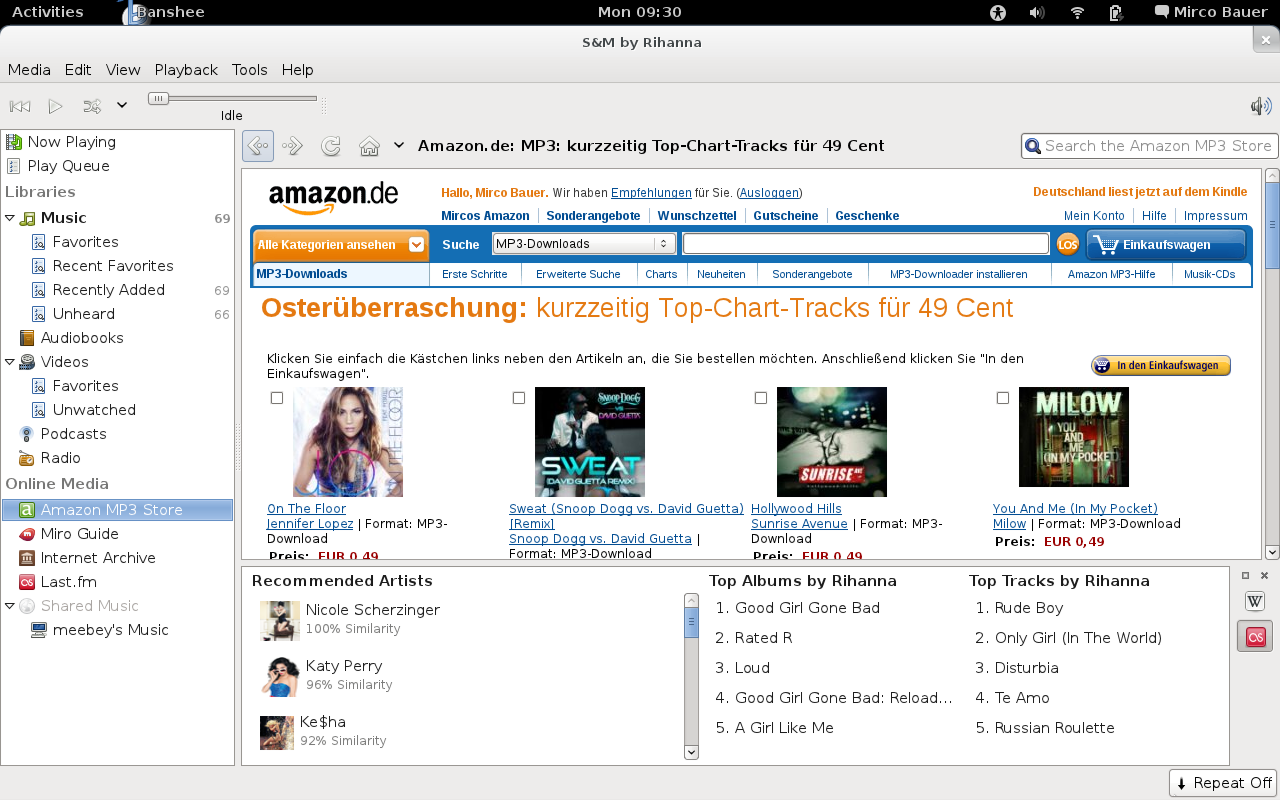
Last night I wanted to buy an album on Amazon and I couldn't do the checkout as the site required me to install the Amazon MP3 Downloader to make the purchase and download of the album. The downloader is not needed for a single song though, but buying each song separately would be more expensive and more work. The good news is that it automatically offered me packages for different Linux distros: Ubuntu, Debian, Fedora and OpenSUSE instead of telling me off for using Linux and leaving me behind with a Windows only download. But here comes the catch, all offered packages are only for the Intel 32-bit architecture. Now this is a showstopper for me, as I am running an AMD64 Debian which is a 64-bit architecture. I first tried to download and run the 32-bit debian package nonetheless as there was some hope with the ia32-libs and ia32-libs-gtk package. But this was not working as the application needs gtkmm libraries like libglademm and bailed when I tried to run it. So I filed a wishlist bug report against ia32-libs-gtk for inclusion of gtkmm and possibly other needed libraries to run the Amazon MP3 downloader on AMD64. So I bought the album using MusicLoad instead which simply puts all songs in a single archive on-the-fly and let me download that archive. When I tweeted my frustration on Twitter I was hinted by Jo Shields and also by Gabriel Burt that there would have been a much simpler solution to this issue by using Banshee which includes an Amazon MP3 Store plugin: Banshee screenshot showing the Amazon MP3 Store plugin This plugin allows you to log into your Amazon account browse their store like the regular Amazon store, plays the song samples directly, purchase songs, downloads the songs and imports them into Banshee's database so you can play them right away. And as if this wasn't good enough yet, with the the purchase of MP3 songs on Amazon using Banshee automatically makes a donation to the GNOME foundation. As I am the only one who forgot or wasn't aware of this awesome solution this deserved some blogging. Update: some people pointed out that clamz is also available to make MP3 purchases on Amazon.

15 February 2011

Gerfried Fuchs: Peter Alexander

I guess it won't be very many people reading this blog to know the name, even though he was without any doubt one of the biggest entertainers. Lots of movies, his own TV show, and an enormous amount of albums made him well known far outside the borders of Austria, his home country. Last saturday he died in the age of 84, yesterday was his funeral. This is a special dedication to him. Peter, you will be missed. Servus.

/music permanent link Comments: 1 Flattr this

7 February 2011

Vincent Sanders: It is a bit breezy

The weather has been a bit odd round here for a while now. The snow storms in December and early January were a mild inconvenience for me but as I work from home the advice not to travel was not too much of a problem.

It seems however that now February is here and the snow is gone we are in for some pretty strong storms. This actually affected me today when my neighbours garden wall was blown over!

As you can see my nice new IP camera captured the event, well OK the frame before and after but you get the idea. Unfortunately for my neighbour the wall collapsed onto his pickup causing extensive damage.

A short time later when my weather station was recording gusts well over 50mph nearby drains started flowing the wrong way and it became a case of water, water everywhere!

It seems that when the new buildings were erected a few years ago that the architect while maximising used space on the building plot may have inadvertently created something of a wind tunnel.

The Gap between our properties is on a parallel (north to south) to the valley below. The wind seems to travel along the crest of the valley and be funnelled through any spaces between the houses. Fortunately the rest of the properties on green lane are pretty old and the spacing between is very generous and the funnelling effect is minimal.

I wonder if we could fit a wind turbine in there? Alas it was too much for my secondary anemometer which is now smashed in three parts.

Also gaining access to the gable end wall of my property has become somewhat perilous (Hence the wonky APT antenna I cannot get fixed). Yes that really is a guy balancing on a ladder 10m high in a strong wind. And indeed the platform the ladder is resting on is built from scaffolding board wedged between the houses.

I guess the hospital emergency room being 300m away means medical assistance is on hand, even so he is braver than I am. So my weather satellite imagery will just have to come from the internet like everyone else's for a while.

4 February 2011

Marco d'Itri: Being an early adopter

This object from the old 6bone whois database is the earliest trace I could find of my IPv6-related activities:
inet6num:     3FFE:1001:210::/48
netname:      ILSWAN-NET-6BONE
descr:        Italian Linux Society geographically dispersed test network
country:      IT
admin-c:      MDI-RIPE
tech-c:       MDI-RIPE
rev-srv:      attila.bofh.it
rev-srv:      spock.linux.it
mnt-by:       MNT-ILS-6BONE
changed:      md@linux.it 20000530
changed:      md@linux.it 20010123
source:       6BONE

27 January 2011

Rob Bradford: Work with us!

Are you graduating this year? Or recently graduated? Do you want to work in Open Source? Do you have the right to work in the UK? Do you want to work with some of the best minds in the field: Chris Lord, of Happy Wombats fame; Damien Lespiau, the Clutter GST mastermind; Emmanuele Bassi, our Clutter super-hero; Jussi Kukkonen, who puts the clue in Geoclue; Ross Burton, our EDS magician; Srini Ragavan, Evolution shiny-thing maker; Thomas Wood, of the MX and control-center massive; Tomas Frydrych, our Antarctic naming scheme generator and of course pippin. Interested? Take a look at our job entry. I should be around as FOSDEM so feel free to corner me to talk.

5 January 2011

Iustin Pop: More Haskell

It's no secret to the people I around me that over the past two years I've become a Haskell fan, to put it mildly. I mean, what's not to like? Just in the past month: The downside is that whenever I feel Ok, now I kind of know my way around Haskell , I learn of another thing that completely resets how I feel about my Haskell understanding. The most recent example is Template Haskell. I mean, there are people who already blame Haskell for its arcane syntax, which I like. But Template Haskell goes a step forward and allows you to use a Haskell library to write Haskell code, with an even more contorted syntax or at least that how it looks for now to my eyes. Gladly this is not easily doable in a recursive way (meta-TH code writing TH code that will write Haskell code), otherwise heads would explode (at least mine). But even though it seems very complicated, I feel that the power that it enables (a macro system that generates code that will be statically checked) is removing one of the last big advantages that (for me) Python had over Haskell: it's easy to do class modification in Python and introspection (e.g. via metaclasses) to automate boiler plate away, but it's of course not type safe (so unittests galore). With TH, you can do the same customization of data types (and not only) and compile-time introspection (called reification) to alter (some) of the properties of the respective type, for example automatic instance derivation, so one less reason to say this particular problem is harder to do in Haskell than in other languages . I haven't yet used TH for my own code and until I actually use it extensively I won't be sure it's actually a good replacement for throw a __metaclass__ in there and automate the boring parts away . But in any case, it looks to be yet another awesome tool in the Haskell programmer's toolbox, which I can't wait to use.

12 December 2010

Neil Williams: Free software under the bus

Sometimes, free software isn't better than proprietary, it's true - and one of the principal reasons is that the majority of free software does not use the full power of the freedom of the software. Far too many free software projects are single-developer projects. Many single-developer projects at SourceForge or Savannah and elsewhere have a single maintainer for the distribution providing the packages too and some (including nearly all of my own) have one person doing both jobs. In other words, there is no collaboration upstream or in packaging, so there is little or no benefit to the code of being free software...

It begs the question of what happens when the omnipresent developer-under-a-bus risk actually bites.

When comparing free software and proprietary, considering end-of-life effects can be very illuminating, especially when considering the interests of third-parties who come to rely upon the output of the project. When a proprietary software producer declares a software product to be end-of-life (whether due to collapse/purchase of the company or some other restructuring) third parties are left high and dry. In effect, all proprietary software is directly equivalent to a single developer writing free software. The more important the software, the worse this gets because at least if the single free software developer does disappear, the third party can try and pick up the pieces.

The bigger problem for free software is the common failure to actually collaborate. This has been my main upstream bug bear for a long time now. The model must change. New contributors must be dissuaded from writing new code just because they prefer one language over another. Distributions need to change their guidelines for new developers to actively discourage new packagers from starting with new upstream code. We are in danger of undermining the main appeal of free software by not stamping harder on the NotInventedHere (NIH) syndrome. NIH is pernicious, NIH is dangerous and there is even an argument for considering NIH as an anti-feature.
New is considered harmful
New is not necessarily a good idea, new can be positively harmful to the interests of the wider software community. New promotes reinventing the wheel. It's another incidence of "Just because we can, does not mean we should."

If free software advocates neglect to counteract the poison of NIH, then free software will lose the argument by losing the fundamental merit of free software. A freedom which is not utilised is akin to not having that freedom at all. Yes, someone can pick up a free software project after the single developer abandons it but, in practise, what actually happens is that someone else comes along whilst the single developer is struggling along alone and decides to fall prey to NIH simply because the original is written in C and their preferred language is Python or Ruby or Haskell or whatever.

The "choice" argument is simply invalid - providing another implementation of program foo in a different language is just a way of reinventing the bugs already fixed in foo in new ways in a new language - and then adding some more which are unique to that language. Yes, the new developer might argue that the new code is more active but for how long? Long enough to become just as stable as the abandoned code? What benefit is that? In a few years time we will have two abandoned codebases in two different languages written by two different developers who never collaborated on the actual problem both of them were trying to solve independently. Lunacy.

The dilemma for distributions like Debian is that the list of Debian Packages that Need Lovin' is a burden to Debian during a release freeze yet provides an ideal launchpad for new developers to refresh stale code. I've long thought that Debian needs to be more strict on removing such packages, yet at the same time I cannot help but feel that this tends to encourage more NIH behaviour.

It's a common mantra amongst free software developers that many eyes make all bugs shallow. The problem for free software is that outside certain key teams, there are simply too few eyes and the community is not doing enough to shine a light on existing code before dancing to the sound of the NIH drum.

Far too much free software is at risk from that omnipresent bus called "RealLife" and this makes far too much free software little better than proprietary software. Pandering to the fashions of NIH only makes things worse.

This isn't a technical problem that can be solved with a new cool tool (which itself is subject to the NIH poison), it is a social problem and, sadly, the free software community has a history of failing to tackle purely social problems successfully.

There is a small role for existing technical solutions to make it easier to spot NIH tendencies, including sites like SourceForge and Savannah having greater scrutiny about new projects and distributors like Debian being more averse to adding yet more ITP bugs (or closing them automatically unless something happens within a month). Fundamentally, it comes down to how new and existing members of the free software community decide to handle their own projects and bugs. The model of "do it this way because that's more fun" has got us so far, the challenge is to remove NIH tendencies without removing that fun.

26 November 2010

David Welton: Kindle thoughts

I went ahead and got myself a Kindle for my birthday. Thanks to everyone for their comments in the last post. Here are my thoughts on it, in no particular order:
I like it a lot. I was worried that I would not actually enjoy reading with it, or that it would be significantly inferior to real books. However, I do enjoy reading with it, and I think they have achieved their aim of making it so that it 'just disappears' like a good book does. It's a very small and light device, even with the leather cover I got for it (always best with a small child in the house), so it's in no way heavy or uncomfortable. It's relatively more expensive and fragile than a copy of The Economist or a paperback, so I don't sling it around quite so casually, and do try and remember to keep it out of reach of said small child, which makes it a little less worry-free than an actual book. On the other hand, it's much cheaper than an ipad or samsung galaxy or something like that, so it's not the end of the world if something happens to it, although it would be unfortunate to be without reading material for the time it took to replace it!
The selection of material available for it is ok, but I'm just a bit disappointed - I thought offhand there were more books than there are. I regularly bump into things I might consider getting if they were available for it, but are not. On the other hand, there are quite a few books available for it for *free* because they're old and out of copyright. Stuff you might get for 99 cents at a used book store as a paperback, but it's pretty cool to be able to just zip it right to the device, for nothing at all. I am not convinced that the economics of it all has settled down yet. It's pretty absurd, for instance, that The Intelligent Investor costs nearly twice as much for the Kindle version as for the paperback! Especially since I can never resell it. I think a lot of the value I get from the device is derived from my situation: living abroad here in Italy, it's expensive and slow to get English language books, and now I can get them *instantly*, which is absolutely wonderful, and will significantly increase my reading. Also, should we ever move back to the US or elsewhere, it means a few less books to lug along or go through the sorrow of parting with. Were I in the US in a place with a decent used book store, and sure about staying in the same place for a while, I am not sure I would have bothered. I find it somehow a bit monotonous to read everything in the same form factor and with the same fonts. It takes something away from the character of a book, especially a well-done hardback. Of course, what counts is the content, but the presentation counts for something too, I think. I really do like the size and shape of the Kindle, and could see the 'smaller tablet' size catching on. Speaking of which, I'm curious to see how reading devices and tables will intersect. Clearly, a generic device that can also read books is going to be a lot more popular, but for now e-ink still has a few advantages: it's better for reading - I can stare at it much longer than I can at an LCD screen; also the battery life is much better, meaning I don't have to worry about/fiddle with charging it every day. Also, in some ways, it's nice not to have the siren-call of the web just a click away... I think though that at some point, generic devices will likely overtake dedicated readers. Who knows when, though.
Yes, it does have a browser, however, the screen refresh is so slow that I'd only really consider using it for reading web pages - wikipedia, say, rather than doing much with it. Still, I think it's nice to have and hope they continue the experiment.
Coming back to the comparison with 'real' books, I don't like the fact that I can no longer finish a book and then hand it to my wife if it's good. We could get her a Kindle too, but I'm still not sure they have the sharing thing worked out that well. 2 weeks - and then what? One way to do it might be that you can share it with anyone who you trust with one-click purchases. That'd limit it to family members or really trustworthy friends. Although... even there, I regularly loan books to friends, and would like to continue to be able to do so. Also, like I mentioned in the previous article, I'm leary of a future where my daughter doesn't have a multitude of books to peruse on our bookshelves. Bookshelves are a great way of making serendipitous discoveries that recommendation engines (those I've used at least) don't really account for. All in all, I'm very pleased with the Kindle, though, and look forward to seeing what the future holds.

23 November 2010

Mike Hommey: Improving libxul startup I/O by hacking the ELF format

If you have been following this blog during the past months, you might have gathered that I ve been focusing on I/O patterns on library initialization, more specifically libxul.so. The very patterns there s not much to do about, except enduring them, or hacking ld.so and/or the toolchain. The latter is not necessarily easy, and won t benefit everyone until all linux distros use an improved glibc and/or toolchain. This could take years before any actual result would reach end users. But with a little creativity, one can overcome these limitations and improve the situation today. Here is a summary of my recent hacks. Backwards static initializers As Taras showed in the past, static initializers are executed in reverse order. It turns out it is an unfortunate design choice in gcc, and it also turns out not to impact all ELF binary files. As far as I know there are currently two different implementations of the static initializers call loop, one provided by gcc, and one provided by ld.so. In the gcc case, the compiler creates a .ctors section, starting with 0xffffffff, ending with 0x00000000, and filled with pointers to the various static initializer functions, in ascending order. The compiler also injects an initializer function, called from .init, going through this .ctors section, starting from the end (__do_global_ctors_aux in crtend.o). A similar .dtors section is created for functions to run when the library is unloaded, and the pointers in it are called in ascending order. There is actually no importance in the order in which .ctors and .dtors are executed. All that matters is that they are executed in reverse order from each other, because that limits the risks of bad ordering. It is only unfortunate that .ctors was chosen to be the one backwards. In the ld.so case, the compiler creates a .init_array section, filled with pointers to the various static initializer functions, in ascending order. It also stores the location and the size of this section in the PT_DYNAMIC ELF header. At runtime, ld.so itself reads this information and executes the static initializers in ascending orders. A similar .fini_array section is created for functions to run when the library in unloaded, and ld.so goes through it in descending order. The .init_array section is newer, and for backwards compatibility reasons, is not used on systems that have been using the .ctors approach forever. On the other hand, some newer ABIs, such as arm EABI, uses the new facility, which means they are not victim of backwards static initialization. I however wonder if backwards compatibility is still needed, considering how long .init_array support has been around (more than 11 years, according to glibc git repository). While we could obviously bug the gcc maintainers to revert their .ctors execution order, or ditch .ctors support on glibc systems, which means we wouldn t get any immediate global benefit, we can also just revert the .ctors section content. Please note the source code out there doesn t take care of reverting the .dtors section accordingly, because it is currently empty in libxul.so. Relocations As I mentioned in an earlier post, relocations are what make it possible to load libraries at arbitrary locations. Unfortunately, a great number of relocations means awful I/O patterns: ld.so reads and applies them one by one, and while the kernel reads ahead by 128 KB chunks, when your relocation section exceeds that amount by more than an order of magnitude, it means I/O goes back and forth a lot between the relocation section and where the relocations take place. There are two classes of relocations: REL and RELA. In both cases, there are several types of relocations, some of which require an addend. The difference between both classes is in REL relocations, the addend is stored at the offset the relocation takes place, and in RELA relocations, the addend is stored in the relocation entry. It means that RELA relocations effectively waste space, as the addend ends up actually being stored twice: it is also stored at the offset the relocation takes place, like with REL relocations, though it could technically be nulled out, there ; in any case, the space is wasted. REL relocations thus take 2 words of storage, and RELA relocations, 3. On x86, the ELF ABI only uses REL relocations, and words are 32 bits, making each relocation take 8 bytes ; on x86-64, the ELF ABI only uses RELA relocations, and words are 64 bits, thus making each relocation take 24 bytes, 3 times that of x86 relocations. On ARM, both may be used, but apparently the compiler and the linker only use REL relocations. These words of storage are used to store 3 or 4 bits of informations: The linker splits relocations in two main categories: those for dynamic linking at startup and those for procedure linkage table (PLT) resolution at runtime. Here is what the repartition look like on libxul.so (taken from the mozilla-central nightly from Nov, the 22nd):
dynamic relocations PLT relocations
Architecture number size (bytes) number size (bytes)
x86 231,836 1,854,688 3,772 30,176
x86-64 235,893 5,661,432 3,773 90,528
So, PLT relocations are quite negligible, and dynamic relocations are just huge, especially on x86-64. Compared to the binary size, it s pretty scary:
Architecture libxul.so size relocations size %
x86 21,869,684 1,884,864 8.61%
x86-64 29,629,040 5,751,984 19.41%
Let me remind you that not only do we need to read these relocations at startup (at least the dynamic ones, but the PLT ones are just negligible), but we only read them by chunks, and need to read other data in between. Of the many existing types of relocations, only a few are actually used in dynamic libraries. Here is a summary of those in use in libxul.so:
x86 relocation type number x86-64 relocation type number
dynamic relocations
R_386_TLS_DTPMOD32 1 R_X86_64_DTPMOD64 1
R_386_GLOB_DAT 213 R_X86_64_GLOB_DAT 238
R_386_32 27,643 R_X86_64_64 27,611
R_386_RELATIVE 203,979 R_X86_64_RELATIVE 208,043
PLT relocations
R_386_JUMP_SLOT 3,772 R_X86_64_JUMP_SLOT 3,773
The above types can be separated in two distinct categories: In the second category, it means we are wasting all the bits for the symbol reference in each entry: 24 on x86 and 32 on x86-64. Unfortunately, the vast majority of the relocations in libxul.so are from that category. At this point, this is how much waste we identified:
description num. entries waste per entry (bytes) total % of relocation size
x86
Relocation without symbol ref. 203,980 3 611,937 32.46%
x86-64
Duplicated addend 239,666 8 1,917,328 33.33%
Relocation type encoded on 32 bits 239,666 3 718,998 12.49%
Relocation without symbol ref. 208,044 4 832,176 14.46%
Total 3,468,502 60.30%
On top of that, one could argue that we don t need 24 or 32 bits for symbol reference (which is the entry number in the symbol table), and that we re really far from requiring 64 bits for r_offset on 64 bits systems, as libxul.so is far from being bigger than 4GB. Anyways, that means we have room for improvement here, and it means that the ELF format, especially on 64 bits systems with RELA relocations, really doesn t help with big programs or libraries with a lot of relocations. (For that matter, the mach-o format used on OS-X has some kind of similar issues ; I don t know for the DLL format) Another interesting data point is looking at how relocations r_offset are following each other, once relocations are reordered (to avoid too much symbol resolution, they are actually grouped by symbol). It turns out 206,739 relocations r_offset are at 4 bytes from the previous one on x86 (i.e. strictly following it), and 210,364 at 8 bytes from the previous on x86-64. The main reason why this happens is that most relocations are happening in pointer tables, and libxul.so has lots of them: And when I say libxul.so has lots of them, that s not an understatement: there are 184,320 relocations due to vtables (function tables you get when using virtual methods in C++) on x86 and 184,098 on x86-64. That s respectively 78.23% and 76.81% of the total number of relocations. Interestingly, while most of these relocations are R_*_RELATIVE, 26,853 are R_386_32, and 26,829 are R_X86_64_64. Except for a very few, these non relative relocations are for the __cxa_pure_virtual symbol, which is a dummy function that does nothing, used for pure virtual methods, such as the following:
class Abstract
public:
virtual void pure_virtual() = 0;
;
As for the remaining relative relocations, there are a few pointer tables responsible for several thousand relocations, such as JSString::length2StringTable, gEntries, GkAtoms_info, Html5Atoms_info, kUnixCharsets, nsIDOMCSS2Properties_properties, etc. Packing relocations While they are not detrimental to most binaries, we saw that relocations can have a bad effect on startup I/O for big binaries. Reducing how much space they take would have a direct impact on these startup I/Os. One way to do so is obviously to reduce the number of relocations. But as we saw above, the vast majority are due to vtables. While reducing vtables would be a nice goal, it s a long way before this can have a significant impact on the relocations number. So another possible way is to try to avoid wasting so much space in relocations. The main problem is that relocations are applied by ld.so, and that, as mentioned in the introduction, while we can hack ld.so to do what we want, it won t work everywhere before a long time. Moreover, it s difficult to test various implementations, and binary compatibility needs to be guaranteed once something is applied in the upstream libc. The idea I started to test a few weeks ago, is to effectively apply relocations by hand instead of relying on ld.so doing it. Considering the first thing ld.so does with a library after applying relocations is to call its DT_INIT function, the idea was to replace the dynamic relocations we can with a new DT_INIT function we would inject that d apply those relocations, while storing them in a more efficient manner. The function would obviously need to call the original DT_INIT function once done. Some parts of the PT_DYNAMIC section also obviously need to be adjusted accordingly. The first iteration I tested a few weeks ago helped validating the idea, but didn t change much of the binary: the dynamic relocation section still was taking all the space it took before, though its content was mostly empty (we ll see further below how efficient even the current dumb format is). Once the theory that an injected DT_INIT function could apply the relocations without breaking everything, I went on to implement a program that would actually strip the ELF binary. I won t get too much into the gory details, but it required PT_LOAD splitting, thus program headers growth, which means moving the following sections, then removing a huge part of the relocations, shrinking the relocations section, injecting our code and the packed relocations as sections, and moving the remaining sections after these new sections, to avoid empty space, but still respecting the proper offsets for both PT_LOAD and the code itself. So far, I only took care of the R_*_RELATIVE relocations. Some but not all other relocations could be taken care of, too, but everything involving symbol resolution from other libraries would be really difficult to handle from the injected code. The relocations are currently stored with a quite dumb format: As we only take care of one type of relocations, we can skip any information about the type. Also, the addend already being stored at r_offset, we just strip it from RELA relocations ; the binary being far from 4GB big, 32 bits is enough on 64 bits systems too. We also saw that a lot of relocations were next to the following ones, so instead of storing r_offset for each one, storing some kind of range is more efficient. As I ve so far been focusing on getting something that actually works more than on getting something really efficient, I only tested this format, but the results are already nice:
x86 x86-64
before
dynamic relocations (bytes) 1,854,688 5,661,432
libxul.so size 21,869,684 29,629,040
after
dynamic relocations (bytes) 222,856 668,400
injected code size 129 84
packed relative relocations (bytes) 224,816 228,568
libxul.so size 20,464,836 (-6.42%) 24,865,520 (-16.07%)
Getting rid of the __cxa_pure_virtual relocations would help getting this even further down, and an even better storage format could be used, too. Gathering new startup coverage data should be interesting as well. The code is available via mercurial. Please note the Makefile deeply sucks, and that the code is in the middle of its third refactoring. Anyways, once you get the code to compile, you just need to run test-x86 or test-x64 depending on your architecture, from the build directory, and give it the libxul.so file as an argument. It will create a libxul.so.new file that you can use to replace libxul.so. You may successfully use the tool on other libraries, but chances are you ll bump into an assert(), or in the worst case, that the resulting library ends up broken. The tool might work on PIE executables, but most probably not on other executables. If you wonder, Chrome is not PIE. It s not even relocatable (which means ASLR won t work with it) ; or at least the x86-64 binaries I just got aren t. More possible ELF hacking The code I wrote to pack relocations allows to do various tricks on ELF files, and it opens various opportunities, such as: Some of the above could probably be done with linker scripts, but using linker scripts is unnecessarily over complicated: as soon as you start using a linker script to fiddle with sections, you need to reimplement the entire default linker script (the one you can see with ld --verbose). And it s not guaranteed to work (Taras told me he had a hard time failing to align the .bss section). And as far as I know, you can t use the same thing depending whether you use ld or gold (AIUI, gold doesn t support the whole ld linker script syntax).

14 November 2010

Marco d'Itri: Other people's ethics and tastes

In the last years I noticed a growing trend of people pushing for "new" rules about what is appropriate or not for single developers or for the project as a whole. In too many cases even just considering these ideas to be an obvious fact... I prefer to not give specific examples because these would divert the attention from the main topic and would be affected by my own biases. At this point I believe it is useful to remember that all ethical issues which are not explicitly covered by the Social Contract are just the developers' own opinions. It may even be a good idea, but other developers are not and should not be compelled to agree with it no matter how good or important you believe it is. You are entitled to having your own ethics and even ranting about it on Planet Debian, but I am entitled to not caring at all without this making me a worse Debian Developer. Let's try to be grown ups and not be excessively annoyed by other people's choices. This is why I want to convey this simple message to the people who keep preaching about what is proper for me or for Debian: please fuck you. If I want to receive lectures about what is right or wrong then I surely know where I can find a priest. For some reason, now I see fit to mention that I have an Amazon wishlist...

21 October 2010

Ian Wienand: Logging POST requests with Apache

After getting a flood of spam, I became suspicious that there was an exploit in my blog software allowing easy robo-posts. Despite a code audit I couldn't see anything, and thus wanted to log the incoming POST requests before any local processing at all. It took me a while to figure out how to do this, hopefully this helps someone else. Firstly install libapache-mod-security, then the magic incarnation is
SecRuleEngine On
SecAuditEngine on
SecAuditLog /var/log/apache2/website-audit.log
SecRequestBodyAccess on
SecAuditLogParts ABIFHZ
SecDefaultAction "nolog,noauditlog,allow,phase:2"
SecRule REQUEST_METHOD "^POST$" "chain,allow,phase:2"
SecRule REQUEST_URI ".*" "auditlog"
So, to break it down a little, the default action says to do nothing during phase 2 (when the body is available for inspection); the allow means that we're indicating that nothing further will happen in any of the remaining phases, so the module can shortcut through them. The two SecRules work together -- the first says that any POST requests should be tested by the next rule (i.e. the chained rule), which in this case says that any request should be sent to the audit log. After that, the similar allow/phase argument again says that nothing further is going to happen in any of the subsequent phases mod_security can work on. As per the parts between A and Z, we'll log the headers, the request body, the final response and trailer. So, as it turns out, there is no exploit; it seems most likely there is an actual human behind the spam that gets through, because every time they take a guess it is correct. So I guess I'll take a glass-half-full kind of approach and rather than being annoyed at removing the spam, I'll just convince myself that I made a small donation from some spam overlord to one of their poor minions!

16 October 2010

Vincent Sanders: Coming to terms

Yesterday was not a great day. One of the family's cats died.

Molly just after she arrived 26th September 2000
Molly, for that was her name, came to us the week Melodie and I moved into our first house together. September 15th 2000, in the middle of the fuel protests which were raging at the time, we hired a van and moved in.

Most people would have considered that enough for one week! We happened to be in Halifax on the Sunday afternoon at the supermarket and decided to visit the RSPCA because somehow we decided what our new home needed was a cat.

On that day a decade ago we saw Molly and Lucy, a pair of cats who needed a new home as their previous owners had a baby who was allergic to them. I still recall them skulking at the back of their cage in the cattery, Lucy who was reluctant to come down of a perch to be petted and Molly looking generally unhappy. No-one else wanted this misfit pair because they were already both over 5 years old, the warden despairing of ever finding them a home.

Of course they were obviously the right animals for us! ;-) So by the end of the week we had taken them home. Molly immediately showed how things were going to be by shredding her way out of the RSPCA provided double walled cardboard carrier. To the day she died she detested being placed inside a carrier, funny that.

Melodie and Molly in the snow 28th December 2000
By the end of the year, when the snow came, the cats ruled the house and we were all happy together.

Little did we realise that soon in the summer of 2001 there would be another arrival to the family.

Molly with Melodie and Alex 2001
The arrival of our first child in June 2001 was a complete change in all our lives but we all managed to settle back into a routine. Although the banishment of the cats from upstairs remained a point of disagreement for a long time.

As Alex grew up the cats learned that feeding times for Alex could result in all manner of things falling from above. Soon Alex was mobile which resulted in different lessons on cats being sharp objects if not treated with respect. In February 2003 our family grew once more with the arrival of Joshua. The cats, now used to infants, took this in their stride.

Molly in Febuary 2004 hiding on a windowsill
While still about day to day the cats are not captured on camera so often form this point on.

Over the forthcoming months they ensured they were out of reach of the newborn and the precocious toddler.

By the time of Joshuas first birthday in 2004 Molly had taken to hiding "out of the way" as much as possible but remained as affectionate as ever.

Molly in a box March 2007
As the children grew up and life progressed Molly became ever more at home and developed the odd aggravating trait like taking clean washing off airers and dragging it out the window, through the cat flap and upstairs so she could sleep on it!

She still enjoyed participating in claiming boxes and defending them vigorously though!

The kids took on the job of feeding the cats which made their bond closer ensuring they were greeted by happy cats sitting lookout as they came home from school each day.

Molly continued to be a good companion and an infuriating self centred animal like all good cats.
Molly asleep in the kitchen sink
Then on Tuesday evening our Neighbour knocked on our front door. They gave us the news that one of our cats had been run over and taken to the Vet. I immediately went to the back door and called and shook the treat box.

Lucy came running, but molly did not. We rang the vets who confirmed they had molly (we had them electronically tagged back in Halifax) and that they advised we did not come and see her until they had chance to asses her and deal with the shock.

As the days progressed her prognosis improved and then sank. She had a broken jaw, broken teeth, a dislocated hip, extensive bruising and something was definitely wrong with her kidney function.

Thursday evening the whole family went to see her and she purred and seemed happy to see us, she looked as bad as I feared though and somehow I knew there and then that this was probably goodbye. The children stroked her and petted her for a while and we left with an odd sadness, oh and to the sound of molly trying to gouge the veterinary nurse.

Yesterday she was due to have surgery to fix her jaw and hip...Alas when she was anaesthetised and x-rayed once more it became evident the hip was not just dislocated but her femur was fractured and there was additional damage. So just after midday came the call to ask what we wanted to do. The vet could attempt the repairs but due to her age and the other complications it was probably futile. So with heavy heart we agreed the best thing was not to revive her and she died a short time later.

I shall miss her morning greetings, her demands for attention, her sleeping in odd places and her companionship. I keep calling for her at meal times forgetting she will never come. I think Lucy is upset too, after spending their lives together her friend is gone and I cannot explain that to her.

So that is the end of Molly, a good cat.


9 September 2010

Cyril Brulebois: SD: Bugzilla gets history support

(Disclaimer: Possibly one of my longest post ever, you may want to scroll to the bottom and only look at the pictures.) So, what s new in SD since last week? Fetching everything From http://bugs.freedesktop.org/, it was possible to download all the bugs I reported there (that means 2 ), but trying to download those reported by Julien led to a crash without any trace. Dichotomy FTW, I came up with a bunch of bugs which would lead to the same result, which confirmed that the amount of bugs processed at once wasn t the issue. Playing around with strace, it appeared that exchanges with the remote server were apparently fine, so an issue on the client-side SOAP machinery got suspected. So let s enable tracing:
use SOAP::Lite +trace => 'all';
Tada! The issue was indeed local: malformed XML got received, leading to a die call issued from the XML-RPC layer. Thankfully, one can set up a fault handler, which I used to display the range of bug IDs which triggered that bug, so that people can look into it and determine what to add to the blacklist until the underlying issue s been investigated (presumably, bugzilla s at fault). Speeding things up With that blacklisting of buggy bugs, one can then try to move to other queries, dealing with more bugs. Some examples follow:
reporter=kibi@d.o
product=xorg&component=Driver/VMWare
product=xorg&component=Driver/nouveau
product=xorg&component=Server/general
product=xorg&component=Driver/intel
Moving from 2 bugs to 10-100 bugs (Julien s or VMWare s) was OK. But then moving to several hundreds of bugs (Driver/nouveau = 500+ bugs) led to noticeable performance issues. Not to mention what happened when one reaches several thousands of bugs (Driver/intel = 2500+ bugs). Indeed, even with network exchanges cached into a local file, processing data was taking up to several dozens of minutes. I knew about Perl s -d:DProf, which helps figuring out where time is spent, but was pointed to -d:NYTProf (and its accompanying tool, nytprofhtml). Some hotspots got noticed: Things got better, but not good enough. There are several Prophet (the engine under the hood) backends, so one can play with:
PROPHET_REPLICA_TYPE=sqlite   # the default for SD
PROPHET_REPLICA_TYPE=prophet
Switching to prophet was a big win, but still not good enough. Indeed, many tiny files are written, and most of the time is spent in I/O. Although I m nothing like a performance guru, I guessed that running on an average laptop, with ext3 and its default commit interval of 5 seconds might not be helping, so I gave a quick try to -o remount,commit=60, and that seemed to help. Even though there are probably other tricks to find in that area (which hopefully won t require root privileges ), there s already a patch which landed in prophet s master branch, replacing File::Spec->catfile with an optimized version: that function alone was eating 10% of runtime In the sqlite case, disabling the auto-commit feature helped reducing the I/O load, but a proper patch is still lacking for now (running into locked database issues, or into missing tables after having created them isn t fun, so I postponed debugging that). Since performance issues looked like they could be solved eventually, I switched back to implementing missing features. Handling more than comments Currently 3 types of stuff are currently fetched from the bugzilla server: (Yes, that means that attachments are totally ignored for now.) Until now, only bug comments were considered. The first comment was used to determine a pseudo-title (using its first line), the reporter, and the creation date. This approach was chosen to try and get a basic sync working quickly, so as to get: Now, the algorithm is the following: from the bug status, determine a set of properties of interest; then walk the history backwards, and update the properties incrementally until the (presumed) initial state is reached. Then create the ticket using this initial state . Adding the incremental property changes to that initial ticket makes it possible to represent the bug s life as a list of Prophet::ChangeSet objects. That s where the fun begins, since properties in the bug status may not match properties in the bug history, so one needs to establish property correspondence. Also, some properties can be multivalued for added fun. I believe that s where most of the time is going to be spent while developing a new replica type in SD: once one knows how to get a hand on needed info on the remote server, the main question is what to do with it. For now, I decided to ignore many fields to make it possible to do a big sync like Server/general, property support will be improved later on. Screenshots Instead of pasting lengthy terminal excerpt, let s use some screenshots instead (sorry, I m not sure how to present such things in an accessible way, suggestions welcome). Cloning Julien s bugs, listing all open tickets, listing all tickets, searching using a regular expression: Cloning, listing, searching Displaying bug 42 (that s the local ID): Displaying Now, let s start the embedded web server through sd server --port 1234 and point the browser there. List of RESOLVED bugs: List of RESOLVED bugs Status and comments for bug 42: Status and comments for bug 42 History for bug 42: History for bug 42 Compared to the original bugzilla page: Same bug on FreeDesktop.org Next time Some items which need work: Flattr this!

27 August 2010

Marco d'Itri: Impact of CVE-2010-2959 on Debian systems

CVE-2010-2959 allows to exploit an integer overflow in the CAN protocol driver to escalate privileges to root. This requires the CAN BCM module (can_bcm) to be loaded, so its impact is either null or easily mitigated since it is never used on normal systems. If this command finds the alias needed to autoload the module then an unpatched system is vulnerable:
grep can-proto-2 /lib/modules/$(uname -r)/modules.alias -r /etc/modprobe.d/
In practice, the combination of the unpatched lenny kernel and module-init-tools packages are not (normally) vulnerable because the alias does not exist, while more recent kernels are: nowadays kernel modules carry their own built-in aliases, which are collected by depmod(8).

24 August 2010

Marco d'Itri: Spammers and their inventiveness

This fragment of code was extracted from a direct-to-MX PHP spam cannon installed on a customer server. Yes, it contains a real DNS stub resolver written in PHP (which abuses the promiscuous cache of a local large ISP).
function dns_get_list($dns,$domains,$type=1)
 
        $sockets=array();
        foreach ($domains as $d=>$domain)
         
                $dns_packet = chr(0).chr($d).
                                chr(1).chr(0).
                                chr(0).chr(1).
                                chr(0).chr(0).
                                chr(0).chr(0).
                                chr(0).chr(0);
                $dns_packet_len=12;
                list($qname_len,$qname)=make_QNAME($domain);
                $dns_packet .= $qname.
                                chr(0).chr($type).
                                chr(0).chr(1);
                $dns_packet_len+=$qname_len+4;
                $sockets[$d]=fsockopen("udp://$dns", 53);
                fwrite($sockets[$d],$dns_packet,$dns_packet_len);
         
        foreach ($domains as $d=>$domain) socket_set_timeout($sockets[$d],3);
        $result=array();
        foreach ($domains as $d=>$domain)
         
[...]

Gunnar Wolf: Thinking about how human-machine interaction is categorized

During DebConf, I managed to squeeze out of the middle of everything for long enough to write a column, a short article for a participation I have every three months, for Mexican Software Gur magazine. All in all, I liked the resulting text The current number's main topic is alternative user interfaces. I find it sometimes hard to define what Software Gur 's audience is Probably, project leaders in software development; not the actual developers, but people who actually understand about coding... but care more about The Big Picture, Processes, Architecture Engineering and Buzzword Compliance. It is an interesting magazine, all in all, but with a focus and viewpoint I often feel myself not precisely comfortable with. So, if this trimester's topic was alternative user interfaces, I decided to write on the history and future of the man-machine interface (Spanish only) (version in the magazine's site). My viewpoint comes from the fact that I do not believe we are in a state of so great, innovative changes that everybody is trumpeting, and I'd rather get others to really think on whether user interfaces have gone different in the last decades. Yes, there are many changes, but in form rather than essence. Anyway, I shared this text with some friends. Some days later, when I was back in Mexico, Pooka/Alejandro Miranda lent me a very interesting book: Hacer clic: Hacia Una Sociosemiotica De Las Interacciones Digitales (Do click: Towards a Socio-semiotics of Digital Interaction (Cibercultura)), by Carlos Scolari. I am not yet even halfway through it, but I am enjoying it This book speaks, so far, about the meanings of interfaces, and of the history of interfaces themselves, even forgetting that nowadays we (mostly) refer to interfaces as what we have between the man and the machine. Hacer click (book cover) Sadly, I cannot find this book in English, as it is very well worth a read. But if the topic sounds interesting and you can understand the language, don't hesitate and pick up the book. It gives an interesting insight on the topic, for a group of people (us techies) used to looking at things in a much more human-cognitive-process-oriented way. [update] I found this nice overview of the "Hacer clic" book, written as a presentation for the book. It explains precisely the part I am currently reading - The four metafora for interaction: Conversational, instrumental, superficial and spatial.

Next.

Previous.