Search Results: "edd"

28 January 2025

Russ Allbery: Review: Moose Madness

Review: Moose Madness, by Mar Delaney
Publisher: Kalikoi
Copyright: May 2021
ASIN: B094HGT1ZB
Format: Kindle
Pages: 68
Moose Madness is a sapphic shifter romance novella (on the short side for a novella) by the same author as Wolf Country. It was originally published in the anthology Her Wild Soulmate, which appears to be very out of print. Maggie (she hates the nickname Moose) grew up in Moose Point, a tiny fictional highway town in (I think) Alaska. (There is, unsurprisingly, an actual Moose Point in Alaska, but it's a geographic feature and not a small town.) She stayed after graduation and is now a waitress in the Moose Point Pub. She's also a shifter; specifically, she is a moose shifter like her mother, the town mayor. (Her father is a fox shifter.) As the story opens, the annual Moose Madness festival is about to turn the entire town into a blizzard of moose kitsch. Fiona Barton was Maggie's nemesis in high school. She was the cool, popular girl, a red-headed wolf shifter whose friend group teased and bullied awkward and uncoordinated Maggie mercilessly. She was also Maggie's impossible crush, although the very idea seemed laughable. Fi left town after graduation, and Maggie hadn't thought about her for years. Then she walks into Moose Point Pub dressed in biker leathers, with piercings and one side of her head shaved, back in town for a wedding in her pack. Much to the shock of both Maggie and Fi, they realize that they're soulmates as soon as their eyes meet. Now what? If you thought I wasn't going to read the moose and wolf shifter romance once I knew it existed, you do not know me very well. I have been saving it for when I needed something light and fun. It seemed like the right palette cleanser after a very disappointing book. Moose Madness takes place in the same universe as Wolf Country, which means there are secret shifters all over Alaska (and presumably elsewhere) and they have the strong magical version of love at first sight. If one is a shifter, one knows immediately as soon as one locks eyes with one's soulmate and this feeling is never wrong. This is not my favorite romance trope, but if I get moose shifter romance out of it, I'll endure. As you can tell from the setup, this is enemies-to-lovers, but the whole soulmate thing shortcuts the enemies to lovers transition rather abruptly. There's a bit of apologizing and air-clearing at the start, but most of the novella covers the period right after enemies have become lovers and are getting to know each other properly. If you like that part of the arc, you will probably enjoy this, but be warned that it's slight and somewhat obvious. There's a bit of tension from protective parents and annoying pack mates, but it's sorted out quickly and easily. If you want the characters to work for the relationship, this is not the novella for you. It's essentially all vibes. I liked the vibes, though! Maggie is easy to like, and Fi does a solid job apologizing. I wish there was quite a bit more moose than we get, but Delaney captures the combination of apparent awkwardness and raw power of a moose and has a good eye for how beautiful large herbivores can be. This is not the sort of book that gives a moment's thought to wolves being predators and moose being, in at least some sense, prey animals, so if you are expecting that to be a plot point, you will be disappointed. As with Wolf Country, Delaney elides most of the messier and more ethically questionable aspects of sometimes being an animal. This is a sweet, short novella about two well-meaning and fundamentally nice people who are figuring out that middle school and high school are shitty and sometimes horrible but don't need to define the rest of one's life. It's very forgettable, but it made me smile, and it was indeed a good palette cleanser. If you are, like me, the sort of person who immediately thought "oh, I have to read that" as soon as you saw the moose shifter romance, keep your expectations low, but I don't think this will disappoint. If you are not that sort of person, you can safely miss this one. Rating: 6 out of 10

26 January 2025

Dirk Eddelbuettel: RcppBDT 0.2.7 on CRAN: Maintenance

Another minor maintenance release for the RcppBDT package is now on CRAN. The RcppBDT package is an early adopter of Rcpp and was one of the first packages utilizing Boost and its Date_Time library. The now more widely-used package anytime is a direct descentant of RcppBDT. This release follows the recent updates of other package updating their C++ compilation standard along with other standard package updates. No feature or interface changes. The NEWS entry follows:

Changes in version 0.2.7 (2025-01-25)
  • The package no longer sets a C++ compilation standard
  • Package infrastructure, documentation and continuous integration support have been updated
  • Several manual pages now have package anchors for the code link
  • A demo/ file has been move to inst/examples/

Courtesy of my CRANberries, there is also a diffstat report for this release. For questions, suggestions, or issues please use the issue tracker at the GitHub repo.

This post by Dirk Eddelbuettel originated on his Thinking inside the box blog. If you like this or other open-source work I do, you can now sponsor me at GitHub.

23 January 2025

Dirk Eddelbuettel: qlcal 0.0.14 on CRAN: Calendar Updates

The fourteenth release of the qlcal package arrivied at CRAN today, following the QuantLib 1.37 release two days ago. qlcal delivers the calendaring parts of QuantLib. It is provided (for the R package) as a set of included files, so the package is self-contained and does not depend on an external QuantLib library (which can be demanding to build). qlcal covers over sixty country / market calendars and can compute holiday lists, its complement (i.e. business day lists) and much more. Examples are in the README at the repository, the package page, and course at the CRAN package page. This releases synchronizes qlcal with the QuantLib release 1.37 (made this week), and moves a demo/ file to examples/.

Changes in version 0.0.14 (2025-01-23)
  • Synchronized with QuantLib 1.37 released two days ago
  • Calendar updates for United States and New Zealand
  • The demo/ file is now in inst/examples/

This update includes the inclusion of the January 9, 2025, holiday for the memorial of President Carter that was observed at the NYSE and shown by the allUScalendars.R example:
edd@rob:~/git/qlcal-r/inst/examples(master)$ Rscript allUScalendars.R 
           LiborImpact NYSE GovernmentBond NERC FederalReserve SOFR
2025-01-01        TRUE TRUE           TRUE TRUE           TRUE TRUE
2025-01-09          NA TRUE             NA   NA             NA   NA
2025-01-20        TRUE TRUE           TRUE   NA           TRUE TRUE
2025-02-17        TRUE TRUE           TRUE   NA           TRUE TRUE
2025-04-18          NA TRUE           TRUE   NA             NA TRUE
2025-05-26        TRUE TRUE           TRUE TRUE           TRUE TRUE
2025-06-19        TRUE TRUE           TRUE   NA           TRUE TRUE
2025-07-04        TRUE TRUE           TRUE TRUE           TRUE TRUE
2025-09-01        TRUE TRUE           TRUE TRUE           TRUE TRUE
2025-10-13        TRUE   NA           TRUE   NA           TRUE TRUE
2025-11-11        TRUE   NA           TRUE   NA           TRUE TRUE
2025-11-27        TRUE TRUE           TRUE TRUE           TRUE TRUE
2025-12-25        TRUE TRUE           TRUE TRUE           TRUE TRUE
edd@rob:~/git/qlcal-r/inst/examples(master)$ 
Courtesy of my CRANberries, there is a diffstat report for this release. See the project page and package documentation for more details, and more examples. If you like this or other open-source work I do, you can sponsor me at GitHub.

This post by Dirk Eddelbuettel originated on his Thinking inside the box blog. Please report excessive re-aggregation in third-party for-profit settings.

21 January 2025

Dirk Eddelbuettel: ttdo 0.0.10 on CRAN: Small Extension

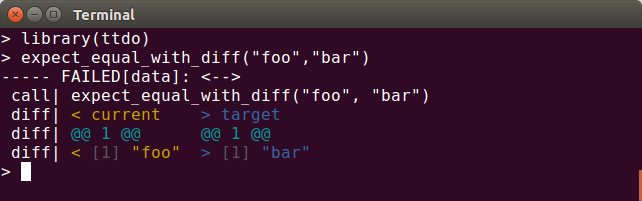
A new minor release of our ttdo package arrived on CRAN a few days ago. The ttdo package extends the excellent (and very minimal / zero depends) unit testing package tinytest by Mark van der Loo with the very clever and well-done diffobj package by Brodie Gaslam to give us test results with visual diffs (as shown in the screenshot below) which seemingly is so compelling an idea that it eventually got copied by another package which shall remain unnamed And as of this release, we also support visual diffs as provided by tinysnapshot by Vincent Arel-Bundock. ttdo screenshot This release chiefly adds support for visual diff plots. As we extend tinytest for use in the R autograder we maintain and deploy within the lovely PrairieLearn framework, we need to encode the diffplot that has been produced by the autograder (commonly in a separate Docker process) to communicate it back to the controlling (Docker also) instance of PrairieLearn. We also did the usual bits of package maintenance keeping badges, URLs, continuous integration and minor R coding standards current. As usual, the NEWS entry follows.

Changes in ttdo version 0.0.10 (2025-01-21)
  • Regular packaging updates to badges and continuous integration setup
  • Add support for a 'visual difference' taking advantage of a tinysnapshot feature returning a ttvd-typed result
  • Added (versioned) dependency on tinysnapshot (to also get the plot 'style' enhancement in the most recent version) and base64enc
  • Return ttdo-typed result if diffobj-printed result is returned
  • Ensure all package-documentation links in manual page have anchors to the package

Courtesy of my CRANberries, there is also a diffstat report for this release. For questions, suggestions, or issues please use the issue tracker at the GitHub repo.

This post by Dirk Eddelbuettel originated on his Thinking inside the box blog. If you like this or other open-source work I do, you can now sponsor me at GitHub.

20 January 2025

Dirk Eddelbuettel: RcppMsgPack 0.2.4 on CRAN: Maintenance

Another maintenance release of RcppMsgPack got onto CRAN today. MessagePack itself is an efficient binary serialization format. It lets you exchange data among multiple languages like JSON. But it is faster and smaller. Small integers are encoded into a single byte, and typical short strings require only one extra byte in addition to the strings themselves. RcppMsgPack brings both the C++ headers of MessagePack as well as clever code (in both R and C++) Travers wrote to access MsgPack-encoded objects directly from R. This is the first release in over six years, and contains mostly maintenance. One somewhat embarassing aspect is that Travers and I forgot about a PR that had been ready all this since the last release, it has now been integrated. Details follow from the NEWS file.

Changes in version 0.2.4 (2025-01-19)
  • Use Rcpp::RawVector instead of std::vector<unsigned char> saving extra copy (Travers in #16)
  • Several updates to README.md with R Journal paper, add badges, add Authors@R, add CITATION file, add repo info to DESCRIPTION
  • Update continuous integration via r-ci
  • Update to no longer require compilation standard

Courtesy of my CRANberries, there is also a diffstat report for this release. For questions, suggestions, or issues please use the [issue tracker][issue tickets] at the GitHub repo.

This post by Dirk Eddelbuettel originated on his Thinking inside the box blog. If you like this or other open-source work I do, you can now sponsor me at GitHub.

17 January 2025

C.J. Collier: Security concerns regarding OpenSSH mac sha1 in Debian

What is HMAC? HMAC stands for Hash-Based Message Authentication Code. It s a specific way to use a cryptographic hash function (like SHA-1, SHA-256, etc.) along with a secret key to produce a unique fingerprint of some data. This fingerprint allows someone else with the same key to verify that the data hasn t been tampered with. How HMAC Works Keyed Hashing: The core idea is to incorporate the secret key into the hashing process. This is done in a specific way to prevent clever attacks that might try to bypass the security.
Inner and Outer Hashing: HMAC uses two rounds of hashing. First, the message and a modified version of the key are hashed together. Then, the result of that hash, along with another modified version of the key, are hashed again. This two-step process adds an extra layer of protection. HMAC in OpenSSH OpenSSH uses HMAC to ensure the integrity of messages sent back and forth during an SSH session. This prevents an attacker from subtly modifying data in transit. HMAC-SHA1 with OpenSSH: Is it Weak? SHA-1 itself is considered cryptographically broken. This means that with enough computing power, it s possible to find collisions (two different messages that produce the same hash). However, HMAC-SHA1 is generally still considered secure for most purposes. This is because exploiting weaknesses in SHA-1 to break HMAC-SHA1 is much more difficult than just finding collisions in SHA-1. Should you use it? While HMAC-SHA1 might still be okay for now, it s best practice to move to stronger alternatives like HMAC-SHA256 or HMAC-SHA512. OpenSSH supports these, and they provide a greater margin of safety against future attacks. In Summary HMAC is a powerful tool for ensuring data integrity. Even though SHA-1 has weaknesses, HMAC-SHA1 in OpenSSH is likely still safe for most users. However, to be on the safe side and prepare for the future, switching to HMAC-SHA256 or HMAC-SHA512 is recommended. Following are instructions for creating dataproc clusters with sha1 mac support removed: I can appreciate an excess of caution, and I can offer you some code to produce Dataproc instances which do not allow HMAC authentication using sha1. Place code similar to this in a startup script or an initialization action that you reference when creating a cluster with gcloud dataproc clusters create:
#!/bin/bash
# remove mac specification from sshd configuration
sed -i -e 's/^macs.*$//' /etc/ssh/sshd_config
# place a new mac specification at the end of the service configuration
ssh -Q mac   perl -e \
  '@mac=grep  chomp; ! /sha1/  ; print("macs ", join(",",@mac), $/)' >> /etc/ssh/sshd_config
# reload the new ssh service configuration
systemctl reload ssh.service
If this code is hosted on GCS, you can refer to it with
--initialization-actions=CLOUD_STORAGE_URI,[...]
or
--metadata startup-script-url=CLOUD_STORAGE_URI,[...]

15 January 2025

Dirk Eddelbuettel: RcppFastFloat 0.0.5 on CRAN: New Upstream, Updates

A new minor release of RcppFastFloat just arrived on CRAN. The package wraps fast_float, another nice library by Daniel Lemire. For details, see the arXiv preprint or published paper showing that one can convert character representations of numbers into floating point at rates at or exceeding one gigabyte per second. This release updates the underlying fast_float library version to the current version 7.0.0, and updates a few packaging aspects.

Changes in version 0.0.5 (2025-01-15)
  • No longer set a compilation standard
  • Updates to continuous integration, badges, URLs, DESCRIPTION
  • Update to fast_float 7.0.0
  • Per CRAN Policy comment-out compiler 'diagnostic ignore' instances

Courtesy of my CRANberries, there is also a diffstat report for this release. For questions, suggestions, or issues please use the [issue tracker][issue tickets] at the GitHub repo.

This post by Dirk Eddelbuettel originated on his Thinking inside the box blog. If you like this or other open-source work I do, you can now sponsor me at GitHub.

14 January 2025

Dirk Eddelbuettel: RProtoBuf 0.4.23 on CRAN: Mulitple Updates

A new maintenance release 0.4.23 of RProtoBuf arrived on CRAN earlier today, about one year after the previous update. RProtoBuf provides R with bindings for the Google Protocol Buffers ( ProtoBuf ) data encoding and serialization library used and released by Google, and deployed very widely in numerous projects as a language and operating-system agnostic protocol. This release brings a number of contributed PRs which are truly appreciate. As the package dates back fifteen+ years, some code corners can be crufty which was addressed in several PRs, as were two updates for ongoing changes / new releases of ProtoBuf itself. I also made the usual changes one does to continuous integrations, README badges and URL as well as correcting one issue the checkbashism script complained about. The following section from the NEWS.Rd file has full details.

Changes in RProtoBuf version 0.4.23 (2022-12-13)
  • More robust tests using toTextFormat() (Xufei Tan in #99 addressing #98)
  • Various standard packaging updates to CI and badges (Dirk)
  • Improvements to string construction in error messages (Michael Chirico in #102 and #103)
  • Accommodate ProtoBuf 26.x and later (Matteo Gianella in #104)
  • Accommodate ProtoBuf 6.30.9 and later (Lev Kandel in #106)
  • Correct bashism issues in configure.ac (Dirk)

Thanks to my CRANberries, there is a diff to the previous release. The RProtoBuf page has copies of the (older) package vignette, the quick overview vignette, and the pre-print of our JSS paper. Questions, comments etc should go to the GitHub issue tracker off the GitHub repo.

This post by Dirk Eddelbuettel originated on his Thinking inside the box blog. If you like this or other open-source work I do, you can sponsor me at GitHub.

12 January 2025

Dirk Eddelbuettel: Rcpp 1.0.14 on CRAN: Regular Semi-Annual Update

rcpp logo The Rcpp Core Team is once again thrilled, pleased, and chuffed (am I doing this right for LinkedIn?) to announce a new release (now at 1.0.14) of the Rcpp package. It arrived on CRAN earlier today, and has since been uploaded to Debian. Windows and macOS builds should appear at CRAN in the next few days, as will builds in different Linux distribution and of course r2u should catch up tomorrow too. The release was only uploaded yesterday, and as always get flagged because of the grandfathered .Call(symbol) as well as for the url to the Rcpp book (which has remained unchanged for years) failing . My email reply was promptly dealt with under European morning hours and by the time I got up the submission was in state waiting over a single reverse-dependency failure which is also spurious, appears on some systems and not others, and also not new. Imagine that: nearly 3000 reverse dependencies and only one (spurious) change to worse. Solid testing seems to help. My thanks as always to the CRAN for responding promptly. This release continues with the six-months January-July cycle started with release 1.0.5 in July 2020. This time we also need a one-off hotfix release 1.0.13-1: we had (accidentally) conditioned an upcoming R change on 4.5.0, but it already came with 4.4.2 so we needed to adjust our code. As a reminder, we do of course make interim snapshot dev or rc releases available via the Rcpp drat repo as well as the r-universe page and repo and strongly encourage their use and testing I run my systems with these versions which tend to work just as well, and are also fully tested against all reverse-dependencies. Rcpp has long established itself as the most popular way of enhancing R with C or C++ code. Right now, 2977 packages on CRAN depend on Rcpp for making analytical code go faster and further. On CRAN, 13.6% of all packages depend (directly) on Rcpp, and 60.8% of all compiled packages do. From the cloud mirror of CRAN (which is but a subset of all CRAN downloads), Rcpp has been downloaded 93.7 million times. The two published papers (also included in the package as preprint vignettes) have, respectively, 1947 (JSS, 2011) and 354 (TAS, 2018) citations, while the the book (Springer useR!, 2013) has another 676. This release is primarily incremental as usual, generally preserving existing capabilities faithfully while smoothing our corners and / or extending slightly, sometimes in response to changing and tightened demands from CRAN or R standards. The move towards a more standardized approach for the C API of R once again to a few changes; Kevin did once again did most of these PRs. Other contributed PRs include G bor permitting builds on yet another BSD variant, Simon Guest correcting sourceCpp() to work on read-only files, Marco Colombo correcting a (surprisingly large) number of vignette typos, I aki rebuilding some documentation files that tickled (false) alerts, and I took care of a number of other maintenance items along the way. The full list below details all changes, their respective PRs and, if applicable, issue tickets. Big thanks from all of us to all contributors!

Changes in Rcpp release version 1.0.14 (2025-01-11)
  • Changes in Rcpp API:
    • Support for user-defined databases has been removed (Kevin in #1314 fixing #1313)
    • The SET_TYPEOF function and macro is no longer used (Kevin in #1315 fixing #1312)
    • An errorneous cast to int affecting large return object has been removed (Dirk in #1335 fixing #1334)
    • Compilation on DragonFlyBSD is now supported (G bor Cs rdi in #1338)
    • Use read-only VECTOR_PTR and STRING_PTR only with with R 4.5.0 or later (Kevin in #1342 fixing #1341)
  • Changes in Rcpp Attributes:
    • The sourceCpp() function can now handle input files with read-only modes (Simon Guest in #1346 fixing #1345)
  • Changes in Rcpp Deployment:
    • One unit tests for arm64 macOS has been adjusted; a macOS continuous integration runner was added (Dirk in #1324)
    • Authors@R is now used in DESCRIPTION as mandated by CRAN, the Rcpp.package.skeleton() function also creates it (Dirk in #1325 and #1327)
    • A single datetime format test has been adjusted to match a change in R-devel (Dirk in #1348 fixing #1347)
  • Changes in Rcpp Documentation:
    • The Rcpp Modules vignette was extended slightly following #1322 (Dirk)
    • Pdf vignettes have been regenerated under Ghostscript 10.03.1 to avoid a false positive by a Windows virus scanner (I aki in #1331)
    • A (large) number of (old) typos have been corrected in the vignettes (Marco Colombo in #1344)

Thanks to my CRANberries, you can also look at a diff to the previous release Questions, comments etc should go to the rcpp-devel mailing list off the R-Forge page. Bugs reports are welcome at the GitHub issue tracker as well (where one can also search among open or closed issues).

This post by Dirk Eddelbuettel originated on his Thinking inside the box blog. If you like this or other open-source work I do, you can sponsor me at GitHub.

10 January 2025

Dirk Eddelbuettel: nanotime 0.3.11 on CRAN: Polish

Another minor update 0.3.11 for our nanotime package is now on CRAN. nanotime relies on the RcppCCTZ package (as well as the RcppDate package for additional C++ operations) and offers efficient high(er) resolution time parsing and formatting up to nanosecond resolution, using the bit64 package for the actual integer64 arithmetic. Initially implemented using the S3 system, it has benefitted greatly from a rigorous refactoring by Leonardo who not only rejigged nanotime internals in S4 but also added new S4 types for periods, intervals and durations. This release covers two corner case. Michael sent in a PR avoiding a clang warning on complex types. We fixed an issue that surfaced in a downstream package under sanitizier checks: R extends coverage of NA to types such as integer or character which need special treatment in non-R library code as they do not know . We flagged (character) formatted values after we had called the corresponding CCTZ function but that leaves potentiall undefined values (from R s NA values for int, say, cast to double) so now we flag them, set a transient safe value for the call and inject the (character) representation "NA" after the call in those spots. End result is the same, but without a possibly slap on the wrist from sanitizer checks. The NEWS snippet below has the full details.

Changes in version 0.3.11 (2025-01-10)
  • Explicit Rcomplex assignment accommodates pickier compilers over newer R struct (Michael Chirico in #135 fixing #134)
  • When formatting, NA are flagged before CCTZ call to to not trigger santizier, and set to NA after call (Dirk in #136)

Thanks to my CRANberries, there is a diffstat report for this release. More details and examples are at the nanotime page; code, issue tickets etc at the GitHub repository and all documentation is provided at the nanotime documentation site.

This post by Dirk Eddelbuettel originated on his Thinking inside the box blog. If you like this or other open-source work I do, you can now sponsor me at GitHub.

9 January 2025

Dirk Eddelbuettel: inline 0.3.21: Minor Polish

A fresh minor release of the inline package got to CRAN today, following on the November release which had marked the first release in three and half years. inline facilitates writing code in-line in simple string expressions or short files. The package was used quite extensively by Rcpp in the very early days before Rcpp Attributes arrived on the scene providing an even better alternative for its use cases. inline is still used by rstan and a number of other packages. In the November release we accommodated upcoming R-devel changes on setting R_NO_REMAP by conditioning on the release version. It turns that this does not get when the #define independently so this needed a small refinement which this version brings. No other changes were made. The NEWS extract follows and details the changes some more.

Changes in inline version 0.3.21 (2025-01-08)
  • Refine use of Rf_warning in cfunction setting -DR_NO_REMAP ourselves to get R version independent state

Thanks to my CRANberries, you can also look at a diff to the previous release. Questions, comments etc should go to the rcpp-devel mailing list off the R-Forge page. Bugs reports are welcome at the GitHub issue tracker as well (where one can also search among open or closed issues).

This post by Dirk Eddelbuettel originated on his Thinking inside the box blog. If you like this or other open-source work I do, you can now sponsor me at GitHub.

Reproducible Builds: Reproducible Builds in December 2024

Welcome to the December 2024 report from the Reproducible Builds project! Our monthly reports outline what we ve been up to over the past month and highlight items of news from elsewhere in the world of software supply-chain security when relevant. As ever, however, if you are interested in contributing to the Reproducible Builds project, please visit our Contribute page on our website. Table of contents:
  1. reproduce.debian.net
  2. debian-repro-status
  3. On our mailing list
  4. Enhancing the Security of Software Supply Chains
  5. diffoscope
  6. Supply-chain attack in the Solana ecosystem
  7. Website updates
  8. Debian changes
  9. Other development news
  10. Upstream patches
  11. Reproducibility testing framework

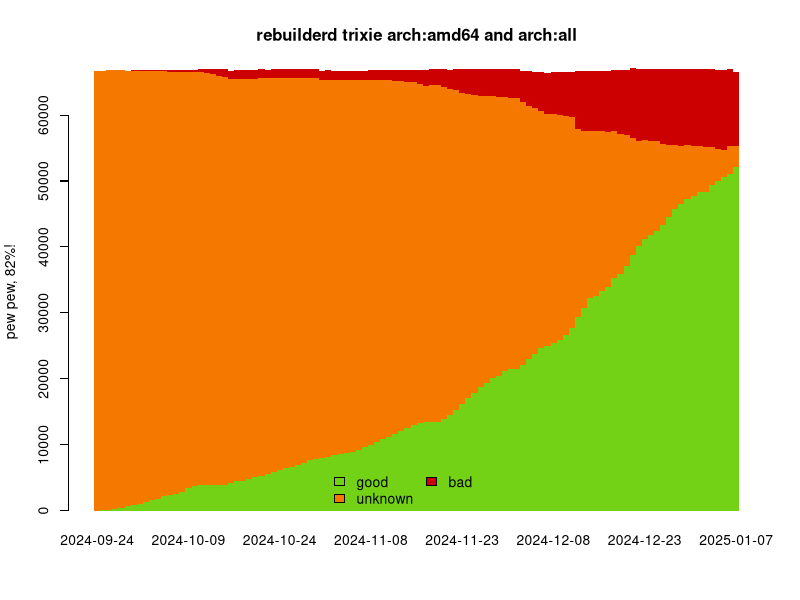
reproduce.debian.net Last month saw the introduction of reproduce.debian.net. Announced at the recent Debian MiniDebConf in Toulouse, reproduce.debian.net is an instance of rebuilderd operated by the Reproducible Builds project. rebuilderd is our server designed monitor the official package repositories of Linux distributions and attempts to reproduce the observed results there. This month, however, we are pleased to announce that not only does the service now produce graphs, the reproduce.debian.net homepage itself has become a start page of sorts, and the amd64.reproduce.debian.net and i386.reproduce.debian.net pages have emerged. The first of these rebuilds the amd64 architecture, naturally, but it also is building Debian packages that are marked with the no architecture label, all. The second builder is, however, only rebuilding the i386 architecture. Both of these services were also switched to reproduce the Debian trixie distribution instead of unstable, which started with 43% of the archive rebuild with 79.3% reproduced successfully. This is very much a work in progress, and we ll start reproducing Debian unstable soon. Our i386 hosts are very kindly sponsored by Infomaniak whilst the amd64 node is sponsored by OSUOSL thank you! Indeed, we are looking for more workers for more Debian architectures; please contact us if you are able to help.

debian-repro-status Reproducible builds developer kpcyrd has published a client program for reproduce.debian.net (see above) that queries the status of the locally installed packages and rates the system with a percentage score. This tool works analogously to arch-repro-status for the Arch Linux Reproducible Builds setup. The tool was packaged for Debian and is currently available in Debian trixie: it can be installed with apt install debian-repro-status.

On our mailing list On our mailing list this month:
  • Bernhard M. Wiedemann wrote a detailed post on his long journey towards a bit-reproducible Emacs package. In his interesting message, Bernhard goes into depth about the tools that they used and the lower-level technical details of, for instance, compatibility with the version for glibc within openSUSE.
  • Shivanand Kunijadar posed a question pertaining to the reproducibility issues with encrypted images. Shivanand explains that they must use a random IV for encryption with AES CBC. The resulting artifact is not reproducible due to the random IV used. The message resulted in a handful of replies, hopefully helpful!
  • User Danilo posted an in interesting question related to their attempts in trying to achieve reproducible builds for Threema Desktop 2.0. The question resulted in a number of replies attempting to find the right combination of compiler and linker flags (for example).
  • Longstanding contributor David A. Wheeler wrote to our list announcing the release of the Census III of Free and Open Source Software: Application Libraries report written by Frank Nagle, Kate Powell, Richie Zitomer and David himself. As David writes in his message, the report attempts to answer the question what is the most popular Free and Open Source Software (FOSS)? .
  • Lastly, kpcyrd followed-up to a post from September 2024 which mentioned their desire for someone to implement a hashset of allowed module hashes that is generated during the kernel build and then embedded in the kernel image , thus enabling a deterministic and reproducible build. However, they are now reporting that somebody implemented the hash-based allow list feature and submitted it to the Linux kernel mailing list . Like kpcyrd, we hope it gets merged.

Enhancing the Security of Software Supply Chains: Methods and Practices Mehdi Keshani of the Delft University of Technology in the Netherlands has published their thesis on Enhancing the Security of Software Supply Chains: Methods and Practices . Their introductory summary first begins with an outline of software supply chains and the importance of the Maven ecosystem before outlining the issues that it faces that threaten its security and effectiveness . To address these:
First, we propose an automated approach for library reproducibility to enhance library security during the deployment phase. We then develop a scalable call graph generation technique to support various use cases, such as method-level vulnerability analysis and change impact analysis, which help mitigate security challenges within the ecosystem. Utilizing the generated call graphs, we explore the impact of libraries on their users. Finally, through empirical research and mining techniques, we investigate the current state of the Maven ecosystem, identify harmful practices, and propose recommendations to address them.
A PDF of Mehdi s entire thesis is available to download.

diffoscope diffoscope is our in-depth and content-aware diff utility that can locate and diagnose reproducibility issues. This month, Chris Lamb made the following changes, including preparing and uploading versions 283 and 284 to Debian:
  • Update copyright years. [ ]
  • Update tests to support file 5.46. [ ][ ]
  • Simplify tests_quines.py::test_ differences,differences_deb to simply use assert_diff and not mangle the test fixture. [ ]

Supply-chain attack in the Solana ecosystem A significant supply-chain attack impacted Solana, an ecosystem for decentralised applications running on a blockchain. Hackers targeted the @solana/web3.js JavaScript library and embedded malicious code that extracted private keys and drained funds from cryptocurrency wallets. According to some reports, about $160,000 worth of assets were stolen, not including SOL tokens and other crypto assets.

Website updates Similar to last month, there was a large number of changes made to our website this month, including:
  • Chris Lamb:
    • Make the landing page hero look nicer when the vertical height component of the viewport is restricted, not just the horizontal width.
    • Rename the Buy-in page to Why Reproducible Builds? [ ]
    • Removing the top black border. [ ][ ]
  • Holger Levsen:
  • hulkoba:
    • Remove the sidebar-type layout and move to a static navigation element. [ ][ ][ ][ ]
    • Create and merge a new Success stories page, which highlights the success stories of Reproducible Builds, showcasing real-world examples of projects shipping with verifiable, reproducible builds. These stories aim to enhance the technical resilience of the initiative by encouraging community involvement and inspiring new contributions. . [ ]
    • Further changes to the homepage. [ ]
    • Remove the translation icon from the navigation bar. [ ]
    • Remove unused CSS styles pertaining to the sidebar. [ ]
    • Add sponsors to the global footer. [ ]
    • Add extra space on large screens on the Who page. [ ]
    • Hide the side navigation on small screens on the Documentation pages. [ ]

Debian changes There were a significant number of reproducibility-related changes within Debian this month, including:
  • Santiago Vila uploaded version 0.11+nmu4 of the dh-buildinfo package. In this release, the dh_buildinfo becomes a no-op ie. it no longer does anything beyond warning the developer that the dh-buildinfo package is now obsolete. In his upload, Santiago wrote that We still want packages to drop their [dependency] on dh-buildinfo, but now they will immediately benefit from this change after a simple rebuild.
  • Holger Levsen filed Debian bug #1091550 requesting a rebuild of a number of packages that were built with a very old version of dpkg.
  • Fay Stegerman contributed to an extensive thread on the debian-devel development mailing list on the topic of Supporting alternative zlib implementations . In particular, Fay wrote about her results experimenting whether zlib-ng produces identical results or not.
  • kpcyrd uploaded a new rust-rebuilderd-worker, rust-derp, rust-in-toto and debian-repro-status to Debian, which passed successfully through the so-called NEW queue.
  • Gioele Barabucci filed a number of bugs against the debrebuild component/script of the devscripts package, including:
    • #1089087: Address a spurious extra subdirectory in the build path.
    • #1089201: Extra zero bytes added to .dynstr when rebuilding CMake projects.
    • #1089088: Some binNMUs have a 1-second offset in some timestamps.
  • Gioele Barabucci also filed a bug against the dh-r package to report that the Recommends and Suggests fields are missing from rebuilt R packages. At the time of writing, this bug has no patch and needs some help to make over 350 binary packages reproducible.
  • Lastly, 8 reviews of Debian packages were added, 11 were updated and 11 were removed this month adding to our knowledge about identified issues.

Other development news In other ecosystem and distribution news:
  • Lastly, in openSUSE, Bernhard M. Wiedemann published another report for the distribution. There, Bernhard reports about the success of building R-B-OS , a partial fork of openSUSE with only 100% bit-reproducible packages. This effort was sponsored by the NLNet NGI0 initiative.

Upstream patches The Reproducible Builds project detects, dissects and attempts to fix as many currently-unreproducible packages as possible. We endeavour to send all of our patches upstream where appropriate. This month, we wrote a large number of such patches, including:

Reproducibility testing framework The Reproducible Builds project operates a comprehensive testing framework running primarily at tests.reproducible-builds.org in order to check packages and other artifacts for reproducibility. In November, a number of changes were made by Holger Levsen, including:
  • reproduce.debian.net-related:
    • Add a new i386.reproduce.debian.net rebuilder. [ ][ ][ ][ ][ ][ ]
    • Make a number of updates to the documentation. [ ][ ][ ][ ][ ]
    • Run i386.reproduce.debian.net run on a public port to allow external workers. [ ]
    • Add a link to the /api/v0/pkgs/list endpoint. [ ]
    • Add support for a statistics page. [ ][ ][ ][ ][ ][ ]
    • Limit build logs to 20 MiB and diffoscope output to 10 MiB. [ ]
    • Improve the frontpage. [ ][ ]
    • Explain that we re testing arch:any and arch:all on the amd64 architecture, but only arch:any on i386. [ ]
  • Misc:
    • Remove code for testing Arch Linux, which has moved to reproduce.archlinux.org. [ ][ ]
    • Don t install dstat on Jenkins nodes anymore as its been removed from Debian trixie. [ ]
    • Prepare the infom08-i386 node to become another rebuilder. [ ]
    • Add debug date output for benchmarking the reproducible_pool_buildinfos.sh script. [ ]
    • Install installation-birthday everywhere. [ ]
    • Temporarily disable automatic updates of pool links on buildinfos.debian.net. [ ]
    • Install Recommends by default on Jenkins nodes. [ ]
    • Rename rebuilder_stats.py to rebuilderd_stats.py. [ ]
    • r.d.n/stats: minor formatting changes. [ ]
    • Install files under /etc/cron.d/ with the correct permissions. [ ]
and Jochen Sprickerhof made the following changes: Lastly, Gioele Barabucci also classified packages affected by 1-second offset issue filed as Debian bug #1089088 [ ][ ][ ][ ], Chris Hofstaedtler updated the URL for Grml s dpkg.selections file [ ], Roland Clobus updated the Jenkins log parser to parse warnings from diffoscope [ ] and Mattia Rizzolo banned a number of bots and crawlers from the service [ ][ ].
If you are interested in contributing to the Reproducible Builds project, please visit our Contribute page on our website. However, you can get in touch with us via:

8 January 2025

Dirk Eddelbuettel: RcppGetconf 0.0.4 on CRAN: Updates

A minor package update, the first in over six years, for the RcppGetconf package for reading system configuration not unlike getconf from the libc library is now on CRAN The changes are all minor package maintenance items of keeping URLs, continuous integration, and best practices current. We had two helper scripts use bash in their shebangs, and we just got dinged in one of them. Tedious as this can at times seem, it ensures CRAN packages do in fact compile just about anywhere which is a Good Thing (TM) so we obliged and updated the package with that change and all the others that had accumulated over six years. No interface or behaviour changes, just maintenance as one does at times. The short list of changes in this release follows:

Changes in inline version 0.0.4 (2025-01-07)
  • Dynamically linked compiled code is now registered in NAMESPACE
  • The continuous integration setup was update several times
  • The README was updated with current badges and URLs
  • The DESCRIPTION file now uses Authors@R
  • The configure and cleanup scripts use /bin/sh

Courtesy of my CRANberries, there is also a diffstat report of changes relative to the previous release. More about the package is at the local RcppGetconf page and the GitHub repo.

This post by Dirk Eddelbuettel originated on his Thinking inside the box blog. If you like this or other open-source work I do, you can now sponsor me at GitHub.

Sandro Tosi: HOWTO remove Reddit (web) "Recent" list of communities

If you go on reddit.com via browser, on the left column you can see a section called "RECENT" with the list of the last 5 communities recently visited.If you want to remove them, say for privacy reasons (shared device, etc.), there's no simple way to do so: there's not "X" button next to it, your profile page doesn't offer a way to clear that out. you could clear all the data from the website, but that seems too extreme, no?Enter Chrome's "Developer Tools"While on reddit.com open Menu > More Tools > Developers tool, go on the Application tab, Storage > Local storage and select reddit.com; on the center panel you see a list of key-value pairs, look for the key "recent-subreddits-store"; you can see the list of the 5 communities in the JSON below.If you wanna get rid of the recently viewed communities list, simply delete that key, refresh reddit.com and voila, empty list.Note: I'm fairly sure i read about this method somewhere, i simply cant remember where, but it's definitely not me who came up with it. I just needed to use it recently and had to back track memories to figure it out again, so it's time to write it down.

2 January 2025

Matthew Garrett: The GPU, not the TPM, is the root of hardware DRM

As part of their "Defective by Design" anti-DRM campaign, the FSF recently made the following claim:
Today, most of the major streaming media platforms utilize the TPM to decrypt media streams, forcefully placing the decryption out of the user's control (from here).
This is part of an overall argument that Microsoft's insistence that only hardware with a TPM can run Windows 11 is with the goal of aiding streaming companies in their attempt to ensure media can only be played in tightly constrained environments.

I'm going to be honest here and say that I don't know what Microsoft's actual motivation for requiring a TPM in Windows 11 is. I've been talking about TPM stuff for a long time. My job involves writing a lot of TPM code. I think having a TPM enables a number of worthwhile security features. Given the choice, I'd certainly pick a computer with a TPM. But in terms of whether it's of sufficient value to lock out Windows 11 on hardware with no TPM that would otherwise be able to run it? I'm not sure that's a worthwhile tradeoff.

What I can say is that the FSF's claim is just 100% wrong, and since this seems to be the sole basis of their overall claim about Microsoft's strategy here, the argument is pretty significantly undermined. I'm not aware of any streaming media platforms making use of TPMs in any way whatsoever. There is hardware DRM that the media companies use to restrict users, but it's not in the TPM - it's in the GPU.

Let's back up for a moment. There's multiple different DRM implementations, but the big three are Widevine (owned by Google, used on Android, Chromebooks, and some other embedded devices), Fairplay (Apple implementation, used for Mac and iOS), and Playready (Microsoft's implementation, used in Windows and some other hardware streaming devices and TVs). These generally implement several levels of functionality, depending on the capabilities of the device they're running on - this will range from all the DRM functionality being implemented in software up to the hardware path that will be discussed shortly. Streaming providers can choose what level of functionality and quality to provide based on the level implemented on the client device, and it's common for 4K and HDR content to be tied to hardware DRM. In any scenario, they stream encrypted content to the client and the DRM stack decrypts it before the compressed data can be decoded and played.

The "problem" with software DRM implementations is that the decrypted material is going to exist somewhere the OS can get at it at some point, making it possible for users to simply grab the decrypted stream, somewhat defeating the entire point. Vendors try to make this difficult by obfuscating their code as much as possible (and in some cases putting some of it in-kernel), but pretty much all software DRM is at least somewhat broken and copies of any new streaming media end up being available via Bittorrent pretty quickly after release. This is why higher quality media tends to be restricted to clients that implement hardware-based DRM.

The implementation of hardware-based DRM varies. On devices in the ARM world this is usually handled by performing the cryptography in a Trusted Execution Environment, or TEE. A TEE is an area where code can be executed without the OS having any insight into it at all, with ARM's TrustZone being an example of this. By putting the DRM code in TrustZone, the cryptography can be performed in RAM that the OS has no access to, making the scraping described earlier impossible. x86 has no well-specified TEE (Intel's SGX is an example, but is no longer implemented in consumer parts), so instead this tends to be handed off to the GPU. The exact details of this implementation are somewhat opaque - of the previously mentioned DRM implementations, only Playready does hardware DRM on x86, and I haven't found any public documentation of what drivers need to expose for this to work.

In any case, as part of the DRM handshake between the client and the streaming platform, encryption keys are negotiated with the key material being stored in the GPU or the TEE, inaccessible from the OS. Once decrypted, the material is decoded (again either on the GPU or in the TEE - even in implementations that use the TEE for the cryptography, the actual media decoding may happen on the GPU) and displayed. One key point is that the decoded video material is still stored in RAM that the OS has no access to, and the GPU composites it onto the outbound video stream (which is why if you take a screenshot of a browser playing a stream using hardware-based DRM you'll just see a black window - as far as the OS can see, there is only a black window there).

Now, TPMs are sometimes referred to as a TEE, and in a way they are. However, they're fixed function - you can't run arbitrary code on the TPM, you only have whatever functionality it provides. But TPMs do have the ability to decrypt data using keys that are tied to the TPM, so isn't this sufficient? Well, no. First, the TPM can't communicate with the GPU. The OS could push encrypted material to it, and it would get plaintext material back. But the entire point of this exercise was to avoid the decrypted version of the stream from ever being visible to the OS, so this would be pointless. And rather more fundamentally, TPMs are slow. I don't think there's a TPM on the market that could decrypt a 1080p stream in realtime, let alone a 4K one.

The FSF's focus on TPMs here is not only technically wrong, it's indicative of a failure to understand what's actually happening in the industry. While the FSF has been focusing on TPMs, GPU vendors have quietly deployed all of this technology without the FSF complaining at all. Microsoft has enthusiastically participated in making hardware DRM on Windows possible, and user freedoms have suffered as a result, but Playready hardware-based DRM works just fine on hardware that doesn't have a TPM and will continue to do so.

comment count unavailable comments

23 December 2024

Simon Josefsson: OpenSSH and Git on a Post-Quantum SPHINCS+

Are you aware that Git commits and tags may be signed using OpenSSH? Git signatures may be used to improve integrity and authentication of our software supply-chain. Popular signature algorithms include Ed25519, ECDSA and RSA. Did you consider that these algorithms may not be safe if someone builds a post-quantum computer? As you may recall, I have earlier blogged about the efficient post-quantum key agreement mechanism called Streamlined NTRU Prime and its use in SSH and I have attempted to promote the conservatively designed Classic McEliece in a similar way, although it remains to be adopted. What post-quantum signature algorithms are available? There is an effort by NIST to standardize post-quantum algorithms, and they have a category for signature algorithms. According to wikipedia, after round three the selected algorithms are CRYSTALS-Dilithium, FALCON and SPHINCS+. Of these, SPHINCS+ appears to be a conservative choice suitable for long-term digital signatures. Can we get this to work? Recall that Git uses the ssh-keygen tool from OpenSSH to perform signing and verification. To refresh your memory, let s study the commands that Git uses under the hood for Ed25519. First generate a Ed25519 private key:
jas@kaka:~$ ssh-keygen -t ed25519 -f my_ed25519_key -P ""
Generating public/private ed25519 key pair.
Your identification has been saved in my_ed25519_key
Your public key has been saved in my_ed25519_key.pub
The key fingerprint is:
SHA256:fDa5+jmC2+/aiLhWeWA3IV8Wj6yMNTSuRzqUZlIGlXQ jas@kaka
The key's randomart image is:
+--[ED25519 256]--+
     .+=.E ..      
      oo=.ooo      
     . =o=+o .     
      =oO+o .      
      .=+S.=       
       oo.o o      
      . o  .       
     ...o.+..      
    .o.o.=**.      
+----[SHA256]-----+
jas@kaka:~$ cat my_ed25519_key
-----BEGIN OPENSSH PRIVATE KEY-----
b3BlbnNzaC1rZXktdjEAAAAABG5vbmUAAAAEbm9uZQAAAAAAAAABAAAAMwAAAAtzc2gtZW
QyNTUxOQAAACAWP/aZ8hzN0WNRMSpjzbgW1tJXNd2v6/dnbKaQt7iIBQAAAJCeDotOng6L
TgAAAAtzc2gtZWQyNTUxOQAAACAWP/aZ8hzN0WNRMSpjzbgW1tJXNd2v6/dnbKaQt7iIBQ
AAAEBFRvzgcD3YItl9AMmVK4xDKj8NTg4h2Sluj0/x7aSPlhY/9pnyHM3RY1ExKmPNuBbW
0lc13a/r92dsppC3uIgFAAAACGphc0BrYWthAQIDBAU=
-----END OPENSSH PRIVATE KEY-----
jas@kaka:~$ cat my_ed25519_key.pub 
ssh-ed25519 AAAAC3NzaC1lZDI1NTE5AAAAIBY/9pnyHM3RY1ExKmPNuBbW0lc13a/r92dsppC3uIgF jas@kaka
jas@kaka:~$ 
Then let s sign something with this key:
jas@kaka:~$ echo "Hello world!" > msg
jas@kaka:~$ ssh-keygen -Y sign -f my_ed25519_key -n my-namespace msg
Signing file msg
Write signature to msg.sig
jas@kaka:~$ cat msg.sig 
-----BEGIN SSH SIGNATURE-----
U1NIU0lHAAAAAQAAADMAAAALc3NoLWVkMjU1MTkAAAAgFj/2mfIczdFjUTEqY824FtbSVz
Xdr+v3Z2ymkLe4iAUAAAAMbXktbmFtZXNwYWNlAAAAAAAAAAZzaGE1MTIAAABTAAAAC3Nz
aC1lZDI1NTE5AAAAQLmWsq05tqOOZIJqjxy5ZP/YRFoaX30lfIllmfyoeM5lpVnxJ3ZxU8
SF0KodDr8Rtukg2N3Xo80NGvZOzbG/9Aw=
-----END SSH SIGNATURE-----
jas@kaka:~$
Now let s create a list of trusted public-keys and associated identities:
jas@kaka:~$ echo 'my.name@example.org ssh-ed25519 AAAAC3NzaC1lZDI1NTE5AAAAIBY/9pnyHM3RY1ExKmPNuBbW0lc13a/r92dsppC3uIgF' > allowed-signers
jas@kaka:~$ 
Then let s verify the message we just signed:
jas@kaka:~$ cat msg   ssh-keygen -Y verify -f allowed-signers -I my.name@example.org -n my-namespace -s msg.sig
Good "my-namespace" signature for my.name@example.org with ED25519 key SHA256:fDa5+jmC2+/aiLhWeWA3IV8Wj6yMNTSuRzqUZlIGlXQ
jas@kaka:~$ 
I have implemented support for SPHINCS+ in OpenSSH. This is early work, but I wanted to announce it to get discussion of some of the details going and to make people aware of it. What would a better way to demonstrate SPHINCS+ support in OpenSSH than by validating the Git commit that implements it using itself? Here is how to proceed, first get a suitable development environment up and running. I m using a Debian container launched in a protected environment using podman.
jas@kaka:~$ podman run -it --rm debian:stable
Then install the necessary build dependencies for OpenSSH.
# apt-get update 
# apt-get install git build-essential autoconf libz-dev libssl-dev
Now clone my OpenSSH branch with the SPHINCS+ implentation and build it. You may browse the commit on GitHub first if you are curious.
# cd
# git clone https://github.com/jas4711/openssh-portable.git -b sphincsp
# cd openssh-portable
# autoreconf -fvi
# ./configure
# make
Configure a Git allowed signers list with my SPHINCS+ public key (make sure to keep the public key on one line with the whitespace being one ASCII SPC character):
# mkdir -pv ~/.ssh
# echo 'simon@josefsson.org ssh-sphincsplus@openssh.com AAAAG3NzaC1zcGhpbmNzcGx1c0BvcGVuc3NoLmNvbQAAAECI6eacTxjB36xcPtP0ZyxJNIGCN350GluLD5h0KjKDsZLNmNaPSFH2ynWyKZKOF5eRPIMMKSCIV75y+KP9d6w3' > ~/.ssh/allowed_signers
# git config gpg.ssh.allowedSignersFile ~/.ssh/allowed_signers
Then verify the commit using the newly built ssh-keygen binary:
# PATH=$PWD:$PATH
# git log -1 --show-signature
commit ce0b590071e2dc845373734655192241a4ace94b (HEAD -> sphincsp, origin/sphincsp)
Good "git" signature for simon@josefsson.org with SPHINCSPLUS key SHA256:rkAa0fX0lQf/7V7QmuJHSI44L/PAPPsdWpis4nML7EQ
Author: Simon Josefsson <simon@josefsson.org>
Date:   Tue Dec 3 18:44:25 2024 +0100
    Add SPHINCS+.
# git verify-commit ce0b590071e2dc845373734655192241a4ace94b
Good "git" signature for simon@josefsson.org with SPHINCSPLUS key SHA256:rkAa0fX0lQf/7V7QmuJHSI44L/PAPPsdWpis4nML7EQ
# 
Yay! So what are some considerations? SPHINCS+ comes in many different variants. First it comes with three security levels approximately matching 128/192/256 bit symmetric key strengths. Second choice is between the SHA2-256, SHAKE256 (SHA-3) and Haraka hash algorithms. Final choice is between a robust and a simple variant with different security and performance characteristics. To get going, I picked the sphincss256sha256robust SPHINCS+ implementation from SUPERCOP 20241022. There is a good size comparison table in the sphincsplus implementation, if you want to consider alternative variants. SPHINCS+ public-keys are really small, as you can see in the allowed signers file. This is really good because they are handled by humans and often by cut n paste. What about private keys? They are slightly longer than Ed25519 private keys but shorter than typical RSA private keys.
# ssh-keygen -t sphincsplus -f my_sphincsplus_key -P ""
Generating public/private sphincsplus key pair.
Your identification has been saved in my_sphincsplus_key
Your public key has been saved in my_sphincsplus_key.pub
The key fingerprint is:
SHA256:4rNfXdmLo/ySQiWYzsBhZIvgLu9sQQz7upG8clKziBg root@ad600ff56253
The key's randomart image is:
+[SPHINCSPLUS 256-+
  .  .o            
 o . oo.           
  = .o.. o         
 o o  o o . .   o  
 .+    = S o   o . 
 Eo=  . + . . .. . 
 =*.+  o . . oo .  
 B+=    o o.o. .   
 o*o   ... .oo.    
+----[SHA256]-----+
# cat my_sphincsplus_key.pub 
ssh-sphincsplus@openssh.com AAAAG3NzaC1zcGhpbmNzcGx1c0BvcGVuc3NoLmNvbQAAAEAltAX1VhZ8pdW9FgC+NdM6QfLxVXVaf1v2yW4v+tk2Oj5lxmVgZftfT37GOMOlK9iBm9SQHZZVYZddkEJ9F1D7 root@ad600ff56253
# cat my_sphincsplus_key 
-----BEGIN OPENSSH PRIVATE KEY-----
b3BlbnNzaC1rZXktdjEAAAAABG5vbmUAAAAEbm9uZQAAAAAAAAABAAAAYwAAABtzc2gtc3
BoaW5jc3BsdXNAb3BlbnNzaC5jb20AAABAJbQF9VYWfKXVvRYAvjXTOkHy8VV1Wn9b9slu
L/rZNjo+ZcZlYGX7X09+xjjDpSvYgZvUkB2WVWGXXZBCfRdQ+wAAAQidiIwanYiMGgAAAB
tzc2gtc3BoaW5jc3BsdXNAb3BlbnNzaC5jb20AAABAJbQF9VYWfKXVvRYAvjXTOkHy8VV1
Wn9b9sluL/rZNjo+ZcZlYGX7X09+xjjDpSvYgZvUkB2WVWGXXZBCfRdQ+wAAAIAbwBxEhA
NYzITN6VeCMqUyvw/59JM+WOLXBlRbu3R8qS7ljc4qFVWUtmhy8B3t9e4jrhdO6w0n5I4l
mnLnBi2hJbQF9VYWfKXVvRYAvjXTOkHy8VV1Wn9b9sluL/rZNjo+ZcZlYGX7X09+xjjDpS
vYgZvUkB2WVWGXXZBCfRdQ+wAAABFyb290QGFkNjAwZmY1NjI1MwECAwQ=
-----END OPENSSH PRIVATE KEY-----
# 
Signature size? Now here is the challenge, for this variant the size is around 29kb or close to 600 lines of base64 data:
# git cat-file -p ce0b590071e2dc845373734655192241a4ace94b   head -10
tree ede42093e7d5acd37fde02065a4a19ac1f418703
parent 826483d51a9fee60703298bbf839d9ce37943474
author Simon Josefsson <simon@josefsson.org> 1733247865 +0100
committer Simon Josefsson <simon@josefsson.org> 1734907869 +0100
gpgsig -----BEGIN SSH SIGNATURE-----
 U1NIU0lHAAAAAQAAAGMAAAAbc3NoLXNwaGluY3NwbHVzQG9wZW5zc2guY29tAAAAQIjp5p
 xPGMHfrFw+0/RnLEk0gYI3fnQaW4sPmHQqMoOxks2Y1o9IUfbKdbIpko4Xl5E8gwwpIIhX
 vnL4o/13rDcAAAADZ2l0AAAAAAAAAAZzaGE1MTIAAHSDAAAAG3NzaC1zcGhpbmNzcGx1c0
 BvcGVuc3NoLmNvbQAAdGDHlobgfgkKKQBo3UHmnEnNXczCMNdzJmeYJau67QM6xZcAU+d+
 2mvhbksm5D34m75DWEngzBb3usJTqWJeeDdplHHRe3BKVCQ05LHqRYzcSdN6eoeZqoOBvR
# git cat-file -p ce0b590071e2dc845373734655192241a4ace94b   tail -5 
 ChvXUk4jfiNp85RDZ1kljVecfdB2/6CHFRtxrKHJRDiIavYjucgHF1bjz0fqaOSGa90UYL
 RZjZ0OhdHOQjNP5QErlIOcZeqcnwi0+RtCJ1D1wH2psuXIQEyr1mCA==
 -----END SSH SIGNATURE-----
Add SPHINCS+.
# git cat-file -p ce0b590071e2dc845373734655192241a4ace94b   wc -l
579
# 
What about performance? Verification is really fast:
# time git verify-commit ce0b590071e2dc845373734655192241a4ace94b
Good "git" signature for simon@josefsson.org with SPHINCSPLUS key SHA256:rkAa0fX0lQf/7V7QmuJHSI44L/PAPPsdWpis4nML7EQ
real	0m0.010s
user	0m0.005s
sys	0m0.005s
# 
On this machine, verifying an Ed25519 signature is a couple of times slower, and needs around 0.07 seconds. Signing is slower, it takes a bit over 2 seconds on my laptop.
# echo "Hello world!" > msg
# time ssh-keygen -Y sign -f my_sphincsplus_key -n my-namespace msg
Signing file msg
Write signature to msg.sig
real	0m2.226s
user	0m2.226s
sys	0m0.000s
# echo 'my.name@example.org ssh-sphincsplus@openssh.com AAAAG3NzaC1zcGhpbmNzcGx1c0BvcGVuc3NoLmNvbQAAAEAltAX1VhZ8pdW9FgC+NdM6QfLxVXVaf1v2yW4v+tk2Oj5lxmVgZftfT37GOMOlK9iBm9SQHZZVYZddkEJ9F1D7' > allowed-signers
# cat msg   ssh-keygen -Y verify -f allowed-signers -I my.name@example.org -n my-namespace -s msg.sig
Good "my-namespace" signature for my.name@example.org with SPHINCSPLUS key SHA256:4rNfXdmLo/ySQiWYzsBhZIvgLu9sQQz7upG8clKziBg
# 
Welcome to our new world of Post-Quantum safe digital signatures of Git commits, and Happy Hacking!

21 December 2024

Dirk Eddelbuettel: anytime 0.3.11 on CRAN: Maintenance

A follow-up release 0.3.11 to the recent 0.3.10 release release of the anytime package arrived on CRAN two days ago. The package is fairly feature-complete, and code and functionality remain mature and stable, of course. anytime is a very focused package aiming to do just one thing really well: to convert anything in integer, numeric, character, factor, ordered, input format to either POSIXct (when called as anytime) or Date objects (when called as anydate) and to do so without requiring a format string as well as accomodating different formats in one input vector. See the anytime page, or the GitHub repo for a few examples, and the beautiful documentation site for all documentation. This release simply skips one test file. CRAN labeled an error M1mac yet it did not reproduce on any of the other M1 macOS I can access (macbuilder, GitHub Actions) as this appeared related to a local setting of timezone values I could not reproduce anywwhere. So the only way to get rid of the fail is to not to run the test. Needless to say the upload process was a little tedious as I got the passive-aggressive not responding treatment on a first upload and the required email answer it lead to. Anyway, after a few days, and even more deep breaths, it is taken care of and now the package result standing is (at least currently) pristinely clean. The short list of changes follows.

Changes in anytime version 0.3.11 (2024-12-18)
  • Skip a test file

Courtesy of my CRANberries, there is also a diffstat report of changes relative to the previous release. The issue tracker tracker off the GitHub repo can be use for questions and comments. More information about the package is at the package page, the GitHub repo and the documentation site.

This post by Dirk Eddelbuettel originated on his Thinking inside the box blog. If you like this or other open-source work I do, you can now sponsor me at GitHub.

17 December 2024

Dirk Eddelbuettel: BH 1.87.0-1 on CRAN: New Upstream

Boost Boost is a very large and comprehensive set of (peer-reviewed) libraries for the C++ programming language, containing well over one hundred individual libraries. The BH package provides a sizeable subset of header-only libraries for (easier, no linking required) use by R. It is fairly widely used: the (partial) CRAN mirror logs (aggregated from the cloud mirrors) show over 38.5 million package downloads. Version 1.87.0 of Boost was released last week following the regular Boost release schedule of April, August and December releases. As before, we packaged it almost immediately and started testing following our annual update cycle which strives to balance being close enough to upstream and not stressing CRAN and the user base too much. The reverse depends check revealed six packages requiring changes or adjustments. We opened issue #103 to coordinate the issue (just as we did in previous years). Our sincere thanks to Matt Fidler who fixed two packages pretty much immediately. As I had not heard back from the other maintainers since filing the issue, I uploaded the package to CRAN suggesting that the coming winter break may be a good opportunity for the four other packages to catch up. CRAN concurred, and 1.87.0-1 is now available there. There are no other changes apart from cosmetics in the DESCRIPTION file. For once, we did not add any new Boost libraries. The short NEWS entry follows.

Changes in version 1.87.0-1 (2024-12-17)
  • Upgrade to Boost 1.87.0, patched as usual to comment-out diagnostic suppression messages per the request of CRAN
  • Switched to Authors@R

Via my CRANberries, there is a diffstat report relative to the previous release. Comments and suggestions about BH are welcome via the issue tracker at the GitHub repo.

This post by Dirk Eddelbuettel originated on his Thinking inside the box blog. If you like this or other open-source work I do, you can now sponsor me at GitHub.

Russ Allbery: Review: Iris Kelly Doesn't Date

Review: Iris Kelly Doesn't Date, by Ashley Herring Blake
Series: Bright Falls #3
Publisher: Berkley Romance
Copyright: October 2023
ISBN: 0-593-55058-7
Format: Kindle
Pages: 381
Iris Kelly Doesn't Date is a sapphic romance novel (probably a romantic comedy, although I'm bad at romance subgenres). It is the third book in the Bright Falls series. In the romance style, it has a new set of protagonists, but the protagonists of the previous books appear as supporting characters and reading this will spoil the previous books. Among the friend group we were introduced to in Delilah Green Doesn't Care, Iris was the irrepressible loudmouth. She's bad at secrets, good at saying whatever is on her mind, and has zero desire to either get married or have children. After one of the side plots of Astrid Parker Doesn't Fail, she has sworn off dating entirely. Iris is also now a romance novelist. Her paper store didn't get enough foot traffic to justify staying open, so she switched her planner business to online only and wrote a romance novel that was good enough to get a two-book deal. Now she needs to write a second book and she has absolutely nothing. Her own avoidance of romantic situations is not helping, but neither is her meddling family who are convinced her choices about marriage and family can be overturned with sufficient pestering. She desperately needs to shake up her life, get out of her creative rut, and do something new. Failing that, she'll settle for meeting someone in a bar and having some fun. Stevie is a barista and actress living in Portland. Six months ago, she broke up with Adri, her creative partner, girlfriend of six years, and the first person with whom she had a serious relationship. More precisely, Adri broke up with her. They're still friends, truly, even though that friendship is being seriously strained by Adri dating Vanessa, another member of their small and close-knit friend group. Stevie has occasionally-crippling anxiety, not much luck in finding real acting roles in Portland, and a desperate desire to not make waves. Ren, the fourth member of their friend group, thinks Stevie needs a new relationship, or at least a fling. That's how Stevie, with Ren as backup and encouragement, ends up at the same bar with Iris. The resulting dance and conversation was rather fun for both Stevie and Iris. The attempted one-night stand afterwards was a disaster due to Stevie's anxiety, and neither of them expected to see the other again. Stevie therefore felt safe pretending they'd hit it off to get her friends off her back. When Iris's continued restlessness lands her in an audition for Adri's fundraiser play that she also talked Stevie into performing in, this turns into a full-blown fake dating trope. These books continue to be impossible to put down. I'm not sure what Blake is doing to make the pacing so perfect, but as with the previous books of the series I found this utterly compulsive reading. I started it in the afternoon, took a break in the evening for a few hours, and then finished it at 2am. I wasn't sure if a book focused on Iris would work as well, but I need not have worried. Iris Kelly Doesn't Date is both more dramatic and more trope-centered than the earlier books, but Blake handles that in a way that fits Iris's personality and wasn't annoying even to a reader like me, who has an aversion to many types of relationship drama. The secret is Stevie, and specifically having the other protagonist be someone with severe anxiety.
No was never a very easy word for Stevie when it came to Adri, when it came to anyone, really. She could handle the little stuff do you want a soda, have you seen this movie, do you like onions on your pizza but the big stuff, the stuff that caused disappointed expressions and down-turned mouths... yeah, she sucked at that part. Her anxiety would flare, and she'd spend the next week convinced her friends hated her, she'd die alone and miserable, and wasn't worth a damn to anyone. Then, when said friend or family member eventually got ahold of her to tell her that, no, of course they didn't hate her, why in the world would she think that, her anxiety would crest once again, convincing her that she was terrible at understanding people and could never trust her own brain to make heads or tails of any social situation.
This is a spot-on description of a particular type of anxiety, but also this is the perfect protagonist to pair with Iris. Throughout the series, Iris has always been the ride-or-die friend, the person who may have no idea how to help but who will show up anyway and at least try to distract you. Stevie's anxiety makes Iris feel protective, which reveals one of the best sides of Iris's personality, and then the protectiveness plays off against Iris's own relationship issues and tendency to avoid taking anything too seriously. It's one of those relationships that starts a bit one-sided and then becomes mutually supporting once Stevie gets her feet under her. That's a relationship pattern I really enjoy reading about. As with the rest of the series, the friendship dynamics are great. Here we get to see two friend groups at work: Iris's, which we've seen in the previous two volumes and which expanded interestingly in Astrid Parker Doesn't Fail, and Stevie's, which is new. I liked all of these people, even Adri in her own way (although she's the hardest to like). The previous happily-ever-afters do get a bit awkward here, but Blake tries to make that part of the plot and also avoids most of the problem of somewhat-boring romantic bliss by spreading the friendship connections a bit wider. Stevie's friend group formed at orientation at Reed College, and that let me put my finger on another property of this series: essentially all of the characters are from a very specific social class. They're nearly all arts people (bookstore owner, photographer, interior decorator, actress, writer, director), they've mostly gone to college, and while most of them don't have lots of money, there's always at least one person in each friend group with significant wealth. Jordan, from the previous book, is a bit of an exception since she works in a trade (a carpenter), but she still acts like someone from that same social class. It's a bit like reading Jane Austen novels and realizing that the protagonists are drawn from a very specific and very narrow portion of society. This is not a complaint, to be clear; I have no objections to reading about a very specific social class. But if one has already read lots of books about this class of people, I could see that diminishing the appeal of this series a bit. There are a lot of assumptions baked into the story that aren't really questioned, such as the ubiquity of therapists. (I don't know how Stevie affords one on a barista salary.) There are also some small things in the terminology (therapy speak, for example) and in the specific type of earnestness with which the books attempt to be diverse on most axes other than social class that I suspect may grate a bit for some readers. If that's you, this is your warning. There is a third-act breakup here, just like the previous volumes. There is also a defense of the emotional punch of third-act breakups in romance novels in the book itself, put into Iris's internal monologue, so I suspect that's the author's answer to critics like myself who don't like the trope. I was less frustrated by this one because it fit the drama level of the protagonists, but I'll also know to expect a third-act breakup in any Blake novel I read in the future. But, all that said, the summary once again is that I loved this book and could not put it down. Iris is dramatic and occasionally self-destructive but has a core of earnest empathy that makes her easy to like. She's exactly the sort of extrovert who is soothing to introverts rather than draining because she carries the extrovert load of social situations. Stevie is adorably earnest and thoughtful beneath her anxiety. They two of them are wildly different and yet remarkably good together, and I loved reading their story. Highly recommended, along with the whole series. Start with Delilah Green Doesn't Care; if you like that, you're in for a treat. Content note: This book is also rather sex-forward and pretty explicit in the sex scenes, maybe a touch more than Astrid Parker Doesn't Fail. If that is or is not your thing in romance novels, be aware going in. Rating: 9 out of 10

16 December 2024

Dirk Eddelbuettel: #45: Some r-ci Updates

market monitor Welcome to post 45 in the $R^4 series! We introduced r-ci here in post #32 here nearly four years ago. It has found pretty widespread use and adoption, and we received a few kind words then (in the linked issue) and also more recently (in a follow-up comment) from which we merrily quote:
[ ] almost 3 years later on and I have had zero problems with this CI setup. For people who want reliable R software, resources like these are invaluable.
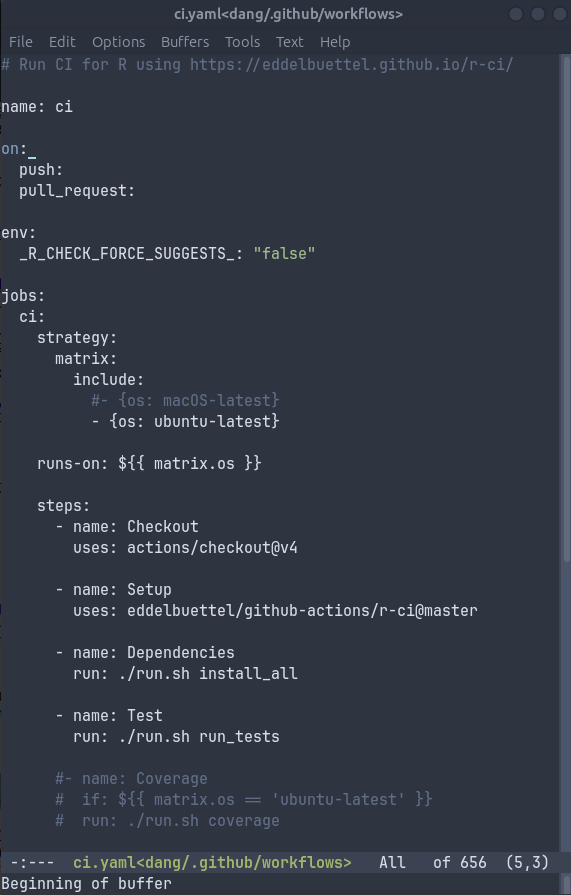
And while we followed up with post #41 about r2u for simple continuous integration, we may not have posted when we based r-ci on r2u (for the obvious Linux usage case). So let s make time now for a (comparitively smaller) update, and an update usage examples. We made two changes in the last few days. One is a (obvious in hindsight) simplification. Given that the bootstrap step was always executed, and needed no parameters, we pulled it into a new aggregated setup simply called r-ci that includes it so that it can be omitted as a step in the yaml file. Second, we recently needed Fortran on macOS too, and realized it was not installed by default so we just added that too. With that a real and used example is now as simple as the screenshot to the left (and hence one paragraph shorter). The trained eye will no doubt observe that there is nothing specific to a given repo. And that is basically the key feature: we can simply copy this file around and get fast and easy and reliable CI by taking advantage of the underlying robustness of r2u solving all dependency automagically and reliably. The option to enable macOS is also solid and compelling as the GitHub runners are fast (but more expensive in how the count against the limit of minutes so again a tradeoff to make), as is the option to run coverage if one so desires. Some of my repos do too. Take a look at the r-ci website which has more examples for the other supported CI servics it can used with, and feel free to ask questions as issue in the repo.

This post by Dirk Eddelbuettel originated on his Thinking inside the box blog. If you like this or other open-source work I do, you can now sponsor me at GitHub. Please report excessive re-aggregation in third-party for-profit settings.

Next.

Previous.