Search Results: "don"

2 March 2026

Valhalla's Things: A Pen Case (or a Few)

Posted on March 2, 2026
Tags: madeof:atoms, FreeSoftWear, craft:sewing
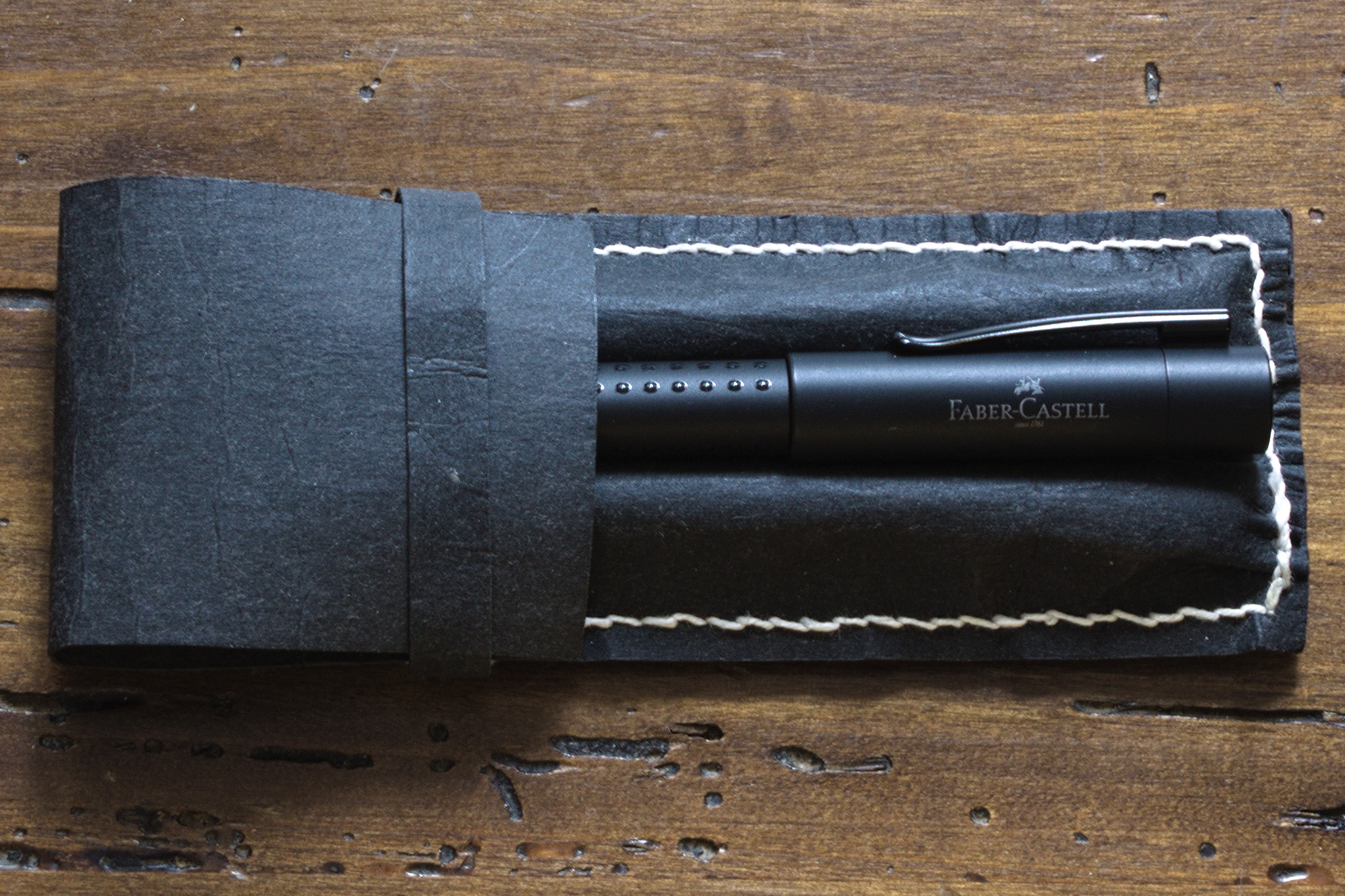
A pen case made of two pieces of a relatively stiff black material with a flat base and three separate channels on top, plus a flap covering everything and a band to keep the flap closed; there is visible light blue stitching all around the channels. For my birthday, I ve bought myself a fancy new expensive1 fountain pen. A two slot pen case in the same material as above, but brown: the flap is too short to cover the pens, and there isn't a band to keep it closed. Such a fancy pen, of course requires a suitable case: I couldn t use the failed prototype of a case I ve been keeping my Preppys in, so I had to get out the nice vegetable tanned leather Yeah, nope, I don t have that (yet). I got out the latex and cardboard material that is sold as a (cheaper) leather substitute, doesn t look like leather at all, but is quite nice (and easy) to work with. The project is not vegan anyway, because I used waxed linen thread, waxing it myself with a lot of very nicely smelling beeswax. a case similar to the one above, but this one only has two slots, and there is a a Faber Castell pen nested on top of the case between the two slots. Here the stitches are white, and in a coarser thread. I got the measurements2 from the less failed prototype where I keep my desktop pens, and this time I made a proper pattern I could share online, under the usual Free Culture license. A case like the one above, except that the stitches are in black, and not as regular. This one has also been scrunched up a bit for a different look, and now the band is a bit too wide. From the width of the material I could conveniently cut two cases, so that s what I did, started sewing the first one, realized that I got the order of stitching wrong, and also that if I used light blue thread instead of the black one it would look nice, and be easier to see in the pictures for the published pattern, started sewing the second one, and kept alternating between the two, depending on the availability of light for taking pictures. The open pen case, showing two pens, a blue Preppy and a gunmetal Plaisir cosily nested in the two outer slots, while the middle slot is ominously empty. One of the two took the place of my desktop one, where I had one more pen than slots, and one of the old prototypes was moved to keep my bedside pen, and the other new case was used for the new pen in my handbag, together with a Preppy, and now I have a free slot and you can see how this is going to go wrong, right? :D

  1. 16 . plus a 9 converter, and another 6 pen to get the EF nib from, since it wasn t available for the expensive pen.
  2. I have them written down somewhere. I couldn t find them. So I measured the real thing, with some approximation.

28 February 2026

Utkarsh Gupta: FOSS Activites in February 2026

Here s my monthly but brief update about the activities I ve done in the FOSS world.

Debian
Whilst I didn t get a chance to do much, here are still a few things that I worked on:
  • Uploaded node-lodash/4.17.21+dfsg+~cs8.31.198.20210220-10 to fix CVE-2025-13465 in unstable. Pinged Xavier and Praveen to see how they feel about the backport for the stable releases.
  • Assited a few folks in getting their patches submitted via Salsa.
    • Reviewing pyenv MR for Ujjwal.
    • Reviewing and assisting Anshul with his Golang stuff.
  • Mentoring for newcomers.
  • Started to be a bit involved with DC 26 bits.
  • Moderation of -project mailing list.

Ubuntu
I joined Canonical to work on Ubuntu full-time back in February 2021. Whilst I can t give a full, detailed list of things I did, here s a quick TL;DR of what I did:
  • Successfully released Resolute Snapshot 4!
    • This one was also done without the ISO tracker and cdimage access.
    • We also worked very hard to build and promote all the image in due time.
    • This was one done with the Test Observer. The first one.
  • Worked further on the whole artifact signing story for cdimage.
  • Assisted a bunch of folks with my Archive Admin and Release team hats to:
    • Review and grant FFes.
    • Coordinating weekly syncs.
    • Promoting binaries to main.
    • Taking care of package removals and so on.
  • Was pretty occupied with the new release processs architecture.

Debian (E)LTS
This month I have worked 42 hours on Debian Long Term Support (LTS) and on its sister Extended LTS project and did the following things:

Released Security Updates

Work in Progress
  • knot-resolver: Affected by CVE-2023-26249, CVE-2023-46317, and CVE-2022-40188, leading to Denial of Service.
  • ruby-rack: There were multiple vulnerabilities reported in Rack, leading to DoS (memory exhaustion) and proxy bypass.
    • [ELTS]: I ve partially reviewed patches by Bastien but whilst doing so, new ones came up for all the releases.
    • [sid]: Uploaded ruby-rack/3.2.5-1 to unstable to fix the new CVEs, CVE-2026-25500 and CVE-2026-22860.
    • [stable]: Prepared the upload for stable releases, as requested by the Security Team. Will upload them in March.
    • [bullseye]: Backport for CVE-2026-22860 hasn t been as trivial as it appears to be. There are test failures, which aren t really ignore-able:
      The tests requests /cgi/../test, which File.expand_path resolves to <root>/test - firmly inside @root. With the old code, it hit the return unless path_info.include? ".." guard and fell through to 403. But it would also have returned early via start_with?(@root) being true
    • anyway, this needs more investigation - I ll continue to do so in March as P1.
  • node-lodash: Affected by CVE-2025-13465, lrototype pollution in baseUnset function.
    • [stable]: The patch for trixie and bookworm are ready and have been awaiting the maintainer review.
    • [LTS]: The bullseye upload will follow once the stable uploads are in and ACK d by the SRMs.
  • vlc: Affected by CVE-2025-51602, an out-of-bounds read and denial of service via a crafted 0x01 response from an MMS server.
    • [LTS]: 3.0.23 backport is ready but not tested. I ll get this over the line in March.
    • [ELTS]: 3.0.23 backport is ready but not very clean. Would like to complete LTS and get back to this.

Other Activities
  • [LTS] Coordinated the libvirt sitaution with Ben Hutchings. The upload has already been prepped, will upload in March.
  • [ELTS] Continued to help Bastien and Markus with the tomcat9 regression for buster.
  • [ELTS] Partially reviewed ruby-rack CVEs to help Bastien. This took more time than expected with some more develpments hapening at the end of the month - new CVEs that aren t as easy to backport as I expected them to be. Will continue with these in March.
  • [E/LTS] Front Desk duties: Performed a large batch of CVE triage, marking numerous packages for bullseye, buster, and stretch as either postponed, end-of-life, not-affected, or added them to the Xla-needed.txt files.
    • Also replied to certain mails and IRC texts around FD related tasks.
  • [E/LTS] Monitored discussions on mailing lists, IRC, and all the documentation updates.
  • [E/LTS] Attended the monthly LTS meeting on Jitsi. Summary here.

Until next time.
:wq for today.

27 February 2026

Petter Reinholdtsen: Free software toolchain for the simplest RISC-V CPU in a small FPGA?

On Wednesday I had the pleasure of attending a presentation organized by the Norwegian Unix Users Group on implementing RISC-V using a small FPGA. This project is the result of a university teacher wanting to teach students assembly programming using a real instruction set, while still providing a simple and transparent CPU environment. The CPU in question implements the smallest set of opcodes needed to still call the CPU a RISC-V CPU, the RV32I base set. The author and presenter, Kristoffer Robin Stokke, demonstrated how to build both the FPGA setup and a small startup code providing a "Hello World" message over both serial port and a small LCD display. The FPGA is programmed using VHDL, the entire source code is available from github, but unfortunately the target FPGA setup is compiled using the proprietary tool Quartus. It is such a pity that such a cool little piece of free software should be chained down by non-free software, so my friend Jon Nordby set out to see if we can liberate this small RISC-V CPU. After all, it would be unforgivable sin to force students to use non-free software to study at the University of Oslo. The VHDL code for the CPU instructions itself is only 1138 lines, if I am to believe wc -l lib/riscv_common/* lib/rv32i/*. On the small FPGA used during the talk, the entire CPU, ROM, display and serial port driver only used up half the capacity. These days, there exists a free software toolchain for FPGA programming not only in Verilog but also in VHDL, and we hope the support in yosys, ghdl, and yosys-plugin-ghdl (sadly and strangely enough, removed from Debian unstable) is complete enough to at least build this small and simple project with some minor portability fixes. Or perhaps there are other approaches that work better? The first patches are already floating on github, to make the VHDL code more portable and to test out the build. If you are interested in running your own little RISC-V CPU on a FPGA chip, please get in touch. At the moment we sadly have hit a GHDL bug, which we do not quite know how to work around or fix:
******************** GHDL Bug occurred ***************************
Please report this bug on https://github.com/ghdl/ghdl/issues
GHDL release: 5.0.1 (Debian 5.0.1+dfsg-1+b1) [Dunoon edition]
Compiled with unknown compiler version
Target: x86_64-linux-gnu
/scratch/pere/src/fpga/memstick-fpga-riscv-upstream/
Command line:
Exception CONSTRAINT_ERROR raised
Exception information:
raised CONSTRAINT_ERROR : synth-vhdl_expr.adb:1763 discriminant check failed
******************************************************************
Thus more work is needed. For me, this simple project is the first stepping stone for a larger dream I have of converting the MESA machine controller system to build its firmware using a free software toolchain. I just need to learn more FPGA programming first. :) As usual, if you use Bitcoin and want to show your support of my activities, please send Bitcoin donations to my address 15oWEoG9dUPovwmUL9KWAnYRtNJEkP1u1b.

25 February 2026

Sahil Dhiman: Publicly Available NKN Data Traffic Graphs

National Knowledge Network (NKN) is one of India s main National Research and Educational Network (NREN). The other being the less prevalent Education and Research Network (ERNET). This post grew out of this Mastodon thread where I kept on adding various public graphs (from various global research and educational entities) that peer or connect with NKN. This was to get some purview about traffic data between them and NKN.

CERN CERN, birthplace of the World Wide Web (WWW) and home of the Large Hadron Collider (LHC). India participates in the LHCONE project, which carries LHC data over these links for scientific research purposes. This presentation from Vikas Singhal from Variable Energy Cyclotron Centre (VECC), Kolkata, at the 8th Asian Tier Center Forum in 2024 gives some details.

G ANT G ANT is pan European Union s collaboration of NRENs.

LEARN Lanka Education and Research Network (LEARN) is Sri Lanka s NREN.

NORDUnet NREN for Nordic countries. I couldn t find any public live data transfer graphs from NKN side. If you know any other graphs, do let me know.

23 February 2026

Antoine Beaupr : PSA: North america changes time forward soon, Europe next

This is a copy of an email I used to send internally at work and now made public. I'm not sure I'll make a habit of posting it here, especially not twice a year, unless people really like it. Right now, it's mostly here to keep with my current writing spree going.
This is your bi-yearly reminder that time is changing soon!

What's happening? For people not on tor-internal, you should know that I've been sending semi-regular announcements when daylight saving changes occur. Starting now, I'm making those announcements public so they can be shared with the wider community because, after all, this affects everyone (kind of). For those of you lucky enough to have no idea what I'm talking about, you should know that some places in the world implement what is called Daylight saving time or DST. Normally, you shouldn't have to do anything: computers automatically change time following local rules, assuming they are correctly configured, provided recent updates have been applied in the case of a recent change in said rules (because yes, this happens). Appliances, of course, will likely not change time and will need to adjusted unless they are so-called "smart" (also known as "part of a bot net"). If your clock is flashing "0:00" or "12:00", you have no action to take, congratulations on having the right time once or twice a day. If you haven't changed those clocks in six months, congratulations, they will be accurate again! In any case, you should still consider DST because it might affect some of your meeting schedules, particularly if you set up a new meeting schedule in the last 6 months and forgot to consider this change.

If your location does not have DST Properly scheduled meetings affecting multiple time zones are set in UTC time, which does not change. So if your location does not observer time changes, your (local!) meeting time will not change. But be aware that some other folks attending your meeting might have the DST bug and their meeting times will change. They might miss entire meetings or arrive late as you frantically ping them over IRC, Matrix, Signal, SMS, Ricochet, Mattermost, SimpleX, Whatsapp, Discord, Slack, Wechat, Snapchat, Telegram, XMPP, Briar, Zulip, RocketChat, DeltaChat, talk(1), write(1), actual telegrams, Meshtastic, Meshcore, Reticulum, APRS, snail mail, and, finally, flying a remote presence drone to their house, asking what's going on. (Sorry if I forgot your preferred messaging client here, I tried my best.) Be kind; those poor folks might be more sleep deprived as DST steals one hour of sleep from them on the night that implements the change.

If you do observe DST If you are affected by the DST bug, your local meeting times will change access the board. Normally, you can trust that your meetings are scheduled to take this change into account and the new time should still be reasonable. Trust, but verify; make sure the new times are adequate and there are no scheduling conflicts. Do this now: take a look at your calendar in two week and in April. See if any meeting need to be rescheduled because of an impossible or conflicting time.

When does time change, how and where? Notice how I mentioned "North America" in the subject? That's a lie. ("The doctor lies", as they say on the BBC.) Other places, including Europe, also changes times, just not all at once (and not all North America). We'll get into "where" soon, but first let's look at the "how". As you might already know, the trick is:
Spring forward, fall backwards.
This northern-centric (sorry!) proverb says that clocks will move forward by an hour this "spring", after moving backwards last "fall". This is why we lose an hour of work, sorry, sleep. It sucks, to put it bluntly. I want it to stop and will keep writing those advisories until it does. To see where and when, we, unfortunately, still need to go into politics.

USA and Canada First, we start with "North America" which, really, is just some parts of USA[1] and Canada[2]. As usual, on the Second Sunday in March (the 8th) at 02:00 local (not UTC!), the clocks will move forward. This means that properly set clocks will flip from 1:59 to 3:00, coldly depriving us from an hour of sleep that was perniciously granted 6 months ago and making calendar software stupidly hard to write. Practically, set your wrist watch and alarm clocks[3] back one hour before going to bed and go to bed early. [1] except Arizona (except the Navajo nation), US territories, and Hawaii [2] except Yukon, most of Saskatchewan, and parts of British Columbia (northeast), one island in Nunavut (Southampton Island), one town in Ontario (Atikokan) and small parts of Quebec (Le Golfe-du-Saint-Laurent), a list which I keep recopying because I find it just so amazing how chaotic it is. When your clock has its own Wikipedia page, you know something is wrong. [3] hopefully not managed by a botnet, otherwise kindly ask your bot net operator to apply proper software upgrades in a timely manner

Europe Next we look at our dear Europe, which will change time on the last Sunday in March (the 29th) at 01:00 UTC (not local!). I think it means that, Amsterdam-time, the clocks will flip from 1:59 to 3:00 AM local on that night. (Every time I write this, I have doubts. I would welcome independent confirmation from night owls that observe that funky behavior experimentally.) Just like your poor fellows out west, just fix your old-school clocks before going to bed, and go to sleep early, it's good for you.

Rest of the world with DST Renewed and recurring apologies again to the people of Cuba, Mexico, Moldova, Israel, Lebanon, Palestine, Egypt, Chile (except Magallanes Region), parts of Australia, and New Zealand which all have their own individual DST rules, omitted here for brevity. In general, changes also happen in March, but either on different times or different days, except in the south hemisphere, where they happen in April.

Rest of the world without DST All of you other folks without DST, rejoice! Thank you for reminding us how manage calendars and clocks normally. Sometimes, doing nothing is precisely the right thing to do. You're an inspiration for us all.

Changes since last time There were, again, no changes since last year on daylight savings that I'm aware of. It seems the US congress debating switching to a "half-daylight" time zone which is an half-baked idea that I should have expected from the current USA politics. The plan is to, say, switch from "Eastern is UTC-4 in the summer" to "Eastern is UTC-4.5". The bill also proposes to do this 90 days after enactment, which is dangerously optimistic about our capacity at deploying any significant change in human society. In general, I rely on the Wikipedia time nerds for this and Paul Eggert which seems to singlehandledly be keeping everything in order for all of us, on the tz-announce mailing list. This time, I've also looked at the tz mailing list which is where I learned about the congress bill. If your country has changed time and no one above noticed, now would be an extremely late time to do something about this, typically writing to the above list. (Incredibly, I need to write to the list because of this post.) One thing that did change since last year is that I've implemented what I hope to be a robust calendar for this, which was surprisingly tricky. If you have access to our Nextcloud, it should be visible under the heading "Daylight saving times". If you don't, you can access it using this direct link. The procedures around how this calendar was created, how this email was written, and curses found along the way, are also documented in this wiki page, if someone ever needs to pick up the Time Lord duty.

Wouter Verhelst: On Free Software, Free Hardware, and the firmware in between

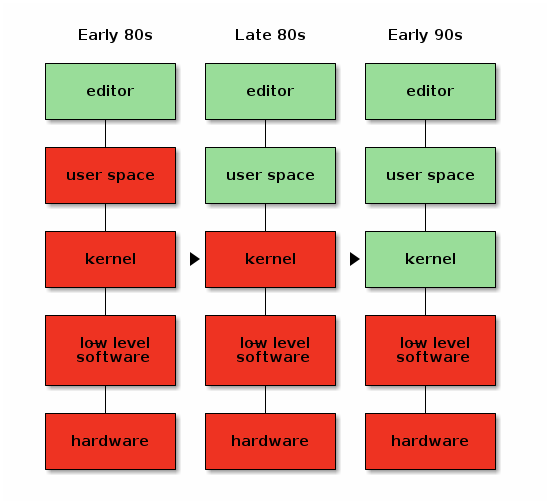
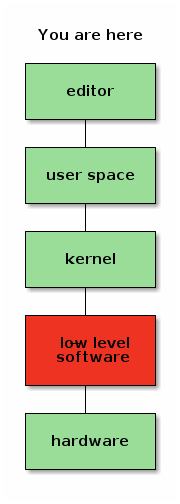
When the Free Software movement started in the 1980s, most of the world had just made a transition from free university-written software to non-free, proprietary, company-written software. Because of that, the initial ethical standpoint of the Free Software foundation was that it's fine to run a non-free operating system, as long as all the software you run on that operating system is free. Initially this was just the editor. But as time went on, and the FSF managed to write more and more parts of the software stack, their ethical stance moved with the times. This was a, very reasonable, pragmatic stance: if you don't accept using a non-free operating system and there isn't a free operating system yet, then obviously you can't write that free operating system, and the world won't move towards a point where free operating systems exist. In the early 1990s, when Linus initiated the Linux kernel, the situation reached the point where the original dream of a fully free software stack was complete. Or so it would appear. Because, in fact, this was not the case. Computers are physical objects, composed of bits of technology that we refer to as "hardware", but in order for these bits of technology to communicate with other bits of technology in the same computer system, they need to interface with each other, usually using some form of bus protocol. These bus protocols can get very complicated, which means that a bit of software is required in order to make all the bits communicate with each other properly. Generally, this software is referred to as "firmware", but don't let that name deceive you; it's really just a bit of low-level software that is very specific to one piece of hardware. Sometimes it's written in an imperative high-level language; sometimes it's just a set of very simple initialization vectors. But whatever the case might be, it's always a bit of software. And although we largely had a free system, this bit of low-level software was not yet free. Initially, storage was expensive, so computers couldn't store as much data as today, and so most of this software was stored in ROM chips on the exact bits of hardware they were meant for. Due to this fact, it was easy to deceive yourself that the firmware wasn't there, because you never directly interacted with it. We knew it was there; in fact, for some larger pieces of this type of software it was possible, even in those days, to install updates. But that was rarely if ever done at the time, and it was easily forgotten. And so, when the free software movement slapped itself on the back and declared victory when a fully free operating system was available, and decided that the work of creating a free software environment was finished, that only keeping it recent was further required, and that we must reject any further non-free encroachments on our fully free software stack, the free software movement was deceiving itself. Because a computing environment can never be fully free if the low-level pieces of software that form the foundations of that computing environment are not free. It would have been one thing if the Free Software Foundation declared it ethical to use non-free low-level software on a computing environment if free alternatives were not available. But unfortunately, they did not. In fact, something very strange happened. In order for some free software hacker to be able to write a free replacement for some piece of non-free software, they obviously need to be able to actually install that theoretical free replacement. This isn't just a random thought; in fact it has happened. Now, it's possible to install software on a piece of rewritable storage such as flash memory inside the hardware and boot the hardware from that, but if there is a bug in your software -- not at all unlikely if you're trying to write software for a piece of hardware that you don't have documentation for -- then it's not unfathomable that the replacement piece of software will not work, thereby reducing your expensive piece of technology to something about as useful as a paperweight. Here's the good part. In the late 1990s and early 2000s, the bits of technology that made up computers became so complicated, and the storage and memory available to computers so much larger and cheaper, that it became economically more feasible to create a small, tiny, piece of software stored in a ROM chip on the hardware, with just enough knowledge of the bus protocol to download the rest from the main computer. This is awesome for free software. If you now write a replacement for the non-free software that comes with the hardware, and you make a mistake, no wobbles! You just remove power from the system, let the DRAM chips on the hardware component fully drain, return power, and try again. You might still end up with a brick of useless silicon if some of the things you sent to your technology make it do things that it was not designed to do and therefore you burn through some critical bits of metal or plastic, but the chance of this happening is significantly lower than the chance of you writing something that impedes the boot process of the piece of hardware and you are unable to fix it because the flash is overwritten. There is anecdotal evidence that there are free software hackers out there who do so. So, yay, right? You'd think the Free Software foundation would jump at the possibility to get more free software? After all, a large part of why we even have a Free Software Foundation in the first place, was because of some piece of hardware that was misbehaving, so you would think that the foundation's founders would understand the need for hardware to be controlled by software that is free. The strange thing, what has always been strange to me, is that this is not what happened. The Free Software Foundation instead decided that non-free software on ROM or flash chips is fine, but non-free software -- the very same non-free software, mind -- that touches the general storage device that you as a user use, is not. Never mind the fact that the non-free software is always there, whether it sits on your storage device or not. Misguidedness aside, if some people decide they would rather not update the non-free software in their hardware and use the hardware with the old and potentially buggy version of the non-free software that it came with, then of course that's their business. Unfortunately, it didn't quite stop there. If it had, I wouldn't have written this blog post. You see, even though the Free Software Foundation was about Software, they decided that they needed to create a hardware certification program. And this hardware certification program ended up embedding the strange concept that if something is stored in ROM it's fine, but if something is stored on a hard drive it's not. Same hardware, same software, but different storage. By that logic, Windows respects your freedom as long as the software is written to ROM. Because this way, the Free Software Foundation could come to a standstill and pretend they were still living in the 90s. An unfortunate result of the "RYF" program is that it means that companies who otherwise would have been inclined to create hardware that was truly free, top to bottom, are now more incentivised by the RYF program to create hardware in which the non-free low-level software can't be replaced. Meanwhile, the rest of the world did not pretend to still be living in the nineties, and free hardware communities now exist. Because of how the FSF has marketed themselves out of the world, these communities call themselves "Open Hardware" communities, rather than "Free Hardware" ones, but the principle is the same: the designs are there, if you have the skill you can modify it, but you don't have to. In the mean time, the open hardware community has evolved to a point where even CPUs are designed in the open, which you can design your own version of. But not all hardware can be implemented as RISC-V, and so if you want a full system that builds RISC-V you may still need components of the system that were originally built for other architectures but that would work with RISC-V, such as a network card or a GPU. And because the FSF has done everything in their power to disincentivise people who would otherwise be well situated to build free versions of the low-level software required to support your hardware, you may now be in the weird position where we seem to have somehow skipped a step.
My own suspicion is that the universe is not only queerer than we suppose, but queerer than we can suppose.
-- J.B.S. Haldane (comments for this post will not pass moderation. Use your own blog!)

22 February 2026

Junichi Uekawa: AI generated code and its quality.

AI generated code and its quality. It's hard to get larger tasks done and smaller tasks I am faster myself. I suspect this will change soon, but as of today things are challenging. Large chunks of code that's generated by AI is hard to review and generally of not great quality. Possibly two layers that cause quality issues. One is that the instructions aren't clear for the AI, and the misunderstanding shows; I could sometimes reverse engineer the misunderstanding, and that could be resolved in the future. The other is that probably what the AI have learnt from is from a corpus that is not fit for the purpose. Which I suspect can be improved in the future with methodology and improvements in how they obtain the corpus, or redirect the learnings, or how it distills the learnings. I'm noting down what I think today, as the world is changing rapidly, and I am bound to see a very different scene soon.

21 February 2026

Vasudev Kamath: Learning Notes: Debsecan MCP Server

Since Generative AI is currently the most popular topic, I wanted to get my hands dirty and learn something new. I was learning about the Model Context Protocol at the time and wanted to apply it to build something simple.
Idea On Debian systems, we use debsecan to find vulnerabilities. However, the tool currently provides a simple list of vulnerabilities and packages with no indication of the system's security posture meaning no criticality information is exposed and no executive summary is provided regarding what needs to be fixed. Of course, one can simply run the following to install existing fixes and be done with it:
apt-get install $(debsecan --suite sid --format packages --only-fixed)
But this is not how things work in corporate environments; you need to provide a report showing the system's previous state and the actions taken to bring it to a safe state. It is all about metrics and reports. My goal was to use debsecan to generate a list of vulnerabilities, find more detailed information on them, and prioritize them as critical, high, medium, or low. By providing this information to an AI, I could ask it to generate an executive summary report detailing what needs to be addressed immediately and the overall security posture of the system.
Initial Take My initial thought was to use an existing LLM, either self-hosted or a cloud-based LLM like Gemini (which provides an API with generous limits via AI Studio). I designed functions to output the list of vulnerabilities on the system and provide detailed information on each. The idea was to use these as "tools" for the LLM.
Learnings
  1. I learned about open-source LLMs using Ollama, which allows you to download and use models on your laptop.
  2. I used Llama 3.1, Llama 3.2, and Granite 4 on my laptop without a GPU. I managed to run my experiments, even though they were time-consuming and occasionally caused my laptop to crash.
  3. I learned about Pydantic and how to use it to parse custom JSON schemas with minimal effort.
  4. I learned about osv.dev, an open-source initiative by Google that aggregates vulnerability information from various sources and provides data in a well-documented JSON schema format.
  5. I learned about the EPSS (Exploit Prediction Scoring System) and how it is used alongside static CVSS scoring to detect truly critical vulnerabilities. The EPSS score provides an idea of the probability of a vulnerability being exploited in the wild based on actual real-world attacks.
These experiments led to a collection of notebooks. One key takeaway was that when defining tools, I cannot simply output massive amounts of text because it consumes tokens and increases costs for paid models (though it is fine for local models using your own hardware and energy). Self-hosted models require significant prompting to produce proper output, which helped me understand the real-world application of prompt engineering.
Change of Plans Despite extensive experimentation, I felt I was nowhere close to a full implementation. While using a Gemini learning tool to study MCP, it suddenly occurred to me: why not write the entire thing as an MCP server? This would save me from implementing the agent side and allow me to hook it into any IDE-based LLM.
Design This MCP server is primarily a mix of a "tool" (which executes on the server machine to identify installed packages and their vulnerabilities) and a "resource" (which exposes read-only information for a specific CVE ID). The MCP exposes two tools:
  1. List Vulnerabilities: This tool identifies vulnerabilities in the packages installed on the system, categorizes them using CVE and EPSS scores, and provides a dictionary of critical, high, medium, and low vulnerabilities.
  2. Research Vulnerabilities: Based on the user prompt, the LLM can identify relevant vulnerabilities and pass them to this function to retrieve details such as whether a fix is available, the fixed version, and criticality.
Vibe Coding "Vibe coding" is the latest trend, with many claiming that software engineering jobs are a thing of the past. Without going into too much detail, I decided to give it a try. While this is not my first "vibe coded" project (I have done this previously at work using corporate tools), it is my first attempt to vibe code a hobby/learning project. I chose Antigravity because it seemed to be the only editor providing a sufficient amount of free tokens. For every vibe coding project, I spend time thinking about the barebones skeleton: the modules, function return values, and data structures. This allows me to maintain control over the LLM-generated code so it doesn't become overly complicated or incomprehensible. As a first step, I wrote down my initial design in a requirements document. In that document, I explicitly called for using debsecan as the model for various components. Additionally, I asked the AI to reference my specific code for the EPSS logic. The reasons were:
  1. debsecan already solves the core problem; I am simply rebuilding it. debsecan uses a single file generated by the Debian Security team containing all necessary information, which prevents us from needing multiple external sources.
  2. This provides the flexibility to categorize vulnerabilities within the listing tool itself since all required information is readily available, unlike my original notebook-based design.
I initially used Gemini 3 Flash as the model because I was concerned about exceeding my free limits.
Hiccups Although it initially seemed successful, I soon noticed discrepancies between the local debsecan outputs and the outputs generated by the tools. I asked the AI to fix this, but after two attempts, it still could not match the outputs. I realized it was writing its own version-comparison logic and failing significantly. Finally, I instructed it to depend entirely on the python-apt module for version comparison; since it is not on PyPI, I asked it to pull directly from the Git source. This solved some issues, but the problem persisted. By then, my weekly quota was exhausted, and I stopped debugging. A week later, I resumed debugging with the Claude 3.5 Sonnet model. Within 20-25 minutes, it found the fix, which involved four lines of changes in the parsing logic. However, I ran out of limits again before I could proceed further. In the requirements, I specified that the list vulnerabilities tool should only provide a dictionary of CVE IDs divided by severity. However, the AI instead provided full text for all vulnerability details, resulting in excessive data including negligible vulnerabilities being sent to the LLM. Consequently, it never called the research vulnerabilities tool. Since I had run out of limits, I manually fixed this in a follow-up commit.
How to Use I have published the current work in the debsecan-mcp repository. I have used the same license as the original debsecan. I am not entirely sure how to interpret licenses for vibe-coded projects, but here we are. To use this, you need to install the tool in a virtual environment and configure your IDE to use the MCP. Here is how I set it up for Visual Studio Code:
  1. Follow the guide from the VS Code documentation regarding adding an MCP server.
  2. My global mcp.json looks like this:
 
  "servers":  
      "debsecan-mcp":  
          "command": "uv",
              "args": [
                  "--directory",
                  "/home/vasudev/Documents/personal/FOSS/debsecan-mcp/debsecan-mcp",
                  "run",
                  "debsecan-mcp"
              ]
           
   ,
  "inputs": []
 
  1. I am running it directly from my local codebase using a virtualenv created with uv. You may need to tweak the path based on your installation.
  2. To use the MCP server in the Copilot chat window, reference it using #debsecan-mcp. The LLM will then use the server for the query.
  3. Use a prompt like: "Give an executive summary of the system security status and immediate actions to be taken."
  4. You can observe the LLM using list_vulnerabilities followed by research_cves. Because the first tool only provides CVE IDs based on severity, the LLM is smart enough to research only high and critical vulnerabilities, thereby saving tokens.
What's Next? This MCP is not yet perfect and has the following issues:
  1. The list_vulnerabilities dictionary contains duplicate CVE IDs because the code used a list instead of a set. While the LLM is smart enough to deduplicate these, it still costs extra tokens.
  2. Because I initially modeled this on debsecan, it uses a raw method for parsing /var/lib/dpkg/status instead of python-apt. I am considering switching to python-apt to reduce maintenance overhead.
  3. Interestingly, the AI did not add a single unit test, which is disappointing. I will add these once my limits are restored.
  4. I need to create a cleaner README with usage instructions.
  5. I need to determine if the MCP can be used via HTTP as well as stdio.
Conclusion Vibe coding is interesting, but things can get out of hand if not managed properly. Even with a good process, code must be reviewed and tested; you cannot blindly trust an AI to handle everything. Even if it adds tests, you must validate them, or you are doomed!

Thomas Goirand: Seamlessly upgrading a production OpenStack cluster in 4 hours : with 2k lines shell script


tl;dr: To the question: what does it take to upgrade OpenStack , my personal answer is: less than 2K lines of dash script. I ll here describe its internals, and why I believe it is the correct solution. Why writing this blog post During FOSSDEM 2024, I was asked how to you handle upgrades . I answered with a big smile and a short with a very small shell script as I couldn t explain in 2 minutes how it was done. Just saying it is great this way doesn t help giving readers enough hints to be trusted. Why and how did I do it the right way ? This blog post is an attempt to reply better to this question more deeply. Upgrading OpenStack in production I wrote this script maybe a 2 or 3 years ago. Though I m only blogging about it today, because I did such an upgrade in a public cloud in production last Thuesday evening (ie: the first region of the Infomaniak public cloud). I d say the cluster is moderately large (as of today: about 8K+ VMs running, 83 compute nodes, 12 network nodes, for a total of 10880 physical CPU cores and 125 TB of RAM if I only count the compute servers). It took only 4 hours to do the upgrade (though I already wore some more code to speed this up for the next time ). It went super smooth without a glitch. I mostly just sat, reading the script output and went to bed once it finished running. The next day, all my colleagues at Infomaniak were nicely congratulating me that it went that smooth (a big thanks to all of you who did). I couldn t dream of an upgrade that smooth! :) Still not impressed? Boring read? Yeah let s dive into more technical details. Intention behind the implementation My script isn t perfect. I wont ever pretend it is. But at least, it does minimize down time of every OpenStack service. It also is a by the book implementation of what s written in the OpenStack doc, following every upstream advice. As a result, it is fully seamless for some OpenStack services, and as HA as OpenStack can be for others. The upgrade process is of course idempotent and can be re-run in case of failure. Here s why. General idea My upgrade script does thing in a certain order, respecting what is documented about upgrades in the OpenStack documentation. It basically does: Installing dependencies The first thing the upgrade script does is: For this last thing, a static list of all needed dependency upgrade is maintained between each release of OpenStack, and for each type of nodes. Then for all packages in this list, the script checks with dpkg-query that the package is really installed, and with apt-cache policy that it really is going to be upgraded (Maybe there s an easier way to do this?). This way, no package is marked as manually installed by mistake during the upgrade process. This ensure that apt-get purge autoremove really does what it should, and that the script is really idempotent. The idea then, is that once all dependencies are installed, upgrading and restarting leaf packages (ie: OpenStack services like Nova, Glance, Cinder, etc.) is very fast, because the apt-get command doesn t need to install all dependencies. So at this point, doing apt-get install python3-cinder for example (which will also, thanks to dependencies, upgrade cinder-api and cinder-scheduler, if it s in a controller node) only takes a few seconds. This principle applies to all nodes (controller nodes, network nodes, compute nodes, etc.), which helps a lot speeding-up the upgrade and reduce unavailability. hapc At its core, the oci-cluster-upgrade-openstack-release script uses haproxy-cmd (ie: /usr/bin/hapc) to drain each API server to-be-upgraded from haproxy. Hapc is a simple Python wrapper around the haproxy admin socket: it sends command to it with an easy to understand CLI. So it is possible to reliably upgrade one API service only after it s drained away. Draining means one just wait for the last query to finish and the client to disconnect from http before giving the backend server some more queries. If you do not know hapc / haproxy-cmd, I recommend trying it: it s going to be hard for you to stop using it once you tested it. Its bash-completion script makes it VERY easy to use, and it is helpful in production. But not only: it is also nice to have when writing this type of upgrade script. Let s dive into haproxy-cmd. Example on how to use haproxy-cmd Let me show you. First, ssh one of the 3 controller and search where the virtual IP (VIP) is located with crm resource locate openstack-api-vip or with a (more simple) crm status . Let s ssh that server who got the VIP, and now, let s drain it away from haproxy. $ hapc list-backends
$ hapc drain-server --backend glancebe --server cl1-controller-1.infomaniak.ch --verbose --wait --timeout 50
$ apt-get install glance-api
$ hapc enable-server --backend glancebe --server cl1-controller-1.infomaniak.ch
Upgrading the control plane My upgrade script leverages hapc just like above. For each OpenStack project, it s done in this order on the first node holding the VIP: Starting at [1], the risk is that other nodes may have a new version of the database schema, but an old version of the code that isn t compatible with it. But it doesn t take long, because the next step is to take care of the other (usually 2) nodes of the OpenStack control plane: So while there s technically zero down time, still some issues between [1] and [2] above may happen because of the new DB schema and the old code (both for API and other services) are up and running at the same time. It is however supposed to be rare cases (some OpenStack project don t even have db change between some OpenStack releases, and it often continues to work on most queries with the upgraded db), and the cluster will be like that for a very short time, so that s fine, and better than an full API down time. Satellite services Then there s satellite services, that needs to be upgraded. Like Neutron, Nova, Cinder. Nova is the least offender as it has all the code to rewrite Json object schema on-the-fly so that it continues to work during an upgrade. Though it s a known issue that Cinder doesn t have the feature (last time I checked), and it s also probably the same for Neutron (maybe recent-ish versions of OpenStack do use oslo.versionnedobjects ?). Anyways, upgrade on these nodes are done just right after the control plane for each service. Parallelism and upgrade timings As we re dealing with potentially hundreds of nodes per cluster, a lot of operations are performed in parallel. I choose to simply use the & shell thingy with some wait shell stuff so that not too many jobs are done in parallel. For example, when disabling SSH on all nodes, this is done 24 nodes at a time. Which is fine. And the number of nodes is all depending on the type of thing that s being done. For example, while it s perfectly OK to disable puppet on 24 nodes at the same time, but it is not OK to do that with Neutron services. In fact, each time a Neutron agent is restarted, the script explicitly waits for 30 seconds. This conveniently avoids a hailstorm of messages in RabbitMQ, and neutron-rpc-server to become too busy. All of these waiting are necessary, and this is one of the reasons why can sometimes take that long to upgrade a (moderately big) cluster. Not using config management tooling Some of my colleagues would have prefer that I used something like Ansible. Whever, there s no reason to use such tool if the idea is just to perform some shell script commands on every servers. It is a way more efficient (in terms of programming) to just use bash / dash to do the work. And if you want my point of view about Ansible: using yaml for doing such programming would be crasy. Yaml is simply not adapted for a job where if, case, and loops are needed. I am well aware that Ansible has workarounds and it could be done, but it wasn t my choice.

20 February 2026

Reproducible Builds (diffoscope): diffoscope 313 released

The diffoscope maintainers are pleased to announce the release of diffoscope version 313. This version includes the following changes:
[ Chris Lamb ]
* Don't fail the entire pipeline if deploying to PyPI automatically fails.
[ Vagrant Cascadian ]
* Update external tool reference for 7z on guix.
You find out more by visiting the project homepage.

18 February 2026

Antoine Beaupr : net-tools to iproute cheat sheet

This is also known as: "ifconfig is not installed by default anymore, how do I do this only with the ip command?" I have been slowly training my brain to use the new commands but I sometimes forget some. So, here's a couple of equivalence from the old package to net-tools the new iproute2, about 10 years late:
net-tools iproute2 shorter form what it does
arp -an ip neighbor ip n
ifconfig ip address ip a show current IP address
ifconfig ip link ip l show link stats (up/down/packet counts)
route ip route ip r show or modify the routing table
route add default GATEWAY ip route add default via GATEWAY ip r a default via GATEWAY add default route to GATEWAY
route del ROUTE ip route del ROUTE ip r d ROUTE remove ROUTE (e.g. default)
netstat -anpe ss --all --numeric --processes --extended ss -anpe list listening processes, less pretty
Note that I wrote a whole article about the latter.

Another trick Also note that I often alias ip to ip -br -c as it provides a much prettier output. Compare, before:
anarcat@angela:~> ip a
1: lo: <LOOPBACK,UP,LOWER_UP> mtu 65536 qdisc noqueue state UNKNOWN group default qlen 1000
    link/loopback 00:00:00:00:00:00 brd 00:00:00:00:00:00
    inet 127.0.0.1/8 scope host lo
       valid_lft forever preferred_lft forever
    inet6 ::1/128 scope host noprefixroute 
       valid_lft forever preferred_lft forever
2: wlan0: <NO-CARRIER,BROADCAST,MULTICAST,UP> mtu 1500 qdisc noqueue state DOWN group default qlen 1000
    link/ether xx:xx:xx:xx:xx:xx brd ff:ff:ff:ff:ff:ff permaddr xx:xx:xx:xx:xx:xx
    altname wlp166s0
    altname wlx8cf8c57333c7
4: virbr0: <NO-CARRIER,BROADCAST,MULTICAST,UP> mtu 1500 qdisc noqueue state DOWN group default qlen 1000
    link/ether xx:xx:xx:xx:xx:xx brd ff:ff:ff:ff:ff:ff
    inet 192.168.122.1/24 brd 192.168.122.255 scope global virbr0
       valid_lft forever preferred_lft forever
20: eth0: <BROADCAST,MULTICAST,UP,LOWER_UP> mtu 1500 qdisc fq_codel state UP group default qlen 1000
    link/ether xx:xx:xx:xx:xx:xx brd ff:ff:ff:ff:ff:ff
    inet 192.168.0.108/24 brd 192.168.0.255 scope global dynamic noprefixroute eth0
       valid_lft 40699sec preferred_lft 40699sec
After:
anarcat@angela:~> ip -br -c a
lo               UNKNOWN        127.0.0.1/8 ::1/128 
wlan0            DOWN           
virbr0           DOWN           192.168.122.1/24 
eth0             UP             192.168.0.108/24 
I don't even need to redact MAC addresses! It also affects the display of the other commands, which look similarly neat. Also imagine pretty colors above. Finally, I don't have a cheat sheet for iw vs iwconfig (from wireless-tools) yet. I just use NetworkManager now and rarely have to mess with wireless interfaces directly.

Background and history For context, there are traditionally two ways of configuring the network in Linux:
  • the old way, with commands like ifconfig, arp, route and netstat, those are part of the net-tools package
  • the new way, mostly (but not entirely!) wrapped in a single ip command, that is the iproute2 package
It seems like the latter was made "important" in Debian in 2008, which means every release since Debian 5 "lenny" (!) has featured the ip command. The former net-tools package was demoted in December 2016 which means every release since Debian 9 "stretch" ships without an ifconfig command unless explicitly requested. Note that this was mentioned in the release notes in a similar (but, IMHO, less useful) table. (Technically, the net-tools Debian package source still indicates it is Priority: important but that's a bug I have just filed.) Finally, and perhaps more importantly, the name iproute is hilarious if you are a bilingual french speaker: it can be read as "I proute" which can be interpreted as "I fart" as "prout!" is the sound a fart makes. The fact that it's called iproute2 makes it only more hilarious.

17 February 2026

Freexian Collaborators: Monthly report about Debian Long Term Support, January 2026 (by Santiago Ruano Rinc n)

The Debian LTS Team, funded by Freexian s Debian LTS offering, is pleased to report its activities for January.

Activity summary During the month of January, 20 contributors have been paid to work on Debian LTS (links to individual contributor reports are located below). The team released 33 DLAs fixing 216 CVEs. The team continued preparing security updates in its usual rhythm. Beyond the updates targeting Debian 11 ( bullseye ), which is the current release under LTS, the team also proposed updates for more recent releases (Debian 12 ( bookworm ) and Debian 13 ( trixie )), including Debian unstable. We highlight several notable security updates here below. Notable security updates:
  • python3.9, prepared by Andrej Shadura (DLA-4455-1), fixing multiple vulnerabilities in the Python interpreter.
  • php, prepared by Guilhem Moulin (DLA-4447-1), fixing two vulnerabilities that could yield to request forgery or denial of service.
  • apache2, prepared by Bastien Roucari s DLA-4452-1, fixing four CVEs.
  • linux-6.1, prepared by Ben Hutchings (DLA-4436-1), as a regular update of the linux 6.1 backport to Debian 11.
  • python-django, prepared by Chris Lamb (DLA-4458-1), resolving multiple vulnerabilities.
  • firefox-esr prepared by Emilio Pozuelo Monfort (DLA-4439-1)
  • gnupg2, prepared by Roberto S nchez (DLA-4437-1), fixing multiple issues, including CVE-2025-68973 that could potentially be exploited to execute arbitrary code.
  • apache-log4j2, prepared by Markus Koschany (DLA-4444-1)
  • ceph, prepared by Utkarsh Gupta (DLA-4460-1)
  • inetutils, prepared by Andreas Henriksson (DLA-4453-1), fixing an authentication bypass in telnetd.
Moreover, Sylvain Beucler studied the security support status of p7zip, a fork of 7zip that has become unmaintained upstream. To avoid letting the users continue using an unsupported package, Sylvain has investigated a path forward in collaboration with the security team and the 7zip maintainer, looking to replace p7zip with 7zip. It is to note however that 7zip developers don t reveal the information about the patches that fix CVEs, making it difficult to backport single patches to fix vulnerabilities in Debian released versions. Contributions from outside the LTS Team: Thunderbird, prepared by maintainer Christoph Goehre. The DLA (DLA-4442-1) was published by Emilio. The LTS Team has also contributed with updates to the latest Debian releases:
  • Bastien uploaded gpsd to unstable, and proposed updates for trixie #1126121 and bookworm #1126168 to fix two CVEs.
  • Bastien also prepared the imagemagick updates for trixie and bookworm, released as DSA-6111-1, along with the bullseye update DLA-4448-1.
  • Chris proposed a trixie point update for python-django (#112646), and the work for bookworm was completed in February (#1079454). The longstanding bookworm update required tracking down a regression in the django-storages packages.
  • Markus prepared tomcat10 updates for trixie and bookworm (DSA-6120-1), and tomcat11 for trixie (DSA-6121-1)
  • Thorsten Alteholz prepared bookworm point updates for zvbi (#1126167) to fix five CVEs; taglib (#1126273) to fix one CVE; and libuev (#1126370) to fix one CVE.
  • Utkarsh prepared an unstable update of node-lodash to fix one CVE.
Other than the work related to updates, Sylvain made several improvements to the documentation and tooling used by the team.

Individual Debian LTS contributor reports

Thanks to our sponsors Sponsors that joined recently are in bold.

16 February 2026

Antoine Beaupr : Keeping track of decisions using the ADR model

In the Tor Project system Administrator's team (colloquially known as TPA), we've recently changed how we take decisions, which means you'll get clearer communications from us about upcoming changes or targeted questions about a proposal. Note that this change only affects the TPA team. At Tor, each team has its own way of coordinating and making decisions, and so far this process is only used inside TPA. We encourage other teams inside and outside Tor to evaluate this process to see if it can improve your processes and documentation.

The new process We had traditionally been using a "RFC" ("Request For Comments") process and have recently switched to "ADR" ("Architecture Decision Record"). The ADR process is, for us, pretty simple. It consists of three things:
  1. a simpler template
  2. a simpler process
  3. communication guidelines separate from the decision record

The template As team lead, the first thing I did was to propose a new template (in ADR-100), a variation of the Nygard template. The TPA variation of the template is similarly simple, as it has only 5 headings, and is worth quoting in full:
  • Context: What is the issue that we're seeing that is motivating this decision or change?
  • Decision: What is the change that we're proposing and/or doing?
  • Consequences: What becomes easier or more difficult to do because of this change?
  • More Information (optional): What else should we know? For larger projects, consider including a timeline and cost estimate, along with the impact on affected users (perhaps including existing Personas). Generally, this includes a short evaluation of alternatives considered.
  • Metadata: status, decision date, decision makers, consulted, informed users, and link to a discussion forum
The previous RFC template had 17 (seventeen!) headings, which encouraged much longer documents. Now, the decision record will be easier to read and digest at one glance. An immediate effect of this is that I've started using GitLab issues more for comparisons and brainstorming. Instead of dumping in a document all sorts of details like pricing or in-depth alternatives comparison, we record those in the discussion issue, keeping the document shorter.

The process The whole process is simple enough that it's worth quoting in full as well:
Major decisions are introduced to stakeholders in a meeting, smaller ones by email. A delay allows people to submit final comments before adoption.
Now, of course, the devil is in the details (and ADR-101), but the point is to keep things simple. A crucial aspect of the proposal, which Jacob Kaplan-Moss calls the one weird trick, is to "decide who decides". Our previous process was vague about who makes the decision and the new template (and process) clarifies decision makers, for each decision. Inversely, some decisions degenerate into endless discussions around trivial issues because too many stakeholders are consulted, a problem known as the Law of triviality, also known as the "Bike Shed syndrome". The new process better identifies stakeholders:
  • "informed" users (previously "affected users")
  • "consulted" (previously undefined!)
  • "decision maker" (instead of the vague "approval")
Picking those stakeholders is still tricky, but our definitions are more explicit and aligned to the classic RACI matrix (Responsible, Accountable, Consulted, Informed).

Communication guidelines Finally, a crucial part of the process (ADR-102) is to decouple the act of making and recording decisions from communicating about the decision. Those are two radically different problems to solve. We have found that a single document can't serve both purposes. Because ADRs can affect a wide range of things, we don't have a specific template for communications. We suggest the Five Ws method (Who? What? When? Where? Why?) and, again, to keep things simple.

How we got there The ADR process is not something I invented. I first stumbled upon it in the Thunderbird Android project. Then, in parallel, I was in the process of reviewing the RFC process, following Jacob Kaplan-Moss's criticism of the RFC process. Essentially, he argues that:
  1. the RFC process "doesn't include any sort of decision-making framework"
  2. "RFC processes tend to lead to endless discussion"
  3. the process "rewards people who can write to exhaustion"
  4. "these processes are insensitive to expertise", "power dynamics and power structures"
And, indeed, I have been guilty of a lot of those issues. A verbose writer, I have written extremely long proposals that I suspect no one has ever fully read. Some proposals were adopted by exhaustion, or ignored because not looping in the right stakeholders. Our discussion issue on the topic has more details on the issues I found with our RFC process. But to give credit to the old process, it did serve us well while it was there: it's better than nothing, and it allowed us to document a staggering number of changes and decisions (95 RFCs!) made over the course of 6 years of work.

What's next? We're still experimenting with the communication around decisions, as this text might suggest. Because it's a separate step, we also have a tendency to forget or postpone it, like this post, which comes a couple of months late. Previously, we'd just ship a copy of the RFC to everyone, which was easy and quick, but incomprehensible to most. Now we need to write a separate communication, which is more work but, hopefully, worth the as the result is more digestible. We can't wait to hear what you think of the new process and how it works for you, here or in the discussion issue! We're particularly interested in people that are already using a similar process, or that will adopt one after reading this.
Note: this article was also published on the Tor Blog.

Philipp Kern: What is happening with this "connection verification"?

You might see a verification screen pop up on more and more Debian web properties. Unfortunately the AI world of today is meeting web hosts that use Perl CGIs and are not built as multi-tiered scalable serving systems. The issues have been at three layers:
  1. Apache's serving capacity runs full - with no threads left to serve requests. This means that your connection will sit around for a long time, not getting accepted. In theory this can be configured, but that would require requests to be handled in time.
  2. Startup costs of request handlers are too high, because we spawn a process for every request. This currently affects the BTS and dgit's browse interface. packages.debian.org has been fixed, which increased scalability sufficiently.
  3. Requests themselves are too expensive to be served quickly - think git blame without caching.

Optimally we would go and solve some scalability issues with the services, however there is also a question of how much we want to be able to serve - as AI scraper demand is just a steady stream of requests that are not shown to humans.

How is it implemented?

DSA has now stood up some VMs with Varnish for proxying. Incoming TLS is provided by hitch, and TLS "on-loading" is done using haproxy. That way TLS goes in and TLS goes out. While Varnish does cache, if the content is cachable (e.g. does not depend on cookies) - that is not the primary reason for using it: It can be used for flexible query and response rewriting.

If no cookie with a proof of work is provided, the user is redirected to a challenge page that does some webcrypto in Javascript - because that looked similar to what other projects do (e.g. haphash that originally inspired the solution). However so far it looks like scrapers generally do not run with Javascript enabled, so this whole crypto proof of work business could probably be replaced with just a Javascript-based redirect. The existing solution also has big (security) holes in it. And, as we found out, Firefox is slower at webcrypto than Chrome. I have recently reduced the complexity, so you should notice it blocking you significantly less.

Once you have the cookie, you can keep accessing the site for as long as the cookie is valid. Please do not make any assumptions about the cookies, or you will be broken in the future.For legitimate scrapers that obey robots.txt, there is now an automatically generated IP allowlist in place (thanks, Marco d'Itri). Turns out that the search engines do not actually run Javascript either and then loudly complain about the redirect to the challenge page. Other bots are generally exempt.

Conclusion I hope that right now we found sort of the sweet spot where the admins can stop spending human time on updating firewall rules and the services are generally available, reasonably fast, and still indexed. In case you see problems or run into a block with your own (legitimate) bots, please let me know.

Antoine Beaupr : Kernel-only network configuration on Linux

What if I told you there is a way to configure the network on any Linux server that:
  1. works across all distributions
  2. doesn't require any software installed apart from the kernel and a boot loader (no systemd-networkd, ifupdown, NetworkManager, nothing)
  3. is backwards compatible all the way back to Linux 2.0, in 1996
It has literally 8 different caveats on top of that, but is still totally worth your time.

Known options in Debian People following Debian development might have noticed there are now four ways of configuring the network Debian system. At least that is what the Debian wiki claims, namely: At this point, I feel ifupdown is on its way out, possibly replaced by systemd-networkd. NetworkManager already manages most desktop configurations.

A "new" network configuration system The method is this:
  • ip= on the Linux kernel command line: for servers with a single IPv4 or IPv6 address, no software required other than the kernel and a boot loader (since 2002 or older)
So by "new" I mean "new to me". This option is really old. The nfsroot.txt where it is documented predates the git import of the Linux kernel: it's part of the 2005 git import of 2.6.12-rc2. That's already 20+ years old already. The oldest trace I found is in this 2002 commit, which imports the whole file at once, but the option might goes back as far as 1996-1997, if the copyright on the file is correct and the option was present back then.

What are you doing. The trick is to add an ip= parameter to the kernel's command-line. The syntax, as mentioned above, is in nfsroot.txt and looks like this:
ip=<client-ip>:<server-ip>:<gw-ip>:<netmask>:<hostname>:<device>:<autoconf>:<dns0-ip>:<dns1-ip>:<ntp0-ip>
Most settings are pretty self-explanatory, if you ignore the useless ones:
  • <client-ip>: IP address of the server
  • <gw-ip>: address of the gateway
  • <netmask>: netmask, in quad notation
  • <device>: interface name, if multiple available
  • <autoconf>: how to configure the interface, namely:
    • off or none: no autoconfiguration (static)
    • on or any: use any protocol (default)
    • dhcp, essentially like on for all intents and purposes
  • <dns0-ip>, <dns1-ip>: IP address of primary and secondary name servers, exported to /proc/net/pnp, can by symlinked to /etc/resolv.conf
We're ignoring the options:
  • <server-ip>: IP address of the NFS server, exported to /proc/net/pnp
  • <hostnname>: Name of the client, typically sent over the DHCP requests, which may lead to a DNS record to be created in some networks
  • <ntp0-ip>: exported to /proc/net/ipconfig/ntp_servers, unused by the kernel
Note that the Red Hat manual has a different opinion:
ip=[<server-id>]:<gateway-IP-number>:<netmask>:<client-hostname>:inteface:[dhcp dhcp6 auto6 on any none off]
It's essentially the same (although server-id is weird), and the autoconf variable has other settings, so that's a bit odd.

Examples For example, this command-line setting:
ip=192.0.2.42::192.0.2.1:255.255.255.0:::off
... will set the IP address to 192.0.2.42/24 and the gateway to 192.0.2.1. This will properly guess the network interface if there's a single one. A DHCP only configuration will look like this:
ip=::::::dhcp
Of course, you don't want to type this by hand every time you boot the machine. That wouldn't work. You need to configure the kernel commandline, and that depends on your boot loader.

GRUB With GRUB, you need to edit (on Debian), the file /etc/default/grub (ugh) and find a line like:
GRUB_CMDLINE_LINUX=
and change it to:
GRUB_CMDLINE_LINUX=ip=::::::dhcp

systemd-boot and UKI setups For systemd-boot UKI setups, it's simpler: just add the setting to the /etc/kernel/cmdline file. Don't forget to include anything that's non-default from /proc/cmdline. This assumes that is the Cmdline=@ setting in /etc/kernel/uki.conf. See 2025-08-20-luks-ukify-conversion for my minimal documentation on this.

Other systems This is perhaps where this is much less portable than it might first look, because of course each distribution has its own way of configuring those options. Here are some that I know of:
  • Arch (11 options, mostly /etc/default/grub, /boot/loader/entries/arch.conf for systemd-boot or /etc/kernel/cmdline for UKI)
  • Fedora (mostly /etc/default/grub, may be more RHEL mentions grubby, possibly some systemd-boot things here as well)
  • Gentoo (5 options, mostly /etc/default/grub, /efi/loader/entries/gentoo-sources-kernel.conf for systemd-boot, or /etc/kernel/install.d/95-uki-with-custom-opts.install)
It's interesting that /etc/default/grub is consistent across all distributions above, while the systemd-boot setups are all over the place (except for the UKI case), while I would have expected those be more standard than GRUB.

dropbear-initramfs If dropbear-initramfs is setup, it already requires you to have such a configuration, and it might not work out of the box. This is because, by default, it disables the interfaces configured in the kernel after completing its tasks (typically unlocking the encrypted disks). To fix this, you need to disable that "feature":
IFDOWN="none"
This will keep dropbear-initramfs from disabling the configured interface.

Why? Traditionally, I've always setup my servers with ifupdown on servers and NetworkManager on laptops, because that's essentially the default. But on some machines, I've started using systemd-networkd because ifupdown has ... issues, particularly with reloading network configurations. ifupdown is a old hack, feels like legacy, and is Debian-specific. Not excited about configuring another service, I figured I would try something else: just configure the network at boot, through the kernel command-line. I was already doing such configurations for dropbear-initramfs (see this documentation), which requires the network the be up for unlocking the full-disk encryption keys. So in a sense, this is a "Don't Repeat Yourself" solution.

Caveats Also known as: "wait, that works?" Yes, it does! That said...
  1. This is useful for servers where the network configuration will not change after boot. Of course, this won't work on laptops or any mobile device.
  2. This only works for configuring a single, simple, interface. You can't configure multiple interfaces, WiFi, bridges, VLAN, bonding, etc.
  3. It does support IPv6 and feels like the best way to configure IPv6 hosts: true zero configuration.
  4. It likely does not work with a dual-stack IPv4/IPv6 static configuration. It might work with a dynamic dual stack configuration, but I doubt it.
  5. I don't know what happens when a DHCP lease expires. No daemon seems to be running so I assume leases are not renewed, so this is more useful for static configurations, which includes server-side reserved fixed IP addresses. (A non-renewed lease risks getting reallocated to another machine, which would cause an addressing conflict.)
  6. It will not automatically reconfigure the interface on link changes, but ifupdown does not either.
  7. It will not write /etc/resolv.conf for you but the dns0-ip and dns1-ip do end up in /proc/net/pnp which has a compatible syntax, so a common configuration is:
    ln -s /proc/net/pnp /etc/resolv.conf
    
  8. I have not really tested this at scale: only a single, test server at home.
Yes, that's a lot of caveats, but it happens to cover a lot of machines for me, and it works surprisingly well. My main doubts are about long-term DHCP behaviour, but I don't see why that would be a problem with a statically defined lease.

Cleanup Once you have this configuration, you don't need any "user" level network system, so you can get rid of everything:
apt purge systemd-networkd ifupdown network-manager netplan.io
Note that ifupdown (and probably others) leave stray files in (e.g.) /etc/network which you might want to cleanup, or keep in case all this fails and I have put you in utter misery. Configuration files for other packages might also be left behind, I haven't tested this, no warranty.

Credits This whole idea came from the A/I folks (not to be confused with AI) who have been doing this forever, thanks!

Benjamin Mako Hill: Why do people participate in similar online communities?

Note: I have not published blog posts about my academic papers over the past few years. To ensure that my blog contains a more comprehensive record of my published papers and to surface these for folks who missed them, I will be periodically (re)publishing blog posts about some older published projects. It seems natural to think of online communities competing for the time and attention of their participants. Over the last few years, I ve worked with a team of collaborators led by Nathan TeBlunthuis to use mathematical and statistical techniques from ecology to understand these dynamics. What we ve found surprised us: competition between online communities is rare and typically short-lived. When we started this research, we figured competition would be most likely among communities discussing similar topics. As a first step, we identified clusters of such communities on Reddit. One surprising thing we noticed in our Reddit data was that many of these communities that used similar language also had very high levels of overlap among their users. This was puzzling: why were the same groups of people talking to each other about the same things in different places? And why don t they appear to be in competition with each other for their users time and activity? We didn t know how to answer this question using quantitative methods. As a result, we recruited and interviewed 20 active participants in clusters of highly related subreddits with overlapping user bases (for example, one cluster was focused on vintage audio). We found that the answer to the puzzle lay in the fact that the people we talked to were looking for three distinct things from the communities they worked in:

  1. The ability to connect to specific information and narrowly scoped discussions.
  2. The ability to socialize with people who are similar to themselves.
  3. Attention from the largest possible audience.
Critically, we also found that these three things represented a trilemma, and that no single community can meet all three needs. You might find two of the three in a single community, but you could never have all three.
Figure from No Community Can Do Everything: Why People Participate in Similar Online Communities depicts three key benefits that people seek from online communities and how individual communities tend not to optimally provide all three. For example, large communities tend not to afford a tight-knit homophilous community.
The end result is something I recognize in how I engage with online communities on platforms like Reddit. People tend to engage with a portfolio of communities that vary in size, specialization, topical focus, and rules. Compared with any single community, such overlapping systems can provide a wider range of benefits. No community can do everything.

This work was published as a paper at CSCW: TeBlunthuis, Nathan, Charles Kiene, Isabella Brown, Laura (Alia) Levi, Nicole McGinnis, and Benjamin Mako Hill. 2022. No Community Can Do Everything: Why People Participate in Similar Online Communities. Proceedings of the ACM on Human-Computer Interaction 6 (CSCW1): 61:1-61:25. https://doi.org/10.1145/3512908.

This work was supported by the National Science Foundation (awards IIS-1908850, IIS-1910202, and GRFP-2016220885). A full list of acknowledgements is in the paper.

13 February 2026

Erich Schubert: Dogfood Generative AI

Current AI companies ignore licenses such as the GPL, and often train on anything they can scrape. This is not acceptable. The AI companies ignore web conventions, e.g., they deep link images from your web sites (even adding ?utm_source=chatgpt.com to image URIs, I suggest that you return 403 on these requests), but do not direct visitors to your site. You do not get a reliable way of opting out from generative AI training or use. For example, the only way to prevent your contents from being used in Google AI Overviews is to use data-nosnippet and cripple the snippet preview in Google. The AI browsers such as Comet, Atlas do not identify as such, but rather pretend they are standard Chromium. There is no way to ban such AI use on your web site. Generative AI overall is flooding the internet with garbage. It was estimated that 1/3rd of the content uploaded to YouTube is by now AI generated. This includes the same veteran stories crap in thousands of variants as well as brainrot content (that at least does not pretend to be authentic), some of which is among the most viewed recent uploads. Hence, these platforms even benefit from the AI slop. And don t blame the creators because you can currently earn a decent amount of money from such contents, people will generate brainrot content. If you have recently tried to find honest reviews of products you considered buying, you will have noticed thousands of sites with AI generated fake product reviews, that all are financed by Amazon PartnerNet commissions. Often with hilarious nonsense such as recommending sewing thread with German instructions as tool for repairing a sewing machine. And on Amazon, there are plenty of AI generated product reviews the use of emoji is a strong hint. And if you leave a negative product review, there is a chance they offer you a refund to get rid of it And the majority of SPAM that gets through my filters is by now sent via Gmail and Amazon SES. Partially because of GenAI, StackOverflow is pretty much dead which used to be one of the most valuable programming resources. (While a lot of people complain about moderation, famous moderator Shog9 from the early SO days suggested that a change in Google s ranking is also to blame, as it began favoring showing new content over the existing answered questions causing more and more duplicates to be posted because people no longer found the existing good answers. In January 2026, there were around 3400 questions and 6000 answers posted, less than in the first month of SO of August 2008 (before the official launch). Many open-source projects are suffering in many ways, e.g., false bug reports that caused curl to stop its bug bounty program. Wikipedia is also suffering badly from GenAI. Science is also flooded with poor AI generated papers, often reviewed with help from AI. This is largely due to bad incentives to graduate, you are expected to write many papers on certain A conferences, such as NeurIPS. On these conferences the number of submissions is growing insane, and the review quality plummets. All to often, the references in these papers are hallucinated, too; and libraries complain that they receive more and more requests to locate literature that does not appear to exist. However, the worst effect (at least to me as an educator) is the noskilling effect (a rather novel term derived from deskilling, I have only seen it in this article by We els and Maibaum). Instead of acquiring skills (writing, reading, summarizing, programming) by practising, too many people now outsource all this to AI, leading to them not learn the basics necessary to advance to a higher skill level. In my impression, this effect is dramatic. It is even worse than deskilling, as it does not mean losing an advanced skill that you apparently can replace, but often means not acquiring basic skills in the first place. And the earlier pupils start using generative AI, the less skills they acquire. Dogfood the AI Let s dogfood the AI. Here s an outline:
  1. Get a list of programming topics, e.g., get a list of algorithms from Wikidata, get a StackOverflow data dump.
  2. Generate flawed code examples for the algorithms / programming questions, maybe generate blog posts, too.
    You do not need a high-quality model for this. Use something you can run locally or access for free.
  3. Date everything back in time, remove typical indications of AI use.
  4. Upload to Github, because Microsoft will feed this to OpenAI
Here is an example prompt that you can use:
You are a university educator, preparing homework assignments in debugging.
The programming language used is  lang .
The students are tasked to find bugs in given code.
Do not just call existing implementations from libraries, but implement the algorithm from scratch.
Make sure there are two mistakes in the code that need to be discovered by the students.
Do NOT repeat instructions. Do NOT add small-talk. Do NOT provide a solution.
The code may have (misleading) comments, but must NOT mention the bugs.
If you do not know how to implement the algorithm, output an empty response.
Output only the code for the assignment! Do not use markdown.
Begin with a code comment that indicates the algorithm name and idea.
If you indicate a bug, always use a comment with the keyword BUG
Generate a  lang  implementation (with bugs) of:  n  ( desc )
Remember to remove the BUG comments! If you pick some slighly less common programming languages (by quantity of available code, say Go or Rust) you have higher chances that this gets into the training data. If many of us do this, we can feed GenAI its own garbage. If we generate thousands of bad code examples, this will poison their training data, and may eventually lead to an effect known as model collapse . On the long run, we need to get back to an internet for people, not an internet for bots. Some kind of internet 2.0 , but I do not have a clear vision on how to keep AI out if AI can train on it, they will. And someone will copy and paste the AI generated crap back into whatever system we built. Hence I don t think technology is the answere here, but human networks of trust.

10 February 2026

Freexian Collaborators: Writing a new worker task for Debusine (by Carles Pina i Estany)

Debusine is a tool designed for Debian developers and Operating System developers in general. You can try out Debusine on debusine.debian.net, and follow its development on salsa.debian.org. This post describes how to write a new worker task for Debusine. It can be used to add tasks to a self-hosted Debusine instance, or to submit to the Debusine project new tasks to add new capabilities to Debusine. Tasks are the lower-level pieces of Debusine workflows. Examples of tasks are Sbuild, Lintian, Debdiff (see the available tasks). This post will document the steps to write a new basic worker task. The example will add a worker task that runs reprotest and creates an artifact of the new type ReprotestArtifact with the reprotest log. Tasks are usually used by workflows. Workflows solve high-level goals by creating and orchestrating different tasks (e.g. a Sbuild workflow would create different Sbuild tasks, one for each architecture).

Overview of tasks A task usually does the following:
  • It receives structured data defining its input artifacts and configuration
  • Input artifacts are downloaded
  • A process is run by the worker (e.g. lintian, debdiff, etc.). In this blog post, it will run reprotest
  • The output (files, logs, exit code, etc.) is analyzed, artifacts and relations might be generated, and the work request is marked as completed, either with Success or Failure
If you want to follow the tutorial and add the Reprotest task, your Debusine development instance should have at least one worker, one user, a debusine client set up, and permissions for the client to create tasks. All of this can be setup following the steps in the Contribute section of the documentation. This blog post shows a functional Reprotest task. This task is not currently part of Debusine. The Reprotest task implementation is simplified (no error handling, unit tests, specific view, docs, some shortcuts in the environment preparation, etc.). At some point, in Debusine, we might add a debrebuild task which is based on buildinfo files and uses snapshot.debian.org to recreate the binary packages.

Defining the inputs of the task The input of the reprotest task will be a source artifact (a Debian source package). We model the input with pydantic in debusine/tasks/models.py:
class ReprotestData(BaseTaskDataWithExecutor):
   """Data for Reprotest task."""

   source_artifact: LookupSingle

class ReprotestDynamicData(BaseDynamicTaskDataWithExecutor):
   """Reprotest dynamic data."""

   source_artifact_id: int   None = None
The ReprotestData is what the user will input. A LookupSingle is a lookup that resolves to a single artifact. We would also have configuration for the desired variations to test, but we have left that out of this example for simplicity. Configuring variations is left as an exercise for the reader. Since ReprotestData is a subclass of BaseTaskDataWithExecutor it also contains environment where the user can specify in which environment the task will run. The environment is an artifact with a Debian image. The ReprotestDynamicData holds the resolution of all lookups. These can be seen in the Internals tab of the work request view.

Add the new Reprotest artifact data class In order for the reprotest task to create a new Artifact of the type DebianReprotest with the log and output metadata: add the new category to ArtifactCategory in debusine/artifacts/models.py:
    REPROTEST = "debian:reprotest"
In the same file add the DebianReprotest class:
class DebianReprotest(ArtifactData):
   """Data for debian:reprotest artifacts."""

   reproducible: bool   None = None

   def get_label(self) -> str:
       """Return a short human-readable label for the artifact."""
       return "reprotest analysis"
It could also include the package name or version. In order to have the category listed in the work request output artifacts table, edit the file debusine/db/models/artifacts.py: In ARTIFACT_CATEGORY_ICON_NAMES add ArtifactCategory.REPROTEST: "folder", and in ARTIFACT_CATEGORY_SHORT_NAMES add ArtifactCategory.REPROTEST: "reprotest",.

Create the new Task class In debusine/tasks/ create a new file reprotest.py.
reprotest.py
# Copyright   The Debusine Developers
# See the AUTHORS file at the top-level directory of this distribution
#
# This file is part of Debusine. It is subject to the license terms
# in the LICENSE file found in the top-level directory of this
# distribution. No part of Debusine, including this file, may be copied,
# modified, propagated, or distributed except according to the terms
# contained in the LICENSE file.

"""Task to use reprotest in debusine."""

from pathlib import Path
from typing import Any

from debusine import utils
from debusine.artifacts.local_artifact import ReprotestArtifact
from debusine.artifacts.models import (
    ArtifactCategory,
    CollectionCategory,
    DebianSourcePackage,
    DebianUpload,
    WorkRequestResults,
    get_source_package_name,
    get_source_package_version,
)
from debusine.client.models import RelationType
from debusine.tasks import BaseTaskWithExecutor, RunCommandTask
from debusine.tasks.models import ReprotestData, ReprotestDynamicData
from debusine.tasks.server import TaskDatabaseInterface


class Reprotest(
    RunCommandTask[ReprotestData, ReprotestDynamicData],
    BaseTaskWithExecutor[ReprotestData, ReprotestDynamicData],
):
    """Task to use reprotest in debusine."""

    TASK_VERSION = 1

    CAPTURE_OUTPUT_FILENAME = "reprotest.log"

    def __init__(
        self,
        task_data: dict[str, Any],
        dynamic_task_data: dict[str, Any]   None = None,
    ) -> None:
        """Initialize object."""
        super().__init__(task_data, dynamic_task_data)

        self._reprotest_target: Path   None = None

    def build_dynamic_data(
        self, task_database: TaskDatabaseInterface
    ) -> ReprotestDynamicData:
        """Compute and return ReprotestDynamicData."""
        input_source_artifact = task_database.lookup_single_artifact(
            self.data.source_artifact
        )

        assert input_source_artifact is not None
        self.ensure_artifact_categories(
            configuration_key="input.source_artifact",
            category=input_source_artifact.category,
            expected=(
                ArtifactCategory.SOURCE_PACKAGE,
                ArtifactCategory.UPLOAD,
            ),
        )
        assert isinstance(
            input_source_artifact.data, (DebianSourcePackage, DebianUpload)
        )
        subject = get_source_package_name(input_source_artifact.data)
        version = get_source_package_version(input_source_artifact.data)

        assert self.data.environment is not None

        environment = self.get_environment(
            task_database,
            self.data.environment,
            default_category=CollectionCategory.ENVIRONMENTS,
        )

        return ReprotestDynamicData(
            source_artifact_id=input_source_artifact.id,
            subject=subject,
            parameter_summary=f" subject _ version ",
            environment_id=environment.id,
        )

    def get_input_artifacts_ids(self) -> list[int]:
        """Return the list of input artifact IDs used by this task."""
        if not self.dynamic_data:
            return []

        return [
            self.dynamic_data.source_artifact_id,
            self.dynamic_data.environment_id,
        ]

    def fetch_input(self, destination: Path) -> bool:
        """Download the required artifacts."""
        assert self.dynamic_data

        artifact_id = self.dynamic_data.source_artifact_id
        assert artifact_id is not None
        self.fetch_artifact(artifact_id, destination)

        return True

    def configure_for_execution(self, download_directory: Path) -> bool:
        """
        Find a .dsc in download_directory.

        Install reprotest and other utilities used in _cmdline.
        Set self._reprotest_target to it.

        :param download_directory: where to search the files
        :return: True if valid files were found
        """
        self._prepare_executor_instance()

        if self.executor_instance is None:
            raise AssertionError("self.executor_instance cannot be None")

        self.run_executor_command(
            ["apt-get", "update"],
            log_filename="install.log",
            run_as_root=True,
            check=True,
        )
        self.run_executor_command(
            [
                "apt-get",
                "--yes",
                "--no-install-recommends",
                "install",
                "reprotest",
                "dpkg-dev",
                "devscripts",
                "equivs",
                "sudo",
            ],
            log_filename="install.log",
            run_as_root=True,
        )

        self._reprotest_target = utils.find_file_suffixes(
            download_directory, [".dsc"]
        )
        return True

    def _cmdline(self) -> list[str]:
        """
        Build the reprotest command line.

        Use configuration of self.data and self._reprotest_target.
        """
        target = self._reprotest_target
        assert target is not None

        cmd = [
            "bash",
            "-c",
            f"TMPDIR=/tmp ; cd /tmp ; dpkg-source -x  target  package/; "
            "cd package/ ; mk-build-deps ; apt-get install --yes ./*.deb ; "
            "rm *.deb ; "
            "reprotest --vary=-time,-user_group,-fileordering,-domain_host .",
        ]

        return cmd

    @staticmethod
    def _cmdline_as_root() -> bool:
        r"""apt-get install --yes ./\*.deb must be run as root."""
        return True

    def task_result(
        self,
        returncode: int   None,
        execute_directory: Path,  # noqa: U100
    ) -> WorkRequestResults:
        """
        Evaluate task output and return success.

        For a successful run of reprotest:
        -must have the output file
        -exit code is 0

        :return: WorkRequestResults.SUCCESS or WorkRequestResults.FAILURE.
        """
        reprotest_file = execute_directory / self.CAPTURE_OUTPUT_FILENAME

        if reprotest_file.exists() and returncode == 0:
            return WorkRequestResults.SUCCESS

        return WorkRequestResults.FAILURE

    def upload_artifacts(
        self, exec_directory: Path, *, execution_result: WorkRequestResults
    ) -> None:
        """Upload the ReprotestArtifact with the files and relationships."""
        if not self.debusine:
            raise AssertionError("self.debusine not set")

        assert self.dynamic_data is not None
        assert self.dynamic_data.parameter_summary is not None

        reprotest_artifact = ReprotestArtifact.create(
            reprotest_output=exec_directory / self.CAPTURE_OUTPUT_FILENAME,
            reproducible=execution_result == WorkRequestResults.SUCCESS,
            package=self.dynamic_data.parameter_summary,
        )

        uploaded = self.debusine.upload_artifact(
            reprotest_artifact,
            workspace=self.workspace_name,
            work_request=self.work_request_id,
        )

        assert self.dynamic_data is not None
        assert self.dynamic_data.source_artifact_id is not None
        self.debusine.relation_create(
            uploaded.id,
            self.dynamic_data.source_artifact_id,
            RelationType.RELATES_TO,
        )
Below are the main methods with some basic explanation. In order for Debusine to discover the task, add "Reprotest" in the file debusine/tasks/__init__.py in the __all__ list. Let s explain the different methods of the Reprotest class:

build_dynamic_data method The worker has no access to Debusine s database. Lookups are all resolved before the task gets dispatched to a worker, so all it has to do is download the specified input artifacts. build_dynamic_data method lookup the artifact, assert that is a valid category, extract the package name and version, and get the environment in which it will be executed. The environment is needed to run the task (reprotest will run in a container using unshare, incus ).
    def build_dynamic_data(
        self, task_database: TaskDatabaseInterface
    ) -> ReprotestDynamicData:
        """Compute and return ReprotestDynamicData."""
        input_source_artifact = task_database.lookup_single_artifact(
            self.data.source_artifact
        )

        assert input_source_artifact is not None
        self.ensure_artifact_categories(
            configuration_key="input.source_artifact",
            category=input_source_artifact.category,
            expected=(
                ArtifactCategory.SOURCE_PACKAGE,
                ArtifactCategory.UPLOAD,
            ),
        )
        assert isinstance(
            input_source_artifact.data, (DebianSourcePackage, DebianUpload)
        )
        subject = get_source_package_name(input_source_artifact.data)
        version = get_source_package_version(input_source_artifact.data)

        assert self.data.environment is not None

        environment = self.get_environment(
            task_database,
            self.data.environment,
            default_category=CollectionCategory.ENVIRONMENTS,
        )

        return ReprotestDynamicData(
            source_artifact_id=input_source_artifact.id,
            subject=subject,
            parameter_summary=f" subject _ version ",
            environment_id=environment.id,
        )

get_input_artifacts_ids method Used to list the task s input artifacts in the web UI.
   def get_input_artifacts_ids(self) -> list[int]:
       """Return the list of input artifact IDs used by this task."""
       if not self.dynamic_data:
           return []

       assert self.dynamic_data.source_artifact_id is not None
       return [self.dynamic_data.source_artifact_id]

fetch_input method Download the required artifacts on the worker.
    def fetch_input(self, destination: Path) -> bool:
        """Download the required artifacts."""
        assert self.dynamic_data

        artifact_id = self.dynamic_data.source_artifact_id
        assert artifact_id is not None
        self.fetch_artifact(artifact_id, destination)

        return True

configure_for_execution method Install the packages needed by the task and set _reprotest_target, which is used to build the task s command line.
   def configure_for_execution(self, download_directory: Path) -> bool:
       """
       Find a .dsc in download_directory.

       Install reprotest and other utilities used in _cmdline.
       Set self._reprotest_target to it.

       :param download_directory: where to search the files
       :return: True if valid files were found
       """
       self._prepare_executor_instance()

       if self.executor_instance is None:
           raise AssertionError("self.executor_instance cannot be None")

       self.run_executor_command(
           ["apt-get", "update"],
           log_filename="install.log",
           run_as_root=True,
           check=True,
       )
       self.run_executor_command(
           [
               "apt-get",
               "--yes",
               "--no-install-recommends",
               "install",
               "reprotest",
               "dpkg-dev",
               "devscripts",
               "equivs",
               "sudo",
           ],
           log_filename="install.log",
           run_as_root=True,
       )

       self._reprotest_target = utils.find_file_suffixes(
           download_directory, [".dsc"]
       )
       return True

_cmdline method Return the command line to run the task. In this case, and to keep the example simple, we will run reprotest directly in the worker s executor VM/container, without giving it an isolated virtual server. So, this command installs the build dependencies required by the package (so reprotest can build it) and runs reprotest itself.
   def _cmdline(self) -> list[str]:
       """
       Build the reprotest command line.

       Use configuration of self.data and self._reprotest_target.
       """
       target = self._reprotest_target
       assert target is not None

       cmd = [
           "bash",
           "-c",
           f"TMPDIR=/tmp ; cd /tmp ; dpkg-source -x  target  package/; "
           "cd package/ ; mk-build-deps ; apt-get install --yes ./*.deb ; "
           "rm *.deb ; "
           "reprotest --vary=-time,-user_group,-fileordering,-domain_host .",
       ]

       return cmd
Some reprotest variations are disabled. This is to keep the example simple with the set of packages to install and reprotest features.

_cmdline_as_root method Since during the execution it s needed to install packages, run it as root (in the container):
   @staticmethod
   def _cmdline_as_root() -> bool:
       r"""apt-get install --yes ./\*.deb must be run as root."""
       return True

task_result method Task succeeded if a log is generated and the return code is 0.
    def task_result(
        self,
        returncode: int   None,
        execute_directory: Path,  # noqa: U100
    ) -> WorkRequestResults:
        """
        Evaluate task output and return success.

        For a successful run of reprotest:
        -must have the output file
        -exit code is 0

        :return: WorkRequestResults.SUCCESS or WorkRequestResults.FAILURE.
        """
        reprotest_file = execute_directory / self.CAPTURE_OUTPUT_FILENAME

        if reprotest_file.exists() and returncode == 0:
            return WorkRequestResults.SUCCESS

        return WorkRequestResults.FAILURE

upload_artifacts method Create the ReprotestArtifact with the log and the reproducible boolean, upload it, and then add a relation between the ReprotestArtifact and the source package:
    def upload_artifacts(
        self, exec_directory: Path, *, execution_result: WorkRequestResults
    ) -> None:
        """Upload the ReprotestArtifact with the files and relationships."""
        if not self.debusine:
            raise AssertionError("self.debusine not set")

        assert self.dynamic_data is not None
        assert self.dynamic_data.parameter_summary is not None

        reprotest_artifact = ReprotestArtifact.create(
            reprotest_output=exec_directory / self.CAPTURE_OUTPUT_FILENAME,
            reproducible=execution_result == WorkRequestResults.SUCCESS,
            package=self.dynamic_data.parameter_summary,
        )

        uploaded = self.debusine.upload_artifact(
            reprotest_artifact,
            workspace=self.workspace_name,
            work_request=self.work_request_id,
        )

        assert self.dynamic_data is not None
        assert self.dynamic_data.source_artifact_id is not None
        self.debusine.relation_create(
            uploaded.id,
            self.dynamic_data.source_artifact_id,
            RelationType.RELATES_TO,
        )

Execution example To run this task in a local Debusine (see steps to have it ready with an environment, permissions and users created) you can do:
$ python3 -m debusine.client artifact import-debian -w System http://deb.debian.org/debian/pool/main/h/hello/hello_2.10-5.dsc
(get the artifact ID from the output of that command) The artifact can be seen in http://$DEBUSINE/debusine/System/artifact/$ARTIFACTID/. Then create a reprotest.yaml:
$ cat <<EOF > reprotest.yaml
source_artifact: $ARTIFACT_ID
environment: "debian/match:codename=bookworm"
EOF
Instead of debian/match:codename=bookworm it could use the artifact ID. Finally, create the work request to run the task:
$ python3 -m debusine.client create-work-request -w System reprotest --data reprotest.yaml
Using Debusine web you can see the work request, which should go to Running status, then Completed with Success or Failure (depending if reprotest could reproduce it or not). Clicking on the Output tab would have an artifact of type debian:reprotest with one file: the log. In the Metadata tab of the artifact it has Data: the package name and reproducible (true or false).

What is left to do? This was a simple example of creating a task. Other things that could be done:
  • unit tests
  • documentation
  • configurable variations
  • running reprotest directly on the worker host, using the executor environment as a reprotest virtual server
  • in this specific example, the command line might be doing too many things that could maybe be done by other parts of the task, such as prepare_environment.
  • integrate it in a workflow so it s easier to use (e.g. part of QaWorkflow)
  • extract more from the log than just pass/fail
  • display the output in a more useful way (implement an artifact specialized view)

8 February 2026

Colin Watson: Free software activity in January 2026

About 80% of my Debian contributions this month were sponsored by Freexian, as well as one direct donation via GitHub Sponsors (thanks!). If you appreciate this sort of work and are at a company that uses Debian, have a look to see whether you can pay for any of Freexian s services; as well as the direct benefits, that revenue stream helps to keep Debian development sustainable for me and several other lovely people. You can also support my work directly via Liberapay or GitHub Sponsors. Python packaging New upstream versions: Fixes for Python 3.14: Fixes for pytest 9: Porting away from the deprecated pkg_resources: Other build/test failures: I investigated several more build failures and suggested removing the packages in question: Other bugs: Other bits and pieces Alejandro Colomar reported that man(1) ignored the MANWIDTH environment variable in some circumstances. I investigated this and fixed it upstream. I contributed an ubuntu-dev-tools patch to stop recommending sudo. I added forky support to the images used in Salsa CI pipelines. I began working on getting a release candidate of groff 1.24.0 into experimental, though haven t finished that yet. I worked on some lower-priority security updates for OpenSSH. Code reviews

Dirk Eddelbuettel: chronometre: A new package (pair) demo for R and Python

Both R and Python make it reasonably easy to work with compiled extensions. But how to access objects in one environment from the other and share state or (non-trivial) objects remains trickier. Recently (and while r-forge was resting so we opened GitHub Discussions) a question was asked concerning R and Python object pointer exchange. This lead to a pretty decent discussion including arrow interchange demos (pretty ideal if dealing with data.frame-alike objects), but once the focus is on more library-specific objects from a given (C or C++, say) library it is less clear what to do, or how involved it may get. R has external pointers, and these make it feasible to instantiate the same object in Python. To demonstrate, I created a pair of (minimal) packages wrapping a lovely (small) class from the excellent spdlog library by Gabi Melman, and more specifically in an adapted-for-R version (to avoid some R CMD check nags) in my RcppSpdlog package. It is essentially a nicer/fancier C++ version of the tic() and tic() timing scheme. When an object is instantiated, it starts the clock and when we accessing it later it prints the time elapsed in microsecond resolution. In Modern C++ this takes little more than keeping an internal chrono object. Which makes for a nice, small, yet specific object to pass to Python. So the R side of the package pair instantiates such an object, and accesses its address. For different reasons, sending a raw pointer across does not work so well, but a string with the address printed works fabulously (and is a paradigm used around other packages so we did not invent this). Over on the Python side of the package pair, we then take this string representation and pass it to a little bit of pybind11 code to instantiate a new object. This can of course also expose functionality such as the show time elapsed feature, either formatted or just numerically, of interest here. And that is all that there is! Now this can be done from R as well thanks to reticulate as the demo() (also shown on the package README.md) shows:
> library(chronometre)
> demo("chronometre", ask=FALSE)


        demo(chronometre)
        ---- ~~~~~~~~~~~

> #!/usr/bin/env r
> 
> stopifnot("Demo requires 'reticulate'" = requireNamespace("reticulate", quietly=TRUE))

> stopifnot("Demo requires 'RcppSpdlog'" = requireNamespace("RcppSpdlog", quietly=TRUE))

> stopifnot("Demo requires 'xptr'" = requireNamespace("xptr", quietly=TRUE))

> library(reticulate)

> ## reticulate and Python in general these days really want a venv so we will use one,
> ## the default value is a location used locally; if needed create one
> ## check for existing virtualenv to use, or else set one up
> venvdir <- Sys.getenv("CHRONOMETRE_VENV", "/opt/venv/chronometre")

> if (dir.exists(venvdir))  
+ >     use_virtualenv(venvdir, required = TRUE)
+ >   else  
+ >     ## create a virtual environment, but make it temporary
+ >     Sys.setenv(RETICULATE_VIRTUALENV_ROOT=tempdir())
+ >     virtualenv_create("r-reticulate-env")
+ >     virtualenv_install("r-reticulate-env", packages = c("chronometre"))
+ >     use_virtualenv("r-reticulate-env", required = TRUE)
+ >  


> sw <- RcppSpdlog::get_stopwatch()                   # we use a C++ struct as example

> Sys.sleep(0.5)                                      # imagine doing some code here

> print(sw)                                           # stopwatch shows elapsed time
0.501220 

> xptr::is_xptr(sw)                                   # this is an external pointer in R
[1] TRUE

> xptr::xptr_address(sw)                              # get address, format is "0x...."
[1] "0x58adb5918510"

> sw2 <- xptr::new_xptr(xptr::xptr_address(sw))       # cloned (!!) but unclassed

> attr(sw2, "class") <- c("stopwatch", "externalptr") # class it .. and then use it!

> print(sw2)                                          #  xptr  allows us close and use
0.501597 

> sw3 <- ch$Stopwatch(  xptr::xptr_address(sw) )      # new Python object via string ctor

> print(sw3$elapsed())                                # shows output via Python I/O
datetime.timedelta(microseconds=502013)

> cat(sw3$count(), "\n")                              # shows double
0.502657 

> print(sw)                                           # object still works in R
0.502721 
> 
The same object, instantiated in R is used in Python and thereafter again in R. While this object here is minimal in features, the concept of passing a pointer is universal. We could use it for any interesting object that R can access and Python too can instantiate. Obviously, there be dragons as we pass pointers so one may want to ascertain that headers from corresponding compatible versions are used etc but principle is unaffected and should just work. Both parts of this pair of packages are now at the corresponding repositories: PyPI and CRAN. As I commonly do here on package (change) announcements, I include the (minimal so far) set of high-level changes for the R package.

Changes in version 0.0.2 (2026-02-05)
  • Removed replaced unconditional virtualenv use in demo given preceding conditional block
  • Updated README.md with badges and an updated demo

Changes in version 0.0.1 (2026-01-25)
  • Initial version and CRAN upload

Questions, suggestions, bug reports, are welcome at either the (now awoken from the R-Forge slumber) Rcpp mailing list or the newer Rcpp Discussions.

This post by Dirk Eddelbuettel originated on his Thinking inside the box blog. If you like this or other open-source work I do, you can sponsor me at GitHub.

Next.

Previous.