Search Results: "dom"

23 February 2025

Kentaro Hayashi: Short journey to Mozc 2.29.5160.102+dfsg-1

Introduction This is just a note-taking about how to upgrading Mozc package for up-coming trixie ready (with many restrictions) last year. Maybe Mozc 2.29.5160.102+dfsg-1.3 will be shipped for Debian 13 (trixie).

FTBFS with Mozc 2.28.4715.102+dfsg-2.2 In May 2024, I've found that Mozc was removed from testing, and still in FTBFS. #1068186 - mozc: FTBFS with abseil 20230802: ../../base/init_mozc.cc:90:29: error: absl::debian5::flags_internal::ArgvListAction has not been declared - Debian Bug report logs That FTBFS was fixed in the Mozc upstream, but not applied for a while. Not only upstream patch, but also additional linkage patch was required to fix it. Mozc is the de-fact standard input method editor for Japanese. Most of Japanese uses it by default on linux desktop. (Even though frontend input method framework is different, the background engine is Mozc in most cases - uim-mozc for task-japanese-desktop, ibus-mozc for task-japanese-gnome-desktop in Debian) There is a case that Mozc was re-built locally with integrated external dictionary to improve quantity of vocabulary. If FTBFS keep ongoing, it means that it blocks such a usage. So I've sent patches to fix it and they were merged.

Motivation to update Mozc With fixing #1068186, I've also found Mozc version is not synced to upstream for a long time. At that time, Mozc in unstable was version 2.28.4715.102+dfsg, but upstream already released 2.30.5544.102. It seems that Mozc's maintainer was too busy and can't afford to update it, so I've tried to do it.

The blockers for updating Mozc But, it was not so easy task to do so. If you want to package latest Mozc, there were many blockers.
  • Newer Mozc requires Bazel to build, but there is no Bazel package to fit it (There is bazel-bootstrap 4.x, but it's old. v6.x or newer one is required.)
  • Newer abseil and protobuf were required
  • Renderer was changed to Qt. GTK renderer was removed
  • Revise existing patchsets (e.g. for UIM, for Fcitx)
It was not all.

Road to latest Mozc First, I knew the existence of debian-bazel, so I've posted about bazel-packaging progress. Any updates about bazel packaging effort? Sadly there was no response from it. Thus, it was not realistic to adopt Bazel as build tool chain. In other words, we need to keep GYP patch and maintain it. And as another topic, upstream changed renderer from GTK+ to Qt. Here are the major topics about each release of Mozc.
  • 2.30.5544.102 Require abseil 20240116.1 or later
  • 2.29.5544.102 GYP was deprecated
  • 2.29.5374.102
  • 2.29.5268.102 No gtk renderer anymore, need Qt.
  • 2.29.5160.102
    • The last version that gtk renderer is available.
    • --use_gyp_for_ibus_build option was removed.
  • 2.28.5029.102
  • 2.28.4880.102
  • 2.28.4715.102+dfsg Debian sid
The internal renderer change are too big, and before GYP deprecation in 2.29.5544.102, GYP support was already removed gradually. As a result, target to 2.29.5160.102 was the practical approach to make it forward.

Revisit existing patchsets for 2.28.4715.102+dfsg Second, need to revisit existing patchset to triage them.
  • 0001-Update-uim-mozc-to-c979f127acaeb7b35d3344e8b1e40848e.patch
    • Required
  • 0002-Support-fcitx.patch
    • Required
  • 0003-Change-compiler-from-clang-to-gcc.patch
  • 0004-Add-usage_dict.txt.patch
    • Required. (maybe)
  • 0005-Enable-verbose-build.patch
    • Required.
  • 0006-Update-gyp-using-absl.patch
    • Required and need massive refactoring.
  • 0007-common.gypi-Use-command-v-instead-of-which.patch
    • (maybe) Not needed anymore
  • 0009-protobuf.gyp-Add-latomic-to-link_settings.patch
    • Required.
  • 0010-Fix-the-compile-error-of-ParseCommandLineFlags-with.patch
    • Required. Should be merged into 0006 patch.
  • 0011-Fix-missing-abseil-gyp-link-settings.patch
    • Required. Should be merged into 0006 patch.
UIM patch was maintained in third-party repository, and directory structure was quite different from Mozc. It seems that maintenance activity was too low, so it was not enough that picking changes from macuim. It was required to fix FTBFS additionally. Fcitx patch was also maintained in fcitx/mozc. But it tracks only master branch, so it was hard to pick patchset for specific version of Mozc. Finally, I could manage to refresh patchset for 2.29.5160.102.
  • support-uim.patch
  • support-fcitx.patch
  • change-compiler-from-clang-to-gcc.patch
  • add-japanese-usage-dictionary.patch
  • enable-verbose-build.patch
  • update-gyp-using-system-abseil.patch
  • gyp-using-command-instead-of-which.patch
  • gyp-protobuf-link-with-atomic.patch
  • enable-deprecated-gtk-renderer.patch
  • fix-compile-error-of-ParseCommandLineFlags.patch
  • enable-use_gyp_for_ibus_build-again.patch
  • ibus-drop-needless-client_mock.patch
  • protobuf-revert-internal-cleanup.patch
  • uim-mozc-fix-ftbfs.patch

Improve packaging task Mozc need to be repacked, but it didn't use Files-Excluded yet. So I've introduced d/watch to repack upstream source. It makes source package more reproducible.

OT: Hardware breakage There was another blocker to do this task. I've hit the situation that g++ cause SEGV during building Mozc randomly. First, I wonder why it fails, but digging further more, finally I've found that memory module was corrupted. Thus I've lost 32GB memory modules. :-<

Unexpected behaviour in uim-mozc When uploaded Mozc 2.29.5160.102+dfsg-1 to experimental, I've found that there is a case that uim-mozc behaves weird. The candidate words were shown with flickering. But it was not regression in this upload. uim-mozc with Wayland cause that problem. Thus GNOME and derivatives might not be affected because ibus-mozc will be used.

Mozc 2.29.5160.102+dfsg-1 As the patchset was matured, then uploaded 2.29.5160.102+dfsg-1 with --delayed 15 option.
$ dput --delayed 15 mozc_2.29.5160.102+dfsg-1_source.changes
Uploading mozc using ftp to ftp-master (host: ftp.upload.debian.org; directory: /pub/UploadQueue/DELAYED/15-day)
running allowed-distribution: check whether a local profile permits uploads to the target distribution
running protected-distribution: warn before uploading to distributions where a special policy applies
running checksum: verify checksums before uploading
running suite-mismatch: check the target distribution for common errors
running gpg: check GnuPG signatures before the upload
 signfile dsc mozc_2.29.5160.102+dfsg-1.dsc 719EB2D93DBE9C4D21FBA064F7FB75C566ED20E3
 fixup_buildinfo mozc_2.29.5160.102+dfsg-1.dsc mozc_2.29.5160.102+dfsg-1_amd64.buildinfo
 signfile buildinfo mozc_2.29.5160.102+dfsg-1_amd64.buildinfo 719EB2D93DBE9C4D21FBA064F7FB75C566ED20E3
 fixup_changes dsc mozc_2.29.5160.102+dfsg-1.dsc mozc_2.29.5160.102+dfsg-1_source.changes
 fixup_changes buildinfo mozc_2.29.5160.102+dfsg-1_amd64.buildinfo mozc_2.29.5160.102+dfsg-1_source.changes
 signfile changes mozc_2.29.5160.102+dfsg-1_source.changes 719EB2D93DBE9C4D21FBA064F7FB75C566ED20E3
Successfully signed dsc, buildinfo, changes files
Uploading mozc_2.29.5160.102+dfsg-1.dsc
Uploading mozc_2.29.5160.102+dfsg-1.debian.tar.xz
Uploading mozc_2.29.5160.102+dfsg-1_amd64.buildinfo
Uploading mozc_2.29.5160.102+dfsg-1_source.changes
Mozc 2.29.5160.102+dfsg-1 was landed to unstable at 2024-12-20.

Additional bug fixes Additionally, the following bugs were also fixed. These bugs were fixed in 2.29.5160.102+dfsg-1.1 And more, I've found that even though missing pristine-tar branch commit, salsa CI succeeds. I've sent MR for this issue and already merged into.

Mozc and future in Debian In this short journey, I gave up to updating more newer Mozc because the version of dependency libraries were not updated. Note that protobuf 3.25.4 on experimental depends on older absl 20230802, so it must be rebuilt against absl 20240722.0. And more, we need to consider how to migrate from GTK renderer to Qt renderer in the future.

21 February 2025

Jonathan Dowland: haskell streaming libraries

For my PhD, my colleagues/collaborators and I built a distributed stream-processing system using Haskell. There are several other Haskell stream-processing systems. How do they compare? First, let's briefly discuss and define streaming in this context. Structure and Interpretation of Computer Programs introduces Streams as an analogue of lists, to support delayed evaluation. In brief, the inductive list type (a list is either an empty list or a head element pre-pended to another list) is replaced with a structure with a head element and a promise which, when evaluated, will generate the tail (which in turn may have a head element and a promise to generate another tail, culminating in the equivalent of an empty list.) Later on SICP also covers lazy evaluation. However, the streaming we're talking about originates in the relational community, rather than the functional one, and is subtly different. It's about building a pipeline of processing that receives and emits data but doesn't need to (indeed, cannot) reference the whole stream (which may be infinite) at once. Haskell streaming systems Now let's go over some Haskell streaming systems. conduit (2011-) Conduit is the oldest of the ones I am reviewing here, but I doubt it's the first in the Haskell ecosystem. If I've made any obvious omissions, please let me know! Conduit provides a new set of types to model streaming data, and a completely new set of functions which are analogues of standard Prelude functions, e.g. sumC in place of sum. It provides its own combinator(s) such as . ( aka fuse) which is like composition but reads left-to-right. The motivation for this is to enable (near?) constant memory usage for processing large streams of data -- presumably versus using a list-based approach and to provide some determinism: the README gives the example of "promptly closing file handles". I think this is another way of saying that it uses strict evaluation, or at least avoids lazy evaluation for some things. Conduit offers interleaved effects: which is to say, IO can be performed mid-stream. Conduit supports distributed operation via Data.Conduit.Network in the conduit-extra package. Michael Snoyman, principal Conduit author, wrote up how to use it here: https://www.yesodweb.com/blog/2014/03/network-conduit-async To write a distributed Conduit application, the application programmer must manually determine the boundaries between the clients/servers and write specific code to connect them. pipes (2012-) The Pipes Tutorial contrasts itself with "Conventional Haskell stream programming": whether that means Conduit or something else, I don't know. Paraphrasing their pitch: Effects, Streaming Composability: pick two. That's the situation they describe for stream programming prior to Pipes. They argue Pipes offers all three. Pipes offers it's own combinators (which read left-to-right) and offers interleaved effects. At this point I can't really see what fundamentally distinguishes Pipes from Conduit. Pipes has some support for distributed operation via the sister library pipes-network. It looks like you must send and receive ByteStrings, which means rolling your own serialisation for other types. As with Conduit, to send or receive over a network, the application programmer must divide their program up into the sub-programs for each node, and add the necessary ingress/egress code. io-streams (2013-) io-streams emphasises simple primitives. Reading and writing is done under the IO Monad, thus, in an effectful (but non-pure) context. The presence or absence of further stream data are signalled by using the Maybe type (Just more data or Nothing: the producer has finished.) It provides a library of functions that shadow the standard Prelude, such as S.fromList, S.mapM, etc. It's not clear to me what the motivation for io-streams is, beyond providing a simple interface. There's no declaration of intent that I can find about (e.g.) constant-memory operation. There's no mention of or support (that I can find) for distributed operation. streaming (2015-) Similar to io-streams, Streaming emphasises providing a simple interface that gels well with traditional Haskell methods. Streaming provides effectful streams (via a Monad -- any Monad?) and a collection of functions for manipulating streams which are designed to closely mimic standard Prelude (and Data.List) functions. Streaming doesn't push its own combinators: the examples provided use $ and read right-to-left. The motivation for Streaming seems to be to avoid memory leaks caused by extracting pure lists from IO with traditional functions like mapM, which require all the list constructors to be evaluated, the list to be completely deconstructed, and then a new list constructed. Like io-streams, the focus of the library is providing a low-level streaming abstraction, and there is no support for distributed operation. streamly (2017-) Streamly appears to have the grand goal of providing a unified programming tool as suited for quick-and-dirty programming tasks (normally the domain of scripting languages) and high-performance work (C, Java, Rust, etc.). Their intended audience appears to be everyone, or at least, not just existing Haskell programmers. See their rationale Streamly offers an interface to permit composing concurrent (note: not distributed) programs via combinators. It relies upon fusing a streaming pipeline to remove intermediate list structure allocations and de-allocations (i.e. de-forestation, similar to GHC rewrite rules) The examples I've seen use standard combinators (e.g. Control.Function.&, which reads left-to-right, and Applicative). Streamly provide benchmarks versus Haskell pure lists, Streaming, Pipes and Conduit: these generally show Streamly several orders of magnitude faster. I'm finding it hard to evaluate Streamly. It's big, and it's focus is wide. It provides shadows of Prelude functions, as many of these libraries do. wrap-up It seems almost like it must be a rite-of-passage to write a streaming system in Haskell. Stones and glass houses, I'm guilty of that too. The focus of the surveyed libraries is mostly on providing a streaming abstraction, normally with an analogous interface to standard Haskell lists. They differ on various philosophical points (whether to abstract away the mechanics behind type synonyms, how much to leverage existing Haskell idioms, etc). A few of the libraries have some rudimentary support for distributed operation, but this is limited to connecting separate nodes together: in some cases serialising data remains the application programmer's job, and in all cases the application programmer must manually carve up their processing according to a fixed idea of what nodes they are deploying to. They all define a fixed-function pipeline.

20 February 2025

Paul Tagliamonte: boot2kier

I can t remember exactly the joke I was making at the time in my work s slack instance (I m sure it wasn t particularly funny, though; and not even worth re-reading the thread to work out), but it wound up with me writing a UEFI binary for the punchline. Not to spoil the ending but it worked - no pesky kernel, no messing around with userland . I guess the only part of this you really need to know for the setup here is that it was a Severance joke, which is some fantastic TV. If you haven t seen it, this post will seem perhaps weirder than it actually is. I promise I haven t joined any new cults. For those who have seen it, the payoff to my joke is that I wanted my machine to boot directly to an image of Kier Eagan. As for how to do it I figured I d give the uefi crate a shot, and see how it is to use, since this is a low stakes way of trying it out. In general, this isn t the sort of thing I d usually post about except this wound up being easier and way cleaner than I thought it would be. That alone is worth sharing, in the hopes someome comes across this in the future and feels like they, too, can write something fun targeting the UEFI. First thing s first gotta create a rust project (I ll leave that part to you depending on your life choices), and to add the uefi crate to your Cargo.toml. You can either use cargo add or add a line like this by hand:
uefi =   version = "0.33", features = ["panic_handler", "alloc", "global_allocator"]  
We also need to teach cargo about how to go about building for the UEFI target, so we need to create a rust-toolchain.toml with one (or both) of the UEFI targets we re interested in:
[toolchain]
targets = ["aarch64-unknown-uefi", "x86_64-unknown-uefi"]
Unfortunately, I wasn t able to use the image crate, since it won t build against the uefi target. This looks like it s because rustc had no way to compile the required floating point operations within the image crate without hardware floating point instructions specifically. Rust tends to punt a lot of that to libm usually, so this isnt entirely shocking given we re nostd for a non-hardfloat target. So-called softening requires a software floating point implementation that the compiler can use to polyfill (feels weird to use the term polyfill here, but I guess it s spiritually right?) the lack of hardware floating point operations, which rust hasn t implemented for this target yet. As a result, I changed tactics, and figured I d use ImageMagick to pre-compute the pixels from a jpg, rather than doing it at runtime. A bit of a bummer, since I need to do more out of band pre-processing and hardcoding, and updating the image kinda sucks as a result but it s entirely manageable.
$ convert -resize 1280x900 kier.jpg kier.full.jpg
$ convert -depth 8 kier.full.jpg rgba:kier.bin
This will take our input file (kier.jpg), resize it to get as close to the desired resolution as possible while maintaining aspect ration, then convert it from a jpg to a flat array of 4 byte RGBA pixels. Critically, it s also important to remember that the size of the kier.full.jpg file may not actually be the requested size it will not change the aspect ratio, so be sure to make a careful note of the resulting size of the kier.full.jpg file. Last step with the image is to compile it into our Rust bianary, since we don t want to struggle with trying to read this off disk, which is thankfully real easy to do.
const KIER: &[u8] = include_bytes!("../kier.bin");
const KIER_WIDTH: usize = 1280;
const KIER_HEIGHT: usize = 641;
const KIER_PIXEL_SIZE: usize = 4;
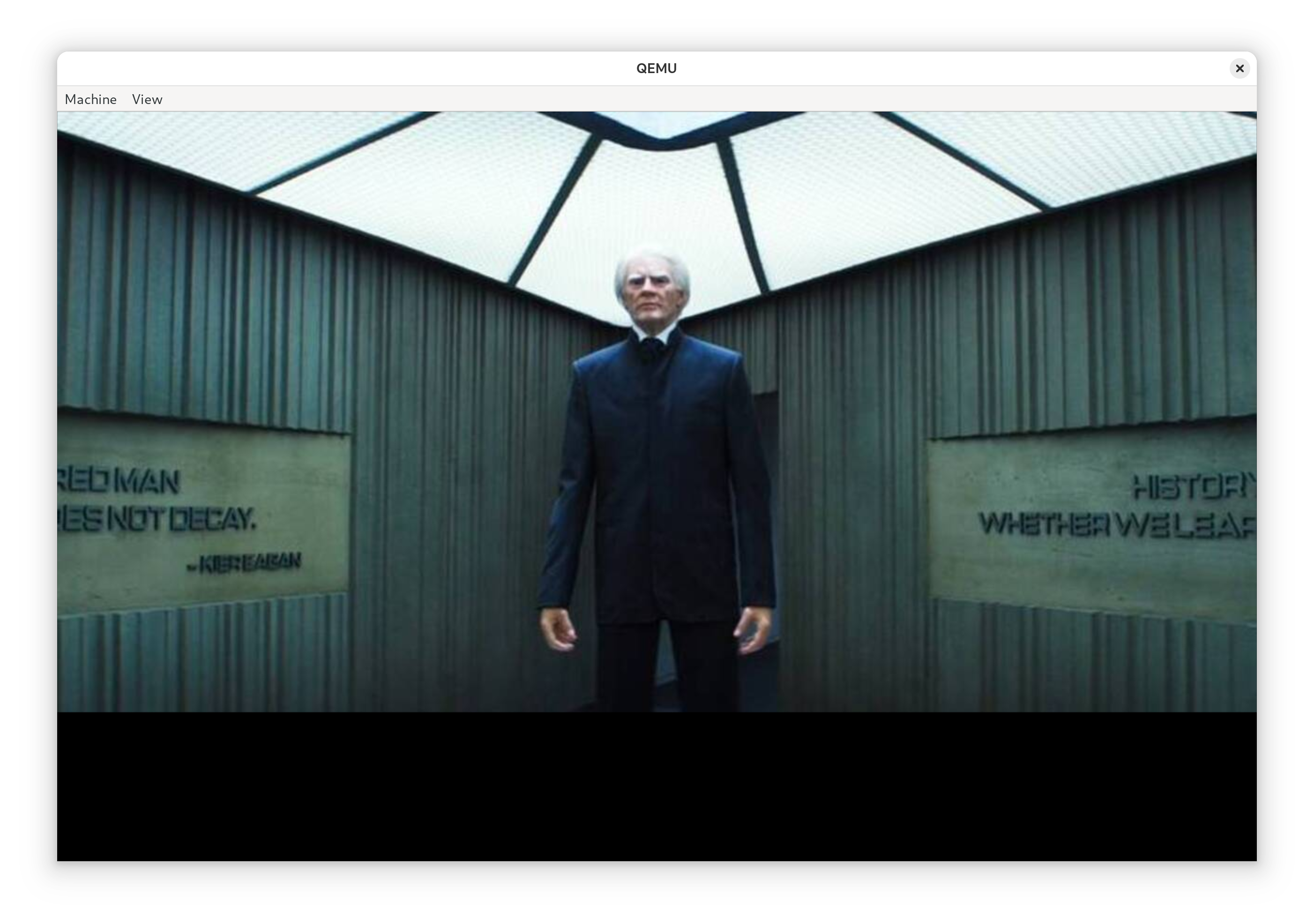
Remember to use the width and height from the final kier.full.jpg file as the values for KIER_WIDTH and KIER_HEIGHT. KIER_PIXEL_SIZE is 4, since we have 4 byte wide values for each pixel as a result of our conversion step into RGBA. We ll only use RGB, and if we ever drop the alpha channel, we can drop that down to 3. I don t entirely know why I kept alpha around, but I figured it was fine. My kier.full.jpg image winds up shorter than the requested height (which is also qemu s default resolution for me) which means we ll get a semi-annoying black band under the image when we go to run it but it ll work. Anyway, now that we have our image as bytes, we can get down to work, and write the rest of the code to handle moving bytes around from in-memory as a flat block if pixels, and request that they be displayed using the UEFI GOP. We ll just need to hack up a container for the image pixels and teach it how to blit to the display.
/// RGB Image to move around. This isn't the same as an
///  image::RgbImage , but we can associate the size of
/// the image along with the flat buffer of pixels.
struct RgbImage  
/// Size of the image as a tuple, as the
 /// (width, height)
 size: (usize, usize),
/// raw pixels we'll send to the display.
 inner: Vec<BltPixel>,
 
impl RgbImage  
/// Create a new  RgbImage .
 fn new(width: usize, height: usize) -> Self  
RgbImage  
size: (width, height),
inner: vec![BltPixel::new(0, 0, 0); width * height],
 
 
/// Take our pixels and request that the UEFI GOP
 /// display them for us.
 fn write(&self, gop: &mut GraphicsOutput) -> Result  
gop.blt(BltOp::BufferToVideo  
buffer: &self.inner,
src: BltRegion::Full,
dest: (0, 0),
dims: self.size,
 )
 
 
impl Index<(usize, usize)> for RgbImage  
type Output = BltPixel;
fn index(&self, idx: (usize, usize)) -> &BltPixel  
let (x, y) = idx;
&self.inner[y * self.size.0 + x]
 
 
impl IndexMut<(usize, usize)> for RgbImage  
fn index_mut(&mut self, idx: (usize, usize)) -> &mut BltPixel  
let (x, y) = idx;
&mut self.inner[y * self.size.0 + x]
 
 
We also need to do some basic setup to get a handle to the UEFI GOP via the UEFI crate (using uefi::boot::get_handle_for_protocol and uefi::boot::open_protocol_exclusive for the GraphicsOutput protocol), so that we have the object we need to pass to RgbImage in order for it to write the pixels to the display. The only trick here is that the display on the booted system can really be any resolution so we need to do some capping to ensure that we don t write more pixels than the display can handle. Writing fewer than the display s maximum seems fine, though.
fn praise() -> Result  
let gop_handle = boot::get_handle_for_protocol::<GraphicsOutput>()?;
let mut gop = boot::open_protocol_exclusive::<GraphicsOutput>(gop_handle)?;
// Get the (width, height) that is the minimum of
 // our image and the display we're using.
 let (width, height) = gop.current_mode_info().resolution();
let (width, height) = (width.min(KIER_WIDTH), height.min(KIER_HEIGHT));
let mut buffer = RgbImage::new(width, height);
for y in 0..height  
for x in 0..width  
let idx_r = ((y * KIER_WIDTH) + x) * KIER_PIXEL_SIZE;
let pixel = &mut buffer[(x, y)];
pixel.red = KIER[idx_r];
pixel.green = KIER[idx_r + 1];
pixel.blue = KIER[idx_r + 2];
 
 
buffer.write(&mut gop)?;
Ok(())
 
Not so bad! A bit tedious we could solve some of this by turning KIER into an RgbImage at compile-time using some clever Cow and const tricks and implement blitting a sub-image of the image but this will do for now. This is a joke, after all, let s not go nuts. All that s left with our code is for us to write our main function and try and boot the thing!
#[entry]
fn main() -> Status  
uefi::helpers::init().unwrap();
praise().unwrap();
boot::stall(100_000_000);
Status::SUCCESS
 
If you re following along at home and so interested, the final source is over at gist.github.com. We can go ahead and build it using cargo (as is our tradition) by targeting the UEFI platform.
$ cargo build --release --target x86_64-unknown-uefi

Testing the UEFI Blob While I can definitely get my machine to boot these blobs to test, I figured I d save myself some time by using QEMU to test without a full boot. If you ve not done this sort of thing before, we ll need two packages, qemu and ovmf. It s a bit different than most invocations of qemu you may see out there so I figured it d be worth writing this down, too.
$ doas apt install qemu-system-x86 ovmf
qemu has a nice feature where it ll create us an EFI partition as a drive and attach it to the VM off a local directory so let s construct an EFI partition file structure, and drop our binary into the conventional location. If you haven t done this before, and are only interested in running this in a VM, don t worry too much about it, a lot of it is convention and this layout should work for you.
$ mkdir -p esp/efi/boot
$ cp target/x86_64-unknown-uefi/release/*.efi \
 esp/efi/boot/bootx64.efi
With all this in place, we can kick off qemu, booting it in UEFI mode using the ovmf firmware, attaching our EFI partition directory as a drive to our VM to boot off of.
$ qemu-system-x86_64 \
 -enable-kvm \
 -m 2048 \
 -smbios type=0,uefi=on \
 -bios /usr/share/ovmf/OVMF.fd \
 -drive format=raw,file=fat:rw:esp
If all goes well, soon you ll be met with the all knowing gaze of Chosen One, Kier Eagan. The thing that really impressed me about all this is this program worked first try it all went so boringly normal. Truly, kudos to the uefi crate maintainers, it s incredibly well done.

Booting a live system Sure, we could stop here, but anyone can open up an app window and see a picture of Kier Eagan, so I knew I needed to finish the job and boot a real machine up with this. In order to do that, we need to format a USB stick. BE SURE /dev/sda IS CORRECT IF YOU RE COPY AND PASTING. All my drives are NVMe, so BE CAREFUL if you use SATA, it may very well be your hard drive! Please do not destroy your computer over this.
$ doas fdisk /dev/sda
Welcome to fdisk (util-linux 2.40.4).
Changes will remain in memory only, until you decide to write them.
Be careful before using the write command.
Command (m for help): n
Partition type
p primary (0 primary, 0 extended, 4 free)
e extended (container for logical partitions)
Select (default p): p
Partition number (1-4, default 1):
First sector (2048-4014079, default 2048):
Last sector, +/-sectors or +/-size K,M,G,T,P  (2048-4014079, default 4014079):
Created a new partition 1 of type 'Linux' and of size 1.9 GiB.
Command (m for help): t
Selected partition 1
Hex code or alias (type L to list all): ef
Changed type of partition 'Linux' to 'EFI (FAT-12/16/32)'.
Command (m for help): w
The partition table has been altered.
Calling ioctl() to re-read partition table.
Syncing disks.
Once that looks good (depending on your flavor of udev you may or may not need to unplug and replug your USB stick), we can go ahead and format our new EFI partition (BE CAREFUL THAT /dev/sda IS YOUR USB STICK) and write our EFI directory to it.
$ doas mkfs.fat /dev/sda1
$ doas mount /dev/sda1 /mnt
$ cp -r esp/efi /mnt
$ find /mnt
/mnt
/mnt/efi
/mnt/efi/boot
/mnt/efi/boot/bootx64.efi
Of course, naturally, devotion to Kier shouldn t mean backdooring your system. Disabling Secure Boot runs counter to the Core Principals, such as Probity, and not doing this would surely run counter to Verve, Wit and Vision. This bit does require that you ve taken the step to enroll a MOK and know how to use it, right about now is when we can use sbsign to sign our UEFI binary we want to boot from to continue enforcing Secure Boot. The details for how this command should be run specifically is likely something you ll need to work out depending on how you ve decided to manage your MOK.
$ doas sbsign \
 --cert /path/to/mok.crt \
 --key /path/to/mok.key \
 target/x86_64-unknown-uefi/release/*.efi \
 --output esp/efi/boot/bootx64.efi
I figured I d leave a signed copy of boot2kier at /boot/efi/EFI/BOOT/KIER.efi on my Dell XPS 13, with Secure Boot enabled and enforcing, just took a matter of going into my BIOS to add the right boot option, which was no sweat. I m sure there is a way to do it using efibootmgr, but I wasn t smart enough to do that quickly. I let er rip, and it booted up and worked great! It was a bit hard to get a video of my laptop, though but lucky for me, I have a Minisforum Z83-F sitting around (which, until a few weeks ago was running the annual http server to control my christmas tree ) so I grabbed it out of the christmas bin, wired it up to a video capture card I have sitting around, and figured I d grab a video of me booting a physical device off the boot2kier USB stick.
Attentive readers will notice the image of Kier is smaller then the qemu booted system which just means our real machine has a larger GOP display resolution than qemu, which makes sense! We could write some fancy resize code (sounds annoying), center the image (can t be assed but should be the easy way out here) or resize the original image (pretty hardware specific workaround). Additionally, you can make out the image being written to the display before us (the Minisforum logo) behind Kier, which is really cool stuff. If we were real fancy we could write blank pixels to the display before blitting Kier, but, again, I don t think I care to do that much work.

But now I must away If I wanted to keep this joke going, I d likely try and find a copy of the original video when Helly 100%s her file and boot into that or maybe play a terrible midi PC speaker rendition of Kier, Chosen One, Kier after rendering the image. I, unfortunately, don t have any friends involved with production (yet?), so I reckon all that s out for now. I ll likely stop playing with this the joke was done and I m only writing this post because of how great everything was along the way. All in all, this reminds me so much of building a homebrew kernel to boot a system into but like, good, though, and it s a nice reminder of both how fun this stuff can be, and how far we ve come. UEFI protocols are light-years better than how we did it in the dark ages, and the tooling for this is SO much more mature. Booting a custom UEFI binary is miles ahead of trying to boot your own kernel, and I can t believe how good the uefi crate is specifically. Praise Kier! Kudos, to everyone involved in making this so delightful .

18 February 2025

Dima Kogan: When are the days getting longer the fastest?

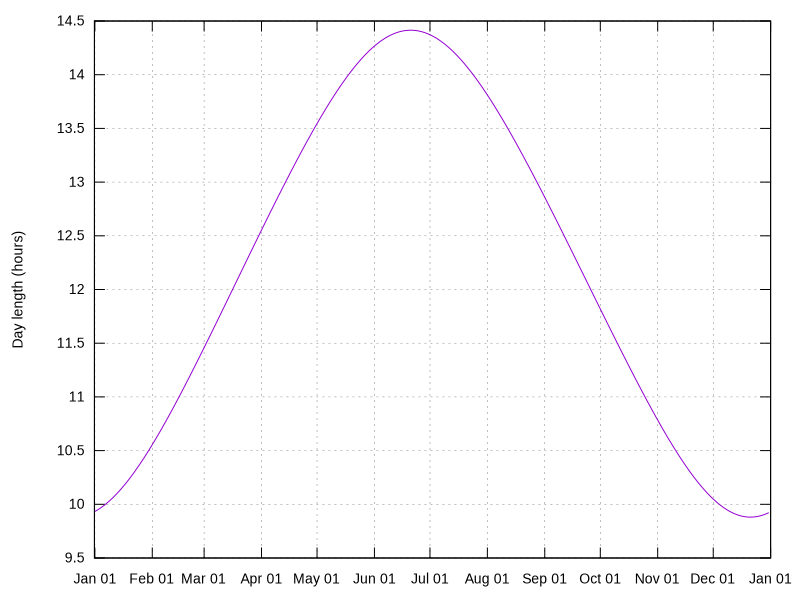
We're way past the winter solstice, and approaching the equinox. The sun is noticeably staying up later and later every day, which raises an obvious question: when are the days getting longer the fastest? Intuitively I want to say it should happen at the equinox. But does it happen exactly at the equinox? I could read up on all the gory details of this, or I could just make some plots. I wrote this:
#!/usr/bin/python3
import sys
import datetime
import astral.sun
lat  = 34.
year = 2025
city = astral.LocationInfo(latitude=lat, longitude=0)
date0 = datetime.datetime(year, 1, 1)
print("# date sunrise sunset length_min")
for i in range(365):
    date = date0 + datetime.timedelta(days=i)
    s = astral.sun.sun(city.observer, date=date)
    date_sunrise = s['sunrise']
    date_sunset  = s['sunset']
    date_string    = date.strftime('%Y-%m-%d')
    sunrise_string = date_sunrise.strftime('%H:%M')
    sunset_string  = date_sunset.strftime ('%H:%M')
    print(f" date_string   sunrise_string   sunset_string   (date_sunset-date_sunrise).total_seconds()/60 ")
This computes the sunrise and sunset time every day of 2025 at a latitude of 34degrees (i.e. Los Angeles), and writes out a log file (using the vnlog format). Let's plot it:
< sunrise-sunset.vnl                   \
  vnl-filter -p date,l='length_min/60' \
  feedgnuplot                          \
  --set 'format x "%b %d"'             \
  --domain                             \
  --timefmt '%Y-%m-%d'                 \
  --lines                              \
  --ylabel 'Day length (hours)'        \
  --hardcopy day-length.svg
day-length.svg
Well that makes sense. When are the days the longest/shortest?
$ < sunrise-sunset.vnl vnl-sort -grk length_min   head -n2   vnl-align
#  date    sunrise sunset     length_min   
2025-06-21 04:49   19:14  864.8543702000001
$ < sunrise-sunset.vnl vnl-sort -gk length_min   head -n2   vnl-align
#  date    sunrise sunset     length_min   
2025-12-21 07:01   16:54  592.8354265166668
Those are the solstices, as expected. Now let's look at the time gained/lost each day:
$ < sunrise-sunset.vnl                                  \
  vnl-filter -p date,d='diff(length_min)'               \
  vnl-filter --has d                                    \
  feedgnuplot                                           \
  --set 'format x "%b %d"'                              \
  --domain                                              \
  --timefmt '%Y-%m-%d'                                  \
  --lines                                               \
  --ylabel 'Daytime gained from the previous day (min)' \
  --hardcopy gain.svg
gain.svg
Looks vaguely sinusoidal, like the last plot. And looks like we gain/lost as most ~2 minutes each day. When does the gain peak?
$ < sunrise-sunset.vnl vnl-filter -p date,d='diff(length_min)'   vnl-filter --has d   vnl-sort -grk d   head -n2   vnl-align
#  date       d   
2025-03-19 2.13167
$ < sunrise-sunset.vnl vnl-filter -p date,d='diff(length_min)'   vnl-filter --has d   vnl-sort -gk d   head -n2   vnl-align
#  date        d   
2025-09-25 -2.09886
Not at the equinoxes! The fastest gain is a few days before the equinox and the fastest loss a few days after.

14 February 2025

Freexian Collaborators: Monthly report about Debian Long Term Support, January 2025 (by Roberto C. S nchez)

Like each month, have a look at the work funded by Freexian s Debian LTS offering.

Debian LTS contributors In January, 20 contributors have been paid to work on Debian LTS, their reports are available:
  • Abhijith PA did 8.0h (out of 14.0h assigned), thus carrying over 6.0h to the next month.
  • Adrian Bunk did 36.5h (out of 47.75h assigned and 52.25h from previous period), thus carrying over 63.5h to the next month.
  • Andrej Shadura did 11.0h (out of 11.0h assigned and 4.0h from previous period), thus carrying over 4.0h to the next month.
  • Arturo Borrero Gonzalez did 9.0h (out of 10.0h assigned), thus carrying over 1.0h to the next month.
  • Bastien Roucari s did 22.0h (out of 22.0h assigned).
  • Ben Hutchings did 8.0h (out of 21.0h assigned and 3.0h from previous period), thus carrying over 16.0h to the next month.
  • Chris Lamb did 18.0h (out of 18.0h assigned).
  • Daniel Leidert did 20.0h (out of 23.0h assigned and 3.0h from previous period), thus carrying over 6.0h to the next month.
  • Emilio Pozuelo Monfort did 34.0h (out of 7.0h assigned and 27.75h from previous period), thus carrying over 0.75h to the next month.
  • Guilhem Moulin did 3.25h (out of 20.0h assigned), thus carrying over 16.75h to the next month.
  • Jochen Sprickerhof did 23.0h (out of 15.0h assigned and 8.0h from previous period).
  • Lee Garrett did 15.75h (out of 8.5h assigned and 51.5h from previous period), thus carrying over 44.25h to the next month.
  • Lucas Kanashiro did 8.0h (out of 32.0h assigned and 32.0h from previous period), thus carrying over 56.0h to the next month.
  • Markus Koschany did 40.0h (out of 40.0h assigned).
  • Roberto C. S nchez did 14.75h (out of 13.5h assigned and 10.5h from previous period), thus carrying over 9.25h to the next month.
  • Santiago Ruano Rinc n did 21.75h (out of 18.75h assigned and 6.25h from previous period), thus carrying over 3.25h to the next month.
  • Sean Whitton did 8.5h (out of 8.5h assigned).
  • Sylvain Beucler did 10.5h (out of 0.0h assigned and 49.5h from previous period), thus carrying over 39.0h to the next month.
  • Thorsten Alteholz did 11.0h (out of 11.0h assigned).
  • Tobias Frost did 12.0h (out of 12.0h assigned).

Evolution of the situation In January, we have released 33 DLAs. There were numerous security and non-security updates to Debian 11 (codename bullseye ) during January.
  • Notable security updates:
    • rsync, prepared by Thorsten Alteholz, fixed several CVEs (including information leak and path traversal vulnerabilities)
    • tomcat9, prepared by Markus Koschany, fixed several CVEs (including denial of service and information disclosure vulnerabilities)
    • ruby2.7, prepared by Bastien Roucari s, fixed several CVEs (including denial of service vulnerabilities)
    • tiff, prepared by Adrian Bunk, fixed several CVEs (including NULL ptr, buffer overflow, use-after-free, and segfault vulnerabilities)
  • Notable non-security updates:
    • linux-6.1, prepared by Ben Hutchings, has been packaged for bullseye (this was done specifically to provide a supported upgrade path for systems that currently use kernel packages from the bullseye-backports suite)
    • debian-security-support, prepared by Santiago Ruano Rinc n, which formalized the EOL of intel-mediasdk and node-matrix-js-sdk
In addition to the security and non-security updates targeting bullseye , various LTS contributors have prepared uploads targeting Debian 12 (codename bookworm ) with fixes for a variety of vulnerabilities. Abhijith PA prepared an upload of puma; Bastien Roucari s prepared an upload of node-postcss with fixes for data processing and denial of service vulnerabilities; Daniel Leidert prepared updates for setuptools, python-asyncssh, and python-tornado; Lee Garrett prepared an upload of ansible-core; and Guilhem Moulin prepared updates for python-urllib3, sqlparse, and opensc. Santiago Ruano Rinc n also worked on tracking and filing some issues about packages that need an update in recent releases to avoid regressions on upgrade. This relates to CVEs that were fixed in buster or bullseye, but remain open in bookworm. These updates, along with Santiago s work on identifying and tracking similar issues, underscore the LTS Team s commitment to ensuring that the work we do as part of LTS also benefits the current Debian stable release. LTS contributor Sean Whitton also prepared an upload of jinja2 and Santiago Ruano Rinc n prepared an upload of openjpeg2 for Debian unstable (codename sid ), as part of the LTS Team effort to assist with package uploads to unstable.

Thanks to our sponsors Sponsors that joined recently are in bold.

13 February 2025

Russell Coker: Browser Choice

Browser Choice and Security Support Google seems to be more into tracking web users and generally becoming hostile to users [1]. So using a browser other than Chrome seems like a good idea. The problem is the lack of browsers with security support. It seems that the only browser engines with the quality of security support we expect in Debian are Firefox and the Chrome engine. The Chrome engine is used in Chrome, Chromium, and Microsoft Edge. Edge of course isn t an option and Chromium still has some of the Google anti-features built in. Firefox So I tried to use Firefox for the things I do. One feature of Chrome based browsers that I really like is the ability to set a custom page for the new tab. This feature was removed because it was apparently being constantly attacked by malware [2]. There are addons to allow that but I prefer to have a minimal number of addons and not have any that are just to replace deliberately broken settings in the browser. Also those addons can t set a file for the URL, so I could set a web server for it but it s annoying to have to setup a web server to work around a browser limitation. Another thing that annoyed me was YouTube videos open in new tabs not starting to play when I change to the tab. There s a Firefox setting for allowing web sites to autoplay but there doesn t seem to be a way to add sites to the list. Firefox is getting vertical tabs which is a really nice feature for wide displays [3]. Firefox has a Mozilla service for syncing passwords etc. It is possible to run your own server for this, but the server is written in Rust which is difficult to package and run [4]. There are Docker images for it but I prefer to avoid Docker, generally I think that Docker is a sign of failure in software development. If you can t develop software that can be deployed without Docker then you aren t developing it well. Chromium The Ungoogled Chromium project has a lot to offer for safer web browsing [5]. But the changes are invasive and it s not included in Debian. Some of the changes like replacing many Google web domains in the source code with non-existent alternatives ending in qjz9zk are things that could be considered controversial. It definitely isn t a candidate to replace the current Chromium package in Debian but might be a possibility to have as an extra browser. What Next? The Falcon browser that is part of the KDE project looks good, but QtWebEngine doesn t have security support in Debian. Would it be possible to provide security support for it? Ungoogled Chromium is available in Flatpak, so I ll test that out. But ideally it would be packaged for Debian. I ll try building a package of it and see how that goes. The Iridium Browser is another option [6], it seems similar in design to Ungoogled-Chromium but by different people.

8 February 2025

Erich Schubert: Azul s State-of-Java report is nonsense

Azul s State-of-Java report is full of nonsense, and no worth looking at. The report claims various stuff about the adoption of AI in the Java ecosystem. But its results do not make any sense when looked at in detail. For example (in the AI section): I can only guess that people picked some random plausible answer, but were not actually using any of that. Probably because of bad incentives:
Participants were offered token compensation for their participation.
Seems like Dimensional Research, the company who did that survey, screwed up badly.

7 February 2025

Dirk Eddelbuettel: zigg 0.0.2 on CRAN: Micromaintenance

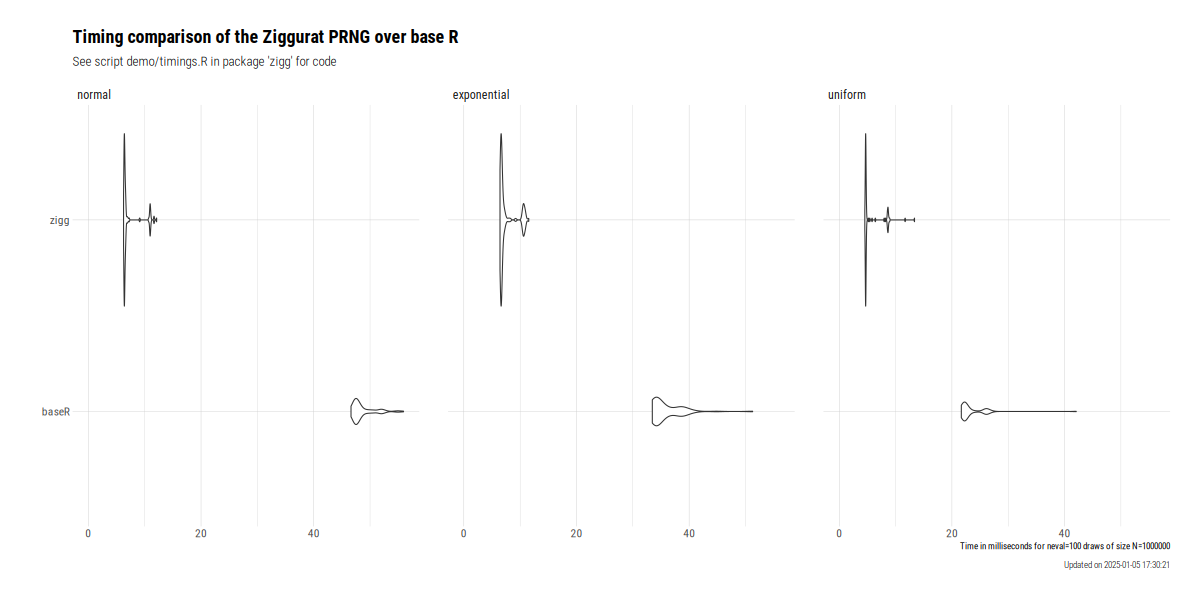
benchmark chart The still very new package zigg which arrived on CRAN a week ago just received a micro-update at CRAN. zigg provides the Ziggurat pseudo-random number generator (PRNG) for Normal, Exponential and Uniform draws proposed by Marsaglia and Tsang (JSS, 2000), and extended by Leong et al. (JSS, 2005). This PRNG is lightweight and very fast: on my machine speedups for the Normal, Exponential, and Uniform are on the order of 7.4, 5.2 and 4.7 times faster than the default generators in R as illustrated in the benchmark chart borrowed from the git repo. As wrote last week in the initial announcement, I had picked up their work in package RcppZiggurat and updated its code for the 64-buit world we now live in. That package alredy provided the Normal generator along with several competing implementations which it compared rigorously and timed them. As one of the generators was based on the GNU GSL via the implementation of Voss, we always ended up with a run-time dependency on the GSL too. No more: this new package is zero-depedency, zero-suggsts and hence very easy to deploy. Moreover, we also include a demonstration of four distinct ways of accessing the compiled code from another R package: pure and straight-up C, similarly pure C++, inclusion of the header in C++ as well as via Rcpp. The other advance is the resurrection of the second generator for the Exponential distribution. And following Burkardt we expose the Uniform too. The main upside of these generators is their excellent speed as can be seen in the comparison the default R generators generated by the example script timings.R: Needless to say, speed is not everything. This PRNG comes the time of 32-bit computing so the generator period is likely to be shorter than that of newer high-quality generators. If in doubt, forgo speed and stick with the high-quality default generators. This release essentially just completes the DESCRIPTION file and README.md now that this is a CRAN package. The short NEWS entry follows.

Changes in version 0.0.2 (2025-02-07)
  • Complete DESCRIPTION and README.md following initial CRAN upload

Courtesy of my CRANberries, there is a diffstat report relative to previous release. For more information, see the package page or the git repo.

This post by Dirk Eddelbuettel originated on his Thinking inside the box blog. If you like this or other open-source work I do, you can sponsor me at GitHub.

6 February 2025

Dominique Dumont: Drawbacks of using Cookiecutter with Cruft

Hi Cookiecutter is a tool for building coding project templates. It s often used to provide a scaffolding to build lots of similar project. I ve seen it used to create Symfony projects and several cloud infrastructures deployed with Terraform. This tool was useful to accelerate the creation of new projects.  Since these templates were bound to evolve, the teams providing these template relied on cruft to update the code provided by the template in their user s code. In other words, they wanted their users to apply a diff of the template modification to their code. At the beginning, all was fine. But problems began to appear during the lifetime of these projects. What went wrong ? In both cases, we had the following scenario: User team giving up on updates is a major problem because these update may bring security or compliance fixes.  Note that code conflicts seen with cruft are similar to git merge conflicts, but harder to resolve because, unlike with a git merge, there s no common ancestor, so 3-way merges are not possible. From an organisation point of view, the main problem is the ambiguous ownership of the functionalities brought by template code: who own this code ? The provider team who writes the template or the user team who owns the repository of the code generated from the template ? Conflicts are bound to happen. Possible solutions to get out of this tar pit: Of course your users won t be happy to be faced with a manual migration from the old big template to the new one with external dependencies. On the other hand, this may be easier to sell than updates based on cruft since the painful work will happen once. Further updates will be done by incrementing dependency versions (which can be automated with renovate). If many projects are to be created with this template, it may be more practical to provide use a CLI that will create a skeleton project. See for instance terragrunt scaffold command. My name is Dominique Dumont, I m a devops freelance. You can find the devops and audit services I propose on my website or reach out to me on LinkedIn. All the best

5 February 2025

Reproducible Builds: Reproducible Builds in January 2025

Welcome to the first report in 2025 from the Reproducible Builds project! Our monthly reports outline what we ve been up to over the past month and highlight items of news from elsewhere in the world of software supply-chain security when relevant. As usual, though, if you are interested in contributing to the Reproducible Builds project, please visit our Contribute page on our website. Table of contents:
  1. reproduce.debian.net
  2. Two new academic papers
  3. Distribution work
  4. On our mailing list
  5. Upstream patches
  6. diffoscope
  7. Website updates
  8. Reproducibility testing framework

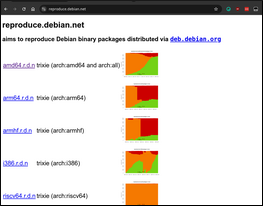
reproduce.debian.net The last few months saw the introduction of reproduce.debian.net. Announced at the recent Debian MiniDebConf in Toulouse, reproduce.debian.net is an instance of rebuilderd operated by the Reproducible Builds project. Powering that is rebuilderd, our server designed monitor the official package repositories of Linux distributions and attempt to reproduce the observed results there. This month, however, we are pleased to announce that in addition to the existing amd64.reproduce.debian.net and i386.reproduce.debian.net architecture-specific pages, we now build for a three more architectures (for a total of five) arm64 armhf and riscv64.

Two new academic papers Giacomo Benedetti, Oreofe Solarin, Courtney Miller, Greg Tystahl, William Enck, Christian K stner, Alexandros Kapravelos, Alessio Merlo and Luca Verderame published an interesting article recently. Titled An Empirical Study on Reproducible Packaging in Open-Source Ecosystem, the abstract outlines its optimistic findings:
[We] identified that with relatively straightforward infrastructure configuration and patching of build tools, we can achieve very high rates of reproducible builds in all studied ecosystems. We conclude that if the ecosystems adopt our suggestions, the build process of published packages can be independently confirmed for nearly all packages without individual developer actions, and doing so will prevent significant future software supply chain attacks.
The entire PDF is available online to view.
In addition, Julien Malka, Stefano Zacchiroli and Th o Zimmermann of T l com Paris in-house research laboratory, the Information Processing and Communications Laboratory (LTCI) published an article asking the question: Does Functional Package Management Enable Reproducible Builds at Scale?. Answering strongly in the affirmative, the article s abstract reads as follows:
In this work, we perform the first large-scale study of bitwise reproducibility, in the context of the Nix functional package manager, rebuilding 709,816 packages from historical snapshots of the nixpkgs repository[. We] obtain very high bitwise reproducibility rates, between 69 and 91% with an upward trend, and even higher rebuildability rates, over 99%. We investigate unreproducibility causes, showing that about 15% of failures are due to embedded build dates. We release a novel dataset with all build statuses, logs, as well as full diffoscopes: recursive diffs of where unreproducible build artifacts differ.
As above, the entire PDF of the article is available to view online.

Distribution work There as been the usual work in various distributions this month, such as:
  • 10+ reviews of Debian packages were added, 11 were updated and 10 were removed this month adding to our knowledge about identified issues. A number of issue types were updated also.
  • The FreeBSD Foundation announced that a planned project to deliver zero-trust builds has begun in January 2025 . Supported by the Sovereign Tech Agency, this project is centered on the various build processes, and that the primary goal of this work is to enable the entire release process to run without requiring root access, and that build artifacts build reproducibly that is, that a third party can build bit-for-bit identical artifacts. The full announcement can be found online, which includes an estimated schedule and other details.

On our mailing list On our mailing list this month:
  • Following-up to a substantial amount of previous work pertaining the Sphinx documentation generator, James Addison asked a question pertaining to the relationship between SOURCE_DATE_EPOCH environment variable and testing that generated a number of replies.
  • Adithya Balakumar of Toshiba asked a question about whether it is possible to make ext4 filesystem images reproducible. Adithya s issue is that even the smallest amount of post-processing of the filesystem results in the modification of the Last mount and Last write timestamps.
  • James Addison also investigated an interesting issue surrounding our disorderfs filesystem. In particular:
    FUSE (Filesystem in USErspace) filesystems such as disorderfs do not delete files from the underlying filesystem when they are deleted from the overlay. This can cause seemingly straightforward tests for example, cases that expect directory contents to be empty after deletion is requested for all files listed within them to fail.

Upstream patches The Reproducible Builds project detects, dissects and attempts to fix as many currently-unreproducible packages as possible. We endeavour to send all of our patches upstream where appropriate. This month, we wrote a large number of such patches, including:

diffoscope diffoscope is our in-depth and content-aware diff utility that can locate and diagnose reproducibility issues. This month, Chris Lamb made the following changes, including preparing and uploading versions 285, 286 and 287 to Debian:
  • Security fixes:
    • Validate the --css command-line argument to prevent a potential Cross-site scripting (XSS) attack. Thanks to Daniel Schmidt from SRLabs for the report. [ ]
    • Prevent XML entity expansion attacks. Thanks to Florian Wilkens from SRLabs for the report.. [ ][ ]
    • Print a warning if we have disabled XML comparisons due to a potentially vulnerable version of pyexpat. [ ]
  • Bug fixes:
    • Correctly identify changes to only the line-endings of files; don t mark them as Ordering differences only. [ ]
    • When passing files on the command line, don t call specialize( ) before we ve checked that the files are identical or not. [ ]
    • Do not exit with a traceback if paths are inaccessible, either directly, via symbolic links or within a directory. [ ]
    • Don t cause a traceback if cbfstool extraction failed.. [ ]
    • Use the surrogateescape mechanism to avoid a UnicodeDecodeError and crash when any decoding zipinfo output that is not UTF-8 compliant. [ ]
  • Testsuite improvements:
    • Don t mangle newlines when opening test fixtures; we want them untouched. [ ]
    • Move to assert_diff in test_text.py. [ ]
  • Misc improvements:
    • Drop unused subprocess imports. [ ][ ]
    • Drop an unused function in iso9600.py. [ ]
    • Inline a call and check of Config().force_details; no need for an additional variable in this particular method. [ ]
    • Remove an unnecessary return value from the Difference.check_for_ordering_differences method. [ ]
    • Remove unused logging facility from a few comparators. [ ]
    • Update copyright years. [ ][ ]
In addition, fridtjof added support for the ASAR .tar-like archive format. [ ][ ][ ][ ] and lastly, Vagrant Cascadian updated diffoscope in GNU Guix to version 285 [ ][ ] and 286 [ ][ ].
strip-nondeterminism is our sister tool to remove specific non-deterministic results from a completed build. This month version 1.14.1-1 was uploaded to Debian unstable by Chris Lamb, making the following the changes:
  • Clarify the --verbose and non --verbose output of bin/strip-nondeterminism so we don t imply we are normalizing files that we are not. [ ]
  • Bump Standards-Version to 4.7.0. [ ]

Website updates There were a large number of improvements made to our website this month, including:

Reproducibility testing framework The Reproducible Builds project operates a comprehensive testing framework running primarily at tests.reproducible-builds.org in order to check packages and other artifacts for reproducibility. In January, a number of changes were made by Holger Levsen, including:
  • reproduce.debian.net-related:
    • Add support for rebuilding the armhf architecture. [ ][ ]
    • Add support for rebuilding the arm64 architecture. [ ][ ][ ][ ]
    • Add support for rebuilding the riscv64 architecture. [ ][ ]
    • Move the i386 builder to the osuosl5 node. [ ][ ][ ][ ]
    • Don t run our rebuilders on a public port. [ ][ ]
    • Add database backups on all builders and add links. [ ][ ]
    • Rework and dramatically improve the statistics collection and generation. [ ][ ][ ][ ][ ][ ]
    • Add contact info to the main page [ ], thumbnails [ ] as well as the new, missing architectures. [ ]
    • Move the amd64 worker to the osuosl4 and node. [ ]
    • Run the underlying debrebuild script under nice. [ ]
    • Try to use TMPDIR when calling debrebuild. [ ][ ]
  • buildinfos.debian.net-related:
    • Stop creating buildinfo-pool_$ suite _$ arch .list files. [ ]
    • Temporarily disable automatic updates of pool links. [ ]
  • FreeBSD-related:
    • Fix the sudoers to actually permit builds. [ ]
    • Disable debug output for FreeBSD rebuilding jobs. [ ]
    • Upgrade to FreeBSD 14.2 [ ] and document that bmake was installed on the underlying FreeBSD virtual machine image [ ].
  • Misc:
    • Update the real year to 2025. [ ]
    • Don t try to install a Debian bookworm kernel from backports on the infom08 node which is running Debian trixie. [ ]
    • Don t warn about system updates for systems running Debian testing. [ ]
    • Fix a typo in the ZOMBIES definition. [ ][ ]
In addition:
  • Ed Maste modified the FreeBSD build system to the clean the object directory before commencing a build. [ ]
  • Gioele Barabucci updated the rebuilder stats to first add a category for network errors [ ] as well as to categorise failures without a diffoscope log [ ].
  • Jessica Clarke also made some FreeBSD-related changes, including:
    • Ensuring we clean up the object directory for second build as well. [ ][ ]
    • Updating the sudoers for the relevant rm -rf command. [ ]
    • Update the cleanup_tmpdirs method to to match other removals. [ ]
  • Jochen Sprickerhof:
  • Roland Clobus:
    • Update the reproducible_debstrap job to call Debian s debootstrap with the full path [ ] and to use eatmydata as well [ ][ ].
    • Make some changes to deduce the CPU load in the debian_live_build job. [ ]
Lastly, both Holger Levsen [ ] and Vagrant Cascadian [ ] performed some node maintenance.
If you are interested in contributing to the Reproducible Builds project, please visit our Contribute page on our website. However, you can get in touch with us via:

4 February 2025

Dominique Dumont: Azure API throttling strikes back

Hi In my last blog, I explained how we resolved a throttling issue involving Azure storage API. In the end, I mentioned that I was not sure of the root cause of the throttling issue. Even though we no longer had any problem in dev and preprod cluster, we still faced throttling issue with prod. The main difference between these 2 environments is that we have about 80 PVs in prod versus 15 in the other environments. Given that we manage 1500 pods in prod, 80 PVs does not look like a lot.  To continue the investigation, I ve modified k8s-scheduled-volume-snapshotter to limit the number of snaphots done in a single cron run (see add maxSnapshotCount parameter pull request). In prod, we used the modified snapshotter to trigger snapshots one by one. Even with all previous snapshots cleaned up, we could not trigger a single new snapshot without being throttled . I guess that, in the cron job, just checking the list of PV to snapshot was enough to exhaust our API quota.  Azure doc mention that a leaky bucket algorithm is used for throttling. A full bucket holds tokens for 250 API calls, and the bucket gets 25 new tokens per second. Looks like that not enough. I was puzzled  and out of ideas  . I looked for similar problems in AKS issues on GitHub where I found this comment that recommend using useDataPlaneAPI parameter in the CSI file driver. That was it!  I was flabbergasted  by this parameter: why is CSI file driver able to use 2 APIs ? Why is one on them so limited ? And more importantly, why is the limited API the default one ? Anyway, setting useDataPlaneAPI: "true" in our VolumeSnapshotClass manifest was the right solution. This indeed solved the throttling issue in our prod cluster.  But not the snaphot issue  . Amongst the 80 PV, I still had 2 snaphots failing. Fortunately, the error was mentioned in the description of the failed snapshots: we had too many (200) snapshots for these shared volumes. What ??  All these snapshots were cleaned up last week. I then tried to delete these snaphots through azure console. But the console failed to delete these snapshot due to API throttling. Looks like Azure console is not using the right API.  Anyway, I went back to the solution explained in my previous blog, I listed all snapshots with az command. I indeed has a lot of snaphots, a lot of them dated Jan 19 and 20. There was often a new bogus snaphot created every minute. These were created during the first attempt at fixing the throttling issue. I guess that even though CSI file driver was throttled, a snaphot was still created in the storage account, but the CSI driver did not see it and retried a minute later . What a mess. Anyway, I ve cleaned up again these bogus snapshot  , and now, snaphot creation is working fine  . For now. All the best.

2 February 2025

Anuradha Weeraman: DeepSeek-R1, at the cusp of an open revolution

DeepSeek-R1, at the cusp of an open revolutionDeepSeek R1, the new entrant to the Large Language Model wars has created quite a splash over the last few weeks. Its entrance into a space dominated by the Big Corps, while pursuing asymmetric and novel strategies has been a refreshing eye-opener.GPT AI improvement was starting to show signs of slowing down, and has been observed to be reaching a point of diminishing returns as it runs out of data and compute required to train, fine-tune increasingly large models. This has turned the focus towards building "reasoning" models that are post-trained through reinforcement learning, techniques such as inference-time and test-time scaling and search algorithms to make the models appear to think and reason better. OpenAI&aposs o1-series models were the first to achieve this successfully with its inference-time scaling and Chain-of-Thought reasoning.
Intelligence as an emergent property of Reinforcement Learning (RL)Reinforcement Learning (RL) has been successfully used in the past by Google&aposs DeepMind team to build highly intelligent and specialized systems where intelligence is observed as an emergent property through rewards-based training approach that yielded achievements like AlphaGo (see my post on it here - AlphaGo: a journey to machine intuition).DeepMind went on to build a series of Alpha* projects that achieved many notable feats using RL:
  • AlphaGo, defeated the world champion Lee Seedol in the game of Go
  • AlphaZero, a generalized system that learned to play games such as Chess, Shogi and Go without human input
  • AlphaStar, achieved high performance in the complex real-time strategy game StarCraft II.
  • AlphaFold, a tool for predicting protein structures which significantly advanced computational biology.
  • AlphaCode, a model designed to generate computer programs, performing competitively in coding challenges.
  • AlphaDev, a system developed to discover novel algorithms, notably optimizing sorting algorithms beyond human-derived methods.
All of these systems achieved mastery in its own area through self-training/self-play and by optimizing and maximizing the cumulative reward over time by interacting with its environment where intelligence was observed as an emergent property of the system.
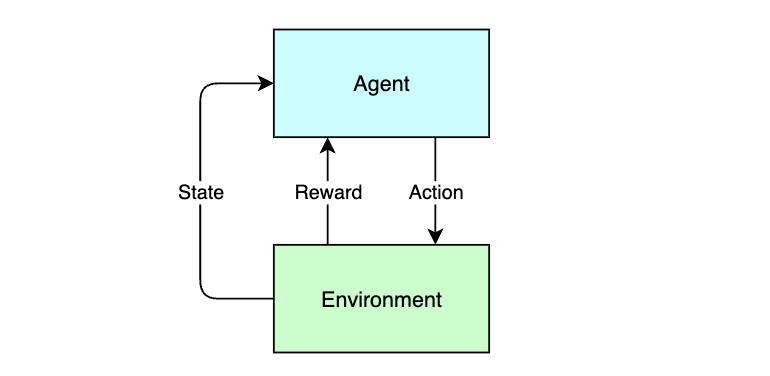
DeepSeek-R1, at the cusp of an open revolutionThe RL feedback loop
RL mimics the process through which a baby would learn to walk, through trial, error and first principles.

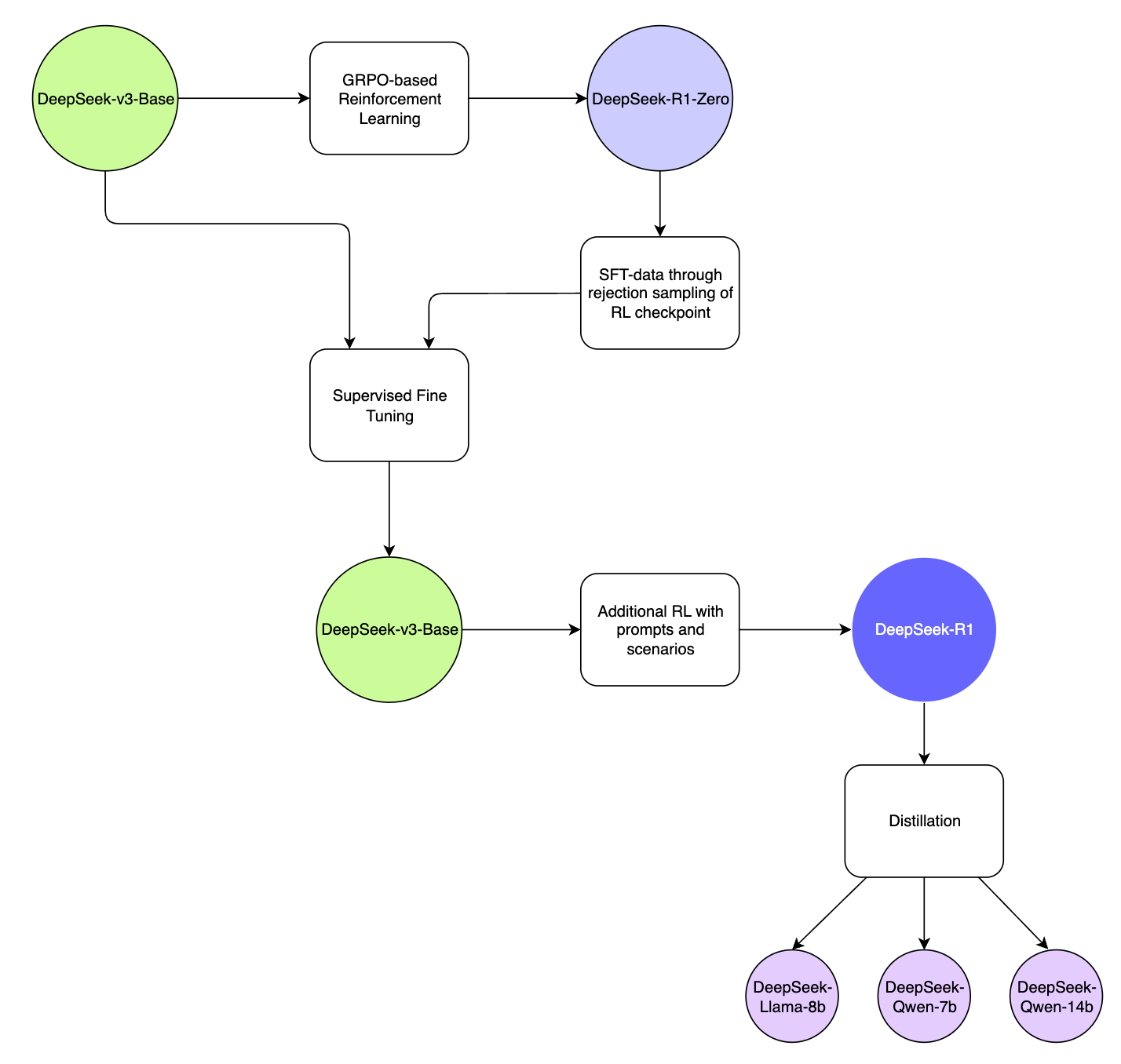
R1 model training pipelineAt a technical level, DeepSeek-R1 leverages a combination of Reinforcement Learning (RL) and Supervised Fine-Tuning (SFT) for its training pipeline:
DeepSeek-R1, at the cusp of an open revolutionDeepSeek-R1 Model Training Pipeline
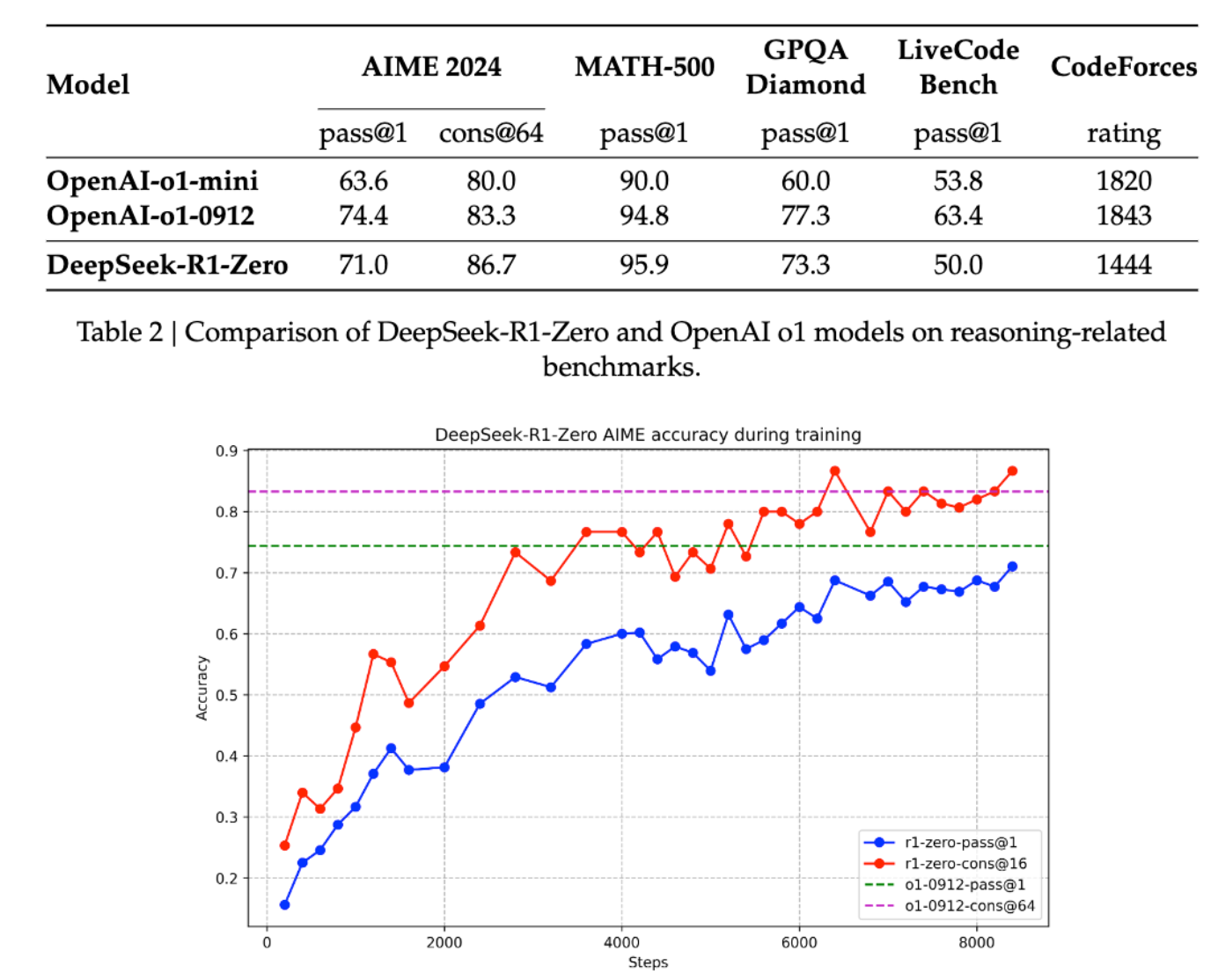
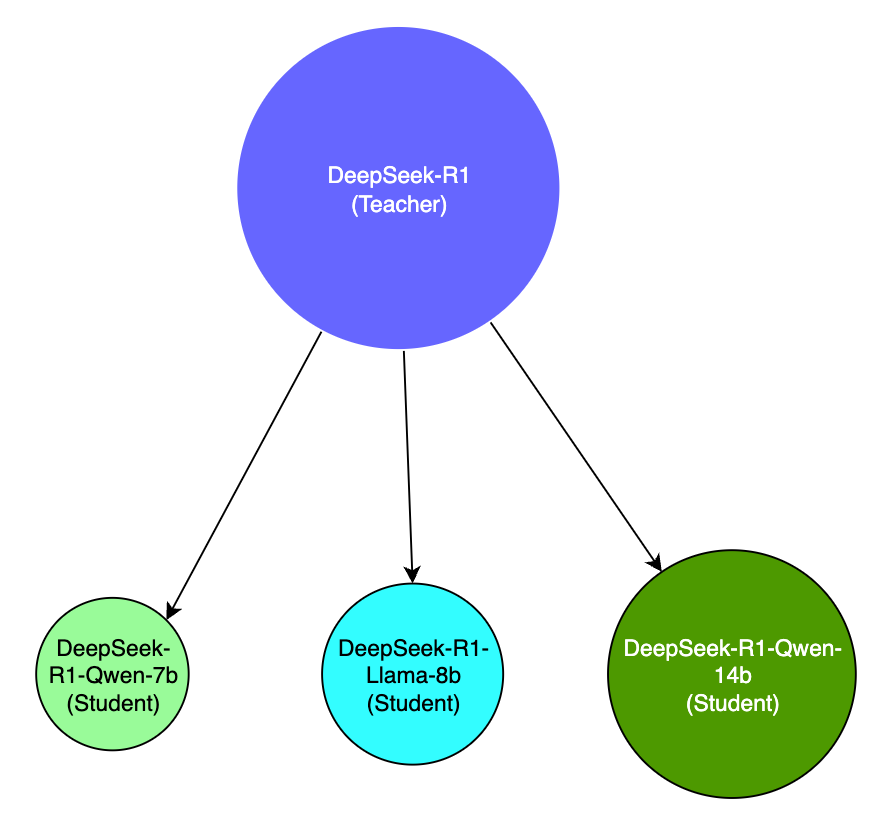
Using RL and DeepSeek-v3, an interim reasoning model was built, called DeepSeek-R1-Zero, purely based on RL without relying on SFT, which demonstrated superior reasoning capabilities that matched the performance of OpenAI&aposs o1 in certain benchmarks such as AIME 2024.The model was however affected by poor readability and language-mixing and is only an interim-reasoning model built on RL principles and self-evolution.DeepSeek-R1-Zero was then used to generate SFT data, which was combined with supervised data from DeepSeek-v3 to re-train the DeepSeek-v3-Base model.The new DeepSeek-v3-Base model then underwent additional RL with prompts and scenarios to come up with the DeepSeek-R1 model.The R1-model was then used to distill a number of smaller open source models such as Llama-8b, Qwen-7b, 14b which outperformed bigger models by a large margin, effectively making the smaller models more accessible and usable.

Key contributions of DeepSeek-R1
  1. RL without the need for SFT for emergent reasoning capabilities
R1 was the first open research project to validate the efficacy of RL directly on the base model without relying on SFT as a first step, which resulted in the model developing advanced reasoning capabilities purely through self-reflection and self-verification.Although, it did degrade in its language capabilities during the process, its Chain-of-Thought (CoT) capabilities for solving complex problems was later used for further RL on the DeepSeek-v3-Base model which became R1. This is a significant contribution back to the research community.The below analysis of DeepSeek-R1-Zero and OpenAI o1-0912 shows that it is viable to attain robust reasoning capabilities purely through RL alone, which can be further augmented with other techniques to deliver even better reasoning performance.
DeepSeek-R1, at the cusp of an open revolutionSource: https://github.com/deepseek-ai/DeepSeek-R1
Its quite interesting, that the application of RL gives rise to seemingly human capabilities of "reflection", and arriving at "aha" moments, causing it to pause, ponder and focus on a specific aspect of the problem, resulting in emergent capabilities to problem-solve as humans do.
  1. Model distillation
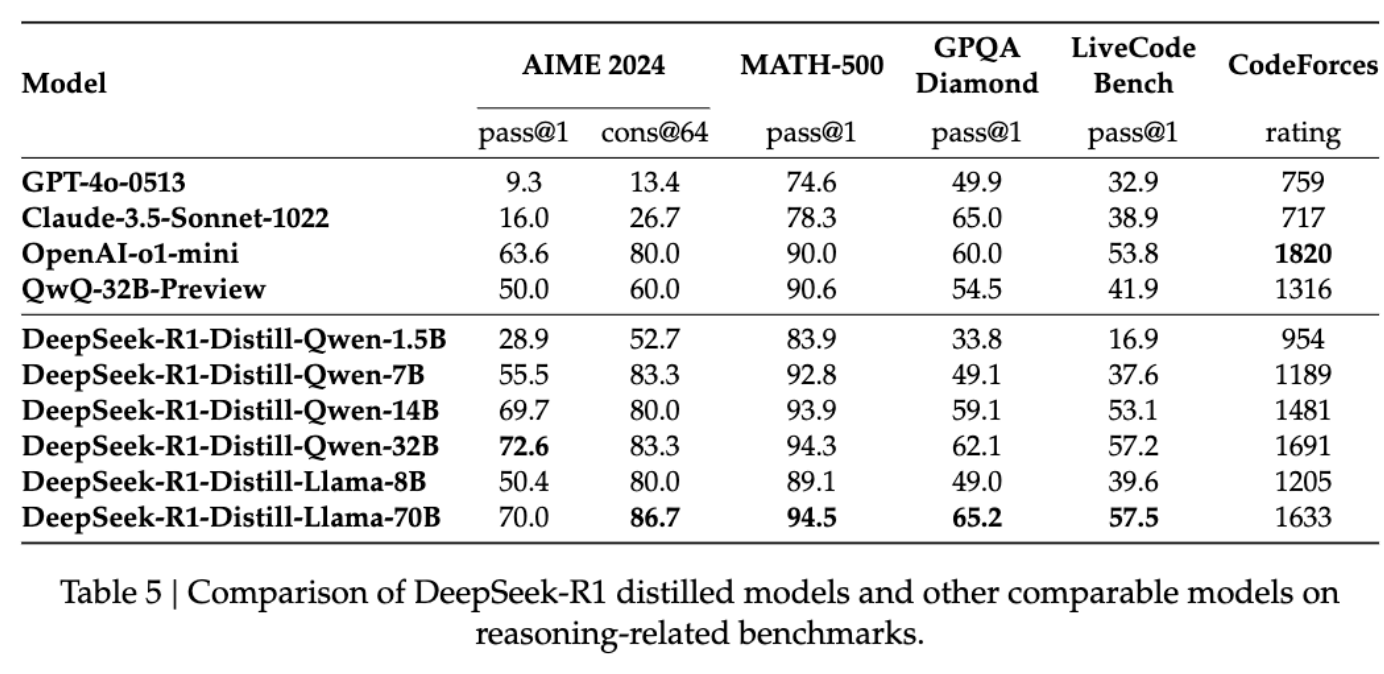
DeepSeek-R1 also demonstrated that larger models can be distilled into smaller models which makes advanced capabilities accessible to resource-constrained environments, such as your laptop. While its not possible to run a 671b model on a stock laptop, you can still run a distilled 14b model that is distilled from the larger model which still performs better than most publicly available models out there. This enables intelligence to be brought closer to the edge, to allow faster inference at the point of experience (such as on a smartphone, or on a Raspberry Pi), which paves way for more use cases and possibilities for innovation.
DeepSeek-R1, at the cusp of an open revolutionSource: https://github.com/deepseek-ai/DeepSeek-R1
Distilled models are very different to R1, which is a massive model with a completely different model architecture than the distilled variants, and so are not directly comparable in terms of capability, but are instead built to be more smaller and efficient for more constrained environments. This technique of being able to distill a larger model&aposs capabilities down to a smaller model for portability, accessibility, speed, and cost will bring about a lot of possibilities for applying artificial intelligence in places where it would have otherwise not been possible. This is another key contribution of this technology from DeepSeek, which I believe has even further potential for democratization and accessibility of AI.
DeepSeek-R1, at the cusp of an open revolution

Why is this moment so significant?DeepSeek-R1 was a pivotal contribution in many ways.
  1. The contributions to the state-of-the-art and the open research helps move the field forward where everybody benefits, not just a few highly funded AI labs building the next billion dollar model.
  2. Open-sourcing and making the model freely available follows an asymmetric strategy to the prevailing closed nature of much of the model-sphere of the larger players. DeepSeek should be commended for making their contributions free and open.
  3. It reminds us that its not just a one-horse race, and it incentivizes competition, which has already resulted in OpenAI o3-mini a cost-effective reasoning model which now shows the Chain-of-Thought reasoning. Competition is a good thing.
  4. We stand at the cusp of an explosion of small-models that are hyper-specialized, and optimized for a specific use case that can be trained and deployed cheaply for solving problems at the edge. It raises a lot of exciting possibilities and is why DeepSeek-R1 is one of the most pivotal moments of tech history.
Truly exciting times. What will you build?

31 January 2025

Gunnar Wolf: ChatGPT is bullshit

This post is an unpublished review for ChatGPT is bullshit
As people around the world understand how LLMs behave, more and more people wonder as to why these models hallucinate, and what can be done about to reduce it. This provocatively named article by Michael Townsen Hicks, James Humphries and Joe Slater bring is an excellent primer to better understanding how LLMs work and what to expect from them. As humans carrying out our relations using our language as the main tool, we are easily at awe with the apparent ease with which ChatGPT (the first widely available, and to this day probably the best known, LLM-based automated chatbot) simulates human-like understanding and how it helps us to easily carry out even daunting data aggregation tasks. It is common that people ask ChatGPT for an answer and, if it gets part of the answer wrong, they justify it by stating that it s just a hallucination. Townsen et al. invite us to switch from that characterization to a more correct one: LLMs are bullshitting. This term is formally presented by Frankfurt [1]. To Bullshit is not the same as to lie, because lying requires to know (and want to cover) the truth. A bullshitter not necessarily knows the truth, they just have to provide a compelling description, regardless of what is really aligned with truth. After introducing Frankfurt s ideas, the authors explain the fundamental ideas behind LLM-based chatbots such as ChatGPT; a Generative Pre-trained Transformer (GPT) s have as their only goal to produce human-like text, and it is carried out mainly by presenting output that matches the input s high-dimensional abstract vector representation, and probabilistically outputs the next token (word) iteratively with the text produced so far. Clearly, a GPT s ask is not to seek truth or to convey useful information they are built to provide a normal-seeming response to the prompts provided by their user. Core data are not queried to find optimal solutions for the user s requests, but are generated on the requested topic, attempting to mimic the style of document set it was trained with. Erroneous data emitted by a LLM is, thus, not equiparable with what a person could hallucinate with, but appears because the model has no understanding of truth; in a way, this is very fitting with the current state of the world, a time often termed as the age of post-truth [2]. Requesting an LLM to provide truth in its answers is basically impossible, given the difference between intelligence and consciousness: Following Harari s definitions [3], LLM systems, or any AI-based system, can be seen as intelligent, as they have the ability to attain goals in various, flexible ways, but they cannot be seen as conscious, as they have no ability to experience subjectivity. This is, the LLM is, by definition, bullshitting its way towards an answer: their goal is to provide an answer, not to interpret the world in a trustworthy way. The authors close their article with a plea for literature on the topic to adopt the more correct bullshit term instead of the vacuous, anthropomorphizing hallucination . Of course, being the word already loaded with a negative meaning, it is an unlikely request. This is a great article that mixes together Computer Science and Philosophy, and can shed some light on a topic that is hard to grasp for many users. [1] Frankfurt, Harry (2005). On Bullshit. Princeton University Press. [2] Zoglauer, Thomas (2023). Constructed truths: truth and knowledge in a post-truth world. Springer. [3] Harari, Yuval Noah (2023. Nexus: A Brief History of Information Networks From the Stone Age to AI. Random House.

Dirk Eddelbuettel: zigg 0.0.1 on CRAN: New Package!

Thrilled to announce a new package: zigg. It arrived on CRAN today after a few days of review in the newbies queue. zigg provides the Ziggurat pseudo-random number generator for Normal, Exponential and Uniform draws proposed by Marsaglia and Tsang (JSS, 2000), and extended by Leong et al. (JSS, 2005). I had picked up their work in package RcppZiggurat and updated its code for the 64-buit world we now live in. That package alredy provided the Normal generator along with several competing implementations which it compared rigorously and timed them. As one of the generators was based on the GNU GSL via the implementation of Voss, we always ended up with a run-time dependency on the GSL too. No more: this new package is zero-depedency, zero-suggsts and hence very easy to deploy. Moreover, we also include a demonstration of four distinct ways of accessing the compiled code from another R package: pure and straight-up C, similarly pure C++, inclusion of the header in C++ as well as via Rcpp. The other advance is the resurrection of the second generator for the Exponential distribution. And following Burkardt we expose the Uniform too. The main upside of these generators is their excellent speed as can be seen in the comparison the default R generators generated by the example script timings.R: Needless to say, speed is not everything. This PRNG comes the time of 32-bit computing so the generator period is likely to be shorter than that of newer high-quality generators. If in doubt, forgo speed and stick with the high-quality default generators. The short NEWS entry follows.

Changes in version 0.0.1 (2021-01-30)
  • Initial version and CRAN upload

For more, see the package page or the git repo.

This post by Dirk Eddelbuettel originated on his Thinking inside the box blog. If you like this or other open-source work I do, you can sponsor me at GitHub.

Russell Coker: Links January 2025

Aaron Quigley s Everything Open lecture about Intelligent Interfaces is one of the most interesting research reports I ve seen in a long time [1]. This one can be understood and appreciated by people who don t have a strong background in computer science. Statites (satellites that don t orbit the sun but use solar sails to hover in place) could be used to catch up to interstellar objects [2]. Slashgear has an interesting article about an AI piloted F16 beating a human piloted F16 [3]. Given the serious handicaps of flying a plane designed for humans and flying to minimise risk to itself and other crewed aircraft this is a serious victory. Hopefully crewed military aircraft will be obsolete soon. Amusing video about the performance of cats with MMORPG style descriptions [4]. John Goerzen wrote an interesting blog post about censorship and the changes to Facebook [5]. Ron Garret wrote an interesting blog post 15 years ago when going through what he now describes as an existential crisis [6]. A comment on Ron s post is references Alan Crowe s blog post about whether the self exists which is an interesting philosophical post [7]. But I m still going to think of myself as a person. Another comment on Ron s post references Aaron Swartz blog post about Noam Chomsky etc [8]. I have to watch Manufacturing Consent: Noam Chomsky and the Media. Ron Garret wrote an interesting blog post about his failed attempts to start a company and how it all worked out well for him any way [9]. Amusing video about a failed crowdfunded e-bike [10]. Cory Doctorow wrote an insightful article about how Enshittification is not caused by VCs but by lack of controls [11].

30 January 2025

Dirk Eddelbuettel: RcppStreams 0.1.4: Maintenance

Streamulus A new maintenance release of RcppStreams is now on CRAN marking the first release in almost six years. RcppStreams brings the excellent Streamulus C++ template library for event stream processing to R. Streamulus, written by Irit Katriel, uses clever template meta-programming (via Boost Fusion) to implement an embedded domain-specific event language created specifically for event stream processing. This release covers only package and CRAN-specific updates. The NEWS file entries follows below:

Changes in version 0.1.4 (2024-01-29)
  • Package maintenance with updates to DESCRIPTION and README.md
  • Continunous integration has been update multiple times
  • No longer set a C++ compilation standard

Courtesy of my CRANberries, there is also a diffstat report for this release. More detailed information is on the RcppStreams page page and of course on the Streamulus page. For questions, suggestions, or issues please use the issue tracker at the GitHub repo.

This post by Dirk Eddelbuettel originated on his Thinking inside the box blog. If you like this or other open-source work I do, you can now sponsor me at GitHub.

27 January 2025

Sergio Talens-Oliag: Running a Debian Sid on Ubuntu

Although I am a Debian Developer (not very active, BTW) I am using Ubuntu LTS (right now version 24.04.1) on my main machine; it is my work laptop and I was told to keep using Ubuntu on it when it was assigned to me, although I don t believe it is really necessary or justified (I don t need support, I don t provide support to others and I usually test my shell scripts on multiple systems if needed anyway). Initially I kept using Debian Sid on my personal laptop, but I gave it to my oldest son as the one he was using (an old Dell XPS 13) was stolen from him a year ago. I am still using Debian stable on my servers (one at home that also runs LXC containers and another one on an OVH VPS), but I don t have a Debian Sid machine anymore and while I could reinstall my work machine, I ve decided I m going to try to use a system container to run Debian Sid on it. As I want to use a container instead of a VM I ve narrowed my options to lxc or systemd-nspawn (I have docker and podman installed, but I don t believe they are good options for running system containers). As I will want to take snapshots of the container filesystem I ve decided to try incus instead of systemd-nspawn (I already have experience with it and while it works well it has less features than incus).

Installing incusAs this is a personal system where I want to try things, instead of using the packages included with Ubuntu I ve decided to install the ones from the zabbly incus stable repository. To do it I ve executed the following as root:
# Get the zabbly repository GPG key
curl -fsSL https://pkgs.zabbly.com/key.asc -o /etc/apt/keyrings/zabbly.asc
# Create the zabbly-incus-stable.sources file
sh -c 'cat <<EOF > /etc/apt/sources.list.d/zabbly-incus-stable.sources
Enabled: yes
Types: deb
URIs: https://pkgs.zabbly.com/incus/stable
Suites: $(. /etc/os-release && echo $ VERSION_CODENAME )
Components: main
Architectures: $(dpkg --print-architecture)
Signed-By: /etc/apt/keyrings/zabbly.asc
EOF'
Initially I only plan to use the command line tools, so I ve installed the incus and the incus-extra packages, but once things work I ll probably install the incus-ui-canonical package too, at least for testing it:
apt update
apt install incus incus-extra

Adding my personal user to the incus-admin groupTo be able to run incus commands as my personal user I ve added it to the incus-admin group:
sudo adduser "$(id -un)" incus-admin
And I ve logged out and in again of my desktop session to make the changes effective.

Initializing the incus environmentTo configure the incus environment I ve executed the incus admin init command and accepted the defaults for all the questions, as they are good enough for my current use case.

Creating a Debian containerTo create a Debian container I ve used the default debian/trixie image:
incus launch images:debian/trixie debian
This command downloads the image and creates a container named debian using the default profile. The exec command can be used to run a root login shell inside the container:
incus exec debian -- su -l
Instead of exec we can use the shell alias:
incus shell debian
which does the same as the previous command. Inside that shell we can try to update the machine to sid changing the /etc/apt/sources.list file and using apt:
root@debian:~# echo "deb http://deb.debian.org/debian sid main contrib non-free" \
  >/etc/apt/sources.list
root@debian:~# apt update
root@debian:~# apt dist-upgrade
As my machine has docker installed the apt update command fails because the network does not work, to fix it I ve executed the commands of the following section and re-run the apt update and apt dist-upgrade commands.

Making the incusbr0 bridge work with DockerTo avoid problems with docker networking we have to add rules for the incusbr0 bridge to the DOCKER-USER chain as follows:
sudo iptables -I DOCKER-USER -i incusbr0 -j ACCEPT
sudo iptables -I DOCKER-USER -o incusbr0 -m conntrack \
  --ctstate RELATED,ESTABLISHED -j ACCEPT
That makes things work now, but to make things persistent across reboots we need to add them each time the machine boots. As suggested by the incus documentation I ve installed the iptables-persistent package (my command also purges the ufw package, as I was not using it) and saved the current rules when installing:
sudo apt install iptables-persistent --purge

Integrating the DNS resolution of the container with the hostTo make DNS resolution for the ictus containers work from the host I ve followed the incus documentation. To set up things manually I ve run the following:
br="incusbr0";
br_ipv4="$(incus network get "$br" ipv4.address)";
br_domain="$(incus network get "$br" dns.domain)";
dns_address="$ br_ipv4%/* ";
dns_domain="$ br_domain:=incus ";
resolvectl dns "$br" "$ dns_address ";
resolvectl domain "$br" "~$ dns_domain ";
resolvectl dnssec "$br" off;
resolvectl dnsovertls "$br" off;
And to make the changes persistent across reboots I ve created the following service file:
sh -c "cat <<EOF   sudo tee /etc/systemd/system/incus-dns-$ br .service
[Unit]
Description=Incus per-link DNS configuration for $ br 
BindsTo=sys-subsystem-net-devices-$ br .device
After=sys-subsystem-net-devices-$ br .device
[Service]
Type=oneshot
ExecStart=/usr/bin/resolvectl dns $ br  $ dns_address 
ExecStart=/usr/bin/resolvectl domain $ br  ~$ dns_domain 
ExecStart=/usr/bin/resolvectl dnssec $ br  off
ExecStart=/usr/bin/resolvectl dnsovertls $ br  off
ExecStopPost=/usr/bin/resolvectl revert $ br 
RemainAfterExit=yes
[Install]
WantedBy=sys-subsystem-net-devices-$ br .device
EOF"
And enabled it:
sudo systemctl daemon-reload
sudo systemctl enable --now incus-dns-$ br .service
If all goes well the DNS resolution works from the host:
$ host debian.incus
debian.incus has address 10.149.225.121
debian.incus has IPv6 address fd42:1178:afd8:cc2c:216:3eff:fe2b:5cea

Using my host user and home dir inside the containerTo use my host user and home directory inside the container I need to add the user and group to the container. First I ve added my user group with the same GID used on the host:
incus exec debian -- addgroup --gid "$(id --group)" --allow-bad-names \
  "$(id --group --name)"
Once I have the group I ve added the user with the same UID and GID as on the host, without defining a password for it:
incus exec debian -- adduser --uid "$(id --user)" --gid "$(id --group)" \
  --comment "$(getent passwd "$(id --user -name)"   cut -d ':' -f 5)" \
  --no-create-home --disabled-password --allow-bad-names \
  "$(id --user --name)"
Once the user is created we can mount the home directory on the container (we add the shift option to make the container use the same UID and GID as we do on the host):
incus config device add debian home disk source=$HOME path=$HOME shift=true
We have the shell alias to log with the root account, now we can add another one to log into the container using the newly created user:
incus alias add ush "exec @ARGS@ -- su -l $(id --user --name)"
To log into the container as our user now we just need to run:
incus ush debian
To be able to use sudo inside the container we could add our user to the sudo group:
incus exec debian -- adduser "$(id --user --name)" "sudo"
But that requires a password and we don t have one, so instead we are going to add a file to the /etc/sudoers.d directory to allow our user to run sudo without a password:
incus exec debian -- \
  sh -c "echo '$(id --user --name) ALL = NOPASSWD: ALL' /etc/sudoers.d/user"

Accessing the container using sshTo use the container as a real machine and log into it as I do on remote machines I ve installed the openssh-server and authorized my laptop public key to log into my laptop (as we are mounting the home directory from the host that allows us to log in without password from the local machine). Also, to be able to run X11 applications from the container I ve adusted the $HOME/.ssh/config file to always forward X11 (option ForwardX11 yes for Host debian.incus) and installed the xauth package. After that I can log into the container running the command ssh debian.incus and start using it after installing other interesting tools like neovim, rsync, tmux, etc.

Taking snapshots of the containerAs this is a system container we can take snapshots of it using the incus snapshot command; that can be specially useful to take snapshots before doing a dist-upgrade so we can rollback if something goes wrong. To work with container snapshots we run use the incus snapshot command, i.e. to create a snapshot we use de create subcommand:
incus snapshot create debian
The snapshot sub commands include options to list the available snapshots, restore a snapshot, delete a snapshot, etc.

ConclusionSince last week I have a terminal running a tmux session on the Debian Sid container with multiple zsh windows open (I ve changed the prompt to be able to notice easily where I am) and it is working as expected. My plan now is to add some packages and use the container for personal projects so I can work on a Debian Sid system without having to reinstall my work machine. I ll probably write more about it in the future, but for now, I m happy with the results.

Russ Allbery: Review: The House That Fought

Review: The House That Fought, by Jenny Schwartz
Series: Uncertain Sanctuary #3
Publisher: Jenny Schwartz
Copyright: December 2020
Printing: September 2024
ASIN: B0DBX6GP8Z
Format: Kindle
Pages: 199
The House That Fought is the third and final book of the self-published space fantasy trilogy starting with The House That Walked Between Worlds. I read it as part of the Uncertain Sanctuary omnibus, which is reflected in the sidebar metadata. At the end of the last book, one of Kira's random and vibe-based trust decisions finally went awry. She has been betrayed! She's essentially omnipotent, the betrayal does not hurt her in any way, and, if anything, it helps the plot resolution, but she has to spend some time feeling bad about it first. Eventually, though, the band of House residents return to the problem of Earth's missing magic. By Earth here, I mean our world, which technically isn't called Earth in the confusing world-building of this series. Earth within this universe is an archetypal world that is the origin world for humans, the two types of dinosaurs, and Neanderthals. There are numerous worlds that have split off from it, including Human, the one world where humans are dominant, which is what we think of as Earth and what Kira calls Earth half the time. And by worlds, I mean entire universes (I think?), because traveling between "worlds" is dimensional travel, not space travel. But there is also space travel? The world building started out confusing and has degenerated over the course of the series. Given that the plot, such as it is, revolves around a world-building problem, this is not a good sign. Worse, though, is that the quality of the writing has become unedited, repetitive drivel. I liked the first book and enjoyed a few moments of the second book, but this conclusion is just bad. This is the sort of book that the maxim "show, don't tell" was intended to head off. The dull, thudding description of the justification for every character emotion leaves no room for subtlety or reader curiosity.
Evander was elf and I was human. We weren't the same. I had magic. He had the magic I'd unconsciously locked into his augmentations. We were different and in love. Speaking of our differences could be a trigger. I peeked at him, worried. My customary confidence had taken a hit. "We're different," he answered my unspoken question. "And we work anyway. We'll work to make us work."
There is page after page after page of this sort of thing: facile emotional processing full of cliches and therapy-speak, built on the most superficial of relationships. There's apparently a romance now, which happened with very little build-up, no real discussion or communication between the characters, and only the most trite and obvious relationship work. There is a plot underneath all this, but it's hard to make it suspenseful given that Kira is essentially omnipotent. Schwartz tries to turn the story into a puzzle that requires Kira figure out what's going on before she can act, but this is undermined by the confusing world-building. The loose ends the plot has accumulated over the previous two books are mostly dropped, sometimes in a startlingly casual way. I thought Kira would care who killed her parents, for example; apparently, I was wrong. The previous books caught my attention with a more subtle treatment of politics than I expect from this sort of light space fantasy. The characters had, I thought, a healthy suspicion of powerful people and a willingness to look for manipulation or ulterior motives. Unfortunately, we discover here that this is not due to an appreciation of the complexity of power and motive in governments. Instead, it's a reflexive bias against authority and structured society that sounds like an Internet libertarian complaining about taxes. Powerful people should be distrusted because all governments are corrupt and bad and steal your money in order to waste it. Oh, except for the cops and the military; they're generally good people you should trust. In retrospect, I should have expected this turn given the degree to which Schwartz stressed the independence of sorcerers. I thought that was going somewhere more interesting than sorcerers as self-appointed vigilantes who are above the law and can and should do anything they damn well please. Sadly, it was not. Adding to the lynch mob feeling, the ending of this book is a deeply distasteful bit of magical medieval punishment that I thought was vile, and which is, of course, justified by bad things happening to children. No societal problems were solved, but Kira got her petty revenge and got to be gleeful and smug about it. This is apparently what passes for a happy ending. I don't even know what to say about the bizarre insertion of Christianity, which makes little sense given the rest of the world-building. It's primarily a way for Kira to avoid understanding or thinking about an important part of the plot. As sadly seems to often be the case in books like this, Kira's faith doesn't appear to prompt any moral analysis or thoughtful ethical concern about her unlimited power, just certainty that she's right and everyone else is wrong. This was dire. It is one of those self-published books that I feel a little bad about writing this negative of a review about, because I think most of the problem was that the author's skill was not up to the story that she wanted to tell. This happens a lot in self-published fiction, particularly since Kindle Unlimited has started rewarding quantity over quality. But given how badly the writing quality degraded over the course of the series, and how offensive the ending was, I do want to warn other people off of the series. There is so much better fiction out there. Avoid this one, and probably the rest of the series unless you're willing to stop after the first book. Rating: 2 out of 10

26 January 2025

Otto Kek l inen: 10 habits to help becoming a Debian Maintainer

Featured image of post 10 habits to help becoming a Debian MaintainerBecoming a Debian maintainer is a journey that combines technical expertise, community collaboration, and continuous learning. In this post, I ll share 10 key habits that will both help you navigate the complexities of Debian packaging without getting lost, and also enable you to contribute more effectively to one of the world s largest open source projects.

1. Read and re-read the Debian Policy, the Developer s Reference and the git-buildpackage manual Anyone learning Debian packaging and aspiring to become a Debian maintainer is likely to wade through a lot of documentation, only to realize that much of it is outdated or sometimes outright incorrect. Therefore, it is important to learn right from the start which sources are the most reliable and truly worth reading and re-reading. I recommend these documents, in order of importance:
  • The Debian Policy Manual: Describes the structure of the operating system, the package archive, and requirements for packages to be included in the Debian archive.
  • The Developer s Reference: A collection of best practices and process descriptions Debian packagers are expected to follow while interacting with one another.
  • The git-buildpackage man pages: While the Policy focuses on the end result and is intentionally void of practical instructions on creating or maintaining Debian packages, the Developer s Reference goes into greater detail. However, it too lacks step-by-step instructions. For the exact commands, consult the man pages of git-buildpackage and its subcommands (e.g., gbp clone, gbp import-orig, gbp pq, gbp dch, gbp push). See also my post on Debian source package git branch and tags for an easy to understand diagrams.

2. Make reading man pages a habit In addition to the above, try to make a habit of checking out the man page of every new tool you use to ensure you are using it as intended. The best place to read accurate and up-to-date documentation is manpages.debian.org. The manual pages are maintained alongside the tools by their developers, ensuring greater accuracy than any third-party documentation. If you are using a tool in the way the tool author documented, you can be confident you are doing the right thing, even if it wasn t explicitly mentioned in some third-party guide about Debian packaging best practices.

3. Read and write emails While members of the Debian community have many channels of communication, the mailing lists are by far the most prominent. Asking questions on the appropriate list is a good way to get current advice from other people doing Debian packaging. Staying subscribed to lists of interest is also a good way to read about new developments as they happen. Note that every post is public and archived permanently, so the discussions on the mailing lists also form a body of documentation that can later be searched and referred to. Regularly writing short and well-structured emails on the mailing lists is great practice for improving technical communication skills a useful ability in general. For Debian specifically, being active on mailing lists helps build a reputation that can later attract collaborators and supporters for more complex initiatives.

4. Create and use an OpenPGP key Related to reputation and identity, OpenPGP keys play a central role in the Debian community. OpenPGP is used to various degrees to sign git commits and tags, sign and encrypt email, and most importantly to sign Debian packages so their origin can be verified. The process of becoming a Debian Maintainer and eventually a Debian Developer culminates in getting your OpenPGP key included in the Debian keyring, which is used to control who can upload packages into the Debian archive. The earlier you create a key and start using it to gain reputation for that specific key that is used to sign your work, the better. Note that due to a recent schism in the OpenPGP standards working group, it is safest to create an OpenPGP key using GnuPG version 2.2.x (not 2.4.x), or using Sequoia-PGP.

5. Integrate Salsa CI in all work One reason Debian remains popular, even 30 years after its inception, is due to its culture of maintaining high standards. For a newcomer, learning all the quality assurance tools such as Lintian, Piuparts, Adequate, various build variations, and reproducible builds may be overwhelming. However, these tasks are easier to manage thanks to Salsa CI, the continuous integration pipeline in Debian that runs tests on every commit at salsa.debian.org. The earlier you activate Salsa CI in the package repository you are working on, the faster you will achieve high quality in your package with fewer missteps. You can also further customize a package specific salsa-ci.yml to have more testing coverage. Example Salsa CI pipeline with customizations

6. Fork on Salsa and use draft Merge Requests to solicit feedback All modern Debian packages are hosted on salsa.debian.org. If you want to make a change to any package, it is easy to fork, make an initial attempt at the change, and publish it as a draft Merge Request (MR) on Salsa to solicit feedback. People might have surprising reasons to object to the change you propose, or they might need time to get used to the idea before agreeing to it. Also, some people might object to a vague idea out of suspicion but agree once they see the exact implementation. There may also be a surprising number of people supporting your idea, and if there is an MR, they have a place to show their support at. Don t expect every Merge Request to be accepted. However, proposing an idea as running code in an MR is far more effective than raising the idea on a mailing list or in a bug report. Get into the habit of publishing plenty of merge requests to solicit feedback and drive discussions toward consensus.

7. Use git rebase frequently Linear git history is much easier to read. The ease of reading git log and git blame output is vital in Debian, where packages often have updates from multiple people spanning many years even decades. Debian packagers likely spend more time than the average software developer reading git history. Make sure you master git commands such as gitk --all, git citool --amend, git commit -a --fixup <commit id>, git rebase -i --autosquash <target branch>, git cherry-pick <commit id 1> <id 2> <id 3>, and git pull --rebase. If rebasing is not done on your initiative, rest assured others will ask you to do it. Thus, if the commands above are familiar, rebasing will be quick and easy for you.

8. Reviews: give some, get some In open source, the larger a project becomes, the more it attracts contributions, and the bottleneck for its growth isn t how much code developers can create but how much code submissions can be properly reviewed. At the time of writing, the main Salsa group Debian has over 800 open merge requests pending reviews and approvals. Feel free to read and comment on any merge request you find. You don t have to be a subject matter expert to provide valuable feedback. Even if you don t have specific feedback, your comment as another human acknowledging that you read the MR and found no issues is viewed positively by the author. Besides, if you spend enough time reviewing MRs in a specific domain, you will eventually become an expert in it. Code reviews are not just about providing feedback to the submitter; they are also great learning opportunities for the reviewer. As a rule of thumb, you should review at least twice as many merge requests as you submit yourself.

9. Improve Debian by improving upstream It is common that while packaging software for Debian, bugs are uncovered and patched in Debian. Do not forget to submit the fixes upstream, and add a Forwarded field to the file in debian/patches! As the person building and packaging something in Debian, you automatically become an authority on that software, and the upstream is likely glad to receive your improvements. While submitting patches upstream is a bit of work initially, getting improvements merged upstream eventually saves time for everyone and makes packaging in Debian easier, as there will be fewer patches to maintain with each new upstream release.

10. Don t hold any habits too firmly Last but not least: Once people learn a specific way of working, they tend to stick to it for decades. Learning how to create and maintain Debian packages requires significant effort, and people tend to stop learning once they feel they ve reached a sufficient level. This tendency to get stuck in a local optimum is understandable and natural, but try to resist it. It is likely that better techniques will evolve over time, so stay humble and re-evaluate your beliefs and practices every few years. Mastering these habits takes time, but each small step brings you closer to making a meaningful impact on Debian. By staying curious, collaborative, and adaptable, you can ensure your contributions stand the test of time just like Debian itself. Good luck on your journey toward becoming a Debian Maintainer!

19 January 2025

Fran ois Marier: Blocking comment spammers on an Ikiwiki blog

Despite comments on my ikiwiki blog being fully moderated, spammers have been increasingly posting link spam comments on my blog. While I used to use the blogspam plugin, the underlying service was likely retired circa 2017 and its public repositories are all archived. It turns out that there is a relatively simple way to drastically reduce the amount of spam submitted to the moderation queue: ban the datacentre IP addresses that spammers are using.

Looking up AS numbers It all starts by looking at the IP address of a submitted comment: From there, we can look it up using whois:
$ whois -r 2a0b:7140:1:1:5054:ff:fe66:85c5
% This is the RIPE Database query service.
% The objects are in RPSL format.
%
% The RIPE Database is subject to Terms and Conditions.
% See https://docs.db.ripe.net/terms-conditions.html
% Note: this output has been filtered.
%       To receive output for a database update, use the "-B" flag.
% Information related to '2a0b:7140:1::/48'
% Abuse contact for '2a0b:7140:1::/48' is 'abuse@servinga.com'
inet6num:       2a0b:7140:1::/48
netname:        EE-SERVINGA-2022083002
descr:          servinga.com - Estonia
geoloc:         59.4424455 24.7442221
country:        EE
org:            ORG-SG262-RIPE
mnt-domains:    HANNASKE-MNT
admin-c:        CL8090-RIPE
tech-c:         CL8090-RIPE
status:         ASSIGNED
mnt-by:         MNT-SERVINGA
created:        2020-02-18T11:12:49Z
last-modified:  2024-12-04T12:07:26Z
source:         RIPE
% Information related to '2a0b:7140:1::/48AS207408'
route6:         2a0b:7140:1::/48
descr:          servinga.com - Estonia
origin:         AS207408
mnt-by:         MNT-SERVINGA
created:        2020-02-18T11:18:11Z
last-modified:  2024-12-11T23:09:19Z
source:         RIPE
% This query was served by the RIPE Database Query Service version 1.114 (SHETLAND)
The important bit here is this line:
origin:         AS207408
which referts to Autonomous System 207408, owned by a hosting company in Germany called Servinga.

Looking up IP blocks Autonomous Systems are essentially organizations to which IPv4 and IPv6 blocks have been allocated. These allocations can be looked up easily on the command line either using a third-party service:
$ curl -sL https://ip.guide/as207408   jq .routes.v4 >> servinga
$ curl -sL https://ip.guide/as207408   jq .routes.v6 >> servinga
or a local database downloaded from IPtoASN. This is what I ended up with in the case of Servinga:
[
  "45.11.183.0/24",
  "80.77.25.0/24",
  "194.76.227.0/24"
]
[
  "2a0b:7140:1::/48"
]

Preventing comment submission While I do want to eliminate this source of spam, I don't want to block these datacentre IP addresses outright since legitimate users could be using these servers as VPN endpoints or crawlers. I therefore added the following to my Apache config to restrict the CGI endpoint (used only for write operations such as commenting):
<Location /blog.cgi>
        Include /etc/apache2/spammers.include
        Options +ExecCGI
        AddHandler cgi-script .cgi
</Location>
and then put the following in /etc/apache2/spammers.include:
<RequireAll>
    Require all granted
    # https://ipinfo.io/AS207408
    Require not ip 46.11.183.0/24
    Require not ip 80.77.25.0/24
    Require not ip 194.76.227.0/24
    Require not ip 2a0b:7140:1::/48
</RequireAll>
Finally, I can restart the website and commit my changes:
$ apache2ctl configtest && systemctl restart apache2.service
$ git commit -a -m "Ban all IP blocks from Servinga"

Future improvements I will likely automate this process in the future, but at the moment my blog can go for a week without a single spam message (down from dozens every day). It's possible that I've already cut off the worst offenders. I have published the list I am currently using.

Next.

Previous.