Search Results: "dark"

24 August 2014

Lucas Nussbaum: on the Dark Ages of Free Software: a Free Service Definition ?

Stefano Zacchiroli opened DebConf 14 with an insightful talk titled Debian in the Dark Ages of Free Software (slides available, video available soon). He makes the point (quoting slide 16) that the Free Software community is winning a war that is becoming increasingly pointless: yes, users have 100% Free Software thin client at their fingertips [or are really a few steps from there]. But all their relevant computations happen elsewhere, on remote systems they do not control, in the Cloud. That give-up on control of computing is a huge and important problem, and probably the largest challenge for everybody caring about freedom, free speech, or privacy today. Stefano rightfully points out that we must do something about it. The big question is: how can we, as a community, address it? Towards a Free Service Definition? I believe that we all feel a bit lost with this issue because we are trying to attack it with our current tools & weapons. However, they are largely irrelevant here: the Free Software Definition is about software, and software is even to be understood strictly in it, as software programs. Applying it to services, or to computing in general, doesn t lead anywhere. In order to increase the general awareness about this issue, we should define more precisely what levels of control can be provided, to understand what services are not providing to users, and to make an informed decision about waiving a particular level of control when choosing to use a particular service. Benjamin Mako Hill pointed out yesterday during the post-talk chat that services are not black or white: there aren t impure and pure services. Instead, there s a graduation of possible levels of control for the computing we do. The Free Software Definition lists four freedoms how many freedoms, or types of control, should there be in a Free Service Definition, or a Controlled-Computing Definition? Again, this is not only about software: the platform on which a particular piece of software is executed has a huge impact on the available level of control: running your own instance of WordPress, or using an instance on wordpress.com, provides very different control (even if as Asheesh Laroia pointed out yesterday, WordPress does a pretty good job at providing export and import features to limit data lock-in). The creation of such a definition is an iterative process. I actually just realized today that (according to Wikipedia) the very first occurrence of an attempt at a Free Software Definition was published in 1986 (GNU s bulletin Vol 1 No.1, page 8) I thought it happened a couple of years earlier. Are there existing attempts at defining such freedoms or levels of controls, and at benchmarking such criteria against existing services? Such criteria would not only include control over software modifications and (re)distribution, but also likely include mentions of interoperability and open standards, both to enable the user to move to a compatible service, and to avoid forcing the user to use a particular implementation of a service. A better understanding of network effects is also needed: how much and what type of service lock-in is acceptable on social networks in exchange of functionality? I think that we should inspire from what was achieved during the last 30 years on Free Software. The tools that were produced are probably irrelevant to address this issue, but there s a lot to learn from the way they were designed. I really look forward to the day when we will have: Exciting times!

15 August 2014

Steve Kemp: A tale of two products

This is a random post inspired by recent purchases. Some things we buy are practical, others are a little arbitrary. I tend to avoid buying things for the sake of it, and have explicitly started decluttering our house over the past few years. That said sometimes things just seem sufficiently "cool" that they get bought without too much thought. This entry is about two things. A couple of years ago my bathroom was ripped apart and refitted. Gone was the old and nasty room, and in its place was a glorious space. There was only one downside to the new bathroom - you turn on the light and the fan comes on too. When your wife works funny shifts at the hospital you can find that the (quiet) fan sounds very loud in the middle of the night and wakes you up.. So I figured we could buy a couple of LED lights and scatter them around the place - when it is dark the movement sensors turn on the lights. These things are amazing. We have one sat on a shelf, one velcroed to the bottom of the sink, and one on the floor, just hidden underneath the toilet. Due to the shiny-white walls of the room they're all you need in the dark. By contrast my second purchase was a mistake - The Logitech Harmony 650 Universal Remote Control should be great. It clearly has the features I want - Able to power: The problem is solely due to the horrific software. You program the device via an application/website which works only under Windows. I had to resort to installing Windows in a virtual machine to make it run:
# Get the Bus/ID for the USB device
bus=$(lsusb  grep -i Harmony   awk ' print $2 '   tr -d 0)
id=$(lsusb  grep -i Harmony   awk ' print $4 '   tr -d 0:)
# pass to kvm
kvm -localtime ..  -usb -device usb-host,hostbus=$bus,hostaddr=$id ..
That allows the device to be passed through to windows, though you'll later have to jump onto the Qemu console to re-add the device as the software disconnects and reconnects it at random times, and the bus changes. Sigh. I guess I can pretend it works, and has cut down on the number of remotes sat on our table, but .. The overwhelmingly negative setup and configuration process has really soured me on it. There is a linux application which will take a configuration file and squirt it onto the device, when attached via a USB cable. This software, which I found during research prior to buying it, is useful but not as much as I'd expected. Why? Well the software lets you upload the config file, but to get a config file you must fully complete the setup on Windows. It is impossible to configure/use this device solely using GNU/Linux. (Apparently there is MacOS software too, I don't use macs. *shrugs*) In conclusion - Motion-activated LED lights, more useful than expected, but Harmony causes Discord.

3 August 2014

Bits from Debian: DebConf14 - schedule available

Debconf14 will be held in three weeks in Portland, OR, USA and we're happy to announce that the schedule is already available. Of course, it is still possible for some minor changes to happen! DebConf will open on Saturday, August 23 with the Welcome talk followed by two highlighted talks: There will also be also a plethora of social events, such as our traditional cheese and wine party, our group photo and our day trip. The complete schedule can be found at: https://summit.debconf.org/debconf14/ DebConf talks will be broadcast live on the Internet when possible, and videos of the talks will be published on the web along with the presentation slides.

29 July 2014

Russell Coker: Android Screen Saving

Just over a year ago I bought a Samsung Galaxy Note 2 [1]. About 3 months ago I noticed that some of the Ingress menus had burned in to the screen. Back in ancient computer times there were screen saver programs that blanked the screen to avoid this, then the screen saver programs transitioned to displaying a variety of fancy graphics which didn t really fulfill the purpose of saving the screen. With LCD screens I have the impression that screen burn wasn t an issue, but now with modern phones we have LED displays which have the problem again. Unfortunately there doesn t seem to be a free screen-saver program for Android in the Google Play store. While I can turn the screen off entirely there are some apps such as Ingress that I d like to keep running while the screen is off or greatly dimmed. Now I sometimes pull the notification menu down when I m going to leave Ingress idle for a while, this doesn t stop the screen burning but it does cause different parts to burn which alleviates the problem. It would be nice if apps were designed to alleviate this. A long running app should have an option to change the color of it s menus, it would be ideal to randomly change the color on startup. If the common menus such as the COMM menu would appear in either red, green, or blue (the 3 primary colors of light) in a ratio according to the tendency to burn (blue burns fastest so should display least) then it probably wouldn t cause noticable screen burn after 9 months. The next thing that they could do is to slightly vary the position of the menus, instead of having a thin line that s strongly burned into the screen there would be a fat line lightly burned in which should be easier to ignore. It s good when apps have an option of a dark theme, that involves less light coming from the screen that should reduce battery use and screen burn. A dark theme should be at least default and probably mandatory for long running apps, a dark theme is fortunately the only option for Ingress. I am a little disappointed with my phone. I m not the most intensive Ingress player so I think that the screen should have lasted for more than 9 months before being obviously burned.

Christian Perrier: [life] Running update July 26th 2014

Dog, long time since I blogged about my running activities. Apparently, I didn't since.....I posted a summary for 2013. So, well, that will be a long update as many things happened during the first half of 2014 when it comes at running, for me. January: I was recovering from a fatigue fracture injury inherited from last races in 2013. As a consequence, I resumed running only on Jan 7th. Therefore I cancelled my participation to the "Semi Raid 28", an night orienteering raid of about 50-60km in southern neighbourhood of Paris. Instead, I actually offerred my help to organizers in collecting orienteering signs after the race (the longest one : 120km). So, I ended up spending over 24 hours running in woods and hunting down hidden signs with the same information than runners. My only advantage was that I was able to use my car to go from one point to another. Still, I ended up running over 70km in many small parts, often alone in the dark woods with my headlamp, on very muddy areas...and collecting nearly 80 huge signs. February: Everything was going well and I for instance ran a great half-marathon in Bullion (south of Paris) in 1h3821" (great for a quite hilly race)....until I twisted my left ankle while running back from work. A quite severe twist, though no bone damage, thankfully. I had to stop running, again, for 3 years. Biking to/from work was the replacement activity.... March: I resumed running on March 10th, one week before a quite difficult trail race in my neighbourhood (30km "only" but up to 800 meters positive climb). That race was a preparation (and a test after the injury) for my 3rd participation to "Paris Ecotrail", a 80km trail race in woods of the South-West area of Paris, ending in the Eiffel Tower area. Indeed, both went very well, though I was very careful with my ankle. I finally broke my record at Ecotrail, finishing the race in 9h08 (to be compared to 9h36 last year and 11h15 the year before). April: Paris marathon was scheduled one week after Ecotrail. Everybody will tell you that running a marathon one week after a 80km race is kinda crazy.....which is why I made it..:-). That was my 3rd Paris marathon and my 12th marathon overall. However, this year, no record in sight. The challenge was running the marathon....dressed as SpongeBob (you know me, right?). I actually had great fun doing that and was happy to get zillions of cheering all over the race, from the crowd. I finally completed the race in 4h30, which is, after all, not that far from the time of my very first marathon (4h12). The only drawback was that the succession of quite very long distance runs made my left knee suffer as it never happened before. As a consequence, I (again) had to stop running for nearly one month before we found that I was quite sensitive to pronation, which the succession of long and slow races made worse. May: so finally afterthese (very) long weeks, I could gradually resume running, which finally culminated in mid-May with the 50km race "trail des Cerfs", in the Rambouillet Forest, closed to our place. This quite long but not too difficult trail race ("only" 800 meters positive climb overall) was completed in 5h16, which was completely unexpected, given the low training during the previous weeks. June: no race during that month. The entire month was focused on preparing the Montagn'hard race of July 5th: so several training sessions with a lot of climbing either by running or by fast walking (nordic style) as well as downhill run training (always important for moutain trail). July: the second "big peak" of my 2014 season was scheduled for July 5th: "La Montagn'hard", a moutain trail race close to Les Contamines in the neighbourhood of Chamonix, the french moutaineering Mekkah. "Only" 60 kilometers....but close to 5000 meters positive climb. Montagn'hard is among the thoughest moutain trail races in France and therefore a "must do" for trail runners. This race week-end includes also a 105km ultra-race, which is often said to be as hard, even maybe harder, than the very famous "Ultra Trail du Mont-Blanc" trail in Chamonix. Still, for my second only season in moutain trail running, I decided to be "wise" and stick with the "medium" version (after all, my experience, as of now with moutain trails were only two quite "short" ones). Needless to say, it has indeed been a GREAT race. The environment is wonderful ("Miage" side of the Mont-Blanc range), the race goes through great place (Col de Tricot, noticeably) and I made a great result by finishing80th out of 325+ runners, in 12h18, while my target time was around 13 hours. This is where I am now. Nearly one month after Montagn'hard, I'm deeply training for my next Big Goal: The "Sur la Trace des Ducs de Savoie" or "TDS", one of the 4 races of the Ultra Trail du Mont-Blanc week, in end August (during DebConf): 120km, nearly 7500m positive climp, between Courmayeur and Chamonix, through several passes, up to 2600m height. Yet another challenge: my first "over 24h" race, with a full night out in the moutains. You'll certainly hear again from me about that...:-)

27 July 2014

Christian Perrier: [life] Running update July 26th 2014

Dog, long time since I blogged about my running activities. Apparently, I didn't since...... So, well, that will be a long update as many things happened during the first half of 2014 when it comes at running, for me. January: I was recovering from a fatigue fracture injury inherited from last races in 2013. As a consequence, I resumed running only on Jan 7th. Therefore I cancelled my participation to the "Semi Raid 28", an night orienteering raid of about 50-60km in southern neighbourhood of Paris. Instead, I actually offerred my help to organizers in collecting orienteering signs after the race (the longest one : 120km). So, I ended up spending over 24 hours running in woods and hunting down hidden signs with the same information than runners. My only advantage was that I was able to use my car to go from one point to another. Still, I ended up running over 70km in many small parts, often alone in the dark woods with my headlamp, on very muddy areas...and collecting nearly 80 huge signs. February: Everything was going well and I for instance ran a great half-marathon in Bullion (south of Paris) in 1h3821" (great for a quite hilly race)....until I twisted my left ankle while running back from work. A quite severe twist, though no bone damage, thankfully. I had to stop running, again, for 3 years. Biking to/from work was the replacement activity.... March: I resumed running on March 10th, one week before a quite difficult trail race in my neighbourhood (30km "only" but up to 800 meters positive climb). That race was a preparation (and a test after the injury) for my 3rd participation to "Paris Ecotrail", a 80km trail race in woods of the South-West area of Paris, ending in the Eiffel Tower area. Indeed, both went very well, though I was very careful with my ankle. I finally broke my record at Ecotrail, finishing the race in 9h08 (to be compared to 9h36 last year and 11h15 the year before). April: Paris marathon was scheduled one week after Ecotrail. Everybody will tell you that running a marathon one week after a 80km race is kinda crazy.....which is why I made it..:-). That was my 3rd Paris marathon and my 12th marathon overall. However, this year, no record in sight. The challenge was running the marathon....dressed as SpongeBob (you know me, right?). I actually had great fun doing that and was happy to get zillions of cheering all over the race, from the crowd. I finally completed the race in 4h30, which is, after all, not that far from the time of my very first marathon (4h12). The only drawback was that the succession of quite very long distance runs made my left knee suffer as it never happened before. As a consequence, I (again) had to stop running for nearly one month before we found that I was quite sensitive to pronation, which the succession of long and slow races made worse. May: so finally afterthese (very) long weeks, I could gradually resume running, which finally culminated in mid-May with the 50km race "trail des Cerfs", in the Rambouillet Forest, closed to our place. This quite long but not too difficult trail race ("only" 800 meters positive climb overall) was completed in 5h16, which was completely unexpected, given the low training during the previous weeks. June: no race during that month. The entire month was focused on preparing the Montagn'hard race of July 5th: so several training sessions with a lot of climbing either by running or by fast walking (nordic style) as well as downhill run training (always important for moutain trail). July: the second "big peak" of my 2014 season was scheduled for July 5th: "La Montagn'hard", a moutain trail race close to Les Contamines in the neighbourhood of Chamonix, the french moutaineering Mekkah. "Only" 60 kilometers....but close to 5000 meters positive climb. Montagn'hard is among the thoughest moutain trail races in France and therefore a "must do" for trail runners. This race week-end includes also a 105km ultra-race, which is often said to be as hard, even maybe harder, than the very famous "Ultra Trail du Mont-Blanc" trail in Chamonix. Still, for my second only season in moutain trail running, I decided to be "wise" and stick with the "medium" version (after all, my experience, as of now with moutain trails were only two quite "short" ones). Needless to say, it has indeed been a GREAT race. The environment is wonderful ("Miage" side of the Mont-Blanc range), the race goes through great place (Col de Tricot, noticeably) and I made a great result by finishing80th out of 3250+ runners, in 12h18, while my target time was around 13 hours. This is where I am now. Nearly one month after Montagn'hard, I'm deeply training for my next Big Goal: The "Sur la Trace des Ducs de Savoie" or "TDS", one of the 4 races of the Ultra Trail du Mont-Blanc week, in end August (during DebConf): 120km, nearly 7500m positive climp, between Courmayeur and Chamonix, through several passes, up to 2600m height. Yet another challenge: my first "over 24h" race, with a full night out in the moutains. You'll certainly hear again from me about that...:-)

20 July 2014

Laura Arjona: Upgrading my laptop to Debian Jessie

Some days ago I decided to upgrade my laptop from stable to testing. I had tried Jessie since several months, in my husband s laptop, but that was a fresh install, and a not-so-old laptop, and we have not much software installed there. In my netbook (Compaq Mini 110c), with stable, I already had installed Pumpa, Dianara and how-can-i-help from testing, and since the freeze is coming, I thought that I could full-upgrade and use Jessie from now on, and report my issues and help to diagnose or fix them, if possible, before the freeze. I keep Debian stable at work for my desktop and servers (well, some of them are still in oldstable, thanks LTS team!!), and I have testing in a laptop that I use as clonezilla/drbl server (but I had issues, next week I ll put some time on them and I ll write here my findings, and report bugs, if any). So! let s go. Here I write my experience and the issues that I found (very few! and not sure if they are bugs or configuration problems or what, I ll keep an eye on them). The upgrade I pointed my /etc/apt/sources.list to jessie, then apt-get update, then apt-get dist-upgrade. (With the servers I am much more careful, read the release notes, upgrade guides and so, or directly I go for a fresh install, but with my laptop, I am too lazy). I went to bed (wow, risky LArjona!) and when I got up for going to work, the laptop was waiting for me to accept to block root from ssh access, or restart some services, and so. Ok! the upgrade resumed but I have to go to work and I wanted my laptop! Since all the packages were already downloaded, I closed the lid (double risky LArjona!) unplugged it, put everything in my bag, and catched the bus in time :) At the bus, I opened again the lid of my laptop (crossing fingers!) and perfect, the laptop had suspended and returned back to life, and the upgrade just resumed with no problem. Wow! I love you Debian! After 15 minutes, I had to suspend again, since the bus arrived and I had to take the metro. In the metro, the upgrade resumed, and finished. I shutdown my laptop and arrive to work. Testing testing :) In a break for lunch, I opened my brand new laptop (the hardware is the same, but the software totally renewed, so it s brand new for me). I have to say that use xfce, with some GNOME/GTK apps installed (gedit, cheese, evince, XChat ) and some others that use Qt or are part of the KDE project (Okular, Kile, QtLinguist, Pumpa, Dianara). I don t know/care too much about desktops and tweaking my desktop: I just put the terminal and gedit in black background, Debian wallpaper is enough dark for me so ok, put the font size a bit smaller to better use my low-vertical-resolution, and that s all, I only go to configure something else if there s something that really annoys me. My laptop booted correctly and a nice, more modern LightDM was greeting me. I logged in and everything worked ok, except some issues that follow. Network Manager and WPA2-enterprise wireless connections I had to reconfigure some wireless connections in Network Manager. At the University we use WPA2-enterprise, TTLS + PAP. I had stored my username and password in the connection, and network manager seemed to remember the username but not the password. No problem, I said, and I wrote it when it asked, but the Save or OK button was greyed out. I could not click it. Then I went to edit the connections, and more or less the same, it seems that I could edit, but not save the (new) configuration. Finally, I removed the wireless connection and created it again, and everything worked as a charm. This, I had to do it with the two wireless in my University (both of them are WPA2-enterprise TTLS + PAP). At home, I have WPA2 personal, and I had no issues, everything worked ok. This problem is not appearing in a fresh install, since there are no old configs to keep. Adblock Plus not working any more I opened Iceweasel and I began to see ads in the webpages that I visited. What? I checked and Adblock plus was installed and activated I reinstalled the package xul-ext-adblock-plus and it worked again. Strange display in programs based on Qt When I opened Pumpa I noticed that the edges of the windows where too rough, as if it was not using a desktop theme. I asked to a friend that uses Plasma and he suggested to install qt4-qtconfig, and then, select a theme for my Qt apps. It worked like a charm, but I find strange that I didn t need it before in stable. Maybe the default xfce configuration from stable is setting a theme, and the new one is not setting it, and so, the Qt apps are left barefoot .
With qtconfig I chose a GTK+ Style GUI for my Qt apps and then, they looked similar to what I had in stable (frankly, I cannot say if it was similar or exactly the same , but I didn t find them strange as before, so I m fine). Strange display in programs from GNOME Well, this is not a Jessie problem, it s just that some programs adopted the new GNOME appearance, and since I m on xfce, not on GNOME, they look a bit strange (no menus integration, and so). I am not sure that I can run GNOME (fallback, classic?) in my 1 GB RAM laptop, I have to investigate if I can tweak it to use less memory, or what. I m not very tied to xfce, and in fact it does not look so light (well, on top of it, I don t run light programs, I run Iceweasel, Icedove, Libreoffice, and some others). At work I use GNOME in my desktop, but with GNOME shell, not the fallback or classic modes, so I m thinking about giving a chance to MATE or second chance to LXDE. We ll see. Issues when opening the lid (waking up from suspend) This is the most strange thing I found in the migration, and the most dangerous one, I think. As I said before, I don t tweak too much my desktop, if it works with the default configuration. I m not sure that I know the differences between suspend, hibernate, hard disks disconnections and so. When I was in stable, and I closed the lid of my laptop, it just shutdown the screen, then I heard something like the system going to suspend or whatever, and after some seconds, the harddisk and fans stop, the wireless led turns off, and the power led begins to blink. Ok. When I open the lid, then it was waking up itself (the power led stayed on, the wireless led turns on, and when I tap the touchpad or type anything, the screen was coming, with the xscreensaver asking for my password). Just sometimes, when the screen was turning on, I could see my desktop for less than a second, before xscreensaver turns the background black and asks for the password. Now since I migrated to Jessie, I m experiencing a different behavior. When I close the lid, the laptop behaves the same. When I open the lid, the laptop behaves the same, but when I type or tap the touchpad and xscreensaver comes to ask the password, before than I can type it, the laptop just suspends again (or hibernates, I m not sure), and I have to press the power button in order to bring it back to life (then I see the xscreensaver again asking for the password, I type it, and my desktop is there, the same as I left it when I closed the lid). Strange, isn t it? I have tried to suspend my laptop directly from the menu, and it comes to the same state in which I have to press the power button in order to bring it back to life, but then, no xscreensaver password is required (which is double strange, IMHO). Things I miss in Jessie Well, until now, the only thing I miss in Jessie is the software center. I rarely use it (I love apt) but I think it makes a good job in easing the installation of programs in Debian for people coming from other operative systems (specially after smartphones and their copied software stores became popular). I hope the maintainer can upload a new version before the freeze, and so, it enters in the release. I ll try to contact him. Update 2014/07/20: Julian Andres Klode, maintainer of software-center, just replied (see his comment below) and pointed to GNOME Software (gnome-packagekit) as alternative. I just installed and it looks neat and nice. I m very happy! TODO I have a Debian stable laptop at work (this one with xfce + GNOME), I ll try to upgrade it and see if I see the same problems that I notice in mine. Then, I ll check the corresponding packages to see if there are open bugs about them, and if not, report them to their maintainers. I have to review the wiki pages related to the Jessie Desktop theme selection, I think they wanted the wallpaper to be inside before the freeze. Maybe I can help in publicity about that, handle the votings and so. I like Joy, but it s time to change a bit, new fresh air into the room!
Filed under: My experiences and opinion Tagged: Contributing to libre software, Debian, English, Free Software, Moving into free software

16 July 2014

Raphaël Hertzog: Spotify migrate 5000 servers from Debian to Ubuntu

Or yet another reason why it s really important that we succeed with Debian LTS. Last year we heard of Dreamhost switching to Ubuntu because they can maintain a stable Ubuntu release for longer than a Debian stable release (and this despite the fact that Ubuntu only supports software in its main section, which misses a lot of popular software). Spotify Logo A few days ago, we just learned that Spotify took a similar decision:

A while back we decided to move onto Ubuntu for our backend server deployment. The main reasons for this was a predictable release cycle and long term support by upstream (this decision was made before the announcement that the Debian project commits to long term support as well.) With the release of the Ubuntu 14.04 LTS we are now in the process of migrating our ~5000 servers to that distribution.
This is just a supplementary proof that we have to provide long term support for Debian releases if we want to stay relevant in big deployments. But the task is daunting and it s difficult to find volunteers to do the job. That s why I believe that our best answer is to get companies to contribute financially to Debian LTS. We managed to convince a handful of companies already and July is the first month where paid contributors have joined the effort for a modest participation of 21 work hours (watch out for Thorsten Alteholz and Holger Levsen on debian-lts and debian-lts-announce). But we need to multiply this figure by 5 or 6 at least to make a correct work of maintaining Debian 6. So grab the subscription form and have a chat with your management. It s time to convince your company to join the initiative. Don t hesitate to get in touch if you have questions or if you prefer that I contact a representative of your company. Thank you!

5 comments Liked this article? Click here. My blog is Flattr-enabled.

8 July 2014

Matthew Palmer: Doing Password Complexity Wrong

I just made an account on yet another web service. On the suggestion of my password manager, I attempted to use the password W:9[$X*F . It was rejected because Password must contain at least one non-alphabet character, one lowercase letter, one uppercase letter . OK, how about Passw0rd ? Yep, that s fine. Anyone want to guess which of those two passwords is going to fall victim to a brute-force attack first? Go on, don t be shy, take a wild shot in the dark!

29 June 2014

Paul Tagliamonte: Apple and Debian: A tragic love story

One which ends in tears, I m afraid. A week or so ago, I got an MacBook Air 13 (MacBook Air 6-2), to take with me when I head out to local hack sessions, and when I travel out of state for short lengths of time. My current Thinkpad T520i is an amazing machine, and will remain my daily driver for a while to come. After getting it, I unboxed the machine, and put in a Debian install USB key. I wiped OSX (without even booting into it) and put Debian on the drive. To my dismay, it didn t boot up after install. Using the recovery mode of the disk, I chrooted in and attempted an upgrade (to ensure I had an up-to-date GRUB). I couldn t dist-upgrade, the terminal went white. After C-c ing the terminal, I saw something about systemd s sysvinit shim, so I manually did a purge of sysvinit and install of systemd. I hear this has been resolved now. Thanks :) My machine still wasn t booting, so I checked around. Turns out I needed to copy over the GRUB EFI blob to a different location to allow it to boot. After doing that, I could boot Debian whilst holding Alt. After booting, things went great! Until I shut my lid. After that point, my screen was either 0% bright (absolutely dark) or 100% (facemeltingly bright). I saw mba6x_bl, which claims to fix it, and has many happy users. If you re in a similar suggestion, I highly suggest looking at it. Unfortunately, this caused my machine to black out on boot and I couldn t see the screen at all anymore. A rescue disk later, and I was back. Annoyingly, the bootup noise s volume is stored in NVRAM, which gets written out by OSX when it shuts down. After consulting the inimitableMatthew Garrett, I was told the NVRAM can be hacked about with by mounting efivarfs on /sys/firmware/efi/efivars type efivarfs. Win! After hitting enter, I got a kernel panic and some notes about hardware assertions failing. That s when I returned my MacBook and got a Dell XPS 13.
This is a problem, folks. If I can t figure out how to make this work, how can we expect our users? Such a shame the most hardware on the planet gets no support, locking it s users into even less freedom.

25 June 2014

Russ Allbery: Review: Face of the Enemy

Review: Face of the Enemy, by Sandra Barret
Series: Terran-Novan #1
Publisher: Digital Mindancer
Copyright: 2007
Printing: 2009
ISBN: 1-934452-36-X
Format: Kindle
Pages: 216
Set in a future SF world of an alliance of breakaway human colonies and a smoldering war between the Terrans (who focus on technology and implants) and the Novans (who have embraced genetic engineering), Face of the Enemy is military SF with a side of lesbian romance. Or vice versa. It was mentioned in a Tor.com roundup of SFF lesbian romance, and since I'd had good luck with lesbian romance and was looking for more light SF, I picked it up and read it between other things. Flaws first for this review: Face of the Enemy is not going to impress anyone with its originality. Technology versus bioengineering is an old, old bit of world-building. Barret doesn't bring much new to it other than enhanced pheromones, which provoked a bit of an eye roll. One protagonist is from a military family and is passionate about joining the family tradition, particularly since her mother is frequently blamed for the loss of a major battle. The other protagonist is the beautiful daughter of a diplomat but is half-Novan and hiding it, since the bioengineered Novans are second-class citizens viewed with suspicion and repulsion by the Terrans. You can doubtless make some good guesses about where the rest of the story goes. It's also the sort of story in which the protagonists are always the people you want to know: talented, eager, better than other cadets, but usually modest and loyal friends. Obviously, in a romance I want to like the protagonists and root for them. But the complex friendships of military cadets at the top of their class is another story that I've read many times before. That said, while it might sound like you could write the rest of the story from the setup, I was surprised several times. Barret throws in some twists and behind-the-scenes maneuvering, the complications generated by the backgrounds of both protagonists don't always follow expected patterns, and I was impressed by the degree to which the story manages to avoid clear-cut villains. I don't think it fully engages with the underclass on which both sides have built their societies, but there's at least some movement in that direction. The opening had set my expectations low, but there's more to this world than it first appears. I thought Barret did a reasonably good job staying consistent with the backgrounds of her characters: they have some connections, and those are somewhat helpful, but they're still trainees and never get unrealistic amounts of real responsibility. And I did like these people and enjoyed reading about them. The romance itself has significant love-at-first-sight elements and lots of missed communication and unspoken uncertainty, which aren't my favorite plot elements. As you might imagine, the dark secret aspect of hidden genetic engineering angle is played to the hilt, with lots of failed communication and jumping to incorrect conclusions on both sides. It's the kind of story where people have to knock the heads of the protagonists together to get them to open up to each other, but at least that does happen, and is rewarding when it does. Overall, I wouldn't recommend this book. It has significant flaws, some paint-by-numbers world-building, and some romantic stupidity. It's a minor work. But it did satisfy the reason I picked it up: light and unchallenging reading when I wanted something quick, optimistic, and with a happy ending. And although the romance isn't very original, it has the constant plus of lesbian romance: a refreshing deficit of standard sexist stereotypes. Rating: 5 out of 10

23 June 2014

Daniel Pocock: Bendigo: a risk of becoming the Australian capital of Islamophobia?

I spent most of my high-school years in a small town called Bendigo in Australia. These days, I'm living in the centre of Europe, Switzerland. Oddly enough, a more than trivial number of people in Bendigo are now trying to imitate one of the darkest moments in Switzerland's history, a crusade to prevent the construction of a mosque. At least in Switzerland, they tried to be slightly diplomatic: the official question on the referendum was about banning minarets rather than a whole religion. The placards in the street were more explicit, with the silhouette of blackened minarets arranged to resemble a field of inter-continental ballistic missiles: In Bendigo, however, the gloves are off. One councillor has already declared "I wouldn't want to live near a mosque. Would you?" Will Bendigo ban the internet too? In Australia and Britain, the press has been fascinated with the recent release of a Jihad video on Youtube created by Brits and Aussies fighting in Syria. Fear-mongering fanatics claim the mosque will bring jihadists to Bendigo. If they genuinely believe that, shouldn't they be pushing to censor or ban the internet too, so that the children of Bendigo won't get their hands on these recruitment videos? Weeds will grow if nobody plucks them out The fact is, most of these anti-Islam campaigners are nutcases or opportunists looking for a political career. Hundreds of millions of muslims worship their God in peace every day. As the referendum in Switzerland demonstrates, if good people do nothing, the nutcases will flourish like weeds. Only 30% of Swiss people voted to ban minarets, but with 47% of people not voting at all, the nutcases won. Citizens of Bendigo who value their human rights (which includes freedom of religion) would be wise to avoid complacency. Even though the mosque may now have council approval, sinister groups from around the whole country are now conspiring to overturn the decision or perhaps just make the town a focal point for their Islamophobia campaigns.

2 June 2014

Russ Allbery: Review: Debt

Review: Debt, by David Graeber
Publisher: Melville House
Copyright: 2011, 2012
Printing: October 2012
ISBN: 1-61219-129-0
Format: Trade paperback
Pages: 453
You probably remember this story from introductory economics. Originally, people exchanged things through barter. I needed grain but had a cow. You had a farm but needed milk. I gave you milk for your grain. But this was tedious and awkward, and required finding the right combination of people who needed something the other person had on hand. Then, people invented money: small objects with an agreed-upon value that you could keep and use later when you needed something else. In other words, both a medium of exchange and a store of value. And that improved matters for a long time, although war-torn societies or societies that collapsed (the supposed "Dark Ages" often raises its head) would sometimes "revert to barter" for some period of time until things were stable enough for currency to reappear. Following that story was usually some story about the emergence of money based on credit: goldsmith shops that started a side business in storing other people's coins and giving them receipts, leading to the receipts trading like the coins since the shops were trustworthy, and from there into the Bank of England and eventually the fractional reserve banking system, fiat money, and all the modern machinery of finance. All of this was dated from the early Enlightenment and the development of modern finance in Europe. It's a very neat story, and it makes a great deal of intuitive sense. That barter system does feel like what you'd have to do without money, but one can immediately see how obnoxious and limiting it would be. These stories play into our intuitive sense of history: people started with emergent properties of the physical world (different people have different goods and different skills and want to exchange them) and then develop layers of abstraction on top of them, eventually leading to the sophistication of modern societies. However, David Graeber is not an economist. He's an anthropologist: the profession devoted to understanding how people actually do things rather than how we've reconstructed our history based on our modern perspective. And, as he points out, engagingly and comprehensively, in chapter two of Debt, there is no evidence that this story about economic history has anything whatsoever to do with reality. And quite a bit of evidence that it does not. As best as we've been able to determine, not only is there no society in the world that deals with routine, day-to-day needs like grain and milk through barter, there never has been such a society in human history. Instead, history and anthropology shows that credit is, in a sense, older than currency: the earliest recorded economic transactions were built on a rich system of credit, but in the form of purchases from shopkeepers on credit, or credit clearinghouses through the local government or temple. Those credit records were often denominated in some standardized commodity so many cattle or bushels of grain that could create the impression that the economy worked on barter. But the anthropological evidence indicates that this was more an accounting technique than a practical currency. People rarely brought the named commodity to the temple to pay off some debt. Rather, there was an agreed conversion from various other goods to that standardized commodity, and its primary purpose was consistent bookkeeping. Specie minted coins appear to come later, and wax and wane throughout history depending on local circumstance. For example, Europe did not "revert to barter" after the collapse of the Roman Empire, but the inhabitants did stop using specie and returned to a system of credit and record-keeping... records that continued to be denominated in Roman currency, even though few people still used the actual coins. That's one fascinating observation with which Graeber begins this book. The other is the question of why we have such a strong social and moral belief that people must pay their debts. This moral belief is ever-present in discussions about the 2008 financial collapse, and more broadly in discussions about the modern economy, but it's not as obvious of a belief as it might appear on the surface. After all, the banking and investment system is founded on the principle that not everyone will repay their debts, and therefore lenders receive a risk premium based on the likelihood that the debt won't be repaid. But, despite building the possibility of non-repayment into the system, debt forgiveness or intentional default is almost unthinkable and considered a huge moral problem. To this, Graeber brings the perspective of historical anthropology: human societies have struggled with the problems of debt and repayment from the beginning of recorded history, and have attempted a wide variety of solutions to those problems, including massive debt forgiveness. The jubilee described in the Bible was not novel; rather, it reflected a common practice to keep abuses of debt under control in ancient Sumer. The subtitle of Debt is The First 5,000 Years, and this book is a historical survey. But Graeber puts off the history to first lay an intellectual groundwork for our understanding of debt, and I found that preliminary discussion extremely valuable. Most memorable was the way Graeber divides human economic relationships into communism (in the old sense, not the political sense), exchange, and hierarchy. Capitalism has consumed our economic analysis to such a degree that exchange is the only economic basis that gets much discussion, but the other two are both obvious and pervasive once Graeber points them out. Human civilization could not exist without all three. And Graeber also points out one aspect of exchange-based economics that had not previously occurred to me: it's the economic relationship that one creates with strangers. Debt has the unique characteristic that it can be discharged, at which point the relationship ceases. This has far more complex and far-reaching moral and social implications than one might initially realize, and Graeber did a wonderful job opening my eyes to some of the subtleties. Debt is clearly a scholarly work, but Graeber's writing is clear and engaging. I found most of this book to be surprisingly easy reading. The hardest going was Graeber's discussion of societies that use a form of currency to arrange relationships between people (marriages, births, and deaths, primarily), but not day-to-day economic transactions. I suspect this area is closer to Graeber's areas of personal research and field work, which resulted in more technical detail. I'm still not sure I completely grasp the principles that Graeber was trying to communicate. But I was struck by the observation of alienation's role in turning a human being into a commodity, and how that links with debt's role as the economic transaction one has with strangers. Graeber covers slavery only glancingly, but makes some memorable points about the use of violence to rip someone out of their social context, and how that is necessary in human cultures before humans can be reduced to a commodity. There's a lot here, and I've only scratched the surface. I haven't mentioned, for example, the fascinatingly elegant theory that coining money and then requiring taxes be paid in the same money is a simple and highly effective way of funding armies, an explanation for specie that is largely unproven but that I find more compelling than the ones I've previously heard. Approaching debt from an anthropological instead of economic perspective is surprisingly enlightening. Debt is primarily a historical and cultural discussion rather than a set of proposed solutions, but Graeber does effectively show that debt as a moral obligation is not an unquestionable moral stance, but rather has a long history as one side of a two-sided political debate. I also came away from this book more conscious of the social implications and costs of debt-structured interactions, and wanting to push more of the language of debt out of my day-to-day dealings. Graeber is well known as one of the supporters of Occupy Wall Street, and Debt, while a well-defended academic work, certainly does advocate a position. But the academic analysis is more prominent than the advocacy, and I found his positions well-defended and well-argued. I do need to give the caveat that I don't have the anthropological background to distinguish the statements from Graeber that are well-established common knowledge in anthropology from the ones that are more controversial, and I would be a bit leery of taking this book as the final word on the topic. But it fully deserves its popularity and reputation as a thought-provoking and valuable contribution to the conversation. It's another book that I want to re-read someday to digest further, and the sort of book whose observations keep occurring to me in subsequent discussions or news stories. If you're at all interested in the way in which we construct the morality around economics and debt, I think this is a book that you should read. It's thoughtful, challenging, and surprising, and it passes my acid test for books of this sort with flying colors: after reading it, you realize that many things are more complicated, more historical, and less novel than you had originally thought. Highly recommended. Rating: 9 out of 10

28 May 2014

John Goerzen: Review: The Wheel of Time

Five years ago, I opened The Eye of the World, the first book in the Wheel of Time series, and read:
Lord of the Morning, he said, I have come for you.

On the island, the air shimmered and coalesced. The black-clad man stood staring at the fiery mountain rising out of the plain. His face twisted in rage and contempt. You cannot escape so easily, Dragon. It is not done between us. It will not be done until the end of time. Then he was gone, and the mountain and the island stood alone. Waiting.
And then, as often, Robert Jordan began books citing some of the prophecy he invented:
And it came to pass in those days, as it had come before and would come again, that the Dark lay heavy on the land and weighed down the hearts of men, and the green things failed, and hope died. And men cried out to the Creator, saying, O Light of the Heavens, Light of the World, let the Promised One be born of the mountain, according to the prophecies, as he was in ages past and will be in ages to come. Let the Prince of the Morning sing to the land that green things will grow and the valleys give forth lambs. Let the arm of the Lord of the Dawn shelter us from the Dark, and the great sword of justice defend us. Let the Dragon ride again on the winds of time. from Charal Drianaan to Calamon,
The Cycle of the Dragon.
Author unknown, the Fourth Age
And then, the grand opening to each of the books in the 11,000-page series, something like this:
The Wheel of Time turns, and Ages come and pass, leaving memories that become legend. Legend fades to myth, and even myth is long forgotten when the Age that gave it birth comes again. In one Age, called the Third Age by some, an Age yet to come, an Age long past, a wind rose in the Mountains of Mist. The wind was not the beginning. There are neither beginnings nor endings to the turning of the Wheel of Time. But it was a beginning. Born below the ever cloud-capped peaks that gave the mountains their name, the wind blew east, out across the Sand Hills, once the shore of a great ocean, before the Breaking of the World. Down it flailed into the Two Rivers, into the tangled forest called the Westwood, and beat at two men walking with a cart and horse down the rock-strewn track called the Quarry Road.
And yesterday, 11,000 pages later, I have completed the series. Really, how could I have put down a book with such a majestic beginning as that? It hinted at the epic that was to come, the amazing literature I was going to read. I didn t read it straight through; I enjoyed books like War and Peace along the way. But what a trip the Wheel of Time series was. The characters were so detailed, so deep, the setting so elaborate, the plots so grand and also so small everyone from servants to queens were well-represented in the books. Not every section was a page-turner; in fact, around the 4th or 5th book, the series started to plod for a thousand pages or two, reading more like a history book than a novel. Sometimes the prejudices and stereotypes of the characters, particularly the sexism that both the men and women displayed, were frustrating to read. I never quite figured out of this was brilliant writing (making the reader feel frustrated at the plodding pace of the book when it was describing characters being frustrated at the plodding pace of events), or if it could have been trimmed down by 2/3 in some places. But really, the number of brilliant endings, laugh-out-loud situations, and page-turning suspense that somehow managed to build over hundreds, and then even thousands of pages, outweighed the flaws.
Politics is a foggy mire full of snakes. - The Eye of the World
Ah. Furlan washed his hands in one direction, then rubbed them in the other. Ah. Forgive me, Master Andra, but Lady Alys is a fierce sounding woman. Only with those who displease her, Lan said blandly. Her bite is far worse than her bark. Ah. Ah. Ah. Your rooms are this way. . . - The Dragon Reborn
One of the marks of truly good writing is that I leave a book or series with a sense of sadness or nostalgia, leaving characters that seem almost like friends. I felt that after finishing the last book in the series, A Memory of Light. The ending was deep, and satisfying, but ultimately left me wanting even more even more than 11,000 pages, somehow.
Elienda and Briain woke from the dream. She might have been speaking of the weather rather than two deaths among women she knew. We all must wake eventually. - Knife of Dreams
I was often touched by the way the Aiel referred to each other. A desert people, their fond farewall was may you always find water and shade. A fitting metaphor for anyone s life, I think. And they referred to their spouse as shade of my heart. Jordan touched on quite a few themes of religion and philosophy. In that quote above, he has the Aiel referring to death as waking from a dream. An intriguing metaphor, isn t it? He even writes conflicts of philosophy, religion, and culture into the series. I was particularly impressed with his treatment of theodicy and the problem of evil (the argument and religious response relating to the presence of evil in the world in the face of a loving God.) It is the most impressive treatment I have seen in fiction, and does a better job of advancing the theodistic argument than many philosophers have, I suspect. It is hard to really go into that one here because of the length and potential for spoilers. I can, however, comment on his treatment of existential nihilism the theory that life and the universe is without meaning, and the sometimes-related comment that what does anything matter then anyway? Here are a couple of quotes:
In Maradon, I saw what had been done to men who followed me. I saw Light in them, Min. Defying the Dark One no matter the length of his shadow. We will live, that defiance said. We will love and we will hope. And I saw him trying so hard to destroy that. He knows that if he could break them, it would mean something. Something much more than Maradon. Breaking the spirit of men he thirsts for that. He struck far harder than he otherwise would have because he wanted to break my spirit. His voice grew softer and he opened his eyes, looking down at her. And so I stood against him. - Towers of Midnight
What if I think it s all meaningless? he demanded with the loud voice of a king. What if I don t want it to keep turning? We live our lives by the blood of others! And those others become forgotten. What good is it if everything we know will fade? Great deeds or great tragedies, neither means anything! They will become legends, then those legends will be forgotten, then it will all start over again!

Why? Rand thought with wonder. Because each time we live, we get to love again.

It felt relaxing to stare out at that distant light, so welcoming and noble. Storms will soon come, it seemed to say. But for now, I am here. I am here. - The Gathering Storm
I unfortunately can t put in in its proper context due to spoilers, but it is a pivotal turning point in the series, relating to the preservation of the world. By giving what we might normally call a characteristic or behavior evil an almost-human voice and character, it can be discussed in interesting ways.
We are always more afraid than we wish to be, but we can always be braver than we expect. Hold on to your heart, and the Aes Sedai cannot harm what is really you, your heart. They are not nearly so far above us as we believed. May you always find water and shade, Egwene. And always remember your heart. - Lord of Chaos
Eben is dead. Would you want to forget your pain if you lost that hulking giant of yours? Have your feelings for him cut away like some spoiled chunk of flesh in an otherwise good roast? - The Gathering Storm
These quotes are examples of characters in the series dealing with difficult situations. In one, a character is yelled at for offering to use her special powers to numb the pain of another person over a death. It brings up a question that those of us that have known pain might find interesting: would we really have wanted our pain erased? And suggests perhaps not. That there is a benefit to it. That we get through it by embracing it by embracing it while still being true to our heart.
He had four rules concerning action and information. Never make a plan without knowing as much as you can of the enemy. Never be afraid to change your plans when you receive new information. Never believe you know everything. And never wait to know everything. - Lord of Chaos
Sometimes the series treats us to logical thinkers, whether they are generals or innkeepers, and gives us little tidbits like this one.
Androl brushed off his hands, smiling. Children were so adaptable. Before them, centuries of tradition, terror and superstition could melt away like butter left too long in the sun. - Towers of Midnight
And sometimes, things to chew over. Isn t that an interesting comment on prejudice? Children aren t born prejudiced; we can see how easily they make friends with anyone. It is sad that we teach them to be, isn t it? Wheel of Time is a fine story, expertly woven. But it is not just a story. It is true, in the sense that it illuminates truths, just like Romeo and Juliet can. In it, I see lessons and echoes of the civil rights era, comments on what makes good leaders, characters wrestling with decisions without adequate data, people putting on a mask of emotions, sacrifice, and the overall theme of the entire series: the power of love and compassion. The inspiration of the series for me well, it is there, but it may take a few more days to figure it out. I think it has something to do with this: The wind rose high and free, to soar in an open sky with no clouds.

Joachim Breitner: Predicting the livetime of a Hackage package

The Debian Haskell Group has no proper policy about when to update a certain package to a new version from Hackage. So far, we upgrade when one of us personally needs something, when someone nudges us, if its required as a dependency or just when we feel like it. I was thinking about ways to improve that. One thing that we should definitely do is to upgrade to new versions that differ only in the forth version number, e.g. from 1.2.3.4 to 1.2.3.5 these are most likely bug fix uploads and have little risk of breaking things. (Unless they are only changes to the .cabal file, then they might not be an improvement for our users or us.) I plan to code that soon. But what else can we do? Ideally we d package versions that will be the newest version for a long time, and not versions that are going to be replaced the next day. Unfortunately, deciding that requires visionary powers. But maybe there is a correlation between the upload history and the lifetime of a new package? Maybe there are patterns, e.g. the first upload after a long time tends to be replaced fast, but the third package in a short succession has a high chance to live long? Can we predict the livetime of a freshly uploaded package? So after a bit of hacking I got this graphic:
It needs a bit explanation: Both axis are time differences, the picture is one year by one year. For every release of which we know the lifetime (i.e. there has been an upload later), we draw its history on a vertical line. The horizontal position of the line corresponds to the lifetime of the release: A package that was superseded immediately later (which I sometimes do after spotting annoying typos) would appear on the far left, a package that is stable for one year on the far right. The history itself is a series of dots, representing the previous uploads of that package, with their distance from the lower edge indicating the time that has passed since then. So if a package had two updates half a year ago, and then no update for another half year, it would contribute two dots right above each other in the middle of the picture. Unfortunately, the picture does not yield any insight, besides that short-lived packages are more frequent than long-lived packages. So I tried another view:
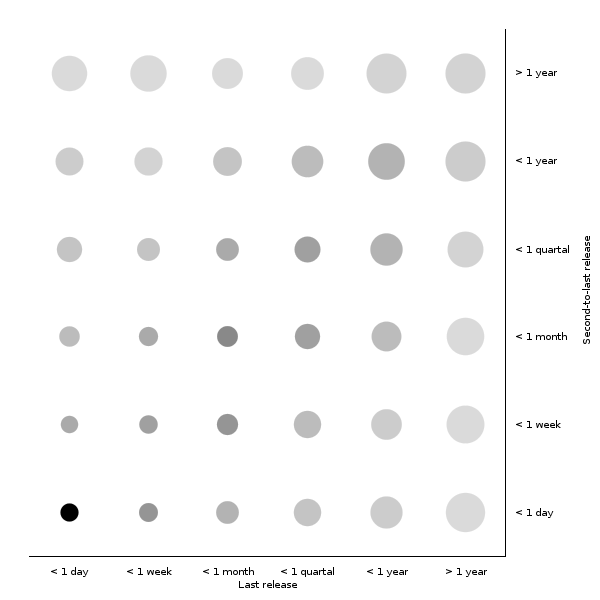
I grouped uploads by the livetime of their two preceding uploads. For each such groups, the circle indicates the average livetime. The darkness indicates the absolute number in the sample. So we see a correlation between the packages livetime and the livetime of its predecessor, which is also not very surprising. We can state some hypothesis, like: A package replacing a very old package is likely to be long-lived if its pre-predecessor lived very long or very shortly, but less so if that lived for a few months. But I m not sure of the significance of these. I could have also taken into account which uploads are major and which are minor, by looking at the version number, but I didn t. What s the conclusion? Nothing much. I got some funny looking graphs. And there needs to be a way to render pictures like the first within the axes of a Chart diagram. I put the (somewhat hackish) code online feel free to play with it.

Tanguy Ortolo: GNU/Linux graphic sessions: allowing computer suspend and disabling a monitor

Allowing computer suspend Major desktop environments such as Xfce or KDE have a built-in computer suspend feature, but when you use a lighter alternative, things are a bit more complicated, because basically: only root can suspend the computer. Possible solutions include: With recent updates of the related Debian packages no idea of which one exactly the latter solution may not work any more, in which case it will only return the following error:
Error org.freedesktop.UPower.GeneralError: not authorized
It appears that this error is linked to ConsoleKit, a part of all this modern *Kit gizmo pile. If you are in this case, try prefixing your session launcher with the undocumented dark magic call ck-launch-session. For instance, this is what I have in my .xsession to launch my window manager i3:
exec ck-launch-session i3
Note: I do not know what ck-launch-session does exactly, why it is needed, and I do not want to know. To me, all that WhatsitKit pile is just some opaque, under-documented as in: no man page crap, that no one but their author really understand, designed to solve theoretical problems no one really cares about like: how to allow locally connected users to use the sound card while forbidding it to remote users while creating new issues such as this one. This stuff is too complex and under-documented for me to dive into it, so if it does not work out of the box, it is just some crap that gets in my way to using my computer as I wish. Disabling a monitor In some configurations, you have two monitors and want to disable one. For instance, in addition to my LCD monitor, I have a projector which I only use for movies. According to xorg.conf's man page, it can be disabled this way:
Section "Device"
    Identifier  "Internal graphic card"
    Option      "Monitor-DVI"   "LCD Monitor"
    Option      "Monitor-VGA"   "Projector"
EndSection
Section "Monitor"
    Identifier  "LCD Monitor"
EndSection
Section "Monitor"
    Identifier  "Projector"
    Option      "Enable"    "false"
EndSection
Except that does not work, because contrary to what the man page says the real option to use is not Enable but Disable! So here is the correct configuration to disable that monitor at start-up:
Section "Device"
    Identifier  "Internal graphic card"
    Option      "Monitor-DVI"   "LCD Monitor"
    Option      "Monitor-VGA"   "Projector"
EndSection
Section "Monitor"
    Identifier  "LCD Monitor"
EndSection
Section "Monitor"
    Identifier  "Projector"
    Option      "Disable"   "true"
EndSection
Note: yes, I will send a bug report with a patch against xorg.conf's man page.

27 May 2014

Jon Dowland: 2012 In Review

2013 is nearly all finished up and so I thought I'd spend a little time writing up what was noteable in the last twelve months. When I did so I found an unfinished draft from the year before. It would be a shame for it to go to waste, so here it is. 2012 was an interesting year in many respects with personal highs and lows. Every year I see a lots of "round-up"-style blog posts on the web, titled things like "2012 in music", which attempt to summarize the highlights of the year in that particular context. Here's JWZ's effort, for example. Often they are prefixed with statements like "2012 was a strong year for music" or whatever. For me, 2012 was not a particularly great year. I discovered quite a lot of stuff that I love that was new to me, but not new in any other sense. In Music, there were a bunch of come-back albums that made the headlines. I picked up both of Orbital's Wonky and Brian Eno's Lux (debatably a comeback: his first ambient record since 1983, his first solo effort since 2005, but his fourth collaborative effort on Warp in the naughties). I've enjoyed them both, but I've already forgotten Wonky and I still haven't fully embraced Lux (and On Land has not been knocked from the top spot when I want to listen to ambience.) There was also Throbbing Gristle's (or X-TG) final effort, a semi/post-TG, partly posthumous double-album swan song effort which, even more than Lux, I still haven't fully digested. In all honesty I think it was eclipsed by the surprise one-off release of a live recording of a TG side project featuring Nik Void of Factory Floor: Carter Tutti Void's Transverse, which is excellent. Ostensibly a four-track release, there's a studio excerpt V4 studio (Slap 1) which is available from (at least) Amazon. There's also a much more obscure fifth "unreleased" track cruX which I managed to "buy" from one of the web shops for zero cost. The other big musical surprise for me last year was Beth Jeans Houghton and the Hooves of Destiny: Yours Truly, Cellophane Nose. I knew nothing of BJH, although it turns out I've heard some of her singles repeatedly on Radio 6, but her band's guitarist Ed Blazey and his partner lived in the flat below me briefly. In that time I managed to get to the pub with him just once, but he kindly gave me a copy of their album on 12" afterwards. It reminds me a bit of Goldfrapp circa "Seventh Tree": I really like it and I'm looking forward to whatever they do next. Reznor's How To Destroy Angels squeezed out An Omen EP which failed to set my world on fire as a coherent collection, despite a few strong songs individually. In movies, sadly once again I'd say most of the things I recall seeing would be "also rans". Prometheus was a disappointment, although I will probably rewatch it in 2D at least once. The final Batman was fun although not groundbreaking to me and it didn't surpass Ledger's efforts in The Dark Knight. Inception remains my favourite Nolan by a long shot. Looper is perhaps the stand-out, not least because it came from nowhere and I managed to avoid any hype. In games, I moaned about having moaning about too many games, most of which are much older than 2012. I started Borderlands 2 after enjoying Borderlands (disqualified on age grounds) but to this day haven't persued it much further. I mostly played the two similar meta-games: The Playstation Plus download free games in a fixed time period and the more sporadic but bountiful humble bundle whack-a-mole. More on these another time. In reading, as is typical I mostly read stuff that was not written in 2012. Of that which was, Charles Stross's The Apocalypse Codex was an improvement over The Fuller Memorandum which I did not enjoy much, but in general I'm finding I much prefer Stross's older work to his newer; David Byrne's How Music Works was my first (and currently last) Google Books ebook purchase, and I read it entirely on a Nexus 7. I thoroughly enjoyed the book but the experience has not made a convert of me away from paper. He leans heavily on his own experiences which is inevitable but fortunately they are wide and numerous. Iain Banks' Stonemouth was an enjoyable romp around a fictional Scottish town (one which, I am reliably informed, is incredibly realistical rendered). One of his "mainstream" novels, It avoided a particular plot pattern that I've grown to dread with Banks, much to my suprise (and pleasure). Finally, the stand-out pleasant surprise novel of the year was Pratchett and Baxter's The Long Earth. With a plot device not unlike Banks' Transition or Stross's Family Trade series, the pair managed to write a journey-book capturing the sense-of-wonder that these multiverse plots are good for. (Or perhaps I have a weakness for them). It's hard to find the lines between Baxter and Pratchett's writing, but the debatably-reincarnated Tibetan Monk-cum-Artificial Intelligence 'Lobsang' must surely be Pratchett's. Pratchett managed to squeeze out another non-Discworld novel (Dodger) as well as a long-overdue short story collection, although I haven't read either of them yet. On to 2013's write-up...

2 May 2014

Dimitri John Ledkov: X4D Icons released

I am releasing some icons under MIT license. They will be hosted at x4d.surgut.co.uk and available for development on GitHub.

I had to create my own icons, as I couldn't find icons of similar nature under a free license. Hopefully others will find these useful as well.

The icons below are all available in PNG, GIF, SVG and EPS. To link to a specific version directly, add .png, .gif, -v.svg or -v.eps to the generic URI (or browse the icons repository to see all versions).

Document type Light Dark
HTML 2.0 Valid HTML2 Valid HTML20
HTML 3.2 Valid HTML32 Valid HTML32
HTML 4.0 Valid HTML40 Valid HTML40
HTML 4.01 Valid HTML4.01 Valid HTML4.01
XHTML 1.0 Valid XHTML10 Valid XHTML10
XHTML 1.1 Valid XHTML11 Valid XHTML11
XHTML Basic 1.0 Valid XHTML Basic 10 Valid XHTML Basic 10
XHTML-Print 1.0 Valid XHTML Print 10 Valid XHTML Print 10
CSS Valid CSS Valid CSS
CSS 1 Valid CSS1 Valid CSS1
CSS 2 Valid CSS2 Valid CSS2
MathML 2.0 Valid MathML 20 Valid MATHML20
SVG 1.0 Valid SVG10 Valid SVG10
SVG 1.1 Valid SVG11 Valid SVG11
SVG 1.2 Valid SVG12 Valid SVG12
SVG Tiny 1.1 Valid SVG Tiny11 Valid SVG Tiny11
SVG Tiny 1.2 Valid SVG Tiny12 Valid SVG Tiny12
XML 1.0 well-formed XML10 well-formed XML10
XML 1.1 well-formed XML11 well-formed XML11

29 April 2014

Russell Coker: Autism and the Treatment of Women Again

Background I ve previously written about the claim that people use Autism as an excuse for bad behavior [1]. In summary it doesn t and such claims instead lead to people not being assessed for Autism. I ve also previously written about empathy and Autism in the context of discussions about conference sexual harassment [2]. The main point is that anyone who s going to blame empathy disorders for the widespread mistreatment of women in society and divert the subject from the actions of average men to men in minority groups isn t demonstrating empathy. Discussions of the actions of average men are so often derailed to cover Autism that the Geek Feminism Wiki has a page about the issue of blaming Autism [3]. The Latest Issue Last year Shanley Kane wrote an informative article for Medium titled What Can Men Do about the treatment of women in the IT industry [4]. It s a good article, I recommend reading it. As an aside @shanley s twitter feed is worth reading [5]. In response to Shanley s article Jeff Atwood wrote an article of the same title this year which covered lots of other things [6]. He writes about Autism but doesn t seem to realise that officially Asperger Syndrome is now Autism according to DSM-V (they decided that separate diagnosis of Autism, Asperger Syndrome, and PDD-NOS were too difficult and merged them). Asperger Syndrome is now a term that refers to historic issues (IE research that was published before DSM-V) and slang use. Gender and the Autism Spectrum Jeff claims that autism skews heavily towards males at a 4:1 ratio and cites the Epidemiology of Autism Wikipedia page as a reference. Firstly that page isn t a great reference, I fixed one major error (which was obviously wrong to anyone who knows anything about Autism and also contradicted the cited reference) in the first section while writing this post. The Wikipedia page cites a PDF about the Epidemiology of Autism that claims the 4.3:1 ratio of boys to girls [7]. However that PDF is a summary of other articles and the one which originated the 4.3:1 claim is behind a paywall. One thing that is worth noting in the PDF is that the section containing the 4.3:1 claim also references claims about correlations between race and Autism and studies contradicting such claims it notes the possibility of ascertainment bias . I think that anyone who reads that section should immediately consider the possibility of ascertainment bias in regard to the gender ratio. Most people who are diagnosed with Autism are diagnosed as children. An Autism diagnosis of a child is quite subjective, an important part is an IQ test (where the psychologist interprets the intent of the child in the many cases where answers aren t clear) to compare social skills with IQ. So whether a child is diagnosed is determined by the psychologist s impression of the child s IQ vs the impression of their social skills. Whether a child is even taken for assessment depends on whether they act in a way that s considered to be obviously different. Any child who is suspected of being on the Autism Spectrum will be compared other children who have been diagnosed (IE mostly boys) and this will probably increase the probability that a boy will be assessed. So an Aspie girl might not be assessed because she acts like other Aspie girls not like the Aspie boys her parents and teachers have seen. The way kids act is not solely determined by neuro-type. Our society expects and encourages boys to be louder than girls and take longer and more frequent turns to speak, this is so widespread that I don t think it s possible for parents to avoid it if their kids are exposed to the outside world. Because of this boys who would be diagnosed with Asperger Syndrome by DSM-IV tend to act in ways that are obviously different from other kids. While the combination of Autism and the the social expectations on girls tends to result in girls who are quiet, shy, and apologetic. The fact that girls are less obviously different and that their differences cause fewer difficulties for parents and teachers makes them less likely to be assessed. Note that the differences in behavior of boys and girls who have been diagnosed is noted by the professionals (and was discussed at a conference on AsperGirls that my wife attended) while the idea that this affects assessment rates is my theory. Jeff also cites the book The Essential Difference: Male And Female Brains And The Truth About Autism by Professor Simon Baron-Cohen (who s (in)famous for his Extreme Male Brain theory). The first thing to note about the Extreme Male Brain theory are that it depends almost entirely on the 4.3:1 ratio of males to females on the Autism Spectrum (which is dubious as I noted above). The only other evidence in support of it is subjective studies of children which suffer from the same cultural issues this is why double blind tests should be used whenever possible. The book Delusions of Gender by Cordelia Fine [8] debunks Simon Baron-Cohen s work among other things. The look inside feature of the Amazon page for Delusions of Gender allows you to read about Simon Baron-Cohen s work [9]. Now even if the Extreme Male Brain theory had any merit it would be a really bad idea to cite it (or a book based on it) if you want to make things better for women in the IT industry. Cordelia s book debunks the science and also shows how such claims about supposed essential difference are taken as exclusionary. The Problem with Jeff Atwood Jeff suggests in his post that men should listen to women. Then he and his followers have a huge flame-war with many women over twitter during which which he tweeted Trying to diversify my follows by following any female voices that engaged me in a civil, constructive way recently . If you only listen to women who agree with you then that doesn t really count as listening to women. When you have a stated policy of only listening to women who agree then it seems to be more about limiting what women may feel free to say around you. The Geek Feminism wiki page about the Tone Argument [10] says the following: One way in which the tone argument frequently manifests itself is as a call for civility. A way to gauge whether a request for civility is sincere or not is to ask whether the person asking for civility has more power along whatever axes are contextually relevant (see Intersectionality) than the person being called incivil , less power, or equal power. Often, people who have the privilege of being listened to and taken seriously level accusations of incivility as a silencing tactic, and label as incivil any speech or behavior that questions their privilege. For example, some men label any feminist thought or speech as hostile or impolite; there is no way for anybody to question male power or privilege without being called rude or aggressive. Likewise, some white people label any critical discussion of race, particularly when initiated by people of color, as incivil. Writing about one topic is also a really good idea. A blog post titled What Can Men Do should be about things that men can do. Not about Autism, speculation about supposed inherent differences between men and women which are based on bad research, gender diversity in various occupations, etc. Following up a post on What Can Men Do with discussion (in blog comments and twitter) about what women should do before they are allowed to join the conversation is ridiculous. Jeff s blog post says that men should listen to women, excluding women based on the tone argument is gross hypocrisy. Swearing Jeff makes a big deal of the fact that Shanley uses some profane language in her tweets. This combines a couple of different ways of silencing women. It s quite common for women to be held to a high standard of ladylike behavior, while men get a free pass on doing the same thing. One example of this is the Geek Feminism article about the results of Sarah Sharp s request for civility in the Linux kernel community [11]. That s not an isolated incident, to the best of my recollection in 20+ years my local Linux Users Group has had only one debate about profanity on mailing lists in that case a woman (who is no longer active in the group) was criticised for using lesser profanity than men used both before and after with no comment (as an experiment I used some gratuitous profanity a couple of weeks later and no-one commented). There is also a common difference in interpretation of expressions of emotion, when a woman seems angry then she invariably has men tell her to change her approach (even when there are obvious reasons for her anger) while when a man is angry the possibility that other people shouldn t make him angry will usually be considered. The issues related to the treatment of women have had a large affect on Shanley s life and her friend s lives. It s quite understandable that she is angry about this. Her use of profanity in tweets seems appropriate to the situation. Other Links Newsweek s Gentlemen in Technology article has a section about Jeff [12], it s interesting to note his history of deleting tweets and editing his post. I presume he will change his post in response to mine and not make any note of the differences. Jacob Kaplan-Moss wrote a good rebuttal to Jeff s post [13]. It s a good article and has some other relevant links that are worth reading.

27 April 2014

Vincent Bernat: Local corporate APT repositories

Distributing software efficiently accross your platform can be difficult. Every distribution comes with a package manager which is usually suited for this task. APT can be relied upon on when using Debian or a derivative. Unfortunately, the official repositories may not contain everything you need. When you require unpackaged software or more recent versions, it is possible to setup your own local repository. Most of what is presented here was setup for Dailymotion and was greatly inspired by the work done by Rapha l Pinson at Orange.

Setting up your repositories There are three kinds of repositories you may want to setup:
  1. A distribution mirror. Such a mirror will save bandwidth, provide faster downloads and permanent access, even when someone searches Google on Google.
  2. A local repository for your own packages with the ability to have a staging zone to test packages on some servers before putting them in production.
  3. Mirrors for unofficial repositories, like Ubuntu PPA. To avoid unexpected changes, such a repository will also get a staging and a production zone.
Before going further, it is quite important to understand what a repository is. Let s illustrate with the following line from my /etc/apt/sources.list:
deb http://ftp.debian.org/debian/ unstable main contrib non-free
In this example, http://ftp.debian.org/debian/ is the repository and unstable is the distribution. A distribution is subdivided into components. We have three components: main, contrib and non-free. To setup repositories, we will use reprepro. This is not the only solution but it has a good balance between versatility and simplicity. reprepro can only handle one repository. So, the first choice is about how you will split your packages in repositories, distributions and components. Here is what matters:
  • A repository cannot contain two identical packages (same name, same version, same architecture).
  • Inside a component, you can only have one version of a package.
  • Usually, a distribution is a subset of the versions while a component is a subset of the packages. For example, in Debian, with the distribution unstable, you choose to get the most recent versions while with the component main, you choose to get DFSG-free software only.
If you go for several repositories, you will have to handle several reprepro instances and won t be able to easily copy packages from one place to another. At Dailymotion, we put everything in the same repository but it would also be perfectly valid to have three repositories:
  • one to mirror the distribution,
  • one for your local packages, and
  • one to mirror unofficial repositories.
Here is our target setup: Local APT repository

Initial setup First, create a system user to work with the repositories:
$ adduser --system --disabled-password --disabled-login \
>         --home /srv/packages \
>         --group reprepro
All operations should be done with this user only. If you want to setup several repositories, create a directory for each of them. Each repository has those subdirectories:
  • conf/ contains the configuration files,
  • gpg/ contains the GPG stuff to sign the repository1,
  • logs/ contains the logs,
  • www/ contains the repository that should be exported by the web server.
Here is the content of conf/options:
outdir +b/www
logdir +b/logs
gnupghome +b/gpg
Then, you need to create the GPG key to sign the repository:
$ GNUPGHOME=gpg gpg --gen-key
Please select what kind of key you want:
   (1) RSA and RSA (default)
   (2) DSA and Elgamal
   (3) DSA (sign only)
   (4) RSA (sign only)
Your selection? 1
RSA keys may be between 1024 and 4096 bits long.
What keysize do you want? (2048) 4096
Requested keysize is 4096 bits
Please specify how long the key should be valid.
         0 = key does not expire
      <n>  = key expires in n days
      <n>w = key expires in n weeks
      <n>m = key expires in n months
      <n>y = key expires in n years
Key is valid for? (0) 10y
Key expires at mer. 08 nov. 2023 22:30:58 CET
Is this correct? (y/N) y
Real name: Dailymotion Archive Automatic Signing Key
Email address: the-it-operations@dailymotion.com
Comment: 
[...]
By setting an empty password, you allow reprepro to run unattended. You will have to distribute the public key of your new repository to let APT check the archive signature. An easy way is to ship it in some package.

Local mirror of an official distribution Let s start by mirroring a distribution. We want a local mirror of Ubuntu Precise. For this, we need to do two things:
  1. Setup a new distribution in conf/distributions.
  2. Configure the update sources in conf/updates.
Let s add this block to conf/distributions:
# Ubuntu Precise
Origin: Ubuntu
Label: Ubuntu
Suite: precise
Version: 12.04
Codename: precise
Architectures: i386 amd64
Components: main restricted universe multiverse
UDebComponents: main restricted universe multiverse
Description: Ubuntu Precise 12.04 (with updates and security)
Contents: .gz .bz2
UDebIndices: Packages Release . .gz
Tracking: minimal
Update: - ubuntu-precise ubuntu-precise-updates ubuntu-precise-security
SignWith: yes
This defines the precise distribution in our repository. It contains four components: main, restricted, universe and multiverse (like the regular distribution in official repositories). The Update line starts with a dash. This means reprepro will mark everything as deleted before updating with the provided sources. Old packages will not be kept when they are removed from Ubuntu. In conf/updates, we define the sources:
# Ubuntu Precise
Name: ubuntu-precise
Method: http://fr.archive.ubuntu.com/ubuntu
Fallback: http://de.archive.ubuntu.com/ubuntu
Suite: precise
Components: main main multiverse restricted universe
UDebComponents: main restricted universe multiverse
Architectures: amd64 i386
VerifyRelease: 437D05B5
GetInRelease: no
# Ubuntu Precise Updates
Name: ubuntu-precise-updates
Method: http://fr.archive.ubuntu.com/ubuntu
Fallback: http://de.archive.ubuntu.com/ubuntu
Suite: precise-updates
Components: main restricted universe multiverse
UDebComponents: main restricted universe multiverse
Architectures: amd64 i386
VerifyRelease: 437D05B5
GetInRelease: no
# Ubuntu Precise Security
Name: ubuntu-precise-security
Method: http://fr.archive.ubuntu.com/ubuntu
Fallback: http://de.archive.ubuntu.com/ubuntu
Suite: precise-security
Components: main restricted universe multiverse
UDebComponents: main restricted universe multiverse
Architectures: amd64 i386
VerifyRelease: 437D05B5
GetInRelease: no
The VerifyRelease lines are GPG key fingerprint to use to check the remote repository. The key needs to be imported in the local keyring:
$ gpg --keyring /usr/share/keyrings/ubuntu-archive-keyring.gpg \
>     --export 437D05B5   GNUPGHOME=gpg gpg --import
Another important point is that we merge three distributions (precise, precise-updates and precise-security) into a single distribution (precise) in our local repository. This may cause some difficulties with tools expecting the three distributions to be available (like the Debian Installer2). Next, you can run reprepro and ask it to update your local mirror:
$ reprepro update
This will take some time on the first run. You can execute this command every night. reprepro is not the fastest mirror solution but it is easy to setup, flexible and reliable.

Repository for local packages Let s configure the repository to accept local packages. For each official distribution (like precise), we will configure two distributions:
  • precise-staging contains packages that have not been fully tested and not ready to go to production.
  • precise-prod contains production packages copied from precise-staging.
In our workflow, packages are introduced in precise-staging where they can be tested and will be copied to precise-prod when we want them to be available for production. You can adopt a more complex workflow if you need. The reprepro part is quite easy. We add the following blocks into conf/distributions:
# Dailymotion Precise packages (staging)
Origin: Dailymotion #  
Label: dm-staging   #  
Suite: precise-staging
Codename: precise-staging
Architectures: i386 amd64 source
Components: main role/dns role/database role/web #  
Description: Dailymotion Precise staging repository
Contents: .gz .bz2
Tracking: keep
SignWith: yes
NotAutomatic: yes #  
Log: packages.dm-precise-staging.log
 --type=dsc email-changes
# Dailymotion Precise packages (prod)
Origin: Dailymotion #  
Label: dm-prod      #  
Suite: precise-prod
Codename: precise-prod
Architectures: i386 amd64 source
Components: main role/dns role/database role/web #  
Description: Dailymotion Precise prod repository
Contents: .gz .bz2
Tracking: keep
SignWith: yes
Log: packages.dm-precise-prod.log
First notice we use several components (in ):
  • main will contain packages that are not specific to a subset of the platform. If you put a package in main, it should work correctly on any host.
  • role/* are components dedicated to a subset of the platform. For example, in role/dns, we ship a custom version of BIND.
The staging distribution has the NotAutomatic flag (in ) which disallows the package manager to install those packages except if the user explicitely requests it. Just below, when a new dsc file is uploaded, the hook email-changes will be executed. It should be in the conf/ directory. The Origin and Label lines (in ) are quite important to be able to define an explicit policy of which packages should be installed. Let s say we use the following /etc/apt/sources.list file:
# Ubuntu packages
deb http://packages.dm.gg/dailymotion precise main restricted universe multiverse
# Dailymotion packages
deb http://packages.dm.gg/dailymotion precise-prod    main role/dns
deb http://packages.dm.gg/dailymotion precise-staging main role/dns
All servers have the precise-staging distribution. We must ensure we won t install those packages by mistake. The NotAutomatic flag is one possible safe-guard. We also use a tailored /etc/apt/preferences:
Explanation: Dailymotion packages of a specific component should be more preferred
Package: *
Pin: release o=Dailymotion, l=dm-prod, c=role/*
Pin-Priority: 950
Explanation: Dailymotion packages should be preferred
Package: *
Pin: release o=Dailymotion, l=dm-prod
Pin-Priority: 900
Explanation: staging should never be preferred
Package: *
Pin: release o=Dailymotion, l=dm-staging
Pin-Priority: -100
By default, packages will have a priority of 500. By setting a priority of -100 to the staging distribution, we ensure the packages cannot be installed at all. This is stronger than NotAutomatic which sets the priority to 1. When a package exists in Ubuntu and in our local repository, we ensure that, if this is a production package, we will use ours by using a priority of 900 (or 950 if we match a specific role component). Have a look at the How APT Interprets Priorities section of apt_preferences(5) manual page for additional information. Keep in mind that version matters only when the priority is the same. To check if everything works as you expect, use apt-cache policy:
$ apt-cache policy php5-memcache
  Installed: 3.0.8-1~precise2~dm1
  Candidate: 3.0.8-1~precise2~dm1
  Version table:
 *** 3.0.8-1~precise2~dm1 0
        950 http://packages.dm.gg/dailymotion/ precise-prod/role/web amd64 Packages
        100 /var/lib/dpkg/status
     3.0.8-1~precise1~dm4 0
        900 http://packages.dm.gg/dailymotion/ precise-prod/main amd64 Packages
       -100 http://packages.dm.gg/dailymotion/ precise-staging/main amd64 Packages
     3.0.6-1 0
        500 http://packages.dm.gg/dailymotion/ precise/universe amd64 Packages
If we want to install a package from the staging distribution, we can use apt-get with the -t precise-staging option to raise the priority of this distribution to 990. Once you have tested your package, you can copy it from the staging distribution to the production distribution:
$ reprepro -C main copysrc precise-prod precise-staging wackadoodle

Local mirror of third-party repositories Sometimes, you want a software published on some third-party repository without to repackage it yourself. A common example is the repositories edited by hardware vendors. Like for an Ubuntu mirror, there are two steps: defining the distribution and defining the source. We chose to put such mirrors into the same distributions as our local packages but with a dedicated component for each mirror. This way, those third-party packages will share the same workflow as our local packages: they will appear in the staging distribution, we validate them and copy them to the production distribution. The first step is to add the components and an appropriate Update line to conf/distributions:
Origin: Dailymotion
Label: dm-staging
Suite: precise-staging
Components: main role/dns role/database role/web vendor/hp
Update: hp
# [...]
Origin: Dailymotion
Label: dm-prod
Suite: precise-prod
Components: main role/dns role/database role/web vendor/hp
# [...]
We added the vendor/hp component to both the staging and the production distributions. However, only the staging distribution gets an Update line (remember, packages will be copied manually into the production distribution). We declare the source in conf/updates:
# HP repository
Name: hp
Method: http://downloads.linux.hp.com/SDR/downloads/ManagementComponentPack/
Suite: precise/current
Components: non-free>vendor/hp
Architectures: i386 amd64
VerifyRelease: 2689B887
GetInRelease: no
Don t forget to add the GPG key to your local keyring. Notice an interesting feature of reprepro: we copy the remote non-free component to our local vendor/hp component. Then, you can synchronize the mirror with reprepro update. Once the packages have been tested, you will have to copy them in the production distribution.

Building Debian packages Our reprepro setup seems complete, but how do we put packages into the staging distribution? You have several options to build Debian packages for your local repository. It really depends on how much time you want to invest in this activity:
  1. Build packages from source by adding a debian/ directory. This is the classic way of building Debian packages. You can start from scratch or use an existing package as a base. In the latest case, the package can be from the official archive but for a more recent distribution or a backport or from an unofficial repository.
  2. Use a tool that will create a binary package from a directory, like fpm. Such a tool will try to guess a lot of things to minimize your work. It can even download everything for you.
There is no universal solution. If you don t have the time budget for building packages from source, have a look at fpm. I would advise you to use the first approach when possible because you will get those perks for free:
  • You keep the sources in your repository. Whenever you need to rebuild something to fix an emergency bug, you won t have to hunt the sources which may be unavailable when you need them the most. Of course, this only works if you build packages that don t download stuff directly from the Internet.
  • You also keep the recipe3 to build the package in your repository. If someone enables some option and rebuild the package, you won t accidently drop this option on the next build. Those changes can be documented in debian/changelog. Moreover, you can use a version control software for the whole debian/ directory.
  • You can propose your package for inclusion into Debian. This will help many people once the package hits the archive.

Builders We chose pbuilder as a builder4. Its setup is quite straightforward. Here is our /etc/pbuilderrc:
DISTRIBUTION=$DIST
NAME="$DIST-$ARCH"
MIRRORSITE=http://packages.dm.gg/dailymotion
COMPONENTS=("main" "restricted" "universe" "multiverse")
OTHERMIRROR="deb http://packages.dm.gg/dailymotion $ DIST -staging main"
HOOKDIR=/etc/pbuilder/hooks.d
BASE=/var/cache/pbuilder/dailymotion
BASETGZ=$BASE/$NAME/base.tgz
BUILDRESULT=$BASE/$NAME/results/
APTCACHE=$BASE/$NAME/aptcache/
DEBBUILDOPTS="-sa"
KEYRING="/usr/share/keyrings/dailymotion-archive.keyring.gpg"
DEBOOTSTRAPOPTS=("--arch" "$ARCH" "--variant=buildd" "$ DEBOOTSTRAPOPTS[@] " "--keyring=$KEYRING")
APTKEYRINGS=("$KEYRING")
EXTRAPACKAGES=("dailymotion-archive-keyring")
pbuilder is expected to be invoked with DIST, ARCH and optionally ROLE environment variables. Building the initial bases can be done like this:
for ARCH in i386 amd64; do
  for DIST in precise; do
    export ARCH
    export DIST
    pbuilder --create
  done
done
We don t create a base for each role. Instead, we use a D hook to add the appropriate source:
#!/bin/bash
[ -z "$ROLE" ]    
  cat >> /etc/apt/sources.list <<EOF
deb http://packages.dm.gg/dailymotion $ DIST -staging role/$ ROLE 
EOF
 
apt-get update
We ensure packages from our staging distribution are preferred over other packages by adding an /etc/apt/preferences file in a E hook:
#!/bin/bash
cat > /etc/apt/preferences <<EOF
Explanation: Dailymotion packages are of higher priority
Package: *
Pin: release o=Dailymotion
Pin-Priority: 900
EOF
We also use a C hook to get a shell in case there is an error. This is convenient to debug a problem:
#!/bin/bash
apt-get install -y --force-yes vim less
cd /tmp/buildd/*/debian/..
/bin/bash < /dev/tty > /dev/tty 2> /dev/tty
A manual build can be run with:
$ ARCH=amd64 DIST=precise ROLE=web pbuilder \
>         --build somepackage.dsc

Version numbering To avoid to apply complex rules to chose a version number for a package, we chose to treat everything as a backport, even in-house software. We use the following scheme: X-Y~preciseZ+dmW.
  • X is the upstream version5.
  • Y is the Debian version. If there is no Debian version, use 0.
  • Z is the Ubuntu backport version. Again, if such a version doesn t exist, use 0.
  • W is our version of the package. We increment it when we make a change to the packaging. This is the only number we are allowed to control. All the others are set by an upstream entity, unless it doesn t exist and in this case, you use 0.
Let s suppose you need to backport wackadoodle. It is available in a more recent version of Ubuntu as 1.4-3. Your first backport will be 1.4-3~precise0+dm1. After a change to the packaging, the version will be 1.4-3~precise0+dm2. A new upstream version 1.5 is available and you need it. You will use 1.5-0~precise0+dm1. Later, this new upstream version will be available in some version of Ubuntu as 1.5-3ubuntu1. You will rebase your changes on this version and get 1.5-3ubuntu1~precise0+dm1. When using Debian instead of Ubuntu, a compatible convention could be : X-Y~bpo70+Z~dm+W.

Uploading To upload a package, a common setup is the following workflow:
  1. Upload the source package to an incoming directory.
  2. reprepro will notice the source package, check its correctness (signature, distribution) and put it in the archive.
  3. The builder will notice a new package needs to be built and build it.
  4. Once the package is built, the builder will upload the result to the incoming directory.
  5. reprepro will notice again the new binary package and integrate it in the archive.
This workflow has the disadvantage to have many moving pieces and to leave the user in the dark while the compilation is in progress. As an alternative, a simple script can be used to execute each step synchronously. The user can follow on their terminal that everything works as expected. Once we have the .changes file, the build script just issues the appropriate command to include the result in the archive:
$ reprepro -C main include precise-staging \
>      wackadoodle_1.4-3~precise0+dm4_amd64.changes
Happy hacking!

  1. The gpg/ directory could be shared by several repositories.
  2. We teached Debian Installer to work with our setup with an appropriate preseed file.
  3. fpm-cookery is a convenient tool to write recipes for fpm, similar to Homebrew or a BSD port tree. It could be used to achieve the same goal.
  4. sbuild is an alternative to pbuilder and is the official builder for both Debian and Ubuntu. Historically, pbuilder was more focused on developers needs.
  5. For a Git snapshot, we use something like 1.4-git20130905+1-ae42dc1 which is a snapshot made after version 1.4 (use 0.0 if no version has ever been released) at the given date. The following 1 is to be able to package different snapshots at the same date while the hash is here in case you need to retrieve the exact snapshot.

Next.

Previous.