Search Results: "christoph"

12 June 2010

Russell Coker: Links June 2010

Seth Berkley gave an interesting TED talk about developing vaccines against the HIV and Influenza viruses [1]. The part I found most interesting was the description of how vaccines against viruses are currently developed using eggs and how they plan to use bacteria instead for faster and cheaper production. One of the problems with using eggs is that if the chickens catch the disease and die then you can t make a vaccine. Aigars Mahinovs wrote a really good review of Microsoft Azure and compared it to Amazon EC2 [2]. It didn t surprise me that Azure compared poorly to the competition. Johanna Blakley gave an insightful TED talk about IP lessons from the fashion industry [3]. She explained how an entire lack of IP protection other than trademark law was an essential part of the success of the fashion industry. She also compared the profits in various industries and showed that industries with little or no IP protection involve vastly larger amounts of money than industries with strong IP protection. Lisa D wrote an insightful post about whether Autism Spectrum Disorders (such as Asperger Syndrome) should be considered to be disabilities [4]. I don t entirely agree with her, but she makes some really good points. Sharmeen Obaid-Chinoy gave an interesting TED talk about the way the Taliban train young children to become suicide bombers [5]. Apparently the Taliban prey on large poor families, sometimes paying the parents for taking children away to school . At the Taliban schools the children are beaten, treated poorly, and taught theology by liars who will say whatever it takes to get a result. Then after being brain-washed they are sent out to die. Wired has an interesting article about Charles Komanoff s research into New York traffic problems [6]. He aims to track all the economic externalities of traffic patterns and determine incentives to encourage people to do things that impose less costs on the general economy. His suggestions include making all bus travel free as the externality of the time spent collecting fares is greater than the fare revenue. It s a really interesting article, his research methods should be implemented when analysing traffic in all large cities, and many of his solutions can be implemented right now without further analysis such as free buses and variable ticket pricing according to the time of day. William Li gave an interesting TED talk about starving cancer by preventing new blood vessels from growing to feed it [7]. Drugs to do this have been shown to increase the life expectancy of cancer patients by more than 100% on average. Also autopsies of people who died in car accidents show that half the women in their 40 s had breast cancer and half the men in their 50 s prostate cancer but those cancers didn t grow due to a natural lack of blood supply, so the aim here is to merely promote what naturally happens in terms of regulating cancers and preventing them from growing larger than 0.5mm^3. There are a number of foods that prevent blood vessels growing to cancers which includes dark chocolate! ;) Also drugs which prevent blood vessel growth also prevent obesity, I always thought that eating chocolate all the time prevented me from getting fat due to the central nervous system stimulants that kept me active Graham Hill gave an inspiring TED talk about becoming a weekday vegetarian [8]. Instead of making a commitment to being always vegetarian he s just mostly vegetarian (only eating meat on Sundays). He saves most of the environmental cost and doesn t feel guilty if he ever misses a day. It s an interesting concept. Cory Doctorow wrote an insightful article for the Guardian about the phrase Information Wants To Be Free [9]. He points out that really it s people who want to be free from the tyranny that is being imposed on us in the name of anti-piracy measures. He also points out that it s a useful straw-man for the MAFIAA to use when claiming that we are all pirates. The Atlantic has an interesting article about the way that Google is working to save journalistic news [10]. Adam Sadowsky gave an interesting TED talk about creating a Rube Goldberg machine for the OK Go video This Too Shall Pass [11]. At the end of the talk they include a 640*480 resolution copy of the music video. Brian Cox gave an interesting TED talk advocating increased government spending on scientific research [12]. Among other things he pointed out that the best research indicates that the amount of money the US government invested in the Apollo program was returned 14* to the US economy due to exports of new American products that were based on that research. It s surprising that any justification other than the return on investment for the Apollo program is needed! Moot gave an interesting TED talk about Anonymity [13]. I don t think that he made a good case for anonymity, he cited one person being identified and arrested for animal cruelty due to the efforts of 4chan people and also the campaign against the Cult of Scientology (which has not been very successful so far). Rory Sutherland gave an intriguing TED talk titled Sweat the Small Stuff [14]. He describes how small cheap changes can often provide greater benefits than huge expensive changes and advocates corporations having a Chief Detail Officer to take charge of identifying and implementing such changes. TED Hosted an interesting debate between pro and anti nuclear campaigners [15]. They agreed that global warming is a significant imminent problem but disagree on what methods should be implemented to solve it.

2 June 2010

Christoph Egger: [FAIL] Security

I'm all for security and really like encryption (my Notebook's harddrive is encrypted, I've recently got a GPG Smartcard, ...) but sometimes you see big failes where security is atemted but doesn't actually secure anything but only hinders the legitimate user. Today one of these candidates ate way to much of my time again. I'm currently getting more and more used to GNU Emacs and currently experimenting with emacs-jabber. Therefore copying my jabber accounts over from psi. As with these passwords you never type in I couldn't remember some of my jabber passwords -- no problem psi has to store them so it should be easy to get them, right? Well actually not. The configuration file (XML) had a password entry but all that was in it was just obviously hex-encoded numbers. These numbers turned out to be be 16bit packages of characters that are XOR-ed against the JID So now you have to read them in in junks of 16bit, XOR them against the JID and get the password. Time to recapitulate what this security helped. I've written a hacky 10 lines C Program that can reliably retrieve passwords from any config file I might come across. Seems you can do the same in 2 lines of perl. Ergo no security at all was added. Next question: What did it cost? Needed an hour or so of researching the encryption and trial&error out the right program fragment. For nothing gained at all. Fail.

10 May 2010

Ian Wienand: Cook's Illustrated v Food52 Cookie Challenge

I saw Christopher Kimball, doyen of the Cook's Illustrated empire, at our local bookstore a while ago and, as one of my old professors would say, he was "good value". He did, however, have a bit of a rant about the internet and how random websites just did not produce recipes that could compare to the meticulous testing that a Cook's Illustrated recipe went through. I was interested to see this come to a head on Slate where Cook's Illustrated has put their recipes up against food52.com for a head-to-head battle. So yesterday, my wife and I took up the challenge. We resolved to follow both recipes meticulously, which I believe we achieved after a trip for ingredients. Neither was particularly easier or harder than the other -- the Cook's Illustrated had a lot of fiddling with spices, while the food52.com one required creaming the butter and sugar. Both came out pretty much as you would expect, although the Cook's Illustrated ones were a little flat. The recipe does say to be careful to not overwork the dough; it may be partially user error. We were split. I liked the Cook's Illustrated one better, as the spices really were quite mellow and very enjoyable with a cup of coffee. My wife tended towards the plainer food52.com ones, but she is a big fan of a plain sugar cookie. The ultimate test, however, was leaving both of them on the bench at work with a request to vote. The winner was clear -- 10 votes for Cook's Illustrated and only 3 for food52.com. So, maybe Kimball has a point. Either way, when there's cookies, everyone's a winner! Some photos of the results: <object height="300" width="400"> <param name="flashvars" value="offsite=true&amp;lang=en-us&amp;page_show_url=%2Fphotos%2Fiwienand%2Fsets%2F72157623913498245%2Fshow%2F&amp;page_show_back_url=%2Fphotos%2Fiwienand%2Fsets%2F72157623913498245%2F&amp;set_id=72157623913498245&amp;jump_to="> <param name="movie" value="http://www.flickr.com/apps/slideshow/show.swf?v=71649"> <param name="allowFullScreen" value="true"><embed allowfullscreen="true" flashvars="offsite=true&amp;lang=en-us&amp;page_show_url=%2Fphotos%2Fiwienand%2Fsets%2F72157623913498245%2Fshow%2F&amp;page_show_back_url=%2Fphotos%2Fiwienand%2Fsets%2F72157623913498245%2F&amp;set_id=72157623913498245&amp;jump_to=" height="300" src="http://www.flickr.com/apps/slideshow/show.swf?v=71649" type="application/x-shockwave-flash" width="400"></embed></object>

8 May 2010

Christoph Berg: tenace 0.10 released

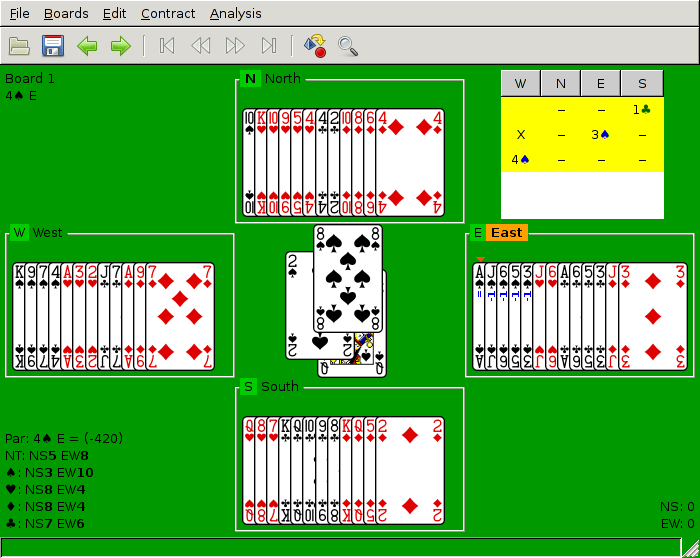
It has been a while since the last update for tenace, my bridge hand viewer. The highlight in version 0.10 is version 2.0 of the double dummy engine dds which has been updated to support parallel computation in multiple threads. The parscore computation in tenace now uses all available CPU cores. Even my notebook has two CPUs :). More on the technical side, the GUI has been switched to use GtkBuilder which comes with Gtk so there is no external library needed anymore (previously libglade). The looks are pretty much the same as before, though. The previous version 0.9 had added windows support via mingw. I would still appreciate if people could test it and tell me which bits I need to improve.
7 May 2010

Christoph Berg: Clamav segfaults

If you are still using clamav on etch, you might want to upgrade now:
# /etc/init.d/clamav-daemon start  
Starting ClamAV daemon: clamd LibClamAV Warning: ***********************************************************
LibClamAV Warning: ***  This version of the ClamAV engine is outdated.     ***
LibClamAV Warning: *** DON'T PANIC! Read http://www.clamav.net/support/faq ***
LibClamAV Warning: ***********************************************************
/etc/init.d/clamav-daemon: line 240:  5221 Segmentation fault      start-stop-daemon --start -o -c $User --exec $DAEMON
 failed!
Rolling back to yesterday's daily.cld fixes the issue, at least for the segfault.

6 May 2010

Adrian von Bidder: Inglourious Basterds

Whew. Thank God I did download that one and not spend money on it. If you're trying to poke fun (or be satirical) at the Nazis, do it like Chaplin, or do it like Monty Python. Inglourious Basterds is just not funny and hasn't got enough substance to be satire. It's just fooling around by people with too big an ego and too much money. I'm extremely disappointed with Tarantino here; I liked his other movies and had expected quite a bit more here. I'm not surprised to see Brad Pitt in such a movie (he's not a bad actor, but I've always had the impression that he's not picky about the roles he's playing), and Uma Thurman gets bonus points for not appearing :-) It just occurs to me that as well as completely missing the mark with the plot here, Tarantino also utterly fails at assembling a gripping soundtrack. Coincidence? If we ignore all this, the film is at least well made, and most of the actors show a good performance (I particularly like Christoph Waltz being the complete asshole.) (On second thought: now, he didn't miss the mark with the plot, but with the way he's been filming it. Use the same plot but do it as a slapstick comedy, I think it could have been really funny. Use the same basic plot but take it seriously, it might have been a real thrilling war movie. Etc. So the plot is not to blame.)

26 April 2010

Christoph Egger: [Review] AI Touchbook

Having my primary working Computer, a Lenovo Thinkpad, going into repair at the end of December I finally got up to ordering on of those TouchBook ARM based netbooks I was looking at for some time. After some processing time it finally got shipped in April and arrived here last Monday, time to write up my first impressions. Some words about the Hardware. The TouchBook ships with a so called "Beagle Board" featuring a OMAP3 Processor, ARM Cortex A8 running at 600MHz, 512MiB of RAM and a 8GiB SD Card for storage. It has a 8.9" touch screen and comes with USB and Bluetooth Sticks for wireless connectivity. The Display part contains all the needed Hardware and is detachable from the bottom that is just a keyboard sitting on the secondary Battery. You can open the Top to get at 4 intern USBs (3 USB-A and one Mini-USB) where 2 of these spots are occupied already for wireless networking and Bluetooth. First experience The TouchBook comes with an US Power Adaptor only so when I got the device I was running for some tiny Adaptor to get the plug into a normal EU Power Outlet (it's incredibly hard to get one for this Direction while it's easy to get some travelling stuff to plug EU Hardware into various different Outlets!). When I finally booted it the first thing you'll notice is the touch interface for the bootloader. That's quite a difference to all-text-based old grub! The shipped SD Card offers 3 Operating Systems, one custom Linux that might well be interesting to the average User, a Ubuntu Karmic that really OK for a Debianoid Hacker- both running a XFCE Desktop - and a Android that is really slow and doesn't seem to be good at anything. Needless to say I sticked with the Ubuntu for now. What to not expect Well this is a 600MHz CPU with half a Gig of RAM running of a SD Card. So don't expect it to be good at anything that can profit from today's High-End Hardware. The good Points First of all, I have to admit that the touch screen is a neat interface, way superior to the Touchpad Area you'll normally find on a Notebook - at least if you use the stylus. It's quite different from the inside-the-keyboard trackball the thinkpads have of course. The Website claims 10h of Battery life and while I've emptied the battery much faster under certain workloads (e.g. Playing cards) it does hold that promise with emacs fired up in org-mode, IRCing on a server over SSH and the mandatory wireless working. Same for a always-on on campus day which just works. Again putting the screen on the keyboard the wrong way 'round will give you a touchscreen tablet with the keyboard out of your way, an ideal configuration for playing. And I have to admit playing games like gtkballs or aisle riot real fun. So much fun actually I'm currently thinking on whether it would be feasible to get openpandora working on it. What I'm really missing There are two Properties that are really lacking from the device which would make it (in my personal opinion at least) a whole lot better: A simple Ethernet controller I could use to go online when sitting in the server room doing some maintenance without taking my WRT with me and some slot to store the stylus when not using it where it's easy to get out (currently I'm having it in my wallet). Then there's something (maybe a Kernel Bug): The Wireless is unable to find any new Access Point after disconnecting from some and walking out of reach from that. Force-unloading the kernel module and waiting 30 minutes worked for me multiple times but that's purely inacceptable. Finally there are some minor glitches. The shiny red cover just gets dirty every time you touch the thing and the Keyboard is really small (what a surprise on a 9" device) and has some of the special Keys (like the Home key) located at unusual spots (Page-Up/Down only available through the FN modifier). Shift and End at the right side are also labeled opposite from their actual function (at least on Ubuntu). The last ugliness is the top part battery only charging when the device is running, which means you"ll have the TouchBook running all night to get the battery charged and the Battery Monitor not working at all (at least in the current version of the operating systems). Where to go now I've not yet come around to really play with the operating system (apart from installing wicd, urxvt-unicode and awesome getting the most needed of my working environment). As I'm a Debian Developer I'll definitely need a Debian running on it (although I was told it'll be slow with software compiled for armv4te) and, as it needs to be running all night anyway, I'll try out gentoo pending another SD Card for experiments. Secondly there's currently no useable conforming Common Lisp Implementation in Debian for armel as far as I can tell. As arm was already working it shouldn't be that hard, let's see if I can change that but feel free to join me! Final Notes I was thinking of some mobile-ish note-taking device and remote ssh terminal for University which the device clearly can do even for 10h away from any power plug while being some non-standard non-x86 device to toy on (It's actually my second armel next to the sheeva plug mounted on my window board. As a final Remark: This blogpost was written on the TouchBook hacking some markdown into emacs while traveling by train to Erlangen where I study on Sunday Night after having read some chapters of Cory Doctorow's Little Brother on my E-Slick E-Book reader and finished later in my Room. Maybe I'll find some time to write a review for this device as well one day!

31 March 2010

Christoph Egger: Another piece of well done software

As I really liked saying why I think Open Game Art is a good project I decided to start a small serie of well done free (well not only software) projects. This time SFML got to be the one. SFML is, as the name already tells, a Simple and Fast Multimedia Library written in C++ but providing bindings for a whole bunch of other languages like Python, Ruby, C, D and others. Debian currently provides the original library as well as the C and Python bindings maintained by the Games Team and myself. On a side remark, SFML also uses my favourite License, zlib. What I really like about SFML is the readable code all through the project. Every time I was unsure what some function does having a look at the actual implementation (and some OpenGL and X11) knowledge turned out to be quite satisfactory. This is, of course, aided by the fact that SFML's development is driven by a single Developer, Laurent Gomila. On the rather weak points I'm still hoping the to-be-released 2.0 Version of SFML will introduce something like a stable API which it currently lacks (although the API has settled and there are no such huge changes as from 1.2 to 1.3 in recent updates any more). SFML also uses hand-made Makefiles for building (now supporting DESTDIR at least -- in some non-standard way) and has the usual load of embedded libraries which results in it's current load of patches. For a nice time burner make sure you take a look at the python binding's snake-like clone. It clearly misses some important aspects to form a full game but it's nice nontheless. I have a (not-quite) small SFML based Project myself, a forward ported game from my old DirectX days, however it's unfortunately not yet playable again und rather stalled at the moment due to lack of time. So much for SFML. If you feel like it feel free to join me on writing about well done pieces of software or just about pieces on how you think it should be done and tell us where you found it happening.

19 March 2010

Christoph Egger: Open Game Art did it right

Open Game Art is a newly started site for exchanging free Artwork. While one can easily get the impression that there are loads of such sites around, Open Game Art is one of the very few that actually is done right. As a Member of the Debian Games Team and the Unknown Horizons Project I was way too often in the need for good artwork searching around the web. I've also already reported once about my trouble. There are quite some sites like Free Sounds around offering free artwork -- but only free as in beer as the saying goes, not as in speech which of course is really unhelpfull for FOSS projects. And even most of the sites that have free content often only tell you the license on some special pice of arts details page. Open Game Art is quite different from that. All the license you may choose as a contributor are free (both in Debian and in FSF terms) and the license is available through a search filter so you can find stuff that fits you project's licensing policy. This list, and that's another thing I really like about that site, is the availability of choice among common licenses including, next to the copyleft class of licenses a fair share of more liberal licenses like my personal favourite, the zlib License. And because such a site is just as good as it's amount and quality of data I've started sharing some recordings. I'm currently really new to audio recording so I guess it'll take some time for me to become really good. I'm considering putting some of my experiences and stuff I've learned here.

31 January 2010

Axel Beckert: abe@debian.org

On Wednesday I got DAM approval and since Saturday late evening I m officially a Debian Developer. Yay! :-) My thanks go to As Bernd cited in his AM report, my earliest activity within the Debian community I can remember was organising the Debian booth at LinuxDay.lu 2003, where I installed Debian 3.0 Woody on my Hamilton Hamstation hy (a Sun SparcStation 4 clone). I wrote my first bugreport in November 2004 (#283365), probably during the Sarge BSP in Frankfurt. And my first Debian package was wikipedia2text, starting to package it August 2005 (ITP #325417). My only earlier documented interest in the Debian community is subscribing to the lists debian-apache@l.d.o and debian-emacsen@l.d.o in June 2002. I though remember that I started playing around with Debian 2.0 Hamm, skipping 2.1 (for whatever reasons, I can t remember), using 2.2 quite regularily and started to dive into with Woody which also ran on my first ThinkPad bijou . I installed it over WLAN with just a boot floppy at the Chemnitzer Linux-Tage. :-) Anyway, this has led to what it had to lead to a new Debian Developer. :-) The first package I uploaded with my newly granted rights was a new conkeror snapshot. This version should work out of the box on Ubuntu again, so that conkeror in Ubuntu should not lag that much behind Debian Sid anymore. In other News Since Wednesday I own a Nokia N900 and use it as my primary mobile phone now. Although it s not as free as the OpenMoko (see two other recent posts by Lucas Nussbaum and by Tollef Fog Heen on Planet Debian) it s definitely what I hoped the OpenMoko will once become. And even if I can t run Debian natively on the N900 (yet), it at least has a Debian chroot on it. :-) I'm going to FOSDEM, the Free and Open Source Software Developers' European Meeting A few weeks ago, I took over the organisation of this year s Debian booth at FOSDEM from Wouter Verhelst who s busy enough with FOSDEM organisation itself. Last Monday the organiser of the BSD DevRoom at FOSDEM asked on #mirbsd for talk suggestions and they somehow talked me into giving a talk about Debian GNU/kFreeBSD. The slides should show up during the next days on my Debian GNU/kFreeBSD talks page. I hope, I ll survive that talk despite giving more or less a talk saying Jehova! . ;-) What a week.

27 January 2010

Russell Coker: Costs and Benefits of Search Engines

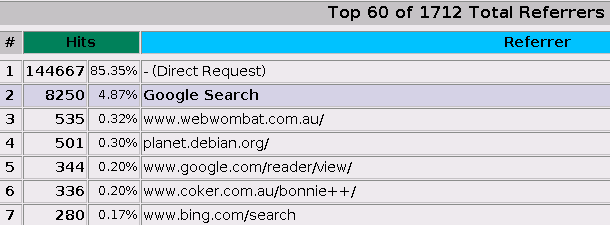
Chris Smart writes about the latest money making schemes for OS distributors, Canonical is getting paid by Yahoo to make them stop using Google as the default Firefox search engine [1]. I think this is OK, the user can easily change it back if desired and it allows them to pay the salaries of more employees who contribute code back to upstream projects. MSN uses 455M, Google uses 189M, and Yahoo uses 109MGoogle referrs 8250 hits, but Bing only refers 280 Above are sections of my Webalizer output related to my blog which show the data transfer use of search.msn.com (Bing presumably) which is 50% greater than that of Google and Yahoo combined. Why does MSN need to do 455MB of transfer so far this month to scan my blog when Google gets the job done with 189M and Yahoo only takes 109M? Also judging by the referrals Bing is only 3% as much use to me as Google. MSN uses 525M, Yahoo uses 132M, and Google only uses 35M Above is a sample of the Webalizer output from www.coker.com.au, MSN is using 525MB of data to scan the site which contains about 1.2G of static files that change very rarely. A Russian malware site seems to be downloading it three times a month, and Google only takes 35MB of data transfer to scan the site (which is probably still excessive). If Bing was a quality search engine that returned appropriate results then this could be forgiven. But however it is a very poor search engine that returns bad results. For example if you query Google or Yahoo for bonnie++ you will get an entire page of search results concerning my Bonnie++ benchmark, and those results are ordered in a sensible way. If you ask Bing then the first four results concern Bonnie (three women and a plant) and most of the first page don t concern my benchmark. Some time ago I had blocked MSN from scanning a server that I ran. The server in question had all the web servers for my domain plus quite a few other small domains. The total MSN data transfer was 3G per month which was almost half the data allowance for the server in question (data plans in Australia suck that s why my web servers are hosted in Germany now), so it was a question of whether to allow normal operation of the business or MSN searches. With Microsoft not running a popular search engine (then or now) it was an easy decision. I think that anyone who accepts money from Microsoft/Bing is doing their users a mis-service. Bing is simply an inferior search engine, it gets bad results and imposes excessive costs on service providers. Yahoo however seems to be a reasonable service, not as good as Google for the web hosters but not too bad. I wonder what would happen if Yahoo offered some sponsorship money to the Debian project in exchange for being the default search engine. I m sure it would be dramatic.

31 December 2009

Debian News: New Debian Developers (December 2009)

The following developers got their Debian accounts in the last month: Congratulations!

26 December 2009

Stefano Zacchiroli: RC bugs of the week - week 16

RCBW - week #16 ... and here are christmas (for those who care) RC squashes, by yours truly (for those who care too): and here are the usual notes: Hint/request of the week: please add +pending when you do DELAYED/ NMUs, that way filtering out already taken care of bugs gets easier and refreshing a bug log page in the browser will immediately show the new tag at the top.
(Yes, I agree that nmudiff should offer that when passed --delay, I intend to propose a patch for that, but feel free to beat me at it :-P) In other news, christmas vacations are awesome to catch up with books you planned to finish reading months ago ... Update: the patch for nmudiff I've mentioned has been kindly provided by gregor hermann, thanks!

11 December 2009

Tim Retout: Moving

I'm now a Debian Developer. :) My thanks go to Ben Hutchings, gregor herrmann, Chris Lamb, Christoph Berg, Steve McIntyre, Brad Smith, Jonny Lamb, Chris Boyle, everyone at credativ, and everyone else who helped me with Debian over the last... almost six years? Actually, I've been a DD since the weekend, but have been too absorbed to write about it. In other news, I'm moving house today... I'm more or less packed now. My internet access may be intermittent at home for the next few weeks. (Home is now Southampton, UK.)

17 November 2009

Christoph Haas: Curious mice

You better not leave confidential documents near your optical mouse. You never know where it s looking at.

8 November 2009

David Paleino: Finally a DD!

Finally, it happened! I became a Debian Developer! I wish to thank everybody involved in this process: from those who helped me in my initial packaging efforts, to who actually created the account. Many thanks to the pkg-perl team for accepting newbies and helping them: props to Damyan Ivanov, Gregor Herrmann, Gunnar Wolf! Thanks to Debian-Med and Debian CLI: they always believed in me, and I had a great time in these teams. A special thanks goes to Andreas Tille, who advocated my NM candidature. Thanks to my two AMs, Bart Martens and Bernd Zeimetz. Even if my NM was long, difficult and not so flawless, it all went good, at the end Smile. A special thanks to Enrico Zini: he was the first DD signing my GPG key, thus allowing me to have more "rights" (being a DM), and experience some more responsibility than I previously had. Thanks to his "Become a DD. NOW!" right after checking my ID in Palermo -- Enrico, it finally happened! Thanks to Christoph Berg, Ron Lee, and Stephen Gran, which handled the final steps of the overall process. And now, dapal is here to break the world. Be warned! Smile

26 September 2009

Christoph Haas: This should work fine nowadays (about vino, Compiz and wrong optimism)

I ve been back from KDE (4.2!) to Gnome and with the mighty powers of Compiz my desktop is the envy of my Windows coworkers and still geeky functional. Well, somehow functional. For a while I wondered why I can t properly use VNC to remote-control my desktop from home. The connection works and I see the desktop but nothing seems to happen when I click or type. Now I figured out the desktop in the VNC client window is just not refreshed while my mouse and keyboard actions really do what they were supposed to on the VNC server. This is my sad tale of how I learned that a regression may mean driving the motorcycle to work in the middle of the night after cursing VNC. :) After a little searching through the lazyweb I found out that it s a bug reported on Ubuntu already. Apparently Compiz doesn t use the XDAMAGE extension properly. Somehow when using the graphics adapter s magic 3D powers X11 loses control of what sections are changed I m not an X11 guru. At least the client doesn t know when to redraw areas of the screen that have changed. The suggested workarounds were pretty ridiculous. Start another x11vnc session without compiz and connect to that. Very funny. I want to control my running desktop not create a new one. So I switched off compiz at work and voila VNC works again. Some eye-candy and shortcuts are gone but remote controlling the desktop is far more important while im on call. But I quickly missed Compiz. The missing eye-candy wasn t that bad. But metacity s window placement algorithm sucks as badly as back in 2002. As if I can hear it whisper: I have no idea where to put that stupid window. You tell me. I researched a little further and somehow the bug is known to Gnome, too. And other users suffering from the problem are pointed to the VirtualGL page of Wikipedia. Apparently the problem was fixed for several people until a regression was reported where things failed again. Seems like the vino developers removed the piece of code that detected the use of 3D window managers as a 2008 christmas present. Their reason: This should work fine nowadays. Hell, no, it doesn t! Somehow I downgraded vino to version 2.24.1-3 and ran the vino server manually (/usr/lib/vino/vino-server sm-disable) to see if it prints any error message. Indeed it does:
Composite detected, disabling XDamage extension.
This is a workaround while XDamage extension does not work correctly with 3d desktops.
Hopefully it will work at next vino release.
This time it worked well, too . I upgraded to the current version 2.28.0-1 (as in unstable by today) and suddenly my VNC connection had the same problems again. Aha! Let s try the Lenny version 2.22.2-1. Works, too. This has taken me hours to debug. Finally I know I can report a bug against the vino package. I wonder how long it would have taken a mortal to figure that out. :( [Sorry to my sponsorees who's package sponsoring requests were delayed again due to this mess.]

19 September 2009

Evgeni Golov: v86d searching for a new home

i've been maintaining v86d for a year, and is has to stop now.
no, not because its bad to maintain it, it's just I've sold the last piece of hardware (my Thinkpad Z61m) it was useful on.
my X300 has an Intel card and KMS, my iBook does not know what 86 is ;)

Currently, the package has two bugs:
#505977 segfault
never could reproduce this one, reporter has nvidia gpu...
#525415 CFLAGS setting includes random kernel headers
this is easy to fix and I will do so in my orhpan upload (or provide a patch)

So if someone has the hardware and need of v86d, please tell me and take over the package.

PS: Christoph, do it NOW! :)

Christoph Haas: Tired of Nagios and Cacti? Try Zabbix.

One of my professional duties in my past ten years was monitoring systems. Even my diploma thesis was dedicated to distributed monitoring (altough my professor sucked badly). Apart from a few custom-programmed scripts to analyze special situations (e.g. proxy clusters) I used tools that fellow administrators will find familiar: Nagios and Cacti. And another less famous text-configuration-based monitoring tool called Cricket. That worked well somehow but Cricket was hard to learn for my coworkers and Cacti seems unreliable and fundamentally broken in terms of SNMP checking. Besides why do I have to set up availability checking in Nagios and set up checking of the same parameters in another software to draw graphs? Just recently I came across an open-source software I hadn t heard of before: Zabbix. And although it has a few rough edges it seems way more professional than other common tools (the commercial tools I saw are even worse than the open-source variants). I tried it and after a lot of reading and trying it looks like it has a good potential to replace Nagios and Cacti. So I thought I d sum up my personal experiences with all of these tools. Nagios. Their makers claim that it s the industry-standard in IT infrastructure monitoring . Honestly it s a great tool but considering how many years it has been existing it barely evolved. During my diploma thesis I wrote an alternative software that I called MrNetwork that dealt with flaws that Nagios hasn t even fixed today. Still Nagios is a tool I have used for many years and it is very reliable.Nagios service detail screen Advantages: Annoyances: Cricket. As Nagios does not support plotting graphs of the monitored values I was in need of another piece of software. Basically Cricket is a frontend to RRD (which stores data in a rotating/round-robin file that keeps data of the last X minutes/hours/days). It has a textual configuration that takes a lot of getting used to. It s main principle is inheritance of settings they call it configuration tree . Which means you have a master DEFAULTS file that contains general settings like how to query SNMP. In a subdirectory you define a certain class of devices that you want to monitor e.g. routers (the DEFAULTS are inherited to this level). Within the routers directory you can just define a list of routers you want to monitor. All settings are inherited from above (parent directories). It s more a geek tool for shell lovers. Cricket screenshotAdvantages: Annoyances: Cacti. Another frontend to RRD and a pretty sophisticated one. Nearly everything is configured through its web interface. And the result is beautiful. It s not entirely reliable though and SNMP support (at least in version 0.8.7b) is a big fail. I like Cacti for its user interface is much better than Cactis but it s less reliable and flexible. Cacti screenshotAdvantages: Disadvantages: Zenoss. People pointed me to Zenoss which is supposed to offer the same functionality as other monitoring systems but is much more integrated. So this short list is more a quick one-day-experimental expression than a thorough analysis. But in the end much of the fuss is just marketing. Advantages: Annoyances: Zabbix. This is the tool I have been evaluating for the past two weeks and currently I m moving all checks away from Nagios and Cacti and put it into Zabbix. So the following list is more a first impression instead of a year-long experience. (I m using Zabbix 1.6.5 here. Debian Lenny s 1.4 version lacked some interesting features like proper SNMP handling so I backported the newer version to Lenny.) Zabbix seems very close to the perfect monitoring system I had always dreamt of. I would have designed it differently in some aspects though. Zabbix screenshotAdvantages: Annoyances: See also: Ben Rockwood s blog Further similar software I didn test thoroughly: Hyperic and Opsview (I ll surely update this blog post while I learn more about Zabbix.) All of the above tools are great. I m not meaning to say that Zenoss is total crap for example. The differences are subtle. And whether a piece of software suits your needs really depends on your expectations. I love that all this software is available as open-source. And a totally unscientific but fun analysis of the community is counting the number of active people in the respective channels on the Freenode IRC network: Either Nagios has the largest fanbase or perhaps that means that the majority of people needs help with it. :)
http://en.wikipedia.org/wiki/Network_monitoring

7 September 2009

Eugene V. Lyubimkin: I became DD.

That are only 3 simple words, but their value is hard to underrate. It's very important milestone in my Debian work.

The achievement might not be possible, if there wasn't the help of:
- Vincent Bernat, who thoroughly corrected my first packaging and sponsored my first (and not only) package;
- Dmitry E. Oboukhov, who uploaded many packages for me and also gave some useful advices;
- Roger Leigh, who spent not one day to improve my packaging skills, and also advocated my NM application;
- Enrico Zini, who was my NM Application Manager.
Thank you!

Thanks to people who built my NM procession chain up to creating the account: Bernd Zeimetz (FD), Christoph Berg (DAM), Peter Palfrader (account creation).

Next.

Previous.