Search Results: "az"

14 October 2024

Philipp Kern: Touch Notifications for YubiKeys

When setting up your YubiKey you have the option to require the user to touch the device to authorize an operation (be it signing, decrypting, or authenticating). While web browsers often provide clear prompts for this, other applications like SSH or GPG will not. Instead the operation will just hang without any visual indication that user input is required. The YubiKey itself will blink, but depending on where it is plugged in that is not very visible.
yubikey-touch-detector (fresh in unstable) solves this issue by providing a way for your desktop environment to signal the user that the device is waiting for a touch. It provides an event feed on a socket that other components can consume. It comes with libnotify support and there are some custom integrations for other environments.For GNOME and KDE libnotify support should be sufficient, however you still need to turn it on:
$ mkdir -p ~/.config/yubikey-touch-detector
$ sed -e 's/^YUBIKEY_TOUCH_DETECTOR_LIBNOTIFY=.*/YUBIKEY_TOUCH_DETECTOR_LIBNOTIFY=true/' \
  < /usr/share/doc/yubikey-touch-detector/examples/service.conf.example \
  > ~/.config/yubikey-touch-detector/service.conf
$ systemctl --user restart yubikey-touch-detector
I would still have preferred a more visible, more modal prompt. I guess that would be an exercise for another time, listening to the socket and presenting a window. But for now, desktop notifications will do for me.PS: I have not managed to get SSH's no-touch-required to work with YubiKey 4, while it works just fine with a YubiKey 5.

7 October 2024

Reproducible Builds: Reproducible Builds in September 2024

Welcome to the September 2024 report from the Reproducible Builds project! Our reports attempt to outline what we ve been up to over the past month, highlighting news items from elsewhere in tech where they are related. As ever, if you are interested in contributing to the project, please visit our Contribute page on our website. Table of contents:
  1. New binsider tool to analyse ELF binaries
  2. Unreproducibility of GHC Haskell compiler 95% fixed
  3. Mailing list summary
  4. Towards a 100% bit-for-bit reproducible OS
  5. Two new reproducibility-related academic papers
  6. Distribution work
  7. diffoscope
  8. Other software development
  9. Android toolchain core count issue reported
  10. New Gradle plugin for reproducibility
  11. Website updates
  12. Upstream patches
  13. Reproducibility testing framework

New binsider tool to analyse ELF binaries Reproducible Builds developer Orhun Parmaks z has announced a fantastic new tool to analyse the contents of ELF binaries. According to the project s README page:
Binsider can perform static and dynamic analysis, inspect strings, examine linked libraries, and perform hexdumps, all within a user-friendly terminal user interface!
More information about Binsider s features and how it works can be found within Binsider s documentation pages.

Unreproducibility of GHC Haskell compiler 95% fixed A seven-year-old bug about the nondeterminism of object code generated by the Glasgow Haskell Compiler (GHC) received a recent update, consisting of Rodrigo Mesquita noting that the issue is:
95% fixed by [merge request] !12680 when -fobject-determinism is enabled. [ ]
The linked merge request has since been merged, and Rodrigo goes on to say that:
After that patch is merged, there are some rarer bugs in both interface file determinism (eg. #25170) and in object determinism (eg. #25269) that need to be taken care of, but the great majority of the work needed to get there should have been merged already. When merged, I think we should close this one in favour of the more specific determinism issues like the two linked above.

Mailing list summary On our mailing list this month:
  • Fay Stegerman let everyone know that she started a thread on the Fediverse about the problems caused by unreproducible zlib/deflate compression in .zip and .apk files and later followed up with the results of her subsequent investigation.
  • Long-time developer kpcyrd wrote that there has been a recent public discussion on the Arch Linux GitLab [instance] about the challenges and possible opportunities for making the Linux kernel package reproducible , all relating to the CONFIG_MODULE_SIG flag. [ ]
  • Bernhard M. Wiedemann followed-up to an in-person conversation at our recent Hamburg 2024 summit on the potential presence for Reproducible Builds in recognised standards. [ ]
  • Fay Stegerman also wrote about her worry about the possible repercussions for RB tooling of Debian migrating from zlib to zlib-ng as reproducibility requires identical compressed data streams. [ ]
  • Martin Monperrus wrote the list announcing the latest release of maven-lockfile that is designed aid building Maven projects with integrity . [ ]
  • Lastly, Bernhard M. Wiedemann wrote about potential role of reproducible builds in combatting silent data corruption, as detailed in a recent Tweet and scholarly paper on faulty CPU cores. [ ]

Towards a 100% bit-for-bit reproducible OS Bernhard M. Wiedemann began writing on journey towards a 100% bit-for-bit reproducible operating system on the openSUSE wiki:
This is a report of Part 1 of my journey: building 100% bit-reproducible packages for every package that makes up [openSUSE s] minimalVM image. This target was chosen as the smallest useful result/artifact. The larger package-sets get, the more disk-space and build-power is required to build/verify all of them.
This work was sponsored by NLnet s NGI Zero fund.

Distribution work In Debian this month, 14 reviews of Debian packages were added, 12 were updated and 20 were removed, all adding to our knowledge about identified issues. A number of issue types were updated as well. [ ][ ] In addition, Holger opened 4 bugs against the debrebuild component of the devscripts suite of tools. In particular:
  • #1081047: Fails to download .dsc file.
  • #1081048: Does not work with a proxy.
  • #1081050: Fails to create a debrebuild.tar.
  • #1081839: Fails with E: mmdebstrap failed to run error.
Last month, an issue was filed to update the Salsa CI pipeline (used by 1,000s of Debian packages) to no longer test for reproducibility with reprotest s build_path variation. Holger Levsen provided a rationale for this change in the issue, which has already been made to the tests being performed by tests.reproducible-builds.org. This month, this issue was closed by Santiago R. R., nicely explaining that build path variation is no longer the default, and, if desired, how developers may enable it again. In openSUSE news, Bernhard M. Wiedemann published another report for that distribution.

diffoscope diffoscope is our in-depth and content-aware diff utility that can locate and diagnose reproducibility issues. This month, Chris Lamb made the following changes, including preparing and uploading version 278 to Debian:
  • New features:
    • Add a helpful contextual message to the output if comparing Debian .orig tarballs within .dsc files without the ability to fuzzy-match away the leading directory. [ ]
  • Bug fixes:
    • Drop removal of calculated os.path.basename from GNU readelf output. [ ]
    • Correctly invert X% similar value and do not emit 100% similar . [ ]
  • Misc:
    • Temporarily remove procyon-decompiler from Build-Depends as it was removed from testing (via #1057532). (#1082636)
    • Update copyright years. [ ]
For trydiffoscope, the command-line client for the web-based version of diffoscope, Chris Lamb also:
  • Added an explicit python3-setuptools dependency. (#1080825)
  • Bumped the Standards-Version to 4.7.0. [ ]

Other software development disorderfs is our FUSE-based filesystem that deliberately introduces non-determinism into system calls to reliably flush out reproducibility issues. This month, version 0.5.11-4 was uploaded to Debian unstable by Holger Levsen making the following changes:
  • Replace build-dependency on the obsolete pkg-config package with one on pkgconf, following a Lintian check. [ ]
  • Bump Standards-Version field to 4.7.0, with no related changes needed. [ ]

In addition, reprotest is our tool for building the same source code twice in different environments and then checking the binaries produced by each build for any differences. This month, version 0.7.28 was uploaded to Debian unstable by Holger Levsen including a change by Jelle van der Waa to move away from the pipes Python module to shlex, as the former will be removed in Python version 3.13 [ ].

Android toolchain core count issue reported Fay Stegerman reported an issue with the Android toolchain where a part of the build system generates a different classes.dex file (and thus a different .apk) depending on the number of cores available during the build, thereby breaking Reproducible Builds:
We ve rebuilt [tag v3.6.1] multiple times (each time in a fresh container): with 2, 4, 6, 8, and 16 cores available, respectively:
  • With 2 and 4 cores we always get an unsigned APK with SHA-256 14763d682c9286ef .
  • With 6, 8, and 16 cores we get an unsigned APK with SHA-256 35324ba4c492760 instead.

New Gradle plugin for reproducibility A new plugin for the Gradle build tool for Java has been released. This easily-enabled plugin results in:
reproducibility settings [being] applied to some of Gradle s built-in tasks that should really be the default. Compatible with Java 8 and Gradle 8.3 or later.

Website updates There were a rather substantial number of improvements made to our website this month, including:

Upstream patches The Reproducible Builds project detects, dissects and attempts to fix as many currently-unreproducible packages as possible. We endeavour to send all of our patches upstream where appropriate. This month, we wrote a large number of such patches, including:

Reproducibility testing framework The Reproducible Builds project operates a comprehensive testing framework running primarily at tests.reproducible-builds.org in order to check packages and other artifacts for reproducibility. In September, a number of changes were made by Holger Levsen, including:
  • Debian-related changes:
    • Upgrade the osuosl4 node to Debian trixie in anticipation of running debrebuild and rebuilderd there. [ ][ ][ ]
    • Temporarily mark the osuosl4 node as offline due to ongoing xfs_repair filesystem maintenance. [ ][ ]
    • Do not warn about (very old) broken nodes. [ ]
    • Add the risc64 architecture to the multiarch version skew tests for Debian trixie and sid. [ ][ ][ ]
    • Mark the virt 32,64 b nodes as down. [ ]
  • Misc changes:
    • Add support for powercycling OpenStack instances. [ ]
    • Update the fail2ban to ban hosts for 4 weeks in total [ ][ ] and take care to never ban our own Jenkins instance. [ ]
In addition, Vagrant Cascadian recorded a disk failure for the virt32b and virt64b nodes [ ], performed some maintenance of the cbxi4a node [ ][ ] and marked most armhf architecture systems as being back online.

Finally, If you are interested in contributing to the Reproducible Builds project, please visit our Contribute page on our website. However, you can get in touch with us via:

4 October 2024

Jonathan Dowland: synths

Although I've never written about them, I've been interested in music synthesisers for ages. My colleagues know this. Whilst I've been off sick, they had a whip-round and bought me a voucher for Andertons, a UK-based music store, to cheer me up. I'm absolutely floored by this generosity. And so, I'm now on a quest to buy a synthesizer! Although, not my first one.
Alesis Micron on my desk, taunting me Alesis Micron on my desk, taunting me
I bought my first synth, an Alesis Micron, from a colleague at $oldjob, 16 years ago. For various reasons, I've struggled to engage with it, and it's mostly been gathering dust on my desk in all that time. (I might write more about the Micron in a later blog post). "Bad Gear" sums it up better than I could:
So, I'm not truly buying my "first" synth, but for all intents and purposes I'm on a similar journey to if I was, and I thought it might be fun to write about it. Goals I want something which has as many of its parameters presented physically, as knobs or sliders etc., as possible. One reason I've failed to engage with the Micron (so far) is it's at the other end of this spectrum, with hundreds of tunable parameters but a small handful of knobs. To change parameters you have to go diving into menus presented on a really old-fashioned, small LCD display. If you know what you are looking for, you can probably find it; but if you just want to experiment and play around, it's off-putting. Secondly, I want something I can use away from a computer, as much as possible. Computers are my day-job, largely dominate my existing hobbies, and are unavoidable even in some of the others (like 3d printing). Most of the computers I interact with run Linux. And for all its strengths, audio management is not one of them. If I'm going to carve out some of my extremely limited leisure time to explore this stuff, I don't to spend any of it (at least now) fighting Pulseaudio/ALSA/Pipewire/JACK/OSS/whatever, or any of the other foibles that might crop up1. Thirdly, I'd like something which, in its soul, is an instrument. You can get some amazing little synth boxes with a huge number of features in them. Something with a limited number of features but which really feels well put together would suit me better. So next time, I'll write about the 2-3 top candidates on my list. Can you guess what they might be?

  1. To give another example. The other day I sat down to try and use the Micron, which had its audio out wired into an external audio interface, in turn plugged into my laptop's Thunderbolt dock. For a while I couldn't figure out why I couldn't hear anything, until I realised the Thunderbolt dock was having "a moment" and not presenting its USB devices to the laptop. Hobby time window gone!

30 September 2024

Russell Coker: Links September 2024

CNA Insider has an insightful documentary series about Chinese illegal immigrants to the US [1]. They should migrate to Australia, easier to get in and a better place to live. Linus tech tips has an informative video about using Windows on Snapdragon ARM64 laptops. [2]. Maybe I should get one for running Linux. They are quite expensive on ebay now which is presumably a good sign about their quality. A web site for comparing monospace fonts so you can find the one that best suits yuor coding [3]. Roboto works well for me. Noema has an interesting article about nationhood comparing the attitudes towards European colonisation in Africa and Russian colonisation in Ukraine [4]. Insightful lecture by Grace Hopper (then Captain) about the future of computers [5]. The second part is linked from the first part. Published by the NSA. Tony Hoare gave an insightful lecture titled The Billion Dollar Mistake about his work on designing the Algol language in 1965 [6]. The lecture was recorded in about 2005. But it still has a lot of relevance to computer science. Jascha Sohl-Dickstein wrote an interesting blog post about Goodhart s law, Machine Learning models, and how to try and mitigate problems in society [7]. Cory Doctorow wrote an insightful article on the Marshmallow test and long term thinking [8]. The rich fail this test badly. Insightful interview with Justice Breyer about interpreting the US constitution and the problems with textualism and originalism [9]. Cory Doctorow wrote an informative article about Google s practices of deleting Gmail accounts for no apparent reason and denying people access to their data [10]. We need more laws like the Digital Markets Act in the EU and we need them to apply to eBay/PayPal and AWS/Amazon.

25 September 2024

Russell Coker: The PiKVM

Hardware I have just setup a PiKVM, here s the Amazon link for the KVM hardware (case and Pi hat etc) and here s an Amazon link for a Pi4 to match. The PiKVM web site has good documentation [1] and they have a YouTube channel with videos showing how to assemble the devices [2]. It s really convenient being able to change the playback speed from low speeds like 1/4 original speed) to double speed when watching such a video. One thing to note is that there are some revisions to the hardware that aren t covered in the videos, the device I received had some improvements that made it easier to assemble which weren t in the video. When you buy the device and Pi you need to also get a SD card of at least 4G in size, a CR1220 battery for real-time clock, and a USB-2/3 to USB-C cable for keyboard/mouse MUST NOT BE USB-C to USB-C! When I first tried using it I used a USB-C to USB-C cable for keyboard and mouse and it didn t work for reasons I don t understand (I welcome comments with theories about this). You also need a micro-HDMI to HDMI cable to get video output if you want to set it up without having to find the IP address and ssh to it. The system has a bright OLED display to show the IP address and some other information which is very handy. The hardware is easy enough for a 12yo to setup. The construction of the parts are solid and well engineered with everything fitting together nicely. It has a PCI/PCIe slot adaptor for controlling power and sending LED status over the connection which I didn t test. I definitely recommend this. Software This is the download link for the RaspberryPi images for the PiKVM [3]. The v3 image matches the hardware from the Amazon link I provided. The default username/password is root/root. Connect it to a HDMI monitor and USB keyboard to change the password etc. If you control the DHCP server you can find the IP address it s using and ssh to it to change the password (it is configured to allow ssh as root with password authentication). If you get the kit to assemble it (as opposed to buying a completed unit already assembled) then you need to run the following commands as root to enable the OLED display. This means that after assembling it you can t get the IP address without plugging in a monitor with a micro-HDMI to HDMI cable or having access to the DHCP server logs.
rw
systemctl enable --now kvmd-oled kvmd-oled-reboot kvmd-oled-shutdown
systemctl enable --now kvmd-fan
ro
The default webadmin username/password is admin/admin. To change the passwords run the following commands:
rw
kvmd-htpasswd set admin
passwd root
ro
It is configured to have the root filesystem mounted read-only which is something I thought had gone out of fashion decades ago. I don t think that modern versions of the Ext3/4 drivers are going to corrupt your filesystem if you have it mounted read-write when you reboot. By default it uses a self-signed SSL certificate so with a Chrome based browser you get an error when you connect where you have to select advanced and then tell it to proceed regardless. I presume you could use the DNS method of Certbot authentication to get a SSL certificate to use on an internal view of your DNS to make it work normally with SSL. The web based software has all the features you expect from a KVM. It shows the screen in any resolution up to 1920*1080 and proxies keyboard and mouse. Strangely lsusb on the machine being managed only reports a single USB device entry for it which covers both keyboard and mouse. Managing Computers For a tower PC disconnect any regular monitor(s) and connect a HDMI port to the HDMI input on the KVM. Connect a regular USB port (not USB-C) to the OTG port on the KVM, then it should all just work. For a laptop connect the HDMI port to the HDMI input on the KVM. Connect a regular USB port (not USB-C) to the OTG port on the KVM. Then boot it up and press Fn-F8 for Dell, Fn-F7 for Lenovo or whatever the vendor code is to switch display output to HDMI during the BIOS initialisation, then Linux will follow the BIOS and send all output to the HDMI port for the early stages of booting. Apparently Lenovo systems have the Fn key mapped in the BIOS so an external keyboard could be used to switch between display outputs, but the PiKVM software doesn t appear to support that. For other systems (probably including the Dell laptops that interest me) the Fn key apparently can t be simulated externally. So for using this to work on laptops in another city I need to have someone local press Fn-F8 at the right time to allow me to change BIOS settings. It is possible to configure the Linux kernel to mirror display to external HDMI and an internal laptop screen. But this doesn t seem useful to me as the use cases for this device don t require that. If you are using it for a server that doesn t have iDRAC/ILO or other management hardware there will be no other monitor and all the output will go through the only connected HDMI device. My main use for it in the near future will be for supporting remote laptops, when Linux has a problem on boot as an easier option than talking someone through Linux commands and for such use it will be a temporary thing and not something that is desired all the time. For the gdm3 login program you can copy the .config/monitors.xml file from a GNOME user session to the gdm home directory to keep the monitor settings. This configuration option is decent for the case where a fixed set of monitors are used but not so great if your requirement is display a login screen on anything that s available . Is there an xdm type program in Debian/Ubuntu that supports this by default or with easy reconfiguration? Conclusion The PiKVM is a well engineered and designed product that does what s expected at a low price. There are lots of minor issues with using it which aren t the fault of the developers but are due to historical decisions in the design of BIOS and Linux software. We need to change the Linux software in question and lobby hardware vendors for BIOS improvements. The feature for connecting to an ATX PSU was unexpected and could be really handy for some people, it s not something I have an immediate use for but is something I could possibly use in future. I like the way they shipped the hardware for it as part of the package giving the user choices about how they use it, many vendors would make it an optional extra that costs another $100. This gives the PiKVM more functionality than many devices that are much more expensive. The web UI wasn t as user friendly as it might have been, but it s a lot better than iDRAC so I don t have a serious complaint about it. It would be nice if there was an option for creating macros for keyboard scancodes so I could try and emulate the Fn options and keys for volume control on systems that support it.

23 September 2024

Jonathan McDowell: The (lack of a) return-to-office conspiracy

During COVID companies suddenly found themselves able to offer remote working where it hadn t previously been on offer. That s changed over the past 2 or so years, with most places I m aware of moving back from a fully remote situation to either some sort of hybrid, or even full time office attendance. For example last week Amazon announced a full return to office, having already pulled remote-hired workers in for 3 days a week. I ve seen a lot of folk stating they ll never work in an office again, and that RTO is insanity. Despite being lucky enough to work fully remotely (for a role I d been approached about before, but was never prepared to relocate for), I feel the objections from those who are pro-remote often fail to consider the nuances involved. So let s talk about some of the reasons why companies might want to enforce some sort of RTO.

Real estate value Let s clear this one up first. It s not about real estate value, for most companies. City planners and real estate investors might care, but even if your average company owned their building they d close it in an instant all other things being equal. An unoccupied building costs a lot less to maintain. And plenty of companies rent and would save money even if there s a substantial exit fee.

Occupancy levels That said, once you have anyone in the building the equation changes. If you re having to provide power, heating, internet, security/front desk staff etc, you want to make sure you re getting your money s worth. There s no point heating a building that can seat 100 for only 10 people present. One option is to downsize the building, but that leads to not being able to assign everyone a desk, for example. No one I know likes hot desking. There are also scheduling problems about ensuring there are enough desks for everyone who might turn up on a certain day, and you ve ruled out the option of company/office wide events.

Coexistence builds relationships As a remote worker I wish it wasn t true that most people find it easier to form relationships in person, but it is. Some of this can be worked on with specific teambuilding style events, rather than in office working, but I know plenty of folk who hate those as much as they hate the idea of being in the office. I am lucky in that I work with a bunch of folk who are terminally online, so it s much easier to have those casual conversations even being remote, but I also accept I miss out on some things because I m just not in the office regularly enough. You might not care about this ( I just need to put my head down and code, not talk to people ), but don t discount it as a valid reason why companies might want their workers to be in the office. This often matters even more for folk at the start of their career, where having a bunch of experience folk around to help them learn and figure things out ends up working much better in person (my first job offered to let me go mostly remote when I moved to Norwich, but I said no as I knew I wasn t ready for it yet).

Coexistence allows for unexpected interactions People hate the phrase water cooler chat , and I get that, but it covers the idea of casual conversations that just won t happen the same way when people are remote. I experienced this while running Black Cat; every time Simon and I met up in person we had a bunch of useful conversations even though we were on IRC together normally, and had a VoIP setup that meant we regularly talked too. Equally when I was at Nebulon there were conversations I overheard in the office where I was able to correct a misconception or provide extra context. Some of this can be replicated with the right online chat culture, but I ve found many places end up with folk taking conversations to DMs, or they happen in private channels. It happens more naturally in an office environment.

It s easier for bad managers to manage bad performers Again, this falls into the category of things that shouldn t be true, but are. Remote working has increased the ability for people who want to slack off to do so without being easily detected. Ideally what you want is that these folk, if they fail to perform, are then performance managed out of the organisation. That s hard though, there are (rightly) a bunch of rights workers have (I m writing from a UK perspective) around the procedure that needs to be followed. Managers need organisational support in this to make sure they get it right (and folk are given a chance to improve), which is often lacking.

Summary Look, I get there are strong reasons why offering remote is a great thing from the company perspective, but what I ve tried to outline here is that a return-to-office mandate can have some compelling reasons behind it too. Some of those might be things that wouldn t exist in an ideal world, but unfortunately fixing them is a bigger issue than just changing where folk work from. Not acknowledging that just makes any reaction against office work seem ill-informed, to me.

17 September 2024

Jonathan Dowland: ouch, part 3

The debridement operation was a success: nothing bad grew afterwards. I was discharged after a couple of nights with crutches, instructions not to weight-bear, a remarkable, portable negative-pressure "Vac" pump that lived by my side, and some strong painkillers. About two weeks later, I had a skin graft. The surgeon took some skin from my thigh and stitched it over the debridement wound. I was discharged same-day, again with the Vac pump, and again with instructions not to weight-bear, at least for a few days. This time I only kept the Vac pump for a week, and after a dressing change (the first time I saw the graft), I was allowed to walk again. Doing so is strangely awkward, and sometimes a little painful. I have physio exercises to help me regain strength and understanding about what I can do. The donor site remained bandaged for another week before I saw it. I was expecting a stitched cut, but the surgeons have removed the top few layers only, leaving what looks more like a graze or sun-burn. There are four smaller, tentative-looking marks adjacent, suggesting they got it right on the fifth attempt. I'm not sure but I think these will all fade away to near-invisibility with time, and they don't hurt at all. I've now been off work for roughly 12 weeks, but I think I am returning very soon. I am looking forward to returning to some sense of normality. It's been an interesting experience. I thought about writing more about what I've gone through, in particular my experiences in Hospital, dealing with the bureaucracy and things falling "between the gaps". Hanif Kureishi has done a better job than I could. It's clear that the NHS is staffed by incredibly passionate people, but there are a lot of structural problems that interfere with care.

9 September 2024

Ben Hutchings: FOSS activity in July 2024

7 September 2024

Sergio Durigan Junior: Chatting in the 21st century

Several people have been asking me to explain and/or write about my solution for chatting nowadays. I realize that the current scenario is much more complex than, say, 10 or 20 years ago. Back then, this post would probably be more about the IRC client I used than about different chatting technologies. I have also spent a non trivial amount of time setting things up the way I want, so I understand that it s about time to write about my setup not only because I think it can be helpful to others, but also because I would like to document things for myself.

The backbone: Matrix I chose to use Matrix as the place where I integrate everything. Despite there being some heavy (and justified) criticism on the protocol itself, it serves me well for what I need right now. Obviously, I don t like the fact that I have to provide Matrix and all of its accompanying bridges a VPS with 4GB of RAM and 3 vCPUs, but I think that that ship has sailed, unfortunately. In an ideal world, I would be using XMPP and dedicating only a fraction of the resources I m using today to have a full chat system. And since I have been running my personal XMPP server for more than a decade now, I did try to find a solution that would allow me to keep using it, but unfortunately the protocol became almost a hobbyist thing, so there s that.

A few disclaimers I self-host everything, including my Matrix server. Much of what I did won t work if you don t self-host Matrix, so keep that in mind. This won t be a post teaching you how to deploy the services. My intention is to describe what I use and for what purpose. Also, as much as I try to use Debian packages for everything I do, I opted to deploy all services using a community-maintained Ansible playbook which is very well written and organized: matrix-docker-ansible-deploy. Last but not least, as I said above, you will likely need a machine with a good amount of RAM, CPU and storage, especially if you deploy Synapse as your Matrix homeserver (which is what I recommend if you plan to use the bridges I ll mention). My current VPS has 4GB of RAM, 3 vCPUs and 80GB of storage (of which I m currently using approximately 55GB).

Problem #1: my Matrix client(s) There are a lot of clients that can talk the Matrix protocol, but most of them are either web clients or GUI programs. I live on the terminal, more specifically inside Emacs, so I settled for the amazing ement.el Emacs mode. It works surprisingly well, but unfortunately doesn t support end-to-end encryption out of the box; for that, you have to hook it up with pantalaimon. Unfortunately, the project seems abandoned and therefore I don t recommend you to use it. I don t use it myself. When I have to reply some E2E encrypted message from another user, I go to my web browser and use my self-hosted Element client. It s a nuisance, but one that I m willing to accept because of security concerns. If you re into web clients and don t want to use Element (because it is heavy), you can try Cinny. It s lightweight and supports a decent set of features. If you re a terminal lover but don t use Emacs, you may want to try gomuks or iamb.

Problem #2: IRC bridging There are basically two types of IRC bridges for Matrix:
  • The regular and most used matrix-appservice-irc. This bridge takes Matrix to IRC (think of IRC users with the [m] suffix appended to their nicknames), and is what the matrix.org and other big homeservers (including matrix.debian.social) use. It s a complex service which allows thousands of Matrix users to connect to IRC networks, but that unfortunately has complex problems and is only worth using if you intend to host a community server.
  • A bouncer-like bridge called Heisenbridge. This is what I use personally. It takes IRC to Matrix, which means that people on IRC will not know that you re using Matrix. This bridge is much simpler, and because it acts like a bouncer it s pretty much impossible for it to cause problems with the IRC network.
Due to the fact that I sometimes like to use other IRC clients, I still run a regular ZNC bouncer, and I use Heisenbridge to connect to my ZNC. This means that I can use, e.g., ERC inside Emacs and my Matrix bridge at the same time. But you don t necessarily need to run another bouncer; you can simply use Heisenbridge and connect directly to the IRC network(s) you want. A word of caution, though: unlike ZNC, Heisenbridge doesn t support per-user configuration when you use it in bouncer mode. This is the reason why you need to self-host it, and why it s not possible to offer the service to other users (they would have access to your IRC network configuration otherwise). It s also worth talking about logs. I find that keeping logs of everything that goes on IRC has saved me a bunch of times, and so I find it really important to continue doing that. Unfortunately, neither ement.el nor Element support logging things out of the box (at least not that I know). This is also one of the reasons why I still keep my ZNC around: I configure it to log everything.

Problem #3: Telegram I don t use Telegram myself, but unfortunately several people from the Debian community do, especially in Brazil. There is a whole Debian community on Telegram, and I wanted to be able to bridge our Debian Matrix channels to their Telegram counterparts. I am currently using mautrix-telegram for that, and it s working great. You need someone with a Telegram account to configure their credentials so that the bridge can connect to it, but afterwards it s really easy to bridge channels together.

Problem #4: GitLab webhooks Something else I wanted to be able to do was to receive notifications regarding new issues, merge requests and other activities from Salsa. For this, I m using maubot, which is awesome and has a huge list of plugins. I m using the gitlab one.

Final thoughts Overall, I m satisfied with the setup I have now. It has certainly taken some time and effort to find the right tool for each problem I needed to solve, and I still feel like there are some rough edges to soften (like the fact that my Emacs client doesn t support E2E encryption out of the box, or the whole logging situation), but otherwise things are working fine and I haven t had any big problems with the deployment. You do have to be much more careful about stuff (for example, when I installed an unrelated service that hijacked my Apache configuration and made Matrix s federation silently stop working), though. If you have more specific questions about any part of my setup, shoot me an email and I ll do my best to help. Happy chatting!

4 September 2024

Reproducible Builds: Reproducible Builds in August 2024

Welcome to the August 2024 report from the Reproducible Builds project! Our reports attempt to outline what we ve been up to over the past month, highlighting news items from elsewhere in tech where they are related. As ever, if you are interested in contributing to the project, please visit our Contribute page on our website. Table of contents:
  1. LWN: The history, status, and plans for reproducible builds
  2. Intermediate Autotools build artifacts removed from PostgreSQL distribution tarballs
  3. Distribution news
  4. Mailing list news
  5. diffoscope
  6. Website updates
  7. Upstream patches
  8. Reproducibility testing framework

LWN: The history, status, and plans for reproducible builds The free software newspaper of record, Linux Weekly News, published an in-depth article based on Holger Levsen s talk, Reproducible Builds: The First Eleven Years which was presented at the recent DebConf24 conference in Busan, South Korea. Titled The history, status, and plans for reproducible builds and written by Jake Edge, LWN s article not only summarises Holger s talk and clarifies its message but it links to external information as well. Holger s original talk can also be watched on the DebConf24 webpage (direct .webm link and his HTML slides are available also). There are also a significant number of comments on LWN s page as well. Holger Levsen also headed a scheduled discussion session at DebConf24 on Preserving *other* build artifacts addressing a topic where a number of Debian packages are (or would like to) produce results that are neither the .deb files, the build logs nor the logs of CI tests. This is an issue for reproducible builds as this 4th type of build artifact are typically shipped within the binary .deb packages, and are invariably non-deterministic; thus making the .deb files unreproducible. (A direct .webm link and HTML slides are available).

Intermediate Autotools build artifacts removed from PostgreSQL distribution tarballs Peter Eisentraut wrote a detailed blog post on the subject of The new PostgreSQL 17 make dist . Like many projects, the PostgreSQL database has previously pre-built parts of its GNU Autotools build system: the reason for this is a mix of convenience and traditional practice . Peter astutely notes that this arrangement in the build system is quite tricky as:
You need to carefully maintain the different states of clean source code , partially built source code , and fully built source code , and the commands to transition between them.
However, Peter goes on to mention that:
a lot more attention is nowadays paid to the software supply chain. There are security and legal reasons for this. When users install software, they want to know where it came from, and they want to be sure that they got the right thing, not some fake version or some version of dubious legal provenance.
And cites the XZ Utils backdoor as a reason to care about transparent and reproducible ways of distributing and communicating a source tarball and provenance. Because of this, intermediate build artifacts are now henceforth essentially disallowed from PostgreSQL distribution tarballs.

Distribution news In Debian this month, 30 reviews of Debian packages were added, 17 were updated and 10 were removed this month adding to our knowledge about identified issues. One issue type was added by Chris Lamb, too. [ ] In addition, an issue was filed to update the Salsa CI pipeline (used by 1,000s of Debian packages) to no longer test for reproducibility with reprotest s build_path variation. Holger Levsen provided a rationale for this change in the issue, which has already been made to the tests being performed by tests.reproducible-builds.org.
In Arch Linux this month, Jelle van der Waa published a short blog post on the topic of Investigating creating reproducible images with mkosi, motivated by the desire to make it possible for anyone to re-recreate the official Arch cloud image bit-by-bit identical on their own machine as per [the] reproducible builds definition. In addition, Jelle filed a patch for pacman, the Arch Linux package manager, to respect the SOURCE_DATE_EPOCH environment variable when installing a package.
In openSUSE news, Bernhard M. Wiedemann published another report for that distribution.
In Android news, the IzzyOnDroid project added 49 new rebuilder recipes and now features 256 total reproducible applications representing 21% of the total offerings in the repository. IzzyOnDroid is an F-Droid style repository for Android apps[:] applications in this repository are official binaries built by the original application developers, taken from their resp. repositories (mostly GitHub).

Mailing list news From our mailing list this month:
  • Bernhard M. Wiedemann posted a brief message to the list with some helpful information regarding nondeterminism within Rust binaries, positing the use of the codegen-units = 16 default and resulting in a bug being filed in the Rust issue tracker. [ ]
  • Bernhard also wrote to the list, following up to a thread in November 2023, on attempts to make the LibreOffice suite of office applications build reproducibly. In the thread from this month, Bernhard could announce that the four patches previously mentioned have landed in LibreOffice upstream.
  • Fay Stegerman linked the mailing list to a thread she made on the Signal issue tracker regarding whether device-specific binaries [can] ever be considered meaningfully reproducible . In particular: the whole part about allow[ing] multiple third parties to come to a consensus on a correct result breaks down completely when correct is device-specific and not something everyone can agree on. [ ]
  • Developer kpcyrd posted an update for source code indexing project, whatsrc.org. Announcing that it now importing packages from live-bootstrap ( a usable Linux system [that is] created with only human-auditable, and wherever possible, human-written, source code ) into its database of provenance data.
  • Lastly, Mechtilde Stehmann posted an update to an earlier thread about how Java builds are not reproducible on the armhf architecture, enquiring how they might gain temporary access to such a machine in order to perform some deeper testing. [ ]

diffoscope diffoscope is our in-depth and content-aware diff utility that can locate and diagnose reproducibility issues. This month, Chris Lamb released versions 274, 275, 276 and 277, uploaded these to Debian, and made the following changes as well:
  • New features:
    • Strip ANSI escapes usually colour codes from the output of the Procyon Java decompiler. [ ]
    • Factor out a method for stripping ANSI escapes. [ ]
    • Append output from dumppdf(1) in more cases, avoiding situations where we fallback to a binary diff. [ ]
    • Add support for versions of Perl s IO::Compress::Zip version 2.212. [ ]
  • Bug fixes:
    • Also catch RuntimeError exceptions when importing the PyPDF library so that it, or, crucially, its transitive dependencies, cannot not cause diffoscope to traceback at runtime and build time. [ ]
    • Do not call marshal.load( ) of precompiled Python bytecode as it, alas, inherently unsafe. Replace for now with a brief summary of the code section of .pyc. [ ][ ]
    • Don t include excessive debug output when calling dumppdf(1). [ ]
  • Testsuite-related changes:
    • Don t bother to check version number in test_python.py: the fixture for this test is fixed. [ ][ ]
    • Update test_zip text fixtures and definitions to support new changes to the Perl IO::Compress library. [ ]
In addition, Mattia Rizzolo updated the available architectures for a number of test dependencies [ ] and Sergei Trofimovich fixed an issue to avoid diffoscope crashing when hashing directory symlinks [ ] and Vagrant Cascadian proposed GNU Guix updates for diffoscope versions 275 and 276 and 277.

Website updates There were a rather substantial number of improvements made to our website this month, including:
  • Alba Herrerias:
    • Substantially extend the guidance on the Contribute page. [ ]
  • Chris Lamb:
    • Set the future: true configuration value so we render all files and documents in the website, regardless of whether they have a date property in the future. After all, we don t re-generate the website on a timer, and have other ways of making unpublished, draft posts. [ ][ ]
  • Fay Stegerman:
  • hulkoba:
  • kpcyrd:
  • Mattia Rizzolo:
  • Pol Dellaiera:

Upstream patches The Reproducible Builds project detects, dissects and attempts to fix as many currently-unreproducible packages as possible. We endeavour to send all of our patches upstream where appropriate. This month, we wrote a large number of such patches, including:

Reproducibility testing framework The Reproducible Builds project operates a comprehensive testing framework running primarily at tests.reproducible-builds.org in order to check packages and other artifacts for reproducibility. In August, a number of changes were made by Holger Levsen, including:
  • Temporarily install the openssl-provider-legacy package for the Debian unstable environments for running diffoscope due to Debian bug #1078944. [ ][ ][ ][ ]
  • Mark Debian armhf architecture nodes as being down due to proxy down. [ ][ ]
  • Detect proxy failures. [ ][ ][ ]
  • Run the index-buildinfo for the builtin-pho script with the -q switch. [ ]
  • Disable all Arch Linux reproducible jobs. [ ]
In addition, Mattia Rizzolo updated the website configuration to install the ruby-jekyll-sitemap package as it is now used in the website [ ], Roland Clobus updated the script to build Debian live images to treat openQA issues as warnings [ ], and Vagrant Cascadian marked the cbxi4b node as down [ ].

If you are interested in contributing to the Reproducible Builds project, please visit our Contribute page on our website. However, you can get in touch with us via:

Samuel Henrique: DebConf24 was fun!: Security, curl, wcurl, Debian's quality

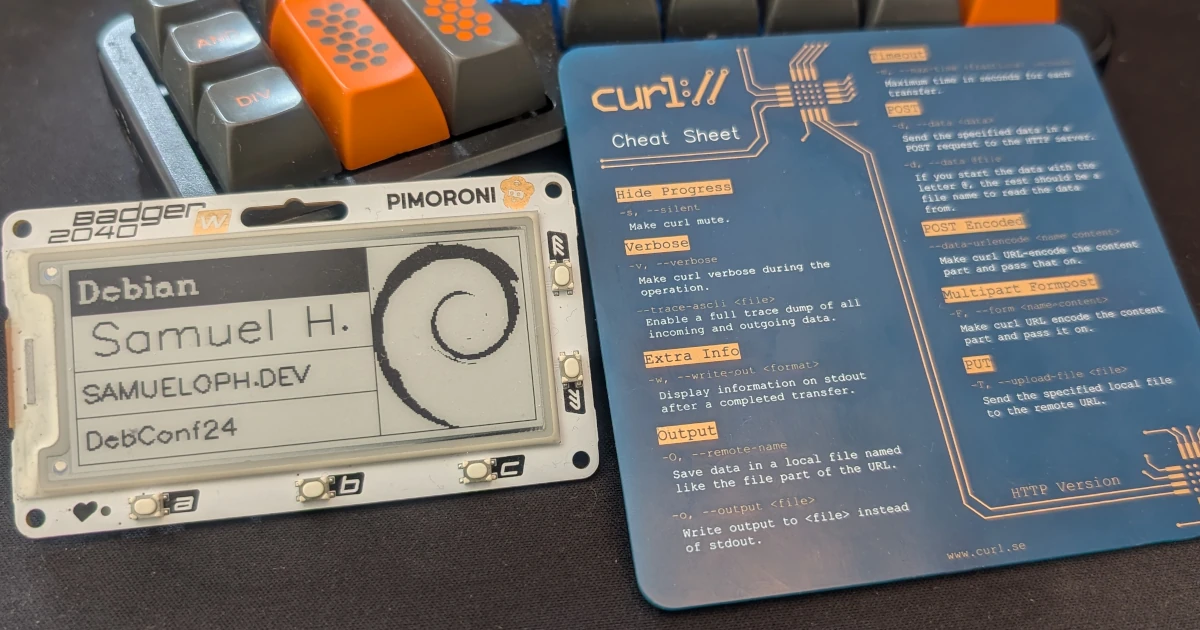
A picture of a badger2040w with Samuel's badge and the curl manpage PCB on the side

tl;dr DebConf24 was fun! A playlist of all of my talks, with subtitles (en, pt-br) and chapters is available on YouTube.

Overview DebConf24 was held in Busan, South Korea, between Sunday July 28th to Sunday August 4th 2024. As usual for DebConfs, I had a great time meeting my friends, but also met new people and got to learn a bit about the interesting things they're working on. I ended up getting too excited during the talk submission stage of the conference and as a result I presented 5 different activities (3 talks, 1 BoF and 1 lightning talk). Since I was too busy with the presentations, I did not have a lot of time to actually hang out with folks, or even to go out in the city, I guess I've learned my lesson for next time. The main purpose of this post is to write about all of the things I presented at the conference. I did want to list some of the interesting talks I've watched, but that I would not be able to be fair as I'm sure I would miss some. You can get the schedule and the recordings of any talks from the conference's website: https://debconf24.debconf.org/schedule/

wcurl Lightning Talk The most fun of my presentations, during the second-to-last day of the conference, I've asked for help from Sergio Durigan Junior <sergiodj> to setup an URL containing a whitespace and redirecting that to wcurl's manpage. I then did a little demo to showcase why me (and a lot others) struggle with downloading things with curl, and how wcurl solves that. https://www.youtube.com/watch?v=eM8M5qa4pPM

Fixing CVEs on Debian: Everything you probably know already I've always felt like DebConf was missing security-related talks, so I decided to do something about it and presented a few of the things I've learned when fixing CVEs for Debian. This is an area where we don't get a lot of new contributors, I'm trying to change that, and this talk can be used to introduce newcomers to it. https://www.youtube.com/watch?v=XzNVVILVyUM

The secret sauce of Debian Debian is not very vocal about all of the nice things it has regarding quality-assurance, testing, or CI, even though it's at the state-of-the-art for a lot of things. This talk is an initial step towards making people aware of the cool things happening behind the scenes. Ideally we should have it well-documented somewhere. https://www.youtube.com/watch?v=x_X2IBnpjic

"I use Debian BTW": fzf, tmux, zoxide and friends One of my earliest good memories of Debian was when it started coming with a colored PS1 by default, I still remember the feeling of relief whenever I jumped into a Debian server and didn't have to deal with a black and white PS1. There's still a lot of room for Debian to ship better defaults, and I think some of them can actually happen. This talk is a bit of a silly one where I'm just making people aware of the existence of a few Golang/Rust CLI tools, and also some dotfiles configurations that should probably be the default. https://www.youtube.com/watch?v=tfto3Seokn4

curl The curl project does such a great job with their security advisories that it will likely never receive the amount of praise it deserves, but I did my best at mentioning it throughout my CVEs talk. Maybe I will write more extensively about this someday, but in case I don't:
There's no other project which always consistently mentions the exact range of commits that are affected by a given CVE. Forget about whether the versions are EOL, curl doesn't have LTS releases, yet they do such a great job at clearly documenting their CVEs that I would take that over having LTS releases anytime (that's for curl at least, I acknowledge some types of projects have a different need for LTS releases). Not only that, but they are also always careful about explaining alternative mitigations such as configuration changes, build flags that defuse the exploitation, or parameters that you should not use.
Just like we tend to do every time we meet, me and the other Debian curl maintainers spent the first 2 or 3 days of the conference talking about how we wanted to eventually meet up to discuss the package. It was going to be informal, maybe during the Cheese and Wine party, but then I've realized we should make it part of the official schedule, which would also give us the recordings for later. And so the "curl maintainers BoF" happened, where we spoke about HTTP3, GnutTLS, wcurl and other things. https://www.youtube.com/watch?v=fL7hSypUTdM

wcurl Right after that BoF, Daniel Stenberg asked if we were interested in having wcurl adopted into curl, which we definitely were, so wcurl is now part of the curl project. Daniel was also kind enough to design a logo for the project, which makes me especially happy because I can stop with my own approach at a logo (which I had to redo every few days): A laptop with a curl and a GoHorse sticker, there's a 'w' handwritten with a marker on the right side of the curl sticker, making it 'wcurl' And here is the new logo: 'wcurl' written with the same font and colors as the curl logo, with the 'w' being green instead of blue, and a download icon at the end Much better, I would say :)

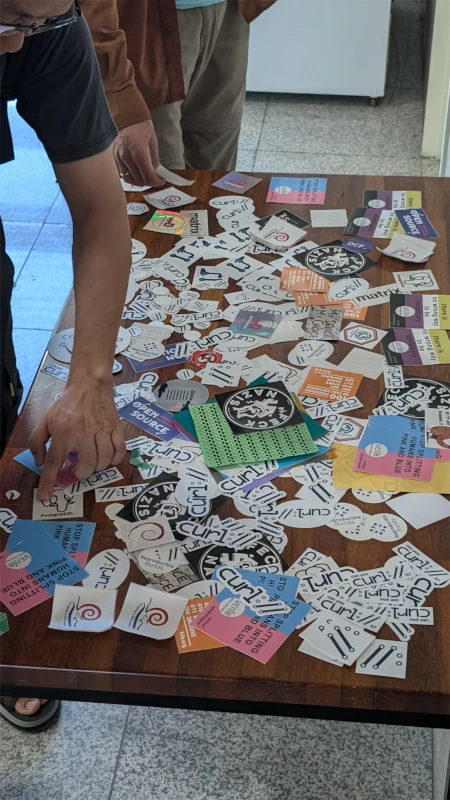
curl Swag DebConf24 was my chance at forwarding some curl swag items to the other curl maintainers, so both Sergio Durigan Junior <sergiodj> and Carlos Henrique Lima Melara <charles> got the curl-up t-shirt and the very cool curl PCB coaster, both gifted by Daniel Stenberg. Unfortunately I didn't have any of that for DebConf attendees, but I did drop loads of curl stickers at the stickers table, they were gone very quickly. A table full of different stickers, curl stickers can be seen over the whole table

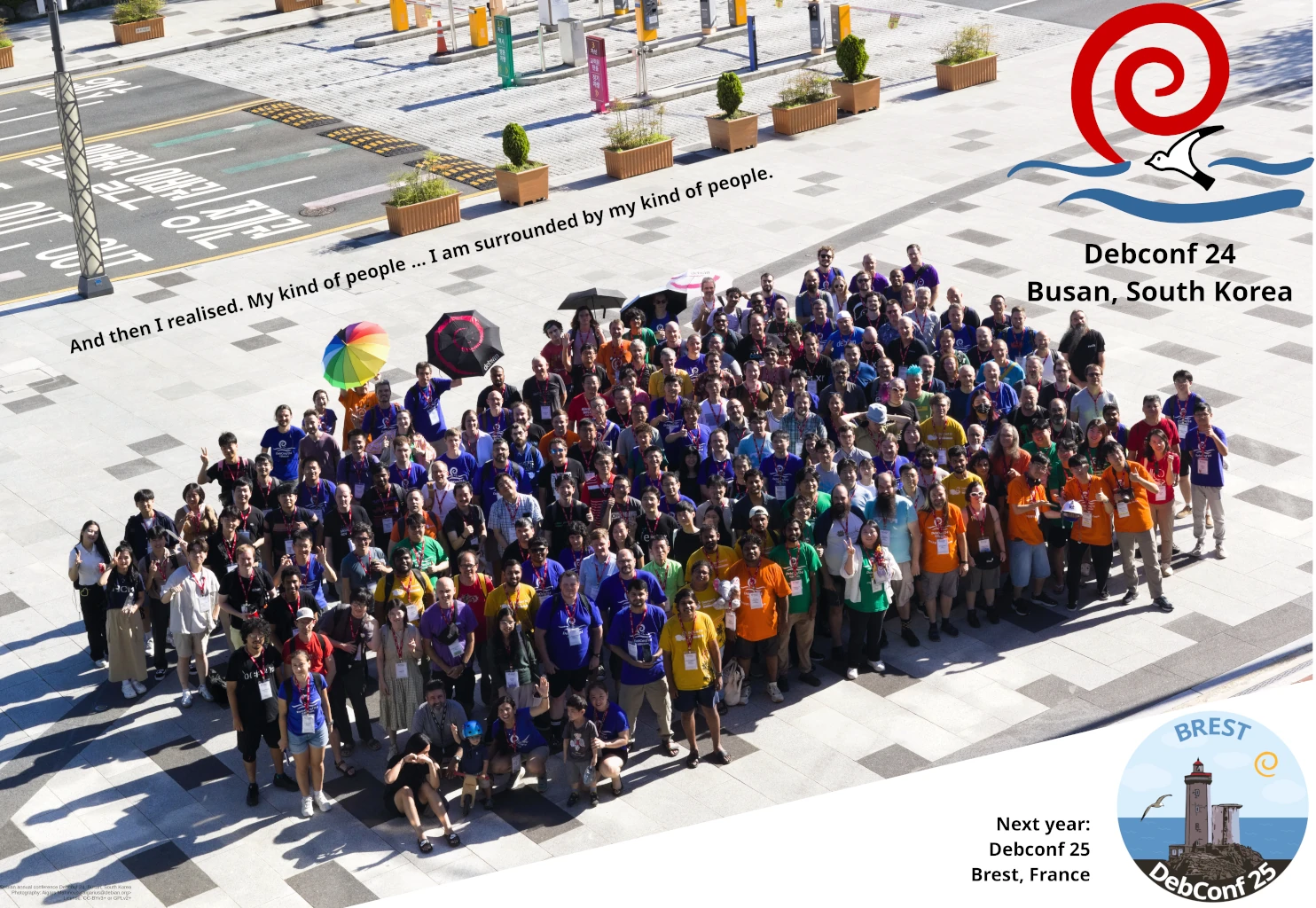
For the future I used to think the most humbling experience you could have as someone who presented a talk was to have to watch it yourself, you notice a lot of mistakes and you instantly think about things that should be done differently. It turns out the most humbling thing to do is actually to write subtitles for your talks, I noticed every single mistake, often multiple times. So after spending more than 30 hours writing the subtitles for both English and Brazilian Portuguese for my talks, I feel like it's going to be much easier to avoid committing the same mistakes again. After some time you stop feeling shame about those mistakes and you're just left with feelings of annoyance, and at that point it becomes easier to consciously avoid them. I am collecting a list of things I wish I had done differently on all of those talks, so if I end up presenting any one of them again, it will be an improved version. A picture from the top of a group of conference attendees, there's about 150 people in the picture

2 September 2024

Jonathan Carter: Debian Day South Africa 2024

Beer, cake and ISO testing amidst rugby and jazz band chaos On Saturday, the Debian South Africa team got together in Cape Town to celebrate Debian s 31st birthday and to perform ISO testing for the Debian 11.11 and 12.7 point releases.
We ran out of time to organise a fancy printed cake like we had last year, but our improvisation worked out just fine!
We thought that we had allotted plenty of time for all of our activities for the day, and that there would be plenty of time for everything including training, but the day zipped by really fast. We hired a venue at a brewery, which is usually really nice because they have an isolated area with lots of space and a big TV nice for presentations, demos, etc. But on this day, there was a big rugby match between South Africa and New Zealand, and as it got closer to the game, the place just got louder and louder (especially as a band started practicing and doing sound tests for their performance for that evening) and it turned out our space was also double-booked later in the afternoon, so we had to relocate.
Even amidst all the chaos, we ended up having a very productive day and we even managed to have some fun!
Four people from our local team performed ISO testing for the very first time, and in total we covered 44 test cases locally. Most of the other testers were the usual crowd in the UK, we also did a brief video call with them, but it was dinner time for them so we had to keep it short. Next time we ll probably have some party line open that any tester can also join.

Logo
We went through some more iterations of our local team logo that Tammy has been working on. They re turning out very nice and have been in progress for more than a year, I guess like most things Debian, it will be ready when it s ready!

Debian 11.11 and Debian 12.7 released, and looking ahead towards Debian 13 Both point releases tested just fine and was released later in the evening. I m very glad that we managed to be useful and reduce total testing time and that we managed to cover all the test cases in the end. A bunch of things we really wanted to fix by the time Debian 12 launched are now finally fixed in 12.7. There s still a few minor annoyances, but over all, Debian 13 (trixie) is looking even better than Debian 12 was around this time in the release cycle. Freeze dates for trixie has not yet been announced, I hope that the release team announces those sooner rather than later, also KDE Plasma 6 hasn t yet made its way into unstable, I ve seen quite a number of people ask about this online, so hopefully that works out. And by the way, the desktop artwork submissions for trixie ends in two weeks! More information about that is available on the Debian wiki if you re interested in making a contribution. There are already 4 great proposals.

Debian Local Groups Organising local events for Debian is probably easier than you think, and Debian does make funding available for events. So, if you want to grow Debian in your area, feel free to join us at -localgroups on the OFTC IRC network, also plumbed on Matrix at -localgroups:matrix.debian.social where we ll try to answer any questions you might have and guide you through the process! Oh and btw South Africa won the Rugby!

30 August 2024

Sahil Dhiman: Debconf24 Busan

DebConf24 was held in Busan, South Korea, from July 28th to August 4th 2024 and preceded by DebCamp from July 21st to July 27th. This was my second IRL DebConf (DC) and fourth one in total. I started in Debian with a DebConf, so its always an occasion when one happens. This year again, I worked in fundraising team, working to raise funds from International sponsors. We did manage to raise good enough funding, albeit less than budgeted. Though, the local Korean team was able to connect and gather many Governmental sponsors, which was quite surprising for me. I wasn t seriously considering attending DebConf until I discussed this with Nilesh. More or less, his efforts helped push me through the whole process. Thanks, Nilesh, for this. In March, I got my passport and started preparing documents for South Korean visa. It did require quite a lot of paper work but seeing South Korea s s fresh passport visa rejection rate, I had doubts about visa acceptance. The visa finally got approved, which could be attributed to great documentation and help from DebConf visa team. This was also my first trip outside India, and this being to DebConf made many things easy. Most stuff were documented on DebConf website and wiki. Asking some query got immediate responses from someone in the DebConf channels. We then booked a direct flight from Delhi, reaching Seoul in the morning. With good directions from Sourab TK who had reached Seoul a few hours earlier, we quickly got Korean Won, local SIM and T Money card (transportation card) and headed towards Seoul by AREX, airport metro. We spent the next two days exploring Seoul, which is huge. It probably has the highest number of skyscrapers I have ever seen. The city has a good mix of modern and ancient culture. We explored various places in Seoul including Gyeongbokgung Palace, Statue of King Sejong, Bukchon Hanok village, N Seoul Tower and various food markets which were amazing. A Street in Seoul
A Street in Seoul
Next, we headed to Busan for DebConf using KTX (Korean high speed rail). (Fun fact, slogan for City of Busan is Busan is Good .) South Korea has a good network of frequently running high speed trains. We had pre-booked our tickets because, despite the frequency, trains were sold out most of the time. KTX ride was quite smooth, despite travelling at 300 Kmph at times through Korean countryside and long mountain tunnels. View from Dorm Room
PKNU Entrance
The venue for DebConf was Pukyong National University (PKNU), Daeyeon Campus. PKNU had two campuses in the Busan and some folks ended up in wrong campus too. With good help and guidance from the front desk, we got our dormitory rooms assigned. Dorms here were quite different, ie: View from Dorm Room
View from Dorm Room
Settling in was easy. We started meeting familiar folks after almost a year. The long conversations started again. Everyone was excited for DebConf. Like everytime, the first day was full of action (and chaos). Meet and greet, volunteers check in, video team running around and fixing stuff and things working (or not). There were some interesting talks and sponsors stalls. After day one, things more or less settled down. I again volunteered for video team stuff and helped in camera operations and talk directions, which is always fun. As the tradition applies, saw few talks live on stream too sitting in the dorm room during the conf, which is always fun, when too tired to get ready and go out. From Talk Director's chair
From Talk Director's chair
DebConf takes care of food needs for vegan/vegetarianism folks well, of which I m one. I got to try different food items, which was quite an experience. Tried using chopsticks again which didn t work, which I later figured that handling metal ones were more difficult. We had late night ramens and wooden chopsticks worked perfectly. One of the days, we even went out to an Indian restaurant to have some desi aloo paratha, paneer dishes, samosas and chai (milk tea). I wasn t particularly craving desi food but wasn t able to get something according to my taste so went there. As usual Bits from DPL talk was packed
As usual Bits from DPL talk was packed
For day trip, I went to Ulsan. San means mountains in Korean. Ulsan is a port city with many industries including Hyundai car factory, petrochemical industry, paint industry, ship building etc. We saw bamboo forest, Ulsan tower (quite a view towards Ulsan port), whale village, Ulsan Onggi Museum and the sea (which was beautiful). The beautiful sea
The beautiful sea

View from Ulsan Bridge Observatory
Amongst the sponsors, I was most interested in our network sponsors, folks who were National research and education networks (NREN) here. We had two network sponsors, KOREN and KREONET, thanks to efforts by local team. Initially it was discussed that they ll provide 20G uplink each, so 40G in total, which was whopping but by the time the closing talk happened, we got to know we had 200G uplink to the Internet. This was a massive update to last year when we had 1G main and 100M backup link. 200G wasn t what is required, but it was massive capacity and IIRC from the talk, we peaked at around 500M in usage, but it s always fun to have astronomical amount of bandwidth for bragging rights ;) Various mascots in attendance
Various mascots in attendance

Video and Network stats. Screengrab from closing ceremony
Now let s talk about things I found interesting about South Korea in general: Gyeongbokgung Palace Entrance Gyeongbokgung Palace Entrance Gyeongbokgung Palace Entrance
Grand Gyeongbokgung Palace, Seoul

Starfield Library
Starfield Library, Seoul
If one has to get the whole DebConf experience, it s better to attend DebCamp as well because that s when you can sit and interact with everyone better. As DebConf starts, everyone gets busy in various talks and events and things take a pace. DebConf days literally fly. This year, attending DebConf in person was a different experience. Attending DebConf without any organizational work/stress so was better, and I was able to understand working of different Debian team and workflows better while also identified a few where I would like to join and help. A general conclusion was that almost all Debian teams needs more folks to help out. So if someone want to join, they can probably reach out to the team, and would be able to onboard new folks. Though this would require some patience. Kudos to the Korean team who were able to pull off this event under this tight timeline and thanks for all the hospitality. DebConf24 Group Photo
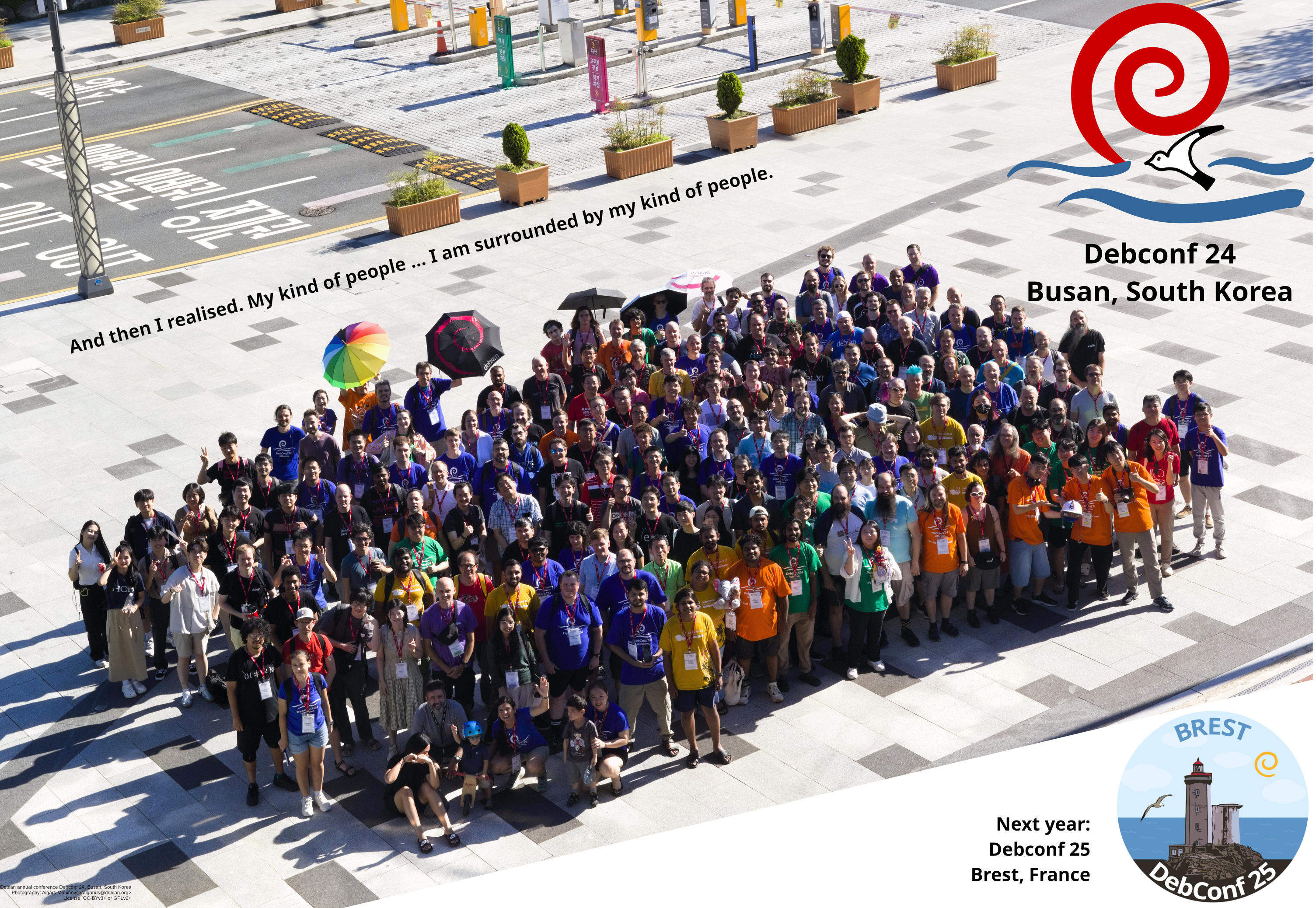
DebConf24 Group Photo. Click to enlarge.
Credits - Aigars Mahinovs
This whole experience expanded my world view. There s so much to see and explore and understand. Looking forward to DebConf25 in Brest, France. PS - Shoutout to abbyck (aka hamCK)!

Steve McIntyre: A birthday gift to remember!

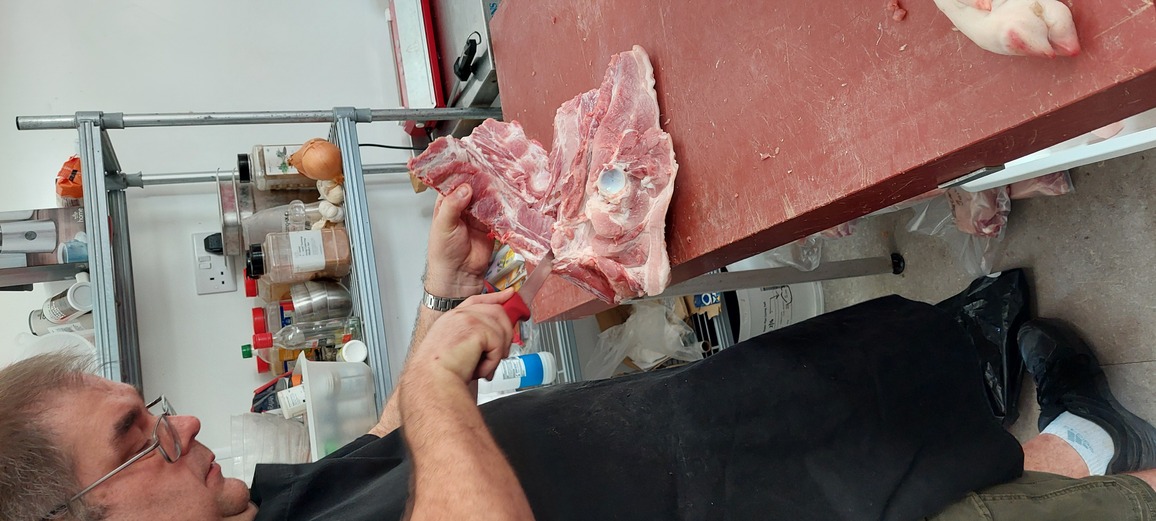
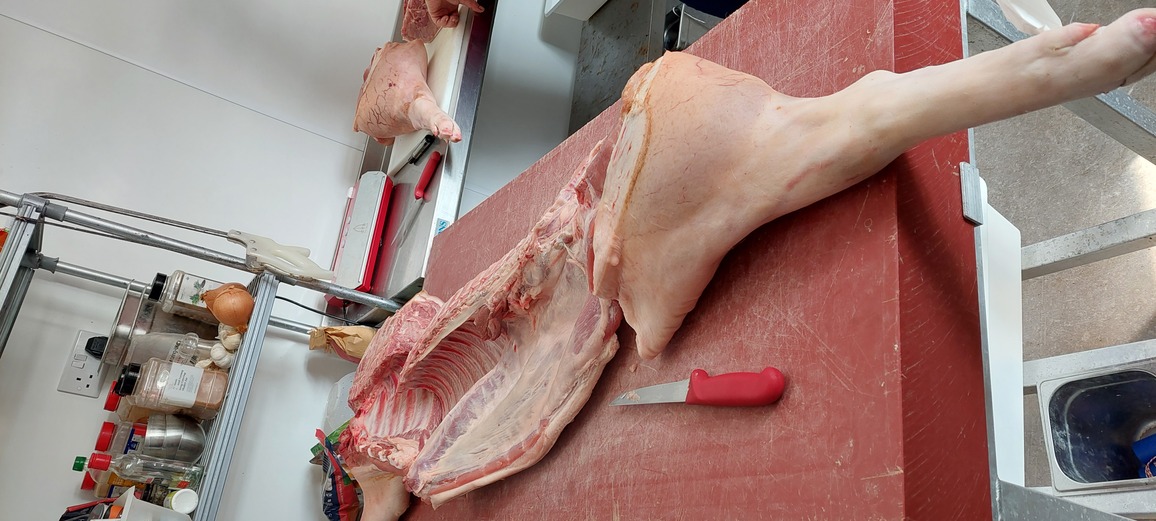
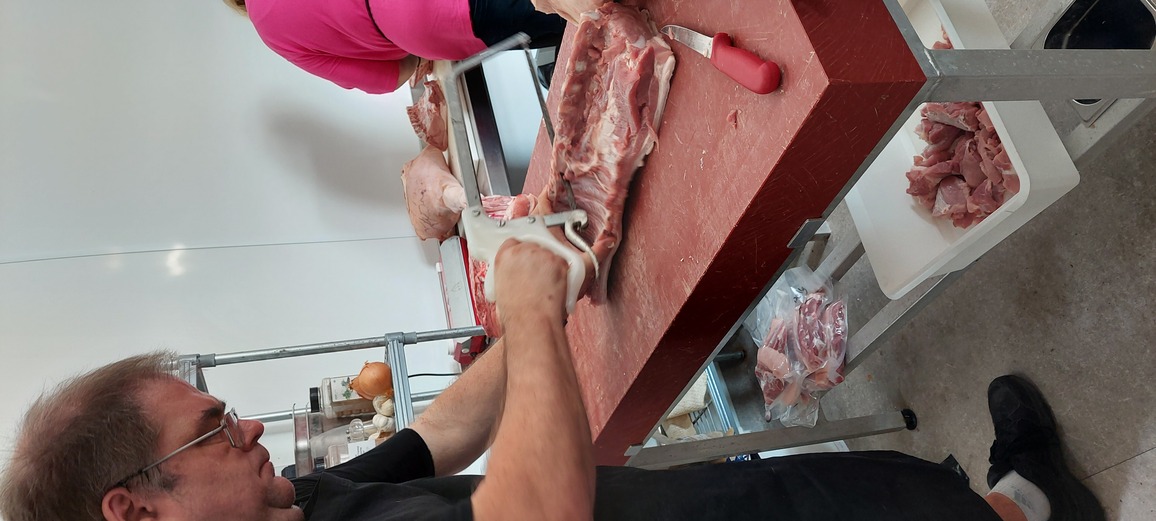
Warning: If you're not into meat, you might want to skip the rest of this... This year, I turned 50. Wow. Lots of friends and family turned up to help me celebrate, with a BBQ (of course!). I was very grateful for a lovely set of gifts from those awesome people, and I have a number of driving experiences to book in the next year or so. I'm going to have so much fun driving silly cars on and off road! However, the most surprising gift was something totally different - a full-day course of hands-on pork butchery. I was utterly bemused - I've never considered doing anything like this at all, and I'd certainly never talked to friends about anything like it either. I was shocked, but in a good way! So, two weekends back Jo and I went over to Empire Farm in Somerset. We stayed nearby so we could be ready on-site early on Sunday morning, and then we joined three other people doing the course. Jo was there to observe, i.e. to watch and take (lots of!) pictures. I can genuinely say that this was the most fun surprise gift I've ever received! David Coldman, the master butcher working with us, has been in the industry for many years. He was an excellent teacher, showing us everything we needed to know and being very patient with us when we needed it. It was great to hear his philosophy too - he only uses the very best locally-sourced meat and focuses on quality over quantity. He showed us all the different cuts of pork that a butcher will make, and we were encouraged to take everything home - no waste here! half a pig At the beginning of the day, we each started with half a pig. Over the next several hours, we steadily worked our way through a series of cuts with knife and saw, making the remaining pig smaller and smaller as we went. saw knife We finished the day with three sets of meat. First, a stack of vacuum-packed joints, chops and steaks ready for cooking and eating at home. Second: a box of off-cuts that we minced and made into sausages at the end of the day. Finally: a bag of skin and bones. Our friend's dog got some of the bones, and Jo turned a lot of the skin into crackling that we shared with friends at the OMGWTFBBQ the next weekend. sausages This was an amazing day. Massive thanks to my good friend Chris Walker for suggesting this gift. As I told David on the day: this was the most fun surprise gift I've ever received. Good hands-on teaching in a new craft is an incredible thing to experience, and I can't recommend this course highly enough.
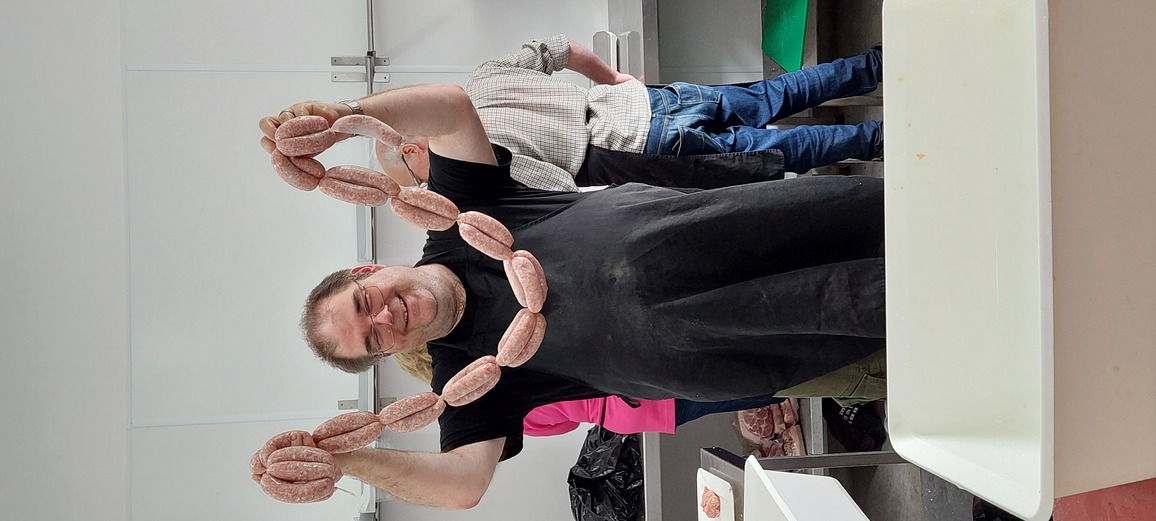
27 August 2024

Russ Allbery: Review: Dark Horse

Review: Dark Horse, by Michelle Diener
Series: Class 5 #1
Publisher: Eclipse
Copyright: June 2015
ISBN: 0-9924559-3-6
Format: Kindle
Pages: 366
Dark Horse is a science fiction romance novel, the first of a five book series as of this writing. It is self-published, although it is sufficiently well-edited and packaged that I had to do some searching to confirm that. Rose was abducted by aliens. The Tecrans picked her up along with a selection of Earth animals, kept her in a cell in their starship, and experimented on her. As the book opens, she has managed to make her escape with the aid of an AI named Sazo who was also imprisoned on the Tecran ship. Sazo dealt with the Tecrans, dropped the ship in the middle of Grih territory, and then got Rose and most of the animals on shuttles to a nearby planet. Dav Jallan is the commander of the ship the Grih sent to investigate the unexplained appearance of a Class 5 Tecran warship in the middle of their territory. The Grih and the Tecran, along with three other species, are members of the United Council, which means in theory they're all at peace. With the Tecran, that theory is often strained. Dav is not going to turn down one of their highly-advanced Class 5 warships delivered to him on a silver platter. There is only the matter of the unexpected cargo, the first orange dots (indicating unknown life forms) that most of the Grih have ever seen. There is a romance. That romance did not work for me. I thought it was highly unprofessional on Dav's part and a bit too obviously constructed on the author's part. It also leans on the subgenre convention that aliens can be remarkably physically similar and sexually compatible, which always causes problems for my suspension of disbelief even though I know it's no less plausible than faster-than-light travel. Despite that, I had so much fun with this book! It was absolutely delightful and weirdly grabby in a way that caught me by surprise. I was skimming some parts of it to write this review and found myself re-reading multiple pages before I dragged myself back on task. I think the most charming part of this book is that the United Council has a law called the Sentient Beings Agreement that makes what the Tecran were doing extremely illegal, and the Grih and the other non-Tecran aliens take this very seriously and with a refreshing lack of cynicism. Rose has a typical human reaction to ending up in a place where she doesn't know the rules and isn't entirely an expected guest. She almost reflexively smoothes over miscommunications and tensions, trying to adapt to their expectations. And then, repeatedly, the Grih realize how much work she's doing to adapt to them, feel enraged at the Tecran and upset that they didn't understand or properly explain something, and find some way to make Rose feel more comfortable. It's surprisingly soothing and comforting to read. It occurred to me in several places that Dark Horse could be read as a wish-fulfillment fantasy of what life as a woman could be like if men took their fair share of the mental load. (This concept is usually applied to housework, but I think it generalizes to other social and communication contexts.) I suspect this was not an accident. There is a lot of wish fulfillment in this book. The Grih are very human-like but hunky, which is convenient for the romance subplot. They struggle to sing, value music exceptionally highly, and consider Rose's speaking voice beautifully musical. Her typical human habit of singing to herself is a source of immediate and almost overwhelming fascination. The supplies Rose takes from the Tecran ship when she flees just happen to be absurdly expensive scented shampoo and equally expensive luxury adaptable clothing. The world she lands on, and the Grih ship, are low-gravity compared to Earth, so Rose is unusually strong for her size. Grih military camouflage has no effect on her human vision. The book is set up to make Rose special. If that type of wish fulfillment is going to grate, wait on this book until you're more in the mood for it. But I like wish fulfillment books when they're done well. Part of why I like to read is to imagine a better world. And Rose isn't doted on; despite their hospitality, she's constantly underestimated by the Grih. Even with their deep belief in the Sentient Beings Agreement, they find it hard to believe that an unknown sentient, even an advanced sentient, is really their equal. Their concern at the start is somewhat patronizing, so watching Rose constantly surprise them delighted the part of my brain that likes both competence porn and deserved reversals, even though the competence here is often due to accidents of biology. It helps that Diener tells the story in alternating perspectives, so the reader first watches Rose do something practical and straightforward from her perspective and then gets to enjoy the profound surprise and chagrin of the aliens. There is a plot beneath this first contact story, and beyond the political problem of figuring out what to do with Rose and the Tecran. Sazo, Rose's AI friend, does not want the Grih to know he exists. He has a history that Rose does not know about and may not be entirely safe. As the political situation with the Tecran escalates, Sazo is pursuing goals of his own, and Rose has a firm opinion about where her loyalties should lie. The resolution is nothing ground-breaking as far as SF goes, but I thought it was satisfyingly tense and complex. Dark Horse leaves obvious room for a sequel, but it comes to a satisfying conclusion. The writing is serviceable, particularly once you get into the story. I would not call it great, and it's not going to win any literary awards, but it didn't interfere with my enjoyment of the story. This is not the sort of book that will make anyone's award list, but it is easily in the top five of books I had the most fun reading this year. Maybe save it for when you're looking for something light and wholesome and don't mind some rather obvious tropes, but if you're in the mood for imagining people who take laws seriously and sincerely try to help other people, I found this an utterly delightful way to pass the time. I immediately bought the sequel. Recommended. Followed by Dark Deeds. Rating: 8 out of 10

22 August 2024

Debian Brasil: Debian Day 2024 em Natal/RN - Brasil

por Allythy O Debian Day um evento anual que celebra o anivers rio do Debian, uma das distribui es GNU/Linux mais importante do Software Livre, criada em 16 de Agosto de 1993, por Ian Murdock. No ltimo s bado (17/08/2024) no Sebrae-RN comemoramos os 31 anos Debian em Natal, no Rio Grande do Norte. A celebra o, foi organizada pela PotiLivre(Comunidade Potiguar de Software Livre), destacou os 31 anos de hist ria do Debian. O evento contou com algumas palestras e muitas discuss es sobre Software Livre. Tivemos 70 inscri es, 40 estiverem presentes. O Debian Day em Natal foi uma ocasi o para celebrar a trajet ria do Debian e refor ar a import ncia do Software Livre. Palestrantes Agradecemos imensamente a Isaque Barbosa Martins, Eduardo de Souza Paix o, Fernando Guisso,que palestraram nessa edi o! Obrigado por compartilhar tanto conhecimento com a comunidade. Esperamos ver voc s novamente em futuros encontros! foto da palestra conhecendo projeto Debian Link dos slides do Debian Day Participantes Um grande obrigado tamb m a todos os participantes, n s fazemos isso por voc s! Esperamos que tenham aprendido, se divertido e feito novas conex es entre a comunidade Participantes do Debian Day Natal-RN Essa edi o do Debina Day Natal foi organizada por: Allythy, Clara Nobre, Gabriel Damazio e Marcel Ribeiro.
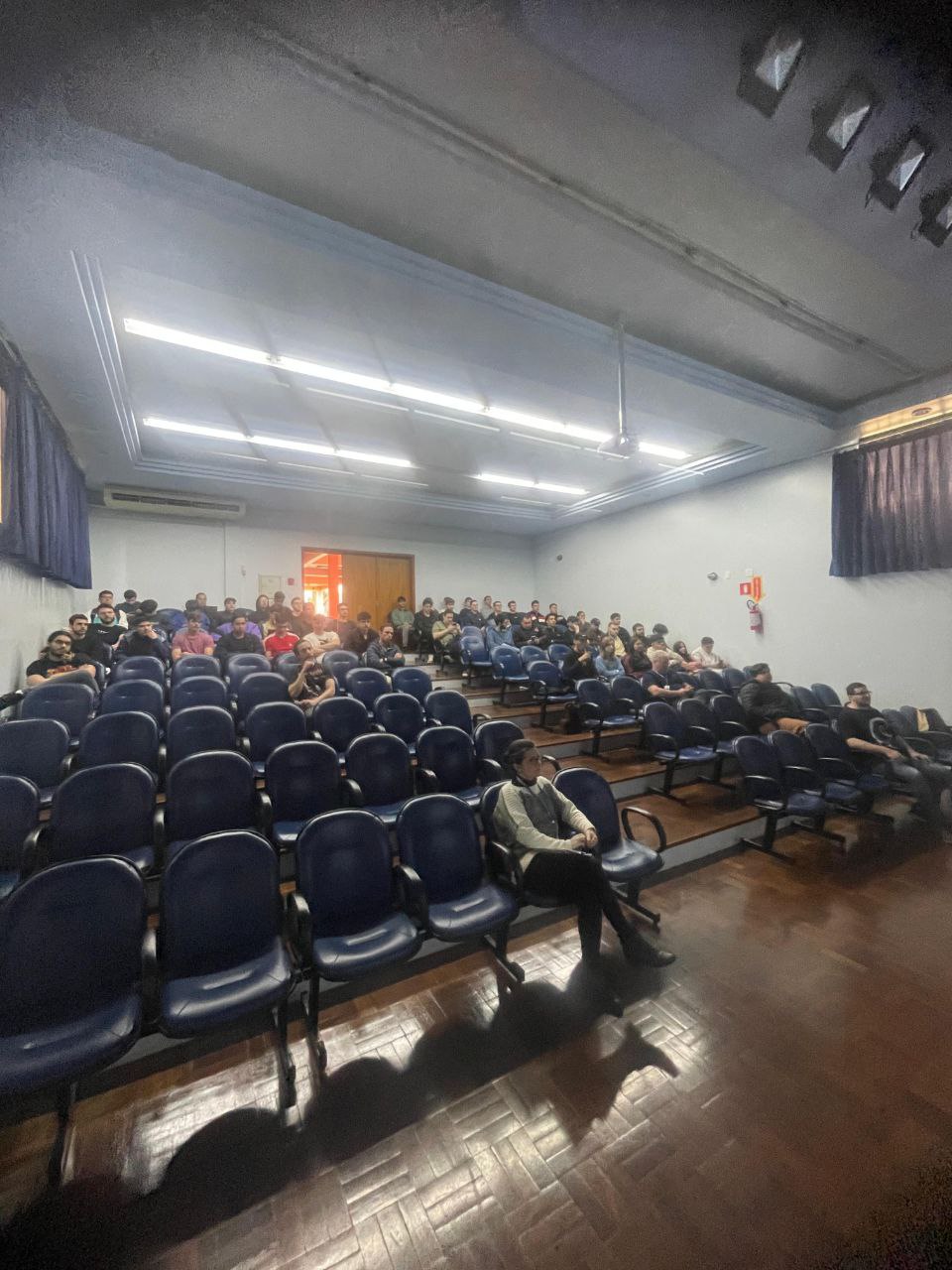
20 August 2024

Debian Brasil: Debian Day 2024 em Santa Maria/RS - Brasil

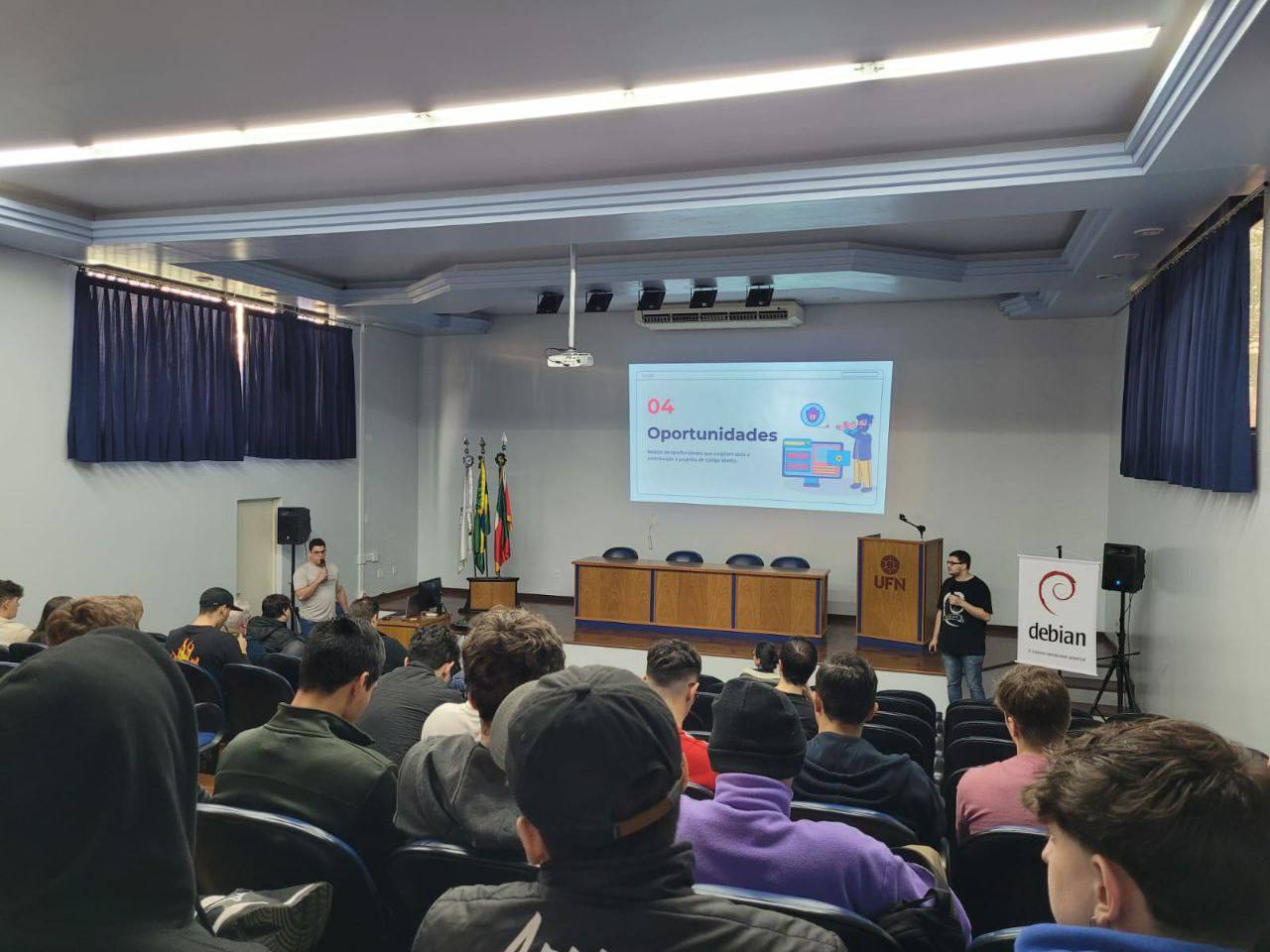
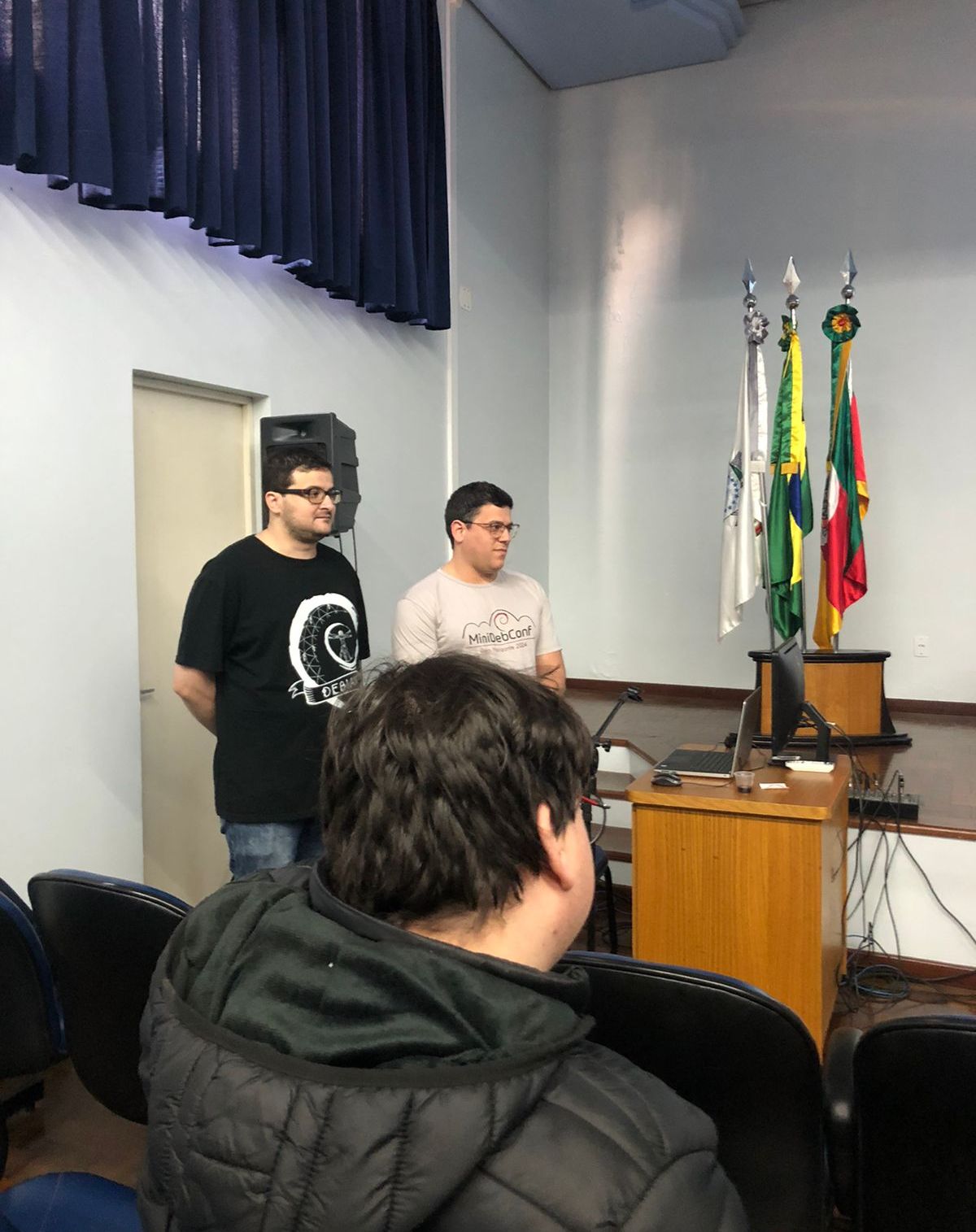
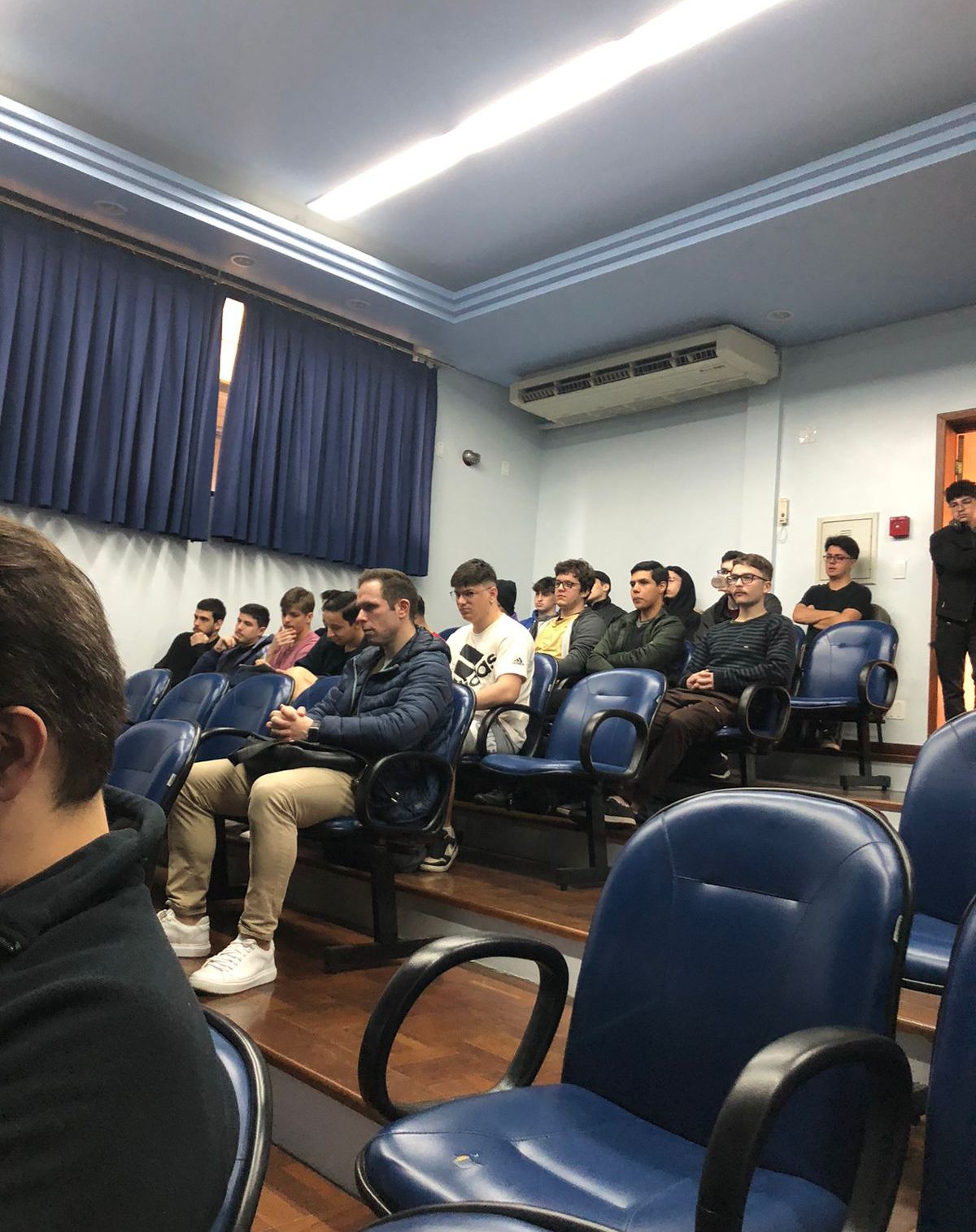
por Andrew Gon alves O Debian Day em Santa Maria - RS 2024 foi realizado ap s 5 anos de hiato, foi feito durante a manh do dia 16/08/2024 no Sal o Azul da Universidade Franciscana (UFN) com apoio da comunidade Debian e do Laborat rio de Pr ticas da Computa o da UFN. O evento contou com alunos de todos os semestres dos cursos de Ci ncia da Computa o, Jogos Digitais e Sistemas de Informa o, fizemos um coffee break onde tivemos a oportunidade de conversar com os participantes. Cerca de 60 alunos prestigiaram uma palestra de introdu o ao Software Livre e de C digo Aberto, Linux e foram introduzidos ao projeto Debian, tanto sobre a filosofia do projeto, at como ele acontece na pr tica e oportunidades que se abriram para participantes do projeto por fazerem parte do Debian. Ap s a palestra foi feita uma demonstra o de empacotamento pelo DD local Francisco Vilmar, que demonstrou na pr tica como funciona o empacotamento de software no Debian. Gostaria de agradecer a todas as pessoas que nos ajudaram: E um muito obrigado a todos os participantes que nos prestigiaram neste evento fazendo perguntas intrigantes e se interessando pelo mundo do Software Livre. Algumas fotos: DD em Santa Maria 1 DD em Santa Maria 2 DD em Santa Maria 3 DD em Santa Maria 4

16 August 2024

Bits from Debian: Debian Celebrates 31 years!

Debian 31 years by Daniel Lenharo As the expression goes, "Time flies when you are having fun", meaning you do not normally account for the passage of time when you are distracted and enjoying yourself. The expression is a well established English idiom, though today for a moment the Debian Project pauses to reflect on that expression. It has been 31 years now that we have been around. It has been 31 amazing years of fun and amazement in watching the world around us grow and ourselves grow into the world. Let us tell you, we have had a great time in doing so. We have been invited to nearly every continent and country for over 25 Debian Developer Conferences, we have contributed to the sciences with our Debian Pure Blends; we have not given up on or discounted aged hardware with Long Term Support (LTS); we have encouraged and sponsored diversity with our Outreach Programs. We have contributed to exploration of this lovely planet and the vast vacuum of space (where no one hears Developers scream). There is more to what we have done but from a cursory glance, we seem to have done it all. But we never noticed it. Time does fly or "escape irretrievably" when having a good time and making progress, though our pause at this moment is that we have also had a few moments of honest self-evaluation and reflection. Over the years the project has lost some significant loved ones who were dear to us - you may have called them Developers while we called them Friends, we called them Mentors, we hurt, we grieved, and in their memories we keep moving forward. The course of the project has seen a few tragedies, has seen heated discourse in the public domain, has addressed and weathered concerns, and has still continually grown. And we did that in the public sphere, because at the core this is an open project. Our code is public, our bugs and failings are public, our communications are public, our meetings are public, and our love of FLOSS is most definitely public. And now more than ever the Debian Project realizes that the "we" that is sprinkled throughout this letter is just another way of saying: "you". You, the user, contributor, sponsor, developer, maintainer, bug squasher; all of you make the WE that is Debian. So what are WE waiting for? Lets celebrate! Join the worldwide celebration or find an event local to you by visiting our DebianDay events page - see you there!

14 August 2024

Lukas M rdian: Netplan v1.1 released

I m happy to announce that Netplan version 1.1 is now available on GitHub and is soon to be deployed into a Debian and/or Ubuntu installation near you! Six months and 120 commits after the previous version (including one patch release v1.0.1), this release is brought to you by 17 free software contributors from around the globe.  Kudos to everybody involved!

Highlights
  • Custom systemd-networkd-wait-online logic override to wait for link-local and routable interfaces. (#456, #482)
  • Modification of the embedded-switch-mode setting without virtual-function (VF) definitions on SR-IOV devices (#454)
  • Parser flag to ignore individual, broken configurations, instead of not generating any backend configuration (#412)
  • Fixes for @ProtonVPN (#495) and @microsoft Azure Linux (#445), contributed by those companies

Releasing v1.1

Documentation

Bug fixes

New Contributors Full Changelog: 1.0 1.1

10 August 2024

Bits from Debian: DebConf24 closes in Busan and DebConf25 dates announced

DebConf24 group photo - click to enlarge On Saturday 3 August 2024, the annual Debian Developers and Contributors Conference came to a close. Over 339 attendees representing 48 countries from around the world came together for a combined 108 events made up of more than 50 Talks and Discussions, 37 Birds of a Feather (BoF informal meeting between developers and users) sessions, 12 workshops, and activities in support of furthering our distribution and free software (25 patches submitted to the Linux kernel), learning from our mentors and peers, building our community, and having a bit of fun. The conference was preceded by the annual DebCamp hacking session held July 21st through July 27th where Debian Developers and Contributors convened to focus on their Individual Debian-related projects or work in team sprints geared toward in-person collaboration in developing Debian. This year featured a BootCamp that was held for newcomers with a GPG Workshop and a focus on Introduction to creating .deb files (Debian packaging) staged by a team of dedicated mentors who shared hands-on experience in Debian and offered a deeper understanding of how to work in and contribute to the community. The actual Debian Developers Conference started on Sunday July 28 2024. In addition to the traditional 'Bits from the DPL' talk, the continuous key-signing party, lightning talks and the announcement of next year's DebConf25, there were several update sessions shared by internal projects and teams. Many of the hosted discussion sessions were presented by our technical core teams with the usual and useful meet the Technical Committee and the ftpteam and a set of BoFs about packaging policy and Debian infrastructure, including talk about APT and Debian Installer and an overview about the first eleven years of Reproducible Builds. Internationalization and localization have been subject of several talks. The Python, Perl, Ruby, and Go programming language teams, as well as Med team, also shared updates on their work and efforts. More than fifteen BoFs and talks about community, diversity and local outreach highlighted the work of various team involved in the social aspect of our community. This year again, Debian Brazil shared strategy and action to attract and retain new contributors and members and opportunities both in Debian and F/OSS. The schedule was updated each day with planned and ad-hoc activities introduced by attendees over the course of the conference. Several traditional activities took place: a job fair, a poetry performance, the traditional Cheese and Wine party, the group photos and the Day Trips. For those who were not able to attend, most of the talks and sessions were broadcast live and recorded and the videos made available through a link in their summary in the schedule. Almost all of the sessions facilitated remote participation via IRC messaging apps or online collaborative text documents which allowed remote attendees to 'be in the room' to ask questions or share comments with the speaker or assembled audience. DebConf24 saw over 6.8 TiB (4.3 TiB in 2023) of data streamed, 91.25 hours (55 in 2023) of scheduled talks, 20 network access points, 1.6 km fibers (1 broken fiber...) and 2.2 km UTP cable deployed, more than 20 country Geoip viewers, 354 T-shirts, 3 day trips, and up to 200 meals planned per day. All of these events, activities, conversations, and streams coupled with our love, interest, and participation in Debian and F/OSS certainly made this conference an overall success both here in Busan, South Korea and online around the world. The DebConf24 website will remain active for archival purposes and will continue to offer links to the presentations and videos of talks and events. Next year, DebConf25 will be held in Brest, France, from Monday, July 7 to Monday, July 21, 2025. As tradition follows before the next DebConf the local organizers in France will start the conference activities with DebCamp with particular focus on individual and team work towards improving the distribution. DebConf is committed to a safe and welcome environment for all participants. See the web page about the Code of Conduct in DebConf24 website for more details on this. Debian thanks the commitment of numerous sponsors to support DebConf24, particularly our Platinum Sponsors: Infomaniak, Proxmox, and Wind River. We also wish to thank our Video and Infrastructure teams, the DebConf24 and DebConf committees, our host nation of South Korea, and each and every person who helped contribute to this event and to Debian overall. Thank you all for your work in helping Debian continue to be "The Universal Operating System". See you next year! About Debian The Debian Project was founded in 1993 by Ian Murdock to be a truly free community project. Since then the project has grown to be one of the largest and most influential open source projects. Thousands of volunteers from all over the world work together to create and maintain Debian software. Available in 70 languages, and supporting a huge range of computer types, Debian calls itself the universal operating system. About DebConf DebConf is the Debian Project's developer conference. In addition to a full schedule of technical, social and policy talks, DebConf provides an opportunity for developers, contributors and other interested people to meet in person and work together more closely. It has taken place annually since 2000 in locations as varied as Scotland, Argentina, Bosnia and Herzegovina, and India. More information about DebConf is available from https://debconf.org/. About Infomaniak Infomaniak is an independent cloud service provider recognized throughout Europe for its commitment to privacy, the local economy and the environment. Recording growth of 18% in 2023, the company is developing a suite of online collaborative tools and cloud hosting, streaming, marketing and events solutions. Infomaniak uses exclusively renewable energy, builds its own data centers and develops its solutions in Switzerland, without relocating. The company powers the website of the Belgian radio and TV service (RTBF) and provides streaming for more than 3,000 TV and radio stations in Europe. About Proxmox Proxmox provides powerful and user-friendly Open Source server software. Enterprises of all sizes and industries use Proxmox solutions to deploy efficient and simplified IT infrastructures, minimize total cost of ownership, and avoid vendor lock-in. Proxmox also offers commercial support, training services, and an extensive partner ecosystem to ensure business continuity for its customers. Proxmox Server Solutions GmbH was established in 2005 and is headquartered in Vienna, Austria. Proxmox builds its product offerings on top of the Debian operating system. About Wind River Wind River For nearly 20 years, Wind River has led in commercial Open Source Linux solutions for mission-critical enterprise edge computing. With expertise across aerospace, automotive, industrial, telecom, and more, the company is committed to Open Source through initiatives like eLxr, Yocto, Zephyr, and StarlingX. Contact Information For further information, please visit the DebConf24 web page at https://debconf24.debconf.org/ or send mail to press@debian.org.

Next.

Previous.