Search Results: "ana"

15 December 2025

Gunnar Wolf: Unique security and privacy threats of large language models a comprehensive survey

This post is an unpublished review for Unique security and privacy threats of large language models a comprehensive survey
Much has been written about large language models (LLMs) being a risk to user security and privacy, including the issue that, being trained with datasets whose provenance and licensing are not always clear, they can be tricked into producing bits of data that should not be divulgated. I took on reading this article as means to gain a better understanding of this area. The article completely fulfilled my expectations. This is a review article, which is not a common format for me to follow: instead of digging deep into a given topic, including an experiment or some way of proofing the authors claims, a review article will contain a brief explanation and taxonomy of the issues at hand, and a large number of references covering the field. And, at 36 pages and 151 references, that s exactly what we get. The article is roughly split in two parts: The first three sections present the issue of security and privacy threats as seen by the authors, as well as the taxonomy within which the review will be performed, and sections 4 through 7 cover the different moments in the life cycle of a LLM model (at pre-training, during fine-tuning, when deploying systems that will interact with end-users, and when deploying LLM-based agents), detailing their relevant publications. For each of said moments, the authors first explore the nature of the relevant risks, then present relevant attacks, and finally close outlining countermeasures to said attacks. The text is accompanied all throughout its development with tables, pipeline diagrams and attack examples that visually guide the reader. While the examples presented are sometimes a bit simplistic, they are a welcome guide and aid to follow the explanations; the explanations for each of the attack models are necessarily not very deep, and I was often left wondering I correctly understood a given topic, or wanting to dig deeper but being this a review article, it is absolutely understandable. The authors present an easy to read prose, and this article covers an important spot in understanding this large, important, and emerging area of LLM-related study.

Russ Allbery: Review: Brigands & Breadknives

Review: Brigands & Breadknives, by Travis Baldree
Series: Legends & Lattes #3
Publisher: Tor
Copyright: 2025
ISBN: 1-250-33489-6
Format: Kindle
Pages: 325
Brigands & Breadknives is a secondary-world sword-and-sorcery fantasy and a sequel to both Legends & Lattes and Bookshops & Bonedust. It takes place shortly after Legends & Lattes chronologically, but Fern, the protagonist, was introduced in the Bookshops & Bonedust prequel. You may have noticed I didn't describe this as cozy fantasy. That is intentional. When we left Fern at the end of Bookshops & Bonedust, the rattkin was running a bookshop in the town of Murk. As Brigands & Breadknives opens, Fern is moving, for complicated and hard-to-describe personal reasons, to Thune where Viv has her coffee shop. Her plan is to open a new bookstore next door to Legends and Lattes. This is exactly the sort of plot one might expect from this series, and the first few chapters feel like yet another version of the first two novels. Then Fern makes an impulsive and rather inexplicable (even to herself) decision and the plot goes delightfully sideways. Brigands & Breadknives is not, as Baldree puts it in the afterword, a book about fantasy small-business ownership as the answer to all of life's woes. It is, instead, a sword and sorcery story about a possibly immortal elven bounty hunter, her utterly baffling goblin prisoner, and a rattkin bookseller who becomes their unexpected travel companion for reasons she can't explain. It's a story about a mid-life crisis in a world and with supporting characters that I can only describe as inspired by a T. Kingfisher novel. Baldree is not Ursula Vernon, of course. This book does not contain paladins or a romance, possibly to the relief of some readers. It's slower, a bit more introspective, and doesn't have as sharp of edges or the casual eerie unsettlingness. But there is a religious order that worships a tentacled space horror for entirely unexpected reasons, pompous and oleaginous talking swords with verbose opinions about everything, a mischievously chaotic orange-haired goblin who quickly became one of my favorite fantasy characters and then kept getting better, and a whole lot of heart. You may see why Kingfisher was my first thought for a comparison point. Unlike Baldree's previous novels, there is a lot of combat and injury. I think some people will still describe this book as cozy, and I'm not going to argue too strongly because the conflicts are a bit lighter than the sort of rape and murder one would see in a Mercedes Lackey novel. But to me this felt like sword and sorcery in a Dungeons and Dragons universe made more interesting by letting the world-building go feral and a little bit sarcastic. Most of the book is spent traveling, there are a lot of random encounters that build into a connected plot, and some scenes (particularly the defense of the forest village) felt like they could have sold to the Swords and Sorceress anthology series. Also, this was really good! I liked both Legends & Lattes and Bookshops & Bonedust, maybe a bit more than the prevailing opinion among reviewers since the anachronisms never bothered me, but I wasn't sure whether to dive directly into this book because I was expecting more of the same. This is not more of the same. I think it's clearly better writing and world-building than either of the previous books. It helps that Fern is the protagonist; as much as I like Viv, I think Fern is a more interesting character, and I am glad she got a book of her own. Baldree takes a big risk on the emotional arc of this book. Fern starts the story in a bad state and makes some decisions to kick off the plot that are difficult to defend. She beats herself up for those decisions for most of the book, deservedly, and parts of that emotional turmoil are difficult to read. Baldree resists the urge to smooth everything over and instead provides a rather raw sense of depression, avoidance, and social anxiety that some readers are going to have to brace themselves for. I respect the decision to not write the easy series book people probably expected, but I'm not sure Fern's emotional arc quite worked. Baldree is hinting at something that's hard to describe logically, and I'm not sure he was able to draw a clear enough map of Fern's thought process for the reader to understand her catharsis. The "follow your passion" self-help mindset has formed a gravitational singularity in the vicinity of this book's theme, it takes some skillful piloting to avoid being sucked into its event horizon, and I don't think Baldree quite managed to escape it. He made a valiant attempt, though, and it created a far more interesting book than one about safer emotions. I wanted more of an emotional payoff than I got, but the journey, even with the moments of guilt and anxiety, was so worth it. The world-building is funnier and more interesting than the previous books of the series, and the supporting cast is fantastic. If you bailed on the series but you like sword and sorcery and T. Kingfisher novels, consider returning. You do probably need to read Bookshops & Bonedust first, if you haven't already, since it helps to know the start of Fern's story. Recommended, and shortcomings aside, much better than I had expected. Content notes: Bloody sword fights, major injury, some very raw emotions about letting down friends and destroying friendships. Rating: 8 out of 10

12 December 2025

Freexian Collaborators: Debian Contributions: Updates about DebConf Video Team Sprint, rebootstrap, SBOM tooling in Debian and more! (by Anupa Ann Joseph)

Debian Contributions: 2025-11 Contributing to Debian is part of Freexian s mission. This article covers the latest achievements of Freexian and their collaborators. All of this is made possible by organizations subscribing to our Long Term Support contracts and consulting services.

DebConf Video Team Sprint The DebConf Video Team records, streams, and publishes talks from DebConf and many miniDebConfs. A lot of the infrastructure development happens during setup for these events, but we also try to organize a sprint once a year to work on infrastructure, when there isn t a DebConf about to happen. Stefano attended the sprint in Herefordshire this year and wrote up a report.

rebootstrap, by Helmut Grohne A number of jobs were stuck in architecture-specific failures. gcc-15 and dpkg still disagree about whether PIE is enabled occasionally and big endian mipsen needed fixes in systemd. Beyond this regular uploads of libxml2 and gcc-15 required fixes and rebasing of pending patches. Earlier, Loongson used rebootstrap to create the initial package set for loong64 and Miao Wang now submitted their changes. Therefore, there is now initial support for suites other than unstable and use with derivatives.

Building the support for Software Bill Of Materials tooling in Debian, by Santiago Ruano Rinc n Vendors of Debian-based products may/should be paying attention to the evolution of different jurisdictions (such as the CRA or updates on CISA s Minimum Elements for a Software Bill of Materials) that require to make available Software Bill of Materials (SBOM) of their products. It is important then to have tools in Debian to make it easier to produce such SBOMs. In this context, Santiago continued the work on packaging libraries related to SBOMs. This includes the packaging of the SPDX python library (python-spdx-tools), and its dependencies rdflib and mkdocs-include-markdown-plugin. System Package Data Exchange (SPDX), defined by ISO/IEC 5962:2021, is an open standard capable of representing systems with software components as SBOMs and other data and security references. SPDX and CycloneDX (whose python library python3-cyclonedx-lib was packaged by prior efforts this year), encompass the two main SBOM standards available today.

Miscellaneous contributions
  • Carles improved po-debconf-manager: added checking status of bug reports automatically via python-debianbts; changed some command line options naming or output based on user feedback; finished refactoring user interaction to rich; codebase is now flake8-compliant; added type safety with mypy.
  • Carles, using po-debconf-manager, created 19 bug reports for translations where the merge requests were pending; reviewed and created merge requests for 4 packages.
  • Carles planned a second version of the tool that detects packages that Recommends or Suggests packages which are not in Debian. He is taking ideas from dumat.
  • Carles submitted a pull request to python-unidiff2 (adapted from the original pull request to python-unidiff). He also started preparing a qnetload update.
  • Stefano did miscellaneous python package updates: mkdocs-macros-plugin, python-confuse, python-pip, python-mitogen.
  • Stefano reviewed a beets upload for a new maintainer who is taking it over.
  • Stefano handled some debian.net infrastructure requests.
  • Stefano updated debian.social infrastructure for the trixie point release.
  • The update broke jitsi.debian.social, Stefano put some time into debugging it and eventually enlisted upstream assistance, who solved the problem!
  • Stefano worked on some patches for Python that help Debian:
    • GH-139914: The main HP PA-RISC support patch for 3.14.
    • GH-141930: We observed an unhelpful error when failing to write a .pyc file during package installation. We may have fixed the problem, and at least made the error better.
    • GH-141011: Ignore missing ifunc support on HP PA-RISC.
  • Stefano spun up a website for hamburg2026.mini.debconf.org.
  • Rapha l reviewed a merge request updating tracker.debian.org to rely on bootstrap
    version 5.
  • Emilio coordinated various transitions.
  • Helmut sent patches for 26 cross build failures.
  • Helmut officially handed over the cleanup of the /usr-move transition.
  • Helmut monitored the transition moving libcrypt-dev out of build-essential and bumped the remaining bugs to rc-severity in coordination with the release team.
  • Helmut updated the Build-Profiles patch for debian-policy incorporating feedback from Sean Whitton with a lot of help from Nattie Mayer-Hutchings and Freexian colleagues.
  • Helmut discovered that the way mmdebstrap deals with start-stop-daemon may result in broken output and sent a patch.
  • As a result of armel being removed from sid , but not from forky , the multiarch hinter broke. Helmut fixed it.
  • Helmut uploaded debvm accepting a patch from Luca Boccassi to fix it for newer
    systemd.
  • Colin began preparing for the second stage of the OpenSSH GSS-API key exchange package split.
  • Colin caught and fixed a devscripts regression due to it breaking part of Debusine.
  • Colin packaged django-pgtransaction and backported it to trixie , since it looks useful for Debusine.
  • Thorsten uploaded the packages lprng, cpdb-backend-cups, cpdb-libs and ippsample to fix some RC bugs as well as other bugs that accumulated over time. He also uploaded cups-filters to all Debian releases to fix three CVEs.

8 December 2025

Isoken Ibizugbe: Beginning My Outreachy Journey With Debian

Hello, my name is Isoken, I m a software engineer and product manager from Nigeria. I am excited and grateful to begin this journey as an Outreachy intern working on the project Debian Images Testing with OpenQA . I am particularly drawn to helping solve problems for people; it keeps bugging me till I can find a way to help. This interest in problem-solving and improving quality is what drew me to this project. OpenQA is an automated test tool that simulates a user s interaction by looking at the screen and sending actions like mouse clicks and keyboard inputs. It takes screenshots and compares the image to known reference images to verify if the system is behaving correctly. During the contribution phase (which was 4 weeks), I got to know about Debian software, it s different mode of installation and available different desktop environments, at first I felt intimidated as most of it was new to me, but the setup material and docs for the project made it easy for me, the fact that it looked like a gradual process, getting to know the program, registering the steps in mind and then take notes of every step and visuals, writing it in a way another developer would understand (this is called detail level 3), and then translate it to test code level 1. I contributed to improving the installation documents and a detail level 3 doc for a bug report on the system locale being incorrect. This strengthened my documentation skills and ability to adjust to the writing style of the project. I also started working on app start-stop tests for two desktop environments. I was able to explore, check the applications, and note their differences and similarities. It was really interesting to me; this was where I started writing on coding level 1, and my tests started passing. I will spend the next few weeks continuing on it and hopefully creating a way to synergize the tests and make it easy to maintain later on. I am also grateful for the assistance from other candidates during the contribution stage and the privilege of having the mentors, Tassia Camoes Araujo and Roland Clobus, and Philip Hands, to guide and correct me through the internship period. I will share my progress regularly here on the blog. You can follow the progress of the work here on the main repo. Wish me luck on the rest of this journey

Freexian Collaborators: Debian's /usr-move transition has been completed (by Helmut Grohne)

By now, the /usr-merge is an old transition. Effectively, it turns top-level directories such as /bin into symbolic links pointing below /usr. That way the entire operating system can be contained below the /usr hierarchy enabling e.g. image based update mechanisms. It was first supported in Debian 9, which is no longer in active use at this point (except for users of Freexian s ELTS offer). When it became mandatory in Debian 12, it wasn t really done though, because Debian s package manager was not prepared to handle file system objects being referred to via two different paths. With nobody interested in handling the resulting issues, Freexian stepped in and funded a project lead by Helmut Grohne to resolve the remaining issues. While the initial idea was to enhance the package manager, Debian s members disagreed. They preferred an approach where files were simply tracked with their physical location while handling the resulting misbehavior of the package manager using package-specific workarounds. This has been recorded in the DEP17 document. During the Debian 13 release cycle, the plan has been implemented. A tool for detecting possible problems was developed specifically for this transition. Since all files are now tracked with their physical location and necessary workarounds have been added, problematic behavior is no longer triggered. An upgrade from Debian 12 to Debian 13 is unlikely to run into aliasing problems as a result. This whole project probably consumed more than 1500 hours of work from Debian contributors, of which 700 were sponsored by Freexian through the work of Helmut Grohne. What remains is eventually removing the workarounds.

7 December 2025

Iustin Pop: Yes, still alive!

Yeah, again three months have passed since my last (trivial) post, and I really don t know where the time has flown. I suppose the biggest problem was the long summer vacation, which threw me off-track, and then craziness started. Work work work, no time for anything, which kept me fully busy in August, and then you should travel . So mid-September I went on my first business trip since Covid, again to Kirkland, which in itself was awesome. Flew out Sunday, and as I was concerned I was going to lose too much fitness had a half-marathon planned on the weekend after the return I ran every morning of the four days I was there. And of course, on the last day, I woke up even earlier (05:30 AM), went out to run before sunrise, intending to do a very simple run along the road that borders the lake for 2.5K, then back . And right at the farthest point, a hundred metres before my goal of turning around, I tripped, started falling, and as I was falling, I hit sideways a metal pole. I was in a bus station, it was the pole that has the schedule at the top, and I hit it at relatively full speed, right across my left-side ribs. The crash took the entire air out of my lungs, and I don t remember if I ever felt pain/sensation like that I was seriously not able to breathe for 20 seconds or so, and I was wondering if I m going to pass out at this rate. Only 20 seconds, because my Garmin started howling like a police siren, and the screen was saying something along the lines of: Incident detected; contacting emergency services in 40 35 and I was fumbling to cancel that, since a) I wasn t that bad, b) notifying my wife that I had a crash would have not been a smart idea. My left leg was scraped in a few places, my left hand pretty badly, or more than just scraped, so my focus was on limping back, and finding a fountain to wash my injuries, which I did, so I kept running with blood dripping down my hand. Fun fun, everything was hurting, I took an Uber for the ~1Km to the office, had many meetings, took another Uber and flew back to Zurich. Seattle San Francisco Z rich, I think 14 hours, with my ribs hurting pretty badly. But I got home (Friday afternoon), and was wondering if I can run or not on Saturday. Saturday comes, I feel pretty OK, so I said let s try, will stop if the pain is too great. I pick up my number, I go to the start, of course in the last block and not my normal block, and I start running. After 50 metres, I knew this won t be good enough, but I said, let s make it to the first kilometre. Then to the first fuelling point, then to the first aid point, at which moment I felt good enough to go to the second one. Long story short, I ran the whole half marathon, with pain. Every stop for fuelling was mentally hard, as the pain stopped, and I knew I had to start running again, and the pain would resume. In the end, managed to finish: two and a half hours, instead of just two hours, but alive and very happy. Of course, I didn t know what was waiting for me Sunday I wake up in heavy pain, and despite painkillers, I was not feeling much better. The following night was terrible, Monday morning I went to the doctor, had X-rays, discussion with a radiologist. Not really broken, but more than just bruised. See this angle here? Bones don t have angles normally . Painkillers, chest/abdomen wrapping, no running! So my attempts to not lose fitness put me off running for a couple of weeks. Then October came, and I was getting better, but work was getting even more crazy. I don t know where November passed, honestly, and now we re already in December. I did manage to run, quite well, managed to bike a tiny bit and swim a little, but I m not in a place where I can keep a regular and consistent schedule. On the good side, I managed this year, for the first time since Covid, to not get sick. Hey, a sport injury is 100 better than a sickness, like I had in previous years, taking me out for two weeks. But life was crazy enough that I didn t read some of my email accounts for months, and I m just now starting to catch up to, well, baseline. Of course, the rib the lowest one on the left side is long-healed, or so I thought. After some strength training early this week, I was very sore the next day, and I wanted to test whether my rib is still sore. I touched it at the point , and it hurt so badly I couldn t believe. Two and a half months, and it s not done-done. And now it s just two weeks before Christmas and New Year s, and that time off will ruin my rhythm again. At least ski vacation is booked, ski service is done, and slowly, work is getting in good enough shape to actually enjoy thinking about vacation. So, in the end, a very adventurous last third of the year, and that wasn t even all. As I m writing this, my right wrist is bandaged and for the past 24 hours it hasn t hurt too much, but that s another, and not so interesting, story. I ll close with a yay for always being behind/backlogged, but alive and relatively well. My sport injuries are elective injuries so to speak, and I m very thankful for that. See you in the next post!

6 December 2025

Simon Josefsson: Reproducible Guix Container Images

Around a year ago I wrote about Guix Container Images for GitLab CI/CD and these images have served the community well. Besides continous use in CI/CD, these Guix container images are used to confirm reproducibility of the source tarball artifacts in the releases of Libtasn1 v4.20, InetUtils v2.6, Libidn2 v2.3.8, Libidn v1.43, SASL v2.2.2, Guile-GnuTLS v5.0.1, and OATH Toolkit v2.6.13. See how all those release announcements mention a Guix commit? That s the essential supply-chain information about the Guix build environment that allows the artifacts to be re-created. To make sure this is repeatable, the release tarball artifacts are re-created from source code every week in the verify-reproducible-artifacts project, that I wrote about earlier. Guix s time travelling feature make this sustainable to maintain, and hopefully will continue to be able to reproduce the exact same tarball artifacts for years to come. During the last year, unfortunately Guix was removed from Debian stable. My Guix container images were created from Debian with that Guix package. My setup continued to work since the old stage0 Debian+Guix containers were still available. Such a setup is not sustainable, as there will be bit-rot and we don t want to rely on old containers forever, which (after the removal of Guix in Debian) could not be re-produced any more. Let this be a reminder how user-empowering features such as Guix time-travelling is! I have reworked my Guix container image setup, and this post is an update on the current status of this effort. The first step was to re-engineer Debian container images with Guix, and I realized these were useful on their own, and warrant a separate project. A more narrowly scoped project makes will hopefully make it easier to keep them working. Now instead of apt-get install guix they use the official Guix guix-install.sh approach. Read more about that effort in the announcement of Debian with Guix. The second step was to reconsider my approach to generate the Guix images. The earlier design had several stages. First, Debian+Guix containers were created. Then from those containers, a pure Guix container was created. Finally, using the pure Guix container another pure Guix container was created. The idea behind that GCC-like approach was to get to reproducible images that were created from an image that had no Debian left on it. However, I never managed to finish this. Partially because I hadn t realized that every time you build a Guix container image from Guix, you effectively go back in time. When using Guix version X to build a container with Guix on it, it will not put Guix version X into the container but will put whatever version of Guix is available in its package archive, which will be an earlier version, such as version X-N. I had hope to overcome this somehow (running a guix pull in newly generated images may work), but never finished this before Guix was removed from Debian. So what could a better design look like? For efficiency, I had already started experimenting with generating the final images directly from the Debian+Guix images, and after reproducibility bugs were fixed I was able to get to reproducible images. However, I was still concerned that the Debian container could taint the process somehow, and was also concerned about the implied dependency on non-free software in Debian. I ve been using comparative rebuilds using similar distributions to confirm artifact reproducibility for my software projects, comparing builds on Trisquel 11 with Ubuntu 22.04, and AlmaLinux 9 with RockyLinux 9 for example. This works surprisingly well. Including one freedom-respecting distribution like Trisquel will detect if any non-free software has bearing on artifacts. Using different architectures, such as amd64 vs arm64 also help with deeper supply-chain concerns. My conclusion was that I wanted containers with the same Guix commit for both Trisquel and Ubuntu. Given the similarity with Debian, adapting and launching the Guix on Trisquel/Debian project was straight forward. So we now have Trisquel 11/12 and Ubuntu 22.04/24.04 images with the same Guix on them. Do you see where the debian-with-guix and guix-on-dpkg projects are leading to? We are now ready to look at the modernized Guix Container Images project. The tags are the same as before:
registry.gitlab.com/debdistutils/guix/container:latest
registry.gitlab.com/debdistutils/guix/container:slim
registry.gitlab.com/debdistutils/guix/container:extra
registry.gitlab.com/debdistutils/guix/container:gash
The method to create them is different. Now there is a build job that uses the earlier Guix+Trisquel container (for amd64) or Guix+Debian (for arm64, pending Trisquel arm64 containers). The build job create the final containers directly. Next a Ubuntu reproduce job is launched that runs the same commands, failing if it cannot generate the bit-by-bit identical container. Then single-arch images are tested (installing/building GNU hello and building libksba), and then pushed to the GitLab registry, adding multi-arch images in the process. Then the final multi-arch containers are tested by building Guile-GnuTLS and, on success, uploaded to the Docker Hub. How would you use them? A small way to start the container is like this:
jas@kaka:~$ podman run -it --privileged --entrypoint=/bin/sh registry.gitlab.com/debdistutils/guix/container:latest
sh-5.2# env HOME=/ guix describe # https://issues.guix.gnu.org/74949
  guix 21ce6b3
    repository URL: https://git.guix.gnu.org/guix.git
    branch: master
    commit: 21ce6b392ace4c4d22543abc41bd7c22596cd6d2
sh-5.2# 
The need for --entrypoint=/bin/sh is because Guix s pack command sets up the entry point differently than most other containers. This could probably be fixed if people want that, and there may be open bug reports about this. The need for --privileged is more problematic, but is discussed upstream. The above example works fine without it, but running anything more elaborate with guix-daemon installing packages will trigger a fatal error. Speaking of that, here is a snippet of commands that allow you to install Guix packages in the container.
cp -rL /gnu/store/*profile/etc/* /etc/
echo 'root:x:0:0:root:/:/bin/sh' > /etc/passwd
echo 'root:x:0:' > /etc/group
groupadd --system guixbuild
for i in $(seq -w 1 10); do useradd -g guixbuild -G guixbuild -d /var/empty -s $(command -v nologin) -c "Guix build user $i" --system guixbuilder$i; done
env LANG=C.UTF-8 guix-daemon --build-users-group=guixbuild &
guix archive --authorize < /share/guix/ci.guix.gnu.org.pub
guix archive --authorize < /share/guix/bordeaux.guix.gnu.org.pub
guix install hello
GUIX_PROFILE="/var/guix/profiles/per-user/root/guix-profile"
. "$GUIX_PROFILE/etc/profile"
hello
This could be simplified, but we chose to not hard-code in our containers because some of these are things that probably shouldn t be papered over but fixed properly somehow. In some execution environments, you may need to pass --disable-chroot to guix-daemon. To use the containers to build something in a GitLab pipeline, here is an example snippet:
test-amd64-latest-wget-configure-make-libksba:
  image: registry.gitlab.com/debdistutils/guix/container:latest
  before_script:
  - cp -rL /gnu/store/*profile/etc/* /etc/
  - echo 'root:x:0:0:root:/:/bin/sh' > /etc/passwd
  - echo 'root:x:0:' > /etc/group
  - groupadd --system guixbuild
  - for i in $(seq -w 1 10); do useradd -g guixbuild -G guixbuild -d /var/empty -s $(command -v nologin) -c "Guix build user $i" --system guixbuilder$i; done
  - export HOME=/
  - env LANG=C.UTF-8 guix-daemon --build-users-group=guixbuild &
  - guix archive --authorize < /share/guix/ci.guix.gnu.org.pub
  - guix archive --authorize < /share/guix/bordeaux.guix.gnu.org.pub
  - guix describe
  - guix install libgpg-error
  - GUIX_PROFILE="//.guix-profile"
  - . "$GUIX_PROFILE/etc/profile"
  script:
  - wget https://www.gnupg.org/ftp/gcrypt/libksba/libksba-1.6.7.tar.bz2
  - tar xfa libksba-1.6.7.tar.bz2
  - cd libksba-1.6.7
  - ./configure
  - make V=1
  - make check VERBOSE=t V=1
More help on the project page for the Guix Container Images. That s it for tonight folks, and remember, Happy Hacking!

Taavi V n nen: How to import a new Wikipedia language edition (in hard mode)

I created the latest Wikipedia language edition, the Toki Pona Wikipedia, last month. Unlike most other wikis which start their lives in the Wikimedia Incubator before the full wiki is created, in this case the community had been using a completely external MediaWiki site to build the wiki before it was approved as a "proper" Wikipedia wiki,1 and now that external wiki needed to be imported to the newly created Wikimedia-hosted wiki. (As far as I'm aware, the last and previously only time an external wiki has been imported to a Wikimedia project was in 2013 when Wikitravel was forked as Wikivoyage.) Creating a Wikimedia wiki these days is actually pretty straightforward, at least when compared to what it used to be like a couple of years ago. Today the process mostly involves using a script to generate two configuration changes, one to add the basic configuration for a wiki to operate and an another to add the wiki to the list of all wikis that exist, and then running a script to create the wiki database in between of deploying those two configuration changes. And then you wait half an hour while the script to tell all Wikidata client wikis about the new wiki runs on one wiki at a time. The primary technical challenge in importing a third-party wiki is that there's no SUL making sure that a single username maps to the same account on both wikis. This means that the usual strategy of using the functionality I wrote in CentralAuth to manually create local accounts can't be used as is, and so we needed to come up with a new way of matching everyone's contributions to their existing Wikimedia accounts. (Side note: While the user-facing interface tries to present a single "global" user account that can be used on all public Wikimedia wikis, in reality the account management layer in CentralAuth is mostly just a glue layer to link together individual "local" accounts on each wiki that the user has ever visited. These local accounts have independent user ID numbers for example I am user #35938993 on the English Wikipedia but #4 on the new Toki Pona Wikipedia and are what most of MediaWiki code interacts with except for a few features specifically designed with cross-wiki usage in mind. This distinction is also still very much present and visible in the various administrative and anti-abuse workflows.) The approach we ended up choosing was to re-write the dump file before importing, so that a hypothetical account called $Name would be turned $Name~wikipesija.org after the import.2 We also created empty user accounts that would take ownership of the edits to be imported so that we could use the standard account management tools on them later on. MediaWiki supports importing contributions without a local account to attribute them to, but it doesn't seem to be possible to convert an imported actor3 to a regular user later on which we wanted to keep as a possibility, even with the minor downside of creating a few hundred users that'll likely never get touched again later. We also made specific decisions to add the username suffix to everyone, not to just those names that'd conflicted with existing SUL accounts, and to deal with renaming users that wanted their contributions linked to an existing SUL account only after the import. This both reduced complexity and thus risk from the import phase, which already had much more unknowns compared to the rest of the process, but also were much better options ethically as well: suffixing all names meant we would not imply that those people chose to be Wikimedians with those specific usernames (when in reality it was us choosing to import those edits to the Wikimedia universe), and doing renames using the standard MediaWiki account management tooling meant that it produced the normal public log entries that all other MediaWiki administrative actions create. With all of the edits imported, the only major thing remaining was doing those merges I mentioned earlier to attribute imported edits to people's existing SUL accounts. Thankfully, the local account -based system makes it actually pretty simple. Usually CentralAuth prevents renaming individual local accounts that are attached to a global account, but that check can be bypassed with a maintenance script or a privileged enough account. Renaming the user automatically detached it from the previous global account, after which an another maintenance script could be used to attach the user to the correct global account.

  1. That external site was a fork of a fork of the original Toki Pona Wikipedia that was closed in 2005. And because cool URIs don't change, we made the the URLs that the old Wikipedia was using work again. Try it: https://art-tokipona.wikipedia.org.
  2. wikipesija.org was the domain where the old third-party wiki was hosted on, and ~ was used as a separator character in usernames during the SUL finalization in the early 2010s so using it here felt appropriate as well.
  3. An actor is a MediaWiki term and a database table referring to anything that can do edits or logged actions. Usually an actor is a user account or an IP address, but an imported user name in a specific format can also be represented as an actor.

4 December 2025

Colin Watson: Free software activity in November 2025

My Debian contributions this month were all sponsored by Freexian. I had a bit less time than usual, because Freexian collaborators gathered in Marseille this month for our yearly sprint, doing some planning for next year. You can also support my work directly via Liberapay or GitHub Sponsors. OpenSSH I began preparing for the second stage of the GSS-API key exchange package split (some details have changed since that message). It seems that we ll need to wait until Ubuntu 26.04 LTS has been released, but that s close enough that it s worth making sure we re ready. This month I just did some packaging cleanups that would otherwise have been annoying to copy, such as removing support for direct upgrades from pre-bookworm. I m considering some other package rearrangements to make the split easier to manage, but haven t made any decisions here yet. This also led me to start on a long-overdue bug triage pass, mainly consisting of applying usertags to lots of our open bugs to sort them by which program they apply to, and also closing a few that have been fixed, since some bugs will eventually need to be reassigned to GSS-API packages and it would be helpful to make them easier to find. At the time of writing, about 30% of the bug list remains to be categorized this way. Python packaging I upgraded these packages to new upstream versions: I packaged django-pgtransaction and backported it to trixie, since we plan to use it in Debusine; and I adopted python-certifi for the Python team. I fixed or helped to fix several other build/test failures: I fixed a couple of other bugs: Other bits and pieces Code reviews

3 December 2025

Reproducible Builds: Reproducible Builds in November 2025

Welcome to the report for November 2025 from the Reproducible Builds project! These monthly reports outline what we ve been up to over the past month, highlighting items of news from elsewhere in the increasingly-important area of software supply-chain security. As always, if you are interested in contributing to the Reproducible Builds project, please see the Contribute page on our website. In this report:

  1. 10 years of Reproducible Build at SeaGL
  2. Distribution work
  3. Tool development
  4. Website updates
  5. Miscellaneous news
  6. Software Supply Chain Security of Web3
  7. Upstream patches

10 years of Reproducible Builds at SeaGL 2025 On Friday 8th November, Chris Lamb gave a talk called 10 years of Reproducible Builds at SeaGL in Seattle, WA. Founded in 2013, SeaGL is a free, grassroots technical summit dedicated to spreading awareness and knowledge about free source software, hardware and culture. Chris talk:
[ ] introduces the concept of reproducible builds, its technical underpinnings and its potentially transformative impact on software security and transparency. It is aimed at developers, security professionals and policy-makers who are concerned with enhancing trust and accountability in our software. It also provides a history of the Reproducible Builds project, which is approximately ten years old. How are we getting on? What have we got left to do? Aren t all the builds reproducible now?

Distribution work In Debian this month, Jochen Sprickerhof created a merge request to replace the use of reprotest in Debian s Salsa Continuous Integration (CI) pipeline with debrebuild. Jochen cites the advantages as being threefold: firstly, that only one extra build needed ; it uses the same sbuild and ccache tooling as the normal build ; and works for any Debian release . The merge request was merged by Emmanuel Arias and is now active. kpcyrd posted to our mailing list announcing the initial release of repro-threshold, which implements an APT transport that defines a threshold of at least X of my N trusted rebuilders need to confirm they reproduced the binary before installing Debian packages. Configuration can be done through a config file, or through a curses-like user interface. Holger then merged two commits by Jochen Sprickerhof in order to address a fakeroot-related reproducibility issue in the debian-installer, and J rg Jaspert deployed a patch by Ivo De Decker for a bug originally filed by Holger in February 2025 related to some Debian packages not being archived on snapshot.debian.org. Elsewhere, Roland Clobus performed some analysis on the live Debian trixie images, which he determined were not reproducible. However, in a follow-up post, Roland happily reports that the issues have been handled. In addition, 145 reviews of Debian packages were added, 12 were updated and 15 were removed this month adding to our knowledge about identified issues. Lastly, Jochen Sprickerhof filed a bug announcing their intention to binary NMU a very large number of the R programming language after a reproducibility-related toolchain bug was fixed.
Bernhard M. Wiedemann posted another openSUSE monthly update for their work there.
Julien Malka and Arnout Engelen launched the new hash collection server for NixOS. Aside from improved reporting to help focus reproducible builds efforts within NixOS, it collects build hashes as individually-signed attestations from independent builders, laying the groundwork for further tooling.

Tool development diffoscope version 307 was uploaded to Debian unstable (as well as version 309). These changes included further attempts to automatically attempt to deploy to PyPI by liaising with the PyPI developers/maintainers (with this experimental feature). [ ][ ][ ] In addition, reprotest versions 0.7.31 and 0.7.32 were uploaded to Debian unstable by Holger Levsen, who also made the following changes:
  • Do not vary the architecture personality if the kernel is not varied. (Thanks to Ra l Cumplido). [ ]
  • Drop the debian/watch file, as Lintian now flags this as error for native Debian packages. [ ][ ]
  • Bump Standards-Version to 4.7.2, with no changes needed. [ ]
  • Drop the Rules-Requires-Root header as it is no longer required.. [ ]
In addition, however, Vagrant Cascadian fixed a build failure by removing some extra whitespace from an older changelog entry. [ ]

Website updates Once again, there were a number of improvements made to our website this month including:

Miscellaneous news

Software Supply Chain Security of Web3 Via our mailing list, Martin Monperrus let us know about their recently-published page on the Software Supply Chain Security of Web3. The abstract of their paper is as follows:
Web3 applications, built on blockchain technology, manage billions of dollars in digital assets through decentralized applications (dApps) and smart contracts. These systems rely on complex, software supply chains that introduce significant security vulnerabilities. This paper examines the software supply chain security challenges unique to the Web3 ecosystem, where traditional Web2 software supply chain problems intersect with the immutable and high-stakes nature of blockchain technology. We analyze the threat landscape and propose mitigation strategies to strengthen the security posture of Web3 systems.
Their paper lists reproducible builds as one of the mitigating strategies. A PDF of the full text is available to download.

Upstream patches The Reproducible Builds project detects, dissects and attempts to fix as many currently-unreproducible packages as possible. We endeavour to send all of our patches upstream where appropriate. This month, we wrote a large number of such patches, including:

Finally, if you are interested in contributing to the Reproducible Builds project, please visit our Contribute page on our website. However, you can get in touch with us via:

2 December 2025

Birger Schacht: Status update, November 2025

I started this month with a week of vacation which was followed by a small planned surgery and two weeks of sick leave. Nonetheless, I packaged and uploaded new releases of a couple of packages: Besides that I reactivated I project I started in summer 2024: debiverse.org. The idea of that was to have interfaces to Debian bugs and packages that are usable on mobile devices (I know, ludicrous!). Back then I started with Flask and Sqlalchemy, but that soon got out of hand. I now switched the whole stack to FastAPI and SQLModel which makes it a lot easier to manage. And the upside is that it comes with an API and OpenAPI docs. For the rendered HTML pages I use Jinja2 with Tailwind as CSS framework. I am currently using udd-mirror as database backend, which works pretty good (for this single user project). It would be nice to have some of the data in a faster index, like Typesense or Meilisearch. This way it would be possible to have faceted search or more performant full text search. But I haven t found any software that could provide this that is packaged in Debian.
Screenshot of the debiverse bug report list Screenshot of the debiverse swagger API

1 December 2025

Guido G nther: Free Software Activities November 2025

Another short status update of what happened on my side last month. Hand holding the release machinery for Phosh 0.51.0 but there's more: See below for details on the above and more: phosh phoc phosh-mobile-settings stevia xdg-desktop-portal-phosh pfs Phrog gmobile feedbackd feedbackd-device-themes libcall-ui wirepumber Chatty mobile-broadband-povider-info Debian Mobian wlroots libqrtr-glib libadwaits-rs phosh-site bengalos-debs gtk Reviews This is not code by me but reviews on other peoples code. The list is (as usual) slightly incomplete. Thanks for the contributions! Help Development If you want to support my work see donations. Comments? Join the Fediverse thread

30 November 2025

Russ Allbery: Review: The Last Soul Among Wolves

Review: The Last Soul Among Wolves, by Melissa Caruso
Series: The Echo Archives #2
Publisher: Orbit
Copyright: August 2025
ISBN: 0-316-30404-2
Format: Kindle
Pages: 355
The Last Soul Among Wolves is urban high fantasy with strong mystery vibes. It is a direct sequel to The Last Hour Between Worlds. You need the previous book for some character setup (and this book would spoil it badly), but you don't have to remember the first book in detail. Only the main plot outcomes are directly relevant and the characters will remind you of those. Kembrel Thorne is a Hound, the equivalent of a police detective in the medieval-inspired city setting of this series, but this book does not open with an official assignment. Instead, she has been dragged by her childhood friend Jaycel Morningrey as company for a reading of the will of old lady Lovegrace, reclusive owner of a gothic mansion on an island connected to the city by an intermittent sandbar. A surprise reunion with her gang of childhood friends ensues, followed by the revelation that they are all in serious trouble. Shortly after Kem left the group to become a Hound, the remaining four, plus several other apparently random people, got entangled with a powerful Echo artifact. Now that Lovegrace has died, one of them will inherit the artifact and the ability to make a wish, but only one. The rest will be killed at decreasing intervals until only the winner is left alive. The Last Hour Between Worlds was fae fantasy built around a problem that was more of a puzzle than a mystery. The Last Soul Among Wolves is closer to a classic mystery: A cast of characters are brought together and semi-isolated in a rural house, they start dying, and it's up to the detective to solve the mystery of their death before it's too late. In this case, the initial mechanism of death is supernatural and not in doubt the challenge instead is how to stop it from happening again but Kem's problems quickly become more complicated. As mystery plots go, this is more thriller than classical despite the setting. There are a few scenes of analyzing clues, but Kem is more likely to use the time-honored protagonist technique of throwing herself into danger and learning what's going on via the villain monologues. As readers of the previous book would expect, Rika Nonesuch is here too, hired by another of Kem's old friends, and the two navigate their personal feelings and the rivalry between their guilds in much the way that they did in the Last Hour Between Worlds. As in the first book, there is a sapphic romance subplot, but it's a very slow burn asexual romance. The best part of this series continues to be the world-building. The previous book introduced the idea of the Echoes and sent the characters exploring into stranger and stranger depths. This book fleshes out the rules in more detail, creating something that feels partly like a fae realm and partly like high fantasy involving gods, but diverges from both into a logic of its own. The ending satisfyingly passes my test of fantasy mysteries: Resolving the mystery requires understanding and applying the rules of the setting, which are sufficiently strange to create interesting outcomes but coherent enough that the reader doesn't feel like the author is cheating. There are some hissable villains here, but my favorite part of this book was the way Caruso added a lot of nuance and poignancy to the Echoes rather than showing them only as an uncanny threat. That choice made the world feel deeper and richer. It's not yet clear whether that element is setup for a longer-term series plot, but I hope Caruso will develop the story in that direction. It felt to me like Caruso is aiming for an ongoing series rather than a multi-volume story with a definite ending. She avoids a full episodic reset Rika, in particular, gets considerable character development and new complications that bode well for future volumes but it doesn't feel like the series is building towards an imminent climax. This is not a complaint. I enjoy these characters and this world and will happily keep devouring each new series entry. If you liked The Last Hour Between Worlds, I think you will like this. It doesn't have the same delight of initial discovery of the great world-building, but the plot is satisfying and a bit more complex and the supporting characters are even better than those in the first book. Once again, Caruso kept me turning the pages, and I'm now looking forward to a third volume. Recommended. The third book in the series has not yet been announced, but there are indications on social media that it is coming. Rating: 7 out of 10

Otto Kek l inen: DEP-18: A proposal for Git-based collaboration in Debian

Featured image of post DEP-18: A proposal for Git-based collaboration in DebianI am a huge fan of Git, as I have witnessed how it has made software development so much more productive compared to the pre-2010s era. I wish all Debian source code were in Git to reap the full benefits. Git is not perfect, as it requires significant effort to learn properly, and the ecosystem is complex with even more things to learn ranging from cryptographic signatures and commit hooks to Git-assisted code review best practices, forge websites, and CI systems. Sure, there is still room to optimize its use, but Git certainly has proven itself and is now the industry standard. Thus, some readers might be surprised to learn that Debian development in 2025 is not actually based on Git. In Debian, the version control is done by the Debian archive itself. Each commit is a new upload to the archive, and the commit message is the debian/changelog entry. The commit log is available at snapshots.debian.org. In practice, most Debian Developers (people who have the credentials to upload to the Debian archive) do use Git and host their packaging source code on salsa.debian.org the GitLab instance of Debian. This is, however, based on each DD s personal preferences. The Debian project does not have any policy requiring that packages be hosted on salsa.debian.org or be in version control at all.

Is collaborative software development possible without git and version control software? Debian, however, has some peculiarities that may be surprising to people who have grown accustomed to GitHub, GitLab or various company-internal code review systems. In Debian:
  • The source code of the next upload is not public but resides only on the developer s laptop.
  • Code contributions are plain patch files, based on the latest revision released in the Debian archive (where the unstable area is equivalent to the main development branch).
  • These patches are submitted by email to a bug tracker that does no validation or testing whatsoever.
  • Developers applying these patches typically have elaborate Mutt or Emacs setups to facilitate fetching patches from email.
  • There is no public staging area, no concept of rebasing patches or withdrawing a patch and replacing it with a better version.
  • The submitter won t see any progress information until a notification email arrives after a new version has been uploaded to the Debian archive.
This system has served Debian for three decades. It is not broken, but using the package archive just feels well, archaic. There is a more efficient way, and indeed the majority of Debian packages have a metadata field Vcs-Git that advertises which version control repository the maintainer uses. However, newcomers to Debian are surprised to notice that not all packages are hosted on salsa.debian.org but at various random places with their own account and code submission systems, and there is nothing enforcing or even warning if the code there is out of sync with what was uploaded to Debian. Any Debian Developer can at any time upload a new package with whatever changes, bypassing the Git repository, even when the package advertised a Git repository. All PGP signed commits, Git tags and other information in the Git repository are just extras currently, as the Debian archive does not enforce or validate anything about them. This also makes contributing to multiple packages in parallel hard. One can t just go on salsa.debian.org and fork a bunch of repositories and submit Merge Requests. Currently, the only reliable way is to download source packages from Debian unstable, develop patches on top of them, and send the final version as a plain patch file by email to the Debian bug tracker. To my knowledge, no system exists to facilitate working with the patches in the bug tracker, such as rebasing patches 6 months later to detect if they or equivalent changes were applied or if sending refreshed versions is needed. To newcomers in Debian, it is even more surprising that there are packages that are on salsa.debian.org but have the Merge Requests feature disabled. This is often because the maintainer does not want to receive notification emails about new Merge Requests, but rather just emails from bugs.debian.org. This may sound arrogant, but keep in mind that these developers put in the effort to set up their Mutt/Emacs workflow for the existing Debian process, and extending it to work with GitLab notifications is not trivial. There are also purists who want to do everything via the command-line (without having to open a browser, run JavaScript and maintain a live Internet connection), and tools like glab are not convenient enough for the full workflow.

Inefficient ways of working prevent Debian from flourishing I would claim, based on my personal experiences from the past 10+ years as a Debian Developer, that the lack of high-quality and productive tooling is seriously harming Debian. The current methods of collaboration are cumbersome for aspiring contributors to learn and suboptimal to use for both new and seasoned contributors. There are no exit interviews for contributors who left Debian, no comprehensive data on reasons to contribute or stop contributing, nor are there any metrics tracking how many people tried but failed to contribute to Debian. Some data points to support my concerns do exist:
  • The contributor database shows that the number of contributors is growing slower than Debian s popularity.
  • Most packages are maintained by one person working alone (just pick any package at random and look at the upload history).

Debian should embrace git, but decision-making is slow Debian is all about community and collaboration. One would assume that Debian prioritized above all making collaboration tools and processes simpler, faster and less error-prone, as it would help both current and future package maintainers. Yet, it isn t so, due to some reasons unique to Debian. There is no single company or entity running Debian, and it has managed to operate as a pure meritocracy and do-cracy for over 30 years. This is impressive and admirable. Unfortunately, some of the infrastructure and technical processes are also nearly 30 years old and very difficult to change for the same reason: the nature of Debian s distributed decision-making process. As a software developer and manager with 25+ years of experience, I strongly feel that developing software collaboratively using Git is a major step forward that Debian needs to take, in one form or another, and I hope to see other DDs voice their support if they agree.

Debian Enhancement Proposal 18 Following how consensus is achieved in Debian, I started drafting DEP-18 in 2024, and it is currently awaiting enough thumbs up at https://salsa.debian.org/dep-team/deps/-/merge_requests/21 to get into CANDIDATE status next. In summary, the DEP-18 proposes that everyone keen on collaborating should:
  1. Maintain Debian packaging sources in Git on Salsa.
  2. Use Merge Requests to show your work and to get reviews.
  3. Run Salsa CI before upload.
The principles above are not novel. According to stats at e.g. trends.debian.net, and UDD, ~93% of all Debian source packages are already hosted on salsa.debian.org. As of June 1st, 2025, only 1640 source packages remain that are not hosted on Salsa. The purpose of DEP-18 is to state in writing what Debian is currently doing for most packages, and thus express what among others new contributors should be learning and doing, so basic collaboration is smooth and free from structural obstacles. Most packages are also already allowing Merge Requests and using Salsa CI, but there hasn t been any written recommendation anywhere in Debian to do so. The Debian Policy (v.4.7.2) does not even mention the word Salsa a single time. The current process documentation on how to do non-maintainer uploads or salvaging packages are all based on uploading packages to the archive, without any consideration of using git-based collaboration such as posting a Merge Request first. Personally I feel posting a Merge Request would be a better approach, as it would invite collaborators to discuss and provide code reviews. If there are no responses, the submitter can proceed to merge, but compared to direct uploads to the Debian archive, the Merge Request practice at least tries to offer a time and place for discussions and reviews to happen. It could very well be that in the future somebody comes up with a new packaging format that makes upstream source package management easier, or a monorepo with all packages, or some other future structures or processes. Having a DEP to state how to do things now does not prevent people from experimenting and innovating if they intentionally want to do that. The DEP is merely an expression of the minimal common denominators in the packaging workflow that maintainers and contributors should follow, unless they know better.

Transparency and collaboration Among the DEP-18 recommendations is:
The recommended first step in contributing to a package is to use the built-in Fork feature on Salsa. This serves two purposes. Primarily, it allows any contributor to publish their Git branches and submit them as Merge Requests. Additionally, the mere existence of a list of Forks enables contributors to discover each other, and in rare cases when the original package is not accepting improvements, collaboration could arise among the contributors and potentially lead to permanent forks in the general meaning. Forking is a fundamental part of the dynamics in open source that helps drive quality and agreement. The ability to fork ultimately serves as the last line of defense of users rights. Git supports this by making both temporary and permanent forks easy to create and maintain.
Further, it states:
Debian packaging work should be reasonably transparent and public to allow contributors to participate. A maintainer should push their pending changes to Salsa at regular intervals, so that a potential contributor can discover if a particular change has already been made or a bug has been fixed in version control, and thus avoid duplicate work. Debian maintainers should make reasonable efforts to publish planned changes as Merge Requests on Salsa and solicit feedback and reviews. While pushing changes directly on the main Git branch is the fastest workflow, second only to uploading all changes directly to Debian repositories, it is not an inclusive way to develop software. Even packages that are maintained by a single maintainer should at least occasionally publish Merge Requests to allow new contributors to step up and participate.
I think these are key aspects leading to transparency and true open source collaboration. Even though this talks about Salsa which is based on GitLab the concepts are universal and will work also on other forges, like Forgejo or GitHub. The point is that sharing work-in-progress on a real-time platform, with CI and other supporting features, empowers and motivates people to iterate on code collaboratively. As an example of an anti-pattern, Oracle MySQL publishes the source code for all their releases and is license-compliant, but as they don t publish their Git commits in real-time, it does not feel like a real open source project. Non-Oracle employees are not motivated to participate as second-class developers who are kept in the dark. Debian should embrace git and sharing work in real-time, embodying a true open source spirit.

Recommend, not force Note that the Debian Enhancement Proposals are not binding. Only the Debian Policy and Technical Committee decisions carry that weight. The nature of collaboration is voluntary anyway, so the DEP does not need to force anything on people who don t want to use salsa.debian.org. The DEP-18 is also not a guide for package maintainers. I have my own views and have written detailed guides in blog articles if you want to read more on, for example, how to do code reviews efficiently. Within DEP-18, there is plenty of room to work in many different ways, and it does not try to force one single workflow. The goal here is to simply have agreed-upon minimal common denominators among those who are keen to collaborate using salsa.debian.org, not to dictate a complete code submission workflow. Once we reach this, there will hopefully be less friction in the most basic and recurring collaboration tasks, giving DDs more energy to improve other processes or just invest in having more and newer packages for Debian users to enjoy.

Next steps In addition to lengthy online discussions on mailing lists and DEP reviews, I also presented on this topic at DebConf 2025 in Brest, France. Unfortunately the recording is not yet up on Peertube. The feedback has been overwhelmingly positive. However, there are a few loud and very negative voices that cannot be ignored. Maintaining a Linux distribution at the scale and complexity of Debian requires extraordinary talent and dedication, and people doing this kind of work often have strong views, most of the time for good reasons. We do not want to alienate existing key contributors with new processes, so maximum consensus is desirable. We also need more data on what the 1000+ current Debian Developers view as a good process to avoid being skewed by a loud minority. If you are a current or aspiring Debian Developer, please add a thumbs up if you think I should continue with this effort (or a thumbs down if not) on the Merge Request that would make DEP-18 have candidate status. There is also technical work to do. Increased Git use will obviously lead to growing adoption of the new tag2upload feature, which will need to get full git-buildpackage support so it can integrate into salsa.debian.org without turning off Debian packaging security features. The git-buildpackage tool itself also needs various improvements, such as making contributing to multiple different packages with various levels of diligence in debian/gbp.conf maintenance less error-prone. Eventually, if it starts looking like all Debian packages might get hosted on salsa.debian.org, I would also start building a review.debian.org website to facilitate code review aspects that are unique to Debian, such as tracking Merge Requests across GitLab projects in ways GitLab can t do, highlighting which submissions need review most urgently, feeding code reviews and approvals into the contributors.debian.org database for better attribution, and so forth. Details on this vision will be in a later blog post, so subscribe to updates!

29 November 2025

Freexian Collaborators: Monthly report about Debian Long Term Support, October 2025 (by Roberto C. S nchez)

The Debian LTS Team, funded by Freexian s Debian LTS offering, is pleased to report its activities for October.

Activity summary During the month of October, 21 contributors have been paid to work on Debian LTS (links to individual contributor reports are located below). The team released 37 DLAs fixing 893 CVEs. The team has continued in its usual rhythm, preparing and uploading security updates targeting LTS and ELTS, as well as helping with updates to oldstable, stable, testing, and unstable. Additionally, the team received several contributions of LTS uploads from Debian Developers outside the standing LTS Team. Notable security updates:
  • https-everywhere, prepared by Markus Koschany, deals with a problem created by ownership of the https-rulesets.org domain passing to a malware operator
  • openjdk-17 and openjdk-11, prepared by Emilio Pozuelo Monfort, fixes XML external entity and certificate validation vulnerabilities
  • intel-microcode, prepared by Tobias Frost, fixes a variety of privilege escalation and denial of service vulnerabilities
Notable non-security updates:
  • distro-info-data, prepared by Stefano Rivera, updates information concerning current and upcoming Debian and Ubuntu releases
Contributions from outside the LTS Team:
  • Lukas M rdian, a Debian Developer, provided an update of log4cxx
  • Andrew Ruthven, one of the request-tracker4 maintainers, provided an update of request-tracker4
  • Christoph Goehre, co-maintainer of thunderbird, provided an update of thunderbird
Beyond the typical LTS updates, the team also helped the Debian community more broadly:
  • Guilhem Moulin prepared oldstable/stable updates of libxml2, and an unstable update of libxml2.9
  • Bastien Roucari s prepared oldstable/stable updates of imagemagick
  • Daniel Leidert prepared an oldstable update of python-authlib, oldstable update of libcommons-lang-java and stable update of libcommons-lang3-java
  • Utkarsh Gupta prepared oldstable/stable/testing/unstable updates of ruby-rack
The LTS Team is grateful for the opportunity to contribute to making LTS a high quality for sponsors and users. We are also particularly grateful for the collaboration from others outside the time; their contributions are important to the success of the LTS effort.

Individual Debian LTS contributor reports

Thanks to our sponsors Sponsors that joined recently are in bold.

28 November 2025

Clint Adams: monkeying around bitrot

One of the servers to which I SSH ratcheted up its public key requirements and thus the Monkeysphere key I've been using for 15 years stopped working. Unfortunately, monkeysphere gen-subkey hardcodes RSA keys and if I'm going to be forced to use a new subkey I want mine to be of the 25519 variety. Therefore, to add a subkey by hand: gpg --expert --edit-key $KEYID Follow roughly what's in /usr/share/monkeysphere/m/gen_subkey, but change the key type to 11 (ECC (set your own capabilities)), don't bother with Encrypt capability, and pick Curve25519. monkeysphere subkey-to-ssh-agent and agent-transfer will be all happy with the "ed25519" subkey without any code modifications, and you won't need to rewrite monkeysphere from scratch to use Sequoia for the next 15 years.
Posted on 2025-11-28
Tags:

Russell Coker: 10gbit and 40gbit Home Networking

Aliexpress has a 4 port 2.5gbit switch with 2*SFP+ sockets for $34.35 delivered [1]. 4 ports isn t very good for the more common use cases (if daisy chaining them then it s only
2 available for devices) so this is really a device for use with 10Gbit uplink. Aliexpress has a pair of SFP+ 10Gbit devices with 1M of copper between them for $15.79 delivered [2]. That page also offers a pair of QSFP+ 40Gbit devices with 1M of copper between them for $27.79 delivered. They have a dual port SFP+ card for a server with two of the pairs of SFP+ 10gbit devices with copper between them for $32.51 delivered [3]. So you can get a 2.5gbit switch with two 10gbit uplink cables to nearby servers for $66.86 including postage. I don t need this but it is tempting. I spent $93.78 to get 2.5gbit networking [4] so spending $66.86 to get part of my network to 10gbit isn t much. It is $99.81 including postage for a Mellanox 2*40Gbit QSFP+ card and two QSFP+ adaptors with 3M of copper between them [5]. It is $55.81 including postage for the Mellanox card without the cable. So that s $155.62 for a point to point 40gbit link between systems that are less than 3M apart, that s affordable for a home lab. As an aside the only NVMe I ve tested which can deliver such speeds was in a Thinkpad and the Thinkpad entered a thermal throttling state after a few seconds of doing that. The best price I could see for a 40Gbit switch is $1280 for a L3 Managed switch with 2*40G QSFP+ slot ports, 4*10G SFP+ ports, and 48*2.5G RJ45 ports [6]. That s quite affordable for the SME market but a bit expensive for home users (although I m sure that someone on r/homelab has one). I m not going to get 40Gbit, that s well above what I need and while a point to point link is quite affordable I don t have servers in that range. But I am seriously considering 10Gbit, I get paid to do enough networking stuff that having some hands on experience with 10Gbit could be useful. For a laptop a 5gbit ethernet USB device is $29.48 including delivery which isn t too expensive [7]. The faster ones seem to be all Thunderbolt and well over $100, which is disappointing as USB 3.2 can do up to 20Gbit. If I start doing 10gbit over ethernet I ll get one of those USB devices for testing. For a single server it s cheaper and easier to get a 4 port 2.5Gbit ethernet for $55.61 [8].

25 November 2025

Russell Coker: EDID and my 8K TV

I previously blogged about buying a refurbished Hisense 65u80g 8K TV with the aim of making it a large monitor [1] and about searching for a suitable video card for 8k [2]. After writing the second post I bought an Intel Arc B580 which also did a maximum of 4096*2160 resolution. This post covers many attempts to try and get the TV to work correctly and it doesn t have good answers. The best answer might be to not buy Hisense devices but I still lack data. Attempts to Force 8K I posted on Lemmy again about this [3] and got a single response, which is OK as it was a good response. They didn t give me the answer on a silver platter but pointed me in the right direction of EDID [4]. I installed the Debian packages read-edid, wxedid, and edid-decode. The command get-edid > out.edid saves the binary form of the edid to a file. The command wxedid out.edid allows graphical analysis of the EDID data. The command edid-decode out.edid dumps a plain text representation of the output, the command edid-decode out.edid grep VIC cut -d: -f2 sort -n shows an ordered list of video modes, in my case the highest resolution is 4096 2160 which is the highest that Linux had allowed me to set with two different video cards and a selection of different cables (both HDMI and DisplayPort).
xrandr --newmode 7680x4320 1042.63  7680 7984 7760 7824  4320 4353 4323 4328
xrandr --addmode HDMI-3 7680x4320
xrandr --output HDMI-3 --mode 7680x4320
I ran the above commands and got the below error:
xrandr: Configure crtc 0 failed
At this time I don t know how much of this is due to the video card and how much is due to the TV. The parameters for xrandr came from a LLM because I couldn t find any Google results on what 8K parameters to use. As an aside if you have a working 8K TV or monitor connected to a computer please publish the EDID data, xrandr, and everything else you can think of. I found a Github repository for EDID data [5] but that didn t have an entry for my TV and didn t appear to have any other entry for an 8K device I could use. Resolution for Web Browsing I installed a browser on the TV, Chrome and Firefox aren t available for a TV and the Play Store program tells you that (but without providing a reason) when you search for them. I tried the site CodeShack What is my Screen Resolution [6] which said that my laptop is 2460*1353 while the laptop display is actually 2560*1440. So apparently I have 100 pixels used for the KDE panel at the left of the screen and 87 pixels used by the Chrome tabs and URL bar which seems about right. My Note 9 phone reports 384*661 out of it s 2960*1440 display so it seems that Chrome on my phone is running web sites at 4/15 of the native resolution and about 16% of the height of the screen is used by the system notification bar, the back/home/tasklist buttons (I choose buttons instead of swipe for navigation in system settings), and the URL bar when I have Screen zoom in system settings at 1/4. When I changed Screen zoom to 0/4 the claimed resolution changed to 411*717 (2/7 of the native resolution). Font size changes didn t change the claimed resolution. The claimed Browser Viewport Size by CodeShack is 1280*720 which is 1/6 of the real horizontal resolution and slightly more than 1/6 of the vertical resolution, it claims that the Pixel Density is 2* and a screen resolution of 970*540 which means to imply that the browser is only working at 1920*1080 resolution! Netflix When I view Netflix shows using the Netflix app running on the TV is reports 4K which doesn t happen on Linux PCs (as they restrict 4K content to platforms with DRM) and in the Device setting it reports Device Model as Hisense_SmartTV 8K FFM so the Netflix app knows all about 4K content and knows the text string 8K . YouTube When I view a YouTube video that s described as being 8K I don t get a request for paying for YouTube Premium which is apparently what happens nowadays when you try to play actual 8K video. I turn on State for Nerds and one line has Viewport / Frames 1920 1080*2.00 and another has Current / Optimal Res 3840 2160@60 / 3840 2160@60 so it seems that the YouTube app is seeing the screen as 4K but choosing to only display FullHD even when I have Quality set to 2160p60 HDR . It declares the network speed to be over 100mbit most of the time and the lowest it gets is 60mbit while 50mbit is allegedly what s required for 8K. I installed a few Android apps to report hardware capabilities and they reported the screen resolution to be 1920*1080. Have I Been Ripped Off? It looks like I might have been ripped off by this. I can t get any app other than Netflix to display 4K content. My PC will only connect to it at 4K. Android apps (including YouTube) regard it as 1920*1080. The AI Upscaling isn t really that great and in most ways it seems at best equivalent to a 4K TV and less than a 4K TV that runs Android apps with an actual 4K display buffer. Next Steps The next things I plan to do are to continue attempts to get the TV to do what it s claimed to be capable of, either an Android app that can display 8K content or a HDMI input of 8K content will do. Running a VNC client on the TV would be an acceptable way of getting an 8K display from a Linux PC. I need to get a somewhat portable device that can give 8K signal output. Maybe a mini PC with a powerful GPU or maybe one of those ARM boards that s designed to drive an 8K sign. Then I can hunt for stores that have 8K TVs on display. It would be nice if someone made a USB device that does 8K video output NOT a USB-C DisplayPort alternative mode that uses the video hardware on the laptop. Then I could take a laptop to any place that has an 8K display to show and connect my laptop to it. The one thing I haven t done yet is testing 8K MP4 files on a USB stick. That s mainly due to a lack of content and the fact that none of the phone cameras I have access to can do 8K video. I will try displaying 8K PNG and JPEG files from a USB stick. Most people would give up about now. But I am determined to solve this and buying another large TV isn t out of the question.

17 November 2025

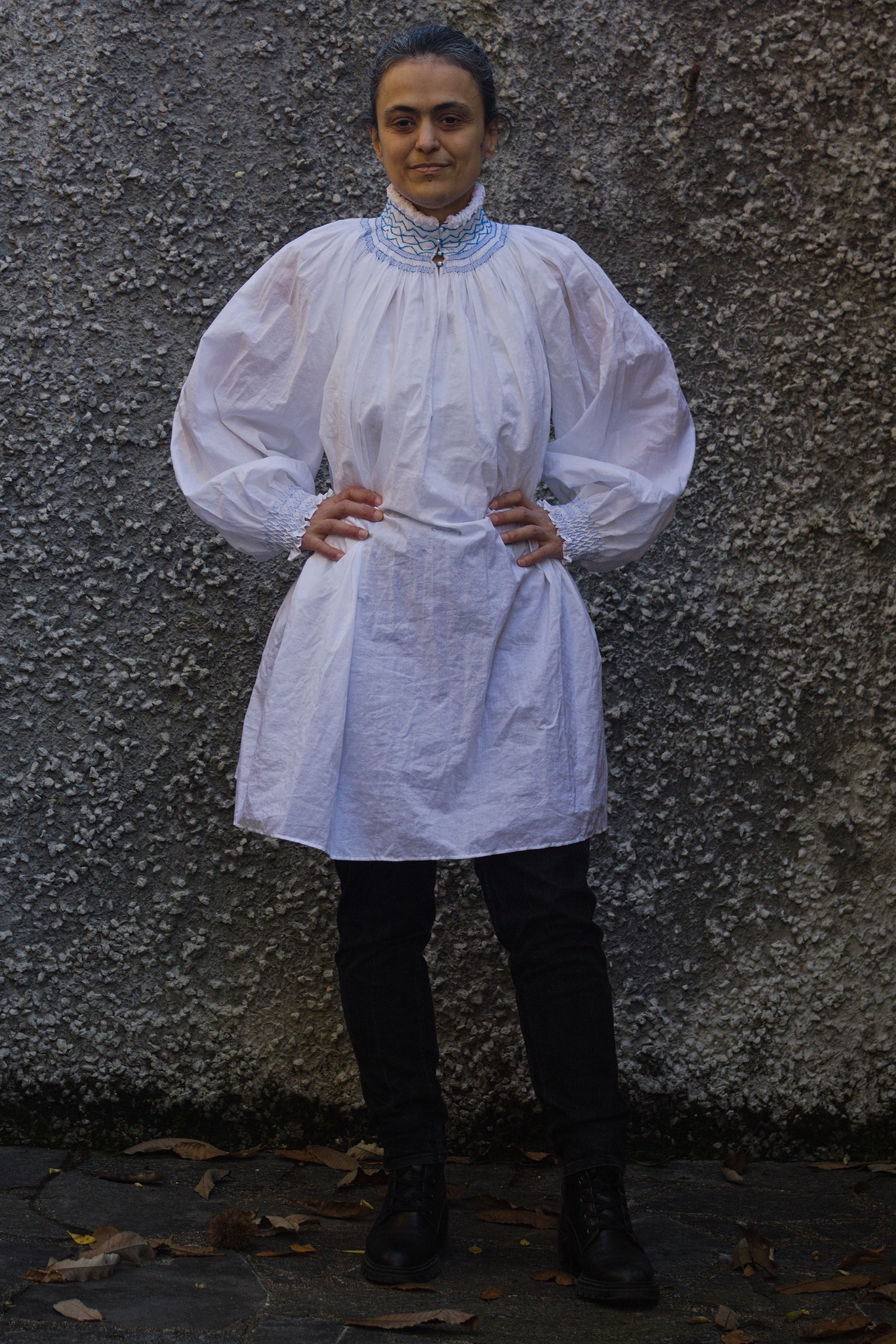
Valhalla's Things: Historically Inaccurate Hemd

Posted on November 17, 2025
Tags: madeof:atoms, craft:sewing
A woman wearing a white shirt with a tall, thick collar with lines of blue embroidery, closed in the front with small buttons; the sleeves are wide and billowing, gathered at the cuffs with more blue embroidery. She's keeping her hands at the waist so that the shirt, which reaches to mid thigh, doesn't look like a shapeless tent from the neck down. After cartridge pleating and honeycombing, I was still somewhat in the mood for that kind of fabric manipulation, and directing my internet searches in that vague direction, and I stumbled on this: https://katafalk.wordpress.com/2012/06/26/patternmaking-for-the-kampfrau-hemd-chemise/ Now, do I want to ever make myself a 16th century German costume, especially a kampfrau one? No! I m from lake Como! Those are the enemies who come down the Alps pillaging and bringing the Black Death with them! Although I have to admit that at times during my day job I have found the idea of leaving everything to go march with the J germonsters attractive. You know, the exciting prospective of long days of march spent knitting sturdy socks, punctuated by the excitement of settling down in camp and having a chance of doing lots of laundry. Or something. Sometimes being a programmer will make you think odd things. Anyway, going back to the topic, no, I didn t need an historically accurate hemd. But I did need a couple more shirts for daily wear, I did want to try my hand at smocking, and this looked nice, and I was intrigued by the way the shaping of the neck and shoulder worked, and wondered how comfortable it would be. And so, it had to be done. I didn t have any suitable linen, but I did have quite a bit of cotton voile, and since I wasn t aiming at historical accuracy it looked like a good option for something where a lot of fabric had to go in a small space. At first I considered making it with a bit less fabric than the one in the blog, but then the voile was quite thin, so I kept the original measurement as is, only adapting the sleeve / sides seams to my size. The same woman, from the back. This time the arms are out, so that the big sleeves show better, but the body does look like a tent. With the pieces being rectangles the width of the fabric, I was able to have at least one side of selvedge on all seams, and took advantage of it by finishing the seams by simply folding the allowances to one sides so that the selvedge was on top, and hemstitching them down as I would have done with a folded edge when felling. Also, at first I wanted to make the smocking in white on white, but then I thought about a few hanks of electric blue floss I had in my stash, and decided to just go with it. The initial seams were quickly made, then I started the smocking at the neck, and at that time the project went on hold while I got ready to go to DebConf. Then I came back and took some time to get back into a sewing mood, but finally the smocking on the next was finished, and I could go on with the main sewing, which, as I expected, went decently fast for a handsewing project. detail of the smocking in progress on the collar, showing the lines of basting thread I used as a reference, and the two in progress zig-zag lines being worked from each side. While doing the diagonal smocking on the collar I counted the stitches to make each side the same length, which didn t completely work because the gathers weren t that regular to start with, and started each line from the two front opening going towards the center back, leaving a triangle with a different size right in the middle. I think overall it worked well enough. Then there were a few more interruptions, but at last it was ready! just as the weather turned cold-ish and puffy shirts were no longer in season, but it will be there for me next spring. I did manage to wear it a few times and I have to say that the neck shaping is quite comfortable indeed: it doesn t pull in odd ways like the classical historically accurate pirate shirt sometimes does, and the heavy gathering at the neck makes it feel padded and soft. The same shirt belted (which looks nicer); one hand is held out to show that the cuff is a bit too wide and falls down over the hand. I m not as happy with the cuffs: the way I did them with just honeycombing means that they don t need a closure, and after washing and a bit of steaming they lie nicely, but then they tend to relax in a wider shape. The next time I think I ll leave a slit in the sleeves, possibly make a different type of smocking (depending on whether I have enough fabric) and then line them like the neck so that they are stable. Because, yes, I think that there will be another time: I have a few more project before that, and I want to spend maybe another year working from my stash, but then I think I ll buy some soft linen and make at least another one, maybe with white-on-white smocking so that it will be easier to match with different garments.


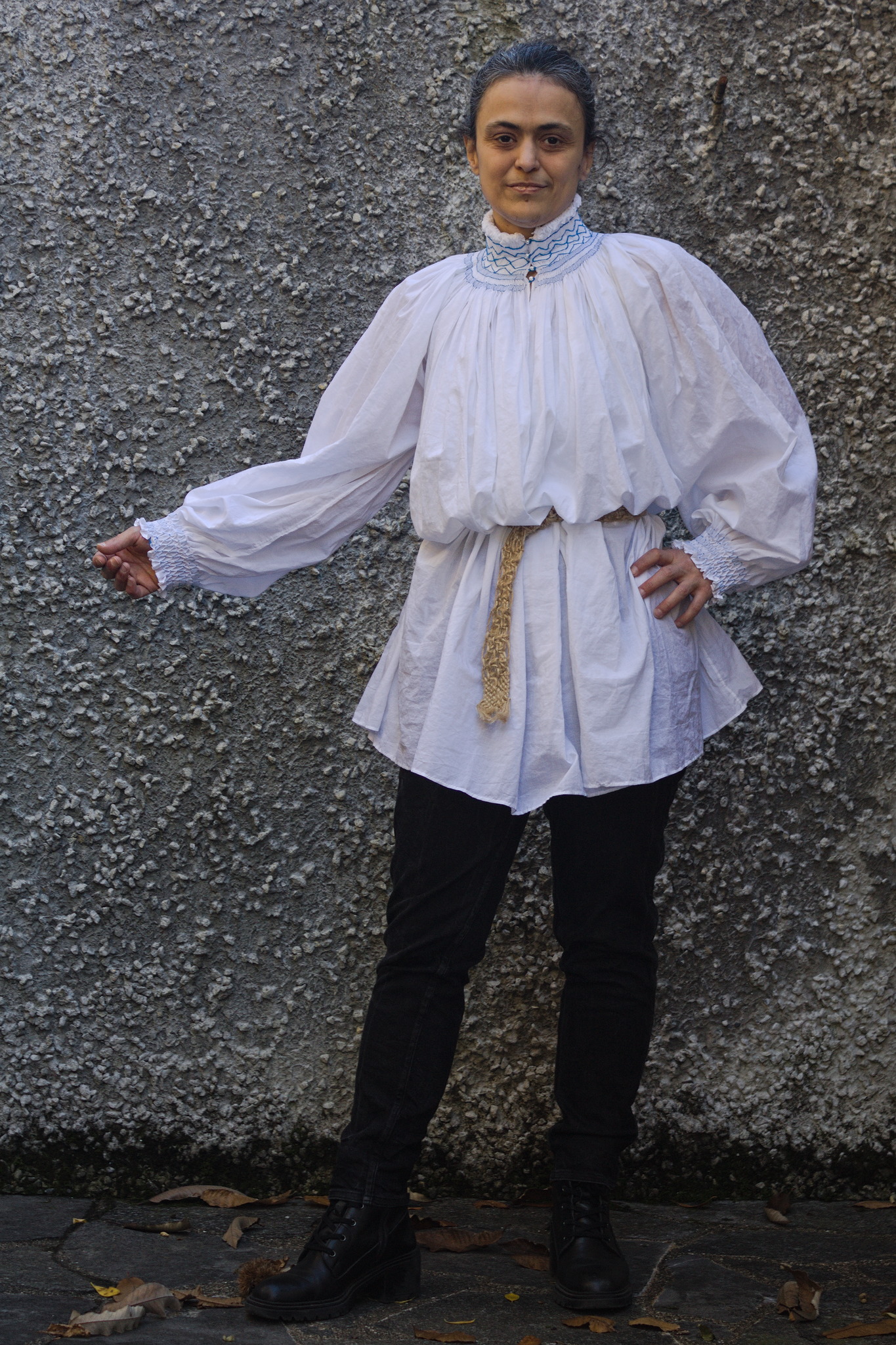
13 November 2025

Freexian Collaborators: Debian Contributions: Upstreaming cPython patches, ansible-core autopkgtest robustness and more! (by Anupa Ann Joseph)

Debian Contributions: 2025-10 Contributing to Debian is part of Freexian s mission. This article covers the latest achievements of Freexian and their collaborators. All of this is made possible by organizations subscribing to our Long Term Support contracts and consulting services.

Upstreaming cPython patches, by Stefano Rivera Python 3.14.0 (final) released in early October, and Stefano uploaded it to Debian unstable. The transition to support 3.14 has begun in Ubuntu, but hasn t started in Debian, yet. While build failures in Debian s non-release ports are typically not a concern for package maintainers, Python is fairly low in the stack. If a new minor version has never successfully been built for a Debian port by the time we start supporting it, it will quickly become a problem for the port. Python 3.14 had been failing to build on two Debian ports architectures (hppa and m68k), but thankfully their porters provided patches. These were applied and uploaded, and Stefano forwarded the hppa one upstream. Getting it into shape for upstream approval took some work, and shook out several other regressions for the Python hppa port. Debugging these on slow hardware takes a while. These two ports aren t successfully autobuilding 3.14 yet (they re both timing out in tests), but they re at least manually buildable, which unblocks the ports. Docutils 0.22 also landed in Debian around this time, and Python needed some work to build its docs with it. The upstream isn t quite comfortable with distros using newer docutils, so there isn t a clear path forward for these patches, yet. The start of the Python 3.15 cycle was also a good time to renew submission attempts on our other outstanding python patches, most importantly multiarch tuples for stable ABI extension filenames.

ansible-core autopkgtest robustness, by Colin Watson The ansible-core package runs its integration tests via autopkgtest. For some time, we ve seen occasional failures in the expect, pip, and template_jinja2_non_native tests that usually go away before anyone has a chance to look into them properly. Colin found that these were blocking an openssh upgrade and so decided to track them down. It turns out that these failures happened exactly when the libpython3.13-stdlib package had different versions in testing and unstable. A setup script removed /usr/lib/python3*/EXTERNALLY-MANAGED in order that pip can install system packages for some of the tests, but if a package shipping that file were ever upgraded then that customization would be undone, and the same setup script removed apt pins in a way that caused problems when autopkgtest was invoked in certain ways. In combination with this, one of the integration tests attempted to disable system apt sources while testing the behaviour of the ansible.builtin.apt module, but it failed to do so comprehensively enough and so that integration test accidentally upgraded the testbed from testing to unstable in the middle of the test. Chaos ensued. Colin fixed this in Debian and contributed the relevant part upstream.

Miscellaneous contributions
  • Carles kept working on the missing-relations (packages which Recommends or Suggests packages that are not available in Debian). He improved the tooling to detect Suggested packages that are not available in Debian because they were removed (or changed names).
  • Carles improved po-debconf-manager to send translations for packages that are not in Salsa. He also improved the UI of the tool (using rich for some of the output).
  • Carles, using po-debconf-manager, reviewed and submitted 38 debconf template translations.
  • Carles created a merge request for distro-tracker to align text and input-field (postponed until distro-tracker uses Bootstrap 5).
  • Rapha l updated gnome-shell-extension-hamster for GNOME 49. It is a GNOME Shell integration for the Hamster time tracker.
  • Rapha l merged a couple of trivial merge requests, but he did not yet find the time to properly review and test the bootstrap 5 related merge requests that are still waiting on salsa.
  • Helmut sent patches for 20 cross build failures.
  • Helmut refactored debvm dropping support for running on bookworm . There are two trixie features improving the operation. mkfs.ext4 can now consume a tar archive to populate the filesystem via libarchive and dash now supports set -o pipefail. Beyond this change in operation, a number of robustness and quality issues have been resolved.
  • Thorsten fixed some bugs in the printing software and uploaded improved versions of brlaser and ifhp. Moreover he uploaded a new upstream version of cups.
  • Emilio updated xorg-server to the latest security release and helped with various transitions.
  • Santiago worked on and reviewed different Salsa CI MR to address some regressions introduced by the move to sbuild+unshare. Those MR included stop adding the salsa-ci user in the build image to the sbuild group, fix the suffix path used by mmdebstrap to create the chroot and update the documentation about how to use aptly repos in another project.
  • Santiago supported the work on the DebConf 26 organisation, particularly helping with an implemented method to count the votes to choose the conference logo.
  • Stefano reviewed Python PEP-725 and PEP-804, which hope to provide a mechanism to declare external (e.g. APT) dependencies in Python packages. Stefano engaged in discussion and provided feedback to the authors.
  • Stefano prepared for Berkeley DB removal in Python.
  • Stefano ported the backend to reverse-depends to Python 3 (yes, it had been running on 2.7) and migrated it to git from bzr.
  • Stefano updated miscellaneous packages, including beautifulsoup4, mkdocs-macros-plugin, python-pipx.
  • Stefano applied an upstream patch to pypy3, fixing an AST Compiler Assertion error.
  • Stefano uploaded an update to distro-info-data, including data for two additional Debian derivatives: eLxr and Devuan.
  • Stefano prepared an update to dh-python, the python packaging tool, merging several contributed patches and resolving some bugs.
  • Colin upgraded OpenSSH to 10.1p1, helped upstream to chase down some regressions, and further upgraded to 10.2p1. This is also now in trixie-backports.
  • Colin fixed several build regressions with Python 3.14, scikit-learn 1.7, and other transitions.
  • Colin investigated a malware report against tini, making use of reproducible builds to help demonstrate that this is highly likely to be a false positive.
  • Anupa prepared questions and collected interview responses from women contributors in Debian to publish the post as part of Ada Lovelace day 2025.

Next.

Previous.