Search Results: "Stefano Zacchiroli"

23 October 2008

Stefano Zacchiroli: from Vim to Emacs - part 1

One month with Emacs and counting - Part 1 Straight to the point: since mid September I've been using Emacs, trying to evaluate whether I was willing to switch from Vim to it. Yup, that's true, me (user of Vim since the day I've started using GNU/Linux 10 years ago, (not so) active maintainer in Debian of vim and related packages, author of some popular Vim extensions and of vim-addon-manager) it's considering switching to Emacs. What is worse is that I've de facto already switched. May jamessan forgive me. OK, that was the hardest part to write, now ... This choice will have an impact on me: partly because I'm quite sure several fellow DDs will start making fun of this story :-) , and partly because as many geeks I've always had strong opinions on the editor war. Switching side ain't easy. Hence, I've decided to write a small (2-3) series of blog posts on the issue, to future memory. The post you are reading is about why, since a few months ago, I wasn't willing to give Emacs a try, and how I've changed my mind. Why I wasn't willing to give Emacs a try, but then changed my mind I love knowing tools which can improve my workflow, no matter the task. Editors happen to be at the intersection of many tasks, hence knowing well his own editor and feeling satisfied about it is quite important. This is even more so for free software hackers which, for a reason or another, happen to use the very same editor for a lot of different tasks; in my case: programming, conf file hacking (i.e., playing the sysadm role), mail writing, and everything in between. I've started using vi on Solaris around 1998, then switched to Vim starting from version 4.0, and then followed all its releases up to 7.0. I consider my "Vim karma" to be quite hight and I've delivered several talks about using Vim for LUGs and other free software-related events. Still, I've always been hit bit several minor nuisances and glitches of Vim which couldn't be fixed by simple configuration tuning or add-on implementations (more on this in a future post). In the quest for the perfect workflow, those glitches have made me try several times other editors hoping for more satisfying work environments. Of course Emacs was one of them, which I've tried repeatedly during the years; the last time was circa 2006. For one reason or another, after a few days of experiments, I've always decided to give up with it. Why? Various reasons, listed below, together with an explanation of what (I think) has changed since then.
  1. Poor Unicode/multibyte support. Support for whatever Unicode encoding was close to null. It was not available in the legacy editor, and you had to use something called MULE, to be specifically enabled. That was so 60's, and rather hard to use. Now (apparently starting from Emacs 22.1, June 2007) finally you have built-in Unicode support and the needed two variables for setting the input encoding and the file encoding, which is basically all you need. Looks easy once you have it ...
  2. Lack of "modern" UI toolkit support. Yes, I do live in a console and invoke my editor from it, but nevertheless for long coding sessions I do also love having a nice GTK+ window containing my editor using settings which smoothly integrated with the graphical settings of my desktop environment. Maybe I'm getting old, maybe GNOME has changed my perceptions, but why the heck I had to tolerate different monospace fonts in my gnome-terminal wrt my GUI editor I never understood. Firing up Emacs was like getting back in time of 15 years, and if a geek having a maximized terminal on most of its workspaces had this feeling, then something was really wrong. This has changed: starting again from Emacs 22.1, the editor has frown support for that "bleeding edge" technology called GTK+. Finally you can use Pango font faces and avoid the time travel feeling when switching from a terminal to your GUI.
  3. "Dead upstream" syndrome. As we all know by experience, choosing a free software product is not only a matter of evaluating bugs and features, there are other environmental factors. A notable example is how active upstream is. A few of us will use a product affected by the "dead upstream" syndrome. That's exactly what I was feeling about Emacs. The first argument I can offer to back that feeling is again the Emacs release history (noted that "small" hole between 2001 and 2007? Rest In Peace release early, release often ...). The second argument is the bug tracking system: there was none, bug discussions happened only on the development mailing list and the bug tracker was a text file on CVS! (Yes, Vim doesn't have a proper BTS either, but I was looking for reasons to switch from it and hence looking for something better in several respects.) That has changed completely, as I discovered only at this year DebConf thanks to gismo. 2007 has enjoyed 1 Emacs release and 2008 already two. They do have a BTS now and guess what? is dear old debbugs. According to my first experiences as Emacs bug reported the maintainers are very reactive and also friendly in dealing with bug reporters. Finally, also keeping up with snapshot releases in Debian is entirely trivial, thanks to Romain's repository.
  4. Poor performances & memory consumption. This goes in the direction of probably the most popular joke used by Vim zealots in the editor war: Emacs is a nice operating system, but lacks a good editor, or something such. In the past I had the impression that starting Emacs was really slow and that generally the memory footprint was too high to be acceptable. You know what: starting a full-blown gvim with a good deals of add-ons (and I used quite a lot of them, that's why vim-addon-manager was born) is not that faster. And on the contrary, firing up an emacsclient is way faster than starting up a new gvim instance. Regarding memory consumption Emacs is still "gaining" the battle. Still, one has to keep in mind the different workflow: with Vim you are encouraged to enter and exit the editor (not without drawbacks, as I'll discuss in a future post), while with Emacs you always use the same one. It turns out that via emacsclient the resulting feeling is the same as having multiple editors (as you can fire them up as separate windows or in separate consoles), still sharing all user memory. A final comment on memory consumption while looking at my top sorted by decreasing RSS memory: the top process is xulrunner (from the browser) with 356Mb, then Xorg (159M), pidgin (128Mb !!!!), trackerd, gnome-terminal, gnome-panel, ..., Emacs shows up with 51 Mb at the 7th position. Yes, it is not the thinnest editor in the world, but on average machine it doesn't really matter at all.
In the next post: how to switch from Vim to Emacs, without loosing your mental sanity. (Whether I did succeed wrt sanity is up to the reader to judge.)

9 September 2008

Stefano Zacchiroli: bye bye vacations

Back at Work It has been a while, but August has been an exciting month. During the first half I've attended DebConf8, which has been great as usual, but even more exciting due to several synergies I've found around Mancoosi. The second half of August has been totally occupied by long overdue vacations, spent visiting north Argentina. It has been lovely. See you soon, Argentina.

15 August 2008

Stefano Zacchiroli: edos-builddebcheck

Statically detecting FTBFS with edos-builddebcheck Here at DebConf8, after my talk about Mancoosi, I got in touch with several people interested in the QA implication of the EDOS/Mancoosi tools. Me and Ralf have for example been contacted by Ubuntu people which are setting up theirs equivalent of http://edos.debian.net. A guy working on a mirroring tool made an interesting hack using edos-debcheck: out of a mirror with broken dependencies he can mirrors a subset of packages which do not suffer of the same problem. But now to the more interesting development, following a bug report by Atomo and discussions with Lucas (the RC-bug-filing-master), me and Ralf implemented edos-builddebcheck. You can invoke it on a pair of Packages/Sources package list, and it will check whether some packages will FTBFS due to unsatisfiable dependencies. The results on Lenny main/amd64 as of today are, ... erm ..., scary : 49 packages will FTBFS. The RC-bug-filing-master and Ralf are working on filing them, "don't worry". You can find edos-builddebcheck in the edos-debcheck package, starting from version 1.0-7 (in incoming at the time of writing). Update yes, ATM edos-builddebcheck does not know anything about P-A-S packages, so there are some false positive. Still, 33 source packages are proper hits.

10 August 2008

Stefano Zacchiroli: PTS and package descriptions

PTS, package descriptions (and more than a bit of UDD) After delivering my talk at DebConf, I went back to some (more) PTS hacking ... apparently I'm in the mood for it :) An apparently trivial feature request (showing package descriptions) provided for interesting thoughts. First of all the PTS is mostly source-based, but in Debian we have no source package descriptions (issue which probably deserves fixing by its own). Rough consensus has then been to add tooltips on binary package hyperlinks, to show short descriptions. Still, adding the import of Packages sounded like overkilling, not mentioning duplicated wrt packages.d.o. Hence I decided to be the first jumping on the UDD boat (wonderful GSOC project which I had the pleasure to co-mentor together with Lucas and HE) for routinely usage. Retrieving the most recent short description of each binary package at each PTS run is as easy as:
select distinct packages.package, packages.description
from packages,
  (select package, max(version) from packages group by package)
    as latest (package, version)
where packages.package = latest.package
  and packages.version = latest.version ;

To solve the more generic problem of the PTS missing a generic description (or, if you want, to mitigate the problem that in Debian we are missing a source package description), Lucas came up with the intriguing idea of showing the description of the most popular binary package, according to popocon. Piece of cake:
select distinct packages.package, popcon.insts, packages.description
from packages, popcon,
  (select package, max(version) from packages group by package)
    as latest (package, version)
where packages.package = latest.package
  and packages.version = latest.version 
  and packages.package = popcon.package ;

(same as before, but adding popularity: one has both all short descriptions, and a way to spot the "canonical" one) Long life to UDD. (BTW if you are interested in UDD, and you happen to be at DebConf8, do not miss tomorrow's QA BOF.)

Alexander Reichle-Schmehl: Bits from the DPN editors

It's more or less four months since I proposed to resurrect our newsletter. We already released eight issues of the Debian Project News and work for the ninth issue has already started. So I guess it's time for a small "state of the DPN" speech, but since I'm not attending DebConf, you will have to read this mail instead ;) After having a rough start (and in fact missing some self-set deadlines and completely underestimating how much work is involved in such a kind of newsletter) we finally developed a - more or less - working flow of work (Which is by the way documented here). Speaking of the current state sadly means to confess, that our hopes to draw a lot of help from the community by using a system for drafting the news with a low entry barrier were not fulfilled. We actually had a good start, with good participation, but due to (I assume) the aforementioned initial difficulties participation in the creation of the DPN dropped considerably. Currently the workload of creating our bi-weekly newsletter is shared by only two people (that being Meike Reichle and myself), which is barely enough :( While we at least get a hint from time to time, what we should mention in the next issue, it rarely happens, that someone contributes by drafting a text -- which is the real work. (At this point a BIG "Thank You" to those who did! (See list bellow.) It's much appreciated!) We suffer especially, since although we are a two people team, we have in fact no redundancy, since real live issues affecting one of us will most likely affect the other one, too. Therefore we mostly concentrated our work on creating the next issues and getting them out in time, and didn't have time to answer all mails considering suggestions for changes and improvements (yet?). We are sorry, but at least we tried to read them briefly and keep them in mind when drafting the next issue. As a result of this we re-added the list of DSAs, WNPP and new and noteworthy packages due to popular demand. There are still a lot of unanswered mails not dealing with content, but with workflow issues / proposals (including changing from wiki.debian.org to a special ikiwiki instance). We are sorry, that we couldn't yet act on them and take appropriate measures, but be assured, they are not forgotten. Other issues the DPN currently have are "unwritten guidelines" regarding editorial choices of DSAs to be published and which packages to list in the "new and noteworthy package" section. Both is more or less done by our gut feeling. Speaking of problems the DPN are facing, we also need to mention translations of the DPN. The current workflow makes it difficult for translators of the DPN, since we often fail to get the final draft of the DPN ready in time to give translators a "head start" so the translated DPNs can be released together with (or at least with a as small as possible delay to) the English DPN. So here is a big call for help! We really need your help writing the DPN. (Monitoring lists and newstickers we don't monitor ourselves would be nice, too, but only add more work to us if you only give us pointers.) We will both be very busy with our real live the upcoming month, and are not sure how much time we can dedicate to the DPN. So please help us! The current draft for the next issue of the DPN is always available here . There should already be a todo list with pointers to interesting topics, which need to be written out. Some guidelines about style and content are available here. Last but not least, we would like to thank the following people who have contributed to the DPN so far: (Unfortunately we can't list those people, who contributed by translating the DPN, nor do we have a complete list of the native English speakers, who helped by proofreading. But we thank them nonetheless!)
9 August 2008

Stefano Zacchiroli: PTS integrated with mentors and gifts

more PTS hacking: mentors.d.n and gift/help bugs Some more PTS hacking at DebConf8. Among about 20 bugs triaged/fixed thus far, 2 are peculiar and integrate some more info in PTS package pages. A minor glitch is currently affecting this though: when pending uploads on mentors.d.n are not uploaded, but rather superseded by new versions in unstable, they are currently not removed automatically from mentors.d.n and will thus show up in the PTS. Apparently this is going to be fixed soon on mentors.d.n, so hopefully this bug won't have time to bother anyone. Bugs (user-)tagged gift on the other hand are a rather new (and thus far neglected) QA feature proposed by Lucas. Packages with gift bugs have now them shown as an extra line in the bug summary box. The idea is to point contributors to PTS pages to discover if some of the packages they are interested in have gifts for them. As an extra gift (pun, intended) I've written for the PTS a tiny Python script to retrieve bug summaries via SOAP. The lookup is via tag, supporting both official tags and usertags. In case it can be useful to someone else, I'm putting it up for download. The PTS is using tagged bugs.py it as follows:
$ tagged_bugs.py "gift" "debian-qa@lists.debian.org" > bugs.gift.txt
$ tagged_bugs.py "help" > bugs.gift.txt

8 August 2008

Stefano Zacchiroli: improved integration among PTS and Lintian

DebConf8 hacks: better PTS/Lintian integration Yesterday nigh hack: better integration of the PTS with Lintian.d.o. Quoting from the filed misc developer news:
=== Lintian and the PTS ===
The integration between lintian and the PTS has been improved. On one hand
now the hyperlink to the Lintian will be shown for a source package only if
Lintian had something "to say" about that package. On the other hand, if
there were warnings or errors in the last Lintian ran, they will be shown as
TODO items in the appropriate part of the PTS web interface.
The display logics is as follows:
 * if there is 1 or more amongst errors and warnings they will be shown as TODO items
 * if there is 1 or more amongst errors, warnings, and information messages, the hyperlink to the Lintian report will be shown

Some more info are available in the bug logs (bug #458329, bug #243729); if you want a sample page have a look at ocaml, but I'm pretty sure that most random package pages will show at least 1 lintian warning in need of your love :-)

6 August 2008

Stefano Zacchiroli: yay from debcamp8

DebCamp8, shakiness, planes, python-debian Well, not unexpected news, but since I've been rather quite lately it is worth reminding that I'm now at DebConf8, enjoying the DebCamp. I've arrived today after a quite long trip made of unexpected extra plane stops in Madrid (thanks Iberia for not declaring it and letting me ponder about how can it possibly take 16 hours from Barcelona to Buenos Aires, now I know the reason ...) and shaky bus hours. First tiny teeny achievement of DebCamp (among a handful of beers already) is an upload of python-debian 0.1.11, implementing among other things support for parsed dependencies and a major overhaul changelog parsing (thanks to James Westby). Unfortunately we are going to miss Lenny with this release, but after all it is a package mostly meant for Debian Developers, so it is probably not a big deal.

22 July 2008

Stefano Zacchiroli: reminder: Homepage pseudo fields are GONE

go fix your ancient Homepage pseudo-fields, you lazy maintainer! ... or I'll kill a kitten for each homepage URL I found in long package descriptions. Homepage pseudo-fields are gone since long, the proper way to document upstream homepage is now to use a real Homepage field in the source stanza of debian/control. Still, as a page of mine has been documenting, we still have more than 1100 packages (dd-list) which are using the old pseudo-field which clutters the long description, is often badly rendered, and stays in the way of who works on long descriptions (e.g. translators). The transition from the old pseudo-field to the new field is being monitored on our wiki. Please, pretty please, take some time to convert your old pseudo-fields: it's quick, easy, and helpful.

20 July 2008

Stefano Zacchiroli: debconf8 dangerous cheese party

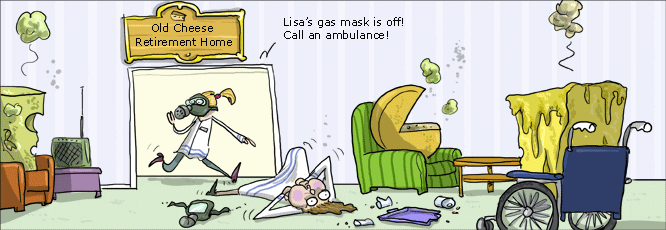
When seeing this: wulffmorgenthaler-cheese.gif ... I couldn't help thinking at the forthcoming cheese and wine party at debconf8 (which I love, but still the strip is hilarious :) ) strip from wulffmorgenthaler, see it in its original context
17 July 2008

Stefano Zacchiroli: paper about mancoosi at debconf8

Mancoosi paper for DebConf8 now available As previously announced, I'll be attending DebConf this year, as I did for the past 3 years. Beside the usual projects and ideas one carries with himself on his way to a DebConf, this time I will also be there to present part of my everyday work in the Mancoosi project. Very briefly (and a bit too simplistic) Mancoosi is working on pushing forward the research and technology needed to deliver better package managers to the users of open source software distributions. The project presentation event proposed by me and Ralf Treinen has been accepted in the DebConf main track. The presentation will discuss what the former EDOS project did, what Mancoosi is doing right now, trying to focus on their relationships with Debian. In case you are interested I suggest to attend the talk which will be delivered by yours truly (what else can I suggest? :) ) In the meantime, the accompanying paper is now available, you can take a sneak peek if you are interested in knowing more about Mancoosi right ahead. The paper is available in .pdf format from both my homepage and from the Pentabarf event page as an attachment (the latter, as all Pentabarf events, needs login for reasons that I still fail to understand ...). Download

16 July 2008

Stefano Zacchiroli: updating w3-recs

revamping w3-recs: new specs, misc improvements After quite a lot from my initial adoption, I've spent some time to update w3-recs. Beside the long overdue update of shipped recommendations (quite a few new specification was released, mostly related to SPARQL, but a few more have been edited, including CSS 1 and 2), I've also uploaded some pending improvements. A couple of bug fixes were about dangling links and registration of recommendations with the GNOME devhelp stuff. Additionally, I've also moved all the documents registered with doc-base under the new Help/Standards section of doc-base, which seems to be fit for W3C Recommendations. Apparently we have finally managed to have a proper section tree for doc-base, the decoupling of that tree from the Debian menu one will not be missed (at least not by me). During the process I've also discovered a (recent?) change in debhelper semantics. Thus far I used to have broken doc-base document IDs in w3-recs, as they contained uppercase letters, which are prohibited according to /usr/share/doc/doc-base/doc-base.txt.gz. My fault, I concur, but in the past the documents got installed anyhow without any problem. On the contrary, with the latest debhelper all documents got written to the very same file, apparently stripping away the part of their names which do not match the used lowercase regular expression. Well, not too bad, I fixed one more bug, but with a warning fixing that would have been quicker. Also, /me wonders, if everything (but package build :-) ) worked properly with uppercase document IDs, why the heck one should forbid them in the doc-base specification?

1 July 2008

Stefano Zacchiroli: python-debian w dependency parsing

New python-debian feature: Dependency Parsing Since my merge commit of this afternoon python-debian has grown dependency parsing support. (But first things first: you know about python-debian, don't you? If you don't, and you always wanted to program with Debian-related files with Python, then shame on you!) Thus far, playing with Packages-like files using dictionary-like objects was already as simple as (quoting from /usr/share/doc/python-debian/examples/deb822/grep-maintainer):
for pkg in deb822.Packages.iter_paragraphs(file('/var/lib/dpkg/status')):
    if pkg.has_key('Maintainer') and maint_RE.search(pkg['maintainer']):
        print pkg['package']

However, it was a bit unfortunate that Depends-like fields were only returned as strings. Now each package (as iterated upon in the above snippet) is equipped with a .relations property returning a dictionary of inter-package relationship fields. Looking up keys like "depends" you will get back a conjunctive normal form (CNF) representation of dependencies, together with parsed constraints on version or architectures, if any. A simple example is shipped as /usr/share/doc/python-debian/examples/deb822/depgraph, which outputs a labeled Graphviz script of all inter-package dependencies extracted from a Packages file. Here is its most relevant snippet:
name = pkg['package']
rels = pkg.relations
for deps in rels['depends']:
    if len(deps) == 1:
        emit_arc(name, deps[0]['name'])
    else:   # output an OR node
        or_node = get_id()
        emit_arc(name, or_node)
        emit_node(or_node, 'OR')
        for dep in deps:
            emit_arc(or_node, dep['name'].lower())

The appropriate sub-classes of Deb822 have been customized with the knowledge of which inter-package relationship fields are supported in their stanzas (e.g. Build-Depends are supported by Sources, but not by Packages; the other way around for Recommends). Testing from the git repo is more than welcome.

30 June 2008

Stefano Zacchiroli: fancy bibliography entry

sooner or later in a bibliography I should add ... Quoting from the bibliography of a paper from the ACM SIGMOD conference:
[11] Sergio Leone, Clint Eastwood, Eli Wallach, and Lee Van
     Cleef. The Good, the Bad and the Ugly / Il Buono, il Brutto,
     Il Cattivo (The Man with No Name). Produzioni Europee
     Associate (Italy) Production, Distributed by United Artists
     (USA) 1966.

... one of the things I would have killed for having written by myself.

26 June 2008

Stefano Zacchiroli: firefox 3 un-ranting

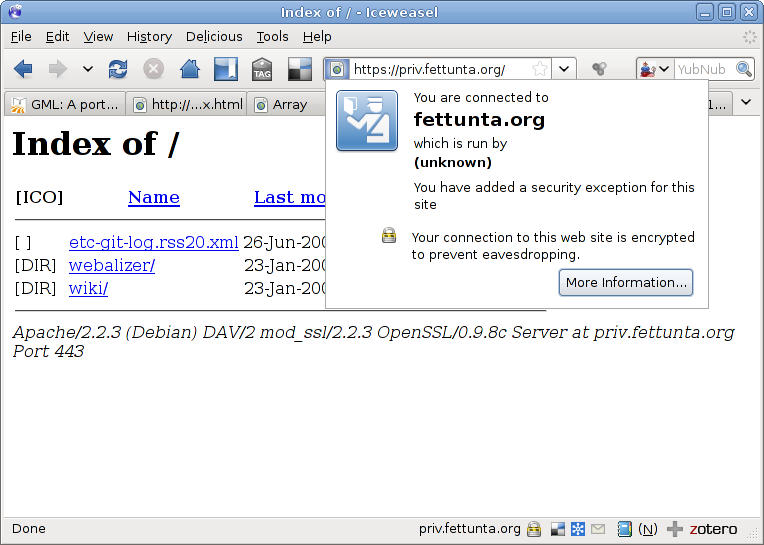
Gunnar, have a look at this: iceweasel-ssl.png. So your example using the Penta website was just a bad one, and I personally agree with the "INVALID" resolution of your bug report. In fact, showing a partially encrypted connection as an insecure one is an overall advantage for (l)user securities, as with the browser interfaces we are used to use, we don't know which parts are actually sent encrypted and which are not. As you can see in the example above a fully encrypted connection is properly reported as such by Firefox 3.0. FWIW: I'm overall satisfied with Firefox 3.0, especially about the new URL bar Wouther is disliking. Yes it is a bit slower than before, but even on my 4-year old laptop it is perfectly usable. The HTML title shown there? Well, it is rather handy when I start typing bugs.debian.org and then I've to discriminate among tons of almost identical bug report URLs ... Is the about:config hand-holding dialog worst than the pop-up the first time you "have provided unencrypted information" in a random form? It is not, we have probably just forgot about the first time we unchecked the corresponding checkbox. All in all, the only "feature" of the new Firefox I found incredibly stupid is the SSL certificate exception mechanism. Installing the untrusted certificate is what? ... 5 click-away from the initial page? That is just dumb. (And as it is well-known that habits form anyhow, getting the habits harder to form is just a way to piss-off users.)

9 June 2008

Stefano Zacchiroli: debian weather is back

What's the weather like in Debian? One of the cool things developed during EDOS (now Mancoosi) has been edos-debcheck. Using it it is possible to check (incredibly quickly) whether some package in a given distribution cannot be installed according to its dependencies. When there are such packages it usually means that the distro is buggy s it is shipping uninstallable packages (there are some corner cases, but they are rare). In fact, edos-debcheck has been run daily (as a service maintained by Ralf) on Debian's main suites and some derivatives for years now. The resulting list of uninstallable packages is linked from http://edos.debian.net and is being used by the QA team; I've no idea if it is being used by the Release Managers too, but it probably should be. A cool toy built on top of edos-debcheck was the Debian weather (part of a more generic service called Anla, I'll blog about it sooner or later ...). Debian weather basically used to present the status of a given Debian-based distro in term of how many uninstallable packages were shipped using the weather metaphor: the fewer the uninstallable packages, the better the weather. I wrote "used to" because Anla was stopped about 1 year ago, and is being re-engineered these days. In the meantime it was a pity not to have the Debian weather (as Enrico pointed out with me), so I spent some time to resurrect it on top of edos-debcheck daily runs: Debian weather is back, enjoy!

1 June 2008

Stefano Zacchiroli: ocaml 3.10.2 is in testing

OCaml 3.10.2 meets Lenny As per title: OCaml 3.10.2 (... and friends of course) today has entered testing, as such it will be released with Debian Lenny. Yay. This transition was the second binNMU-based and went flawlessly (while the first one was hit by a bug in the script generating binNMU/dep-wait requests automatically). This way transitions are way easier to handle, and would probably be real PITAs now that we have about 120 OCaml-related source packages to care about. Kudos to all who helped, Luk -release side, and the other fellow Debian camlers.

27 May 2008

Stefano Zacchiroli: on maintainer script sizes

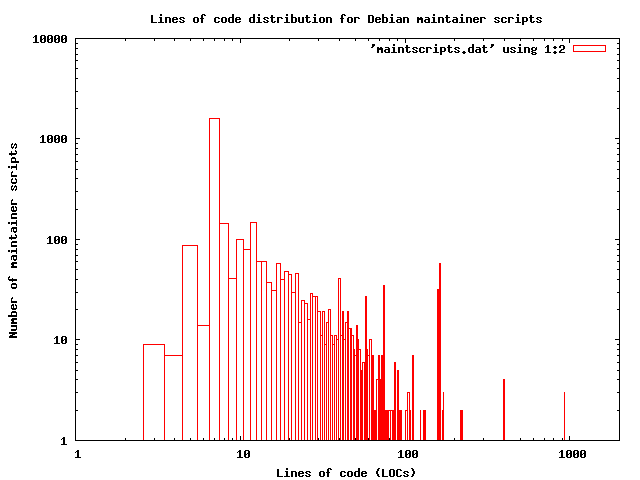
Measurnig maintainer scripts LOCs After some discussions which touched them in various (Debian and non-Debian) mailing lists, I got interested in having a closer look to maintainer scripts. The first question I was asking myself is how big they are? . As an absolutely empirical, non-scientific test, I hacked a couple of scripts to graph the distribution of maintainer script lengths (measured as LOCs). I just run them on /var/lib/dpkg/info/*. post,pre inst,rm on my laptop, which contains ATM 3612 scripts. Here is the result: maintscripts.png The obvious (though, I repeat, absolutely empirically obtained) point is that, as expected, most of the scripts are really short, with 1/3 of them being just 7 LOCs. And I guess you can guess (sorry) what the 7 lines are about:
    #!/bin/sh
    set -e
    # Automatically added by dh_makeshlibs
    if [ "$1" = "configure" ]; then
            ldconfig
    fi
    # End automatically added section

dear old debhelper boilerplate. The longest script, not shown properly in the graph due to my low gnuplot karma, is 1905 LOCs (and the winner is: /var/lib/dpkg/info/xserver-xorg.postinst). The shortest scripts are 5 LOCs, but they are structurally equivalent to the 7 LOCs above, sometimes invoking some other idempotent update-bla tool, and sporting less newlines.

Stefano Zacchiroli: debian ocaml news

Catching up: some OCaml in Debian news Hei, it looks like I stopped giving updates about OCaml news in Debian, time to catch up. 2 hot news basically:
  1. OCaml 3.10.2 transition is ongoing. Release managers did not forget about our old request of transitioning OCaml to 3.10.2 in time for Lenny, and as soon as the last Perl transition was other they pinged us about the transition. Together with Luk we are now working on it. After some initial issues on arm which was unable to run docbook2html on our poor little policy document without segfaulting(!), it now looks like is not going too bad ... get ready for OCaml 3.10.2 in Debian Lenny!
  2. the "core" OCaml library by Jane St Capital (which I consider a really good replacement for the legacy standard library FWIW) has entered testing a few days ago. It will be released with Debian Lenny, no matter if with 3.10.1 or 3.10.2
Stay tuned!

8 May 2008

Stefano Zacchiroli: vcs distribution stats for packaging

Some more stats: $VCS distribution for Debian packaging I've set up yet another stat page, this time it's about the distribution of $VCS for Debian packaging. It's as trivial as you can imagine: it gets all the Vcs-XXX fields out of unstable Sources and plot how many packages are using a given $VCS. I've got no surprises in the relative popularity of $VCS: subversion is clearly the most widespread (with about 2700 packages on a total of about 13000) and git is growing (700 packages); with the exception of bzr (90 packages), all the other are used by less then 50 packages. Thanks to Lucas I've also included graphs in the page, as I think it would be interesting to monitor the evolution. (Probably as everybody) I'm confident to see an increasing trend for git balanced by a decrease of subversion, we'll see. The total number of packages using some $VCS is encouraging, we are at about 29% of the archive (you know that if your package is not declearing some Vcs- headers in its source stanza I'm not counting it, right? Go add the headers!). Interesting side effect: as I'm now maintaining a handful of these stat pages, I was pondering hey, we should create a wiki page with pointers to all the stat pages about Debian we have . Well, in fact it already exists: Statistics on wiki.d.o.

Next.

Previous.