Search Results: "Lucas Nussbaum"

26 September 2007

Lucas Nussbaum: Compiz interest

From time to time, I try Compiz, to see if how it has evolved. The last time was yesterday (I also switched to the xserver-xorg-driver-ati from experimental). But as usual, after using it for a few minutes, I can’t help switching back to metacity. I don’t think that Compiz’s visual effects bring anything on the usability POV, and I just find them annoying after the initial “WOW”. Of course, it’s nice to show off, but to do actual work? Are there people really using it all the time?

22 September 2007

Lucas Nussbaum: creating a Distributions Developers Forum : follow-up

After that blog post, I decided to write a mail asking a first set of questions. I sent it to developers’ mailing lists of Fedora, Gentoo, Mandriva, openSUSE, and of course Debian and Ubuntu. I got really interesting answers from everyone, except …. Debian and Ubuntu.

18 September 2007

Lucas Nussbaum: Better Debian RC bugs graphs

if you like to monitor the number of RC bugs, you are probably annoyed by the graph on http://bugs.debian.org/release-critical/. The graph starts in 2003, making it impossible to read short-time changes. There’s a bug about that: #431299: RC bug status graph timescale is too long. And I provided a patch a few months ago, but it hasn’t been included yet. So, in the meantime, you can use my private copy (generated daily): Also, if you like graphs, Yves-Alexis Perez (aka Corsac) generates cool graphs about Debian: And if you want to have all the interesting graphs on the same page, you can use this page.

14 September 2007

Lucas Nussbaum: Idea: creating a Distributions Developers Forum ?

Scientific papers always have a “related works” section, where the authors describe how the work they are presenting compares with what others did. In the Free Software world, this is nearly non-existent: in a way, it seems that many of us are thinking of their projects as competing products, fighting for market share. On a project web page, I would love to read something like:
This project is particularly well suited if you want XX. But if YY is more important to you, you might want to have a look at ZZ.
Or simply links to similar projects for other environments, etc. All in all, I think that the goal is to improve the global satisfaction. Not to win a few users, who won’t be totally happy, because the project doesn’t really suit their needs. While some projects cooperate and share ideas, like I think desktop environments do inside freedesktop.org, most just ignore each other. I am both a Debian and an Ubuntu developer, and I’m sometimes amazed that Ubuntu discusses technical choices that were discussed (and solved) a few weeks earlier in Debian. And it’s even worse with the other big distros out there. Couldn’t we try to improve this ? We could just create a mailing list, where developers from various distributions could present the way they do things. This would allow to discuss future developments (”We are planning to improve this, what are you doing about that ?“) or simply to improve people’s knowledge of the various distributions. Of course, this could easily turn into flamefests, but they are technical ways to avoid that, like moderating posts from trollers… Does something like that already exist ? Do you think that it would be interesting ? Would you like to contribute to such a forum ? Some examples of things that could be discussed:

13 September 2007

Lucas Nussbaum: Which distribution on Thinkpads: really the good question to ask?

After Dell, Lenovo decided to ask users which Linux distribution they should put on Thinkpads. Seriously, who cares? If I buy a laptop that comes with Linux pre-installed, my first step would be to reinstall it from scratch, exactly like with a laptop with Windows pre-installed. Because the choices that were made wouldn’t match mine (think of partitioning, etc). Or simply because I wouldn’t totally trust the hardware manufacturer. So, what would make me happier about a laptop? I couldn’t care less about which distribution comes preinstalled. If Lenovo wants to make me happy, there are two ways: It’s not _that_ hard: some manufacturers got it right, at least for some of their products. There are many manufacturers contributing code directly to the Linux kernel, for network drivers for example. But maybe this is just about marketing and communication, not about results? Because after all, Dell and Lenovo will look nice to the random user. While playing-by-the-rules manufacturers are hidden deep in the Linux changelog.

22 August 2007

Lucas Nussbaum: Opening mutt s HTML attachments with epiphany?

I just ran into a rather funny problem. I’d like to use epiphany to open text/html attachments or mail parts. Mutt uses mailcap, so I added an entry in ~/.mailcap:
text/html; epiphany-browser '%s'; description=HTML Text; nametemplate=%s.html This should work fine, but the problem is that mutt creates a temporary file (/tmp/mutt.html) and removes it when the command terminates, which is nearly immediately with epiphany. And epiphany has a really nice feature: it monitors local files for changes and reload them when they change. Which results in seeing the page briefly, then a File "/tmp/mutt.html" not found. error page. Anyone using mutt and epiphany together successfully?

12 July 2007

Lucas Nussbaum: Collaborative Maintenance

Stefano Zacchiroli blogs his thoughts about collaborative maintenance. He identifies two arguments/religions about it:
  1. it is good because duties are shared among co-maintainers
  2. it is bad because no one feels responsible for the co-maintained packages
And he says he stand for the first one. I’m not sure that those two positions really contradict. Sure, collaborative maintenance is a good thing, because it allows to share the load between co-maintainers, which often results in bugs being fixed faster. But collaborative maintenance creates the problem of the dilution of responsabilities, and the dilution of knowledge. In many cases, a single maintainer will have a better knowledge of a package than the sum of the knowledge of all co-maintainers. Also, sometimes, teams don’t work very well, and everybody start thinking that a specific bug is another co-maintainer’s problem. In the pkg-ruby-extras team, we have been trying different organizations over the past two years. We have now settled with the following: Stefano also raises the point of infrastructure issues caused by the switch to the team model. I ran into one recently. My “Automated mails to maintainers of packages with serious problems” are currently only sent to the maintainers of the packages with problems, unless someone has problems in both maintained and co-maintained packages (in that case, all problems are mentioned). I thought for a while about sending mails to co-maintainers as well, but that would mean sending more mails… I might try that and see if I get flamed :-)

9 July 2007

Lucas Nussbaum: Easy migration of a service to another, totally different host with iptables

I’m tired of googling for this every time I need it, so I’m blogging about it. Q: How can one redirect all connections to hostA:portA to hostB:portB, where hostA and hostB and in totally different parts of the Internet? A:
echo 1 > /proc/sys/net/ipv4/ip_forward
$IPT -t nat -A PREROUTING -p tcp --dport portA -j DNAT --to hostB:portB
$IPT -A FORWARD -i eth0 -o eth0 -d hostB -p tcp --dport portB -j ACCEPT
$IPT -A FORWARD -i eth0 -o eth0 -s hostB -p tcp --sport portB -j ACCEPT
$IPT -t nat -A POSTROUTING -p tcp -d hostB --dport portB -j SNAT --to-source hostA
Connections are masqueraded, that means that, for hostB, all connections are coming from hostA. So be careful.

5 July 2007

Lucas Nussbaum: How do archive rebuilds and piuparts tests on Grid 5000 work?

With the development of rebuildd and the fact that several people are interested in re-using my scripts, I feel the need to explain how this stuff works. Grid’5000 First, Grid’5000 is a research platform used to study computer grids. It’s not really a grid (it doesn’t use all the classic grid middleware such as Globus). Grid’5000 is composed of 9 sites, each hosting from 1 to 3 clusters. Inside clusters, nodes are usually connected using gigabit ethernet, and sometimes another high speed network (Myrinet, Infiniband, etc). Clusters are connected using a dedicated 1OG ethernet network. Grid’5000 is in a big private network (you access it through special gateways), and one can access each node from any other node directly (no need for complex tunnelling). Using Grid’5000 nodes When you want to use some nodes on Grid’5000, you have to use a resource manager to say “I’d like to use 50 nodes for 10 hours”. Then your job starts. At that point, you can use a tool called KaDeploy to install your own system on all the nodes (think of it as “FAI for large clusters”). When KaDeploy finishes, the nodes are rebooted in your environment, and you can connect as root. At that point, you can basically break the nodes the way you want, since they will be restored at the end of your job. Running Debian QA tasks on Grid’5000 None of that was Debian-specific. I will now try to explain how QA tasks are run on Grid’5000. The scripts mentioned below are in the debcluster directory of the collab-qa SVN repository. When the nodes are ready, the first node is chosen to play a special role (it’s called the master node from now on). A script is run on the master node to prepare it. This consists in mounting a shared NFS directory, and run another script located on this shared NFS directory to install a few packages, configure some stuff, and start a script (masternode.rb) that will schedule the tasks on all the other nodes. masternode.rb is also responsible for preparing the other nodes. Which consists in mounting the same shared NFS directory, and executing a script (preparenode.rb) that installs a few packages and configures some stuff. After the nodes have been prepared, they are ready to execute tasks. To execute a task, masternode.rb connects to the node using ssh and executes a script in the shared directory. Those scripts are basically wrappers around lower-level tools. Examples are buildpackage.rb, and piuparts.rb. Now, some specific details: Comments and questions welcomed :)

29 June 2007

Lucas Nussbaum: How old are our packages?

Debian’s binary packages are only built when they are uploaded (or when a binNMU is requested, but that doesn’t happen frequently). They are never rebuilt later. This means that some binary packages in etch weren’t build in an up-to-date etch environment, but possibly in a much older environment. Is this a problem? It depends. Old packages don’t benefit from the improvements introduced in Debian after they were built. Like new compiler optimizations, or other changes in the toolchain that could induce changes in binary packages. For example, some files used to be at some place, but are now put at another place. Also, some parts of maintainers scripts are automatically generated, and would be different if the package was rebuilt today. But is it really a problem? Are our packages _that_ old? Also, when a big change is made in the way we generate our binary packages (like Raphael Hertzog’s new dpkg-shlibdeps), when can we expect that the change will be effective in all packages? I went through all binary packages in unstable (as on 24/06/2007) (both main, contrib and non-free packages) on i386. Using dpkg-deb –contents, I extracted the most recent date of each package (which can reasonably be taken as the date of the package’s creation). And here are the results. Most packages are actually quite recent. 9008 packages (43%) were built after the release of etch. And 19857 packages (94%) were built after the release of sarge. But that still leaves us with 1265 packages that were built before sarge was released, and even one package (exim-doc-html) that was built before the release of woody! (the removal of this package has been requested, so we will soon be woody-clean :-) Now, what could we do with this data? We could review the older packages, to determine if: Here is the full sorted list of packages.

25 June 2007

Lucas Nussbaum: debconf7

DebConf7 finished today. This was my first DebConf, and probably not my last one :-) I had a really interesting time in Edinburgh, despite the weather (but at least we are prepared for DebConf8 now!). The organization team really did a fantastic work, the venue was gorgeous, etc, etc, etc. Again, I was positively surprised by how nice everybody was at DebConf. It’s weird to think that the same people are part of the regular flames on the mailing lists. Which proves that most flames are just caused by people being passionate about Debian, and looking for the best for the project, and not by people trying to be annoying, like one could think :) I gave a talk about the usual QA stuff I’m doing: archive-wide rebuilds, piuparts runs, and how to make all this more efficient by working inside the collab-qa project. So far, it’s not like a lot of people have been joining the project, which is kind of a failure. But at least everybody seem to think that the idea is good. I also gave a lightning talk about Debian Package of the Day, which I didn’t plan to give originally (I think I never prepared slides in such a short time). I think it was well received, and we even got a new submission half an hour after the talk. I even managed to clear some tasks on my TODO list during Debconf, the most visible one being the “automated monthly mails to maintainers of packages with serious problems”. I was quite afraid of being flamed, but I sent 250 mails, and only one person replied aggressively. I also got a lot of positive feedback, so the next batch will probably use slightly less strict criterias. And of course, the most important result of debconf was the numerous discussions, that resulted in a lot of good and interesting ideas.

13 June 2007

Lucas Nussbaum: maintainer wanted for next generation tetrinet server!

You probably all know tetrinet - if you don’t, you should really try that game. There are several servers for that game out there, and one of them is tetrinetx. It is packaged in Debian, but it has several problems: A few years ago, I worked with a few friends on improving tetrinetx. This resulted in: This is hosted on sourceforge under the name tetrinetx-ng, but it hasn’t seen any activity for the last two years. It would really be great if a tetrinet fan could take over the project and start making it alive again. Then tetrinet.debian.net could support tetrifast ;) Also, I could try to setup a server with tetrinetx-ng. Someone wants to host tetrifast.debian.net for me ? Needed: MySQL DB + Apache (for the stats), + not being afraid of insecure code (doesn’t need to run as root)

4 June 2007

Lucas Nussbaum: Distributed SCM and branching a sub-directory ?

I am considering switching from SVN to a distributed SCM for my personal stuff. I had a look at git and mercurial, but neither really support branching a sub-directory: Often, I am working on a big private project, and, while working on a sub-project (stored inside the project’s repository), I’d like to share that sub-project with others. So there are actually two problems: SVN only partially meets my needs with that (it’s possible to checkout a sub-directory directly, for example with svn co svn://svn.debian.org/svn/pkg-ruby-extras/tools/ruby-pkg-tools). I think that it’s possible to do fine-grained access control
using libapache2-svn, but I haven’t tried yet. It seems that mercurial can do that, using the forest extension. But you have to convert the specific directory into a repository, with a complex step to keep the history. Amongst the distributed SCM, is there one that supports that ? (at least the sub-directory branching part)

18 April 2007

Lucas Nussbaum: Bash is weird.

Consider the following command:
echo (cat /etc/ motd,passwd ) (you can replace “echo” with any command that takes one file as argument and cannot take it as stdin) It’s obvious that the goal is to expand this to:
echo (cat /etc/motd /etc/passwd) Then to:
echo /dev/fd/63 However, it doesn’t work like this:
$ echo (cat /etc/ motd,passwd )
++ cat /etc/motd
++ cat /etc/passwd
+ echo /dev/fd/63 /dev/fd/62
/dev/fd/63 /dev/fd/62
But bash doesn’t work like this. Brace expansion is done first, but inside parameters of the command (that is, (cat /etc/ motd,passwd )) not words. So when (cat /etc/ motd,passwd ) is expanded, the prefix is (cat /etc/, the suffix is “)”, so it’s expanded to (cat /etc/motd) (cat /etc/passwd). After reporting a bug about that, Chet Ramey gave me the correct way to reach the initial goal:
cat (eval cat /etc/\ passwd,motd )

19 March 2007

Lucas Nussbaum: Condorcet method and the french presidential election

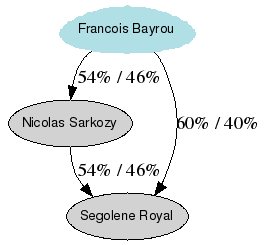
The french presidential election (in april/may 2007) will use plurality voting with two rounds (voters will choose 1 amongst 11 or 12 candidates during the first round. The two candidates with the most votes will be qualified for the second round). The latest polls clearly show how this election method fails to satisfy the Condorcet criterion. Using the second round results from this poll (only considering the 3 main candidates, since the other don’t have any chance to win the presidential election), we get this: 2007 elect results So Francois Bayrou is the Condorcet winner, and should win the election. However, the first round results, according to the same poll, could be:
  1. Sarkozy 31%
  2. Royal 24%
  3. Bayrou 22%
  4. Le Pen 12%
Since only the two first candidates are qualified to second round, Bayrou wouldn’t be elected. It will be interesting to see how those scores evolves until the first round (April 22nd).

16 March 2007

Lucas Nussbaum: Most broken spam protection ever

Just received that, in reply to a mail I sent:
This email is from X. My email address (X@Y.com) is protected against spam and viruses by MailInBlack. Please click on the following link in order to identify yourself to me and to allow your message to reach me.
http://192.168.0.252/v/?C8BEF10E72C&tmstp=20070316084314&tk=message_confirm&tkid=7951&lang=2 This needs to be done only once, for this email and all future email correspondence. Thank you for your understanding. X
MailInBlack seems to be a french company. No wonder why they guarantee that 100% of spams are stopped. (To be fair, I am not sure yet of who fucked up, it might be the admin)

14 March 2007

Lucas Nussbaum: Jabber clients and OS usage stats (3)

Using XMPP4R, I did some stats about Jabber clients usage on the Apinc Jabber server, which hosts im.apinc.org, jabber.fr, and many more using virtual hosting. I already did similar stats in March 2006 and September 2005. The poll was done by sending jabber:iq:version to online users, around 1:00 PM (french local time, most of the users are french). 1343 clients were pinged, and 1315 answered, which is better than last year (1145 answers). Of the 1145 jids that answered last year, 368 were also part of the poll this year (I don’t know if this is good, or not enough). Systems: Clients: (all clients with at least one reply are listed here) I also did some stats on the Linux distros. With 566 Linux users, one can consider that statistically signifiant. (Other distros are below 5 replies) The Debian/Ubuntu situation is interesting. Debian is not dying, even on the desktop ! The server is hosting jabber.ubuntu-fr.org, so the results are biased towards Ubuntu. Update: it seems that Psi reports “Debian GNU/Linux (testing/unstable)” even when running on Ubuntu. This is the case for ~5% of linux users. To server admins: if you are running a large jabber server with jabberd 1.6, it’s easy to give me the right to get the list of online users, so contact me if your are interested in me doing your users stats. It would be interesting to see if users from different servers/countries have different behaviours. I’m not sure if it’s possible with ejabberd and other servers.

26 February 2007

Lucas Nussbaum: Slides for my FOSDEM talks about Debian QA

As promised, the slides from my FOSDEM talks about Automated Testing of Debian Packages and Use of Grid Computing for Debian Quality Assurance are available. Don’t hesite to ask questions or post comments. The videos for both talks should be available so you can laugh at my frenglish, but I haven’t heard of an ETA yet.

Lucas Nussbaum: Efficient key signing

I just finished signing all the keys from the FOSDEM KSP. Importing keys I received:
Mutt is nice. You can tag all messages with ‘t’, then use ‘;’ (tag-prefix) and ^K (Ctrl + K) to import all signatures. (Thanks Myon + sam for the tip) Signing keys:
caff (featured on debaday last week) has some useful info in /usr/share/doc/signing-party/, especially the README.many-keys and README.gpg-agent files.

21 February 2007

Lucas Nussbaum: State of software for Suspend to RAM/Disk ?

Dear readers, I am the mostly happy owner of a Dell Latitude D610 (the one with the ATI video card), running Debian Etch. I installed the hibernate package to try to get Suspend to RAM and to Disk to work, and Suspend to Disk worked out of the box. But Suspend to RAM didn’t work (garbled screen at resume). I never bothered to investigate this until today, when I discovered that acpi-support provides the same functionality, and works both for Suspend to RAM and to Disk ! I’m happier now, but I would like to understand, and the world of ACPI and Suspend to RAM/Disk is very difficult to grasp for newcomers. What is the story behind hibernate and acpi-support ? Why was this duplication of effort needed ? Also, it seems that gnome-power-manager and kpowersave provide the same functionality. Why can’t they just call the relevant acpi-support or hibernate scripts ? How do those different implementations compare (what are their main differences ?) ? Looking at the packages content, it seems that hibernate tries to be generic, while acpi-support gave up, and handles each and every laptop model differently. Correct ? Also, hibernate seems to be handling a few things better, like getting my network interface back up after hibernation. Finally, the last question: how do one debug Suspend issues, when it fails to work ? Is there a document somewhere explaining that ?

Next.

Previous.