Search Results: "John Goerzen"

10 April 2011

John Goerzen: The Mennonite Mecca

I d like to paint you a picture of the sorts of things that have been going on around here the past few months, and with growing fervor the past few days. I ll start with church basements. Possibly a little chilly, but with a bunch of women getting together to make some quilts along with some conversation, maybe some snacks. Or perhaps about hundreds of kitchens throughout Kansas, warm with baking pies, cookies, breads, and all sorts of items. Then there are a bunch of wood shops, turning up sawdust, building things from toys to furniture. Or even a body shop donating its time and materials to put some finishing touches on a classic car. I ve also seen around 300 men getting together to practice for a men s chorus concert. I know there was large crowd of people gathering to make verenike. People always wind up running 5km on a particular Saturday morning, rain or shine. Or ride 35 miles on a bicycle on a different Saturday. Or even help build a house using as much volunteer labor and donated materials as possible. And then, of course, comes this week, where Mennonites from all over Kansas start to converge on Hutchinson, KS. I can imagine you might see some odd sights rolling down the road: a vehicle called the borscht buggy for preparing large quantities of the delicious soup. Several old tractors being hauled down the road on trailers. Semi loads of food. Vanloads of pie and cookies. Plants, trees, rugs, quilts, even a lawn mower. And then, yesterday and today, excited people ready to buy all of these things. Families with children excited to get a ride on the largest slide they ve ever seen. And, of course, so many people wanting to eat the famous food that, despite the many parallel serving areas, lines still can extend for blocks. It s all because people are hungry. Not these Kansans with pie-laden kitchens, though it s to help those in need. It s all part of the annual Kansas MCC Relief Sale. The idea is that people make, bake, build, sing, or give things to the sale. The items are then sold, and the proceeds go to Mennonite Central Committee, one of the world s most efficient charities. MCC not only helps with directly bringing people out of hunger, but also supports sustainable projects, such as building hand-operated wells to give those in need a safe source of drinking water. Virtually all of the money you spend on those pies winds up helping someone in poverty. Each year, the relief sale and related events raise around half a million dollars for charity. It s not unusual to see a quilt sell for thousands of dollars. Most of the things sell at more normal prices, but last year someone decided to add a loaf of bread to an auction and it sold for $100. And so it was this that we took the boys to today. We started with the Feeding the Multitude a wonderful meal with some traditional Kansas Mennonite food. Here s a photo: That bread is zwieback, then there is cherry moos, bohne berrogi, verenike, and of course, sausage. Here are Jacob and Oliver enjoying their food: IMG_5548.JPG After that, we went over to the giant slide. I m not sure how many stories tall it is, but it s big enough that they have a strip of carpet there at the bottom to slow people down at the end. Here s a photo of Jacob on my lap after going down the slide. If you zoom in, you can see the giant smile on his face. IMG_5562.JPG After that, we hopped on the mass transit at the sale: a wagon being pulled by a tractor. We checked out the general auction, with Jacob wanting to be sure to peer under the hood of each car present. Then after a stop to buy some kettle corn for Jacob, we checked out the plants, quilt auction, and then on to buy cheese curds. After another stop at the slide, it was time to head home. And then tomorrow is a concert of the Kansas Mennonite Men s Chorus (motto: We Sing That Others May Live). You get around 300 men on a stage signing together and wow no recording can do it justice. It s amazing to hear the power of the choir at the loud parts, but still more amazing to listen to 300 men signing as softly as they possibly can. I ve been singing with that choir for 3 years, and we ve been practicing for a few months now. If you ever hear some Mennonites boasting about something, it s probably going to be about how much money they ve raised for charity. And on that note, I ll nudge those Indiana folks reading this and point out that you have some catching up to do with the Kansas sale
25 March 2011

John Goerzen: Country Car Repair & California-Kansas Culture Shock

I know this is almost a cliche, but here goes. Just to show you that it still exists. Today my car needed some work. This morning I dropped it off at the mechanic, who lives right off a well-traveled state highway. They don t have a dropbox for keys because, well, they don t need one. I left the keys in the car. They called to say that they d have to close early this afternoon, but not to worry the keys were in the car along with the bill, which I could drop by and pay or put in the family s box at church. And sure enough, the car sat there the rest of the afternoon, and until about 9:45PM, with the keys in the ignition, bill tucked in under my ham radio speaker, ready to pick up. And it wasn t at risk for being stolen. Things just sort of happen that way out here sometimes. I remember one time we were taking a train out of Newton, KS, which departs at about 3:30AM. The only other train through there departs at 3:00AM. And back then, there was sometimes no station agent on some days. We got there our usual 15 minutes before the train departed, and struck up a conversation with a couple from California. They were almost beside themselves with shock. First off, they had arrived an hour and a half early, being used to doing that for getting on planes and, apparently, trains. But what really stunned them was the fact that the station was simply left unlocked all night. There weren t any cops there, and in fact there was nobody there at all for most of the night. And yet it had no signs of graffiti, no vandalism, and no apparent concern from anybody that it was unlocked. I think they also felt unsafe, having no guards or officials present. And they were literally the only people in the station for an hour, I m sure. And sure enough, along came the train. We all heard the whistle and had our things ready to go by the time the conductor got off the train, walked into the station, announced it, and led us all out to it. 3 minutes later, we were all on our way to California and the land of, apparently, locked doors. Back in 2002, when we bought a house in Kansas, the inspector commented that none of the outside locks worked. At closing, the sellers gave us a key, commenting We never use it and it took forever to find it. I guess that s why they didn t know the locks were broken. There s something good about a setting like this. I know that my car is safe at the mechanic with the keys in it. He knows that I ll pay his bill. We all take pride in our community institutions. And besides, if anybody did try to spray some graffiti in the train station, they ll be living with people that will remember it for the next 40 years. Accountability is implicit here.

16 March 2011

John Goerzen: A Proud Dad

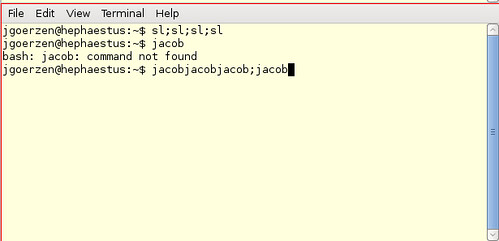
I saw this on my computer screen the other day, and I ve got to say it really warmed my heart. I ll explain below if it doesn t provoke that reaction for you. Evidence a 4-year-old has been using my computer So here s why that made me happy. Well for one, it was the first time Jacob had left stuff on my computer that I found later. And of course he left his name there. But moreover, he s learning a bit about the Unix shell. sl is a command that displays an animated steam locomotive. I taught him how to use the semicolon to combine commands. So he has realized that he can combine calls to sl with the semicolon to get a series of a LOT of steam trains all at once. And was very excited about this discovery. Also he likes how error messages start with the word bash .

5 March 2011

John Goerzen: Visiting Purdue

Terah went to college at Purdue University, and always enjoyed basketball games there. I ve not been much of a sports fan, but have enjoyed watching Purdue games with her on TV. Terah has been wanting to see a game in person for awhile, so a couple of weeks ago, we went. It was a really fun weekend! When we planed the trip, we had no idea that the Purdue-Ohio State game was going to be such a big one. We walked over from the Union Club Hotel where we were staying on the Purdue campus. People were streaming towards Mackey Arena from all directions. Once inside, it was already loud and buzzing people cheering, the band playing. I ve never experienced anything quite so loud. The game started out badly for Purdue; they were down a few points up front. The entire game was a close one, and the crowd sometimes got so loud that nothing else could be heard not even the band or the announcer. When it became clear at the end that Purdue won the game, the people behind me and apparently 12,000 others began screaming at the top of their lungs. My hearing did eventually return to normal. So did my throat, which had gotten rather sore from from cheering myself. This was our first road trip since I got my amateur radio license. I had a lot of fun visiting with people as we drove. I talked to a retired railroad engineer that used to take an amateur radio with him in his locomotive. As he went through a certain town where he had friends he liked to talk with on the radio, he d get their attention by blowing CQ in Morse code with the train s whistle. Some people in Kansas City had us laughing as we passed through. In Missouri, I talked with some farmers and a World War II vet. In Champaign, IL, I visited with a retired Unix systems administrator that had spent decades working with Unix operating systems. Our hotel was connected to the Purdue Memorial Union, a large and historic building. Besides having some ice cream at the Sweet Shop one evening, we also spent a bit of time exploring it. I noticed that the Purdue Amateur Radio Club was having a testing session in there. We walked past once it was underway, and one of the students was not very busy. I introduced myself and asked if we could see their shack. It was neat to see all the equipment some of it quite old in the room that they must have been using for decades. Terah, of course, had ideas for visiting a number of her favorite places while we were there. We visited Arni s and Bruno s, both pizza places. Bruno s happens to be a Swiss pizza place, so much to my surprise, I had Wienerschnitzel there, which was excellent. We ate a (week late) Valentine s dinner at Bistro 501. On our way back, we also chatted with various people on the radio, though not quite as much. We got helpful suggestions for which route to take, and stopped at the excellent Bobby D s Merchant St. BBQ in Emporia, KS for supper. The boys had also enjoyed their weekend with grandparents, but were glad to see us back. They were particularly interested to see a lot of train videos from Youtube with me the next day.

16 February 2011

Kartik Mistry: Nexenta is hiring!

* It is always fantastic being with Kernel, Device Drivers, File Systems and Network Protocol and yeah, Illumos, NCP and NexentaStor! So, if you re around or in St. Petersburg, Krasnodar or Northen Boston (or even somewhere else too) read below :) we re hiring! From, John Goerzen s recent post,
Oh, and if you d like to work for us, you should probably be sending me an email. No, I m not going to list the address here on this blog post. If you can t figure it out, I don t want to hear from you

14 February 2011

John Goerzen: How do you hire programmers and sysadmins? How should employers evaluate you?

Reading job listings for any sort of IT job is depressing. It s been quite some time since I ve had to do that, but how many times have you seen something like this: I could go on and on. As a job seeker, that sort of thing is fundamentally devaluing to someone who has strengths in being adaptable and quickly learning new tools, languages, or even entire environments. As an employer, it sends a message that you re not interested in more than a surface look at someone s strengths, and probably don t care to hire the best and the brightest. After all, would you turn away a rockstar programmer simply because he or she had been writing filesystem code in C the last 3 years instead of the latest whizbang Java web widget that will probably be obsolete in a year and unsupported in two? I am quite certain that there are plenty of managers that do. Even if you are a company large enough to have an entire team of people that do nothing but work on that whizbang app, don t you still want the best you can find, realizing that some of the best people to work on that app may not have even heard of it yet? (And that when the app goes obsolete in 5 years, you d rather not have to lay off a large team of single-skill people) Some of you may know that I work in IT at a manufacturing company. We have a small IT team here, about seven people, and are a heavy Debian shop. And we have a vacancy open up in our development/Linux admin group. I m the manager of that group, which is why I m thinking about this right now. We re too small for single-subject specialists to make sense, yet we re big enough to appreciate skill, experience, flexibility, and rigor. Consequently, when the occasion arises for me to look for new employees, I don t prepare a laundry list of things we use in-house and would like experience with. The list of almost-required things generally begins with Linux and ends with experienced , and has nothing else in between. In other words, I d like it if I don t have to explain to you what a symlink or a hardlink is, but I d be willing to do so if I think you d internalize it quickly. On the experienced side, it would be nice if you already have a well-developed sense of fear at running rm when you re root, or have designed a storage infrastructure for a network before, or are paranoid about security. But again, if people can pick up those traits on the job, we are usually still interested. If learning how to package up software for Debian, fix bugs in software you ve never seen in a language you ve never heard of, raise good questions about things you may not have lots of experience with, and write documentation for it all on a wiki sounds like fun, then that s probably the kind of person I want, even if you ve never used our particular tools before. If I were to judge based on the stuff I normally see in job postings, I guess you might conclude I m nuts. I don t think I am, but then again I m also the only person I know that formats his own resume in hand-crafted LaTeX. What do you all think? The next question is: how should one evaluate candidates given this sort of philosophy? I m not a fan of canned tests, or even whiteboard tests that tend to be some sort of canned topic that may test the applicant s specific knowledge base more than overall skill and flexibility. Similarly, as an applicant in years past, I ve struggled with how to present the I ve never used $LANGUAGE, but I know I could pick it up quickly and do it very well vibe. To certain people, that might sound like BS. To the more geeky managers, perhaps it sounds like what they want. We ve built a fairly diverse team on the back of this approach, and it s worked out well for us so far. I m interested to hear your thoughts. Oh, and if you d like to work for us, you should probably be sending me an email. No, I m not going to list the address here on this blog post. If you can t figure it out, I don t want to hear from you <grin>

John Goerzen: Lots of Snow, Being Stuck, and Fun

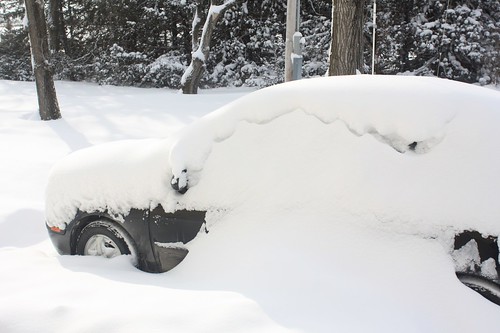
Those of you that watch my twitter know that we got dumped on with snow recently. The final estimate reported by local papers is 17 to 19 inches. IMG_5301.JPG That s my car. You might understand why I went home at 1PM Tuesday and worked from home the rest of the afternoon. The county didn t get the roads opened until 5:30PM Wednesday, so we were stuck. Terah s dad kindly opened the driveway for us though. Without that, we wouldn t have even known where it was. marla-IMG_4180.JPG Jacob and Oliver loved playing in the snow. It was a HUGE hit for them. Both of them hated to go back inside when it was time. Oliver had trouble walking, or even standing up, but that didn t stop him from begging for more every chance he got. IMG_5345.JPG On Saturday, I took Jacob outside to play. We had in mind building a snow tunnel. We went to one of the big piles of snow left by the tractor after our driveway was cleared, and I dug out a space underneath it that Jacob could crawl through. He got a little scoop (he insisted on calling it my shovel ) and helped dig too. He had a great time with it. He was very anxious to go inside, and it probably didn t help his eagerness that the cats could freely walk through it long before he could. They were around and taking a great interest in the proceedings. One of then stretched out on my back while I was stretched out pulling snow out from the pile. Finally Jacob got to go through. He had a little trouble because it wasn t tall enough for him to crawl like he usually does (though still plenty big for him to get through with lots of room to spare), but he came out beaming. I then went and got the camera and got some photos of his second trip through. IMG_5424.JPG You d think that this might be the highlight of a 4-year-old s snow excursion. And given his excitement, you might be very convinced of that. But you d be wrong. What Jacob really wanted was a snow train. So I drew some train track-sized lines in the snow with my shovel. Then I was supposed to draw a train engine. He had been planning this for hours before we even went outside, and I knew very well what was supposed to go on the engine: a snowball for a headlight. We then added passenger cars and a coal car, because apparently that s what you do with snow trains. And the result: IMG_5445.JPG When we went inside, Terah asked Jacob about his snow experience. Jacob was very happy, until she asked him if his snow train was a real train or a drawing of a train. Then he became very sad when he said it was a drawing of a train, and decided it was not what he wanted AT ALL. So today we went out again. This time I built a snow train that stands up, complete with snowballs for wheels. I asked him if it was right, and he kept saying, No, I want a REAL train. Finally I asked him what the difference between a real snow train and this one was. Apparently a real train would be on tracks, move around, make noise, and take us places. Fortunately he didn t dwell too long when I explained I couldn t build one of those. And then today s highlight was writing JACOB in the snow. He had started by drawing larger and larger J letters with his arm, and finally asked me to make one. I made footprints in the shape of a very large J, which he loved. He had me make another one, and then the rest of the letters in his name.

31 January 2011

John Goerzen: Unix Password and Authority Management

One of the things that everyone seems to do different is managing passwords. We haven t looked at that in quite some time, despite growth both of the company and the IT department. As I look to us moving some things to the cloud, and shifting offsite backups from carrying tapes to a bank to backups via the Internet, I m aware that the potential for mischief whether intentional or not is magnified. With cloud hosting, a person could, with the press of a button, wipe out the equivalent of racks of machines in a few seconds. With disk-based local and Internet-based offsite backups, the potential for malicious behavior may be magnified; someone could pretty quickly wipe out local and remote backups. Add to that the mysterious fact that many enterprise-targeted services allow only a single username/password for an account, and make no provision for ACLs to delegate permissions to others. Even Rackspace Cloud has this problem, as do their JungleDisk backup product, and many, many other offsite backup products. Amazon AWS seems to be the only real exception to this rule, and their ACL support is more than a little complicated. So one of the questions we will have to address is the balance of who has these passwords. Too many people and the probability of trouble, intentional or not, rises. Too few and productivity is harmed, and potentially also the ability to restore. (If only one person has the password, and that person is unavailable, company data may be as well.) The company does have some storage locations, including locked vaults and safe deposit boxes, that no IT people have access to. I am thinking that putting a record of passwords in those locations may be a good first step, as putting the passwords in the control of those that can t use them seems a reasonable step. But we ve been thinking of this as it pertains to our local systems as well. We have, for a number of years now, assigned a unique root password to every server. These passwords are then stored in a password-management tool, encrypted with a master password, and stored on a shared filesystem. Everyone in the department therefore can access every password. Many places where I worked used this scheme, or some variant of it. The general idea was that if root on one machine was compromised and the attacker got root s password, it would prevent the person from being able to just try that password on the other servers on the network and achieve a greater level of intrusion. However, the drawback is that we now have more servers than anyone can really remember the passwords for. So many people are just leaving the password tool running. Moreover, while the attack described above is still possible, these days I worry more about automated intrusion attempts that most likely won t try that attack vector. A couple of ways we could go may include using a single root password everywhere, or a small set of root passwords. Another option may be to not log in to root accounts at all possibly even disabling their password and requiring the use of user accounts plus sudo. This hasn t been practical to date. We don t want to make a dependency on LDAP from a bunch of machines just to be able to use root, and we haven t been using a tool such as puppet or cfengine to manage this stuff. Using such a tool is on our roadmap and could let us manage that approach more easily. But this approach has risks too. One is that if user accounts can get to root on many machines, then we re not really more secure than a standard root password. Second is that it makes it more difficult to detect and enforce password expiration and systematic password changes. I m curious what approaches other people are taking on this.

28 January 2011

John Goerzen: Slices of 2010

A lot of people look back on their year in December. I think it doesn t make sense to look back on a year until it s done. And then take a little time to let it simmer. That s my excuse for not doing this until almost February, anyhow. 2010 started with a 3-day ordeal of taking out the trash, nearly snapping the hood off my pickup while closing it, and Greek poetry. I then dived right into reading the Odyssey, and my post suggesting we read the Old Testament of the Bible like we read Greek mythology generated almost 100 comments. I guess I said something controversial I also read a number of other books last year. Our family had quite the year. In March, Terah and I got to visit Europe for the first time. A few months later, we visited New York City for the first time and I attended Debconf10. Jacob predictably loved our train trip to NYC, calling our room in the sleeper the best place of ever. Terah had thyroid surgery, and Jacob survived a tractor accident with amazingly minor injuries. But as I look back at my posts from last year, I m struck that most of them were about more everyday, ordinary events of life. Jacob loved the switchbox he and I built, Oliver somtimes acts like Yoda, and they both loved camping. I have made probably way too many posts with photos of them last year, but I m making no promises to slow down this year! Jacob and I built a computer together, and he loves bashing random words at the Linux shell. He also developed an interest in some half-broken FRS radios, and had tons of fun with them. Eventually this kindled in interest in amatuer radio in me. At the end of 2009, I finally completed my computer science degree and mused about what I might do next. I m a curious, inquisitive person that enjoys both challenge and knowledge. I thought that perhaps I would dive into reading more, or perhaps take some more college classes. Turns out I instead picked up amateur radio one of the big unexpected twists of the year. Jacob really did kindle that interest in me, and by July I had passed my technician and general exams and was on the air. I continued to study, and passed my extra class exam in October. Since then, I ve rigged up my bicycle for amateur radio operation, made some fun contacts, set up outdoor antennas, and got going with digital operation. It has been a lot of fun, and will keep providing opportunities for a challenge for me for a very long time. Also on the technical side, I made my archive of Gopherspace available for download. It s hard to cut off the list I have dozens of other things I could mention but I suppose I should end it with the Christmas gathering / piano moving episode.

25 January 2011

John Goerzen: rdiff-backup, ZFS, and rsync scripts

rdiff-backup vs. ZFS As I ve been writing about backups, I ve gone ahead and run some tests with rdiff-backup. I have been using rdiff-backup personally for many years now probably since 2002, when I packaged it up for Debian. It s a nice, stable system, but I always like to look at other options for things every so often. rdiff-backup stores an uncompressed current mirror of the filesystem, similar to rsync. History is achieved by the use of compressed backwards binary deltas generated by rdiff (using the rsync algorithm). So, you can restore the current copy very easily a simple cp will do if you don t need to preserve permissions. rdiff-backup restores previous copies by applying all necessary binary deltas to generate the previous version. Things I like about rdiff-backup:
  1. Bandwidth-efficient
  2. Reasonably space-efficient, especially where history is concerned
  3. Easily scriptable and nice CLI
  4. Unlike tools such as duplicity, there is no need to periodically run full backups old backups can be deleted without impacting the ability to restore more current backups
Things I don t like about it:
  1. Speed. It can be really slow. Deleting 3 months worth of old history takes hours. It has to unlink vast numbers of files and that s pretty much it, but it does it really slowly. Restores, backups, etc. are all slow as well. Even just getting a list of your increment sizes so you d know how much space would be saved can take a very long time.
  2. The current backup copy is stored without any kind of compression, which is not at all space-efficient
  3. It creates vast numbers of little files that take forever to delete or summarize
So I thought I would examine how efficient ZFS would be. I wrote a script that would replay the rdiff-backup history first it would rsync the current copy onto the ZFS filesystem and make a ZFS snapshot. Then each previous version was processed by my script (rdiff-backup s files are sufficiently standard that a shell script can process them), and a ZFS snapshot created after each. This lets me directly compare the space used by rdiff-backup to that used by ZFS using actual history. I enabled gzip-3 compression and block dedup in ZFS. My backups were nearly 1TB in size and the amount of space I had available for ZFS was roughly 600GB, so I couldn t test all of them. As it happened, I tested the ones that were the worst-case scenario for ZFS: my photos, music collection, etc. These files had very little duplication and very little compressibility. Plus a backup of my regular server that was reasonably compressible. The total size of the data backed up with rdiff-backup was 583 GB. With ZFS, this came to 498GB. My dedup ratio on this was only 1.05 (meaning 5% or 25GB saved). The compression ratio was 1.12 (60GB saved). The combined ratio was 1.17 (85GB saved). Interestingly 498 + 85 = 583. Remember that the data under test here was mostly a worst-case scenario for ZFS. It would probably have done better had I had the time to throw the rest of my dataset at it (such as the 60GB backup of my iPod, which would have mostly deduplicated with the backup of my music server). One problem with ZFS is that dedup is very memory-hungry. This is common knowledge and it is advertised that you need to use roughly 2GB of RAM per TB of disk when using dedup. I don t have quite that much to dedicate to it, so ZFS got VERY slow and thrashed the disk a lot after the ARC grew to about 300MB. I found some tweakables in zfsrc and the zfs command that let me tweak the ARC cache to grow bigger. But the machine in question only has 2GB RAM, and is doing lots of other things as well, so this barely improved anything. Note that this dedup RAM requirement is not out of line with what is expected from these sorts of solutions. Even if I got absolutely stellar dedup ratio of 2:1, that would get me at most 1TB. The cost of buying a 1TB disk is less than the cost of upgrading my system to 4GB RAM, so dedup isn t worth it here. I think the lesson is: think carefully about where dedup makes sense. If you re storing a bunch of nearly-identical virtual machine images the sort of canonical use case for this go for it. A general fileserver well, maybe you should just add more disk instead of more RAM. Then that raises the question: if I don t need dedup from ZFS, do I bother with it at all, or just use ext4 and LVM snapshots? I think ZFS still makes sense, given its built-in support for compression and very fast snapshots LVM snapshots are known to cause serious degradation to write performance once enabled, which ZFS doesn t. So I plan to switch my backups to use ZFS. A few observations on this:
  1. Some testing suggests that the time to delete a few months of old snapshots will be a minute or two with ZFS compared to hours with rdiff-backup.
  2. ZFS has shown itself to be more space-efficient than rdiff-backup, even without dedup enabled.
  3. There are clear performance and convenience wins with ZFS.
  4. Backup Scripts So now comes the question of backup scripts. rsync is obviously a pretty nice choice here and if used with inplace perhaps even will play friendly with ZFS snapshots even if dedup is off. But let s say I m backing up a few machines at home, or perhaps dozens at work. There is a need to automate all of this. Specifically, there s a need to:
    1. Provide scheduling, making sure that we don t hammer the server with 30 clients all at once
    2. Provide for run before jobs to do things like snapshot databases
    3. Be silent on success and scream loudly via emails to administrators on any kind of error and keep backing up other systems when there is an error
    4. Create snapshots and provide an automated way to remove old snapshots (or mount them for reading, as ZFS-fuse doesn t support the .zfs snapshot directory yet)
    To date I haven t found anything that looks suitable. I found a shell script system called rsbackup that does a large part of this, but something about using a script whose homepage is a forum makes me less than 100% confident. On the securing the backups front, rsync comes with a good-looking rrsync script (inexplicably installed under /usr/share/doc/rsync/scripts instead of /usr/bin on Debian) that can help secure the SSH authorization. GNU rush also looks like a useful restricted shell.

20 January 2011

John Goerzen: Research on deduplicating disk-based and cloud backups

Yesterday, I wrote about backing up to the cloud. I specifically was looking at cloud backup services. I ve been looking into various options there, but also various options for disk-based backups. I d like to have both onsite and offsite backups, so both types of backup are needed. Also, it is useful to think about how the two types of backups can be combined with minimal overhead. For the onsite backups, I d want to see:
  1. Preservation of ownership, permissions, etc.
  2. Preservation of symlinks and hardlinks
  3. Space-efficient representation of changes ideally binary deltas or block-level deduplication
  4. Ease of restoring
  5. Support for backing up Linux and Windows machines
Deduplicating Filesystems for Local Storage Although I initially thought of block-level deduplicating file systems as something to use for offsite backups, they could also make an excellent choice for onsite disk-based backups. rsync-based dedup backups One way to use them would be to simply rsync data to them each night. Since copies are essentially free, we could do (or use some optimized version of) cp -r current snapshot/2011-01-20 or some such to save off historic backups. Moreover, we d get dedup both across and within machines. And, many of these can use filesystem-level compression. The real upshot of this is that the entire history of the backups can be browsed as a mounted filesystem. It would be fast and easy to find files, especially when users call about that file that they deleted at some point in the past but they don t remember when, exactly what it was called, or exactly where it was stored. We can do a lot more with find and grep to locate these things than we could do with tools in Bacula (or any other backup program) restore console. Since it is a real mounted filesystem, we could also do fun things like make tarballs of it at will, zip parts up, scp them back to the file server, whatever. We could potentially even give users direct access to their files to restore things they need for themselves. The downside of this approach is that rsync can t store all the permissions unless it s running as root on the system. Wrappers such as rdup around rsync could help with that. Another downside is that there isn t a central scheduling/statistics service. We wouldn t want the backup system to be hammered by 20 servers trying to send it data at once. So there d be an element of rolling our own scripts, though not too bad. I d have preferred not to authorize a backup server with root-level access to dozens of machines, but may be inescapable in this instance. Bacula and dedup The other alternative I thought of system such as Bacula with disk-based volumes . A Bacula volume is normally a tape, but Bacula can just write them to disk files. This lets us use the powerful Bacula scheduling engine, logging service, pre-backup and post-backup jobs, etc. Normally this would be an egregious waste of disk space. Bacula, like most tape-heritage programs, will write out an entire new copy of a file if even one byte changes. I had thought that I could let block-level dedupe reduce the storage size of Bacula volumes, but after looking at the Bacula block format spec, this won t be possible as each block will have timestamps and such in it. The good things about this setup revolve around using the central Bacula director. We need only install bacula-fd on each server to be backed up, and it has a fairly limited set of things it can do. Bacula already has built-in support for defining simple or complicated retention policies. Its director will email us if there is a problem with anything. And its logs and catalog are already extensive and enable us to easily find out things such as how long backups take, how much space they consume, etc. And it backs up Windows machines intelligently and comprehensively in addition to POSIX ones. The downsides are, of course, that we don t have all the features we d get from having the entire history on the filesystem all at once, and far less efficient use of space. Not only that, but recovering from a disaster would require a more extensive bootstrapping process. A hybrid option may be possible: automatically unpacking bacula backups after they ve run onto the local filesystem. Dedupe should ensure this doesn t take additional space if the Bacula blocksize aligns with the filesystem blocksize. This is certainly not a given however. It may also make sense to use Bacula for Windows and rsync/rdup for Linux systems. This seems, however, rather wasteful and useless. Evaluation of deduplicating filesystems I set up and tested three deduplicating filesystems available for Linux: S3QL, SDFS, and zfs-fuse. I did not examine lessfs. I ran a similar set of tests for each:
  1. Copy /usr/bin into the fs with tar -cpf - /usr/bin tar -xvpf - -C /mnt/testfs
  2. Run commands to sync/flush the disk cache. Evaluate time and disk used at this point.
  3. Rerun the tar command, putting the contents into a slightly different path in the test filesystem. This should consume very little additional space since the files will have already been there. This will validate that dedupe works as expected, and provide a hint about its efficiency.
  4. Make a tarball of both directories from the dedup filesystem, writing it to /dev/zero (to test read performance)
I did not attempt to flush read caches during this, but I did flush write caches. The test system has 8GB RAM, 5GB of which was free or in use by a cache. The CPU is a Core2 6420 at 2.13GHz. The filesystems which created files atop an existing filesystem had ext4 mounted noatime beneath them. ZFS was mounted on an LVM LV. I also benchmarked native performance on ext4 as a baseline. The data set consists of 3232 files and 516MB. It contains hardlinks and symlinks. Here are my results. Please note the comments below as SDFS could not accurately complete the test.
Test ext4 S3QL SDFS zfs-fuse
First copy 1.59s 6m20s 2m2s 0m25s
Sync/Flush 8.0s 1m1s 0s 0s
Second copy+sync N/A 0m48s 1m48s 0m24s
Disk usage after 1st copy 516MB 156MB 791MB 201MB
Disk usage after 2nd copy N/A 157MB 823MB 208MB
Make tarball 0.2s 1m1s 2m22s 0m54s
Max RAM usage N/A 150MB 350MB 153MB
Compression none lzma none gzip-2
It should be mentioned that these tests pretty much ruled out SDFS. SDFS doesn t appear to support local compression, and it severely bloated the data store, which was much larger than the original data. Moreover, it permitted any user to create and modify files, even if the permissions bits said that the user couldn t. tar gave many errors unpacking symlinks onto the SDFS filesystem, and du -s on the result threw up errors as well. Besides that, I noted that find found 10 fewer files than in my source data. Between the huge memory consumption, the data integrity concerns, and inefficient disk storage, SDFS is out of the running for this project. S3QL is optimized for storage to S3, though it can also store its files locally or on an sftp server a nice touch. I suspect part of its performance problem stems from being designed for network backends, and using slow compression algorithms. S3QL worked fine, however, and produced no problems. Creating a checkpoint using s3qlcp (faster than cp since it doesn t have to read the data from the store) took 16s. zfs-fuse appears to be the most-used ZFS implementation on Linux at the moment. I set up a 2GB ZFS pool for this test, and set dedupe=on and compress=gzip-2. When I evaluated compression in the past, I hadn t looked at lzjb. I found a blog post comparing lzjb to the gzip options supported by zfs and wound up using gzip-2 for this test. ZFS really shone here. Compared to S3QL, it took 25s instead of over 6 minutes to copy the data over and took only 28% more space. I suspect that if I selected gzip -9 compression it would have been closer both in time and space to S3QL. But creating a ZFS snapshot was nearly instantaneous. Although ZFS-fuse probably doesn t have as many users as ZFS on Solaris, still it is available in Debian, and has a good backing behind it. I feel safer using it than I do using S3QL. So I think ZFS wins this comparison. I spent quite some time testing ZFS snapshots, which are instantaneous. (Incidentally, ZFS-fuse can t mount them directly as documented, so you create a clone of the snapshot and mount that.) They worked out as well as could be hoped. Due to dedupe, even deleting and recreating the entire content of the original filesystem resulted in less than 1MB additional storage used. I also tested creating multiple filesystems in the zpool, and confirmed that dedupe even works between filesystems. Incidentally wow, ZFS has a ton of awesome features. I see why you OpenSolaris people kept looking at us Linux folks with a sneer now. Only our project hasn t been killed by a new corporate overlord, so guess that maybe didn t work out so well for you <grin>. The Cloud Tie-In This discussion leaves another discussion: what to do about offsite backups? Assuming for the moment that I want to back them up over the Internet to some sort of cloud storage facility, there are about 3 options:
  1. Get an Amazon EC2 instance with EBS storage and rsync files to it. Perhaps run ZFS on that thing.
  2. Use a filesystem that can efficiently store data in S3 or Cloud Files (S3QL is the only contender here)
  3. Use a third-party backup product (JungleDisk appears to be the leading option)
There is something to be said for using a different tool for offsite backups if there is some tool-level issue, that could be helpful. One of the nice things about JungleDisk is that bandwidth is free, and disk is the same $0.15/GB-mo that RackSpace normally charges. JungleDisk also does block-level dedup, and has a central management interface. This all spells nice for us. The only remaining question would be whether to just use JungleDisk to back up the backup server, or to put it on each individual machine as well. If it just backs up the backup server, then administrative burdens are lower; we can back everything there up by default and just not worry about it. On the other hand, if there is a problem with our main backups, we could be really stuck. So I d say I m leaning towards ZFS plus some sort of rsync solution and JungleDisk for offsite. I had two people suggest CrashPlan Pro on my blog. It looks interesting, but is a very closed product which makes me nervous. I like using standard tools and formats gives me more peace of mind, control, and recovery options. CrashPlan Pro supports multiple destinations and says that they do cloud hosting, but don t list pricing anywhere. So I ll probably not mess with it. I m still very interested in what comments people may have on all this. Let me know!

18 January 2011

John Goerzen: Backing Up to the Cloud

I m recently taking some big-picture looks at how we do things, and one thing that I think could be useful would be for us to back up a limited set of data to an offsite location states away. Prices are cheap enough for this to make it useful. Services such as Amazon S3 and Rackspace Cloud Files (I ve heard particularly good things about that one) seem to be perfect for this. I m not quite finding software that does what I want, though. Here are my general criteria:
  1. Storage fees of $0.15 per gigabyte-month or less
  2. Free or cheap ($0.20 per gigabyte or less) bandwidth fees
  3. rsync-like protocol to avoid having to re-send those 20GB files that have 20MB of changes in their entirety every night
  4. Open Source and cross-platform (Linux, Windows, Mac, Solaris ideally; Linux and Windows at a minimum)
  5. Compression and encryption
  6. Easy way to restore the entire backup set or individual files
  7. Versatile include/exclude rules
  8. Must be runnable from scripts, cron, etc. without a GUI
  9. Nice to have: block or file-level de-duplication
  10. Nice to have: support for accurately backing up POSIX (user, group, permission bits, symlink, hard links, sparse files) and Windows filesystem attributes
  11. Nice to have: a point-and-click interface for the non-Unix folks to use to restore Windows files and routine restore requests
So far, here s what I ve found. I should note that not a single one of these solutions appears to handle hard links or sparse files correctly, meaning I can t rely on them for complete system-level backups. That doesn t mean they re useless I could still use them to back up critical user data just less useful. Of the Free Software solutions, Duplicity is a leading contender. It has built-in support for Amazon S3 and Rackspace Cloud Files storage. It uses rdiff, which is a standalone implementation of the rsync binary delta algorithm. So you send up a full backup, then binary deltas from that for incrementals. That makes it bandwidth-efficient for incremental backups, and storage-efficient. However, periodic full backups will have to be run, which will make it less bandwidth-efficient. (Perhaps not incredibly *often*, but they will still be needed.) Duplicity doesn t offer block-level de-deuplication or a GUI for the point-and-click folks. But it DOES offer the most Unixy approach and feels like a decent match for the task overall. The other service relying on Free Software is rsync.net, which supports rsync, sftp, scp, etc. protocols directly. That would be great, as it could preserve hard links and be compatible with any number of rsync-based backup systems. The downside is that it s expensive really expensive. Their cheapest rate is $0.32 per GB-month and that s only realized if you store more than 2TB with them. The base rate is $0.80 per GB-month. They promise premium support and such, but I just don t think I can justify that for what is, essentially, secondary backup. On the non-Open Source side, there s JungleDisk, which has a Server Edition that looks like a good fit. The files are stored on either S3 or Rackspace, and it seems to be a very slick and full-featured solution. The client, however, is proprietary though it does seem to offer a non-GUI command-line interface. They claim to offer block-level de-duplication which could be very nice. The other nice thing is that the server management is centralized, which presumably lets you easily automate things like not running more than one backup at a time in order to not monopolize an Internet link. This can, of course, be managed with something like duplicity with appropriate ssh jobs kicked off from appropriate places, but it would be easier if the agent just handled it automatically. What are people s thoughts about this sort of thing?

16 January 2011

John Goerzen: 24 hours with Jacob

Friday, I wrote about the train trip Jacob and I were planning to take. Here s the story about it. Friday night, Jacob was super excited. He was running around the house, talking about trains. I had him pack his own backpack with toys this time, which were you guessed it trains. Plus train track. His usual bedtime is around 7. He was still awake in his room at about 11, too excited to sleep. The train was an hour late into Newton, so got up, got ready, and then went into Jacob s room at 3:15AM. I put my arm around him and said his name softly. No response. I said, just a little louder, Jacob, it s time to wake up to go to the train station. There was about a 2-second pause and then he sat bolt upright rubbing his eyes. A couple seconds later, in a very tired but clear voice, OK dad, let s go! That is, I believe, a record for waking up speed for Jacob. We went downstairs, got coats, mittens, hats, etc. on, made sure we had the stuffed butterfly he always sleeps with, and went out the door. As usual, Jacob chattered happily during the entire 15-minute drive to the Amtrak station. One of these days I need to remember to record it because it s unique. He described things to me ranging from the difference between freight and passenger trains, to what the dining car is all about, to tractors and how to ride them safely. Newton has some winter lights , and a few places still had Christmas lights, which were of course big hits. We had to wait a few minutes at the Amtrak station, and Jacob hadn t shown any signs of slowing down yet. He wanted to look at every Amtrak poster, picture, logo, or sign in the building. This generally meant me holding him up high while he leaned over to touch it and make out a few words. Then, of course, he would pick out minute details about the trains, such as how many coach cars he thought they had, and we d visit about that for awhile. We got on at about 4:20. We found our seats, and Jacob showed no signs of calming down, despite having had only 4 hours of sleep (instead of his usual 11) so far. We checked out the buttons for lights. And, of course, he excitedly yelled out, Dad, the train is moving! He spent the next while mostly watching out his window, but also still exploring his space. Finally at about 5, I said, Jacob, I am really tired. I am going to sleep now. Will you sleep too? His response: Oh sure dad, I will sleep with my eyes open! As a result, no sleep was had for Jacob, and only a little for me. The dining car opens for breakfast at 6:30, which is normally a rather foreign time for breakfast on the train for us. But we were both awake so I figured might as well go. So Jacob and I went to the dining car. We sat with a woman going from New Mexico to Lawrence for her grandpa s funeral, though it was expected and she was having a good time on the train. Jacob turned completely shy, and refused to say a word, except maybe a few whispered into my ear. He got his favorite railroad French toast, and had me drizzle some syrup on it. I used the word drizzle for syrup the first time he had French toast on the train, and if I fail to use that word in the dining car, I will hear about it in no uncertain terms from Jacob. He loved his dining car breakfast, but we spent about an hour and a half there. He was really slow at eating because his face was pressed up against the window so much. But that was just fine; we had nowhere else to be, the person eating breakfast with us enjoyed visiting (and, apparently, scaring the dining car staff with tales of bears in the New Mexico mountains). This was what the train trip was all about, after all. We played in the lounge car for awhile. The almost floor-to-ceiling wrap-around windows provided a great view for him, and more opportunities to press his face against a window. We talked about freight trains that he saw, noticed the snow on some of them. Then we found the back of the train and he got to look out the back window. Back at our seat, he played with his toys for about 10 minutes, which was all he used them on the entire trip. There was just too much else to enjoy. When we used the restroom on the train, he d comment on how much he liked the Amtrak soap. It smells SO very very good! He wanted to wash his hands on the train. By late morning, he had decided: Dad, I LOVE this Amtrak soap. It smells like peaches! Shall your hands smell like peaches too? And, when we d get back up to our seats, he d put his hands in my face, saying, Dad, smell that! My hands smell like peaches! It was from the AMTRAK SOAP! At some point, he discovered the airline-style safety brochures in the seat back pockets. These were filled with diagrams of the train car, a few photos, and lots of icons with descriptions. I don t know how many times I read the thing to him, or really how many times he then recited it to me from memory. It was a lot. He spent hours with those brochures. Jacob had already told me that he wanted pizza for lunch, so I got him the kid-sized pizza. It wasn t all that big, and he could have devoured at least half of it when hungry. But he was getting really tired and ate only a few bites of pizza and a few chips. Pretty soon he was leaning up against me, the window, and eventually had his head on the table in some tomato sauce. But he didn t quite fall asleep by the time we went back to our seats, and of course was wide awake by that point. Jacob loves spotting the word Amtrak on things. It was very exciting when he noticed his orange juice at breakfast, and milk at lunch, were Amtrak juice and Amtrak milk due to the logo on the cups. At dinner he noticed we had Amtrak plates, and when I pointed out that his metal fork had the Amtrak logo on it, he got very excited and had to check every piece of silverware within reach. Dad, I have an Amtrak fork too! . And dad, YOU also have an Amtrak fork! We ALL have Amtrak forks! *cackling laughter* I finally insisted that Jacob lay down for some quiet time. I closed the curtains, and he finally did fall asleep less than an hour before our arrival into Galesburg. So by 2:15 he was up to 4.75 hours of sleep, I guess. We stopped in the train station briefly, then started our walk to the Discovery Depot Children s Museum, which was right nearby. Although I made no comment about it, Jacob said, Dad, there is a train museum RIGHT HERE! Yes, you re right Jacob. I can see a steam engine and some cars here. Let s go in! I don t think it s open today. It IS open shall we go check? It wasn t, and that was mighty sad though when he spotted another old caboose sitting outside the children s museum, the day suddenly seemed brighter. He complained of how cold he was, although my suggestion that he stop walking through the big piles of snowdrifts was met with a whiny, But dad, I WANT to do that! We went inside the museum (having to walk right buy the locked caboose thankfully the people at the desk promised to unlock it for us when we were ready) and Jacob started to explore. There was some wooden play trains big enough for children to climb in which he enjoyed, but in general he went from one thing to the next every minute or two as he does when he s really tired or overstimulated. Until, that is, he discovered the giant toy train table. It had a multi-level wooden track setup, and many toy trains with magnetic hitches. It was like what we have at home, only much bigger and fancier. He spent a LONG time with that. We then briefly explored the rest of the museum and went out into the caboose. It wasn t the hit it might have been, possibly because there are several at the Great Plains Transportation Museum that he gets to go in on a somewhat regular basis. After that, he was ready to go back into the museum, but I was feeling rather over-stimulated. On a day when the highs were still well below freezing, it seemed just about every family in Galesburg was crowded into the children s museum, making it loud and crowded which I don t enjoy at all. So I suggested maybe it was snack time instead. A moment s thought, then he started to pull me out of the caboose before I could get my gloves back on Yes dad, I think it IS snack time. Let s go. Let s go NOW! We walked over to Uncle Billy s Bakery (Google link or minimal website). Jacob spotted some sugar cookies shaped like mittens. Despite my reluctance to get him more sugar, he was so excited plus I had barely prevented a meltdown at lunch by promising him that he would get dessert later in the day so he picked two red mitten cookies. I got myself a wonderful peach muffin and a croissant and we sat down at one of the tables by the window. I taught Jacob how to hang his coat on his chair and he lit into those cookies. I spotted a guy at the next table over wearing a BNSF jacket, and asked him if he worked for the railroad. He had retired as an engineer a couple of years ago, and had worked various jobs before that. He grew up in Manhattan, KS and so was interested in our trip and very friendly. While we visited, Jacob devoured his cookies and increasing portions of my snack as well. He told us about a new shop The Stray Cat just two stores down that was having a grand opening event today. They make decorations and art out of basically discarded items, and had some really nifty things that I may have bought had I not been wanting for space in our backpack. Then I spotted Sweets Old-Fashioned Ice Cream, Candy, and Soda Shop across the road. I figured he d love it and I was already in for the sugar so might as well. He picked out some birthday cake flavor ice cream for himself. I got huckleberry ice cream, which he insisted on calling purpleberry and managed to get some tastes of as well. After that, we went to the train station. It was about an hour until our train would be there. I wasn t sure if we d find enough to do, but I shouldn t have worried. Earlier, we had made the happy discovery that the station s restroom featured the Amtrak soap, so there was that. Then there was the model Amtrak train in the ticket window, which Jacob kept wanting to look at while I d hold him. And also, the California Zephyr came in. We watched it arrive from the station window, saw people get off and on, and saw it leave maybe the first time Jacob has witnessed all that in person. And, of course, we looked at the pictures in that train station. The ticketmaster gave Jacob a paper conductor s hat with puzzles and mazes on the back side. And then it was time to get onto our train back home. We ate dinner Jacob again ate little and almost fell asleep and got back to our seats. I let Jacob stay awake until about 8, when he was starting to get a bit fragile. It took him awhile to fall asleep, but he finally did at about 8:30. Today he s still been all excited. He will randomly tell us about bits of the trip, that the man at supper called his grilled cheese sandwich piece little when it was really big, what we did at the ice cream store, etc. And I do think that he is now a train safety expert. All in all, I think that is probably the most excitement he s ever had in 24 hours and it was a lot of fun to be with him for it!

15 January 2011

John Goerzen: Jacob & Dad & Trains

Back in July, our family took a train trip from Kansas to New York for Debconf10. And then in September, we went to Indiana. The only train service from here leaves at about 3AM in both directions. So starting about November, Jacob started asking me, Dad, will you wake me up in the middle of the night to go to the train station TODAY? He didn t seem to get it through his head that we didn t have another trip planned, although we surely would at some point. It just couldn t possibly be, right? So around Christmas, I booked a round trip from here to Galesburg, IL for just Jacob and me. We ll get on the train at 3AM Saturday morning, get to Galesburg about noon, and then head back home at 5PM, getting home again at, well, 3:30AM. Jacob is super excited about this. When the tickets arrived, he didn t yet know about the trip. I thought he d be excited then, but the ticket sleeve had a picture of a toy train that he didn t own, so he was somewhat sad. But starting the next day he was very excited. We wrote Amtrak on the Jan. 15 spot on his pharmacy calendar (a local pharmacy gives them away free each year). He carefully checked off each day as it went past. And he s been getting increasingly excited all week. Tonight he couldn t really think, couldn t really play, couldn t really calm down. He jabbered about how he would sit by the window, how precisely I would wake him up, and his eyes would open up right away and we ll go straight there. He talked about how he will look out the window at the dark night, and was extra excited when I told him he d see snow out the window like one of the Amtrak videos he likes to watch on Youtube. He already placed his order for breakfast in the dining car: French toast with syrup on top. He ran past the computer while I was looking at things to do in Galesburg, and saw I had a map up, and immediately noticed the train tracks. Then he pointed to the station, and said, Dad, that says Galesburg Amtrak . A rather stunned dad replied, Yes indeed it does, Jacob. I guess it was some combination of pre-reading and detective skills, but that surprised me. Anyhow, this is the first trip with just Jacob and me. We re going to have a blast, I m sure. I may, however, wind up going 24 hours without sleep if his adrenaline level is any guide

4 January 2011

John Goerzen: Looking back at 2010: reading

A year ago, I posted my reading list for 2010. I listed a few highlights, and a link to my Goodreads page, pointing out that this wasn t necessarily a goal, just a list of things that sounded interesting. I started off with Homer s Iliad, which I tremendously enjoyed and found parallels to modern life surprisingly common in that ancient tale. I enjoyed it so much, in fact, that I quickly jumped to a book that wasn t on my 2010 list: The Odyssey. I made a somewhat controversial post suggesting that the Old Testament of the Bible can be read similar to how we read The Odyssey. Homer turned out to be much more exciting than I d expected. Jordan s Fires of Heaven (WoT #5) was a good read, though it is one of those books that sometimes is action-packed and interesting, and other times slow-moving and almost depressing. I do plan to continue with the series but I m not enjoying it as much as I did at first. War and Peace is something I started late last year. I m about 400 pages into it, which means I ve not even read a third of it yet. It has some moving scenes, and is a fun read overall, but the work it takes to keep all the many characters straight can be a bit frustrating at times. Harvey Cox s The Future of Faith was one of the highlights of the year. A thought-provoking read by someone that embraces both science and religion, and shows a vision of religion that returns to its earlier roots, less concerned about what particular truths a person believes in than it is about more fundamental issues. Marcus Borg s Jesus: Uncovering the Life, Teachings, and Relevance of a Religious Revolutionary began with a surprisingly engaging history lesson on how agriculture caused the formation of domination societies. It also described in a lot of detail how historians analyze ancient texts their drafting, copying, etc. It paints a vivid portrait of Jewish society in the time that Jesus would have lived, and follows the same lines of thought as Cox regarding religion finally moving past the importance of intellectual assent to a set of statements. Among books that weren t on my 2010 list, I also read and here I m not listing all of them, just some highlights: The Cricket on the Hearth in something of a Christmastime tradition of reading one of the shorter Dickens works. I enjoyed it, but not as much as I enjoyed A Christmas Carol last year. Perhaps I made up for that by watching Patrick Stewart as Scrooge instead. How to Disappear Completely was a fun short humorous read, with a very well-developed first-person narrative. Paralleling my interest in amateur radio, I read and studied three books in order to prepare myself for the different exams. In something of a surprise, I laughed a lot at Sh*t My Dad Says, which was more interesting and funny than I expected it to be. All I can say is that Justin s got quite the dad and quite the interesting childhood. I even read two other recent releases: The Politician (about John Edwards) and Game Change (about the 2008 presidential race). Both were interesting, vibrant, and mostly unsourced so hard to know exactly how much to take from them. And finally, reflecting on and travel before my first trip to Europe, Travel as a Political Act, which encourages us to find the fun in my cultural furniture rearranged and my ethnocentric self-assuredness walloped. And that was fun. Now to make up the 2011 list

3 January 2011

John Goerzen: Wikis, Amateur Radio, and Debian

As I have been getting involved with amateur radio this year, I ve been taking notes on what I m learning about certain things: tips from people on rigging up a bicycle antenna to achieve a 40-mile range, setting up packet radio in Linux, etc. I have long run a personal, private wiki where I put such things. But I really wanted a convenient place to put this stuff in public. There was no reason to keep it private. In fact, I wanted to share with others what I ve learned. And, as I wanted to let others add their tips if they wish, I set up a public MoinMoin instance on . So far, most of my attention has focused on the amateur radio section of it This has worked out pretty well for me. Sometimes I will cut and paste tips from emails into there, and then after trying them out, edit them into a more coherent summary based on my experiences. Now then, on to packet radio and Debian. Packet radio is a digital communications mode that runs on the amateur radio bands. It is a routable, networking protocol that typically runs at 300bps, 1200bps, and 9600bps. My packet radio page gives a better background on it, but essentially AX.25 the packet protocol is similar to a scaled-down TCP/IP. One interesting thing about packet is that, since it can use the HF bands, can have direct transcontinental wireless links. More common are links spanning 30-50 miles on VHF and UHF, as well as those going across a continent on HF. Linux is the only operating system I know of that has AX.25 integrated as a first-class protocol in the kernel. You can create AX.25 sockets and use them with the APIs you re familiar with already. Not only that, but the Linux AX.25 stack is probably the best there is, and it interfaces easily with TCP/IP there are global standards for encapsulating TCP/IP within AX.25 and AX.25 within UDP, and both are supported on Linux. Yes, I have telnetted to a machine to work on it over VHF. Of Linux distributions, Debian appears to have the best AX.25 stack built-in. The AX.25 support in Linux is great, but it s rather under-documented. So I set up a page for packet radio on Linux. I ve had a great deal of fun with this. It s amazing what you can do running a real networking protocol at 300bps over long-distance radio. I ve had real-time conversations with people, connected to their personal BBS and sent them mail, and even use AX.25 nodes (think of them as a kind of router or bridge; you can connect in to them and the connect back out on the same or different frequencies to extend your reach) to connect out to systems that I can t reach directly. MoinMoin has worked out well for this. It has an inviting theme and newbie-friendly interface (I want to encourage drive-by contributions).

28 December 2010

Wouter Verhelst: On moving pianos

John Goerzen blogs about moving pianos complete with outdoors music. While I don't have a similar story, my dad does. It doesn't involve a pickup (what with that being the standard american car type) but instead a piano which at an angle is stuck through the roof of a 2CV. I wasn't there (my parents hadn't even met yet), but I'm told it was great fun. In the not so distant future, however, I may have another story to tell about moving pianos. Currently, I live right above my office. Due mainly to bureaucratic reasons, this will change in the near future (it's a long story). Now when I moved into the apartment, moving the piano involved several people, a ladderlift, and some extra helping hands from another apartment a few blocks down the road where they just happened to be moving, too, just to lift it 10 cm up and over the window sill. Then, we just tried to avoid dropping it to the floor, about a meter down. Now if me, my three brothers, a friend, and an extra hand were only just enough to lift it for just 10 cm, I'm a bit worried as to how we'll be moving it out again, which would involve moving it up about a meter. To be continued, I'm sure.

John Goerzen: Christmas Gatherings, a Piano, and a Pickup

Perhaps I am not very imaginative. Or perhaps insufficiently adventurous. But when I woke up today, a day that would actually get a little bit above freezing, I didn t have a thought of riding without a coat in the bed of a pickup. Nor did I expect to be involved with moving a piano. I didn t have any thought of listening to piano music outdoors. And I certainly didn t anticipate the fun to be had doing all of these things simultaneously. Now, let me back up and set the scene. This was our annual Goerzen Christmas today. We already ate and exchanged gifts. Here s the thing about moving pianos, especially the old heavy ones with the cast iron frame inside: it s not something where a group of people just get together, count to 3, and that s that. No, you ve got to start the project out right. You have to break the news that people will be moving a piano gently. And then, of course, you get a room full of people usually mostly men and at this point, before any lifting happens, you ve got to plan. Tape measures must be produced, measurements taken, plans made for how to lift and who should lift where. Differing points of view have to be considered carefully. Then, of course, you have too many people for each one to actually help lift so each person not lifting has to find a job. And then when things actually start going, you realize that not one of the plans fully accounted for the unprecedented weight and maddening stubbornness of the piano, and you have to stop every few feet to plan anew. I don t think I ve ever seen a piano move happen in any other fashion. So, today, my uncle, whose house our gathering was at this year, said, Ahh good, lots of young backs. Just what I need. Mildly concerned glances pass between my brothers, my cousins, and I. One brother looks like he s pretending not to have heard. We have a few things to move. Anticipation. A small couch probably not too bad, right? An upholstered chair maybe a bit unruly but still not too bad. And an old piano is going to a neighbor. Full alert now more glances, a pause for a second, and then acceptance: Oh! Uhm great! My uncle s friend Ken teaches music at the local college, and on the side, Ken also teaches children how to play piano. One of Ken s students didn t have a piano at home, and my uncle and aunt had an old one they weren t using, which they would give to the family of the student just a couple of blocks away. All that remained was moving it. There was the inevitable measuring, planning, re-planning, until we got it out of the house and onto the back of my uncle s pickup. We have about 8 men involved, plus my aunt. Most of us rode in the back of the pickup with the piano. And of course, there came the inevitable request: Ken, play for us! So Ken sat on the edge of the pickup, at the piano, playing as we and the piano went through town in the open air. He started with Joplin s Entertainer, then broke out into some Christmas music We Wish You a Merry Christmas, followed by Nun Ist Sie Erschienen and a few others. It must be said that small towns in Kansas are probably not accustomed to their Christmas carolers having a piano with them, much less being played from the bed of a pickup. But there we were, mostly laughing too hard or enjoying the ride too much to sing. To add excitement, or perhaps embarrassment, my uncle was sounding the horn. Some thought that his intent was to have it in time with the piano music from the back, but I ll give him the benefit of the doubt and say that he meant to sound the horn in that rather random fashion. Eventually we got to the neighbor s house, and my dad and another uncle who hadn t been on the pickup came running up. We hopped down and asked them where they wanted the piano. Upstairs! That got repeated among everyone there, producing laughter each time. More tape measures were produced, as it was a narrow staircase. The conclusion was that the piano could make it with about an inch (2.54cm) to spare. So we got it out of the pickup and onto the porch, then into the house. Now, how to get it upstairs? This called for an extra helping of planning and calculating. Ken, the unofficial piano moving boss, kept reminding us in jest that I grew up on a farm . He said he could be alone at the top of the piano while we pushed. This quickly turned out to not be practical; due to the incline, the weight at the bottom was just too much to get it up over the stairs. Ken then went and picked up a wooden contraption they use to move pianos at the college. We tried that, but its supports underneath got stuck on the steps as well. Various ideas were tossed around at this point, until I pointed out that four of us on the bottom couldn t get it up over a step, so when we get it into the stairway only wide enough for 2 we won t be able to get it up anyhow. That being considered a good point, various other ideas were tossed around. They all seemed to be wanting either for practicality or, perhaps, safety. Though the idea of having a dozen Goerzens stand at the top of the staircase pulling it up by a rope did have some excellent humor value. In the end, perhaps wanting our group of free, highly ambitious, but somewhat less effective piano movers out of their house, the neighbors found a place for it on the ground floor. We all piled back into the pickup for the ride back, which was rather more quiet due to lack of horn and piano music. So there you have it. The most fun I have ever had moving a piano. (Really, the only fun I have ever had moving a piano.)

18 December 2010

John Goerzen: Alternatives to Delicious

I ve used Delicious (del.icio.us) for some time now for managing bookmarks. I have never really used its social features, just its management features. With word that it is closing (sigh, just after I had to leave Bloglines, too) I m looking for something else. There are a somewhat bewildering array of new options available, and I m wondering if people have had experience with them. My requirements are:

17 December 2010

John Goerzen: KR0L: Amateur Radio, Wikis, and Linux

Since I got my amateur radio license back in July, I ve had a lot of fun with it. It s a great hobby for anyone technically-inclined or anyone socially-inclined, and between those categories that includes a lot of people. I ve learned quite a bit over the last few months and really enjoyed it all. I passed my extra class exam back this fall, and thus got my new callsign, KR0L. So long, KD0MJT. I ve enjoyed some contesting, as well as general conversations on the system. I ve also done some work with the keyboard-to-keyboard digital modes on HF. Debian includes a very nice program called fldigi for this. Of late, I have developed an interest in packet radio. Packet radio uses a networking protocol called AX.25 over RF links. AX.25 bears a familial resemblance to TCP/IP, and in fact, you can run TCP/IP over AX.25 and AX.25 over TCP/IP. My learning curve on packet was somewhat steep. It has declined in popularity significantly since the growth of generally-available Internet access, though seems to be once again growing now. So a lot of information about it is 10 years old. As I was learning about packet, I of course was using my Debian system. The Linux kernel has long had AX.25 support integrated as a first-class networking protocol. You can open AX.25 sockets, monitor AX.25 traffic, etc. from the Linux kernel. You can use soundmodem to make a software-defined packet modem (called a TNC), or you can use kissattach to hook up to a traditional TNC via a serial port and a protocol strongly similar to SLIP (which, for those of you with shorter memories, is a predecessor to PPP). Linux can do what you d expect out of a modern networking system: multiplexing with AX.25, handling lots of simultaneous users, etc. So I was a bit surprised and baffled to keep running into systems that only supported 1 user at a time, couldn t easily do some things I was taking for granted, etc. Until I realized that Linux is the only major operating system with integrated AX.25 support in the kernel. Things started to make a bit more sense. I hadn t realized just how awesome a setup I had until I started learning about the hoops some other people went through. It is pretty easy to run a basic client on Windows, but to run the server side of things as I am doing well some of the features just aren t there or are really kludgy. Anyhow, I have decided to start documenting things I learn as I go. Beyond amateur radio, I also have sometimes wanted places to stick bits of information. Things that other people might benefit from if they Google, but that maybe aren t the best blog fodder or website material. So I have set up a wiki, openly editable of course, at http://wiki.complete.org/. To date, only the amateur radio section has much content in it. I m also sending in patches and bug reports to the various projects involved in amateur radio in Linux, and am glad to see development has resumed on several of those.

Next.

Previous.