Search Results: "Ben Hutchings"

9 November 2014

Enrico Zini: fun-and-sanity

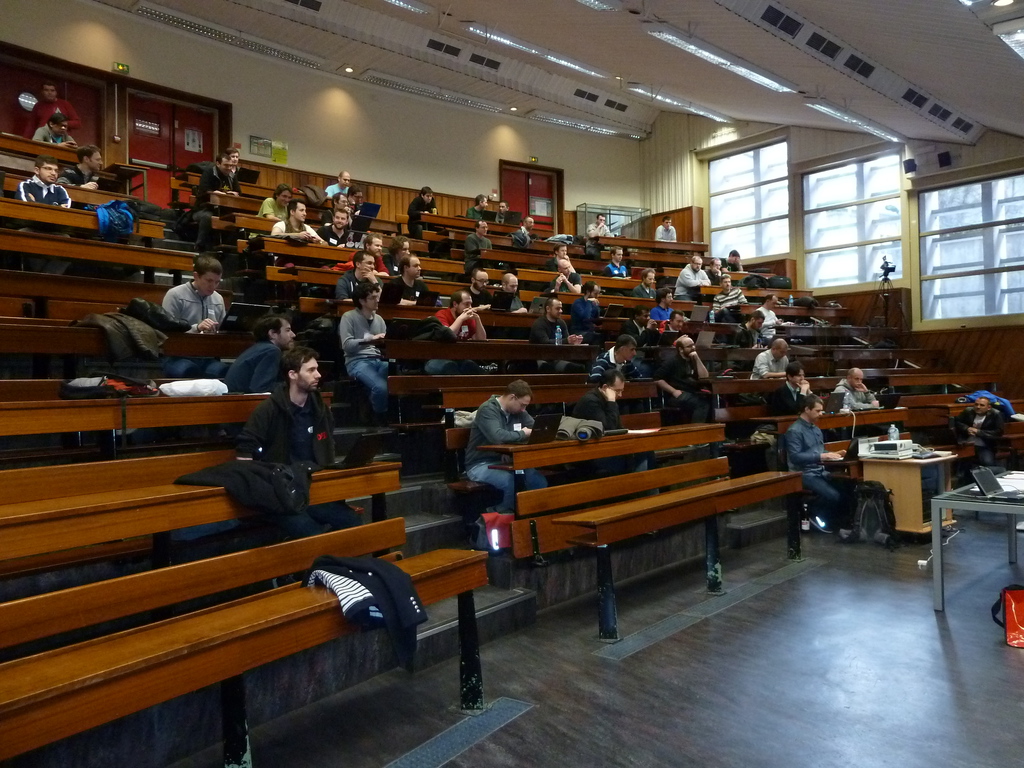
Fun and Sanity in Debian A friend of mine recently asked: "is there anything happening in Debian besides systemd?" Of course there is. He asked it 2 days after the freeze, which happened in time, and with an amazingly low RC bug count. The most visible thing right now seems to be this endless init system argument, but there are fun and sane things in Debian. Many of them. I think someone should put the spotlight on them, and here's my attempt. Yesterday I set up a gobby document asking "What is now happening in Debian that is exciting, fun and sane?", and passed the link around the Cambridge Miniconf and some IRC channels. Here are a few quotations that I collected:
The armhf and arm64 ports have for me been wonderful and exciting, and were a great time for me to start getting involved. (Jon "Aardvark" Ward) We have a way of tracking random contributors, and as far as I know no other project has anything like it. (Enrico Zini) codesearch.debian.net is an incredibly important resource, not just for us but for the free software community at large. (Ben Hutchings) sources.debian.net is a very useful resource with lots of interested contributors, it received 10 OPW applicants (Stefano Zacchiroli) It has never been easier to work on new infrastructure project thanks to the awesome work of the DSA team. We have dozens of contribution opportunities outside of just plain packaging. (Rapha l Hertzog) The work on reproducible builds has achieved excellent results with 61.3% of packages being reproducible. (Paul Wise) Porting arm64 has been (peversely) great fun. It's remarkably morish and I like nothing more than a tedious argument with autoconf macros. Working with lots of enthusiastic people from other teams, helping getting the port set up and build has been great - thank you everybody. (Wookey)
And here are random exciting things that were listed:

30 July 2014

Bits from Debian: Jessie will ship Linux 3.16

The Debian Linux kernel team has discussed and chosen the kernel version to use as a basis for Debian 8 'jessie'. This will be Linux 3.16, due to be released in early August. Release candidates for Linux 3.16 are already packaged and available in the experimental suite. If you maintain a package that is closely bound to the kernel version - a kernel module or a userland application that depends on an unstable API - please ensure that it is compatible with Linux 3.16 prior to the freeze date (5th November, 2014). Incompatible packages are very likely to be removed from testing and not included in 'jessie'.
  1. My kernel module package doesn't build on 3.16 and upstream is not interested in supporting this version. What can I do?
    The kernel team might be able to help you with forward-porting, but also try Linux Kernel Newbies or the mailing list(s) for the relevant kernel subsystem(s).
  2. There's an important new kernel feature that ought to go into jessie, but it won't be in 3.16. Can you still add it?
    Maybe - sometimes this is easy and sometimes it's too disruptive to the rest of the kernel. Please contact the team on the debian-kernel mailing list or by opening a wishlist bug.
  3. Will Linux 3.16 get long term support from upstream?
    The Linux 3.16-stable branch will not be maintained as a longterm branch at kernel.org. However, the Ubuntu kernel team will continue to maintain that branch, following the same rules for acceptance and review, until around April 2016. Ben Hutchings is planning to continue maintenance from then until the end of regular support for 'jessie'.

2 June 2014

Raphaël Hertzog: My Free Software Activities since January 2014

If you follow my blog closely, you noticed that I skipped all my usual monthly summaries in 2014. It s not that I stopped doing free software work, instead I was just too busy to be able to report about what I did. As an excuse, let me tell you that we just moved into a new house which was in construction since may last year. The lack of visible activity on my blog resulted in a steady decrease of the amount of donations received (January: 70.72 , February: 71.75 , March: 51.25 , April: 39.9 , May: 40.33 ). Special thanks to all the people who kept supporting my work even though I stopped reporting about it. So let s fix this. This report will be a bit less detailed since it covers the whole period since the start of the year. Debian France Preparations related to general assemblies. The year started with lots of work related to Debian France. First I took care of setting up limesurvey with Alexandre Delano to handle the vote to pick our new logo:
The new logo of Debian France I also helped Sylvestre Ledru to finalize and close the accounting books for 2013 in preparation for the general assembly that was due later in the month. I wrote the moral report of the president to be presented to the assembly. And last step, I collected vote mandates to ensure that we were going to meet the quorum for the extraordinary assembly that was planned just after the usual yearly assembly. The assemblies took place during a two days mini-debconf in Paris (January 17-18) where I was obviously present even though I gave no talk besides announcing the logo contest winner and thanking people for their participation.
Assembl e g n rale 2014 de Debian France

The Debian France members during the general assembly

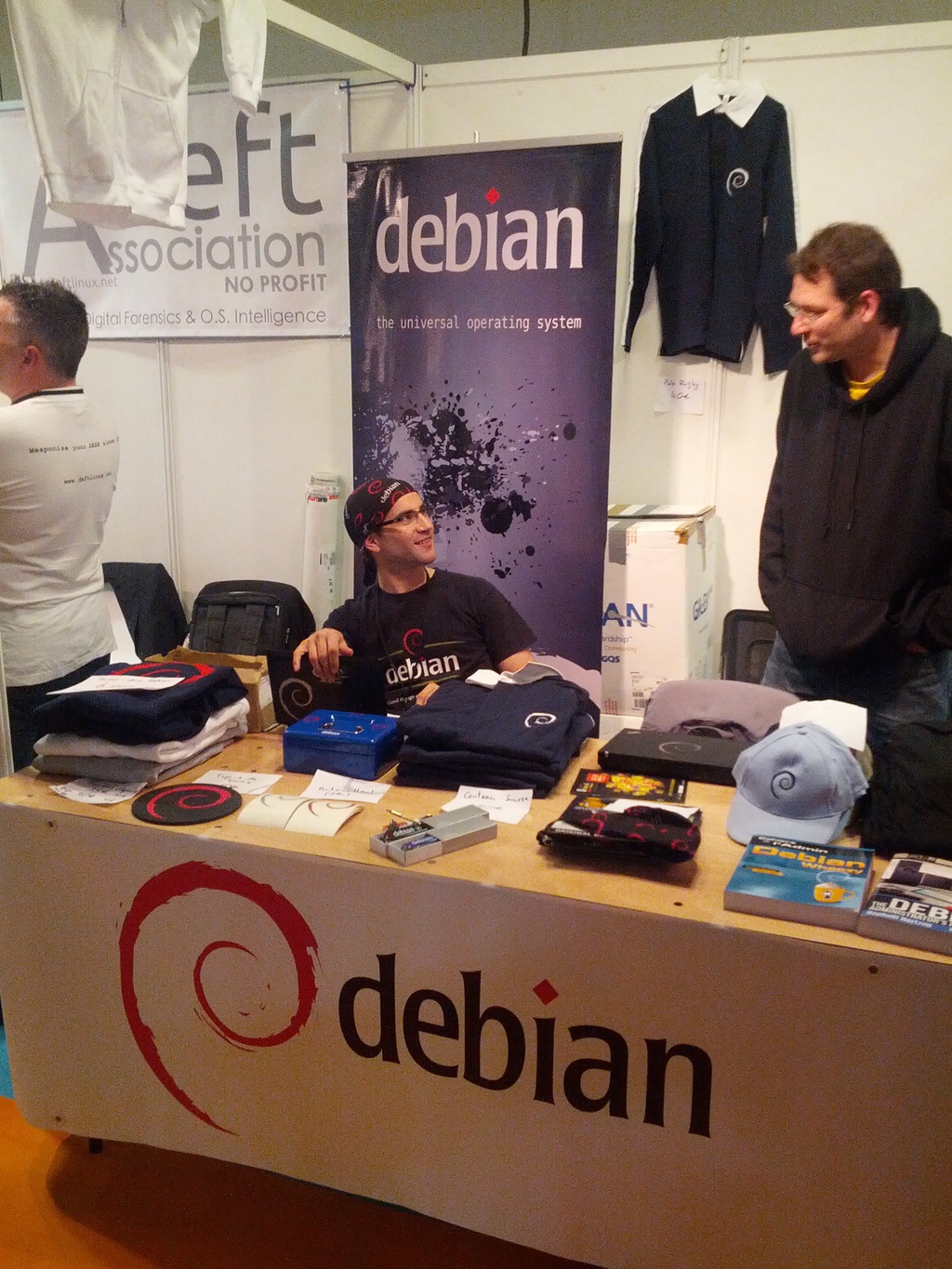
It s worth noting that the extraordinary assembly was meant primarily to enshrine in our bylaws the possibility to act as a trusted organization for Debian. This status should be officialized by the Debian project leader (Lucas Nussbaum) in the upcoming weeks since we answered satisfactorily to all questions. Our paypal donation form and the accounting tools behind it are ready. Galette packaging and members map. I managed to hand over the package maintenance of galette to Fran ois-R gis Vuillemin. I sponsored all his uploads and we packaged a new plugin that allows to create a map with all the members who accept to share their location. The idea was to let people meet each other when they don t live far away with the long term goal to have Debian France organized activities not only in Paris but everywhere in France. New contributor game. Last but not least, I organized a game to encourage people to do their first contribution to Debian by offering them a copy of my book if they managed to complete a small Debian project. We got many interesting projects but the result so far seem to be very mixed. Many people did not complete their project (yet) that said for the few that did substantial work, it was rather good and they seem to be interested to continue to contribute. Debian France booth at Solutions Linux in Paris. Like each year, I spent two days in Paris to help man the Debian France booth at Solutions Linux. We had lots of goodies on sale and we made more than 2000 EUR in earnings during the two days. I also used this opportunity to try to convince companies to support the new Debian LTS effort.
Debian France booth at Solutions Linux

Tanguy Ortolo and Fernando Lagrange behind the Debian France booth

The Debian Administrator s Handbook In the last days of 2013, we released the wheezy update of the book. Then I quickly organized everything needed so that the various translation teams can now focus their efforts on the latest release of the book. Later (in February) I announced the availability of the French and Spanish translations. Debian Squeeze LTS When the security team called for help to try to put in place long term support for Squeeze, I replied positively because I m convinced that it s very important if Debian wants to stay an acceptable choice in big deployments and because I knew that some of my customers would be interested Thus I followed all the discussions (on a semi-private list first and then on debian-lts@lists.debian.org) and contributed my own experience. I have also taken up the responsibility to coordinate with the Debian contributors who can be hired to work on Squeeze LTS so that we have a clear common offer for all the companies who have offered financial support towards Squeeze LTS. Expect further news on this front in the upcoming days/weeks. Tryton I have been a long time user of SQL-Ledger to manage the accounting of my company Freexian. But while the license is free software, the project is not. It s the work of a single developer who doesn t really accept help. I have thus been considering to move to something else for a long time but never did anything. This year, after some rough evaluation, I decided to switch to Tryton for my company. It s probably not a wise choice from a business perspective because that migration took me many hours of unpaid labor but from a free software perspective it s definitely better than everything else I saw. I contributed a lot of bug reports and a few patches already (#3596, #3631, #3633, #3665, #3667, #3694, #3695, #3696, #3697) mainly about problems found in the French chart of accounts but also about missing features for my use case. I also accepted to sponsor Matthias Berhle, who is maintaining the official Debian packages of Tryton. He s already a Debian maintainer so it s mainly a matter of reviewing new source packages and granting him the required rights. Misc Debian work Thanks See you next month for a new summary of my activities.

2 comments Liked this article? Click here. My blog is Flattr-enabled.

18 May 2014

Benjamin Mako Hill: Installing GNU/Linux on a 2014 Lenovo Thinkpad X1 Carbon

I recently bought a new Lenovo X1 Carbon. It is the new second-generation, type 20A7 laptop, based on Intel s Haswell microarchiteture with the adaptive keyboard. It is the version released in 2014. I also ordered the Thinkpad OneLink Dock which I have returned for the OneLink Pro Dock which I have not yet received. The system is still very new, challenging, and different, but seems to support GNU/Linux reasonably well if you are willing to run a bleeding edge version and/or patch your kernel and if you are not afraid to spend an afternoon or two tweaking things. What follows are my installation notes for Debian testing (jessie) when I installed it in early May 2014. My general impressions about the laptop as a GNU/Linux system and overall are at the end of this write-up.
System Description The X1 Carbon I ordered included the 512GB SSD, the 14.0 inch WQHD (2560 1440) 260 nit touchscreen, and the maximum 8GB of memory. I believe the rest is not particularly negotiable but includes a 720p HD Camera, a 45.2Wh battery, and an Intel Dual Band Wireless 7260AC with Bluetooth 4.0. For those that are curious Here is the output of lspci on the system:
00:00.0 Host bridge: Intel Corporation Haswell-ULT DRAM Controller (rev 0b)
00:02.0 VGA compatible controller: Intel Corporation Haswell-ULT Integrated Graphics Controller (rev 0b)
00:03.0 Audio device: Intel Corporation Haswell-ULT HD Audio Controller (rev 0b)
00:14.0 USB controller: Intel Corporation Lynx Point-LP USB xHCI HC (rev 04)
00:16.0 Communication controller: Intel Corporation Lynx Point-LP HECI #0 (rev 04)
00:16.3 Serial controller: Intel Corporation Lynx Point-LP HECI KT (rev 04)
00:19.0 Ethernet controller: Intel Corporation Ethernet Connection I218-LM (rev 04)
00:1b.0 Audio device: Intel Corporation Lynx Point-LP HD Audio Controller (rev 04)
00:1c.0 PCI bridge: Intel Corporation Lynx Point-LP PCI Express Root Port 6 (rev e4)
00:1c.1 PCI bridge: Intel Corporation Lynx Point-LP PCI Express Root Port 3 (rev e4)
00:1d.0 USB controller: Intel Corporation Lynx Point-LP USB EHCI #1 (rev 04)
00:1f.0 ISA bridge: Intel Corporation Lynx Point-LP LPC Controller (rev 04)
00:1f.2 SATA controller: Intel Corporation Lynx Point-LP SATA Controller 1 [AHCI mode] (rev 04)
00:1f.3 SMBus: Intel Corporation Lynx Point-LP SMBus Controller (rev 04)
BIOS/Firmware The BIOS firmware is non-free and proprietary as it the case with all ThinkPads and nearly all laptops. According to this thread there is a bug in the default BIOS that means that suspend to RAM is broken in GNU/Linux. You can get updated BIOS at the Lenovo s ThinkPad X1 Carbon (Type 20A7, 20A8) Drivers and software page by looking in the the BIOS section. Honestly, the easiest approach is probably to download the Windows BIOS Update utility (documentation is here) which you can use to run the BIOS update from within Windows before you install GNU/Linux. If that s not an option (e.g., if you ve already installed GNU/Linux) the best method is to download the bootable CD ISO from the same page. Of course, since the X1 Carbon has no optical media, you have to find another way to boot the CD image. I struggled to get the ISO to boot from USB using the usually reliable dd method. This message suggest that the issue had to do with the El Torito wrapper:
I had to dump the eltorito image from the ISO they provide, after that I was able to dd the resulting image to a flash drive and the bios update went well, no cdrom needed.
I updated to version 1.13 of the BIOS which fixes the suspend/resume bug. By the time you read this, there may be newer versions that fix other things so check the Lenovo website.
Installing Debian I installed Debian testing using the March 19, 2014 Alpha 1 release of the Debian Installer for Jessie (currently testing). I installed in graphical mode. With the WQHD screen, everything was extremely tiny but it worked flawlessly. I downloaded the amd64 net install image from the normal place and installed the rest of the system using the built-in Ethernet port which required no firmware or extra drivers. I did the normal dd if=FILENAME.iso of=/dev/sdX method of getting the installer onto the a USB stick to boot. I turned off restricted boot in BIOS first. In general, the latest version of the Debian installation guide is always a good source of guidance on installing Debian. I used the Debian installer wizard to partition and selected Use entire disk and partition it for LVM and encrypted data which kept the UEFI partitions around. The system installed with no errors or issues and booted up normally afterward. The grub menu is hilariously narrow on the WQHD screen. If you want to use the built-in wireless and/or Bluetooth, you will need to install the non-free iwlwifi firmware package. It is very lame that we still have to do this to use hardware we have purchased.
What Works and Doesn t The following stuff works the first time I booted into the GNOME 3 desktop and logged in:
  • The WQHD 2560 1440 screen
  • The touchscreen
  • Both the TrackPoint and the touchpad
  • Built-in e1000e Ethernet using the dongle
  • The keyboard plus the adaptive row of F1-F12 keys.
  • External monitor using the full HDMI or mini-DisplayPort connectors
  • Audio (both speakers and microphone)
  • The camera/webcam
The following stuff works if you install non-free firmware:
  • Internal Wireless
  • Bluetooth 4.0
The following stuff works with qualifications:
  • Suspend to RAM Works once you have updated the firmware.
  • The adaptive keyboard The F1-F12 keys work but the button that theoretically lets you switch to different sets of function buttons (e.g., volume, brightness) does nothing.
  • Disabling the touchpad There is a BIOS option to disable the touchpad. It works in Windows and does nothing at all in GNU/Linux.
I have not tried:
  • The fingerprint reader
Disabling the touchpad As a long-term ThinkPad user, I love the TrackPoint pointing stick. If you plan on using this, the built-in touchpad is incredibly aggravating because it is very easy to brush against it while using the TrackPoint. In BIOS, there is an option to disable the touchpad. Although this works in Windows, it does absolutely nothing in GNU/Linux. Part of the issue is that, unlike the older X1 Carbon and other ThinkPads, there are no TrackPoint buttons. Instead of buttons, there are regions at the top of the touchpad which are configured, in software, to act like buttons. If you want to be able to click, the touchpad can never be truly turned off. This is not problem unique to the Haswell X1 Carbon and a number of people have been struggling with this issue on other Lenovo laptops. Essentially, what you need to do is configure your touchpad so that the buttons are where you want them and so that it ignores any input for the purposes of cursor movement. There are a few ways of doing this but this answer from an askubuntu.com question has the solution I ended up using:

Open file /usr/share/X11/xorg.conf.d/50-synaptics.conf for edit.

Find Section InputClass which the following line is Identifier Default clickpad buttons .

Edit option for SoftButtonAreas to values 64% 0 1 42% 36% 64% 1 42%, this is size of the right and middle button.

Enable option AreaBottomEdge and change value to 1, this will disable touchpad movement.

If everything done right, your class should looks like:

Section "InputClass"
     Identifier "Default clickpad buttons"
     MatchDriver "synaptics"
     Option "SoftButtonAreas" "64% 0 1 42% 36% 64% 1 42%"
     Option "AreaBottomEdge" "1"
EndSection
Essentially, the first Option line will create a middle button that is 32% of the width and 42% of the height, and a right button that is 32% of the width and 42% of the height. The synaptics manpage (man synpatics) will give you more detail on the general way this works. Of course, something does feel very wrong about editing a file in /usr/share.
Fixing the Adaptive Keyboard The most wild feature of the laptop is the adaptive keyboard strip. The strip is a back-lit LCD that looks almost like E Ink screen and acts as a touchscreen keyboard. The default mode gives you the F1-F12 keys. If you press the keys (since they aren t buttons, you just put your finger on top of them) they act like normal F-keys. You can Ctrl-Alt-F1, etc., to switch to virtual terminals out of the box. There are four modes: Function (i.e., normal F-keys), Home, Web, and Chat. The last three overlap quite a bit (e.g., they all have brightness and volume). You can play with an example on the Lenovo homepage. In Windows, switching programs will apparently change these keys so that an appropriate set of buttons is shown for the application you are using. You can also change these keys manually with a big Fn button at the far left of the adaptive keyboard strip. As I write this this, released kernels do not support the adaptive keyboard Fn button which means you cannot use anything other than the F-keys out of the box. I believe it also means that resuming from suspend to RAM breaks these keys. That said, Shuduo Sang from Canonical has released several versions of a patch to to the thinkpad_acpi kernel module which adds support for the Home mode. The other modes (web and chat) do not seem to be supported. The latest version of the patch is on on the Linux Kernel Mailing List and the relevant commits are:
330947b save and restore adaptive keyboard mode for suspend and,resume
3a9d20b support Thinkpad X1 Carbon 2nd generation's adaptive keyboard
Although this is not supported in Debian testing at the time of writing, a bug was filed in Debian and quickly fixed by Ben Hutchings in Debian kernel version 3.14.2-1 which is currently in sid/unstable. As a result, if you install the latest version kernel from Debian unstable (3.14.2-1 or later), the adaptive keyboard just works. If you aren t using Debian and if kernel you are using does not have support, you might be patching your kernel.
General Impressions As I have described in my interview with The Setup, I have been a user of ThinkPad X-series laptops for many years. This is my sixth X-series ThinkPad. Overall, I quite like the hardware! Once things mature a little bit, I think that this will be a great laptop for running GNU/Linux. That said, I ordered the laptop without realizing that the X1 Carbon had gone through a major revision! The keyboard was quite a suprise. I think that changing a system so radically without changing the model name/number is a very bad move on Lenovo s part. There are two remaining issues with the system I m still struggling with: (1) the keyboard layout is freaky and weird, and (2) the super high resolution screen breaks many things. The quality of the keyboard itself is great and worthy of the ThinkPad name. That said, there are two ways in which it is strange. The first is the adaptive keyboard strip. Overall, it works surprisingly well and I think it is a clever idea. My sense is that the strip is more annoying in Windows because it changes out from under you all the time. In GNU/Linux, only manual changing of modes is supported. This, in my opinion, is a feature. I do miss the real feedback you get from pressing keys but for F-keys and volume-keys that I don t use often this isn t too important. On the downside, I have realized several times that I had been holding down a button for several seconds and not noticed. The more annoying issue with the keyboard is the way that the other keys have moved around. Getting rid of the CapsLock is wonderful! How has this taken so long? Replacing it with a split Home and End keys is nuts. I ve remapped the Home and End to put Control back where it should be. My right Control to now Home but I still don t have an End key. The split Backspace and Delete is not a problem for me. The tilde/apostrophe is in a very bad place. There is no Insert, Print Screen/SysRq, Scroll Lock, Pause/Break or NumLock. They are all just gone. Surprisingly, I haven t missed any of them. The second issue is the 2560 1440 resolution on the 14 inch screen. I use a 27 inch external monitor with the same native resolution laptop but, by my arithmetic, the pixel density on the laptop is 210 DPI instead 109 DPI on the external monitor. The result is the scaling problem and it s a huge pain that seems mostly unsolved on any operating system. Fonts and widgets that look good on the laptop look huge on my external monitor. Stuff that looks good on my external monitor looks minuscule on the laptop. I routinely move windows between my laptop screen and my large monitor. Until I find a display system that can handle this kind of scaling effectively, this requires changing font size and zooming all the time. At the moment, I m shrinking and expanding my font size using the built in hot keys in Emacs, Gnome Terminal, and Firefox/Iceweasel. I love the high resolution screen but the current situation is crazy-making. Finally, this setup will not get you into the Church of Emacs and it s not about to find its way onto the FSF s list of endorsed hardware. For one, I paid the Windows tax. Beyond that, there is the non-free BIOS and the need for non-free firmware to use the wireless and Bluetooth. This is standard for ThinkPads but it isn t getting any easier to swallow. There are alternatives in the form of Gluglug s X60 laptops running CoreBoot, Lemote Yeelong laptops, Bunnie Huang s Novena and others that are better in these regards. I am very excited for these projects but, for a number of reasons, these just weren t an option for the laptop I use for my research computing.


19 April 2014

Ben Hutchings: Linux kernel update for Debian 7.5; new Intel Ethernet drivers

Debian 7.5 will include an update to the Linux kernel, based on Linux 3.2.57. Package version 3.2.57-2 is currently available in the wheezy-proposed-updates suite. I would appreciate any testing people can do to find regressions in the next few days. In addition to bug fixes, this version updates the e1000e and igb drivers. The drivers are now based on the versions found in Linux 3.13, which support several newer chips (i210, i211, i217, i218, i354). Please consider testing this new kernel if you have an Intel gigabit Ethernet controller, even if it was already supported in Linux 3.2.

16 April 2014

Wouter Verhelst: Call for help for DVswitch maintenance

I've taken over "maintaining" DVswitch from Ben Hutchings a few years ago, since Ben realized he didn't have the time anymore to work on it well. After a number of years, I have to admit that I haven't done a very good job. Not becase I didn't want to work on it, but mainly because I don't have enough time to fix DVswitch against the numerous moving targets that it uses; the APIs of libav and of liblivemedia are fluent enough that just making sure everything remains compilable and in working order is quite a job. DVswitch is used by many people; DebConf, FOSDEM, and the CCC are just a few examples, but I know of at least three more. Most of these (apart from DebConf and FOSDEM) maintain local patches which I've been wanting to merge into the upstream version of dvswitch. However, my time is limited, and over the past few years I've not been able to get dvswitch into a state where I confidently felt I could upload it into Debian unstable for a release. One step we took in order to get that closer was to remove the liblivemedia dependency (which implied removing the support for RTSP sources). Unfortunately, the resulting situation wasn't good enough yet, since libav had changed API enough that current versions of DVswitch compiled against current versions of libav will segfault if you try to do anything useful. I must admit to myself that I don't have the time and/or skill set to maintain DVswitch on an acceptable level all by myself. So, this is a call for help: If you're using DVswitch for your conference and want to continue doing so, please talk to us. The first things we'll need to do: See you there?

25 January 2014

Ben Hutchings: Looking back on my time at Solarflare, part 1

Friday was my last day at Solarflare Communications, which I joined in 2006 (originally as Level 5 Networks). When I started, Level 5 Networks (L5N) had a 2-port gigabit Ethernet controller called EF1 and a user-level network stack called EtherFabric which ran on Linux. It had nearly completed the Falcon project to develop a 10-gigabit controller (also supporing a 2-port gigabit mode) and was porting EtherFabric to Windows. Later that year, however, L5N merged with Solarflare Communications (SF), which was developing a 10GBASE-T PHY (for 10-gigabit Ethernet over twisted-pair cables). The investors and management saw the opportunity to create an integrated 10GBASE-T LAN-on-motherboard chip that would be attractive to OEMs and so had the potential for mass sales. EtherFabric was put on the back-burner, but regular net drivers for Linux, Windows and other operating systems became more important. In a change from my previous jobs, my initial role at L5N was to maintain and extend the in-house test automation software, Runbench, written in Python. I worked with Dickon Reed who had written most of Runbench up to then. One of my first major tasks was to extend it to cover DUTs running Windows. Aside from changing Runbench itself, I wrote a simple SSH server to be installed on DUTs, using the Twisted.Python framework. (Cygwin's port of OpenSSH wasn't suitable for running a lot of native Windows commands.) I rewrote the test-installation script for the Windows driver itself, converting it to Python (with a C extension to get around the WOW64 nonsense). As Windows does not allow loading a driver just once (like insmod in Linux), except by using the kernel debugger, I added a time check in the driver so the test-installation script can make it fail early when reloaded after a reboot, so that a crasher bug in the probe path would usually be recoverable. In 2007 I persuaded management in Cambridge to loan several older servers to DebConf. I took them there and back by car, and they were used to convert video for live streams and recordings. (This was repeated in 2009.) I was also asked to work on other small development tasks, including some cleanup on the Linux net driver (sfc). In mid-2007, when SF decided it was time to get sfc upstream (in-tree), I joined Steve Hodgson and Robert Stonehouse in working on that. Out-of-tree (separately distributed) drivers for Linux normally need a large number of preprocessor conditions for compatibility with Linux's kernel module API across a range of supported versions. They may also implement some features with a driver-specific interface that should be replaced with a standard interface (possibly including the work to define that standard). They may not comply with the kernel coding style or unwritten conventions for kernel code. All of these problems were present and had to be dealt with. As part of this work, I extended unifdef so that it could be used to remove all of the backward-compatibility and not-for-upstream code without introducing extra blank lines. I could then export the out-of-tree driver from CVS(!) into a kernel source tree automatically and turn it into a patch or patch series that would stand a chance of being acceptable upstream. Our first few attempts got little response, but eventually we newbies got the message that the driver was simply too big for a single submission and that putting patches on a web site because they're too big for the list was not a solution. In the next week, I removed about half of the code (on a git branch), resulting in a relatively lean driver that could be sent to the netdev list. And finally the 9th (I think) submission was accepted. Following this, I continued to work on sfc but was also brought into the Siena project. Siena (SFL9021) was the LAN-on-motherboard chip that had been planned following the merger. It combined a dual-port controller based on Falcon with a 10GBASE-T PHY and a management controller (MC) to support Lights-Out Management (LOM). (Since 10GBASE-T has not taken off, it is now mostly sold as the SFC9020 variant in which the PHY is disabled.) I worked on some of the test framework and test cases for validating the controller design in software simulation and FPGA. In the course of this I learned to read and (somewhat) understand the chip design written in Verilog, but only made a single trivial fix to it. In August 2009, the first Siena ASICs came back from the fab. There were a few ASIC-specific bugs but all of them were quickly worked around in firmware, so it would soon be ready for production. But there was much work still to be done on the driver and firmware. The firmware had until then been running in a smaller block of RAM with no peripherals to manage, while sfc had earlier been modified just enough to configure a sim or FPGA for running a userland test application. sfc now had many special cases scattered around it, and would tell the MC firmware to peek and poke registers that were no longer directly accessible from the host. The software and firmware developers had agreed that, in order to support LOM, the MC would be responsible for managing the ports and all peripherals and drivers would send higher-level requests to the MC. As a bonus, this removed the need for the driver to know the details of each new board, so that it would not be necessary to backport sfc into distribution kernels very often. Over the next few months, the firmware team did an excellent job of defining and implementing those operations, including writing the driver-side functions to invoke them. Meanwhile, Steve and I concentrated on refactoring sfc so most of the Falcon/Siena differences could be abstracted through a few structures with function pointers. The refactoring and new code for Siena were completed and submitted upstream in several large patch series in October and November. In fact, there were so many patches that Solarflare appeared in LWN's table of who wrote Linux 2.6.33 (as did I, thanks also to another patch series adding firmware metadata to many drivers). Sadly we had missed Linux 2.6.32 which was a longterm stable branch and used in many distributions, but I was able to get this version backported into all the major distributions over the next year. (To be continued.)

2 December 2013

Ben Hutchings: Upgrading from Android 2.3 'Gingerbread' to 4.3 'Jelly Bean'

Replacing my phone My first Android phone was a ZTE Blade (sold as Orange San Francisco here in the UK). It originally shipped with Android 2.1 but was upgradable to 2.3 thanks to CyanogenMod (or other unofficial mods). However there's little sign of an upgrade to 4.x; the apps I want to use are pushing the limits of its CPU, RAM and internal storage; and I've never got very good at typing on a soft keyboard. So it seemed like time to get a newer phone with a hard keyboard (and still with a SD slot). After a little research with the CyanogenMod compatibility list and some time looking at reviews, I settled on the Samsung Galaxy S Relay 4G, which was exclusive to T-Mobile USA but is being resold through eBay. It shipped with Android 4.0 but I immediately installed CyanogenMod 10.2 (Android 4.3). This was a bit of an adventure as I bought the Blade with CM already installed and wasn't familiar with the multiple steps that were necessary. Copying my data The last step, and the real subject of this entry, was to move my data across. Much of this was on a SD card which I could simply plug into the Relay. The internal files had to be backed up onto this card and then restored, using the recovery environment (ClockworkMod) on each phone. After rebooting the Relay into the full Android system, my apps and settings were mostly present but I was immediately confronted with a series of error dialogs reporting that 'Unfortunately, Dialler has stopped' - and the same for 'Clock' and 'the process android.process.acore' (whatever that is). What went wrong There are thankfully more detailed error logs in the filesystem, under /data/system/dropbox (this is for logging at the Java level; if a process is terminated by a fatal signal it's logged to /data/tombstones). There are several ways to get at them, but I used recovery mode and adb to get a root shell where I could easily read and write files as necessary. The Contacts (aka People) database upgrade fails with an SQLiteException, apparently because it doesn't account for upgrading from the schema used in 2.3:
Process: android.process.acore
Flags: 0x883e45
Package: com.android.providers.applications v18 (4.3.1-f963020e38)
Package: com.android.providers.contacts v18 (4.3.1-f963020e38)
Package: com.android.providers.userdictionary v18 (4.3.1-f963020e38)
Build: samsung/apexqtmo/apexqtmo:4.1.2/JZO54K/T699UVBMC5:user/release-keys
android.database.sqlite.SQLiteException: no such column: phonebook_label (code 1): , while compiling: UPDATE raw_contacts SET display_name_source=?,display_name=?,display_name_alt=?,phonetic_name=?,phonetic_name_style=?,sort_key=?,phonebook_label=?,phonebook_bucket=?,sort_key_alt=?,phonebook_label_alt=?,phonebook_bucket_alt=? WHERE _id=?
...
        at com.android.providers.contacts.ContactsDatabaseHelper.updateRawContactDisplayName(ContactsDatabaseHelper.java:5344)
        at com.android.providers.contacts.ContactsDatabaseHelper.upgradeToVersion504(ContactsDatabaseHelper.java:3580)
        at com.android.providers.contacts.ContactsDatabaseHelper.onUpgrade(ContactsDatabaseHelper.java:2261)
...
Clock fails somewhat similarly though it apparently didn't try to upgrade:
Process: com.android.deskclock
Flags: 0xc8be45
Package: com.android.deskclock v203 (2.0.3)
Build: samsung/apexqtmo/apexqtmo:4.1.2/JZO54K/T699UVBMC5:user/release-keys
android.database.sqlite.SQLiteException: no such column: incvol (code 1): , while compiling: SELECT _id, hour, minutes, daysofweek, alarmtime, enabled, vibrate, message, alert, incvol, profile FROM alarms WHERE (enabled=1)
...
        at com.android.deskclock.AlarmProvider.query(AlarmProvider.java:73)
        at android.content.ContentProvider.query(ContentProvider.java:744)
        at android.content.ContentProvider$Transport.query(ContentProvider.java:199)
        at android.content.ContentResolver.query(ContentResolver.java:414)
        at android.content.ContentResolver.query(ContentResolver.java:357)
        at com.android.deskclock.Alarms.getFilteredAlarmsCursor(Alarms.java:165)
        at com.android.deskclock.Alarms.calculateNextAlert(Alarms.java:344)
        at com.android.deskclock.Alarms.setNextAlert(Alarms.java:417)
        at com.android.deskclock.Alarms.saveSnoozeAlert(Alarms.java:510)
        at com.android.deskclock.AlarmInitReceiver$1.run(AlarmInitReceiver.java:49)
...
The media player fails with a NullPointerException:
Process: com.andrew.apollo:main
Flags: 0x98be65
Package: com.andrew.apollo v2 (1.1)
Build: samsung/apexqtmo/apexqtmo:4.1.2/JZO54K/T699UVBMC5:user/release-keys
java.lang.NullPointerException
        at com.andrew.apollo.MusicPlaybackService.stop(MusicPlaybackService.java:878)
        at com.andrew.apollo.MusicPlaybackService.openCurrentAndMaybeNext(MusicPlaybackService.java:1048)
        at com.andrew.apollo.MusicPlaybackService.openCurrentAndNext(MusicPlaybackService.java:1031)
        at com.andrew.apollo.MusicPlaybackService.access$1500(MusicPlaybackService.java:74)
        at com.andrew.apollo.MusicPlaybackService$MusicPlayerHandler.handleMessage(MusicPlaybackService.java:2337)
        at android.os.Handler.dispatchMessage(Handler.java:99)
        at android.os.Looper.loop(Looper.java:137)
        at android.os.HandlerThread.run(HandlerThread.java:61)
Fixing the problem Maybe I could have worked out how to upgrade the relevant databases myself, but I went for simpler solutions. The clock settings are easy to re-enter and most of the media player state is regenerated by scanning files on the SD card. So I just deleted those on the Relay:
  rm -rf /data/data/com.android.deskclock
  rm -rf /data/data/com.android.providers.media
The contacts were what I really cared about, and there are actually specific menu items in Contacts to export and import those (using VCF format), side-stepping the database upgrade. So I did:
  1. Insert SD card in Blade
  2. Open Contacts and export to VCF (I forget where this is in the menus but it was easy to find)
  3. Remove broken Contacts database on Relay:
    rm -rf /data/data/com.android.providers.contacts
  4. Insert SD card in Relay
  5. Move exported contacts to internal storage:
    mv /storage/sdcard1/*.vcf /storage/emulated/legacy
  6. Open People and tap the menu key, 'Import/export', 'Import from storage', then the filename
This may not include all data, and in particular it doesn't seem to include attached photos. But that was good enough for me.

23 September 2013

Ben Hutchings: Linux kernel update for wheezy (3.2.51-1)

The upcoming stable update for Debian (7.2) should have a new Linux kernel version, fixing various bugs. I have uploaded version 3.2.51-1 which is now available in wheezy-proposed-updates. I would appreciate any regression testing people can do before this is released. Also, this fixes one of the causes of lock-ups currently seen with newer Intel GPUs, though we don't know exactly which bug reports were due to this. If you've reported this kind of problem, please test whether this version fixes it. Updated 2013-09-23: KiBi reminded me to link to the page about proposed-updates. And the update is now available for all architectures.

15 September 2013

Ben Hutchings: The terrible state of EFI variable storage

EFI includes support for storing persistent 'variables': it implements a key-value store where keys are (UUID, string) and values are arbitrary blobs. (There are also some flags that restrict when the variables can be accessed.) The physical storage medium is normally flash. The Linux efivars module provides access to variable storage, both through a specific interface in sysfs and through the somewhat abstracted pstore interface. An EFI implementation reads the boot order and (if applicable) Secure Boot configuration from specific EFI variables. An operating system can add arbitrary variables, using its own UUID(s). On Linux, the efibootmgr utility is used to read and write the boot order and the pstore interface is used within the kernel to dump kernel log messages or other information when particular events occur. Since efivars is needed to set the boot order on EFI systems, it's a critical part of installation. But it wasn't being loaded on Debian systems until efibootmgr was run. This doesn't work so well when using a rescue system, as the installation kernel and installed kernel may be different (Debian bug 703363). In future (Debian package version 3.2.41-1) this will be loaded automatically on EFI systems. But now comes a new problem: bugs in the implementation of variable storage can prevent a system from booting, and even worse, they may prevent manual recovery without special equipment (the system is 'bricked'). Matthew Garrett recently talked about this and mentioned that some Samsung laptops are bricked if the variable storage becomes more than 50% full. efivars now has some extra checks to avoid triggering this (both in mainline and in stable branches). This isn't the end of the story, unfortunately. Remember that nothing can be overwritten in flash without erasing a relatively large block, and that writes may fail after a few thousand erase cycles (number depending on the type of flash used). Therefore, deleting a variable usually does not free storage immediately, and overwriting a variable usually reduces the amount of free storage. In the case of the Samsung laptops, unused storage is apparently reclaimed at the next reboot. However, while testing the backported efivars changes I found that my EFI-booting system (Asus P8Z68-V LX motherboard) does not reclaim unused storage until it's very nearly full. Since the firmware itself increments a counter variable on every boot, using 36 more bytes of storage, I was able to observe the available space dropping to under 100 bytes, and then after another boot jumping to about 42K (out of 64K). This means that well over 50% of storage was unused, yet efivars would refuse to write any variables because the firmware didn't reclaim it. This would prevent (re)installation of Linux, as the boot configuration could not be written. On the assumption that both behaviours are common, I've settled on a compromise that I hope minimises overall risk: But it's essential that we find a way to identify and work safely with both behaviours. Not only do I want to eliminate the possibility of bricking or installaton failure, but I want to make EFI-backed pstore safe to enable. Crash logs are often hard to obtain and pstore can help to solve that problem. Updated 2013-09-15: The free space check has been revised (in Linux 3.2.48, 3.5.7.17, 3.8.13.5, 3.9.7 and 3.10) based on advice from Samsung. The kernel leaves at least 5K (rather than 50%) of the EFI variable store free. If it is about to breach this limit, it attempts to write a dummy variable that is larger than the free space, which will either fail or trigger garbage collection. The normal variable can then be written if garbage collection freed up enough space. This check can be disabled using the kernel parameter efi_no_storage_paranoia, but there should be no need to do so.

12 August 2013

Richard Hartmann: DebConf13 I

DebConf! The venue here at Le Camp is pretty much perfect. Short walking distances, organic layout of the buildings, and a stunning view of the lake. I would be hard pressed to think of other venues which could be as nice... After arriving Fri/Sat night at 0330, Saturday was spent setting up the Access points: Me prior to pull-ups on the roof beams Access Point in pillow cases This little green valve caused a power outage in the server room, messing with servers, and resetting several switches to old configs. Xtaran had a lot of fun as a result of this. The valve of evil. And water. The ikiwiki BoF on sunday was rather interesting. I will try to publish some notes from this BoF and the other Git-related ones towards the end of the week. The Gitify ALL the things BoF managed to fill the room from "full-ish" over "good thing we don't need the beamer and can use the space in front of the whitescreen" over "out of chairs" over "the chairs from other rooms won't fit any more" to the final state of "people stand around near the walls and in the doors". At a total of 54 people, turnout has been... unexpectedly high.. The BoF started at 1130 and usually, slots are 45 minutes long. We extended our BoF into lunch time (I chose the slot just prior to lunch for precisely that reason) and finally finished at around 1245, i.e. 30 minutes late. After a quick show of hands on if there's interest in another BoF, I applied for and got the next slot, tomorrow at 11:30, once again in BoF room 1 and just before lunch. It's called Gitify EVEN MORE of the things and will expand on use cases and best practices. At a guess, we will focus on managing configurations and photos in default and complex situations. Sadly, neither of those BoF are taped. Afterwards, I had a chance to sit down with Lucas Nussbaum to talk over some points regarding the Debian Trademark Team. Finally, during Why Debian should (or should not) make systemd the default (it probably should not, but that's a different story), my kernel panicked. 3.9 and 3.10 have been less than ideal on my new X1 Carbon, but this was the first panic. I was not even done cussing and Ben Hutchings suddenly appeared on my side, telling me that yes, this particular module (mei) has been causing issues recently. Kernel panic As a closing note, I am really enjoying my first DebConf. Great venue, great people, great content, winebeer and cheese party tonight, and I found out that we have a fire place and fire wood...

11 August 2013

Ben Hutchings: What's new in the Linux kernel (and what's missing in Debian)

Slides from my talk earlier today

4 August 2013

Ben Hutchings: I'm going to DebConf 13

DebConf 13 I'm leaving OHM 2013 and heading toward Vaumarcus today. Hoping to get lots of kernel work (and maybe some video team preparation) done during DebCamp. I proposed a talk and 3 discussion events for DebConf itself, of which all have been accepted.

11 June 2013

Ben Hutchings: Updating the Linux kernel for Debian 7.1

The first point release for Debian 'wheezy', 7.1, is due next weekend. The Linux kernel should be updated with: The new package, version 3.2.46-1, is available for most architectures in stable-proposed-updates. Please test it now if you can, so we can catch any serious regressions.

14 May 2013

Ben Hutchings: That perf root exploit (CVE-2013-2094)

There's some exploit code going around that will let you get root on a range of Linux kernel versions by using a bug in the perf_event_open() syscall. The fix for this is in 3.2.45 and various other stable updates. As a workaround, until it's in Debian stable, you can set sysctl kernel.perf_event_paranoid=2. This blocks the exploit I've seen, but it is still possible to get around this restriction. Red Hat has a SystemTap script that should provide more complete mitigation. The debuginfo packages for Debian kernels are named e.g. linux-image-3.2.0-4-amd64-dbg. They are only provided for some architectures and flavours. Updated: Added the CVE ID. Added SystemTap information.

8 May 2013

Ben Hutchings: Warning: Debian 7.0 'wheezy' on VIA C3 and Cyrix III systems

The 'longhaul' module may cause instability or even hardware damage on some systems. Unfortunately, it is now being auto-loaded on all systems with a compatible CPU (VIA C3 or Cyrix III). See bug #707047. Before upgrading one of these systems to Debian 7.0 'wheezy', if you do not currently use the 'longhaul' module, you should blacklist it by creating e.g. /etc/modprobe.d/blacklist-longhaul.conf containing the line:
  blacklist longhaul
I would advise against attempting a fresh installation on these systems at present.

4 February 2013

Raphaël Hertzog: My Free Software Activities in January 2013

This is my monthly summary of my free software related activities. If you re among the people who made a donation to support my work (84.25 , thanks everybody!), then you can learn how I spent your money. Otherwise it s just an interesting status update on my various projects. Debian Packaging In one of my customer projects, I had to use libwebsockets and since it was not packaged for Debian, I filed a Request For Package (RFP #697671). I discovered a fork of this library on github and decided to mail the original author and the author of the fork to learn a bit more about the reason of the fork. It turns out that they miscommunicated and that the original author was interested by most of the improvements. The fork still exists but the important fixes and most of the improvements have been merged (and he released a version 1.0 after that!). Furthermore the original author setup a bug tracker to better organize the project and so that the author of the fork can submit patches and be sure that they won t be forgotten (as it happened in the past). I spend quite some time discussing with both parties but at the end I m pleased to see that good progress has been made (although nobody stepped up to maintain this package in Debian). I packaged zim 0.59 (an important bugfix release) and wordpress 3.5.1 (with several security fixes). I updated the dpkg-dev squeeze backports to version 1.16.9~bpo60+1 on request of Daniel Schepler. This backport led me to file #698133 on kgb-client because the bot literally spammed the #debian-dpkg IRC channel for multiple hours by resending old commit notices that got merged in the squeeze-backports branch. BTW, they need help to get this issue fixed. I updated python-django-registration to fix a compatibility issue with python3-sphinx (see #697721 for details). Misc Debian Stuff Serious bug with salt. I filed a grave bug on salt (#697747 ) and prepared the upload to fix the issue on request of the maintainer. In the mean time, the maintainer orphaned the package. Franklin G. Mendoza already announced its willingness to take over but this package deserves multiple maintainers since this is a good piece of software that is getting more and more popular. net-retriever and alternate keyrings. I filed a wishlist bug (#698618) on net-retriever to request a way for derivatives to use another keyring package (i.e. not debian-archive-keyring-udeb) without having to fork net-retriever. Linux 3.7 on armel/armhf. I helped the kernel maintainers to fix the 3.7 kernel on armel/armhf by reporting on IRC the results of successive failing kernel rebuilds on those architectures (this kernel version is only in experimental). Carl9170 firmware. I also pinged the kernels maintainers about a missing firmware for the carl9170 driver (already reported in #635840) and Ben Hutchings took care of re-activating its inclusion in upstream s linux-firmware.git and then uploaded firmware-free 3.2 to Debian. Thanks Ben! New QA team member. And to finish with the miscellaneous stuff, I helped Holger Levsen to be added to the qa group so that he could integrate his awesome work on automated QA checks with Jenkins. Debian France Preparation for Solutions Linux. The people organizing the village of associations in the Solutions Linux conference have asked all organizations to apply for a booth if they wanted one. Last year Carl Chenet took care of organizing this and this time we had to find someone else. I made multiple call for volunteers (on the mailing list, on my blog) without much success but I finally managed to convince Tanguy Ortolo to take care of this. Thank you Tanguy! Get in touch with treasurer who disappeared. During the transition with the former Debian France officers, it has been said that Aur lien G r me another former treasurer of Debian France had entirely disappeared together with some papers that he never gave to his successor. I didn t want to give up on this without at least trying to get in touch by myself so after multiple tries (over IRC, phone, and snail mail), and some weeks without answers, he got back to me, explaining that he s currently in a foreign country and that he will take care of that next time that he comes in France. \o/ New website in preparation. Replacing the single-page website webpage with a more comprehensive website is an important goal. Alexandre Delano provided a basic ikiwiki setup inspired by dsa.debian.org. I cleaned it and integrated it in a git repository on our machine. There s thus a new test website on http://france.debian.net/test/. Tanguy Ortolo and Fernando Lagrange immeditaly made some small improvements but since then nobody stepped up to further complete the website. I ll try to do this in February and put the new website in production. Paypal and handling of members. We installed a paypal plugin in galette so that members can renew their membership online. I asked Christian Bayle to try it out and we found some issues that I reported upstream and that got fixed. But this is only the first step, we want to go much further and automate all the membership handling, from membership renewal mail reminders up to integration in the accounting system. To this end, I filed some new tickets in the Galette tracker and completed some that were already opened: #490, #368 and #394. We requested a quote for those tickets and Debian France is going to fund the work on those tickets so that we have a 100% free software solution for our needs. Thanks See you next month for a new summary of my activities.

No comment Liked this article? Click here. My blog is Flattr-enabled.

28 January 2013

Ben Hutchings: Testing network link state

Jan Wagner writes about using ethtool to poll the link state on network devices. While I'm pleased to see another happy ethtool user, it's a bit heavyweight for reading one bit of information and it's not ideal for scripting. Much information about each network device is available under the /sys/class/net/name directory, including the carrier and speed attributes. (When the interface is down, some of these attributes cannot be read.) It's also possible to listen for link changes (rather than polling periodically) using the rtnetlink API, but this is probably not suitable for munin.

27 January 2013

Ben Hutchings: Call for testing: SAS driver update for Debian 6.0 'squeeze'

The next point update for Debian 6.0 should include many fixes and improvements to the Linux kernel. Version 2.6.32-47, currently available in the 'squeeze-proposed-updates' suite, includes updates to the following SAS drivers, adding support for new hardware: Note that the binary package names don't change; they are still linux-image-2.6.32-5-flavour. If you are using any of the above SAS controllers, whether or not it is already supported by Debian 6.0.6, please consider testing this kernel version. If it works, please follow up to the bug reports listed above. If you find any regressions, please report bugs against the new package version.

26 January 2013

Ben Hutchings: What's in the Linux kernel for Debian 7.0 'wheezy', part 4

The Debian package of the Linux kernel is based on Linux 3.2, but has some additional features. This continues from parts 1, 2 and 3, and covers new and improved hardware support. DRM drivers from Linux 3.4 (proposed) Some recent Intel and AMD graphics chips were not supported well or at all by the DRM (Direct Rendering Manager) drivers in Linux 3.2. Although many bug fixes have been included in 3.2.y stable updates, we are considering updating them to the versions found in Linux 3.4. (We did something similar for Debian 6.0 'squeeze'.) Julien Cristau has been working on this and has prepared binary packages. To install, run as root:
gpg --no-default-keyring --keyring /usr/share/keyrings/debian-keyring.gpg --export 310180050905E40C   apt-key add -
echo deb http://people.debian.org/~jcristau/wheezy-drm34/ ./ > /etc/apt/sources.list.d/jcristau-wheezy-drm34.list
apt-get update
apt-get install linux-image-3.2.0-4.drm-amd64  # or -486, or -686-pae
Please test these and report your results to bug #687442. I would suggest testing suspend/resume (if applicable), use of internal and external displays on laptops, and 3D accelerated graphics (games and compositing window managers such as GNOME Shell). Remember that AMD/ATI graphics chips require the firmware from the firmware-linux-nonfree package for 3D acceleration and many other features. amilo-rfkill driver I wrote a standard rfkill driver for the Fujitsu-Siemens Amilo A1655 and M7440, based on the out-of-tree fsaa1655g and fsam7440 drivers. Unlike those, it should work with the rfkill command, Network Manager, etc. ALPS touchpads Newer touchpads made by ALPS use different protocols for reporting scroll and pinch gestures. Jonathan Nieder backported the changes to support these. Wacom tablets Jonathan Nieder updated the wacom driver to the version in Linux 3.5, adding support for the Intuos5, Bamboo Connect, Bamboo 16FG and various other models. Emulex OneConnect 'Skyhawk' Sarveshwar Bandi at Emulex contributed a backport of the be2net driver from Linux 3.5, adding support for their 'Skyhawk' chip. Marvell Kirkwood Marvell's Kirkwood SoCs have been supported upstream for some time and in Debian since release 6.0 'squeeze'. However new models and boards generally require specific support. Arnaud Patard backported support for the 6282 rev A1 chip found in QNAP TS-x19P II models, and for the Marvell Dreamplug and Iomega Iconnect. Miscellaneous More to come Missing hardware support is an important bug that can be fixed by kernel updates during a freeze and throughout the lifetime of a stable release. If you know that new hardware isn't supported by the Debian kernel, please open a bug report. I can't promise that it will be fixed, but we need to know what's missing. Hardware vendors that maintain their own drivers upstream (not out-of-tree) are especially welcome to contribute tested backports that add support for the latest hardware. Send mail to debian-kernel@lists.debian.org if you have any questions about this.

Next.

Previous.