Search Results: "ag"

21 September 2007

Cameron Dale: 2Wire Router 2700HG-E Violates HTTP/1.1

I recently upgraded my Internet service with Telus, which included a new wireless router to replace my old high-speed modem. The new router is a 2Wire 2700HG-E which is configured through a web interface. The web interface worked fine at first on some other machines, but whenever I accessed it from my main desktop machine the pages would either fail to load, or have the images in the wrong locations. After much debugging (though it seems obvious now) I finally discovered that this was due to my enabling HTTP pipelining in FireFox on that machine (as suggested by Mozilla). Being the diligent citizen that I am, I of course filed a support request so that this could be fixed in the next version of the 2Wire software. Here is the response I received:
The HomePortal GUI was designed for internet browsers on default settings. We recommend keeping the pipelineing [sic] setting on "false".
Not exactly a good solution, and a little surprising, considering it's relatively straight-forward to implement. I know because I recently upgraded a simple HTTP handler from 1.0 to 1.1 specifically to support pipelining, as part of my work on DebTorrent. Now I've just read "Structured streams: a new transport abstraction", in which the authors state:
implementing pipelining correctly in web servers has proven challenging enough that seven years after the standardization of HTTP/1.1, popular browsers still leave pipelining disabled for compatibility
So it seems pipelining is disabled for a reason, though I had it enabled for years in FireFox and saw no problems (that I know of) until now. Maybe the problems are a thing of the past. Does anyone else have any experiences (good or bad) with pipelining to share?

Piotr Roszatycki: 0x1F years old

The geek like me should have a special birthday cake. And my girl knows it :) [Cake]

Jonathan McDowell: Electricity prepay meters and graphing

The new house has a prepay electricity meter. My initial reaction was that I'd have to get NIE to come out and replace it with a normal meter, as I have a perception that card meters are awkward and expensive. However some investigation revealed that a keypad meter gets the same 2.5% discount that paying quarterly by direct debit does. The only way to get a larger discount (4%) is to pay a fixed amount monthly by DD. That would still leave the annoyance of having to remember to top up, but it can be done over the phone with an automated system (you get a 20 digit number to key into the meter) and won't turn off supply overnight or at weekends apparently. Plus, and this is the real reason I'm giving it a while before switching away, it has a nice little satellite keypad/LCD unit. Connected to the main meter unit via a 4 core low voltage style cable. Bets on those being power, ground, rx and tx? You can query the meter on various things, some of which are crying out to be hooked up to a Munin plugin. The meter is made by PRI and seems to be a Liberty 1E. PRI have a vague page about comms, but little useful information about how to do anything or if the end user can buy anything suitable. I'll drop them an email, but it might just be a case of trying to reverse engineer the keypad protocol so I can talk it. The processor in the satellite is just a Mitsubishi M38223M which has some serial pins, so hopefully it'll be RS232 at TTL levels and something fairly basic over that. However, before I go about doing this, has anyone else any experience of these meters and care to share details?

Julien Danjou: Is X.org 7.3 a sucking release?

I just upgraded my X server at work. Oh my god. I had a working configuration with multi-head (without Xinerama). I was happy. Oh yes I remember yesterday everything was so fine. And now it screwed everything up. I've got 3 LCD screens and 2 Matrox G450 PCI cards. After restarting X.Org 7.3, all I've got was two screens (connected on the first card) in clone mode. Very useful.... After 1 hour of googling I managed to use xrandr to setup a Xinerama display on this 2 screens.... I don't want Xinerama and I want my other Matrox card back. I don't know why but reading Brice Goglin post around, I understand that the old behaviour is no more available. GREAT, now I'm stuck with Xinerama that a lot of window managers don't handle correctly and I still don't know why my other Matrox card doesn't work. Is X.Org 7.3 a piece of shit or what?

Mario Iseli: WesternDigital My Book network harddisk

Hello World, a tape streamer of one of our customers died two days ago and we haven’t anymore warranty on this device, a new infrastructure will be realized soon anyway. So, we needed a cheap temporary solution. We bought a WD network harddisk for home use and “remote access over the internet”, even if we only need local access to it. It’s a 500 GB harddisk and you find several short GPL references in the crappy 5-pages-manual. Ok, this sounded already interesting. I read the manual and see that only Windows 2000 and Windows XP are supported and that you have to install a very proprietary Windows tool to start using the harddisk. Later there would also be a webinterface available, after the initialization. Ok, so I wanted to know if it’s possible to access the drive also with other operating systems. I connected the RJ45 port of the harddisk with my ethernet card with a cross-over cable and started to sniff with ngrep on the interface. After waiting a while I got this message some strange from a APIPA address to a Multicast address. Ok, assigned my local interface an address in the APIPA range and connected with my browser to it: T 169.254.71.58:80 -> 169.254.71.57:56819 [A]
HTTP/1.1 200 OK.
Transfer-Encoding: chunked.
Date: Thu, 30 Nov 2006 23:12:51 GMT.
0: no-cache.
Content-Type: text/html; charset=UTF-8.
Server: lighttpd/1.4.3.
Very interesting… lighttpd :) The device asks for a password, I went to the website of WD to read the “full manual” (as the CDROM isn’t readable with Linux as it seems), in the support part I found something about “admin” and “123456″. With this information I could login on the device and saw that it does nothing else than Samba (3.0.14) and it’s also accessible via smbclient. Without the proprietary tool, without sending personal information to Westerndigital and getting stupid newsletters. Maybe I will remove the harddisk from the case later and install it on my workstation (it isn’t reachable except port 80 and the netbios stuff) to see what exactly is on it. At least I know that it’s an ext3 filesystem. I think vendors who use embedded Linux systems for their devices and use such proprietary clients, give not more information about it are just crap. It’s something like unfair for the free-software community. :( (even if it works unofficially with an uncommon way) [Update] A little codesnippet from the Webinterface… very useful ;) function moveArrow(ycord) // vert cord of layer

// ignore this function
//
// if(document.layers). //NN4+
//
// document.layers[”MenuArrow”].moveToAbsolute(xcord,ycord);
//
// else if(document.getElementById). //gecko(NN6) + IE 5+
//
// var obj = document.getElementById(”MenuArrow”);
//
obj.style.top = ycord;
//
// else if(document.all).// IE 4
//
// document.all[”MenuArrow”].style.top = ycord;
//

Holger Levsen: Democracy as you knew it is over

A new law is being made in germany, which will make consentual sex between minors a crime, which has to be punished with four years of prison at least, plus ending up in a sexual offenders database for life. I, for one, do not welcome our new taliban overlords.

These two articles explain the situation in full detail (in german).

In other news, it's 102 days until all electronic communication in germany (as in the EU) will be logged for half a year. (Until a terrorist attack happens which was planned for more than half a year...) This includes all emails sent, the location data of all mobile phones, every webpage visited and so on. From everybody. If you are in Berlin tomorrow, go demonstrate. I, for one, do not welcome George Orwells lack of imagination, 1984 looks really pale today. (But it's still a good read.)

My next blog post shall take place in teletubby land again and shall feature smileys as well. Sigh.

Russell Coker: Multiple DNS Names

There are many situations where multiple DNS names for a single IP address that runs a single service are useful. One common example is with business web servers that have both www.example.com and example.com being active, so whichever a customer hits they will get the right content (the last thing you want is for a potential customer to make some trivial mistake and then give up). Having both DNS names be equal and separate is common. One example of this is the way http://planet.ubuntulinux.org/ and http://planet.ubuntu.com/ both have the same content, it seems to me that planet.ubuntu.com is the more official name as the wiki for adding yourself to the Planet is wiki.ubuntu.com. Another example of this is the way http://planet.debian.org/ and http://planet.debian.net/ both have the same content. So far this month I have had 337 referrals to my blog from planet.debian.org and 147 from planet.debian.net. So even though I can’t find any official reason for preferring one over another the fact that more than 2/3 of the referrals from that planet come from the planet.debian.org address indicates that most people regard it as the canonical one. In times past there was no problem with such things, it was quite routine to have web servers with multiple names and no-one cared about this (until of course one name went away and a portion of the user-base had broken links). Now there are three main problems with having two names visible:

  1. Confusion for users. When a post on thedebianuser.org referred to my post about Planet Ubuntu it used a different URL to the one I had used. I was briefly worried that I had missed half (or more) of the content by getting my links from the wrong blog - but it turned out that the same content was on both addresses.

  2. More confusing web stats for the people who run sites that are referenced (primarily the bloggers in the case of a Planet installation). This also means a lower ranking as the counts are split. In my Webalizer logs planet.debian.org is in position #5 and planet.debian.net is in position #14. If they were combined they would get position #3. One thing to keep in mind is that the number of hits that you get has some impact on the content. If someone sees repeated large amounts of traffic coming from planet.debian.org then they are likely to write more content that appeals to those users.

  3. Problems with sites that have strange security policies. Some bloggers configure their servers to only serve images if the referrer field in the HTTP protocol has an acceptable value (to prevent bandwidth theft by unethical people who link to their pictures). My approach to this problem is reactive (I rename the picture to break the links when it happens) because I have not had it happen often enough to do anything else. But I can understand why some people want to do more. If we assume that an increasing number of bloggers do this, it would be good to not make things difficult for them by having the smallest possible number of referrer URLs. It would suck for the readers to find that planet.debian.org has the pictures but planet.debian.net doesn’t.

The solution to this is simple, one name should redirect to the other. Having something like the following in the Apache virtual host configuration (or the .htaccess) file for the least preferred name should redirect all access to the other name. RewriteCond % REQUEST_URI ^(.*$) [NC]
RewriteRule . http://planet.example.com/%1 [R=301,L] In my posts last night I omitted the URLs for the Planet Searches from the email version (by not making them human readable). Here they are:

Michael Prokop: grml-live - framework for building a live system

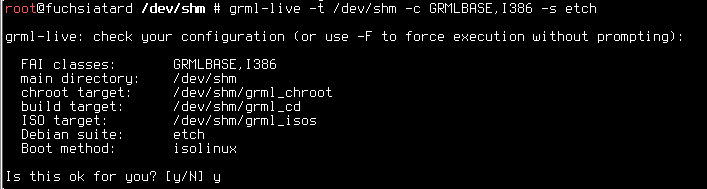
[Gnaaaaa, sorry Planet Debian for sending a german article to you a few hours ago. I just chose the wrong category for the article. I removed the tag already and the article disappeared from Planet Debian right now; so if you don’t know what I’m talking about just don’t care. ;-) To the german readers: it’s just the same article as my previous one, but this time in english. :-)] grml-live is a framework which lets you build a grml/Debian based Linux Live-CD with one single command. grml-live is based on FAI (Fully Automatic Installation) and uses its class based concept: Screenshot: grml-live In this example I built a full grml-ISO. All I did was setting the Debian-Mirror in /etc/grml/grml-live.conf to my local one (to save traffic and time) and invoking the following command:
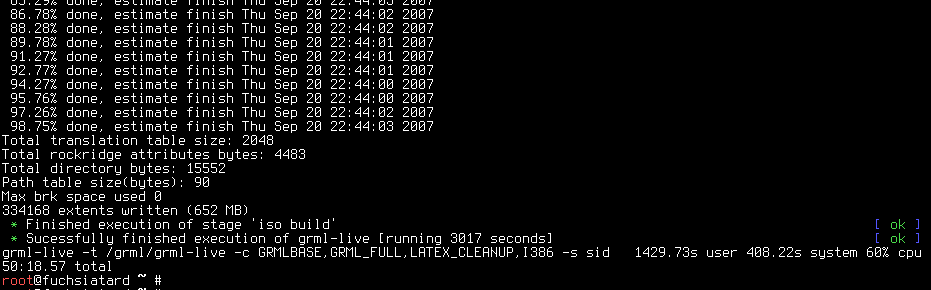
# grml-live -t /grml/grml-live -c GRMLBASE,GRML_FULL,LATEX_CLEANUP,I386 -s sid
About 50 minutes later I have a grml-ISO inside grml_isos at directory /grml/grml-live/ (-t …). It was built using the classes (-c …) GRMLBASE (all the core, essential stuff), GRML_FULL (software selection like official grml provides), LATEX_CLEANUP (clean up some very big LaTeX directories) and I386 (x86-specific packages like kernel). Debian unstable/sid was used as the suite (-s). And that’s it. You want a smaller grml-version using Debian/stable? No problem, let’s do it in shared memory (being very fast, and with enough RAM and mountoptions rw,suid,dev no problem at all): Screenshot grml-live: the beginning A ‘grml-live -t /dev/shm -c GRMLBASE,I386 -s etch’ and not even 5(!) minutes later I’ve my 135MB small grml: Screenshot grml-live: done So using grml-live you can build your own, customized Linux Live-CD without having to deal with remastering in detail. Via creating a new class (or just editing an existing one) its easy to include the software you would like to get. So, will the official grml-ISOs become obsolet? No, definitely not. The goal of grml-live is to give the grml-team a buildsystem providing exactly what we need. It should give us the possibility to concentrate on the important and interesting tasks, like: testing, bugfixing, implementing new features, working on the kernel, quality assurance, documentation,… grml-live should work on every Debian based system. If you want to give it a try just grab the Debian package from grml’s repository. The source is available (as usual) via mercurial. Find more details on the grml-live-webpage. If you have any further questions that aren’t answered by the docs yet, have feature requests, bugreports or patches: please let me know.

Michal Čihař: XMP support for Python

As I produce quite a lot of photos and want to manage them in some reasonable way, I started to look for some tools which can do commenting/tagging/whatever of taken photos. I really don't want these meta data stored outside picture itself, so most of photo managers currently available are not acceptable. When reading Gnome 2.20, I noticed support for XMP (Extensible Metadata Platform) in eog. Well I didn't know this standard up to now, but it looks interesting. Especially when open source tools can easily adopt library open sourced by Adobe. I would like to add support for this to Lazygal, but I didn't find any reasonable Python module to work with XMP. There is simple extractor, but nothing what would allow me to easily grab meta data out of file. In fact one solution seems to exist, but it costs almost $300 and is not free software in any way. Or did I just miss something when using Google and some such Python library exists?

Eddy Petrișor: software for managing finances

Dear lazyweb,

I decided to track our (mine and my fince 's) expenses more closely and I am in search of some software for this task.

The requirements for the software:
I have never used such software before, so I am a total noob in this area. Please be gentile if I might have naively described the problem.

Thanks in advance!

20 September 2007

Michael Prokop: grml-live - mach dir deine eigene Live-CD

grml-live ist ein Framework, mit dessen Hilfe man mit nur 1 Kommando eine auf grml/Debian basierende Linux Live-CD bauen kann. grml-live baut auf FAI (Fully Automatic Installation) auf und nutzt dessen klassenbasiertes Konzept: Screenshot: grml-live In diesem Beispiel habe ich gerade ein gro es grml-ISO gebaut. Dabei habe ich einfach nur den Debian-Mirror in /etc/grml/grml-live.conf auf meinen lokalen Mirror gedreht (um Traffic und Zeit zu sparen) und dann folgendes Kommando aufgerufen:
# grml-live -t /grml/grml-live -c GRMLBASE,GRML_FULL,LATEX_CLEANUP,I386 -s sid
Ca. 50 Minuten sp ter habe ich im Ordner grml_isos unter /grml/grml-live/ (-t …) ein fertiges grml-ISO. Dieses wurde auf Basis der Klassen (-c …) GRMLBASE (da steckt alles essenzielle drin), GRML_FULL (Software-Auswahl wie auf der offiziellen gro en grml), LATEX_CLEANUP (ein paar sehr gro e LaTeX-Verzeichnisse aufr umen) und I386 (x86-spezifische Pakete wie z.B. der Kernel) gebaut. Als Debian-Suite (-s) wurde sid (unstable) ausgew hlt. Und das war es auch schon. Ein kleinere grml-Version auf Basis von Debian/stable gef llig? Kein Problem, machen wir es doch einfach mal im Shared-Memory (superschnell und mit genug RAM und den Mountoptionen rw,suid,dev auch kein Problem): Screenshot grml-live: der Start Ein ‘grml-live -t /dev/shm -c GRMLBASE,I386 -s etch’ und keine 5(!) Minuten sp ter hab ich dann mein 135MB kleines grml: Screenshot grml-live: done Mit grml-live kann man sich somit seine pers nlich angepasste Linux Live-CD erstellen, ohne sich erst mit Remastering im Detail besch ftigen zu m ssen. Auch muss man dabei nicht zwingend Debian/unstable nehmen, sondern kann auch Debian/stable als Basis ausw hlen. Durch das Erstellen einer neuen Klasse oder das Anpassen einer existierenden kann man auch spezielle Software-W nsche ganz einfach erf llen. Wird damit das offizielle grml-ISO etwa obsolet? Nein, auf keinen Fall. grml-live soll dem grml-Team als Buildsystem dienen (automatisierte Snapshots auf regelm iger Basis z.B. sind schon in Planung) und die langweilige Arbeit abnehmen, damit wir uns auf die wirklich wichtigen Sachen konzentrieren k nnen: Testen, Bugfixing, Implementieren von neuen Features, Arbeit am Kernel, Qualit tssicherung, Dokumentation,… grml-live hat den Anspruch, auf jedem Debian-basierten System zu funktionieren und wer Interesse daran gefunden hat, kann sich das Debian-Pakete aus dem grml-Repository holen. Den Quellcode gibt es nat rlich auf unserer Mercurial-Webseite. Wer jetzt noch Fragen hat oder mehr Details zu grml-live erfahren m chte, der m ge einfach auf die grml-live-Homepage schauen. Falls dort eine Frage noch nicht beantwortet sein sollte, jemand Feature-Requests, Bugreports oder Patches hat: meine Inbox freut sich ber Post! :-)

Miriam Ruiz: Some artwork

I’ve had a look at DebianArt today, and it seems to have nice stuff. I’ve added a small contribution: three wallpapers and some logos. Someone might be interested in them, I guess. I’ve also added SVG versions of Debian logo and Debian-Women logo. It’s a nice feature to be able to upload the works in different formats, as my original ones are Gimp’s XCF files. The resulting PNG are not really optimal for modifications. I didn’t upload the original XCF version of two of the wallpapers, as they weight quite a lot and I don’t really know the policy of DebianArt about that. I’m still trying to find some time to finish my usplash theme. Some time I’ll be able to do it :)

Julien Danjou: awesome

Then, I did it finally, I wrote my own window manager. \o/

Russell Coker: Custom Search for Planet Linux Australia

Here is a Google Custom Search for Planet Linux Australia (homepage):
Google Custom Search

Russell Coker: Google Custom Search Engine

I’ve just been experimenting with Google Custom Search [1]. Below are two custom search engines I created to generate searches for Planet Debian and Planet Ubuntu (for each Planet it searches all the blogs that are syndicated - and doesn’t just get the category that is syndicated). It’s interesting to compare search terms such as “selinux” to get an idea for how much topics are being discussed in the two communities. I’m going to set up cron jobs to update these CSEs as the Planet subscription lists change. Also it would be quite easy for me to set up a custom search that covers both Debian and Ubuntu, and other planets as well. If nothing else this will save me from the problem of finding a blog post that has just scrolled off a Planet that I read. Planet Debian (homepage):
Google Custom Search
Planet Ubuntu (homepage):
Google Custom Search

Adrian von Bidder: Who'd have thought it?

Who'd have thought it ... Dan Lyons (one of the louder SCO backers) actually published a May Culpa, admitting that he was wrong all the time. A respectful nod in his direction from me, I'd not have expected this. Remains to be said that covering a lawsuit by (judging by the description of what he did before publishing the first article) more or less only talking to one party and, probably, not actually knowing much about the actual topic under discussion still seems to be very bad journalism, but at least he doesn't try to wriggle out of it now. And, IIRC, IBM did not talk much about this lawsuit, while SCO talked to everybody who might listen at length, so you might call that mitigating circumstances. Hmm. Completely unrelated, but ... Konqueror crashes when I try to leave the Forbes web page. Somehow I don't think I'm all too interested in this particular bug being fixed. I still like what the Canberra Times wrote about Forbes Magazine in August 2004:
[Forbes Magazine] looks ... like corporate pornography, giving middle-management dreamers fodder for their fantasies, and this sort of exercise, basically meaningless, hardly seems useful or instructive.

Paul van Tilburg: Getting Rid of Titles

I propose that we get rid of names and titles, especially journal post titles. There are these annoying moments when you clearly know what you want to write but you can’t think of a fitting title, so you just don’t write it down and it is forgotten. It’s the inverse of the writer’s block, I think. It is similar to having a clear idea about a piece of code, a line of code, a function or a program in your mind, but you just can’t think of any suitable variable, function or program name. Designation by “brain-concept” would be far more preferable. Maybe that’s something to think about for the future. This concludes my excuse for not writing much the past few months. Now that I at least have a title for this post, I might as well abuse it. Here are some things that I have been busy with the past few weeks:

Benjamin Mako Hill: Award

Due to the fact that my favorite Window manager is now licensed non-freely (and then some), I award Tuomo Valkonen the J rg Schilling award for free software project management. /copyrighteous/images/trophy.png Tuomo can console himself with his award while I console myself with Tritium. With the new dock feature announced today, I think it just turned into something I can switch to.

19 September 2007

Christian Perrier: RWC: SCO-ROM and ITA-POR

Two successive days with only one match. We watched Scotland-Romania (42-0) yesterday. Very serious match by the Scots who played better than their first match. They scored 6 tries against a quite weak Romanian team, with no soul. Nothing really important to say as I nearly felt asleep watching the match. Italia-Portugal today feature a good hot attendance in Parc des Princes with the numerous Portuguese or Portuguese-origin people who live in the Paris area pushing "their" team. Most of them certainly never got interested in rugby before (futebol!) but that gave a noisy stadium, particularly when portugal scored their try (and only points in the game). Italia won 31-5 after a good start, but quite weak field play later even if the Portuguese has big defensive holes. I don't really see Italia beat Scotland now and I think we'll see Scotland in 1/4th finals. Small day to come tomorrow (Wales-Japan, with a probable easy win by Wales), before a peak day on Fridady with a very much expected France-Ireland.

Raphaël Hertzog: Planet Debian for users ?

A few days ago I created a planet for French Debian users, and the interest is slowly growing. In fact, I just received a request to add an English-speaking blog! So the question is: why not creating (and hosting) an English-speaking planet for Debian users that would allow only Debian-related articles. Developers are also users and if they have a feed dedicated to their Debian posts, they could add it of course. It would be handled like the current planet and a few volunteers could collect and process the requests to add new feeds for non-developers. This would provide the much-requested alternative of filtering planet Debian… and also encourage some of our users to blog about Debian and how they use it. What do you think of this idea?

Next.

Previous.