Search Results: "tim"

6 September 2021

Jelmer Vernooij: Web Hooks for the Janitor

The Debian Janitor is an automated system that commits fixes for (minor) issues in Debian packages that can be fixed by software. It gradually started proposing merges in early December. The first set of changes sent out ran lintian-brush on sid packages maintained in Git. This post is part of a series about the progress of the Janitor. As covered in my post from last week, the Janitor now regularly tries to import new upstream git snapshots or upstream releases into packages in Sid.

Moving parts There are about 30,000 packages in sid, and it usually takes a couple of weeks for the janitor to cycle through all of them. Generally speaking, there are up to three moving targets for each package:
  • The packaging repository; vcswatch regularly scans this for changes, and notifies the janitor when a repository has changed. For salsa repositories it is instantly notified through a web hook
  • The upstream release tarballs; the QA watch service regularly polls these, and the janitor scans for changes in the UDD tables with watch data (used for fresh-releases)
  • The upstream repository; there is no service in Debian that watches this at the moment (used for fresh-snapshots)
When the janitor notices that one of these three targets has changed, it prioritizes processing of a package - this means that a push to a packaging repository on salsa usually leads to a build being kicked off within 10 minutes. New upstream releases are usually noticed by QA watch within a day or so and then lead to a build. Now commits in upstream repositories don t get noticed today. Note that there are no guarantees; the scheduler tries to be clever and not e.g. rebuild the same package over and over again if it s constantly changing and takes a long time to build. Packages without priority are processed with a scoring system that takes into account perceived value (based on e.g. popcon), cost (based on wall-time duration of previous builds) and likelihood of success (whether recent builds were successful, and how frequently the repositories involved change).
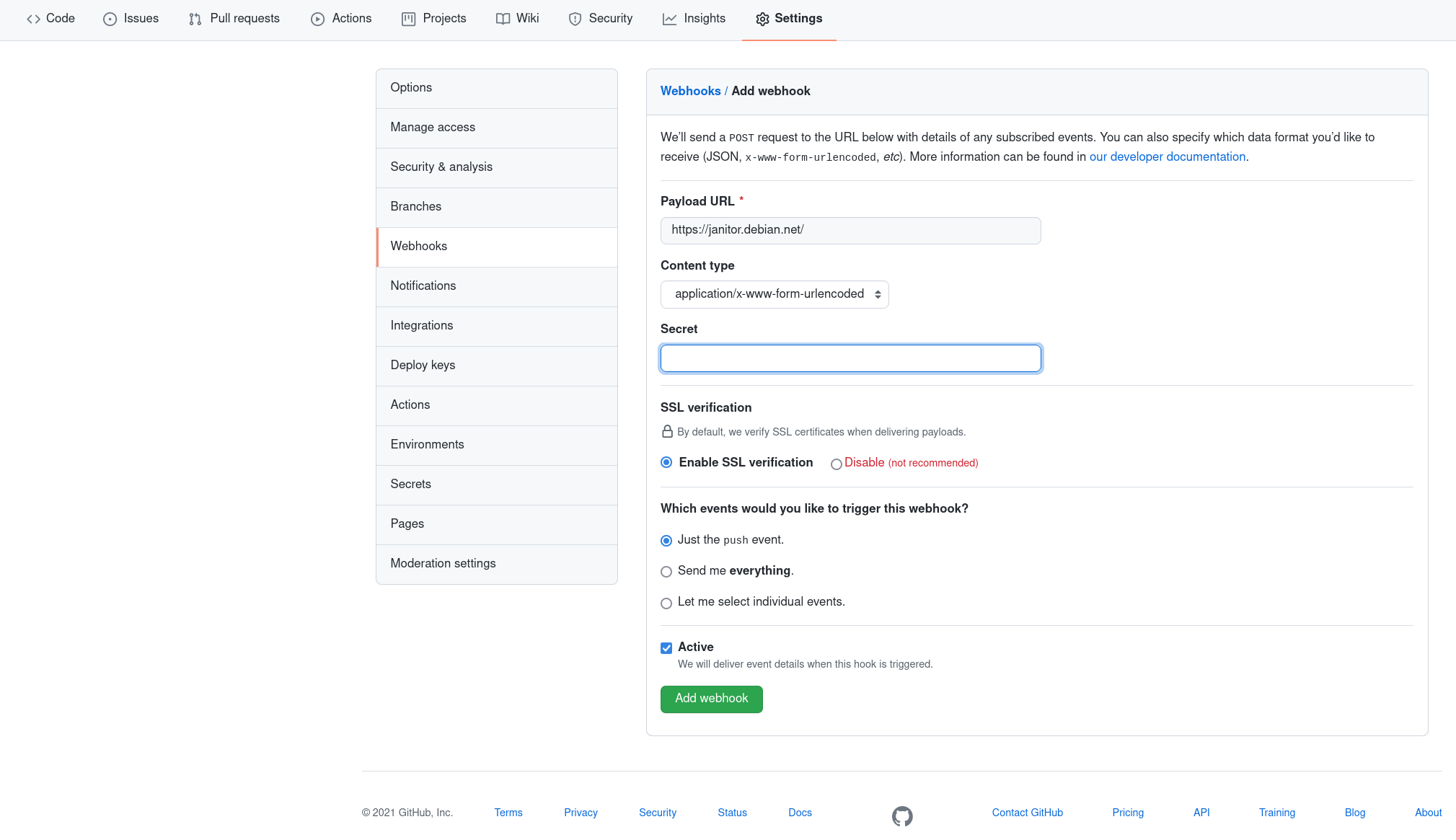
webhooks for upstream repositories At the moment there is no service in Debian (yet - perhaps this is something that vcswatch or a sibling service could also do?) that scans upstream repositories for changes. However, if you maintain an upstream package, you can use a webhook to notify the janitor that commits have been made to your repository, and it will create a new package in fresh-snapshots. Webhooks from the following hosting site software are currently supported: You can simply use the URL https://janitor.debian.net/ as the target for hooks. There is no need to specify a secret, and the hook can either use a JSON or form encoding payload. The endpoint should tell you whether it understood a webhook request, and whether it took any action. It s fine to submit webhooks for repositories that the janitor does not (yet) know about.
GitHub For GitHub, you can do so in the Webhooks section of the Settings tab. Fill the form as shown below and click on Add webhook:
GitLab On GitLab instances, you can find the Webhooks tab under the Settings menu for each repository (under the gear symbol). Fill the form in as shown below and click Add Webhook:
Launchpad For Launchpad, go to the repository (for Git) web view and click Manage Webhooks. From there, you can add a new webhook; fill the form in as shown below and click Add Webhook:

Vincent Bernat: Switching to the i3 window manager

I have been using the awesome window manager for 10 years. It is a tiling window manager, configurable and extendable with the Lua language. Using a general-purpose programming language to configure every aspect is a double-edged sword. Due to laziness and the apparent difficulty of adapting my configuration about 3000 lines to newer releases, I was stuck with the 3.4 version, whose last release is from 2013. It was time for a rewrite. Instead, I have switched to the i3 window manager, lured by the possibility to migrate to Wayland and Sway later with minimal pain. Using an embedded interpreter for configuration is not as important to me as it was in the past: it brings both complexity and brittleness.
i3 dual screen setup
Dual screen desktop running i3, Emacs, some terminals, including a Quake console, Firefox, Polybar as the status bar, and Dunst as the notification daemon.
The window manager is only one part of a desktop environment. There are several options for the other components. I am also introducing them in this post.

i3: the window manager i3 aims to be a minimal tiling window manager. Its documentation can be read from top to bottom in less than an hour. i3 organize windows in a tree. Each non-leaf node contains one or several windows and has an orientation and a layout. This information arbitrates the window positions. i3 features three layouts: split, stacking, and tabbed. They are demonstrated in the below screenshot:
Example of layouts
Demonstration of the layouts available in i3. The main container is split horizontally. The first child is split vertically. The second one is tabbed. The last one is stacking.
Tree representation of the previous screenshot
Tree representation of the previous screenshot.
Most of the other tiling window managers, including the awesome window manager, use predefined layouts. They usually feature a large area for the main window and another area divided among the remaining windows. These layouts can be tuned a bit, but you mostly stick to a couple of them. When a new window is added, the behavior is quite predictable. Moreover, you can cycle through the various windows without thinking too much as they are ordered. i3 is more flexible with its ability to build any layout on the fly, it can feel quite overwhelming as you need to visualize the tree in your head. At first, it is not unusual to find yourself with a complex tree with many useless nested containers. Moreover, you have to navigate windows using directions. It takes some time to get used to. I set up a split layout for Emacs and a few terminals, but most of the other workspaces are using a tabbed layout. I don t use the stacking layout. You can find many scripts trying to emulate other tiling window managers but I did try to get my setup pristine of these tentatives and get a chance to familiarize myself. i3 can also save and restore layouts, which is quite a powerful feature. My configuration is quite similar to the default one and has less than 200 lines.

i3 companion: the missing bits i3 philosophy is to keep a minimal core and let the user implements missing features using the IPC protocol:
Do not add further complexity when it can be avoided. We are generally happy with the feature set of i3 and instead focus on fixing bugs and maintaining it for stability. New features will therefore only be considered if the benefit outweighs the additional complexity, and we encourage users to implement features using the IPC whenever possible. Introduction to the i3 window manager
While this is not as powerful as an embedded language, it is enough for many cases. Moreover, as high-level features may be opinionated, delegating them to small, loosely coupled pieces of code keeps them more maintainable. Libraries exist for this purpose in several languages. Users have published many scripts to extend i3: automatic layout and window promotion to mimic the behavior of other tiling window managers, window swallowing to put a new app on top of the terminal launching it, and cycling between windows with Alt+Tab. Instead of maintaining a script for each feature, I have centralized everything into a single Python process, i3-companion using asyncio and the i3ipc-python library. Each feature is self-contained into a function. It implements the following components:
make a workspace exclusive to an application
When a workspace contains Emacs or Firefox, I would like other applications to move to another workspace, except for the terminal which is allowed to intrude into any workspace. The workspace_exclusive() function monitors new windows and moves them if needed to an empty workspace or to one with the same application already running.
implement a Quake console
The quake_console() function implements a drop-down console available from any workspace. It can be toggled with Mod+ . This is implemented as a scratchpad window.
back and forth workspace switching on the same output
With the workspace back_and_forth command, we can ask i3 to switch to the previous workspace. However, this feature is not restricted to the current output. I prefer to have one keybinding to switch to the workspace on the next output and one keybinding to switch to the previous workspace on the same output. This behavior is implemented in the previous_workspace() function by keeping a per-output history of the focused workspaces.
create a new empty workspace or move a window to an empty workspace
To create a new empty workspace or move a window to an empty workspace, you have to locate a free slot and use workspace number 4 or move container to workspace number 4. The new_workspace() function finds a free number and use it as the target workspace.
restart some services on output change
When adding or removing an output, some actions need to be executed: refresh the wallpaper, restart some components unable to adapt their configuration on their own, etc. i3 triggers an event for this purpose. The output_update() function also takes an extra step to coalesce multiple consecutive events and to check if there is a real change with the low-level library xcffib.
I will detail the other features as this post goes on. On the technical side, each function is decorated with the events it should react to:
@on(CommandEvent("previous-workspace"), I3Event.WORKSPACE_FOCUS)
async def previous_workspace(i3, event):
    """Go to previous workspace on the same output."""
The CommandEvent() event class is my way to send a command to the companion, using either i3-msg -t send_tick or binding a key to a nop command. The latter is used to avoid spawning a shell and a i3-msg process just to send a message. The companion listens to binding events and checks if this is a nop command.
bindsym $mod+Tab nop "previous-workspace"
There are other decorators to avoid code duplication: @debounce() to coalesce multiple consecutive calls, @static() to define a static variable, and @retry() to retry a function on failure. The whole script is a bit more than 1000 lines. I think this is worth a read as I am quite happy with the result.

dunst: the notification daemon Unlike the awesome window manager, i3 does not come with a built-in notification system. Dunst is a lightweight notification daemon. I am running a modified version with HiDPI support for X11 and recursive icon lookup. The i3 companion has a helper function, notify(), to send notifications using DBus. container_info() and workspace_info() uses it to display information about the container or the tree for a workspace.
Notification showing i3 tree for a workspace
Notification showing i3 s tree for a workspace

polybar: the status bar i3 bundles i3bar, a versatile status bar, but I have opted for Polybar. A wrapper script runs one instance for each monitor. The first module is the built-in support for i3 workspaces. To not have to remember which application is running in a workspace, the i3 companion renames workspaces to include an icon for each application. This is done in the workspace_rename() function. The icons are from the Font Awesome project. I maintain a mapping between applications and icons. This is a bit cumbersome but it looks great.
i3 workspaces in Polybar
For CPU, memory, brightness, battery, disk, and audio volume, I am relying on the built-in modules. Polybar s wrapper script generates the list of filesystems to monitor and they get only displayed when available space is low. The battery widget turns red and blinks slowly when running out of power. Check my Polybar configuration for more details.
Various modules for Polybar
Polybar displaying various information: CPU usage, memory usage, screen brightness, battery status, Bluetooth status (with a connected headset), network status (connected to a wireless network and to a VPN), notification status, and speaker volume.
For Bluetooh, network, and notification statuses, I am using Polybar s ipc module: the next version of Polybar can receive an arbitrary text on an IPC socket. The module is defined with a single hook to be executed at the start to restore the latest status.
[module/network]
type = custom/ipc
hook-0 = cat $XDG_RUNTIME_DIR/i3/network.txt 2> /dev/null
initial = 1
It can be updated with polybar-msg action "#network.send.XXXX". In the i3 companion, the @polybar() decorator takes the string returned by a function and pushes the update through the IPC socket. The i3 companion reacts to DBus signals to update the Bluetooth and network icons. The @on() decorator accepts a DBusSignal() object:
@on(
    StartEvent,
    DBusSignal(
        path="/org/bluez",
        interface="org.freedesktop.DBus.Properties",
        member="PropertiesChanged",
        signature="sa sv as",
        onlyif=lambda args: (
            args[0] == "org.bluez.Device1"
            and "Connected" in args[1]
            or args[0] == "org.bluez.Adapter1"
            and "Powered" in args[1]
        ),
    ),
)
@retry(2)
@debounce(0.2)
@polybar("bluetooth")
async def bluetooth_status(i3, event, *args):
    """Update bluetooth status for Polybar."""
The middle of the bar is occupied by the date and a weather forecast. The latest also uses the IPC mechanism, but the source is a Python script triggered by a timer.
Date and weather in Polybar
Current date and weather forecast for the day in Polybar. The data is retrieved with the OpenWeather API.
I don t use the system tray integrated with Polybar. The embedded icons usually look horrible and they all behave differently. A few years back, Gnome has removed the system tray. Most of the problems are fixed by the DBus-based Status Notifier Item protocol also known as Application Indicators or Ayatana Indicators for GNOME. However, Polybar does not support this protocol. In the i3 companion, The implementation of Bluetooth and network icons, including displaying notifications on change, takes about 200 lines. I got to learn a bit about how DBus works and I get exactly the info I want.

picom: the compositor I like having slightly transparent backgrounds for terminals and to reduce the opacity of unfocused windows. This requires a compositor.1 picom is a lightweight compositor. It works well for me, but it may need some tweaking depending on your graphic card.2 Unlike the awesome window manager, i3 does not handle transparency, so the compositor needs to decide by itself the opacity of each window. Check my configuration for details.

systemd: the service manager I use systemd to start i3 and the various services around it. My xsession script only sets some environment variables and lets systemd handles everything else. Have a look at this article from Micha G ral for the rationale. Notably, each component can be easily restarted and their logs are not mangled inside the ~/.xsession-errors file.3 I am using a two-stage setup: i3.service depends on xsession.target to start services before i3:
[Unit]
Description=X session
BindsTo=graphical-session.target
Wants=autorandr.service
Wants=dunst.socket
Wants=inputplug.service
Wants=picom.service
Wants=pulseaudio.socket
Wants=policykit-agent.service
Wants=redshift.service
Wants=spotify-clean.timer
Wants=ssh-agent.service
Wants=xiccd.service
Wants=xsettingsd.service
Wants=xss-lock.service
Then, i3 executes the second stage by invoking the i3-session.target:
[Unit]
Description=i3 session
BindsTo=graphical-session.target
Wants=wallpaper.service
Wants=wallpaper.timer
Wants=polybar-weather.service
Wants=polybar-weather.timer
Wants=polybar.service
Wants=i3-companion.service
Wants=misc-x.service
Have a look on my configuration files for more details.

rofi: the application launcher Rofi is an application launcher. Its appearance can be customized through a CSS-like language and it comes with several themes. Have a look at my configuration for mine.
Rofi as an application launcher
It can also act as a generic menu application. I have a script to control a media player and another one to select the wifi network. It is quite a flexible application.
Rofi as a wifi network selector
Rofi to select a wireless network

xss-lock and i3lock: the screen locker i3lock is a simple screen locker. xss-lock invokes it reliably on inactivity or before a system suspend. For inactivity, it uses the XScreenSaver events. The delay is configured using the xset s command. The locker can be invoked immediately with xset s activate. X11 applications know how to prevent the screen saver from running. I have also developed a small dimmer application that is executed 20 seconds before the locker to give me a chance to move the mouse if I am not away.4 Have a look at my configuration script.
Demonstration of xss-lock, xss-dimmer and i3lock with a 4 speedup.

The remaining components
  • autorandr is a tool to detect the connected display, match them against a set of profiles, and configure them with xrandr.
  • inputplug executes a script for each new mouse and keyboard plugged. This is quite useful to load the appropriate the keyboard map. See my configuration.
  • xsettingsd provides settings to X11 applications, not unlike xrdb but it notifies applications for changes. The main use is to configure the Gtk and DPI settings. See my article on HiDPI support on Linux with X11.
  • Redshift adjusts the color temperature of the screen according to the time of day.
  • maim is a utility to take screenshots. I use Prt Scn to trigger a screenshot of a window or a specific area and Mod+Prt Scn to capture the whole desktop to a file. Check the helper script for details.
  • I have a collection of wallpapers I rotate every hour. A script selects them using advanced machine learning algorithms and stitches them together on multi-screen setups. The selected wallpaper is reused by i3lock.

  1. Apart from the eye candy, a compositor also helps to get tear-free video playbacks.
  2. My configuration works with both Haswell (2014) and Whiskey Lake (2018) Intel GPUs. It also works with AMD GPU based on the Polaris chipset (2017).
  3. You cannot manage two different displays this way e.g. :0 and :1. In the first implementation, I did try to parametrize each service with the associated display, but this is useless: there is only one DBus user session and many services rely on it. For example, you cannot run two notification daemons.
  4. I have only discovered later that XSecureLock ships such a dimmer with a similar implementation. But mine has a cool countdown!

5 September 2021

Antoine Beaupr : Automating major Debian upgrades

It's major upgrade time again! The Debian project just published the Debian 11 "bullseye" release, and it's pretty awesome! This makes me realized that I have never written here about my peculiar upgrade process, and figured it was worth bringing that up to a wider audience. My upgrade process also has a notable changes section which includes major version changes (e.g. Inkscape 1.0!), new packages (e.g. podman!) and important behavior changes (e.g. driverless scanning and printing!). I'm particularly interested to hear about any significant change I might have missed. If you know of a cool new package that shipped with bullseye and that I forgot, do let me know! But that's for the cool new stuff. We need to talk about the problems with Debian major upgrades.

Background I have been maintaining detailed upgrade guides, on my wiki, starting with the jessie release, but I have actually written such guides for Koumbit.org as far back as Debian squeeze in 2011 (another worker wrote the older Debian lenny upgrade guide in 2009). Koumbit, since then, has kept maintaining those guides all the way to the latest bullseye upgrade, through 7 major releases! Over the years, those guides evolved from a quick "cheat-sheet" format copied from the release notes into a more or less "scripted" form that I currently use. Each guide has a procedure made of a few steps that can be basically copy-pasted to batch-upgrade a host (or multiple hosts in parallel) as quickly as possible. There is also the predict-os script which allows you to keep track of progress of the upgrades in a Puppet cluster.

Limitations of the official procedure In comparison with my procedure, the official upgrade guide is mostly designed to upgrade a single machine, typically a workstation, with a rather slow and exhaustive process. The PDF version of the upgrade guide is 14 pages long! This, obviously, does not work when you have tens or hundreds of machines to upgrade. Debian upgrades are notorious for being extremely reliable, but we have a lot of packages, and there are always corner cases where the upgrade will just fail because of a bug specific to your environment. Those will only be fixed after some back and forth in the community (and that's assuming users report those bugs, which is not always the case). There's no obvious way to deploy "hot fixes" in this context, at least not without fixing the package and publishing it on an unofficial Debian archive while the official ones catch up. This is slow and difficult. Or some packages require manual labor. Examples of this are the PostgreSQL or Ganeti packages which require you to upgrade your clusters by hand, while the old and new packages live side by side. Debian packages bring you far in the upgrade process, but sometimes not all the way. Which means every Debian install needs to be manually upgraded and inspected when a new release comes out. That's slow and error prone and we can do better.

How to automate major upgrades I have a proposal to automate this. It's been mostly dormant in the Debian wiki, for 5 years now. Fundamentally, this is a hard problem: Debian gets installed in so many different environments, from workstations to physical servers to virtual machines, embedded systems and so on, that it's extremely hard to come up with a "one size fits all" system. The (manual) procedure I'm using is mostly targeting servers, but I'm also using it on workstations. And I'll note that it's specific to my home setup: I have a different procedure at work, although it has a lot of common code. To automate this, I would factor out that common code with hooks where you could easily inject special code like "you need to upgrade ferm first", "you need an extra reboot here", or "this is how you finish the PostgreSQL upgrade". With Debian getting closer to a 2 year release cycle, with the previous release being supported basically only one year after the new stable comes out, I feel more and more strongly that this needs better automation. So I'm thinking that I should write a prototype for this. Ubuntu has do-release-upgrade that is too Ubuntu-specific to be reused. An attempt at collaborating on this has been mostly met with silence from Ubuntu's side as well. I'm thinking that using something like Fabric, Mitogen, or Transilience: anything that will allow me to write simple, portable Python code that can run transparently on a local machine (for single systems upgrades, possibly with a GUI frontend) to remote servers (for large clusters of servers, maybe with canaries and grouping using Cumin). I'll note that Koumbit started experimenting with Puppet Bolt in the bullseye upgrade process, but that feels too site-specific to be useful more broadly.

Trade-offs I am not sure where this stands in the XKCD time trade-off evaluation, because the table doesn't actually cover the time frequency of Debian release (which is basically "biennial") and the amount of time the upgrade would take across a cluster (which varies a lot, but that I estimate to be between one to 6 hours per machine). Assuming I have 80 machines to upgrade, that is 80 to 480 hours (between ~3 to 20 days) of work! It's unclear how much work such an automated system would shave off, however. Assuming things are an order of magnitude faster (say I upgrade 10 machines at a time), I would shave off between 3 and 18 days of work, which implies I might allow myself to spend a minimum of 5 days working on such a project.

The other option: never upgrade Before people mention those: I am aware of containers, Kubernetes, and other deployment mechanisms. Indeed, those may be a long-term solution, we currently can't afford to migrate everything over to containers right now: that is a huge migration and a total paradigm shift. At that point, whatever is left might not even be Debian in the first place. And besides, if you run Kubernetes, you still need to run some OS underneath and upgrade that, so that problem never completely disappears. Still, maybe that's the final answer: never upgrade. For some stateless machines like DNS replicas or load balancers, that might make a lot of sense as there's no or little data to carry to the new host. But this implies a seamless and fast provisioning process, and we don't have that either: at my work, installing a machine takes about as long as upgrading it, and that's after a significant amount of work automating that process, partly writing my own Debian installer with Fabric (!).

What is your process? I'm curious to hear what people think of those ideas. It strikes me as really odd that no one has really tackled that problem yet, considering how many clusters of Debian machines are out there. Surely people are upgrading those, and not following that slow step by step guide, right? I suspect everyone is doing the same thing: we all have our little copy-paste script we batch onto multiple machines, sometimes in parallel. That is what the Debian.org sysadmins are doing as well. There must be a better way. What is yours?

My upgrades so far So far, I have upgraded 2 out of my 3 home machines running buster -- others have been installed directly in bullseye -- with only my main, old, messy server left. Upgrades have been pretty painless so far (see another report, for example), much better than the previous buster upgrade. Obviously, for me personal use, automating this is pointless. Work-side, however, is another story: we have over 80 boxes to upgrade there and that will take a while. The last stretch to buster cycle took about two years to complete, so we might be done by the time the next release (12, "bookworm") is released, but that's actually a full year after "buster" becomes EOL, so it's actually too late... At least I fixed the installers so that new the machines we create all ship with bullseye, so we stopped accumulating new buster hosts...
Thanks to lelutin and pabs for reviewing a draft of this post.

Reproducible Builds: Reproducible Builds in August 2021

Welcome to the latest report from the Reproducible Builds project. In this post, we round up the important things that happened in the world of reproducible builds in August 2021. As always, if you are interested in contributing to the project, please visit the Contribute page on our website.
There were a large number of talks related to reproducible builds at DebConf21 this year, the 21st annual conference of the Debian Linux distribution (full schedule):
PackagingCon (@PackagingCon) is new conference for developers of package management software as well as their related communities and stakeholders. The virtual event, which is scheduled to take place on the 9th and 10th November 2021, has a mission is to bring different ecosystems together: from Python s pip to Rust s cargo to Julia s Pkg, from Debian apt over Nix to conda and mamba, and from vcpkg to Spack we hope to have many different approaches to package management at the conference . A number of people from reproducible builds community are planning on attending this new conference, and some may even present. Tickets start at $20 USD.
As reported in our May report, the president of the United States signed an executive order outlining policies aimed to improve the cybersecurity in the US. The executive order comes after a number of highly-publicised security problems such as a ransomware attack that affected an oil pipeline between Texas and New York and the SolarWinds hack that affected a large number of US federal agencies. As a followup this month, however, a detailed fact sheet was released announcing a number large-scale initiatives and that will undoubtedly be related to software supply chain security and, as a result, reproducible builds.
Lastly, We ran another productive meeting on IRC in August (original announcement) which ran for just short of two hours. A full set of notes from the meeting is available.

Software development kpcyrd announced an interesting new project this month called I probably didn t backdoor this which is an attempt to be:
a practical attempt at shipping a program and having reasonably solid evidence there s probably no backdoor. All source code is annotated and there are instructions explaining how to use reproducible builds to rebuild the artifacts distributed in this repository from source. The idea is shifting the burden of proof from you need to prove there s a backdoor to we need to prove there s probably no backdoor . This repository is less about code (we re going to try to keep code at a minimum actually) and instead contains technical writing that explains why these controls are effective and how to verify them. You are very welcome to adopt the techniques used here in your projects. ( )
As the project s README goes on the mention: the techniques used to rebuild the binary artifacts are only possible because the builds for this project are reproducible . This was also announced on our mailing list this month in a thread titled i-probably-didnt-backdoor-this: Reproducible Builds for upstreams. kpcyrd also wrote a detailed blog post about the problems surrounding Linux distributions (such as Alpine and Arch Linux) that distribute compiled Python bytecode in the form of .pyc files generated during the build process.

diffoscope diffoscope is our in-depth and content-aware diff utility. Not only can it locate and diagnose reproducibility issues, it can provide human-readable diffs from many kinds of binary formats. This month, Chris Lamb made a number of changes, including releasing version 180), version 181) and version 182) as well as the following changes:
  • New features:
    • Add support for extracting the signing block from Android APKs. [ ]
    • If we specify a suffix for a temporary file or directory within the code, ensure it starts with an underscore (ie. _ ) to make the generated filenames more human-readable. [ ]
    • Don t include short GCC lines that differ on a single prefix byte either. These are distracting, not very useful and are simply the strings(1) command s idea of the build ID, which is displayed elsewhere in the diff. [ ][ ]
    • Don t include specific .debug-like lines in the ELF-related output, as it is invariably a duplicate of the debug ID that exists better in the readelf(1) differences for this file. [ ]
  • Bug fixes:
    • Add a special case to SquashFS image extraction to not fail if we aren t the superuser. [ ]
    • Only use java -jar /path/to/apksigner.jar if we have an apksigner.jar as newer versions of apksigner in Debian use a shell wrapper script which will be rejected if passed directly to the JVM. [ ]
    • Reduce the maximum line length for calculating Wagner-Fischer, improving the speed of output generation a lot. [ ]
    • Don t require apksigner in order to compare .apk files using apktool. [ ]
    • Update calls (and tests) for the new version of odt2txt. [ ]
  • Output improvements:
    • Mention in the output if the apksigner tool is missing. [ ]
    • Profile diffoscope.diff.linediff and specialize. [ ][ ]
  • Logging improvements:
    • Format debug-level messages related to ELF sections using the diffoscope.utils.format_class. [ ]
    • Print the size of generated reports in the logs (if possible). [ ]
    • Include profiling information in --debug output if --profile is not set. [ ]
  • Codebase improvements:
    • Clarify a comment about the HUGE_TOOLS Python dictionary. [ ]
    • We can pass -f to apktool to avoid creating a strangely-named subdirectory. [ ]
    • Drop an unused File import. [ ]
    • Update the supported & minimum version of Black. [ ]
    • We don t use the logging variable in a specific place, so alias it to an underscore (ie. _ ) instead. [ ]
    • Update some various copyright years. [ ]
    • Clarify a comment. [ ]
  • Test improvements:
    • Update a test to check specific contents of SquashFS listings, otherwise it fails depending on the test systems user ID to username passwd(5) mapping. [ ]
    • Assign seen and expected values to local variables to improve contextual information in failed tests. [ ]
    • Don t print an orphan newline when the source code formatting test passes. [ ]

In addition Santiago Torres Arias added support for Squashfs version 4.5 [ ] and Felix C. Stegerman suggested a number of small improvements to the output of the new APK signing block [ ]. Lastly, Chris Lamb uploaded python-libarchive-c version 3.1-1 to Debian experimental for the new 3.x branch python-libarchive-c is used by diffoscope.

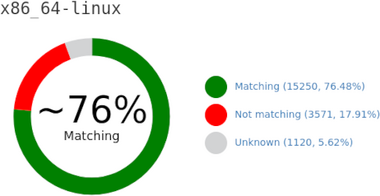
Distribution work In Debian, 68 reviews of packages were added, 33 were updated and 10 were removed this month, adding to our knowledge about identified issues. Two new issue types have been identified too: nondeterministic_ordering_in_todo_items_collected_by_doxygen and kodi_package_captures_build_path_in_source_filename_hash. kpcyrd published another monthly report on their work on reproducible builds within the Alpine and Arch Linux distributions, specifically mentioning rebuilderd, one of the components powering reproducible.archlinux.org. The report also touches on binary transparency, an important component for supply chain security. The @GuixHPC account on Twitter posted an infographic on what fraction of GNU Guix packages are bit-for-bit reproducible: Finally, Bernhard M. Wiedemann posted his monthly reproducible builds status report for openSUSE.

Upstream patches The Reproducible Builds project detects, dissects and attempts to fix as many currently-unreproducible packages as possible. We endeavour to send all of our patches upstream where appropriate. This month, we wrote a large number of such patches, including: Elsewhere, it was discovered that when supporting various new language features and APIs for Android apps, the resulting APK files that are generated now vary wildly from build to build (example diffoscope output). Happily, it appears that a patch has been committed to the relevant source tree. This was also discussed on our mailing list this month in a thread titled Android desugaring and reproducible builds started by Marcus Hoffmann.

Website and documentation There were quite a few changes to the Reproducible Builds website and documentation this month, including:
  • Felix C. Stegerman:
    • Update the website self-build process to not use the buster-backports suite now that Debian Bullseye is the stable release. [ ]
  • Holger Levsen:
    • Add a new page documenting various package rebuilder solutions. [ ]
    • Add some historical talks and slides from DebConf20. [ ][ ]
    • Various improvements to the history page. [ ][ ][ ]
    • Rename the Comparison protocol documentation category to Verification . [ ]
    • Update links to F-Droid documentation. [ ]
  • Ian Muchina:
    • Increase the font size of titles and de-emphasize event details on the talk page. [ ]
    • Rename the README file to README.md to improve the user experience when browsing the Git repository in a web browser. [ ]
  • Mattia Rizzolo:
    • Drop a position:fixed CSS statement that is negatively affecting with some width settings. [ ]
    • Fix the sizing of the elements inside the side navigation bar. [ ]
    • Show gold level sponsors and above in the sidebar. [ ]
    • Updated the documentation within reprotest to mention how ldconfig conflicts with the kernel variation. [ ]
  • Roland Clobus:
    • Added a ticket number for the issue with the live Cinnamon image and diffoscope. [ ]

Testing framework The Reproducible Builds project runs a testing framework at tests.reproducible-builds.org, to check packages and other artifacts for reproducibility. This month, the following changes were made:
  • Holger Levsen:
    • Debian-related changes:
      • Make a large number of changes to support the new Debian bookworm release, including adding it to the dashboard [ ], start scheduling tests [ ], adding suitable Apache redirects [ ] etc. [ ][ ][ ][ ][ ]
      • Make the first build use LANG=C.UTF-8 to match the official Debian build servers. [ ]
      • Only test Debian Live images once a week. [ ]
      • Upgrade all nodes to use Debian Bullseye [ ] [ ]
      • Update README documentation for the Debian Bullseye release. [ ]
    • Other changes:
      • Only include rsync output if the $DEBUG variable is enabled. [ ]
      • Don t try to install mock, a tool used to build Fedora packages some time ago. [ ]
      • Drop an unused function. [ ]
      • Various documentation improvements. [ ][ ]
      • Improve the node health check to detect zombie jobs. [ ]
  • Jessica Clarke (FreeBSD-related changes):
    • Update the location and branch name for the main FreeBSD Git repository. [ ]
    • Correctly ignore the source tarball when comparing build results. [ ]
    • Drop an outdated version number from the documentation. [ ]
  • Mattia Rizzolo:
    • Block F-Droid jobs from running whilst the setup is running. [ ]
    • Enable debugging for the rsync job related to Debian Live images. [ ]
    • Pass BUILD_TAG and BUILD_URL environment for the Debian Live jobs. [ ]
    • Refactor the master_wrapper script to use a Bash array for the parameters. [ ]
    • Prefer YAML s safe_load() function over the unsafe variant. [ ]
    • Use the correct variable in the Apache config to match possible existing files on disk. [ ]
    • Stop issuing HTTP 301 redirects for things that not actually permanent. [ ]
  • Roland Clobus (Debian live image generation):
    • Increase the diffoscope timeout from 120 to 240 minutes; the Cinnamon image should now be able to finish. [ ]
    • Use the new snapshot service. [ ]
    • Make a number of improvements to artifact handling, such as moving the artifacts to the Jenkins host [ ] and correctly cleaning them up at the right time. [ ][ ][ ]
    • Where possible, link to the Jenkins build URL that created the artifacts. [ ][ ]
    • Only allow only one job to run at the same time. [ ]
  • Vagrant Cascadian:
    • Temporarily disable armhf nodes for DebConf21. [ ][ ]

Lastly, if you are interested in contributing to the Reproducible Builds project, please visit the Contribute page on our website. You can get in touch with us via:

2 September 2021

Eddy Petrișor: Stretch to Buster upgrade issues: "Grub error: symbol grub_is_lockdown not found", missing RTL8111/8168/8411 Ethernet driver and RTL8821CE Wireless adapter on Linux Kernel 5.10 (and 4.19)

I have been Debian Stretch running on my HP Pavilion 14-ce0000nq laptop since buying it back in April 2019, just before my presence at Oxidizeconf where I presented "How to Rust When Standards Are Defined in C".Debian Buster (aka Debian 10) was released about 4 months later and I've been postponing the upgrade as my free time isn't what it used to be. I also tend to wait for the first or even second update of the release to avoid any sharp edges.As this laptop has a Realtek 8821CE wireless card that wasn't officially supported in the Linux kernel, I had to use an out-of-tree hacked driver to have the wireless work on Stretch kernels such as 4.19, it didn't even got along with DKMS, so all compilations and installations of it, I did them manually. More reason to wait for a newer release that would contain a driver inside the official kernel.I was waiting for the inevitable and dreading the wireless issues, but since mid-august Bullseye became stable, turning Stretch into oldoldstable, I decided that I had to do the upgrade, at least to buster.The Grub error and the fix
Everything went quite smooth, except that after the reboot, the laptop failed to boot with this Grub error:

error: symbol grub_is_lockdown not found
I looked for a solution and it seemed everyone was stuck or the solution was unclear.There is even a bug report in Debian about this error, bug #984760.
Adding to the pile of confusion my own confused solution: I tried supergrubdisk2/rescatux, it didn't work for me, it might have been a combination of me using LVM and grub-efi-amd64. I also tried to boot in rescue mode the Buster first DVD (to avoid the need for network), I was able to enter the partition, mount the EFI partition, too, but since I didn't want to mess the setup even more or depend on an external USB stick, I didn't know where should I try to write the Grub EFI config - the root partition is on an NVME storage.When buying the laptop it had FreeDOS installed on it and some HP rescue app, which I did not wipe when installing Debian. I even forgot where or how was the EFI installed on the disk and EFI, even if it should be more reliable and simpler, I never got the hang of it.
In the end, I realized that I could via BIOS actually select manually which EFI executable should be booted into, so I was able to boot with some manual intervention during boot into the regular system.I tried regenerating the grub configuration, installing it and also tried restoring the default proper boot sequence (and I even installed refind in the system during my fumbling), but I think somewhere between grub-efi-amd64 reconfiguration and its reinstallation I managed to do the right thing, as the default boot screen is the Grub one now.Hints for anyone reading this in the hope to fix the same issue, hopefully it will make things better, not worse (see the text below):1) regenerate the grub config:
update-grub2
2) reinstall grub-efi-amd64 and make Debian the default
dpkg-reconfigure -plow grub-efi-amd64
When reinstalling grub-efi-amd64 onto the disk, I think the scariest questions were to these:

Force extra installation to the EFI removable media path?

Some EFI-based systems are buggy and do not handle new bootloaders correctly. If you force an extra installation of GRUB to the EFI removable media path, this should ensure that this system will boot Debian correctly despite such a problem. However, it may remove the ability to boot any other operating systems that also depend on this path. If so, you will need to make sure that GRUB is configured successfully to be able to boot any other OS installations correctly.

and
Update NVRAM variables to automatically boot into Debian?

GRUB can configure your platform's NVRAM variables so that it boots into Debian automatically when powered on. However, you may prefer to disable this behavior and avoid changes to your boot configuration. For example, if your NVRAM variables have been set up such that your system contacts a PXE server on every boot, this would preserve that behavior.

I think the first can be safely answered "No" if you don't plan on booting via a removable USB stick, while the second is the one that does the restoring.The second question is probably safe if you don't use PXE boot or other boot method, at least that's what I understand. But if you do, I suspect by installing refind, by playing with the multiple efi* named packages and tools, you can restore that, or it might be that your BIOS allows that directly.
I just did a walk through of these 2 steps again on my laptop and answered "No" to the removable media question as it leads to errors when the media was not inserted (in my case the internal SD card reader), and "Yes" to making Debian the default.It seems that for me this broke the FreeDOS and HP utilities boot entries from Grub, but I still can boot via the BIOS options and my goal was to have Debian boot correctly by default.
Fixing the missing RTL811/8168/8411 Ethernet card issue
As a side note for people with computers having Realtek RTL8111/8168/8411 Gigabit Ethernet Controller and upgrading to Buster or switching to a newer kernel, please note that you might end up having the unpleasant surprise even your Ethernet card to disappear because the r8169 driver is not loader by default.I had to add it to /etc/modules so is loaded by default:
eddy@aptonia:/ $ cat /etc/modules
# /etc/modules: kernel modules to load at boot time.
#
# This file contains the names of kernel modules that should be loaded
# at boot time, one per line. Lines beginning with "#" are ignored.
r8169

The 5.10 compatible driver for RTL8821CE wireless adapterAfter the upgrade to Buster, the oldstable version of the kernel, 4.19, the hacked version of the driver I've been using on Stretch on 4.9 kernels was no longer compatible - failed to compile due to missing symbols.The fix for me was to switch to the DKMS compatible driver from https://github.com/tomaspinho/rtl8821ce, as this seems to work for both 4.19 and 5.10 kernels (installed from backports).
I installed it via a modification of the manual install method only for the 4.19 and 5.10 kernels, leaving the legacy 4.9 kernels working with the hacked driver. You can do the same if instead of running the provided script, you do its steps manually and you install only for the kernel versions you want, instead of the default to install for all:I looked inside the dkms-install.sh script to do the required steps:Copy the driver, add it to the dkms set of known drivers:
DRV_NAME=rtl8821ce
DRV_VERSION=v5.5.2_34066.20200325

cp -r . /usr/src/$ DRV_NAME -$ DRV_VERSION

dkms add -m $ DRV_NAME -v $ DRV_VERSION
But you just build and install them only for the select kernel versions of your choice:
dkms build -m $ DRV_NAME -v $ DRV_VERSION -k 5.10.0-0.bpo.8-amd64
dkms install -m $ DRV_NAME -v $ DRV_VERSION -k 5.10.0-0.bpo.8-amd64
Or, without the variables:
dkms build rtl8821ce/v5.5.2_34066.20200325 -k 4.19.0-17-amd64
dkms install rtl8821ce/v5.5.2_34066.20200325 -k 4.19.0-17-amd64
dkms status should confirm everything is in place and I think you need to update grub2 again after this.
Please note this driver is no longer maintained and the 5.10 tree should support the RTL8821CE wireless card with the rtw88 driver from the kernel, but for me it did not. I'll probably try this at a later time, or after I upgrade to the current Debian stable, Bullseye.

Ian Jackson: partial-borrow: references to restricted views of a Rust struct

tl;dr:
With these two crazy proc-macros you can hand out multipe (perhaps mutable) references to suitable subsets/views of the same struct. Why In Otter I have adopted a style where I try to avoid giving code mutable access that doesn't need it, and try to make mutable access come with some code structures to prevent "oh I forgot a thing" type mistakes. For example, mutable access to a game state is only available in contexts that have to return a value for the updates to send to the players. This makes it harder to forget to send the update. But there is a downside. The game state is inside another struct, an Instance, and much code needs (immutable) access to it. I can't pass both &Instance and &mut GameState because one is inside the other. My workaround involves passing separate references to the other fields of Instance, leading to some functions taking far too many arguments. 14 in one case. (They're all different types so argument ordering mistakes just result in compiler errors talking about arguments 9 and 11 having wrong types, rather than actual bugs.) I felt this problem was purely a restriction arising from limitations of the borrow checker. I thought it might be possible to improve on it. Weeks passed and the question gradually wormed its way into my consciousness. Eventually, I tried some experiments. Encouraged, I persisted. What and how partial-borrow is a Rust library which solves this problem. You sprinkle #[Derive(PartialBorrow)] and partial!(...) and then you can pass a reference which grants mutable access to only some of the fields. You can also pass a reference through which some fields are inaccessible. You can even split a single mut reference into multiple compatible references, for example granting mut access to mutually-nonverlapping subsets. The core type is Struct__Partial (for some Struct). It is a zero-sized type, but we prevent anyone from constructing one. Instead we magic up references to it, always ensuring that they have the same address as some Struct. The fields of Struct__Partial are also ZSTs that exist ony as references, and they Deref to the actual field (subject to compile-type borrow compatibility checking). Soundness and testing partial-borrow is primarily a nontrivial procedural macro which autogenerates reams of unsafe. Of course I think it's sound, but I thought that the last two times before I added a test which demonstrated otherwise. So it might be fairer to say that I have tried to make it sound and that I don't know of any problems... Reasoning about the correctness of macro-generated code is not so easy. One problem is that there is nowhere good to put the kind of soundness arguments you would normally add near uses of unsafe. I decided to solve this by annotating an instance of the macro output. There's a not very complicated script using diff3 to help fold in changes if the macro output changes - merge conflicts there mean a possible re-review of the argument text. Of course I also have test cases that run with miri, and test cases for expected compiler errors for uses that need to be forbidden for soundness. But this is quite hairy and I'm worried that it might be rather "my first insane unsafe contraption". Also the pointer/reference trickery is definitely subtle, and depends heavily on knowing what Rust's aliasing and pointer provenance rules really are. Stacked Borrows is not entirely trivial to reason about in fiddly corner cases. So for now I have only called it 0.1.0 and left a note in the docs. I haven't actually made Otter use it yet but that's the rather more boring software integration part, not the fun "can I do this mad thing" part so I will probably leave that for a rainy day. Possibly a rainy day after someone other than me has looked at partial-borrow (preferably someone who understands Stacked Borrows...). Fun! This was great fun. I even enjoyed writing the docs. The proc-macro programming environment is not entirely straightforward and there are a number of things to watch out for. For my first non-adhoc proc-macro this was, perhaps, ambitious. But you don't learn anything without trying...
edited 2021-09-02 16:28 UTC to fix a typo


comment count unavailable comments

Norbert Preining: Reducing (sparsifying) qcow2 image of Windows10

Since joining Fujitsu I am permanently running a VM (kvm/qemu) with Windows 10 (unfortunately necessary). While the usaged disk space is about 50G, the actual qcow2 file had grown to over 180G, not good. Searching the web the very promising virt-sparsify is mentioned again and again, and the man page gives hope, but as it turns out it is broken and calls qemu-img with incorrect/not-working arguments (see this bug). Another problem seems to be that by default the discard mode seems not to be set to unmap. So here are the stages how I reduced the size of the qcow2 image back down to around 60G.
  1. Turn off the VM
  2. Make sure you are using VirtIO for the disk, select Discard mode: unmap
  3. Boot into Windows, and from an elevated prompt run: Optimize-Volume -DriveLetter C -ReTrim -Verbose
  4. Shut down the VM
  5. Run a dummy conversion which sparsifies the image: qemu-img convert -O qcow2 orig.qcow2 sparse.qcow2
  6. Rename/Backup the images and boot back into Windows.
That helped in my case, without any consequences (till now) for the Windows installation.

1 September 2021

Utkarsh Gupta: FOSS Activites in August 2021

Here s my (twenty-third) monthly but brief update about the activities I ve done in the F/L/OSS world.

Debian
This was my 32nd month of actively contributing to Debian. I became a DM in late March 2019 and a DD on Christmas 19! \o/ Tough month but I mostly spent on it churning through the immense backlog. But that somewhat backfired and I have even more backlog than ever. :D Anyway, I did the following stuff in Debian:

Uploads and bug fixes:
  • ruby3.0 (3.0.0-2) - Upload to unstable! \o/

Other $things:
  • Mentoring for newcomers.
  • Moderation of -project mailing list.

Ubuntu
This was my 7th month of actively contributing to Ubuntu. Now that I ve joined Canonical to work on Ubuntu full-time, there s a bunch of things I do! \o/ I mostly worked on different things, I guess. But mostly on packaging keylime and some Google Agents upload(s) and SRU(s). Also did a lot of reviewing, et al. I was too lazy to maintain a list of things I worked on so there s no concrete list atm. Maybe I ll get back to this section later or will start to list stuff from next month onward, as I ve been doing before. :D

Debian (E)LTS
Debian Long Term Support (LTS) is a project to extend the lifetime of all Debian stable releases to (at least) 5 years. Debian LTS is not handled by the Debian security team, but by a separate group of volunteers and companies interested in making it a success. And Debian Extended LTS (ELTS) is its sister project, extending support to the Jessie release (+2 years after LTS support). This was my twenty-third month as a Debian LTS and eleventh month as a Debian ELTS paid contributor.
I was assigned 23.75 hours for LTS and 40.00 hours for ELTS and worked on the following things:
(however, I only worked for 23.75h on ELTS work, thereby, carrying the rest to next month)

LTS CVE Fixes and Announcements:

ELTS CVE Fixes and Announcements:

Other (E)LTS Work:
  • Front-desk duty from 26-07 until 01-08 and from 30-08 until 05-09 for both LTS and ELTS.
  • Triaged haproxy, ntfs-3g, and cyrus-imapd, and exiv2, ffmpeg, git, gpac, inetutils, mc, modsecurity-crs, node-object-path, php-pear, systemd-cron, node-tar, ruby2.3, gst-plugins-bad0.10, jsoup, libxstream-java, qemu, tomcat7, ruby2.1, prototypejs, pillow, cpio, and qtbase-opensource-src, and amd64-microcode.
  • Mark CVE-2021-39240/haproxy as not-affected for stretch and jessie.
  • Mark CVE-2021-39241/haproxy as not-affected for stretch and jessie.
  • Mark CVE-2021-39242/haproxy as not-affected for stretch and jessie.
  • Mark CVE-2021-33582/cyrus-imapd as no-dsa for stretch.
  • Mark CVE-2020-18771/exiv2 as no-dsa for exiv2 for stretch.
  • Mark CVE-2020-18899/exiv2 as no-dsa for exiv2 for stretch.
  • Mark CVE-2021-38171/ffmpeg as postponed for stretch.
  • Mark CVE-2021-40330/git as no-dsa for stretch and jessie.
  • Mark CVE-2020-19481/gpac as ignored for stretch.
  • Mark CVE-2021-40491/inetutils as no-dsa for stretch.
  • Mark CVE-2021-36370/mc as no-dsa for stretch and jessie.
  • Mark CVE-2021-35368/modsecurity-crs as no-dsa for stretch.
  • Mark CVE-2021-23434/node-object-path as end-of-life for stretch.
  • Mark CVE-2021-32610/php-pear as no-dsa for stretch.
  • Mark CVE-2017-9525/systemd-cron as no-dsa for stretch.
  • Mark CVE-2021-37701/node-tar as end-of-life for stretch.
  • Mark CVE-2021-37712/node-tar as end-of-life in stretch.
  • Mark CVE-2021-3750/qemu as postponsed for jessie.
  • Mark CVE-2021-27511/prototypejs as postponsed for jessie.
  • Mark CVE-2021-23437/pillow as postponed for stretch and jessie.
  • Auto EOL ed gpac, cacti, openscad, cgal, cyrus-imapd-2.4, libsolv, mosquitto, atomicparsley, gtkpod, node-tar, libapache2-mod-auth-openidc, neutron, inetutils and linux for jessie.
  • Drop cpio from ela-needed; open issues don t warrant an ELA.
  • Attended monthly Debian LTS meeting.
  • Answered questions (& discussions) on IRC (#debian-lts and #debian-elts).
  • General and other discussions on LTS private and public mailing list.

Until next time.
:wq for today.

31 August 2021

Russ Allbery: kstart 4.3

kstart provides the programs k5start and krenew, which are similar to the Kerberos kinit program with some extra support for running programs with separate credentials and running as a daemon. This is the first full release in nearly six years. The major change is new support for the Linux kafs module, which is a native Linux implementation of the AFS protocol that David Howells and others have been working on for years. It has an entirely different way of thinking about tokens and credential isolation built on Linux keyrings rather than the AFS token concept (which sometimes uses keyrings, but in a different way, and sometimes uses other hacks). k5start and krenew, when run with the -t option to get AFS tokens, would fail if AFS was not available. That meant -t would fail with kafs even if the AKLOG environment variable were set properly to aklog-kafs. This release fixes that. The programs also optionally link with libkeyutils and use it when used to run a command to isolate the AFS credentials from the calling process. This is done by creating a new session keyring and linking it to the user keyring before running the aklog program. Thanks to Bill MacAllister, David Howells, and Jeffrey Altman for the help with this feature. I'm not sure that I have it right, so please let me know if it doesn't work for you. Also in this release is a fix from Aasif Versi to use a smarter exit status if k5start or krenew is running another program and that program is killed with a signal. Previously, that would cause k5start or krenew to exit with a status of 0, which was not helpful. Now it exits with a status formed by adding 128 to the signal number, which matches the behavior of bash. Since this is the first release in a while, it also contains some other minor fixes and portability updates. You can get the latest release from the kstart distribution page.

Benjamin Mako Hill: Returning to DebConf

I first started using Debian sometime in the mid 90s and started contributing as a developer and package maintainer more than two decades years ago. My first very first scholarly publication, collaborative work led by Martin Michlmayr that I did when I was still an undergrad at Hampshire College, was about quality and the reliance on individuals in Debian. To this day, many of my closest friends are people I first met through Debian. I met many of them at Debian s annual conference DebConf. Given my strong connections to Debian, I find it somewhat surprising that although all of my academic research has focused on peer production, free culture, and free software, I haven t actually published any Debian related research since that first paper with Martin in 2003! So it felt like coming full circle when, several days ago, I was able to sit in the virtual DebConf audience and watch two of my graduate student advisees Kaylea Champion and Wm Salt Hale present their research about Debian at DebConf21. Salt presented his masters thesis work which tried to understand the social dynamics behind organizational resilience among free software projects. Kaylea presented her work on a new technique she developed to identifying at risk software packages that are lower quality than we might hope given their popularity (you can read more about Kaylea s project in our blog post from earlier this year). If you missed either presentation, check out the blog post my research collective put up or watch the videos below. If you want to hear about new work we re doing including work on Debian you should follow our research group blog, and/or follow or engage with us in the Fediverse (@communitydata@social.coop), or on Twitter (@comdatasci). And if you re interested in joining us perhaps to do more research on FLOSS and/or Debian and/or a graduate degree of your own? please be in touch with me directly!
Wm Salt Hale s presentation plus Q&A. (WebM available)
Kaylea Champion s presentation plus Q&A. (WebM available)

30 August 2021

Joachim Breitner: A Candid explainer: Safe higher-order upgrades

This is the second post in a series about the interface description language Candid.

Safe upgrades A central idea behind Candid is that services evolve over time, and so also their interfaces evolve. As they do, it is desirable to keep the interface usable by clients who have not been updated. In particular on a blockchainy platform like the Internet Computer, where some programs are immutable and cannot be changed to accommodate changes in the interface of the services they use, this is of importance. Therefore, Candid defines which changes to an interface are guaranteed to be backward compatible. Of course it s compatible to add new methods to a service, but some changes to a method signature can also be ok. For example, changing
service A1 :  
  get_value : (variant   current; previous : nat  )
    -> (record   value : int; last_change : nat  )
 
to
service A2 :  
  get_value : (variant   current; previous : nat; default  )
    -> (record   value : int; last_change : nat; committed : bool  )
 
is fine: It doesn t matter that clients that still use the old interface don t know about the new constructor of the argument variant. And the extra field in the result record will silently be ignored by old clients. In the Candid spec, this relation is written as A2 <: A1 (note the order!), and the formal footing this builds on is subtyping. We thus say that it is safe to upgrade a service to a subtype , and that A2 s interface is a subtype of A1 s. In small examples, I often use nat and int, because every nat is also a int, but some int values are not not nat values, namely the negative ones. We say nat is a subtype of int, nat <: int. So a function that in the first returns a int can in the new version return a nat without breaking old clients. But the other direction doesn t work: If the old version s method had a return type of nat, then changing that to int would be a breaking change, as old clients would not be prepared to handle negative numbers. Note that arguments of function types follow different rules. In fact, the rules are simply turned around, and in argument position (also called negative position ), we can evolve the interface to accept supertypes. Concretely, a function that originally expected an nat can be changed to expect an int, but the other direction doesn t work, because there might still be old clients around that send negative numbers. This reversing-of-the-rules is called contravariance. The vision is that the developer s tooling will warn the developer before they upgrade the code of a running service to a type that is not a subtype of the old interface. Let me stress, though, that all this is about not breaking existing clients that use the old interface. It does not mean that a client developer who fetches the new interface for your service won t have to change their code to make his programs compile again.

Higher order composition So far, we considered the simple case of one service with a bunch of clients, i.e. the first order situation. Things get much more interesting if we have multiple services that are composed, and that pass around references to each other, and we still want everything to be nicely typed and never fail even as we upgrade services. Therefore, Candid s type system can express that a service s method expects or a returns a reference to another service or method, and the type that this service or method should have. For example
service B :   add_listener : (text, func (int) -> ()) -> ()  
says that the service with interface B has a method called add_listener which takes two arguments, a plain value of type text and a reference to a function that itself expects a int-typed argument. The contravariance of the subtyping rules explained above also applies to the types of these function reference. And because the int in the above type is on the left of two function arrows, the subtyping rule direction flips twice, and it is therefore safe to upgrade the service to accept the following interface:
service B :   add_listener : (text, func (nat) -> ()) -> ()  

Soundness theorem and Coq proof The combination of these higher order features and the safe upgrade mechanism is maybe the unique selling point of Candid, but also what made its design quite tricky sometimes. And although the conventional subtyping rules work well, we wanted to do some less conventional things (more on that below), and more than once thought we had a good solution, only to notice that it did not hold water in complicated higher-order cases. But what does it mean to hold water? I felt the need to precisely define a soundness criteria for higher order interface description languages, which you can find in the document An IDL Soundness Proposition. This is a general framework which you can instantiate with your concrete IDL language and rules, and then it tells you what you have to prove to consider your language to be sound. Intuitively, it simulates all possible ways in which services can be defined and upgraded, and in which they can pass around references to each other, and the soundness property is that then that for all messages sent between services, they can always be understood. The document also shows, in general, that any system that builds on canonical subtyping in sound, as expected. That is still a generic theorem that you can instantiate with a concrete system, but now there is less to do. Because these proofs can get tricky in corner cases, it is valuable to mechanize them in an interactive theorem prover and have the computer check the proofs. So I have created a Coq formalization that defines the soundness criteria, including the reduction to canonical subtyping. It also defines MiniCandid, a greatly simplified variant of Candid, proves various properties about it (transitivity etc.) and finally instantiates the soundness theorem. I am particularly fond of the use of coinduction to model the equirecursive types, and the use of named cases, as we know them from Isabelle, to make the proofs a bit more readable and maintainable. I am less fond of how much work it seems to be to extend MiniCandid with more of Candid s types. Already adding vec was more work than it s worth it, and I defensively blame Coq s not-so-great support for nested recursion. The soundness relies on subtyping, and that is all fine and well as long as we stick to canonical rules. Unfortunately, practical considerations force us to deviate from these a bit, as we see in the next post of this series.

Andrew Cater: Oh, my goodness, where's the fantastic barbeque [OMGWTFBBQ 2021]

I'm guessing the last glasses will be through the dishwasher (again) and Pepper the dog can settle down without having to cope with so many people.For those who don't know - Steve and his wife Jo (Sledge and Randombird) hold a barbeque in their garden every August Bank Holiday weekend [UK Bank Holiday on the last Monday in August]. The barbeque is not small - it's the dominating feature in the suburban garden, brick built, with a dedication stone, lights, electricity. The garden is small, generally made smaller by forty or so Debian friends and allies standing and sitting around. People are talking, arguing, hugging people they've not seen for (literal) years and putting the world to rights. This is Debian central point - with large quantities of meat and salads, an amount of beer/alcohol and "Cambridge gin" and general goodwill. This year was more than usually atmospheric because for some of us it was the first time with a large group of people in a while. Side conversations abound: for me it was learning something about the high energy particle physics community, how to precision build helicopters, fly quadcopters and precision 3D print anything, the maths of Isy counting crochet stitches to sew together randomly sized squares ... and, of course, obligatory things like how random is random and what's good enough entropy. And a few sessions of the game of our leader.
This is also a place for stuff to get done: I was unashamedly using this to upgrade the storage in my laptop while there were sensible engineers around. A corner of the table, a RattusRattus and it was quickly sorted - then a discussion around the internals of Thinkpads as he took his apart. Then getting a full install - Gb Ethernet to the Debian mirror in the cupboard six feet away is faster bandwidth than a jumbo jet full of tapes. Then getting mail to work again - it's handy when the mailserver owner is next to you, having come in from the garden to help, and finally IRC. And not just me: "You need a GPG key signed - there's three DPLs here, there's a release manager - but you've just missed one of the DAMs." plus an in-depth GPG how-to session on the other side of the table.I was the luckiest one with the most comfortable bed in the house overnight but I couldn't stay for last night. Thanks once again to all involved but especially Steve and Jo who do this for the love of it, and the fun, and the community and the family. Oh, and thanks to Lenovo - not just for being a platinum sponsor of Debconf but also for providing the official laptop of this and most Debian occasions

Thomas Goirand: developers-reference needs love

During Debconf, Holger, who s one of the developers-reference maintainers, made a quick presentation that was explaining the developers-reference needs some love. Indeed, it has gathered dust, and some useful refresh would be very welcome. Holger pointed at the list of bugs:
https://bugs.debian.org/src:developers-reference After having a quick look into that list, after Holger s Debconf presentation, I wrote to him on IRC: <zigo> Many of the bugs you refered are indeed easily actionable, if all of us just try to help for one bug, that d be a huge improvement of that doc. Then, as I was waiting for the closing ceremony of Debconf, I thought I shouldn t just say it, but actually do something about it. I decided to address https://bugs.debian.org/793633 as I thought it was easy. In just a few minutes, I was able to do a first patch, as seen here: https://salsa.debian.org/debian/developers-reference/-/merge_requests/27 I wrote about it on IRC, and a few people helped with rephrasing what was there (thanks to Fil for correcting my English mistakes, and others for the content). Today, which is 2 days after the MR was opened, I have decided it was long enough and actually merged it, as I considered it was enough time to gather comments. So we now have a brand new shiny chapter about Backports and how to handle them. I m sure that new part is perfectible, so do not hesitate, and do patch what I just wrote if you feel like you can do better. If I m writing this blog post, this is not to promote myself. The goal is to promote the developers-reference manual and push others in Debian to do the same. Please do what Holger suggested, and what I just did: contribute to the document by addressing just one of the currently opened bugs. If all DDs do it, we ll get a much nicer document, and help others to contribute to Debian. This is going to take less than 30 minutes of your time, and it is very much ok if you do this only once. It is really easy: just clone https://salsa.debian.org/debian/developers-reference/ and write a patch. If you re a DD, you can even merge your patch yourself once you re satisfied with it.

28 August 2021

Anton Gladky: 2021/08, FLOSS activity

LTS This is my sixth month of working for LTS. I was assigned 12 hrs and worked all of them.

Released DLAs
  1. DLA 2742-1 ffmpeg_7:3.2.15-0+deb9u3
    • CVE-2020-22036: A heap-based Buffer Overflow vulnerability in filter_intra at libavfilter/vf_bwdif.c, which might lead to memory corruption and other potential consequences.
    • CVE-2020-22032: A heap-based Buffer Overflow vulnerability in gaussian_blur, which might lead to memory corruption and other potential consequences.
    • CVE-2020-22031: A Heap-based Buffer Overflow vulnerability in filter16_complex_low, which might lead to memory corruption and other potential consequences.
    • CVE-2020-22028: Buffer Overflow vulnerability in filter_vertically_8 at libavfilter/vf_avgblur.c, which could cause a remote Denial of Service.
    • CVE-2020-22026: Buffer Overflow vulnerability exists in the config_input function at libavfilter/af_tremolo.c, which could let a remote malicious user cause a Denial of Service.
    • CVE-2020-22025: A heap-based Buffer Overflow vulnerability exists in gaussian_blur at libavfilter/vf_edgedetect.c, which might lead to memory corruption and other potential consequences.
    • CVE-2020-22023: A heap-based Buffer Overflow vulnerabililty exists in filter_frame at libavfilter/vf_bitplanenoise.c, which might lead to memory corruption and other potential consequences.
    • CVE-2020-22022: A heap-based Buffer Overflow vulnerability exists in filter_frame at libavfilter/vf_fieldorder.c, which might lead to memory corruption and other potential consequences.
    • CVE-2020-22021: Buffer Overflow vulnerability at filter_edges function in libavfilter/vf_yadif.c, which could let a remote malicious user cause a Denial of Service.
    • CVE-2020-22020: Buffer Overflow vulnerability in the build_diff_map function in libavfilter/vf_fieldmatch.c, which could let a remote malicious user cause a Denial of Service.
    • CVE-2020-22016: A heap-based Buffer Overflow vulnerability at libavcodec/get_bits.h when writing .mov files, which might lead to memory corruption and other potential consequences.
    • CVE-2020-22015: Buffer Overflow vulnerability in mov_write_video_tag due to the out of bounds in libavformat/movenc.c, which could let a remote malicious user obtain sensitive information, cause a Denial of Service, or execute arbitrary code.
    • CVE-2020-21041: Buffer Overflow vulnerability exists via apng_do_inverse_blend in libavcodec/pngenc.c, which could let a remote malicious user cause a Denial of Service
    • CVE-2021-3566: The tty demuxer did not have a read_probe function assigned to it. By crafting a legitimate ffconcat file that references an image, followed by a file the triggers the tty demuxer, the contents of the second file will be copied into the output file verbatim (as long as the -vcodec copy option is passed to ffmpeg).
    • CVE-2021-38114: libavcodec/dnxhddec.c does not check the return value of the init_vlc function. Crafted DNxHD data can cause unspecified impact.
  2. DLA 2742-2 ffmpeg_7:3.2.15-0+deb9u4 During the backporting of one of patches in CVE-2020-22021 one line was wrongly interpreted and it caused the regression during the deinterlacing process. Thanks to Jari Ruusu for the reporting the issue and for the testing of prepared update.

LTS-Meeting
  • I attended the Debian LTS team Jitsi-meeting (though the connection was extremely bad).
  • Partly participated in preparation of Debconf21 BoF Funding Projects to Improve Debian .

Debian Science Team
  • Partly participated in Debconf21 Debian Science BoF.

Other FLOSS activities
  • Reviewed many merge requests in Yade open source project, merge some of them.

25 August 2021

John Goerzen: Excellent Experience with Debian Bullseye

I ve appreciated the bullseye upgrade, like most Debian upgrades. I m not quite sure how, since I was already running a backports kernel, but somehow the entire system is snappier. Maybe newer X or something? I m really pleased with it. Hardware integration is even nicer now, particularly the automatic driverless support for scanners in addition to the existing support for printers. All in all, a very nice upgrade, and pretty painless. I experienced a few odd situations. For one, I had been using Gnome Flashback. Since xmonad-log-applet didn t compile there (due to bitrot in the log applet, not flashback), and I had been finding Gnome Flashback to be a rather dusty and forgotten corner of Gnome for a long time, I decided to try Mate. Mate just seemed utterly unable to handle a situation with a laptop and an external monitor very well. I want to use only the external monitor with the laptop lid is closed, and it just couldn t remember how to do the right thing external monitor on, laptop monitor off, laptop not put into suspend. gdm3 also didn t seem to be able to put the external monitor to sleep, either, causing a few nights of wasted power. So off I went to XFCE, which I had been using for years on my workstation anyhow. Lots more settings available in XFCE, plus things Just Worked there. Odd that XFCE, the thin and light DE, is now the one that has the most relevant settings. It seems the Gnome let s remove a bunch of features approach has extended to MATE as well. When I switched to XFCE, I also removed gdm3 from my system, leaving lightdm as the only DM on it. That matched what my desktop machine was using, and also what task-xfce-desktop called for. But strangely, the XFCE settings for lightdm were completely different between the laptop and the desktop. It turns out that with lightdm, you can have the lightdm-gtk-greeter and the accompanying lightdm-gtk-greeter-settings, or slick-greeter and the accompanying lightdm-settings. One machine had one greeter and settings, and the other had the other. Why, I don t know. But lightdm-gtk-greeter-settings had the necessary options for putting monitors to sleep on the login screen, so I went with it. This does highlight a bit of a weakness in Debian upgrades. There is SO MUCH choice in Debian, which I highly value. At some point, almost certainly without my conscious choice, one machine got one greeter and another got the other. Despite both having task-xfce-desktop installed, they got different desktop experiences. There isn t a great way to say OK, I know I had a bunch of things installed before, but NOW I want the default bullseye experience . But overall, it is an absolutely fantastic distribution. It is great to see this nonprofit community distribution continue to have such quality on such an immense scale. And hard to believe I ve been a Debian developer for 25 years. That seems almost impossible!

23 August 2021

Vincent Bernat: ThinkPad X1 Carbon (Gen 7): 2 years later

Two years ago, I replaced my ThinkPad X1 Carbon 2014 with the latest generation. The new configuration embeds an Intel Core i7-8565U, 16 Gib of RAM, a 1 Tib NVMe disk, and a WQHD display (2560 1440). I did not ask for a WWAN card. I think it is easier and more reliable to use the wifi hotspot feature of a phone instead: no unreliable firmware and unsupported drivers.1 Here is my opinion on this model.
ThinkPad X1 Carbon 7th Gen with the lid closed
ThinkPad X1 Carbon with its lid closed
While the second generation got a very odd keyboard, this one got a classic one with a full row of function keys. I don t know if my model was defective, but the keyboard skips one keypress from time to time. I have got used to it, but the space key still has a hard time registering when hitting it with my right thumb. The travel course is also shorter and it is less comfortable to type on it than it was on the 2014 version. The trackpoint2 works well. The physical buttons are a welcome addition. I am only using the trackpad for scrolling with the two-finger gesture.
Keyboard of the X1 Carbon 7th Gen
Keyboard with an ANSI QWERTY layout (aka English EU for Lenovo). The LEDs on the speaker and microphone keys work out of the box on Linux.
The screen does not suffer from ghosting effects like the one in my previous ThinkPad. To avoid leaving marks on the screen, I use a piece of cloth on top of the keyboard when closing the laptop. The 720p webcam has a built-in mechanical cover. Its quality is not great, but it does the job.
X1 Carbon 7th Gen
ThinkPad X1 Carbon with its lid opened
Battery life effortlessly reaches about 8 hours on a full charge. This is the main reason this laptop feels like a solid upgrade compared to the previous one: no need to carry a power brick during the day. This is the first Lenovo model with a sound card requiring the Sound Open Firmware. Without the appropriate firmware and the related userspace components (ALSA UCM and PulseAudio), the microphone does not work. If everything is set up correctly, the speakers produce a very decent sound, better than the 2014 model. It should now work out-of-the-box with Debian Bullseye. Just install the firmware-sof-signed package.3 The BIOS can be updated directly from Linux, thanks to the Linux Vendor Firmware Service. I was using the ThinkPad USB-C Dock Gen 2 as a docking station. Everything works out-of-the-box. However, from time to time, I got issues reliably getting an image on the two screens. I was using a couple of 10-year LG monitors with DVI connectors, so I relied on DP HDMI DVI adapters. This may have been the source of some of the problems.
ThinkPad USB-C Dock Gen 2
ThinkPad USB-C Dock Gen 2 with network, keyboard, mouse, power and two screens plugged

In summary, this is a fine laptop plagued with a bad keyboard. I did appreciate the good battery life and the fact there is still one HDMI and two USB-A ports, so I didn t need to travel with dongles. I was disappointed by how small the performance gap was with my 5-year older laptop. I am unsure to get a Lenovo for the next one: HiDPI screens are mostly unavailable and current prices are high. Other possibilities include: Until then, I am using my previous ThinkPad.

  1. The seventh generation moved from Sierra Wireless to Fibocom. While Linux support for modems is good, thanks to ModemManager, they are usually driven over the USB bus. The Fibocom L850-GL can use either the USB bus or the PCI bus but Lenovo s BIOS blacklists the former. It took quite some time to find how to switch it to USB after booting. A PCI driver is in progress.
  2. I did replace the trackpoint with a low-profile one from SaotoTech.
  3. The package is in non-free, despite being open-source: many platforms require the firmware to be signed by Intel.

Leandro Doctors: Clojure CLI Tools in Debian - GSoC 2021 Final Report

NOTE: this blog post is based on my "Clojure CLI Tools in Debian" GSoC 2021 project Final Report.

IntroMy name is Leandro Doctors ( allentiak on IRC), and I ve been the GSoC intern working with the Debian Clojure Team during 2021. This is my final report. You can also check my original proposal and my first report.

SummaryWhereas the raw data may not sound by itself very positive, my personal conclusion is. This is, whereas I didn t fully finish the required deliverables envisioned in my original proposal, I do feel I am much closer to, eventually, becoming a Debian Developer. So, by all means, I consider this project has had a positive outcome.

ProjectThe goal of the Clojure Build Tools in Debian project was to provide Clojure Debian users with some of the latest advanced build tools and libraries the upstream Clojure developers have been lately working on. These include tools.deps.alpha, a library for dependency graph resolution and classpath building, and the CLI tool clj, for REPL interaction. If time permitted, I was also to improve the quality of both new and existing Clojure packages, and the overall Debian Clojure packaging process. My mentor was Louis-Louis-Philippe V ronneau, and my co-mentor was Utkarsh Gupta.

MotivationWhy this project? On the one side, if you re a Clojure lover like me, you may have noticed that the Clojure experience in Debian is, as of mid 2021, well... still quiet limited. Additionally, this project aligned with my own background in Free Software community building and my research interest in Peer Production.When I mention how limited today s Clojure experience in Debian is, I can see two reasons for this, deeply intertwined. The first one is that there currently aren t many Clojure-specific packaging tools in Debian (such as a clojure-debian-helper). The second reason for which we only currently have a suboptimal Clojure experience in Debian, and probably the root of the previous one, is that many core build tools and libraries for the language have not simply been packaged yet. My project aimed to attack that seemingly root cause.As I said, another reason for me choosing this project is my own experience as the Co-founder and Leader of, probably, the first Free Software Community experience in my hometown of San Juan, Argentina. That interest in Free Software evolved in a first PhD attempt in what is now known as the field of Peer Production. A subject that has lived within me as a research interest during my day job at a University.Being a Clojure fan, it felt only logical combining all those interests somehow. And this project seemed like the ideal combination.

The Debian Clojure TeamI ve been working with a small, yet very warm team. The current incarnation of the Debian Clojure Team exists thanks to the hard work of three people.Elana Hashman (aka the Clojure necromancer ), revived the team around three years ago. Later on, the team gained the invaluable presence of Louis-Philippe V ronneau and Utkarsh Gupta (my mentor and co-mentor, respectively).Together, these Three Musketeers have maintained the team alive, allowing us, Debian users, to enjoy Clojure.

StatusDuring the first part of my project, I mainly worked on learning the basics of Debian packaging, and got my first package uploaded. I have to thank Louis-Philippe, Utkarsh, and Elana for their immense patience and support during that part, as it took me quite some effort grasping the basics of Debian packaging.During the second part of my project, I worked on my last packages, and almost completed the originally required scope of the project. I only have to finish working on the transition from the currently provided set of packages (based on a Debian-specific clojure runner) to the newly provided upstream clojure and clj runners.Unfortunately, I didn t have much time left to start working on the opportunities for improvement already identified by the Debian Clojure Team originally outlined in my proposal. Whereas I did update one older Clojure package not built using leiningen (tools-data-xml-clojure), I didn t write any Lintian tags to make Clojure packaging in Debian more robust, nor worked towards the automation of Clojure unit tests in autopkgtests via autodep8.

Deliverables: Data vs. ConclusionsIf we are to talk about deliverables, we should start with the data. According to my original proposal, I was required to provide both new and updated Clojure packages accepted into Debian unstable , and updated Clojure packaging documentation. Additionally, if time permitted, I was to also provide new Clojure Lintian tags merged by the Lintian maintainers, and new Clojure autodep8 scripts merged by the autodep8 maintainers. Whereas I partially accomplished both required tasks, I didn t manage to start working on any of the optional deliverables.When looked in isolation, those numbers may look somewhat disappointing for some people. However, I can draw a much more positive conclusion. Why?Firstly, GSoC is supposed to be a learning experience. Moreover, as I said in my original proposal, I approach[ed] this project as a great opportunity to, finally, start my journey towards becoming a Debian Developer . In that sense, I consider the time invested into this project fruitful. In this way, I have learned the basics of packaging, how to interact with the Debian Clojure Team, and and already got my first packages accepted. Plus, I m looking forward to continuing to work with the Debian Clojure Team so I can attain the original scope of the project. Therefore, all things considered, I can consider this experience as a moderate success.

Lessons LearnedTechnically speaking, if I have learned one thing during these weeks, is that packaging, although easy to be underestimated, is by no means a trivial process. As any Debian Developer surely knows, the onboarding process can take some time. Plus, what is easy for some people, can be difficult for others. In my case, this was quite evident. Whereas I can speak several languages and learning new ones takes me little effort, grasping the basics of packaging took me (literally!) blood, sweat and tears. Indeed, the packaging learning curve was quite steep for me.That being said, I did learn a thing or two about packaging. So, if I managed to get here, I m sure many others can. It may take them more or less time than what it took me, but learning (at least the basics) of packaging is an achievable goal.Technical skill learning aside, I value very highly the non-technical skills I have so far improved during this project.For instance, I also learned that it can take some time to adapt to real-time online communication. Before this project, remote working meant either exchanging emails or getting into video or audio calls, with a low emphasis on chat-based interaction. Early on, I realized that the Debian Clojure Team interacts almost exclusively via, well... chat! And those two approaches are very different indeed. It has taken me some time to adjust, but I ve improved greatly in this aspect as well.Finally, improving my time management skills has been also a key part of this process. Whereas I had already been working remotely for over a year and a half already, my day job is not so interaction-dependent as this project (specially in the beginning). So it took me some time to adapt to this way of working, and to plan my workload so I could use those waiting moments to advance in other parts of the project. Still a lot to improve here, but improving nevertheless.

AcknowledgmentsI first have to thank upstream. More specifically, one of the upstream developers of the clojure-tools, Alex Miller. Everytime I needed specific information on what do specific parts of the Clojure CLI tools s codebase do, tools.deps.alpha do, he popped up a reply in a matter of hours. He has shown genuine interest in the success of is project during by carefully replying to my emails with detailed explanations of code intent and form, both in private and in public conversations. Thank you for all that, Alex!Let s move on to the Debian Clojure Team.First, Elana. I thank Elana for her initial openness when I first contacted her about this idea. It was *her* who initially contacted Louis-Philippe so he would become my mentor. I wouldn t have started to work on this project if it wasn t for her. Plus, she provided quite a piece of advise in more that one ocassion. So, thank you very much for all that, Elana!I also thank Utkarsh, my co-mentor, for his overall technical advise. And a special mention to his initial help to setup my Matrix client for OFTC chat. At that moment, it was *him* who took the time to help me in real time so I could solve that problem. So, thank you very much for all that, Utkarsh!I finally have to thank Louis-Philippe, my mentor, for his patient guidance during the whole process. His dedication and hard work has been *instrumental* for my progress. And a special mention for his tolerance with respect to some unforeseen personal circumstances I had to endure during the first weeks. When one is playing the newbie, times abound when one depends on other people s feedback. And Debian is made of volunteers, who have a life outside it. Every time I asked, Louis-Philippe was there. I wouldn t have gotten here if it wasn t for him. So, thank you *so* much for all that, Louis-Philippe!

Final WordsI would like to close this report with a reflection.I have been using Debian for many, many years now, and I had been looking for a way to contribute back to the project for some time already. I even did some work on a non-packaging Debian project. That being said, I never managed to deliver much, really.So, the very existence of outreach programs as this one is, in my humble opinion, crucial. In my case, the funding I got through the GSoC program was instrumental in being able to allocate time for this endeavor, and to finally get started contributing to Debian. Plus, it has had a very positive impact on me; in many ways, some of which I am only starting to discover now that the project is ending.When I put things into perspective, this project is very important for me. Actually, it is nothing but the first step within a long-term journey: becoming a Debian member. Hopefully, I would like to be able to apply for Debian membership by the end of this year.

Questions?Thank you very much for your time reading this! I look forward to hearing (or reading) your feedback. Please come and meet with the Debian Clojure Team Moreover, I will be in the Clojure BoF on DebConf2021. Moreover, do not hesitate to send me an email.

Data

Task Status
  • Required Tasks:
    • T1: Setting up a full Debian packaging development environment and learning the basics of Debian packaging.
      • Successfully completed the first part during the Application period.
      • Successfully completed the second part during the Coding periods.
    • T2: Identifying and packaging the missing dependencies to package clojure-cli.
      • Successfully completed as of the end of Coding II.
    • T3: Packaging clojure-cli.
      • 90% done as of the end of Coding II.
    • T4: Updating clojure to use clojure-cli.
      • To be completed after GSoC.
    • T5: Updating the Clojure Packaging Guide with information on how to use the new clojure-cli scripts.
      • Improved existing documentation. To be completed after GSoC.
  • Optional Tasks:
    • T6: Writing Lintian tags to make Clojure packaging in Debian more robust.
      • To be completed after GSoC.
    • T7: Working to automate Clojure unit testing in autopkgtests using autodep8.
      • To be completed after GSoC.
    • T8: Updating older Clojure packages not built using leiningen or clojure-cli.
      • To be completed after GSoC.

Packages
  1. Updated packages:
  2. New packages:
    • tools-gitlibs-clojure -- Clojure API for programatically accessing git libraries. ITP: #905543 in NEW.
    • ITP: tools-deps-alpha-clojure -- functional API for dependency management and classpath creation https://bugs.debian.org/891136 Needs to be uploaded by Louis-Philippe.
  3. In-Progress packages:
    • ITP: clojure-cli -- upstream CLI entrypoints for Clojure https://bugs.debian.org/891141 90% done - Package completed. I only need to finish implementing the transition from existing clojure scripts. To be completed after GSoC.
  4. Opened ITPs:
  5. Reported bugs

Other
  1. Interactions with upstream in the Debian-Clojure mailing list:
    • Many productive interactions with one of the upstream developers, Alex Miller (June, August).
  2. Wiki page:
    1. https://wiki.debian.org/Clojure/Goals/ClojureCLIToolsInDebian

21 August 2021

Pavit Kaur: GSoC: Second Phase of Coding Period

Hello there. So here we are near the end of GSoC 2021 and with that, I am sharing details of the work I completed in the second phase of the coding period. coding-period-2 Continuing with details of the task I left on

Task: Adding support for testing security uploads and Debian LTS
  • The extra-apt-sources parameter is added to both API and Self-Service section for the test request object and the part which took some time was deciding on its validation since if you ever deal with apt sources, you would know that there exist a lot of combinations of a valid apt source and in the end, the decision was taken to just add the minimal checks.
  • Since, we have enough setup to request private tests, it made sense to have a way of looking them up in the Self-Service section. So a new column is added to the test records in Job-History marking the visibility of a test (private or public) and a new filter to filter out records based on the visibility.
  • The option to retry tests is also added in Self-Service in the Job-History section so that private tests can also be retried. As earlier, this option was only available in Package History pages but those pages do not show the private tests.
  • The next thing in the list was to publish these test results of private tests at some point. For the API section, a new endpoint is added to accept a string of run_ids which is ready to be published, and for the Self-Service , in the Job-History page a Publish button is added to be clicked after check boxing the required tests.
This ends the list of my planned work for the project.

Some more interesting stuff As we got some more time for the coding period to end, my mentor Antonio Terceiro suggested that I could pick any issue from the opened issues list to work on so I picked up the one to add a user menu for the Self-Service section and completed that. Antonio also gave me insights into Debian Packaging and even let me try packaging a newer upstream version of the package itamae which is one of the packages maintained by him. I also worked on creating a video about my GSoC project for DebConf21 and this was truly the hardest thing to do. From setting up everything to final editing, it took me about 2 days to create something sane to submit. Now, I am excited about DebConf21 That concludes my work in the second phase of the coding period and next, I will be sharing my Final Evaluation Submission real soon. Stay tuned!

20 August 2021

Jonathan Dowland: PhD year 4 progression

I've now completed my 4th year on my part-time PhD (a.k.a. Stage 2). I'm 2/3 of the way through. Here's my stage 2 / year 4 report. As I've written before, this isn't graded so it might not be an example of a good one, but I did pass progression. I had hoped to write some more blog posts about the actual content of my work before another administrative document. I spent a couple of hours drafting one a few weeks back but didn't finish it!

Reproducible Builds (diffoscope): diffoscope 181 released

The diffoscope maintainers are pleased to announce the release of diffoscope version 181. This version includes the following changes:
[ Chris Lamb ]
* New features and bug fixes:
  - Don't require apksigner in order to compare .apk files using apktool.
  - Add a special-case to squshfs image extraction to not fail if we aren't
    root/superuser. (Closes: #991059)
  - Reduce the maximum line length to avoid O(n^2) Wagner-Fischer algorithm,
    which meant that diff generation took an inordinate amount of time.
    (Closes: reproducible-builds/diffoscope#272)
  - Include profiling information in --debug output if --profile is not set.
  - Don't print an orphan newline when the Black source code formatter
    self-test passes.
* Tests:
  - Update test to check specific contents of squashfs listing, otherwise it
    fails depending on the test systems uid-to-username mapping in passwd(5).
  - Assign "seen" and "expected" values to local variables to improve
    contextual information in/around failed tests.
* Misc changes:
  - Print the size of generated HTML, text (etc.) reports.
  - Profile calls to specialize and diffoscope.diff.linediff.
  - Update various copyright years.
You find out more by visiting the project homepage.

Next.

Previous.