Search Results: "dom"

15 March 2012

Erich Schubert: ELKI applying for GSoC 2012

I've submitted an organization application to the Google Summer of Code 2012 for ELKI - an open source data mining framework I'm working on.

ELKI
I hope I can get spots for 1-2 students to help implementing additional state of the art methods, to allow for even more broad comparisons. Acceptance notification will be tomorrow. I have no idea how high out chances are of getting accepted. We're open source, as part of the university we have a proven record of educating students (in fact, around two dozen have by now contributed to ELKI, although not all of this has been "released" yet). We're rather small compared to e.g. Gnome, Debian or Apache and just a few years old. But I believe we are trying to fill an important gap in the research and open source interaction: way too many algorithms get published in science, but are never made available as source code to test and compare. This is where we try to step in: make many largely overlooked methods available. Of course we also have k-means (who hasn't?), but there is much more than just k-means! And there are plenty of methods often cited in scientific literature, yet nobody seems to have a working implementation of them ...

While most people equal data mining to prediction and classification (both of which are actually more machine learning topics), ELKI is strong on cluster analysis and outlier detection as well as index structures. Plus, it is much more flexible than other frameworks. For example, we allow almost arbitrary combinations of algorithms and distance functions. So with our tool, you can easily test your own distance function by plugging it into various algorithms. Otherwise we could just have used Weka.
The other reason why we did not extend Weka (or used R) is that we actually wanted to not just implement some algorithms, but actually be able to study the effects of index structures on the algorithms. And in my opinion, this is actually the key difference between true data mining and ML, AI or "statistics". In ML and statistics, the key objective is the result quality. Which is often rather easy to measure, too. For "full" data mining, one also needs to consider all the issues of actually managing the data, indexing it to accelerate computations. Plus, the prime objective is to discover something new, that you did not know before.
Of course these things cannot be completely separated. You can of course discover patterns and rules in the data that will allow you to make good predictions. But data mining is not just prediction and classification!

The next release of ELKI, 0.5, will be released in early april. ELKI 0.4 is already available in Debian testing and Ubuntu. The next release has a focus on comparing clustering results, including an experimental visualization for clustering differences, which will be presented at the ICDE 2012 conference.
On the big to-do list is a lot of stuff. In particular, ELKI is currently mostly useful for research, as it is too difficult to use for the average business guy wanting to do data mining. You can think of it more as a prototyping system: try out what works for you, then implement that within your larger project in an integrated and optimized way. The other big thing that I'm unhappy with is the visualization speed. SVG is great for print export, but Batik can be really slow, and the XML-DOM-API isn't exactly "accessible" to students wanting to add new visualizations. Right now, it is all useful and okay for my kind of experiments, but it could be so much more if we could solve the speed (and memory) issues of the pure SVG based approach. I'd love to see something much faster here, but with a SVG export for editing and printing.

14 March 2012

Richard Hartmann: Open Source Days 2012, the aftermath

Open Source Days Open Source Days were nice, especially the meating(sic) of and talking to old friends and new people. I got to discuss Mercurial with two of its developers which was very interesting indeed. It's funny how similar git and Mercurial are in some regards and how different in others. Overall, it feels a bit as if Mercurial is not quite as distributed as git. Its local, sliding revision index feels like disaster waiting to happen, to me. On the other hand, Mercurials ability to not check out large files to your local repository sounds very git-annex-ish, which is nice. Choice is good :) My talk about how to gitify your life (slides, no video) went extremely well. Within my time-slot, there were a total of six talks, and lunch(!), in parallel. About 300 people attended OSD on Sunday and of those, many were at booths, stands, eating, etc. My personal turnout was 50-70 listeners so I was well above mathematical average and from what I heard, my talk was the most-visited one during that time. Add the fact that several people asked me to put up the resource links up again after the talk so they could take pictures and I would say this talk really was a success. Ego-stroking? Yes. Vanity? Most likely. Being able to see that people can really want to learn about what you have to say? Priceless. It's a real pity that there was no video recording, but it's obviously too late to do anything about that. Joey Hess asked me to at least make an audio recording on my laptop, but that turned out to be a lot of useless white noise with faint mumbling in between. Maybe I should at least get a small microphone or recorder so I will always have an audio copy. I already did order a presentation clickie with built-in laser pointer so I won't have to rely on possibly non-existent conference infra, any more. If there's any interest, I may re-record the talk as audio, else I will just try to get another speaker slot at another conference, with video recording, and link that. Denmark Barring the airport, central station, bus, hotel, venue, and metro, I did not see anything of Copenhagen. That's a pity, but I didn't want to leave the conference early. To continue my recent tradition of dumping random observations about places I visit onto my blog, here goes:

9 March 2012

Gunnar Wolf: Reflections on Mexico's bandwidth

Around two years ago, the OECD presented a study on residential bandwitdth available per country that triggered quite a bit of debate all over the world I have seen at least criticism to it in Mexico, in the USA and in Australia. It's very easy to take a simplified view of a statistic and bitch on how sorry the state of our country is. In our case, the outcry was that Mexico was the lowest of all of the OECD countries, and I have seen this repeated on so many topics that it what surprises me is that people keep getting surprised at it! OECD does not represent the 200 countries in this world (only the top 30, and the meaning of "top" is not unambiguous). I found this graph that helps me illustrate this point: Residential Internet speed comparison per country (2010) While that graphic is part of a report illustrating how sorry the USA should be for their low position, it shows the OECD member countries. And yes, the only country Mexico could be compared in general terms from those in the list is Turkey. Coherently, they are located at positions 28 and 30. But what prompted me into writing this post? That some weeks ago I was reading a viewpoint article at the Communications of the ACM magazine: What gets measured gets done: Stop focusing on irrelevant broadband metrics, by Scott Wallsten (might be behind a paywall for you If you are interested, I can share a copy with you, just ask me by email). Wallsten's article contains the following graph: Measured and advertised download speeds (in kbps) I found it pretty telling that, although Mexico sits at the extreme of the graph (and the height of our bar makes it very hard to get a real value out of this particular rendering), our ISPs join a very select group of countries (Sweden, Germany, Belgium, Luxembourg and Ireland, in my very subjective measure) by delivering what they promise. In 2010, the dominant broadband offering was 1Mbps, although higher options have long existed. I always got basically the 100% of what my ISP (Telmex) has promised, even though I have always had the cheapest package available. Some months ago, I got a call announcing we were being pushed 5x into the future, and starting right then, I had a 5Mbps connection. And although I didn't really expect it to be true, I have had a clean 6Mbps (yes, 6 instead of 5) connection. So, that's it. This post contains no hidden truths, but just what grabbed my attention from a series of data points :-)
AttachmentSize
Residential Internet speed comparison per country (2010)397.15 KB
Measured and advertised download speeds (in kbps)252.86 KB

Tanguy Ortolo: JSON License considered harmful

Summary The JSON License may seem interesting, but it a bad license, both non-free and ambiguous: do not use it. If you are the author of a piece of software that uses JSMin or its PHP port, consider dropping that non-free part or at least rendering it optional.The JSON license Do you know the JSON License? It is a software license inspired by the MIT/Expat license with one additional morality clause:
The Software shall be used for Good, not Evil.
Non-free For novices that clause can be perceived as a good idea serving a noble goal. But the problem here is that is would make your software non-free. Indeed, there are two common definitions of free software: the FSF definition, and the Debian Free Software Guidelines, also known as the Open Source Definition. Basically, both definitions indicate that to be free, a piece of software must be usable with no restrictions, and forbidding evil uses is such a restriction. Specifically, it violates: Ambiguous In addition to these incompatibilities to being free, this morality clause implies additional problems, the most important one being that it is ambiguous, which is very bad for a license clause: who exactly defines what is Good and what is Evil? If it is the author, then this clause could be used for arbitrarily forbidding any use; it it is the licensee, then this clause it as good as void. Do not use it For all these reasons, the JSON License with that infamous morality clause is not suitable for free software, so if you plan to use that license for your work, please consider these suggestions: 1. do not; 2. do not, really; 3. if still in doubt, refer to point 1. There are several standard free software licenses, the closest one being the MIT/Expat one, that you should consider instead. Now, if you really want to be considered as non-free, and rejected by Debian, Red Hat/Fedora, Google Code and more generally any free software distributor, this is the way to go. On thing worth noting is that this morality clause only annoys free software distributors, that are certainly not doing Evil, but will not prevent any evil person to do Evil things with your software. To encourage people to do Good rather than Evil, it would be better to formulate that clause as a suggestion rather than an order:
The Software should rather be used for Good, not Evil.
The JSMin case This infamous JSON License is known to be used by JSMin and its PHP port. If you are a Web application author, be careful when embedded external content, since it can render you whole piece of software non-free! If you are using JSMin, I would suggest that you drop it, or at least make it optional by using a conditional (if JSMin is here, use it, otherwise do nothing) so that distributors such as Debian can expurgate that non-free part.

6 March 2012

Benjamin Mako Hill: Half the Battle Against DRM

As the free software and free culture movements have sat quietly by, DRM is now well on its way to becoming the norm in the electronic book publishing industry. The free culture movement has failed to communicate the reality of DRM and, as a result, millions of people are buying books that they won't be able to read when they switch to a different model of ebook reader in the future. They are buying books that will become inaccessible when the DRM system that supports them is shut down -- as we've already seen with music from companies including Wal*Mart, Yahoo, and Microsoft. They are buying books that require that readers use proprietary tools that lock them out from doing basic things that have always been the right of a book owner. Some anti-DRM advocates are, indirectly, part of this problem as they buy these books and turn to shady methods of stripping the DRM. Buying DRMed books is voting with your wallet for a system that criminalizes those that insist on living in freedom and will screw us all in the long run when DRM is the only choice we are offered and removing the DRM is difficult, unsafe, and illegal. Buying non-DRMed e-books is a more freedom-friendly alternative for those that, like me, are excited about not lugging kilograms of paper around our cities and the world. We can do this at "non-mainstream" publishers like Smashwords who explicitly reject DRM. Of course, the big ebook sellers like Amazon, and Barnes and Nobel, and Google all offer non-DRMed books. But none of the major ebook retailers explicitly reveal the DRM status of locked down books before purchase. On Amazon, there are some cryptic signs and signals that, if you understand them, suggest the absence of DRM. Google and Barnes and Nobel currently offer no way to know if a book is DRMed without buying it first and questions in their support forums go unanswered. It's hard to support non-DRM alternatives when we can't recognize them. It's hard to tell people to not buy DRM ebooks if we can't even tell them apart. Getting this message through to book buyers -- and perhaps even to ebook retailers -- seems like a critical first step.

Mike Hommey: libgcc.a symbol visibility considered harmful

I recently got to rebuild an Android NDK with a fresh toolchain again, and hit an interesting problem. I actually had hit it before, but only this time I fully analyzed what s going on. [As a side note, if you build such a NDK, don't use mpfr 3.1.0, as there is a bug in the libtool it ships] Linking an application or a library pulls many things, that aren t part of the code being built. One of these many things is the libgcc static library. Part of libgcc consists in an implementation of the platform ABI. On Android systems, this means the ARM EABI. GCC, when compiling some instructions, will generate ABI calls. For example, integer divisions may call __aeabi_idiv. Consider the following minimized real world scenario:
$ echo "int foo(int a) return 42 % a; " > foo.c
$ arm-linux-androideabi-gcc -o libfoo.so -shared foo.c -mandroid
GCC will emit a call to __aeabi_idivmod for the % operation. With GCC 4.6.3, this function is in _divsi3.o under libgcc.a. That function itself calls __aeabi_idiv0, which lives in _dvmd_lnx.o under libgcc.a. When statically linking, ld will thus include foo.o, _divsi3.o and _dvmd_lnx.o, meaning it will include all functions from these object files. That is, foo, __divsi3, __aeabi_idiv, __aeabi_idivmod, __aeabi_idiv0 and __aeabi_ldiv0. And more than being included, these functions are exported, because symbol visibility in libgcc.a is default. So while we expect exporting foo from our library, we re actually exporting much more, including functions that just happened to be near the ones that our code (indirectly) uses. Now, let s say we want to build another library, using that foo function from libfoo:
$ cat > bar.c <<EOF
extern int foo(int a);
long long bar(long long a) return foo(a) % a;
EOF
$ arm-linux-androideabi-gcc -o libbar.so -shared bar.c -mandroid
(The code above has absolutely no meaning, it just triggers the same function calls as what I was getting in the actual real world case) When statically linking the above code, GCC will generate a call to __aeabi_ldivmod, which calls __aeabi_ldiv0, and many other things, directly or indirectly. When linking as above, nothing particularly nasty is going to happen. However, linking as above is actually wrong: the resulting library has an undefined reference to the foo symbol, and doesn t depend on libfoo. At runtime, if libfoo wasn t already loaded somehow, loading libbar would fail. The proper way to link is the following:
$ arm-linux-androideabi-gcc -o libbar.so -shared bar.c -mandroid -L. -lfoo
A feature of ELF static linking is that when it resolves undefined symbols, the linker will choose to use the first occurrence of a symbol it finds in the various objects and libraries given on its command line. So with the command line above, for each __aeabi_* symbol, it will first look in libfoo if there isn t one. And while __aeabi_ldivmod is not in libfoo, __aeabi_ldiv0 is (see above). So instead of including the code for __aeabi_ldiv0 from libgcc.a, it will call the copy from libfoo. This wouldn t be so much of a problem if __aeabi_ldiv0 wasn t a weak symbol. Enters faulty.lib. In the real world case, libfoo is loaded by the system dynamic linker, and libbar by faulty.lib. When resolving symbols for libbar, faulty.lib has to resolve libfoo symbols with the system linker, using dlsym(). On Android, dlsym() returns NULL for weak (defined) symbols, so faulty.lib can t resolve __aeabi_ldiv0. The real world case wasn t a problem with GCC 4.4.3 from the vanilla Android NDK because in that GCC version, __aeabi_ldivmod doesn t call __aeabi_ldiv0. This wouldn t happen if shared libraries wouldn t expose random platform ABI specific bits depending on what they use and depending on other symbols that happen to be in the same object files. A similar issue happened a little while ago on Debian powerpc because a shared library was exporting ABI specific bits. Even worse, the toolchain was assuming the symbols would come from libgcc.a and generated wrong relocations for these symbols. Update: Interestingly, the __aeabi_* symbols are hidden, in libgcc.a as provided on the Debian armel port.

5 March 2012

Russell Coker: LUV Hardware Library

What is it? Last month I started what I am calling the LUV Hardware Library. It s a briefcase full of computer parts that are free to LUV members which I plan to bring to all LUV meetings [1]. The issue is that there is a lot of hardware which has no great value to people and is often excess to requirements but which is still somewhat expensive or difficult to obtain and thus transferring it from the people who don t need it to people who do provides a significant benefit to the recipient but no real cost to the donor. Currently my briefcase has a range of different types of DIMM, some PCI cards, some assorted cables, a laptop SATA disk, and a bunch of other random things. Most of the stuff has been in my spare parts pile for a year or two, but some of it has been donated by other people. What we Need The next thing we need is more packaging, anti-static bags for RAM and PCI cards, sealable bags for screws, and some way of storing motherboard batteries. In terms of hardware that can be donated one thing that would be really useful is SATA disks. I m sure that there are lots of people who have upgraded the storage of their computer and kept the old drive with no real chance of using it. But there are lots of people who need such disks, for example I ve been giving away a bunch of P4 systems which lack disks and are not cabled for IDE disks a supply of SATA disks would make them a lot more usable. Also any other random electronic stuff is of interest, including non-Linux things such as mobile phones (but only if not network locked). If you have something that s big or heavy to donate then contact me via email first. Other Options Computerbank does great work in rebuilding old PCs and selling them cheaply to worthy people [2], but most of the spare hardware I get is below the minimum specs that they will accept. I m not planning to compete with Computerbank in any way, I just want to provide a useful service to LUV members who want to upgrade their PC for free. I encourage other people to do the same at other LUG meetings! Related posts:
  1. Donating old Hardware On a recent visit to my local e-waste disposal place...
  2. Giving Away Hardware For the last few years I have been actively seeking...
  3. Shelf-life of Hardware Recently I ve been having some problems with hardware dying. Having...

Benjamin Mako Hill: Unhappy Birthday Hall of Shame

/copyrighteous/images/no_happy_bday.png I roll my eyes a little when I think that Unhappy Birthday is the document I have written that has been read by the most people. The page -- basically a website encouraging people to rat on their friends for copyright violation for singing Happy Birthday in public -- has received millions of page views and has generated tons of its own media (including a rather memorable interview of CBC's WireTap). At the bottom of the page I am listed, by name and email, as the "copyrighteous spokesman" for the initiative. And since the page has been online, I have received hate mail about it. Constantly. Since the email only goes to me, I thought it might be fun to share some of these publicly. All these messages are quoted verbatim but I have not included the senders' names. Be warned: the language is often salty. This email is years old now but it is probably still my favorite:
Atrocity and strife run rampant in this world. Babies are abandoned in dumpsters. Teachers molest students. Impoverished Indonesians make sneakers for pennies while the spoiled jackhole in the 30-second commercial makes millions for sinking a three-pointer and smirking at the camera. Forms of religion are interpreted as to compel people to strap explosives to their chest and board buses full of innocents. Boss Tweeds embezzle and get severance pay while John Q. Workingman gets put out on the street when the corporation goes belly up. Out of all these indignities and countless others I haven't the time to mention, why do you make it your personal crusade to assist in the flagrant persecution of family restaurants for partaking in the time-honored tradition of singing "Happy Birthday"? God forbid these foul brigands bend copyright law in order to bring a smile to somebody's face. Food for thought...without the accompanying song.
Many others strike a defiant, if less poetic, tone:
Good luck! There are millions of us who refuse to accept the ridiculous "copyright" on Happy Birthday. If Time Warner were an ethical company rather than a greedy megacorp they would do something truly special and release it into the public domain. There are some things in this world more important than money.
Quite a few people notice that my last name is Hill and suspect that I must be related to the Hill sisters who originally penned the song. I'm not, to my knowledge, although since Time Warner bought the rights, it's not clear it would matter:
I am writing to just let you know how disappointed I am that a large corporation and others (like the HILL family) are making $2 million plus for a song that was created over 100 years ago with noone knowing who created the lyrics! None of us at our place of employment could believe this and we certainly won't encourage people to send money to ASCAP. It is a shame that ASCAP license fees aren't used to pay more to up-and-coming artists who I'm sure need this money alot more than Time Warner. We all plan to sing Happy Birthday MORE now in public places and if anyone asks if it is copyrighted we will say "of course not". Maybe this way the song will not die out completely as more and more other "birthday" songs are being sung. It would also be nice if your website cited whose opinion is writing the piece and your obvious conflict of interest.
Or another:
Is it a coincidence that your last name is the same as the last name of the authors of the song "Happy Birthday?" You seem to have a personal monetary motive for your work with the "grassroots project" you call Unhappy Birthday, and if you do not, your concern is misplaced all the same. Whom do you imagine your campaign serves? And do you realize whom it harms? I do not question the illegality of performing the copyrighted song publicly. And you are correct that most of the public is not even aware that the song is under copyright. I think the harm done to Time Warner and its associates by such public performances is far outweighed by the joy created when the much-loved happy tune is shared. I urge you to ask yourself why you think the immortal Hill sisters wrote the song in the first place. It was not to put more money Time Warner's pocket. It was, I would argue, for the sake of the song itself and the happiness it brings when performed (publicly or otherwise). Please consider siding with the children and the artists; let the lawsuits alone.
Some people suspect the site may be satire, but include insults and and attacks just in case it isn't:
I'm trying to figure out if your Unhappy Birthday site is meant to be in jest. If so Rofl, and congrats on a hilarious site. If you're actually serious, then fuck you Nazi cunts and your corporate butt buddies. Thank you for your time.
Or these two alternatives (each were separate emails):
If this is a joke then it's rather funny. However if this website is serious then you're a fucking idiot. Get a life!!!! if it is a form of protest, then THANK YOU! if it is not, then screw you all!
One memorable piece of mail was from someone who knew of me from my activities in the free software and free culture communities and had a hard time reconciling my work there with the high protectionist website:
I was quiet surprised to see your name and email address at the bottom of the home page of the site Unhappy Birthday. The site claims that you are their spokesman. Is this correct? I do not understand... You have all this Open Source/ Free Software background and then this site that defends one of the most controversial copyright issues??? Do you really mean this? Do you want to help Time Warner?
I've also received probably half a dozen mails that offer some sort of support! For example, this person liked the website -- and even wanted to buy one of our t-shirts -- but objected to our logo:
I was going to buy one of your products from your Unhappy Birthday Shop at CafePress but there's a problem. I hate emblems that uses human skulls in them. Being a member of ASCAP I really do support your cause but I can't buy a product that I would never wear.
And many people are simply confused asking something like this one:
So I saw the unhappy birthday site and I'm just a little confused. Is this a joke or a serious thing?
I usually reply and explain that I have tried to ensure that the site describes the legal situation around Happy Birthday honestly and correctly. That said, the vast majority of messages I receive are unequivocal. Like this email that I received last week addressed to "you anti-free speech fascists":
         __
        /  \


 __  __      __
/  \/  \    /  \
                \
                  
                 /
                 \
                  /
\                /
                 
                 
Half an hour later, the author followed up with a English version of the same message, set to the tune of happy birthday. You might think that getting insulted and flipped off by confused people on the Internet might get me down. It doesn't! I made Unhappy Birthday because I thought that the fact that something as important to our culture as Happy Birthday could be owned was outrageous. Every piece of hate mail means that somebody else -- almost always somebody who isn't a "copyfighter" or a free culture geek -- is now upset about the current state of copyright too. Sure, Unhappy Birthday makes me a tiny bit sad about people's ability to recognize satire. But it makes me really happy about people's ability to get very annoyed at what they think is the outrageous control of our culture through copyright. When more people are as mad as the the people I've quoted above, we will be able to change copyright into something less outrageous to all of us.

4 March 2012

Stefano Zacchiroli: bits from the DPL for February 2012

Released a few hours ago, here is the monthly report of DPL activities for February 2012.
Howdy, dear Project Members,
here's another round of updates about what has happened in DPL land, this time during February 2012. Highlights Quit a bit of highlights for this month: Talks, interviews, and the like Sprints Plenty of sprints related news! It would be amazing to have an average of one sprint per month for 2012, and we're on good track for it. If you want to help, organize one for your team as documented on the wiki. Legal stuff Appointments In addition to the GSoC admins delegation (see above), I've agreed with former secretary Kurt Roeckx to reappoint him as a secretary for another year. Many thanks, Kurt! Miscellaneous Happy Debian hacking.
PS as usual, the boring day-to-day activity log is available at master:/srv/leader/news/bits-from-the-DPL.*

Steve Kemp: Symbiosis is wonderful

Symbiosis
Symbiosis is the collective name given to a group of Debian GNU/Linux packages which implement simple virtual hosting. It is developed by my employers Bytemark. Symbiosis is basically a collection of configuration snippets, code, and libraries which works to offer virtual hosting in a reliable consistent and easy to understand fashion. You implement hosting for a new domain by merely creating a directory tree. So for example you might configure the hosting for the domain example.com by running:
mkdir -p /srv/example.com/public/htdocs
echo "hello, world" >> /srv/example.com/public/htdocs/index.html
mkdir -p /srv/example.com/mailboxes/webmaster
echo "super-secret" > /srv/example.com/mailboxes/webmaster/password
mkdir -p /srv/example.com/config
echo "3l33t" > /srv/example.com/mailboxes/config/ftp-password
There you are, now http://www.example.com/ and http://example.com/ will work, and you may login to check mail with the email address webmaster@example.com via POP3, IMAP, IMAPS, or POP3S. Finally you can FTP with username example.com and be dropped into the public directory. The mail handling is very flexible, and the webhosting supports wonderful things. I don't generally talk about work-stuff explicitly, but we've just made a major new release of the Symbiosis system such that it works upon Squeeze and has lots of IPv6 support out of the box. (Email, DNS, HTTP, Firewalling, FTP etc.) All in all it is simple, well-documented, and open-source with a reasonably large user-base. More external testers, users, and developers would be a wonderful thing..
Mutt Mailboxes & Idle Hooks?
Mutt is wonderful but I'm starting to get annoyed by its lack of auto-mailbox discovery. Assuming you use procmail you might deliver mail to ~/Maildir/.foo/ and mutt won't notice that if the directory is created once it starts. (This is because generally mailboxes are defined via "mailboxes =one =two ..", even if you use a shell snippet it won't get updated unless you re-read configuration, or re-exec mutt). I wish it were possible to use inotify/dnotify/something magic such that everything beneath ~/Maildir would just work. (Re-reading mailboxes manually is one solution but it is .. nasty?) I'm thinking that of all the possible solutions one of the most potentially interesting would be to define a new hook: "idle-hook command .." That way "command" would be executed every time the client is idle. (This is a distinct state unrelated to IMAP IDLE times.) Nopte: There is already "mail_check" & "timeout" options. Even running a defined command immediately following the code for mail_check would be reasonable.
Reverse Proxy
I continue to use, love, and enjoy my node.js-based reverse HTTP proxy, and pub discussions seemed to suggest it is a great idea (due to flexibility) but it will never take on because people don't trust node. I'm almost tempted to re-code it in LUA & C. But I can't help but think that would be a waste of time which would not increase adoption - after all most people use "simple" reverse proxies, and they are well suited by Apache, nginx, or even varnish. Still no rush I suppose.
In more personal news after living in this flat for 7 years, or so, I'm getting a new bathroom designed and deployed. Good times. In the meantime I've been steadily watching Stargate SG-1 having recently purchased a box-set of series 1-10. I've just started series six this evening, and I'm enjoying it a lot. ObQuote: "You have been recruited by the Star League to defend the frontier against Xur and the Ko-Dan armada. " - The Last Starfighter (1984). First film I ever saw at a cinema as a child.

3 March 2012

Ingo Juergensmann: Goodbye Google, hello Diaspora!

Well, at least in Germany there was lot of press coverage about Google changing its data protection policies and joining the user profiles of their services like Youtube, GMail, Google+ and so on. There were even HowTos to delete some tracking relevant data and history before of March 1st. like on German Spiegel Online news magazine. Because I'm no big fan of Google and being a strong privacy advocate, I tried to follow the steps mentioned there and got some surprises. First of all I discovered in Googles Dashboard that Google already joined my private account or email address with the one I used at work when I was testing some Android phones for some reasons. The mail address from work was considered as primary address and I couldn't change this. I could delete my private mail address from that account, but not the primary address from work. So, time was pressing because 1st of March was coming near, only one hour left, but what to do know? I'm already using plugins like Ghostery and AdBlockPlus for some time now to minimize the chance of being tracked and such. I registered with Google+ to have a look onto it and to reserve my name and account there, but I was not actively using it for privacy reasons nor do I use Facebook. Therefor the decision was simple and easy: deleting my Google account was probably the best idea I got on that day. That was easy and a quick win for my privacy concerns! On the other hand having some sort of a social network can be nice. And I'm a fan of decentralized solutions like Jabber, which I prefer over AIM/ICQ. I'm running my own Jabber server for some years now, so it was a natural thought to me to make this step for a social network as well. Diaspora* started as a distributed social network in 2010 after some students listened to a speech by Eben Moglen about "Freedom in the Cloud" and is currently still in Alpha stage of development. But it is working and it is running on free software. That's a fairly good reason alone to prefer, support and use Diaspora* over other proprietary social networks like G+ or Facebook, isn't it? So, give it a try! Everyone can run a Diaspora* node, called "pod", on their own server. There are some good installation guides available at Github.com Wiki even covering installation on Debian! Although these installation HowTo is quite good there are some pitfalls left. For example you'll need good SSL cert from an CA authority that is wildly installed on all systems. CAcert seems not to be supported and self-signed certs and CAs doesn't work either. Without a good SSL cert you won't be able to interconnect with other Diaspora* pods. Another pitfall for Debian seems to be the installation of Ruby. First I used the Debian Ruby packages, but got some errors when starting the server that some CSS files couldn't be found. After using the RVM installation metioned in the installation guide these problems were solved (please note that the described way of using RVM didn't work for me either and I got help from some really helpful people on #diaspora-de@freenode). But anyway, I managed to get Diaspora* up and running on my own server and get it to interconnect with other pods. Although installing Diaspora* from source is currently a little pain compared with the ease and comfort of pre-built Debian packages, it's worth the effort! Everyone who consider Google evil and Facebook bad should consider switching to Diaspora*! The more people join, the better the social network will get! Help to fight against the AOL-ism of the Internet by using open and non-proprietary APIs and software like Jabber and Diaspora*! You can find my Diaspora* pod at: http://nerdwind.de/ where my account is "ij".
Kategorie:
File attachments:

1 March 2012

Mike Hommey: Introducing faulty.lib

TL;DR link: faulty.lib is on github. Android applications are essentially zip archives, with the APK extension instead of ZIP. While most of Android is java, and java classes are usually loaded from a ZIP archive (usually with the JAR extension), Android applications using native code need to have native libraries on the file system. These native libraries are found under /data/data/$appid/lib, where $appid is the package name, as defined in the AndroidManifest.xml file. So, when Android installs an application, it puts that APK file under /data/app. Then, if the APK contains native libraries under a lib/$ABI subdirectory (where $ABI is armeabi, armeabi-v7a or x86), it also decompresses the files and places them under /data/data/$appid/lib. This means native libraries are actually stored twice on internal flash: once compressed and once decompressed. This is why Chrome for Android takes almost 50MB of internal flash space after installation. Firefox for Android used to have that problem, and we decided we should stop doing that. Michael Wu thus implemented a custom dynamic linker, which would load most of Firefox libraries directly off the APK. This involves decompressing the zipped data somewhere in memory, and doing ld.so s job to make the library usable (please note that on Android, ld.so is actually named linker). There were initially circumstances under which we would decompress into a file and reuse it the next time Firefox starts, but we subsequently removed that possibility (except for debugging purpose) because it ended up being slower than decompressing each time (thanks to internal flash being so slow). Anyways, in order to do ld.so s job, our custom linker was directly derived from Android s system linker, with many tweaks. This custom linker has done its job quite well for some time, now, but has been recently replaced, see further below. Considering Firefox can t do anything useful involving Gecko until its libraries are loaded, in practice, this means Firefox can t display a web page faster than completely decompressing the libraries. Or can it? Just don t sit down cause I ve moved your chair We know that a lot of code and data is not used during Firefox startup. Based on that knowledge, we started working on only loading the necessary bits. The core of the idea is, when a library is requested to be loaded, to reserve anonymous memory for its decompressed size, and that s all. That memory is protected such that any access to it triggers a segmentation fault. When a segmentation fault happens, the required bits are decompressed, and execution is resumed where it was before the segmentation fault. The original prototype was decompressing from a normal zip deflated stream, which means it was impossible to seek in it. So, if an access was made at the end of the library, it was necessary to decompress the whole library. With some nasty binary reordering, and some difficulty, it was possible to avoid accessing the end of the library, but the approach is very much fragile. It only takes an unexpected code path to make things much slower than they should be. Consequently, for the past months, I ve been working on improving the original idea and, with some assistance from Julian Seward, implemented the scheme with seekable compressed streams. Instead of letting the zip archive creation tool deflate libraries, we store specially crafted files. Essentially, files are cut in small chunks, and each chunk is compressed individually. This means a less efficient compression, but it also means random access to chunks is possible. However, instead of stacking on top of our existing custom linker, I started over, from the ground up. First, because it needed a serious clean up (a good part of linker.c is leftovers from the Android linker that we don t use, and APKOpen.cpp is a messy mix of JNI stubs, library decompression handling (which in itself was also a mess) and Gecko initialization code) and most importantly, because it relied on some Android system linker internals and thus required binary compatibility with the system linker. Which, according to Google engineers that contacted us a few months ago, was going to break in what we now know will be called Android Jelly Bean. The benefit of the clean slate approach is that the new code is not tied to Gecko at all and was designed to work on Android as well as on desktop Linux systems (which made debugging much much easier). We re thus releasing the code as a separate project: faulty.lib. It is licensed under the Mozilla Public License version 2.0. Please feel free to try, contribute, and/or fork it. This dynamic linker is not meant to completely follow standard ELF rules (most notably for symbol resolution), and as a result does some assumptions. It s also still work in progress, with some obvious optimizations pending (like, avoiding to resolve the same symbols again and again during relocations), and some features missing (for example, symbol versioning). The next blog post will give some information about how to build Firefox for Android to benefit from on-demand decompression. I will also detail a few of the tricks involved in this dynamic linker in subsequent blog posts.

29 February 2012

Antonio Terceiro: Thesis submitted

Last Friday, after 5 long years, I have finally submitted my PhD thesis. It was quite a relief, more or less as if an elephant was taken off my back. An English title for my thesis would be Structural Complexity Characterization in Software Systems. Here is an abstract:
This thesis proposes a theory to characterize structural complexity in software systems. This theory aims to identify (i) the contribution of several factors to the structural complexity variation and (ii) the effects of structural complexity in software projects. Possible factors in the structural complexity variation include: human factors, such as general experience of the developers and their familiarity with the different parts of the system; factors related to the changes performed on the system, such as size variation and change diffusion; and organizational factors, such as the maturity of the software development process and the communication structure of the project. Effects of structural complexity include higher effort, and consequently higher cost, in software comprehension and maintenance activities. To test the validity of the proposed theory, four empirical studies were performed, mining data from free software project repositories. We analyzed historical data from changes performed in 13 systems from different application domains and written in different programming languages. The results of these studies indicated that all the factors studied influenced the structural complexity variation significantly in at least one of the projects, but different projects were influenced by different sets of factors. The models obtained were capable of describing up to 93% of the structural complexity variation in the projects analyzed. Keywords: Structural Complexity, Software Maintainance, Human factors in Software Engineering, Mining Software Repositories, Theories in Software Engineering, Empirical Software Engineering, Free/Open Source Software Projects.
Those who read Portuguese can check out the actual thesis text as a PDF file. Most of the studies discussed in the thesis are presented in English in papers I have published during the last years. My defense is going to be on March 23rd. If you happen to be at Salvador at that day, please feel cordially invited.

27 February 2012

Mark Brown: Yahoo! Groups spam

Yahoo! Groups have for a long time had big problems with allowing people to create obvious spam groups (randomly generated names, no meaningful description and so on) and then add people without any confirmation. This was annoying but at least they have an obvious abuse reporting link in the subscription mails. Sadly rather than improve the situation they appear to have just changed the link to not be a direct link to the reporting form but instead to be a generic help page. The link didn t change, the content just got even less useful. I m strongly tempted to just block all of Yahoo! from the mail systems I control.

26 February 2012

John Goerzen: Timelessness of an Old Pickup

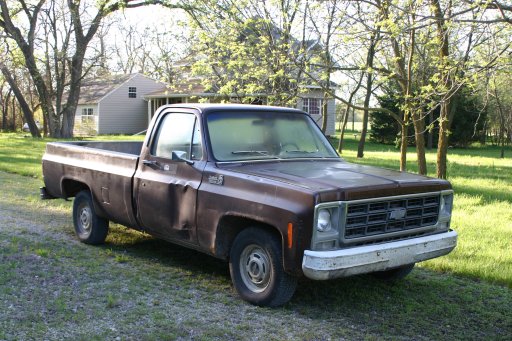
Our society is one that is pretty well defined by timeliness. TV programs start at a precise time, down to the second. Schools have elaborate timekeeping systems. Even church services are carefully timed. We know how fast we re going, and our GPS or phones tell us when we ll get there. And we re pretty confident that we will, in fact, get there. Somehow this doesn t apply to our pickup. This pickup, in case you re wondering, is a thing of stories, shall we say. After a particularly frustrating experience with it one week (oh yes, the battle extended several days), I likened it to the Greek gods. And Terah had a good laughing fit when I began a sentence with The reason there s a towel connecting the brake pedal to the steering wheel But I guess the thrifty side of me won out, and somewhere along the line, I relented. My brother fixed up the carburetor. I got it a new battery. The flat tire is repaired. The starter broke, and I got it replaced. And I even got an oil change. Fancy, I know. So today, when I needed to take some backbreaking junk off the yard, I was hoping the pickup would work. I hadn t driven it in months, and any manner of catastrophe could have struck it in that time. So I was mildly relieved when it started on the 6th try. That is, quite seriously, quite the improvement, and shows how skilled a mechanic my brother is. The speedometer, of course, isn t working. The odometer stupidly reads 21531 or something like that (it was only a 5-digit odometer, broke long ago, so who knows how many miles it really has.) And I like to keep things like grease and heavy ancient air conditioners (one of the things I was hauling) away from my watch, so I wasn t wearing it. The result: I have no idea what time it is, how fast I m going, when I ll get there, IF I ll get there, or all those things. I set out, and made it a good half mile before it died as I was rounding a corner at the bottom of the hill. Always a great place for a finicky old stick-shift vehicle to die, right? Anyhow, a few random adjustments to the choke later, and the thing sputtered then roared (and I do mean roared) back to life. A little lurching up the hill and I was back on my way. Now, I was stuck there in the middle of the road, but it was a country road, so I d have probably had a good hour to get it fixed before worrying about blocking anybody s way. My first stop: my great uncle s place. He has a scrap metal for charity project going on. He is looking for old motors, air conditioners, dehumidifiers, etc. He takes them apart, separates out the metals, sells them, and donates the result to MCC, a world relief agency. I knew I had an old dehumidifier in the basement, and thought I remembered seeing an old window air conditioner in the elevator. That thing is probably the single heaviest object I have ever moved without help. I have a bandaid to prove it. It was way too heavy to carry, so I kind of rolled it, side to side, from the side of the elevator on to the pickup. If you were watching, you d have heard me making struggling noises, followed by BANG rattle rattle rattle pause struggling noises . BANG rattle rattle rattle as I rolled it along the ground, and waited for the internal bits to settle after each quarter turn. So anyway, eventually I got it to the pickup, and then had the sickening realization: I have no way to get this thing up there. Oops. I eventually placed it on top of an old tire rim, balanced it there as I knelt down, and somehow still not quite sure how managed to lift the entire thing a few feet until I could get some leverage to shove it onto the pickup. I later commented to my dad that it was a Chrysler brand air conditioner, somewhat to my surprise, and he said that it was probably my great-grandpa s. That was a surprise. Anyhow, back to the pickup. I drove down the few miles to my great grandpa s place, not really knowing how fast I was going. I smelled the familiar smells of the old pickup: exhaust fumes, oil on hot surfaces it shouldn t be on, a touch of hot antifreeze. You never have any doubt about whether the engine is running. It was sort of nice to not know, or particularly care, how fast I was going, or what time it was. Sometimes I d idly wonder, but you know, it didn t really matter and there wasn t a thing I could do about it anyhow. I got to uncle s place, unloaded the junk sorta dropped the air conditioner off the back of the pickup with a terrific BANG, then rolled it all the way to his trailer and got back in. On to town. I hadn t put gas in the pickup in a few years, and I suspected it was getting low. (The gas gauge, you guessed it, doesn t work right either.) Plus we had some large recyclables built up and it was time to get rid of them. And for that, I had to drive on the highway a ways. The speed limit there is 65MPH. I have no idea how fast I was going, but it wasn t 65. Maybe it was 45. I got passed a lot, but nobody looked particularly surprised that a pickup that looks like mine wasn t going 65. Partway there, I smelled a different smoke smell. Not an oil smoke, but more of a grassy or wood smoke. Hmm, I thought. That s odd. Hope it s not coming from the pickup. I didn t really see smoke anywhere else, so I just drove on until I couldn t smell it anymore. I unloaded the recyclables, then went to the gas station. As the pump readout neared $50, I decided: 1) the gas tank really was pretty empty, and 2) I just can t put more gas in it anymore. That would be more than the truck s worth. So I drove home. The drive home was into the wind. My face got pretty cold I always drive with the windows open to prevent carbon monoxide poisoning (remember the fumes?) I got home and prepared to pack up the pickup close the windows, replace the bungee cord holding the brake pedal up, etc. I then thought I d have a look under the hood to see if there was anything, well, on fire. Nope, but there was a packrat nest that fell down as soon as the wind hit it. Source of grassy-smelling smoke identified. It s amazing what difference simple lack of knowledge makes sometimes. Not knowing what time it is or how fast I m going means I don t have to worry about those things. I wonder how society has changed simply because accurate and cheap watches are available. I kind of like driving the old truck. It s a bit of an adventure, a bit of a challenge, a bit of randomness, and a bit of an escape from the normal and predictable. Not a bad deal for a $75 vehicle.

Iustin Pop: First running event of 2012

Today I had the first running race of 2012. Well, actually, it was my first race in Switzerland ever so double first. And, if I have to be precise, it was my first run with a shiny new Garmin 910XT; while I had it ordered for more than a month, out-of-stock and other delays converged such that I received the new toy the evening before the run. After getting it, I walked around a bit to confirm it's not DOA, read the manual, and hoped it's not too different in basic operation to my old Garmin. So a triple first. Also, (this is the last one, I promise!) this was the first time I ran with a foot pod (pedometer), so it was the first time I got actual cadence measurements. The run I went to the Bremgarter Reusslauf, which is an 11km flat run held in the woods near Bremgarten, a very very nice small town. I have never before visited it (even though it's quite close to Z rich), and I was pleasantly surprised by it. I should go sometimes back and visit a bit more. The weather was cloudy (and just a tiny bit foggy), a bit cold but not much. From this point of view, it was good running weather, but it detracted from the scenery. Otherwise, the course itself was very very enjoyable, I could have used a camera lots. At one point, in the middle of the (light, not dense) woods, the course passed beneath the arm of an excavator which was like a mechanical arch (in the middle of nature); at another point, we crossed the river, and the sight was so nice I had to stop myself from stopping and admiring the view . The course is marked as a 'flat' one, but I've read some blog posts saying that this is not entirely true, so I was prepared for 'the worst'. Actually, I found it to be surprisingly well behaved; even though the finish was near the start, it seemed to me to be 60% downhill, 30% flat and only 10% somewhat-uphill. Garmin 910XT I didn't quite know what to expect, upgrading from my Forerunner 205. I read the very nice review on dcrainmaker, but in practice I didn't know what to expect (review awesome, but soo detailed). The new toy seems more stylish, so I expected worse UI or behaviour. On the contrary, it worked very well; much more responsive to changes in direction/pace (my 205 used to delays tens before adjusting the pace, the 910 is very fast), and new minor features (like auto-lap) were nice (I was able to track average speed on each 1KM lap, very useful). It's a ++ on the upgrade, with the big downside that so far it doesn't seem to work under Linux . It also has a barometric altimeter, but I didn't calibrate it (explicitly); so while the absolute measurements might be off, the relative elevation changes were much more sane than with 205 (GPS is not too good at elevation changes, as far as I know). One funny thing about the delays in getting the device: before the race, another runner asks me (note: the conversation was in German, accuracy not guaranteed):
Is that the new Garmin? Yes, it is, just got it last evening. (showing me his identical watch) Ha! Me too, I got this only two days ago!
So yes, I think a few people were happy to get their new toy before the race. I also have now a heartbeat sensor, but as I never used one before, I didn't want to try it the first time during a race; so I skipped on that. The foot pod on the other hand is practically ignorable, so I took that along (sometime I think I run just because there are nice running toys ). As to accuracy, it was quite OK; it measured 10.86 km instead of the official 11 km, but most/all of the difference was in the first km of the run (inaccuracy while starting to run? who knows). I'll have to see how the watch performs while cycling (uh, I didn't do that in a long while) or swimming ( I didn't do that in an even longer while), but for running it's a good upgrade from my old watch. Results My normal run pace is about 6min/km, which is quite slow. So I didn't expect anything of the race, except to finish it. There were lots of people participating (> 2,600 in the main 11km category). I started slow, because I know I usually start too fast and get tired quickly. This allowed me to not feel the first, and only, significant hill, and after that it was or seemed all downhill (literally, I mean, not figuratively), so in the end I had (for me) a very good time. By the Garmin, I run 10.86 km in 59:01, to an average 5.26 min/km. By the official results, I had 11 km in 58:56, with a pace of 5.21 min/km. I have never before run 10k faster than 5:30, so I was very very happy. As for individual laps (1 km) as recorded by the Garmin: On the overall ranking, I ended up 362 out of 394 in my category. Hah! I'll try to remember this race simply for my own pace results, and ignore the ranking . Honestly I'm not sure how people can run twice as fast need to train more! The foot pod gave me a cadence of 83 steps per minute (average, max 88). This was quite surprising for me, I expected to be significantly below the much talked about 90 steps per minute. But anyway, I have lots of work ahead of me to improve my running speed. Overall, it was an excellent day, and I'm looking forward to the next races in/around Z rich. But I should be careful not to overdo-it, like I do whenever I get excited about something .

25 February 2012

David Bremner: First steps with Racket PLoT

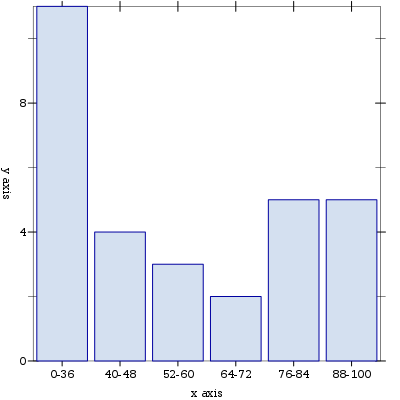
I have been in the habit of using R to make e.g. histograms of test scores in my courses. The main problem is that I don't really need (or am too ignorant to know that I need) the vast statistical powers of R, and I use it rarely enough that its always a bit of a struggle to get the plot I want. racket is a programming language in the scheme family, distinguished from some of its more spartan cousins by its "batteries included" attitude. I recently stumbled upon the PLoT graph (information visualization kind, not networks) plotting module and was pretty impressed with the Snazzy 3D Pictures. So this time I decided try using PLoT for my chores. It worked out pretty well; of course I am not very ambitious. Compared to using R, I had to do a bit more work in data preparation, but it was faster to write the Racket than to get R to do the work for me (again, probably a matter of relative familiarity). racket-hist.png
#lang racket/base
(require racket/list)
(require plot)
(define marks (build-list 30 (lambda (n) (random 25))))
(define out-of 25)
(define breaks '((0  9) (10 12) (13 15) (16 18) (19 21) (22 25)))
(define (per-cent n)
  (ceiling (* 100 (/ n out-of))))
(define (label l)
  (format "~a-~a" (per-cent (first l)) (per-cent (second l))))
(define (buckets l)
  (let ((sorted (sort l <)))
    (for/list ([b breaks])
          (vector (label b)
           (count (lambda (x) (and 
                    (<= x ( second b))
                    (>= x ( first b))))
               marks)))))
(plot
 (list
  (discrete-histogram 
  (buckets marks)))
 #:out-file "racket-hist.png")

24 February 2012

Guido G nther: Iodine plugin for network-manager

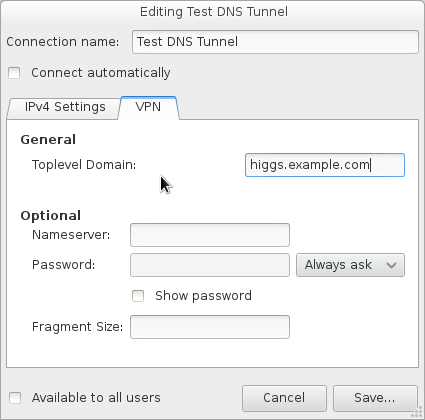
During FOSDEM I finally got around to hack on a iodine plugin for network manager. Given a suitably prepared server on the other end this allows you to tunnel connections over DNS when all other traffic is firewalled. The basic configuration only needs the domain name set: Network Manager Iodine Configuration You can grab the sources from git.gnome.org, a Debian package is also available. This blog is flattr enabled.

Dominique Dumont: Config::Model: new cme command is available

Hello I ve (finally) released a new version of Config::Model. The main change for users is the deprecation of the config-edit program in favor of cme program. Instead of using options, this cme uses command keywords like git, so users will have more possibilities while typing less. bash completion is provided for cme command and options. Following Debian annoucement regarding the recommended format of Debian copyright file (aka DEP-5), I ve also updated the URL in Debian copyright model. If your package is already in a DEP-5 format, you can update the URL with this simple command: cme fix dpkg-copyright Check the wiki on github for more example of cme command. All the best

MJ Ray: Signed the PDFreaders Petition

We, the undersigned, hereby state that we expressly and unequivocally oppose the advertising of proprietary software products on government websites. Such advertising breaches impartiality and encourages citizens to employ technologies that unnecessarily restrict their freedom. The role of government is not to support certain market participants and not others, particularly when doing so works to maintain the monopolies of global software companies. In explanations of how to use digital resources that they provide, government agencies should clarify that multiple methods are available, and favour technologies which do not restrict users digital rights; by linking to PDFreaders.org, for example. Free Software guarantees the users right to use (for any purpose), study (without secrets), share (with anyone), and improve the software that they use. Public institutions should publish their documents in formats that can be read with Free Software. Indeed, many Free Software applications exist for reading such documents. Governments should lead citizens to freedom, and encourage them to make use of these applications. Sincerely,
Our co-op and 56 other businesses, 69 organisations and over 2200 individuals so far. How about adding your signature? Surely it s time for our governments to stop giving free adverts to Adobe? It was particularly annoying in the Digital Britain report, I thought.

Next.

Previous.