Search Results: "cas"

10 July 2016

Ritesh Raj Sarraf: Leprosy in India

During my recent travel, I had quite a long layover at the Doha International Airport in Qatar. While killing time, I watched an interesting programme on the Al Jazeera network. The program aired on Al Jazeera is Lifelines. This special episode I watched, covered about "Leprosy in India". After having watched the entire programme, I felt the urge to blog about it. First of all, it was quite depressing to me, to know through the programme, that the Govt. of India had officially marked "Leprosy" eradicated from India in 2005. As per Wikipedia, "Globally in 2012, the number of chronic cases of leprosy was 189,000, down from some 5.2 million in the 1980s. The number of new cases was 230,000. Most new cases occur in 16 countries, with India accounting for more than half." Of the data presented on Lifelines, they just covered a couple of districts from 2 States (of the 28+ States) of India. So, with many states remaining, and unserveyed, and uncounted, we are far away from making such statements. Given that the Govt., on paper, has marked Leprosy eradicated; so does WHO. Which means that there is no more funding to help people suffering from the disease. And with no Govt. (or International) funding, it is a rather disappointing situation. I come from a small town on the Indo-Nepal intl. border, named Raxaul. And here, I grew up seeing many people who suffered from Leprosy. As a child, I never much understood the disease, because as is mentioned in the programme, I was told it was a communicable disease. Those suffering, were (and are) tagged as Untouchables (Hindi: ). Of my small town, there was and still is a sub-town, named Sunderpur. This town houses patients suffering from Leprosy, from around multiple districts closeby. I've never been there, but have been told that it is run by an NGO, and helps patients fight the disease. Lifelines also reported that fresh surveys done by the Lepra society, just a 3 day campaign, resulted in 3808 new cases of people suffering from Leprosy. That is a big number, given accessibility to small towns only happens once a week on market day. And in 3 days the team hardly covered a couple of district towns. My plea to the Media Houses of India. Please spend some time to look beyond the phony stuff that you mostly present. There are real issues that could be brought to a wider audience. As for the government, it is just depressing to know how rogue some/most of your statements are.

Categories:

Keywords:

Like:

Bits from Debian: New Debian Developers and Maintainers (May and June 2016)

The following contributors got their Debian Developer accounts in the last two months: The following contributors were added as Debian Maintainers in the last two months: Congratulations!

Paul Tagliamonte: SNIff

A while back, I found myself in need of two webservers that would terminate TLS (with different rules). I wanted to run some custom code I d written (which uses TLS peer authentication), and also nginx on port 443. The best way I figured out how to do this was to write a tool to sit on port 443, and parse TLS Client Hello packets, and dispatch to the correct backend depending on the SNI name. SNI, or Server Name Indication allows the client to announce (yes over cleartext!) what server it s looking for, similar to the HTTP Host header. Sometimes, like in the case above, the Host header won t work, since you ve already done a TLS handshake by the time you figure out who they re looking for. I also spun the Client Hello parser out into its own importable package, just in case someone else finds themselves in this same boat. The code s up on github.com/paultag/sniff!

Sune Vuorela: Let Qt models meet std::vector<std::tuple< >>

The problem So. I was stuck with a container of tuples that I wanted to see in a Qt view (QTableView, QtQuick ListView or similar). So how to do that? Another problem: I haven t been doing fun things with templates recently. A solution? After a bit of hacking, it seems like it can just be done like
typedef std::tuple<std::string, QString> Element;
typedef std::vector List;
List list =   std::make_tuple("first", "second"), 
              std::make_tuple("third", "fourth")  ;
std::unique_ptr<TableModel> magic = createTableModel(list);
QTableView view;
view.setModel(magic->model());
and tada:
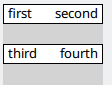
QTableView Of course, we are also QtQuick friendly
std::unique_ptr<ListModel>List>> magic = createListModel(list);
// expose magic->model() to your quickview
and a delegate containing the following
Text  
    text: role0
 
Text  
    text: role1
 
can give:
ListView But enough about creation. Whattabout manipulation? Luckily we got you covered. Insert two extra rows at position 1?
auto lines =   std::make_tuple("extra", "extra"),
               std::make_tuple("extra2","extra2")  ;
magic->insertRows(1,lines.begin(), lines.end());
Append a row?
magic->appendRow(std::make_tuple("",""));
Remove 2 rows at position 3?
magic->removeRow(3,2);
Replace the underlying list?
List newList;
// fill list
magic->reset(newList);
Read-only looping over the elements?
for(const Element& e : magic->list())
 
    ...
 
The Qt model of course also accepts setData calls. Future? If anyone is interested I will polish the code a bit and publish it. If that s the case, how should I name this thing? And I did get around doing fun things with templates again.

Craig Small: procps 3.3.12

The procps developers are happy to announce that version 3.3.12 of procps was released today. This version has a mixture of bug fixes and enhancements. This unfortunately means another API bump but we are hoping this will be fixed with the new library API coming soon. procps is developed on gitlab and the new version of procps can be found at https://gitlab.com/procps-ng/procps/tree/newlib procps 3.3.12 can be found at https://gitlab.com/procps-ng/procps/tags/v3.3.12 From the NEWS file, procps 3.1.12 has the following: We are hoping this will be the last one to use the old API and the new format API ( imaginatively called newlib ) will be used in subsequent releases. Feedback for this and any other version of procps can be sent to either the issue tracker or the development email list.

8 July 2016

Mike Hommey: Are all integer overflows equal?

Background: I ve been relearning Rust (more about that in a separate post, some time later), and in doing so, I chose to implement the low-level parts of git (I ll touch the why in that separate post I just promised). Disclaimer: It s friday. This is not entirely(?) a serious post. So, I was looking at Documentation/technical/index-format.txt, and saw:
32-bit number of index entries.
What? The index/staging area can t handle more than ~4.3 billion files? There I was, writing Rust code to write out the index.
try!(out.write_u32::<NetworkOrder>(self.entries.len()));
(For people familiar with the byteorder crate and wondering what NetworkOrder is, I have a use byteorder::BigEndian as NetworkOrder) And the Rust compiler rightfully barfed:
error: mismatched types:
 expected  u32 ,
    found  usize  [E0308]
And there I was, wondering: mmmm should I just add as u32 and silently truncate or hey what does git do? And it turns out, git uses an unsigned int to track the number of entries in the first place, so there is no truncation happening. Then I thought but what happens when cache_nr reaches the max? Well, it turns out there s only one obvious place where the field is incremented. What? Holy coffin nails, Batman! No overflow check? Wait a second, look 3 lines above that:
ALLOC_GROW(istate->cache, istate->cache_nr + 1, istate->cache_alloc);
Yeah, obviously, if you re incrementing cache_nr, you already have that many entries in memory. So, how big would that array be?
        struct cache_entry **cache;
So it s an array of pointers, assuming 64-bits pointers, that s ~34.3 GB. But, all those cache_nr entries are in memory too. How big is a cache entry?
struct cache_entry  
        struct hashmap_entry ent;
        struct stat_data ce_stat_data;
        unsigned int ce_mode;
        unsigned int ce_flags;
        unsigned int ce_namelen;
        unsigned int index;     /* for link extension */
        unsigned char sha1[20];
        char name[FLEX_ARRAY]; /* more */
 ;
So, 4 ints, 20 bytes, and as many bytes as necessary to hold a path. And two inline structs. How big are they?

struct hashmap_entry  
        struct hashmap_entry *next;
        unsigned int hash;
 ;
struct stat_data  
        struct cache_time sd_ctime;
        struct cache_time sd_mtime;
        unsigned int sd_dev;
        unsigned int sd_ino;
        unsigned int sd_uid;
        unsigned int sd_gid;
        unsigned int sd_size;
 ;
Woohoo, nested structs.
struct cache_time  
        uint32_t sec;
        uint32_t nsec;
 ;
So all in all, we re looking at 1 + 2 + 2 + 5 + 4 32-bit integers, 1 64-bits pointer, 2 32-bits padding, 20 bytes of sha1, for a total of 92 bytes, not counting the variable size for file paths. The average path length in mozilla-central, which only has slightly over 140 thousands of them, is 59 (including the terminal NUL character). Let s conservatively assume our crazy repository would have the same average, making the average cache entry 151 bytes. But memory allocators usually allocate more than requested. In this particular case, with the default allocator on GNU/Linux, it s 156 (weirdly enough, it s 152 on my machine). 156 times 4.3 billion 670 GB. Plus the 34.3 from the array of pointers: 704.3 GB. Of RAM. Not counting the memory allocator overhead of handling that. Or all the other things git might have in memory as well (which apparently involves a hashmap, too, but I won t look at that, I promise). I think one would have run out of memory before hitting that integer overflow. Interestingly, looking at Documentation/technical/index-format.txt again, the on-disk format appears smaller, with 62 bytes per file instead of 92, so the corresponding index file would be smaller. (And in version 4, paths are prefix-compressed, so paths would be smaller too). But having an index that large supposes those files are checked out. So let s say I have an empty ext4 file system as large as possible (which I m told is 2^60 bytes (1.15 billion gigabytes)). Creating a small empty ext4 tells me at least 10 inodes are allocated by default. I seem to remember there s at least one reserved for the journal, there s the top-level directory, and there s lost+found ; there apparently are more. Obviously, on that very large file system, We d have a git repository. git init with an empty template creates 9 files and directories, so that s 19 more inodes taken. But git init doesn t create an index, and doesn t have any objects. We d thus have at least one file for our hundreds of gigabyte index, and at least 2 who-knows-how-big files for the objects (a pack and its index). How many inodes does that leave us with? The Linux kernel source tells us the number of inodes in an ext4 file system is stored in a 32-bits integer. So all in all, if we had an empty very large file system, we d only be able to store, at best, 2^32 22 files And we wouldn t even be able to get cache_nr to overflow. while following the rules. Because the index can keep files that have been removed, it is actually possible to fill the index without filling the file system. After hours (days? months? years? decades?*) of running
seq 0 4294967296   while read i; do touch $i; git update-index --add $i; rm $i; done
One should be able to reach the integer overflow. But that d still require hundreds of gigabytes of disk space and even more RAM. Ok, it s actually much faster to do it hundreds of thousand files at a time, with something like:
seq 0 100000 4294967296   while read i; do j=$(seq $i $(($i + 99999))); touch $j; git update-index --add $j; rm $j; done
At the rate the first million files were added, still assuming a constant rate, it would take about a month on my machine. Considering reading/writing a list of a million files is a thousand times faster than reading a list of a billion files, assuming linear increase, we re still talking about decades, and plentiful RAM. Fun fact: after leaving it run for 5 times as much as it had run for the first million files, it hasn t even done half more One could generate the necessary hundreds-of-gigabytes index manually, that wouldn t be too hard, and assuming it could be done at about 1 GB/s on a good machine with a good SSD, we d be able to craft a close-to-explosion index within a few minutes. But we d still lack the RAM to load it. So, here is the open question: should I report that integer overflow? Wow, that was some serious procrastination. Edit: Epilogue: Actually, oops, there is a separate integer overflow on the reading side that can trigger a buffer overflow, that doesn t actually require a large index, just a crafted header, demonstrating that yes, not all integer overflows are equal.

Russell Coker: Nexus 6P and Galaxy S5 Mini

Just over a month ago I ordered a new Nexus 6P [1]. I ve had it for over a month now and it s time to review it and the Samsung Galaxy S5 Mini I also bought. Security The first noteworthy thing about this phone is the fingerprint scanner on the back. The recommended configuration is to use your fingerprint for unlocking the phone which allows a single touch on the scanner to unlock the screen without the need to press any other buttons. To unlock with a pattern or password you need to first press the power button to get the phone s attention. I have been considering registering a fingerprint from my non-dominant hand to reduce the incidence of accidentally unlocking it when carrying it or fiddling with it. The phone won t complete the boot process before being unlocked. This is a good security feature. Android version 6 doesn t assign permissions to apps at install time, they have to be enabled at run time (at least for apps that support Android 6). So you get lots of questions while running apps about what they are permitted to do. Unfortunately there s no allow for the duration of this session option. A new Android feature prevents changing security settings when there is an overlay running . The phone instructs you to disable overlay access for the app in question but that s not necessary. All that is necessary is for the app to stop using the overlay feature. I use the Twilight app [2] to dim the screen and use redder colors at night. When I want to change settings at night I just have to pause that app and there s no need to remove the access from it note that all the web pages and online documentation saying otherwise is wrong. Another new feature is to not require unlocking while at home. This can be a convenience feature but fingerprint unlocking is so easy that it doesn t provide much benefit. The downside of enabling this is that if someone stole your phone they could visit your home to get it unlocked. Also police who didn t have a warrant permitting search of a phone could do so anyway without needing to compel the owner to give up the password. Design This is one of the 2 most attractive phones I ve owned (the other being the sparkly Nexus 4). I think that the general impression of the appearance is positive as there are transparent cases on sale. My phone is white and reminds me of EVE from the movie Wall-E. Cables This phone uses the USB Type-C connector, which isn t news to anyone. What I didn t realise is that full USB-C requires that connector at both ends as it s not permitted to have a data cable with USB-C at the device and and USB-A at the host end. The Nexus 6P ships with a 1M long charging cable that has USB-C at both ends and a ~10cm charging cable with USB-C at one end and type A at the other (for the old batteries and the PCs that don t have USB-C). I bought some 2M long USB-C to USB-A cables for charging my new phone with my old chargers, but I haven t yet got a 1M long cable. Sometimes I need a cable that s longer than 10cm but shorter than 2M. The USB-C cables are all significantly thicker than older USB cables. Part of that would be due to having many more wires but presumably part of it would be due to having thicker power wires for delivering 3A. I haven t measured power draw but it does seem to charge faster than older phones. Overall the process of converting to USB-C is going to be a lot more inconvenient than USB SuperSpeed (which I could basically ignore as non-SuperSpeed connectors worked). It will be good when laptops with USB-C support become common, it should allow thinner laptops with more ports. One problem I initially had with my Samsung Galaxy Note 3 was the Micro-USB SuperSpeed socket on the phone being more fiddly for the Micro-USB charging plug I used. After a while I got used to that but it was still an annoyance. Having a symmetrical plug that can go into the phone either way is a significant convenience. Calendars and Contacts I share most phone contacts with my wife and also have another list that is separate. In the past I had used the Samsung contacts system for the contacts that were specific to my phone and a Google account for contacts that are shared between our phones. Now that I m using a non-Samsung phone I got another Gmail account for the purpose of storing contacts. Fortunately you can get as many Gmail accounts as you want. But it would be nice if Google supported multiple contact lists and multiple calendars on a single account. Samsung Galaxy S5 Mini Shortly after buying the Nexus 6P I decided that I spend enough time in pools and hot tubs that having a waterproof phone would be a good idea. Probably most people wouldn t consider reading email in a hot tub on a cruise ship to be an ideal holiday, but it works for me. The Galaxy S5 Mini seems to be the cheapest new phone that s waterproof. It is small and has a relatively low resolution screen, but it s more than adequate for a device that I ll use for an average of a few hours a week. I don t plan to get a SIM for it, I ll just use Wifi from my main phone. One noteworthy thing is the amount of bloatware on the Samsung. Usually when configuring a new phone I m so excited about fancy new hardware that I don t notice it much. But this time buying the new phone wasn t particularly exciting as I had just bought a phone that s much better. So I had more time to notice all the annoyances of having to download updates to Samsung apps that I ll never use. The Samsung device manager facility has been useful for me in the past and the Samsung contact list was useful for keeping a second address book until I got a Nexus phone. But most of the Samsung apps and 3d party apps aren t useful at all. It s bad enough having to install all the Google core apps. I ve never read mail from my Gmail account on my phone. I use Fetchmail to transfer it to an IMAP folder on my personal mail server and I d rather not have the Gmail app on my Android devices. Having any apps other than the bare minimum seems like a bad idea, more apps in the Android image means larger downloads for an over-the-air update and also more space used in the main partition for updates to apps that you don t use. Not So Exciting In recent times there hasn t been much potential for new features in phones. All phones have enough RAM and screen space for all common apps. While the S5 Mini has a small screen it s not that small, I spent many years with desktop PCs that had a similar resolution. So while the S5 Mini was released a couple of years ago that doesn t matter much for most common use. I wouldn t want it for my main phone but for a secondary phone it s quite good. The Nexus 6P is a very nice phone, but apart from USB-C, the fingerprint reader, and the lack of a stylus there s not much noticeable difference between that and the Samsung Galaxy Note 3 I was using before. I m generally happy with my Nexus 6P, but I think that anyone who chooses to buy a cheaper phone probably isn t going to be missing a lot.

7 July 2016

Matthew Garrett: Bluetooth LED bulbs

The best known smart bulb setups (such as the Philips Hue and the Belkin Wemo) are based on Zigbee, a low-energy, low-bandwidth protocol that operates on various unlicensed radio bands. The problem with Zigbee is that basically no home routers or mobile devices have a Zigbee radio, so to communicate with them you need an additional device (usually called a hub or bridge) that can speak Zigbee and also hook up to your existing home network. Requests are sent to the hub (either directly if you're on the same network, or via some external control server if you're on a different network) and it sends appropriate Zigbee commands to the bulbs.

But requiring an additional device adds some expense. People have attempted to solve this in a couple of ways. The first is building direct network connectivity into the bulbs, in the form of adding an 802.11 controller. Go through some sort of setup process[1], the bulb joins your network and you can communicate with it happily. Unfortunately adding wifi costs more than adding Zigbee, both in terms of money and power - wifi bulbs consume noticeably more power when "off" than Zigbee ones.

There's a middle ground. There's a large number of bulbs available from Amazon advertising themselves as Bluetooth, which is true but slightly misleading. They're actually implementing Bluetooth Low Energy, which is part of the Bluetooth 4.0 spec. Implementing this requires both OS and hardware support, so older systems are unable to communicate. Android 4.3 devices tend to have all the necessary features, and modern desktop Linux is also fine as long as you have a Bluetooth 4.0 controller.

Bluetooth is intended as a low power communications protocol. Bluetooth Low Energy (or BLE) is even lower than that, running in a similar power range to Zigbee. Most semi-modern phones can speak it, so it seems like a pretty good choice. Obviously you lose the ability to access the device remotely, but given the track record on this sort of thing that's arguably a benefit. There's a couple of other downsides - the range is worse than Zigbee (but probably still acceptable for any reasonably sized house or apartment), and only one device can be connected to a given BLE server at any one time. That means that if you have the control app open while you're near a bulb, nobody else can control that bulb until you disconnect.

The quality of the bulbs varies a great deal. Some of them are pure RGB bulbs and incapable of producing a convincing white at a reasonable intensity[2]. Some have additional white LEDs but don't support running them at the same time as the colour LEDs, so you have the choice between colour or a fixed (and usually more intense) white. Some allow running the white LEDs at the same time as the RGB ones, which means you can vary the colour temperature of the "white" output.

But while the quality of the bulbs varies, the quality of the apps doesn't really. They're typically all dreadful, competing on features like changing bulb colour in time to music rather than on providing a pleasant user experience. And the whole "Only one person can control the lights at a time" thing doesn't really work so well if you actually live with anyone else. I was dissatisfied.

I'd met Mike Ryan at Kiwicon a couple of years back after watching him demonstrate hacking a BLE skateboard. He offered a couple of good hints for reverse engineering these devices, the first being that Android already does almost everything you need. Hidden in the developer settings is an option marked "Enable Bluetooth HCI snoop log". Turn that on and all Bluetooth traffic (including BLE) is dumped into /sdcard/btsnoop_hci.log. Turn that on, start the app, make some changes, retrieve the file and check it out using Wireshark. Easy.

Conveniently, BLE is very straightforward when it comes to network protocol. The only thing you have is GATT, the Generic Attribute Protocol. Using this you can read and write multiple characteristics. Each packet is limited to a maximum of 20 bytes. Most implementations use a single characteristic for light control, so it's then just a matter of staring at the dumped packets until something jumps out at you. A pretty typical implementation is something like:

0x56,r,g,b,0x00,0xf0,0x00,0xaa

where r, g and b are each just a single byte representing the corresponding red, green or blue intensity. 0x56 presumably indicates a "Set the light to these values" command, 0xaa indicates end of command and 0xf0 indicates that it's a request to set the colour LEDs. Sending 0x0f instead results in the previous byte (0x00 in this example) being interpreted as the intensity of the white LEDs. Unfortunately the bulb I tested that speaks this protocol didn't allow you to drive the white LEDs at the same time as anything else - setting the selection byte to 0xff didn't result in both sets of intensities being interpreted at once. Boo.

You can test this out fairly easily using the gatttool app. Run hcitool lescan to look for the device (remember that it won't show up if anything else is connected to it at the time), then do gatttool -b deviceid -I to get an interactive shell. Type connect to initiate a connection, and once connected send commands by doing char-write-cmd handle value using the handle obtained from your hci dump.

I did this successfully for various bulbs, but annoyingly hit a problem with one from Tikteck. The leading byte of each packet was clearly a counter, but the rest of the packet appeared to be garbage. For reasons best known to themselves, they've implemented application-level encryption on top of BLE. This was a shame, because they were easily the best of the bulbs I'd used - the white LEDs work in conjunction with the colour ones once you're sufficiently close to white, giving you good intensity and letting you modify the colour temperature. That gave me incentive, but figuring out the protocol took quite some time. Earlier this week, I finally cracked it. I've put a Python implementation on Github. The idea is to tie it into Ulfire running on a central machine with a Bluetooth controller, making it possible for me to control the lights from multiple different apps simultaneously and also integrating with my Echo.

I'd write something about the encryption, but I honestly don't know. Large parts of this make no sense to me whatsoever. I haven't even had any gin in the past two weeks. If anybody can explain how anything that's being done there makes any sense at all[3] that would be appreciated.

[1] typically via the bulb pretending to be an access point, but also these days through a terrifying hack involving spewing UDP multicast packets of varying lengths in order to broadcast the password to associated but unauthenticated devices and good god the future is terrifying

[2] For a given power input, blue LEDs produce more light than other colours. To get white with RGB LEDs you either need to have more red and green LEDs than blue ones (which costs more), or you need to reduce the intensity of the blue ones (which means your headline intensity is lower). Neither is appealing, so most of these bulbs will just give you a blue "white" if you ask for full red, green and blue

[3] Especially the bit where we calculate something from the username and password and then encrypt that using some random numbers as the key, then send 50% of the random numbers and 50% of the encrypted output to the device, because I can't even

comment count unavailable comments

Lior Kaplan: Anonymous CVE requests

A year ago I ve blogged about people requesting CVE without letting upstream know. On the other hand, per requests from Debian, I m working on improving PHP upstream CVE request process. For the last few release this means I ask the security list members which issues they think should have CVE and ask for them in parallel to the release being made (usually in the space between the release being tagged publicly and is actually announced). In the last week, I ve encountered a case where a few CVE were assigned to old PHP issues without any public notice. The fixes for these issues have been published a year ago (August 2015). And I find out about these assignment through warning published by the distributions (mostly Debian, which I m close to). Sometimes things fall between the chairs, and it s perfectly OK to ask for CVE to make sure security issues do get attention even if time has passed. But after the issues (and fixes) are public, I don t see a reason to do so without making the request itself public as well. And even if the request wasn t public, at least notify upstream so this info can be added to the right places. Most of these bug were found out when I started to add sequential number into the CVE search after getting an a notice from Debian for two of the issues. And while working on processing these issues for PHP, I also notice they weren t updated for libGD where appropriate (including recent issues). Beyond keeping the eco-system up to date, another aspect of publicity is getting opinions from other parties. For example, in the case of CVE-2015-8879, RedHat doesn t agree with the classification of the bug as security. To give an example of a way things should happen is the request of CVE for PHP 5.5.34 in April, in which the Gentoo security team asked for assignment without upstream knowledge, Debian representative CCs upstream (Thanks!) and also asks CVE for issues covered by Ubuntu, to which the Ubuntu guy then adds some details. I hope this blog post will reach the anonymous people behind these CVE requests, and also the people assigning them. Without transparency and keeping things in synchronization, the idea of having a centralized location for security warning is not going to accomplish its goals.
Filed under: Debian GNU/Linux, PHP

Michal &#268;iha&#345;: uTidylib 0.3

Several years ago I've complained about uTidylib not being maintained upstream. Since that time I've occasionally pushed some fixes to my GitHub repository with uTidylib code, but without any clear intentions to take it over. Time has gone and there was still no progress and I started to consider becoming upstream maintainer as well. I quickly got approval from Cory Dodt, who was the original author of this code, unfortunately he is not owner of the PyPI entry and the claim request seems to have no response (if you know how to get in touch with "cntrlr" or how to take over PyPI module please let me know). Anyway the amount of patches in my repository is big enough to warrant new release. Additionally Debian bug report about supporting new HTML tidy library came in and that made me push towards releasing 0.3 version of the uTidylib. As you might guess, the amount of changes against original uTidylib is quite huge, to name the most important ones: Anyway as I can not update PyPI entry, the downloads are currently available only on my website: https://cihar.com/software/utidylib/

Filed under: Debian English uTidylib 0 comments

Sean Whitton: Kant and tear gas

Over the past year I ve been refining my understanding of the core claims of Kantian ethics. I ve realised that I have deeply Kantian intuitions about a lot of issues, and I understand these intuitions better now that I can put them in Kantian terms. Consider two exercises of state power: riot police suppressing protesters by non-lethal means, and soldiers shooting protesters to death. I feel more uncomfortable thinking about the first: there s something altogether more sinister about it than the second, even though the second is much more sad. I think that the reason is that non-lethal weaponry is designed to take away people s agency, and it often achieves this aim by means of emotional manipulation. Riot police use so-called baton charges to incite fearful retreat. Protesters have reasoned that in their political situation, they have a duty to resist the incumbent government. Riot police seek to unseat this conviction and cause fear to determine what the protesters will do. In Kantian terms, the riot police fail to respect the moral agency of the protesters by seeking to unseat the moral personality s determination of what the protester will do. A controversial example that Kant uses to make this point is the axe murderer case. Kant asks us to imagine that someone bangs on our front door and begs us to hide him in our house, because someone who wishes to kill him is coming up behind them. We do so. When the axe murderer arrives, he goes door-to-door and asks us whether the intended victim is in each house. Kant says that it is morally wrong to lie to the axe murderer and say that the victim is not in your house. How could this be? Surely there is a moral duty to protect the victim from being killed? Indeed there is, but when it comes into conflict with the duty not to lie, that second duty wins out. That s because respecting the moral agency of individuals is paramount. In this case, we would fail to respect the murderer s agency if we didn t allow him to take the decision to murder or not murder the victim; by lying to him we (disrespectfully) bypass his choice as to whether to do it. It s obviously crazy to say that we are morally required to give up the victim. Kant gives the wrong answer in this case. However, the case definitely reveals a requirement to respect other people s view of what they should do, and give them a chance to do it. Similarly it seems like we shouldn t give semi-automatics to our riot police, but there s something wrong with a lot of what they do. During the recent campaigns about Britain s EU referendum, some criticised Jeremy Corbyn s campaigning on the grounds that he failed to make an emotional appeal, instead asking people to make their own rational decision when they come to cast their vote. So he lost out the emotional appeals other people were making. It seems that he was successfully respecting individual agency. You ve got to give people a chance to live up to their own idea of what they should do. I m not sure how to reconcile these various ideas, and I m not sure what it says about me that I find non-lethal weaponry as uncomfortable as I do.

6 July 2016

Daniel Pocock: Avoiding SMS vendor lock-in with SMPP

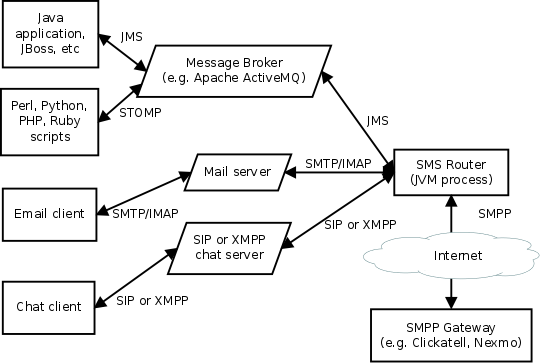
There is increasing demand for SMS notifications about monitoring alerts, trading notifications, flight delays and other events. Various companies are offering SMS transmission services to meet this demand and many of them aggressively pushing their own proprietary interfaces to the SMS world rather than using the more open and widely supported SMPP. There is good reason for this: if users write lots of of scripts to access the REST API of an SMS service, the users won't be able to change their service provider without having to change all their code. Well, that is good if you are an SMPP vendor but not if you are their customer. If an SMS gateway company goes out of business or has a system meltdown, the customers linked to their REST API will have a much bigger effort to migrate to a new provider than those using SMPP. The HTTP REST APIs offered by many vendors hide some details of the SMS protocol and payload. At first glance, this may feel easier. In fact, this leads to unpredictable results when delivering messages to users in different countries and different character sets/languages. It is better to start with SMPP from the beginning and avoid discovering those pitfalls later. The SMS Router free/open source software project helps overcome the SMPP learning curve by using APIs you are already familiar with. More troublesome for large organizations, some of the REST APIs offered by SMS gateways want to make callbacks to your own servers: this means your servers need public IP addresses accessible from the Internet. In some organizations that can take months to organize. SMPP works over one or more outgoing TCP connections initiated from your own server(s) and doesn't require any callback connections from the SMPP gateway. SMS Router lets SMS users have the best of both worlds: the flexibility of linking to any provider who supports SMPP and the convenience of putting messages into the system using any of the transports supported by an Apache Camel component. Popular examples include camel-jms (JMS) for Java and J2EE users, STOMP for scripting languages, camel-mail (SMTP and IMAP) for email integration and camel-sip (SIP) or camel-xmpp (XMPP) for chat/instant messaging systems. If you really want to, you can also create your own in-house HTTP REST API too using camel-restlet for internal applications. In all these cases, SMS Router always uses standard SMPP to reach any gateway of your choice. Architecture overview SMS Router is based on Apache Camel. Multiple instances can be operated in parallel for clustering, load balancing and high availability. It can be monitored using JMX solutions such as JMXetric. The SMPP support is based on the camel-smpp component which is in turn based on the jSMPP library, which comprehensively implements the SMPP protocol in Java. camel-smpp can be used with minimal configuration but for those who want to, many SMPP features can be tweaked on a per-message basis using various headers. The SMPP gateway settings can be configured and changed at will using the sms-router.properties file. The process doesn't require any other files or databases at runtime. The SMS Router is ready-to-run with one queue for sending messages and another queue for incoming messages. The routing logic can be customized by editing the RouteBuilder class to use other Camel components or any of Camel's wide range of functions for inspecting, modifying and routing messages. For example, you can extend it to failover to multiple SMPP gateways using Camel's load-balancer pattern. SMS Router based projects are already used successfully in production, for example, the user registration mechanism for the Lumicall secure VoIP app for Android. Getting started See the README for instructions. Feel free to ask questions about this project on the Camel users mailing list. Disclaimer SMS is not considered secure, the SMS Router developers and telecommunications industry experts discourage the use of this technology for two-factor authentication. Please see the longer disclaimer in the README file and my earlier blog about SMS logins: an illusion of security. The bottom line: if your application is important enough to need two-factor authentication, do it correctly using smart cards or tokens. There are many popular free software projects based on these full cryptographic solutions, for example, the oath-toolkit and dynalogin.

Mike Gabriel: [Arctica Project] Release of nx-libs (version 3.5.99.0)

Introduction NX is a software suite which implements very efficient compression of the X11 protocol. This increases performance when using X applications over a network, especially a slow one. NX (v3) has been originally developed by NoMachine and has been Free Software ever since. Since NoMachine obsoleted NX (v3) some time back in 2013/2014, the maintenance has been continued by a versatile group of developers. The work on NX (v3) is being continued under the project name "nx-libs". History Until January 2015, nx-libs was more mainly a redistribution approach of the original NX (v3) software. We (we as in mainly a group of X2Go developers) kept changes applied to the original NoMachine sources as minimal as possible. We also kept the original files and folders structure. Patches had been maintained via the quilt utility on top of a Git repository, the patches had always been kept separate. That was the 3.5.0.x series of nx-libs. In January 2015, the characteristics of nx-libs as maintained by the X2Go project between 2011 and 2015 changed. A decision was reached: This effort is now about to be released as "nx-libs 3.6.0.0". Contributors Since 2011, the nx-libs code base has to a great extent been maintained in the context of the X2Go Project [1]. Qindel Group joining in... In 2014, developers from the Qindel Group [2] joined the nx-libs maintenance. They found X2Go's work on nx-libs and suggested joining forces as best as possible on hacking nx-libs. The Arctica Project comming up... Starting in January 2015, the development on the 3.6.x branch of the project was moved into a new project called the Arctica Project [3]. Development Funding by Qindel In September 2015, a funding project was set up at Qindel. Since then, the Qindel group greatly supports the development of nx-libs 3.6.x monetarily and with provided man power. The funding project officially is a cooperation between Qindel and DAS-NETZWERKTEAM (business run by Mike Gabriel, long term maintainer of nx-libs). The funding is split into two subprojects and lasts until August 2017: The current nx-libs development effort is coordinated in the context of the Arctica Project (by Mike Gabriel), with use cases in Arctica, X2Go and TheQVD (VDI product worked on at Qindel) in mind. People involved There are various people involved in nx-libs 3.6.x maintenance and development, some of them shall be explicitly named here (in alphabetical order of surnames): Some other people have contributed, but have left the project already. Thanks for your work on nx-libs: A big thanks to everyone involved!!! Special thanks go to Stefan Baur for employing Mihai Moldovan and handling all the bureaucracy, so that Mihai can work on this project and get funded for his work. Achievements of nx-libs 3.5.99.0 We are very close to our self-defined release goal 3.6.0. The below tasks have already been (+/-) completed for version 3.5.99.0: In a previous blog post [4], the code reduction in nx-libs has already been discussed. With this announcement, we want to give a status update about our effort of shrinking the nx-libs code base:
    [mike@minobo nx-libs (3.6.x)]$ cloc --match-f '.*\.(c cpp h)' .
        1896 text files.
        1896 unique files.                                          
        7430 files ignored.
    http://cloc.sourceforge.net v 1.60  T=5.88 s (307.3 files/s, 143310.5 lines/s)
    -------------------------------------------------------------------------------
    Language                     files          blank        comment           code
    -------------------------------------------------------------------------------
    C                              958          68574          74891         419638
    C/C++ Header                   730          25683          33957         130418
    C++                            120          17007          11721          61292
    -------------------------------------------------------------------------------
    SUM:                          1808         111264         120569         611348
    -------------------------------------------------------------------------------
The previous statistics had these sums in the last line. First the nx-libs 3.5.0.x code tree (where we came from):
    -------------------------------------------------------------------------------
    SUM:                          5614         329279         382337        1757743
    -------------------------------------------------------------------------------
Then the nx-libs 3.6.x status as it was on May 9th 2016:
    -------------------------------------------------------------------------------
    SUM:                          1922         118581         126783         662635
    -------------------------------------------------------------------------------
Another 50.000 lines of code have been removed over the past two months. Work pending for the final 3.6.0 release goal Known Issues There are several open issues on the nx-libs Github project space, see https://github.com/ArcticaProject/nx-libs/issues. Testing the nx-libs 3.5.99.0 We are currently working on provisioning release builds and nightly builds of nx-libs for various recent Linux distributions. Please stay tuned and watch Mike Gabriel's blog [5]. We already have nightly builds of nx-libs for Debian and Ubuntu [6], but there are more to come soon. Until now, please use the build recipes provided in the README.md file of the nx-libs source tree [7]. References

4 July 2016

Benjamin Mako Hill: Studying the relationship between remixing & learning

With more than 10 million users, the Scratch online community is the largest online community where kids learn to program. Since it was created, a central goal of the community has been to promote remixing the reworking and recombination of existing creative artifacts. As the video above shows, remixing programming projects in the current web-based version of Scratch is as easy is as clicking on the see inside button in a project web-page, and then clicking on the remix button in the web-based code editor. Today, close to 30% of projects on Scratch are remixes. Remixing plays such a central role in Scratch because its designers believed that remixing can play an important role in learning. After all, Scratch was designed first and foremost as a learning community with its roots in the Constructionist framework developed at MIT by Seymour Papert and his colleagues. The design of the Scratch online community was inspired by Papert s vision of a learning community similar to Brazilian Samba schools (Henry Jenkins writes about his experience of Samba schools in the context of Papert s vision here), and a comment Marvin Minsky made in 1984:
Adults worry a lot these days. Especially, they worry about how to make other people learn more about computers. They want to make us all computer-literate. Literacy means both reading and writing, but most books and courses about computers only tell you about writing programs. Worse, they only tell about commands and instructions and programming-language grammar rules. They hardly ever give examples. But real languages are more than words and grammar rules. There s also literature what people use the language for. No one ever learns a language from being told its grammar rules. We always start with stories about things that interest us.
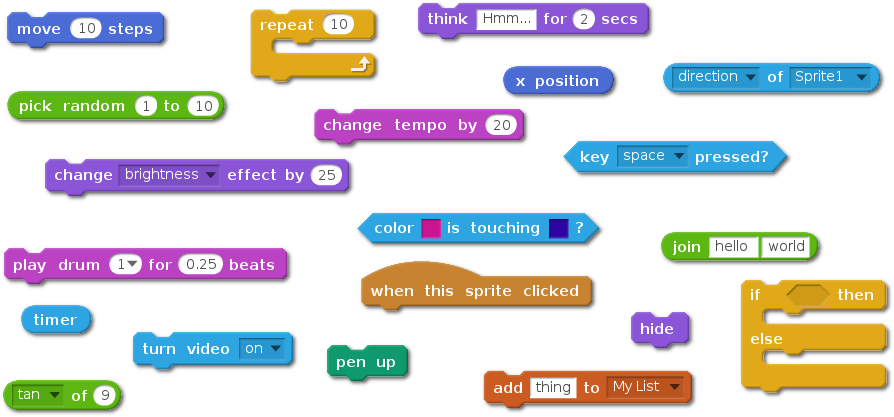
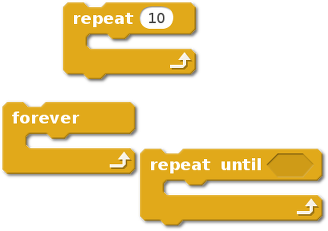
In a new paper titled Remixing as a pathway to Computational Thinking that was recently published at the ACM Conference on Computer Supported Collaborative Work and Social Computing (CSCW) conference, we used a series of quantitative measures of online behavior to try to uncover evidence that might support the theory that remixing in Scratch is positively associated with learning. scratchblocksOf course, because Scratch is an informal environment with no set path for users, no lesson plan, and no quizzes, measuring learning is an open problem. In our study, we built on two different approaches to measure learning in Scratch. The first approach considers the number of distinct types of programming blocks available in Scratch that a user has used over her lifetime in Scratch (there are 120 in total) something that can be thought of as a block repertoire or vocabulary. This measure has been used to model informal learning in Scratch in an earlier study. Using this approach, we hypothesized that users who remix more will have a faster rate of growth for their code vocabulary. Controlling for a number of factors (e.g. age of user, the general level of activity) we found evidence of a small, but positive relationship between the number of remixes a user has shared and her block vocabulary as measured by the unique blocks she used in her non-remix projects. Intriguingly, we also found a strong association between the number of downloads by a user and her vocabulary growth. One interpretation is that this learning might also be associated with less active forms of appropriation, like the process of reading source code described by Minksy. The second approach we used considered specific concepts in programming, such as loops, or event-handling. To measure this, we utilized a mapping of Scratch blocks to key programming concepts found in this paper by Karen Brennan and Mitchel Resnick. For example, in the image below are all the Scratch blocks mapped to the concept of loop . scratchblocksctWe looked at six concepts in total (conditionals, data, events, loops, operators, and parallelism). In each case, we hypothesized that if someone has had never used a given concept before, they would be more likely to use that concept after encountering it while remixing an existing project. Using this second approach, we found that users who had never used a concept were more likely to do so if they had been exposed to the concept through remixing. Although some concepts were more widely used than others, we found a positive relationship between concept use and exposure through remixing for each of the six concepts. We found that this relationship was true even if we ignored obvious examples of cutting and pasting of blocks of code. In all of these models, we found what we believe is evidence of learning through remixing. Of course, there are many limitations in this work. What we found are all positive correlations we do not know if these relationships are causal. Moreover, our measures do not really tell us whether someone has understood the usage of a given block or programming concept.However, even with these limitations, we are excited by the results of our work, and we plan to build on what we have. Our next steps include developing and utilizing better measures of learning, as well as looking at other methods of appropriation like viewing the source code of a project.

This blog post and the paper it describes are collaborative work with Sayamindu Dasgupta, Andr s Monroy-Hern ndez, and William Hale. The paper is released as open access so anyone can read the entire paper here. This blog post was also posted on Sayamindu Dasgupta s blog and on Medium by the MIT Media Lab.

3 July 2016

Iustin Pop: A relaxation week

A (forced) relaxation week This was an interesting week, much more so than I expected. The start of the week was the usual: on Monday a run, although at an easier pace after Sunday's longer indoor bike ride, on Tuesday a 30Km outside bike ride (flat, on road, with a mountain bike so not fast at all). On Wednesday however, I had a planned "intervention" at my dentist bone reconstruction (or regeneration, not sure what the right term is for the implantation of scaffolding). The dentist told me I won't be allowed to do sports, especially in the first few days after the procedure, so I knew I will have to take it easy; easy bike rides are fine, but not anything more (e.g. especially not running). The procedure went well and after that I went to work (the dentist looked at me in a funny way when I mentioned I'm not going home but instead back to work). There was a bit of pain a couple of hours after the local anaesthesia went away, but the painkillers did work, so I was able to function somewhat OK. Laughing was the only thing that caused pain, so I tried to be very serious; didn't work well On Thursday morning however, I did feel funny and when I looked into the mirror, I got a shock. The affected side of my face was heavily swollen, and I was feeling as bad as I looked. I had a followup checkup at the dentist, so I went there, and they told me Oh, this is normal. Bone reconstruction is much more difficult on the body as opposed to extraction, since the body actually has to rebuild stuff, instead of just healing the wound. And yes, you should just go back home and take the day off! . OK, logically that explanation makes sense, but my dental extraction had a very predictable pain/recovery curve (spike right at the extraction, plateau for that day, then slow recovery that went to faster recovery after a few days). This procedure was very different, with the first day easy, and the second day much worse. The dentist continued Oh, and by the way, expect this to be worse in the morning, as the body can work all night; also, this should go away by itself over the weekend, so let's meet again on Monday. At this point I realised than I'm not allowed to do sports is not by doctor's orders, but rather my condition doesn't allow me to do sport . Sad panda Friday was even worse; my face was swollen in a different way, such that I looked even more like a monster from the Witcher games. I had to stay at home again, not being able to do much, as the painkillers I got were mostly ineffective. From my usual ~10K steps a day (or more if I run), my Friday was a paltry sub-2K step day. The only thing I was able to do was watch anime. I found Log Horizon to be a pretty interesting anime, much more so than what the synopsis said; the ramification on politics and how to interaction between the two cultures unfolded was much more in-depth than I presumed. Didn't finish it yet, so this is a partial but very strong recommendation for it. Besides watching stuff, I also went to the shop to buy some food, which turned out to be an excuse for "junk food foraging!". The pain took my willpower away and instead of the planned and short grocery list, I found myself with lots of chocolate and ice cream on my hands. Funny how the brain works On Saturday I was a bit better; the swelling went partially away, so if you squinted you could pretend I look my normal-ugly, not the monster-ugly from before. I was able to go outside of the house, do some shopping, etc. so I was able to go back to a ~9K steps day. I also stopped taking painkillers since anyway they weren't of much help, and kept myself entertained with movies and other stuff (cough cough Grim Dawn , since it's a mindless click-kill-loot-repeat ARPG that one can play even when only partially functional). Today (Sunday) was swelling was slightly worse; however, I was feeling well enough to try to go back on the bike trainer (the first three days of "no sports" were over), and planned to do a slow/relaxing one hour Zwift ride. Right, as all the people who ever tried this, it works as long as only fast people overtake you (since you can't catch them anyway), or as long as you don't get to sprint sections. I did slightly improve my Watopia 300m sprint personal record (29.20s 28.29s), which was good enough. After the first lap I took it easier as in had to, since I was not really in shape. I was in any case very glad about ending my 4 days long break from sports! So, my dentist was right indeed. The swelling did by and large clear up over the weekend (although I'll have to see how tomorrow will be), and was also right about how much more difficult this was. On one hand makes sense (growing bone does sound complex), on the other hand, I couldn't imagine that the body works so hard that it puts you out. The dentist was however slightly wrong with the you should not do any strenuous activity, especially in the first three days ; they should have said, ha ha, you'll be flat out for the first days, take it easy and enjoy the painkillers instead. Looking forward now to get back into my regular routine; relaxation is good, but only when done by choice like most things in life

Jonathan McDowell: Confirming all use of an SSH agent

For a long time I ve wanted an ssh-agent setup that would ask me before every use, so I could slightly more comfortably forward authentication over SSH without worrying that my session might get hijacked somewhere at the remote end (I often find myself wanting to pull authenticated git repos on remote hosts). I m at DebConf this week, which is an ideal time to dig further into these things, so I did so today. As is often the case it turns out this is already possible, if you know how. I began with a setup that was using GNOME Keyring to manage my SSH keys. This isn t quite what I want (eventually I want to get to the point that I can sometimes forward a GPG agent to remote hosts for signing purposes as well), so I set about setting up gpg-agent. I used Chris excellent guide to GnuPG/SSH Agent setup as a starting point and ended up doing the following:
$ echo use-agent >> ~/.gnupg/options
$ echo enable-ssh-support >> ~/.gnupg/gpg-agent.conf
$ sudo sed -i.bak "s/^use-ssh-agent/# use-ssh-agent/" /etc/X11/Xsession.options
$ sudo rm /etc/xdg/autostart/gnome-keyring-ssh.desktop
The first 2 commands setup my local agent, and told it to do SSH agent foo. The next stopped X from firing up ssh-agent, and the final one prevents GNOME Keyring from being configured to be the SSH agent, without having to remove libpam-gnome-keyring as Chris did. After the above I logged out of and into X again, and could see ~/.gnupg/S.gpg-agent.ssh getting created and env grep SSH showing SSH_AUTH_SOCK pointing to it (if GNOME Keyring is still handling things it ends up pointing to something like /run/user/1000/keyring/ssh). [Update: Luca Capello emailed to point out this was a bad approach; there s thankfully no need to do the last 2 commands that require root. #767341 removed the need to edit Xsession.options and you can prevent GNOME Keyring starting on a per user basis with:
(cat /etc/xdg/autostart/gnome-keyring-ssh.desktop ;
 echo 'X-GNOME-Autostart-enabled=false') > \
 ~/.config/autostart/gnome-keyring-ssh.desktop
] After this it turned out all I need to do was ssh-add -c <ssh keyfile>. The -c says confirm use and results in the confirm flag being appended to the end of ~/.gnupg/sshcontrol (so if you ve already done the ssh-add you can go and add the confirm if that s the behaviour you d like). Simple when you know how, but I ve had conversations with several people in the past who wanted the same thing and hadn t figured out how, so hopefully this is helpful to others.

Paul Wise: DebConf16 Open Festival day 1

Today was day one of the DebConf16 Open Festival and I attended the open hardware panel, part of the talk about Code For South Africa, shirish's experiences and the DebConf new folks session. The open hardware panel was a wide ranging discussion between bdale, Andy and indiebio. bdate talked about the experiences he has had with his rocketry hardware. bdale said "Make concious decisions about what you are buying", referencing a case where he investigated, found a GPL violation and didn't buy. Various people care about openness of different layers of the hardware. Off-the-shelf products are very strongly integrated, which is great for makers but means that people who care about lower layers like CPU micro-architecture aren't able to participate. Andy said "We are just beginning to come out of the shareware stage [of open hardware]". bdale mentioned the companies who do hardware production as a service from design files. Later in the pub some folks mentioned j-core, an open re-implementation of SuperH processors. I missed most of the code4sa talk unfortunately, but it was about government services and open data. shirish covered his journey through life to Debian. His youth, how satellite TV and knowledge of the outside world came to India around the time of the Iraq war. His experience accessing the Internet for the first time, uncensored vs the usual censorship in India's media. His experiences of Windows 95 viruses and crashes. He learned of PCTwist Linux through a magazine cover. His initial install was not a success but eventually managed to break through and install a desktop, but experienced network and other issues. Eventually he encountered Ubuntu and began contributing bug reports. His experiences there led him to Debian. He began blogging about Debian. In the last few years he and others have been going around the country doing mini-DebConfs at institutes around India. The first question was predictably about having a DebConf in India and how shirish might like to get more involved. DebConf in India sounds like a possibility some day and shirish was thinking about getting involved in publicity, marketting and the Debian installer. The DebConf new folks session was a great intro to DebConf for folks new to the community. There were some quite excellent touches added to this year's version of the event by indiebio and Rhonda. I also got some things done. Usual spam reporting. Reviewed wiki RecentChanges. Talked to the chromium-bsu/MacPorts maintainer about AX_CHECK_GL brokenness. Filed Debian wishlist bug #829292 asking to update autoconf-archive. Redirected a Hurd porterbox request to the exodar admin and quickly found out I was wrong to do that, rectified. Then we found out the LDAP sync to exodar was broken. Replied to someone who intends to sell Debian pre-installs. Thanked BunsenLabs folks for joining the derivatives list. Applied reproducible builds patch for cats from Chris Lamb. Heard about awesome new terminal-mode screensaver. Moo! Prepared a blog post about check-all-the-things.

Thadeu Lima de Souza Cascardo: Debian on old Linux versions

On recent posts, I mentioned that I have a Chromebook, and that I would like to run Debian on devices that ship with old Linux versions. The Samsung ARM Chromebook is such a device, it has Linux 3.4, and that's still what I am running on it most of the time. After an upgrade of Debian, systemd stopped working, and it took me some time before I could look into it. In order to boot, I had to temporarily use System V init. The bug involves the use of new interfaces, bugs in such interfaces, and how versioning would not be a solution to such cases. Cases like this are not common, so it's no excuse to doing the right thing when developing software, like considering portability, API and ABI maintenance and not bundle. But they expose some of the challenges when trying to support different OSes on top of old versions of Linux, or maybe even new versions. The new version of systemd included in Debian Jessie uses a feature of Linux of checking the mount ID of a file by inspecting the mnt_id line in the fdinfo files. fdinfo files are not that new, they have been present since 2007, Linux 2.6.22. The mnt_id line, however, is from Linux 3.15, from 2014. So, a fairly new feature. But systemd falls back to other methods if the feature is not present. However, during the last few weeks of development of Linux 3.4, a bug was introduced to fdinfo handling, which will cause its access to fail in a way that will cause systemd to halt. It simply will refuse to mount the most basic filesystems and not proceed. The bug was fixed not much longer than two weeks after that, but that window of time was enough to have it on a shipped product, one that was not using systemd, let alone one that required a feature not yet present on Linux. But now I wanted to run this new systemd on this old Linux version. Being too early in the boot process, systemd even ignored some of the debug options and I had to resort to other methods of debugging. As I am running a kernel I built by myself, it wasn't hard for me to have a fixed kernel up and running after I found out the problem. Unfortunately, not everyone will be able to do it by themselves. And the point of getting different OSes working on these many varied devices is scaling. If every device needs to be tested, we lose this scalability. The other problem I found was that this old Linux version didn't load firmware files by itself, and requested help from userspace, which used to be the job of udev. Well, udev now does not support loading firmware, and the kernel must do it by itself. I managed to backport that feature too. But now, it sounds like I should get upstream support for this device. Unfortunately, this means not working on the scalability problem, but going back to get upstream support for a lot of devices out there, which is very hard to scale without the necessary people to do the work. I am certainly going to do that, because it's the right thing to do. But not as many people will benefit from that. But I think it has been interesting to look into the possible problems we might find when trying to make Debian and other OSes working on old Linux versions. I know even older Debian versions won't boot fine on Linux 2.6.32, one of the LTS versions of Linux. I have one other device which runs on it, and I am also working on getting better upstream support for it. Let's see if I can get some news on that soon.

2 July 2016

Thorsten Alteholz: APU and Debian

I just got an APU1D4 made by PC Engines. I bought it from a German retailer called VARIA System GmbH. They are also located in Chemnitz, so at least I could support the local economy. I purchased a bundle consisting of mainboard, case, power supply and 16GB SSD. The board has 4GB RAM and three network adapters and shall replace my old PC that I use as router to the internet. As there is no VGA/HDMI output, the first hurdle was organizing a null-modem cable. Of course I could have prepared the SSD on another PC, but I wanted to try PXE. After finding the cable on the ground of a box, deeply buried under other boxes, I could start. The DHCP server got an entry
host apu1d4  
  hardware ethernet 00:0d:b9:42:a0:e8;
  fixed-address apu1d4;
  option broadcast-address 10.42.255.255;
  option routers 10.42.10.1;
  next-server 10.42.10.1;
  filename "pxelinux.0";
 
and the TFTP server got a file /tftp/pxelinux.cfg/01-00-0d-b9-42-a0-e8
default install
label install
        menu label ^Install
        menu default
        kernel debian-installer/amd64/linux
        append initrd=debian-installer/amd64/initrd.gz --- vga=off console=ttyS0,115200n8
The files debian-installer/amd64/linux and debian-installer/amd64/initrd.gz are the normal debian installer files obtained from the official Debian servers. That s it, the installer starts, spits its output over the serial line and I can install the system. Great! Thanks DebianInstaller team. Why couldn t everything be always so easy?

Paul Wise: DebCamp16 day 8

Apply wget security update to mentors.debian.net. Poke the DebConf video team about archiving the one Debian & stuff podcast episode. Discuss exclusion, privilege & DebConf. Usual spam reporting. Review wiki RecentChanges. Fix some typos from RecentChanges. File Debian wishlist bug #829177 against bugs.debian.org. Mention the recent post about breaking Android full-disk encryption on the exploits Debian wiki page. Answer questions about recommended build configuration for chromium-bsu from the maintainer of it in FreeBSD. Mention that HTML SRI could help secure initial Debian downloads. File Debian bug #829199 against file and add workaround in derivatives census. Report broken boss-gnome source package to BOSSLinux folks on IRC. Delete and re-download Parsix apt folder to stop hash sum mismatches. File Debian minor/wishlist bugs #829209/#829211/#829212 against cypher-lint. Add a porterbox guest account for one of the RTC GSoC students. Extend the expiry of another guest account. Direct query about the excuses HTML to the release team. File Debian bug #829241 against fonts-play. Discuss accessibility, life, the universe and rakia.

Next.

Previous.