Search Results: "beh"

11 May 2009

Andrew McMillan: Internet NZ Sponsoring LCA 2010

It's great that in these supposedly straightened times InternetNZ have wasted no time in confirming themselves as key sponsors for LCA in Wellington in 2010. Now if only all of our other sponsors could line up behind them (please) and tell me the extent of their sponsorship, we would have some facts to moderate our plans... But seriously: thanks to InternetNZ for stumping up with the basics to make sure this conference will become a reality. Anyone else looking to sponsor the best linux conference in the world should send me an e-mail. Soon... :-)

Martin F. Krafft: GPG-key mania

Would all the paranoid crypto-users please stop flooding Planet Debian with GPG output? And if you just cannot avoid it, please tag those posts meme, because that s what they are. If you really think there s a need for a new key, you re one step ahead of me, because so far, there s only a theoretical attack and the valid question of whether this is actually something to worry about in the context of GPG (or in the context of Git, for that matter). There is no practical exploit out there, and I don t expect one that would endanger your use of GPG any time soon. Of course, we ought to replace the current crypto infrastructure with a new one before the current one is compromised, but that should really be motivated by careful consideration and planning, not by lemming-like behaviour and the infamous tipping point. I ve long been meaning to clean up my key and may also switch to using a new one in the near future. However, I don t think there is an immediate need and I ll take time first to investigate the options RSA is hardly free from problems or an optimal choice. For instance, why would I want to use an RSA key, which is limited in GPG to 4096 bit keys? Do we really want to deal with signatures that are 4-10 times longer than their DSA counterparts? When RSA is broken, will we see a replay of this whole key-replacing frenzy? Wouldn t it make more sense to leverage the current situation and work on pushing/improving the DSA algorithm with larger keys, and to strive towards better algorithms in general, e.g. through SHA-3. If you still need to replace your key, revoke the old one, point at the new one in the revocation reason, and please refrain from abusing feed aggregators from letting the world know. If gpg cannot follow the trust chain after the revocation, please fix it. In the mean time, it is a good idea to use RIPEMD160 instead of SHA-1 for signing, with the following lines in ~/.gnupg/gpg.conf:
personal-digest-preferences SHA512 SHA384 SHA256 SHA224 RIPEMD160
default-preference-list [ ] H10 H9 H8 H11 H3 [ ]

and to set the preferences on your key accordingly:
% gpg --edit-key $KEYID
> setpref [ ] H10 H9 H8 H11 H3 [ ]
> save
% gpg --send-key

Then, make sure RIPEMD160 is being used:
% gpg --clearsign -a </dev/null   grep '^Hash:'

I ll end with a link to a decent write-up on the cryptographic basics of GPG.

10 May 2009

Ond&#345;ej &#268;ert&iacute;k: My experience with running an opensource project

Nir Aides, the author of the excellent winpdb debugger, sent me the following email on September 21, 2008, so I asked him if I can copy his email and reply in form of a blog post (so that other people can comment and join the discussion) and he agreed. It took me almost a year to reply, but I made it. :)

Hi Ondrej,

How are you?

I am about to publish a new free software project, a new simple PHP framework, and I am interested in your advice.

You started SymPy and were able to make other people join you and develop it with you.
How did you do it?
How did it happen?
Did you actively call for other people or they spontaneously showed interest and joined you?
Are the other major contributor people who were your friends before you started the project?
Did you need to create or manage the project in a particular way to make it attractive to other people?
Are there things you are aware of that promote collaboration or demote it?

I was never successful in doing the same with Winpdb, which while it became reasonably popular, no one has ever joined me to develop it, except for a notable tutorial contribution by Chris Lasher which was developed independently.

Now with the new project, I am wondering what are my chances of making other people try it and take it on. On the one hand it is a new and fresh code base in an interesting field, on the other hand, why would anyone bother to spend their energy on this new project when they have Symfony or Drupal?

What do you think?

BTW, Ohloh believes you have a median of 19,000 lines of changed code per month since the start of their log. Can this be true? Is this humanly possible? According to it SymPy has over 1,000,000 lines of code? I can't understand these numbers. Winpdb has about 25,000 lines after 3 years of development. And from my experience 1,000,000 lines of code projects need about 20-50 full time developers to work on for 2-5 years which is about 40-250 man years. And as if this is not enough you are listed as owner in a dozen other projects in Google code and have enough time to become an awarded scientist. How is this possible?

http://www.ohloh.net/p/sympy/contributors/

BTW2, do you still use Winpdb? If you find yourself using it less, can you say what are the reasons, or what it would take to make it more useful?

BTW3, How is SymPy doing?

Cheers,
Nir


So my most honest answer how to run a successful opensource project is: I don't know.

But nevertheless I tried to summarize some of my ideas and experience and some guidelines that I try to follow, maybe it will be useful to you Nir, or anyone else.

First of all, there has to be a public mailinglist (easily accessible), public bug tracker, nice webpage, easy to find downloads, frequent releases (once a month is good, but in the worst case at least 4 times a year) and a set of guidelines to follow in order to contribute. So that's a must, if the project doesn't have the above, it's almost impossible to become successful. However, that is just a start, just a playground. There are still many projects that have the above and yet they totally fail to attract developers.

So I think the most important principle is that I always think how to employ other people in what I do. If I have some plan in my head how to do something, e.g. how to move some things forward, I always create exact steps and put it to issues, or our mailinglist, so that each step can be done by someone who is completely new to sympy. So I try to look at things from other people's perspective and think -- ok, I quite like this SymPy project and I'd like to get this done (for example a new release, or something fixed, or implemented), but I have no idea how to start and what exactly needs to be done.

So what I try to do if someone comes to our list and asks for something, is that I create a new issue for it and think how I would fix it if I had time. Then write the necessary steps in the issue and invite the submitter to fix it and I offer help with explaining anything and guiding. Now there are two things that can happen. Either the submitter has time and a will to go forward and in this case he starts wrestling with it and whenever he has some code or a question, I need to find time, review it and offer some way out. Or the submitter is too busy, in which case the instructions simply rest in the issues and the next time someone asks for the feature, the instructions are already there. I don't have estimates how frequent either case is.

When I am working on something myself, I try not to code privately, but also put up issues first and put the steps needed in the issues, so that it's easy for other people to join in.

In general, the most precious value for me is the fact that someone else had to sit down at his computer and wrote the patch. So I do everything possible to get new (or more) people interested in the development. Some people think that only super programmers can do a decent job and it's useless to invest time in people that may just have started with Python. They are wrong. Among the SymPy developers (around 65 people total have contributed patches so far at the time of writing this post), we have all kinds of people. We have people from high school, we have a retired US army engineer, we have physicists, mathematicians, biologists, engineers, teachers, or just hobbyists, who do it for fun. Unfortunately, we do not have many women (I think no patch that made it into sympy was contributed by a woman, but I may be wrong), so if anyone has any ideas how to get more women involved, let me know (I know we have several women fans, so that's a good start:). We have people whose first open source project they ever contributed to was sympy and people who are new to Python.

Many times the first patch that a new potential developer submits is not perfect, usually it's faster for me to write it myself, than to help with the first patch, however my rule is to always help the submitter do that. Sometimes he sends a second patch, or a third, and usually it needs less and less work on my side and it already pays off, because he is then able to fix things himself, if he discovers a bug and sympy has just won a one more contributor.

So I came to the conclusion that all that is needed is an enthusiasm. You don't even have to know Python (as you can learn all these things on the way) and you can still do useful things for us and really spare our time.

To answer another question from Nir's email, SymPy has about 130000 lines of code and another about 20000 lines of tests, so I think those stats are wrong. Also the changed lines of code is in my opinion wrong, we usually have about 250 new patches per release (this depends how often we release and other things).

Yes, I am involved in couple other projects, e.g. Debian, Sage, ipython, scipy, hpfem.org (and couple more), basically everything that has to do with numeric simulation and Python, but my activity there varies. The most time consuming thing in the last couple years was definitely school, I was finishing my master in Theoretical Physics in Prague and then moved to the Nevada/Reno and I just finished my first semester here at PhD in Chemical Physics, and sometimes it was just crazy, e.g. I finished teaching at 7pm and instead of going home and sleep, I stayed in my office, fixed 10 sympy issues that were holding off a release, finished at 1am, went home (by bike, since I don't have a car yet), slept couple hours and then did just school again for a week, other people reviewed the issues in the meantime, and then I made the release (instead of sleeping again). In the last semester it was not unusual that I got home at 1am every week day, then slept most of Saturday to catch up, on Sunday I did some laundry and shopping, and the rest of time I did grading and homeworks for all my classes and teaching, no time for anything else (e.g. no friends, no girls, no rest, no hobby, no opensource stuff, nothing). So sometimes one has to work pretty hard to get through it, but fortunately it's behind me finally, if all goes well, I should be just doing research from now on and have a real life too. Also I am sorry I didn't manage to reply sooner. :)

To answer the other questions:
Are the other major contributor people who were your friends before you started the project?
No, not a single major contributor was my friend before I started the project. Every single one of them become a developer using the procedure I described above, e.g. first showed on the list or in the issues, and maybe even the very first patch was not a high quality one (and if I was stupid and arrogant, or didn't see the big potential, I would just ignore them). But when given a chance, they became extremely good developers and sympy would simply just not be here without them.

Did you actively call for other people or they spontaneously showed interest and joined you?
I very much encourage everyone to contribute, but the initial interest must be in them, e.g. they at least have to show around the mailinglist/issues, so that I know about them. But once I know they are interested in some issue, yes, I try to invite them to fix it, with my help.

One observation I made is that I have to always think in the spirit "how to earn new money, not how to spare the money I already have", e.g. when applied to sympy, how to get new developers, how to develop the new great things etc. Even if I am super busy as I was, I still have to think this way. Once I start thinking how to conserve and preserve what we already have, I am done, finished and that's the road to hell.

If I am open, positive, full of energy, I can see people joining me and we can do great things together. It probably sounds obvious, but it was not for me, when for example some people I worked with, started their own projects, when I got busy, and started to compete, instead of helping sympy out. And I felt betrayed, after so much work that I invested into it and started to become protective. And then I realised that's wrong. I can never stop other people do what they want to do. If they want to have their own project, they will have it. If they don't want to help sympy out, they won't (and what is more important, there is nothing wrong with either of that). It's that simple and being protective only makes things worse.

There is also a question of the license that you use for the project, e.g. one should basically only choose between BSD (maybe also MIT or Apache), LGPL and GPL (there are also several versions of the GPL licenses). Unfortunately the fact is, that there are people who will never contribute a code under a permissive BSD license (because it's not protecting their work enough) and there are also other people who really want to code to be BSD (or other permissive license) so they can sell it and they don't need to consult with lawyers what they are or aren't allowed to do and also so that they can combine it with any other code (opensource or not). It also depends if one wants to combine (and distribute) other codes together. So choosing a license is also important. I believe that for sympy BSD is the best and for other projects (like Sage) GPL is the best and one has to decide on a case by case basis. For Winpdb, I would make it BSD too, since you can get more people using it.

To conclude, SymPy is a little more than 2 years old, and it has been a great ride so far and more things are coming, e.g. this summer we have 5 Google Summer of Code students and people are starting it to use in their research and we plan to use it in our codes at our group here in Reno too, so things look promising. I am really glad, we managed to build such a community, so that when I am busy, as I was the last semester, other people help out with patches, reviews and other things, so that the project doesn't stall and when I got rid of my school duties now, we can move things forward a lot.

So maybe you can get inspired by some of the ideas above. I am also interested in any discussion about this (feel free to post a comment below, or send me an email, or just write to a sympy list about what you think).

9 May 2009

Biella Coleman: Fresh

If you are into sustainable farming this movie will likely catch your fancy.There is a screening here in NYC at the end of May. Supposedly they are going to stream the movie online, which I certainly hope to be the case. A political documentary that is behind bars is really not so useful and is a contradictory project as well. If you are into the idea of farming but live in the city, and New York City in specific, you can attend a Htink workshop on May 17th and start urban farming.

8 May 2009

Christoph Haas: Thanks for the great time, KDE

After years of being a dedicated KDE user it seems like it s finally time for me to go back to Gnome. I once tried KDE 4.x from the Debian experimental branch knowing that it s probably unstable and will require a lot of patience. But I was willing to report bugs and dive into new things. It didn t take long though to find out that graphics were extraordinarily slow with the new desktop effects . The worst was resizing a konsole (KDE terminal window). It took 25 seconds until the window was resized and redrawn! On the interweb I found KDE developers rant about NVidia who didn t support some special extension they needed. They suggested to get an ATI card instead. (No, thanks, I was struggling with the crappy radeon and fglrx drivers on my new work laptop and am sick of ATI for Xorg.) Or I could use a bare XTerm instead. Yeah, right. So I couldn t use the desktop effects. After all I used the non-free NVidia driver for years and it never let me down. I don t mind doing without eye candy. But the desktop effects were about the only serious way to switch between virtual desktops. Point the mouse into a corner or edge of the screen and get a zoom-out bird s view of the virtual desktops. Nice but quickly annoying. Besides you had to push the mouse pointer a few pixels into the edge (it s not sufficient to just hit the edge) which means that after 10 desktop switches I had to lift the mouse and set it back on the mousepad. Another annoying issue is that up to now I can t assign functionality to every key on my keyboard any more. I had a neat trick by having 3 3=9 virtual desktops and use my numpad keys 1 to 9 to page through them. 0 on the numpad opened a new shell window. + on the numpad maximized a window. But now I couldn t assign any of those numpad keys. I pressed the 1 but KDE didn t detect Numpad_1 but just 1 . Guess how useful it is to not be able to type the 1 any more. There is a low-priority bug report for KDE from users who want this fixed but it will likely not happen any time soon. So the only way to switch desktops was to poke on the tiny pager widget in my panel. Yuk. Not to mention that I couldn t put icons on the desktop any longer. There was just a sissy widget that I could use for that purpose but it didn t work like a conqueror or dolphin at all. It was pretty amusing when in KDE 4.2 there was suddenly a feature to re-enable the old behavior. Let me guess, KDE developers - I wasn t the only user you couldn t persuade of the new paradigm? Next evil thing was performance. KDE 4 takes ages to load. Simple window managers get me started within seconds. Even Gnome. But KDE takes 30 seconds until it s loaded plus some disk grinding in the background. And memory usage wasn t nice either. And what finally made me mad was stabilty - or rather lack thereof. Everytime the screen saver ran my kbluetooth module crashed. kmail crashed even more frequently than before. (I loved kmail for it s great customizability and feature set.) plasma (the actual window manager) died at least twice a day. Suddenly the panels were looking ugly or crashing. As a Debian developer I have to follow the unstable branch on my workstation. And there is no distinction between KDE 3 and KDE 4 any more so a dist-uprade inevitably gets all of my applications upgraded to KDE 4 (plus an hour of manual engineering in aptitude because half of my applications weren t upgraded automatically due to different application names and I had a mixed environment). So there I was with KDE 4.2. I really worked with it for a month. I tried hard to get acquainted to its bloatedness and instability. It s really a nice technological preview of what might be possible in the future. Everything is really automatic. Mounting external media. New ways to find programs (although I m not happy with the new K start menu). Funny effects and nice eye candy. But it s far from the rock solid desktop environment that I was used from KDE 3.5.8. So there I am on Gnome now. I was switching back and forth. One day working on KDE 4.2 and the other day using Gnome 2.26. And although it makes me feel sad I think it s finally time to say goodbye to KDE 4. I have invested a good amount of time and energy into it - even just from a user perspective. But it s not ready. And I finally need to get some work done. A number of projects suffered from my playfulness (my ispmail tutorial, screenshots.debian.net, debexpo, my kids) and it s time to get back to work. And Gnome was pretty surprising. With compiz I have the KDE desktop effects working (here they really do) and they are all customizable. I can assign keys properly again (even the numpad). Everything is pretty fast and stable. I have replaced kmail and its buggy shared calendar feature by Icedove (aka Thunderbird) with the Lightning plugin. Worked from the first minute and hasn t crashed in a week (just have to remember next time to install libstdc++5 to be able to use Lightning). With enigmail I finally have a proper simple working PGP key management that doesn t die and is buggy like hell like in kgpg. And there s the nice Nostalgy add-on that allows me to file emails into IMAP folder quickly again - a feature that just kmail seemed to support so far. Oh, and I see new mail instantly because Icedove supports the IDLE command while kmail has never learned that neat little trick. The Gnome file manager isn t really great for my taste but it s doing its job (dolphin is just much nicer). It s not as nice as KDE but I had to learn that working and stable weighs more than nice. The hard way. And many things I liked about KDE 4 (like starting a new program with Alt-F2 and having a smart application finder and simple calculator in one) are built into Gnome, too. So why bother. Thanks, KDE, for the years of fun and service. I ll surely miss you. Get back to me should you grow up one day.

4 May 2009

Daniel Kahn Gillmor: NYC public services require Microsoft software

Providing city services only to users of specific proprietary software is bad public policy. I just discovered that New York City's 2009 Summer Youth Employment Program requires Internet Explorer in order to apply online. Even downloading the pdf version of the application to print out from the site is impossible under non-IE browsers because the actual pdf link is wrapped in some IE-only javascript. And even if you could download the PDF directly, any additional "online information to help you select a SYEP provider" is inaccessible for the same reason. I just called 311 and filed an official complaint against the NYC Dept. of Youth and Community Development (DYCD), who sponsor the program. I also called the number on the application page (1-800-246-4646), and spoke with "Karen" from the DYCD, who explained that the site was a New York City web site, and that it had been created by DoITT (the Department of Information Technology and Telecommunications) at the request of the DYCD, but that the DYCD didn't program it directly. She seemed to misunderstand the tech behind the situation, saying "we can't bring it to a higher level (like Firefox) because then it wouldn't work for everyone". I was happy that she understood that Firefox was a concern here, but the point is not to build the site "higher" to Firefox, but to use standard technology that all browsers can access for a public site. Karen also seemed to think the situation was acceptable because the city youth "can always use IE on local public library computers" to access the site. Note that the applications involve submitting very detailed information (SSN, health insurance, family income, criminal record, selective service registration #, etc), which are things that i would personally be unwilling to submit over a shared public computer if i had any other choice. Furthermore, this crappy implementation decision encourages the NYPL to continue to spend limited resources on proprietary software to an out-of-state monopolist to run their computer labs, which is money that could be better spent locally (or even spent on books or something similarly quaint and library-like). I'm frustrated. This is 2009. The application process for public services here should not require any proprietary technology, but it uses it gratuitously. This excludes legitimate citizens, and encourages Microsoft in its ongoing pursuit of monopoly status. Both of these are bad things. I submitted feedback on the DYCD customer survey web site, and submitted two 150-word-limited(!) complaints to Commissioner Mulgrav of the DYCD and Commissioner Cosgrave of DoITT. I'm sure they'd be interested in hearing from other people about this. Is this kind of proprietary lock-in what we should expect from a Mayor who cuts budgets city-wide except for IT? Where is all that money going? What is the city getting out of it?Tags: policy

3 May 2009

Daniel Burrows: aptitude-gtk status, a visual tour

As some of you may know, Arthur Liu did the initial work on a GTK+ interface for aptitude last summer as part of the Google Summer of Code program. Since that program ended, I've been working to complete the GTK+ interface, along with some unrelated but similarly large changes to other parts of aptitude. It's been a while since I've written anything about aptitude-gtk, though, mostly because I set it aside for a few months to improve the dependency solver. While I'll probably be doing more work on the backend over the summer, I also hope to get the GTK+ interface to a point where I can feel comfortable including it in a stable release of aptitude. There are two things that I want to be in place for the GTK+ interface before I release it:
  1. The interface should be functionally complete, meaning that you should be able to do anything you can do in the other interfaces.
  2. The interface should be reasonably straightforward to use and nice to look at. This is a never-ending task, but there are some pieces of the current interface that are particularly ugly or awkward that I'd like to fix before release.
I've gone through the major areas of the current UI and marked them up with notes about things that I think need to be done. This isn't a definitive or exhaustive list, but it should give some idea of where aptitude is and where it's going.
Dashboard Tab annotated dashboard tab The first thing you see when you start aptitude is the dashboard. This is a display that gives you immediate access to some of the most common things you'll want to do: searching for a package, viewing the available upgrades, and upgrading as many packages as aptitude can figure out how to upgrade without removing anything. This is one of the most complete parts of the interface, but there are a few minor aesthetic things that I'd like to take care of. [UPDATE] Michael Johnson writes:
I agree with most of the notes on this screen. However, I'd like to see the Selected Package changelog stay. I often look more than one upgrade back. The summary doesn't show more than what's being upgraded. However, I do like the idea of package description tab. The search box should definately always be available. I found it annoying when I had to click back to a different tab to get it. One thing I definately miss from the console version of aptitude is the list of recommended and suggested packages. I don't let aptitude auto-install recommended packages, but I like to know what they are.

Packages tab annotated packages tab This is the view that's shown after you search for a package by name, keyword, or by other criteria. It's also fairly complete, but there are more things that could be added (mostly enhancements). Related to this is the dialog box for editing which columns are visible: annotated visible columns editor
Dependency solver tab annotated dependency solver tab The dependency solver got a lot of love in the 0.5.2.1 release, and it's now basically functional. There are some minor layout issues to be fixed, and if I have time I'd like to add more ways of controlling the resolver's behavior.
Package information tab annotated package information tab The package information page is probably the weakest part of the GTK+ aptitude interface; it wouldn't be too much of a stretch to say that this tab is holding back a stable release of aptitude-gtk. The big problem I have with it is that I feel that the information tab should open up with an overview of the status of the package. What version is installed, what's available, what archive is it in, who's the maintainer, how big is it, etc. Instead, aptitude-gtk currently shows you a big tree of all the package's dependencies. While that's useful, it should be something the user chooses from. I also find this tab to be visually unappealing, but I'm not entirely sure how to fix that. [UPDATE] Gunnar Wolf writes:
As you have mentioned in your blog post (quote this mail if you so wish) that you want to make the package information screen "sexier": I think it would be natural to integrate screenshots (from http://screenshots.debian.net/) into it. Of course, it would be worth measuring whether it imposes too high a load into that system (maybe it should only get a screenshot if the user explicitly asks for it) - but surely would be a net win.
I think this is a great idea and I'm definitely planning to incorporate this feature. [UPDATE] Michael Johnson writes:
One of the things I really like about aptitude-gtk over console-aptitude is how obvious it makes some things. The version display on this tab is one of those things. Maybe it could be more obvious, I don't know. I agree, the dependency list is not the most important thing. And it's missing the reverse dependencies. I use that more than the dependencies. As far as the actual display of the list, I can't think of anything besides a tree. Although the current implementation does feel quite clunky. What I'd more like to see first is the list of files in the package. But I can see how other people would have different priorties. So it should be really easy to change the default view.

Preferences tab vast gaping hole where the preferences tab should be One of the reasons that it is a stretch to say that the information tab is holding aptitude-gtk back is the preferences tab, which is a huge pile of not-yet-implemented-ness. In fact, it's not even designed, let alone implemented. Releasing a GUI program with no way to alter the settings strikes me as ... silly.
Preview tab annotated The preview tab is a bit weaker than the packages tab, in my opinion, but much stronger than the information tab. Like the information tab, I find it visually unappealing, but I'm not entirely sure how to improve it. I'm currently leaning towards the paned browser idea. [UPDATE] Michael Johnson writes:
I've never been comfortable using this tab. It never made much sense to me. I think the last one or two times I used aptitude-gtk it started making sense, but that seems to be too long a time. I think it's the mass of text at each top level entry. The console version has brief descriptions with more info in the details pane when the entry is selected. Perhaps healthy use of tool tips or an info pane would help with this. The paned browser idea sounds promising. I think it will be easier for new users to follow. And it provides a natural way to provide more information on what each section is about.

That's all folks!

1 May 2009

Chris Lamb: April 2009 in UK civil liberties

Wednesday 1st
At the G20 protests, Londoner Ian Tomlinson collapses and is attended to by the emergency services; Metropolitan Police claim "during this time a number of missiles - believed to be bottles - were being thrown at them". Tomlinson dies that evening.
Thursday 2nd
The Evening Standard reports that "police were bombarded with bricks, bottles and planks of wood" as they helped Tomlinson.
Saturday 4th
Postmortem of Tomlinson finds he died of a heart attack.
Monday 6th
The EC Data Retention Regulations 2009 comes into force requiring internet service providers to retain details of emails, internet phone calls and other web traffic.
Tuesday 7th
The Guardian publishes a video of a police officer assualting Tomlinson on 1st April.
Wednesday 8th
Twelve Pakistani students are arrested on suspicion of planning terror attacks over the Easter holiday weekend.
Thursday 9th
The Guardian publishes a second video of Tomlinson's assualt, contributing that no missiles were thrown.
Monday 13th
Police arrest 114 climate protestors on conspiracy to cause criminal damage at Nottingham power plant. [ref]
Tuesday 14th
A video of a seperate assualt at the G20 protests is published.
Thursday 16th
Police claim tourist's photography of transport-related buildings is "strictly forbidden" and demand the photos are deleted. [ref]
Friday 17th
A second postmortem of Iam Tomlinson finds the cause of death to be an abdominal haemorrhage. A policeman is interviewed under caution on suspicion of manslaughter. [ref]
Saturday 18th
The Times reveals MP Damian Green private emails were searched by the police using the keywords "Shami Chakrabarti" (director of Liberty) after his arrest last year.
Monday 20th
The Guardian reveals police intelligence was given to E.On before the Nottingham climate demonstration, including movements of protesters and their meetings.
Tuesday 21st
Another video of the Tomlinson assault is revealed showing his head hitting the pavement. The Independent Police Complaints Commission fails to obtain an injunction to prevent broadcast.
Wednesday 22nd
Nine Pakistani students arrested during anti-terror raids are released after 13 days without charge and are passed to UK Border Agency custody for deportation. [ref]
Monday 27th
Home Secretary Jacqui Smith announces that ISPs and telecoms companies will be asked to record usage "to track murderers and paedophiles" without a warrant. [ref]
Tuesday 28th
Emails are revealed of the Home Office asking Phorm, the behavioural targeted advertising service, whether they are falling outside the law. Home Office claim Phorm would be legal if consent is obtained and that "providers of goods and services need only ensure they are compliant with relevant legislation". [ref]
Wednesday 29th
The Guardian documents the friends of the 7/7 bombers were denied bail on secret evidence - "the appellant asked the judge the question: why are you sending me to prison? To which the judge replied: 'I cannot tell you that.'"

Simon McVittie: Implementing D-Bus clients with telepathy-glib (and telepathy-qt4)

(The much-delayed part 2 in an ongoing series: shiny things in telepathy-glib) Over a year ago I explained my first major round of work on telepathy-glib, with which it could be used to implement D-Bus services. I started to write this post shortly after, but then got distracted by a bee or something; recent discussion about having a D-Bus binding in GLib has finally prompted me to finish it. The second major round of work on telepathy-glib dealt with implementing client code, and went sufficiently well that telepathy-qt4 (currently under development) uses essentially the same model. Again, while telepathy-glib is intended for Telepathy implementors, I think TpProxy's ideas are generically useful, particularly for "large" D-Bus APIs.

Some background: dbus-glib and libtelepathy
GObject-CRITICAL: Assertion failed: proxy->convenient
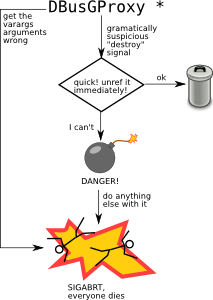
The life-cycle of a DBusGProxy (PD clipart credit: karderio and Andy)
The API provided by dbus-glib for client code is, er, rather less than ideal. The basic object is DBusGProxy, which has a few problems. There's one per interface, rather than one per object; this leads to a maze of twisty GObjects, all suspiciously similar. Our old client library, libtelepathy, got round this by subclassing DBusGProxy to make helper objects called TpChan, TpConn etc., which were simultaneously the proxy for the "main" interface (Channel, Connection etc.), and a factory for proxies for the other interfaces (like Channel.Type.Text and Channel.Interface.Password). This still wasn't ideal, but it was a start. If you use a DBusGProxy in any way after it has emitted the destroy signal, this is considered to be invalid use of the API, and dbus-glib asserts all over the place. We'd rather it didn't do that - remote objects becoming invalid is a fact of life, and if you don't immediately discard all your references to those objects, remote operations on them should just give you a runtime error. You have to be prepared to handle such runtime errors already, because any IPC call can fail at any time. The main API for calling methods uses varargs and is rather subtle. Notably, the calling convention for variant parameters (of D-Bus signature 'v') is not consistent with the calling convention for any other container. For any other container, for instance a GPtrArray *, you pass in a GPtrArray ** pointing to a GPtrArray * variable containing NULL; on success, a pointer to a new GPtrArray is written into that variable. For variant parameters, though, you must pass in a GValue * pointing to a zero-filled GValue, and the result will be written into that GValue. dbus-binding-tool generates thin wrappers around this method-calling API which provide type-safety, although they can't directly specify a non-default timeout. As for signals, before binding to a signal, you have to tell dbus-glib about its signature. This tells dbus-glib how it should push the signal arguments onto the C stack (in GObject terminology: how it should marshal them), to match the signature of the signal-handler function. The documentation claims that this isn't necessary for objects supporting the Introspect method, but that's untrue - on the other hand, if the documented behaviour actually happened, I would consider this to be a critical bug in dbus-glib, since it would enable remote objects to crash dbus-glib clients (by causing signal arguments to be pushed onto the stack in a way that does not match the signature of the signal handler). Of course, the signal-adding function takes varargs, and has to be called exactly once per signal per object. If you don't, dbus-glib asserts when you connect to the signal; if you call it twice, dbus-glib asserts anyway.

TpProxy TpProxy is a GObject subclass vaguely inspired by Python's dbus.proxy.ProxyObject. It isn't a subclass of DBusGProxy, which lets us encapsulate dbus-glib almost completely - in fact, all the references to DBusGProxy are in a separate header, proxy-subclass.h, only used by subclasses of TpProxy (as opposed to normal library API users). TpProxy instances are per-remote-object (per-object-path) like in dbus-python, rather than per-interface like in dbus-glib or QtDBus. As explained below, I believe that this is the most natural object mapping for D-Bus interfaces; in practice it tends to lead to clearer code for us, since one remote object often maps nicely to one UI element (of course, if your objects only have one interface, this approach is no better or worse than dbus-glib's). TpProxy provides support for the following common D-Bus things:
  • Calling methods
  • Connecting to signals
  • Objects becoming invalid
  • Objects with optional interfaces
  • Extensibility
It doesn't currently provide any particular help with Properties - the Properties interface is just another interface as far as we're concerned. We find that, in practice, that's not a problem (even though we use D-Bus properties extensively). In telepathy-qt4 we basically reinvented TpProxy in C++, as Tp::DBusProxy. I've put in some comments below illustrating how the general ideas we used in TpProxy translate into a different object mapping.

Calling methods Method calls on TpProxy are done through auto-generated wrapper functions, much like DBusGProxy. These look something like this:
typedef void (*tp_cli_channel_callback_for_close) (TpChannel *proxy,
    /* any 'out' arguments would go here - Close() doesn't have any */
    const GError *error, gpointer user_data,
    GObject *weak_object);
TpProxyPendingCall *tp_cli_channel_call_close (TpChannel *proxy,
    gint timeout_ms,
    /* any 'in' arguments would go here - Close() doesn't have any */
    tp_cli_channel_callback_for_close callback,
    gpointer user_data,
    GDestroyNotify destroy,
    GObject *weak_object);
Methods for some interfaces, like DBus.Properties, are available on TpProxy itself; others, like Telepathy's Channel.anything, are only available on a particular subclass, like TpChannel. Things to note here:
  • It's an asynchronous call with a callback. General design principle: "this is IPC, get over it". We don't try to hide the fact that IPC is taking place by doing pseudo-blocking calls.
  • The timeout is explicit (although you can always pass -1 to let libdbus pick a "reasonable" default for you). This is because the remote service might not respond, and API users should be at least vaguely aware of this: "this is IPC, get over it".
  • The callback isn't a GCallback; it has an explicit signature, for some semblance of type-safety (it's not much, but it's better than nothing).
  • The callback takes a GError, because any IPC call can fail for any reason.
  • A TpProxyPendingCall * is returned. This is a pointer to an object that only exists until just after the callback is called (so you can ignore it if you don't want it), with a method you can call to cancel the method call (with hindsight this is not ideal, and if I was writing this API now, I'd use gio's GCancellable). "Cancel" is perhaps slightly misleading: the method call still takes place (it was already in libdbus's outgoing queue) but the result gets ignored and the callback isn't called. This is mostly so you an object can forget all the calls it was busy making at the time that the results become irrelevant (e.g. the object is destroyed).
  • There is an extra weak_object argument, which is weakly referenced and is passed to the callback: in practice, most users of telepathy-glib use this as well as or instead of user_data. If the weak_object runs out of references, the callback is automatically cancelled, which means that in practice, explicit cancellation is almost never needed.
  • The generated code has as its first argument a suitable subclass of TpProxy, in this case TpChannel (we tell the code generator about subclasses).
  • You can't see it in the API, but the TpProxy gains an extra ref while a method call is in progress, so you never have to worry about what happens if the proxy gets unreffed during a method call.
  • There's an explicit destructor for the user_data, which is called even if you "cancel" the method call.
In telepathy-qt4, these methods are on small generated helper classes similar to dbus-python's dbus.Interface, one per interface (we provide accessors for them on the non-generated DBusProxy subclass). Instead of using callbacks, we return a temporary QObject per call, which emits a Qt signal on success or failure (that's how all async calls in QtDBus work).

Connecting to signals Similarly, signals have some generated functions:
typedef void (*tp_cli_channel_signal_callback_closed) (TpChannel *proxy,
    /* any arguments would go here - Closed doesn't have any */
    gpointer user_data, GObject *weak_object);
TpProxySignalConnection *tp_cli_channel_connect_to_closed (TpChannel *proxy,
    tp_cli_channel_signal_callback_closed callback,
    gpointer user_data,
    GDestroyNotify destroy,
    GObject *weak_object,
    GError **error);
API notes for these:
  • The callback doesn't take a GError any more, because signals can't fail; the weak_object and the user_data are the same as for method calls
  • This isn't actually a GObject signal at all: those aren't particularly typesafe, and lack namespacing. This might not be very binding-friendly, we haven't tried doing that yet... it might be worth introducing a signal with details, like in dbus-glib, for which these functions are "C bindings".
  • The returned TpProxySignalConnection lets you disconnect from the signal, just like the TpProxyPendingCall above; it can safely be ignored
  • Similarly, if the weak_object dies, then the signal automatically disconnects
  • It is possible for connecting to a signal to fail: this happens if the proxy doesn't actually have the requested interface. If this happens, it's graceful, not a crash. In practice, the flow of code is almost always such that error can safely be NULL because the interfaces are already known.
In telepathy-qt4 the per-interface generated helper classes emit Qt signals. In many cases, we end up proxying these signals by responding to them in the hand-written Tp::DBusProxy subclass by emitting a different signal, in order to give them a nicer representation.

Becoming invalid This is IPC, and any error can happen to you at any time. We found that it was useful to have a general concept of "this object is no longer useful", so we introduced the concept of an object becoming invalidated. The invalidation reason is stored on the object as a GError. If this GError is NULL (as it is initially), then the object is still expected to be valid; if it's non-NULL, the remote object has vanished and the local proxy no longer works. There are several ways a TpProxy can become invalid:
  • its bus name falls off the bus (the process exited or crashed)
  • application-specific reasons (usually triggered by a D-Bus signal in a subclass, like the Telepathy Channel's Closed signal)
  • the GObject gets disposed
Method calls on an invalidated object always fail, with the invalidation reason as the error. This means that calling a method on a TpProxy should never crash your process. The method's callback has to be prepared to handle an error in any case, because this is Sparta^WIPC, so there's no loss in giving it another error. Connecting to signals on an invalidated object always fails, and any existing signal connections are disconnected when it becomes invalidated. This means that if a new remote object appears, and it happens to have the same object path, bus name etc. as the old one, you won't get its signals. A TpProxy can either be bound to a unique bus name or a well-known bus name. In the equivalent code in telepathy-qt4, we call this "stateful" or "stateless" - these names don't capture the intention perfectly, but they're the best we could come up with. A proxy for a stateful API like Telepathy's Channel should always bind to a unique name - when the unique name falls off the bus, the TpProxy becomes invalidated automatically, representing the fact that the Channel you had no longer exists, and nothing can be a perfect replacement for it (the VoIP call has already been terminated, you've already left the chatroom, or whatever - if you make another Channel, that's e.g. a distinct VoIP call). A proxy for a stateless API like Telepathy's ConnectionManager, where an exiting process can disappear, be service-activated again, and still have exactly the same API, should bind to the well-known name. Proxies for well-known names aren't invalidated when the process exits. Qt doesn't have a natural equivalent for GError, so the invalidation reasons in telepathy-qt4 are just a pair of strings, the namespaced name and the message - basically a libdbus DBusError. The principle is the same, though.

Optional interfaces As mentioned above, TpProxy instances are per-remote-object (per-object-path) like in dbus-python, rather than per-interface like in dbus-glib or QtDBus. I believe that this is the most natural object mapping for the D-Bus object model, because the D-Bus interfaces on a remote object can behave like any of these:
  • classes and subclasses (Telepathy.Channel.Type.Text is a Telepathy.Channel)
  • shared interfaces (some Telepathy.Channel objects, of many Types, implement Telepathy.Channel.Interface.Group; any D-Bus object can implement DBus.Properties)
  • optional features (some Telepathy.Channel.Type.Text objects implement Telepathy.Channel.Interface.ChatStates, some do not)
  • discoverable extensions (some Telepathy.Channel.Type.Text objects implement Telepathy.Channel.Interface.Messages, which is more or less Text 2.0)
The way in which interfaces are discovered is also variable. The "classic" D-Bus way to discover interfaces would be to call Introspect. Telepathy services still support that style of introspection, but we don't use it for anything beyond d-feet:
  • Introspect returns a blob of XML, which you have to parse into something useful; if it was in a D-Bus data structure, you'd already have some sensible data structure.
  • Finding out more information about the supported interfaces than their names isn't very useful: in a static language like C you already need to know the methods, signals, properties and their signatures in order to write and compile your code, and in a dynamic language like Python consumers of Introspect end up being remotely crashable by services with unexpected method signatures (this is one of dbus-python's big mistakes in my opinion).
  • If a method that you want to call turns out to be missing, the worst that can happen (in a competently written service) is that it fails with a D-Bus error - and you have to handle D-Bus errors anyway, because this is IPC and anything could fail.
  • Static bindings like dbus-glib have poor support for removing interfaces for which C code exists at runtime, whereas Telepathy needs features like an IM connection that might or might not support avatars (we don't get to find out until we've successfully connected to the server).
Instead, our older interfaces have a method on the "base class" (Channel, Connection etc.) called GetInterfaces, which just returns an array of strings. Newer interfaces (like Account), and older interfaces that have been ported (like Channel), have a property called Interfaces which is, again, an array of strings - this lets us combine the download of the interfaces list with downloading other basic information in a GetAll call. To cater for all these ways to use interfaces, the TpProxy base class has very basic support for interface discovery - you can ask it whether it supports an interface, and you can tell it that it does, in fact, support an interface. Asking which interfaces are supported is directly useful for library users; it's also used as a check by the generated method-call and signal-connection stubs, which return a canned error (Telepathy.Error.NotImplemented in Telepathy's case) if the object isn't known to have the interface. Telling TpProxy that it does support an interface is intended for use by subclasses, and might have been protected if we were writing C++: what happens in practice is that a concrete subclass like TpChannel knows how to discover the fully supported interfaces for this particular object, does so, and calls methods on the TpProxy to tell it which interfaces can work.

Extensibility The API stubs used by TpProxy to call methods and bind to signals are generated from XML documents containing an augmented form of D-Bus introspection data. These XML documents contain various Telepathy-specific extensions, but none of the extensions are language-specific - telepathy-glib, telepathy-python and telepathy-qt4 all operate from exactly the same XML specification. telepathy-qt4's different object-mapping did require us to tighten up some rules that were previously only conventions, but even so, the format is the same. I think this is vitally important - it just doesn't scale to have one set of language-specific annotations in a D-Bus API for each language that will have bindings. One thing that we make heavy use of is what I call "Ugly_Case", which is camel-case with underscores at word boundaries. This gives us a simple, unambiguous and foolproof rule to use in code generators whenever we generate any of the popular conventions for identifiers:
  • CamelCase: delete underscores
  • javaCamelCase: force everything before the first underscore to lower case, then delete underscores
  • lower_case: force everything to lower case, retain underscores
  • UPPER_CASE: force everything to upper case, retain underscores
dbus-glib, by contrast, applies a complex and subtly buggy algorithm to the CamelCase D-Bus names, which results in our SendDTMF method being mapped into GLib as send_dt_mf, and requires that telepathy-glib's Python reimplementation of dbus-binding-tool uses a bug-for-bug compatible implementation (we ended up reimplementing dbus-binding-tool in order to generate the TpProxy-based bindings). Our code generation tools are still rather ad-hoc, because so is our spec format, but for draft interfaces it's possible to copy them into individual projects and use them to generate additional methods for TpProxy or any subclass. This is how we implement unfinished APIs like geolocation in Empathy, for instance. The Interfaces or GetInterfaces hook described above is entirely usable for these extension interfaces, and in fact that's how they're set up. In telepathy-qt4, the generated method stubs are genuine C++ methods, so we can't just append methods to an existing class: this is why we have one helper class per interface, so individual clients can generate a helper class for their particular version of an unfinished API, and instantiate an object of this class attached to a particular Tp::DBusProxy. When an interface becomes stable, it can be added to the set of interfaces for which code is generated in telepathy-glib or telepathy-qt4, at which point any client or service that was already using the final draft of that interface can easily be ported to the library version using sed (the API remains the same).

Becoming ready The concept of being "ready" does not directly exist in TpProxy, but is implemented in TpChannel, TpConnection and TpConnectionManager. The idea is that a freshly created proxy object isn't really fully usable yet - you have to connect to basic signals and recover the initial state of the remote object, as well as checking which extension interfaces are supported. In many well-designed D-Bus APIs you can do this initial setup with a few signal connections and a DBus.Properties.GetAll call. After doing that initial setup (which has to be done asynchronously, because it's IPC), the TpProxy subclass has a local cache of the remote object's state (not necessarily in the same format as the representation on the bus), which can be accessed synchronously at any time, and will be updated in response to change-notification signals. TpChannel and subclasses like it have explicit support for checking for readiness, and having a callback called when the object is ready or invalidated (whichever happens first). The "ready" property also supports the GObject notify signal. telepathy-qt4 took this concept and ran with it - there is library support for objects that can become ready, including a mixin. If I had as much time to work on telepathy-glib as I wish I had, this would be one of the first telepathy-qt4 features to be added to telepathy-glib.

Features becoming ready Going beyond that, in an extensible framework like Telepathy it's probable that not every client understands (or wants to understand) every feature of every object, so it's highly inefficient for every proxy object to subscribe to all the change notification signals and cache all the remote state on the off-chance that the library user wants them. In the API for TpContact (which is not actually a TpProxy for various reasons) we introduced the concept of optional features; telepathy-qt4 extended this idea throughout the library. The idea is that each library user knows which of the optional features are "interesting" to it, and makes a single asynchronous call (which expands into a series of D-Bus calls inside the library) to download the state for core functionality plus all of the selected features, and subscribe to change notification for all of those. This is another telepathy-qt4 thing that telepathy-glib still needs to catch up with; until someone works out how to make the clone() syscall apply to programmers, I fear all libraries are doomed to lag behind how their designers want them to look :-) (license: CC-BY-3.0 / LGPL-2.1+)

25 April 2009

Biella Coleman: What We Know So Far

So, when I like something, I tend to yap about it for weeks and weeks. Take Icelandic Yogurt, for example. After re-discovering it a month ago, I went on a mini-binge (not a mega as it is too expensive) and spread the word to anyone who would listen. The stuff, especially with fun flavors like ginger and orange, just made my morning. Another fine fine thing out there is the performance group What We Know So Far who give performance-based lectures that mix intellectual insight with artistic flair. They put us regular academics to shame who are a bit more staid, to put it mildly. After seeing them a few weeks ago at the 3rd Ward, I snagged them to give a version of their A-mazing talk on Memes in my class and am organizing a much larger event at NYU for the fall of 2009. This is a sort of long winded way of announcing their up and coming show on April 27th the Hannah Complex, which entertains, among other topics, the nature of common sense: Can there be more than one common sense? they ask on their site. And I can t wait to hear the answer as this is a recurrent topic that anthropologists like to entertain. And in fact one of my favorite essays to teach is on this topic, Clifford Geertz Common Sense as Cultural System, a short excerpt which I found here and below is his thesis in a nutshell:
There are a number of reasons why treating common sense as a relatively organized body of considered thought, rather than just what anyone clothed and in his right mind knows, should lead on to some useful conclusions; but perhaps the most important is that it is an inherent characteristic of common-sense thought precisely to deny this and to affirm that its tenets are immediate deliverances of experience, not deliberated reflections upon it. Knowing that rain wets and that one ought to come in out of it, or that fire burns and one ought not to play with it (to stick to our own culture for the moment) are conflated into comprising one large realm of the given and undeniable, a catalog of in-the-grain-of-nature realities so peremptory as to force themselves upon any mind sufficiently unclouded to receive them. Yet this is clearly not so. No one, or no one functioning very well, doubts that rain wets; but there may be some people around who question the proposition that one ought to come in out of it, holding that it is good for one s character to brave the elements hatlessness is next to godliness. And the attractions of playing with fire often, with some people usually, override the full recognition of the pain that will result. Religion rests its case on revelation, science on method, ideology on moral passion; but common sense rests its on the assertion that it is not a case at all, just life in a nutshell. The world is its authority.

24 April 2009

Gunnar Wolf: Some prefer marathoning... I prefer going to my old workplace

I was invited to talk about Free Software at yesterday's FLISOL. Yesterday? Aren't FLISOLs organized on Saturday? Well, not this one, for various reasons which I won't quote here. And no, I am not a supporter of the installfests idea, but I went gladly to talk about what is Free Software all about - The philosophy behind Free Software. Besides, the talk was at FES Iztacala, where I worked for four happy years, 1999-2003. I have not been often to Iztacala since 2003 (probably I have visited only three or four times), partly because of the distance (~25Km from home in a straight line, but the city's Northern part is quite poorly communicated). The last time I was there, last October, I went by bike, just to test my endurance and... because I could. Yesterday, I also did, not to be outdone by my fellow Debianers Christian and Dirk. Think they are so cool because they can run for 43Km? Well, I had my 55Km yesterday, and I was not even in a competition! (yes, yes, running and biking is not the same. So sue me. I just didn't want to stand still and let them walk away with all of the fun!) I took slightly different routes (my route to get there on Nokia Sportstracker and OpenStreetMap trace, my route back on Nokia Sportstracker and OpenStreetMap trace), crossing diagonally Azcapotzalco, a region of the city (delegaci n) I hardly know... The Sourthern of it seems like a continuation of Tacuba to the North, small and not-very-well-communicated prior villages engulfed by our hungry, huge city. The Northern half is a mostly industrial area, with very sparse population, lots of trucks, and streets that are not in the best shape. You can end up feeling lonely in those regions, and I am glad not to have crossed back by night. And the trip back was interesting as well... Mexico City is home to many more bikers you would expect given its size, and it is very common to find other people doing nice long stretches. In this case, I started cycling quite close to another guy in a white bike more or less when I got to Calzada Camarones. Possibly we had passed each other over and over until after Tlatelolco, arriving to Guerrero, where I approached him at a stoplight:
Hi! Where to?
Near Vocacional 7, Iztapalapa!
Nice! I'm just going to Copilco Every now and then we crossed each other... Turns out he does this ~30Km commute daily between Iztapalapa and Azcapotzalco. Quite admirable, to be honest. I also crossed my road with Sergio Mendoza, fellow Debianer (and co-administrator of our Mexican mirror) around Centro M dico (about 7Km north from my destination), whom I had only seen before around the University. Nice surprise. And yes, getting to know the city by bike is the best way to go! Back to the conference... my first thought when I was invited was to present Qu es el Software Libre?, a talk I have given over and over since... 2002 (although, yes, with updates). I must say it's one of the best structured talks I have prepared and has almost always been very successful - But give the same talk based on the same script over and over (AFAICT, around 20 times), and you will be fed up with it. And yes, yesterday I didn't take my laptop along, and didn't put my presentation on a USB stick - I took a pen and some paper, and during the presentation prior to mine, wrote some points to go over. And yes, it was a refreshing change. The talk was as successful as expected, and it's much more refreshing to talk about the same topics bot on a different way, and without being constrained to a predefined script. I know that organizing formally your ideas makes sure you don't miss out important points and that the audience is sometimes encouraged to pay attention by having some bullet points to look at - But on the other hand, it is much easier to follow your audience's interest if you are not bound by the script. And the few times I've spoken that way, it has felt refreshing and nice.

19 April 2009

Biella Coleman: Paris in June (and better with hackers)

/tmp/lab announces the second Hacker Space Festival
(Paris, 26-30 June 2009) Hacker Space Festival 2009 Call For Proposals HSF2009 In 2008, we organized HSF[1] on the spot, as an ad-hoc meeting for
hackerspaces-related networks, technical and artistic research emerging
from them and social questionning arising from them. This sudden
experiment proved to be a huge success, as much as on the
self-organizing level as on the participants and meetings quality, as
well as the emotionally-charged ambient, the kind of which you make
fond memories. The 2008 edition generated a strong emulation in France, from its
historical role as the first official hack meeting there, and in Europe
with the subsequent creation of the Hacker Space Brussels[2], the
rapprochement with The Fiber in Amsterdam and the hackerspaces.org[3]
network. Initiatives of hackerspace openings in Grenoble or Lille, or
the upcoming FrHack[4] conference show an actual enthusiasm in the
French hackers community that was doomed to the underground not so
long ago. We salute these initiatives and their diversity! Soon enough, we wanted to reiterate the HSF experience : however, it
was out of the question to institutionalize this temporary autonomous
zone, nor make it an ersatz of the previous edition, nor even to wrap
it into an elite or underground aura. On the opposite, we ardently
desire; and especially to explore further, in all directions some
lesser known domains (see below) et foster meeting and sharing around
experiences at the confluence of art, technology and politics. The world financial crisis, the decay of democracy in Europe, the
obscurantism, paranoia and lack of culture presiding over legislation
(Internet and Reaction Err Creation Law[5][6]) seem a fertile
environment for the sensible development of new (social ) life forms.
Quick! Let s rest for a few days in jubilation and ecstasy to take a
deep breathe of freedom under the indelicate smells of the medicine
factory nearby! For if the public space is shrinking to oblivion, where any side-step
becomes suspect, and that, from an early age (deviant behavior
detection in nursery school), where moving without a mobile phone
becomes suspect (hello you Julien Coupat[7], a French political
prisoner in France!), there s a domain that the Leviathan would have a
lot of trouble to contain, and for a reason: that of sensitivity. Even
the desperate attempts of the State to block the free and premonitory
expression of sense (hello you Demeure du Chaos![8]) cannot do anything
against a loud laughter or a knowing glance, a sensual kiss or an
explosion of colors. Sensitivity, we could say, is what is left to a human being when she
has nothing anymore, and differenciates her from the body corporate or
the institution, that are, in essence, devoid of it. Therefore, Art
definitely remains the public space to share between humans, and only
between us. And if it the last one to share, we propose to explore it
and take it over during the upcoming edition of the Hacker Space
Festival, from the 26th to 30th of June, 2009 at Vitry sur Seine[9]. ========================================================================
Keynote Speakers: Sergey Grim and Larry Fake with Eric Schmoudt
Groogle Summer of Crode, Survivor style
VLC, I vote against you because you really fucked up when ========================================================================
== W A N T E D ========================================================= Focus on solutions rather than problems. * The Final (Hardware) Frontier: Open FPGA Cores, Reverse Engineering
* Designer Religions and Creative Beliefs Systems
* WiFiDoors & WiFi System-on-Chip controllers firmware hacking,
infection & backdooring
* Telecom Core Network Equipment Reverse Engineering: MSC, STP,
Switches,
* Algebraic Attacks and Modern Cryptography Attacks
* Autonomous, Parasitic and Viral Drones
* Enhanced or Infected Reality Swarms
* Auto-Builders / Self-Fabrication
* Embedded OS breakins stories & recipes
* Actualization rather than mere concepts
* FPGA & ASIC hacking / backdooring
* Cloud+Privacy+Open Source: O Brave New World?
* Explosion-Proof clothing
* Radio Appz & Hackz: Mesh @ RF Layer 1-3
* Database & Privacy
* Problematic & Ethical Open Source/Content Licenses
* Institutional Relationships: Lobbying or Licking?
* Non Lethal Protection (anti-taser vests?)
* Survival in the Age of the Ministry of Immigration and National
Identity
* Mental asylum improvised visit
* Open Source Legacy Media(TM) Production Solutions (TV, Radio, Press,
DRM)
* Gas Sensors & Environmental Benchmarking
* Building Hackerspaces Without Money
* Milsatcomm hacking: Military satellites shots, broken birds in the
sky
* Other research topics on security and insecurity
* Academics and Hackers
* Organics and Fermentation
* Clean Food in Tainted Environment
* Low Impact Energy & Recycling
* Media Sandwich: layers of crap makes good food?
* Deconstructing Carla Sarkozy
* Knitting DIY Factory (jazzy, eh?)
* Signs of life among industrial wasteland
* Hallucinogenic & Computing: Can you Code on Acid?
* Mesh Networking (Wireless BattleMesh Royal!)
* Legal Sabotage: When Democracy Needs You And anything that does not fit. ========================================================================
== P R O P O S E ======================================================= Send you contributions to HSF2009-CFP@lists.tmplab.org + Type of the proposal: 1. conference (45min. presentation + 10min. for questions)
2. workshop / demo (30min. 2 heures)
3. installation / performance (music, plastic, sound, video) Lightning talks can be proposed and organized until the last moment,
according to available space and schedule, in the form of BarCamps or
Blitz Conferences. + Required Information: * Title of the presentation
* Type (see above)
* Language : French or English
* Name of speaker(s)
* Affiliation (organization / company)
* Short biography
* Abstract (5 to 10 lines)
* Topics / Keywords
* Includes a demo? YES NO
* Release during the festival? YES NO
* Internet connection required? YES NO + Acceptable Formats * Open Document
* PDF
* Plain Text
* RTF + Agenda * beginning of proposals : now
* end of proposals : 01 May 2009
* selection notification : 07 May 2009
* publication of program : 15 May 2009 + Evaluation criteria for proposals: 1. Innovating Topic
2. Open Technology
3. Demonstration / Live Act
4. DIY Reproducibility
5. Fun Potential The Programming Committee resembles that of last year
See : http://hackerspace.net/committee ========================================================================
== V E N U E =========================================================== /tmp/lab
6 Bis rue Leon Geffroy
94400 Vitry sur Seine
France http://hackerspace.net/directions ========================================================================
== P A R T I C I P A T E =============================================== Email : http://lists.tmplab.org/listinfo.cgi/hsf2009-talk-tmplab.org
CFPmail: HSF2009-CFP@lists.tmplab.org
IRC : irc://irc.freenode.net/frlab
Jabber : xmpp:hsf2009@space.cepheide.org?join
Wiki : http://hackerspace.net/hsf2009 ========================================================================
== L I N K S =========================================================== The CFP is available online at http://hackerspace.net/cfp [1] http://hackerspace.net/hsf2008
[2] http://hsb.wikidot.com/
[3] http://hackerspaces.org/
[4] http://www.frhack.org/
[5] http://jaimelesautistes.fr/
[6] http://laquadrature.net/
[7] http://fr.wikipedia.org/wiki/Julien_Coupat
[8] http://www.demeureduchaos.org/
[9] http://hackerspace.net/
Philippe Langlois
Email: philippelanglois@free.fr
PGP Key: 8DAEE244


18 April 2009

David Nusinow: Input Hotplug Guide

There's been a lot of questions about the new input system (referred to as "input-hotplug" or "i-h") that we've enabled in the latest X upload. Questions range from "how do I configure my keyboard now?" to "why are you making me install all this other stuff I didn't have before?" While the XSF has been dealing mainly with bug triage for the software itself, we've also been wanting some documentation on the system so people can understand it.

Thus was born our Input Hotplug Guide. The first portion of the doc explains the rationale behind input-hotplug and how it works. The second section is a HOWTO, explaining how to configure it. Hopefully this will answer some of the questions that are out there right now. So if you're curious or just plain frustrated with the changes happening to the X server's input subsystem I recommend that you check it out.

15 April 2009

MJ Ray: SPI April 2009

The monthly board meeting of Software in the Public Interest will take place on irc.oftc.net #spi tonight (Wed 15 April) at 20:00 UTC. The meeting announcement was posted, but a bit late, so there s another discussion about that going on behind the scenes. The frustrating thing is that fixing the announcements doesn t really need selling out to Google or anything complicated - simply using at on a server to schedule the email would work I know, because that s pretty much what I do at TTLLP for routine member emails. Only the secretary has posted any report at the time of writing and there are no discussion items. There are two sets of minutes up for approval, but one contains at least one error which I ve already described by email. Should be a short meeting, though. Once again (aren t Wednesday evenings awful for me?), I may be without a stable network connection during the meeting. Even so, watch the comments below this article for a link to the summary when posted.

14 April 2009

Biella Coleman: Paris in June (and better with hackers)

========================================================================
/tmp/lab announces the second Hacker Space Festival
(Paris, 26-30 June 2009)
======================================================================== Hacker Space Festival 2009 Call For Proposals HSF2009 In 2008, we organized HSF[1] on the spot, as an ad-hoc meeting for
hackerspaces-related networks, technical and artistic research emerging
from them and social questionning arising from them. This sudden
experiment proved to be a huge success, as much as on the
self-organizing level as on the participants and meetings quality, as
well as the emotionally-charged ambient, the kind of which you make
fond memories. The 2008 edition generated a strong emulation in France, from its
historical role as the first official hack meeting there, and in Europe
with the subsequent creation of the Hacker Space Brussels[2], the
rapprochement with The Fiber in Amsterdam and the hackerspaces.org[3]
network. Initiatives of hackerspace openings in Grenoble or Lille, or
the upcoming FrHack[4] conference show an actual enthusiasm in the
French hackers community that was doomed to the underground not so
long ago. We salute these initiatives and their diversity! Soon enough, we wanted to reiterate the HSF experience : however, it
was out of the question to institutionalize this temporary autonomous
zone, nor make it an ersatz of the previous edition, nor even to wrap
it into an elite or underground aura. On the opposite, we ardently
desire; and especially to explore further, in all directions some
lesser known domains (see below) et foster meeting and sharing around
experiences at the confluence of art, technology and politics. The world financial crisis, the decay of democracy in Europe, the
obscurantism, paranoia and lack of culture presiding over legislation
(Internet and Reaction Err Creation Law[5][6]) seem a fertile
environment for the sensible development of new (social ) life forms.
Quick! Let s rest for a few days in jubilation and ecstasy to take a
deep breathe of freedom under the indelicate smells of the medicine
factory nearby! For if the public space is shrinking to oblivion, where any side-step
becomes suspect, and that, from an early age (deviant behavior
detection in nursery school), where moving without a mobile phone
becomes suspect (hello you Julien Coupat[7], a French political
prisoner in France!), there s a domain that the Leviathan would have a
lot of trouble to contain, and for a reason: that of sensitivity. Even
the desperate attempts of the State to block the free and premonitory
expression of sense (hello you Demeure du Chaos![8]) cannot do anything
against a loud laughter or a knowing glance, a sensual kiss or an
explosion of colors. Sensitivity, we could say, is what is left to a human being when she
has nothing anymore, and differenciates her from the body corporate or
the institution, that are, in essence, devoid of it. Therefore, Art
definitely remains the public space to share between humans, and only
between us. And if it the last one to share, we propose to explore it
and take it over during the upcoming edition of the Hacker Space
Festival, from the 26th to 30th of June, 2009 at Vitry sur Seine[9]. ========================================================================
Keynote Speakers: Sergey Grim and Larry Fake with Eric Schmoudt
Groogle Summer of Crode, Survivor style
VLC, I vote against you because you really fucked up when ========================================================================
== W A N T E D ========================================================= Focus on solutions rather than problems. * The Final (Hardware) Frontier: Open FPGA Cores, Reverse Engineering
* Designer Religions and Creative Beliefs Systems
* WiFiDoors & WiFi System-on-Chip controllers firmware hacking,
infection & backdooring
* Telecom Core Network Equipment Reverse Engineering: MSC, STP,
Switches,
* Algebraic Attacks and Modern Cryptography Attacks
* Autonomous, Parasitic and Viral Drones
* Enhanced or Infected Reality Swarms
* Auto-Builders / Self-Fabrication
* Embedded OS breakins stories & recipes
* Actualization rather than mere concepts
* FPGA & ASIC hacking / backdooring
* Cloud+Privacy+Open Source: O Brave New World?
* Explosion-Proof clothing
* Radio Appz & Hackz: Mesh @ RF Layer 1-3
* Database & Privacy
* Problematic & Ethical Open Source/Content Licenses
* Institutional Relationships: Lobbying or Licking?
* Non Lethal Protection (anti-taser vests?)
* Survival in the Age of the Ministry of Immigration and National
Identity
* Mental asylum improvised visit
* Open Source Legacy Media(TM) Production Solutions (TV, Radio, Press,
DRM)
* Gas Sensors & Environmental Benchmarking
* Building Hackerspaces Without Money
* Milsatcomm hacking: Military satellites shots, broken birds in the
sky
* Other research topics on security and insecurity
* Academics and Hackers
* Organics and Fermentation
* Clean Food in Tainted Environment
* Low Impact Energy & Recycling
* Media Sandwich: layers of crap makes good food?
* Deconstructing Carla Sarkozy
* Knitting DIY Factory (jazzy, eh?)
* Signs of life among industrial wasteland
* Hallucinogenic & Computing: Can you Code on Acid?
* Mesh Networking (Wireless BattleMesh Royal!)
* Legal Sabotage: When Democracy Needs You And anything that does not fit. ========================================================================
== P R O P O S E ======================================================= Send you contributions to HSF2009-CFP@lists.tmplab.org + Type of the proposal: 1. conference (45min. presentation + 10min. for questions)
2. workshop / demo (30min. 2 heures)
3. installation / performance (music, plastic, sound, video) Lightning talks can be proposed and organized until the last moment,
according to available space and schedule, in the form of BarCamps or
Blitz Conferences. + Required Information: * Title of the presentation
* Type (see above)
* Language : French or English
* Name of speaker(s)
* Affiliation (organization / company)
* Short biography
* Abstract (5 to 10 lines)
* Topics / Keywords
* Includes a demo? YES NO
* Release during the festival? YES NO
* Internet connection required? YES NO + Acceptable Formats * Open Document
* PDF
* Plain Text
* RTF + Agenda * beginning of proposals : now
* end of proposals : 01 May 2009
* selection notification : 07 May 2009
* publication of program : 15 May 2009 + Evaluation criteria for proposals: 1. Innovating Topic
2. Open Technology
3. Demonstration / Live Act
4. DIY Reproducibility
5. Fun Potential The Programming Committee resembles that of last year
See : http://hackerspace.net/committee ========================================================================
== V E N U E =========================================================== /tmp/lab
6 Bis rue Leon Geffroy
94400 Vitry sur Seine
France http://hackerspace.net/directions ========================================================================
== P A R T I C I P A T E =============================================== Email : http://lists.tmplab.org/listinfo.cgi/hsf2009-talk-tmplab.org
CFPmail: HSF2009-CFP@lists.tmplab.org
IRC : irc://irc.freenode.net/frlab
Jabber : xmpp:hsf2009@space.cepheide.org?join
Wiki : http://hackerspace.net/hsf2009 ========================================================================
== L I N K S =========================================================== The CFP is available online at http://hackerspace.net/cfp [1] http://hackerspace.net/hsf2008
[2] http://hsb.wikidot.com/
[3] http://hackerspaces.org/
[4] http://www.frhack.org/
[5] http://jaimelesautistes.fr/
[6] http://laquadrature.net/
[7] http://fr.wikipedia.org/wiki/Julien_Coupat
[8] http://www.demeureduchaos.org/
[9] http://hackerspace.net/
Philippe Langlois
Email: philippelanglois@free.fr
PGP Key: 8DAEE244

12 April 2009

Manoj Srivastava: Manoj: Sample kernel symlink postinst hook script

With the new kernel-package hitting Sid today, and the fact that it no longer does symlink handling by default, I thought it was time that we had an example script that shows how to do that. This is a fairly full featured script, feel free to cull down to use just what you want. I ll post a couple of ther scripts, if there is interest in this. BTW, this script does far more than the old kernel-package postisnt script ever did. Have fun.

    1  #!/bin/sh -
    2  #                               -*- Mode: Sh -*- 
    3  # 
    4  # This is an example of a script that can be run as a postinst hook,
    5  # and manages the symbolic links in a manner similar to the kernel
    6  # image default behaviour, except that the latest two versions (as
    7  # determined by ls -lct) are kept. You can modify this script 
    8  # 
    9  # Copyright 2003, 2004, 2005, 2006, 2007, 2008, 2009 Manoj Srivastava
   10  # Copyright 2009 Darren Salt
   11  
   12  set -e
   13  
   14  # The dir where symlinks are managed
   15  SYMLINKDIR=/
   16  
   17  if [ $# -ne 2 ]; then
   18      echo Usage: $0 version location
   19      exit 2
   20  fi
   21  
   22  version="$1"
   23  vmlinuz_location="$2"
   24  vmlinuz_dir="$(dirname "$2")"
   25  
   26  cd $SYMLINKDIR   exit 1
   27  
   28  if [ -n "$DEB_MAINT_PARAMS" ]; then
   29      eval set -- "$DEB_MAINT_PARAMS"
   30  fi
   31  
   32  if [ -z "$1" ]   [ "$1" != "configure" ]; then
   33      exit 0;
   34  fi
   35  
   36  rm -f vmlinuz vmlinuz.old vmlinuz-rd vmlinuz-rd.old initrd.img initrd.img.old 
   37  
   38  # Create a temporary file safely
   39  if [ -x /bin/tempfile ]; then
   40      outfile=$(tempfile -p outp -m 0600);
   41  else
   42      set -e
   43      mkdir /tmp/kernel-image-$version-$$
   44      outfile=/tmp/kernel-image-$version-$$/output
   45  fi
   46  
   47  (cd "$vmlinuz_dir" && ls -ct vmlinuz-*) > $outfile
   48  
   49  STD="$(head -n 1 $outfile               sed 's/vmlinuz-//')" 
   50  OLD="$(head -n 2 $outfile   tail -n 1   sed 's/vmlinuz-//')" 
   51  
   52  if [ "X$STD" = "X" ]; then
   53      exit 0;
   54  fi
   55  
   56  # If you want version-specific links, here's how to start
   57  STD24="$(grep vmlinuz-2.4 $outfile   head -n 1   sed 's/vmlinuz-//')"   true
   58  OLD24="$(grep vmlinuz-2.4 $outfile   head -n 1   tail -n 1   sed 's/vmlinuz-//')"   true
   59  
   60  STD25="$(grep vmlinuz-2.5 $outfile   head -n 1   sed 's/vmlinuz-//')"   true
   61  OLD25="$(grep vmlinuz-2.5 $outfile   head -n 1   tail -n 1   sed 's/vmlinuz-//')"   true
   62  
   63  echo Booting $STD, old is $OLD
   64  
   65  if [ -f "$vmlinuz_dir/"initrd.img-$STD ] ; then 
   66     ln -s "$vmlinuz_dir/"initrd.img-$STD initrd.img
   67     ln -s "$vmlinuz_dir/"vmlinuz-$STD vmlinuz-rd
   68  else
   69     ln -s "$vmlinuz_dir/"vmlinuz-$STD vmlinuz
   70  fi
   71  
   72  if [ "X$OLD" != "X" ]; then
   73      if [ -f "$vmlinuz_dir/"initrd.img-$OLD ] ; then
   74      ln -s "$vmlinuz_dir/"initrd.img-$OLD initrd.img.old
   75      ln -s "$vmlinuz_dir/"vmlinuz-$OLD vmlinuz-rd.old
   76      else
   77      ln -s "$vmlinuz_dir/"vmlinuz-$OLD vmlinuz.old
   78      fi
   79  fi
   80  
   81  # if [ "X$STD24" != "X" ]; then
   82  #     if [ -f "$vmlinuz_dir/"initrd.img-$STD24 ] ; then 
   83  #     ln -s "$vmlinuz_dir/"initrd.img-$STD24 initrd24.img
   84  #     ln -s "$vmlinuz_dir/"vmlinuz-$STD24 vmlinuz24-rd
   85  #     else
   86  #     ln -s "$vmlinuz_dir/"vmlinuz-$STD24 vmlinuz24
   87  #     fi
   88  # fi
   89  # if [ "X$OLD24" != "X" ]; then
   90  #     if [ -f "$vmlinuz_dir/"initrd.img-$OLD24 ] ; then
   91  #     ln -s "$vmlinuz_dir/"initrd.img-$OLD24 initrd24.img.old
   92  #     ln -s "$vmlinuz_dir/"vmlinuz-$OLD vmlinuz24-rd.old
   93  #     else
   94  #     ln -s "$vmlinuz_dir/"vmlinuz-$OLD vmlinuz24.old
   95  #     fi
   96  # fi
   97  
   98  # Run boot loaders here.
   99  #lilo
  100  
  101  rm -f $outfile 
  102  if [ -d /tmp/kernel-image-$version-$$ ]; then
  103      rmdir /tmp/kernel-image-$version-$$
  104  fi
  105  
  106  exit 0

Andrew Pollock: [debian] Grappling with Git, episode 1

At work, we have a bit of a vested interest in the Puppet and Facter packages that are in Debian, because we ultimately consume them in Ubuntu. We noticed that what was in Debian unstable was lagging a bit behind what was released upstream, and when one of my co-workers tried getting in contact with the Debian developers that were maintaining the Puppet package and got no response, I got involved. I got in touch with Micah Anderson and got myself and Nigel Kersten added to the Alioth project for Puppet. Despite Jamie Wilkinson being listed as the maintainer of the facter package in Debian, he claimed this was news to him, and Matt Palmer, who was listed as an uploader, didn't really claim much knowledge of maintaining the package either, so we took that as blessing to take over that package as well. This is where the fun begins. I've been meaning to try out Git ever since Debconf 7, where all the cool kids were using it and raving about it. I've been meaning to make the Debian DHCP package collaboratively-maintained, and use Git for the revision control, but I haven't quite gotten off my good intentions and done it yet. Part of the problem is not knowing exactly what workflow I should use, and suffering from paralysis by analysis, reluctant to experiment, because I don't want to go down the wrong path. Anyway, this is about Puppet, not DHCP. The Puppet package, as it turns out, is already maintained in Git on Alioth, so the problem here was more one of figuring out what the current workflow was, and trying to follow it. This is where Nigel came in. Conveniently, the upstream Puppet development is done in Git also, and Nigel is a contributor to Puppet upstream, so he had some Git-fu. So between the instructions on how to get started with Git on Alioth and what he knew, we could start fumbling around. It seems like the Alioth Git repository was also tracking the upstream Puppet repository, as there were commits in the Alioth one by Luke Kanies, and we didn't really imagine that he was doing Debian-specific stuff. Here's what we ended up doing to try and get what was in the Alioth repository up to the upstream version 0.24.8 of Puppet:

git clone ssh://apollock@git.debian.org/git/pkg-puppet/puppet.git
This part was fairly straight forward. Clone what's in Alioth locally.
git remote add reductive git://reductivelabs.com/puppet
git remote update
git fetch --tags reductive
Next, we added a remote branch that tracked upstream. We called it "reductive", and we updated it. The bit that took some fiddling with was fetching the tags. Nigel later figured out that tags are inherently private to a repository, and normally stay that way. So if I have a local clone of say the upstream Puppet repository, I can tag it to my heart's content, and normally those tags would stay in my local repository, because they're probably only meaningful to me.
git checkout -b upstream/0.24.8 0.24.8
This bit took a bit of work to arrive at as well. What we wanted to do was create a new branch called upstream/0.24.8, which was at what was tagged 0.24.8 in the reductive repository. Nigel pondered what would happen if you already had a tag or a branch called "0.24.8" before you added the remote repository. This is also why we had to fetch the tags from the remote repository, so we had something to check out.
git checkout master
git merge upstream/0.24.8
Next, we switched back to the master branch and merged the contents of our local upstream/0.24.8 branch that we just created. This now got the Puppet source in the master branch up to what was released as version 0.24.8. (and this is better than just running uupdate?) We did some fiddling with the debian/control file and debian/changelog and fixed up a few things that Lintian was bitching about, and were done. I'd set up a sid chroot with cowdancer previously, and had to do some faffing around with git-buildpackage to convince it to use pbuilder. I ended up using
git-buildpackage --git-builder="pdebuild --debbuildopts '-i\.git -I.git' --basepath /var/cache/pbuilder/base-unstable.cow"
So now we've got most of what we want to ship checked into Git on Alioth. I have no idea if we've done it "right", I suspect we may have done something wrong by operating on the master branch. Looking at the revision history in the Git repository on Alioth, it looks like previously things have been done a few different ways. I certainly want to write up a definitive workflow once we've figured one out. We haven't uploaded the new package to unstable yet, because we're still trying to give it a modicum of testing, and we'd like to sort out the Facter package as well. The Facter package was a more greenfield exercise, as while there was already a Git repository on Alioth for it, it was empty. So Nigel had to do some futzing around to get it checked in the right way to make git-buildpackage want to build it. He did this by himself, so I'm not sure exactly what he did. I've since discovered that it's probably lacking some dependencies it needs, so that'll need to get fixed before it gets uploaded. I look forward to reading blog posts from the smart people who actually know how to use Git properly, telling me how we should have done it. I'm still very interested in coming up with a proper workflow for preparing packages and committing the changes, and for doing code review.

11 April 2009

Christian Perrier: First KDE4 impressions

I finally more or less completed my switch to KDE4. Thanks the great great KDE maintenance team we have. Simultaneously, X.org packages were updated so possible problems may have ben triggerred by it more than KDE, though. At first glance, this new KDE is nice and has great improvements but generally speaking painfully slow..:-) So, I began deactivating again all visual effects so that my poor old Dell X1 survives the upgrade. I was also greatly annoyed by losing the "Terminal sessions" which I was very actively using with Konsole. No more "Terminal Sessions" menu in my task bar to connect to various hosts over the network. Bleh. I have to redo everything with Konsole's "profiles". Also sucking a lot is the default setting for fonts in Konsole (antialiased fonts). It makes scrolling painfully slooooooow. I just deactivated this and it's much much much better. I also lost my old mail notification utility (Korn). It is still working but having it running leaves a kio_mbox process eating all my CPU. Actually, korn is still something from KDE3, so I might expect it to be rebuilt for KDE4, hopefully. I never found anything as good as it in the gazillion of mail notification utilities we have. Maybe my dear Lazyweb will help. I'm still left with weird keyboard behaviour which is hard to identify. Apparently the delay before key repetition starts when one leaves a finger on a key has changed in some way and despite my attempts to restore this in the adequate KDE thing, it doesn't change that much. I suspect some weird interaction with X.org stuff. Such "minor" details are very annoying as they interfere with year of (bad) typing habits. In general, as a very old KDE user (I adopted it back in 2001 or so because of Kbabel), I'm somewhat happy with that upgrade but it will take time to be used to all the new concepts (ah, these "Plasmoids" thing...) and also restore the overall speed of my machine...:-)

Next.

Previous.