Search Results: "bab"

28 February 2013

Russ Allbery: podlators 2.5.1

This is a quick, test-suite-only release to handle a new warning in Pod::Simple 3.26 that broke the test suite. Pod::Simple now warns if the =item elements seem to mix different types of items (bullets, numbers, and text strings). This triggered a couple of times in the test suite: once where I was explicitly testing the Pod::Man handling of that case (now moved to a separate test suite where I can suppress errors), and in several other places where I was testing item tag widths in formatting and was using =item 1 as the test for a single-column tag. That's now disambiguated with Z<>. There are various other changes pending, but alas I don't have time for a proper release at the moment. (Particularly since I'll probably be tackling coding style changes and a switch to Module::Build in the next release.) You can get the latest version from CPAN or from the podlators distribution page.

27 February 2013

Matthew Garrett: Supporting third-party keys in a Secure Boot world

It's fairly straightforward to boot a UEFI Secure Boot system using something like Shim or the Linux Foundation's loader, and for distributions using either the LF loader or the generic version of Shim that's pretty much all you need to care about. The physically-present end user has had to explicitly install new keys or hashes, and that means that you no longer need to care about Microsoft's security policies or (assuming there's no exploitable flaws in the bootloader itself) fear any kind of revocation.

But what about if you're a distribution that cares about booting without the user having to install keys? There's several reasons to want that (convenience for naive users, ability to netboot, that kind of thing), but it has the downside that your system can now be used as an attack vector against other operating systems. Do you care about that? It depends how you weigh the risks. First, someone would have to use your system to attack another. Second, Microsoft would have to care enough to revoke your signature. The first hasn't happened yet, so we have no real idea how likely the second is. However, it doesn't seem awfully unlikely that Microsoft would be willing to revoke a distribution signature if that distribution were being used to attack Windows.

How do you avoid that scenario? There's various bits of security work you need to do, but one of them is to require that all your kernel modules be signed. That's easy for the modules in the distribution, since you just sign them all before shipping them. But how about third party modules? There's three main options here:

  1. Don't support third party modules on Secure Boot systems
  2. Have the distribution sign the modules
  3. Have the vendor sign the modules

The first option is easy, but not likely to please users. Or hardware vendors. Not ideal.

The second option is irritating for a bunch of reasons, and a pretty significant one is license-related. If you sign a module, does that mean you're endorsing it in some way? Does signing the nvidia driver mean that you think there's no license concerns? Even ignoring that, how do you decide whose drivers to sign? We can probably assume that companies like AMD and nvidia are fairly reputable, but how about Honest John's Driver Emporium? Verifying someone's identity is astonishingly expensive to do a good job of yourself, and not hugely cheaper if you farm it out to a third party. It's also irritating for the driver vendor, who needs a separate signature for every distribution they support. So, while possible, this isn't an attractive solution.

The third option pushes the responsibility out to other people, and it's always nice to get other people to do work instead of you. The problem then is deciding whose keys you trust. You can push that off to the user, but it's not the friendliest solution. The alternative is to trust any keys that are signed with a trusted key. But what is a trusted key? Having the distribution sign keys just pushes us back to option (2) - you need to verify everyone's identity, and they need a separate signing key for every distribution they support. In an ideal world, there'd be a key that we already trust and which is owned by someone willing to sign things with it.

The good news is that such a key exists. The bad news is that it's owned by Microsoft.

The recent discussion on LKML was about a patchset that allowed the kernel to install new keys if they were inside a PE/COFF binary signed by a trusted key. It's worth emphasising that this patchset doesn't change the set of keys that the kernel trusts - the kernel trusts keys that are installed in your system firmware, so if your system firmware trusts the Microsoft key then your kernel already trusts the Microsoft key. The reasoning here is pretty straightforward. If your firmware trusts things signed by Microsoft, and if a bad person can get things signed by Microsoft, the bad person can already give you a package containing a backdoored bootloader. Letting them sign kernel modules doesn't alter the power they already have over your system. Microsoft will sign PE/COFF binaries, so a vendor would just have to sign up with Microsoft, pay $99 to Symantec to get their ID verified, wrap their key in a PE/COFF binary and then get it signed by Microsoft. The kernel would see that this object was signed by a trusted key and extract and install the key.

Linus is, to put it mildly, unenthusiastic about this idea. It adds some extra complexity to the kernel in the form of a binary parser that would only be used to load keys from userspace, and the kernel already has an interface for that in the form of X509 certificates. The problem we have is that Microsoft won't sign X509 certificates, and there's no way to turn a PE/COFF signature into an X509 signature. Someone would have to re-sign the keys, which starts getting us back to option (2). One way around this would be to have an automated service that accepts PE/COFF objects, verifies that they're signed by Microsoft, extracts the key, re-signs it with a new private key and spits out an X509 certificate. That avoids having to add any new code to the kernel, but it means that there would have to be someone to run that service and it means that their public key would have to be trusted by the kernel by default.

Who would that third party be? The logical choice might be the Linux Foundation, but since we have members of the Linux Foundation Technical Advisory Board saying that they think module signing is unnecessary and that there's no real risk of revocation, it doesn't seem likely that they'll be enthusiastic. A distribution could do it, but there'd be arguments about putting one distribution in a more privileged position than others. So far, nobody's stood up to do this.

A possible outcome is that the distributions who care about signed modules will all just carry this patchset anyway, and the ones who don't won't. That's probably going to be interpreted by many as giving too much responsibility to Microsoft, but it's worth emphasising that these patches change nothing in that respect - if your firmware trusts Microsoft, you already trust Microsoft. If your firmware doesn't trust Microsoft, these patches will not cause your kernel to trust Microsoft. If you've set up your own chain of trust instead, anything signed by Microsoft will be rejected.

What's next? It wouldn't surprise me too much if nothing happens until someone demonstrates how to use a signed Linux system to attack Windows. Microsoft's response to that will probably determine whether anyone ends up caring.

comment count unavailable comments

24 February 2013

Sylvain Le Gall: Configuration management: Puppet is worth it.

Replying to an old blog post of Martin F. Krafft: Configuration management, I want to give my point of view. The problems listed by madduck are quite common with Puppet, but I think Puppet is still worth, mostly because you can solve all these problems. Let give you my opinion on the list: True. I think the approach of puppet is not really UNIXish. It is probably on purpose. The biggest issue is probably the PKI. It breaks frequently for unknown reason. The "non intuitive configuration language" is probably a matter of taste. I think the language is not very well designed and strange, but I can cope with that. The attempt to versioning -- if I understand correcly what it means -- refers to the fact that when Puppet replace a file it moves the old file to a bucket. This is not a good thing, but you can say "backup => '.puppet-bak'" and you get almost the same behavior as ".dpkg-old". False debate. We can discuss for hours on Ruby, PHP, Java or whatever pet language people has invented. I am not a fan of Ruby but it is still nice as a general purpose language. To my mind, Ruby is still better to write daemon than bash. False debate.
   info: Caching catalog for centi.....
   info: Applying configuration version '1350597216'
   notice: Finished catalog run in 3.08 seconds
The config of this node is not complex, but 3s is not that bad for something that runs every 30min. If you need sub-second speed for this kind of thing, maybe you are not looking for this kind of tool. Does 144s of server time per day is a big deal ? With a lot more complex setup, I can reach 30s for a run, although this is the point where I manage a lot of thing with it. False and True. Augeas allows you to replace a single value (even more precise than a line). Just have a look at the augeas type. This is pretty nice and allow to do thing like replacing "Defaults env_reset" by "Defaults env_reset, !tty_tickets" in 4 lines of code. So this i not precisely "a single line of text", but there is other way to do it. False. Well if you organize your code with manifests/site.pp and manifests/classes/*.pp, it seems like there is a separation between the two. Next you can try inheritance and define to create specific high-level features. False-ish. Hey at least there are error message ;-) Now, most of the error that are related to the programming language are useless (at least as cryptic as a C++ error message). But as usual with error message in programming language True. Multi versions installation is horrible and you have to fix a lot of stuff to manage a sane overall configuration. Not sure to understand this point, I use puppet over IPv6... To whoever is considering using puppet, this is worth a try. It is a nice system that really helps to maintain a decent configuration across nodes.

Andrew Pollock: [tech] On owning a Nissan Leaf

I'll soon be disposing of the Nissan Leaf that we leased a few months ago, so I thought it a useful exercise to write about my experiences with it. I am not a car man. I am a gadget man. For me, driving is a means to an end, and I'm much more interested in what I call the "cabin" experience, than the "driving" experience, so this is going to slanted much more that way. That said, I found the Nissan Leaf a fun car to drive, from my limited experiences of having fun driving cars. I liked how responsive it was when you put your foot down. It has two modes of operation, "D" and "Eco". I've actually taken to driving it in "Eco" mode most of the time, as it squeezes more range out of the batteries, but occasionally I'll pop it back into "D" to have a bit of fun. The main difference between the two modes, from a driving perspective, is it seems to limit the responsiveness of the accelerator. In "Eco" mode it feels more like you're driving in molasses, whereas in "D" mode, when you put your foot down, it responses instantly. "D" is great for dragging people off at the lights. It's a very zippy little car in "D" mode. It feels lighter. I've noticed that it has a bit of a penchant for over steering. Or maybe that's just my driving. If I have floored it a bit to take a right turn into oncoming traffic, I've noticed slight over steering. That's about all the driving type "real car stuff" I'll talk about. Now to the driver's "cabin experience". It's absolutely fabulous. I love sitting in the driver's seat of this car. Firstly, the seat itself is heated (in fact all of them are). As is the steering wheel. Nissan has gone to great lengths to allow you to avoid needing to run the car's heating system to heat the car, as doing so immediately drops at least 10 miles off the range. Unfortunately I found the windscreen had a tendency to fog up in the winter rainy periods, so I'd have to intermittently fire up the air conditioning to defog the windscreen. Of course, in the summer months, you're going to want to run the AC to cool down, so the range hit in that situation is unavoidable. I've only had this car from late Autumn until late Winter so far, so that hasn't been an issue I've had to contend with. The dashboard is all digital, and looks relatively high tech, which appeals to my inner geek. It's a dashboard. It tells you stuff. The stuff you'd expect it to tell you. Enough said. The audio system is nice. It supports Bluetooth audio, so one can be streaming Pandora from one's phone, through the sound system, for example. Or listening to audio from the phone. There's also a USB port, and it will play various audio files from USB storage. I found the way it chose to sort the files on a USB stick to be slightly surprising though. I haven't invested the time to figure out how I should be naming files so that they play in the order I expect them to play. The ability to play from USB storage compensates nicely for the fact that it only has a single CD player. (We have a 6 disc stacker in our 2006 Prius). The car also came with a 3 month free trial of Sirius XM satellite radio. This was fun. The only dance music FM station in the Bay Area has a weak signal in Mountain View, and I hate dance music with static, whereas there was an excellent electronic music station that I could listen to in glorious high definition. As long as I wasn't driving under a bridge. There's no way I'd pay money for satellite radio, but it was a fun gimmick to try out. The navigation system is really, really good. I haven't bothered using Google Maps on my phone at all. It gives such good spoken directions, that you don't even need to have the map on the screen. It names all the streets. I couldn't figure out a way to get distances in metric. The telematics service, Carwings, is probably my favourite feature. This is what really makes it feel like a car of the future. Through the companion Android application, I can view the charging status (if it's plugged in) or just check the available range (if it's not plugged in). From a web browser, I can plan a route, and push the route to the vehicle's navigation system. If the car is plugged in, I can also remotely turn on the vehicle's climate control system, pre-warming or cooling the car. It's a little thing, but the door unlocking annoyed me a little bit. I'm used to the Prius, where if you unlock the boot (that's trunk, Americans), or the front passenger door, all the doors unlocked. This was a convenient way of unlocking the car for multiple people as you approached it. With the Leaf, unlocking the boot only unlocks the boot. Unlocking the front passenger door only unlocks that door. It requires a second unlock action to unlock all the doors. I've found this to be slightly cumbersome when trying to unlock the car for everyone all at once, quickly (like when it's raining). Another minor annoyance is the headlights. I've gotten into the habit of driving with the headlights on all the time, because I believe it's safer. In the Prius, one could just leave the headlights switched to the "on" position, and they'd turn off whenever the driver's door was opened after the car was switched off. If you try that in the Leaf, the car beeps at you to warn you you've left the headlights on. It has an "auto" mode, where the car will choose when to turn the headlights on, based on ambient light conditions. In that case, when you turn the car off, it'll leave the headlights on for a configurable period of time and then turn them off. This is actually slightly unsettling, because it makes you think you've left your headlights on. The default timeout was quite long as well, something like 60 seconds. The way multiple Bluetooth phones are handled is just as annoying in the Leaf as it is in the Prius, which disappoints me, given 6 years have passed. The way I'd like to see multiple phones handled is the car chooses to pair with whichever phone is in range, or if multiple phones are in range, it asks or uses the last one it paired with. In reality, it tries to pair with whatever it paired with last time, and one has to press far too many buttons to switch it to one of the other phones it knows about. Range anxiety is definitely something of a concern. It can be managed by using the GPS navigation for long or otherwise anxiety-inducing trips, and then one can compare the "miles remaining" on the GPS with the "miles remaining" on the battery range, and reassure oneself that they will indeed make it to where they're trying to go. The worst case I had was getting to within 5 miles of empty. The car started complaining at me. The charging infrastructure in the Bay Area is pretty good. There are plenty of charging stations in San Francisco and San Jose. I'm spoiled in that I have free charging available at work (including a building at the end of my street, so I never bothered with getting a home charger installed). I've almost never had to pay for charging, so it's been great while gas prices have been on the rise. The car's navigation system knows about some charging stations, so you can plan a route with the charging stations it knows about in mind. The only problem is it doesn't know if the charging stations are in use. If you use the ChargePoint Android app, you can see if the charging stations are in use, but then you have to do this cumbersome dance to find an available charging station and plug the address into the vehicle's navigation system. Of course, what can then happen is in the time you're driving to the charging station, someone else starts using it. I actually got bitten by this yesterday. Would I buy a Leaf again? Not as my sole car. It makes a perfect second/commuter car, but as a primary vehicle, it's too limited by its range. They're also ridiculously expensive in Australia, and Brisbane has absolutely no charging infrastructure.

23 February 2013

Russell Coker: Serious Begging

This evening I was driving through one of the inner suburbs of Melbourne when a man flagged me down. He said that his mother was dying and he needed a taxi ride to some hospital far away and needed to borrow $200. He was saying something about his phone, I wasn t sure if he was planning to give me his phone number so I could call him to ask for repayment or offering his phone as collateral on the loan (incidentally a well known scam is to offer a stolen phone as collateral for a loan, it s a way of selling a locked phone that doesn t have cables). I ve encountered many beggars over the years, but he was by far the most serious about it he demonstrated the level of desperation that I ve only previously seen documented in history books and reports from travelers who visited developing countries. I will never know if his mother was dying, there are lots of other reasons why someone might urgently need cash (most of which won t get much sympathy). I gave him $20 as a gift. If his story was legitimate then I gave him 10% of what he needed so he only had to find another 9 people willing to do the same. If he was lying then I can afford to lose $20. In any case I definitely wasn t going to do what he asked and withdraw hundreds of dollars from an ATM for him. Also regardless of whether he was telling the truth I didn t want to have him repay me, if he s telling the truth then I m happy to give money to him and if he s not then I m better off avoiding him in future. If I had $50 I would probably have given it to him, but $200 is too much. As I drove off I looked in my rear-vision mirror and saw him running between cars on the road trying to flag someone else down. Running through moving traffic on a Saturday night is another indication of how serious he was, generally someone who s in a good state of mind and wants a long and healthy life won t do that.

22 February 2013

Richard Hartmann: Finland I

Finland. Helsinki, Lahti, streets Arriving at Helsinki airport, we filed a claim with Lufthansa as a hard shell suitcase had a splintered corner. We were surprised that so many Finns arrived from Munich with skis, more on that later. We picked up our car and started on our way towards Koli; driving with a top speed of 100 km/h and often being limited to 80 km/h or even 60 km/h is... unusual... Finnish police/authorities seem to be obsessed with enforcing those speed limits as there are a lot of speed cameras along the way. Finnish people seem to be similarly obsessed with slot machines; there is an incredible amount of them at gas stations and a constant stream of people playing them. From an outsider's perspective, it's weird that a country as strict about one form of addiction, alcohol, and working against it vigorously, by means of taxes, would allow another form of addiction, gambling, run as freely and this allow so many slot machines. Speaking of taxes on alcohol: a single 0.33 l bottle of beer is more expensive in a Finnish supermarket than 0.5 l of beer in a German restaurant. Which also explains why supermarkets tend to have a rather large section with relatively cheap alcohol free beer. Anyway, coming back to streets: Highway intersections don't have continuous on/off ramps from which you change from one highway to another; you drive off of the highway, stop at a traffic light, and then continue onto the other highway. Weird system, but given the amount of traffic we witnessed, it's probably Good Enough (tm). Stopping for a short time in Lohti simply because it's apparently famous for winter sports competitions, we arrived at Future Freetime in Koli national park after about five to six gruelling hours of net driving through somewhat bad weather and behind slow drivers. Koli Hiking up to Ukko-Koli and its sister peaks proved to be rather exhausting as we kept on breaking through the snow cover to our knees and sometimes even our hips. Once we were up there, we realized that even though you couldn't see it in between the trees, there was fog all over the plains so we couldn't see anything. Still, it was a nice hike even if somewhat short. Note to self: Even when a trail is marked locally, if OpenStreetMap does not know about it... don't walk along it. Especially not when the going's rough already. And if there's a sign suggesting you wear snow shoes... wear snow shoes. Returning to Koli Hotel and the museum next to it, we walked over to the ski slope. The highest peak within Koli,Ukko-Koli, is 347 meters high, the local ski slope starts a good way below that. This would explain why a lot of Finns came back from Munich with their skis... Afterwards, we rented a snow mobile, without guide or supervision, and drove from Loma-Koli over lake Pielien towards Purnuniemi and in a large circle down towards lake Ryyn skyl where we turned around and went back the same way. If we thought Finnish streets don't have a lot of signs we soon realized that snow mobile tracks have even less. There are at most two or three signs pointing you in the right direction, but on the plus side, there are no posted speed limits for snow mobiles, either. In somewhat related news, snow mobiles can go at least 95 km/h. At that point, the scratched and dirty visor of your rental helmet will keep slamming down, forcing you to take one hand off the handle and thus stop accelerating to maintain stability. To round off the day, we heated up the sauna built into our little wooden hut. Running outside three times to rub myself off with snow from head to toes, I almost slipped and fell while standing still. When your feet are too hot for the snowy ground, you'll start to melt your own little pools of slippery water/snow mush within seconds. File that one under "I would never have guessed unless I had experienced it myself". Generic The MarkDown source of this blog post is not even 5 kiB in size; even in a worst case scenario, pushing this to my ikiwiki instance via git will eat up less 10 kiB of mobile data. Which is good because I have 78 MiB of international data left on this plan. This is also the reason why there are no links in this blog post: I am writing everything off line and don't want to search for the correct URLs to link to. I really wish EU regulators would start to tackle data roaming now that SMS and voice calls are being forced down into somewhat sane pricing regions by regulations. PS:
-rw-r--r-- 1 richih richih 4.6K Feb 11 22:55 11-Finland-I.mdwn
[...]
Writing objects: 100% (7/7), 2.79 KiB, done.

Russell Coker: iPhone vs Android

A friend who s a long-time iPhone user just asked for my advice about whether to get a Samsung Galaxy S3, a Samsung Galaxy Note 2, or a iPhone 5. Advantages for Android I think that liberty should be the first consideration, I ve previously written about how Android phones won t necessarily give you as much freedom as you desire if you buy on the basis of price and features [1]. But even the least free Android options are way better than the iOS (iPhone and iPad) environment. This isn t necessarily a big deal for my friend, like most of the population he usually just wants things to work being able to hack them isn t such an issue. However unlike most of the population he does make a reasonable portion of his income from software development and it could be that he will have a contract for developing an app on a mobile device in which case the freedom to tinker on Android will help him. He could use an iPhone for his personal use and develop on an Android platform for his clients, but generally it s more efficient if your personal use of technology is similar to that of your clients. The Nexus devices are very good for liberty and they also have nice hardware at a low price, I ve just got a Nexus 4 for my wife and it s very nice. The next issue is that of hardware standards, I ve previously written about the potential for developing a standard form factor for Android phones [2] although this doesn t seem likely to be implemented in the near future. The wide range of Android hardware means that the range of cases etc on the market is rather small. But the advantage of the wide range is that with an Android phone you can have a device that s bigger, smaller, cheaper, cuter, or faster than an iPhone. There are Android devices which have a higher resolution, more RAM, more storage (if you include SD storage), or has other benefits over an iPhone. For whatever reasonable range of specs appeal to you you can probably find a device to match. I ve previously written about the way the ideal size for devices depends on your hand size and your preferred manner of gripping the device [3], so the lack of size range in Apple devices is not just a limitation on personal choice but also a failure to properly support people with different size hands. Depending on the preferred manner of gripping a phone the iPhone 5 is either too big for an average woman or too small for a tall man. The Google Play store apparently has more applications than the iPhone/iPad App Market. This difference can be expected to increase now that the Samsung Galaxy S3 is outselling the iPhone 5. Comparing the number of unit sales of the iPhone vs Android phones is no longer interesting, comparing Samsung to Apple is the interesting thing. Advantages for the iPhone By all accounts it s quite an easy process to backup and restore all iPhone settings. You can expect that after losing an iPhone you can just connect the new one to your PC and have it work in exactly the same way after all the data is transferred. Trying to do such things on Android is merely difficult if you have root access to your phone and the source and destination phones are of exactly the same make and model. But if you have different versions of the phone or if you don t have root access then it may be impossible. I welcome comments from anyone who knows of good solutions to this problem. The iPhone achieved a reasonable share of the smart-phone market before Android really started going well so there are a lot of people who are used to the iPhone. Simply by being unfamiliar Android will be a more difficult option for people who have used the iPhone such as my friend. But it is possible to learn other systems. Generally I think that this may be a big issue for people who use Macs for all their other computing. But if the only Apple product you use is an iPhone then switching to Android shouldn t be a big deal. Update: One feature of the iPhone that is very important to my friend is the ability to add arbitrary tags in the contacts. In addition to name, address, phone number, etc he wants to add arbitrary notes related to his business. While he could put that sort of thing into the Notes field in Android he would rather have several fields with his own names. Android 4.1.x definitely doesn t have this and I can t test Android 4.2.x at this time. Is there any way of doing such things on Android? Conclusion It seems to me that Android devices are better in every way apart from backup, restore, and general management. If I was about to buy 100 phones then I d probably consider the iPhone (not necessarily buy but definitely consider). But for a single user I definitely recommend Android devices. The Android devices which seem good at the moment are the Galaxy S3 (which I m using now), the Nexus 4 (which is really good apart from being unable to change the battery or add more storage), and the Galaxy Note 2 (which is about the biggest phone available). One of the things that my friend wants to do is to use a phone instead of a tablet or laptop. I think that the Galaxy Note 2 is the only option for him.

21 February 2013

Joey Hess: Kickstarter rewards wrap-up

I finished delivering all my Kickstarter rewards at the end of the year. This is an overview of how that went, both financially and in general.
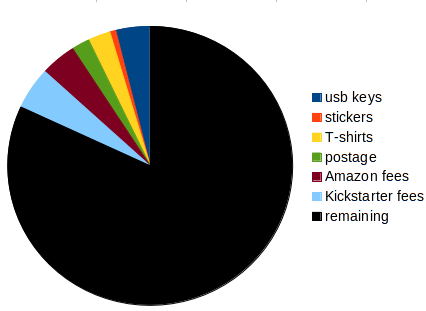
my Kickstarter pie (not including taxes)
While the Kickstarter was under way, several friends warned me that I might end up spending a lot of the money for rewards, or even shipping, and come out a loser. It's happened to some people, but I avoided it. Most of the pie went to its intended purpose.
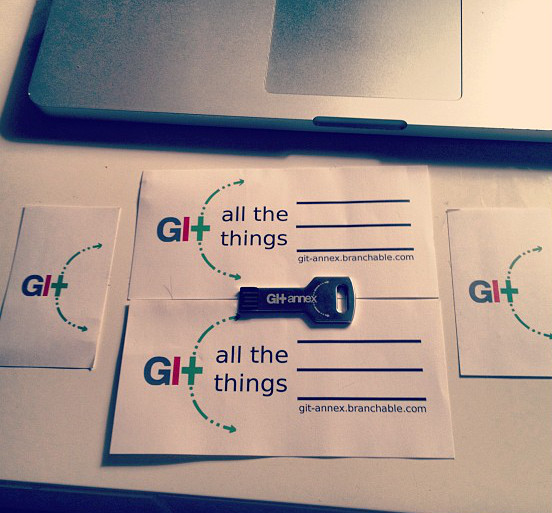
USB key arrives in Amsterdam
I kept shipping cost low by shipping everything by US postal service, including Air Mail for international shipping. This was particularly important for the stickers (which cost $1.05 to ship internationally). But I also shipped USB keys in regular mail envelopes, protected by bubble wrap, which worked very well and avoided the bother of shipping packages. The USPS will be annoyed at you for a rigid letter and add a non-machinable surcharge, but it's still a nice savings.
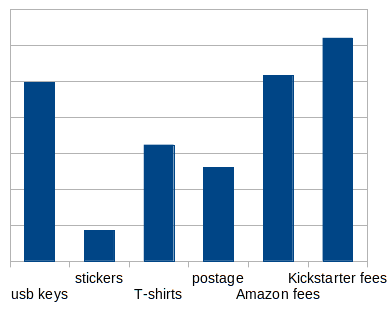
expenses
I spent more on rewards than on transaction fees, but the fees are still pretty large. Being dinged a second time by Amazon is the worst part. I have not been able to work out exactly what formula Kickstarter uses to determine its fee per pledge. It does not seem to be a simple percentage of the pledge. For example, they seem to have charged $0.25 per $10 pledge, but $25 for a $500 pledge. I wanted to solve this, but I'd have to match up all the pledges and fees manually to do it.
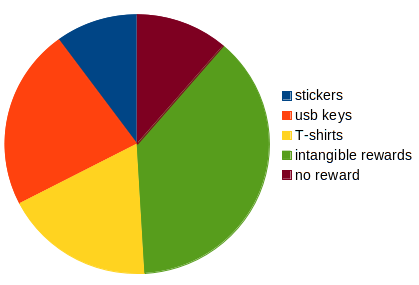
gross income by reward type
This chart is slightly innacurrate, because it puts any money pledged, beyond the amount needed to get a reward, into the "intangibles" category, despite the reward being probably responsible for that money being pledged. (The intangibles also includes people who did not ask for a reward, and several categories of rewards not involving shipping matter around.) But, the surprise for me is how large a peice the T-shirts are responsible for. It was my least favorite reward, and a low volume one, but I made out pretty well on it. However, I'd still try to avoid putting T-shirts on Kickstarter again. It's hard to do a good design (I didn't, really); they're expensive, and were by far the most annoying thing to ship. Also, I was not happy with the countries Cafe Press sourced their shirts from; I've been to Honduras and talked with people who have relatives in las machinas.
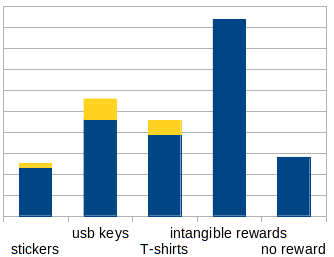
gross and net income by reward type (excluding shipping)
In contrast, the stickers had an amazing margin; they're so inexpensive to print that I printed up two kinds and included multiple with every other reward I mailed. I still have hundreds left over, too.. All the online print shops I tried have very annoying interfaces to upload artwork though. I had to do quite a bit of math to render TIFF files with appropriate DPI and margins. The USB keys were my favorite reward. I got them from USB Memory Direct, who gave me quite a nice deal. I was very happy that I was able to send them a SVG file of my artwork, so I didn't need to worry about lacking resolution for the laser engraving. And it came out looking great. The best part was when their sales guy Mike actually did a minor alteration of the artwork, to better fit on the key, when I, being overloaded with Kickstarter stuff asked him too. A bit above and beyond. There was an issue with their Chinese manufacturer's quality control of the 16 gb drives, but they were willing to send me replacement for all the ones I found problems with.
All told I spent probably 3 full days stuffing and shipping envelopes, and probably spent a week working on Kickstarter reward fullfillment. As work-related overhead goes, that's not bad. Maybe someone considering a Kickstarter will find this information useful somehow. Oh well, back to work. :)

20 February 2013

Keith Packard: DRI3000

DRI3000 Even Better Direct Rendering This all started with the presentation that Eric Anholt and I did at the 2012 X developers conference, and subsequently wrote about in my DRI-Next posting. That discussion sketched out the goals of changing the existing DRI2-based direct rendering infrastructure. Last month, I gave a more detailed presentation at Linux.conf.au 2013 (the best free software conference in the world). That presentation was recorded, so you can watch it online. Or, you can read Nathan Willis summary at lwn.net. That presentation contained a lot more details about the specific techniques that will be used to implement the new system, in particular it included some initial indications of what kind of performance benefits the overall system might be able to produce. I sat down today and wrote down an initial protocol definition for two new extensions (because two extensions are always better than one). Together, these are designed to provide complete support for direct rendering APIs like OpenGL and offer a better alternative to DRI2. The DRI3 extension Dave Airlie and Eric Anholt refused to let me call either actual extension DRI3000, so the new direct rendering extension is called DRI3. It uses POSIX file descriptor passing to share kernel objects between the X server and the application. DRI3 is a very small extension in three requests:
  1. Open. Returns a file descriptor for a direct rendering device along with the name of the driver for a particular API (OpenGL, Video, etc).
  2. PixmapFromBuffer. Takes a kernel buffer object (Linux uses DMA-BUF) and creates a pixmap that references it. Any place a Pixmap can be used in the X protocol, you can now talk about a DMA-BUF object. This allows an application to do direct rendering, and then pass a reference to those results directly to the X server.
  3. BufferFromPixmap. This takes an existing pixmap and returns a file descriptor for the underlying kernel buffer object. This is needed for the GL Texture from Pixmap extension.
For OpenGL, the plan is to create all of the buffer objects on the client side, then pass the back buffer to the X server for display on the screen. By creating pixmaps, we avoid needing new object types in the X server and can use existing X apis that take pixmaps for these objects. The Swap extension Once you ve got direct rendered content in a Pixmap, you ll want to display it on the screen. You could simply use CopyArea from the pixmap to a window, but that isn t synchronzied to the vertical retrace signal. And, the semantics of the CopyArea operation precludes us from swapping the underlying buffers around, making it more expensive than strictly necessary. The Swap extension fills those needs. Because the DRI3 extension provides an X pixmap reference to the direct rendered content, the Swap extension doesn t need any new object types for its operation. Instead, it talks strictly about core X objects, using X pixmaps as the source of the new data and X drawables as the destination. The core of the Swap extension is one request SwapRegion. This request moves pixels from a pixmap to a drawable. It uses an X fixes Region object to specify the area of the destination being painted, and an offset within the source pixmap to align the two areas. A bunch of data are included in the reply from the SwapRegion request. First, you get a 64-bit sequence number identifying the swap itself. Then, you get a suggested geometry for the next source pixmap. Using the suggested geometry may result in performance improvements from the techniques described in the LCA talk above. The last bit of data included in the SwapRegion reply is a list of pixmaps which were used as source operands to earlier SwapRegion requests to the same drawable. Each pixmap is listed along with the 64-bit sequence number associated with an earlier SwapRegion operation which resulted in the contents which the pixmap now contains. Ok, so that sounds really confusing. Some examples are probably necessary. I m hoping you ll be able to tell that in both cases, the idle swap count tries to name the swap sequence at which time the destination drawable contained the contents currently in the pixmap. Note that even if the SwapRegion is implemented as a Copy operation, the provided source pixmap may not be included in the idle list as the copy may be delayed to meet the synchronization requirements specfied by the client. Finally, if you want to throttle rendering based upon when frames appear on the screen, Swap offers an event that can be delivered to the drawable after the operation actually takes place. Because the Swap extension needs to supply all of the OpenGL SwapBuffers semantics (including a multiplicity of OpenGL extensions related to that), I ve stolen a handful of DRI2 requests to provide the necessary bits for that:
  1. SwapGetMSC
  2. SwapWaitMSC
  3. SwapWaitSBC
These work just like the DRI2 requests of the same names. Current State of the Extensions Both of these extensions have an initial protocol specification written down and stored in git:
  1. DRI3 protocol
  2. Swap protocol

17 February 2013

Cyril Brulebois: First release candidate

After a release cycle longer than between each beta (which is slightly sad, but I can t spend all my time on Debian), here comes the first release candidate of the Debian Installer for Wheezy. The Debian Installer 7.0 RC1 announce on the website has links to relevant bug reports in the Debian BTS, and the errata page lists things you probably want to know about (including gotchas with grub-install we ve been having for a while, now diagnosed, and hopefully fixed for the next release candidate). According to Arwen s sleepy attitude, it s officially time for a nap! Sleepy Arwen

16 February 2013

Christian Perrier: DPL game or why I'm not your man

I am in some way flattered (en_FR?) that some people think that I should stand as DPL candidate (here, or there, or there). Thank you, ladies and gentlemen, for your confidence, it's appreciated. Still, I won't stand and I feel like I should explain why. Yes, I now have some experience in the Debian Project after more than 11 years as DD. Yes, I like to represent the project and I think I don't do that so badly when I do it (which is not as often as one might imagine). Yes, I feel like I have some experience in acting as a "leader" though I often have doubts about this, probably just like many people who have management duties in their professional life. Yes, I often define myself as a non-technical person which helps in dealing with problems and projects with different perspectives. Still, this is often not so true and that extends to my professionnal activity. I *am* indeed a technical person but I'm more a "specialist of everything and nothing" in this aspect. That's probably good for a DPL. But, still I won't stand. There are indeed many reasons for this and I'll try to give them here. First of all, Debian has always been a hobby for me. A hobby that sometimes ate several hours a day and still eats part of my time. But still a hobby. It can't become the major part of my life. And I think that someone spending one year as DPL "has" to do it as the major part of her his life. I can't free time from my work schedule. My work, though being in IT, has few to relate with Free Software, and I can't divert part of it with Debian duties...or merge it with Debian duties. For about 3 years, I compensate the loss of two people in my team by working hard and VERY fast, in a constant stress....connecting with Onera nearly all time long and maintaining the level of services our users deserve as high as I can. And I like it. I can't free time from my family schedule. Of course, my children don't request much attention right now, they all live their own lives. Jean-Baptiste is now having a full-time paid job and does great things in a geeky style I recognize very well. Sophie will soon be a great graduated social worker and will start working in next Summer. And Magali is studying physical therapy so that she can later help me recovering after too hard running races..:-). However, last and definitely not least, I have a wonderful wife who I want to share as much as I can with. And I can't share Debian with her. Indeed, Elizabeth is the very first reason for my reasoning.....because she is the center of my life for more than 30 years now. You also know that I happen to run a little bit..:-)...and that requires time too. Something I won't sacrifice as it brought more equilibrium in my life (and a great health, at an age where one has to care about one's health, now). All this doesn't leave much room. And I indeed noticed that my involvement in Debian has reduced noticeably in the past months. That is indeed the most important point: I'm "slowing down" in Debian...or, at least, I'm trying to find an equilibrium where it represents only a part of my hobbies....and not an ever-growing one. Last...maybe not least, I'm somehow pessimistic about the future of the project. You may have read that subtly in my writings, here or there. I feel like we are slowing down in innovation and are slowly feeling short of resources. Renewal in project members doesn't come as fast as it used to. You are free to disagree with me and I hope you'll be right to. But, still, that won't remove my pessimism. And, well, it's hard to lead a project when you're partly pessimistic about it, isn't it? In short, all in all, I'm currently "fighting" in some way to keep motivation for something I deeply love being involved in. And that's really important. And that's why I can't stand: it wouldn't be a good service to the project. It would be good for my ego, certainly (yes, I have one....and sometimes not a small one)....but it wouldn't be a good service to the project, and I also feel it could very well lead me to burnout. And, if you "nominated" me...or think I would candidate for DPL, you don't want me to burnout and vanish from Debian, right? So, this is why I won't stand. And this is why you'll continue to have great Cheese and Wine parties at Debconfs....or boring l10n reports....or, here or there, some broken uploads in the archive..:-)....but not another French DPL, at least not /me. PS: by the way, I have my own list of preferred candidates. Not sure I want it to be public, though...:-)...you'll see soon if I change my mind!

15 February 2013

Iustin Pop: Garmin Montana

Garmin Montana notes Sometimes, I get waaay too excited about gadgets, and I have to share it. So, sorry, here it goes :) For some reason that is not very important, I was looking for a better solution for GPSes with maps. Side-note: if you ask why Android is not good enough , here's the story: last year, knowing that Google Maps supports caching (finally), I upgraded Maps, preloaded London, and went on a trip. Only to exit the Victoria underground station and to stare ~20 minutes in light rain at my phone, wondering why it doesn't get a fix. I gave up in the end, and used the cached maps for getting around. Later I learned the reason: Maps was not broken, but without data, Android can't get a lock easily; and more-over, the recent Maps update without GPS active even once afterwards, to do whatever it needed, meant I couldn't get a lock until back in Switzerland. Or, alternatively: while on a trip to Japan, it turns out that Google Maps caching is not supported there, probably because of rights over mapping data. So I had location, but only temporary cached maps (from the wifi in the hotels). Due to this kind of problems makes I consider Android maps a toy, so I wanted a GPS device with proper maps (on the device, not in the cloud), and with good GPS capabilities (no fancy A-GPS or anything, just plain good standalone GPS). Having had good experiences with the sport line of Garmin (but which doesn't have maps, so it's out of the question), I looked at Garmin. Many people complained about some things (same all over the place): The latter is something that jumped at me from many of the blogs/fora that I read; I like customisable power tools , not one-button mice. The other thing that I didn't really like was that most devices are very focused on a niche: the n vi line on automotive, the Zumo line on motorbikes, and the hand-held lines with some blurring of hiking/geocaching/etc. So no one-size fits all device Features! Customisation! That is, until I found out the Montana series. My my, I was blown. Both by the price (I couldn't believe how expensive it was, without maps!) and by the features. As it turns out, the Montana has different profiles , and it can act: That is for flexibility. As for performance/features: Now for the downsides. Being a multi-functional device, it's not as good as a dedicated one: But the small (for me) draw-backs aside, it's definitely not a dumbed-down device. It's the first device that I have which I feel it a bit too customisable . From completely changeable menus, to profiles that remember their maps selection, to many dashboards, to almost-programmable shortcuts (e.g. a shortcut to change profile, set destination to a given way point, reset the trip log, and turn track logging on) a bit overwhelming at first. Add the 3-axis compass, barometric altimeter, ANT+ support and you get a very powerful device. Software As to the software, yes it has some bugs - mainly that the device crashes sometimes (abruptly) if you play too much with the routes (didn't happen to me yet on the road , only when testing it at home). On the PC-side, Garmin's BaseCamp is nice, but doesn't hold a candle to Google Maps, for example, in terms of UI; I don't mean shininess, but simply how well the UI works. The most annoying thing is how it doesn't scale detail appropriately with the zoom level. But it works, and I can plan hikes offline, and upload both tracks and routes to it (this is important: it seems other recent Garmins can't replay tracks, only routes). And I can load many maps, and toggle them at will, etc. The many maps feature is not to be overlooked. I could have, for example, standard Garmin maps loaded, but just in case they're insuficiently detailed or out of date (hey, Navteq is slow ), I can also have Open Street Maps from two days ago. The routing is then done on the currently active maps, so you are not restricted to a single mapping provider. And of course you can also have custom POIs (Point of interest) on it. Bycicle use The bicycle mount is solid enough, so that on a rough roads it's held firmly. From my ~20 minute test this morning, a few things to note: Voice output By default, the unit can only beep, but if coupled via a 3.5" jack to headphones or via the automotive mount, it can properly speak; quality varies with voice, and whether it is TTS or not. I managed to find one voice (non-TTS) that sounds really well, but of course with less information, and one TTS voice that sounds OK-ish but gives full info. By full info , I mean the following: the behaviour of the various TTS voices is not consistent. For example, on a simulated route, various voices were saying the following: I don't know why these differences, or if they are consistent across routes. But I'll keep with voice E for now :) Summary So, sorry again for sounding like an ad (I don't have any relation with Garmin the company), but I find this device awesome - powerful, rugged, and working (so far) very well. I'm glad that there still exist companies who don't believe they know better than their customers, and instead offer you with a tool that you can make it work just like you want. Or almost ;-) Garmin's tag line: Big and Tough Goes anywhere, everywhere . I tend to agree :)

Michal &#268;iha&#345;: phpMyAdmin at GSoC 2013

As you have probably already noticed, Google Summer of Code 2013 has been officially announced. As usual, we want to participate with phpMyAdmin. We really want good students to participate, so our selection process will be again slightly stricter than in last years. So if you want to participate as a student on phpMyAdmin, please check our applicant guide. The most important thing is that we expect you to show knowledge of the code before being accepted and fixing some bug for upcoming 4.0 release is great opportunity to start with that! Also student themselves usually don't bring new ideas, so it's pretty much on the organization to come with projects it would like to see. We are currently collecting these on our wiki. We will most likely add some new ones to the list as well, so feel free to get in touch if you have some brilliant idea. Also voting on feature requests might help us to choose what users see as most important improvements.

Filed under: English Phpmyadmin 0 comments Flattr this!

Robert Collins: More subunit needs

Of course, as happens sadly often, the scope creeps.. Additional pain points Zope s test runner runs things that are not tests, but which users want to know about layers . At the moment these are reported as individual tests, but this is problematic in a couple of ways. Firstly, the same test runs on multiple backend runners, so timing and stats get more complex. Secondly, if a layer fails to setup or teardown, tools like testrepository that have watched the stream will think a test failed, and on the next run try to explicitly run that test but that test doesn t really exist, so it won t run [unless an actual test that needs the layer is being run]. Openstack uses python coverage to gather coverage statistics during test runs. Each worker running tests needs to gather and return such statistics. The current subunit protocol has no space to hand this around, without it pretending to be a test [see a pattern here?]. And that has the same negative side effect test runners like testrepository will try to run that test . While testrepository doesn t want to know about coverage itself, it would be nice to be able to pass everything around and have a local hook handle the aggregation of that data. The way TAP is reflected into subunit today is to mangle each tap test into a subunit test , but for full benefits subunit tests have a higher bar they are individually addressable and runnable. So a TAP test script is much more equivalent to a subunit test. A similar concept is landing in Python s unittest soon subtests which will give very lightweight additional assertions within a larger test concept. Many C test runners that emit individual tests as simple assertions have this property as well there may be 5 or 10 executables each with dozens of assertions, but only the executables are individually addressable there is no way to run just one assertion from an executable as a test . It would be nice to avoid the friction that currently exists when dealing with that situation. Minimum requirements to support these Layers can be supported via timestamped stdout output, or fake tests. Neither is compelling, as the former requires special casing in subunit processors to data mine it, and the latter confuses test runners. A way to record something that is structured like a test (has an id the layer, an outcome in progress / ok / failed, and attachment data for showing failure details) but isn t a test would allow the data to flow around without causing confusion in the system. TAP support could change to just show the entire output as progress on one test and then fail or not at the end. This would result in a cognitive mismatch for folk from the TAP world, as TAP runners report each assertion as a test , and this would be hidden from subunit. Having a way to record something that is associated with an actual test, and has a name, status, attachment content for the TAP comments field that would let subunit processors report both the addressable tests (each TAP script) and the individual items, but know that only the overall scripts are runnable. Python subtests could use a unique test for each subtest, but that has the same issue has layers. Python will ensure a top level test errors if a subtest errors, so strictly speaking we probably don t need an associated-with concept, but we do need to be able to say that a test-like thing happened that isn t actually addressable. Coverage information could be about a single test, or even a subtest, or it could be about the entire work undertaken by the test process. I don t think we need a single standardised format for Coverage data (though that might be an excellent project for someone to undertake). It is also possible to overthink things :) . We have the idea of arbitrary attachments for tests. Perhaps arbitrary attachments outside of test scope would be better than specifying stdout/stderr as specific things. On the other hand stdout and stderr are well known things. Proposal version 2 A packetised length prefixed binary protocol, with each packet containing a small signature, length, routing code, a binary timestamp in UTC, a set of UTF8 tags (active only, no negative tags), a content tag one of (estimate + number, stdin, stdout, stderr, file, test), test-id, runnable, test-status (one of exists/inprogress/xfail/xsuccess/success/fail/skip), an attachment name, mime type, a last-block marker and a block of bytes. The std/stdout/stderr content tags are gone, replaced with file. The names stdin,stdout,stderr can be placed in the attachment name field to signal those well known files, and any other files that the test process wants to hand over can be simply embedded. Processors that don t expect them can just pass them on. Runnable is a boolean, indicating whether this packet is describing a test that can be executed deliberately (vs an individual TAP assertion, Python sub-test etc). This permits describing things like zope layers which are top level test-like things (they start, stop and can error) though they cannot be run.. and it doesn t explicitly model the setup/teardown aspect that they have. Should we do that? Testid is for identifying tests. With the runnable flag to indicate whether a test really is a test, subtests can just be namespaced by the generator reporters can choose whether to be naive and report every test , or whether to use simple string prefix-with-non-character-seperator to infer child elements. Impact on Python API If we change the API to:
class TestInfo(object):
    id = unicode
    status = ('exists', 'inprogress', 'xfail', 'xsuccess', 'success', 'fail', 'error', 'skip')
    runnable = boolean
class StreamingResult(object):
    def startTestRun(self):
        pass
    def stopTestRun(self):
        passs
    def estimate(self, count, route_code=None, timestamp=None):
        pass
    def file(self, name, bytes, eof=False, mime=None, test_info=None, route_code=None, timestamp=None):
        """Inform the result about the contents of an attachment."""
    def status(self, test_info, route_code=None, timestamp=None):
        """Inform the result about a test status with no attached data."""
This would permit the full semantics of a subunit stream to be represented I think, while being a narrow interface that should be easy to implement. Please provide feedback! I ll probably start implementing this soon.

14 February 2013

Russell Coker: Conversion of Video Files

To convert video files between formats I use Makefiles, this means I can run make -j2 on my dual-core server to get both cores going at once. avconv uses 8 threads for it s computation and I ve seen it take up to 190% CPU time for brief periods of time, but overall it seems to average a lot less, if nothing else then running two copies at once allows one to calculate while the other is waiting for disk IO. Here is a basic Makefile to generate a subdirectory full of mp4 files from a directory full of flv files. I used to use this to convert my Youtube music archive for my Android devices until I installed MX Player which can play every type of video file you can imagine [1]. I ll probably encounter some situation where this script becomes necessary again so I keep it around. It s also a very simple example of how to run a batch conversion of video files. MP4S:=$(shell for n in *.flv ; do echo $$n sed -e s/^/mp4\\// -e s/flv$$/mp4/ ; done)

all: $(MP4S)

mp4/%.mp4: %.flv
avconv -i $< -strict experimental -b $$(~/bin/video-encoding-rate $<) $@ > /dev/null Here is a more complex Makefile. I use it on my directory of big videos (more than 1280*720 resolution) and scales them down for my favorite Android devices (Samsung Galaxy S3, Samsung Galaxy S, and Sony Ericsson Xperia X10). My Galaxy S3 can t play a FullHD version of Gangnam Style without going slow so I need to do this even for the fastest phones. This makefile generates three subdirectories of mp4 files for the three devices. S3MP4S:=$(shell for n in *.mp4 ; do echo $$n sed -e s/^/s3\\// -e s/.mp4$$/-s3.mp4/ -e s/.flv$$/-s3.mp4/; done)
XPERIAMP4S:=$(shell for n in *.mp4 ; do echo $$n sed -e s/^/xperiax10\\// -e s/.mp4$$/-xperiax10.mp4/ -e s/.flv$$/-xperiax10.mp4/; done)
SMP4S:=$(shell for n in *.mp4 ; do echo $$n sed -e s/^/galaxys\\// -e s/.mp4$$/-galaxys.mp4/ -e s/.flv$$/-galaxys.mp4/; done)

all: $(S3MP4S) $(XPERIAMP4S) $(SMP4S)

s3/%-s3.mp4: %.mp4
avconv -i $< -strict experimental -s $(shell ~/bin/video-scale-resolution 1280 720 $<) $@ > /dev/null

galaxys/%-galaxys.mp4: %.mp4
echo avconv -i $< -strict experimental -s $(shell ~/bin/video-scale-resolution 800 480 $<) $@ > /dev/null

xperiax10/%-xperiax10.mp4: %.mp4
echo avconv -i $< -strict experimental -s $(shell ~/bin/video-scale-resolution 854 480 $<) $@ > /dev/null The following script is used by the above Makefile to determine the resolution to use. Some Youtube videos have unusual combinations of width and height (Linkin Park seems to like doing this) so I scale them down so it fits the phone in one dimension and the other dimension is scaled appropriately. This requires a script from the Mplayer package and expects it to be in the location that it s used in the Debian package, for distributions other than Debian a minor change will be required. #!/bin/bash
set -e
OUT_VIDEO_WIDTH=$1
OUT_VIDEO_HEIGHT=$2

eval $(/usr/share/mplayer/midentify.sh $3)
XMULT=$(echo $ID_VIDEO_WIDTH*100/$OUT_VIDEO_WIDTH bc)
YMULT=$(echo $ID_VIDEO_HEIGHT*100/$OUT_VIDEO_HEIGHT bc)
if [ $XMULT -gt $YMULT ]; then
NEWX=$OUT_VIDEO_WIDTH
NEWY=$(echo $OUT_VIDEO_WIDTH*$ID_VIDEO_HEIGHT/$ID_VIDEO_WIDTH/2*2 bc)
else
NEWX=$(echo $OUT_VIDEO_HEIGHT*$ID_VIDEO_WIDTH/$ID_VIDEO_HEIGHT/2*2 bc)
NEWY=$OUT_VIDEO_HEIGHT
fi
echo $ NEWX x$ NEWY Note that I can t preserve TAB characters in a blog post. So those Makefiles won t work until you replace strings of 8 spaces with a TAB character.

Robert Collins: Time to revise the subunit protocol

Subunit is seven and a half years old now Conrad Parker and I first sketched it up at a CodeCon camping and coding, a brilliant combination in mid 2005.
revno: 1
committer: Robert Collins <robertc@robertcollins.net>
timestamp: Sat 2005-08-27 15:01:20 +1000
message:  design up a protocol with kfish
It has proved remarkably resilient as a protocol the basic nature hasn t changed at all, even though we ve added tags, timestamps, support for attachments of arbitrary size. However a growing number of irritations have been building up with it. I think it is time to design another iteration of the protocol, one that will retain the positive qualities of the current protocol, while helping it become suitable for the next 7 years. Ideally we can keep compatibility and make it possible for a single stream to be represented in any format. Existing design The existing design is a mostly human readable line orientated protocol that can be sniffed out from the regular output of make or other build systems. Binary attachments are done using HTTP chunking, and the parser has to maintain state about the current test, tags, timing data and test progression [a simple stack of progress counters]. How to arrange subunit output is undefined, how to select tests to run is undefined. This makes writing a parser quite easy, and the tagging and timestamp facility allow multiplexing streams from two or more concurrent test runs into one with good fidelity but also requires that state be buffered until the end of a test, as two tests cannot be executing at once. Dealing with debuggers The initial protocol was intended to support dropping into a debugger just pass each line read through to stdout, and connect stdin to the test process, and voila, you have a working debugger connection. This works, but the current line based parsers make using it tedious the line buffered nature of it makes feedback on what has been typed fiddly, and stdout tends to be buffered, leading to an inability to see print statements and the like. All in-principle fixable, right ? When running two or more test processes, which test process should stdin be connected to? What if two or more drop into a debugger at once? What is being typed to which process is more luck than anything else. We ve added some idioms in testrepository that control test execution by a similar but different format one test per line to list tests, and have runners permit listing and selecting by a list. This works well, but the inconsistency with subunit itself is a little annoying you need two parsers, and two output formats. Good points The current protocol is extremely easy to implement for emitters, and the arbitrary attachments and tagging features have worked extremely well. There is a comprehensive Python parser which maps everything into Python unittest API calls (an extended version of the standard, with good backwards compatibility). Pain points The debugging support was a total failure, and the way the parser depraminates it s toys when a test process corrupts an outcome line is extremely frustrating. (other tests execute but the parser sees them as non-subunit chatter and passes the lines on through stdout). Dealing with concurrency The original design didn t cater for concurrency. There are three concurrency issues the corruption issue (see below for more detail) and multiplexing. Consider two levels of nested concurrency: A supervisor process such as testrepository starts 2 (or more but 2 is sufficient to reason about the issue) subsidiary worker processes (I1 and I2), each of which starts 2 subsidiary processes of their own (W1, W2, W3, W4). Each of the 4 leaf processes is outputting subunit which gets multiplexed in the 2 intermediary processes, and then again in the supervisor. Why would there be two layers? A concrete example is using testrepository to coordinate test runs on multiple machines at once, with each machine running a local testrepository to broker tests amongst the local CPUs. This could be done with 4 separate ssh sessions and no intermediaries, but that only removes a fraction of the issues. What issues? Well, consider some stdout chatter that W1 outputs. That will get passed to I1 and from there to the supervisor and captured. But there is nothing marking the chatter as belonging to W1: there is no way to tell where it came from. If W1 happened to fail, and there was a diagnostic message printed, we ve lost information. Or at best muddled it all up. Secondly, buffering imagine that a test on W1 hangs. I1 will know that W1 is running a test, but has no way to tell the supervisor (and thus the user) that this is the case, without writing to stdout [and causing a *lot* of noise if that happens a lot]. We could have I1 write to stdout only if W1 s test is taking more than 5 seconds or something but this is a workaround for a limitation of the protocol. Adding to the confusion, the clock on W1 and W3 may be very skewed, so timestamps for everything have to be carefully synchronised by the multiplexer. Thirdly, scheduling if W1/W2 are on a faster machine than W3/W4 then a partition of equal-timed tests onto each machine will lead one idle before the other finishes. It would be nice to be able to pass tests to run to the faster machine when it goes idle, rather than having to start a new runner each time. Lastly, what to do when W1 and W2 both wait for user input on stdin (e.g. passphrases, debugger input, $other). Naively connecting stdin to all processes doesn t work well. A GUI supervisor could connect a separate fd to each of I1 and I2, but that doesn t help when it is W1 and W2 reading from stdin. So additional requirement over baseline subunit:
  1. make it possible for stdout and stderr output to be captured from W1 and routed through I1 to the supervisor without losing its origin. It might be chatter from a noisy test, or it might be build output. Either way, the user probably will benefit if we can capture it and show it to them later when they review the test run. The supervisor should probably show it immediately as well the protocol doesn t need to care about that, just make it possible.
  2. make it possible to pass information about tests that have not completed through one subunit stream while they are still incomplete.
  3. make it possible (but optional) to pass tests to run to a running process that accepts subunit.
  4. make it possible to route stdin to a specific currently process like W1. This and point 3 suggest that we need a bidirectional protocol rather than the solely unidirectional protocol we have today. I don t know of a reliable portable way to tell when some process is seeking such input, so that will be up to the user I think. (e.g. printing (pdb) to stdout might be a sufficiently good indicator.)
Dealing with corruption Consider the following subunit fragment:
test: foo
starting serversuccess:foo
This is a classic example of corruption: the test foo started a server and helpfully wrote to stdout explaining that it did that, but missed the newline. As a result the success message for the test wasn t printed on a line of its own, and the subunit parser will believe that foo never completed. Every subsequent test is then ignored. This is usually easy to identify and fix, but its a head-scratcher when it happens. Another way it can happen is when a build tool like make runs tests in parallel, and they output subunit onto the same stdout file handle. A third way is when a build tool like make runs two separate test scripts serially, and the first one starts a test but errors hard and doesn t finish it. That looks like:
test: foo
test: bar
success: bar
One way that this sort of corruption can be mitigated is to put subunit on it s own file descriptor, but this has several caveats: it is harder to tunnel through things like ssh and it doesn t solve the failing test script case. I think it is unreasonable to require a protocol where arbitrary interleaving of bytes between different test runner streams will work so the make -j2 case can be ignored at the wire level though we should create a simple way to safely mux the output from such tests when the execute. The root of the issue is that a dropped update leaves bad state in the parser and it never recovers. So some way to recover, or less state to carry in the parser, would neatly solve things. I favour reducing parser state as that should shift stateful complexity onto end nodes / complex processors, rather than being carried by every node in the transmission path. Dependencies Various suggestions have been made JSON, Protobufs, etc A key design goal of the first subunit was a low barrier to entry. We keep that by being backward compatible, but being easy to work with for the new revision is also a worthy goal. High level proposal A packetised length prefixed binary protocol, with each packet containing a small signature, length, routing code, a binary timestamp in UTC, a set of UTF8 tags (active only, no negative tags), a content tag one of (estimate + number, stdin, stdout, stderr, test- + test id), test status (one of exists/inprogress/xfail/xsuccess/success/fail/skip), an attachment name, mime type, a last-block marker and a block of bytes. The content tags: Test status values are pretty ordinary. Exists is used to indicate a test that can be run when listing tests, and inprogress is used to report a test that has started but not necessarily completed. Attachment names must be unique per routing code + testid. So how does this line up? Interleaving and recovery We could dispense with interleaving and say the streams are wholly binary, or we can say that packets can start either after a \n or directly after another packet. If we say that binary-only is the approach to take, it would be possible to write a filter that would apply the newline heuristic (or even look for packet headers at every byte offset. I think mandating adjacent to a packet or after \n is a small concession to make and will avoid tools like testrepository forcing users to always configure a heuristic filter. Non-subunit content can be wrapped in subunit for forwarding (the I1 in W1->I1->Supervisor chain would do the wrapping). This won t eliminate corruption but it will localise it and permit the stream to recover: the test that was corrupted will show up as incomplete, or with incomplete attachment data. listing Test listing would emit many small non-timestamped packets. It may be useful to have a wrapper packet for bulk amounts of fine grained data like listing is, or for multiplexers with many input streams that will often have multiple data packets available to write at once. Selecting tests to run Same as for listing while passing regexes down to the test runner to select groups of tests is a valid use case, thats not something subunit needs to worry about : if the selection is not the result of the supervisor selecting by test id, then it is known at the start of the test run and can just be a command line parameter to the backend : subunit is relevant for passing instructions to a runner mid-execution. Because the supervisor cannot just hand out some tests and wait for the thing it ran to report that it can accept incremental tests on stdin, supervisor processes will need to be informed about that out of band. Debugging Debugging is straight forward . The parser can read the first 4 or so bytes of a packet one at a time to determine if it is a packet or a line of stdout/stderr, and then either read to end of line, or the binary length of the packet. So, we combine a few things; non-subunit output should be wrapped and presented to the user. Subunit that is being multiplexed and forwarded should prepend a routing code to the packet (e.g. I1 would append 1 or 2 to select which of W1/W2 the content came from, and then forward the packet. S would append 1 or 2 to indicate I1/I2 the routing code is a path through the tree of forwarding processes). The UI the user is using needs to supply some means to switch where stdin is attached. And stdin input should be routed via stdin packets. When there is no routing code left, the packet should be entirely unwrapped and presented as raw bytes to the process in question. Multiplexing Very straight forward unwrap the outer layer of the packet, add or adjust the routing code, serialise a header + adjusted length + rest of packet as-is. No buffering is needed, so the supervisor can show in-progress tests (and how long they have been running for). Parsing / representation in Python or other languages The parser should be very simple to write. Once parsed, this will be fundamentally different to the existing Python TestCase->TestResult API that is in used today. However it should be easy to write two adapters: old-style <-> this new-style. old-style -> new-style is useful for running existing tests suites and generating subunit, because thats way the subunit generation is transparent. new-style->old-style is useful for using existing test reporting facilities (such as junitxml or html TestResult objects) with subunit streams. Importantly though, a new TestResult style that supports the features of this protocol would enable some useful features for regular Python test suites: The API might be something like:
class StreamingResult(object):
    def startTestRun(self):
        pass
    def stopTestRun(self):
        pass
    def estimate(self, count, route_code=None):
        pass
    def stdin(self, bytes, route_code=None):
        pass
    def stdout(self, bytes, route_code=None):
        pass
    def test(self, test_id, status, attachment_name=None, attachment_mime=None, attachment_eof=None, attachment_bytes=None):
        pass
This would support just-in-time debugging by wiring up pdb to the stdin/stdout handlers of the result object, rather than actual stdin/stdout of the process a simple matter once written. Alternatively, the test runner could replace sys.stdin/stdout etc with thunk file-like objects, which might be a good idea anyway to capture spurious output happening during a test run. That would permit pdb to Just Work (even if the test process is internally running concurrent tests.. until it has two pdb objects running concurrently :) Generation new streams Should be very easy in anything except shell. For shell, we can have a command line tool that when invoked outputs a subunit stream for one instruction. E.g. test foo completed + some attachments or test foo starting .


Jon Dowland: Managing Puppet modules with puppet

Over the last few days I've done quite a lot of work to try and get our puppet configuration up to modern best practises. The Puppet Labs folks strongly encourage you to make as much use of puppet modules as possible. A puppet module gathers together puppet manifests, facter facts and other bits and pieces into a reusable component that you could potentially share with others. Many modules (of very mixed quality) are available on the web, in particular at github and via Puppet Lab's own Forge. Since version 2.7.14, the puppet command-line tool has built-in support for managing modules:
# puppet module list
/etc/puppet/modules
  auth (???)
  interfaces (???)
 
# puppet module install puppetlabs-apt
 
However, they have not provided support for managing modules in puppet manifests themselves. This strikes me as a bit odd: the whole point of using puppet to manage your machines is to capture the configuration in one place. If your configuration depends on a collection of modules and module versions, you'd ideally record that in the puppet configuration itself. Otherwise building a new puppet master is a mixture of manually installing modules and setting it up as a client of your existing master. Other people to the rescue: Ryan Coleman (and Pieter van de Bruggen) have written puppet_module_provider which does exactly this. (Note that they both work for Puppet Labs). Now I can define which modules and what versions are necessary:
class puppetmaster  
   
  module   'rcoleman/puppet_module': ensure => '0.0.3',  
  module   'puppetlabs/firewall':    ensure => '0.0.4',  
  module   'puppetlabs/lvm':         ensure => '0.1.1',  
  module   'puppetlabs/ntp':         ensure => '0.2.0',  
   
I've decided to pin specific versions given the highly variable nature of module quality. There's no guarantee of backwards compatibility except by reputation of the publisher. The puppetlabs modules are likely to be of higher quality than average, so over time I'll probably gain confidence to change the specific versioning to 'latest' or similar. I also want to double-check how secure the module selection and downloading is (whether it's over HTTPS or cryptographic signatures are checked etc.)

13 February 2013

Julien Danjou: Cloud tools for Debian

Recently, I've worked on the cloud utilities that are provided as standard in Ubuntu, and I ported them to Debian. Let's see how that brings Debian to the cloud! Basics of a cloud image When starting an instance on a IaaS platform, your instance image is raw, un-configured. Therefore, you need to have a way to configure it automagically at boot time, based on what you want to do with it. Usually, IaaS platforms provides for this a metadata server, like Amazon EC2 does. It's a special HTTP server listening on a special and hard-coded IP address that your instance can request to know basic information about itself, like its hostname, and retrieve basic user metadata to auto-configure itself. You can check the documentation about the OpenStack metadata service for more information. Also, image have a predefined size at upload time. So when you run it on a platform, the disk size you request is usually bigger than the size of your image disk: you mayneed to resize and grow your image to use the full disk space that is allocated to your instance. Needed tools
To run a cloud platform, and especially Amazon EC2 or OpenStack, you need to configure and update your image based on the context you're started in. This also includes extending your template image disk to use the full available disk size provided to the running instance. Ubuntu provides a set of cloud utils, which is actually composed of different source packages (cloud-init, cloud-utils and clout-initiramfs-tools). Combined, these 3 packages will allow you to run a number of step, from disk resize at boot time to Puppet configuration handling. So Ubuntu got this working right a long time ago, but unfortunately, Debian was really late on that. Until now. I've worked on getting these into Debian, and you can now find these 3 packages adapted and uploaded to Debian sid. All you need to do, is to build a Debian image and then run:
apt-get install cloud-init cloud-tools cloud-initiramfs-growroot

And voil : at the next reboot, your instance will extend its root partition size to the full available disk size, and ask the metadata server to configure things like its hostname. The packages sources are available on Debian's git server for cloud-utils and cloud-initramfs-tools and you can build them yourself until the packages are processed by ftp-master and get out of the NEW queue. cloud-init on the other hand is directly available in sid. One of next steps would probably be to build or enhance a tool like vmbuilder to be able to build cloud-compatible Debian images with a simple command line.

Raphael Geissert: A bashism a week: negative matches

Probably due to the popular way of expressing the negation of a character class in regular expressions, it is common to see negative patterns such as [^b] in shell scripts.

However, using an expression such as [^b] where the shell is the one processing the pattern will cause trouble with shells that don't support that extension. The right way to express the negation is using an exclamation mark, as in: [!b]

Big fat note: this only applies to patterns that the shell is responsible for processing. Some of such cases are:

case foo in
[!m]oo)
echo bar
;;
esac
and
# everything but backups:
for file in documents/*[!~]; do
echo doing something with "$file" ...
done

If the pattern is processed by another program, beware that most won't interpret the exclamation the way the shell does. E.g.

$ printf "foo\nbar\nbaz\n"   grep '^[^b]'
foo
$ printf "foo\nbar\nbaz\n" grep '^[!b]'
bar
baz

12 February 2013

John Goerzen: Catching the mudball

Dad, can I bring my mudball inside? Jacob Ooo, dad, I need a mudball too! Oliver You d have to have been there to see how excited Jacob was about his mudball. We had been out hiking down by the creek a day after a rain, and he, well, made a mudball and carried it around with him. I m not used to finding mud all that exciting. To me, mud is something that my car can get stuck in, that my boots can drag into the house, that needs to be suppressed by a little gravel on top. But to Jacob, he was holding a ball of excitement, of adventure, of discovery. And Oliver wanted in on the fun! Jacob wasn t thinking about consequences of bringing a mudball indoors, because he didn t need to. He wasn t visualizing the damage it could cause, the time of cleaning it up, or even the fact that a mudball doesn t really stay a mudball permanently. He just wanted to carry his ball of excitement with him. Being a parent means being a teacher, an example, and a leader. It is fine for Jacob to not think about the consequences of bringing a mudball into the house at age 6, but part of my duty as a parent is to make sure he thinks about consequences by the time he gets behind the wheel of a car. As we grow up, we are shown, taught, and prodded into thinking about consequences of our choices: getting good grades in school, thinking about the impression the clothes we wear to a job interview might leave, worrying about what people think about us when we talk in front of a group. We take on real responsibilities when we leave childhood, and the consequences of our actions become more significant. But where s the off switch? Shouldn t there be a way for us to wonder about bringing the mudball indoors, too? There was a time in our lives when we didn t care one bit about whether we were wearing fashionable clothes, making a good impression, or doing things the right way. After being in the mindset of taking careful responsibility over life for so many years, it s hard to re-discover that earlier time. A colleague forwarded a little speech about Thanksgiving. It contained, Those who live in thanksgiving daily have a way of opening their eyes and seeing the wonders and beauties of this world as though seeing them for the first time. This is something children know how to do, and we adults have often forgotten, because we are too busy worrying about dirty floors and stained curtains to see the potential for fun in mud. I am convinced that, just as important as being responsible, is learning how to let go, to let our hearts feel peace and joy as if a child. We can t open our eyes and see the wonders of this world if we re too busy worrying about convincing someone else to vote for our preferred candidate, about saying things perfectly, about being right. There s beauty in that daily commute in a car or subway. Look around, and you might see kids with their noses pressed to the window, even if it s mostly black tunnel outside. There s wonder in that business flight, in the mud, in the doctor s office waiting room. When I see people using insults in a discussion thread on the Internet, I am saddened, because it means they have lost sight of the wonder of being able to communicate with and understand a person thousands of miles away, instantly, and are more worried about their position looking good, or are unable to see the beauty in a person that thinks differently. I once had this conversation with Jacob in an airplane, probably surrounded by people impatiently waiting to turn on their electronic devices:
Jacob, we are in the air! Woooooooow! Jacob, we re flying! Dad, I don t know that I ve ever been a butterfly before!
I hope we can all find ways to be a butterfly more often.

Next.

Previous.