Search Results: "ag"

12 October 2007

Benjamin Mako Hill: Ubuntu (w/ Special Guests) in Boston

There are quite a few important events related to Ubuntu -- and to free software communities more generally -- in the Boston area in the next few weeks. I plan to participate in many of them. First, this coming Saturday, October 13, there will be an Ubuntu install party hosted at MIT and organized by the Ubuntu Massachusetts local community team. It promises to be a lot of fun and a great opportunity to have a gaggle of geeks install a free OS on your computer for you. If you've been thinking about installing free software but been hesitant (my guess is that this is not the majority of my readers), this is the event for you. I'll probably be doing RockBox installs as well so backup your music and bring an iPod if you're unfortunate enough to have funded Apple through the purchase of one. Next week on October 18, Ubuntu Massachusetts will be hosting a party at the Globe Bar and Cafe to celebrate the (scheduled) release of the Gutsy Gibbon. I am not thrilled about everything in this release -- like Compiz by default -- but I am happy about the progress of the distribution both technically and in reaching out to an ever-wider and ever-larger group of users. On the week of October 29-November 2, Canonical is hosting the Ubuntu Developer Summit in Cambridge. I'll definitely drop by for a least a day or two to make some strategic interjections and to participate in a few specifications that I care about. The summit is just down the street from my office at the Hotel at MIT so I have little excuse to not show up. I'll also being hanging out with friends from Ubuntu during the week. Finally, as part of the Ubuntu conference, Canonical is sponsoring FOSSCamp. It promises to be a Foocamp/Barcamp style "un-conference" with a focus on free software and open source. I'll be there and, if there's demand, will run sessions on Selectricity and a quick Making Debian/Ubuntu Packages for Sysadmins talk -- basically a more polished version of what I did at the Ubucon in New York. All events are open to the public although people who are not Ubuntu developers may be a little bored at the developer summit. I look forward to seeing both old and new faces around the project in the next month.

Andrea Veri: iBluepaper: My new home .

Having a new home on the web is alwais something really special for me and installing wordpress listening to some good music make me feel quite happy and ready to write a new chapter of my web-life on a new home. I’ve decided to start up a new blog to share my thoughts and opinions on a bigger area of users with the idea to link it to the existing italian one on blogspot (http://andreaveri.blogspot.com), maybe subscribing my feed to community planets such as Ubuntu and Debian one respectively at http://planet.ubuntu.com and http://planet.debian.org. I’m currently trying to install a new bittorrent client called linkage… ….but something is going wrong making it, seems something like the use of a bad syntax or even an ABI breakage on compiling it with the new libtorrent-rasterbar 0.12, I hope to find out a workaround for this; I would like to use linkage again hoping to have it fixed upstream in the near future……and I suggest everyone to browse linkage’s homepage at http://zeflunk.googlepages.com/ and maybe try it out, every istruction on having it installed on Ubuntu can be found at http://code.google.com/p/linkage/wiki/Installation, and yeah…it looks too nice to avoid his use as your main bit-torrent application… What to say….try it out!

Kartik Mistry: Getting gitty with it..

* Martin (madduck) posted really nice (and long..) tutorial of ‘Packaging with Git‘. Highly recommended.

Eddy Petrișor: SELinux: unusable from a newbie perspective

Thanks Russell for the explanations on the execmem bits.

Now I am trying to go further and set up my system to really work with SELinux enabled because, although the promise of the targeted policy is to allow you to do your job mostly as you did before, that "mostly" has a really wide meaning, more than you'd think you bargained for.

Examples from my laptop: hald does not start by default (various denials), resolvconf is denied some getattr operations on tmpfs, hald-addon-dell-backlight is denied access to some character device I just know it should have access to, etc. Of course, this means that automatic mounting does not work anymore and there is a decrease in usability just because of the "mostly" part.

I am sure that some of the denials are correct (see the execstack stuff or the memexec), but there are cases where this "mostly" is stretched way too much. IMHO, desktop installs should suffer no restrictions when using the targeted policy (and I mean "no restrictions that would make my system less than it was before enabling and enforcing SELinux").


But let me tell a reason why SELinux sucks without any help from others:

The interface sucks big time.

Probably there is are good reasons, but if you need to create and use a new policy based on the denials found in the logs, you need to use no less than 4 (four) different tools with the right incantation (although you can use just 2, if you don't want to customize the rules[1]):
In the end, you still hit the bad interface:

bounty:~# semodule -i local.pp
libsepol.check_assertion_helper: assertion on line 0 violated by allow hald_t memory_device_t:chr_file read ;
libsepol.check_assertions: 1 assertion violations occured
libsemanage.semanage_expand_sandbox: Expand module failed
semodule: Failed!

Now what? That error message doesn't tell me much, except that some assertion failed. But where does the assertion come from? Why is it an assertion? What is bad about that line?
To me that really looks like an internal error or an inconsistency in what the SELinux tools generate.


[1] still, why advertise the longer path as the Fedora FAQ does? I would have done it the other way around.

Michal Čihař: Incoming calls notifications

Wammu just got one of long wanted features - notification on incoming calls. It uses D-Bus and Desktop Notifications, so you are probably lost without some modern Linux desktop. The implementation was quite easy, if I would know that using notifications is so easy, I would have written this sooner :-). So if you have phone connected to Wammu and somebody calls you, notification pops up and allows you to accept or reject the call. I doubt anybody needs more than this :-). The next step will be SMS notifications, but those will be a bit more complicated.

Ian Wienand: Scrambled text

There's this thing going around on Facebook suggesting you are smart if you can read a paragaph where the middle letters of the words are scrambled. Everything old is new again, since I remember reading about this in 2003. As far as I remember being able to read the scrambled text was not related to intelligence in any way. Anyway, as a Friday afternoon distraction I wrote a little javascript to scramble text.
PlainScrambled
Scramble It Ahh, the good-olde Fisher-Yates shuffle algorithm, friend of the first year tutorial!

Raphaël Hertzog: The DSA dilemma

For once, Clint blogged on something that I can understand. :-) I don’t buy everything he says, but in the case of DSA, the part where he says “you cannot have a functional and respectable subgroup if it maintains autonomy like that” is a real problem. The leadership problem I mentioned is real. And it can theoretically be solved by undelegating one of the problematic side of this DSA-internal dispute. But which one? Given the unwillingness of Joey to discuss the problems, he makes an easy target… which would leave DSA up to Ryan, James and Phil. But is that a desirable thing? If DSA is perceived as being an “autonomous” group which is not involved in Debian’s main discussions and which is somewhat disconnected from Debian’s day-to-day life, it’s largely due to the behavior of James and Ryan. E-mail communication with them is very difficult as they’ll respond only if they really care about something. And despite the setup of the request tracker, they have barely been able to make proper usage of it… the idea was to use RT tickets to track everything that DSA does but they don’t use it as such. For example, James setup a “wikiadm” group and he never reported anything to the related ticket (#194) (I did it myself once I found out). Also there’s an internal ticket about the replacement of ftp.debian.org (that I created because ftp.d.o ran out of space regularly) and AFAIK Jeroen has been in touch with James to setup that replacement, but nothing got reported to the tracker. Ryan promised me once to put his DSA TODO list in the tracker so that other people can jump in and help out. He never did. So while Joey is definitely a pain for DSA, at least he’s a visible participant of the team and he interacts with the community. James and Ryan are not, they interact only through private channels and do not share their opinions or their vision of Debian.
I believe this is a real problem. On the other hand, most of the interesting changes in the last months are the results of James’s work. But he’s also implicitly blocking addition of new members as long as the leadership problem is not solved. I tried to fill the communication void of the DSA team by various means. I follow everything as closely as I can so that I can report changes on other channels, mailing lists when needed. I made efforts to document stuff on the wiki page, etc. But this is not a long term solution, the communication issue must be fixed within the team. The path ouf of this mess is still not very clear, but something is going to change soon. Not quite sure what though. What would you suggest? And if you were DPL, what would you do? Since private discussions and negotiations lead nowhere, it’s tempting to bring the issue in the public area. In theory, they have no way to escape discussions and they’ll have to communicate their grudges against the other side if they want to have some fair judgment between both parties. Unfortunately, given the habits of James and Ryan, they probably won’t participate in any public discussion and either resign or stay where they are waiting for any decision… Comments welcome. Partagez cet article / Share This

11 October 2007

Simon Richter: New uClibc packages for both users

I've written before that uClibc is currently not acceptable for the Debian archive maintainers because the licence notices in the source files are incomplete and there is no complete per-file breakdown of contributors and licences. No wonder, there are over 2,000 source files. Thus, I'm setting up a database that will allow me to map file content to people. I'm not sure there is existing software to do that, so it's going to take a while. Until then, uClibc for Debian can be downloaded from uclibc.debian.net (source, amd64 and m68k, the latter cross-compiled using the emdebian toolchain).

Russell Coker: Cheap Laptops for Children

I was recently browsing an electronics store and noticed some laptops designed for children advertised at $50AU. These machines were vastly different from what most of us think of when the term laptop is used, they had tiny screens, flimsy keyboards, no IO devices, and a small set of proprietary programs. It was more of a toy that pretends to be a laptop than a real laptop (although I’m sure that it had more compute power than a desktop machine from 1998). After seeing that I started wondering what we can do to provide cheap serious laptops for children running free software. The One Laptop Per Child (OLPC) [1] program aims at producing laptops for $100US to give to children in developing countries. It’s a great project, the hardware and software are innovative in every way and designed specifically for the needs of children. However they won’t have any serious production capacity for the near future, and even $100US is a little more expensive than desired. Laptops have significant benefits for teaching children in that they can be used at any time and in any place - including long car journeys (inverters that can be used to power laptops from a car power socket are cheap). A quick scan of a couple of auction sites suggests that laptops get cheap when they have less than 256M of RAM. A machine with 128M of RAM seems likely to cost just over $200 and a machine with less than 128M is likely to be really cheap if you can find someone selling it. So I’m wondering, what can you do to set up a machine with 64M of RAM to run an educational environment for a child? KDE and GNOME are moderately user-friendly (nothing like the OLPC system, and even Windows 3.0 was easier in some ways) but too big to run on such a machine (particularly when GIMP is part of a computer education system). This should be a solvable problem, Windows 3.0 ran nicely in 4M of RAM, one of the lighter X window managers ran well in 8M of RAM for me in Linux 0.99 days, and the OS/2 2.0 Workplace Shell (which in many ways beats current KDE and GNOME systems) ran nicely in 12M). I think that a GUI that vaguely resembles Windows 3.0 should run well on a machine with 64M of RAM - is there such a GUI? I have briefly scanned the Debian-Edu [2] site but the only reference to hardware requirements is for running LTSP.

Lars Wirzenius: Debian: In the interest of full disclosure

<liw> Guest1482, iirc fakeroot doesn't work on all architectures, and there may be situations where it doesn't work on any, but it should certainly be used when possible <Clint> liw: it should always work the same on all the linux ones <liw> Clint, I have a vague recollection of libc making life difficult for fakeroot on... sh? hppa? but I may be utterly wrong here, and I hope I am <Clint> liw: there was a crackheaded struct change on alpha, but vorlon and i fixed that <Clint> "fixed" <liw> Clint, ok, so I'm utterly wrong, and the world is a better place for it <Clint> that's right, so stop spreading fakeroot fud <Clint> OR ELSE
I take it back, I offer a complete and utter retraction. The imputation was totally without basis in fact, and was in no way fair comment, and was motivated purely by malice, and I deeply regret any distress that my comments may have caused fakeroot, or its family, and I hereby undertake not to repeat any such slander at any time in the future.

Martin F. Krafft: Not so chatty

Since its inception 4458 days ago, the debian-devel mailing list has processed only just over a quarter million messages, 258378 to be exact. That's a measely 58 messages per day, not even three per hour, only one every 25 minutes. I am gutted! If this becomes public, we might lose larger parts of our lists-related reputation. NP: David Bowie: Station to Station

MJ Ray: Current Issues / Re: Walking and Cycling in WsM

There were some surprising numbers given at yesterday's workshop: a quarter of Weston-super-Mare households don't use a car, while only 37% of men and 24% of women take the minimum recommended exercise (at least 30 minutes 5 days a week).  Meanwhile, the West of England's traffic is growing at three times the national average and congestion is already a big problem, WsM's population has grown 34% in a decade and the southwards expansion of the town around the dual carriageway seems unlikely to slow that.

Two-fifths of WsM journeys are under 5km, but over half of those are done by car.  In short, if we don't get walking, cycling and mass transport working, this town is going to become very ugly, and expensive to live and work in.  The walking and cycling strategy is being developed now with Halcrow consultants and a draft will be published in December, to help shape planning and transport policies, as well as works programmes.

So, yesterday, they seemed particularly interested in: what stops people from walking and cycling more?  What can be done to put them right?  What do people think of shared-use paths?  Do cyclists prefer to be on-road?  What stops them being on-road?  I guess answers from non-Weston-residents would also be interesting in the forum or comments box...

Sorry for the short notice of yesterday's event. It's been a bit manic here lately and I believed that there was a shortage of places - as it happened, there could easily have been three times as many people there.  I guess that means you're likely to have an effect if you email your thoughts and suggestions to sustainable.travel@n-somerset.gov.uk telephone 01934 634848 or post them to The Sustainable Travel Team, North Somerset Council, Somerset House, Oxford Street, Weston-super-Mare BS23 1TG.

Lars Wirzenius: Random hacks: Unperish 2.0

I've just released a new, completely re-written version of Unperish, my program to automate the mechanical steps of releasing a free software project. It is now completely based on plugins, so it should be easy to adapt to other people's needs than mine. For example, although it currently only supports Bazaar as a version control system, it should be quite easy to write a plugin for any other one. After that is done, the rest of the existing plugins will still work, and can take care of things like building a Debian package with pbuilder, checking it with lintian, linda, and piuparts, and putting the results in an apt repository. Git, for example, should be especially easy. I haven't written a git plugin yet myself, since I don't use git. The README has instructions for writing plugins, and if anything is unclear, please ask me. I'd be more than happy to include any such plugins, or changes to plugins, that other people want to make.

Steve Kemp: I put a spell on you

Felipe Sateler kindly made a Debian package for the chronicle blog compiler, so you can now get it from my apt-get repository. He suggested it be uploaded to Debian sid, I'm happy to do so if there is any interest. Otherwise I'll keep placing release there when they occur. (To be honest I don't anticipate any major development unless there are bugs, or people would like to contribute themes ..)

Russell Coker: Getting People into IT

Pia writes about the difficulty in getting young women and young people in general into the computer industry [1]. While I agree that having more women in the computer industry would be a good thing, I have difficulty believing some of the claims that Pia makes. For example the claim that “[girls] are more career focused earlier in their school life“. I chose my career when I was about 11 years old [2] and several of my friends made similar decisions at similar ages. I would be interested to read anecdotal evidence from women in the computer industry about how old they were when they decided on their career and if their friends did the same, a reference to any research on this topic would also be useful. I tend to believe that boys are more career focussed at all stages of their life but have little evidence to support this idea. One fact that seems obvious is that the idea that “if you don’t succeed in your career then you can always marry someone who does” is almost non-existent among boys. It seems likely that such ideas have a statistically relevant affect on the focus on career of boys vs girls. Also the Australian Bureau of Statistics reports that the MEDIAN income for women is significantly lower than for men [4], I find it difficult to imagine that girls could be more career focussed from a younger age and yet get significantly lower pay (note the fact that it’s median not mean income is very significant as it removes the “glass ceiling” effect). Phillip Greenspun writes about why there are so few women doing scientific research [6] and makes some good points about why scientific research is generally not well paid and therefore a university student would choose a career in some other area and suggests that it’s a macho thing that guys enter such competitive fields for relatively low wages. Maybe some women correctly assess the costs and benefits of a career in scientific research and then make the mistake of equating Computer Science to other branches of science. But the median income suggests that although there may be some valid reasons for avoiding science that would only cover a small portion of the problem (the difference in median income can not be explained by misplaced attempts to maximise income). One problem that is significant is the quality of school education for girls. Not only is there the issue that boys may crowd-out girls for some subjects that are supposedly traditionally for boys (such as all science) but even girls schools aren’t as good as they should be. Some time ago I was talking to a teacher at an all-girls school, the school was moderately expensive and parents were paying the extra money presumably to give their daughters educational opportunities that they might miss in a co-ed school. However the school did not teach hard maths (”Maths B” was the official name at the time) and only taught the easy maths (official name “Maths A” and unofficial name “Vegie Maths“) because they didn’t have many girls demanding it (which is probably difficult to measure if you don’t offer it as a reasonable option) and the girls who wanted to study it could always move to a different school. So the choice facing girls at the exclusive school in question was “skip the subject that is most useful for further studies in most science subjects” or “go to a different school and miss most of your friends“, this sort of decision would surely discourage some potential female computer programemers. Also I think that the difference between boys and girls in regard to studying computer science has a lot to do with the fact that given a choice between missing most of their friends and missing out on something related to computers would be a no-brainer for most boys. Paul Graham’s article about Nerds has some interesting points to make in this regard - maybe the problem is that girls aren’t Nerdish enough [5]. Pia also writes about parents and teachers advising children not do study IT because of a perceived lack of jobs. I think that the problem here is not just bad advice, but also a bad tendency to take advice. Someone who wants to study in an established field which changes little over time (law and accounting spring to mind) probably should take careful note of the advice that they are given - things haven’t changed much in the last few decades. But someone who wants to study in a field that changes rapidly and where every year has new and significant developments (of which the best example is the computer industry) should probably be quite skeptical of all advice - most advice about the computer industry concerns how things used to be not how things are. Finally when considering whether to accept advice you should consider who is offering it. For example advice from a hiring manager should be carefully noted (as the manager will tell you precisely what factors influence their own decisions on hiring). Advice from people who are successful in the industry should also be noted. Advice from a school career advisor who gets paid about 1/3 what any 25yo can earn in the computer industry should be entirely ignored. I wonder whether being hesitant to ignore advice is a problem for girls in this regard. When I was in year 11 I had to take a subject related to career planning. It covered some things that were of minor use (such as writing CVs) and had an assignment of writing a fictional CV for yourself a few years after leaving university. I received bad marks for preparing a CV that involved changing jobs as companies went bankrupt or projects failed due to bad management, I was told that if your employer fails in the market it makes you look bad! However my fictional CV did bear some resemblance to what really happened… In terms of what industries have jobs available, the best advice I can give students is to actively do some research of their own. It’s not difficult to get the jobs sections of some newspapers and do a quick scan to see how many positions are open in a field, and it’s even easier to do some searches on online jobs sites (which usually tell you how many positions posted in the last X days match your criteria). For example I just visited jobserve.com.au and found 1724 Engineering jobs and 5622 IT jobs advertised. If you compare this to the university intake (I visited the Swinburne university courses list [3] and found 25 IT courses vs 29 Engineering course) it seems that the ratio of Engineering graduates to jobs is not likely to be as good as that for CS graduates. Of course it may be that all the other universities have hardly any Engineering courses and balance the ratio out (but I doubt it). In any case this would be a good way of injecting some facts into a discussion of the relative merits of different career choices and avoiding it being an issue of parents/teachers not liking computers vs children liking them. Determining the relative pay rates of different industries is a lot more difficult (and requires a significant amount of work), some recruiting agencies publish statistics - but those stats only apply to the positions that they fill (which is a sub-set of the actual positions). Finally as a piece of advice for children, try and find a job that you enjoy. If you earn $30K doing something you enjoy then you’ll probably be happier than if you earn $100K doing something you hate. Also if you enjoy your work then you will probably be able to take the extra steps needed to become successful - often it’s not a choice between having fun or making good money but a choice between fun and good money or the absence of both. If someone tells you to avoid doing what you love and instead do something boring for some unsubstantiated belief that there would be more money in it then be a nerd and tell them that their opinion is not relevant (it does tend to make teachers angry though).

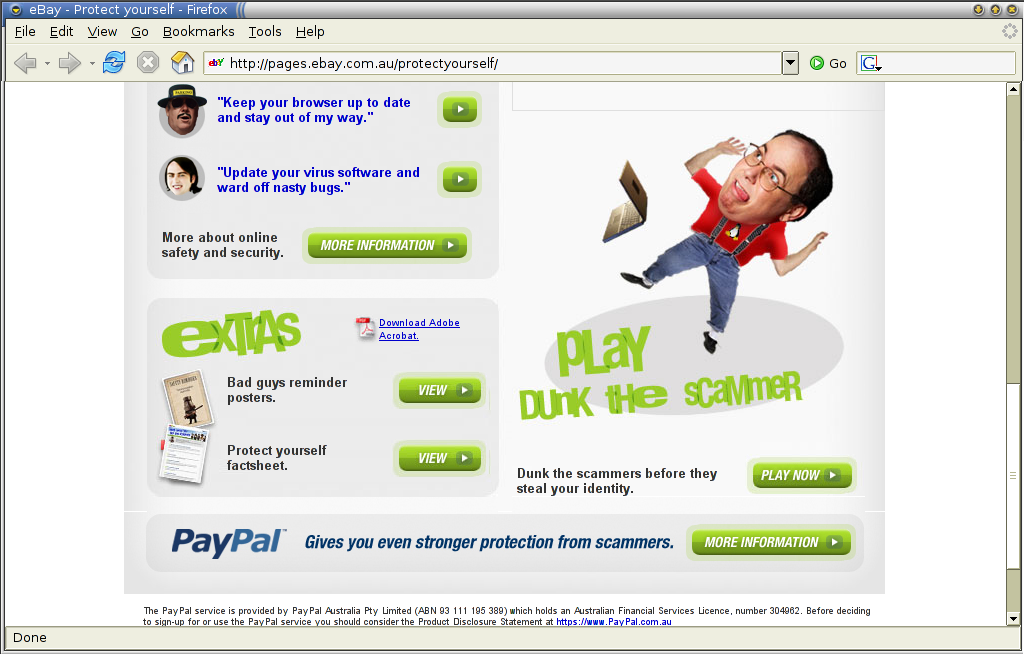
Matthew Palmer: EBay Sez: Linux is for scammers

In what I can only assume is a case of "graphic design spec gone horribly wrong", EBay has decided to portray our lovable penguin friend as the mascot of the online scam artist: Linux is for scammers, says EBay (Click on the image for a full-size version) Personally, I think the scam artists' best friend is a Windows machine, as it provides a rich source of untraceable connectivity, but my guess is that Microsoft has scarier lawyers. I don't know how long the image has been up there for, but I'd imagine it won't last long. Linux users may not be that numerous, but we're a noisy lot. <grin>

Andrew Pollock: [life] A c-section from a bloke's perspective

I've been meaning to write this for weeks. Hopefully I can still remember everything. So Sarah had a c-section the day before we were scheduled to have our c-section class. We'd both read a bit though, so it wasn't like we were going in totally uninformed and unprepared.. Firstly, Stanford Hospital's operating room area is rather mind-blowing. Sarah was transferred from Lucille Packard Children's Hospital to Stanford because they could get an operating room there sooner. The transfer was trivial, just roll the whole bed down the corridor, through the magic double doors into the operating rooms. The doors in question have a whole heap of video cameras pointing straight down, so they see everyone that gets wheeled in and out, which I found interesting. Good for records of patient movements I guess. Anyway, through those doors is a maze of corridors. There was a light-up board hanging from the ceiling in the middle of the main corridor with lights for all of the ORs. I think there were about 20. The illuminated ones were available. We went down a corridor, and past a few ORs. Outside of each one is a big stainless-steel scrub area. We got to "our" OR, and they transferred Sarah onto the operating table. Because of her heart condition, they wanted to have an arterial line in her for the duration of the procedure. This is some sort of gadget that goes into an artery and monitors your blood pressure beat by beat. The "interesting" thing with the anaesthesiologist was the New Zealand woman that we'd seen when we had an anaesthesiologist months prior, but the appointment was with a different anaesthesiologist, and this New Zealand woman was "observing". At the time, the anaesthesiologist we had the appointment with told us that she was going to be on vacation at the time of the delivery, so she wouldn't be attending. So I don't know if the Kiwi woman got promoted out of "observing" to "doing" in that period, or what, but she reintroduced herself to us in LPCH prior to moving to Stanford as being our anaesthesiologist for the delivery. Anyway, in the OR, they handed her the arterial line, in it's plastic packaging, and the first thing she asked was whether it came with anything else to put it in. At this point I figured she hadn't put one of these in before. (The answer to her question, by the way, was "no") She then proceeded to have a terrible time getting the line into Sarah's arm. Normally intravenous lines go into a vein, but this has to go into an artery. Apparently when you go poking an artery, it spasms. It then becomes very hard to get it into a moving target. She had a few goes on one arm, then gave up, and had to move over to the other arm. Sarah doesn't like needles at the best of times, and getting this honking great big thing in was no picnic. The bruising on both her wrists afterwards was phenomenal. She tends to bruise fairly spectacularly whenever they stick a needle in her. I almost stepped in and asked if it was really necessary that she have it, because they were having so much trouble getting it in, and it was clearly hurting Sarah. I think someone else ended up getting it in, not the anaesthesiologist. Not "that" one anyway. There were heaps of people in the OR. Next, came the epidural. Again, we had the inexperienced anaesthesiologist. This time she said to someone else how she was so nervous because there were "too many eyes". Not really reassuring. They gave Sarah a numbing injection first, and then proceeded to poke her in back with the epidural catheter needle thing. Sarah was flinching when they did it, and they kept yelling at her not to move. Apparently it didn't hurt, but it caused discomfort every time they tried to get it in. Eventually the associate professor of anaesthesiology stepped in and got it in. Later, they said that Sarah had a slightly curved spine or something, and that had made it a bit more complicated. I'm not begrudging the obviously inexperienced anaesthesiologist for anything. Stanford is a teaching hospital, and doctors have to get their experience somehow, but I think that when the patient is conscious, it's important to come across a little more confident. So once they got all of that sorted out, they could get her lying down on the table and get down to business. Apparently one of the side-effects of the epidural is that it can cause your body to think it's got hypothermia. Part way through the procedure, Sarah started shaking uncontrollably. I can't remember whether she complained about feeling cold or not. She also got a really itchy face. Apparently that's a side-effect of morphine. Sarah also doesn't tolerate anaesthetics very well, and started feeling nauseous part way through the procedure. Sure enough, as has happened countless times previously post-operatively, she threw up. At least we had warning and I got a kidney dish in place in time. That was about all the eventful surgical stuff. They had the usual screen up from about her neck area, so I couldn't see what they were doing. After Joshua was delivered, one of the nurses asked me if I wanted to see him, and took me around from her left shoulder where I'd been sitting to around below her right foot, to where they had him in one of those perspex portable crib things. I could see a lot of red out of the corner of my eye, and I could have seen a lot more if I'd bothered to look, but I was more interested in seeing my son at that stage. They let me bring him back around to where I'd been sitting previously, to show Sarah, but it was hard getting him up to a point where she could see him properly, and she was partially out of it by this stage. I think she dozed off for a little bit not long after that. I forget what time we got into the OR, but they started the operation in earnest at about 10:00am, and we were out of there by 10:45am if memory serves. The nurse in charge of the recovery room really didn't want me there, so I went back to LPCH with one of the nurses to spend some time with him while he was weighed and measured, and I took some photos, and held him. This was good, because I got to have a good cry on my own with him. So overall, in my "I'll never be squeezing a watermelon out of my nether regions" blokey perspective, having seen what Sarah went through, and how much discomfort that it looked like she was going through, both in the OR and afterwards, I'm not convinced c-sections are any less painful than a vaginal birth (taking the average case of both). I think you're trading some "short term" (depends on how long your labour is I guess) pain for some "long term" pain while you recover from your incision. Granted, Sarah wasn't really laid up all that badly for all that long, but it still didn't look all that pleasant. I guess really only the women who have done both delivery methods can really comment. All I know is I found it very difficult watching Sarah go through so much pain. So much so that I'm not really looking forward to that again. Maybe, hopefully, after her aorta is repaired, they'll let her delivery vaginally next time. I'm not holding much hope though. The high-risk obstetricians are fairly paranoid. There's also the possibility the baby will make the decision very easy for everyone by being breech. Sarah raised an interesting point today. Why didn't they just knock her out with a general anaesthetic? There was no need for her to be conscious for the delivery. That would have spared her the pain and suffering of getting the arterial line in, and they wouldn't have needed to bother with an epidural. One for her to ask the obstetrician at her follow-up appointment.

Joey Hess: introducing mr

Mr. Who? No.. mr is a Multiple Repository management tool. With lots of people using svn with no real reason to switch, and some people using git because it's the cool thing of the day, I need a way to be able to checkout and update from multiple repositories, in multiple revison control systems. There are probably many scripts already written to do this; mr(1) is my attempt, and since it's very configurable and has a very short name, perhaps it will be useful to others in this situation. An example is probably worth 1347 words (according to wc -w mr). One thing not shown here is that it can look for .mrconfig files not just in the home directory, but inside the repositories it checks out.
joey@kodama:~/src> mr update
mr update: in /home/joey/src/dpkg
Already up-to-date.
Already up-to-date.
mr update: in /home/joey/src/linux-2.6
Already up-to-date.
mr update: in /home/joey/src/mr
Already up-to-date.
mr update: finished (3 sucessful; 1 skipped)
Here's my current ~/.mrconfig file.
[src/mr]
checkout = git clone ssh://git.kitenet.net/srv/git/kitenet.net/mr
[src/linux-2.6]
checkout = git clone git://git.kernel.org/pub/scm/linux/kernel/git/torvalds/linux-2.6.git
# I only check this out on kodama, otherwise skip it.
skip = test $(hostname) != kodama
[src/dpkg]
# A merge of the upstream dpkg git repo and my own personal branch.
checkout = git clone git://git.debian.org/git/dpkg/dpkg.git && \
        cd dpkg && \
        git remote add kite ssh://kitenet.net/srv/git/kitenet.net/dpkg && \
        git fetch kite && \
        git checkout -b sourcev3 kite/sourcev3
update = git pull origin master && git pull kite sourcev3
commit = git push kite
# My home directory, which I keep in svn.
[]
checkout = svn co svn+ssh://svn.kitenet.net/srv/svn/joey/trunk/home-$(hostname) joey
# run svnfix after each update
update = svn update && svnfix
PS, what should "mr clean" do?

Michal &#268;iha&#345;: Ukolovnik 0.8

New version of simple todo manager called Ukolovnik has been just released. Version 0.8 comes with following changes: Switch to gettext means that you can translate it now using standard tools. One of them can be Pootle at l10n.cihar.com. If you want to add new language, just tell me.

10 October 2007

John Goerzen: Hey Dell, Can You Hear Me Now?

A couple of years ago, I had an apparent lapse of judgement and bought a 21" Dell LCD because it seemed to be a good monitor and a good price. Even after my earlier experiences with Dell.

Last winter, it developed an odd dim area in the shape of an L. It was under warranty.

I made the mistake of contacting Dell support. It probably took 2-3 hours of calling before they agreed to replace it. I'm pretty sure I said each of these things to them at least 5 times:


Eventually I spoke to somebody that understood the concept of a serial number and agreed to send me a replacement monitor. I made the mistake of giving them a shipping address for that.

Ever since then, they have sent me stupid catalogs.

NO, DELL, I DO NOT WANT TO BUY A FLAMINGO PINK INSPIRON NOTEBOOK

that is what I think each week when I get such a catalog.

I have gone to their website to try to get off of these mailings. They have different privacy forms for their different units (home, small business, etc.), and I sent in a removal form for all of them. That didn't help. I called their customer service department, and after getting the run around yet again, they said they'd take me off right away. That didn't help either. This was all months ago. They are blatantly violating their stated privacy policy.

Today I got another magazine. Featuring Flamingo Pink inspirons yet again. And a page that says "Raze your standards." Need I say more?

I will therefore be following the advice of Junkbusters.com and will file a Prohibitory Order against Dell at my earliest convenience. That's the first time I've been motivated to do that.

And if they don't honor that, they'll be hearing from the postal inspectors.

Dell has now become my most despised company ever. Yes, even more than Sprint.

Next.

Previous.