Search Results: "zed"

21 June 2010

Matt Zimmerman: Finishing books

Having invested in some introspection into my reading habits, I made up my mind to dial down my consumption of bite-sized nuggets of online information, and finish a few books. That s where my bottleneck has been for the past year or so. Not in selecting books, not in acquiring books, and not in starting books either. I identify promising books, I buy them, I start reading them, and at some point, I put them down and never pick them back up again. Until now. Over the weekend, I finished two books. I started reading both in 2009, and they each required my sustained attention for a period measured in hours in order to finish them. Taking a tip from Dustin, I decided to try alternating between fiction and non-fiction. Jitterbug Perfume by Tom Robbins This was the first book I had read by Tom Robbins, and I am in no hurry to read any more. It certainly wasn t without merit: its themes were clever and artfully interwoven, and the prose elicited a silent chuckle now and again. It was mainly the characters which failed to earn my devotion. They spoke and behaved in ways I found awkward at best, and problematic at worst. Race, gender, sexuality and culture each endured some abuse on the wrong end of a pervasive white male heteronormative American gaze. I really wanted to like Priscilla, who showed early promise as a smart, self-reliant individual, whose haplessness was balanced by a strong will and sense of adventure. Unfortunately, by the later chapters, she was revealed as yet another vacant vessel yearning to be filled by a man. She s even the steward of a symbolic, nearly empty perfume bottle throughout the book. Yes, really. Managing Humans by Michael Lopp Of the books I ve read on management, this one is perhaps the most outrageously reductionist. Many management books are like this, to a degree. They take the impossibly complex problem domain of getting people to work together, break it down into manageable problems with tidy labels, and prescribe methods for solving them (which are hopefully appropriate for at least some of the reader s circumstances). Managing Humans takes this approach to a new level, drawing neat boxes around such gestalts as companies, roles, teams and people, and assigning them Proper Nouns. Many of these bear a similarity to concepts which have been defined, used and tested elsewhere, such as psychological types, but the text makes no effort to link them to his own. Despite being a self-described collection of tales , it s structured like a textbook, ostensibly imparting nuggets of managerial wisdom acquired through lessons learned in the Real World (so pay attention!). However, as far as I can tell, the author s experience is limited to a string of companies of a very specific type: Silicon Valley software startups in the dot com era. Lopp (also known as Rands) does have substantial insight into this problem domain, though, and does an entertaining job of illustrating the patterns which have worked for him. If you can disregard the oracular tone, grit your teeth through the gender stereotyping, and add an implicit preface that this is (sometimes highly) context-sensitive advice, this book can be appreciated for what it actually is: a coherent, witty and thorough exposition of how one particular manager does their job. I got some good ideas out of this book, and would recommend it to someone working in certain circumstances, but as with Robbins, I m not planning to track down further work by the same author.

20 June 2010

Stefano Zacchiroli: debian meeting guidelines RFC

How to have a (Debian) summit without turning into a secret cabal It seems rather uncontroversial that sponsoring various kinds of Debian meetings (conferences, sprints, BSPs, etc.) is a good way to spend, actually invest, Debian money. Historically, that has not always saved the Debian community from muttering about "cabal-ish" meetings in very few specific occasions. (No, there is no cabal, in case you wonder.) I've always believed in the good faith of people and I don't think that we have ever had "secret meetings" on purpose. Nevertheless the question of how to have meetings in a community-compatible way is a sound one. Answering properly to such a question is something that it's harder than what it might seem at first sight (at least for me). In particular, organizers have to carefully balance the high efficiency that meetings offer (e.g.: communication bandwidth is higher than when working remotely, people have less distractions, more enthusiasm, more fun!, etc.) with the risk of cutting out the rest of the community which cannot attend the meeting, for whatever reason. Note also that since Debian is not a company, we cannot just require that everybody who is interested attend the meeting. As DPL, I'm starting to get quite some requests for meeting sponsorship, and that's just wonderful: it means that we have thrilling groups of people that are eager to get together and hack to improve Debian! Still, in doing so, we should all try to minimize the above risk; that's why I've started to apply the following Debian meeting guidelines, as a kind of prerequisite for sponsoring.
  1. Before the meeting: the meeting should be announced to the most relevant public mailing list(s); ideally, the tentative agenda of the meeting should be included in the announcement.
    That will enable people interested in the meeting topics to provide their inputs and more generally to know what is going on.
  2. During the meeting (preparation): expenses should be minimized, as a form of respect for all people that donate to Debian. Since we value their contributions, we do our best not to waste them. (TTBOMK, we've always done that, but making it explicit won't hurt.)
  3. After the meeting: meeting minutes should be sent to the most relevant public mailing list(s), usually to d-d-a for meetings that cover topics of general development interest.
    As an obvious consequence, minutes should be taken during the meeting; it is a bit of extra burden, but the risk of leaving the rest of the community in the dark is just not acceptable a community as wide and diverse as ours.
  4. In general, think about communication, e.g.: (micro)blog about the meeting, contact press/-publicity to prepare a news item about it, enable others to attend virtually on IRC or other media, etc.
For now, the above is just a brain dump.
Now, what do you think? Are the above reasonable demands? What else should we ask for?
Feel free to leave a comment or mail me about that.

Daniel Baumann: Debian Live Web Images Builder

Richard Nelson, an outstanding debian-live contributor and team member since many years, has setup an instance of the live-helper CGI scripts that are included within live-helper. This webbuilder lets users get their own customized images without the need of having to install live-helper and build them on their own. It's available at live-helper.debian.net. Apart from having some better looking html form and adding an online-help that will be worked on soon, it's working great. Thanks you, Richard.

19 June 2010

Torsten Werner: Results from the Debian Community Poll

I have announced the Debian Community Poll in my former blog post. I have closed the poll today and I will start publishing its results now.
What is the codename of the current stable release?This is the only compulsory question with the intention to block spammers. The correct codename is Lenny but I have accepted almost any answer that is somehow related to Debian. Version numbers, names from Sarge to Experimental, even well known codenames and version numbers from Ubuntu have been counted as correct. 22 partipants answered wrongly and their submissions got removed from the result set. A whopping number of 3258 submissions have been accepted and get analyzed now. Thanks to all participants!
How long have you been using Debian?

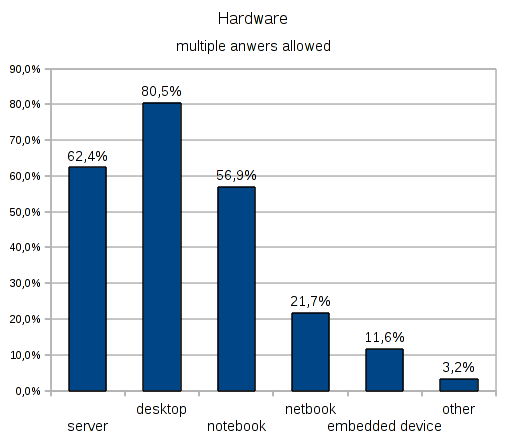
On what kind of hardware are you using Debian?
Multiple answers are allowed for this question and that is why the values do not sum up to 100%.
  • 80.5% are using Debian on the desktop
  • 62.4% on the server
  • 56.9% on the notebook
  • 21.7% on the netbook
  • 11.6% on embedded device(s)
  • 3.2% on other device(s)
The following other devices have been mentioned: smartphone, virtual machine, nettop, NAS, HTPC, workstation, pendrive, live cd, cluster, thin client, router, rocket flight computer, ibm mainframe, and automatic bar tender.

Do you contribute to Debian?
  • 50.0% choose answer #5: I don't contribute on a regular base.
  • 31.2% choose answer #4: I'm regularly helping other Debian users.
  • 8.0% choose other (see below) or simply did not answer
  • 4.9% choose answer #3: I'm regularly contributing to Debian packages without uploading them by myself.
  • 4.5% choose answer #1: I'm a Debian developer.
  • 1.4% choose answer #2: I'm a Debian maintainer.
The following other answers have been provided:
  • upstream developer or contributor
  • translator
  • bug reporter
  • advocator
  • former DD or DM
  • prospective DD or DM
  • mirror maintainer
  • package/installer tester
  • documentation writer
  • donator or debconf sponsor
  • debconf organizer or helper

How do you think about the Debian Free Software Guidelines (DFSG)?
  • 46.0% choose answer #2: I like the DFSG but it is not the most important reason for using Debian.
  • 36.6% choose answer #1: The DFSG is very important to me. I could live with many changes in Debian but I would be very upset if Debian would allow non-free software into its main component in the future.
  • 10.1% choose answer #3: I don't know.
  • 4.9% choose answer #4: I don't care.
  • 2.4% did not answer.

Are you using Debian derived distributions, too?
Multiple answers are allowed for this question and that is why the values do not sum up to 100%. There were a lot of different answers but the most frequent are:
  • 47.1%: Ubuntu (Kubuntu, Lubuntu, Xubuntu)
  • 40.8%: no answer; this was the only way to say that someone does not use a derived distribution
  • 11.0%: other (see below)
  • 7.0%: damn small linux
  • 4.8%: Sidux
  • 4.3%: grml (juxlala)
  • 2.2%: Knoppix
  • 1.6%: ELive
  • 1.4%: Maemo
The other answer includes the following distributions: 64studio, ALT Linux, arch linux, ArtistX, BackTrack, BRLix, Canaima GNU/Linux, catix, cdlinux.pl, CloneZilla, CrunchBang, Custom, ddwrt, debian arm userspace for zipit z2, DebXO (?), DreamLinux, Easy Peasy, eb4, eeebuntu, EMC2 Ubuntu (linuxcnc.org), Emdebian, Estrella Roja, Fedora, Finnix, Gentoo, gNewSense, Hackable:1, Kanotix, Kuliax, LFS and CLFS, LinEx, Linux Mint, live CDs, live-helper, Mepis antix, Musix, My own LiveCD, Mythbuntu, OpenInkpot, openwrt, paipix gnu, Parsix, Peppermint, personal debian derived, proxmox, Puppy, PureOS, qtopia, SHR, simplyMEPIS, Skolelinux, slackware, SymphonyOS, Toutou, Trisquel, tty GNU/Linux, UHU Linux, Univention Corporate Server, vinux, Voyage, Vyatta, whiite, Xandros, Xarnoppix. Not all of them are derived from Debian.

- to be continued -

13 June 2010

Martin Michlmayr: Debian support for eSATA SheevaPlug available

The eSATA SheevaPlug is supported by the Debian installer and by Debian now. I've updated the install guide accordingly. If you're already running Debian on your eSATA SheevaPlug but you installed as a regular SheevaPlug to USB or SD and you'd like to use the eSATA, then make sure you're the latest kernel from Debian squeeze:
apt-get update
apt-get dist-upgrade
flash-kernel
Reboot and type this in u-boot:
setenv arcNumber 2678
saveenv
reset
Your machine will then be recognized as an eSATA SheevaPlug and eSATA will work. Thanks to John Holland for working on SheevaPlug eSATA support.

Bernd Zeimetz: signs of bad package maintenance

<rant>Recently I've adopted a package, mainly as Merkaartor uses it now. It made me sad to see in which bad condition the package was. Here are just a few things I had to do to bring it into shape: These points were only the larger issues, a lot more were fixed by me or by QA uploads while the package was orphaned. For me it seems that the former maintainer of that package threw some stuff together just to be able to upload the package - or at least run out of spare time to maintain a package properly several years ago. To all the people who maintain packages - and it doesn't matter if you maintain a single package or hundreds of them: Please orphan or at least RFA your packages if you don't have the proper time to maintain (all of) them. Don't open new ITPs if you obviously don't have the time to maintain the packages you have already. Talk with your upstreams, they're usually happy about it. Look at Lintian warnings and errors instead of overriding them. If you take patches from NMUs, say 'thanks' to the poor soul who had to create them for you in debian/changelog instead of taking the work without any notice. Remember - Debian is a community effort, not a run for the highest number of maintained packages on your QA page.</rant>

12 June 2010

Matt Zimmerman: How to decide what to read (and what not to read)?

Like you, dear Internet readers, I have no shortage of reading material. I have ready access to more engaging, high quality, informative and relevant information than I can possibly digest. Every day, I have to choose what to read, and what to pass by. This seems like an important thing to do well, and I wonder if I do a good enough job of it. This is just one example of a larger breadth/depth problem, but I m finding the general problem difficult to stomach, so I m focusing on reading for the moment. These are my primary sources of reading material on a day-to-day basis: How do you decide what to read, and what not to read? How does your experience differ between your primary information sources? How have you tried to improve?

Russell Coker: Defense in Depth and Sudo

My blog post about logging in as root and whether sudo provides any benefit [1] got some interest on Redit. In the Reddit comments on my post [2] there are a lot of strange things. One interesting comment was to suggest that logging in as non-root provided defense in depth . The NSA is credited with inventing the term Defense in Depth as applied to the computer industry, they have a PDF that gives an overview of the concept [3]. It seems that Defense in Depth is all about having multiple different layers of security, firewalls, IDS/IPS, passwords, PKI, etc. Entering the same password twice (once to login and once to run sudo which seems to be a fairly typical configuration of sudo) hardly seems to count. Can using sudo provide Defense in Depth benefits? With a typical configuration the use of sudo provides no real protection. The user either enters their own password or the root password to gain full root access, in either case the attacker can exploit their session and get the password. A session exploit can be easily arranged by creating a shell function or alias that makes sudo run something else (such as using netcat to send the password out over the network). One way of making this sort of attack more difficult is to make root own the user home directory, files such as ~/.login that are used by the user shell, the ~/.ssh directory and the ~/.ssh/authorized_keys file. This way a hostile party can t change the configuration, so a successful attack has to involve a long running process that uses ptrace to intercept the shell and divert an attempt to run sudo. If the non-root user is prevented from using ptrace then things start to become a little more difficult for the attacker. In some quick tests I was able to capture about half the data through messing with /proc/X/fd/0 and /proc/X/fd/1 for a target process, but it seems that it would be difficult to get an entire password that way. To disable ptrace you could compile a kernel without ptrace support, use a SE Linux policy that prevents prevent ptrace access for the sessions in question, or make the user s shell SETGID. If the root account and the account used for su or sudo use different authentication methods, where the options include ssh authorized keys, password, and security token (maybe both password and token for the root account) then it does seem that it would provide some Defense in Depth benefits. sudo can be used to only permit executing certain commands. While this is a real security benefit it doesn t allow full sysadmin work, merely delegating some portions of operations to people who don t have full sysadmin rights. As someone needs to have full access to fix any problem that might occur on the machine someone needs to have access to run any command as root. So while sudo is great for providing limited administrative access to certain junior people, it s not going to stop an attack on a member of the sysadmin team. Conclusion In a typical sudo configuration the non-root account is configured in a default Unix manner (with the user having ownership of their home directory). The user who logs in to that account controls it s environment through .login and other scripts, so sudo doesn t gain anything. In a typical configuration ptrace is enabled so even if the critical environment files can t be modified by a hostile party they can get the same result through ptrace. Admittedly using a SETGID shell is not going to be difficult to implement after you have changed the ownership of the home directory. If you have a configuration where ptrace is not available and the non-root user can t modify their own profile files then it starts to become difficult for an attacker. If root authentication requires using a security token such that every login uses a different code and the code expires rapidly then it becomes even more difficult for an attacker. But for all configurations that are close to the default for every OS that I ve ever used none of these conditions hold. Also none of those conditions held for any of the systems I ve been employed to use which were configured to require su or sudo for root access. As it seems that most sudo configurations don t provide any extra security, and that auditing the actions of the sysadmin can be better done in other ways (such as the Bash 4.1 syslog feature) [4] it seems that for the vast majority of systems sudo doesn t provide a benefit. The fact that sudo could provide a benefit if configured in a way that is quite different to all the defaults and the ways that it is typically used is worth noting. I m not going to argue with anyone who wants to configure their systems in such a manner and who believes that they need to do so. But anyone who thinks that sudo is the only way to go because the Ubuntu default configuration does it really needs to investigate the issues. Remember that blind faith in the security choices of other people can be a security problem.

Bernd Zeimetz: styling changes in ikiwiki 3.20100610

Some minutes before the release of 3.20100610 we convinced Joey in #ikiwiki to commit the following changes: We hope that nobody wants to hit us with a bat now :-)

11 June 2010

Bernd Zeimetz: merkaartor 0.16.0 available in unstable

Merkaartor 0.16.0 was uploaded to Debian/unstable several days ago and should be available on all architectures now. Merkaartor As usual please help testing the new version - upstream and me will try to fix all bugs as fast as possible. Below follows the long list of new features, for the full list of changes see the CHANGELOG.

10 June 2010

Dirk Eddelbuettel: RcppArmadillo 0.2.2

Following the Rcpp 0.8.1 release we made yesterday, we released RcppArmadillo release 0.2.2 this morning. RcppArmadillo uses Rcpp (and some 'glue' code) to provide a transparent interface from R to Conrad Sanderson's impressive Armadillo library for linear algebra. This release works well with the most recent inline release 0.3.5. One can now employ inlined R code as we generalized how/which headers are included and how library / linking information is added thanks a plugin mechanism. This is the first RcppArmadillo version to provide such a plugin, We also updated the included Armadillo headers to its most recent release 0.9.10, added some more operators and provide a utility function RcppArmadillo:::CxxFlags() to provide include directory information on the fly. An example of the direct inline approach for the fastLm function:
library(inline)
library(RcppArmadillo)
src <- '
	Rcpp::NumericVector yr(ys);			// creates Rcpp vector from SEXP
	Rcpp::NumericMatrix Xr(Xs);			// creates Rcpp matrix from SEXP
	int n = Xr.nrow(), k = Xr.ncol();

	arma::mat X(Xr.begin(), n, k, false);   	// reuses memory and avoids extra copy
	arma::colvec y(yr.begin(), yr.size(), false);

	arma::colvec coef = arma::solve(X, y);      	// fit model y ~ X
	arma::colvec res = y - X*coef;			// residuals

	double s2 = std::inner_product(res.begin(), res.end(), res.begin(), double())/(n - k);
							// std.errors of coefficients
	arma::colvec std_err = arma::sqrt(s2 * arma::diagvec( arma::inv(arma::trans(X)*X) ));

	return Rcpp::List::create(Rcpp::Named("coefficients") = coef,
				  Rcpp::Named("stderr")       = std_err,
				  Rcpp::Named("df")           = n - k
				  );
'
fun <- cxxfunction(signature(ys="numeric", Xs="numeric"), src, plugin="RcppArmadillo")
This creates a compiled function fun which, by using Armadillo, regresses a vector ys on a matrix Xs (just how the fastLmPure() function in the package does) --- yet is constructed on the fly using cxxfunction from inline. More information is on the RcppArmadillo page. Questions, comments etc should go to the rcpp-devel mailing list off the R-Forge page.

9 June 2010

David Welton: A Minor Erlang Rant

In an earlier post, I compared node.js to Erlang: http://journal.dedasys.com/2010/04/29/erlang-vs-node-js - which admittedly has a whiff of apples and oranges about it. Still, though, I think there's something to it. Node.js is creating lots of buzz for itself these days. Some of that will turn into actual production use, and at that point actual companies will have a vested interest in seeing the system improved. Currently, it is not as 'good' as Erlang. Erlang's VM has a built in scheduler, so you simply don't have to worry about manually creating bite-sized chunks of processing that feed into one another, it all "just works". For instance, my current Erlang project involves reading from twitter's stream, and distributing that to IRC and the web. It's pretty simple, works well, and is quite robust. I haven't had the best of days though, and one little annoyance of the many I dealt with today really caught my eye. I need to do an HTTP POST in Erlang, and:
  1. The documentation does not have examples.
  2. Here's an example of how to do a POST:
    http:request( post, "http://scream-it.com/win/tests/posttest.cfm", [], "application/x-www-form-urlencoded", "x=2&y=3&msg=Hello%20World" , [], [] ).
  3. Aside from being ugly and not very leggible, you'll note that he's passing the parameters as a string, and also has to manually include the "x-www-form-urlencoded" header.
  4. To create that string, you'd want to url encode it. Actually, ideally, you'd just pass in a list of key/value pairs and let the library module handle it.
  5. However, there's nothing in the http module that does that.
  6. If you look through various bits of Erlang code on the web, you'll note many, many versions of url encoding and decoding, because the http module makes no mention of how one might go about doing so.
  7. It turns out, that the edoc_lib module does have a uri encode function!
  8. That isn't documented in its own man page.
  9. And certainly isn't linked to in the http page.
So, in 2010, doing an HTTP POST in Erlang is still a pain in the neck. I'd be happy to put my money where my mouth is and submit a patch (at least one for the documentation), but you have to wonder why no one has fixed the problem so far - maybe they're not very accepting of patches?

David Welton: Some difficult decisions?

I am, by nature, a tinkerer. I love to build things to see how they will work or because I have an idea that I think is fun. I am not so much of a natural business guy. I go build something "because it's there". Or rather, it's there in my mind, and I want to make it. I earn money, however, via consulting work. There are problems with this line of business though, namely that it doesn't scale very well unless, besides being good at a skill, you've also got the skills to build up a consulting business, which is very much about adding and managing people, something I'm not all that passionate about and would rather avoid. So what happens is that you go through slumps with less than full capacity, and then things pick up again, and before you know it, you hit your upper limit and can't take on any new work, putting a ceiling over your potential earnings. Sure, you can raise prices a bit, but that'll only get you so far. For a while now, I've been considering this problem, and I think some sort of product would be an ideal way out. Stories like Balsamiq's are inspirational, and along the lines of what I think might be nice. Don't get me wrong, I like my clients and like to help people solve problems a lot, but it's a stressful job in that you're never very far from having no income. I'm not much of an entrepreneur, though, in the sense of someone with a nose for making money. I tend to think about building something cool first, and not really worrying about making money with it. Predictably, some of the sites I have created are popular, but don't make any money. Sure, they have some ads, but that doesn't really make much unless you get really huge page views or have some sort of content that attracts users who will click on very lucrative advertisements. I've started to think that perhaps I should constrain myself in new initiatives to creating things that have a direct source of revenue: you want to use it, you pay. In my daydream world, I'd probably just hack on open source all day long, but there's no money in that for someone like me who is not the author of some huge, famous piece of software, nor a particularly great hacker in any case (I've met some, like Andrew Tridgell, and it's a really humbling experience). So that brings up the question of what to do with the aforementioned sites. One option would be to sell them off via a site like flippa.com, another would be simply to just let them sit there and stew, but they do take up some resources on my server, and require some maintainance now and then, and they're a bit of a distraction too (I start wondering about things to add or how to fiddle with them). Maybe there's a way to make money from some of them, but I'm too blind to see it. The ones I'm thinking about, are, in no particular order:

8 June 2010

Matt Zimmerman: DevOps and Cloud

DevOps I first heard about DevOps from Lindsay Holmwood at linux.conf.au 2010. Since then, I ve been following the movement with interest. It seems to be about cross-functional involvement in software teams, specifically between software development and system administration (or operations). In many organizations, especially SaaS shops, these two groups are placed in opposition to each other: developers are driven to deliver new features to users, while system administrators are held accountable for the operation of the service. In the best case, they maintain a healthy balance by pushing in opposite directions, but more typically, they resent each other for getting in the way, as a result of this dichotomy:
Development Operations
is responsible for creating products offering services
is measured on delivery of new features high reliability
optimizes by increasing velocity controlling change
and so is perceived as reckless and irresponsible obstructing progress
Of course, both functions are essential to a viable service, and so DevOps aims to replace this opposition with cooperation. By removing this friction from the organization, we hope to improve efficiency, lower costs, and generally get more work done.
So, DevOps promotes the formation of cross-functional teams, where individuals still take on specialist development or operations roles, but work together toward the common goal of delivering a great experience to users. By working as teammates, rather than passing work over the wall , they can both contribute to development, deployment and maintenance according to their skills and expertise. The team becomes a devops team, and is responsible for the entire product life cycle. Particular tasks may be handled by specialists, but when there s a problem, it s the team s problem. Some take it a step further, and feel that what s needed is to combine the two disciplines, so that individuals contribute in both ways. Rather than thinking of themselves as developers or sysadmins , these folks consider themselves devops . They work to become proficient in both roles, and to synthesize new ways of working by drawing on both types of skills and experience. A common crossover activity is the development of sophisticated tools for automating deployment, monitoring, capacity management and failure resolution. DevOps meets Cloud Like DevOps, cloud is not a specific technology or method, but a reorganization of the model (as I ve written previously). It s about breaking down the problem in a different way, splitting and merging its parts, and creating a new representation which doesn t correspond piece-for-piece to the old one. DevOps drives cloud because it offers a richer toolkit for the way they work: fast, flexible, efficient. Tools like Amazon EC2 and Google App Engine solve the right sorts of problems. Cloud also drives DevOps because it calls into question the traditional way of organizing software teams. A development/operations division just doesn t fit cloud as well as a DevOps model. Deployment is a classic duty of system administrators. In many organizations, only the IT department can implement changes in the production environment. Reaping the benefits of an IaaS environment requires deploying through an API, and therefore deployment requires development. While it is already common practice for system administrators to develop tools for automating deployment, and tools like Puppet and Chef are gaining momentum, IaaS makes this a necessity, and raises the bar in terms of sophistication. Doing this well requires skills and knowledge from both sides of the fence between development and operations, and can accelerate development as well as promote stability in production.
This is exemplified by infrastructure service providers like Amazon Web Services, where customers pay by the hour for black box access to computing resources. How those resources are provisioned and maintained is entirely Amazon s problem, while its customers must decide how to deploy and manage their applications within Amazon s IaaS framework. In this scenario, some operations work has been explicitly outsourced to Amazon, but IaaS is not a substitute for system administration. Deployment, monitoring, failure recovery, performance management, OS maintenance, system configuration, and more are still needed. A development team which is lacking the experience or capacity for this type of work cannot simply switch to an IaaS model and expect these needs to be taken care of by their service provider.
With platform service providers, the boundaries are different. Developers, if they build their application on the appropriate platform, can effectively outsource (mostly) the management of the entire production environment to their service provider. The operating system is abstracted away, and its maintenance can be someone else s problem. For applications which can be built with the available facilities, this will be a very attractive option for many organizations. The customers of these services may be traditional developers, who have no need for operations expertise. PaaS providers, though, will require deep expertise in both disciplines in order to build and improve their platform and services, and will likely benefit from a DevOps approach. Technical architecture draws on both development and operations expertise, because design goals like performance and robustness are affected by all layers of the stack, from hardware, power and cooling all the way up to application code. DevOps itself promotes greater collaboration on architecture, by involving experts in both disciplines, but cloud is a great catalyst because cloud architecture can be described in code. Rather than talking to each other about their respective parts of the system, they can work together on the whole system at once. Developers, sysadmins and hybrids can all contribute to a unified source tree, containing both application code and a description of the production environment: how many virtual servers to deploy, their specifications, which components run on which servers, how they are configured, and so on. In this way, system and network architecture can evolve in lockstep with application architecture. Cloudy promises such as dynamic scaling and fault tolerance call for a DevOps approach in order to be realized in a real-world scenario. These systems involve dynamically manipulating production infrastructure in response to changing conditions, and the application must adapt to these changes. Whether this takes the form of an active, intelligent response or a passive crash-only approach, development and operational considerations need to be aligned. So what? DevOps and cloud will continue to reinforce each other and gain momentum. Both individuals and organizations will need to adapt in order to take advantage of the opportunities provided by these new models. Because they re complementary, it makes sense to adopt them together, so those with expertise in both will be at an advantage.

6 June 2010

Mart&iacute;n Ferrari: Loi 1901

After one year in France, there's still something I cannot completely understand; I don't know if it is something common in Europe, or a artifact of the French law, or if it is just that French people like to do things so formally all the time... I was taking a look at the website of the local LUG, and was amazed that they have association loi de 1901 status, an administration council with 11 members, statute, and written bylaws. Also, to be a part of the association, you need to send a paper form and at least 10. According to the Wikipedia page , an association loi de 1901 is just a non-profit organisation, and it has that status even if it is not registered. But it seems that is not mandatory to have any of the hierarchical structure, written rules and the such! So it seems that any group of more than 10 that gets together to do something go through all this trouble when it is not needed, there should be some explanation for all this... Tags: Planet Debian, Planet Lugfi, Francia

5 June 2010

Jos? Parrella: Ditching PCI cards in Asterisk for fun and profit

In the past, I ve used PCI cards providing telephony TDM for my Asterisk-based projects. I ve only worked with Digium s FXO/FXS and T1/E1 cards, both in PCI and PCI-x formats, until a client asked for a gateway solution with FXO, FXS and E1, where using the PCI cards in a 1U IPBX was simply out of the question. Using Ethernet gateways has always been a problem in those cases, since entry-to-medium level solutions lack the processing power for massive call handling, and signalling is poor, making the architecture unfit for reporting purposes and specialized apps such as call centers. But hey, that s my experience with gateways. Therefore, I looked into Xorcom s Astribank. They pack FXO, FXS and PRI/BRI ports inside a convenient 19 1U case, which can connect to an Asterisk-based IPBX server via USB and gets recognized as an integral DAHDI device in modern setups. So I ordered a composite 8xFXO, 8xFXS and 1xE1 PRI from Astribank, labelled XR0072. Getting the equipment from Arizona to Florida was easy, and since I worked with DHL, getting it to Guayaquil in Ecuador was a breeze (next-day delivery) but passing customs is, as always in Latin America, a time-consuming operation. After paying 12.5% taxes and then some for DHL operations, and 15 days waiting, I got the equipment in Quito. To my surprise, the Astribank was extremely light and small, slightly near 3 Kg in 1U form factor and under 1/4 depth in the rack. While it had a rack-mounting kit, which I used, it could also rest securely over my IPBX without rack screws. My Astribank uses a single USB cable to connect to the master PBX it could also be connected to a secondary PBX and provide a fault tolerant setup. It also depends on a DC supply, which they included. Since I was using a modern Debian, with a modern Asterisk with already-compiled modern DAHDI (formerly called Zapata/Zaptel) drivers, I just connected the equipment via USB to the IPBX, issued an invoke-rc.d dahdi restart and we were good to go. Note: you do need the fxload package in Debian for firmware loading to the Astribank. And for good to go I mean you can check the registered spans with dahdi_registration and, as soon as you connect the E1 cable that comes from the CPE to the CPE port (which in my XR0072 is the first on the lower row for PRI) you get an OK status with dahdi_tool. Also note that I use an E1/CPE port, which is the default for the Astribank, otherwise I d have to set the XPP_PRI_SETUP variable as indicated on the User Manual. DAHDI insists on configuring a crc4 parameter for the detected spans, which I needed to remove and restart DAHDI so the equipment could sync with the CPE (that is, the box that the telco provided, with the balun and the crossover RJ45 cable) and avoid some nasty noise issues on the line, that also occur with Digium s Wildcard for PRI.
usb:008/005          xpp_usb+     e4e4:1162 Astribank-modular FPGA-firmware
 LABEL=[usb:...]       CONNECTOR=@usb-0000:00:1d.7-1
	XBUS-00/XPD-00: E1       (31)  Span 1  DAHDI-SYNC
	XBUS-00/XPD-10: FXS      (8)   Span 2
	XBUS-00/XPD-20: FXO      (8)   Span 3
Using DAHDI s dahdi_genconf command writes an /etc/asterisk/dahdi-channels.conf file with the group and channel configuration as detected by DAHDI. It should be included by the chan_dahdi.conf file, which, in my case, is not necessary since I only wanted to enable one DAHDI group (DAHDI/g0) with my 31 E1 channels (1-15,17-31)
group=0
context=from-pstn
channel => 1-15,17-31
That means that when I want to use the FXO/FXS ports, it d probably be easier to include the dahdi-channels.conf (FXS ports, for example, belong to a different context, from-internal) so I don t have to type more than my laziness permits. I also found that, in my setup, some Asterisk parameters were superfluous, such as the switchtype (either national or euroisdn work, and the former is the default) or the echo-cancelling stuff, so I assume Astribank s doing a great job in negotiating that with the CPE. Do take note, however, that in my case the CPE needed to be cold-restarted so I could get an Up status in Asterisk (pri show spans) and that my only non-default, channel related configuration in chan_dahdi.conf is signalling=pri_cpe. So far, so good. I m really happy with the Astribank and I can fully understand how useful it is in terms of price (quite competitive in comparison with traditional cards, specially when bought from resellers -like me-), size/weight and functionality/ease of setup and administration. Kudos!

4 June 2010

Marco T&uacute;lio Gontijo e Silva: Summer of Code weekly report #4

My project. I m publishing my report earlier this week, because there was a lot to talk about. This week I started to make changes in the code going in the direction of what I want to do. I haven t started a final implementation, but I m studying about how what I want to do will affect the rest of the Garbage Collection (GC). I noticed the code in rts/sm/Sweep.c was simple and similar to what I m planning to do, so I started changing how it works. Sweep in the Glasgow Haskell Compiler (GHC) is done by a bitmap, which contains a bit for each word in a memory block, and is set to 1 when there s an object starting in the mapped area and 0 otherwise. When there s a block with no objects starting at it, that is, all bits of the bitmap are set to 0, the block is freed.
        if (resid == 0)
         
            freed++;
            gen->n_old_blocks--;
            if (prev == NULL)  
                gen->old_blocks = next;
              else  
                prev->link = next;
             
            freeGroup(bd);
         
The bits are analyzed in a group of BITS_IN(W_), where BITS_IN(W_) is the number of bits in a word.
        for (i = 0; i < BLOCK_SIZE_W / BITS_IN(W_); i++)
         
            if (bd->u.bitmap[i] != 0) resid++;
         
If more than of the groups are completely set to 0, the block is considered fragmented.
            if (resid < (BLOCK_SIZE_W * 3) / (BITS_IN(W_) * 4))  
                fragd++;
                bd->flags  = BF_FRAGMENTED;
             
Immix, the GC algorithm I plan to implement in GHC, divides the blocks of memory in lines. My initial plan was to identify free lines. I decided to consider a the size of a line fixed in BITS_IN(W_) words, because it will map to a word in the bitmap, and the code was already analyzing in groups of BITS_IN(W_) words. This was very easy with the current code.
            if (bd->u.bitmap[i] != 0) resid++;
            else printf("DEBUG: line_found(%p)\n", bd->start + BITS_IN(W_) * i);
This worked, and showed some free lines. I m sure there are other ways of logging in GHC, but printf was the simplest way I could thought of. I measured the occurrence of free lines using the bernouilli program from the NoFib benchmark suite, calling it with 500 +RTS -w, to make it uses sweep. In 782 calls to GarbageCollect(), sweep() was called 171 times, for 41704 blocks to be swept and found 230461 free lines. This gives us about 5.5 free lines per block, from the 8 lines in each block (on 64 bits systems). The problem is that the bitmap is marked only in the start of the objects allocated, so even in a line that all bits are marked with 0 we can t assume that it s completely free, because there may be an object that starts in the previous line that is using the space of the line. Checking only for the previous line doesn t work either, because a big object can span several lines. What we can do here is a variation of conservative marking, as proposed in the Immix paper, checking only the previous line and working only with objects smaller than a line. To make sure I was working only with objects smaller than a line, I had to mark the blocks that contains medium objects and avoid them when seeking free lines. The block flags are defined in includes/rts/storage/Block.h, so I included another flag in this file, BF_MEDIUM.
/* Block contains objects evacuated during this GC */
#define BF_EVACUATED 1
/* Block is a large object */
#define BF_LARGE     2
/* Block is pinned */
#define BF_PINNED    4
/* Block is to be marked, not copied */
#define BF_MARKED    8
/* Block is free, and on the free list  (TODO: is this used?) */
#define BF_FREE      16
/* Block is executable */
#define BF_EXEC	     32
/* Block contains only a small amount of live data */
#define BF_FRAGMENTED 64
/* we know about this block (for finding leaks) */
#define BF_KNOWN     128
/* Block contains objects larger than a line */
#define BF_MEDIUM    256
The GHC GC is generational, there is, objects are allocated in a generation and, after a time, the ones that are still being used are moved the next generation. This idea assumes the death probability of younger objects is higher, so few objects are moved to the next generation. Sweep and Immix work only in the last generation so, to mark blocks with medium objects we have to check the size of the objects that are moved to the next generation. This is done in the copy_tag function of rts/sm/Evac.c. I inserted a code that checks for the object size and marks the block when it s bigger than BITS_IN(W_).
STATIC_INLINE GNUC_ATTR_HOT void
copy_tag(StgClosure **p, const StgInfoTable *info,
         StgClosure *src, nat size, generation *gen, StgWord tag)
 
    StgPtr to, from;
    nat i;
    to = alloc_for_copy(size,gen);
    if(size > 8)  
        Bdescr(to)->flags  = BF_MEDIUM;
     
So I updated the code in rts/sm/Sweep.c to only inspect for free lines in blocks without BF_MEDIUM mark.
            if (bd->u.bitmap[i] != 0) resid++;
            else if(!(bd->flags & BF_MEDIUM))  
                printf("DEBUG: line_found(%p)\n", bd->start + BITS_IN(W_) * i);
             
This also worked. Now, in the 32012 blocks there were 189015 free lines, found in the same number of GCs, making about 5.9 free lines per block. We considered only blocks with small objects, but we didn t ignore the first line of each group of free lines. This can be achieved by checking if the previous line was also free.
            if (bd->u.bitmap[i] != 0) resid++;
            else if(!(bd->flags & BF_MEDIUM) && i > 0 && bd->u.bitmap[i] == 0)  
                printf("DEBUG: line_found(%p)\n", bd->start + BITS_IN(W_) * i);
             
Now, from the 32239 blocks, 165547 free lines were found, giving 5.1 free lines per block. But there are more things to improve. If the whole block is free, we want to free it, instead of marking it s lines as free. So it s better to mark the lines after we know that the blocks are not completely free. So I left the code that checks the bitmap as it was, and included a line check only for blocks that are not completely free. At this point, I also associated the fragmentation test with blocks with medium objects, because in blocks of small objects we plan to allocate in free lines, so fragmentation is not a (big) issue.
            if (resid < (BLOCK_SIZE_W * 3) / (BITS_IN(W_) * 4) &&
                (bd->flags & BF_MEDIUM))  
                fragd++;
                printf("DEBUG: BF_FRAGMENTED\n");
                bd->flags  = BF_FRAGMENTED;
             
            else if(!(bd->flags & BF_MEDIUM))  
                for(i = 1; i < BLOCK_SIZE_W / BITS_IN(W_); i++)
                 
                    if(bd->u.bitmap[i] == 0 && bd->u.bitmap[i - 1] == 0)  
                        printf("DEBUG: line_found(%p)\n", bd->start + BITS_IN(W_) * i);


The total ammount of blocks increased dramatically: the blocks that become fragmented and were not called again in sweep made a huge difference. From the 345143 blocks, 1633268 free lines were found, or about 4.7 free lines per block. 9434 blocks were free, so, from the remaining blocks, we have about 4.9 free lines per block. Something we ll need then is a way to access these lines latter. The simplest way I thought to achieve it is constructing a list of lines, in each the first word of each free line is a pointer to the next free line, and the first word of the last free line is 0. It s useful to keep reporting the lines to stdout, so that we can then follow the list and check if we went to the same lines.
                    if(bd->u.bitmap[i] == 0 && bd->u.bitmap[i - 1] == 0)  
                        StgPtr start = bd->start + BITS_IN(W_) * i;
                        printf("DEBUG: line_found(%p)\n", start);
                        if(line_first == NULL)  
                            line_first = start;
                         
                        if(line_last != NULL)  
                            *line_last = (StgWord) start;
                         
                        line_last = start;
                        *line_last = 0;


    for(line_last = line_first; line_last; line_last = (StgPtr) *line_last)  
        fprintf(stderr, "DEBUG: line_found(%p)\n", line_last);
     
I printed the inclusion of the lines on the list to stdout, and the walking on the list in stderr, so that it d be easy to diff. There was no difference between the lists. There re another improvements that can be made, like using a list of groups of free lines, but I think it ll be better to think about this after studying how the allocation in the free lines will be done. That s where I m going to now.
There are some minor things I learned, and thought they worth blogging. The current GHC uses three strategies for collecting the last generation: copying, mark-compact and mark-sweep. Copying is the default until the memory reaches 30% of the maximum heap size; after that, mark-compact is used. Sweep can be chosen by a Real Time System (RTS) flag, -w. To use mark-compact always, the flag is -c. I ve been submitting small patches to the cvs-ghc mailling list, mostly about outdated comments. Most of them were accepted, except for one which contained a lot of commentary, and that indeed was not completely correct. I corrected it and resend to the list, but the message is waiting for approval because the message header matched a filter rule. I believe this is because I replied the message generated from darcs. There s a very useful ghc option, specially for testing the compiler, because in this case you need to rebuild the source, even when there re no changes in it. It s -fforce-recomp, and it makes only sense when used with --make.

John Goerzen: Hardware/Machine Reporting Tools

We have a tool at work, Kaseya, for our Windows machines. It handles updates, but also can report back information gathered from them: OS version, patches installed, time since last checkin, last user logged in, user most frequently logged in, plus details about hardware: RAM, disk size, serial number, etc. I m looking for a tool that can do this on Linux as well. Of course, we could roll our own; all the above is readily cleaned from standard commands plus examining /proc and /sys. But before we roll our own, we want to be sure there s nothing else out there worth using. Down the road, we might also like it to grow in another direction: centralized configuration, storing links between machines and people in a database, and generating DNS, DHCP, etc. configurations out of it. Whether that would be the same tool as this is another question. There are, of course, expensive and overkilling well-known commercial packages to do this. We re after something simple that gets the job done. Any ideas?

Wouter Verhelst: Re: beid

Sometimes help is just around the corner, and all you have to do is ask. Not so long ago, I asked for help on the support software for the Belgian electronic ID card. I'd been packaging that since it came out back in 2004, but recently I've had some issues with getting the most recent version of this software to work properly. Since Debian 6.0 "squeeze" is fairly near, and since I don't want a horribly outdated version of beid to be part of that release, I realized that something needed to happen, and rather soon. My request got quite some response; much more than I'd expected. There have been answers from people with various amounts of experience in Debian packaging; one of the people to reply to my request was Laurent Bigonville, who's also a Debian Developer. So we've now set up a mailinglist, a git repository, and work seems to be proceeding nicely. I've also asked for the removal of the old belpic source package. However, due to a mistake on my end, the beid source package rather than the belpic one was removed, which means that it'll have to be re-added to the archive now. That should happen sometime during the next few days, after the worst problems have been fixed. However, since I now asked for belpic to be removed, too, this means that for the time being, there is no eID software in unstable. We'll fix that in due time; stay tuned.

Russ Allbery: NVIDIA, bug handling, and patience

Recently, the long-time maintainer of the NVIDIA packages for Debian stepped down, after having not had much time to work on the packages for some time. I don't really like maintaining non-free packages, but I have some NVIDIA hardware and nouveau isn't quite far enough along yet for me to feel comfortable just switching, so I decided to help, despite having very little spare time. Thankfully, Andreas Beckmann stepped up and has been submitting patches like crazy, so I've not had to do a lot of the work. This is a very difficult package to maintain, since it's completely non-free. Nearly all the code is a binary object, which we cannot change in any way, so it's frustrating because we can't do anything about basically any bugs. Upstream distributes their code in a weird, annoying package format. It's also very complicated, full of random upstream libraries for providing various interfaces to the GPU to do computing, and it conflicts with and replaces various X bits like the GL library. And on top of that, it comes in four different variants, all of which need to be separately packaged, plus a bunch of supporting packages and libraries (some non-free and some free). Oh, and it builds a kernel module. And we historically provided pre-built kernel modules and meta-packages. And the packaging infrastructure hadn't been overhauled in quite some time, so it wasn't using current packaging techniques. Did I mention the RC bugs and the nearly 200 open bugs on just the main non-legacy package (now much lower thanks to Andreas's hard work). We're slowly making progress. nvidia-graphics-drivers migrated to testing for the first time since around the lenny release and now supports DKMS, and Andreas has massively modernized the packaging. We also have just about finished the transition to using the free libvdpao library rather than the one included with the NVIDIA packages. But given that background, you might understand why one might find blog posts like this one (about a bug that was first reported for KDE just one week ago!) just a little demotivating. (The problem had been previously observed with GDM, but it appeared to be fixed somehow in GDM 3.) I'm sure there are better ways that I could have communicated the bug status, and I probably stressed a bit more than I need to the point that the module is completely opaque and non-free and there isn't much that we can do to change its behavior. But reading negative comments about one's work on Planet Debian is really kind of frustrating, particularly when that work is on something that it's hard to get Debian to care about and that's kind of thankless to start with. I'm not trolling for praise here; I have a thick skin. But this does seem like a good opportunity for a reminder that this is a volunteer project, some packages are kind of annoying to maintain, and things take time. If you don't agree with a maintainer's determination of whether or not something is RC (I still don't think this bug is RC), one can certainly have that conversation. But unless the maintainer marks the bug wontfix, please don't jump to the conclusion that no one cares about trying to find a resolution. And one week is a rather short time period to arrive at that conclusion, even if the maintainer is fairly negative about the bug. Sometimes that just means that you caught them on a bad day. For the record, I'm currently pondering asking the people with this bug to try adding nvidia to /etc/modules and see if forcing the module load earlier works around this problem. I think what's happening is that the module is doing some sort of prolonged initialization, and it just needs more lead time before it's expected to respond to the X server.

Next.

Previous.