Search Results: "tar"

29 October 2020

Norbert Preining: Deleting many files from an S3 bucket

So we found ourselves in the need to delete a considerable amount of files (around 500000, amounting to 1.6T) from an S3 bucket. With the list of files in hand my first shot was calling
aws s3 rm s3://BUCKET/FILE
for each file. That wasn t the best idea I have to say, since first of all, it makes 500000 requests, and then it takes a looong time. And this command does not allow to pass in multiple files. Fortunately there is aws s3api delete-objects which takes a json input and can delete multiple files:
aws 3api delete-objects --bucket BUCKET --delete ' "Objects": [   "Key" : "FILE1"  ,   "Key" : "FILE2"  ... ] '
That did help, and with a bit of magic from bash (mapfile which can read in lines from stdin in batches) and jq, at the end it was a business of some 20min or so:
cat files-to-be-deleted    while mapfile -t -n 500 ary && (($ #ary[@] )); do
        objdef=$(printf '%s\n' "$ ary[@] "   jq -nR ' Objects: (reduce inputs as $line ([]; . + [ "Key":$line ])) ')
        aws s3api --no-cli-pager  delete-objects --bucket BUCKET --delete "$objdef"
done
This reads 500 files a time, and reformats it using jq into the proper json format: reduce inputs is a jq filter that iterates over the input lines and does a map/reduce step. In this case we use an empty array as start and add new key/filename pairs on the go. Finally, the whole bunch is send to AWS with the above API call. Puuuh, 500000 files and 1.6T less, in 20min.

28 October 2020

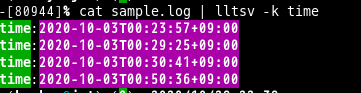
Kentaro Hayashi: lltsv 0.6.1-2: applied background color patch for readability

Original version of lltsv doesn't specify background color, so it is hard to recognize texts in dark background. I've fixed this issue by specifying background color explicitly. Here is the screenshot of fixed version. Yay! f:id:kenhys:20201028223848p:plain This issue was already forwarded as PR github.com

27 October 2020

Noah Meyerhans: Debian STS: Short Term Support

In another of my frequent late-night bouts with insomnia, I started thinking about the intersection of a number of different issues facing Debian today, both from a user point of view and a developer point of view. Debian has a reputation for shipping stale software. Versions in the stable branch are often significantly behind the latest development upstream. Debian s policy here has been that this is fine, our goal is to ship something stable, not something bleeding edge. Unofficially, our response to users is: If you need bleeding edge software, Debian may not be for you. Officially, we have no response to users who want fresher software. Debian also has a problem with a lack of manpower. I believe that part of why we have a hard time attracting contributors is our reputation for stale software. It might be worth it for us to consider changes to our approach to releases.

What about running testing? People who want newer software often look to Debian s testing branch as a possible solution. It s tempting, as it s a dynamically generated release based on unstable, so it should be quite current. In practice, it s not at all uncommon to find people running testing, and in fact I m running it right now on the ThinkPad on which this is being typed. However, testing comes with a glaring issue: a lack of timely security support. Security updates must still propagate through unstable, and this can take some time. They can be held up by dependencies, library transitions, or other factors. Nearly every list of best practices for computer security lists keeping software up-to-date at or near the top of most important steps to take to safely use networked computer. Debian s testing branch makes this very difficult, especially when faced with a zero-day with potential for real-world exploit.

What about stable-backports? Stable backports is both better and worse than testing. It s better in that it allows you to run a system comprised mainly of packages from the stable branch, which receive updates from the security team in a timely manner. However, it s worse in that the packages from the backports repository incur an additional delay. The expectation around backports is that a package migrates naturally from unstable to testing, and then requires a maintainer to upload a new package based on the version in testing specifically targeted at stable backports. The migration can potentially be bypassed, and we used to have a mechanism for announcing the availability of security updates for the stable backports archive, but it has gone unused for several years now. The documentation describes a workflow for posting security updates that involves creating a ticket in Debian s RT system, which is going to be quite foreign to most people. News from mid 2019 suggests that this process might change, but nothing appears to have come of this in over a year, and we still haven t seen a proper security advisory for stable backports in years.

Looking to LTS for ideas The Long-Term Support project is an alternative branch of Debian, maintained outside the normal stable release infrastructure. It s stable, and expected to behave that way, but it s not supported by the stable security team or release team. LTS provides a framework for providing security updates via targeted uploads by a team of interested individuals working outside the structure of the existing stable releases. This project seems to be quite active (how much of this is because at least some members are being paid?), and as of this writing has actually published more security advisories in the past month than the stable security team has published for the current stable branch. This is also interesting in that the software in LTS is quite old, first appearing in a Debian stable release in 2017. LTS is particularly interesting here as it s an example an initiative within the Debian community taken specifically to address user needs. For some of our users, remaining on an old release is a perfectly valid thing for them to do, and we recognize this and support them in doing so.

Debian Short-Term Support So, what would it take to create an LTS-like initiative in the other direction? Instead of providing ongoing support for ancient versions of software that previously comprised a stable release, could we build a distribution branch based on something that hasn t yet reached stable? What would that look like? How would it fit in the existing unstable testing migration process? What impact would it have on the size of the archive? Would we want a rolling release, or discrete releases? If the latter, how many would we want between proper stable releases? The security tracker already tracks outstanding issues in unstable and testing, and can even show issues that have been fixed in unstable but haven t yet propagated to testing. If we want a rolling release, maybe we could just open up the testing-security repository more broadly? There was once a testing security team, which IIRC was chartered to publish updated packages directly to testing security, along with associated security advisory. Based on the mailing list history, that effort seems to have shut down around the time of the squeeze (Debian 6.0) release in early 2011. Would it be worth resurrecting it? We ve probably got much of the infrastructure required in place already, since it previously existed. Personally I m not really a fan of a pure rolling release. I d rather see a light-weight release. Maybe a snapshot of testing that gets just a date, not a Toy Story codename. Probably skip building a dedicated installer for it. Upgrade from stable or use a d-i snapshot from testing if needed. This mini release is supported until the next one comes out, maybe 6 or 8 months later. By supported, I mean that the Short Term Release team is responsible for it. They can upload security or other critical bug fixes directly to a dedicated repository. When the next STS snapshot is released, packages in the updates repository are either archived, if they re a lower version than the one in the new mini release, or rebuilt against the new mini release and preserved. Using some of the same mechanisms as the LTS release, we d need
  1. Something to take the place of oldstable, that is the base release against which updates are released. This could be something that effectively maps to a date snapshot served by http://snapshot.debian.org/. (Snapshot itself could not currently handle the increased load, as I understand it, but conceptually it s similar.)
  2. Something to take the place of the dist/updates apt repository that hosts the packages that are updated.
In theory, if the infrastructure could support hose things, then we could in effect generate a mini release at any time based on a snapshot. I wonder if this could start as something totally unofficial; mirror an arbitrary testing snapshot and provide a place for interested people to publish package updates.

Not a proposal, nor a criticism To be clear, I don t really intend this as a proposal; It s really half-baked. Maybe these ideas have already been considered and dismissed. I don t know if people would be interested in working on such a project, and I m not nearly familiar enough with the Debian archive tooling to even make a guess as to how hard it would be to implement much of it. I m just posting some ideas that I came up with while pondering something that, from my perspective, is an area where Debian is clearly failing to meet the needs of some of our users. We know Debian is a popular and respected Linux distribution, and we know people value our stability. However, we also know that people like running Fedora and Ubuntu s non-LTS releases. People like Arch Linux. Not just end-users , but also the people developing the software shipped by the distros themselves. There are a lot of potential contributors to Debian who are kept away by our unwillingness to provide a distro offering both fresh software and security support. I think that we could attract more people to the Debian community if we could provide a solution for these people, and that would ultimately be good for everybody. Also, please don t interpret this as being critical of the release team, the stable security team, or any other team or individual in Debian. I m sharing this because I think there are opportunities for Debian to improve how we serve our users, not because I think anybody is doing anything wrong. With all that said, though, let me know if you find the ideas interesting. If you think they re crazy, you can tell me that, too. I ll probably agree with you.

26 October 2020

Marco d'Itri: RPKI validation with FORT Validator

This article documents how to install FORT Validator (an RPKI relying party software which also implements the RPKI to Router protocol in a single daemon) on Debian 10 to provide RPKI validation to routers. If you are using testing or unstable then you can just skip the part about apt pinnings. The packages in bullseye (Debian testing) can be installed as is on Debian stable with no need to rebuild them, by configuring an appropriate pinning for apt:
cat <<END > /etc/apt/sources.list.d/bullseye.list
deb http://deb.debian.org/debian/ bullseye main
END
cat <<END > /etc/apt/preferences.d/pin-rpki
# by default do not install anything from bullseye
Package: *
Pin: release bullseye
Pin-Priority: 100
Package: fort-validator rpki-trust-anchors
Pin: release bullseye
Pin-Priority: 990
END
apt update
Before starting, make sure that curl (or wget) and the web PKI certificates are installed:
apt install curl ca-certificates
If you already know about the legal issues related to the ARIN TAL then you may instruct the package to automatically install it. If you skip this step then you will be asked at installation time about it, either way is fine.
echo 'rpki-trust-anchors rpki-trust-anchors/get_arin_tal boolean true' \
    debconf-set-selections
Install the package as usual:
apt install fort-validator
You may also install rpki-client and gortr on Debian 10, or maybe cfrpki and gortr. I have also tried packaging Routinator 3000 for Debian, but this effort is currently on hold because the Rust ecosystem is broken and hostile to the good packaging practices of Linux distributions.

Marco d'Itri: RPKI validation with OpenBSD's rpki-client and Cloudflare's gortr

This article documents how to install rpki-client (an RPKI relying party software, the actual validator) and gortr (which implements the RPKI to Router protocol) on Debian 10 to provide RPKI validation to routers. If you are using testing or unstable then you can just skip the part about apt pinnings. The packages in bullseye (Debian testing) can be installed as is on Debian stable with no need to rebuild them, by configuring an appropriate pinning for apt:
cat <<END > /etc/apt/sources.list.d/bullseye.list
deb http://deb.debian.org/debian/ bullseye main
END
cat <<END > /etc/apt/preferences.d/pin-rpki
# by default do not install anything from bullseye
Package: *
Pin: release bullseye
Pin-Priority: 100
Package: gortr rpki-client rpki-trust-anchors
Pin: release bullseye
Pin-Priority: 990
END
apt update
Before starting, make sure that curl (or wget) and the web PKI certificates are installed:
apt install curl ca-certificates
If you already know about the legal issues related to the ARIN TAL then you may instruct the package to automatically install it. If you skip this step then you will be asked at installation time about it, either way is fine.
echo 'rpki-trust-anchors rpki-trust-anchors/get_arin_tal boolean true' \
    debconf-set-selections
Install the packages as usual:
apt install rpki-client gortr
And then configure rpki-client to generate its output in the the JSON format needed by gortr:
echo 'OPTIONS=-j' > /etc/default/rpki-client
You may manually start the service unit to immediately generate the data instead of waiting for the next timer run:
systemctl start rpki-client &
gortr too needs to be configured to use the JSON data generated by rpki-client:
echo 'GORTR_ARGS=-bind :323 -verify=false -checktime=false -cache /var/lib/rpki-client/json' > /etc/default/gortr
And then it needs to be restarted to use the new configuration:
systemctl restart gortr
You may also install FORT Validator on Debian 10, or maybe cfrpki with gortr. I have also tried packaging Routinator 3000 for Debian, but this effort is currently on hold because the Rust ecosystem is broken and hostile to the packaging practices of Linux distributions.

24 October 2020

Dirk Eddelbuettel: digest 0.6.27: Build fix

Exactly one week after the previous release 0.6.26 of digest, a minor cleanup release 0.6.27 just arrived on CRAN and will go to Debian shortly. digest creates hash digests of arbitrary R objects (using the md5, sha-1, sha-256, sha-512, crc32, xxhash32, xxhash64, murmur32, spookyhash, and blake3 algorithms) permitting easy comparison of R language objects. It is a fairly widely-used package (currently listed at one million monthly downloads, 282 direct reverse dependencies and 8068 indirect reverse dependencies, or just under half of CRAN) as many tasks may involve caching of objects for which it provides convenient general-purpose hash key generation. Release 0.6.26 brought support for the (nice, even cryptographic) blake3 hash algorithm. In the interest of broader buildability we had already (with a sad face) disabled a few very hardware-specific implementation aspects using intrinsic ops. But to our chagrin, we left one #error define that raised its head on everybody s favourite CRAN build platform. Darn. So 0.6.27 cleans that up and also removes the check and #error as all the actual code was already commented out. If you read this and tears start running down your cheeks, then by all means come and help us bring blake3 to its full (hardware-accelerated) potential. This (probably) only needs a little bit of patient work with the build options and configurations. You know where to find us My CRANberries provides the usual summary of changes to the previous version. For questions or comments use the issue tracker off the GitHub repo. If you like this or other open-source work I do, you can now sponsor me at GitHub. For the first year, GitHub will match your contributions.

This post by Dirk Eddelbuettel originated on his Thinking inside the box blog. Please report excessive re-aggregation in third-party for-profit settings.

Jelmer Vernooij: Debian Janitor: Hosters used by Debian packages

The Debian Janitor is an automated system that commits fixes for (minor) issues in Debian packages that can be fixed by software. It gradually started proposing merges in early December. The first set of changes sent out ran lintian-brush on sid packages maintained in Git. This post is part of a series about the progress of the Janitor. The Janitor knows how to talk to different hosting platforms. For each hosting platform, it needs to support the platform- specific API for creating and managing merge proposals. For each hoster it also needs to have credentials. At the moment, it supports the GitHub API, Launchpad API and GitLab API. Both GitHub and Launchpad have only a single instance; the GitLab instances it supports are gitlab.com and salsa.debian.org. This provides coverage for the vast majority of Debian packages that can be accessed using Git. More than 75% of all packages are available on salsa - although in some cases, the Vcs-Git header has not yet been updated. Of the other 25%, the majority either does not declare where it is hosted using a Vcs-* header (10.5%), or have not yet migrated from alioth to another hosting platform (9.7%). A further 2.3% are hosted somewhere on GitHub (2%), Launchpad (0.18%) or GitLab.com (0.15%), in many cases in the same repository as the upstream code. The remaining 1.6% are hosted on many other hosts, primarily people s personal servers (which usually don t have an API for creating pull requests). Packages per hoster

Outdated Vcs-* headers It is possible that the 20% of packages that do not have a Vcs-* header or have a Vcs header that say there on alioth are actually hosted elsewhere. However, it is hard to know where they are until a version with an updated Vcs-Git header is uploaded. The Janitor primarily relies on vcswatch to find the correct locations of repositories. vcswatch looks at Vcs-* headers but has its own heuristics as well. For about 2,000 packages (6%) that still have Vcs-* headers that point to alioth, vcswatch successfully finds their new home on salsa.
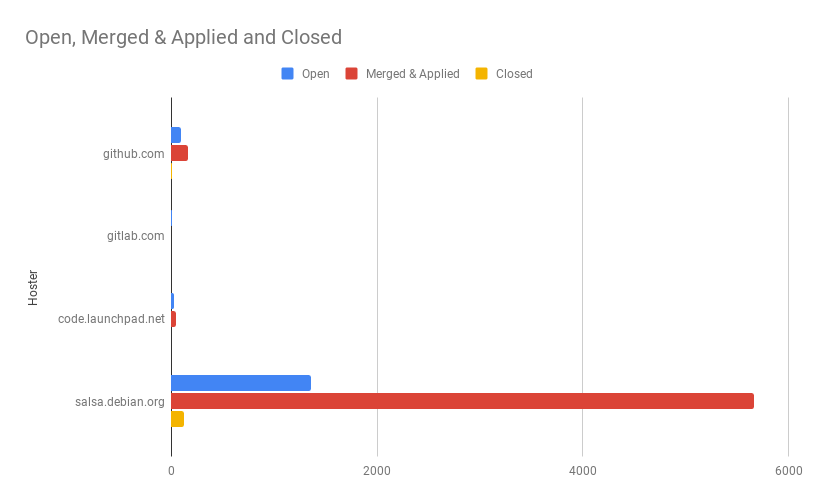
Merge Proposals by Hoster These proportions are also visible in the number of pull requests created by the Janitor on various hosters. The vast majority so far has been created on Salsa.
Hoster Open Merged & Applied Closed
github.com921685
gitlab.com1230
code.launchpad.net24511
salsa.debian.org1,3605,657126
Merge Proposal statistics In this graph, Open means that the pull request has been created but likely nobody has looked at it yet. Merged means that the pull request has been marked as merged on the hoster, and applied means that the changes have ended up in the packaging branch but via a different route (e.g. cherry-picked or manually applied). Closed means that the pull request was closed without the changes being incorporated. Note that this excludes ~5,600 direct pushes, all of which were to salsa-hosted repositories. See also:

For more information about the Janitor's lintian-fixes efforts, see the landing page.

23 October 2020

Enrico Zini: Hetzner build machine

This is part of a series of posts on compiling a custom version of Qt5 in order to develop for both amd64 and a Raspberry Pi. Building Qt5 takes a long time. The build server I was using had CPUs and RAM, but was very slow on I/O. I was very frustrated by that, and I started evaluating alternatives. I ended up setting up scripts to automatically provision a throwaway cloud server at Hetzner. Initial setup I got an API key from my customer's Hetzner account. I installed hcloud-cli, currently only in testing and unstable:
apt install hcloud-cli
Then I configured hcloud with the API key:
hcloud context create
Spin up I wrote a quick and dirty script to spin up a new machine, which grew a bit with little tweaks:
#!/bin/sh
# Create the server
hcloud server create --name buildqt --ssh-key   --start-after-create \
                     --type cpx51 --image debian-10 --datacenter  
# Query server IP
IP="$(hcloud server describe buildqt -o json   jq -r .public_net.ipv4.ip)"
# Update ansible host file
echo "buildqt ansible_user=root ansible_host=$IP" > hosts
# Remove old host key
ssh-keygen -f ~/.ssh/known_hosts -R "$IP"
# Update login script
echo "#!/bin/sh" > login
echo "ssh root@$IP" >> login
chmod 0755 login
I picked a datacenter in the same location as where we have other servers, to get quicker data transfers. I like that CLI tools have JSON output that I can cleanly pick at with jq. Sadly, my ISP doesn't do IPv6 yet. Since the server just got regenerated, I remove a possibly cached host key. Provisioning the machine One git server I need is behind HTTP authentication. Here's a quick hack to pass the relevant .netrc credentials to ansible before provisioning:
#!/usr/bin/python3
import subprocess
import netrc
import tempfile
import json
login, account, password = netrc.netrc().authenticators(" ")
with tempfile.NamedTemporaryFile(mode="wt", suffix=".json") as fd:
    json.dump( 
        "repo_user": login,
        "repo_password": password,
     , fd)
    fd.flush()
    subprocess.run([
        "ansible-playbook",
        "-i", "hosts",
        "-l", "buildqt",
        "--extra-vars", f"@ fd.name ",
        "provision.yml",
        ], check=True)
And here's the ansible playbook:
#!/usr/bin/env ansible-playbook
- name: Install and configure buildqt
  hosts: all
  tasks:
   - name: Update apt cache
     apt:
        update_cache: yes
        cache_valid_time: 86400
   - name: Create build user
     user:
        name: build
        comment: QT5 Build User
        shell: /bin/bash
   - name: Create sources directory
     become: yes
     become_user: build
     file:
        path: ~/sources
        state: directory
        mode: 0755
   - name: Download sources
     become: yes
     become_user: build
     get_url:
        url: "https:// / item "
        dest: "~/sources/ item "
        mode: 0644
     with_items:
      - "qt-everywhere-src-5.15.1.tar.xz"
      - "qt-creator-enterprise-src-4.13.2.tar.gz"
   - name: Populate home directory
     become: yes
     become_user: build
     copy:
        src: build
        dest: ~/
        mode: preserve
   - name: Write .netrc
     become: yes
     become_user: build
     copy:
        dest: ~/.netrc
        mode: 0600
        content:  
           machine  
           login  repo_user 
           password  repo_password 
   - name: Write .screenrc
     become: yes
     become_user: build
     copy:
        dest: ~/.screenrc
        mode: 0644
        content:  
           hardstatus alwayslastline
           hardstatus string '% = cw %-Lw% = KW %50>%n%f* %t% = cw %+Lw%< % = kK %-=%D %Y-%m-%d %c% - '
           startup_message off
           defutf8 on
           defscrollback 10240
   - name: Install base packages
     apt:
        name: git,mc,ncdu,neovim,eatmydata,devscripts,equivs,screen
        state: present
   - name: Clone git repo
     become: yes
     become_user: build
     git:
        repo: https:// @ / .git
        dest: ~/ 
   - name: Copy Qt license
     become: yes
     become_user: build
     copy:
        src: qt-license.txt
        dest: ~/.qt-license
        mode: 0600
Now everything is ready for a 16 core, 32Gb ram build on SSD storage. Tear down When done:
#!/bin/sh
hcloud server delete buildqt
The whole spin up plus provisioning takes around a minute, so I can do it when I start a work day, and take it down at the end. The build machine wasn't that expensive to begin with, and this way it will even be billed by the hour. A first try on a CPX51 machine has just built the full Qt5 Everywhere Enterprise including QtWebEngine and all its frills, for amd64, in under 1 hour and 40 minutes.

22 October 2020

Bastian Blank: Salsa updated to GitLab 13.5

Today, GitLab released the version 13.5 with several new features. Also Salsa got some changes applied to it. GitLab 13.5 GitLab 13.5 includes several new features. See the upstream release postfix for a full list. Shared runner builds on larger instances It's been way over two years since we started to use Google Compute Engine (GCE) for Salsa. Since then, all the jobs running on the shared runners run within a n1-standard-1 instance, providing a fresh set of one vCPU and 3.75GB of RAM for each and every build. GCE supports several new instance types, featuring better and faster CPUs, including current AMD EPICs. However, as it turns out, GCE does not support any single vCPU instances for any of those types. So jobs in the future will use n2d-standard-2 for the time being, provinding two vCPUs and 8GB of RAM.. Builds run with IPv6 enabled All builds run with IPv6 enabled in the Docker environment. This means the lo network device got the IPv6 loopback address ::1 assigned. So tests that need minimal IPv6 support can succeed. It however does not include any external IPv6 connectivity.

21 October 2020

Christian Kastner: RStudio is a refreshingly intuitive IDE

I currently need to dabble with R for a smallish thing. I have previously dabbled with R only once, for an afternoon, and that was about a decade ago, so I had no prior experience to speak of regarding the language and its surrounding ecosystem. Somebody recommended that I try out RStudio, a popular IDE for R. I was happy to see that an open-source community edition exists, in the form of a .deb package no less, so I installed it and gave it a try. It's remarkable how intuitive this IDE is. My first guess at doing something has so far been correct every. single. time. I didn't have to open the help, or search the web, for any solutions, either -- they just seem to offer themselves up. And it's not just my inputs; it's the output, too. The RStudio window has multiple tiles, and each tile has multiple tabs. I found this quite confusing and intimidating on first impression, but once I started doing some work, I was surprised to see that whenever I did something that produced output in one or more of the tabs, it was (again) always in an intuitive manner. There's a fine line between informing with relevant context and distracting with irrelevant context, but RStudio seems to have placed itself on the right side of it. This, and many other features that pop up here and there, like the live-rendering of LaTeX equations, contributed to what has to be one of the most positive experiences with an IDE that I've had so far.

Reproducible Builds: Supporter spotlight: Civil Infrastructure Platform

The Reproducible Builds project depends on our many projects, supporters and sponsors. We rely on their financial support, but they are also valued ambassadors who spread the word about the Reproducible Builds project and the work that we do. This is the first installment in a series featuring the projects, companies and individuals who support the Reproducible Builds project. If you are a supporter of the Reproducible Builds project (of whatever size) and would like to be featured here, please let get in touch with us at contact@reproducible-builds.org. However, we are kicking off this series by featuring Urs Gleim and Yoshi Kobayashi of the Civil Infrastructure Platform (CIP) project.
Chris Lamb: Hi Urs and Yoshi, great to meet you. How might you relate the importance of the Civil Infrastructure Platform to a user who is non-technical? A: The Civil Infrastructure Platform (CIP) project is focused on establishing an open source base layer of industrial-grade software that acts as building blocks in civil infrastructure projects. End-users of this critical code include systems for electric power generation and energy distribution, oil and gas, water and wastewater, healthcare, communications, transportation, and community management. These systems deliver essential services, provide shelter, and support social interactions and economic development. They are society s lifelines, and CIP aims to contribute to and support these important pillars of modern society.
Chris: We have entered an age where our civilisations have become reliant on technology to keep us alive. Does the CIP believe that the software that underlies our own safety (and the safety of our loved ones) receives enough scrutiny today? A: For companies developing systems running our infrastructure and keeping our factories working, it is part of their business to ensure the availability, uptime, and security of these very systems. However, software complexity continues to increase, and the efforts spent on those systems is now exploding. What is missing is a common way of achieving this through refining the same tools, and cooperating on the hardening and maintenance of standard components such as the Linux operating system.
Chris: How does the Reproducible Builds effort help the Civil Infrastructure Platform achieve its goals? A: Reproducibility helps a great deal in software maintenance. We have a number of use-cases that should have long-term support of more than 10 years. During this period, we encounter issues that need to be fixed in the original source code. But before we make changes to the source code, we need to check whether it is actually the original source code or not. If we can reproduce exactly the same binary from the source code even after 10 years, we can start to invest time and energy into making these fixes.
Chris: Can you give us a brief history of the Civil Infrastructure Platform? Are there any specific success stories that the CIP is particularly proud of? A: The CIP Project formed in 2016 as a project hosted by Linux Foundation. It was launched out of necessity to establish an open source framework and the subsequent software foundation delivers services for civil infrastructure and economic development on a global scale. Some key milestones we have achieved as a project include our collaboration with Debian, where we are helping with the Debian Long Term Support (LTS) initiative, which aims to extend the lifetime of all Debian stable releases to at least 5 years. This is critical because most control systems for transportation, power plants, healthcare and telecommunications run on Debian-based embedded systems. In addition, CIP is focused on IEC 62443, a standards-based approach to counter security vulnerabilities in industrial automation and control systems. Our belief is that this work will help mitigate the risk of cyber attacks, but in order to deal with evolving attacks of this kind, all of the layers that make up these complex systems (such as system services and component functions, in addition to the countless operational layers) must be kept secure. For this reason, the IEC 62443 series is attracting attention as the de facto cyber-security standard.
Chris: The Civil Infrastructure Platform project comprises a number of project members from different industries, with stakeholders across multiple countries and continents. How does working together with a broad group of interests help in your effectiveness and efficiency? A: Although the members have different products, they share the requirements and issues when developing sustainable products. In the end, we are driven by common goals. For the project members, working internationally is simply daily business. We see this as an advantage over regional or efforts that focus on narrower domains or markets.
Chris: The Civil Infrastructure Platform supports a number of other existing projects and initiatives in the open source world too. How much do you feel being a part of the broader free software community helps you achieve your aims? A: Collaboration with other projects is an essential part of how CIP operates we want to enable commonly-used software components. It would not make sense to re-invent solutions that are already established and widely used in product development. To this end, we have an upstream first policy which means that, if existing projects need to be modified to our needs or are already working on issues that we also need, we work directly with them.
Chris: Open source software in desktop or user-facing contexts receives a significant amount of publicity in the media. However, how do you see the future of free software from an industrial-oriented context? A: Open source software has already become an essential part of the industry and civil infrastructure, and the importance of open source software there is still increasing. Without open source software, we cannot achieve, run and maintain future complex systems, such as smart cities and other key pieces of civil infrastructure.
Chris: If someone wanted to know more about the Civil Infrastructure Platform (or even to get involved) where should they go to look? A: We have many avenues to participate and learn more! We have a website, a wiki and you can even follow us on Twitter.

For more about the Reproducible Builds project, please see our website at reproducible-builds.org. If you are interested in ensuring the ongoing security of the software that underpins our civilisation and wish to sponsor the Reproducible Builds project, please reach out to the project by emailing contact@reproducible-builds.org.

20 October 2020

Steve Kemp: Offsite-monitoring, from my desktop.

For the past few years I've had a bunch of virtual machines hosting websites, services, and servers. Of course I want them to be available - especially since I charge people money to access at some of them (for example my dns-hosting service) - and that means I want to know when they're not. The way I've gone about this is to have a bunch of machines running stuff, and then dedicate an entirely separate machine solely for monitoring and alerting. Sure you can run local monitoring, testing that services are available, the root-disk isn't full, and that kind of thing. But only by testing externally can you see if the machine is actually available to end-users, customers, or friends.
A local-agent might decide "I'm fine", but if the hosting-company goes dark due to a fibre cut you're screwed.
I've been hosting my services with Hetzner (cloud) recently, and their service is generally pretty good. Unfortunately I've started to see an increasing number of false-alarms. I'd have a server in Germany, with the monitoring machine in Helsinki (coincidentally where I live!). For the past month I've started to get pinged with a failure every three/four days on average, "service down - dns failed", or "service down - timeout". When the notice would wake me up I'd go check and it would be fine, it was a very transient failure. To be honest the reason for this is my monitoring is just too damn aggressive, I like to be alerted immediately in case something is wrong. That means if a single test fails I get an alert, as rather than only if a test failed for something more reasonable like three+ consecutive failures. I'm experimenting with monitoring in a less aggressive fashion, from my home desktop. Since my monitoring tool is a single self-contained golang binary, and it is already packaged as a docker-based container deployment was trivial. I did a little work writing an agent to receive failure-notices, and ping me via telegram - instead of the previous approach where I had an online status-page which I could view via my mobile, and alerts via pushover. So far it looks good. I've tweaked the monitoring to setup a timeout of 15 seconds, instead of 5, and I've configured it to only alert me if there is an outage which lasts for >= 2 consecutive failures. I guess the TLDR is I now do offsite monitoring .. from my house, rather than from a different region. The only real reason to write this post was mostly to say that the process of writing a trivial "notify me" gateway to interface with telegram was nice and straightforward, and to remind myself that transient failures are way more common than we expect. I'll leave things alone for a moment, but it was a fun experiment. I'll keep the two systems in parallel for a while, but I guess I can already predict the outcome:

19 October 2020

Antoine Beaupr : SSH 2FA with Google Authenticator and Yubikey

About a lifetime ago (5 years), I wrote a tutorial on how to configure my Yubikey for OpenPGP signing, SSH authentication and SSH 2FA. In there, I used the libpam-oath PAM plugin for authentication, but it turns out that had too many problems: users couldn't edit their own 2FA tokens and I had to patch it to avoid forcing 2FA on all users. The latter was merged in the Debian package, but never upstream, and the former was never fixed at all. So I started looking at alternatives and found the Google Authenticator libpam plugin. A priori, it's designed to work with phones and the Google Authenticator app, but there's no reason why it shouldn't work with hardware tokens like the Yubikey. Both use the standard HOTP protocol so it should "just work". After some fiddling, it turns out I was right and you can authenticate with a Yubikey over SSH. Here's that procedure so you don't have to second-guess it yourself.

Installation On Debian, the PAM module is shipped in the google-authenticator source package:
apt install libpam-google-authenticator
Then you need to add the module in your PAM stack somewhere. Since I only use it for SSH, I added this line on top of /etc/pam.d/sshd:
auth required pam_google_authenticator.so nullok
I also used no_increment_hotp debug while debugging to avoid having to renew the token all the time and have more information about failures in the logs. Then reload ssh (not sure that's actually necessary):
service ssh reload

Creating or replacing tokens To create a new key, run this command on the server:
google-authenticator -c
This will prompt you for a bunch of questions. To get them all right, I prefer to just call the right ones on the commandline directly:
google-authenticator --counter-based --qr-mode=NONE --rate-limit=1 --rate-time=30 --emergency-codes=1 --window-size=3
Those are actually the defaults, if my memory serves me right, except for the --qr-mode and --emergency-codes (which can't be disabled so I only print one). I disable the QR code display because I won't be using the codes on my phone, but you would obviously keep it if you want to use the app.

Converting to a Yubikey-compatible secret Unfortunately, the encoding (base32) produced by the google-authenticator command is not compatible with the token expected by the ykpersonalize command used to configure the Yubikey (base16 AKA "hexadecimal", with a fixed 20 bytes length). So you need a way to convert between the two. I wrote a program called oath-convert which basically does this:
read base32
add padding
convert to hex
print
Or, in Python:
def convert_b32_b16(data_b32):
    remainder = len(data_b32) % 8
    if remainder > 0:
        # XXX: assume 6 chars are missing, the actual padding may vary:
        # https://tools.ietf.org/html/rfc3548#section-5
        data_b32 += "======"
    data_b16 = base64.b32decode(data_b32)
    if len(data_b16) < 20:
        # pad to 20 bytes
        data_b16 += b"\x00" * (20 - len(data_b16))
    return binascii.hexlify(data_b16).decode("ascii")
Note that the code assumes a certain token length and will not work correctly for other sizes. To use the program, simply call it with:
head -1 .google_authenticator   oath-convert
Then you paste the output in the prompt:
$ ykpersonalize -1 -o oath-hotp -o append-cr -a
Firmware version 3.4.3 Touch level 1541 Program sequence 2
 HMAC key, 20 bytes (40 characters hex) : [SECRET GOES HERE]
Configuration data to be written to key configuration 1:
fixed: m:
uid: n/a
key: h:[SECRET REDACTED]
acc_code: h:000000000000
OATH IMF: h:0
ticket_flags: APPEND_CR OATH_HOTP
config_flags: 
extended_flags: 
Commit? (y/n) [n]: y
Note that you must NOT pass the -o oath-hotp8 parameter to the ykpersonalize commandline, which we used to do in the Yubikey howto. That is because Google Authenticator tokens are shorter: it's less secure, but it's an acceptable tradeoff considering the plugin is actually maintained. There's actually a feature request to support 8-digit codes so that limitation might eventually be fixed as well. Thanks to the Google Authenticator people and Yubikey people for their support in establishing this procedure.

Russell Coker: Video Decoding

I ve had a saga of getting 4K monitors to work well. My latest issue has been video playing, the dreaded mplayer error about the system being too slow. My previous post about 4K was about using DisplayPort to get more than 30Hz scan rate at 4K [1]. I now have a nice 60Hz scan rate which makes WW2 documentaries display nicely among other things. But when running a 4K monitor on a 3.3GHz i5-2500 quad-core CPU I can t get a FullHD video to display properly. Part of the process of decoding the video and scaling it to 4K resolution is too slow, so action scenes in movies lag. When running a 2560*1440 monitor on a 2.4GHz E5-2440 hex-core CPU with the mplayer option -lavdopts threads=3 everything is great (but it fails if mplayer is run with no parameters). In doing tests with apparent performance it seemed that the E5-2440 CPU gains more from the threaded mplayer code than the i5-2500, maybe the E5-2440 is more designed for server use (it s in a Dell PowerEdge T320 while the i5-2500 is in a random white-box system) or maybe it s just because it s newer. I haven t tested whether the i5-2500 system could perform adequately at 2560*1440 resolution. The E5-2440 system has an ATI HD 6570 video card which is old, slow, and only does PCIe 2.1 which gives 5GT/s or 8GB/s. The i5-2500 system has a newer ATI video card that is capable of PCIe 3.0, but lspci -vv as root says LnkCap: Port #0, Speed 8GT/s, Width x16 and LnkSta: Speed 5GT/s (downgraded), Width x16 (ok) . So for reasons unknown to me the system with a faster PCIe 3.0 video card is being downgraded to PCIe 2.1 speed. A quick check of the web site for my local computer store shows that all ATI video cards costing less than $300 have PCI3 3.0 interfaces and the sole ATI card with PCIe 4.0 (which gives double the PCIe speed if the motherboard supports it) costs almost $500. I m not inclined to spend $500 on a new video card and then a greater amount of money on a motherboard supporting PCIe 4.0 and CPU and RAM to go in it. According to my calculations 3840*2160 resolution at 24bpp (probably 32bpp data transfers) at 30 frames/sec means 3840*2160*4*30/1024/1024=950MB/s. PCIe 2.1 can do 8GB/s so that probably isn t a significant problem. I d been planning on buying a new video card for the E5-2440 system, but due to some combination of having a better CPU and lower screen resolution it is working well for video playing so I can save my money. As an aside the T320 is a server class system that had been running for years in a corporate DC. When I replaced the high speed SAS disks with SSDs SATA disks it became quiet enough for a home workstation. It works very well at that task but the BIOS is quite determined to keep the motherboard video running due to the remote console support. So swapping monitors around was more pain than I felt like going through, I just got it working and left it. I ordered a special GPU power cable but found that the older video card that doesn t need an extra power cable performs adequately before the cable arrived. Here is a table comparing the systems.
2560*1440 works well 3840*2160 goes slow
System Dell PowerEdge T320 White Box PC from rubbish
CPU 2.4GHz E5-2440 3.3GHz i5-2500
Video Card ATI Radeon HD 6570 ATI Radeon R7 260X
PCIe Speed PCIe 2.1 8GB/s PCIe 3.0 downgraded to PCIe 2.1 8GB/s
Conclusion The ATI Radeon HD 6570 video card is one that I had previously tested and found inadequate for 4K support, I can t remember if it didn t work at that resolution or didn t support more than 30Hz scan rate. If the 2560*1440 monitor dies then it wouldn t make sense to buy anything less than a 4K monitor to replace it which means that I d need to get a new video card to match. But for the moment 2560*1440 is working well enough so I won t upgrade it any time soon. I ve already got the special power cable (specified as being for a Dell PowerEdge R610 for anyone else who wants to buy one) so it will be easy to install a powerful video card in a hurry.

Louis-Philippe V ronneau: Musings on long-term software support and economic incentives

Although I still read a lot, during my college sophomore years my reading habits shifted from novels to more academic works. Indeed, reading dry textbooks and economic papers for classes often kept me from reading anything else substantial. Nowadays, I tend to binge read novels: I won't touch a book for months on end, and suddenly, I'll read 10 novels back to back1. At the start of a novel binge, I always follow the same ritual: I take out my e-reader from its storage box, marvel at the fact the battery is still pretty full, turn on the WiFi and check if there are OS updates. And I have to admit, Kobo Inc. (now Rakuten Kobo) has done a stellar job of keeping my e-reader up to date. I've owned this model (a Kobo Aura 1st generation) for 7 years now and I'm still running the latest version of Kobo's Linux-based OS. Having recently had trouble updating my Nexus 5 (also manufactured 7 years ago) to Android 102, I asked myself:
Why is my e-reader still getting regular OS updates, while Google stopped issuing security patches for my smartphone four years ago?
To try to answer this, let us turn to economic incentives theory. Although not the be-all and end-all some think it is3, incentives theory is not a bad tool to analyse this particular problem. Executives at Google most likely followed a very business-centric logic when they decided to drop support for the Nexus 5. Likewise, Rakuten Kobo's decision to continue updating older devices certainly had very little to do with ethics or loyalty to their user base. So, what are the incentives that keep Kobo updating devices and why are they different than smartphone manufacturers'? A portrait of the current long-term software support offerings for smartphones and e-readers Before delving deeper in economic theory, let's talk data. I'll be focusing on 2 brands of e-readers, Amazon's Kindle and Rakuten's Kobo. Although the e-reader market is highly segmented and differs a lot based on geography, Amazon was in 2015 the clear worldwide leader with 53% of the worldwide e-reader sales, followed by Rakuten Kobo at 13%4. On the smartphone side, I'll be differentiating between Apple's iPhones and Android devices, taking Google as the barometer for that ecosystem. As mentioned below, Google is sadly the leader in long-term Android software support. Rakuten Kobo According to their website and to this Wikipedia table, the only e-readers Kobo has deprecated are the original Kobo eReader and the Kobo WiFi N289, both released in 2010. This makes their oldest still supported device the Kobo Touch, released in 2011. In my book, that's a pretty good track record. Long-term software support does not seem to be advertised or to be a clear selling point in their marketing. Amazon According to their website, Amazon has dropped support for all 8 devices produced before the Kindle Paperwhite 2nd generation, first sold in 2013. To put things in perspective, the first Kindle came out in 2007, 3 years before Kobo started selling devices. Like Rakuten Kobo, Amazon does not make promises of long-term software support as part of their marketing. Apple Apple has a very clear software support policy for all their devices:
Owners of iPhone, iPad, iPod or Mac products may obtain a service and parts from Apple or Apple service providers for five years after the product is no longer sold or longer, where required by law.
This means in the worst-case scenario of buying an iPhone model just as it is discontinued, one would get a minimum of 5 years of software support. Android Google's policy for their Android devices is to provide software support for 3 years after the launch date. If you buy a Pixel device just before the new one launches, you could theoretically only get 2 years of support. In 2018, Google decided OEMs would have to provide security updates for at least 2 years after launch, threatening not to license Google Apps and the Play Store if they didn't comply. A question of cost structure From the previous section, we can conclude that in general, e-readers seem to be supported longer than smartphones, and that Apple does a better job than Android OEMs, providing support for about twice as long. Even Fairphone, who's entire business is to build phones designed to last and to be repaired was not able to keep the Fairphone 1 (2013) updated for more than a couple years and seems to be struggling to keep the Fairphone 2 (2015) running an up to date version of Android. Anyone who has ever worked in IT will tell you: maintaining software over time is hard work and hard work by specialised workers is expensive. Most commercial electronic devices are sold and developed by for-profit enterprises and software support all comes down to a question of cost structure. If companies like Google or Fairphone are to be expected to provide long-term support for the devices they manufacture, they have to be able to fund their work somehow. In a perfect world, people would be paying for the cost of said long-term support, as it would likely be cheaper then buying new devices every few years and would certainly be better for the planet. Problem is, manufacturers aren't making them pay for it. Economists call this type of problem externalities: things that should be part of the cost of a good, but aren't for one a reason or another. A classic example of an externality is pollution. Clearly pollution is bad and leads to horrendous consequences, like climate change. Sane people agree we should drastically cut our greenhouse gas emissions, and yet, we aren't. Neo-classical economic theory argues the way to fix externalities like pollution is to internalise these costs, in other words, to make people pay for the "real price" of the goods they buy. In the case of climate change and pollution, neo-classical economic theory is plain wrong (spoiler alert: it often is), but this is where band-aids like the carbon tax comes from. Still, coming back to long-term software support, let's see what would happen if we were to try to internalise software maintenance costs. We can do this multiple ways. 1 - Include the price of software maintenance in the cost of the device This is the choice Fairphone makes. This might somewhat work out for them since they are a very small company, but it cannot scale for the following reasons:
  1. This strategy relies on you giving your money to an enterprise now, and trusting them to "Do the right thing" years later. As the years go by, they will eventually look at their books, see how much ongoing maintenance is costing them, drop support for the device, apologise and move on. That is to say, enterprises have a clear economic incentive to promise long-term support and not deliver. One could argue a company's reputation would suffer from this kind of behaviour. Maybe sometime it does, but most often people forget. Political promises are a great example of this.
  2. Enterprises go bankrupt all the time. Even if company X promises 15 years of software support for their devices, if they cease to exist, your device will stop getting updates. The internet is full of stories of IoT devices getting bricked when the parent company goes bankrupt and their servers disappear. This is related to point number 1: to some degree, you have a disincentive to pay for long-term support in advance, as the future is uncertain and there are chances you won't get the support you paid for.
  3. Selling your devices at a higher price to cover maintenance costs does not necessarily mean you will make more money overall raising more money to fund maintenance costs being the goal here. To a certain point, smartphone models are substitute goods and prices higher than market prices will tend to drive consumers to buy cheaper ones. There is thus a disincentive to include the price of software maintenance in the cost of the device.
  4. People tend to be bad at rationalising the total cost of ownership over a long period of time. Economists call this phenomenon hyperbolic discounting. In our case, it means people are far more likely to buy a 500$ phone each 3 years than a 1000$ phone each 10 years. Again, this means OEMs have a clear disincentive to include the price of long-term software maintenance in their devices.
Clearly, life is more complex than how I portrayed it: enterprises are not perfect rational agents, altruism exists, not all enterprises aim solely for profit maximisation, etc. Still, in a capitalist economy, enterprises wanting to charge for software maintenance upfront have to overcome these hurdles one way or another if they want to avoid failing. 2 - The subscription model Another way companies can try to internalise support costs is to rely on a subscription-based revenue model. This has multiple advantages over the previous option, mainly:
  1. It does not affect the initial purchase price of the device, making it easier to sell them at a competitive price.
  2. It provides a stable source of income, something that is very valuable to enterprises, as it reduces overall risks. This in return creates an incentive to continue providing software support as long as people are paying.
If this model is so interesting from an economic incentives point of view, why isn't any smartphone manufacturer offering that kind of program? The answer is, they are, but not explicitly5. Apple and Google can fund part of their smartphone software support via the 30% cut they take out of their respective app stores. A report from Sensor Tower shows that in 2019, Apple made an estimated US$ 16 billion from the App Store, while Google raked in US$ 9 billion from the Google Play Store. Although the Fortune 500 ranking tells us this respectively is "only" 5.6% and 6.5% of their gross annual revenue for 2019, the profit margins in this category are certainly higher than any of their other products. This means Google and Apple have an important incentive to keep your device updated for some time: if your device works well and is updated, you are more likely to keep buying apps from their store. When software support for a device stops, there is a risk paying customers will buy a competitor device and leave their ecosystem. This also explains why OEMs who don't own app stores tend not to provide software support for very long periods of time. Most of them only make money when you buy a new phone. Providing long-term software support thus becomes a disincentive, as it directly reduces their sale revenues. Same goes for Kindles and Kobos: the longer your device works, the more money they make with their electronic book stores. In my opinion, it's likely Amazon and Rakuten Kobo produce quarterly cost-benefit reports to decide when to drop support for older devices, based on ongoing support costs and the recurring revenues these devices bring in. Rakuten Kobo is also in a more precarious situation than Amazon is: considering Amazon's very important market share, if your device stops getting new updates, there is a greater chance people will replace their old Kobo with a Kindle. Again, they have an important economic incentive to keep devices running as long as they are profitable. Can Free Software fix this? Yes and no. Free Software certainly isn't a magic wand one can wave to make everything better, but does provide major advantages in terms of security, user freedom and sometimes costs. The last piece of the puzzle explaining why Rakuten Kobo's software support is better than Google's is technological choices. Smartphones are incredibly complex devices and have become the main computing platform of many. Similar to the web, there is a race for features and complexity that tends to create bloat and make older devices slow and painful to use. On the other hand, e-readers are simpler devices built for a single task: display electronic books. Control over the platform is also a key aspect of the cost structure of providing software updates. Whereas Apple controls both the software and hardware side of iPhones, Android is a sad mess of drivers and SoCs, all providing different levels of support over time6. If you take a look at the platforms the Kindle and Kobo are built on, you'll quickly see they both use Freescale I.MX SoCs. These processors are well known for their excellent upstream support in the Linux kernel and their relative longevity, chips being produced for either 10 or 15 years. This in turn makes updates much easier and less expensive to provide. So clearly, open architectures, free drivers and open hardware helps tremendously, but aren't enough on their own. One of the lessons we must learn from the (amazing) LineageOS project is how lack of funding hurts everyone. If there is no one to do the volunteer work required to maintain a version of LOS for your device, it won't be supported. Worse, when purchasing a new device, users cannot know in advance how many years of LOS support they will get. This makes buying new devices a frustrating hit-and-miss experience. If you are lucky, you will get many years of support. Otherwise, you risk your device becoming an expensive insecure paperweight. So how do we fix this? Anyone with a brain understands throwing away perfectly good devices each 2 years is not sustainable. Government regulations enforcing a minimum support life would be a step in the right direction, but at the end of the day, Capitalism is to blame. Like the aforementioned carbon tax, band-aid solutions can make things somewhat better, but won't fix our current economic system's underlying problems. For now though, I'll leave fixing the problem of Capitalism to someone else.

  1. My most recent novel binge has been focused on re-reading the Dune franchise. I first read the 6 novels written by Frank Herbert when I was 13 years old and only had vague and pleasant memories of his work. Great stuff.
  2. I'm back on LineageOS! Nice folks released an unofficial LOS 17.1 port for the Nexus 5 last January and have kept it updated since then. If you are to use it, I would also recommend updating TWRP to this version specifically patched for the Nexus 5.
  3. Very few serious economists actually believe neo-classical rational agent theory is a satisfactory explanation of human behavior. In my opinion, it's merely a (mostly flawed) lens to try to interpret certain behaviors, a tool amongst others that needs to be used carefully, preferably as part of a pluralism of approaches.
  4. Good data on the e-reader market is hard to come by and is mainly produced by specialised market research companies selling their findings at very high prices. Those particular statistics come from a MarketWatch analysis.
  5. If they were to tell people: You need to pay us 5$/month if you want to receive software updates, I'm sure most people would not pay. Would you?
  6. Coming back to Fairphones, if they had so much problems providing an Android 9 build for the Fairphone 2, it's because Qualcomm never provided Android 7+ support for the Snapdragon 801 SoC it uses.

18 October 2020

Antoine Beaupr : CDPATH replacements

after reading this post I figured I might as well bite the bullet and improve on my CDPATH-related setup, especially because it does not work with Emacs. so i looked around for autojump-related alternatives that do.

What I use now I currently have this in my .shenv (sourced by .bashrc):
export CDPATH=".:~:~/src:~/dist:~/wikis:~/go/src:~/src/tor"
This allows me to quickly jump into projects from my home dir, or the "source code" (~/src), "work" (src/tor), or wiki checkouts (~/wikis) directories. It works well from the shell, but unfortunately it's very static: if I want a new directory, I need to edit my config file, restart shells, etc. It also doesn't work from my text editor.

Shell jumpers Those are commandline tools that can be used from a shell, generally with built-in shell integration so that a shell alias will find the right directory magically, usually by keeping track of the directories visited with cd. Some of those may or may not have integration in Emacs.

autojump

fasd

z

fzf

Emacs plugins not integrated with the shell Those projects can be used to track files inside a project or find files around directories, but do not offer the equivalent functionality in the shell.

projectile

elpy
  • home page
  • elpy has a notion of projects, so, by default, will find files in the current "project" with C-c C-f which is useful

bookmarks.el
  • built-in
  • home page
  • "Bookmarks record locations so you can return to them later"

recentf
  • built-in
  • home page
  • "builds a list of recently opened files. This list is is automatically saved across sessions on exiting Emacs - you can then access this list through a command or the menu"

references https://www.emacswiki.org/emacs/LocateFilesAnywhere

Iustin Pop: Serendipity

To start off, let me say it again: I hate light pollution. I really, really hate it. I love the night sky where you look up and see thousands of stars, and constellations besides Ursa Major. As somebody said once, You haven t lived until you ve seen your shadow by the light of the Milky Way . But, ahem, I live in a large city, and despite my attempts using star trackers, special filters, etc. you simply can t escape it. So, whenever we go on vacation in the mountains, I m trying to think if I can do a bit of astro-photography (not that I m good at it). Which bring me to our recent vacation up in the mountains. I was looking forward to it, until in the week before, when the weather prognosis was switching between snow, rain and overcast for the entire week. No actual day or night with clear skies, so I didn t take a tripod, I didn t take a wide lens, and put night photography out of my mind. Vacation itself was good, especially the quietness of the place, so I usually went to be early-ish and didn t look outside. The weather was as forecasted - no new snow (but there was enough up in the mountains), but heavy clouds all the time, and the sun only showed itself for a few minutes at a time. One night I was up a bit longer than usual, working on the laptop and being very annoyed by a buzzing sound. At first I thought maybe I was imagining it, but from time to time it was stopping briefly, so it was a real noise; I started hunting for the source. Not my laptop, not the fridge, not the TV but it was getting stronger near the window. I open the door to the balcony, and bam! Very loud noise, from the hotel nearby, where at midnight the pool was being cleaned. I look at the people doing the work, trying to estimate how long it ll be until they finish, but it was looking like a long time. Fortunately with the door closed the noise was not bad enough to impact my sleep, so I debate getting angry or just resigned, and since it was late, I just sigh, roll my eyes not metaphorically, but actually roll my eyes and look up, and I can t believe my eyes. Completely clear sky, no trace of clouds anywhere, and stars. Lots of starts. I sit there, looking at the sky and enjoying the view, and I think to myself that it won t look that nice on the camera, for sure. Especially without a real trip, and without a fast lens. Nevertheless, I grab my camera and just for kicks take one handheld picture. To my surprise (and almost disbelief), blurry pixels aside, the photo does look like what I was seeing, so I grab my tiny tripod that I carried along, and (with only a 24-70 zoom lens), grab a photo. And another, and another and then I realise that if I can make the composition work, and find a good shutter speed, this can turn out a good picture. I didn t have a remote release, the tripod was not very stable and it cannot point the camera upwards (it s basically an emergency tripod), so it was quite sub-optimal; still, I try multiple shots (different compositions, different shutter speeds); they look on the camera screen and on the phone pretty good, so just for safety I take a few more, and, very happy, go to bed. Coming back from vacation, on the large monitor, it turns out that the first 28 out of the 30 pictures were either blurry or not well focused (as I was focusing manually), and the 29th was almost OK but still not very good. Only the last, the really last picture, was technically good and also composition-wise OK. Luck? Foresight? Don t know, but it was worth deleting 28 pictures to get this one. One of my best night shots, despite being so unprepared
Stars! Lots of stars! And mountains Stars! Lots of stars! And mountains
Of course, compared to other people s pictures, this is not special. But for me, it will be a keepsake of how a real night sky should look like. If you want to zoom in, higher resolution on flickr. Technically, the challenges for the picture were two-fold: Next time when travelling by car, I ll surely take a proper tripod Until next time, clear and dark skies

Fran ois Marier: Using a Let's Encrypt TLS certificate with Asterisk 16.2

In order to fix the following error after setting up SIP TLS in Asterisk 16.2:
asterisk[8691]: ERROR[8691]: tcptls.c:966 in __ssl_setup: TLS/SSL error loading cert file. <asterisk.pem>
I created a Let's Encrypt certificate using certbot:
apt install certbot
certbot certonly --standalone -d hostname.example.com
To enable the asterisk user to load the certificate successfuly (it doesn't permission to access to the certificates under /etc/letsencrypt/), I copied it to the right directory:
cp /etc/letsencrypt/live/hostname.example.com/privkey.pem /etc/asterisk/asterisk.key
cp /etc/letsencrypt/live/hostname.example.com/fullchain.pem /etc/asterisk/asterisk.cert
chown asterisk:asterisk /etc/asterisk/asterisk.cert /etc/asterisk/asterisk.key
chmod go-rwx /etc/asterisk/asterisk.cert /etc/asterisk/asterisk.key
Then I set the following variables in /etc/asterisk/sip.conf:
tlscertfile=/etc/asterisk/asterisk.cert
tlsprivatekey=/etc/asterisk/asterisk.key

Automatic renewal The machine on which I run asterisk has a tricky Apache setup:
  • a webserver is running on port 80
  • port 80 is restricted to the local network
This meant that the certbot domain ownership checks would get blocked by the firewall, and I couldn't open that port without exposing the private webserver to the Internet. So I ended up disabling the built-in certbot renewal mechanism:
systemctl disable certbot.timer certbot.service
systemctl stop certbot.timer certbot.service
and then writing my own script in /etc/cron.daily/certbot-francois:
#!/bin/bash
TEMPFILE= mktemp 
# Stop Apache and backup firewall.
/bin/systemctl stop apache2.service
/usr/sbin/iptables-save > $TEMPFILE
# Open up port 80 to the whole world.
/usr/sbin/iptables -D INPUT -j LOGDROP
/usr/sbin/iptables -A INPUT -p tcp --dport 80 -j ACCEPT
/usr/sbin/iptables -A INPUT -j LOGDROP
# Renew all certs.
/usr/bin/certbot renew --quiet
# Restore firewall and restart Apache.
/usr/sbin/iptables -D INPUT -p tcp --dport 80 -j ACCEPT
/usr/sbin/iptables-restore < $TEMPFILE
/bin/systemctl start apache2.service
# Copy certificate into asterisk.
cp /etc/letsencrypt/live/hostname.example.com/privkey.pem /etc/asterisk/asterisk.key
cp /etc/letsencrypt/live/hostname.example.com/fullchain.pem /etc/asterisk/asterisk.cert
chown asterisk:asterisk /etc/asterisk/asterisk.cert /etc/asterisk/asterisk.key
chmod go-rwx /etc/asterisk/asterisk.cert /etc/asterisk/asterisk.key
/bin/systemctl restart asterisk.service
# Commit changes to etckeeper.
pushd /etc/ > /dev/null
/usr/bin/git add letsencrypt asterisk
DIFFSTAT="$(/usr/bin/git diff --cached --stat)"
if [ -n "$DIFFSTAT" ] ; then
    /usr/bin/git commit --quiet -m "Renewed letsencrypt certs."
    echo "$DIFFSTAT"
fi
popd > /dev/null

16 October 2020

Yves-Alexis Perez: iOS 14 USB tethering broken on Linux: looking for documentation and contact at Apple

It's a bit of a long shot, but maybe someone on Planet Debian or elsewhere can help us reach the right people at Apple. Starting with iOS 14, something apparently changed on the way USB tethering (also called Personal Hotspot) is set up, which broke it for people using Linux. The driver in use is ipheth, developped in 2009 and included in the Linux kernel in 2010. The kernel driver negotiates over USB with the iOS device in order to setup the link. The protocol used by both parties to communicate don't really seemed documented publicly, and it seems the protocol has evolved over time and iOS versions, and the Linux driver hasn't been kept up to date. On macOS and Windows the driver apparently comes with iTunes, and Apple engineers obviously know how to communicate with iOS devices, so iOS 14 is supported just fine. There's an open bug on libimobildevice (the set of userlands tools used to communicate with iOS devices, although the update should be done in the kernel), with some debugging and communication logs between Windows and an iOS device, but so far no real progress has been done. The link is enabled, the host gets an IP from the device, can ping the device IP and can even resolve name using the device DNS resolver, but IP forwarding seems disabled, no packet goes farther than the device itself. That means a lot of people upgrading to iOS 14 will suddenly lose USB tethering. While Wi-Fi and Bluetooth connection sharing still works, it's still suboptimal, so it'd be nice to fix the kernel driver and support the latest protocol used in iOS 14. If someone knows the right contact (or the right way to contact them) at Apple so we can have access to some kind of documentation on the protocol and the state machine to use, please reach us (either to the libimobile device bug or to my email address below). Thanks!

15 October 2020

Jelmer Vernooij: Debian Janitor: How to Contribute Lintian-Brush Fixers

The Debian Janitor is an automated system that commits fixes for (minor) issues in Debian packages that can be fixed by software. It gradually started proposing merges in early December. The first set of changes sent out ran lintian-brush on sid packages maintained in Git. This post is part of a series about the progress of the Janitor. lintian-brush can currently fix about 150 different issues that lintian can report, but that's still a small fraction of the more than thousand different types of issue that lintian can detect. If you're interested in contributing a fixer script to lintian-brush, there is now a guide that describes all steps of the process:

  1. how to identify lintian tags that are good candidates for automated fixing
  2. creating test cases
  3. writing the actual fixer

For more information about the Janitor's lintian-fixes efforts, see the landing page.

Next.

Previous.