Search Results: "ed"

16 June 2023

Russell Coker: BOINC and Idle Users

The BOINC distributed computing client in Debian (Bookworm and previous releases) can check the idle time via the X11 protocol and run GPU jobs when the interactive user is idle, so the user gets GPU power for graphics when they need it and when it s idle BOINC uses it. This doesn t work for Wayland and unfortunately no-one has written a Wayland equivalent of xprintidle (which shows the number of milliseconds that the X11 session has been idle in milliseconds. In the Debian bug system there is bug #813728 about a message every second due to failed attempts to find X11 idle time [1]. On my main workstation with Wayland it logs Authorization required, but no authorization protocol specified . There is also bug #775125 about BOINC not detecting mouse movements [2], I added to it about the issues with Wayland. There s the package swayidle in Debian that is designed to manage the screen-save process on Wayland, below is an example of how to use it to display output on 5 seconds and 10 seconds of idle.
swayidle -w timeout 5 'echo 5' timeout 10 'echo 10' resume 'echo resume' before-sleep 'echo before-sleep'
The code for swayidle has only 7 comments and isn t easy to read. I looked in to writing a Wayland equivalent of xprintidle but it would take more work than I m prepared to invest in it. So it seems to me that the best option might be to have BOINC receive SIGUSR1 and SIGUSR2 for the start and stop of idle time and then have scripts call xprintidle, swayidle, a wrapper for w (for systems without graphics) or other methods. To run swayidle as root you can set WAYLAND_DISPLAY=../$USER_ID/wayland-0.

Junichi Uekawa: Upgraded my main machines to bookworm.

Upgraded my main machines to bookworm. Things look relatively eventless. Nice. Emacs is noisy. why is native-comp-async-report-warnings-errors t?

John Goerzen: Using git-annex for Data Archiving

In my recent post about data archiving to removable media, I laid out the difference between backing up and archiving, and also said I d evaluate git-annex and dar. This post evaluates git-annex. The next will look at dar, and then I ll make a comparison post. What is git-annex? git-annex is a fantastic and versatile program that does well, it s one of those things that can do so much that it s a bit hard to describe. Its homepage says:
git-annex allows managing large files with git, without storing the file contents in git. It can sync, backup, and archive your data, offline and online. Checksums and encryption keep your data safe and secure. Bring the power and distributed nature of git to bear on your large files with git-annex.
I think the particularly interesting features of git-annex aren t actually included in that list. Among the features of git-annex that make it shine for this purpose, its location tracking is key. git-annex can know exactly which device has which file at which version at all times. Combined with its preferred content settings, this lets you very easily say things like: git-annex can be set to allow a configurable amount of free space to remain on a device, and it will fill it up with whatever copies are necessary up until it hits that limit. Very convenient! git-annex will store files in a folder structure that mirrors the origin folder structure, in plain files just as they were. This maximizes the ability for a future person to access the content, since it is all viewable without any special tool at all. Of course, for things like optical media, git-annex will essentially be creating what amounts to incrementals. To obtain a consistent copy of the original tree, you would still need to use git-annex to process (export) the archives. git-annex challenges In my prior post, I related some challenges with git-annex. The biggest of them quite poor performance of the directory special remote when dealing with many files has been resolved by Joey, git-annex s author! That dramatically improves the git-annex use scenario here! The fixing commit is in the source tree but not yet in a release. git-annex no doubt may still have performance challenges with repositories in the 100,000+-range, but in that order of magnitude it now looks usable. I m not sure about 1,000,000-file repositories (I haven t tested); there is a page about scalability. A few other more minor challenges remain: I worked around the timestamp issue by using the mtree-netbsd package in Debian. mtree writes out a summary of files and metadata in a tree, and can restore them. To save: mtree -c -R nlink,uid,gid,mode -p /PATH/TO/REPO -X <(echo './.git') > /tmp/spec And, after restoration, the timestamps can be applied with: mtree -t -U -e < /tmp/spec Walkthrough: initial setup To use git-annex in this way, we have to do some setup. My general approach is this: Let's get started! I've set all these shell variables appropriately for this example, and REPONAME to "testdata". We'll begin by setting up the metadata-only tracking repo.
$ REPONAME=testdata
$ mkdir "$METAREPO"
$ cd "$METAREPO"
$ git init
$ git config annex.thin true
There is a sort of complicated topic of how git-annex stores files in a repo, which varies depending on whether the data for the file is present in a given repo, and whether the file is locked or unlocked. Basically, the options I use here cause git-annex to mostly use hard links instead of symlinks or pointer files, for maximum compatibility with non-POSIX filesystems such as NTFS and UDF, which might be used on these devices. thin is part of that. Let's continue:
$ git annex init 'local hub'
init local hub ok
(recording state in git...)
$ git annex wanted . "include=* and exclude=$REPONAME/*"
wanted . ok
(recording state in git...)
In a bit, we are going to import the source data under the directory named $REPONAME (here, testdata). The wanted command says: in this repository (represented by the bare dot), the files we want are matched by the rule that says eveyrthing except what's under $REPONAME. In other words, we don't want to make an unnecessary copy here. Because I expect to use an mtree file as documented above, and it is not under $REPONAME/, it will be included. Let's just add it and tweak some things.
$ touch mtree
$ git annex add mtree
add mtree
ok
(recording state in git...)
$ git annex sync
git-annex sync will change default behavior to operate on --content in a future version of git-annex. Recommend you explicitly use --no-content (or -g) to prepare for that change. (Or you can configure annex.synccontent)
commit
[main (root-commit) 6044742] git-annex in local hub
1 file changed, 1 insertion(+)
create mode 120000 mtree
ok
$ ls -l
total 9
lrwxrwxrwx 1 jgoerzen jgoerzen 178 Jun 15 22:31 mtree -> .git/annex/objects/pX/ZJ/...
OK! We've added a file, and it got transformed into a symlink. That's the thing I said we were going to avoid, so:
git annex adjust --unlock-present
adjust
Switched to branch 'adjusted/main(unlockpresent)'
ok
$ ls -l
total 1
-rw-r--r-- 2 jgoerzen jgoerzen 0 Jun 15 22:31 mtree
You'll notice it transformed into a hard link (nlinks=2) file. Great! Now let's import the source data. For that, we'll use the directory special remote.
$ git annex initremote source type=directory directory=$SOURCEDIR importtree=yes \
encryption=none
initremote source ok
(recording state in git...)
$ git annex enableremote source directory=$SOURCEDIR
enableremote source ok
(recording state in git...)
$ git config remote.source.annex-readonly true
$ git config annex.securehashesonly true
$ git config annex.genmetadata true
$ git config annex.diskreserve 100M
$ git config remote.source.annex-tracking-branch main:$REPONAME
OK, so here we created a new remote named "source". We enabled it, and set some configuration. Most notably, that last line causes files from "source" to be imported under $REPONAME/ as we wanted earlier. Now we're ready to scan the source.
$ git annex sync
At this point, you'll see git-annex computing a hash for every file in the source directory. I can verify with du that my metadata-only repo only uses 14MB of disk space, while my source is around 4GB. Now we can see what git-annex thinks about file locations:
$ git-annex whereis less
whereis mtree (1 copy)
8aed01c5-da30-46c0-8357-1e8a94f67ed6 -- local hub [here]
ok
whereis testdata/[redacted] (0 copies)
The following untrusted locations may also have copies:
9e48387e-b096-400a-8555-a3caf5b70a64 -- [source]
failed
... many more lines ...
So remember we said we wanted mtree, but nothing under testdata, under this repo? That's exactly what we got. git-annex knows that the files under testdata can be found under the "source" special remote, but aren't in any git-annex repo -- yet. Now we'll start adding them. Walkthrough: removable drives I've set up two 500MB filesystems to represent removable drives. We'll see how git-annex works with them.
$ cd $DRIVE01
$ df -h .
Filesystem Size Used Avail Use% Mounted on
acrypt/no-backup/annexdrive01 500M 1.0M 499M 1% /acrypt/no-backup/annexdrive01
$ git clone $METAREPO
Cloning into 'testdata'...
done.
$ cd $REPONAME
$ git config annex.thin true
$ git annex init "test drive #1"
$ git annex adjust --hide-missing --unlock
adjust
Switched to branch 'adjusted/main(hidemissing-unlocked)'
ok
$ git annex sync
OK, that's the initial setup. Now let's enable the source remote and configure it the same way we did before:
$ git annex enableremote source directory=$SOURCEDIR
enableremote source ok
(recording state in git...)
$ git config remote.source.annex-readonly true
$ git config remote.source.annex-tracking-branch main:$REPONAME
$ git config annex.securehashesonly true
$ git config annex.genmetadata true
$ git config annex.diskreserve 100M
Now, we'll add the drive to a group called "driveset01" and configure what we want on it:
$ git annex group . driveset01
$ git annex wanted . '(not copies=driveset01:1)'
What this does is say: first of all, this drive is in a group named driveset01. Then, this drive wants any files for which there isn't already at least one copy in driveset01. Now let's load up some files!
$ git annex sync --content
As the messages fly by from here, you'll see it mentioning that it got mtree, and then various files from "source" -- until, that is, the filesystem had less than 100MB free, at which point it complained of no space for the rest. Exactly like we wanted! Now, we need to teach $METAREPO about $DRIVE01.
$ cd $METAREPO
$ git remote add drive01 $DRIVE01/$REPONAME
$ git annex sync drive01
git-annex sync will change default behavior to operate on --content in a future version of git-annex. Recommend you explicitly use --no-content (or -g) to prepare for that change. (Or you can configure annex.synccontent)
commit
On branch adjusted/main(unlockpresent)
nothing to commit, working tree clean
ok
merge synced/main (Merging into main...)
Updating d1d9e53..817befc
Fast-forward
(Merging into adjusted branch...)
Updating 7ccc20b..861aa60
Fast-forward
ok
pull drive01
remote: Enumerating objects: 214, done.
remote: Counting objects: 100% (214/214), done.
remote: Compressing objects: 100% (95/95), done.
remote: Total 110 (delta 6), reused 0 (delta 0), pack-reused 0
Receiving objects: 100% (110/110), 13.01 KiB 1.44 MiB/s, done.
Resolving deltas: 100% (6/6), completed with 6 local objects.
From /acrypt/no-backup/annexdrive01/testdata
* [new branch] adjusted/main(hidemissing-unlocked) -> drive01/adjusted/main(hidemissing-unlocked)
* [new branch] adjusted/main(unlockpresent) -> drive01/adjusted/main(unlockpresent)
* [new branch] git-annex -> drive01/git-annex
* [new branch] main -> drive01/main
* [new branch] synced/main -> drive01/synced/main
ok
OK! This step is important, because drive01 and drive02 (which we'll set up shortly) won't necessarily be able to reach each other directly, due to not being plugged in simultaneously. Our $METAREPO, however, will know all about where every file is, so that the "wanted" settings can be correctly resolved. Let's see what things look like now:
$ git annex whereis less
whereis mtree (2 copies)
8aed01c5-da30-46c0-8357-1e8a94f67ed6 -- local hub [here]
b46fc85c-c68e-4093-a66e-19dc99a7d5e7 -- test drive #1 [drive01]
ok
whereis testdata/[redacted] (1 copy)
b46fc85c-c68e-4093-a66e-19dc99a7d5e7 -- test drive #1 [drive01]
The following untrusted locations may also have copies:
9e48387e-b096-400a-8555-a3caf5b70a64 -- [source]
ok
If I scroll down a bit, I'll see the files past the 400MB mark that didn't make it onto drive01. Let's add another example drive! Walkthrough: Adding a second drive The steps for $DRIVE02 are the same as we did before, just with drive02 instead of drive01, so I'll omit listing it all a second time. Now look at this excerpt from whereis:
whereis testdata/[redacted] (1 copy)
b46fc85c-c68e-4093-a66e-19dc99a7d5e7 -- test drive #1 [drive01]
The following untrusted locations may also have copies:
9e48387e-b096-400a-8555-a3caf5b70a64 -- [source]
ok
whereis testdata/[redacted] (1 copy)
c4540343-e3b5-4148-af46-3f612adda506 -- test drive #2 [drive02]
The following untrusted locations may also have copies:
9e48387e-b096-400a-8555-a3caf5b70a64 -- [source]
ok
Look at that! Some files on drive01, some on drive02, some neither place. Perfect! Walkthrough: Updates So I've made some changes in the source directory: moved a file, added another, and deleted one. All of these were copied to drive01 above. How do we handle this? First, we update the metadata repo:
$ cd $METAREPO
$ git annex sync
$ git annex dropunused all
OK, this has scanned $SOURCEDIR and noted changes. Let's see what whereis says:
$ git annex whereis less
...
whereis testdata/cp (0 copies)
The following untrusted locations may also have copies:
9e48387e-b096-400a-8555-a3caf5b70a64 -- [source]
failed
whereis testdata/file01-unchanged (1 copy)
b46fc85c-c68e-4093-a66e-19dc99a7d5e7 -- test drive #1 [drive01]
The following untrusted locations may also have copies:
9e48387e-b096-400a-8555-a3caf5b70a64 -- [source]
ok
So this looks right. The file I added was a copy of /bin/cp. I moved another file to one named file01-unchanged. Notice that it realized this was a rename and that the data still exists on drive01. Well, let's update drive01.
$ cd $DRIVE01/$REPONAME
$ git annex sync --content
Looking at the testdata/ directory now, I see that file01-unchanged has been renamed, the deleted file is gone, but cp isn't yet here -- probably due to space issues; as it's new, it's undefined whether it or some other file would fill up free space. Let's work along a few more commands.
$ git annex get --auto
$ git annex drop --auto
$ git annex dropunused all
And now, let's make sure metarepo is updated with its state.
$ cd $METAREPO
$ git annex sync
We could do the same for drive02. This is how we would proceed with every update. Walkthrough: Restoration Now, we have bare files at reasonable locations in drive01 and drive02. But, to generate a consistent restore, we need to be able to actually do an export. Otherwise, we may have files with old names, duplicate files, etc. Let's assume that we lost our source and metadata repos and have to restore from scratch. We'll make a new $RESTOREDIR. We'll begin with drive01 since we used it most recently.
$ mv $METAREPO $METAREPO.disabled
$ mv $SOURCEDIR $SOURCEDIR.disabled
$ git clone $DRIVE01/$REPONAME $RESTOREDIR
$ cd $RESTOREDIR
$ git config annex.thin true
$ git annex init "restore"
$ git annex adjust --hide-missing --unlock
Now, we need to connect the drive01 and pull the files from it.
$ git remote add drive01 $DRIVE01/$REPONAME
$ git annex sync --content
Now, repeat with drive02:
$ git remote add drive02 $DRIVE02/$REPONAME
$ git annex sync --content
Now we've got all our content back! Here's what whereis looks like:
whereis testdata/file01-unchanged (3 copies)
3d663d0f-1a69-4943-8eb1-f4fe22dc4349 -- restore [here]
9e48387e-b096-400a-8555-a3caf5b70a64 -- source
b46fc85c-c68e-4093-a66e-19dc99a7d5e7 -- test drive #1 [origin]
ok
...
I was a little surprised that drive01 didn't seem to know what was on drive02. Perhaps that could have been remedied by adding more remotes there? I'm not entirely sure; I'd thought would have been able to do that automatically. Conclusions I think I have demonstrated two things: First, git-annex is indeed an extremely powerful tool. I have only scratched the surface here. The location tracking is a neat feature, and being able to just access the data as plain files if all else fails is nice for future users. Secondly, it is also a complex tool and difficult to get right for this purpose (I think much easier for some other purposes). For someone that doesn't live and breathe git-annex, it can be hard to get right. In fact, I'm not entirely sure I got it right here. Why didn't drive02 know what files were on drive01 and vice-versa? I don't know, and that reflects some kind of misunderstanding on my part about how metadata is synced; perhaps more care needs to be taken in restore, or done in a different order, than I proposed. I initially tried to do a restore by using git annex export to a directory special remote with exporttree=yes, but I couldn't ever get it to actually do anything, and I don't know why. These two cut against each other. On the one hand, the raw accessibility of the data to someone with no computer skills is unmatched. On the other hand, I'm not certain I have the skill to always prepare the discs properly, or to do a proper consistent restore.

Valhalla's Things: Shawl Calculations

Posted on June 16, 2023
Update 2023-06-17: I had missed an N in the formulas, they have been updated, and since I was editing this I ve added the haskell bit. I ve just realized that I m not anywhere close to finishing the shawl I m knitting, so I ve done the perfectly logical and rational thing and started a new one. This one is using some yarn from the stash, so its size is limited by the available yarn, and I wanted to estimate how long it may be, so I weighted the ball of yarn at the beginning and then again after knitting 10 and 20 rows. It s a top-down crescent, with 6 increases every two rows (but these calculations should work for any uniform top-down shawl with a regular number of increases), so each block of 10 rows should use an approximately fixed weight of yarn more than the previous block of 10 rows. So, let w0 be the weight of the first block of rows, wr the (average) difference between two consecutive blocks and wT the total weight of the shawl. Then the weight used by block i should be wi = w0 + wr i and the total weight of the shawl should be:
$$w_T = \sum_ i=0 ^ N w_i = N w_0 + w_r \frac N ( N + 1) 2 $$
where N is the number of blocks in the whole shawl. This gives:
N2 + (1 + 2 w0/wr) N 2 * wT/wr = 0
and the only positive solution will be:
$$N = - 1/2 - w_0/w_r + \sqrt(1/4 + w_0^2/w_r^2 - w_0/w_r + 2 w_T/w_r)$$
or, in a few lines of python that can be easily copypasted (changing the values in ws and w_T, of course):
import math
import statistics
w_T = 200
ws = [2, 4, 6]
w_r = statistics.mean(map(lambda x: x[0] - x[1], zip(ws[1:], ws)))
-1/2 - ws[0] / w_r + math.sqrt(1/4 + ws[0]**2 / w_r**2 - ws[0]/w_r + 2 * w_T / w_r)
Or, in Haskell:
let ws = [2, 4, 6]
let w_T = 200
let w_0 = head ws
let w_r = ( sum (map (\(x,y) -> y-x) (zip ws (drop 1 ws))) ) / (fromIntegral (length ws - 1))
-1/2 - w_0 / w_r + sqrt (1/4 + (w_0/w_r)**2 - w_0/w_r + 2 * w_T / w_r)
Which right now (using the actual measured values) tells me I will have about 135 rows in my shawl, but I d really want to do a few more blocks of 10 rows and have more datapoints before I trust the numbers I ve put in. Which means that this shawl will also take forever.

Valhalla's Things: Shawl Calculations

Posted on June 16, 2023
I ve just realized that I m not anywhere close to finishing the shawl I m knitting, so I ve done the perfectly logical and rational thing and started a new one. This one is using some yarn from the stash, so its size is limited by the available yarn, and I wanted to estimate how long it may be, so I weighted the ball of yarn at the beginning and then again after knitting 10 and 20 rows. It s a top-down crescent, with 6 increases every two rows (but these calculations should work for any uniform top-down shawl with a regular number of increases), so each block of 10 rows should use an aproximately fixed weight of yarn more than the previous block of 10 rows. So, let w0 be the weight of the first block of rows, wr the (average) difference between two consecutive blocks and wT the total weight of the shawl. Then the weight used by block i should be wi = w0 + wr i and the total weight of the shawl should be:
$$w_T = \sum_ i=0 ^ N w_i = w_0 + w_r \frac N ( N + 1) 2 $$
where N is the number of blocks in the whole shawl. This gives:
N2 + N + 2/Wr (w0 wT)
and the only positive solution will be:
$$N = \frac -1 - \sqrt(1 - \frac 8 w_r (w_0 - w_T)) 2 $$
or, in a few lines of python that can be easily copypasted (changing the values in ws and w_T, of course):
import math
import statistics
w_T = 200
ws = [2, 4, 6]
w_r = statistics.mean(map(lambda x: x[0] - x[1], zip(ws[1:], ws)))
(-1 + math.sqrt(1 - 8 / w_r * (ws[0] - w_T))) / 2
Which right now (using the actual measured values) tells me I will have about 140 rows in my shawl, but I d really want to do a few more blocks of 10 rows and have more datapoints before I trust the numbers I ve put in. Which means that this shawl will also take forever.

15 June 2023

Shirish Agarwal: Ayisha, Manju Warrier, Debutsav, Books

Ayisha After a long time I saw a movie that I enjoyed wholeheartedly. And it unexpectedly touched my heart. The name of the movie is Ayisha. The first frame of the movie itself sets the pace where we see Ayisha (Manju Warrier) who decides to help out a gang as lot of women were being hassled. So she agrees to hoodwink cops and help launder some money. Then she is shown to work as a maid for an elite Arab family. To portray a Muslim character in these polarized times really shows guts especially when the othering of the Muslim has been happening 24 7. In fact, just few days back I was shocked to learn that Muslim homes were being marked as Jews homes had been marked in the 1930 s. Not just homes but also businesses too. And after few days in a total hypocritical fashion one of the judges says that you cannot push people to buy or not buy from a shop. This is after systemically doing the whole hate campaign for almost 2 weeks. What value the judge s statements are after 2 weeks ??? The poison has already seeped in  But I m drifting from the topic/movie.

The real fun of the movie is the beautiful relationship that happens between Ayisha and Mama, she is the biggest maternal figure in the house and in fact, her command is what goes in the house. The house or palace which is the perfect description is shown as being opulent but not as rich as both Mama and Ayisha are, spiritually and emotionally both giving and sharing of each other. Almost a mother daughter relationship, although with others she is shown as having a bit of an iron hand. Halfway through the movie we come to know that Ayisha was also a dramatist and an actress having worked in early Malayalam movies. I do not want to go through all the ups and downs as that is the beauty of the movie and it needs to be seen for that aspect. I am always sort of in two worlds where should I promote a book or series or movie or not because most of the time it is the unexpected that works. When we have expectation it doesn t. Avatar, the Way of the Water is an exception, not many movies I can recall like that where I had expectations and still the movie surpassed it. So maybe go with no expectations at all

Manju Warrier Manju Warrier should actually be called Manju Warrior as she chose to be with the survivor rather than the sexism that is prevalent in the Malayalam film industry which actually is more or less a mirror of Bollywood and society as whole. These three links should give enough background knowledge as to what has been happening although I m sure my Malayalam friends would more than add to that knowledge whatever may be missing. In quite a few movies, the women are making inroads without significant male strength. Especially Manju s movies have no male lead for the last few movies. Whether that is deliberate part on Manju or an obstacle being put in front of her. Anyone knows that having a male lead and a female lead enriches the value of a movie quite a bit. This doesn t mean one is better than the other but having both enriches the end product, as simple as that. This is sadly not happening. Having POSH training and having an ICC is something that each organization should look forward for. It s kind of mandatory need of hour, especially when we have young people all around us. I am hopeful that people who are from Kerala would shed some more background light on what has been happening.

Books I haven t yet submitted an application for Debconf. But my idea is irrespective of whether or not I m there, I do hope we can have a library where people can donate books and people can take away books as well. A kind of circular marketplace/library where just somebody notes what books are available. Even if 100 odd people are coming to Debconf that easily means 100 books of various languages. That in itself would be interesting and to see what people are reading, wanting to discuss etc. We could even have readings. IIRC, in 2016 we had a children s area, maybe we could do some readings from some books to children which fuels their imagination. Even people like me who are deaf would be willing to look at excerpts and be charmed by them. For instance, in all my forays of fantasy literature except for Babylon Steel I haven t read one book that has a female lead character and I have read probably around 100 odd fantasy books till date. Not a lot but still to my mind, is a big gap as far as literature is concerned. How would more women write fantasy if they don t have heroes to look forward to :(. Or maybe I may be missing some authors and characters that others know and I do not. Do others feel the same or this question hasn t even been asked ??? Dunno. Please let me know.

Debutsav So apparently Debutsav is happening 2 days from now. While I did come to know about it few days back I had to think whether I want to apply for this or apply for Debconf as I physically, emotionally can t do justice to both even though they are a few months apart. I wish all the best for the attendees as well as presenters sharing all the projects and hopefully somebody shares at least some of the projects that are presented there so we may know what new projects or softwares to follow or whatever. Till later.

Thomas Lange: 20.000 customized images created by the FAI.me build service

The counter of the FAI.me build service has reached 20.000. This counter was added shortly after the service was started in November 2017. Since then, this service has built more than 21.000 installation images and more than 1300 cloud disk images. In the last few month we had averaged 100 requests per week. Some statistics which settings are popular: I still have some more ideas for the future: Build your own custom Live ISO Thanks for all your feedback I got to improve this service. The build service is available on the FAI project website at https://fai-project.org/FAIme

Jonathan Dowland: containers as first-class network citizens

I've moved to having containers be first-class citizens on my home network, so any local machine (laptop, phone,tablet) can communicate directly with them all, but they're not (by default) exposed to the wider Internet. Here's why, and how. After I moved containers from docker to Podman and systemd, it became much more convenient to run web apps on my home server, but the default approach to networking (each container gets an address on a private network between the host server and containers) meant tedious work (maintaining and reconfiguring a HTTP reverse proxy) to make them reachable by other devices. A more attractive arrangement would be if each container received an IP from the range used by my home LAN, and were automatically addressable from any device on it. To make the containers first-class citizens on my home LAN, first I needed to configure a Linux network bridge and attach the host machine's interface to it (I've done that many times before); then define a new Podman network, of type "bridge". podman-network-create (1) serves as reference, but the blog post Exposing Podman containers fully on the network is an easier read (skip past the macvlan bit). I've opted to choose IP addresses for each container by hand. The Podman network is narrowly defined to a range of IPs that are within the subnet that my ISP-provided router uses, but outside the range of IPs that it allocates. When I start up a container by hand for the first time, I choose a free IP from the sub-range by hand and add a line to /etc/avahi/hosts on the parent machine, e.g.

192.168.1.33 octoprint.local
I then start the container specifying that address, e.g.
podman run --rm -d --name octoprint \
        ...
        --network bridge_local --ip 192.168.1.33 \
        octoprint/octoprint
I can now access that container from any device in my house (laptop, phone, tablet...) via octoprint.local. What's next Although it's not a huge burden, it would be nice to not need to statically define the addresses in /etc/avahi/hosts (perhaps via "IPAM"). I've also been looking at WireGuard (which should be the subject of a future blog post) and combining this with that would be worthwhile.

14 June 2023

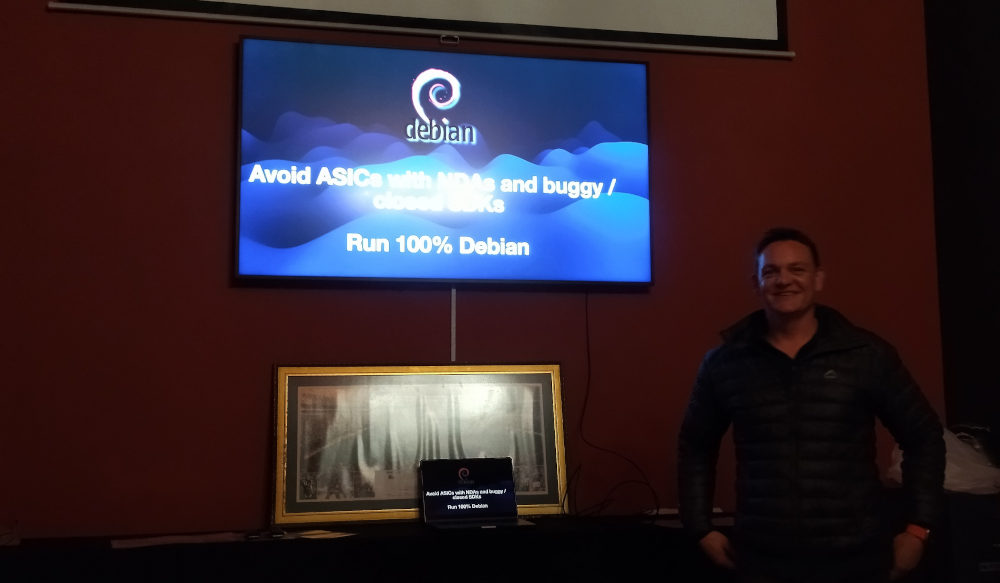
Jonathan Carter: CLUG Talk: Running Debian on a 100Gbps router

Last night I attended the first local Linux User Group talk since before the pandemic (possibly even long before the pandemic!) Topic: How and why Atomic Access runs Debian on a 100Gbps router Speaker: Joe Botha This is the first time CLUG used Woodstock Brewery as a venue. It s great, because now we can have snacks and beer during the talks :)

Joe has worked in the internet space for quite some time, and co-founded companies like Teraco, Frogfoot, Amobia, Octotel and Atomic Access. Through all of these he s done interesting and noteworthy work, which I ve only seen some glimpses of before in the few moments we ve interacted at CLUG events. It was nice seeing a lot more detail of a project that I wouldn t even know about if he didn t give this talk. It doesn t seem that anyone else is running Debian on big switches for commercial ISPs. He goes through these great lengths to run Debian so that he can have a decent set of tools and familiar commands on the switch, as apposed to the (my word here) crappy tooling that you would get on the brand name switches.
By total coincidence, David Plonka happened to be at the brewery too, he s a network expert who works at Akamai. He didn t know this talk was taking place, so this was a fun happenstance, he had some good inputs during the talk too. He also bought everyone a round of beer, thanks David! I asked Joe for his slides and I ll share them here when I get them. Unfortunately we don t have video for this talk, but I asked Joe to consider coming to DebConf23, I think this topic would be really interesting to the wider Debian crowd. By the way, both registration and the call for proposals are now officially open for DebConf23, it s taking place in September in Kochi, India this year. Updates (2023-06-07): Joe provided slides for his talk, you can get them here. He also provided some links:

Russell Coker: Do Not Use

When I connect my Desklab USB-C monitor [1] (which has been vastly underused for the last 3 years) into a Linux system the display type is listed as DO NOT USE RTK . One of the more informative discussions of this was on Linux Mint forums [2] which revealed that it s a mapping for an code that shouldn t be used. So it s not saying don t use this monitor it s saying don t use this code . So the Desklab people when they implemented a display with an RTK chipset should have changed the ID field from RTK to something representing their use. On Debian the file /usr/share/hwdata/pnp.ids has the IDs and you can grep for RTK in that. Also for programmers, please use more descriptive strings than do not use , when I was trying to find this on Debian code search [3] it turned up hundreds of pages of results which was more than a human can read through. If the text had been something that would make sense to a user such as OEM please replace with company name it would have made it very clear to me (and all the other people searching for this) what it meant and the fact that Desklab had stuffed up. So instead of wondering about this for years before eventually finding the right Google search to find the answer I could have worked it out immediately if the text had been clearer.

Sven Hoexter: htop on stage in the theatre

Always amusing to see some more or less famous open source tools on stage or in movies. Lately we watched THE ME (german only) which is mixing live playing of actors and pre recorded video material. In one of the early video sequences a fictional console interface is displayed, claiming to be running on a Macbook, and htop is used to look for a suspicious process.

Freexian Collaborators: Monthly report about Debian Long Term Support, May 2023 (by Roberto C. S nchez)

Like each month, have a look at the work funded by Freexian s Debian LTS offering.

Debian LTS contributors In May, 18 contributors have been paid to work on Debian LTS, their reports are available:
  • Abhijith PA did 6.0h (out of 6.0h assigned and 8.0h from previous period), thus carrying over 8.0h to the next month.
  • Anton Gladky did 6.0h (out of 8.0h assigned and 7.0h from previous period), thus carrying over 9.0h to the next month.
  • Bastien Roucari s did 17.0h (out of 17.0h assigned and 3.0h from previous period), thus carrying over 3.0h to the next month.
  • Ben Hutchings did 17.0h (out of 16.0h assigned and 8.0h from previous period), thus carrying over 7.0h to the next month.
  • Chris Lamb did 18.0h (out of 18.0h assigned).
  • Daniel Leidert did 0.0h (out of 0h assigned and 12.0h from previous period), thus carrying over 12.0h to the next month.
  • Dominik George did 0.0h (out of 0h assigned and 20.34h from previous period), thus carrying over 20.34h to the next month.
  • Emilio Pozuelo Monfort did 32.0h (out of 18.5h assigned and 16.0h from previous period), thus carrying over 2.5h to the next month.
  • Guilhem Moulin did 20.0h (out of 8.5h assigned and 11.5h from previous period).
  • Holger Levsen did 0.0h (out of 0h assigned and 10.0h from previous period), thus carrying over 10.0h to the next month.
  • Lee Garrett did 0.0h (out of 0h assigned and 40.5h from previous period), thus carrying over 40.5h to the next month.
  • Markus Koschany did 34.5h (out of 34.5h assigned).
  • Roberto C. S nchez did 18.25h (out of 20.5h assigned and 11.5h from previous period), thus carrying over 13.75h to the next month.
  • Scarlett Moore did 20.0h (out of 20.0h assigned).
  • Sylvain Beucler did 34.5h (out of 29.0h assigned and 5.5h from previous period).
  • Thorsten Alteholz did 14.0h (out of 14.0h assigned).
  • Tobias Frost did 16.0h (out of 15.0h assigned and 1.0h from previous period).
  • Utkarsh Gupta did 5.5h (out of 5.0h assigned and 26.0h from previous period), thus carrying over 25.5h to the next month.

Evolution of the situation In May, we have released 34 DLAs. Several of the DLAs constituted notable security updates to LTS during the month of May. Of particular note were the linux (4.19) and linux-5.10 packages, both of which addressed a considerable number of CVEs. Additionally, the postgresql-11 package was updated by synchronizing it with the 11.20 release from upstream. Notable non-security updates were made to the distro-info-data database and the timezone database. The distro-info-data package was updated with the final expected release date of Debian 12, made aware of Debian 14 and Ubuntu 23.10, and was updated with the latest EOL dates for Ubuntu releases. The tzdata and libdatetime-timezone-perl packages were updated with the 2023c timezone database. The changes in these packages ensure that in addition to the latest security updates LTS users also have the latest information concerning Debian and Ubuntu support windows, as well as the latest timezone data for accurate worldwide timekeeping. LTS contributor Anton implemented an improvement to the Debian Security Tracker Unfixed vulnerabilities in unstable without a filed bug view, allowing for more effective management of CVEs which do not yet have a corresponding bug entry in the Debian BTS. LTS contributor Sylvain concluded an audit of obsolete packages still supported in LTS to ensure that new CVEs are properly associated. In this case, a package being obsolete means that it is no longer associated with a Debian release for which the Debian Security Team has direct responsibility. When this occurs, it is the responsibility of the LTS team to ensure that incoming CVEs are properly associated to packages which exist only in LTS. Finally, LTS contributors also contributed several updates to packages in unstable/testing/stable to fix CVEs. This helps package maintainers, addresses CVEs in current and future Debian releases, and ensures that the CVEs do not remain open for an extended period of time only for the LTS team to be required to deal with them much later in the future.

Thanks to our sponsors Sponsors that joined recently are in bold.

13 June 2023

Matt Brown: Ventilation Monitoring Market Research

Over the last month I ve performed some market research to better understand the potential for co2mon.nz and to help me decide whether the product I ve built has a fit with the market or not. The key conclusions I ve drawn from this work are: Keep reading to hear more about the results that lead to those conclusions.

Survey The first piece of research I undertook was a survey covering three topics: views on indoor air quality, how respondents currently monitor indoor air quality and the desired features, including price, for a CO2 monitor. The survey was distributed to my extended personal network via social media, email and word of mouth. I offered respondents the opportunity to win a year of free monitoring as an incentive and received just under 70 responses overall - the lucky winner of that prize was Sam H of Auckland whose shiny new CO2 monitor will be in the mail shortly.

Views on indoor air quality
  • Nearly all respondents strongly agreed that clean, fresh indoor air is important for avoiding sickness and enabling our best work, learning and general cognitive performance, with not a single negative response.
  • 25% of respondents indicated they did not have a good understanding of the quality of the indoor air they were breathing versus 43% who indicated they had a good understanding of their indoor air quality.
  • Nearly 70% of respondents agreed (and greater than 40% strongly agreed) that real-time monitoring is beneficial and worth investing time and money in providing, with a similar distribution of responses agreeing it should be required in all shared indoor spaces.

Current ventilation monitoring approaches
  • For the home setting, using our senses was the most common method of understanding air quality, and only 6% of respondents were unhappy with their ability to monitor ventilation at home.
  • At work, trusting the owner of the building to monitor ventilation was the most common method, although using our senses and some personally collected data also featured for 20% of respondents. While the majority of respondents saw some room for improvement here, less than 20% of respondents were unsatisfied with the ability to monitor ventilation at work.
  • In shared public spaces using our senses and trusting the owner were equally popular with very little use of any data reported. The majority of respondents (40%) were unsatisfied with this situation with 34% seeing some room for improvement and very few being satisfied overall.

CO2 monitoring product features
  • A screen and WiFi were both strongly supported features with less than 10% of respondents seeing them as irrelevant and a large majority of answers skewing towards essential.
  • Coloured lights providing a quick indication were not viewed as important by 13% of respondents and while the majority of answers were towards essential there was also a large (22%) set of respondents who were indifferent to this feature.
  • The ability to access measurements and reports via a web interface was very mixed. Around 20% of respondents reported the feature as irrelevant, 20% essential with the majority seeing it as useful but mot essential.
  • Almost all respondents strongly indicated that additional air quality metrics beyond CO2 were important to collect.
  • Respondents mostly indicated the proposed prices are too high (64%), with essentially no responses suggesting they were too low and the balance (43%) in the middle. Only 5% of respondents indicated a preference for a rental option over a straight purchase.

Advertising In parallel with the survey, I worked with my cousin who runs a marketing agency, The Asset, to place some Facebook ads aiming to systematically evaluate what combination of images and text would draw the best response. It s been an interesting process - despite working for Google for 15 years, I know relatively little about the day to day practice of online advertising! I think we re about 50% of the way through that process of systematically building a funnel of traffic, it s been a steep learning curve and its clear there s significantly more thought and time that would need to be invested into this were it to be the primary driver of sales for a business. It s interested to see how what resonates or doesn t resonate with the audience is often completely different to what I expect, confirming the importance of having a process to evaluate and tweak how the advertising runs. After just under 2 weeks of advertising with a daily budget in the $20 - $30 range, my ads have had just under 17k impressions by 10k distinct people resulting in 76 visits to the co2mon.nz website, and zero sales. The ads themselves received 233 clicks, so there s clearly a lot of room for further improvement and revision of the ad text itself to present a more compelling message. Unfortunately the most common response and feedback to the ads themselves has been comments arguing that CO2 is wonderful, climate change is invented and all our problems would be solved if we had more CO2 everywhere. Tedious to deal with, but also useful reminder about awareness and interest in the problem to contrast with the results from the survey of my extended personal network!

Feedback from other conversations In addition to the survey and advertising I ve had conversations with some local air conditioning and ventilation businesses as well as a commercial building management firm - all providing similar feedback to the results from the survey - acknowledgement that air quality is important and relatively immaturely measured currently, but low urgency or pain to change or remedy that situation. Another interesting point that s come up in conversations with various small business owners is what to do if or when the monitoring shows a ventilation problem? The obvious answer of opening the windows more does not seem to be particularly well received. Without a compelling solution to offer to the potential problem that the monitoring might reveal I often sense a reluctance from people to invest too much time and money in something which may create a problem in a space they don t currently see as urgent.

Conclusions The responses are interesting and surprising to me a in a few ways (no interest in rental, favouring web interface over app), but at the end of the day lead to the two conclusions described above: Air quality is acknowledged as important, but monitoring it is not an urgent or pressing problem for most people. At home and work the majority of people are OK with relying on their senses or trusting someone else to maintain ventilation. They wouldn t object to improvements, but the feedback is that ventilation monitoring is not a problem people are actively looking to solve. The number of people who do see this as an urgent enough problem to invest money into solving is low - even within the biased sample of my extended network. There is a stronger set of evidence for the problem being seen as more urgent by the users of shared public spaces - but I ve not been able to find any evidence that the owners and managers of those spaces feel the same urgency or duty of care towards their users to invest in this space. Most of the opportunity is in the hardware rather than the software service. This signal comes through in the feedback on the pricing (preferring outright purchase vs rental), but it s also been directly expressed in the free-form comments and other conversations I ve had and the the relative importance given to the physical product features over the web/app interfaces in the survey results.

Wrap Up I m glad I finally spent the time doing this research, particularly the survey, these are good lessons to learn, even if I should have taken the time to learn them a year ago - so I can write that reminder (do your research before building a product) down as a key outcome of this process too! Stay tuned for more details on the other work I ve been doing recently on the hardware side of co2mon.nz and what these results mean for my overall plans. As always, I d love to hear from you if these results give you ideas or questions you d like to discuss.

12 June 2023

Bits from Debian: Registration and the Call for Proposals for DebConf23 are now open!

For DebConf23, we're pleased to announce opening of registration and call for proposal. Following is the info text -
Registration and the Call for Proposals for DebConf23 are now open. The 24th edition of the Debian annual conference will be held from September 10th to September 17th, 2023, in Infopark, Kochi, India. The main conference will be preceded by DebCamp, which will take place from September 3rd to September 9th, 2023. The registration form can be accessed by creating an account on the DebConf23 website and clicking on "register" in the profile section. The number of attendees is capped at 300 this year. All registrations will be reviewed by bursary team, and completing the registration form does not guarantee attendance. As always, basic registration for DebConf is free of charge for attendees. If you are attending the conference in a professional capacity or as a representative of your company, we kindly ask that you consider registering in one of our paid categories to help cover the costs of organizing the conference and to support subsidizing other community members. The last day to register with guaranteed swag is 5th August. We also encourage eligible individuals to apply for a diversity bursary. Travel, food, and accommodation bursaries are available. More details can be found on the bursary info page. The last day to apply for a bursary is 1st July. Applicants should receive feedback on their bursary application by 16th July. The call for proposals for talks, discussions and other activities is also open. To submit a proposal you need to create an account on the website, and then use the "Submit Talk" button in the profile section. The last day to submit and have your proposal be considered for the main conference schedule, with video coverage guaranteed, is 13th August. DebConf23 is also accepting sponsors. Interested companies and organizations may contact the DebConf team through sponsors@debconf.org or visit the DebConf23 website.

Matthew Palmer: Private Key Redaction: Redux

[Note: the original version of this post named the author of the referenced blog post, and the tone of my writing could be construed to be mocking or otherwise belittling them. While that was not my intention, I recognise that was a possible interpretation, and I have revised this post to remove identifying information and try to neutralise the tone. On the other hand, I have kept the identifying details of the domain involved, as there are entirely legitimate security concerns that result from the issues discussed in this post.] I have spoken before about why it is tricky to redact private keys. Although that post demonstrated a real-world, presumably-used-in-the-wild private key, I ve been made aware of commentary along the lines of this representative sample:
I find it hard to believe that anyone would take their actual production key and redact it for documentation. Does the author have evidence of this in practice, or did they see example keys and assume they were redacted production keys?
Well, buckle up, because today s post is another real-world case study, with rather higher stakes than the previous example.

When Helping Hurts Today s case study begins with someone who attempted to do a very good thing: they wrote a blog post about using HashiCorp Vault to store certificates and their private keys. In his post, they included some test data, a certificate and a private key, which they redacted. Unfortunately, they did not redact these very well. Each base64 blob has had one line replaced with all xs. Based on the steps I explained previously, it is relatively straightforward to retrieve the entire, intact private key.

From Bad to OMFG Now, if this post author had, say, generated a fresh private key (after all, there s no shortage of possible keys), that would not be worthy of a blog post. As you may surmise, that is not what happened. After reconstructing the insufficiently-redacted private key, you end up with a key that has a SHA256 fingerprint (in hex) of: 72bef096997ec59a671d540d75bd1926363b2097eb9fe10220b2654b1f665b54 Searching for certificates which use that key fingerprint, we find one result: a certificate for hiltonhotels.jp (and a bunch of other, related, domains, as subjectAltNames). As of the time of writing, that certificate is not marked as revoked, and appears to be the same certificate that is currently presented to visitors of that site. This is, shall we say, not great. Anyone in possession of this private key which, I should emphasise, has presumably been public information since the post s publication date of February 2023 has the ability to completely transparently impersonate the sites listed in that certificate. That would provide an attacker with the ability to capture any data a user entered, such as personal information, passwords, or payment details, and also modify what the user s browser received, including injecting malware or other unpleasantness. In short, no good deed goes unpunished, and this attempt to educate the world at large about the benefits of secure key storage has instead published private key material. Remember, kids: friends don t let friends post redacted private keys to the Internet.

11 June 2023

Dirk Eddelbuettel: sanitizers 0.1.1 on CRAN: Updated and Expanded

bleach The second release of the sanitizers package is now on CRAN. sanitizers provides true positives for programming errors detected by Address Sanitizers and friends. This permits validation of the setup when chasing such bug reports: it allows us to ascertain that the compiler (and instrumented R version) are correctly set up and the errors we expect to be reported are in fact reported. Almost nine years (!!) since the first release, this update brings an added integer overflow sanitizer contributed by Greg Jeffries so long ago that I had thought it was part of the CRAN releases my bad for delaying this. It also updates programming practices by switching to symbol registration for the compiled functions. And of course several R packaging best practices have improved since the initial release so we updated a few small things throughout. A very good resources for all things sanitizers is the Google repo at GitHub and especially its wiki. The brief NEWS entry follows.

Changes in version 0.1.1 (2023-06-11)
  • Added integer overflow example kindly contributed by Greg Jeffries
  • Added continuous integration and badges
  • Updated package to use symbol registration for compiled code
  • Updated and edited DESCRIPTION, README and help pages for current packaging standards
  • Expanded README with usage example via r-devel-san Rocker container

Courtesy of my CRANberries, there is a diffstat report for this release. See the project page, the github repo, and the package documentation for more details. If you like the open-source work I do, you can sponsor me at GitHub.

This post by Dirk Eddelbuettel originated on his Thinking inside the box blog. Please report excessive re-aggregation in third-party for-profit settings.

Michael Prokop: What to expect from Debian/bookworm #newinbookworm

Bookworm Banner, Copyright 2022 Juliette Taka Debian v12 with codename bookworm was released as new stable release on 10th of June 2023. Similar to what we had with #newinbullseye and previous releases, now it s time for #newinbookworm! I was the driving force at several of my customers to be well prepared for bookworm. As usual with major upgrades, there are some things to be aware of, and hereby I m starting my public notes on bookworm that might be worth also for other folks. My focus is primarily on server systems and looking at things from a sysadmin perspective. Further readings As usual start at the official Debian release notes, make sure to especially go through What s new in Debian 12 + Issues to be aware of for bookworm. Package versions As a starting point, let s look at some selected packages and their versions in bullseye vs. bookworm as of 2023-02-10 (mainly having amd64 in mind):
Package bullseye/v11 bookworm/v12
ansible 2.10.7 2.14.3
apache 2.4.56 2.4.57
apt 2.2.4 2.6.1
bash 5.1 5.2.15
ceph 14.2.21 16.2.11
docker 20.10.5 20.10.24
dovecot 2.3.13 2.3.19
dpkg 1.20.12 1.21.22
emacs 27.1 28.2
gcc 10.2.1 12.2.0
git 2.30.2 2.39.2
golang 1.15 1.19
libc 2.31 2.36
linux kernel 5.10 6.1
llvm 11.0 14.0
lxc 4.0.6 5.0.2
mariadb 10.5 10.11
nginx 1.18.0 1.22.1
nodejs 12.22 18.13
openjdk 11.0.18 + 17.0.6 17.0.6
openssh 8.4p1 9.2p1
openssl 1.1.1n 3.0.8-1
perl 5.32.1 5.36.0
php 7.4+76 8.2+93
podman 3.0.1 4.3.1
postfix 3.5.18 3.7.5
postgres 13 15
puppet 5.5.22 7.23.0
python2 2.7.18 (gone!)
python3 3.9.2 3.11.2
qemu/kvm 5.2 7.2
ruby 2.7+2 3.1
rust 1.48.0 1.63.0
samba 4.13.13 4.17.8
systemd 247.3 252.6
unattended-upgrades 2.8 2.9.1
util-linux 2.36.1 2.38.1
vagrant 2.2.14 2.3.4
vim 8.2.2434 9.0.1378
zsh 5.8 5.9
Linux Kernel The bookworm release ships a Linux kernel based on version 6.1, whereas bullseye shipped kernel 5.10. As usual there are plenty of changes in the kernel area, including better hardware support, and this might warrant a separate blog entry, but to highlight some changes: See Kernelnewbies.org for further changes between kernel versions. Configuration management puppet s upstream sadly still doesn t provide packages for bookworm (see PA-4995), though Debian provides puppet-agent and puppetserver packages, and even puppetdb is back again, see release notes for further information. ansible is also available and made it with version 2.14 into bookworm. Prometheus stack Prometheus server was updated from v2.24.1 to v2.42.0 and all the exporters that got shipped with bullseye are still around (in more recent versions of course). Virtualization docker (v20.10.24), ganeti (v3.0.2-3), libvirt (v9.0.0-4), lxc (v5.0.2-1), podman (v4.3.1), openstack (Zed), qemu/kvm (v7.2), xen (v4.17.1) are all still around. Vagrant is available in version 2.3.4, also Vagrant upstream provides their packages for bookworm already. If you re relying on VirtualBox, be aware that upstream doesn t provide packages for bookworm yet (see ticket 21524), but thankfully version 7.0.8-dfsg-2 is available from Debian/unstable (as of 2023-06-10) (VirtualBox isn t shipped with stable releases since quite some time due to lack of cooperation from upstream on security support for older releases, see #794466). rsync rsync was updated from v3.2.3 to v3.2.7, and we got a few new options: OpenSSH OpenSSH was updated from v8.4p1 to v9.2p1, so if you re interested in all the changes, check out the release notes between those version (8.5, 8.6, 8.7, 8.8, 8.9, 9.0, 9.1 + 9.2). Let s highlight some notable new features: One important change you might wanna be aware of is that as of OpenSSH v8.8, RSA signatures using the SHA-1 hash algorithm got disabled by default, but RSA/SHA-256/512 AKA RSA-SHA2 gets used instead. OpenSSH has supported RFC8332 RSA/SHA-256/512 signatures since release 7.2 and existing ssh-rsa keys will automatically use the stronger algorithm where possible. A good overview is also available at SSH: Signature Algorithm ssh-rsa Error. Now tools/libraries not supporting RSA-SHA2 fail to connect to OpenSSH as present in bookworm. For example python3-paramiko v2.7.2-1 as present in bullseye doesn t support RSA-SHA2. It tries to connect using the deprecated RSA-SHA-1, which is no longer offered by default with OpenSSH as present in bookworm, and then fails. Support for RSA/SHA-256/512 signatures in Paramiko was requested e.g. at #1734, and eventually got added to Paramiko and in the end the change made it into Paramiko versions >=2.9.0. Paramiko in bookworm works fine, and a backport by rebuilding the python3-paramiko package from bookworm for bullseye solves the problem (BTDT). Misc unsorted Thanks to everyone involved in the release, happy upgrading to bookworm, and let s continue with working towards Debian/trixie. :)

Thomas Lange: New FAI ISO images for bookworm available and FAI Live ISO

After Debian 12 aka bookworm was released yesterday, I've also created new FAI ISO images using Debian 12. The defaut ISO (large) uses FAI 6.0.3, kernel 6.1 and can install the XFCE and GNOME desktop without internet connection, since all needed packages are included into the ISO. Additional you can install Ubuntu 22.04 or Rocky Linux 9 with this FAI ISO. During these installations, the packages will be downloade via network. There's also the variant FAI ISO UBUNTU, which includes all Ubuntu packages needed for a Ubuntu server or Ubuntu desktop installation. If you need a small image, you can take the FAI ISO small, which only includes the packages for a XFCE desktop without LibreOffice. This ISO is only 880MB in size. Currently I'm working on a new feature, so FAI can create Live images, that are bootable. It's like the tool live-build which Debian uses for their official Debian Live images. A first verison of the ISO using the XFCE desktop can be downloaded from https://fai-project.org/fai-cd There you also find all other FAI ISOs.

Petter Reinholdtsen: What did I learn from OpenSnitch this summer?

With yesterdays release of Debian 12 Bookworm, I am happy to know the the interactive application firewall OpenSnitch is available for a wider audience. I have been running it for a few weeks now, and have been surprised about some of the programs connecting to the Internet. Some programs are obviously calling out from my machine, like the NTP network based clock adjusting system and Tor to reach other Tor clients, but others were more dubious. For example, the KDE Window manager try to look up the host name in DNS, for no apparent reason, but if this lookup is blocked the KDE desktop get periodically stuck when I use it. Another surprise was how much Firefox call home directly to mozilla.com, mozilla.net and googleapis.com, to mention a few, when I visit other web pages. This direct connection happen even if I told Firefox to always use a proxy, and the proxy setting is ignored for this traffic. Other surprising connections come from audacity and dirmngr (I do not use Gnome). It took some trial and error to get a good default set of permissions. Without it, I would get popups asking for permissions at any time, also the most inconvenient ones where I am in the middle of a time sensitive gaming session. I suspect some application developers should rethink when then need to use network connections or DNS lookups, and recommend testing OpenSnitch (only apt install opensnitch away in Debian Bookworm) to locate and report any surprising Internet connections on your desktop machine. At the moment the upstream developer and Debian package maintainer is working on making the system more reliable in Debian, by enabling the eBPF kernel module to track processes and connections instead of depending in content in /proc/. This should enter unstable fairly soon. As usual, if you use Bitcoin and want to show your support of my activities, please send Bitcoin donations to my address 15oWEoG9dUPovwmUL9KWAnYRtNJEkP1u1b.

10 June 2023

Bits from Debian: Debian 12 "bookworm" has been released!

Alt Bookworm has been released We're happy to announce the release of Debian 12, codenamed bookworm! Want to install it? Choose your favourite installation media and read the installation manual. You can also use an official cloud image directly on your cloud provider, or try Debian prior to installing it using our "live" images. Already a happy Debian user and you only want to upgrade? You can easily upgrade from your current Debian 11 "bullseye" installation; please read the release notes. Do you want to celebrate the release? We provide some bookworm artwork that you can share or use as base for your own creations. Follow the conversation about bookworm in social media via the #ReleasingDebianBookworm and #Debian11Bookworm hashtags or join an in-person or online Release Party!

Next.

Previous.