Search Results: "az"

5 May 2011

Erich Schubert: Upcoming publications in data mining

Upcoming 2011 publications of my research:
Just presented at the SDM11 last weekend:
H.-P. Kriegel, P. Kr ger, E. Schubert, A. Zimek
Interpreting and Unifying Outlier Scores
In Proceedings of the 11th SIAM International Conference on Data Mining (SDM), Mesa, AZ, 2011.
To be presented and published end of August:
T. Bernecker, M. E. Houle, H.-P. Kriegel, P. Kr ger, M. Renz, E. Schubert, A. Zimek
Quality of Similarity Rankings in Time Series
In Proceedings of the 12th International Symposium on Spatial and Temporal Databases (SSTD), Minneapolis, MN, 2011.
E. Achtert, A. Hettab, H.-P. Kriegel, E. Schubert, A. Zimek
Spatial Outlier Detection: Data, Algorithms, Visualizations
In Proceedings of the 12th International Symposium on Spatial and Temporal Databases (SSTD), Minneapolis, MN, 2011.
The latter will also accompany the release of version 0.4 of our data mining research software ELKI.

Jeff Licquia: FHS Refresh

I ve been busy tonight spamming mailing lists and otherwise getting the word out: the LSB workgroup is preparing to update the FHS. This update has been a long time in coming; FHS 2.3 (the current version) was released back in 2004. Since then, a lot has happened, and it s starting to look like the FHS is holding things back due to the lack of updates. For the longest time, the FHS was cared for by its original editors: Dan Quinlan, Rusty Russell, and Chris Yeoh. We should all be grateful that they created a useful and well-written standard one that has been resilient enough to remain useful for six years without changes. Even though it s time to move on, we should not forget that we are building on a strong foundation they laid for us. So, you may be asking: how can I help? Glad you asked! We re tentatively shooting for a goal of releasing FHS 3.0 before July, though that s not written in stone. But we don t want to wait much longer than we ve already had to.

1 May 2011

Christian Perrier: Preview of Debian Installer in Uyghur

Last week, I announced the activation of Uyghur language in Debian Installer. For once, I even went further: I rebuilt all D-I packages that include localization (at least for i386/amd64 architectures) and uploaded them. As a consequence, D-I daily builds now allow previewing how an install done in Uyghur can be like. For this, please go to the Debian Installer development page, download the netboot ISO image (not netinst) and launch D-I with "suite=unstable" passed as argument when booting the ISO image. You should end up with something like this, this or this. There are a few glitches, still: for instance, as the font we chose has no Bold variant, the screens "titles" do not use an Uyghur font but an Arabic or Persian one. As a consequence, glyphs ar enot properly joined together. I'm investigating this issue with Uyghur translators and we're trying to choose an appropriate font among the gazillion that have been created by UKIJ. Please notice that Uyghur looks like Arabic but, according to those who can read Arabic, is really different from Arabic (or Persian). I hope that this great work by Gheyret Tohti, Abduqadir Abliz and other people working on this will give ideas to other so-called "minorities", here or there in the world, who want to be able to install Debian in their language. There is still a lot of work to do, such as having end-user software localization for Uyghur and, then, a uyghur-desktop task, but this is at least the first language that gets added for wheezy. In case you would be wondering, the current count of activated languages in D-I is 71.

29 April 2011

John Goerzen: Anniversary: Europe Ideas?

Terah and I have our 10th wedding anniversary coming up this fall. We ve discussed a bit what we d like to do. Terah said that she d enjoy a relaxing resort on a beach somewhere with a reasonable hotel room so there isn t really anything we have to do just relax. I said that I d love to go back to Europe enjoy some more history, have a fun adventure together, see more of the countryside perhaps. This didn t sound all that relaxing to Terah. So I commented that Europe also has plenty of water, beaches, and resorts and perhaps we could find a place in Europe with history and adventure, plus also a relaxing beach so we can have some adventure but not too much <grin> We ll probably be looking to travel in September or October and would hope for reasonably warm weather though if we need to go at a different time of year, that option is still open. I m at a loss for where to start looking here, so I m hoping readers of this blog can give a suggestion. I very much appreciated the great tips last time I asked. Our first trip to Europe last year was great it was nice to stay with some old friends and make some new ones, to see some amazing cities and buildings, and live for a few days someplace with a culture different from home. Our boys would not be coming with us on this trip. We did get passports for them recently and are looking at some options for a trip with them, but that wouldn t be this one.

Ian Wienand: Toolchains, libc and interesting interactions

When building a user space binary, the -lc that gcc inserts into the final link seems pretty straight forward link the C library. As with all things system-library related there is more to investigate. If you look at /usr/lib/libc.so; the "library" that gets linked when you specify -lc, it is not a library as such, but a link script which specifies the libraries to link, which also includes the dynamic linker itself:
$ cat /usr/lib/libc.so
/* GNU ld script
   Use the shared library, but some functions are only in
   the static library, so try that secondarily.  */
OUTPUT_FORMAT(elf64-x86-64)
GROUP ( /lib/libc.so.6 /usr/lib/libc_nonshared.a  AS_NEEDED ( /lib/ld-linux-x86-64.so.2 ) )
On very old glibc's the AS_NEEDED didn't appear; so every binary really did have a DT_NEEDED entry for the dynamic linker itself. This can be somewhat confusing if you're ever doing forensics on an old binary which seems to have these entries for not apparent reason. However, we can see that that /lib/libc.so itself does actually require symbols from the dynamic linker:
$ readelf --dynamic /lib/libc.so.6   grep NEEDED
 0x0000000000000001 (NEEDED)             Shared library: [ld-linux-x86-64.so.2]
Although you're unlikely to encounter it, a broken toolchain can cause havoc if it gets the link order wrong here, because the glibc dynamic linker defines minimal versions of malloc and friends -- you've got a chicken-and-egg problem using libc's malloc before you've loaded it! You can simulate this havoc with something like:
$ cat foo.c
#include <stdio.h>
#include <syslog.h>
int main(void)
 
   syslog(LOG_DEBUG, "hello, world!");
   return 0;
 
$ cat libbroken.so
GROUP ( /lib/ld-linux-x86-64.so.2 )
$ gcc -o -Wall -Wl,-rpath=. -L. -lbroken -g -o foo foo.c
$ ./foo
Inconsistency detected by ld.so: dl-minimal.c: 138: realloc: Assertion  ptr == alloc_last_block' failed!
Depending on various versions of things, you might see that assert or possibly just strange, corrupt output in your logs as syslog calls the wrong malloc. You could debug something like this by asking the dynamic linker to show you its bindings as it resolves them:
$ LD_DEBUG_OUTPUT=foo.txt LD_DEBUG=bindings ./foo
Inconsistency detected by ld.so: dl-minimal.c: 138: realloc: Assertion  ptr == alloc_last_block' failed!
$ cat foo.txt.11360   grep "\ malloc'"
     11360:	binding file /lib/libc.so.6 [0] to /lib64/ld-linux-x86-64.so.2 [0]: normal symbol  malloc' [GLIBC_2.2.5]
     11360:	binding file /lib64/ld-linux-x86-64.so.2 [0] to /lib64/ld-linux-x86-64.so.2 [0]: normal symbol  malloc' [GLIBC_2.2.5]
     11360:	binding file /lib/libc.so.6 [0] to /lib64/ld-linux-x86-64.so.2 [0]: normal symbol  malloc' [GLIBC_2.2.5]
Above, because the dynamic loader comes first in the link order, libc.so.6's malloc has bound to the minimal implementation it provides, rather the full-featured one it provides internally. As an aside, AFAICT, there is really only one reason why a normal library will link against the dynamic loader -- for the thread-local storage support function __tls_get_addr. You can try this yourself:
$ cat tls.c
char __thread *foo;
char* moo(void)  
	return foo;
 
$ gcc -fPIC -o libtls.so -shared tls.c
$ readelf -d ./libtls.so    grep NEED
 0x00000001 (NEEDED)                     Shared library: [libc.so.6]
 0x00000001 (NEEDED)                     Shared library: [ld-linux.so.2]
 0x6ffffffe (VERNEED)                    0x314
 0x6fffffff (VERNEEDNUM)                 2
Thread-local storage is worthy of a book of its own, but the gist is that this support function says "hey, give me an address of foo in libtls.so", the magic being that if the current thread has never accessed foo then it may not actually have any storage for foo yet, so the dynamic linker can allocate some memory for it lazily and then return the right thing. Otherwise, every thread that started would need to reserve room for foo "just in case", even if it never cares about moo. But looking a little closer at the symbols of libc.so is also interesting. libc.so doesn't actually have many functions you can override. You can see what it is possible to override by checking the relocations against the procdure-lookup table (PLT).
Relocation section '.rela.plt' at offset 0x1e770 contains 8 entries:
  Offset          Info           Type           Sym. Value    Sym. Name + Addend
00000035b000  084600000007 R_X86_64_JUMP_SLO 00000000000a2100 sysconf + 0
00000035b008  02e000000007 R_X86_64_JUMP_SLO 0000000000075e50 calloc + 0
00000035b010  01dd00000007 R_X86_64_JUMP_SLO 0000000000077910 realloc + 0
00000035b018  029300000007 R_X86_64_JUMP_SLO 00000000000661c0 feof + 0
00000035b020  046f00000007 R_X86_64_JUMP_SLO 00000000000768c0 malloc + 0
00000035b028  000400000007 R_X86_64_JUMP_SLO 0000000000000000 __tls_get_addr + 0
00000035b030  01b400000007 R_X86_64_JUMP_SLO 0000000000076dd0 memalign + 0
00000035b038  086000000007 R_X86_64_JUMP_SLO 00000000000767e0 free + 0
i.e. instead of jumping directly to the malloc defined in the libc code section, any internal calls will jump to this stub which, the first time, asks the dynamic linker to go out and find the address of malloc (it then saves it, so the second time the stub just jumps to the saved location). This is an interesting list, seemingly without much order. feof, for example, stands out as worth checking out a bit closer why would that be there when fopen isn't, say? We can track down where it comes from with a bit of detective work; knowing that the value of the symbol feof will be placed into 0x35b018 we can disassemble libc.so to see that this address is used by the feof PLT stub at 0x1e870 (luckily, objdump has done the math to offest from the rip for us; i.e. 0x1e876 + 0x33c7a2 = 0x35b018)
000000000001e870 <feof@plt>:
   1e870:       ff 25 a2 c7 33 00       jmpq   *0x33c7a2(%rip)        # 35b018 <_IO_file_jumps+0xb18>
   1e876:       68 03 00 00 00          pushq  $0x3
   1e87b:       e9 b0 ff ff ff          jmpq   1e830 <h_errno+0x1e7dc>
From there we can search for anyone jumping to that address, and find out the caller:
$ objdump --disassemble-all /lib/libc.so.6   grep 1e870
000000000001e870 <feof@plt>:
   1e870:	ff 25 a2 c7 33 00    	jmpq   *0x33c7a2(%rip)        # 35b018 <_IO_file_jumps+0xb18>
   f19f7:	e8 74 ce f2 ff       	callq  1e870 <feof@plt>
$ addr2line -e /lib/libc.so.6 f19f7
/home/aurel32/eglibc/eglibc-2.11.2/sunrpc/bindrsvprt.c:70
Which turns out to be part of a local patch which probably gets things a little wrong, as described below. The sysconf relocation is from a similar add-on patch (being used to find the page size, it seems). libc, like all sensible libraries, uses the hidden attribute on symbols to restrict what is exported by the library. The benefit of this is that when the linker knows you are referencing a hidden symbol it knows that the value can never be overridden, and thus does not need to emit extra code to do indirection just in case you ever wish to redirect the symbols. In the above, it appears that feof has never been marked as hidden, probably because no internal glibc functions used it until that add-on patch, and since it is not considered an internal function the linker must allow for the possibility that it will be overridden at run time and provide a PLT slot for it. There are consequences; if this was on a fast-path then the extra jumps required to go via the PLT may matter for performance and it may also cause strange behaviour if somebody had preloaded something that took over feof. Note, this is different from saying that your library can override symbols provided by libc.so; such as when you LD_PRELOAD a library to wrap an open call. What you can not override is the open call that say, the internal libc.so function getusershell does to read /etc/shells. Having the malloc related calls as preemptable seems intentional and sane; although I can not find a comment to the effect of "we deliberately leave these like this so that users may use alternative malloc implementations", it makes sense so that libc.so is internally using the same malloc as everything else if you choose to use something such as tc-malloc. tl;dr? Digging into your system libraries is always interesting. Be careful with your link order when creating toolchains, and be careful about symbol visibility when you're working with libraries.

28 April 2011

Meike Reichle: What it's like to do Debian Press Work

A few days ago I did an interview for the People Behind Debian series that, among other things, covered my Debian press work and asked what it's like to do that kind of work for Debian. Here's a little addendum: Sometimes Debian Press Work is great: All these people do all this amazing stuff and it's a pure pleasure to talk about it. Our last release was such an experience for example. I was clamped to my laptop for almost 20 hours straight and I had a great time! There was this great common feeling of community, achievement and pride in our work and I was proud and happy to be a part of it. And then there are times like the last few days, where Alex and I went South for 4.5 precious and long-awaited days of vacation and ended up spending the first two of them working on an obituary for a dear and much valued member of our community and once this was done spent the remaining days of our holidays nervously watching the net and drafting and re-drafting press announcements because some <bleep> thought it might be oh-so-hilarous to send out faked cease and desist orders to a Debian user, ostensibly as a funny prank but along the way causing a huge amount of completely unsubstantiated FUD that we'll probably spend weeks clearing up. Somewhere in between these events is what Debian press work is like.

Erich Schubert: SIAM SDM11 - Unified Outlier Scores

I'm currently in Phoenix, AZ at the 2011 SIAM International Conference on Data Mining.
My contribution is titled "Interpreting and Unifying Outlier Scores", a method that allows the combination, interpretation, visualization etc. of existing outlier algorithms. The method brings back a bit more statistics into a data mining area that has drifted away from the statistical roots.
We apply the method to a couple of outlier detection algorithms and combine them using a naive ensemble approach, that still outperforms existing outlier ensembles.

Patrick Schoenfeld: Directory-dependent shell configuration with zsh (Update)

For a while I've been struggling with a little itch. I'm using my company notebook for company work and for Debian related stuff. Now, whenever I switch between those two contexts, I had to manually fix the environment configuration. This is mostly related to environment variables, because tools like dch et cetera rely on some, which need to be different for the different contexts, like DEBEMAIL.
A while ago I had the idea to use directory dependent configuration for that purpose, but I never found the time and mood to actually fix my itch.
Somewhere in the meanwhile I applied a quick hack ("case $PWD in ...; do export...; esac") to my zsh configuration to ease the pain, but it still did not feel right.


For the impatient: Below you find a way to just use whats described here. The rest of the article just contains detailed information on how to implement something like this.


The other day I were cleaning up and extending my zsh configuration and it came to my mind again. I then thought about what my requirements are and how I could solve it. First I thought about using a ready solution, like the one in the Grml Zsh configuration, but at that point I did not remember it (it needed a hint by a co-worker *after* I finished the first version of my solution). Then I came up with my requirements:

It lead to a configuration approach as a first start. When thinking about how to represent the configuration I looked into the supported data types in zsh. zsh supports arrays, which is perfect for my need. I came up with something like that:
typeset -A EMAILS ENV_DEBIAN ENV_COMPANY
EMAILS=(
"private" "foo@bar.org"
"company" "baz@foo.org"
"debian" "schoenfeld@debian.org"
)
ENV_DEBIAN=(
"DEBEMAIL" "$EMAILS[debian]"
"EMAIL" "$EMAILS[debian]"
)
ENV_COMPANY=(
"DEBEMAIL" "$EMAILS[company]"
)
The next part was selecting the right profile. In the first version I used the old case logic, but it was breaking my separate logic and configuration paradigm. Approximate at this point the co-worker lead me to the grml approach, which I borrowed an idea from:


# Configure profile mappings
zstyle ':chpwd:profiles:*company*' profile company
zstyle ':chpwd:profiles:*debian*' profile debian

and the following code to lookup profile based on $PWD:

1 function detect_env_profile
2 local profile
3 zstyle -s ":chpwd:profiles:$ PWD " profile profile profile='default'
4 profile=$ (U)profile
5 if [ "$profile" != "$ENV_PROFILE" ]; then
6 print "Switching to profile: $profile"
7 fi
8 ENV_PROFILE="$profile"
9

For an explanation: zstyle is a zsh-builtin which is used to "define and lookup styles", as the manpage says, or put different: Another way to store and lookup configuration values.
Its nice for my purpose, because it allows storing patterns instead of plain configuration values which can be compared against $PWD easily with all of the zsh globbing magic. This is basically whats done in line 3. zstyle then sets $profile to the matching zstyle configuration in the :chpwd:profiles: context or to 'default' if no matching zstyle is found.

The (almost) last part is putting it together with code to switch the profile:

1 function switch_environment_profiles
2 detect_env_profile
3 config_key="ENV_$ENV_PROFILE"
4 for key value in $ (kvP)config_key ; do
5 export $key=$value
6 done
7
The only non-obvious part in this are lines 3 and 4. Remember, the profiles were defined as ENV_PROFILE, where PROFILE is the name of the profile. We cannot know that key in advance, therefore we have to construct the right environment variable from the result of detect_env_profile. We do that in line 3 and lookup this environment variable in line 4.
The deciding aspect for that is the P-flag in the parameter expansion. It tells zsh that we do not want the value of $config_key, but instead the value of $WHATEVER_CONFIG_KEY_EXPANDS_TO.
The other flags k and v tell zsh that, from the array, we want both: keys and values. If we'd omitted those flags it would have given us the values only.
We then loop over that to configure the environment. Easy, hu?

We would be finished, if this would do anything. The code above needs to be called. Lucky for us thats pretty easy to achieve, as zsh has a hook for when a directory is changed. Making all this work is simply a matter of adding something like this:

function chpwd()
switch_environment_profiles

Now, one could say, that the solution in the grml configuration has an advantage. It allows calling arbitrary commands on profile changing, which might be useful to *unset* variables in a given profile or whatever you could think of.
Well, its a matter of three lines to extend the above code for that feature:


# Taken from grml zshrc, allow chpwd_profile_functions()
if (( $ +functions[chpwd_profile_$ENV_PROFILE] )) ; then
chpwd_profile_$ ENV_PROFILE
fi

to the end of switch_environment_profiles and now its possible to additionally add a function chpwd_profile_PROFILE which is called whenever the profile is changed to that profile.


USAGE: I have put the functions into a file which can be included into your zsh configuration, which can be found on github.
Please see this README and the comments in the file itself on further usage instructions.

Russell Coker: Australia Needs it s own Monarch

Tomorrow Prince William will marry Kate Middleton. If we don t change anything he will probably become the King of Australia at some future time, so I think that now is the time to start discussing the options. Walter Block makes some interesting points in favor of longer terms for politicians and for having a monarch to get a long-term view of the national interest [1], he s not the only person to make such points, but he makes them in a better way than most. Of course the problem with this is the long history of kings not doing what s best for their country part of the ownership rights to property is the right to destroy it, so a monarch who owns a country therefore can be considered to have the right to cause the wholesale death of their subjects. There are some examples of President for Life political leaders demonstrating this at the moment. Even with a monarch who is generally a nice person and who has controls to prevent the worst abuses there is the possibility of Control Fraud. In the Constitutional Monarchy system that doesn t happen because a constitutional monarch has little power (no official position of power). But there is still the issue of whether the monarchy is any good. Charles Stross wrote an interesting post about the apparent human need to have a leadership figure [2]. So getting rid of a monarch tends to result in a president getting the trappings of a king, and if things go wrong (as they often do) then they get absolute power until the next revolution. It seems that having one person who is the head of government and the head of state (as done in the US for example) is a bad idea, they can start to think that it s all about them. I don t think that the US is at risk of getting a president for life in the near future and I don t think that Australia will do so if we become a republic, but that doesn t mean that the republican system works well. I think that the Australian system is working better than the US system and I will generally vote against any changes that make Australia more like the US. As long as the House of Windsor provides monarchs who are as sensible as Queen Elizabeth 2 I will vote in favor of the continued rule of the House of Windsor in preference to an Australian republic (if Prince Charles ever becomes king I may support a republic). A Way of Improving Things I want to have an Australian monarch. Someone who will live in Australia for most of the time (as opposed to a distant monarch who visits once a decade if we are lucky). Protocol should dictate that the Prime Minister and cabinet ministers are forced to show ritual respect to the monarch, bowing etc, and no touching. A separation between the person who performs most of the ceremonial functions and the person who actually makes the political decisions should help constrain political egos. When a Prime Minister feels the need to suck up to someone more powerful it would be better to have that person be an Australian monarch than the US president. Tradition has it that monarchs have to be descended from other monarchs (although there are cases of elected monarchs as happened in Danish history). An election for a monarch probably wouldn t work well in a modern political environment, so we need someone with royal ancestry. One possibility is to have a spare descendant of our current Queen become the monarch of Australia, I think it s quite likely that given a choice between remaining a UK prince or princess for the rest of their life and becoming the monarch of Australia there would be someone who would take the latter option and I expect that the Queen would consent to that arrangement if asked (she would have to prefer it to a Republic). Another possibility is the fact that Mary the Crown Princess of Denmark has more children than the Danish monarchy requires [3]. As she was born in Australia it seems likely that her children will have more interest in Australia than most royals and a skim read of some tabloid magazines indicates that her family is quite popular. I expect that if a Danish prince or princess was invited to become the monarch of Australia then this would be acceptable to the Queen of Denmark. In an ideal world there would not be such a thing as a monarchy. But as we don t get to have ideal voters and therefore our politicians are far from ideal it seems to me that the constitutional monarchy is the least bad system of government. Don t think that I am in favor of a monarchy, I just dislike it less than the other options. Finally the Queen is the Supreme Governor of the Church of England. I think that it would be good to have a separation between church and state and therefore anyone who is in a leadership position of any religious organisation should be considered unsuitable to be the monarch.

Daniel Kahn Gillmor: USAA Deposit@Home: bad engineering and terrible UX

I use USAA for some of my finances. They specialize in remote banking (i've never been in a physical branch). Sadly, they can still be pretty clueless about how to use the web properly. My latest frustration with them was trying to use their Deposit@Home service, where you scan your checks and upload them. No problem, right? I've got a scanner and a web browser and i know how to use them both. Ha ha. Upon first connecting, i'm rejected, and i find the absurd System Requirements -- only Windows and Mac, and only certain versions of certain browsers. You also need Sun's Java plugin, apparently. Deliberately na ve, i call their helpdesk and ask them if they could just give me a link to let me upload my scanned checks. They tell me that they want 200dpi images, and then give an absurd runaround that includes references to the Gramm-Leach-Bliley Act as the reason they need to limit the system to Windows or Mac, and that security is the reason they need to control the scanner directly (apparently your browser can control your local scanner on Windows? yikes). But they let slip that Mac users don't have the scanner controlled directly, and can just upload images (apparently the federal law doesn't cover them or something). Preposterous silliness. The Workaround Of course, it turns out you can get it working on Debian GNU/Linux, mainly by telling them what they want to hear ("yes sir, i'm running Mac OS"), but you'll also have to run Sun's Java (non-free software) to do it, since their Java uploader fails with nasty errors when using icedtea6-plugin. I set up a dedicated system user for this goofiness, since i'm going to be running apparently untrustworthy applets on top of non-free software. I run a separate instance of iceweasel as that user; all configuration described is for that user's homedir. If you do this yourself, You'll need to decide if you want the same level of isolation for yourself. So i have the choice of installing sun-java6-plugin from non-free and having the plugin installed for all web browsers, or just doing a per-user install of java for my dedicated user (and avoiding the plugin for my normal user). I opted for the latter. As the dedicated user, I fetched the self-extracting variant from java.com, unpacked it, and added it to the iceweasel plugins:
chmod a+x ~/Download/jre-6u25-linux-i586.bin
mkdir -p ~/lib ~/.mozilla/plugins
cd ~/lib
~/Download/jre-6u25-linux-i586.bin
ln -s ~/lib/jre*/lib/*/libnpjp2.so ~/.mozilla/plugins/
Then i closed iceweasel and restarted it. In the relaunched iceweasel sesson, I told Iceweasel 4 to pretend that it was actually Firefox 3.6 on a Mac. I did this by going to about:config (checking the box that says i know what i'm doing), right-clicking, and choosing "new >> string". The new variable name is general.useragent.override and i found that setting it to the following (insane, false) value worked for me:
Mozilla/5.0 (Macintosh; U; PPC Mac OS X Mach-O; en-US; rv:1.9.2.3) Gecko/20060426 Firefox/3.5.18
Note that this configuration might make hotmail think that you are a mobile device. :P If you try to use this browser profile for anything other than visiting USAA, you might want to remove this setting, or install xul-ext-useragentswitcher to be able to set it more easily than using about:config. Once these changes were made, I was able to log into USAA, use the Deposit@Home service to upload my 200dpi grayscale scans. I guess they think i'm a Mac user now. The Followup After completing the upload, I wrote them this review (i doubt they'll post it):
The Deposit@Home service has great potential. Unfortunately, it currently appears to be overengineered and unnecessarily restrictive. The service requires two scans (front and back) of the deposited check, at 200dpi, in grayscale or black-and-white, in jpeg format, reasonably-cropped. The simplest way to do this would be to show some examples of good scans and bad scans, and provide two file upload forms. Once the user uploaded their images, the web site could run its own verification, and display them back for the user to confirm, optionally using a simple javascript-based image-cropper if any image seems wrong-sized. This would work fine with any reasonable browser on any OS. Instead, Deposit@Home requires the user to present a User-Agent header claiming to be from specific versions of Mac or Windows, running certain (older) versions of certain browsers, and requires the use of Sun's Java plugin. Entirely unnecessary system requirements to do a simple task. Disappointing. :(
Acknowledgements I found good background for this approach on the ubuntu forums. The Takeaway I continue to be frustrated and annoyed by organizations that haven't yet embraced the benefits of the open web. Clearly, USAA has spent a lot of money engineering what they think is a certain experience for their users. However, they didn't design with standard web browsers in mind, so they appear to have boxed themselves into a corner where they think they have to test and approve of the entire software stack running on the end-user's machine. This is not only foolish -- it's impossible. When you're designing a web-based application, just design it for the web. Keep it simple. If you want to offer some snazzy java-hooked-into-your-scanner insanity, i will only have a mild objection: it seems like a waste of time and engineering effort. My objection is much stronger if your snazzy/incompatible absurdity is the only way to use your service. A simple, web-based, browser-agnostic interface should be available to all your clients. Even more aggravating is the claim that they don't think they should engineer for everyone. I was told during the runaround that they would only support Linux if 4% of their users were using Linux (which they don't think is the case at the moment -- if you are a USAA customer, and you use something other than Mac and Windows, please tell them so). I tried to tell them that I wasn't asking for Linux support; i was asking for everyone support. If you just use generic engineering in the first place, there's no extra expense for special-casing other users. But they couldn't understand. And now, since i'll need to lie to them in my User Agent string every time i want to deposit a check online, those visits won't even show up in their logs to be counted. "Our web site deliberately disables itself for $foo users; we haven't written it for them; but that's OK, we don't have any $foo users anyway" is a nasty self-fulfilling prophecy. Why would you do that?

26 April 2011

Evgeni Golov: dear qmake

i can haz understanding?I m trying to rebuild a package with gcc-4.6 instead of (default) gcc-4.5. Sounds easy, huh?Not today, not with qmake :(Setting CC=gcc-4.6 CXX=g++-4.6 on the command-line does not help. Neither does exporting these in debian/rules. Let s fire up Google, I think I remember qmake tends to prepend EVERYTHING with QMAKE_ Right, official documentation says it s QMAKE_CC and QMAKE_CXX. Setting those on the command-line does not help. debian/rules? Nope!Okay, let s do it the qmake-way, set it in the main .pro file which basically just calls a bunch of other .pro files (one for each component of the project). Guess what? It does not help. You have to set these in each and every .pro file! Rly? Is this what I have a build-system for?</rant>Now, seriously, what s the proper way to override stuff like this in qmake? Any pointers appreciated.

Lars Wirzenius: I'm a digital luddite, me

I'd like to buy most of my books as e-books, particularly novels. I'd like buy to all of my movies and TV shows as downloads. I'd like to buy maps for my Garmin GPS device as a download. I can do none of these things, unless I consent to restrict my freedoms in essential ways. For example, I can buy books, but only if I read them on a Kindle or Nook or similar restricted device. I can buy TV shows on iTunes, but I can't watch them on my Linux laptop. I can buy the maps, but only if I get a Windows (or maybe Mac) computer so I can run Garmin's proprietary software to download the maps and put them on the device. There are ways to circumvent these restrictions. Doing that is illegal in various countries I would like to live in. If I'm going to be breaking the law, the easier route would be to copy thing illegally. I can choose to succumb to corporate enslavement, where they get to decide what I watch, and how. Even when I try do this, I fail: I installed Amazon's Kindle software for the Android, but it would still not let me buy anthing, saying that each title is not available in my country. It said this even for stuff long past copyright, while giving pointers to the same thing in Project Gutenberg. Alternatively, I can choose to reject doing things digitally, and relying on paper for books and maps, and rental DVDs for video stuff. I've heard rumors that there is a lot of good stuff legally downloadable for free. Maybe I should go find some more. I have a short list already, but finding the stuff that actually interests me is not easy.

Anand Kumria: The SciFiRomCom.

In the last few weeks I've seen both The Adjustment Bureau and Limitless. And I've realised they are really both in a new (new to me, that is) category. If you have the chance, they are both worth seeing. They are not particular spectacular and neither will really make you think. But what is this new category about? Basically you have a Romantic Comedy but the trigger is Science Fiction. For example; in the Adjustment Bureau, a man loses an election. He meets an amazing girl who lifts his spirits and inspires him. To not only give a great consilation speech but to not give up. However, he never meets her again. Or he does but "outside forces" (the titular Adjustment Bureau) conspire to keep them apart. The remainder of the story is about him trying to overcome those obsticles. In Limitless, a man reaches rock bottom when his girlfriend leaves him. Whilst bumbling around he gets a 'magic' pill that helps him get into a state of flow and solve problems. Along the way, he arranges to do things that enhance his social proof; like learning (multiple) languages, earning lots of money, etc. Whilst the remainder of the story is about him trying to overcome the obsticles that life with the pill throws up, a significant sub-plot is the relationship with the ex.; and how he tries to win her back. Thus the SciFiRomCom, there are, no doubt many examples of this genre. But the earliest that I can recall seeing is Groundhog Day (which is a classic and MUST be seen). What other classic SciFiRomCom's are out there?

25 April 2011

Obey Arthur Liu: Welcome to our 2011 Debian Google Summer of Code students!

I d like to extend a warm welcome to our new batch of students selected for the 2011 Debian Google Summer of Code! They should soon be posting on Debian Planet and you re welcome to come talk to them on #debian-soc on irc.debian.org Further details will be posted in the coming days to our wiki: http://wiki.debian.org/gsoc Automated Multi-Arch Cross-Building and Bootstrapping aka autocrossbuild , by Gustavo Prado Alkmim, mentored by Wookey

Enable easy and automated setup of cross-platform automated build systems and bootstrapping for QA in the Multi-Arch era. This involves the creation of multi-stage bootstrap build sequencing tools and a reliable automated multi-arch cross-builder. APT/Dpkg Transaction Ordering for Safety and Performance aka aptordering , by Chris Baines, mentored by Michael Vogt
The ordering code in libapt is responsible for ordering the unpacking/configuration of debs so as to ensure dependencies are satisfied etc. Currently it organizes the ordering into big batches. This project further implements an ordering satisfying more constrains such as minimal amounts of dpkg invocations , minimal amount of broken packages at any point . DebDelta APT Native Integration aka debdelta , by Ishan Jayawardena, mentored by Michael Vogt
Improve user experience of APT and its front-ends by speeding up the upgrade process. This provides a better framework for unified handling of debdelta and future APT improvements such as parallelism. Support for stable and security ugprades as well as multiple APT related libraries is expected. Dpkg Declarative Diversions aka declarativediversions , by Sam Dunne, mentored by Steve Langasek
The dpkg-divert command should be replaced with a new control file with a declarative syntax which Dpkg will parse and process directly as part of the package unpack and removal phases, eliminating the problems resulting from non-atomic handling of diversions. Backend Tools and Infrastructure for DEX aka dextools , by Nathan Handler, mentored by Matt Zimmerman
EX is a new program designed to help improve Debian and its derivatives by merging in changes made downstream and encouraging discussions between the various projects. As this is a new project, most of the infrastructure does not exist (or is rather hackish and incomplete). This project will create the necessary backend tools and infrastructure so that all Debian derivatives can easily make use of the DEX project. Jigsaw Modularized Java in Debian aka jigsaw , by Guillaume Mazoyer, mentored by Tom Marble
The Java Development Kit (JDK) is a big monolithic software tool: many of its features are only useful in limited areas (GUI toolkits are useless for a web server). This project will bring the Jigsaw modular JDK to Debian, helping performance (start-up, size, etc) but also the dependency resolution (to match Debian packaging). Some work exists upstream does not fit with Debian. This project will package the current development version of Jigsaw, update Debian Java Policy, and create the necessary packaging tools for software depending on it. Python Multi-Build for Python Extensions Packaging aka pythonmultibuild , by Mesutcan Kurt, mentored by Piotr O arowski
This project creates a tool to build Python extensions for all Python versions supported by Debian at the time. The project should detect the upstream build system and testing frameworks and use them. It will be interfaced with CDBS and the dh sequencer, replacing their Python snippets. Debian Teams Activity Metrics aka teammetrics , by Sukhbir Singh, mentored by Andreas Tille
This project will gauge the performance of teams in Debian by measuring metrics such as: postings on relevant mailing lists, package upload records from the Ultimate Debian Database and commit statistics from project repositories The information gathered will help in evaluating team performance by measuring how people in a team are working together. An interface to access this information easily will also be developed. Compute Clusters Integration for Debian Development and Building aka computeclusters , by Rudy Godoy, mentored by Steffen M ller
The project s main goal is to enable developers to easily use compute clusters (Eucalyptus, OpenStack ) as environments for arch-specific development by providing a set of tools they can use to setup and run an extended platform for their development, testing and building tasks. Good luck to everyone!

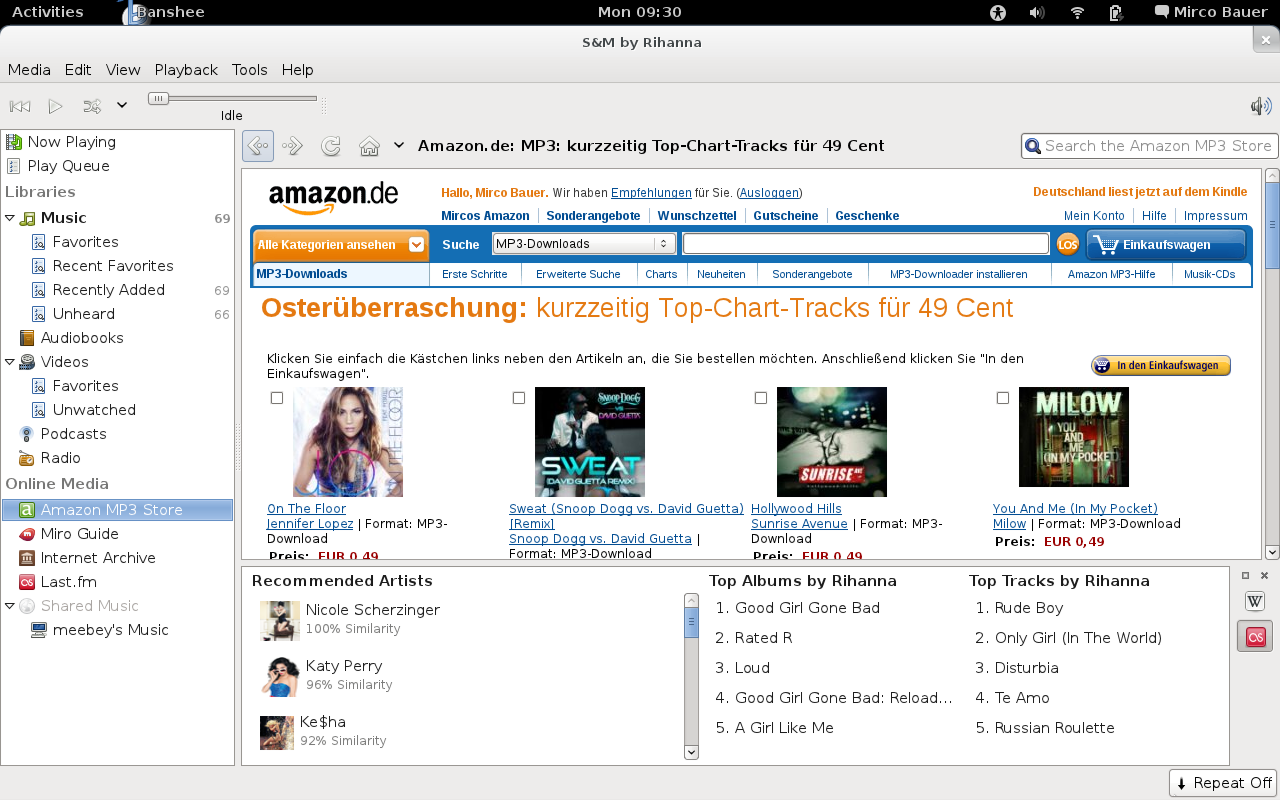
Mirco Bauer: Amazon MP3 Downloader and 64-bit Linux

Last night I wanted to buy an album on Amazon and I couldn't do the checkout as the site required me to install the Amazon MP3 Downloader to make the purchase and download of the album. The downloader is not needed for a single song though, but buying each song separately would be more expensive and more work. The good news is that it automatically offered me packages for different Linux distros: Ubuntu, Debian, Fedora and OpenSUSE instead of telling me off for using Linux and leaving me behind with a Windows only download. But here comes the catch, all offered packages are only for the Intel 32-bit architecture. Now this is a showstopper for me, as I am running an AMD64 Debian which is a 64-bit architecture. I first tried to download and run the 32-bit debian package nonetheless as there was some hope with the ia32-libs and ia32-libs-gtk package. But this was not working as the application needs gtkmm libraries like libglademm and bailed when I tried to run it. So I filed a wishlist bug report against ia32-libs-gtk for inclusion of gtkmm and possibly other needed libraries to run the Amazon MP3 downloader on AMD64. So I bought the album using MusicLoad instead which simply puts all songs in a single archive on-the-fly and let me download that archive. When I tweeted my frustration on Twitter I was hinted by Jo Shields and also by Gabriel Burt that there would have been a much simpler solution to this issue by using Banshee which includes an Amazon MP3 Store plugin: Banshee screenshot showing the Amazon MP3 Store plugin This plugin allows you to log into your Amazon account browse their store like the regular Amazon store, plays the song samples directly, purchase songs, downloads the songs and imports them into Banshee's database so you can play them right away. And as if this wasn't good enough yet, with the the purchase of MP3 songs on Amazon using Banshee automatically makes a donation to the GNOME foundation. As I am the only one who forgot or wasn't aware of this awesome solution this deserved some blogging. Update: some people pointed out that clamz is also available to make MP3 purchases on Amazon.

24 April 2011

Tiago Bortoletto Vaz: New members on the Brazilian Internet Steering Committee

I feel happy about the last CGI.br election results, mainly concerning two new representatives from the third sector. I want to point them here:

23 April 2011

Russell Coker: Links April 2011

Sebastian Thrun gave an interesting TED talk about the Google driverless car project and explains how his main aim is to avoid all the needless road deaths that are due to human error [1]. Finally a good use for the Google street-view type data! AnnMarie Thomas gave an interesting short TED talk about using play-dough to make circuits [2]. There are two recipies for play-dough, the one made with salt conducts well and the one made with sugar conducts poorly. That allows making wires with salty dough and insulators with the sugar dough. John Robb has published an interesting article about a Chinese fake revolutionary group that is triggering a backlash from Chinese security forces [3]. Even if this isn t accurate it seems like a good way to make people hate their local security forces and thus demand political change. Chris Rock made an interesting observation, we aren t making progress on racial issues, white people are getting less crazy [4]. Red Hill has an interesting article about 486 motherboards with fake cache chips that were sold in the 90 s [5]. One thing I disagree with is that they blame the customers for seeking low prices. When a white-box PC cost $2000 (which is $3000 in today s money) it made sense to try and get the cheapest option possible. Now that major department stores sell name-brand laptops for $400 it really makes sense to buy name-brand quality rather than white-box rubbish. IHollaBack.org is an interesting project to combat street harassment of women [6]. Psychology Today has an interesting article by Joe Navarro (former FBI counter-intelligence agent and author) about the serious implications of attempting to detect lies [7]. His main point is that most people over-estimate their ability to detect lies and because the legal system believes such claims from law enforcement officers many innocent people get found guilty and criminals get away free! Cory Doctorow wrote an informative article about the ways of persuading people to pay for content that can be obtained for free [8]. The main message seems to be that the big media companies are doing things the wrong way in everything that they do. The news satire site CBS Breaking News has an interesting about page explaining their mission [9]. They stopped their automated disaster generator after the Japanese Tsunami, while I can understand them wanting to keep some good taste and be sympathetic to the plight of the Japanese people it seems that they have forgotten that there is always a disaster somewhere. The typical bus plunge is just as bad as the Tsunami to the people on the bus and their relatives! Psychology Today has an interesting blog post by Satoshi Kanazawa explaining how criminals don t specialise, the psychological factors that make someone likely to commit one crime will make them likely to commit others, this makes it logical to collect DNA samples from all criminals [10]. Psychology Today has an interesting blog post by Dave Niose about a landmark US legal case in 1948 where Vashti McCollum had to escalate to the Supreme Court to allow her children to receive secular education [11]. We need something like this in Australia now as the religious extremists are going too far in indoctrinating children. Sam Richards gave a TED talk titled A Radical Experiment in Empathy which aims to teach Americans how to understand the way that people in the middle-east feel [12]. The comments suggest that his talk wasn t successful. Of course the fact that empathy doesn t have a clear definition in the English language doesn t help, and the fact that most people don t seem to interpret it in any way that corresponds to any dictionary and that most people seem unable to define what they mean by it makes things worse. At the moment I can t think of any examples of successfully teaching empathy to unwilling people. The people who want to learn will do so eventually, you can have some good success in helping them to learn faster. Kathryn Schulz gave an interesting TED talk about Being Wrong [13]. One interesting point that she makes concerns the way that people assume that people who disagree are ignorant, stupid, or evil instead of just having a different set of data or a different understanding of the same data. Of course it is possible for someone to be ignorant/stupid/evil AND have a different understanding. Marcin Jakubowski gave an inspiring TED talk about his project to develop free blueprints that allow anyone to create all machines needed to sustain civilisation with minimal cost [14]. His Open Source Ecology project has a blog and a wiki with blueprints and files for CAD/CAM [15]. Dave Meslin gave an insightful TED talk about apathy in the political process [16]. Among other things he compares council notices that supposedly request citizen input with adverts for running shoes which encourage people to buy them. One thing he didn t mention is the difference that technology can make, a short council advert with a QR code is probably a lot more useful than the current dense text-based adverts for today s audience.

21 April 2011

Evgeni Golov: Debian/Ubuntu Games Team Meeting #2

The readers of debian-devel-games@l.d.o and games@l.fd.o do already know, but the fact pkg-games has it s next (second) meeting on April 30th at 12:00 UTC in #debian-games needs the attention of the whole planet (pun intended)!For the agenda we have a whole bunch of leftovers from the first meeting, thus I did not plan any new items (besides of kicking Tolimar to be admin again instead of having the dream to drift away from his position ;)).
As most of us are lazy and wont klick the wiki link to read the agenda, it s served here too:
  1. games and cross-distro collaboration
  2. pending, removed, orphaned, wnpp & suggested games
  3. freedesktop.org/games group
  4. sponsoring policy
  5. cleaning old, adding new admins (and users)
Do you still remember where you will be on April 30th at 12:00 UTC? No? #debian-games on irc.debian.org. And don t you dare to be quiet! ;)

19 April 2011

Craig Small: Passwords in PHP

Category:WikiProject Cryptography participants

Image via Wikipedia

Generally speaking it is a really bad idea to hold passwords in cleartext. I am actually amazed people still do this! The standard way of holding passwords that has been around for years is to encrypt or hash the password and store the result, called a ciphertext. There have been many ways of hashing the password, starting off with plain old crypt with no salt (a random pair of characters) then crypt with salt through to MD5 and SHA. The thing is, each one of these hashing techniques results in a ciphertext in a different length. Now with most languages, this doesn t matter because you know what hash you are using; its simply the name of the function or some flag you set. PHP is different, because all of these methods use the one function called crypt which is a little confusing because it is more than plain old crypt. Around the PHP version 5.3 the developers started putting in the more complex hash algorithms which is good, but the ciphertext has been growing. A lot of applications store this hashed password in a database and the decision needs to be made; how big should this field be? For a long while, 50 characters would be enough and this is what programs like jffnms use. Unfortunately the SHA-512 algorithm needs 98 characters so what you get is half a hash stored. When the user enters their password, the program compares the full hash from that password to the half hash in the database and it always fails. I ve adjusted JFFNMS to use 200 character long fields which is fine for now. The problem is who knows what the future will bring?

Patrick Schoenfeld: password-gorilla 1.5.3.4 ACCEPTED into unstable

The password-gorilla package has lacked some love since a while and at some point in time I orphaned it.
That happened due to the fact, that the upstream author was pretty unresponsive and inactive and my own TCL skills are very limited. As a result password-gorilla package was in a bad state, at least from a user point of view, with several (apparently) random happening error message and alike, stalling feature development etc.

But in the meanwhile there was a promising event arising. A guy, named Zbigniew Diaczyszyn, wrote me a mail that he intended to continue upstream development. Well, meanwhile is kind of an understatement. That first mail already happened in December 2009. And he asked me, if I'd like to continue maintaining password-gorilla in Debian. I agreed to that, but as promising as it sounded to have a new upstream, I was not sure if that would work out. However: My doubt were not justified.

In the time between 2009 and now Zbigniew managed to become the official upstream (with the accreditation of the previous upstream), create a github project for it and make several releases.


I know there are several people out there who tested password-gorilla. I know there were magazine reviews including the old version, which were a bit buggy with recent tcl/tk versions. It made a quiet good multi-platform password manager, with support for very common password file formats, stand in a bad light.
I recommend previous users of password-gorilla to try the new version, which recently has been
uploaded to unstable.

Next.

Previous.