Search Results: "ana"

14 October 2016

Antoine Beaupr : Managing good bug reports

Bug reporting is an art form that is too often neglected in software projects. Bug reports allow contributors to participate without deep technical knowledge and at the same time provide a crucial space for developers to be made aware of issues with their software that they could not have foreseen or found themselves, for lack of resources, variety or imagination.

Prior art Unfortunately, there are rarely good guidelines for submitting bug reports. Historically, people have pointed towards How to report bugs effectively or How to ask questions the smart way. While those guides can be useful for motivated people and may seem attractive references for project managers, they suffer from serious issues:
  • they are written by technical people, for non-technical people
  • as a result, they have a deeply condescending attitude such as calling people "stupid" or various animal names like "mongoose"
  • they are also very technical themselves: one starts with a copyright notice and a changelog, the other uses magic words like "Core dumps" and $Id$
  • they are too long: sgtatham's is about 3600 words long, esr's is even longer at about 11800 words. those texts will take about 20 to 60 minutes to read by an average reader, according to research
Individual projects have their own guides as well. Linux has the REPORTING_BUGS file that is a much shorter 1200 that can be read under 5 minutes, provided that you can understand the topic at hand. Interestingly, that guide refers to both esr's and sgtatham's guidelines, which means, in the degenerate case where the user hasn't had the "privilege" of reading esr's prose already, they will have an extra hour and a half of reading to do to have honestly followed the guidelines before reporting the bug. I often find good documentation in the Tails project. Their bug reporting guidelines are easily accessible and quick to read, although they still might be too technical. It could be argued that you need to get technical at some point to get that information out, of course. In the Monkeysign project, I have started a bug reporting guide that doesn't yet address all those issues. I am considering writing a new guide, but I figured I would look at other people's work and get feedback before writing my own standard.

What's the point? Why have those documents been written? Are people really expected to read them before seeking help? It seems to me unlikely that someone would:
  1. be motivated enough to do something about a broken part of their computer
  2. figure out they can do something about it
  3. read a fifteen thousand words novel about how to report a bug...
  4. just to finally write a 20-line bug report that has no warranty of support attached to it
And if I would be a paying customer, I wouldn't want to be forced to waste my time reading that prose either: it's your job to help me fix your broken things, not the reverse. As someone doing consulting these days: I totally understand: it's not you, the user, it's us, the developers, that have a problem. We have been socialized through computers, and it makes us weird and obtuse, but that's no excuse, and we need to clean up our act. Furthermore, it's surprising how often we get (and make!) bug reports that can be difficult to use. The Monkeysign project is very "technical" and I have expected that the bug reports I would get would be well written, with ways to reproduce and so on, but it happened that I received bug reports that were all over the place, didn't have any ways of reproducing or were simply incomplete. Those three bug reports were filed by people that I know to be very technically capable: one is a fellow Debian developer, the second had filed a good bug report 5 days before, and the third one is a contributor that sent good patches before. In all three cases, they knew what they were doing. Those three people probably read the guidelines mentioned in the past. They may have even read the Monkeysign bug reporting guidelines as well. I can only explain those bug reports by the lack of time: people thought the issue was obvious, that it would get fixed rapidly because, obviously, something is broken. We need a better way.

The takeaway What are those guides trying to tell us?
  1. ask questions in the right place
  2. search for similar questions and issues before reporting the bug
  3. try to make the developers reproduce the issues
  4. failing that, try to describe the issue as well as you can
  5. write clearly, be specific and verbose yet concise
There are obviously contradictions in there, like sgtatham telling us to be verbose and esr tells us to, basically, not be verbose. There is definitely a tension in there, and there are many, many more details about how great bug reports can be if done properly. I tend towards the side of terseness in our descriptions: people that will know how to be concise will be, people that don't will most likely not learn by reading a 12 000 words novel that, in itself, didn't manage to be parsimonious. But I am willing to allow for verbosity in bug reports: I prefer too many details instead of missing a key bit of information.

Issue trackers Step 1 is our job: we should send people in the right place, and give them the right tools. Monkeysign used to manage bugs with bugs-everywhere and this turned out to be a terrible idea: you had to understand git and bugs-everywhere to file any bug reports. As a result, there were exactly zero bug reports filed by non-developers during the whole time BE was used, although some bugs were filed in the Debian Bugtracker. So have a good bug tracker. A mailing list or email address is not a good bug tracker: you lose track of old issues, and it's hard for newcomers to search the archives. It does have the advantage of having a unified interface for the support forum and bug tracking, however. Redmine, Gitlab, Github and others are all decent-enough bug trackers. The key point is that the issue tracker should be publicly available, and users should be able to register easily to file new issues. You should also be able to mass-edit tickets and users should be able to discover the tracker's features easily. I am sorry to say that the Debian BTS somewhat falls short on those two features. Step 2 is a shared responsibility: there should be an easy way to search for issues, and we should help the user looking for similar issues. Stackexchange sites do an excellent job at this, by automatically searching for similar questions while you write your question, suggesting similar ones in an attempt to weed out duplicates. Duplicates still happen, but they can then clearly be marked and linked with a distinct mechanism. Most bug trackers do not offer such high level functionality, but should, so I feel the fault lies more on "our" end than at the user's end.

Reproducing the environment Step 3 and 4 are more or less the user's responsibility. We can detail in our documentation how to clearly share the environment where we reproduced the bug, for example, but in the end, the user decides if they want to share that information or not. In Monkeysign, I have finally implemented joeyh's suggestion of shipping the test suite with the program. I can now tell people to run the test suite in their environment to see if this is a regression that is specific to their environment - so a known bug, in a way - or a novel bug for which I can look at writing a new unit test. I also include way more information about the environment in the --version output, an idea I brought forward in the borg project to ease debugging. That way, people can just send the output of monkeysign --test and monkeysign --version, and I have a very good overview of what is happening on their end. Of course, Monkeysign also supports the usual --verbose and --debug flag that users should enable when reproducing issues. Another idea is to report bugs directly from the application. We have all seen Firefox or other software have automatic bug reporting tools, but somehow those seem unsatisfactory for a user: we have no feedback of where the report goes, if it's followed up on. It is useful for larger project to get statistical data, but not so useful for users in the short term. Monkeysign tries to handle exceptions in the code in a graceful way, but could do better. We use a small library to handle exceptions, but that library has since then been improved to directly file bugs against the Github project. This assumes the user is logged into Github, but it is nice to pre-populate bug reports with the relevant information up front.

Issue templates In the meantime, to make sure people provide enough information, I have now moved a lot of the bug reporting guidelines to a separate issue template. That issue template is available through the issue creation form now, although it is not enabled by default, a weird limitation of Gitlab. Issue templates are available in Gitlab and Github. Issue templates somewhat force users in a straight jacket: there is already something to structure their bug report. Those could be distinct form elements that had to be filled in, but I like the flexibility of the template, and the possibility for users to just escape the formalism and just plead for help in their own way.

Issue guidelines In the end, I opted for a short few paragraphs in the style of the Tails documentation, including a reference to sgtatham, as an optional future reference:
  • Before you report a new bug, review the existing issues in the online issue tracker and the Debian BTS for Monkeysign to make sure the bug has not already been reported elsewhere.
  • The first aim of a bug report is to tell the developers exactly how to reproduce the failure, so try to reproduce the issue yourself and describe how you did that.
  • If that is not possible, try to describe what went wrong in detail. Write down the error messages, especially if they have numbers.
  • Take the necessary time to write clearly and precisely. Say what you mean, and make sure it cannot be misinterpreted.
  • Include the output of monkeysign --test, monkeysign --version and monkeysign --debug in your bug reports. See the issue template for more details about what to include in bug reports.
If you wish to read more about issues regarding communication in bug reports, you can read How to Report Bugs Effectively, which takes around 20 to 30 minutes.
Unfortunately, short of rewriting sgtatham's guide, I do not feel there is much more we can do as a general guide. I find esr's guide to be too verbose and commanding, so sgtatham it will be for now.

The prose and literacy In the end, there is a fundamental issue with reporting bugs: it assumes our users are literate and capable of writing amazing prose that we will enjoy reading as the last J.K. Rowling novel (if you're into that kind of thing). It's just an unreasonable expectation: some of your users don't even speak the same language as you, let alone read or write it. This makes for challenging collaboration, to say the least. This is where automated reporting makes sense: it doesn't require user's intervention, and the communication is mediated by machines without human intervention and their pesky culture. But we should, as maintainers, "be liberal in what we accept and conservative in what we send". Be tolerant, and help your users in fixing their issues. It's what you are there for, after all. And in the end, we all fail the same way. In an attempt to improve the situation on bug reporting guides, I seem to have myself written a 2000 short story that will have taken up a hopefully pleasant 10 minutes of your time at minimum. Hopefully I will have succeeded at being clear, specific, verbose and concise all at once and look forward to your feedback on how to improve our bug reporting culture.

12 October 2016

C.J. Adams-Collier: Using SonarQube 5.4, Maven 3.3.9, Jenkins 2.19.1 on systems with both Java 1.7 and 1.8

Hello folks! My team spent hours and hours beating our head against a Sonar deployment problem on Ubuntu Trusty (14.04 LTS). I thought I might share our findings so that you won t have to! As you probably know, Trusty only makes Java Development Kit 1.7 available on the stock installation. The current stable version of the Java is 1.8. The way we install this is to use the OpenJDK PPA, generously uploaded by our dear friend Matthias Klose. To make things even more exciting, a modern Maven is not available on this platform. And so we use the stock Maven 3.3.9 tarball distribution. This tarball distribution does not integrate well with Debian, and so, when we tell the system using sudo update-java-alternatives -s /usr/lib/jvm/java-1.8.0-openjdk-amd64 that we wish to use Java 1.8 as our default system JDK, it does not get the message. The only way to reliably let Maven know which java you wish to use is to set the JAVA_HOME environment variable. In order to do this within the Jenkins environment, one must select the JDK one wishes to use: openjdk8-ubuntu1404-as-jdk To make things worse, this option is not, as one might expect, available for editing in a stock Jenkins 2.x installation. In Jenkins 1.x, one would be able to specify which java one wished to use just by specifying openjdk8 in a field. With Jenkins 2.x, the field does not exist unless a configuration option in an unrelated form is set. So! One should first select Manage Jenkins -> Global Tool Configuration: Jenkins2-Global_Tool_Configuration Once this form is open, look for the JDK installations button: Jenkins2-JDK_installations Click it very thoroughly just once. You ll be presented with a form into which you may enter details about the various JDKs your build executors may have access to. You ll refer to them in your job configuration by the value of their Name field, and when executing the build, Jenkins will set JAVA_HOME to the value of the (you guessed it) JAVA_HOME field: Jenkins2-JDK_installations-expanded Once these entries are made, they can be selected in two place. 1) on the ZMQ Event Publisher: jdk-select-project 2) in the post-build actions under SonarQube analysis with Maven (advanced) postbuild-sonarqube-select-jdk And that s how it s done! Here s the details from my colleague, Thanh: https://lists.fd.io/pipermail/honeycomb-dev/2016-October/000387.html
11 October 2016

Stig Sandbeck Mathisen: DevOps toys, looking at new and old tools

From last month s toybox of distractions, I ve spent time with GitLab CI, Ansible, Prometheus and OpenShift. GitLab CI is a lot like Travis CI, and a little less like Jenkins. When a commit is pushed to the repository in GitLab, and the branch contains a .gitlab-ci.yml file, a GitLab CI runner will check out the repository, and follow the instructions in that file. Useful for configuration syntax checks, unit tests, and puppet environment deployments. I ve mostly used Ansible for orchestration, performing tasks across a number of nodes. I ve used it much configuration management for a bit, and from what I see, it can do that rather well, too. I ve used Puppet in production for a bit (I committed revision 1 in the old puppet configuration management repository at work in 2007-07-04). A new perspective on configuration management is good. Prometheus is a master-node stats gatherer and presenter. It does a single HTTP GET to fetch all metrics in a single request. I ve used Munin for a long, long time, and while the plugin ecosystem is far larger for Munin, the Prometheus master scales much better (millions of metrics per minute on a modern machine). I use Grafana to present graphs from Prometheus and logs from Elasticsearch in the same dashboard. Prometheus can collect data from a munin node, using a munin node exporter. Last week I got training in OpenShift, which was an eye-opener. I ve used Docker for a good while, and planned to introduce Kubernetes, as well as an imperial buttload of shell scripts to keep it all automated. Thankfully, OpenShift Origin already includes Kubernetes and does the required automation. An OpenShift cluster is now being added to the core infrastructure to do the required care and feeding of the herd of APIs and microservices written over the years. Bunch it together behind an API Management Gateway, and you should be able to label the whole thing Microservice Architecture . I m not running out of fun things to do for a while.

Vincent Sanders: The pine stays green in winter... wisdom in hardship.

In December 2015 I saw the kickstarter for the Pine64. The project seemed to have a viable hardware design and after my experience with the hikey I decided it could not be a great deal worse.

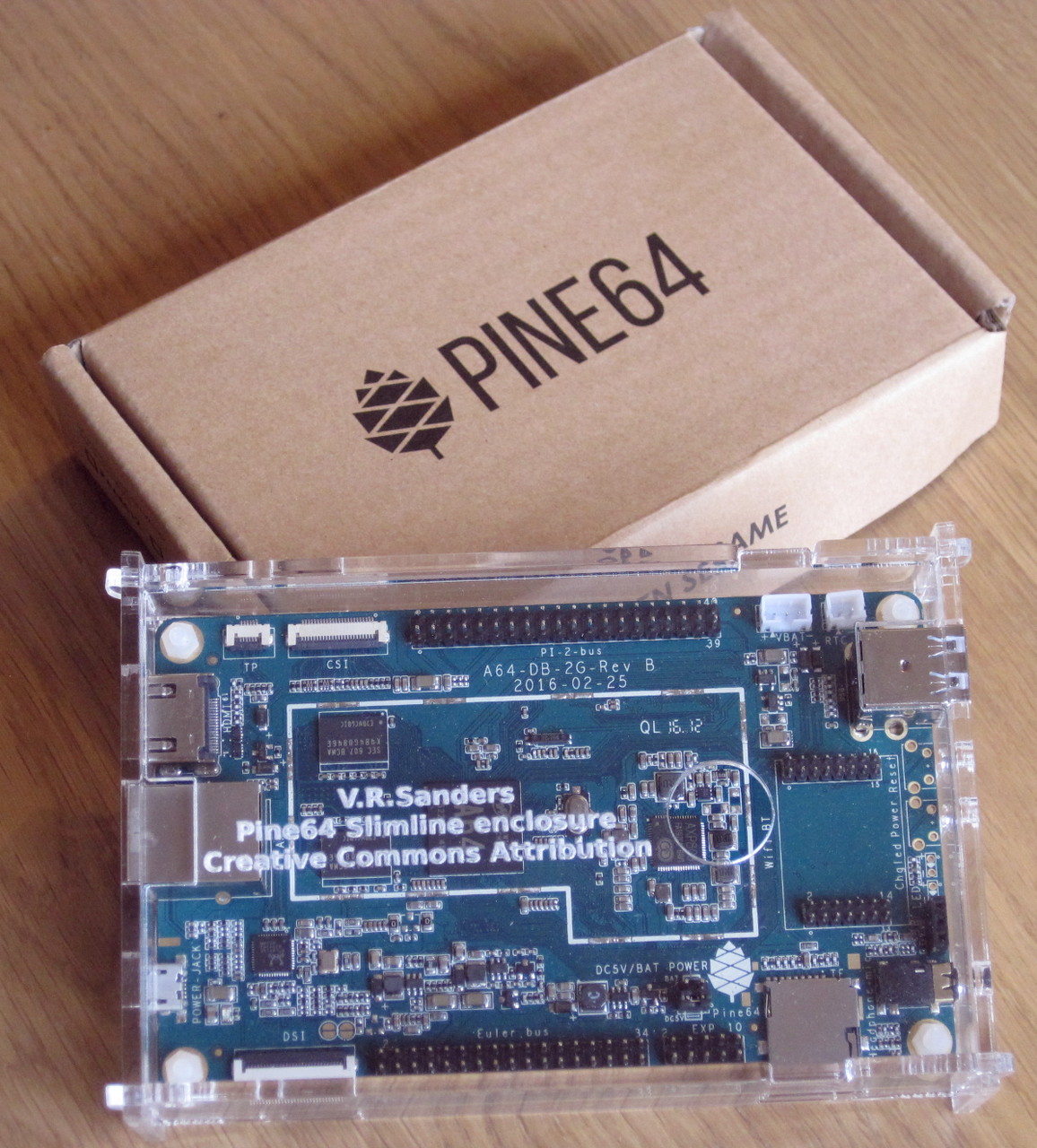
Pine64 board in my case design
The system I acquired comprises of:
Hardware based kickstarter projects are susceptible to several issues and the usual suspects occurred causing delays:
My personal view is that PINE 64 inc. handled it pretty well, much better than several other projects I have backed and as my Norman Douglas quotation suggests I think they have gained some wisdom from this.

I received my hardware at the beginning of April only a couple of months after their initial estimated shipping date which as these things go is not a huge delay. I understand some people who had slightly more complex orders were just receiving their orders in late June which is perhaps unfortunate but still well within kickstarter project norms.

As an aside: I fear that many people simply misunderstand the crowdfunding model for hardware projects and fail to understand that they are not buying a finished product, on the other side of the debate I think many projects need to learn expectation management much better than they do. Hyping the product to get interest is obviously the point of the crowdfunding platform, but over promising and under delivering always causes unhappy customers.

Pine64 board dimensions
Despite the delays in production and shipping the information available for the board was (and sadly remains) inadequate. As usual I wanted to case my board and there were no useful dimension drawings so I had to make my own from direct measurements together with a STL 3D model.

Also a mental sigh for "yet another poor form factor decision" so another special case size and design. After putting together a design and fabricating with the laser cutter I moved on to the software.

Once more this is where, once again, the story turns bleak. We find a very pretty website but no obvious link to the software (hint scroll to the bottom and find the "support" wiki link) once you find the wiki you will eventually discover that the provided software is either an Android 5.1.1 image (which failed to start on my board) or relies on some random guy from the forums who has put together his own OS images using a hacked up Allwinner Board Support Package (BSP) kernel.

Now please do not misunderstand me, I think the work by Simon Eisenmann (longsleep) to get a working kernel and Lenny Raposo to get viable OS images is outstanding and useful. I just feel that Allwinner and vendors like Pine64 Inc. should have provided something much, much better than they have. Even the efforts to get mainline support for this hardware are all completely volunteer community efforts and are are making slow progress as a result.

Assuming I wanted to run a useful OS on this hardware and not just use it as a modern work of art I installed a basic Debian arm64 using Lenny Raposo's pine64 pro site downloads. I was going to use the system for compiling and builds so used the "Debian Base" image to get a minimal setup. After generating unique ssh keys, renaming the default user and checking all the passwords and permissions I convinced myself the system was reasonably trustworthy.

The standard Debian Jessie OS runs as expected with few surprises. The main concern I have is that there are a number of unpackaged scripts installed (prefixed with pine64_) which perform several operations from reporting system health (using sysfs entries) to upgrading the kernel and bootloader.

While I understand these scripts have been provided for the novice users to reduce support burden, doing even more of the vendors job, I would much rather have had proper packages for these scripts, kernel and bootloader which apt could manage. This would have reduced image creation to a simple debootstrap giving much greater confidence in the images provenance.

The 3.10 based kernel is three years old at the time of writing and lacks a great number of features for the aarch64 ARM processors introduced since release. However I was pleasantly surprised at kvm apparently being available.

# dmesg grep -i kvm
[ 7.592896] kvm [1]: Using HYP init bounce page @b87c4000
[ 7.593361] kvm [1]: interrupt-controller@1c84000 IRQ25
[ 7.593778] kvm [1]: timer IRQ27
[ 7.593801] kvm [1]: Hyp mode initialized successfully

I installed the libvirt packages (and hence all their dependencies like qemu) and created a bridge ready for the virtual machines.

I needed access to storage for the host disc images and while I could have gone the route of using USB attached SATA as with the hikey I decided to try and use network attached storage instead. Initially I investigated iSCSI but it seems the Linux target (iSCSI uses initiator for client and target for server) support is either old, broken or unpackaged.

I turned to network block device (nbd) which is packaged and seems to have reasonable stability out of the box on modern distributions. This appeared to work well, indeed over the gigabit Ethernet interface I managed to get a sustained 40 megabytes a second read and write rate in basic testing. This is better performance than a USB 2.0 attached SSD on the hikey

I fired up the guest and perhaps I should have known better than to expect a 3.10 vendor kernel to cope. The immediate hard crashes despite tuning many variables convinced me that virtualisation was not viable with this kernel.

So abandoning that approach I attempted to run the CI workload directly on the system. To my dismay this also proved problematic. The processor has the bad habit of throttling due to thermal issues (despite a substantial heatsink) and because the storage is network attached throttling the CPU also massively impacts I/O.

The limitations meant that the workload caused the system to move between high performance and almost no progress on a roughly ten second cycle. This caused a simple NetSurf recompile CI job to take over fifteen minutes. For comparison the same task takes the armhf builder (CubieTruck) four minutes and a 64 bit x86 build which takes around a minute.

If the workload is tuned to a single core which does not trip thermal throttling the build took seven minutes. which is almost identical to the existing single core virtual machine instance running on the hikey.

In conclusion the Pine64 is an interesting bit of hardware with fatally flawed software offering. Without Simon and Lenny providing their builds to the community the device would be practically useless rather than just performing poorly. There appears to have been no progress whatsoever on the software offering from Pine64 in the six months since I received the device and no prospect of mainline Allwinner support for the SoC either.

Effectively I have spent around 50usd (40 for the board and 10 for the enclosure) on a failed experiment. Perhaps in the future the software will improve sufficiently for it to become useful but I do not hold out much hope that this will come from Pine64 themselves.

9 October 2016

Bits from Debian: Debian is participating in the next round of Outreachy!

Following the success of the last round of Outreachy, we are glad to announce that Debian will take part in the program for the next round, with internships lasting from the 6th of December 2016 to the 6th of March 2017. From the official website: Outreachy helps people from groups underrepresented in free and open source software get involved. We provide a supportive community for beginning to contribute any time throughout the year and offer focused internship opportunities twice a year with a number of free software organizations. Currently, internships are open internationally to women (cis and trans), trans men, and genderqueer people. Additionally, they are open to residents and nationals of the United States of any gender who are Black/African American, Hispanic/Latin@, American Indian, Alaska Native, Native Hawaiian, or Pacific Islander. If you want to apply to an internship in Debian, you should take a look at the wiki page, and contact the mentors for the projects listed, or seek more information on the (public) debian-outreach mailing-list. You can also contact the Outreach Team directly. If you have a project idea and are willing to mentor an intern, you can submit a project idea on the Outreachy wiki page. Here's a few words on what the interns for the last round achieved within Outreachy: Debian would not be able to participate in Outreachy without the help of the Software Freedom Conservancy, who provides administrative support for Outreachy, as well as the continued support of Debian's donors, who provide funding for the internships. If you want to donate, please get in touch with one of our trusted organizations. Debian is looking forward to welcoming new interns for the next few months, come join us!

Laura Arjona Reina: New phone: Samsung Galaxy S III phone with Replicant

Thanks to the Bazaar effort of The Guardian Project, I ve been offered a phone to test F-Droid and other free software apps for Android. I accepted the offer, and chose a Samsung Galaxy S III phone with Replicant 4.2.2, installed and shipped by Tehnoetic.
I m using it now as my main phone, and since it uses Android 4.x I m able to install more modern apps than in my old Galaxy Ace (which remains usable with CyanongenMod 7.2 (Android 2.3.7)).
My plans with this new phone are:
  • Test Replicant and free software for Android on it
  • Get more involved in translations of Android apps
  • Get more involved in the F-Droid community
  • Keep an eye on Android tools in Debian
  • Post here in my blog articles about what I ve been doing (and of course report issues and contributions upstream)
Migration to the new phone
I ve migrated my stuff from the old phone to this one. Some notes:
  • Wrote down my list of apps
  • Used Slight Backup for contacts, call logs and messages
  • Periodical has its own backup tool
  • Whatsapp has its own backup tool
  • Exported settings in K-9 Mail
  • Exported Kontalk GPG key
  • Simply Do has its own backup tool
  • I don t use calendars in the phone so I didn t migrate any events (I have Offline Calendar to ad temporary notes/reminders, but that s all)
I moved the SIM card and the SD Card to the new phone and tried the restore tool for each app.
I found out that several apps could not find the backups because they were not looking at the SD Card for the files (seems that they were using internal memory locations). So for recovering my backups, I made new backups in the new phone with the empty apps, then found out where those backups were created (in the internal memory, /storage/emulated/0), and then copied the authentic backup files there (overwriting teh dummy ones), and then used the app to restore the backup.
For some apps (K-9) I had to set again the folder for attachments, since the SD was not anymore in /media/sdcard, now it was in /storage/sdcard1.
Apart from that, everything went well.
I was a bit upset that I could not migrate Kontalk conversations (there is no backup/export tool, and I am not sure where are the files/database stored).
I noticed that although Kontalk is registered using the phone number, and it uses the phone numbers for contacts, it kept working in the old phone (Whatsapp detects when you change to a new phone and kind of deactivates itself in the old one, but that s not the case for Kontalk: it works as any XMPP client (if it s open, it can send/receive messages)).
Replicant 4.2 in a Galaxy S III (i9300)
Here I write some particularities that I found in the phone, mostly bugs or problems. But don t get me wrong: overall I m very happy with it!
I experienced a problem when using the phone to make/receive calls, it seemed that the proximity sensor was not working well. I thought it was a Replicant issue, but later I realized that there was a Tehnoetic sticker that was partially covering the sensor. I removed the sticker and everything worked well.
The phone came with F-Droid installed which is nice. I upgraded to the latest alpha and I m testing the alpha releases since then
I found that I cannot choose where to install apps nor move apps from internal memory to the SD Card: there is no such option in Settings > Apps > Manage Apps (there is such setting in my CyanogenMod 7.2 phone, though). Since my phone is rooted and I have full access to both internal memory and SDCard, and I have plenty of room in the internal memory, I didn t bother too much. I m not sure if this is a bug, a feature, something related to Android 4 or specific to Replicant, o specific to this phone model. Pending to investigate, but low priority.
Replicant is almost fully translated to Spanish, yay!. I only found one untranslated string: You go to Settings > Wireless > Cell Broadcasts, and in the settings page, Cell Broadcasts is untranslated (but the settings themselves are). I still need to find where/how to send a patch for this (not sure if it comes from Android, CyanogenMod, or it s something specific for Replicant. Also, being Android 4.x, I m not sure about the usefulness of reporting such a minimal and unimportant patch upstream ).
When I turn on the phone, I get the Samsung S III splash screen, later the Replicant Splash screen, later the numeric pad to unlock the SIM card. After that, I see the screen lock but when I press the lock to enter the pattern, the screen turns off and on, screen lock appearing again (and I have to press the lock again to enter the pattern). If after unlocking the SIM card I wait a bit, I see the screen lock and again black screen and screen lock, so it s not my tap causing it. Doing like this (waiting a bit for the phone to show the screen lock for 2nd time) is less annoying, but I wonder why this happen and I cannot unlock the screen directly in the first attempt. This is also pending for research, but low priority.
When the phone boots, I find the splash screens too bright (the Samsung Galaxy S III splash, and later the red Replicant one). I don t know if I can change that. I know that other people have created different Replicant splash screens, so maybe I can create one almost black and only the Replicant text in very dark grey. But this is obviously a workaround, not a fix. OTOH, it s an annoying thing just some seconds: when the unlock screen is shown, the phone shows the brightness level that I ve set (usually, the lowest one).
From time to time, I suffer soft reboots:
  1. the phone hangs for 2-3 seconds
  2. then the red Replicant splash screen is shown (the phone is not totally rebooted, because I don t see the Samsung Galaxy S III splash screen and and the SIM card unlock PIN is not requested)
  3. after unlocking the screen, I see a normal desktop (similar to what I see after rebooting the phone: no apps running, and no last used apps history. Time and date are ok, wireless or 3G starts correctly etc).
I ve tried to track the causes of these soft reboots, but I couldn t find anything specific. They are not frequent at all, and when I decide to launch CatLog to try to catch any hint, the phone works perfectly for hours or days :s
Replicant is currently using the fallback Android EGL implementation, which is incomplete. The missing features of this implementation cause multiple issues, which are described in #705. These are the ones that I experience (or I miss):
  • The phone comes with a video editor preinstalled: Movie Studio. I got excited about it, because I was jealous of the small built-in video editor that comes with Whatsapp, but I became sad because Movie Studio does not work
  • The camera does not record video.
  • When I long-press the central button of my phone to see the list of recent apps, I don t see their thumbnails (only the name, and their icons). This is quite unimportant for me, names and icons are enough.
  • The stock Gallery app does not work well: I cannot see thumbnails of the albums. This is not very important, because I installed Gallery.
  • I cannot use Firefox, Orfox and other derivative web browsers (I usually use the stock browser, and I installed Lightning too).
  • I cannot use barcode or QR scanners.
  • My son cannot play Shattered Pixel Dungeon (nor Pixel Dungeon). Fortunately he uses now my old Android 2.x devide for that.
I installed the non-free firmware to be able to use Wifi and tethering, GPS and some other things. This does not fix the graphics problems listed above.
New apps, and translations
Note: when I write about Android apps, I usually link to their pages in the F-Droid website. Here I talk about translations (contributions), so I ll link to their original website or souce code repos. But you can find all those apps in F-Droid too.
As I told before, I installed another gallery app called Gallery and submitted an update to it Spanish translation.
I installed Red Moon to reduce (even more) the screen brightness. At night it s a relieve. Maybe the brightness of the splash screen is not so much, and I perceive them annoying because I got accostumed to Red Moon! I contributed some strings to the Spanish translation.
I liked RadioDroid very much, and I translated the app to Spanish.
I translated Wifi Privacy Police, and I used for some time, but I became tired that it keeps asking all the time that I walk across my workplace (multiple buildings within the same Wifi network, but quite a lot access points ).
I keep on contributing to K-9 Mail to make it 100% translated to Spanish. Now with a modern Android I can move to the development branch (5.1xx releases), and just did it.
I submitted a Spanish translation to DAVDroid, although I m not using it yet (I have to see if my University s Owncloud instance allows to sync contacts and calendar).
I updated the Spanish translation of PassAndroid, although I don t use it yet (I tend to print my train/airplane tickets ). I keep it installed in my phone, just in case.
Other apps that I use
I m testing OwnCloud, NextCloud and NexCloud Beta clients with my University s Owncloud and with Davros in my Sandstorm box (with Davros, I could only make it work installing an old version of Owncloud/Nexcloud client, and then upgrading. See #65).
I didn t get accostumed to Conversations. Not sure why, though. Maybe it s just that I got accostumed to Xabber-Classic, so I upgraded to Xabber. It works like a charm, dark theme, and I can close it easily when I don t want to chat.
I got in love with KDE Connect. Later I realized that I could have been using it in my Android 2.x phone since long
Sometimes I have fun activating Voice Notification and entering the redeslibres XMPP multi user chat at salas.mijabber.es, for example while I m cooking in the kitchen (in that room people talk in Spanish and make many wordplays, mixing Spanish and English, and use tech slang, etc so it s really fun to hear the Spanish-TTS deal with the conversation there!).
More to come
As I told at the beginning of this long post, my plan is to keep on tinkering with the phone, testing and translating apps, and becoming more involved. So expect some more posts about Android in this blog, in the future.
For now, some big things in my TODO:
  • Watching again some videos: DebConf16 videos about Android tools in Debian, FOSDEM talks about Replicant, and some other talks about free software in Android.
  • I track the #fdroid and #fdroid-dev channels in IRC, but I m not very talkative there. I guess I could do more user support.
  • Participate more in the F-Droid (client, server, data) issue trackers (I send reports when the alpha version crashes, and comment on few issues, but I don t triage the issue tracker to find issues that I could reproduce or help to diagnose or contribute to fix).
  • Long time ago I learned to setup an Android development environment and build apps. I would like to re-learn and maybe do some small fixes in unmaintained or near unmaintained apps, and maybe adopt them or join their development teams (I m thinking, for example, in Puma, an Android client for pump.io network, the MediaGoblin app, or the DebianDroid app). And ship new versions of unmaintained apss, including Spanish translations.
We ll see how far I can go!
Comments?
You can comment about this post in this pump.io thread.

Filed under: My experiences and opinion, Tools Tagged: Android, Debian, English, F-Droid

Nathan Handler: Ohio Linux Fest

This weekend, I traveled to Columbus, Ohio to attend Ohio Linux Fest. I departed San Francisco early on Thursday. It was interesting getting to experience the luxurious side of flying as I enjoyed a mimosa in the American Express Centurion lounge for the first time. I even happend to cross paths with Corey Quinn, who was on his way to [DevOpsDays Boise]. While connecting in Houston, I met up with the always awesome Jos Antonio Rey, who was to be my travel companion for this trip. The long day of travel took its toll on us, so we had a lazy Friday morning before checking in for the conference around lunch time. I was not that interested in the afternoon sessions, so I spent the majority of the first day helping out at the Ubuntu booth and catching up with friends and colleagues. The day ended with a nice Happy Hour sponsored by Oracle. Saturday was the main day for the conference. Ethan Galstad, Founder and CEO of Nagios, started the day with a Keynote about Becoming the Next Tech Entrepreneur. Next up was Elizabeth K. Joseph with A Tour of OpenStack Deployment Scenarios. While I ve read plenty about OpenStack, I ve never actually used it before. As a result, this demo and introduction was great to watch. It was entertaining to watch her login to CirrOS with the default password of cubswin:), as the Chicago Cubs are currently playing the San Francisco Giants in the National League Divisional Series (and winning). Unfortunately, I was not able to win a copy of her new Common OpenStack Deployments book, but it was great getting to watch her signing copies for other attendees after all of the hard work that went into writing the book. For lunch, Jos , Elizabeth, and Svetlana Belkin all gathered together for an informal Ubuntu lunch. Finally, it was time for me to give my talk. This was the same talk I gave at FOSSCON, but this time, I had a significantly larger audience. Practice definitely makes perfect, as my delivery was a lot better the second time giving this talk. Afterwards, I had a number of people come up to me to let me know that they really enjoyed the presentation. Pro Tip: If you ever attend a talk, the speaker will really appreciate any feedback you send their way. Even if it is a simple, Thank You , it really means a lot. One of the people who came up to me after the talk was Unit193. We have known each other through Ubuntu for years, but there has never been an opportunity to meet in person. I am proud to be able to say with 99% confidence that he is not a robot, and is in fact a real person. Next up was a lesson about the /proc filesystem. While I ve explored it a bit on my own before, I still learned a few tips and tricks about information that can be gained from the files in this magical directory. Following this was a talk about Leading When You re Not the Boss. It was even partially taught by a dummy (the speaker was a ventriloquist). The last regular talk of the day was one of the more interesting ones I attended. It was a talk by Patrick Shuff from Facebook about how they have built a load balancer than can handle a billion users. The slide deck was well-made with very clear diagrams. The speaker was also very knowledgeable and dealt with the plethora of questions he received. Prior to the closing keynote was a series of lightning talks. These served as a great means to get people laughing after a long day of talks. The closing keynote was given by father and daughter Joe and Lilly Born about The Democratization of Invention. Both of them had very interesting stories, and Lily was quite impressive given her age. We skipped the Nagios After Party in favor of a more casual pizza dinner. Overall, it was a great conference, and I am very glad to have had the opportunity to attend. A big thanks to Canonical and the Ubuntu Community for fudning my travel through the Ubuntu Community Fund and to the Ohio Linux Fest staff for allowing me the opportunity to speak at such a great conference.

8 October 2016

Joachim Breitner: T430s T460s

Earlier this week, I finally got my new machine that came with my new position at the University of Pennsylvania: A shiny Thinkpad T460s that now replaces my T430s. (Yes, there is a pattern. It continues with T400 and T41p.) I decided to re-install my Debian system from scratch and copy over only the home directory a bit of purification does not hurt. This blog post contains some random notes that might be useful to someone or alternative where I hope someone can tell me how to fix and improve things.

Installation The installation (using debian-installer from a USB drive) went mostly smooth, including LVM on an encrypted partition. Unfortunately, it did not set up grub correctly for the UEFI system to boot, so I had to jump through some hoops (using the grub on the USB drive to manually boot into the installed system, and installing grub-efi from there) until the system actually came up.

High-resolution display This laptop has a 2560 1440 high resolution display. Modern desktop environments like GNOME supposedly handle that quite nicely, but for reasons explained in an earlier post, I do not use a desktop envrionment but have a minimalistic setup based on Xmonad. I managed to get a decent setup now, by turning lots of manual knobs:
  • For the linux console, setting
    FONTFACE="Terminus"
    FONTSIZE="12x24"
    in /etc/default/console-setup yielded good results.
  • For the few GTK-2 applications that I am still running, I set
    gtk-font-name="Sans 16"
    in ~/.gtkrc-2.0. Similarly, for GTK-3 I have
    [Settings]
    gtk-font-name = Sans 16
    in ~/.config/gtk-3.0/settings.ini.
  • Programs like gnome-terminal, Evolution and hexchat refer to the System default document font and System default monospace font . I remember that it was possible to configure these in the GNOME control center, but I could not find any way of configuring these using command line tools, so I resorted to manually setting the font for these. With the help from Alexandre Franke I figured out that the magic incarnation here is:
    gsettings set org.gnome.desktop.interface monospace-font-name 'Monospace 16'
    gsettings set org.gnome.desktop.interface document-font-name 'Serif 16'
    gsettings set org.gnome.desktop.interface font-name 'Sans 16'
  • Firefox seemed to have picked up these settings for the UI, so that was good. To make web pages readable, I set layout.css.devPixelsPerPx to 1.5 in about:config.
  • GVim has set guifont=Monospace\ 16 in ~/.vimrc. The toolbar is tiny, but I hardly use it anyways.
  • Setting the font of Xmonad prompts requires the sytax
    , font = "xft:Sans:size=16"
    Speaking about Xmonad prompts: Check out the XMonad.Prompt.Unicode module that I have been using for years and recently submitted upstream.
  • I launch Chromium (or rather the desktop applications that I use that happen to be Chrome apps) with the parameter --force-device-scale-factor=1.5.
  • Libreoffice seems to be best configured by running xrandr --dpi 194 before hand. This seems also to be read by Firefox, doubling the effect of the font size in the gtk settings, which is annoying. Luckily I do not work with Libreoffice often, so for now I ll just set that manually when needed.
I am not quite satisfied. I have the impression that the 16 point size font, e.g. in Evolution, is not really pretty, so I am happy to take suggestions here. I found the ArchWiki page on HiDPI very useful here.

Trackpoint and Touchpad One reason for me to sticking with Thinkpads is their trackpoint, which I use exclusively. In previous models, I disabled the touchpad in the BIOS, but this did not seem to have an effect here, so I added the following section to /etc/X11/xorg.conf.d/30-touchpad.conf
Section "InputClass"
        Identifier "SynPS/2 Synaptics TouchPad"
        MatchProduct "SynPS/2 Synaptics TouchPad"
        Option "ignore" "on"
EndSection
At one point I left out the MatchProduct line, disabling all input in the X server. Had to boot into recovery mode to fix that. Unfortunately, there is something wrong with the trackpoint and the buttons: When I am moving the trackpoint (and maybe if there is actual load on the machine), mouse button press and release events sometimes get lost. This is quite annoying I try to open a folder in Evolution and accidentially move it. I installed the latest Kernel from Debian experimental (4.8.0-rc8), but it did not help. I filed a bug report against libinput although I am not fully sure that that s the culprit. Update: According to Benjamin Tissoires it is a known firmware bug and the appropriate people are working on a work-around. Until then I am advised to keep my palm of the touchpad. Also, I found the trackpoint too slow. I am not sure if it is simply because of the large resolution of the screen, or because some movement events are also swallowed. For now, I simply changed the speed by writing
SUBSYSTEM=="serio", DRIVERS=="psmouse", ATTRS speed ="120"
to /etc/udev/rules.d/10-trackpoint.rules.

Brightness control The system would not automatically react to pressing Fn-F5 and Fn-F6, which are the keys to adjust the brightness. I am unsure about how and by what software component it should be handled, but the solution that I found was to set
Section "Device"
        Identifier  "card0"
        Driver      "intel"
        Option      "Backlight"  "intel_backlight"
        BusID       "PCI:0:2:0"
EndSection
so that the command line tool xbacklight would work, and then use Xmonad keybinds to perform the action, just as I already do for sound control:
    , ((0, xF86XK_Sleep),       spawn "dbus-send --system --print-reply --dest=org.freedesktop.UPower /org/freedesktop/UPower org.freedesktop.UPower.Suspend")
    , ((0, xF86XK_AudioMute), spawn "ponymix toggle")
    , ((0, 0x1008ffb2  - xF86XK_AudioMicMute - ), spawn "ponymix --source toggle")
    , ((0, xF86XK_AudioRaiseVolume), spawn "ponymix increase 5")
    , ((0, xF86XK_AudioLowerVolume), spawn "ponymix decrease 5")
    , ((shiftMask, xF86XK_AudioRaiseVolume), spawn "ponymix increase 5 --max-volume 200")
    , ((shiftMask, xF86XK_AudioLowerVolume), spawn "ponymix decrease 5")
    , ((0, xF86XK_MonBrightnessUp), spawn "xbacklight +10")
    , ((0, xF86XK_MonBrightnessDown), spawn "xbacklight -10")
The T460s does not actually have a sleep button, that line is a reminiscence from my T430s. I suspend the machine by pressing the power button now, thanks to HandlePowerKey=suspend in /etc/systemd/logind.conf.

Profile Weirdness Something strange happend to my environment variables after the move. It is clearly not hardware related, but I simply cannot explain what has changed: All relevant files in /etc look similar enough. I use ~/.profile to extend the PATH and set some other variables. Previously, these settings were in effect in my whole X session, which is started by lightdm with auto-login, followed by xmonad-session. I could find no better way to fix that than stating . ~/.profile early in my ~/.xmonad/xmonad-session-rc. Very strange.

6 October 2016

Clint Adams: Drawers

Ria has the sprue. She keeps her c liac disease a secret, though, because she works in food service, and customers knowing about her little gluten-sensitive enterology problem would, she feels, damage her credibility. The fried chicken is delicious, she coos. There is nothing gluten-free on the menu, so she does not have first-hand knowledge of this. Instead she is proxying the amalgamated judgments of others.

5 October 2016

Gustavo Noronha Silva: Web Engines Hackfest 2016!

I had a great time last week and the web engines hackfest! It was the 7th web hackfest hosted by Igalia and the 7th hackfest I attended. I m almost a local Galician already. Brazilian Portuguese being so close to Galician certainly helps! Collabora co-sponsored the event and it was great that two colleagues of mine managed to join me in attendance. It had great talks that will eventually end up in videos uploaded to the web site. We were amazed at the progress being made to Servo, including some performance results that blew our minds. We also discussed the next steps for WebKitGTK+, WebKit for Wayland (or WPE), our own Clutter wrapper to WebKitGTK+ which is used for the Apertis project, and much more.
Zan giving his talk on WPE (former WebKitForWayland)Zan giving his talk on WPE (former WebKitForWayland)
One thing that drew my attention was how many Dell laptops there were. Many collaborans (myself included) and igalians are now using Dells, it seems. Sure, there were thinkpads and macbooks, but there was plenty of inspirons and xpses as well. It s interesting how the brand make up shifted over the years since 2009, when the hackfest could easily be mistaken with a thinkpad shop. Back to the actual hackfest: with the recent release of Gnome 3.22 (and Fedora 25 nearing release), my main focus was on dealing with some regressions suffered by users experienced after a change that made putting the final rendering composited by the nested Wayland compositor we have inside WebKitGTK+ to the GTK+ widget so it is shown on the screen. One of the main problems people reported was applications that use WebKitGTK+ not showing anything where the content was supposed to appear. It turns out the problem was caused by GTK+ not being able to create a GL context. If the system was simply not able to use GL there would be no problem: WebKit would then just disable accelerated compositing and things would work, albeit slower. The problem was WebKit being able to use an older GL version than the minimum required by GTK+. We fixed it by testing that GTK+ is able to create GL contexts before using the fast path, falling back to the slow glReadPixels codepath if not. This way we keep accelerated compositing working inside WebKit, which gives us nice 3D transforms and less repainting, but take the performance hit in the final blit .
Introducing "WebKitClutterGTK+"Introducing WebKitClutterGTK+
Another issue we hit was GTK+ not properly updating its knowledge of the window s opaque region when painting a frame with GL, which led to some really interesting issues like a shadow appearing when you tried to shrink the window. There was also an issue where the window would not use all of the screen when fullscreen which was likely related. Both were fixed. Andr Magalh es also worked on a couple of patches we wrote for customer projects and are now pushing upstream. One enables the use of more than one frontend to connect to a remote web inspector server at once. This can be used to, for instance, show the regular web inspector on a browser window and also use IDE integration for setting breakpoints and so on. The other patch was cooked by Philip Withnall and helped us deal with some performance bottlenecks we were hitting. It improves the performance of painting scroll bars. WebKitGTK+ does its own painting of scrollbars (we do not use the GTK+ widgets for various reasons). It turns out painting scrollbars can be quite a hit when the page is being scrolled fast, if not done efficiently. Emanuele Aina had a great time learning more about meson to figure out a build issue we had when a more recent GStreamer was added to our jhbuild environment. He came out of the experience rather sane, which makes me think meson might indeed be much better than autotools.
Igalia 15 years cakeIgalia 15 years cake
It was a great hackfest, great seeing everyone face to face. We were happy to celebrate Igalia s 15 years with them. Hope to see everyone again next year =)

3 October 2016

Russell Coker: 10 Years of Glasses

10 years ago I first blogged about getting glasses [1]. I ve just ordered my 4th pair of glasses. When you buy new glasses the first step is to scan your old glasses to use that as a base point for assessing your eyes, instead of going in cold and trying lots of different lenses they can just try small variations on your current glasses. Any good optometrist will give you a print-out of the specs of your old glasses and your new prescription after you buy glasses, they may be hesitant to do so if you don t buy because some people get a prescription at an optometrist and then buy cheap glasses online. Here are the specs of my new glasses, the ones I m wearing now that are about 4 years old, and the ones before that which are probably about 8 years old:
New 4 Years Old Really Old
R-SPH 0.00 0.00 -0.25
R-CYL -1.50 -1.50 -1.50
R-AXS 180 179 180
L-SPH 0.00 -0.25 -0.25
L-CYL -1.00 -1.00 -1.00
L-AXS 5 10 179
The Specsavers website has a good description of what this means [2]. In summary SPH is whether you are log-sighted (positive) or short-sighted (negative). CYL is for astigmatism which is where the focal lengths for horizontal and vertical aren t equal. AXS is the angle for astigmatism. There are other fields which you can read about on the Specsavers page, but they aren t relevant for me. The first thing I learned when I looked at these numbers is that until recently I was apparently slightly short-sighted. In a way this isn t a great surprise given that I spend so much time doing computer work and very little time focusing on things further away. What is a surprise is that I don t recall optometrists mentioning it to me. Apparently it s common to become more long-sighted as you get older so being slightly short-sighted when you are young is probably a good thing. Astigmatism is the reason why I wear glasses (the Wikipedia page has a very good explanation of this [3]). For the configuration of my web browser and GUI (which I believe to be default in terms of fonts for Debian/Unstable running KDE and Google-Chrome on a Thinkpad T420 with 1600 900 screen) I can read my blog posts very clearly while wearing glasses. Without glasses I can read it with my left eye but it is fuzzy and with my right eye reading it is like reading the last line of an eye test, something I can do if I concentrate a lot for test purposes but would never do by choice. If I turn my glasses 90 degrees (so that they make my vision worse not better) then my ability to read the text with my left eye is worse than my right eye without glasses, this is as expected as the 1.00 level of astigmatism in my left eye is doubled when I use the lens in my glasses as 90 degrees to it s intended angle. The AXS numbers are for the angle of astigmatism. I don t know why some of them are listed as 180 degrees or why that would be different from 0 degrees (if I turn my glasses so that one lens is rotated 180 degrees it works in exactly the same way). The numbers from 179 degrees to 5 degrees may be just a measurement error.

Russ Allbery: Review: Winds of Fury

Review: Winds of Fury, by Mercedes Lackey
Series: Mage Winds #3
Publisher: DAW
Copyright: August 1994
ISBN: 0-88677-612-0
Format: Mass market
Pages: 427
This is the concluding book of the Mage Winds trilogy and a direct sequel to Winds of Change. This series doesn't make sense to read out of order. In traditional fantasy trilogies of this type, the third book is often the best. The author can stop developing characters, building the world, and setting the scene and can get to the meat of the story. All the guns on the mantles go off, all the twists the author has been saving can be used, and there's usually a lot more action than in the second book of a trilogy. That is indeed the case here. I'm not sure Winds of Fury rises to the level of a good book, but if you're invested in the Valdemar story, it works better than the previous books of this series. As one might expect, the protagonists do return to Valdemar, finally. The method of that return makes sense of some things that happened in Winds of Change and is an entertaining surprise, although I wish more had been done with it through the rest of the book and we'd gotten more world-building details. I also like how Lackey handles the Valdemar reactions to the returning protagonists, and their own reactions to Valdemar. Lackey's characters might fit some heavy-handed stereotypes a bit too neatly, but they do grow and change over the course of a series, and the return home is a good technique for showing that. Lackey also throws in her final twist for the villains of this series at the start of this book, and it's a good one (if typical Lackey; she does love her abused youth characters). The villains are still far too one-dimensional and far too stereotyped evil, but the twist (which I'll avoid spoiling) does make that dynamic a bit more interesting. And she manages to get the reader to root for one evil over another, since one of them is at least competent. You'd think from the direction the series was taking that Winds of Fury would culminate in another epic war of magic, but not this book. Lackey takes a more personal and targeted approach, heavier on characterization and individual challenge. This gives Firesong a chance to grow into an almost-likable character and earn some of that empathy and insight that he'd gotten for free. Unfortunately, it sidelines Nyara a lot, and pushes her back into a stereotyped role, which made me sad. The series otherwise emphasizes the importance of magic users who know their own limitations and can thoughtfully use the power they have, but rarely extends that to Nyara herself. I would have much rather seen her play a role like that in the final climax instead of the one she played. This is partly made up for by centering Need in the story and having her play the key connecting role between two different threads of effort. Those are probably the best parts of this book. I wish the entire series had been told from Need's perspective, with a heavy helping of exasperated grumbling, although I don't think Lackey could have written that series. But what we get of her is a delight. The gryphons, sadly, are relegated to fairly minor roles, but we get a few more tantalizing hints about the Companions to make up for it. (Although not enough to figure out their great mystery, which isn't revealed until future books.) This series is nowhere near as good as I remembered, sadly, but I did enjoy bits of it. If you like Valdemar in general, the world building is fairly important and reveals quite a lot about the underpinnings and power dynamics of Lackey's universe. I'm not sure that makes up for some tedious characters, poor communication, and some uncomfortable and dragging sections, but if you're trying to get the whole Valdemar story, the events here are rather important. And this ending was at least entertaining, if not great fiction. Rating: 6 out of 10

2 October 2016

Russ Allbery: Review: Winds of Change

Review: Winds of Change, by Mercedes Lackey
Series: Mage Winds #2
Publisher: DAW
Copyright: August 1993
ISBN: 0-88677-563-9
Format: Mass market
Pages: 475
Winds of Change is a direct sequel to Winds of Fate. This is a more closely connected trilogy than the previous Valdemar books. It's not the sort of thing you want to read out of order. The events of Winds of Fate predictably left the multiple protagonists united and with some breathing space, but none of their problems are resolved. The Heartstone is still a mess; in fact, it may be getting worse. Elspeth needs to learn how to wield the magical power she apparently has. And there are a lot of interpersonal tensions, lingering hurt feelings, and (in the case of Elspeth and Darkwind) a truly prodigious quantity of whining that has to be worked through before the protagonists can feel safe and happy. Winds of Change is the training montage book, and wow did my memory paper over a lot of flaws in this series. This is 475 pages of not much happening, occasionally in very irritating ways. Yes, we do finally meander to a stronger conclusion than the last book, and there is much resolving of old hurts and awkward interactions, as well as a bit of discovery of true love (this is Lackey, after all). But far, far too much of the book is Elspeth and Darkwind sniping at each other, being immature, not communicating, and otherwise being obnoxious while all the people around them try to gently help. Lackey's main characterization flaw for me is that she tends to default into generating characters who badly need to be smacked upside the head, and then does so in ways and for things at odd angles to the reasons why I think they should be smacked. It can make for frustrating reading. The introduction of Firesong as a character about halfway through this book does not help. Firesong is a flamboyant, amazingly egotistical, and stunningly arrogant show-off who also happens to be a magical super-genius and hence has "earned" his arrogance. This is an intentional character design, not my idiosyncratic reaction to the character, since every other character in the book finds him insufferable as well at first. But he's also a deeply insightful healing Adept by, honestly, authorial fiat, so by the end of the novel he's helped patch up everyone's problems and the other characters have accepted his presentation as a character quirk. Sigh. So, okay, one doesn't read popcorn fantasy for its deep characterization or realistic grasp of human subtlety. But this is just way more than I can swallow. Lackey's concept of a healing Adept (which I like a great deal as a bit of world-building) necessarily involves both deep knowledge and deep empathy and connection with other people. Firesong is so utterly full of himself that there's simply no way that he could have the empathy required to do what he is shown to do here. (Lackey does try to explain this away in the book, but the explanation didn't work for me.) Every time he successfully intervenes in other people's emotional lives, he does so with a sudden personality change, some stunning insight that he previously showed no evidence of ability to understand, and somehow only enough arrogance in his presentation to prickle but not to close people's mind to whatever he's trying to say. That's not how this works. That's not how any of this works. Lackey always treats psychology as a bit of a blunt instrument, and one either learns to tolerate that or gives up on her series, but Firesong is flatly the most unbelievable emotional mentor figure in any of her books I've read. (One of the more satisfying, if slight, bits of this series comes up in the next book, where Firesong runs into someone else who can do the same thing but has actually earned the empathy the hard way, and is a bit taken aback by it.) My other complaint with this book is that Lackey adds more chapters from the viewpoint of the big bad of the series. These are deeply unpleasant, since he's a deeply unpleasant person, and seem largely unnecessary. It's vaguely interesting to follow the magical maneuverings from both sides, but there are more of these scenes than strictly necessary for that purpose, and the sheer unmitigated evil of Lackey's evil characters is a bit hard to take. Also, he somehow has vast resources of staff and assistants, and much suspension of disbelief is required to believe that anyone would continue working for this person. It's one thing to imagine people being drawn to a charismatic Hitler type; it's quite another when the boss is a brooding, imperious asshole who roams the hallways and tortures random people to death whenever he's bored. Fear and magic only go so far in maintaining a large following when you do that, and he generates dead bodies at a remarkable rate. The best characters in this series continue to be Nyara, Need, and the gryphons. I'd rather read a book just about them. Need does use a bit too much of Lackey's tough love technique (another recurring theme of this larger series), but from Need that's wholly believable; her gruff and dubious empathy is in line with her character and history and fits a talking sword extremely well. But they, despite having a bit of their own training montage, are a side story here. The climax of the story is moderately satisfying, but the book takes far too long to get to it. I remember liking this series when I first read it, and I still like some aspects of Lackey's world-building and a few of the characters, but it's much weaker than I had remembered. I can't really recommend it. Followed by Winds of Fury. Rating: 5 out of 10

1 October 2016

Ritesh Raj Sarraf: GNOME Shell Extensions and Chromium

Most GNOME users may be using one or more extensions for the GNOME Shell. These extensions allow extending functionality for the shell, or modify default behavior, to suit the taste of many users, who may want more than the default. Having flexibility to customize the desktop to ones personal need is a great feature, and the extensions help achieve them. The GNOME Shell Extensions distribution mechanism is primarily through the web. I think they aspire to achieve something similar to Chrome's Web Store. Up till recently, the ability to install those Shell Extensions was a) Through your distribution channel, where your distribution may have packaged some of the extensions. b) Through the Firefox web browser. GNOME Shell Extensions installation from the web, to most of what I'm aware of, until recently, only worked with Firefox browser. With the chrome-gnome-shell package, which is now available in Debian, Debian GNOME users should be able to use the Chromium browser for managing their GNOME Shell Extensions.
  1. Install package chrome-gnome-shell
  2. Open Chromium Browser and go to Web Store
  3. Install Chrome Shell Integration extension for Chromium
    1. .
  4. Point your browser to: https://extensions.gnome.org/local
In future releases, the plan is to automate the installation of the browser extension (step 3), when the package is installed. This feature is Chromium specific and will be achieved using a system-wide chromium browser policy, which can be set/overridden by an administrator.

Categories:

Keywords:

Like:

Kees Cook: security things in Linux v4.6

Previously: v4.5. The v4.6 Linux kernel release included a bunch of stuff, with much more of it under the KSPP umbrella. seccomp support for parisc Helge Deller added seccomp support for parisc, which including plumbing support for PTRACE_GETREGSET to get the self-tests working. x86 32-bit mmap ASLR vs unlimited stack fixed Hector Marco-Gisbert removed a long-standing limitation to mmap ASLR on 32-bit x86, where setting an unlimited stack (e.g. ulimit -s unlimited ) would turn off mmap ASLR (which provided a way to bypass ASLR when executing setuid processes). Given that ASLR entropy can now be controlled directly (see the v4.5 post), and that the cases where this created an actual problem are very rare, means that if a system sees collisions between unlimited stack and mmap ASLR, they can just adjust the 32-bit ASLR entropy instead. x86 execute-only memory Dave Hansen added Protection Key support for future x86 CPUs and, as part of this, implemented support for execute only memory in user-space. On pkeys-supporting CPUs, using mmap(..., PROT_EXEC) (i.e. without PROT_READ) will mean that the memory can be executed but cannot be read (or written). This provides some mitigation against automated ROP gadget finding where an executable is read out of memory to find places that can be used to build a malicious execution path. Using this will require changing some linker behavior (to avoid putting data in executable areas), but seems to otherwise Just Work. I m looking forward to either emulated QEmu support or access to one of these fancy CPUs. CONFIG_DEBUG_RODATA enabled by default on arm and arm64, and mandatory on x86 Ard Biesheuvel (arm64) and I (arm) made the poorly-named CONFIG_DEBUG_RODATA enabled by default. This feature controls whether the kernel enforces proper memory protections on its own memory regions (code memory is executable and read-only, read-only data is actually read-only and non-executable, and writable data is non-executable). This protection is a fundamental security primitive for kernel self-protection, so making it on-by-default is required to start any kind of attack surface reduction within the kernel. On x86 CONFIG_DEBUG_RODATA was already enabled by default, but, at Ingo Molnar s suggestion, I made it mandatory: CONFIG_DEBUG_RODATA cannot be turned off on x86. I expect we ll get there with arm and arm64 too, but the protection is still somewhat new on these architectures, so it s reasonable to continue to leave an out for developers that find themselves tripping over it. arm64 KASLR text base offset Ard Biesheuvel reworked a ton of arm64 infrastructure to support kernel relocation and, building on that, Kernel Address Space Layout Randomization of the kernel text base offset (and module base offset). As with x86 text base KASLR, this is a probabilistic defense that raises the bar for kernel attacks where finding the KASLR offset must be added to the chain of exploits used for a successful attack. One big difference from x86 is that the entropy for the KASLR must come either from Device Tree (in the /chosen/kaslr-seed property) or from UEFI (via EFI_RNG_PROTOCOL), so if you re building arm64 devices, make sure you have a strong source of early-boot entropy that you can expose through your boot-firmware or boot-loader. zero-poison after free Laura Abbott reworked a bunch of the kernel memory management debugging code to add zeroing of freed memory, similar to PaX/Grsecurity s PAX_MEMORY_SANITIZE feature. This feature means that memory is cleared at free, wiping any sensitive data so it doesn t have an opportunity to leak in various ways (e.g. accidentally uninitialized structures or padding), and that certain types of use-after-free flaws cannot be exploited since the memory has been wiped. To take things even a step further, the poisoning can be verified at allocation time to make sure that nothing wrote to it between free and allocation (called sanity checking ), which can catch another small subset of flaws. To understand the pieces of this, it s worth describing that the kernel s higher level allocator, the page allocator (e.g. __get_free_pages()) is used by the finer-grained slab allocator (e.g. kmem_cache_alloc(), kmalloc()). Poisoning is handled separately in both allocators. The zero-poisoning happens at the page allocator level. Since the slab allocators tend to do their own allocation/freeing, their poisoning happens separately (since on slab free nothing has been freed up to the page allocator). Only limited performance tuning has been done, so the penalty is rather high at the moment, at about 9% when doing a kernel build workload. Future work will include some exclusion of frequently-freed caches (similar to PAX_MEMORY_SANITIZE), and making the options entirely CONFIG controlled (right now both CONFIGs are needed to build in the code, and a kernel command line is needed to activate it). Performing the sanity checking (mentioned above) adds another roughly 3% penalty. In the general case (and once the performance of the poisoning is improved), the security value of the sanity checking isn t worth the performance trade-off. Tests for the features can be found in lkdtm as READ_AFTER_FREE and READ_BUDDY_AFTER_FREE. If you re feeling especially paranoid and have enabled sanity-checking, WRITE_AFTER_FREE and WRITE_BUDDY_AFTER_FREE can test these as well. To perform zero-poisoning of page allocations and (currently non-zero) poisoning of slab allocations, build with:
CONFIG_DEBUG_PAGEALLOC=n
CONFIG_PAGE_POISONING=y
CONFIG_PAGE_POISONING_NO_SANITY=y
CONFIG_PAGE_POISONING_ZERO=y
CONFIG_SLUB_DEBUG=y
and enable the page allocator poisoning and slab allocator poisoning at boot with this on the kernel command line:
page_poison=on slub_debug=P
To add sanity-checking, change PAGE_POISONING_NO_SANITY=n, and add F to slub_debug as slub_debug=PF . read-only after init I added the infrastructure to support making certain kernel memory read-only after kernel initialization (inspired by a small part of PaX/Grsecurity s KERNEXEC functionality). The goal is to continue to reduce the attack surface within the kernel by making even more of the memory, especially function pointer tables, read-only (which depends on CONFIG_DEBUG_RODATA above). Function pointer tables (and similar structures) are frequently targeted by attackers when redirecting execution. While many are already declared const in the kernel source code, making them read-only (and therefore unavailable to attackers) for their entire lifetime, there is a class of variables that get initialized during kernel (and module) start-up (i.e. written to during functions that are marked __init ) and then never (intentionally) written to again. Some examples are things like the VDSO, vector tables, arch-specific callbacks, etc. As it turns out, most architectures with kernel memory protection already delay making their data read-only until after __init (see mark_rodata_ro()), so it s trivial to declare a new data section ( .data..ro_after_init ) and add it to the existing read-only data section ( .rodata ). Kernel structures can be annotated with the new section (via the __ro_after_init macro), and they ll become read-only once boot has finished. The next step for attack surface reduction infrastructure will be to create a kernel memory region that is passively read-only, but can be made temporarily writable (by a single un-preemptable CPU), for storing sensitive structures that are written to only very rarely. Once this is done, much more of the kernel s attack surface can be made read-only for the majority of its lifetime. As people identify places where __ro_after_init can be used, we can grow the protection. A good place to start is to look through the PaX/Grsecurity patch to find uses of __read_only on variables that are only written to during __init functions. The rest are places that will need the temporarily-writable infrastructure (PaX/Grsecurity uses pax_open_kernel()/pax_close_kernel() for these). That s it for v4.6, next up will be v4.7!

2016, Kees Cook. This work is licensed under a Creative Commons Attribution-ShareAlike 3.0 License.
Creative Commons License

Russ Allbery: Review: Sailing to Sarantium

Review: Sailing to Sarantium, by Guy Gavriel Kay
Series: Sarantine Mosaic #1
Publisher: HarperPrism
Copyright: 1998
Printing: January 2000
ISBN: 0-06-105990-0
Format: Mass market
Pages: 533
Crispin is a well-respected mosaicist, a Rhodian, heir to a long tradition of artistic accomplishment. Rhodias is largely in ruins, and the kings that fight over its land are far removed from the emperors of Rhodias at its height, but there's still demand for skilled craftsmanship. Crispin has a partner, assistants, and the opportunity to do at least adequate work. It's not a bad life, or at least wasn't before plague took his wife and daughters while he watched, helpless. Now, he's closed off, angry, and consumed by fatalism and futility. His partner, Martinian, could never say why, when the imperious and obnoxious courier came from the far-off and half-legendary of Sarantium to summon him to assist with the rebuilding of the Sanctuary of Jad, he pretended not to be himself and pointed the courier at Crispin instead. Nor was Crispin entirely sure why he played along, although the courier was so arrogant and officious that he invited such treatment. He had no intention of going in Martinian's place and name until his friends intervened, united in their conviction that he needed something to focus on and a reason to live. But nothing about Sarantium is simple. Even before Crispin leaves, the local queen, precariously balancing between warring factions, reveals her own reason to send Crispin to the capital of the far-off empire: using him as a desperate messenger to propose an alliance through marriage. And when he finally arrives, after unexpected perils on the road, he tumbles immediately into the deep complexities of the Sarantine court and its remarkable rulers. Most of Guy Gavriel Kay's work is historical fiction with the serial numbers partly filed off and some magic added. The degree to which the serial numbers are removed varies by work; here, the history is obvious. Sarantium is Byzantium, fallen Rhodias is Rome, and the emperor Valerius and his former dancer empress Alixana are clearly Justinian and Theodora. Knowing that will provide a lot of context, but can also be distracting, since the temptation to scramble for Wikipedia and line things up with real history is strong. I read this book the first time without knowing the history and this second time knowing it. I think I enjoyed it a bit more on its own terms, instead of as a reflection and reinterpretation. Either way, though, it's one of Kay's best novels, which is saying quite a bit. Sailing to Sarantium has two very different parts: Crispin's journey to Sarantium, and then what happens when he arrives. The first is a fairly linear travel narrative mixed with old religion, magic, and an experience in the woods that's a little disconnected from the rest of the story. The second is the fast-entangling politics and factionalism of the city itself, which wastes no time pulling Crispin into meetings with the most influential people at court. In my memory, I liked the Sarantium narrative the best, and found the travel story less significant. Re-reading, I'm not sure I agree with my earlier self. Kay does write some of the best conversations in fiction; if you want to see careful verbal maneuvering or gut reactions with wide-ranging consequences, I can't think of any author who shows both the words and the nuances as well as Kay. He makes the court maneuvering feel truly epic. Watching Crispin's blunt competence cut through the Sarantine court, and seeing him stay focused on his life work despite all those distractions, is a truly rewarding experience. But that second part of the book also has some structural problems, and a few characterization problems. The structural problem is that Kay wants to tell the same story from multiple angles, viewpoints, and timelines to show the reader every implication of the hornet's nest that Crispin kicks over, since quite a lot happens in the course of one day and night. This mostly works, but it is so laden with flashbacks, foreshadowing, and rewinds that I started losing track of the time relationship between the scenes. Kay is a very skilled author, so he avoids confusing the reader entirely, but I think he still tried too complex of a temporal structure here. The characterization problem is that I previously wasn't paying as close of attention to Kay's portrayal of women and of male sexual reactions to women. It didn't bother me before; this time, it started getting on my nerves. Yes, this is historical fiction (although limitations on roles for women in history is rather overstated in fiction), and to give Kay credit it does feature a very strong female character in Alixana. But the male protector and female seducer dynamic is very strong, and all the women in this book seem to get shoehorned into it. And perhaps I'm missing some weakness that other men have, but I have never had the sort of overwhelming, thought-destroying reaction to the presence of a seductive woman as Kay's men seem to routinely have in this book. To give Crispin credit, he maneuvers his way through those conversations without doing anything stupid. (Kay's characters very rarely do stupid things, which is refreshing.) But the effort required started undermining my suspension of disbelief. Even making allowances for a culture that might consider a woman with her hair down the equivalent of an entirely nude woman, I simply don't believe that a man who had been married with two daughters, had a long career, and had the life experience Crispin had would have that much difficulty with an aggressively seductive woman that he already doesn't trust. As a result, as much as I love Kay's political conversational fencing, I enjoyed the travel portion of the book more on this re-read. Crispin is a type of character Kay writes extremely well: an honest, honorable man trying to navigate unfamiliar waters without a lot of context, but with a firm sense of internal morality, a lot of natural intelligence, and a true passion for something. At one point in this book, another character decides to walk away from his current job and follow Crispin wherever he goes. Kay makes you believe that and want to do it yourself. It's a very rewarding experience as a reader to watch a character you can trust find careful, courageous, and tricky solutions to complicated problems. But I think the best part of this book is Kay's ability to put Crispin's art, the creation of mosaics, on the page in a way that lets the reader viscerally appreciate it. Crispin is passionate about mosaics, about how to make them and how to think about them, and the passion is contagious and forms the heart and soul of this novel. Kay manages to make mosaics overshadow some of the most dramatic politics in history, which says quite a lot. There is almost nothing I love more than reading about talented, passionate people doing things they are extremely good at. I know nothing about mosaic that I haven't read in this book and its sequel, so I have no basis from which to judge the accuracy of Kay's portrayal, but he made me feel like I could appreciate some of the nuance, skill, and design constraints of the art form. It's a wonderful reading experience. Sailing to Sarantium is best thought of half of a long book that was divided for publication reasons, so don't expect much of an ending here. It can only be read in combination with Lord of Emperors, which you'll want to have on hand when you finish this book so that you can continue the story. Followed by Lord of Emperors. Rating: 9 out of 10

30 September 2016

Chris Lamb: Free software activities in September 2016

Here is my monthly update covering what I have been doing in the free software world (previous month):
Reproducible builds

Whilst anyone can inspect the source code of free software for malicious flaws, most Linux distributions provide binary (or "compiled") packages to end users. The motivation behind the Reproducible Builds effort is to allow verification that no flaws have been introduced either maliciously and accidentally during this compilation process by promising identical binary packages are always generated from a given source. My work in the Reproducible Builds project was also covered in our weekly reports #71, #72, #71 & #74. I made the following improvements to our tools:

diffoscope

diffoscope is our "diff on steroids" that will not only recursively unpack archives but will transform binary formats into human-readable forms in order to compare them.

  • Added a global Progress object to track the status of the comparison process allowing for graphical and machine-readable status indicators. I also blogged about this feature in more detail.
  • Moved the global Config object to a more Pythonic "singleton" pattern and ensured that constraints are checked on every change.

disorderfs

disorderfs is our FUSE filesystem that deliberately introduces nondeterminism into the results of system calls such as readdir(3).

  • Display the "disordered" behaviour we intend to show on startup. (#837689)
  • Support relative paths in command-line parameters (previously only absolute paths were permitted).

strip-nondeterminism

strip-nondeterminism is our tool to remove specific information from a completed build.

  • Fix an issue where temporary files were being left on the filesystem and add a test to avoid similar issues in future. (#836670)
  • Print an error if the file to normalise does not exist. (#800159)
  • Testsuite improvements:
    • Set the timezone in tests to avoid a FTBFS and add a File::StripNondeterminism::init method to the API to to set tzset everywhere. (#837382)
    • "Smoke test" the strip-nondeterminism(1) and dh_strip_nondeterminism(1) scripts to prevent syntax regressions.
    • Add a testcase for .jar file ordering and normalisation.
    • Check the stripping process before comparing file attributes to make it less confusing on failure.
    • Move to a lookup table for descriptions of stat(1) indices and use that for nicer failure messages.
    • Don't uselessly test whether the inode number has changed.
  • Run perlcritic across the codebase and adopt some of its prescriptions including explicitly using oct(..) for integers with leading zeroes, avoiding mixing high and low-precedence booleans, ensuring subroutines end with a return statement, etc.

I also submitted 4 patches to fix specific reproducibility issues in golang-google-grpc, nostalgy, python-xlib & torque.


Debian https://lamby-www.s3.amazonaws.com/yadt/blog.Image/image/original/28.jpeg

Patches contributed

Debian LTS

This month I have been paid to work 12.75 hours on Debian Long Term Support (LTS). In that time I did the following:
  • "Frontdesk" duties, triaging CVEs, etc.
  • Issued DLA 608-1 for mailman fixing a CSRF vulnerability.
  • Issued DLA 611-1 for jsch correcting a path traversal vulnerability.
  • Issued DLA 620-1 for libphp-adodb patching a SQL injection vulnerability.
  • Issued DLA 631-1 for unadf correcting a buffer underflow issue.
  • Issued DLA 634-1 for dropbear fixing a buffer overflow when parsing ASN.1 keys.
  • Issued DLA 635-1 for dwarfutils working around an out-of-bounds read issue.
  • Issued DLA 638-1 for the SELinux policycoreutils, patching a sandbox escape issue.
  • Enhanced Brian May's find-work --unassigned switch to take an optional "except this user" argument.
  • Marked matrixssl and inspircd as being unsupported in the current LTS version.

Uploads
  • python-django 1:1.10.1-1 New upstream release and ensure that django-admin startproject foo creates files with the correct shebang under Python 3.
  • gunicorn:
    • 19.6.0-5 Don't call chown(2) if it would be a no-op to avoid failure under snap.
    • 19.6.0-6 Remove now-obsolete conffiles and logrotate scripts; they should have been removed in 19.6.0-3.
  • redis:
    • 3.2.3-2 Call ulimit -n 65536 by default from SysVinit scripts to normalise the behaviour with systemd. I also bumped the Debian package epoch as the "2:" prefix made it look like we are shipping version 2.x. I additionaly backported this upload to Debian Jessie.
    • 3.2.4-1 New upstream release, add missing -ldl for dladdr(3) & add missing dependency on lsb-base.
  • python-redis (2.10.5-2) Bump python-hiredis to Suggests to sync with Ubuntu and move to a machine-readable debian/copyright. I also backported this upload to Debian Jessie.
  • adminer (4.2.5-3) Move mysql-server dependencies to default-mysql-server. I also backported this upload to Debian Jessie.
  • gpsmanshp (1.2.3-5) on behalf of the QA team:
    • Move to "minimal" debhelper style, making the build reproducible. (#777446 & #792991)
    • Reorder linker command options to build with --as-needed (#729726) and add hardening flags.
    • Move to machine-readable copyright file, add missing #DEBHELPER# tokens to postinst and prerm scripts, tidy descriptions & other debian/control fields and other smaller changes.

I sponsored the upload of 5 packages from other developers:

I also NMU'd:


FTP Team

As a Debian FTP assistant I ACCEPTed 147 packages: alljoyn-services-1604, android-platform-external-doclava, android-platform-system-tools-aidl, aufs, bcolz, binwalk, bmusb, bruteforce-salted-openssl, cappuccino, captagent, chrome-gnome-shell, ciphersaber, cmark, colorfultabs, cppformat, dnsrecon, dogtag-pki, dxtool, e2guardian, flask-compress, fonts-mononoki, fwknop-gui, gajim-httpupload, glbinding, glewmx, gnome-2048, golang-github-googleapis-proto-client-go, google-android-installers, gsl, haskell-hmatrix-gsl, haskell-relational-query, haskell-relational-schemas, haskell-secret-sharing, hindsight, i8c, ip4r, java-string-similarity, khal, khronos-opencl-headers, liblivemedia, libshell-config-generate-perl, libshell-guess-perl, libstaroffice, libxml2, libzonemaster-perl, linux, linux-grsec-base, linux-signed, lua-sandbox, lua-torch-trepl, mbrola-br2, mbrola-br4, mbrola-de1, mbrola-de2, mbrola-de3, mbrola-ir1, mbrola-lt1, mbrola-lt2, mbrola-mx1, mimeo, mimerender, mongo-tools, mozilla-gnome-keyring, munin, node-grunt-cli, node-js-yaml, nova, open-build-service, openzwave, orafce, osmalchemy, pgespresso, pgextwlist, pgfincore, pgmemcache, pgpool2, pgsql-asn1oid, postbooks-schema, postgis, postgresql-debversion, postgresql-multicorn, postgresql-mysql-fdw, postgresql-unit, powerline-taskwarrior, prefix, pycares, pydl, pynliner, pytango, pytest-cookies, python-adal, python-applicationinsights, python-async-timeout, python-azure, python-azure-storage, python-blosc, python-can, python-canmatrix, python-chartkick, python-confluent-kafka, python-jellyfish, python-k8sclient, python-msrestazure, python-nss, python-pytest-benchmark, python-tenacity, python-tmdbsimple, python-typing, python-unidiff, python-xstatic-angular-schema-form, python-xstatic-tv4, quilt, r-bioc-phyloseq, r-cran-filehash, r-cran-png, r-cran-testit, r-cran-tikzdevice, rainbow-mode, repmgr, restart-emacs, restbed, ruby-azure-sdk, ruby-babel-source, ruby-babel-transpiler, ruby-diaspora-prosody-config, ruby-haikunator, ruby-license-finder, ruby-ms-rest, ruby-ms-rest-azure, ruby-rails-assets-autosize, ruby-rails-assets-blueimp-gallery, ruby-rails-assets-bootstrap, ruby-rails-assets-bootstrap-markdown, ruby-rails-assets-emojione, ruby-sprockets-es6, ruby-timeliness, rustc, skytools3, slony1-2, snmp-mibs-downloader, syslog-ng, test-kitchen, uctodata, usbguard, vagrant-azure, vagrant-mutate & vim.

28 September 2016

Chris Lamb: Diffoscope progress bar

Diffoscope is a diff utility which recursively unpacks archives, ISOs, etc., transforming a wide variety of files into human-readable forms before comparison instead of simply showing the raw difference in hexadecimal. I recently added a progress bar when diffoscope is run on a terminal: https://i.imgur.com/LDe4FNS.gif Note that as diffoscope can, at any point, encounter an archive or format that requires unpacking, the progress will always be approximate and may even appear to go "backwards". The implementation, available in version 61, is simple (see #1, #2, #3 & #4) but takes into account of a number of subtleties by using context managers to correctly track the state throughout.

26 September 2016

Reproducible builds folks: Reproducible Builds: week 74 in Stretch cycle

Here is what happened in the Reproducible Builds effort between Sunday September 18 and Saturday September 24 2016: Outreachy We intend to participate in Outreachy Round 13 and look forward for new enthusiastic applications to contribute to reproducible builds. We're offering four different areas to work on: Reproducible Builds World summit #2 We are planning e a similar event to our Athens 2015 summit and expect to reveal more information soon. If you haven't been contacted yet but would like to attend, please contact holger. Toolchain development and fixes Mattia uploaded dpkg/1.18.10.0~reproducible1 to our experimental repository. and covered the details for the upload in a mailing list post. The most important change is the incorporation of improvements made by Guillem Jover (dpkg maintainer) to the .buildinfo generator. This is also in the hope that it will speed up the merge in the upstream. One of the other relevant changes from before is that .buildinfo files generated from binary-only builds will no longer include the hash of the .dsc file in Checksums-Sha256 as documented in the specification. Even if it was considered important to include a checksum of the source package in .buildinfo, storing it that way breaks other assumptions (eg. that Checksums-Sha256 contains only files part of that are part of a single upload, wheras the .dsc might not be part of that upload), thus we look forward for another solution to store the source checksum in .buildinfo. Bugs filed Reviews of unreproducible packages 250 package reviews have been added, 4 have been updated and 4 have been removed in this week, adding to our knowledge about identified issues. 4 issue types have been added: 3 issue types have been updated: Weekly QA work FTBFS bugs have been reported by: Documentation updates h01ger created a new Jenkins job so that every commit pushed to the master branch for the website will update reproducible-builds.org. diffoscope development strip-nondeterminism development reprotest development tests.reproducible-builds.org Misc. This week's edition was written by Chris Lamb, Holger Levsen and Mattia Rizzolo and reviewed by a bunch of Reproducible Builds folks on IRC.

25 September 2016

Vincent Sanders: I'll huff, and I'll puff, and I'll blow your house in

Sometimes it really helps to have a different view on a problem and after my recent writings on my Public Suffix List (PSL) library I was fortunate to receive a suggestion from my friend Enrico Zini.

I had asked for suggestions on reducing the size of the library further and Enrico simply suggested Huffman coding. This was a technique I had learned about long ago in connection with data compression and the intervening years had made all the details fuzzy which explains why it had not immediately sprung to mind.

A small subset of the Public Suffix List as stored within libnspslHuffman coding named for David A. Huffman is an algorithm that enables a representation of data which is very efficient. In a normal array of characters every character takes the same eight bits to represent which is the best we can do when any of the 256 values possible is equally likely. If your data is not evenly distributed this is not the case for example if the data was english text then the value is fifteen times more likely to be that for e than k.

every step of huffman encoding tree build for the example string tableSo if we have some data with a non uniform distribution of probabilities we need a way the data be encoded with fewer bits for the common values and more bits for the rarer values. To be efficient we would need some way of having variable length representations without storing the length separately. The term for this data representation is a prefix code and there are several ways to generate them.

Such is the influence of Huffman on the area of prefix codes they are often called Huffman codes even if they were not created using his algorithm. One can dream of becoming immortalised like this, to join the ranks of those whose names are given to units or whole ideas in a field must be immensely rewarding, however given Huffman invented his algorithm and proved it to be optimal to answer a question on a term paper in his early twenties I fear I may already be a bit too late.

The algorithm itself is relatively straightforward. First a frequency analysis is performed, a fancy way of saying count how many of each character is in the input data. Next a binary tree is created by using a priority queue initialised with the nodes sorted by frequency.

The resulting huffman tree and the binary representation of the input symbols
The two least frequent items count is summed together and a node placed in the tree with the two original entries as child nodes. This step is repeated until a single node exists with a count value equal to the length of the input.

To encode data once simply walks the tree outputting a 0 for a left node or 1 for right node until reaching the original value. This generates a mapping of values to bit output, the input is then simply converted value by value to the bit output. To decode the data the data is used bit by bit to walk the tree to arrive at values.

If we perform this algorithm on the example string table *!asiabvcomcoopitamazonawsarsaves-the-whalescomputebasilicata we can reduce the 488 bits (61 * 8 bit characters) to 282 bits or 40% reduction. Obviously in a real application the huffman tree would need to be stored which would probably exceed this saving but for larger data sets it is probable this technique would yield excellent results on this kind of data.

Once I proved this to myself I implemented the encoder within the existing conversion program. Although my perl encoder is not very efficient it can process the entire PSL string table (around six thousand labels using 40KB or so) in less than a second, so unless the table grows massively an inelegant approach will suffice.

The resulting bits were packed into 32bit values to improve decode performance (most systems prefer to deal with larger memory fetches less frequently) and resulted in 18KB of output or 47% of the original size. This is a great improvement in size and means the statically linked test program is now 59KB and is actually smaller than the gzipped source data.

$ ls -alh test_nspsl
-rwxr-xr-x 1 vince vince 59K Sep 25 23:58 test_nspsl
$ ls -al public_suffix_list.dat.gz
-rw-r--r-- 1 vince vince 62K Sep 1 08:52 public_suffix_list.dat.gz

To be clear the statically linked program can determine if a domain is in the PSL with no additional heap allocations and includes the entire PSL ordered tree, the domain label string table and the huffman decode table to read it.

An unexpected side effect is that because the decode loop is small it sits in the processor cache. This appears to cause the string comparison function huffcasecmp() (which is not locale dependant because we know the data will be limited ASCII) performance to be close to using strcasecmp() indeed on ARM32 systems there is a very modest improvement in performance.

I think this is as much work as I am willing to put into this library but I am pleased to have achieved a result which is on par with the best of breed (libpsl still has a data representation 20KB smaller than libnspsl but requires additional libraries for additional functionality) and I got to (re)learn an important algorithm too.

Next.

Previous.