Search Results: "agi"

11 February 2014

Sylvestre Ledru: Hello Planet Mozilla

Hello Planet Mozilla I started as a new employee a few weeks ago. I am working as Release Manager for the next releases of Firefox (both on desktop + android).
As a start, Lukas and I will be working on Firefox 29 (no pressure at all to start with Australis + Firefox account).
I grew up with the first versions of Netscape, followed the Phoenix/Firebird adventures and I have been a supporter of Firefox since then.
I am glad to join such an important project, especially in the perspective of the recent privacy scandals. I think that Mozilla is in the best position to communicate to the public, to denounce certain activities and provides technologies to bypass them. Besides that, let me introduce myself. I have been in free software for almost a decade.
My previous work as working on Scilab (from Inria to Scilab Enterprises) where I stayed for almost 8 years. Over the years, I worked on various development (C, C++, Java, Python, Scilab, etc), user experience, roadmap definition, release management, R and D / customer project management, management, board member, etc. During this period, I learnt tons of things from coding, release and product management, QA, etc. In parallel, I worked part time at IRILL, a free software research center (hosted by Inria). I was involved as community management ie organizing event like GNU Hacker meeting, FOSDEM, Euro LLVM, etc and recording them. I had the chance to meet plenty of people from the FLOSS world (including folks from Mozilla who suggested me to join the adventure). I am also involved in two communities: Debian and LLVM. The first one is Debian. I started to contribute in Debian to get Scilab properly packaged. 7 years
after, I am now maintaining
important packages
like LLVM, Clang, libedit, emscripten (!) or BLAS/LAPACK, treasurer of the French representative association and organizing the French mini Debian Conference (Debconf) / Meetup. For the last couple of years, I contributed to LLVM, Clang and LLDB. I participated to the release 3.3 and 3.4. My technical contributions were mainly driven by the packaging, the nightly Debian/Ubuntu packages and also by the rebuild of the Debian archive using Clang (instead of gcc). And when I am not behind my laptop, I am teaching scuba diving with my girlfriend or hiking, mountaineering, ski touring, climbing, etc. Yeh, I am a bit hyperactive.

10 February 2014

Mario Lang: Neurofunkcasts

I have always loved Drum and Bass. In 2013 I rediscovered my love for Darkstep and Neurofunk, and found that these genres have developed quite a lot in the recent years. Some labels like Black Sun Empire and Evol Intent produce mixes/sets on a regular basis as podcasts these days. This article aggregates some neurofunk podcasts I like a lot, most recent first. Enjoy 33 hours and 57 minutes of fun with dark and energizing beats. Thanks to BSE Contrax and Evol Intent for providing such high quality sets. You can also see the Python source for the program that was used to generate this page.

9 February 2014

Erich Schubert: Minimizing usage of debian-multimedia packages

How to reduce your usage of debian-multimedia packages: As you might be aware, the "deb-multimedia" packages have seen their share of chaos. Originally, they were named "debian-multimedia", but it was then decided that they should better be called "deb-multimedia" as they are not an official part of Debian. The old domain was then grabbed by cybersquatters when it expired. While a number of packages remain indistributable for Debian due to legal issues - such as decrypting DVDs - and thus "DMO" remains useful to many desktop users, please note that for many of the packages, a reasonable version exists within Debian "main". So here is a way to prevent automatically upgrading to DMO versions of packages that also exist in Debian main: We will use a configuration option known as apt pinning. We will modify the priority of DMO package to below 100, which means they will not be automatically upgraded to; but they can be installed when e.g. no version of this package exists within Debian main. I.e. the packages can be easily installed, but it will prefer using the official versions. For this we need to create a file I named /etc/apt/preferences.d/unprefer-dmo with the contents:
Package: *
Pin: release o=Unofficial Multimedia Packages
Pin-Priority: 123
As long as the DMO archive doesn't rename itself, this pin will work; it will continue to work if you use a mirror of the archive, as it is not tied to the URL. It will not downgrade packages for you. If you want to downgrade, this will be a trickier process. You can use aptitude for this, and start with a filter (l key, as in "limit") of ?narrow(~i,~Vdmo). This will only show packages installed where the version number contains dmo. You can now patrol this list, enter the detail view of each package, and check the version list at the end for a non-dmo version. I cannot claim this will be an easy process. You'll probably have a lot of conflicts to clear up, due to different libavcodec* API versions. If I recall correctly, I opted to uninstall some dmo packages such as ffmpeg that I do not really need. In other cases, the naming is slightly different: Debian main has handbrake, while dmo has handbrake-gtk. A simple approach is to consider uninstalling all of these packages. Then reinstall as needed; since installing Debian packages is trivial, it does not hurt to deinstall something, does it? When reinstalling, Debian packages will be preferred over DMO packages. I prefer to use DFSG-free software wherever possible. And as long as I can watch my favorite series (Tatort, started in 1970 and airing episode 900 this month) and the occasional DVD movie, I have all I need. An even more powerful aptitude filter to review installed non-Debian software is ?narrow(~i,!~ODebian), or equivalently ?narrow(?installed,?not(?origin(Debian))). This will list all package versions, which cannot be installed from Debian sources. In particular, this includes versions that are no longer available (they may have been removed because of security issues!), software that has been installed manually from .deb files, or any other non-Debian source such as Google or DMO. (You should check the output of aptitude policy that no source claims to be o=Debian that isn't Debian though). This filter is a good health check for your system. Debian packages receive a good amount of attention with respect to packaging quality, maintainability, security and all of these aspects. Third party packages usually failed the Debian quality check in at least one respect. For example, Sage isn't in Debian yet; mostly because it has so many dependencies, that making a reliable and upgradeable installation is a pain. Similarly, there is no Hadoop in Debian yet. If you look at Hadoop packaging efforts such as Apache Bigtop, they do not live up to Debian quality yet. In particular, the packages have high redundancy, and re-include various .jar copies instead of sharing access to an independently packaged dependency. If a security issue arises with any of these jars, all the Hadoop packages will need to be rebuilt. As you can see, it is usually not because of Debian being too strict or too conservative about free software when software is not packaged. More often than not, it's because the software in question itself currently does not live up to Debian packaging quality requirements. And of course sometimes because there is too little community backing the software in question, that would improve the packaging. If you want your software to be included in Debian, try to make it packaging friendly. Don't force-include copies of other software, for example. Allow the use of system-installed libraries where possible, and provide upgrade paths and backwards compatibility. Make dependencies optional, so that your software can be pacakged even if a dependency is not yet available - and does not have to be removed if the dependency becomes a security risk. Maybe learn how to package yourself, too. This will make it easier for you to push new features and bug fixes to your userbase: instead of requiring your users to manually upgrade, make your software packaging friendly. Then your users will be auto-upgraded by their operating system to the latest version. Update: If you are using APT::Default-Release or other pins, these may override above pin. You may need to use apt-cache policy to find out if the pins are in effect, and rewrite your default-release pin into e.g.
Package: *
Pin: release a=testing,o=Debian
Pin-Priority: 912
for debugging, use a different priority for each pin, so you can see which one is in effect. Notice the o=Debian in this pin, which makes it apply only to Debian repositories.

6 February 2014

Johannes Schauer: botch updates

My last update about ongoing development of botch, the bootstrap/build ordering tool chain, was three months ago with the announcement of bootstrap.debian.net. Since then a number of things happened, so I thought an update was due.

New graphs for port metrics By default, a dependency graph is created by arbitrarily choosing an installation set for binary package installation or source package compilation. Installation set vertices and source vertices are connected according to this arbitrary selection. Niels Thykier approached me at Debconf13 about the possibility of using this graph to create a metric which would be able to tell for each source package, how many other source packages would become uncompilable or how many binary packages would become uninstallable, if that source package was removed from the archive. This could help deciding about the importance of packages. More about this can be found at the thread on debian-devel. For botch, this meant that two new graph graphs can now be generated. Instead of picking an arbitrary installation set for compiling a source package or installing a binary package, botch can now create a minimum graph which is created by letting dose3 calculate strong dependencies and a maximum graph by using the dependency closure.

Build profile syntax in dpkg With dpkg 1.17.2 we now have experimental build profile support in unstable. The syntax which ended up being added was:
Build-Depends: large (>= 1.0), small <!profile.stage1>
But until packages with that syntax can hit the archive, a few more tools need to understand the syntax. The patch we have for sbuild is very simple because sbuild relies on libdpkg for dependency parsing. We have a patch for apt too, but we have to rebase it for the current apt version and have to adapt it so that it works exactly like the functionality dpkg implements. But before we can do that we have to decide how to handle mixed positive and negative qualifiers or whether to remove this feature altogether because it causes too much confusion. The relevant thread on debian-dpkg starts here.

Update to latest dose3 git Botch heavily depends on libdose3 and unfortunately requires features which are only available in the current git HEAD. The latest version packaged in Debian is 3.1.3 from October 2012. Unfortunately the current dose3 git HEAD also relies on unreleased features from libcudf. On top of that, the GraphML output of the latest ocamlgraph version (1.8.3) is also broken and only fixed in the git. For now everything is set up as git submodules but this is the major blocker preventing any packaging of botch as a Debian package. Hopefully new releases will be done soon for all involved components.

Writing and reading GraphML Botch is a collection of several utilities which are connected together in a shell script. The advantage of this is, that one does not need to understand or hack the OCaml code to use botch for different purposes. In theory it also allows to insert 3rd party tools into a pipe to further modify the data. Until recently this ability was seriously hampered by the fact that many botch tools communicated with each other through marshaled OCaml binary files which prevent everything which is not written in OCaml from modifying them. The data that was passed around like this were the dependency graphs and I initially implemented it like that because I didnt want to write a GraphML parser. I now ended up writing an xmlm based GraphML parser so as of now, botch only reads and writes ASCII text files in XML (for the graphs) and in rfc822 packages format (for Packages and Sources files) which can both easily be modified by 3rd party tools. The ./tools directory contains many Python scripts using the networkx module to modify GraphML and the apt_pkg module to modify rfc822 files.

Splitting of tools To further increase the ability to modify program execution without having to know OCaml, I split up some big tools into multiple smaller ones. Some of the smaller tools are now even written in Python which is probably much more hackable for the general crowd. I converted those tools to Python which did not need any dose3 functionality and which were simple enough so that writing them didnt take much time. I could convert more tools but that might introduce bugs and takes time which I currently dont have much of (who does?).

Gzip instead of bz2 Since around January 14, snapshot.debian.org doesnt offer bzip2 compressed Packages and Sources files anymore but uses xz instead. This is awesome for must purposes but unfortunately I had to discover that there exist no OCaml bindings for libxz. Thus, botch is now using gzip instead of bz2 until either myself or anybody else finds some time to write a libxz OCaml binding.

Self hosting Fedora Paul Wise made me aware of Harald Hoyer's attempts to bootstrap Fedora. I reproduced his steps for the Debian dependency graph and it turns out that they are a little bit bigger. I'm exchanging emails with Harald Hoyer because it might not be too hard to use botch for rpm based distributions as well because dose3 supports rpm. The article also made me aware of the tred tool which is part of graphviz and allows to calculate the transitive reduction of a graph. This can help making horrible situations much better.

Dose3 bugs I planned to generate such simplified graphs for the neighborhood of each source package on bootstrap.debian.net but then binutils stopped building binutils-gold and instead provided binutils-gold while libc6-dev breaks binutils-gold (<< 2.20.1-11). This unfortunately triggered a dose3 bug and thus bootstrap.debian.net will not generate any new results until this is fixed in dose3. Another dose3 bug affects packages which Conflicts/Replaces/Provides:bar while bar is fully virtual and are Multi-Arch:same. Binaries of different architecture with this property can currently not be co-installed with dose3. Unfortunately linux-libc-dev has this property and thus botch cannot be used to analyze cross builds until that bug is fixed in dose3. I hope I get some free time soon to be able to look at these dose3 issues myself.

More documentation Since I started to like the current set of tools and how they work together I ended up writing over 2600 words of documentation in the past few days. You can start setting up and running botch by reading the first steps and get more detailed information by reading about the 28 tools that botch makes use of as of now. All existing articles, thesis and talks are linked from the wiki home.

5 February 2014

Thomas Koch: shared infrastructure coop

I'm working in a very small web agency with 4 employees, one of them part time and our boss who doesn't do programming. It shouldn't come as a surprise, that our development infrastructure is not perfect. We have many ideas and dreams how we could improve it, but not the time.

Now we have two obvious choices: Either we just do nothing or we buy services from specialized vendors like github, atlassian, travis-ci, heroku, google and others.
Doing nothing does not work for me. But just buying all this stuff doesn't please me either. We'd depend on proprietary software, lock-in effects or one-size-fits-all offerings.
Another option would be to find other small web shops like us, form a cooperative and share essential services. There are thousands of web shops in the same situation like us and we all need the same things: As I said, all of the above is available as commercial offerings. But I'd prefer the following to be satisfied:
Does something like that already exists? There already is the German cooperative hostsharing which is kind of similar but does provide mainly hosting, not services. But I'll ask them next after writing this blog post.
Is your company interested in joining such an effort? Does it sound silly?


3 February 2014

Evgeni Golov: Monitoring your Puppet nodes using PuppetDB

When you run Puppet, it is very important to monitor whether all nodes have an uptodate catalog and did not miss the last year of changes because of a typo in a manifest or a broken cron-script. The most common solution to this is a script that checks /var/lib/puppet/state/last_run_summary.yaml on each node. While this is nice and easy in a small setup, it can get a bit messy in a bigger environment as you have to do an NRPE call for every node (or integrate the check as a local check into check_mk). Given a slightly bigger Puppet environment, I guess you already have PuppetDB running. Bonuspoints if you already let it save the reports of the nodes via reports = store,puppetdb. Given a central knowledgebase about your Puppet environment one could ask PuppetDB about the last node runs, right? I did not find any such script on the web, so I wrote my own: check_puppetdb_nodes. The script requires a recent (1.5) PuppetDB and a couple of Perl modules (JSON, LWP, Date::Parse, Nagios::Plugin) installed. When run, the script will contact the PuppetDB via HTTP on localhost:8080 (obviously configurable via -H and -p, HTTPS is available via -s) and ask for a list of nodes from the /nodes endpoint of the API. PuppetDB will answer with a list of all nodes, their catalog timestamps and whether the node is deactivated. Based on this result, check_puppetdb_nodes will check the last catalog run of all not deactivated nodes and issue a WARNING notification if there was none in the last 2 hours (-w) or a CRITICAL notification if there was none for 24 hours (-c). As a fresh catalog does not mean that the node was able to apply it, check_puppetdb_nodes will also query the /event-counts endpoint for each node and verify that the node did not report any failures in the last run (for this feature to work, you need reports stored in PuppetDB). You can modify the thresholds for the number of failures that trigger a WARNING/CRITICAL with -W and -C, but I think 1 is quite a reasonable default for a CRITICAL in this case. Using check_puppetdb_nodes you can monitor the health of ALL your Puppet nodes with a singe NRPE call. Or even with zero, if your monitoring host can access PuppetDB directly.

Wouter Verhelst: Waking up

Today is the monday after FOSDEM 2014, and I'm slowly waking up. Being in charge of the video team, and after having spent a whole week preparing followed by a whole weekend stressing about, today is a day of slowly waking up from hibernation and returning gear to various rental companies. At FOSDEM 2013, we had recorded five rooms. Even though we did lose a few talks, I felt pretty good about the whole thing, and I think we did pretty well then. It had been my plan to increase the number of rooms to be recorded from 5 to a reasonably higher number say, 10 or so but someone convinced me to do all of them. I'll readily admit I was afraid. Scratch that, I was terrified. Petrified, that we wouldn't be able to pull it off. For previous editions, we'd kept the number conservative, since video work is a high-risk business: if something goes wrong with volunteers work (say, the heralding volunteer doesn't show up), you find a replacement, or you have a staff member introduce a speaker, and the show will go on. Not so with video work: if something minor goes wrong, you will most likely lose content. If something minor goes wrong in one devroom, I'll deal with it. If something minor goes wrong in 20% of devrooms, that's 4 to 5 devrooms, and I can't deal with it. Moreover, finding enough volunteers to manage the video for five rooms was a challenge last year; I couldn't even begin to imagine how to do so for 22 of them. We did work out a way that didn't seem too far-fetched, and that might work: why not look for volunteers from the devrooms themselves? But then, they couldn't be expected to have the required experience, so we'd have to do a lot of handholding. The week before FOSDEM, four of us sat down in an office in Mechelen, and started preparing. We had a lot to do; and when you do, more jobs keep being added to the pile; TODO lists tend to grow longer, not shorter. Installing servers, testing cameras, setting twinpact dipswitches, configuring laptops. Changing a few tests in the config management system, and having to go over the laptops again. Buying extra gear. Buying yet more extra gear, several times. Buying cardboard boxes when it appeared that the plastic foldable ones we'd ordered wouldn't make it in time, and unloading the pallet of them when it did, after all, so we could load them into the van with all of the other gear. Laminating instruction sheets. Receiving shipments of rented gear. Calling another supplier last minute when one of our other suppliers had contacted us to let us know one of their cameras that they'd promised us had broken down, and couldn't be repaired in time. Calling that last-minute supplier again when we found out that some of the cameras we'd rented could do HDV only (and not DV), and we needed to find more than the ones we'd already asked for. Discovering that his cameras were of the same problematic model and so also couldn't be used. The feeling of relief when he called me a few hours later and told me he'd managed to scrounge up enough cameras to help us out after all. And then it was time to go to the ULB and start setting up everything. On friday, we had a little bit of help, but did have to do most of it ourselves. After setting up everything in every room and testing as much as possible within the time constraints that we had, we picked up the most expensive bits of the gear, brought it down to a safe place, and went home. On saturday and sunday, for me it was mostly a matter of handing out gear to various devrooms, running around to fix various issues, and then in the evening receiving boxes back, using a checklist to ensure everything expected was in the box (and that things not needed would remain in the room, or be sent back). It was exhausting, to the extent that on saturday afternoon, I had to take a bit of time off so I could go and rest. I think it's safe to say that something like this hasn't been done before. FOSDEM is a huge conference; most conferences with multiple rooms don't have more somewhere between 5 and 10 of them. The fact that we have so many more, and the fact that we record all of them, puts FOSDEM video work in a class of its own, to the extent that the professional cameramen I talked to in order to get the right cameras would incredulously ask "what do you need that for?" when I gave them the numbers we needed. As such, I didn't expect, nor was aiming for, perfection. Unfortunately, with video work it is close to impossible to attain perfection; I have told multiple people during the event that I would be happy if we reached 85% of talks recorded at acceptable quality; and though it is much too soon to say for certain, my gut feeling tells m that we've probably achieved that. One thing we hadn't planned for was streaming. During the past three years, FOSDEM enlisted the help and sponsorship of flumotion to get streaming going. Unfortunately, that did not work out this year; and since we already had far too much on our plates with everything else, we decided to forego streaming and focus on recording, only. A few days before the event, however, Steinar Gunderson took it upon himself to fix that. While we couldn't support him a great deal, we could give him access to the secondary laptops (which weren't otherwise doing much anyway) on which he could then do his thing. This was mostly transparent to us; we did communicate to some extent (e.g., when a machine that had been down had fixed and was working again), but he mostly did his thing while we did ours. Full details, for those who want it, in the linked blog post. Today, then, I spent most of my time handling hardware: waiting for other members of FOSDEM to drive the van up to my office; waiting for the laptop rental company to retrieve most of the laptops; waiting for two of the camera rental companies to retrieve their cameras and tripods; driving over to the final camera rental company to return their cameras and tripods; and finally, driving up to the ULB to retrieve the last laptops who had been copying files all night. As I write this, some video files have already been uploaded to the FOSDEM video archive. However, these are extremely low-quality renditions of video snippets that need to be reviewed; they are not ready yet for public consumption. When those files exist, expect an announcement through the main FOSDEM website.

Kees Cook: compiler hardening in Ubuntu and Debian

Back in 2006, the compiler in Ubuntu was patched to enable most build-time security-hardening features (relro, stack protector, fortify source). I wasn t able to convince Debian to do the same, so Debian went the route of other distributions, adding security hardening flags during package builds only. I remain disappointed in this approach, because it means that someone who builds software without using the packaging tools on a non-Ubuntu system won t get those hardening features. Think of a sysadmin trying the latest nginx, or a vendor like Valve building games for distribution. On Ubuntu, when you do that ./configure && make you ll get the features automatically. Debian, at the time, didn t have a good way forward even for package builds since it lacked a concept of global package build flags . Happily, a solution (via dh) was developed about 2 years ago, and Debian package maintainers have been working to adopt it ever since. So, while I don t think any distro can match Ubuntu s method of security hardening compiler defaults, it is valuable to see the results of global package build flags in Debian on the package archive. I ve had an on-going graph of the state of build hardening on both Ubuntu and Debian for a while, but only recently did I put together a comparison of a default install. Very few people have all the packages in the archive installed, so it s a bit silly to only look at the archive statistics. But let s start there, just to describe what s being measured. Here s today s snapshot of Ubuntu s development archive for the past year (you can see development opening after a release every 6 months with an influx of new packages):
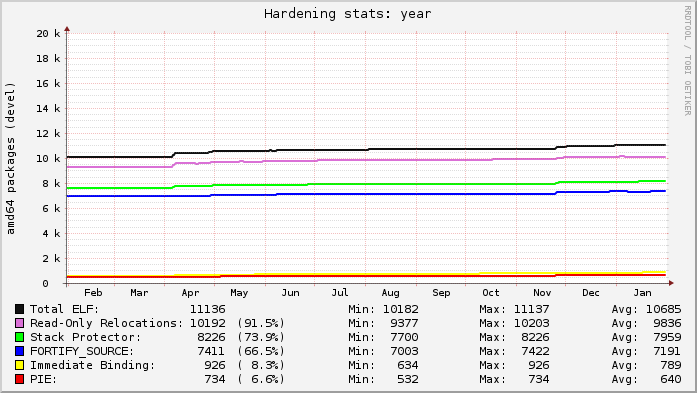
Here s today s snapshot of Debian s unstable archive for the past year (at the start of May you can see the archive unfreezing after the Wheezy release; the gaps were my analysis tool failing):
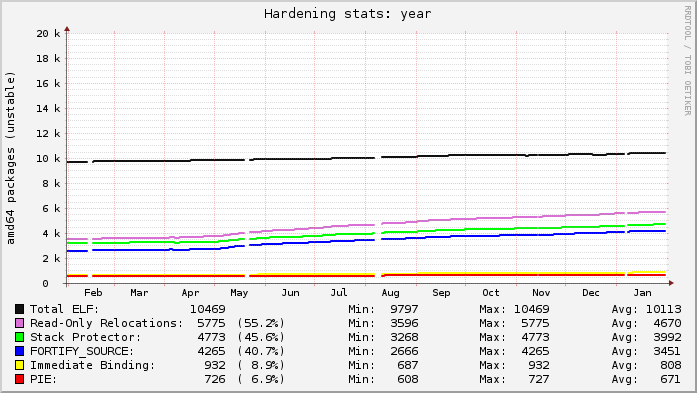
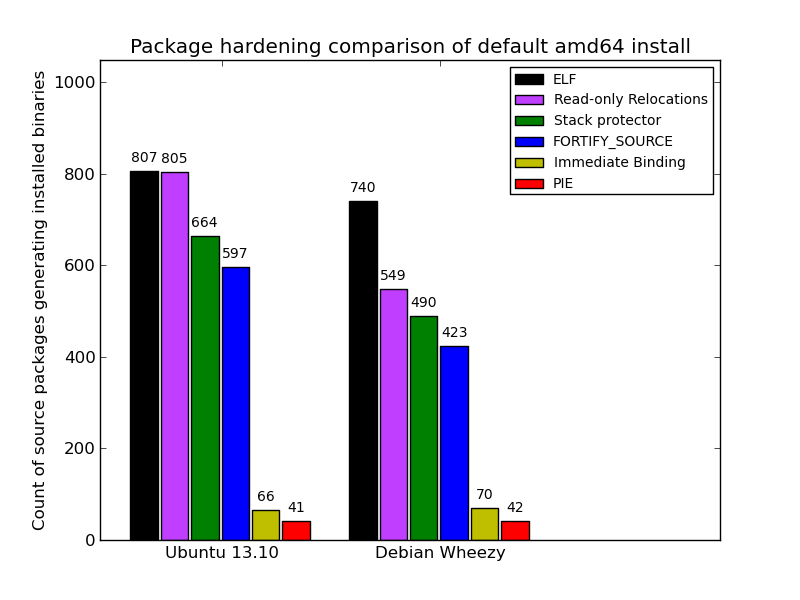
Ubuntu s lines are relatively flat because everything that can be built with hardening already is. Debian s graph is on a slow upward trend as more packages get migrated to dh to gain knowledge of the global flags. Each line in the graphs represents the count of source packages that contain binary packages that have at least 1 hit for a given category. ELF is just that: a source package that ultimately produces at least 1 binary package with at least 1 ELF binary in it (i.e. produces a compiled output). The Read-only Relocations ( relro ) hardening feature is almost always done for an ELF, excepting uncommon situations. As a result, the count of ELF and relro are close on Ubuntu. In fact, examining relro is a good indication of whether or not a source package got built with hardening of any kind. So, in Ubuntu, 91.5% of the archive is built with hardening, with Debian at 55.2%. The stack protector and fortify source features depend on characteristics of the source itself, and may not always be present in package s binaries even when hardening is enabled for the build (e.g. no functions got selected for stack protection, or no fortified glibc functions were used). Really these lines mostly indicate the count of packages that have a sufficiently high level of complexity that would trigger such protections. The PIE and immediate binding ( bind_now ) features are specifically enabled by a package maintainer. PIE can have a noticeable performance impact on CPU-register-starved architectures like i386 (ia32), so it is neither patched on in Ubuntu, nor part of the default flags in Debian. (And bind_now doesn t make much sense without PIE, so they usually go together.) It s worth noting, however, that it probably should be the default on amd64 (x86_64), which has plenty of available registers. Here is a comparison of default installed packages between the most recent stable releases of Ubuntu (13.10) and Debian (Wheezy). It s clear that what the average user gets with a default fresh install is better than what the archive-to-archive comparison shows. Debian s showing is better (74% built with hardening), though it is still clearly lagging behind Ubuntu (99%):

2014, Kees Cook. This work is licensed under a Creative Commons Attribution-ShareAlike 3.0 License.
Creative Commons License

2 February 2014

Steve Kemp: disqus on the cheap?

Last night I was up again, really hard to sleep when you have a bad cold. I decided to do something fun, and allow my tweaking guide to accept comments. Like many of my sites this is 100% static, and generated by templer, so comments are "hard". I've seen a few people try to rewrite disqus as a general-purpose solution, and I like that idea, because I don't trust that particular service. I wasn't so ambitious though, I just hacked up a quick sinatra server: My jquery/javascript is nasty, but the thing seems to work pretty well. The page loads and comments are populated, and new ones are persisted as expected.
I can see the appeal of putting all this magic in one javascript file. You include that and get both the existing comments and the form to add new ones - my approach is to hardwire the submission/display in my generated site. Perhaps something for the future.
In conclusion if people wish they can now leave feedback on most of the pages :)

31 January 2014

Daniel Pocock: If you thought systemd proponents were bad....

Just imagine for a moment if something like the iPhone App Store approval process was applied to every application for a domain name. Delays and unexplained rejections killing many great ideas before they even get off the ground. In the worse cases, like that of Greg Hughes, the great firewall of the app store has been used to quash ideas that it appears Apple may have been planning to compete with or copy. If domain applicants had to go through such a process or if other core technologies fell into a rut like that then it would throw Charles Darwin's long established theory of evolution out the window and society would end up eating each other. Once companies had established their position and were happily making money they would do everything possible to stomp out any innovation that may undermine them. This is exactly the kind of non-evolution that has plagued the telecoms sector for many years now. You don't have to look past the price of a simple SMS to see the truth of this situation. Your 160 bytes can cost anywhere between $US0.10 - $US0.50 throughout the western world, even on a network that is otherwise charging maybe $10 per 1MiB (the equivalent of 6,000 text messages) when roaming. One of the compelling features of free software is that it empowers innovation and efficiency. Telecoms executives may argue that by charging you these extortionate fees, they are keeping spam out of your phone. Think again: technologies like XMPP and SIP are doing that even more effectively and without any price to pay. Software for managing buddy lists and algorithms for spam detection put those telecoms executives out of a job. If SIP, XMPP or both become dominant, evolution may succeed yet. Despite having these great technologies available for messaging and multimedia communications and despite having a range of free software success stories in products such as Firefox or whole distributions like Fedora, Debian and its derivatives like Ubuntu, non-free communications solutions like Skype and Viber continue to run rampant in the voice and video domain. As it turns out, this is a very dangerous area for the free software community to neglect. How many people know somebody who tried running Linux but went back to a proprietary solution so they could use a non-free softphone? In these cases, it is not the phone software itself that appeals to the user: it is the people that software lets them communicate with, their friends, family, professional community and beyond. For people who don't truly perceive the benefits of free software or those who don't have the confidence or experience to defend those benefits, the power of Metcalfe's law hits them like a tsunami and violently sweeps away all the rest of the free software they had started to use. While Skype is currently available for some distributions of Linux, it is not free software: amongst other things, there is no published source code and no independent review of the code has been possible. Leveraging the power of Metcalfe's law, the publisher of that software gains significant power over those who choose to install it. Any day now, they could even use it to offer users a one-click "free trial" upgrade to some "Windows Lite" or install other components that obstruct effective upgrades to newer versions of the free operating system. To make an analogy, the potential for dirty tricks in this area is far more scary than the things systemd proponents have been accused of. For those with an interest in solving these problems or at least giving free real-time communications software a try, On the init system issue itself Note: the reference to systemd is not itself an opinion for or against any particular init system in Debian nor is it a suggestion that any one side is badder than any other.

30 January 2014

Russell Coker: The Movie Experience

Phandroid has one of many articles about a man being detained for wearing Google Glass in a cinema [1]. The article states as a fact that it s probably not smart to bring a recording device into a movie theater which is totally bogus. I ve visited a government office where recording devices were prohibited, they provided a locker for me to store everything that could be used for electronic storage outside their main security zone, that s what you do when you ban recording devices. Any place that doesn t have such facilities really isn t banning recording. The Gadgeteer has the original story with more detail with an update showing that the Department of Homeland Security were responsible for detaining the victim [2]. There are lots of issues here with DHS continuing to do nothing good and more bad things than most people suspect and with the music and film industry organisations attacking innocent people. But one thing that seems to be ignored is that movies are a recreational activity, so it s an experience that they are selling not just a movie. Any organisation that wants to make money out of movies really should be trying to make movies fun. The movie experience has always involved queuing, paying a lot of money for tickets ($20 per seat seems common), buying expensive drinks/snacks, and having to waste time on anti-piracy adverts. Now they are adding the risk of assault, false-arrest, and harassment under color of law to the down-sides of watching a movie. Downloading a movie via Bittorrent takes between 20 minutes and a few hours (depending on size and internet connectivity). Sometimes it can be quicker to download a movie than to drive to a cinema and if you are organising a group to watch a movie it will definitely be easier to download it. When you watch a movie at home you can pause it for a toilet break and consume alcoholic drinks while watching (I miss the Dutch cinemas where an intermission and a bar were standard features). It s just a better experience to download a movie via Bittorrent. I ve previously written about the way that downloading movies is better than buying a DVD [3], now they are making the cinema a worse experience too. I sometimes wonder if groups like the MPAA are actually trying to make money from movies or whether they just want to oppress their audiences for fun or psychological research. I could imagine someone like the young Phillip Zimbardo working for the MPAA and doing experiments to determine how badly movie industry employees can treat their customers before the customers revolt. Anyone who watches a Jack Ryan movie (or any movie with a Marty-Stu/Gary-Stu character) obviously doesn t even want to experience the stress of an unhappy ending to a movie. It seems obvious that such people won t want the stress of potentially being assaulted in the cinema. In terms of economics it seems a bad idea to do anything about recording in the cinema. When I was 11 I was offered the opportunity to watch a movie that had been recorded by a video camera in the US before it was released in Australia, I wasn t interested because watching a low quality recording wouldn t be fun. It seems to me that if The Pirate Bay (the main site for Bittorrent downloads of movies) [4] was filled with awful camera recordings of movies then it would discourage people from using it. A quick search shows some camera recordings on The Pirate Bay, it seems that if you want to download a movie of reasonable quality then you have to read the Wikipedia page about Pirated Movie Release Types [5] to make sure that you get a good quality download. But if you buy a DVD in a store or visit a cinema then you are assured of image and sound quality. If the movie industry were smarter they would start uploading camera recordings of movies described as Blue-Ray rips to mess with Bittorrent users and put newbies off downloading movies.

29 January 2014

Emanuele Rocca: Antifeatures and Antibugs

Software Engineering distinguishes between software features and software bugs. It is usually understood that features are positive, expected characteristics of a computer program. Features make users happy by allowing them to do something useful, interesting, or fun. Something good, anyways. Bugs are instead undesirable and annoying. You're sitting there at your computer writing a long email and the software crashes right before your email is sent. Bad stuff. Features are generally implemented by programmers on purpose, whereas bugs are purely unintentional. They are mistakes. You don't make a mistake on purpose. We might at this point be inclined to think that: i) what is good for users is done on purpose by software manufacturers; ii) what is bad for users was not meant to be. It happened by mistake. Here is a handy table to visualize this idea:
On purpose By mistake
Good Feature
Bad Bug
It seems to make a lot of sense. But you might have noticed that two cells of the table are empty. Right! In a great talk titled When Free Software isn't better, Benjamin Mako Hill mentions the concept of antifeatures, and how they relate to Free Software. Antifeatures are features that make the software do something users will hate. Something they will hate so much they would pay to have those features removed, if that's an option. Microsoft Windows 7 is used in the talk to provide some examples of software antifeatures: the Starter Edition does not allow users to change their background image. Also, it limits the amount of usable memory on the computer to 2GBs, regardless of how much memory the system actually has. Two antifeatures engineered to afflict users to the point that they will purchase a more expensive version of the software, if they have the means to do that. I have another nice example. The Spotify music streaming service plays advertisements between songs every now and then. To make sure users are annoyed as much as possible, Spotify automatically pauses an advertisement if it detects that the volume is being lowered. A poor Spotify user even tried to report the bug on The Spotify Community forum, only to find out that what she naively considered as a software error was "intentional behavior". A spectacular antifeature indeed. Whenever a piece of technology does something you most definitely do not want it to do, such as allowing the NSA to take complete control of your Apple iPhone, including turning on its microphone and camera against your will, that's an antifeature.
On purpose By mistake
Good Feature
Bad Antifeature Bug
Both bugs and antifeatures are bad for users. The difference between them is that antifeatures are engineered. Time and money are spent to make sure the goal is reached. A testing methodology is followed. "Are we really sure customers cannot change their wallpaper even if they try very very hard?" Engineering processes, of course, can fail. If the poor devils at Microsoft who implemented those harassments would have made a mistake that allows users to somehow change their wallpaper on Windows Starter... Well, I would call that a glorious antibug.
On purpose By mistake
Good Feature Antibug
Bad Antifeature Bug
There is no place for antifeatures in Free and Open Source Software. Free Software gives users control over what their software does. Imagine Mozilla adding a feature to Firefox that sets your speakers volume to 11 and starts playing a random song from the black metal artist Burzum every time you add a bookmark, unless you pay for Mozilla Firefox Premium Edition. The source code for Firefox is available under a free license. People who are not into Burzum's music would immediately remove this neat antifeature. I have spent many years of my life advocating Free and Open Source Software, perhaps using the wrong arguments. Mako's talk made me think about all this (thanks mate!). All these years I've been preaching about the technical superiority of Free Software, despite evidence of thousands of bugs and usability issues in the very programs I am using, and contributing to develop. Free Software is not better than Proprietary Software per se. Sometimes it is, sometimes it's not. But it gives you control, and freedom. When it annoys you, when it doesn't do what you expect and want, you can be sure it's not on purpose. And we can fix it together.

Alexander Wirt: everything comes to an end

I was a member of the credativ family for almost 10 years. It was a great and and demanding time where I did things I never imagined I would have to do them :). I started as an apprentice and finished as a technical lead. In the last summer one of my best friends - if not my best - and I developed the idea of me joining his company hs42 as their new Head of IT. The whole concept is interesting, most time I ll do home-office and for ~ 1 week in a month I ll join the company in Oldenburg. After a lot of thinking I accepted that offer. That means that I left credativ in December. Being an open source consultant is interesting on the one hand, but somewhat annoying on the other hand. You will always do new things, but often you are not in the position of designing, deciding or even running them. I was always something that is nowadays known as a devop - a long time before this was getting hip . Now I have the opportunity to design, develop and run my own systems. That also means a little bit windows, but opsi exists :). Running systems on your own is different from the usual consultant work. Being a consultant often means that you design and implement something and after it works you have to give your baby into the hands of someone else. Running them on your own also means you can do constant improvement to something, not only when its broken. The job should give me more time for open source and my family, which is a good thing. It is still a little bit odd to work from home, but being together with your family most of the time is a great thing - and I don t want to miss it. The new job also allows me to work as consultant on my own, so if you need a Debian, E-Mail, Linux or whatever guy that helps you in doing things - get in touch with me. The time at credativ was a great one and I look back with a smile to all the good things. If you need Open Source Support they are the people you should ask. I will stay connected with credativ in many ways.

28 January 2014

Andrea Colangelo: The (brand new) Debian 3D-Printing Team is hiring!

The 3D-printing technology has gained quite a big momentum in recent times. Its use is spreading widely even among hobbyists and many sources report daily several (sometimes weird) examples of its usage. The thing I like most, as a Free Software activist, is that several 3D-printing-related free and open source software are already available and quite good, and some printers are even released as free hardware. Unfortunately, Debian is quite lagged behind with regard to the availability of such software in our archive, especially compared to other distributions who already ship much of it. Hopefully this situation will change drastically thanks to the brand new Debian 3D-Printing team, whose purpose is to make Debian a rocking platform to do some serious 3D-printing. The team is bootstrapping right now, and we are looking for volunteers who are willing to help us. Packagers are greatly welcomed, but also triagers, users and passionate people with some experience in the field are extremely valuable. People willing to join the team can take a look at our (in-progress) wiki page and apply on the team page on Alioth. As with any good packaging team, a mailing list is available to share ideas, feel free to subscribe it, and feel free to join #debian-3dprinting on OFTC if you want to hang out with other team members.

27 January 2014

Steve Kemp: It is unfortunate that many companies need the same sysadmin jobs carried out

It is unfortunate that I've been exposed to several companies that all need the same kind of problems solving, again and again: A lot of these are solved problems, yet they seem to keep cropping up. I guess the fact I've done some of these things more than once means I'm the local-expert, so that's why I get asked. But still.. There was a time when I thought my Debian Administration site would help solve these kind of problems; that writing documentation would encourage people to do things properly. Certainly it has helped me, and some other people are greatful, but it didn't do enough to help. I'm not sure if the problem is that my documentation is a little ideosyncratic, isn't good enough, or isn't reaching the right kind of people. I suspect a combination of that and scale - You can't walk somebody though the idea of setting up a ten-node database-cluster, they need to suffer, they need to break things, they need to sweat on Christmas Day, at 5AM, as everything goes to hell. Then the next time they'll do it properly. I'd love to take the time to write out recipes in Salt, Ansible, Puppet, Chef, CFengine, Slaughter, whatever, and support them.
Remote. Automated. System management.
Throw in monitoring of metrics, security fixes, and reporting and there's probably a valuable service there. It probably can't happen though, for three main reasons: I did recently write some policies for setting up a two-node Master-Slave MySQL setup, with reporting, monitoring, and custom SMS-based alerts. I guess I'm wondering if I can be cheeky and sell the same work twice. ;)

26 January 2014

Daniel Pocock: Beyond init systems: other opportunities for simplification

One thing that everybody agrees on in the debate about Debian's init system replacement is that the manifests used by most of the new schemes are far more concise than traditional init scripts. Simplification need not stop there however. Another opportunity for simplification exists in the creation of users at package installation. Every packaging tool has a different approach and all of them involve multiple lines of boilerplate script code duplicated between hundreds of packages that all need exactly the same thing. What is worse, embedding this logic into the postinst scripts on Debian or %post logic of an RPM makes it far more awkard for a system administrator to audit the user account requirements of packages (when installing many of them in a hurry) or to customise the logic for a whole site without rebuilding the whole packages. Potential improvement How to improve this? Well, packages (on any distribution) could be invited to declare the user and group accounts they depend on. A central configuration parameter in /etc/dpkg/dpkg.cfg or /etc/rpm would then control how the package manager behaves, with several possible options:
  • Create users/groups on demand without prompting
  • Abort installation/configuration of any package if the pre-requisite users do not exist on the system
  • Prompt: at the beginning of any package install, ask the administrator to create the users himself before proceeding, with an option to abort and potentially displaying some convenient LDIF fragments and other samples that the administrator can cut and paste.
Running a command like apt-get --simulate would give a system administrator an immediate view of all users/groups required by the packages they propose to install.

25 January 2014

Ben Hutchings: Looking back on my time at Solarflare, part 1

Friday was my last day at Solarflare Communications, which I joined in 2006 (originally as Level 5 Networks). When I started, Level 5 Networks (L5N) had a 2-port gigabit Ethernet controller called EF1 and a user-level network stack called EtherFabric which ran on Linux. It had nearly completed the Falcon project to develop a 10-gigabit controller (also supporing a 2-port gigabit mode) and was porting EtherFabric to Windows. Later that year, however, L5N merged with Solarflare Communications (SF), which was developing a 10GBASE-T PHY (for 10-gigabit Ethernet over twisted-pair cables). The investors and management saw the opportunity to create an integrated 10GBASE-T LAN-on-motherboard chip that would be attractive to OEMs and so had the potential for mass sales. EtherFabric was put on the back-burner, but regular net drivers for Linux, Windows and other operating systems became more important. In a change from my previous jobs, my initial role at L5N was to maintain and extend the in-house test automation software, Runbench, written in Python. I worked with Dickon Reed who had written most of Runbench up to then. One of my first major tasks was to extend it to cover DUTs running Windows. Aside from changing Runbench itself, I wrote a simple SSH server to be installed on DUTs, using the Twisted.Python framework. (Cygwin's port of OpenSSH wasn't suitable for running a lot of native Windows commands.) I rewrote the test-installation script for the Windows driver itself, converting it to Python (with a C extension to get around the WOW64 nonsense). As Windows does not allow loading a driver just once (like insmod in Linux), except by using the kernel debugger, I added a time check in the driver so the test-installation script can make it fail early when reloaded after a reboot, so that a crasher bug in the probe path would usually be recoverable. In 2007 I persuaded management in Cambridge to loan several older servers to DebConf. I took them there and back by car, and they were used to convert video for live streams and recordings. (This was repeated in 2009.) I was also asked to work on other small development tasks, including some cleanup on the Linux net driver (sfc). In mid-2007, when SF decided it was time to get sfc upstream (in-tree), I joined Steve Hodgson and Robert Stonehouse in working on that. Out-of-tree (separately distributed) drivers for Linux normally need a large number of preprocessor conditions for compatibility with Linux's kernel module API across a range of supported versions. They may also implement some features with a driver-specific interface that should be replaced with a standard interface (possibly including the work to define that standard). They may not comply with the kernel coding style or unwritten conventions for kernel code. All of these problems were present and had to be dealt with. As part of this work, I extended unifdef so that it could be used to remove all of the backward-compatibility and not-for-upstream code without introducing extra blank lines. I could then export the out-of-tree driver from CVS(!) into a kernel source tree automatically and turn it into a patch or patch series that would stand a chance of being acceptable upstream. Our first few attempts got little response, but eventually we newbies got the message that the driver was simply too big for a single submission and that putting patches on a web site because they're too big for the list was not a solution. In the next week, I removed about half of the code (on a git branch), resulting in a relatively lean driver that could be sent to the netdev list. And finally the 9th (I think) submission was accepted. Following this, I continued to work on sfc but was also brought into the Siena project. Siena (SFL9021) was the LAN-on-motherboard chip that had been planned following the merger. It combined a dual-port controller based on Falcon with a 10GBASE-T PHY and a management controller (MC) to support Lights-Out Management (LOM). (Since 10GBASE-T has not taken off, it is now mostly sold as the SFC9020 variant in which the PHY is disabled.) I worked on some of the test framework and test cases for validating the controller design in software simulation and FPGA. In the course of this I learned to read and (somewhat) understand the chip design written in Verilog, but only made a single trivial fix to it. In August 2009, the first Siena ASICs came back from the fab. There were a few ASIC-specific bugs but all of them were quickly worked around in firmware, so it would soon be ready for production. But there was much work still to be done on the driver and firmware. The firmware had until then been running in a smaller block of RAM with no peripherals to manage, while sfc had earlier been modified just enough to configure a sim or FPGA for running a userland test application. sfc now had many special cases scattered around it, and would tell the MC firmware to peek and poke registers that were no longer directly accessible from the host. The software and firmware developers had agreed that, in order to support LOM, the MC would be responsible for managing the ports and all peripherals and drivers would send higher-level requests to the MC. As a bonus, this removed the need for the driver to know the details of each new board, so that it would not be necessary to backport sfc into distribution kernels very often. Over the next few months, the firmware team did an excellent job of defining and implementing those operations, including writing the driver-side functions to invoke them. Meanwhile, Steve and I concentrated on refactoring sfc so most of the Falcon/Siena differences could be abstracted through a few structures with function pointers. The refactoring and new code for Siena were completed and submitted upstream in several large patch series in October and November. In fact, there were so many patches that Solarflare appeared in LWN's table of who wrote Linux 2.6.33 (as did I, thanks also to another patch series adding firmware metadata to many drivers). Sadly we had missed Linux 2.6.32 which was a longterm stable branch and used in many distributions, but I was able to get this version backported into all the major distributions over the next year. (To be continued.)

Russell Coker: Links January 2014

Fast Coexist has an interesting article about the art that Simon Beck creates by walking in snow [1]. If you are an artist you can create art in any way, even by walking in patterns in the snow. Russ Altman gave an interesting TED talk about using DNA testing before prescribing drugs [2]. I was surprised by the amount of variation in effects of codeine based on genetics, presumably many other drugs have a similar range. Helen Epstein wrote an interesting article about Dr. Sara Josephine Baker who revolutionised child care and saved the lives of a huge number of children [3]. Her tenacity is inspiring. Also it s interesting to note that the US Republican party was awful even before the Southern Strategy . The part about some doctors opposing child care because it s the will of God for children to die and keep them in employment is chilling. Jonathan Weiler wrote an insightful article about the problems with American journalism in defending the government [4]. He criticises the media for paying more attention to policing decorum than to content. Tobias Buckell wrote an interesting post about the so-called socialised health-care in the US [5]. He suggests that Ronald Reagan socialised health-care by preventing hospitals from dumping dying people on the street. I guess if doing nothing for people until they have a medical emergency counts as socialised health-care then the US has it. Kelvin Thomson MP made some insightful comments about climate change, the recent heat-wave in Australia, and renewable energy [6]. Iwan Baan gave an interesting TED talk about ways that people have built cheap homes in unexpected places [7], lots of good pictures. Racialicious has an interesting article by Arturo R. Garc a about research into the effects of concussion and the way the NFL in the US tried to prevent Dr. Bennet Omalu publicising the results of his research [8]. Stani (Jan Schmidt) wrote an interesting post about how they won a competition to design a commemerative Dutch 5 Euro coin [9]. The coin design is really good (a candidate for the geekiest coin ever), I want one! Seriously if anyone knows how to get one at a reasonable price (IE close to face value for circulated or not unreasonably expensive for uncirculated) then please let me know. When writing about Edward Snowden, Nathan says Imagine how great a country would be if if it were governed entirely by people who Dick Cheney would call Traitor [10]. That s so right, that might make the US a country I d be prepared to live in. Andrew Solomon gave an interesting TED talk Love No Matter What about raising different children [11]. Aditi Shankardass gave an interesting TED talk about using an ECG to analyse people diagnosed wit severe Autism and other developmental disorders [12]. Apparently some severe cases of Autism have a root cause that can be treated with anti-seizure medication. George Monbiot wrote an insightful article about the way that Bono and Bob Geldoff promote G8 government intervention in Africa and steal air-time that might be given to allow Africans to represent themselves in public debates [13]. Daniel Pocock wrote an informative article about racism in Australian politics and how it is bad for job-seekers and the economy (in addition to being horribly wrong) [14]. Aeon Magazine has an interesting article by Anne Buchanan about the difference between scientists and farmers [15]. She has some interesting points about the way that the lack of general knowledge impacts research, but misses the point that in most fields of study there is a huge problem of people not knowing about recent developments in their own field. I don t think it s a pipe dream to be well educated in humanities and science, but I guess that depends on the definition of well educated . Brian Cox gave an interesting TED talk titled Why We Need the Explorers about the benefits of scientific research [16]. Yupu Zhang, Abhishek Rajimwale, Andrea C. Arpaci-Dusseau, and Remzi H. Arpaci-Dusseau from the University of Wisconsin-Madison wrote an interesting paper about ZFS corruption in the face of disk and memory errors [17]. One thing to note is that turning off atime can reduce the probability of a memory error leading to corrupt data being written to disk, run zfs set atime=off tank to fix this. The comedian Solomon Georgio celebrated Martin Luther King day by tweeting I love you to racists [18]. It s an interesting approach and appears to have worked well.

23 January 2014

John Goerzen: Why and how to run ZFS on Linux

I m writing a bit about ZFS these days, and I thought I d write a bit about why I am using it, why it might or might not be interesting for you, and what you might do about it. ZFS Features and Background ZFS is not just a filesystem in the traditional sense, though you can use it that way. It is an integrated storage stack, which can completely replace the need for LVM, md-raid, and even hardware RAID controllers. This permits quite a bit of flexibility and optimization not present when building a stack involving those components. For instance, if a drive in a RAID fails, it needs only rebuild the parts that have actual data stored on them. Let s look at some of the features of ZFS: Although it is often considered a server filesystem, ZFS has been used in plenty of other situations for some time now, with ports to FreeBSD, Linux, and MacOS. I find it particularly useful: The added level of security in having cheap snapshots available is almost worth it by itself. ZFS drawbacks Compared to other Linux filesystems, there are a few drawbacks of ZFS: Converting to ZFS I have written up an extensive HOWTO on converting an existing system to use ZFS. It covers workarounds for all the boot-time bugs I have encountered as well as documenting all steps needed to make it happen. It works quite well. Additional Hints If setting up zvols to be used by VirtualBox or some such system, you might be interested in managing zvol ownership and permissions with udev.

22 January 2014

Erich Schubert: The init wars

The init wars have recently caught a lot of media attention (e.g. heise, prolinux, phoronix). However, one detail that is often overlooked: Debian is debating over the default, while all of them are already supported to a large extend, actually. Most likely, at least two of them will be made mandatory to support IMHO.
The discussion seems to be quite heated, with lots of people trying to evangelize for their preferred system. This actually only highlights that we need to support more than one, as Debian has always been about choice. This may mean some extra work for the debian-installer developers, because choosing the init system at install time (instead of switching later) will be much easier. More often than not, when switching from one init system to another you will have to perform a hard reset.
If you want to learn about the options, please go to the formal discussion page, which does a good job at presenting the positions in a neutral way.
Here is my subjective view of the init systems:
  • SysV init is the current default, and thus deserves to be mentioned first. It is slow, because it is based on a huge series of shell scripts. It can often be fragile, but at the same time it is very transparent. For a UNIX system administrator, SysV init is probably the preferred choice. You only reboot your servers every year anyway.
  • upstart seems to be a typical Canonical project. It solves a great deal of problems, but apparently isn't good enough at it for everybody, and they fail at including anyone in their efforts. Other examples of these fails include Unity and Mir, where they also announced the project as-is, instead of trying to get other supporters on board early (AFAICT). The key problem to widespread upstart acceptance seems to be the Canonical Contributor License Agreement that many would-be contributors are unwilling to accept. The only alternative would be to fork upstart completely, to make it independent of Canonical. (Note that upstart nevertheless is GPL, which is why it can be used by Debian just fine. The CLA only makes getting patches and enhancements included in the official version hard.)
  • systemd is the rising star in the init world. It probably has the best set of features, and it has started to incorporate/replace a number of existing projects such as ConsoleKit. I.e. it not only manages services, but also user sessions. It can be loosely tied to the GNOME project which has started to rely on it more and more (much to the unhappyness of Canonical, who used to be a key player for GNOME; note that officially, GNOME chose to not depend on systemd, yet I see this as the only reliable combination to get a complete GNOME system running, and since "systemd can eventually replace gnome-session" I foresee this tie to become closer). As the main drawback, systemd as is will (apparently) only work with the Linux kernel, whereas Debian has to also support kFreeBSD, NetBSD, Hurd and the OpenSolaris kernels (some aren't officially supported by Debian, but by separate projects).
So my take: I believe the only reasonable default is systemd. It has the most active development community and widest set of features. But as it cannot support all architectures, we need mandatory support for an alternative init system, probably SysV. Getting both working reliably will be a pain, in particular since more and more projects (e.g. GNOME) tie themselves closely to systemd, and would then become Linux-only or require major patches.
I have tried only systemd on a number of machines, and unfortunately I cannot report it as "prime time ready" yet. You do have the occasional upgrade problems and incompatibilities, as it is quite invasive. From screensavers activating during movies to double suspends, to being unable to shutdown my system when logged in (systemd would treat the login manager as separate session, and not being the sole user it would not allow me to shut down), I have seen quite a lot of annoyances happen. This is an obvious consequence of the active development on systemd. This means that we should make the decision early, because we will need a lot of time to resolve all these bugs for the release.
There are more disruptions coming on the way. Nobody seems to have talked about kDBUS yet, the integration of an IPC mechanism like DBUS into the Linux kernel. It IMHO has a good chance of making it into the Linux kernel rather soon, and I wouldn't be surprised if it became mandatory for systemd soon after. Which then implies that only a recent kernel (say, mid-2014) version might be fully supported by systemd soon.
I would also like to see less GNOME influence in systemd. I have pretty much given up on the GNOME community, which is moving into a UI direction that I hate: they seem to only care about tablet and mobile phones for dumb users, and slowly turn GNOME into an android UI; selling black background as major UI improvements. I feel that the key GNOME development community does not care about developers and desktop users like me anymore (but dream of being the next Android), and therefore I have abandoned GNOME and switched to XFCE.
I don't give upstart much of a chance. Of course there are some Debian developers already involved in its development (employed by Canonical), so this will cause some frustration. But so far, upstart is largely an Ubuntu-only solution. And just like Mir, I don't see much future in it; instead I foresee Ubuntu going systemd within a few years, because it will want to get all the latest GNOME features. Ubuntu relies on GNOME, and apparently GNOME already has chosen systemd over upstart (even though this is "officially" denied).
Sticking with SysV is obviously the easiest choice, but it does not make a lot of sense to me technically. It's okay for servers, but more and more desktop applications will start to rely on systemd. For legacy reasons, I would however like to retain good SysV support for at least 5-10 more years.

But what is the real problem? After all, this is a long overdue decision.
  • There is too much advocacy and evangelism, from either side. The CTTE isn't really left alone to do a technical decision, but instead the main factors have become of political nature, unfortunately. You have all kinds of companies (such as Spotify) weigh in on the debate, too.
  • The tone has become quite aggressive and emotional, unfortunately. I can already foresee some comments on this blog post "you are a liar, because GNOME is now spelled Gnome!!1!".
  • Media attention. This upcoming decision has been picked up by various Linux media already, increasing the pressure on everybody.
  • Last but not least, the impact will be major. Debian is one of the largest distributions, last but not least used by Ubuntu and Steam, amongst others. Debian preferring one over the other will be a slap in somebodys face, unfortunately.
So how to solve it? Let the CTTE do their discussions, and stop flooding them with mails trying to influence them. There has been so much influencing going on, it may even backfire. I'm confident they will find a reasonable decision, or they'll decide to poll all the DDs. If you want to influence the outcome provide patches to anything that doesn't yet fully support your init system of choice! I'm sure there are hundreds of packages which do neither have upstart nor systemd support yet (as is, I currently have 27 init.d scripts launched by systemd, for example). IMHO, nothing is more convincing than have things just work, and of course, contributing code. We are in open source development, and the one thing that gets you sympathy in the community is to contribute code to someone elses project. For example, contribute full integrated power-management support into XFCE, if you include power management functionality.
As is, I have apparently 7 packages installed with upstart support, and 25 with systemd support. So either, everybody is crazy about systemd, or they have the better record of getting their scripts accepted upstream. (Note that this straw poll is biased - with systemd, the benefits of not using "legacy" init.d script may just be larger).

Next.

Previous.