Search Results: "ag"

17 October 2007

Chris Lamb: Missing notes in the Mozart s Dissonance quartet K. 465?

The second movement of Mozart’s String Quartet in C «Dissonance», K. 465 has an interesting two bars where it appears that the violin theme is accidentally missing. As highlighted in red on the score, the violin part is devoid of the crotchet/four quavers that the other parts present - the other “missing” bar is at this section’s mirror in the sub-dominant, bar 75. Some printed editions have added the missing notes, claiming that Mozart made a mistake (or overruling him on musical grounds!), but it seems bizarre that Mozart—who even likened the composition of the “Haydn” quartets to a long, labourious fatigue (”lungha e laboriosa fatica“)—would make such an error. The preface to the Neue Mozart Ausgabe claims:
It is unthinkable that Mozart [could] have made a mistake or from absent-mindedness made a slip of the pen no less than four times in such an obvious and important detail.
(The preparation of the original first edition, which Mozart himself presided over, presumably accounts for the other two.) At least one scholar has claimed that the notes aren’t missing at all; they are simply contained within the cello’s notes. I don’t find this explanation particulary satisfying. The NMA goes further by stressing its wish that the original version should be used in performances, which seems to suggest that adding the notes is (or at least, was) a common practice, but I cannot find many recordings with the added notes: my Leipziger, Emerson, Alban Berg, Ysa e, Italiano and Amadeus Quartet interpretations all omit the notes, whilst only the Hagen Quartet add them.

16 October 2007

MJ Ray: Spam from Gofernet

Gofernet.net 466395 (or is it gofernet.co.uk? They seemed confused about that - maybe it's Jekyll and Hyde, one spammy, one not?) of Sutton Coldfield spammed an associate on 5 Oct 2007. The spam claimed it was sent to their client list. That associate is not and has never been a client of gofernet. The spam claimed to be "in full compliance with the Privacy and Electronic Commerce Statutory Instrument 2003, No 2426". I think they mean the the Privacy and Electronic Communications (EC Directive) Regulations 2003, which usually forbids
"unsolicited communications for the purposes of direct marketing by means of electronic mail unless the recipient of the electronic mail has previously notified the sender that he consents for the time being to such communications being sent by, or at the instigation of, the sender."
Gofernet don't have consent and none of the exceptions apply AFAICS. So it's spam, even by their standards.

Otavio Salvador: noip2 (no-ip) package needing help

I’m looking for someone to help with no-ip package maintainence. It’s hosted on collab-maint Alioth’s project and it does deserves some love. I’m not a regular user of it anymore and I’ve been involved in many other project so lacking the need time to take care of it how it deserves. Please, feel free to start providing patches or even commiting changes on its repository. If you’re not DD or DM I can do the uploads for you and help with anything need. Thank you by any help!

Russell Coker: War is Bad for the Environment

I just read a nutty post claiming that Neo-Conservatism is good for the environment [1]. The first bogus claim is that Saddam had WMD and war was required because he was a despot. The fact is that the Iraqi government was always repressive, there are many factions in Iraq that don’t like each other and a repressive government is the only way to keep such groups in a united country. The current civil war in Iraq and the effective secession of Kurdistan (which currently seems to be involved in an undeclared border war with Turkey) demonstrates this. Saddam was always a despot, but he did improve the living conditions of most Iraqis - the best way to avoid a revolution is to convince the majority of the population that things will get worse if there is change. I suggest reading the Wikipedia page about Saddam Hussein [2]. The best information on Fourth Generation Warfare (4GW) seems to be on the conservative military analysis site Defense and the National Interest [7]. It covers all the issues related to invading other countries from a conservative point of view. Note that Neo-Conservatives are not Conservatives, the real Conservatives hate the Neo-Cons more than anyone else does. The amusing statement is made that “apologists claim it was one of the most advanced Arab nations” and then a link is provided to information on Saudi Arabian censorship. It’s worth reading the wikipedia page about the history of Saudi Arabia [3], among other interesting facts “the U.S. Army Corps of Engineers built the country’s television and broadcast facilities and oversaw the development of its defense industry” (does the US army share responsibility for the censorship?). It’s widely regarded that if the US military support was removed then the Saudi government would be overthrown. Referring to Saudi Arabia hardly seems like something you want to do if trying to justify occupying other middle-eastern states. An unsubstantiated claim is made that under-developed countries produce excess pollution due to inefficient technology. Unlike some people I try to get some facts before posting so I looked up the wikipedia page on CO2 emissions per capita [4]. It seems that the highest ranking first-world country is Luxembourg at #4, the next is the US at #10. The countries on the list that rank higher than the US have a combined population of about 11,000,000 while the US population is 302,000,000 - some quite mental arithmetic suggests that the US produces about 20 times more CO2 than the top 9 countries on the list combined! It doesn’t seem that having the highest technology is helping the US protect the environment, I guess that they just use it to build bigger cars. The next thing I noticed is the countries that are at the bottom of the list - they are the world’s poorest countries. It seems that countries without much money just can’t afford to burn lots of oil, while countries with lots of money can. No real surprises there. The lowest ranking on the list for a country that is unlikely to be regarded as being in abject poverty is India at position #133. The next lowest is Turkey at position #98 followed by China at #91. As a final point of reference Switzerland is at position #69 a produces just under 27% the CO2 that the US does (on a per-capita basis). According to the CIA World Fact Book Switzerland has an infant mortality rate of 4.28/1000 and a life expectancy of 80.62 [5], while the US has an infant mortality rate of 6.37/1000 and a life expectancy of 78 [6]. I believe that the infant mortality rate and the life expectancy are the two factors that are most representative of quality of life as they are the easiest factors for measuring the overall health of the population. Being healthy is one of the most important factors in quality of life. It seems to me that by all objective measures the Swiss are doing better than the people of the US, yet they produce less pollution and never invade other countries. Probably the most ridiculous statement in the post is “see rapidly dwindling resources wasted on jihad and revolution“. A revolution (locals using force to create a new government) takes little resources and most actions that a more simple-minded analysis might call “jihad” takes almost none. Sending an invasion force to the other side of the world and supporting an occupying army for years does however use significant resources, consider that the Hummvee is the least fuel-efficient vehicle on American roads in terms of work done (trucks and buses use more fuel but carry large amounts of cargo or many people), but it’s also the most fuel-efficient vehicle used by the US army in Iraq. There is the possibility that Jaldhar was attempting satire. If so then I suggest that satire be kept separate from serious web content to avoid confusion about where the satire ends. But if you want some satire about oil then I suggest consulting theonion.com. Before someone accuses me of being impolite, over a year ago the best estimate for the death toll from the occupation of Iraq was 655,000 [8]. Current extrapolations from the previous medical research suggest that the death toll has now exceeded 1,000,000. Regardless of whether the original post was intended as satire or not, I’m not laughing and I don’t feel the need to be polite to someone who makes excuses for such loss of life. Finally as a positive suggestion towards the environment (and any other issue that you may want to discuss), I suggest analysing the issues before writing about them and not blindly trusting other people. When you write a post make objective claims with references to back them up. When you read a post consider the points that are made and the references that are cited. Do the references support the claims? Are there other interpretations of the evidence? Are the reference sites reputable?

MJ Ray: the Cooperative Group Half-Yearly Meeting

I attended my first half-yearly meeting as a member of the co-operative group yesterday evening at 7pm. The event for the strangely-named Kennet and Avon area was held at Jury's Hotel near Queen Square, which is a part of Bristol I've not visited for a while, so I got there a bit early to find it. the co-operative food, The Centre, Bristol I found it easily, which gave me a few minutes spare to visit the co-operative food store on the Centre (pictured), which is the first rebranded one I've seen. It looks light and airy and the staff were friendly. I didn't find everything I was looking for, but after exiting, I noticed I'd not seen around the corner of the L-shaped store! Anyway, the meeting itself was chaired by Peter Begley and was attended by six elected reps, three regional officers, four trading managers (all food?) and about 50 members by my reckoning. There was a comment later in the meeting about the low turnout from Bath - it seems that a meeting for each city had been requested and refused. There was also a comment about lack of transport from Weston-super-Mare, about which I'm not sure: trains between WsM and Bristol are at least hourly. Maybe there should be a shuttle between station and meeting for people who can't walk, but it seems nuts to run a bus from here when trains are faster and have space. Officer Chris Griffiths gave a presentation (with loud music!) about our community support, including windfarms on the co-operative farms, Farm to Fork, the Woodcraft Folk, the Queens Award for Sustainable Development, community chef visits to Ilfracombe and Bath, community challenge, Mukti Mitchell's Low Carbon Lifestyle Tour, Fairtrade fashion shows, Holyland Handicrafts Co-operative at Bath Christmas Market, BAND (D is for Daycare, but I missed the rest), Toy Box Library Bath, Avonmouth Community Centre Association and Oldfield Park Juniors. Frank Jones presented the business interim report, noting that the group has a 2.2% increase of revenue before reinsurance premiums, but the bad weather has hit the insurance arm, reducing the overall profit. Nevertheless, we still paid a total of 38 million pounds to and on behalf of members. The closure of WsM Dolphin Square and the gain of the co-operative pharmacy in Milton were mentioned in passing. There was a short presentation about the constitutional review. The first members' consultation ends on 26 October, so send in your comments soon. There was particular concern about some multi-thousand-pound payments to elected representatives who stand down. Then came member questions, which I'll describe in another post, approval of past minutes, reports of the local co-operative party (success in Bath+NES, 8 councillors in Bristol, loss of 2 councillors in N.Somerset) and presentations to Frank Jones and Simon Crew of 10-year elected service awards. The meeting closed at 9pm.

Neil Williams: A little humour from dpkg

This arises from upgrading a cross-built package where the prerm maintainer script wanted to use install-info and as Emdebian doesn't use info or man pages, the prerm script failed. I'd already removed the same from postinst but got this little comment from dpkg when I installed an upgraded package on the Balloon3 ARM board:
dpkg: warning - old pre-removal script returned error exit status 127
dpkg - trying script from the new package instead ...
dpkg: ... it looks like that went OK.

Nice trick!

Emdebian postinst patch.

This is the full apt output:

/ # apt-get upgrade
Reading package lists... Done
Building dependency tree
Reading state information... Done
The following packages have been kept back:
apt
The following packages will be upgraded:
busybox libreadline5 readline-common
3 upgraded, 0 newly installed, 0 to remove and 1 not upgraded.
Need to get 563kB of archives.
After unpacking 12.3kB disk space will be freed.
Do you want to continue [Y/n]?
Get:1 http://buildd.emdebian.org unstable/main readline-common 5.2-3em3 [1882B]
Get:2 http://buildd.emdebian.org unstable/main libreadline5 5.2-3em3 [249kB]
Get:3 http://buildd.emdebian.org unstable/main busybox 1:1.1.3-5em2 [312kB]
Fetched 563kB in 7s (70.5kB/s)
(Reading database ... 489 files and directories currently installed.)
Preparing to replace readline-common 5.2-3em2 (using .../readline-common_5.2-3em3_all.deb) ...
/var/lib/dpkg/info/readline-common.prerm: /var/lib/dpkg/info/readline-common.prerm: 3: install-info: not found
dpkg: warning - old pre-removal script returned error exit status 127
dpkg - trying script from the new package instead ...
dpkg: ... it looks like that went OK.
Unpacking replacement readline-common ...
Preparing to replace libreadline5 5.2-3em2 (using .../libreadline5_5.2-3em3_arm.deb) ...
Unpacking replacement libreadline5 ...
Preparing to replace busybox 1:1.1.3-5em1 (using .../busybox_1%3a1.1.3-5em2_arm.deb) ...
Unpacking replacement busybox ...
Setting up readline-common (5.2-3em3) ...
Setting up libreadline5 (5.2-3em3) ...
Setting up busybox (1:1.1.3-5em2) ...

This is inside a chroot on the Balloon3 board using cross-built packages from the Emdebian target repository. The chroot was created with the 'emsandbox' utility from emdebian-tools 0.4.1 (due for upload to Emdebian tonight) and a little manual help. A few more tweaks to the relevant packages are needed before the chroot (and therefore a root filesystem for Emdebian) can be installed without assistance.

Benjamin Mako Hill: What I'm Up To

So, I finished graduate school at MIT. I presented some of my thesis work at Wikimania and I'll be posting information, code, and the thesis itself, in the next weeks as I find time. I've decided to focus, at least in the immediate future, on several important projects. Here's what I'm up to: This is, of course, in addition to my work with FSF, Debian, and Ubuntu which I'll be continuing. And talks. And writing. (Yikes!) I'll be keeping my office at MIT (yes, like RMS) for the time being and sticking around Cambridge at least until Mika finishes her degree at Harvard School of Public Health. I'll be in wrapping up projects modes for the next few weeks and months and will be posting about them here as I go.

Bdale Garbee: Colorado Rockies in World Series!

I'm not a serious fan of professional sports, but over the years, I've enjoyed watching a wide variety of sporting events at different times and for different reasons. It can be fun when a relatively local team is doing well, and even more fun when they're doing well with style. For the last week or so, I've been paying attention to Major League Baseball for the first time in several years. Last night, from a hotel room on my current business trip, I watched the Colorado Rockies baseball team take the National League championship, thereby winning the right to compete in this year's World Series. It's pretty amazing that they've now won 21 of their last 22 games, including seven straight in the playoffs. But there are two other things that captured my attention last night prompting me to comment here. The first is that this really has been a team effort. With due respect to the various players on the team, none of them seem to be superstars... instead, they come across as a group of very good players who are just doing their jobs really well. And second, they really do seem to be having fun and aren't taking themselves too seriously. I don't know what's going to happen next. They may win, they may lose. But those two observations last night cheered me up after a fairly stressful day, and left me encouraged that doing what you love as well as you can, and finding others to work together with who care as much about the cause at hand as you do can still lead to extraordinary results. That's pretty cool.

Alastair McKinstry: The Curse of Oil

Jaldhar Vyas points to the rogues gallery of oil producing states and argues that Neoconservatism is good, well at least it gets rid of the dictators such as Saddam Hussein while it grabs the oil. As he ightly points out, we are researching new alternative energy sources, and just as importantly (or even more importantly) energy conservation. But we have been doing this for decades. Sooner or later we have to realize that the "Oil Crisis" isn't due to a shortage of energy sources: its due to deliberate politics to make us dependent on oil. Peak Oil is "only" a crisis for us consumers, dependent on oil to drive our cars, heat our houses, and supply our food. For oil companies, it means (1) they are shipping oil at a greater rate than ever before, (2) at higher demand than ever before, and (3) in circumstances where pesky politics like OPEC can't interfere and try and moderate the price down (I'm not arguing OPEC or cartels are good; its just that its long-term 'maximize the benefit for the oil producing nations' strategy interferes with oil companies shorter-term profit maximization). For the Oil Companies, its a good thing. In this context we have to see our current dependence on oil as the result of deliberate policy by the oil companies. The small filip that USanian governments have done towards alternative energy, such as funding Hydrogen fuel-cell research, nuclear power, etc. are so long-term, and so small in scale, that they have to be seen as deliberately not solving the problem. Thinking that research into alternative sources is good is gpoing to save us (disclaimer: as a scientist I think research is a good thing :-)) is missing the real problem. Its politics: the oil companies have simply been better at politics than the strugging alternatives; we need to recognize this, and fight for alternatives. When oil prices reach $100/barrel, and we struggle to pay rising food and energy bills, its because other have deliberately caused the crisis. Oil has often been called a Curse because of the effects 'Oil Wealth' have caused so many countries. They are not co-incidentally dictatorships; Saddam Hussein remained in power in Iraq for so long because it benefitted the West (see the weapons supplies to Iraq in the so-called "Iran-Contra" affair, for example). Ditto Saudi Arabia, remaining 'friends' of the USA despite its ties to 911. Overthrowing Saddam Hussein was about consolidating even more power in the Gulf than America had previously, not democracy. What was planned for Iraq was democracy in name only: all real power was already neutralised, with decisions to US benefit cemented in place before the parliament met: non-negotiable contracts already signed giving US companies control. This is straight imperialism, and cannot be considered democracy or a good thing. Tags , ,

Marc 'Zugschlus' Haber: A thousand things I never wanted to know about X

In the last few days, I have replaced the two 20 inch CRT monitors that I have hardly used the last years with two 20 inch TFT displays, and my company (finally) gave me a 19 inch TFT display to accompany my notebook display at work. Maybe I should take that as a hint that they want to see me in the office more frequently rather than in my home office which I generously use these days. At home, I built a “new” computer from mainly used parts to drive the two 20 inchers. I have learned a lot about X in the last days, but spent too much time with it. I have been running my Desktop with older X and two CRTs for quite some time, but I hardly ever used it due to the setup of my now ex-flat. Back then, I learned that the “two monitors, one display, one screen, one desktop” option of X was called Xinerama and statically configured: You write down your display layout in xorg.conf and it uses it. Configuration changes mean restarting the X server. KDE notices Xinerama automatically, designates one monitor the “main monitor” and displays its panel there. You can move windows from one monitor to the other one, but changing virtual desktops always changes what both monitors display. This is not really what I want, since I often have “static” contents (news reader, mail reader, chat windows, help screens etc) on one monitor while I do my normal work on the other monitor, which involves changing virtual desktops. So I was rather happy when I learned upon the arrival of the external TFT display for the notebook that you can work without Xinerama. In that case, the X server comes up with one display and two screens, which KDE uses to display two independent desktops which can be independently configured, but can both be accessed with one mouse and one keyboard. For me, this means that I finally can independently change virtual desktops on both monitors, but pay the price that I cannot display a certain virtual desktop on monitor 1 now, and on monitor 2 in five minutes, and that a window opened on monitor 1 is never going to be shown on monitor 2 without serious interference. This looked ok for me. Additionally, you can use different font sizes on the different monitors as defaults, which comes in handy if both monitors are blatantly different in size (which is the case with the notebook and its external monitor). However, with that setup, KDE seems to be challenged when it comes to saving the configuration. Some things (such as desktop background and panel config) seem to save fine, desktop independent, other things (such as open windows and their position) are lost when the session exitst. My daily visit to Kevin&Kell (which used to be in a browser window that was saved with my session) has badly suffered since then. Then, a few weeks ago, somebody talked me into trying the X server from experimental. Which is when my dual-desktop setup ceased working. The nice people on #debian-x told me that Xinerama is a thing of the past, and is currently in the process of being replaced by Xrandr 1.2. The removal of “my” two monitor, two screens, two desktop setup is collateral damage, and if I still want that behavior, the X.org upstream considers this an issue to be handled by the Window Manager / Desktop Environment now. Gee, thanks. That’s what I call a regression. After spending half a day cursing and ranting, and even considering to go back to lenny’s (or even etch’s) X.org, I finally settled on going with the “new” way as I was going to lose my independent desktops sooner or later anyway. Again, with the friendly help of the people on #debian-x, I found out about a lot of advantages of the latest X servers. In most basic cases, the latest X server does not need a configuration file any more. It autodetects your hardware and chooses whatever modes it finds optimal. It does a pretty decent job in doing so. If one wants to influence how the X system comes up, once can always write an Xorg.conf file - the configfileless server even writes the “virtual config file” it uses to the log as a starting point. Additionally, almost everything regarding screen layout can be reconfigured at run time using the xrandr binary from a command line. Even a hardware change (such a new monitor plugged into the powered on notebook) is correctly detected. Cute. This allows me to reconfigure my notebook depending on where it currently is and which external monitor (or projector) is connected. This can be perfected if I find out whether X offers a hook to plug a reconfiguration script into that is called when the X server starts or when the system is waking up from standby or hibernation with the X server running. A lot to do, and great potential for elegant stuff. However, while I am talking about hibernation, this is a downside of the new driver: When the system wakes up from hibernation, the X server sometimes confuses itself enough to become nearly unuseable: I had it become psychotic when plugging in the external monitor (which can do 1600x1200 points) after waking it up from hibernation at the office. The internal display can only do 1400x1050, and the box thought that the external monitor only had 1050 y axis pixels, displaying bit garbage in the lower part of the big monitor, and showing a useable, but unintelligible panel. When opening any browser or any other application with considerable text amounts in the window, all fonts become unreadable once one scrolls down. Restarting the X server helps and everyting is fine. But I do not use hibernation to force myself to log out of X after waking up. After going back to the “one monitor mode”, the X server now thinks that my virtual desktop is 1600x1200 and only shows 1400x1050, with dead space at the right and lower side of the virtual desktop. xrandr does not allow me to reisize the FB below 1600x1200. No idea what’s going on here. In most of the cases, calling xrandr --auto for each output will fix the issues at run time, but sometimes a session restart is needed. Code needs to stabilize quite a bit before becoming useable in production. There are a few disadvantages that will remain: Both monitors will change their contents when the virtual desktop is changed, and both displays will use the same default font size (which might be inappropriate if both displays are of different size). But I think, when the issues are cleared up, that I can live with these disadvantages. The “new” desktop system that I built has a Matrox G450 dual head graphics card, and unfortunately, the Xrandr 1.2 enabled X server from experiemental has shown to be unuseable: Upon some mode changes, the X server goes into an endless loop and proves itself to be unkillable short of SIGKILL. And if it dies, it sometimes pulls the entire system with it. There is a corresponding bug in the upstream BTS, but it hasn’t received any noticeable attention by the upstream developers. So I might find myself configuring one last Xinerama config before I can finally completly migrate to Xrandr 1.2 on the desktop as well. Then I’ll probably need to bug the KDE upstream people to implement a two-desktops-on-a-single-screen feature in one of their future versions so that I can get my independent-desktop-things back. But that’s a far far away future.

Bastian Venthur: (Almost) Back

Due some drastic changes in my personal life, I wasn’t very active in the last two months. Now things are getting normal again, and I’m looking forward working on rng and my other packages again. Sorry for all the unanswered mails, I’ll need some time to clear the backlog. I’m currently working on my diploma thesis so my Debian related activity level won’t be as high as it was two months ago. But it should be at least high enough to keep the packages in a good shape.

Russell Coker: Introverts

I am amazed that I had never read the article Caring for Your Introvert [1] before. One of the interesting points concerned acting like an extrovert (I can do it for the duration of a typical job interview). Another was the issue of recovery time after having to deal with people. When living in hotels (which I did for about 18 months straight in 1999 and 2000) I found that some days I would reach my quota for dealing with people before I had dinner, going to bed hungry seemed like a better option than going to a restaurant. One thing that occurred to me is the lack of apparent introversion among most delegates at computer conferences. It seems that the majority of people who are any good at coding are introverts and you might expect an environment with a majority of introverts to be somewhat quiet. An interview with the author of the article [2] published 3 years later explains this (among other things). Here is a quote:
But once an introvert gets on a subject that they know about or care about or that intrigues them intellectually, the opposite often takes hold. They get passionately engaged and turned on by the conversation. But it’s not socializing that’s going on there. It’s learning or teaching or analyzing, which involves, I’m convinced, a whole different part of the brain from the socializing part. Which describes a lot of the activity at conferences. It’s standard practice for people to walk up and join a conversation that covers an area of technology that interests them and then just walk away when the topic changes. I wonder if any of the social networking and dating sites have a section for Myers-Briggs [3] test results. Via Tim Connors blog [4].

Ross Burton: So Sad

Last week just after we got back from holiday our washing machine broke down. The washing machine repair man had a look, and said it's best just to buy a new one -- to replace the main broken part would be £150 and that is without looking at fixing the leaks and the broken filter... Saturday we went down the road armed with a Which? report on washing machines and a price list from QED. After a little haggling ("When I say price match I mean to high street shops...") I splashed out on a new Bosch Exxcel 2465 . This is very sad, but I was getting excited over a washing machine... 20 minute "freshen" cycles, delayed start, cold "handwash" cycles. It rocks. :)

Ross Burton: Mark Thomas

A couple of nights ago (Tuesday, the 8th) I went to see a live Mark Thomas show. A very enjoyable show, he is wonderful at telling stories, making the entire audience collapse with laughter, and then can suddenly make the entire room silent with a serious point about the terrors the Western world manages to inflict on other nations. Lots of interesting facts, like the poor drunk American who is in prison for three years for mentioning the "day of judgement" and "a burning Bush". The number of people dying daily due to lack of action from us. The propaganda about the current war, forced in our faces every second of every day, until the war is over (as far as the media is concerned), at which point it will be ignored and never mentioned again. I am now a proud white ribbon wearer, supporting How About Not Killing Everyone? A small piece of advice from the wise -- if you see MT live, and he starts to talk about John Major and Edwina Curry... look away. Quickly. You shall be haunted for the rest of your days if you do not.

Raphael Geissert: sudo + apt-get + package upgrade + modified config files = root shell

I just got amazed by the fact that when the perfect condition is met, a user which can sudo apt-get has root shell access (since one could expect only installing/removing/purging/upgrading packages is allowed).

Whether expected or not, this is the HOW TO:


$ sudo apt-get upgrade
[...]
Configuration file /etc/foo.conf'
==> Modified (by you or by a script) since installation.
==> Package distributor has shipped an updated version.
What would you like to do about it ? Your options are:
Y or I : install the package maintainer's version
N or O : keep your currently-installed version
D : show the differences between the versions
Z : background this process to examine the situation
The default action is to keep your current version.
*** foo.conf (Y/I/N/O/D/Z) [default=N] ? z
Type exit' when you're done.
root@nova:/# whoami
root


I don't believe it's a bug, but I find it interesting.

Dirk Eddelbuettel: Some marathon data analysis

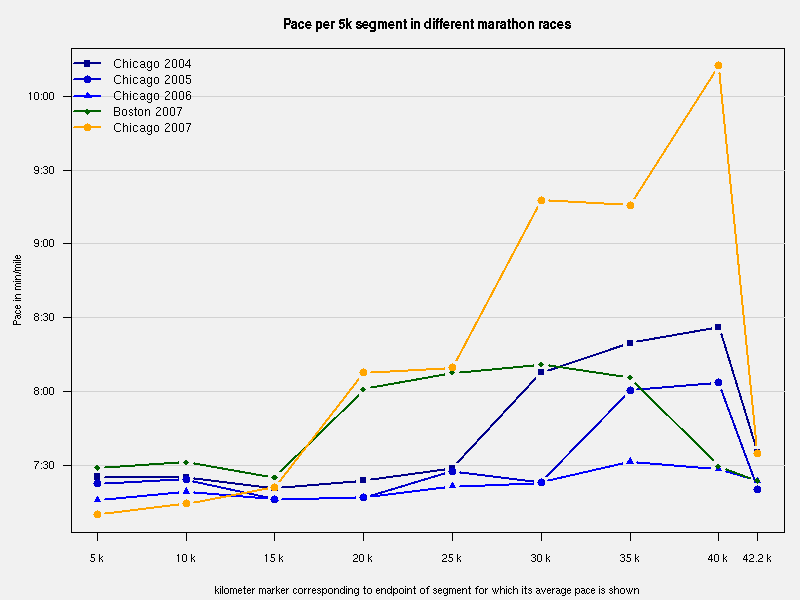
A few days after the Chicago Marathon in record-heat, I was wondering just how much more I had been slowing down, and exactly when during the course of the race this occurred. Bigger races like Chicago provide the so-called 'splits' for every five kilometer segment. Helpfully, they also keep these with the archived results which are all accessible via the web. So it was easy enough to collect a sequence of time such as '0:22:34', '0:45:30', ... and so on. And thanks to R, my data slicing and dicing and visualizing tool of choice, it was just a handful of lines to produce the chart below. The chart covers my four Chicago marathons (2004, 2005, 2006 and 2007) as well as Boston (2007) --- the infamous '27.2 mile marathon' seems to have dropped off the net, and the smaller Sunburst does not have 5k split times. (pace comparison chart) The chart shows a few things quite nicely: While it was a tough race, I clearly ran a lot slower than previously, in particular between 25 km and 40 km. So there.

Andrew McMillan: Release 0.9.0 of DAViCal CalDAV server

I have not been able to put a lot of effort into DAViCal over the last couple of months, since my father was diagnosed with stomach cancer in early September, and he died on 2nd October. So here it is, finally, including a lot of refactoring work around the handling of DAV/CalDAV REPORT requests and implementation of the DAV::principal-property-search report. This also requires an upgrade to the latest AWL library (0.20), which includes a complete rewrite to the class used for parsing and rendering iCalendar data. This release is recommended, since you will need some of this stuff to support the upcoming Mozilla Calendar 0.7 release properly. At this point I have only released the files to http://debian.mcmillan.net.nz/ and I'll push it out to a wider audience if I don't here screams of anguish from people in the next few days :-) This release does not have any associated database changes, so it should be a simple matter to install the upgraded code.

Jaldhar Vyas: Neoconservatism Is Good For The Environment

One of the common criticisms of the war in Iraq is that it was just an excuse to plunder that nations' oil. Of course that wasn't the reason however on Blog Action Day I urge environmentalists to think about why that might have actually been a better reason than the ones the politicians gave. The world supply of oil will probably run out in my lifetime. While alternative sources of energy are being researched, they have yet to be viable on a large enough scale to keep the world economy running at its present rate of progress. For the time being we must depend on oil and it is of vital importance that this precious resource is managed carefully. The problem is that it is not. Whereas civilized countries use energy for good purposes most of the oil is produced in countries which can only be described as evil. Take Saddams Iraq for instance; apologists claim it was one of the most advanced Arab nations, but that isn't setting a very high bar is it? Oil wealth was not used to better the lives of citizens but to prop up a savage and despotic regime. It is the poor and desperate deprived of the ability to take part in free markets who despoil the environment in a struggle to survive. Look at the other major oil producers and there too you will see a veritable rogues gallery. Some of these villains may be motivated by fundamentalism, some by socialism but the effect is the same. The common man in their countries does not get to enjoy the fruits of progress They are forced to muddle along with old, energy-inefficient, pollution-causing tech and their large numbers and vast geographical range undermine any modest environmental gains made by a few middle-class Westerners. How could anyone who cares about the fate of our mother Earth stand by and watch her bounty being squandered by dictators? See rapidly dwindling resources wasted on jihad and revolution? The next time there is talk of war, be environmentally responsible and ask your representatives to make securing oil and spreading capitalism priorities. You owe it to your planet.

Raphael Geissert: Print before you think!

What?! I mean... Think before you print!.

It's not very uncommon to see people who always print almost every single email they receive with information (and not just a notification), pdf's, and many other kind of documents.

I've never liked when people do that because they don't just print it, they sometimes even print the whole email conversation (usually gmail users). Some of them even dare to use non-recycled paper for printing some text and trashing it away after reading it!

Today is the Blog Action Day about the environment, so all I want to say is: reconsider, reuse and recycle (yes, in that specific order :D ). I know it's not the classic reduce, reuse, recycle message because I think people should better reconsider and not only reduce.

Here's a nice reminder you can, err, use on your computer's desktop (did you think I was going to say print??, I wasn't):


If you don't like that one, Google will point you to some others.

Evan Prodromou: 23 Vend miaire CCXVI

Long time no blogging. Yeah, I know that's a weak intro, but I have to put up something to note that I haven't written anything on this blog in weeks. I've got a lot of backfill to give -- life has been exciting, even if my blog hasn't been -- but before I do that, I wanted to make a quick note about a letter I just sent out. It's for the Creative Commons fall fundraiser. As part of their funds drive, they've invited a number of CC supporters to write about their experience and their believes on Open Content. My letter came out first, today. Commoner Letter #1 - Evan Prodromou is my contribution to the series. I hope it helps out with a cause I believe in a lot. And I hope that people take an opportunity to support Creative Commons. tags:

Next.

Previous.