Search Results: "tb"

12 March 2013

Russ Allbery: Review: Commitment Hour

Review: Commitment Hour, by James Alan Gardner
Series: League of Peoples #2
Publisher: Eos
Copyright: April 1998
ISBN: 0-380-79827-1
Format: Mass market
Pages: 343
This is the second book in Gardner's League of Peoples universe, following Expendable, but it is largely unrelated to that novel apart from taking place in the same universe. Expendable follows the portion of humanity that has left Earth and embraced the universe and the advanced technology of the League. Committment Hour is set on Earth, in one of the remaining low-tech settlements that have become a backwater of humanity. Earth is governed by the Spark Lords, who appear to be a sort of scientific artistocracy empowered by the League of Peoples (Gardner gets into this more in later books in the series), but the community in this book is largely left alone. The protagonist of Committment Hour is Fullin, a resident of Tober Cove. The Tober Cove community has a very unusual interaction with gender. Every year, all inhabitants under the age of twenty (starting at the age of two) are taken away by what are viewed locally as gods. When they return, they have the opposite gender. They live their childhoods alternating gender every year, including a mandatory pregnancy (created on one of those trips by the gods) and childbirth. Then, at the age of twenty, rather than being gender-swapped like the other children, they choose the gender that they'll live with for the rest of their life. Fullin is (at least at the start of this book) currently male, but as the book opens on the eve of the day of his final gender committment, he's still undecided on what gender he'll choose. A review of this sort of book immediately requires a significant caveat: this story is all about social constructions of gender and about the implications of one specific transgender scenario. As a cisgender man who fits comfortably within society's normal gender construction, I'm not going to do the best job of judging how well it deals with those issues. It was on the long list for the Tiptree Award, which is a fairly good sign that it does okay, and a quick Internet search didn't uncover any significant dislike, but it's quite possible that I would miss places where it fell short. That said, I found Gardner's presentation of gender fascinating, in large part because Committment Hour is told from deeply inside Fullin's perspective and Gardner treats the Tober Cove gender swapping mostly as the unremarked normal. Fullin and the other inhabitants are quite aware that gender doesn't work for them the way that it does for everyone else, but they consider their gender process entirely sensible and can't imagine how weird life would be without the chance to experience both genders and to have carried a child. And Gardner has several aces up his sleeve that let him, by the end of the book, position Tobin Cove's experience as a very specific and local experience that would not necessarily generalize to gender in society at large, which I thought was an ingenious way to avoid overreaching and excessive generalization. This is not a gender utopia; Fullin's world is rather patriarchal and strongly gender essentialist. The village was, in the past, ruled by a sort of religious fantatic who laid down very firm rules about the roles of men and women, and the village largely stuck to them, but since anyone can choose which gender they want to become, the gender essentialism is also undermined in an interesting way. It becomes more akin to a choice of careers rather than an innate quality, albeit with only two choices and with a permanent decision at the age of 20. Gardner complicates the situation further by introducing a neuter gender (at least that's what the characters call it; by physical description, hermaphrodite would be a more accurate description). People actually have three choices on their twentieth birthday, and although the Patriarch who ruled Tober Cove outlawed and banished all "neuts," it's still a choice. Near the start of Committment Hour one of those who chose the "neut" gender returns to Tober Cove in the company of a Spark Lord (thus making "it" the pronoun used by the natives untouchable and somewhat immune to the normal local prejudice). Committment Hour follows Fullin and his close friend and possible future wife or husband through their last day before their committment hour, a day complicated by the incessant curiosity of the observing Spark Lord and his companion. Gardner has some rather neat world building and some revelations in store; this is the sort of book where, by the end, the curtain has been fully pulled back and the audience gets to peer into the machinery. But most of the book is about the social and societal structure of Tober Cove, about how it feels to swap back and forth between genders (and how specific that is to Tober Cove's unique situation), and how this complicates interpersonal interactions. It's an immersive sort of book that puts the reader in Fullin's head and shows his (and her) comfort with the Tober Cove culture and discomfort with the life choices that he faces as part of committment. As with everything by him I've read, Gardner's tone in writing is unique and can take a bit of getting used to. His stories tend to have a light, almost flippant attitude with frequent touches of absurdist humor, which can give the erroneous impression that he isn't taking his story seriously. But there is depth beneath that tone. Fullin may treat some questions flippantly, but he gives them serious thought and works through the consequences. And I was delighted by how Fullin completely scuttled the Spark Lord's arrogant assumption of superiority around his scientific understanding of things Fullin treats as mythological. Committment Hour is different fare than the typical SF novel, with a lot of focus on an unusual domesticity and small village politics. The technology and the world building are mostly saved for the climax, although are quite satisfying when they finally come. It's primarily a thought-provoking treatment of gender that avoids overreaching by grounding the story in a specific situation. I found it a bit slow in places, and occasionally wanted the characters to stop being stupid and stop dithering, but I ended up enjoying it rather more than I expected. Mildly recommended. Rating: 7 out of 10

10 March 2013

Gregor Herrmann: RC bugs 2013/10

the number of RC bugs concerning wheezy is going down, & here are my small contributions:

8 March 2013

Richard Hartmann: Release Critical Bug report for Week 09

I extended UDD's rcblog historical bug overview table until week 18, which is the last week of April. Let's hope we won't need that long and I will be able to delete half of those. The UDD bugs interface currently knows about the following release critical bugs: How do we compare to the Squeeze release cycle?
Week Squeeze Wheezy Diff
43 284 (213+71) 468 (332+136) +184 (+119/+65)
44 261 (201+60) 408 (265+143) +147 (+64/+83)
45 261 (205+56) 425 (291+134) +164 (+86/+78)
46 271 (200+71) 401 (258+143) +130 (+58/+72)
47 283 (209+74) 366 (221+145) +83 (+12/+71)
48 256 (177+79) 378 (230+148) +122 (+53/+69)
49 256 (180+76) 360 (216+155) +104 (+36/+79)
50 204 (148+56) 339 (195+144) +135 (+47/+90)
51 178 (124+54) 323 (190+133) +145 (+66/+79)
52 115 (78+37) 289 (190+99) +174 (+112/+62)
1 93 (60+33) 287 (171+116) +194 (+111/+83)
2 82 (46+36) 271 (162+109) +189 (+116/+73)
3 25 (15+10) 249 (165+84) +224 (+150/+74)
4 14 (8+6) 244 (176+68) +230 (+168/+62)
5 2 (0+2) 224 (132+92) +222 (+132/+90)
6 release! 212 (129+83) +212 (+129/+83)
7 release+1 194 (128+66) +194 (+128/+66)
8 release+2 206 (144+62) +206 (+144/+62)
9 release+3 174 (105+69) +174 (+105/+62)
Graphical overview of bug stats thanks to azhag:

Richard Hartmann: Release Critical Bug report for Week 10

By using highly advanced and secret analytical tools (i.e. stupid correlation), I am guessing that Wheezy will be released in about six weeks. Week 16... mark my words. The UDD bugs interface currently knows about the following release critical bugs: How do we compare to the Squeeze release cycle?
Week Squeeze Wheezy Diff
43 284 (213+71) 468 (332+136) +184 (+119/+65)
44 261 (201+60) 408 (265+143) +147 (+64/+83)
45 261 (205+56) 425 (291+134) +164 (+86/+78)
46 271 (200+71) 401 (258+143) +130 (+58/+72)
47 283 (209+74) 366 (221+145) +83 (+12/+71)
48 256 (177+79) 378 (230+148) +122 (+53/+69)
49 256 (180+76) 360 (216+155) +104 (+36/+79)
50 204 (148+56) 339 (195+144) +135 (+47/+90)
51 178 (124+54) 323 (190+133) +145 (+66/+79)
52 115 (78+37) 289 (190+99) +174 (+112/+62)
1 93 (60+33) 287 (171+116) +194 (+111/+83)
2 82 (46+36) 271 (162+109) +189 (+116/+73)
3 25 (15+10) 249 (165+84) +224 (+150/+74)
4 14 (8+6) 244 (176+68) +230 (+168/+62)
5 2 (0+2) 224 (132+92) +222 (+132/+90)
6 release! 212 (129+83) +212 (+129/+83)
7 release+1 194 (128+66) +194 (+128/+66)
8 release+2 206 (144+62) +206 (+144/+62)
9 release+3 174 (105+69) +174 (+105/+69)
10 release+4 120 (72+48) +120 (+72/+48)
11 release+5
12 release+6
13 release+7
14 release+8
15 release+9
16 release+10
17 release+11
18 release+12
Graphical overview of bug stats thanks to azhag:

Sylvain Le Gall: Always test your HD first

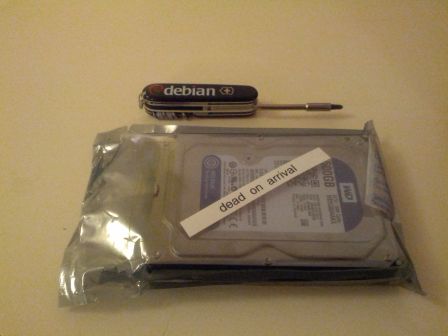
I just received a WD 500GB Blue, to replace the hard drive of my wife's computer. First thing after unpacking: start to test. And I was right to do it... there are bad blocks on it. WD 500GB DOA The story: I tend to do proactive replacement of hard drive, to avoid losing too much data or be in hurry when the current one fails. There are two ways to monitor a hard drive: Logcheck is pretty straightforward to install. It scans your log every two hours and send you a report of what is happening. It is not a very precise tool and you have to tune it a little bit to just send you what is relevant (install extra rules to ignore what you know is not of interest). Whenever you start to see log entry like that:
Jan 24 18:16:08 foo kernel: [ 1965.343980] ata5.00: exception Emask 0x50 SAct 0x39 SErr 0x800 action 0x6 frozen
Jan 24 18:16:08 foo kernel: [ 1965.343991] ata5.00: irq_stat 0x08000000, interface fatal error
Jan 24 18:16:08 foo kernel: [ 1965.344001] ata5: SError:   HostInt  
Jan 24 18:16:08 foo kernel: [ 1965.344036] ata5.00: failed command: READ FPDMA QUEUED
Jan 24 18:16:08 foo kernel: [ 1965.344055] ata5.00: cmd 60/08:00:18:31:44/00:00:1a:00:00/40 tag 0 ncq 4096 in
Jan 24 18:16:08 foo kernel: [ 1965.344059]          res 40/00:2c:e6:c2:fd/00:00:26:00:00/40 Emask 0x50 (ATA bus error)
Jan 24 18:16:08 foo kernel: [ 1965.344071] ata5.00: status:   DRDY  
Jan 24 18:16:08 foo kernel: [ 1965.344081] ata5.00: failed command: WRITE FPDMA QUEUED
It is a good time to think about changing your hardrive -- but it is maybe too late. Smartmontools (aka smartd) is dedicated tool to monitor hard drives and do a good job. I think it is not installed by default in Debian, but it should be. It scans your hard drive for SMART capabilities and monitor the health of the HD using internal tools. In the case of bad blocks, you will start to see entry like that:
Feb 17 14:05:17 bar smartd[1268]: Device: /dev/sda [SAT], 1 Currently unreadable (pending) sectors
Feb 17 14:35:17 bar smartd[1268]: Device: /dev/sda [SAT], 1 Currently unreadable (pending) sectors
Obviously when you see this log, it is also a good time to change your hard drive. In the case of my wife's HD, I just got data from logcheck. It means that the error is not that important (transient failure, something is wrong but the HD can cope with it). But I still decided to get a new one for my wife. Whenever, I receive a new drive, the first thing I do is to check it for errors. You can do that using the program badblocks in write mode. It takes ages to test (count up to 1 day for 1TB on USB), but at the end you know that you have a good candidate -- where it is worth install your data. You just have to follow this procedure
  1. dmesg grep sd
  2. try to find what drive is the one you want to test in the output of 1.
  3. cfdisk /dev/sdX, sdX being the drive you want to test
  4. check that what you see in cfdisk is what you expect to test: right name and capacity for the drive
  5. sudo badblocks -wvs /dev/sdX
  6. run sudo tail -f /var/log/syslog in parallel just in case
  7. wait
If some errors appears in /var/log/syslog, you know something bad is happening. Whenever you have a single failing block, don't think it is ok. It is NOT ok for a HD to start its life with failing blocks. In this case, repack the drive and send it for replacement ASAP. In the case of my hard drive: smartd mail:
The following warning/error was logged by the smartd daemon:
Device: /dev/sda [SAT], 15 Currently unreadable (pending) sectors
syslog entries:
Mar  2 20:52:57 foo kernel: [ 8317.419715] ata4.00: exception Emask 0x0 SAct 0x1 SErr 0x0 action 0x0
Mar  2 20:52:57 foo kernel: [ 8317.419724] ata4.00: irq_stat 0x40000008
Mar  2 20:52:57 foo kernel: [ 8317.419732] ata4.00: failed command: READ FPDMA QUEUED
Mar  2 20:52:57 foo kernel: [ 8317.419747] ata4.00: cmd 60/80:00:00:af:08/00:00:28:00:00/40 tag 0 ncq 65536 in
Mar  2 20:52:57 foo kernel: [ 8317.419750]          res 41/40:00:65:af:08/00:00:28:00:00/40 Emask 0x409 (media error) <F>
Mar  2 20:52:57 foo kernel: [ 8317.419758] ata4.00: status:   DRDY ERR  
Mar  2 20:52:57 foo kernel: [ 8317.419764] ata4.00: error:   UNC  
Mar  2 20:52:57 foo kernel: [ 8317.423959] ata4.00: configured for UDMA/133
I am not blaming any particular brand (like Western Digital), all computer parts I have ever bought had to follow the same procedure and it is a known fact that computer parts as a non-zero percentage of chance to be DOA (dead on arrival) or after a few weeks. But as a consumer you should be aware of that and take action to avoid spending 10h configuring your computer to see it failing after a week... The waste of time to test is a win on the long term.

5 March 2013

Lisandro Dami&aacute;n Nicanor P&eacute;rez Meyer: My Debian freeze experience (so far)

This is the first freeze in which I'm involved with upload rights. And it turned out to be a quite interesting ride so far, so I thought it would be nice to write about it.

As some of you may know, I'm a part of the Qt/KDE team. Before the freeze I was mostly involved in leaf packages, with some patch here or there, nothing fancy. And then the freeze came...

Bugs in Qt

...and bugs appeared in Qt. But they didn't get solved, even if the patches were there. Due to personal reasons, the manpower in Qt/KDE land decreased below normal levels (which were already low).

I took the time to review them, apply them in a local branch, build and test the fixes. I did a Qt upload before, but it was a team-consented one. This time there was not much reaction in our IRC channel as it used to be, so I was doubting if going ahead or not. I asked Ana, my great friend and former sponsor, for an opinion on the subject, and she gave me a really important advice: the patches were looking good and there is one really big true: if something get's broken, it can be fixed with a later upload.

You might be asking yourself why I was that afraid of doing the upload. Well, when one maintains such a medular package for many users one has to be careful And I also got used that those "big ones" like Qt where normally handled by hand skilled people. Do not take me wrong here, it's not that those people where keeping them for themselves, it's knowing that one does not has the same skills nor experience as them.

But again, no one was able to upload and I had the chance and will to do another upload if needed, so off it went. That was Qt 4:4.8.2-2.

Then new experiences followed: asking a buildd maintainer for a giveback, asking the Release Team for an unblock (more on this later), etc. While sponsoring me, Ana gave me another excellent advice which I always keep in my mind:

You can't know **everything** about Debian.

And that also includes a not so technical skill: communicating with other teams. But finally we got this new version of Qt in testing. Cool :-)

Of course, new bugs appeared, and my lack of skills (and sometimes, time) where replaced by team work: Pino looking at patches and Sune contacting upstream. The eleven uploads that followed are a nice example of team work, even if I was the one who signed and did the uploads. Whoever uses Qt must know that these wonderful people (including those who are not so active nowadays like Modestas or Fathi) have done lots to bring the better to their users.Thank you guys!

Be careful, they might bite you back!

Coming back to the non-technical skills, sometimes you have to communicate with other teams in Debian. And each team is (naturally) a separate world: possibly different people, different goals, etc. Of course, we share the goal to make Debian the best experience we can, but we do not necessarily agree on the paths to achieve so.

During the freeze, there is a team that gets lots of pressure, and not by chance: the Release Team. They handle a very important task, which is to ride the freeze to get to a release. OK, that's what everyone knows. Now, one thing is knowing that and another is really understanding what does that means.

Of course I was in the first group. From the outside, communicating with the RT was a kind of "special art", and not an easy one. I have even been advised to not ask for more than one or two unblocks per weekend, as they might "bite me back". So I put on my flamesuit on and... launched reportbug release.debian.org.

Now I'm really happy to say that my experience was far from what I described above. And yes, I had the chance to even disagree on some stuff. But remember: non-technical skills, a.k.a. social skills. Once I started to know what was going on inside the RT (joining #debian-release was a big help for that) I learnt some nice tips to approach them. Please allow me to list some of them:

  • Remember: you are the maintainer of the package, they are like gatekeepers that are there to help us coordinate to do a release. But they don't maintain the code, you do that. So try to be verbose when needed, explain the changes and don't forget a nice diff. They need to understand what is going on: they can't read your mind.
  • They are human beings too: not everyday might be their best day (the same goes for you too!). And they are under the pressure of a release. Be patient, that finally pays off.
  • Does your changes seem not so clear? try to improve them.
  • The package has a lot of changes but you really feel they are needed? Try to explain that as good as you can.
  • Try to put yourself in their position: do we really want this? If in doubt, there is a nice way to know what they think: a pre-approval bug.
I want to make a stop in this last point. A pre-approval bug it's an unblock bug in which you edit the subject to add "pre-approval" in it. Easy, isn't it? It gives you the opportunity to know what the RT thinks before doing the upload. In other words: it gives you the chance to communicate and do things in the best possible way for all the parts involved.

I've have also seen pre-approval bugs that were really not needed. But to learn where the threshold of what can be directly uploaded and what deserves a pre-approval bug is you need to know the guidelines the RT gives you. Do you still have doubts? fire a pre-approval bug and try to be clear.

Of course, this are all fruits of my experience with the RT during this time. If the RT thinks different from what I'm writing here, please stand up: we are hear to listen to you and learn :-)

As a side note, I think I should file a wishlist bug to include the pre-approval bug option in reportbug. Yes, I'm lazy :-)

Summing up

Overall this was a very nice and positive experience. We are not done yet. Are we really done at some point? Let's hope not, because this is where the fun comes from :-)

Russell Coker: Kogan Mobile

Kogan Mobile is the newest virtual telco in Australia [1]. They resell Telstra 3G (not NextG or LTE) and while their coverage isn t as good as the full Telstra service it s more than adequate for my needs as they provide 3G coverage to 97% of the population and 2G+3G coverage to 98.5%. Their coverage is probably a lot better than Three who had the worst record of network coverage in Australia yet managed to always provide coverage where I wanted it I was a happy Three customer for more than 6 years. Kogan s main selling point is that they offer unlimited calls to Australian mobile phones and land-lines and unlimited SMS for a pre-paid fee of only $300 per annum ($25 per month on average). My parents have been getting unpleasantly large phone bills which have considerably more than $25 of calls to mobile phones every month so an obvious solution for them is to sign up for a Kogan mobile phone and use it for all such calls. There are other ways my parents could save money on calls (such as VOIP) but a mobile phone is easiest and offers other benefits such as running Android apps (when compared to using a non-smart phone). 6G of Data! Kogan also offers 6G of data per month, the down-side to this is that they bill in 1MB increments per session . I was worried that this might be per TCP connection or something else silly but I decided to sign my parents up for it as they aren t going to use a lot of data (they claim that they don t want to use the Internet on their phone but I know better). I ve done some tests on the SIM I got for my parents. For testing purposes I installed the Kogan SIM in my wife s new Nexus 4 and had it provide Wifi net access to my phone while we were playing Ingress. So far after 2 days which involved a reasonable amount of Ingress (I reached level 7) as well as all the usual stuff that happens in the background for two phones (checking email, news, weather, etc) Kogan considers that 177MB have been used out of the 6144MB for the month, which means that even with what is an unusual amount of traffic for us the account in question still isn t going to use half the quota for the month. Now that 10 days have elapsed with less intense usage Kogan considers that a total of 1373MB have been used.
days received sent Kogan
2 127.24 41.54 177
10 959.39 299.6 1373
Kogan also don t seem to mention whether they bill for transmitted data. I used the 3G Watchdog app to measure the amount data transferred, the above table has the amounts of data that 3G Watchdog considers were sent and received along with the amount that is listed by the Kogan Android app. My past experience with 3G Watchdog and Virgin Mobile is that it s usually quite accurate but has been over-reporting the data transfers recently (I think that Virgin is only billing me for downloads while 3G Watchdog counts uploads). So the relatively small difference between the 3G Watchdog report and what Kogan thinks I ve done means that either rounding the session up to the nearest meg doesn t make any significant difference (which would imply that a session can be a long time) or that Kogan isn t counting uploaded data and the session rounding up only adds about 40% to the total recorded transfer. My current plan with Virgin Mobile gives me 1.5G per month of quota, so as long as Kogan s rounding doesn t increase the recorded data transfer by a factor of 4 I will still be able to transfer more data with Kogan while paying less. One disadvantage of using Kogan is that I might have to tweak programs like my email program to poll less frequently to avoid excessive session charges (a program polling every 5 minutes would use up the 6G quota in 21 days if each poll counted as a session) although current tests indicate that this won t be necessary. But the up-side is that there are no extra fees with Kogan, they merely restrict data access for my use and that of most people I know it s better to have data access cut off than to receive a large bill. The Kogan Android App Kogan has an Android app that will give the status of your account and allow you to change the plan etc. This is quite nice but one major disadvantage is that it s also a sales app for the Kogan online store. This is bad for the user as some aspects of what I consider the core functionality are limited (for example there s no way to force a poll of the data usage count or determine how current the data is). But there s an obvious advantage to Kogan in providing a way to sell their goods that is going to be used by every customer of Kogan Mobile. The sales part of the app isn t very functional IMHO, it doesn t seem to have basic functionality such as sorting a list of items by price. Benefits of Kogan 6G of data is a lot! $300 per annum is quite cheap, anyone who makes any serious use of phones will be paying more than that in Australia. Lack of extra fees means that there is little need to restrict net access. I can risk getting cut off near the end of the month but I can t risk the potential for hundreds of dollars in excess fees. The Kogan app shows me the data used so I will probably uninstall 3G Watchdog, having one less program running is a good thing. You get a free SIM (value $5) when you buy a phone from Kogan. Disadvantages of Kogan They are new to the Telco business and admit that their customer service is lacking due to unexpected demand. If you order a SIM now they state that it will arrive in April. Apparently they are deliberately delaying orders because they can t cope with demand. The included call quota doesn t include international calls. While unlimited free calls in Australia is great if you make many international calls then this could end up costing you more. Other mobile telcos such as Lebara offer good deals for International calls, it could be an option to use a Lebara SIM with an old non-smart phone while using Kogan for your smart phone. I am concerned about the lack of detail about how data is accounted. If the definition of a session changes then 6G could turn out not to be enough. As Kogan is reselling a Telstra service it is possible that Telstra could change the deal without Kogan being able to stop them. Conclusion I will move my phone and my wife s phone to Kogan ASAP. My general idea is to sign us up for Kogan about 2 weeks apart, so if one phone runs out of the 6G data quota then the other phone can be used as a Wifi access point for 2 weeks. If the phones don t both have their quota end at the same time then there is less chance of both phones running out during a high traffic month.

3 March 2013

Gregor Herrmann: RC bugs 2013/09

hey, the amount of RC bugs (affecting wheezy) is dropping significantly, mostly thanks to the work of the release team, if I'm seeing this correctly.
here are my small contributions for the last week:

2 March 2013

Russ Allbery: Review: Asimov's, June 2011

Review: Asimov's Science Fiction, June 2011
Editor: Sheila Williams
Issue: Volume 35, No. 6
ISSN: 1065-2698
Pages: 112
Sheila Williams's editorial is about a new ebook-only anthology of Asimov's stories, with some discussion of electronic sales. This sort of business editorial is what she's best at writing, although in this case I'm far enough in my reading that I'm reading it through a bit of a time machine. Silverberg's essay is about popular bubbles and is mildly interesting, although I've read quite a lot about this at greater length. I think he misses the plot at the end, though, where he brings in the 2008 collapse and works on focusing the blame on speculators rather than those selling the fraudulent investments. James Patrick Kelly has a surprisingly graceful introduction to fanfic that does a better job at conveying the underlying enthusiasm than most mainstream coverage. The review column this month is Peter Heck's workman-like survey of recently released books of interest. "The Cold Step Beyond" by Ian R. MacLeod: Most of MacLeod's writing I've read has focused on lush world-building, usually with a mix of magic and industrial revolution. This felt like a departure: a character study of a heavily-modified warrior and monster hunter against a clearly science-fictional background. The protagonist has no memory of her past beyond her training in a religious institution, and is as much machine as woman. She is on one of her first missions to hunt dangerous monsters. But she's given almost no direction, and rather than encountering a monster, she encounters a feral woman with an ancient ray gun. MacLeod has a very SFnal twist waiting in the wings, but what I liked best were the character dynamics and the interplay of duty and self-determination. (8) "All the News That's Fit" by Carol Emshwiller: This story follows Emshwiller's normal pattern of telling the story of an outsider and representative of outsider culture trying to understand a society, but her protagonist here is both more alone and more proactive than her average protagonist. She lives in a distant mountain village only rarely visited by a traveling reporter who brings news from outside. When he doesn't come, she goes out looking for him, at first to rescue him if he ran into trouble and later to find the news herself. Much of the story has the reader worrying nervously for her as she observes the large city while clearly having no idea how to live there. The ending provides an interesting and (at least for me) unexpected twist on the rural person coming to the big city, but it was marred by a level of anger from the protagonist that I never thought was well-motivated. (6) "Walking Stick Fires" by Alan DeNiro: There is a science fiction subgenre that, for lack of a better term, I'll call post-apocalyptic surrealism. This is an entry in that strange subgenre, featuring two alien bikers having mostly unmotivated adventures with strange objects and even stranger creatures on an Earth that's apparently been invaded and mostly devastated by multiple parties. Like a lot of post-apocalyptic surrealism, it never makes much sense. It reminded me of Rucker but with a bit more characterization and less hand-waving math. (4) "Apocalypse Daily" by Felicity Shoulders: I really liked the premise for this story. The protagonist is a concept designer for a social-oriented MMORPG, but one where only scores and resources carry over rather than the whole world. The goal of the game is survival: the world ends regularly, globally or locally, in a huge variety of ways, and one scores points and earns resources for further iterations by finding ways to survive that catastrophe. The game is structured to encourage cooperation, at least at first. But Katrina gets into a mildly paranoid workplace conflict with someone else on her team, leading to some significant changes in the underlying expectations of the game. Unfortunately, while the background and idea are quite solid, the direction the story goes is predictable pessimism, the conclusion doesn't say much that I found interesting, and I ended up detesting the protagonist. I would have preferred a more unique psychological twist. (6) "The Fighter" by Colin P. Davies: This is a rather short story, essentially an idea study in the context of a police stop of a futuristic entertainment fighter. This is another one of those depressing takes on a common SF trope. I didn't entirely follow the world-building, but it was all dark and pointless enough that I didn't really want to dig further. (4) "Kiss Me Twice" by Mary Robinette Kowal: I've read a few police procedurals featuring AIs before, but this is by far the best one I've read. Huang is a detective, and like all the detectives he makes extensive use of the police department AI. Unlike most of the detectives, though, he treats her as a full partner and close to human, and she reciprocates with a Mae West persona and a closer relationship with him than most of the department. They're in the middle of investigating a murder when there is a raid on the police department and the AI herself is stolen. The rest of the story entangles their investigation with the theft of the AI. The police AI is, of course, restored from backup, but that's the first time that's ever happened to her, and she's shaken by it, and more disturbed by the knowledge that there are two copies of her running. The mystery angle of the story is reasonably satisfying, but the AI characterization and Huang's careful feeling-out of their relationship and appropriate behavior on his part is the best part of the story. This is a great story: long, satisfying, and thoroughly excellent. I'd happily read more fiction in this universe. (8) Rating: 7 out of 10

28 February 2013

Niels Thykier: Wheezy release progress (February)

About 5-6 weeks ago, I wrote about the Wheezy release progress, so it is about time for another update. According to UDD, we are down to 204 RC bugs (down from 249, since my last post). It is not quite the 2.4 RC bugs per day actually it is about 1.1 RC bug a day. Unfortunately, we do not appear to be fixing bugs faster than we are reporting them at the moment. If you look at Richard Hartmann s post from last week, then we had 206 RC bugs left. Even worse, we appear to have regressed between week 7 and 8 of this year (194 to 206). If you want the Wheezy release to happen soon, please consider helping us by providing bug fixes that comply with the Wheezy freeze policy. If the pace of RC bug fixes do not pick up, the alternative is that the release team deals with the bugs. Note that deals generally falls into one of 2 categories. Either we defer/ignore the problem for Wheezy[1] or we remove affected packages from Wheezy/testing. Particularly, if we have to remove packages, they may take reverse dependencies with them as collateral damage. I do not like these tools anymore than you do. But if the RC bugs fixes are not coming in, it is the only two tools we have left. [1] Meaning that at best the bug fix will occur at Wheezy point release at worst, not at all.

27 February 2013

Matthew Garrett: Supporting third-party keys in a Secure Boot world

It's fairly straightforward to boot a UEFI Secure Boot system using something like Shim or the Linux Foundation's loader, and for distributions using either the LF loader or the generic version of Shim that's pretty much all you need to care about. The physically-present end user has had to explicitly install new keys or hashes, and that means that you no longer need to care about Microsoft's security policies or (assuming there's no exploitable flaws in the bootloader itself) fear any kind of revocation.

But what about if you're a distribution that cares about booting without the user having to install keys? There's several reasons to want that (convenience for naive users, ability to netboot, that kind of thing), but it has the downside that your system can now be used as an attack vector against other operating systems. Do you care about that? It depends how you weigh the risks. First, someone would have to use your system to attack another. Second, Microsoft would have to care enough to revoke your signature. The first hasn't happened yet, so we have no real idea how likely the second is. However, it doesn't seem awfully unlikely that Microsoft would be willing to revoke a distribution signature if that distribution were being used to attack Windows.

How do you avoid that scenario? There's various bits of security work you need to do, but one of them is to require that all your kernel modules be signed. That's easy for the modules in the distribution, since you just sign them all before shipping them. But how about third party modules? There's three main options here:

  1. Don't support third party modules on Secure Boot systems
  2. Have the distribution sign the modules
  3. Have the vendor sign the modules

The first option is easy, but not likely to please users. Or hardware vendors. Not ideal.

The second option is irritating for a bunch of reasons, and a pretty significant one is license-related. If you sign a module, does that mean you're endorsing it in some way? Does signing the nvidia driver mean that you think there's no license concerns? Even ignoring that, how do you decide whose drivers to sign? We can probably assume that companies like AMD and nvidia are fairly reputable, but how about Honest John's Driver Emporium? Verifying someone's identity is astonishingly expensive to do a good job of yourself, and not hugely cheaper if you farm it out to a third party. It's also irritating for the driver vendor, who needs a separate signature for every distribution they support. So, while possible, this isn't an attractive solution.

The third option pushes the responsibility out to other people, and it's always nice to get other people to do work instead of you. The problem then is deciding whose keys you trust. You can push that off to the user, but it's not the friendliest solution. The alternative is to trust any keys that are signed with a trusted key. But what is a trusted key? Having the distribution sign keys just pushes us back to option (2) - you need to verify everyone's identity, and they need a separate signing key for every distribution they support. In an ideal world, there'd be a key that we already trust and which is owned by someone willing to sign things with it.

The good news is that such a key exists. The bad news is that it's owned by Microsoft.

The recent discussion on LKML was about a patchset that allowed the kernel to install new keys if they were inside a PE/COFF binary signed by a trusted key. It's worth emphasising that this patchset doesn't change the set of keys that the kernel trusts - the kernel trusts keys that are installed in your system firmware, so if your system firmware trusts the Microsoft key then your kernel already trusts the Microsoft key. The reasoning here is pretty straightforward. If your firmware trusts things signed by Microsoft, and if a bad person can get things signed by Microsoft, the bad person can already give you a package containing a backdoored bootloader. Letting them sign kernel modules doesn't alter the power they already have over your system. Microsoft will sign PE/COFF binaries, so a vendor would just have to sign up with Microsoft, pay $99 to Symantec to get their ID verified, wrap their key in a PE/COFF binary and then get it signed by Microsoft. The kernel would see that this object was signed by a trusted key and extract and install the key.

Linus is, to put it mildly, unenthusiastic about this idea. It adds some extra complexity to the kernel in the form of a binary parser that would only be used to load keys from userspace, and the kernel already has an interface for that in the form of X509 certificates. The problem we have is that Microsoft won't sign X509 certificates, and there's no way to turn a PE/COFF signature into an X509 signature. Someone would have to re-sign the keys, which starts getting us back to option (2). One way around this would be to have an automated service that accepts PE/COFF objects, verifies that they're signed by Microsoft, extracts the key, re-signs it with a new private key and spits out an X509 certificate. That avoids having to add any new code to the kernel, but it means that there would have to be someone to run that service and it means that their public key would have to be trusted by the kernel by default.

Who would that third party be? The logical choice might be the Linux Foundation, but since we have members of the Linux Foundation Technical Advisory Board saying that they think module signing is unnecessary and that there's no real risk of revocation, it doesn't seem likely that they'll be enthusiastic. A distribution could do it, but there'd be arguments about putting one distribution in a more privileged position than others. So far, nobody's stood up to do this.

A possible outcome is that the distributions who care about signed modules will all just carry this patchset anyway, and the ones who don't won't. That's probably going to be interpreted by many as giving too much responsibility to Microsoft, but it's worth emphasising that these patches change nothing in that respect - if your firmware trusts Microsoft, you already trust Microsoft. If your firmware doesn't trust Microsoft, these patches will not cause your kernel to trust Microsoft. If you've set up your own chain of trust instead, anything signed by Microsoft will be rejected.

What's next? It wouldn't surprise me too much if nothing happens until someone demonstrates how to use a signed Linux system to attack Windows. Microsoft's response to that will probably determine whether anyone ends up caring.

comment count unavailable comments

26 February 2013

Russ Allbery: Review: Witches Abroad

Review: Witches Abroad, by Terry Pratchett
Series: Discworld #12
Publisher: Harper
Copyright: 1991
Printing: February 2008
ISBN: 0-06-102061-3
Format: Mass market
Pages: 350
Witches Abroad is the twelfth book in the Discworld series, but there's no strong reason why you couldn't start here. It's the second book about the three witches (Granny Weatherwax, Nanny Ogg, and Magrat Garlick), following Wyrd Sisters, and the third book about Granny Weatherwax, but it doesn't assume any knowledge of the previous books or of Discworld in general. Desiderata Hollow is dying. This is not a surprise; she's known for a long time exactly when she was going to die, and that time has come. She's not particularly bothered by it, but it does pose one difficult problem. She's a fairy godmother, as well as a witch, and she's balancing another fairy godmother because they come in pairs. With her dead, Lilith seems likely to win their long struggle, and that would be a bad thing. She needs to pass her wand on to a successor, but she wasn't the planning sort. At least she claims; this comment of hers turns out to hide an elegant bit of manipulation that leaves her wand in the hands of Magrat and sends the three witches on their way to the city of Genua to confront Lilith. There are two halves to Witches Abroad. The first half is the setup described above and their trip across Discworld. The second half is a sort of retelling of Cinderella, as foreshadowed early on by Desiderata. But the whole book is about stories and story shapes and their head-on collisions with the practical confidence of Nanny Ogg and the endless stubbornness of Granny Weatherwax. I think the three witches are one of Pratchett's best inventions, and Granny Weatherwax the best of the three. She has many of the characteristics that would normally relegate her to a supporting mentor figure: older, very knowledgeable, remarkably good at getting her way and at manipulating situations, and not particularly interested in going on adventures. But Pratchett turns this on end at every opportunity. Granny Weatherwax doesn't act like a mentor at all: she doesn't explain things to Magrat, or anyone else; she's almost constantly bickering with the other witches; and she's a fount of irritated and exasperated opinions about the world. She's one of the best irascibly competent characters in fiction, and she steals every scene she's in, refusing to become a supporting character and staying at the center of the story, despite not being a viewpoint character. (Pratchett wisely keeps her out of the viewpoint role for most of the story, since much of her knowledge and "headology" would be less effective if the reader knew what she was thinking.) The dynamics between the three witches are the best part of this book, and I love all three of them. But I'm also a sucker for fractured fairy tales in general, and Witches Abroad is full of them. Their opponent loves stories and has gathered most of her power from reinforcing and manipulating stories, which means that the density of random stories keeps increasing as they approach Genua. That provides numerous opportunities for the witches to stumble through, analyze, take apart, twist, or untwist numerous familiar stories, ranging from Red Riding Hood to Sleeping Beauty. Pratchett keeps things moving right along, not belaboring connections and not explaining too much, which makes it very easy to keep turning pages. The story does get a bit slower in Genua. There's quite a bit of scene-setting and figuring things out, and while Pratchett maintains the steady stream of humor, it isn't quite as compelling without the ever-changing context. He introduces a bit of voodoo magic, which I found to be the least interesting of the multiple styles of magic that show up here. But there are some absolutely brilliant bits with Nanny Ogg's cat, a wonderfully annoyed Cinderella, and an inversion of the traditional story that kept surprising me. I thought the ending was a bit of an anticlimax, but it does fit the nature of the characters. Despite a few plot short-comings, this is my favorite Discworld book up to this point in the series. Definitely recommended, and not a horrible starting point. Followed by Small Gods in the chronological sense and (later) by Lords and Ladies in the plot sense. Rating: 8 out of 10

25 February 2013

Russ Allbery: Review: The Hare with Amber Eyes

Review: The Hare with Amber Eyes, by Edmund de Waal
Publisher: Farrar, Straus and Giroux
Copyright: 2010
ISBN: 0-374-10597-9
Format: Kindle
Pages: 351
A netsuke ( ) is a miniature sculpture, often made from ivory or boxwood, generally rounded and no larger than a matchbox. They were a part of Japanese clothing starting from the 17th century: traditional garments had no pockets, but people needed a way to carry small objects around with them, so they wore pouches or small boxes attached to a cord. The cord could then be passed under the sash of the garment and be held in place there by a netsuke attached to the end of the cord, since the netsuke was too large to slip under the sash. The hare with amber eyes is one of 264 netsuke. It, and all the rest, belonged to Edmund de Waal's uncle Iggie. They sat in a vitrine in his home in Japan, where de Waal went for a two-year scholarship and was working on a book on japonisme: the passionate and creative Western misunderstanding of Japan. When Iggie later died in 1991, de Waal inherited the collection. This book is his attempt to tell their history. The Hare with Amber Eyes falls into the genre of family memoir or biography, but it's one told from an unusual angle. Edmund de Waal is a potter by profession: an artist who creates physical objects that then pass from his studio out into the world. The physicality of the netsuke their occupation of time and space and their passsage through the world fascinates him, and he tries to express that fascination to the reader and uses it as a focal point for the memoir. He tells, here, the story of his own family, but he does so via the netsuke, following them from their purchase in Paris in 1871 through one branch of the family and then another until they reach Iggie and, finally, him. Along the way, he tries to put them into context. At first, the context is primarily artistic, and the early parts of this book are something of a tour of late 19th century artistic culture in Paris. But, as the story continues, the connection becomes more emotional and the context becomes more complicated. Anyone who is a fan of the TV program Antiques Roadshow or any similar effort to trace the history of specific objects will see the immediate appeal in this presentation. Antiques are fascinating in their mute path through lives and history; attempting to reconstruct the rooms they've sat in and the conversations they've witnessed is something I've always found intriguing. But it's also very difficult to do. Most of our objects, and most owners of objects, simply don't have that sort of documentation. I was wondering, at the start of this book, how de Waal was going to manage to construct his history. The answer is that his family is, or at least was, famous enough to have letters, papers, and history in libraries throughout Europe. That's what makes the parts of the book before Iggie's living memory possible. It's a bit disappointing, if unsurprising; de Waal doesn't have any special technique to find hidden history, and most objects could never have this sort of history written about them. The first owner of the netsuke in his family is Charles Ephrussi, a critic, historian, and art historian who was a patron of the Impressionists and who was important enough in Parisian art culture that he is the inspiration of a character in Marcel Proust's Remembrance of Things Past. This means that quite a lot of this book is about people who moved through social circles and lived in ways that I find quite foreign, which made it hard to invest too much in the first part of the book. The Ephrussi family was originally from Odessa and made a fortune as grain merchants some time prior to the start of the history, and by the time de Waal opens their story, they have vast inherited wealth. There is no sign in the book that Charles needs to work in any way. The first part of the book paints a picture of the culture of art patronage partly via descriptions of Charles's rooms and personal collection, to which the netsuke were added during the surge in interest in Japanese art in Europe produced by the opening of Japan during the Meiji period. It's interesting, but for me in a distant and intellectual way. (People with a deeper interest in Impressionist art or other late 19th century art may have a different reaction.) De Waal writes at length at the start of this book about avoiding sentimentality and trying to take an honest and immersive look at the history of the netsuke. The emotional intensity that he brings to this goal seemed a bit odd, since little in the early part of the book seems to tempt towards sentimentality. But then the Dreyfus Affair enters Charles's story, followed by his gift of the vitrine and the netsuke to a cousin in Austria as a marriage gift, and I started to realize the implications of following a possession of a prominent Jewish family in Europe during the first half of the twentieth century. This is the sort of non-fiction book that you can spoil, so I won't give a detailed description of the rest of the book. But there is a specific event in the history of the netsuke that de Waal tells that would be the story most people would start with, and I now understand the sentimentality that de Waal was trying to avoid. It's a great story, but one of the things I like about this book is that de Waal puts it into a broader context and complicates the story. He includes the long periods of time when the netsuke were mostly ignored, he ties them into the history of western obsession with (and exploitation of) Japanese art, and he shows how the sturdy nature of the netsuke, meant for physical handling rather than display, led to them creating the emotional connection that made them important to the family. It's a book that deals with anti-Semitism with accuracy and specifics without being either lurid or overwhelming. It's a book that traces a line through one of the most overwritten and well-trod areas of history and manages to stay on its own path. It's a book that made me angry, and made me cry, and then made me step back and think about those emotions in a broader context and think about the benefits of leaving those emotions behind. I've never read a book quite like this before. It's slow in places (particularly if one is not very interested in art history), utterly compelling in others, and carefully avoids any simple themes or grand stories. It's entangled with some of the darkest events of recent history, but de Waal stays tightly focused on the family through the lens of the netsuke, which is valuable for keeping the story from drifting into well-worn and less unique material. I was not as completely taken by this book as the review that got me to buy it (it's an excellent review, better than this one). But I'm glad that I read it, and I feel like I now know more about the world. Rating: 7 out of 10

24 February 2013

Sylvain Le Gall: Configuration management: Puppet is worth it.

Replying to an old blog post of Martin F. Krafft: Configuration management, I want to give my point of view. The problems listed by madduck are quite common with Puppet, but I think Puppet is still worth, mostly because you can solve all these problems. Let give you my opinion on the list: True. I think the approach of puppet is not really UNIXish. It is probably on purpose. The biggest issue is probably the PKI. It breaks frequently for unknown reason. The "non intuitive configuration language" is probably a matter of taste. I think the language is not very well designed and strange, but I can cope with that. The attempt to versioning -- if I understand correcly what it means -- refers to the fact that when Puppet replace a file it moves the old file to a bucket. This is not a good thing, but you can say "backup => '.puppet-bak'" and you get almost the same behavior as ".dpkg-old". False debate. We can discuss for hours on Ruby, PHP, Java or whatever pet language people has invented. I am not a fan of Ruby but it is still nice as a general purpose language. To my mind, Ruby is still better to write daemon than bash. False debate.
   info: Caching catalog for centi.....
   info: Applying configuration version '1350597216'
   notice: Finished catalog run in 3.08 seconds
The config of this node is not complex, but 3s is not that bad for something that runs every 30min. If you need sub-second speed for this kind of thing, maybe you are not looking for this kind of tool. Does 144s of server time per day is a big deal ? With a lot more complex setup, I can reach 30s for a run, although this is the point where I manage a lot of thing with it. False and True. Augeas allows you to replace a single value (even more precise than a line). Just have a look at the augeas type. This is pretty nice and allow to do thing like replacing "Defaults env_reset" by "Defaults env_reset, !tty_tickets" in 4 lines of code. So this i not precisely "a single line of text", but there is other way to do it. False. Well if you organize your code with manifests/site.pp and manifests/classes/*.pp, it seems like there is a separation between the two. Next you can try inheritance and define to create specific high-level features. False-ish. Hey at least there are error message ;-) Now, most of the error that are related to the programming language are useless (at least as cryptic as a C++ error message). But as usual with error message in programming language True. Multi versions installation is horrible and you have to fix a lot of stuff to manage a sane overall configuration. Not sure to understand this point, I use puppet over IPv6... To whoever is considering using puppet, this is worth a try. It is a nice system that really helps to maintain a decent configuration across nodes.

Antonio Terceiro: Ruby 2.0 released, with multiarch support

Ruby 2.0 was released today. This new version of the language brings some very interesting features, and according to the core team, an effort has been made to keep source level compartibility with Ruby 1.9. Debian packaging is under way and should hit NEW soon. During the last few days I gave more attention to getting the new multiarch support fixed upstream than to the packaging bits, but the remaining packaging work should be pretty much about housekeeping. Next steps from a Debian point of view (after Wheezy is out) include: Now let s get back to fixing RC bugs and getting Wheezy released. :-)

Gregor Herrmann: RC bugs 2013/08

here's the list of RC bugs I've worked on during the last week:

23 February 2013

Tiago Bortoletto Vaz: #DPLgame

in a random disorder:
MadameZou - photo by Andrew McMillan, CC-BY-SA 2.0 dkg moray h01ger

Paul Tagliamonte: Here was a talk I gave at Boston Python a few weeks ago. Check...

<iframe allowfullscreen="allowfullscreen" frameborder="0" height="225" src="http://www.youtube.com/embed/ulekCWvDFVI?wmode=transparent&amp;autohide=1&amp;egm=0&amp;hd=1&amp;iv_load_policy=3&amp;modestbranding=1&amp;rel=0&amp;showinfo=0&amp;showsearch=0" width="400"></iframe>

Here was a talk I gave at Boston Python a few weeks ago. Check it out, and feel free to follow along with the slides, and take a look at the source. Sorry about the major futzup at 40 minutes in, and small mistakes throughout first time giving this talk! (link to the video for those on the planets)

Russell Coker: Serious Begging

This evening I was driving through one of the inner suburbs of Melbourne when a man flagged me down. He said that his mother was dying and he needed a taxi ride to some hospital far away and needed to borrow $200. He was saying something about his phone, I wasn t sure if he was planning to give me his phone number so I could call him to ask for repayment or offering his phone as collateral on the loan (incidentally a well known scam is to offer a stolen phone as collateral for a loan, it s a way of selling a locked phone that doesn t have cables). I ve encountered many beggars over the years, but he was by far the most serious about it he demonstrated the level of desperation that I ve only previously seen documented in history books and reports from travelers who visited developing countries. I will never know if his mother was dying, there are lots of other reasons why someone might urgently need cash (most of which won t get much sympathy). I gave him $20 as a gift. If his story was legitimate then I gave him 10% of what he needed so he only had to find another 9 people willing to do the same. If he was lying then I can afford to lose $20. In any case I definitely wasn t going to do what he asked and withdraw hundreds of dollars from an ATM for him. Also regardless of whether he was telling the truth I didn t want to have him repay me, if he s telling the truth then I m happy to give money to him and if he s not then I m better off avoiding him in future. If I had $50 I would probably have given it to him, but $200 is too much. As I drove off I looked in my rear-vision mirror and saw him running between cars on the road trying to flag someone else down. Running through moving traffic on a Saturday night is another indication of how serious he was, generally someone who s in a good state of mind and wants a long and healthy life won t do that.

22 February 2013

Richard Hartmann: Release Critical Bug report for Week 08

Boat Again, technology.. I am on a boat in international waters somewhere in between Stockholm and Tallinn and there's a (sluggish) satellite uplink so I can push out this post. We really do live in the future.. Beta git annex assistant runs on Android now; get it, break it, report it. Bugs The UDD bugs interface currently knows about the following release critical bugs: How do we compare to the Squeeze release cycle?
Week Squeeze Wheezy Diff
43 284 (213+71) 468 (332+136) +184 (+119/+65)
44 261 (201+60) 408 (265+143) +147 (+64/+83)
45 261 (205+56) 425 (291+134) +164 (+86/+78)
46 271 (200+71) 401 (258+143) +130 (+58/+72)
47 283 (209+74) 366 (221+145) +83 (+12/+71)
48 256 (177+79) 378 (230+148) +122 (+53/+69)
49 256 (180+76) 360 (216+155) +104 (+36/+79)
50 204 (148+56) 339 (195+144) +135 (+47/+90)
51 178 (124+54) 323 (190+133) +145 (+66/+79)
52 115 (78+37) 289 (190+99) +174 (+112/+62)
1 93 (60+33) 287 (171+116) +194 (+111/+83)
2 82 (46+36) 271 (162+109) +189 (+116/+73)
3 25 (15+10) 249 (165+84) +224 (+150/+74)
4 14 (8+6) 244 (176+68) +230 (+168/+62)
5 2 (0+2) 224 (132+92) +222 (+132/+90)
7 release+1 194 (128+66) +194 (+128/+66)
8 release+2 206 (144+62) +206 (+144/+62)
Graphical overview of bug stats thanks to azhag:

Next.

Previous.