
Search Results: "sten"

23 November 2008

Wouter Verhelst: Music is Math

Gintautas Miliauskas blogs about a computer program that can generate something which reportedly really sounds like composer-written music; apparently it has passed a 'turing test' where people listened to music generated by this thing, and music written by a human composer. I'm afraid, however, I'll have to disappoint him a bit, really. If we ignore the effect that music can have on the emotional state of a living being for a moment, then it's a plain and simple fact that music is pure math: There are many other things in music that can be expressed as mathematical rules; learning to how to compose music involves learning those rules, which is a long and tedious process. Now I'm not saying that following those rules will necessarily lead you to an interesting piece of music; the fact that it's possible to create something ugly while still using chords etc. But since so much of it already is math, I can imagine it not being extremely hard to figure out what the other rules are (the ones a composer figures out by imself as opposed to being taught them), transferring them into a computer program, and using that to generate music. That's not to say that such a thing is easy to do, and I'm sure it's still an impressive feat to create a computer program which can create "nice" sounding music; but I don't think this would qualify as 'artificial intelligence'. At least not any more than Deep Blue

21 November 2008

Gintautas Miliauskas: Computer-generated music

EMI (Experiments in Musical Intelligence) by David Cope changed my mind on the state of computer music generation software. I had come across numerous "music generation" programs, but it would have been a long stretch to call their results "music". They would produce, at best, strange patterns of beeps. I had heard of a live "jazz improvisation gig partner" machine (probably this one), but EMI is on a completely different level just listen to the MP3 samples. Sure, in the end it is mostly splicing and rehashing of existing pieces, but Cope claims that in blind tests even experienced listeners would sometimes confuse an original piece by a composer and a composition by EMI. In other words, EMI passed the equivalent of a Turing test for music generation software. If that is not impressive, I do not know what is. Unfortunately David Cope's site is skimpy on the details of how EMI works, even though there is an extensive bibliography (note the time span: 20 years!). At least some information can be gathered from the webpages of his numerous books.

18 November 2008

Joey Hess: a year of haskell (not really)

Guess it's really been longer than a year that haskell has been on my mind, though not much lately. Things are aligning again. I'll shortly be visiting the Bay Area again -- last time I piled up haskell documentation for the plane trip. This time I'm looking forward to the Real World Haskell book waiting in the mailbox when I get back. I read and commented on the first several draft chapters, hoping my ignorance would be useful, and I know one of the authors (though if I'm not mistaken I've never met him). So I'm looking forward to reading it, but also feeling guilty that I haven't managed to do anything serious with haskell yet. No new project that I dared, or had the patience, to attempt in it. But that's what the book's supposed to solve. Getting over the gap from a basic understanding to being able to add the language as another tool in the kit. And hey, it's better than seriously learning javascript would be, right?
Right now I can't think about haskell without thinking about Buddhism. I won't bore you with why they're connected in my head.

Matthew Garrett: Aggressive graphics power management

My current desktop PC has an RS790-based Radeon on-board graphics controller. It also has a Radeon X1900 plugged in. Playing with my Watts Up, I found that the system was (at idle!) drawing around 35W more power with the X1900 than with the on-board graphics.

This is clearly less than ideal.

Recent Radeons all support dynamic clock gating, a technology where the clocks to various bits of the chip are turned off when not in use. Unfortunately it seems that this is generally already enabled by the BIOS on most hardware, so playing with that didn't give me any power savings. Next I looked at Powerplay, the AMD technology for reducing clocks and voltages. It turns out that my desktop hardware doesn't provide any Powerplay tables, so no joy there either. What next?

Radeons all carry a ROM containing a bunch of tables and scripts written in a straightforward bytecode language called Atom. The idea is that OS-specific drivers can call the Atom tables to perform tasks that are hardware dependent, even without knowledge of the specific low-level nature of the hardware they're driving. You can use Atom to do several things, from card initialisation through mode setting to (crucially) setting the clock frequencies. Jerome Glisse wrote a small utility called Atomtools that lets you execute Atom scripts and set the core and RAM frequencies. Playing with this showed that it was possible to save the best part of 5W by underclocking the graphics core, and about the same again by reducing the memory clock. A total saving of 9-10W was pretty significant.

The main problem with reducing the memory clock was that doing it while the screen is being scanned out results in memory corruption, showing up as big ugly graphical artifacts on the screen. I'm a fan of doing power management as aggressively as possible, which means reclocking the memory whenever the system is idle. Turning the screen off to reclock the memory would avoid the graphical corruption but introduce irritating flicker, so that wasn't really an option. The next plan was to synchronise the memory reclocking to the vertical refresh interval, the period of time between the bottom of a frame and the top of the next frame being drawn. Unfortunately setting the memory frequency took somewhere between 2 and 20 milliseconds, far too long to finish inside that time period.

So. Just using Atom was clearly not going to be possible. The next step was to try writing the registers directly. Looking at the R500 register documentation showed that the MPLL_FUNC_CNTL register contained the PLL dividers for the memory clock. Simply smacking a new value in here would allow changing the frequency of the memory clock with a single register write. It even worked. Almost. I could change the frequency within small ranges, but going any further resulted in increasingly severe graphical corruption. Unlike the sort I got with the Atom approach to changing the frequency, this corruption manifested itself as a range of effects from shimmering on the screen down to blocks of image gradually disappearing in an impressively trippy (though somewhat disturbing) way.

Next step was to perform a register dump before and after changing the frequencies via Atom, and compare them to the registers I was programming. MC_ARB_RATIO_CLK_SEQ was consistently different, which is where things got interesting. The AMD docs helpfully describe this register as "Magic field, please use the excel programming guide. Sets the hclk/sclk ratio in the arbiter", about as helpful as being told that the register contents are defined by careful examination of a series of butterflies kept somewhere in Taiwan. Now what?

Back to Atomtools. Enabling debugging let me watch a dump of the Atom script as it ran. The relevant part of the dump is here. The most significant point was:
MOVE_REG @ 0xBC09
src: ID[0x0000+B39E].[31:0] -> 0xFF7FFF7F
dst: REG[0xFE16].[31:0] <- 0xFF7FFF7F
, showing that the value in question was being read out of a table in the video BIOS (ID[0x0000+B39E] indicating the base of the ROM plus 0xB39E). Looking further back showed that WS[0x40] contained a number that was used as an index into the table. Grepping the header files gave 0x40 as ATOM_WS_QUOTIENT, containing the quotient of a division operation immediately beforehand. Working back from there showed that the value was derived from a formula involving the divider frequencies of the memory PLL and the source PLL. Reimplementing that was trivial, and now I could program the same register values. Hurrah!

It didn't work, of course. These things never do. It looked like modifying this value didn't actually do anything unless the memory controller was reinitialised. Looking through the Atom dump showed that this was achieved by calling the MemoryDeviceInit script. Reimplementing this from scratch was one option, but it had a bunch of branches and frankly I'm lazy and that's why I work on this Linux stuff rather than getting a proper job. This particular script was fast, so there was no real reason to do it by hand instead of just using the interpreter. Timing showed that doing so could easily be done within the vblank interval. This time, it even worked.

I've done a proof of concept that involved wedging this into the Radeon DRM code with extreme prejudice, but it needs some rework. However, it demonstrates that it's possible to downclock the memory whenever the screen is idle without there being any observable screen flicker. Combine that with GPU downclocking and we can save about 10W without any noticable degradation in performance or output. Victory!

I gave the code to someone with an X1300 and it promptly corrupted their screen and locked their machine up. Oh well. Turns out that they have a different memory controller or some such madness.

So, obviously, there's more work to be done on this. I've put some test code here. It's a small program that should be run as root. It should reprogram an Atom-based discrete graphics card[1] to half its memory clock. Running it again will halve it again. I don't recommend doing that. You'll need to reboot to get the full clock back. This isn't vblank synced, so it may introduce some graphical corruption. If the corruption is static (ie, isn't moving or flickering) then that's fine. If it's moving then I (and/or the docs) suck and there's still work to be done. If your machine hangs then I'm interested in knowing what hardware you have and may have some further debugging code to be run. Unless you have an X1300, in which case it's known to break and what were you thinking running this code you crazy mad fool.

Once this is stable it shouldn't take long to integrate it into the DRM and X layers. I'm also trying to get hold of some mobile AMD hardware to test what impact we can have on laptops.

[1] Shockingly enough, it's somewhat harder to underclock graphics memory on a shared memory system

17 November 2008

Russell Coker: Other Reasons for not Censoring the Net

Currently there is a debate about censoring the Internet in Australia. Although debate might not be the correct word for a dispute where one party provides no facts and refuses to talk to any experts (Senator Conroy persistently refuses all requests to talk to anyone who knows anything about the technology or to have his office address any such questions). The failures of the technology are obvious to anyone who has worked with computers, here is an article in the Sydney Morning Herald about it [1] (one of many similar articles in the MSM). I don’t plan to mention the technological failures again because I believe that the only people who read my blog and don’t understand the technology are a small number of my relatives - I gave up on teaching my parents about IP protocols a long time ago. One of the fundamental problems with the current censorship idea is that they don’t seem to have decided what they want to filter and who they want to filter it from. The actions taken to stop pedophiles from exchanging files are quite different from what would be taken to stop children accidentally accessing porn on the net. I get the impression that they just want censorship and will say whatever they think will impress people. I have previously written about the safety issues related to mobile phones [2]. In that document I raised the issue of teenagers making their own porn (including videos of sexual assault). About four months after writing it a DVD movie was produced showing a gang of teenagers sexually assaulting a girl (they sold copies at their school). It seems that the incidence of teenagers making porn using mobile phones is only going to increase, while no-one has any plans to address the problem. The blog www.somebodythinkofthechildren.com has some interesting information on this issue. Two final reasons for opposing net censorship have been provided by the Sydney Anglicans [3]. They are:

  1. Given anti-vilification laws, could religious content be deemed illegal and be filtered out? Could Sydneyanglicans.net be blocked as illegal if it carries material deemed at some point now or in the future as vilifying other religions? If it s illegal in Vic say, and there isn t state-based filtering (there wont be), will the govt be inclined to ban it nation wide?

  2. Given anti-discrimination laws, if Sydneyanglicans.net runs an article with the orthodox line on homosexuality, will that be deemed illegal, and the site blocked? You can imagine it wouldn t be too hard for someone to lobby Labor via the Greens, for instance.

So the Sydney Anglicans seem afraid that their religious rights to discriminate against others (seriously - religious organisations do have such rights) will be under threat if filtering is imposed. I was a bit surprised when I saw this article, the Anglican church in Melbourne seems reasonably liberal and I had expected the Anglican church in the rest of Australia to be similar. But according to this article Peter Jensen (Sydney’s Anglican Archbishop) regards himself as one of the “true keepers of the authority of the Bible” [4]. It seems that the Anglican church is splitting over the issues related to the treatment of homosexuals and women (Peter believes that women should not be appointed to leadership positions in the church to avoid “disenfranchising” men who can’t accept them [5]). It will be interesting to see the fundamentalist Christians who want to protect their current legal rights to vilify other religions and discriminate against people on the basis of gender and sexual preference fighting the other fundamentalist Christians who want to prevent anyone from seeing porn. But not as interesting as it will be if the Anglican church finally splits and then has a fight over who owns the cathedrals. ;) A comment on my previous post about the national cost of slow net access suggests that Germany (where my blog is now hosted) has better protections for individual freedom than most countries [6]. If you want unrestricted net access then it is worth considering the options for running a VPN to another country (I have previously written a brief description of how to set up a basic OpenVPN link [7]).

15 November 2008

Russ Allbery: The Teaching Company

John Goerzen recently wrote in his blog about the value of a broad, classical education. I wholeheartedly agree, and this gives me the opportunity to plug a gem of a company that makes a product you may not realize you're interested in (I didn't until I heard about it). I love to learn about random parts of the world and random bits of history and culture, even if I have no practical use for the knowledge. I do a lot of that by reading, but reading requires certain conditions and a level of attention, and I can never read as much as I want to. I also often want something more in-depth than a popularization can provide, but not as technical and focused as academic writings in the subject. A college course is just about right, but I don't really want to take courses. Apart from the possible expense (although I could audit classes for free) and hassle of having to be somewhere at a particular time, courses are often also based around more reading and around homework and grades, none of which I'm interested in. I get completely irrational about grades and push myself out of proportion to their significance, which meant I had an excellent GPA in college and I still have nightmares about missing tests. Enter The Teaching Company. What they do is find high-rated college professors, generally those who have won teaching awards, and have them record a course within their field of expertise but without the homework and grades. They then sell those courses on DVD, CD, or MP3 download (some visual-heavy courses are only available on DVD). Some of them are as long as a full college course and some of them are a bit shorter, but they're all meaty enough to really dig into a topic. A typical course is about 18 hours of material; some can be twice that length. And they're exceptional, better than just taking courses at a local college since they draw on the best teachers from all over the United States (I haven't seen any non-US teachers yet, although it wouldn't surprise me if there were some). I listen to these while I'm exercising, on long car trips, while I'm walking back and forth to work, even while I'm grocery shopping — basically, all the places you'd listen to a book on tape. I've listened to several twice, since I wasn't always paying attention the first time. So far, I've gone through a course on Greek mythology, a literature survey covering plays, poetry and novels, a course on modern economics, two history courses (Vikings and China), and I'm currently listening to a course on opera mostly because I knew I didn't know anything about it. The courses are a bit spendy (always buy them on sale — they have a weird pricing structure where courses go on sale on a rolling basis, and the non-sale price is ridiculously higher), but you can get a shorter one for around US$50 and from that get an idea of whether you're interested. (And while that's a lot to spend at once, it's actually a great deal for the length of material you get.) They have a very solid guarantee system, they'll replace lost or worn-out or broken CDs from CD sets for life, they have a reasonable on-line ordering system, and I've had nothing but positive experiences with them as a company. And as soon as you start buying courses, they tend to give you discounts and special deals and so forth. Highly recommended. It's filled a gap I've felt for a long time but never had the time to read enough to fill normally.

Matthew Garrett: Adventures in PCI hotplug

I played with an Eee for a bit last time I was in Boston, culminating in a patch to make the eeepc-laptop driver use standard interfaces rather than just having random files in /sys that people need to write custom scripts to use. The world became a better place.

However. Asus implemented the rfkill control on the Eee in a slightly odd way. Disabling the wifi actually causes the entire card to drop off the bus, similar to how Bluetooth is normally handled. The difference is that the Bluetooth dongles are almost exclusively USB, while the Eee's wifi is PCI. Linux supports hotplugging of PCI devices, but nothing seemed to work out of the box on the Eee. Another case of this was the SD reader in the Acer Aspire One. Unless a card was present in the slot during boot, it simply wouldn't appear on the PCI bus. It turned out that Acer have implemented things in such a way that removing the card results in the entire chip being unplugged. This was when I started looking more closely into how this functionality is implemented.

The two common cases of PCI hotplug are native PCIe hotplug and ACPI mediated hotplug. In the former case, the chipset generates an interrupt when a hotplug event occurs and the OS then rescans the bus. This is a mildly complicated operation, requiring enabling the slot, checking whether there's a card there, powering the card and all its functions up, waiting for the PCIe link to settle and then announcing the new PCI device to the rest of the OS. ACPI-mediated hotplugging puts more of the load on the firmware rather than the OS - the hotplug event generates a notify message that is caught by the ACPI interpreter in the OS, allowing the OS to check for device presence by calling another ACPI method. If the device is present it's then a simple matter of telling the PCI layer about it.

Native PCIe hotplug has the advantage that there's much less vendor code involved. ACPI is still involved to an extent - an _OSC method on the PCIe bridge is called to allow the OS to tell the firmware that it supports handling hotplug events. This allows the firmware to stop sending any ACPI notifications. ACPI hotplugging requires more support in the firmware, but can work for PCI as well as PCIe.

The general approach taken to getting the Eee's wifi hotplugging to work has been to load the pciehp driver with the pciehp_force=1 argument. This tells the driver to listen for hotplugging events even when there's no _OSC method to tell the firmware that the OS is handling things now. Since the hardware will generate the event anyway, things work. However, this is non-ideal. Some hardware exists where ACPI hotplugging will work, but due to quirks in the hardware design native PCIe hotplugging control will fail. This has been handled in their firmware by having the _OSC method fail, signalling to the pciehp driver that it shouldn't bind to the port. Using pciehp_force overrides that, leading to a situation where hardware could potentially be removed from a port that's powered up. Unfortunate.

My first approach was to add a new argument to pciehp called pciehp_passive. This would indicate to the pciehp driver that it should only listen for notifications from the hardware. User-triggered events would not be supported, avoiding the situation where anyone could remove the card by accident. This worked on my test machine (an Eee 901 somewhere in Ottawa, since I don't actually have one myself...) but was reported to work less well on a 700. Since the 700 didn't claim to have any support for power control, the code was forced to wait a second on every operation to see whether the link powered up or not. This resulted in long pauses during boot and suspend/resume operations.

The final issue that convinced me that this was the wrong approach was reading a document on Microsoft's site on how PCIe hotplugging is implemented in Windows. It turns out that XP doesn't support native PCIe hotplugging at all - that feature was added in Vista. Both the Eee and the Aspire One are available with XP, but things work there. So PCIe native hotplugging was clearly not the right answer. Time to look further.

Armed with a disassembly of the Aspire One's DSDT, I figured out why the ACPI hotplug driver didn't work on it. The first thing the driver does is walk the list of ACPI devices, looking for any that are removable. That was being implemented by looking for an _EJ0 method. _EJ0 indicates that the device can be ejected under the control of the OS. The Aspire One doesn't have an _EJ0 method on its SD readers. However, it did have an _RMV method. This can be used to indicate that a device is removable but not ejectable - that is, the device can be removed (by physically pulling it out or by the hardware taking it away itself), but there's no standard way to ask the OS to logically disconnect it. A quick patch to acpiphp later and the Aspire One now worked without any forcing or spec contravention. This also has the nice side effect of making expresscard hotplug work on a bunch of machines where it otherwise wouldn't.

But back to the Eee. acpiphp still wasn't binding, and a closer examination revealed why. There's nothing to indicate that the Eee's ports are hotpluggable, and there's no topological data in the ACPI tables that ties the wifi function to the PCIe root bridges. However, the Eee firmware was sending an ACPI notification on wifi hotplug. But it was only sending this to the PCIe root bridges, and there's no way to then tell which device had potentially appeared or vanished.

In the end, I gave up on trying to solve this generically. Instead I've got a patch that implements the hotplugging entirely in eeepc-laptop. In an ideal world nobody else will have implemented this in the same way as Asus and we can all be happy.

Stefano Zacchiroli: from Vim to Emacs - part 2

One month with Emacs and counting - Part 2
Other posts in the from Vim to Emacs series: part 1
A while ago I've blogged about my switch from Vim to Emacs, promising a blog post series, quite a mouthful :-) nevertheless, it's time to continue the series. The first part was about why I think that nowadays Emacs is ready to be switching to. This second part is about flawed Vim design choices which substantially contributed to my choice. (Of course all this post is under a IMO-/rant-disclaimer, it can't be otherwise, so take it cum grano salis) Flawed Vim design choices Vim started as a wonderful editor, following the path of Vi, which in turn has got right a good deal of design choices. One is the often debated modality. In spite of being a HCI PITA in general, modality is not a problem at all for software you are using every single day (and the editor is the 2nd program I use the most, with the terminal being the 1st), because you learn it as a habit. In the case of Vim, modality is good because it let you use powerful yet simple motions in command mode, which can be easily combined with operator-pending commands. This can be considered yet another incarnation of the UNIX philosophy, casted inside the editor itself. ... which brings us to the good old joke which describes Emacs as a great operating system, lacking only a decent editor. In fact, Vim is no longer the nice Unix philosophy player which it used to be, and Emacs plays much more nicely with external tools than Vim. As arguments, let's consider a few (not so) recent Vim evolutions: Well, I acknowledge that Emacs got this choice right, and that it's an important one: Emacs supports interaction with external processes, and plugin authors have been happy to exploit it to create really cool stuff (sticking to the UNIX philosophy). Please welcome: Flyspell, M-x grep (shameless smartass plug: same number of keystroke of :grep), Grand Unified Debugger, a sampling of language-specific major modes with top-level support. (But I recommend having a look at least once at the coolness of other stuff built-on top of external process support, like Flymake, mentioned by dancer not a long ago.) Even in this respect, I acknowledge that Emacs got this right. It has chosen a single, now full-fledged, programming language (Elisp), which is offered both to the final user (fact: the average Emacs user knows much better how to program her own editor than the average Vim user) and to extensions developer. The standard library of the language is organized with a consistent naming (even though not always intuitive) and documented in an organized manner. You might not like the language, but at least is has been taken seriously and managed as such. Finally, being a Lisp dialect, you might need what you learn with Elisp elsewhere. Vim script is too committing: it is useful only inside Vim. I believe that contributed significantly in its scarce diffusion among Vim users. The fact that Elisp was born together with Emacs and that it is also used internally for the editor implementation is not relevant here: I do care about what is offered to me as an user and as an extension developer. What I see on the Emacs side in this respect is much better that what I see on the Vim side. Moreover, from the point of view of the users, is the difference between what is inside the editor and what is outside (i.e., the extensions) that relevant? I think it is not, and that brings me to the final Vim choice which I consider flawed and which has the potential of seriously limit its future evolutions: Where to from here in this blog post series? For sure some tips on how to migrate for hard-core Vim users, then we'll see ... If you did enjoy the read please let me know commenting in the discussion page (as you did in the last post, thanks!).

13 November 2008

Tore S. Bekkedal: Following memes for fun and prophets.

Cute meme du jour: Well, OK. Page 56, fifth sentence:
“The functions of other software interrupt service routines are quite variable; The I/O postprocessing interrupt service routine has a specific function to perform but is data-driven by the I/O request packets (IRPs) in its work queue.”
I know at least one of the slightly more than one people (I count too, right?) who read my blog (Hi, Ian!) might well realize what book this came from: VAX/VMS Internals and Data Structures, by Ruth Goldenberg and Lawrence Kenah. Yes, the book really was the closest to me - I have an overdesk shelf, and it was the furthest out. The book, by the way, is a fascinating read; I don’t know of any other book that lays out the design of an entire OS kernel in the really quite elegant way that this book does. I got mine signed by Ruth, too, which is pretty damn cool. :) One highlight of this book are the quotes at the beginning of each chapter - sometimes funny, sometimes profound, frequently both. I decided to list those from the first part here, for the enjoyment of both my readers.
Part I
Chapter 1, System Overview:
For the fashion of Minas Tirith was such that it was built on seven levels, each delved into a hill, and about each was set a wall, and in each wall was a gate.
- J. R. R. Tolkien, The Return of the King
Chapter 2, VAX Interrupts and Exceptions
“By indirections find directions out.”
- Shakespeare, Hamlet, 2, i
3, Hardware Interrupts
While I nodded, nearly napping, suddenly there came a tapping,
As of someone gently rapping, rapping at my chamber door.
Edgar Allan Poe, The Raven
4. Software Interrupts
And now I see with eye serene
The very pulse of the machine.
William Wordsworth, She Was A Phantom Of Delight
5. Condition Handling
“Would you tell me, please, which way I ought to go from here?”
“That depends a good deal on where you want to get to,” said the Cat.
Lewis Carroll, Alice’s Adventures in Wonderland
6. System Service Dispatching
Between the idea
And the reality
Between the motion
And the act
Falls the Shadow
T. S. Eliot, The Hollow Men
7. ASTs (Asynchronous Software Traps, ed.)
What you want, what you’re hanging around in the world
waiting for, is for something to occur to you.
Robert Frost
8. Synchronization Techniques
“Time,” said George, “why I can give you a definition of time. It’s what keeps everything from happening at once.”
Ray Cummings, The Man Who Mastered Time
9. Event Flags
I claim not to have controlled events, but confess plainly that events have controlled me.
Abraham Lincoln, Letter to A. G. Hodges, April 4, 1864
10. Lock Management
‘Tis in my memory lock’d
And you yourself shall keep the key of it.
Shakespeare, Hamlet, 1, iii
11. Time Support
Love, all alike, no season knows, nor clime,
Nor hours, days, months, which are the rags of time.
John Donne, The Sun Rising
12. Scheduling
It is equally bad when one speeds on the guest unwilling to go, and when he holds back one who is hastening. Rather one should befriend the guest who is there, but speed him when he wishes.
Homer, The Oddysey
13. Process Control and Communication
I was alone and unable to comunicate with anyone. I did not know the names of anything. I did not even know things had names. Then one day, after she had tried a number of approaches, my teacher held my hand under the water pump on our farm. As the cool water ran over my hand and arm, she spelled the word water in my other hand. She spelled it over and over, and suddenly I knew there was a name for things and that I would never be completely alone again.
Helen Keller

9 November 2008

Adam Rosi-Kessel: Roslindale Scoop: Himalayan Bistro Coming to the Neighborhood

I have it on very good authority* that our favorite Indian/Nepali restaurant, Himalayan Bistro, is coming to Roslindale (from West Roxbury), into the oft-turned-over location last assigned to NuVo, and Gusto before that. Perhaps the third “-o” restaurant will be a charm. Assuming they serve up the same superlative food and atmosphere as the West Roxbury location, I’m sure this one will be a keeper. (My only concern is that having the two restaurants so close to each other may result in self-competition.) *Authority = Himalayan Bistro delivery guy. You don’t get much more authoritative than that. In other Roslindale Restaurant news, we heard via RVMS recently that Robyn’s Bar and Grill has changed hands to the owners of the Halfway Cafe in Dedham, which could be a change for the better. Roslindale did not need another pizza/sports-bar, and still does not need one, although maybe that’s all the Robyn’s location will ever be. Even more recently, however, we heard an unconfirmed rumor from a neighbor that the sale fell through and Robyn’s is not changing owners. In other potentially disappointing news, the Roslindale Emac and Bolio’s has changed owners again, this time to a co-owner of the Blue Star Restaurant. I want to like Blue Star, but they can’t seem to get the most basic short-order cooking tasks right. A diner must, first and foremost, deliver greasy food fast, hot, and at the same time for the entire group. At worst, serve the kids first. It also helps for the food to be consistent. Blue Star in our experience (many visits) only occasionally satisfies the basic diner requirements, much less delivers any sort of creative urban-chic reinterpretation of the classic retro diner. (By contrast, Deluxe Town Diner in Watertown is our current Greater Boston favorite — it’s always a good sign when a greasy spoon also actively caters to vegans.) Which brings me to Emac and Bolio’s, which apparently will be renamed “Select Caf .” First, why give up the goodwill associated with the Emac’s trademark? Second, the initial signs of the change-over are not promising. A handwritten sign posted in the window announces that the cafe is under new management, and (1) no credit or debit cards will be accepted and (2) no Emac and Bolio’s gift certificates will be honored. I’d love to be proved wrong about this, but I’m pessimistic that this is going to be the Change We Need in Roslindale — namely, a top rate artisanale snobby espresso shop. We can only hope that Simon’s, Flatblack, Cafe Nation, Diesel, or another of their ilk will come occupy one of the vacant storefronts on the courtyard. That we have any vacancies at all in the square, much less several, is a crime against humanity. Technorati Tags: ,

Simon McVittie: Implementing D-Bus services with telepathy-glib

(Part 1 of an ongoing series: shiny things in telepathy-glib)
16:46 < epmf> tp-glib is made of magic

—#telepathy, 2008-04-15

Rob pointed out today that I'd been promising to blog about telepathy-glib for several months and still haven't done so. I think there's too much to cover in one blog post, so I'll start with the oldest part - implementing a service (typically a Telepathy connection manager).

While telepathy-glib is (obviously) intended for Telepathy implementors, I think the ideas we've been implementing are likely to be useful for any D-Bus API, particularly flexible/complex APIs where an object implements many interfaces.

Introduction to telepathy-glib telepathy-glib started out as a collection of code extracted from our XMPP connection manager, telepathy-gabble, but at some point it grew beyond that into a wrapper around/partial replacement for dbus-glib. We've been quite pleased with it, really :-) My first major round of work on telepathy-glib, during the first half of 2007, was to split it out from telepathy-gabble (versions up to 0.5.9 were released as part of Gabble 0.5.x tarballs, in fact), leading to the release of the 0.6.x stable branch in late September. This was very helpful for implementing connection managers - Salut, Idle and telepathy-sofiasip (our connection managers for link-local XMPP, IRC and SIP) all started off by forking/cargo-culting from Gabble, and achieved huge code reductions by porting to telepathy-glib. Also, Will Thompson used it in his Summer of Code project, telepathy-haze, to go from nothing to a working and useful Telepathy implementation based on libpurple in a matter of a few months. The second major round of work, which I'll discuss in a later article, added client code to telepathy-glib, obsoleting the older/worse libtelepathy and allowing client programs like Empathy and telepathy-stream-engine to be written using telepathy-glib. In the process, I accidentally reinvented DBusGProxy :-) More details to come later!
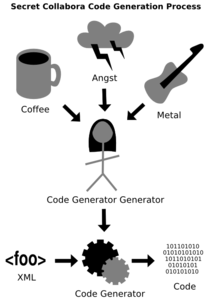
Some background: service-side code generation
The secret Collabora code-generation process

(credit: daf)

Supporting D-Bus in the GObject world has always involved quite a lot of code generation. The core API of dbus-glib is heavily reliant on varargs functions, which aren't type-safe and are easy to get wrong. dbus-glib contains a program called dbus-binding-tool, which is meant to generate reasonably sane GObject APIs for D-Bus objects. Unfortunately, it seems to be intended to generate a whole GObject at a time. Early versions of telepathy-gabble used dbus-binding-tool plus a script called gengobject.py to generate API stubs for the exported objects; developers then filled in the blanks, and hey presto, we had a GObject on D-Bus. This was fine up to a point, but had a couple of major drawbacks. Whenever we changed the D-Bus API (quite common during the early development of Telepathy), there was a very laborious and error-prone merging process. We ended up with the following process:
  • copy the D-Bus introspection XML from the telepathy-spec repository into a directory xml/pristine (actually, the canonical form for the spec was Python for a while, and we had a script that exported a contrived object onto D-Bus and introspected itself to get the XML - but that's another story!)
  • preprocess the introspection XML to add the dbus-glib CFunctionName annotation, resulting in a directory xml/modified
  • run dbus-binding-tool and a Python script gengobject.py to generate C source in xml/src
  • three-way-diff the old version of xml/src, the new version of xml/src, and the real C code in src to create a new version of src
  • pray that the diff process hadn't randomly exchanged functions' implementations
  • update the resulting code in src so it worked
  • check the whole mess back into darcs
  • hope that nobody else had made changes that would result in darcs conflicts
If you haven't yet gathered, this was a bit of a nightmare. Also, it was very easy to return the wrong thing from a method without noticing - because all the APIs were varargs, the compiler didn't notice, and the first we'd know about it was a mysterious segfault under certain circumstances.
How telepathy-glib fixes code generation telepathy-glib improves on this by taking advantage of this innocuous-looking feature in dbus-glib:
commit 355ef78d98d6fc65715845d56232199162cab12a
Author: Steve Fr cinaux <steve istique net>
Date:   Thu Aug 17 11:48:20 2006 +0200
    Interface support for bindings.
Instead of running dbus-binding-tool or creating GObjects with D-Bus interfaces, we put the entire Telepathy spec through glib-ginterface-gen.py, a distant descendant of Gabble's gengobject.py. For each interface in the spec, we generate a GInterface that mirrors the D-Bus interface. Any GObject that implements the GInterface automatically gets the D-Bus interface if it's exported onto D-Bus. There are a few non-obvious refinements, though:
  • The signature of the method implementation is always in the mode that dbus-glib calls "asynchronous", where the method implementation can either send a reply message before or after it returns. For "slow" methods, this is the only thing you can do. For instance, many Telepathy D-Bus methods can't return anything until some TCP round-trips to the server have happened. This is also the only thing you can do if you want to extract extra information, like the sender's unique name, from the method-call message (dbus-glib's "synchronous" API doesn't allow this to be done). For "fast" methods, sending a reply message before returning is just as easy as using the "synchronous" API (it's just a difference of syntax), and has an API consistent with that of the "slow" methods, making it easier for service authors.

  • The layout of the GInterface vtable is private, and (auto-generated) accessor functions are used to fill in implementations. This means our ABI doesn't change just because we re-ordered functions in the spec.

  • If no implementation is provided for a method, we just raise an appropriate error (org.freedesktop.Telepathy.Errors.NotImplemented), rather than suffering an assertion failure. This means we can safely add methods to an interface.

  • While we're generating code anyway, we generate some static inline wrapper functions which wrap dbus_g_method_return(), to have type-safe method returns. You can easily check that a method replies with correct types, by checking that the implementation of Foo() replies by calling tp_svc_some_interface_return_from_foo().

  • Similarly, we generate wrapper functions to emit signals, to get type-safe signal emission.

Not all interfaces are stable enough to be included in telepathy-glib's stable API and ABI, so some of our other projects include a copy of the telepathy-glib code-generation tools, and generate their own "mini-telepathy-glib" (traditionally in a /extensions/ directory) for their implementation-specific (drafts of) interfaces. This isn't yet as polished as it ought to be (mainly because we don't want to freeze the augmented-introspection-XML format that we write the Telepathy spec in, because it's rather ad-hoc and hackish in places) but it works quite well in practice. To see what this looks like in practice, have a look at the examples in telepathy-glib, or at a Telepathy connection manager like telepathy-gabble.
Mixins and base classes Another feature of telepathy-glib which makes life easier for connection manager authors is that it provides "mixins" and base classes which implement some of the GInterfaces. There's absolutely nothing magic about the base classes - they don't have any access to private implementation details of the GInterfaces, they just implement them like everyone else does. The "mixins" are only slightly more magical - they store some extra state inside the structures representing GObjects and their classes, and use it to provide default implementations of some or all of the methods on a particular interface (or two interfaces, in the case of the new TpMessageMixin). I'll leave it up to Rob to explain those in greater detail, since I seem to remember that he invented them :-P The examples and regression tests in telepathy-glib are quite good examples of how these work in practice.

8 November 2008

Joerg Jaspert: Debian mirror scripts

With a small mail to our mirrors-announce list, I just opened the work of more than one month to the public. Even better, I strongly encourage every mirror admin to use my scripts, or at least scripts that follow a minimal set of rules I wrote down… Some long time (somewhere in April or May this year) I got added to the Debian mirroradm group. First it was only to get some problems with packages.debian.org solved, but later on I started doing more. This group is basically the one that handles the archvsync user on .debian.org machines and also manages the official Debian mirrors listing. As the archvsync user exists on multiple .debian.org machines, and many of them do mirror a copy of our archive for various reasons, all of them had some version of a mirroring script, and sometimes also a version of a pushmirror script. Unfortunately, as they all had been maintained mostly on their own per machine - they sometimes had evolved a bit different. Additionally all of them had a few problems which could leave us with a broken mirror behind, despite it looking all well. So on Sept. 26 I decided to trash it all and rewrite the script and put it all in a VCS (and selected git). For that I set myself a few goals, like (in no particular order) Now, 109 commits and more than a month later, I was finally able to open the scripts to the wide public. (Had multiple people test them before this, but thats always different than a real “release”). The scripts are in use on all .debian.org machines and some other mirrors already, so I’m fairly sure they work.
As I already wrote, Debian mirror admins are strongly encouraged to use this scriptset and not to invent their own. In case you miss a feature either send me a mail describing it, or better, a patch implementing it. I’m happy to implement as much as possible (and sensible :) ) And while it is discouraged to use own scripts, sometimes people have reasons to have their own, so there is now a minimal set of functionality that such a script MUST support. All of those requirements are easy to fulfill. Well, at least the MUST ones. The first one is basically a given, all scripts I know are doing this already. The second one sounds more complicated, but actually might just be about 4 lines of actual code changes. Just touch an extra file before you gain a lockfile (to avoid two scripts running at the same time) and then rerun rsync as long as that extra file is around. (It helps to rm this trigger file right before you call rsync :) ). The should directive is actually a little more work to implement correctly. I won’t show source here, read the ftpsync script if you want to see it, but I try some small explanation. Background: Debian mirror synchronisation is usually done by scripts that get started via ssh. As mirror operators (understandably) do not like their upstream mirror to be able to login, this is done using “ssh triggers”, a feature I wrote about earlier. Those are sshkeys using a forced command, so nothing else than this command will be run, ever. SSH, if used with such forced commands, has the helpful feature that it sets the environment variable SSH_ORIGINAL_COMMAND containing the original arguments. Which means that, if the mirror pushes you with “ssh yourhost -l mirror sleep 1” you will see *sleep 1 in that variable. It is what many mirror operators currently use when pushing their downstreams. Now, we can use that to tell the receiving end all things we want it to know. If you look in my script you will see that I defined a little more than the minimal arguments. But none of the additional ones are a requirement, they only make life much easier. My script currently understands, additional to the 3 minimal ones:
As if that wasn’t enough, I also had to rewrite the runmirrors script. The old 10-line one just didn’t cope with the more general approach. This script is used to “push” your downstream mirrors, telling them that they need to update. (Which is the only sane way to run a mirror. cron is just not made for mirrors that can update at random times!). One nice new feature of it is the ability to update multiple mirrors nearly at the same time. This is extremely helpful in case of DNS Round Robin entries like security.debian.org (multiple hosts offering the same archive under one hostname). You do not want to have such hosts out of sync. Not even for a minute, if you can avoid that. So we now push the mirrors with sync:stage1 as argument. Then we wait until all of them have finished the stage1 sync before we push them all again, this time with sync:stage2 as argument. This will erase any update delays thanks to network latency / low bandwidth one of the security mirrors might have, as the large transfers (all the binary and source packages) are done in stage1. They can take time, a normal user won’t notice it - the Package and Source indices are not transferred yet. They arevery small and as such transfered pretty fast whenever stage1 is done everywhere and we tell mirrors to do stage2.
All in all it was a pretty nice exercise writing those scripts. Comments: 0

7 November 2008

John Goerzen: Wow

People often talk about "memorable moments" -- times where pretty much everybody in the country remembers where they were at that exact time.

There are probably only two of those moments I can remember: the 1989 earthquake during the World Series and the time 9/11 happened. My car was in for service that day, and I was sitting in the lobby of the mechanics watching it on TV.

So now I have a third: watching Barack Obama win the presidency.

We were installing some new blinds in the kitchen while listening to the coverage on NPR, periodically going over to the office to watch the TV coverage on the computer. (Our TV is upstairs right now, so that was more convenient.)

A few minutes before the election was called, I remember Brian Williams saying something like "We're going to go to local stations now, but you better not walk away. We'll have some amazing news at the top of the hour."

We watched that announcement, then saw McCain's speech, and finally Obama's speech (missed the first minute or two of it actually). What an amazing evening.

Then seeing the stories of people celebrating all around the country and around the world: the impromptu party in front of the White House Tuesday night, the small gathering at the Lincoln Memorial Wednesday morning, the Obama parties all around the world. And we watched it on TV in our house while Jacob slept. I feel like I missed out somehow.

5 November 2008

Francois Marier: Converting any video to a podcast

If you don't always have time to sit down in front of your computer to watch long video presentations (lectures, talks, etc.), then you might find this simple script useful. That's what I use to convert any video file to a podcast that I can listen to on the go.

First, dump the audio using mplayer to a file called audiodump.wav:
mplayer -vo null -ao pcm:fast input_video_file
Then, if you want, you can downsample that wave file (using sox) since voice doesn't need the same quality as music:
sox audiodump.wav --rate 32000 -1 --channels 1 audiodump_small.wav vol 0.9 dither
Finally, encode the file as in the SPEEX format (if your music player supports it):
speexenc --denoise --vbr --dtx audiodump_small.wav output.spx
You could also use the OGG Vorbis format:
oggenc --downmix --output=output.ogg audiodump.wav
or create an MP3 using lame:
lame -mm audiodump.wav output.mp3
It works very well with Youtube videos, but you have to download the video first using youtube-dl or clive.

4 November 2008

MJ Ray: Tasty New Microblog Flavour

I’ve flirted with it in the past and resisted it for a while, but you can now follow me on Identi.ca and Twitter if you are so inclined. Seems like I might have picked a good time to try this because TwiTip just soft-launched. There’s some overlap between my accounts, but they’re not identical because different third-party sites connect to each one. Both will get told when a new article appears on this website, but Twitter is likely to see more links to other sites and Identi.ca will get more status updates. Other than that, usage will be determined by popularity at events or with communities - or by suggestions here. How would you use them? At first glance, the two services are similar but different. Both sites seem to be “cooperative deserts” (not many cooperative members on them), both sites seem to be running on non-free software (I consider AGPL non-free until its big questions are resolved) and neither site seems to have an easy way to backup one’s data or participate without registration. Identi.ca seems to have some SEO-spammer problems, while Twitter’s interface has some silly needless javascript uses. Identi.ca supports OpenMicroBlogging (OMB) but I don’t understand that yet - it seems a terrible specification. It opens with references (but not web links) to three other things I’ve never heard of, then continues into a dictionary where terms like “listener” are redefined (ouch!) and doesn’t contain an examples section. New article announcements are done by a Wordpress plugin I’ll publish soon. Because of the above problems with OMB and that I can’t find whether Twitter supports it, the plugin uses the simpler status HTTP POST interface. Does anything other than Twitter and Identi.ca support that? I tried a few sites and got bored with them requiring me to apply for an API key before they’d tell me much.

MJ Ray: Tasty New Microblog Flavour

I’ve flirted with it in the past and resisted it for a while, but you can now follow me on Identi.ca and Twitter if you are so inclined. Seems like I might have picked a good time to try this because TwiTip just soft-launched. There’s some overlap between my accounts, but they’re not identical because different third-party sites connect to each one. Both will get told when a new article appears on this website, but Twitter is likely to see more links to other sites and Identi.ca will get more status updates. Other than that, usage will be determined by popularity at events or with communities - or by suggestions here. How would you use them? At first glance, the two services are similar but different. Both sites seem to be “cooperative deserts” (not many cooperative members on them), both sites seem to be running on non-free software (I consider AGPL non-free until its big questions are resolved) and neither site seems to have an easy way to backup one’s data or participate without registration. Identi.ca seems to have some SEO-spammer problems, while Twitter’s interface has some silly needless javascript uses. Identi.ca supports OpenMicroBlogging (OMB) but I don’t understand that yet - it seems a terrible specification. It opens with references (but not web links) to three other things I’ve never heard of, then continues into a dictionary where terms like “listener” are redefined (ouch!) and doesn’t contain an examples section. New article announcements are done by a Wordpress plugin I’ll publish soon. Because of the above problems with OMB and that I can’t find whether Twitter supports it, the plugin uses the simpler status HTTP POST interface. Does anything other than Twitter and Identi.ca support that? I tried a few sites and got bored with them requiring me to apply for an API key before they’d tell me much.

3 November 2008

Jonathan McDowell: NM gets longer and longer

If you ask the old timers about how they got started in Debian they'll tell you about sending off an email saying they wanted to get involved and having an account setup the same day. By the time I got round to joining it was during tbm's blitz when NM opened up again and it took only a few days to get through the process. When I first AMed, back in 2002, it took anywhere from a few days to a few months to process an applicant. I've recently started AMing again and so far my NM and I have exchanged 9 mails over the course of 2 weeks and still aren't through Philosophy and Procedures.

This isn't due to any failing on the part of my NM. It's just that there's a lot more "paperwork" to get through these days. There's currently a lot of discussion going on about the idea of introducing new classes of Debian involvement. I think that's something that's definitely worth looking at; it's already in existence for Debian Maintainers vs Debian Developers. However anything new that's introduced really needs to make some effort to be lighter than NM; someone who just wants to handle a few packages is going to get put off by too many hoops and the current NM process is already largely constrained by available AM time rather than anything else. I don't pretend to know what the right solution is, but I think anyone attempting to produce one should be praised for that rather than attacked.

2 November 2008

Matthew Garrett: Ultamatix

First, let me make one thing clear. This isn't constructive criticism. This is just criticism. It's directed at software that's so wrong-headed that there's no way to make it significantly better, and everyone involved would be much better spending their time doing something else instead of trying to fix any of what I'm about to describe. It's not worth it. Sit in a park or something instead. Meet new and interesting people. Take up a hobby that doesn't involve writing shell scripts for Linux. You'll be happier. I'll be happier. Everyone wins.

Anyway. I wrote about Automatix some time ago. It died and the world became a better place. More recently it's been resurrected as something called Ultamatix. In summary, don't bother. It's crap. And dangerous. But mostly crap. Again, I'm going to utterly ignore the UI code and just concentrate on what it runs.
There's almost certainly more. I got bored. The worrying thing about this is that the Ultamatix author read my criticisms of Automatix and appears to have attempted to fix all of them. The problem with this is that there's clearly a complete lack of understanding of the fundamental problem in several cases. For example, one of my criticisms of Automatix:

sudo sed -i "s/^vboxusers\(.*\):$/vboxusers\1:$AXUSER/" /etc/group

- assumes that the system isn't using some sort of user directory service.


and the Ultamatix response:

Fixed...Got rid of Virtualbox

Except exactly the same problem is present at other points in Ultamatix, as noted above. Taking a bug list and slavishly fixing or deleting all the bugs isn't helpful if you then proceed to add the same bug back in 24 other places. In that respect, it's even worse than Automatix - the author's managed to produce a huge steaming pile of shite despite having been told how to avoid doing so beforehand. He may be no newbie to programming, but if not it's a perfect example of how experience doesn't imply competence.

Don't install this package. Don't let anyone else install this package. If you see anyone advocating the installation of this package, call them a fool. There's absolutely no excuse whatsoever for the existence of this kind of crap.

Minor update:
The above was looking at 1.8.0-4. It turns out that there's a 1.8.0-5 that's not linked off the website. There's no substantive difference, but some of the numbers may be slightly different.

29 October 2008

MJ Ray: Why Are You Distributing Leaflets?

Like all visitors to the Listening to the Social Entrepreneur conference, my pack included a leaflet from a university research centre. Today it popped up on the top of my in-tray while I was making a concerted effort to clear it. The leaflet is a description of the research centre, but it included a web address, so I visited that website. It contained essentially the same information and nothing else. What was the point of that? I already had their contact details in the attendee list. How much did these leaflets cost? In general, it’s a little disappointing when you get a “null pointer” from a private company, but it’s particularly annoying from a university. University mistakes like “technology transfer programmes” (that stop software becoming free software available to social enterprises) are justified by a need to get more money - but clearly this particular university has money to waste. How about others? If there was a way to subscribe to email or blog news of their research publications, I probably would have subscribed. Instead, I’ve just ranted here (without rewarding them with a link) and now I’m going to recycle the flier. I’ll probably have forgotten the three-letter acronym by next week. It’s simply bad marketing. It’s paper spam. Please, if you are putting things into conference handout packs, ask yourself why? What are you hoping to get out of it? How are you going to measure its success?

28 October 2008

Russell Coker: The Latest Dick Smith Catalogue

I was just reading the latest catalogue from Dick Smith Electronics (a chain of computer stores in Australia). The first interesting thing that I noticed is that laptops are cheaper than desktops in all categories. For any combination of CPU power and RAM in a desktop system I can see a laptop advertised with similar specs at a lower price. Of course you won’t get such a big display in a laptop, but big displays don’t always work well. I just read an interesting review of LCD display technology [1] which states (among other things) that TN panels (which provide poor colors and a limited viewing angle) are used in all current 22 inch monitors! They state that the Dell 2007WFP (which I own) comes in two versions, I was fortunate to get the one that doesn’t suck. Based on that review I think I’ll refrain from all further monitor purchases until the technology gets sorted out and it becomes possible to reliably buy the better monitors at a decent price. The most expensive desktop system that Dick Smith advertised in their catalogue has a 22 inch monitor. It seems that with desktop systems being more expensive an increasing number of home users will use laptops instead, which will of course change the economics of manufacture. Maybe the desktop computer is about to die out and be replaced by laptops, PDAs, and mobile phone type devices (blackberries etc). Another interesting thing is an advert for a LASER pointer (it seems that they haven’t been banned as “terrorist weapons” yet). Being on special for a mere $27 is not the interesting thing, what is interesting is that the advert claims “projects up to 500m indoors“. I’m sure it will be handy if I ever have to give a presentation at the Airbus factory. But otherwise it seems quite unlikely that I will ever get an opportunity for a 500m indoor space. The prices on digital cameras have been dropping consistently for some time. Now they are selling a Samsung S860 (8.1MP with 3* optical zoom) for $98. This is (according to the specs at least) a very powerful camera for a price that most people won’t think twice about. I expect that an increasing number of people will buy new digital cameras every year the way white-box enthusiasts buy new motherboards! Hopefully people will use services such as Freecycle [2] to dispose of all their old cameras, to both avoid pollution and get cameras into the hands of more people. Very few monitors are being sold with resolutions greater than 2MP (1680*1050 is the highest you can get for a reasonable price). So an 8MP camera allows significant scope for cropping and resizing an image before publishing it on the web. Even the 4MP cameras that were on sale a few years ago (and which are probably being discarded now) are more than adequate for such use.

Next.

Previous.