Search Results: "rra"

13 February 2007

Christian Perrier: fr: 99.858%, cs: 93.363%, de: 81.470%, sv: 79.599%, vi: 78.085%

No change today, mostly. Today's NMUs: faqomatic, calamaris, scsitools, cyrus21-imapd (most of them fix erroneous translation files here and there). Uncoordinated upload for atokx, wmmoonclock, atokx2. For all of them, I was having a pending call for translation updates, which the maintainer had been notified of....and which wasn't finished yet. Hurrah....:- atokx and wmmoonclock will improve the stats for French tomorrow...but we will be missing 100% because the atokx2 upload hadn't wait enough for us to send the update (and Steve has been slow.....). Really infortunate.

11 February 2007

Antti-Juhani Kaijanaho: Announcing darcs-monitor

There aren’t many features I grew fond of with CVS that I haven’t yet found a satisfactory solution for in Darcs. One of them was, until today, sending commit mails to mailing lists. There are a number of more or less ugly hacks floating around the net, but I never found them very satisfactory, so I wrote my own. Darcs-monitor will send email to a specified recipient about new changes added to a specific darcs repository. It can be run as an apply posthook (resulting in near-instantaneous “push” emails), or periodically from Cron, or occasionally by hand, whatever seems most convenient. You can get it by darcs at http://antti-juhani.kaijanaho.fi/darcs/darcs-monitor/ (darcsweb available), or as a tarball at http://antti-juhani.kaijanaho.fi/software/dist/. It depends on mtl and HaXml and is written in Haskell, naturally. It has been tested only with GHC 6.6 so far. For installation and usage instructions, refer to the README. Please note that this software is very new and thus can be buggy. As with any email-sending software, bugs can result in major annoyance; user caution is warranted.

9 February 2007

Benjamin Mako Hill: Title

I've been taking the train frequently lately so decided to sign up for the Amtrak Guest Rewards Program -- kind of like a frequently flyer program but without the flying. When filling out their online join form, I was asked to select a title from what turned out to be a rather extensive list:
That will be Princess Benjamin Mako Hill to you, Mr. Conductor.

6 February 2007

Gunnar Wolf: Free KQemu - Yay!

I've been feeling dirty lately - For my netadmin tasks, I've been heavily relying on running virtualized instances of the various MS Windows flavors, to check for compatibility with my work. Of course, being a zealot, I would not run VMWare (as it is grossly non-free from every possible angle) - I used Qemu. I'm also, however, impatient as hell - If I'm going to suffer from the sluggishness of the typical Microsoft desktop OS, I just don't want to suffer from emulation slugishness as well! Of course, the KQemu kernel accelerator module came to my rescue. I felt tainted, as it was just free as in beer.
Well, today the sun rose, and the world looks shinier. Yes, it's chilly in Mexico City (around 5 Celsius), but great news always make the sun shine brighter: First thing I read in the morning, http://lwn.net/Articles/220807/">KQEMU 1.3.0pre10 released - under the GPL! Of course, it's echoed at Barrapunto. Even better, it took little time for Mike Hommey to post it into Planet Debian. Better still, Daniel Baumann has already packaged and uploaded it to NEW (and has an APT repository already set up with unofficial packages). Ftp-masters, please, issue the dear green light soon! :-D
/me does the dance of joy

5 February 2007

Joachim Breitner: Linux flexibility

One of the things about the GNU/Linux system that I wouldn t want to miss anymore is the general flexibility: I had to send my main machine, a ThinkPad, for warranty repair (again...). But I wanted to continue to use my programs with all my settings and all my data. So I took my old desktop machine, upgraded the Debian to unstable (which is what my laptop was running), using dpkg --get-selections and dpkg --set-selections I made sure that it had all programs installed that were on my laptop and then I mounted the laptop s harddrive, which I put in a USB case, on /home. Et voil , I can continue to work just as before. I wonder if this would have been as easy with, say, Microsoft Windows.

1 February 2007

Jeff Bailey: Relationship properties

My brain is drawing a blank on this:

Let's say I have a class Group and a class Person, where there's an n:m relationship between these. It's simple to say that Group could have an attribute "members" which is a collection of Persons, or Person could have an attribute "groups" which is a collection of Groups.

The problem then is that there's no relationship properties there. I can't easily describe for how long the person has been a member of the group, when that membership expires, etc. It seems to me that these type of properties ought to be describable in an elegant way. Perhaps as a characteristic of the array? I want to do this ideally in a way that for items that have no meaningful characteristics I can just use a standard Array class of some sort, but that when properties come up, I want to be able to add them silently so that existing code can continue to just work.

30 January 2007

MJ Ray: Debconf7 loves climate change? (2)

I've just noticed that some debconf7 registrations close this week. Yes, this week - a full two months before national rail advance tickets go on sale. What's that about? [...] Jon Dowland replied
"MJ, the debconf7 travel page has far more flight information on it than anything else because it has been put together primarily by people who are figuring out international travel arrangements which will require flights."
International travel does not necessarily require flights. Intercontinental travel probably does, due to time constraints, or maybe even cross-continent, but I've seen DDs from nearby countries posting about booking their flights, and putting the deadlines before land tickets are even on sale is really shameful.
"It could certainly use some more information for people travelling more locally. If you have some advice on how to get there from Europe or the UK without flying, please contribute it: the site is a wiki, you can sign up for an account and edit the page yourself."
As I've posted elsewhere, it's a mediawiki rather than a wiki, so once I get around to installing mvs, I can sign up and edit it. (Bring back patches in the mail...) However, I'm not sure how best to get to Edinburgh without flying yet, because most tickets aren't on sale yet, which is where I started, remember? David Moreno Garza replied
"in 3rd world countries, some things like technology, travelling or taking care of the environment are not a matter of choice, unfortunately. [...]"
Sure, if people are travelling from 3rd world countries to Edinburgh, then flying is probably the only practical way, but surely people from nearby countries can get to Scotland without dumping CO2 into our sky?

Meike Reichle: They're at it again

(Almost all links in this text lead to German sources. Sorry, but this is a local topic and there aren't any English sources.) Unfortunately, Hildesheim is home to some rather prominent figures of the German neo-nazi scene. One of them has now registered for a protest march through Hildesheim on the 24 February 2007. The reason for this is, that an other neo-nazi event, that had been disguised as a "birthday party", but was in fact a propaganda event featuring talks by "contemporary witnesses" and "an evening of ballads" and was arranged by "National Forces of Hildesheim and the Association of German Women" had been prevented by the Hildesheim police. As a reaction to this, the aforementioned gentleman has now registered for a demonstration with the Hildesheim city council. (In Germany you need to register demonstrations.) Official head of the whole thing is this other gentleman, who has a history of trying to organise nazi demonstrations. He occasionally does so in Leipzig, where he tries to organise such demonstrations about twice a year. Their attendance is dropping though and they are usually met with about ten times as many counter demonstrators and thus have to be ended prematurely, exposing them as the unwanted and ridiculous farces they really are. However, the fact that people still try to register demonstrations such as this one is worrying. And the fact that this one is meant to be in the town I live in makes me pretty angry. Fortunately the demonstration is met with broad opposition. An alliance has been formed, consisting of the German adult education centre of Hildesheim (VHS), the Federation of German Trade Unions (DGB), Verdi, our public services union, Attac, the Antifa, the refugee council of Lower Saxony and the political parties with the Hildesheim Greens as the most active part at the moment. It is good to see, that such neo-nazi endeavours are met with such a broad opposition, and that this opposition does not only originate from the "usual suspects", but from the centre of society. (The VHS for example is usually a non-political organisation, and seeing them engage in such an alliance and even hosting its meetings is pretty cool!) It's not sure yet, whether the demonstration will be approved. It probably will, but with a bunch of extra conditions. If it is approved, it is even more important to meet it with the resistance it deserves! So, if you are living near Hildesheim, watch this space for announcements of the planned counter measures.

Jon Dowland: DC7 travel information

MJ, the debconf7 travel page has far more flight information on it than anything else because it has been put together primarily by people who are figuring out international travel arrangements which will require flights. It could certainly use some more information for people travelling more locally. If you have some advice on how to get there from Europe or the UK without flying, please contribute it: the site is a wiki, you can sign up for an account and edit the page yourself.

Joey Hess: bug scribbling

This is something I do when I'm working on a hard or perplexing bug. I'll write down a verbose description, as if I'm describing the bug to someone, or having a conversation with myself. I include all the debugging data I find, as I come up with tenative hypothesis, write them down, as I disprove them go on to say why that hypothesis failed, etc. I just dealt with an OpenID signin bug in ikiwiki, which ended up being several hundred lines of text descibing my process for solving the bug, including amusing blind alleys involving a sha1sum implementation being broken (it wasn't). And then I committed the one line fix, and :q!'d out of the buffer containing my bug solving log, because all that text now seems both boring, and, given the cause, embarrasing.. Anyone else do that? It has its good and its bad points. I suspect most of the time that I spend typing into the log, I'm also spending organising my thoughts, and it makes sure that all relevant debugging information is all in one place and well organised to look at, and avoids me looping back into blind paths that I've visited before. On the other hand, I could probably go read a book (or in some cases, an appropriate man page :-/) or sleep and process the bug in the background without all that typing.

28 January 2007

Erich Schubert: How Microsoft might already have lost the desktop wars

I was recently asked to help someone understand the OpenSource movement, and the effects it might have on companies such as Oracle or SAP. I talked a bit that these companies can benefit from being independant of big vendors like Microsoft, while still not having to do everything themselves. But also on how opensource alternatives to their products will threaten their business in the long run and force them to be more innovative and constantly improve their product. I then talked about the 'viral' aspects in OpenSource; not about that GPL licensing bullshit (just read the licenses of stuff you want to use, and don't use them if you don't like the license...; this virality is highly overrated due to Microsofts FUD), but a very different kind of virality: Let's say you are supposed to evaluate different CMS solutions. So you install one or another that sounds promising. Most likely you'll install an opensource database like MySQL or Postgresql. And when you've decided upon a solution, you are quite likely to go with this database, and say to yourself: "if MySQL doesn't scale up well enough for our needs, we can still but an Oracle license". This would be probably different if you had had installed Oracle in the first place. Say a demo or so. But the demo versions of the CMS you tried already made you comfortable in using MySQL; it's easy to install (most likely included with your system anyway), and it just works. But would you have tried a CMS in first place that actuall required you to setup Oracle? Anyway, this "social" virality brought me to another point: developers and administrators. When you see numbers on the market share of Microsoft, they're still huge. Some 95% of users are using Microsoft as their primary operation system (I'm discounting the fact that a huge share of DSL modems here is running Linux, so actually many people are Linux users, and I'm also discounting the use of www.google.com, which would make 99.9% of people Linux users...). But these are the average users. But they aren't on their own. The software choice of the "average user" is influenced by a couple of factors, including: But if you look at the computer geeks around you, what are they using? A huge share of the people I know are using Linux. Not everyone is using Linux as their main desktop system, but many are. Others are using Linux just for their development stuff, some only on servers. It doesn't really matter, Linux is huge with the geeks. When I look at the sofware my mom has installed on her Windows system (which also dual-boots Linux, and interestingly is the primary choice for watching a movie - Windows doesn't playback sound with some videos...): half of it is opensource. There is OpenOffice.org, Gimp, Gaim, Firefox, Thunderbird, Inkscape, LyX, Mplayer and a couple others. He favourite game? PySol. My dad already has switched to Linux as his main operating system. So why did they switch to so much opensource software? Because it's what I recommended them, and where I can help them. My mom needed a software to record something for her blog (yes, she's "podcasting" now) - of course I recommended her an opensource application, audacity. My mom is giving private lessons in math and physics; she's very successful at that. When one of her students got herself a laptop, she of course was given all kinds of (opensource!) software. For her highschool thesis she needed a vector graphics program - she ended up with inkscape. Now if my parents have some problem with Windows, who are they going to ask? I didn't manage to solve the video playback issues, my mom by herself switched to Linux for watching movies. It didn't work with Windows, I couldn't help her - she switched to something where she knews she'd get more support (and where the problem by chance didn't occur). Now let's have a look at the university. Our computer pool for the students is all Linux. There are a few windows systems for legacy purposes, I never found out if they are accessible to regular students; I only know they're supposed to exist. When doing some assignment, you're very often required to use some opensource software. For a thesis, you'll very likely be building upon some opensource system. The mathematics institute is still on solaris, but recently Gnome was installed there. Physics and electrical engineering also have mostly Linux systems, I've heard. For software development, it's pretty much a "develop on Linux, run anywhere", whereas Windows-only developers usually need to port their applications (or trust on Wine being able to run them good enough on Linux). So more and more people start developing on Linux, and get to love it's great development environment (after all, Linux was pretty much completely done by software developers...). And that is how Microsoft might already have lost the desktop war: developers, technical students and administrators (who usually also love their Linux boxes). They're only a small share of the userbase, but they're influential. In fact, other users rely on them being able to eventually fix their systems for them. But since these are using Windows much less already, they will be less capable of assisting others with Windows. They'll be putting Linux systems everywhere, and keep on encouraging them to make the switch. Of course it will still take some years, but you can expect more and more companies (and cities) to switch over, like the city of Munich. Windows support staff on the other hand might even become more expensive. I don't know of any numbers on the MCSE programme (Minesweeper Consultant, Solitaire Expert) - does anyone have numbers on "graduates" for that?

27 January 2007

Wouter Verhelst: Rock. Or not.

A week or two ago, one of the hard disks in rock utterly broke down. In itself, this wasn't a problem, since the disk was part of a 3x40G RAID5 set. Moreover, I knew it was dying, and was preparing to buy me a new disk anyway; the fact that it broke down only sped up matters. No worries. However, there's one slight problem with rock: it's a pretty old SMP box, and because of some bug somewhere (which I still need to hunt down), it can't run anything later than 2.6.12 in SMP mode. The new disk was a 80G disk, to replace a 40G disk. I wasn't very happy about the RAID5 array, but since I needed more disk space than what a RAID1 or RAID10 array on three 40G partitions would give me, I didn't have much choice. One of the disks in the RAID5 set was a 80G, too, however, with a 40G partition dedicated to the RAID5 set; so rather than doing ugly things with two disks only halfway committed to the RAID1, I decided to convert the RAID5 set to a RAID1 one. When you use LVM-on-RAID, as I do, that's pretty easy: you just create the new array (in degraded mode, on the new disk); add it to the volume group; use pvmove to move all data to the new array; use vgreduce to remove the old array from the volume group; and finally, repurpose the freed-up space to make sure the RAID1 set is no longer degraded. Which is all nice, except that on 2.6.12, when pvmove locks the entire volume group, you can't write to it anymore, which is quite painful if things like /var and / are on that volume group; gives you a nice deadlock. So I compiled me a 2.6.19.2 kernel with SMP support explicitly disabled, in order to be able to do the pvmove dance without much issues. That worked. I only forgot to do one rather important thing: to regenerate the initrd after all data had been moved; mainly because it took quite a while for the RAID1 resync to finish, and I had other things to do by then. Yesterday, we had a power failure, and obviously rock failed to come up again. By doing some utterly ugly things with the sarge d-i and forcing the yaird-generated initrd into a debug shell, I was able to boot the box properly again, and had it running 2.6.12. Which took all of three hours, or so. By then, it was kinda late, so I went to bed. This morning, my brother woke me to say he couldn't reach the Internet. Since rock is my gateway, I got suspicious. Running dmesg showed me a number of warnings from the kernel, where it said that it didn't properly understand some of the hashing stuff in some directory inodes. As a result, several files had been corrupted—including /var/lib/dpkg/status and /var/lib/dpkg/status-old. The file with 'extra' information that aptitude maintains, however, /var/lib/aptitude/pkgstates, still existed and was readable. So I downloaded me a one-week-old Packages file from snapshot.debian.net, and wrote this perl script:
#!/usr/bin/perl
open(APTITUDE,"</var/lib/aptitude/pkgstates");
open(STATUS,">status");
open(PKGS,"<Packages");
my $pkgent;
my $aptent;
my %aptitude;
my $i;
my $key;
my $val;
while(<APTITUDE>)  
	if(/^$/)  
		$aptitude "Package:" . $aptent-> "Package"  . "\n" =$aptent;
		$aptent =  ;
	  else  
		chomp;
		($key,$val) = split /:/;
		$aptent-> $key  = $val;
	 
 
close APTITUDE;
while(<PKGS>)  
	if(/^$/)  
		$aptent = $aptitude $pkgent->[0] ;
		if($aptent-> "State"  == " 1")  
			print STATUS $pkgent->[0];
			print STATUS "Status: install ok installed\n";
			for($i=1;$i<$# $pkgent ;$i++)  
				if(!($pkgent->[$i] =~ /^(Filename Size MD5sum)/))  
					print STATUS $pkgent->[$i];
				 
			 
			print STATUS "\n";
		 
		$pkgent = [];
	  else  
		push @ $pkgent , $_;
	 
 
close PKGS;
close STATUS;
... which generated a somewhat valid status file, that I copied to its right place. Yeah, that's an ugly hack, but at least I don't have to reinstall rock now. Phew.

25 January 2007

Bastian Venthur: Pimp My Boot Process

I’ve tested Ubuntu the other day and I must say I was really impressed how polished the boot process looked. Ubuntu uses the same image as grub splash and as usplash image. This has the nice effect that there is no visible switch between grub and usplash. I don’t remember if they even used the same image for the login as well, but it would surely improve the boot experience even further. Since we have grub and usplash in our repository too, I thought it would be nice to create something similar for Debian. Creating an image and preparing it for grub is not that hard but creating something suitable for usplash actually is a problem. First obstacle: usplash uses certain defined colors from the palette of the splash to draw stuff like text, background and progress bar, so you almost certainly have to re-arrange the position of the colors in the palette of the image manually. Second: installing the image is not exactly user-friendly. You have to create a .c-file from the .png. Compile it to a .so. and regenerate the initramfs in order to activate the theme… While second part is not that hard and can be done by a script, the first problem (re-arranging the color palette entries) seems kinda unsolvable for me and my limited Gimp skills. So does anyone know a tool which allows to create a usplash theme painlessly? I think it would be nice to have some grub/usplash theme packs in our repositories. While it’s certainly uninteresting for servers it surely adds some extra fun for our desktop users.

Russell Coker: presentation laptops

I suggested in a previous blog entry that conferences should provide computers that speakers can use for their presentations. The reason for this is that getting one computer working with the beamer in each room is an easy task, while getting the laptop of every speaker to work is much more difficult.

It seems that my idea has been rejected by almost everyone who read it, so I'll document some tips for getting a laptop working.
 SZ:    Pixels          Physical       Refresh
*0 1400 x 1050 ( 474mm x 356mm ) *50
4 640 x 480 ( 474mm x 356mm ) 50
5 800 x 600 ( 474mm x 356mm ) 50
6 1024 x 768 ( 474mm x 356mm ) 50
8 1280 x 960 ( 474mm x 356mm ) 50
9 1280 x 1024 ( 474mm x 356mm ) 50

Firstly there is the command xrandr which can be used to change the resolution without logging out. Above are the most useful lines produced by running xrandr with no options on my Thinkpad T41p. The left column is the index to the list of resolutions. For example I run xrandr -s 9 to use mode 1280x1024 and xrandr -s 0 to use mode 1400x1050. This takes much less time than editing an X config file!

The next thing to note is that my Thinkpad has a refresh rate of 50Hz, apparently most beamers expect at least 60Hz, this explains why I have had ongoing problems in getting my Thinkpad to correctly work for presentations for the entire time that I have owned it. If you own such a Thinkpad then I recommend that you just bring another laptop to do your presentation on the assumption that the display possibly won't work and probably won't work properly! I had developed this habit anyway after repeated problems in getting my Thinkpad working (occurring on a number of occasions in several countries). It's good to now know the reason for this (thanks Keith).

When setting the resolution there are often tweaks that can be used. For example in my talk for the Debian Miniconf of LCA 2007 I used mode 800x600 (I think - Keith set it up and I didn't look closely after verifying that things basically worked). Even though the beamer didn't have good support for a low refresh rate it worked when the resolution was low enough. Fortunately the xrandr program allows changing resolution fast enough that all 13 resolutions could be attempted in about a minute.

The support for better display detection and configuration is steadily improving. Hopefully this year the problems will be solved (which means that for the Debian and RHEL releases in 2008 the problem will be solved).

A possible work-around is to use Xephyr (the replacement for Xnest). In a previous blog entry I described how to get Xephyr going for use by Xen images. It seems to be a common symptom of display synchronization problems that the edges of the screen will be clipped. The most common work-around for this is to not use the full-screen mode of OpenOffice - which means that instead of having a small amount of text clipped there is a large amount of OpenOffice menus etc on the screen. As Xephyr accepts any resolution it should not be difficult to arrange for it to use 98% of the screen space and then run the presentation full-screen in the Xephyr window. This will be particularly useful for programs such as MagicPoint (my favorite presentation program) which don't support a windowed mode of operation.

If you have any other suggestions on how to solve or work around display problems with laptops then please leave comments.

24 January 2007

Enrico Zini: package-managers

Improving package managers I noticed two posts on improving package managers none of which mentions Debtags. Daniel Burrows mentions various issues: David Nusinov mentions that the ideal package manager should look like Google, where you search for things using just a simple one line text entry and pick from the results what you want to install. I should probably do a bit of recap of things that have been going on. I'll go through that list again:
  • The current sections in Synaptic are useless
Agreed. This used to be a bug about this, which has been closed by Debtags more than one year ago. We now have much more useful category data for about 73% of the archive (including experimental), but what we lack is software using it. Here's a quick trick to try:
  1. install debtags, and this gives you an easy to read text file in /var/lib/debtags/package-tags.
  2. from that file, pick packages that have the tags role::program, scope::application and interface::x11.
  3. display the results, and use the tags works-with::* and use::* to navigate the results.
There is a python-debian package in experimental that has a debtags module you could play with. Why is that that so far noone has written a simple package manager just for gamers, which uses only the game::* tags? Do you think Debtags gives you too many tags? Then check out: To summarise so far, we not only do have better categories, but also a number of cool algorithms to use them, and some interface prototypes as well. Just don't expect me to write a package manager as well: that's a job that so far I decided to leave to someone else. adept gave it a try, with positive results.
  • there are better keyword search technologies than strstr()
Indeed, Xapian for example. I use it as part of the backend of the Debtags smart search, and here's our Xapian-powered normal keyword based package search interface which does stemming, indexing and all you want to ask from a serious full text index. In that page you don't see all the nice features of Xapian, but only the ones that I needed for my Debtags evil plans. Have a look at the documentation and give it a try. Here is a way to see Xapian's similarity matching in action:
  1. go to the Go tagging! page
  2. click on a random untagged package
  3. the system gives you a rather relevant selection of tags
  4. look at it again: the package was untagged: how could the web engine possibly figure those tags out?
What is happening under the scenes is that:
  1. I ask Xapian: "what packages are similar to this one?".
  2. I aggregate the tags of the resulting packages.
  3. I rank the tags by how many resulting packages have them.
While we are on this topic, why don't we decide that we maintain a Xapian index of our package descriptions in, for example, /var/lib/apt/fulltext/, so that various applications can share it? Indeed. Anyone would like to implement this little "popcon" tool? Having the data easily accessible locally can encourage people to use them. The Debtags Go tagging! page already uses popcon data to show the most common untagged packages at the top, with double reason: it shows packages that more people are likely to know (and therefore likely to categorise) and it pushes for the most common packages to be tagged more urgently. Indeed. Anyone volunteers to implement a prototype? The full unaggregated (but anonymised) popcon data are accessible to every Debian Developer on the host gluck.debian.org in the directory /org/popcon.debian.org/popcon-mail/all-popcon-results. Ideally one can do many interesting things with this concept: besides tag suggestions, one could identify the packages that are most representative of an installed system, and also offer negative suggestions like: "people who have packages like yours usually don't have this package: would you like to remove it?". There is more than all this that could be done. Recently, almost by accident, I had the idea of querying packages by example, like pointing to a file and find packages that can work with it. I've asked Jeroen to have Mole collect info on all files that could possibly get installed in /usr/lib/mime/packages/ (as suggested by Bernhard R. Link), to see if that prototype can be made more accurate. Query by similarity would be nice: I don't like this program, but what else do we have that does the same job? This is best implemented using Debtags data, since it directly maps to semantic properties. Note that you don't have to show a single tag to the user to implement this kind of interface. Do we have a way to point at the X window of an application and get the name of the package that installed it? Wouldn't it be about time to have it? Why don't we have a system updater utility that shows the Debian weather? Why aren't more people playing with semantic web? But more generally, the problem with package managers is that we seem to be irrationally compulsive in wanting to make the one and only big easy and complete interface for everyone. Other more reasonable people would tell you that if you have two very different kinds of users you may want to consider having two different user interfaces. Ubuntu for example installs by default 3 package manager interfaces: Synaptic; the thing that you access from the application menu to add applications to it; and the update manager. Does it sound like a waste? To me it makes lots of sense. We have lots of interesting, usable metadata; we have algorithms; we have prototypes; we have ideas for lots of cool, implementable features. The question is, are we able to write applications that just combines what is needed from all this treasure to provide the right interface(s) for our base(s) of users? Even if my English in 2004 wasn't easy to understand, a read here might still be useful. There is so much really cool stuff to be written, just within reach.

23 January 2007

Zak B. Elep: Smarty enough for Smart Bro, and 3G

Finally, I’m now on broadband! :D I made the move today to Smart Bro as they have been touting a promotion offering free installation and a 384 Kbps connection via their Canopy system. As I’ve been mostly offline (or slightly online, counting the occasional GPRS modem connection on a GSM network) I figured that this is the best way at the moment to get broadband connectivity, as the only DSL choices available locally have been either seriously damaged (due to the last supertyphoon) or excessively priced (with unpredictable foreign-currency adjustments.) So, needless to say, I’m now enjoying myself with this new investment. Adding to this, I also got a new Netgear WGR614v7 wireless router so I can share the connectivity with perlis. While not exactly as flexible as the famous WRT45G from Linksys, it surely does the job to sharing the Net, so I’ve no complaints about it. And I’ve no complaints about the service offered by Smart Bro, either; the installer did an absolutely good job of making sure that the Canopy SM is on the most receptive direction and even gave me some pointers on what to expect with such a connection. Actually, I’ve already made arrangements about the peeves experienced by other Smart Bro users by taking a cue from Joey Hess by setting up the right service caches and by being not too abusive with my expectations. But, I still have a lot to expect with this new connection. After all, I still have a few more items on my TODO that needs doing, namely writing about what the hell happened to me since last month until now, and my future directions (erm, resolutions) for this new year. Ah well… … but first, I need to do some monster dist-upgrades… :P BTW: a UMTS (3G) signal has finally been broadcast in Daet, giving me a reason to also have smart-3g as a backup service in case the Canopy goes down. Yipee!
20 January 2007

Julien Blache: Once again, XFS saves the day

The server hosting this blog just suffered what can only be described as catastrophic hardware failure, thanks to the crap that are Maxtor hard drives, Dell CERC 1.5 RAID controllers and the Linux driver for those (aacraid). So, the machine got shut down for a moment on thursday night, just the time to move the rack around in the datacenter, and one of the disks did not come back in one piece. But it did come back online after a reboot, prompting an array rebuild by the controller which took 12.5 hours for 250 GB (RAID 1). And the drive failed again 10 minutes after the rebuild was completed, confusing both the controller and the driver. At that point I could still log into the machine, but any command would trigger nice I/O errors all over the place. Fortunately, the FS got shut down by XFS automatically on I/O errors and I haven’t lost a single bit of data. The machine came back just fine with the faulty drive removed. And you thought a RAID controller would help in this case. Obviously this one doesn’t. I need to mention that we’ve observed this behaviour on another machine before this incident, we have another machine suffering from a faulty drive in just the same way, so this isn’t an isolated case and it’s reproducible.

17 January 2007

Edd Dumbill: External SATA storage for the Macbook Pro

Here's a mini-review of my new external storage arrangements for the Macbook Pro.Thanks to my music collection, an appetite for shooting photos in RAW format, and general untidiness I'm not exactly blessed with spare space. Something had to be done.
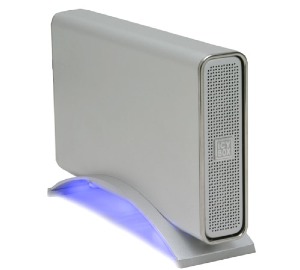
The solution I came up with was an IcyBox IB-360StUS-BL external SATA/USB2 enclosure, wired to a Sonnet Tempo Express 34 SATA adapter. Icybox HD enclosure
Icybox IB-360StUS-BL enclosureEnclosure The IcyBox is such an affordable little box that it seems silly not to have one to hand as a precaution, especially given the cheapness of hard drives these days. The enclosure is convection cooled, so has no noisy fan, and is an a reasonably attractive alumnium package that fits in with the look of the Macbook Pro quite well. The blue LED is switchable, just in case you don't want that bling look on your desktop.Inside the enclosure there's both PATA and SATA connectors. I chose to use a SATA drive, a Samsung HD400LJ. There are two headers for connecting a SATA drive. One goes to the USB 2 adapter, one straight to the outside of the enclosure for wiring to a SATA port on the computer.Four screws secure the hard drive in its tray. The tray then slides into the frame and is secured by four screws in the base. I didn't find it that easy to get these in, but they seemed secure enough once screwed in.The IcyBox comes with plenty of cables, including a SATA-SATA cable, a bracket to relocate an internal SATA port to the PCI card cover on a regular PC, and a USB cable. The power supply is of the external brick sort. SATA adapterThe other half of the equation is the Sonnet Tempo Express 34 SATA adapter. This fits into the Macbook Pro's Express Card port — you knew that something had to eventually, eh? The Tempo card features two eSATA ports, which are of a different design to the  SATA ports featured on the Icybox. This means you need to buy an eSATA-SATA cable. You can either spend $20 on one from Sonnet themselves, or get a cheaper unbranded one for about the tenth of the price: just make sure its reasonably well shielded.Once plugged in, the external drive shows up on the Mac as a SCSI device, and behaves like any removable media. As such, it needs to be unmounted from the desktop before you eject the Tempo card.The only bug with the Tempo card I've found is that things don't seem to work that well if you boot the machine with the card inserted. The very helpful people from Sonnet tell me this is an issue with the underlying Silicon Image chipset, and they're working on sorting it out. (I was very impressed with the technical knowledge, friendliness and speed of response from Sonnet's support department.)PerformanceI'm no benchmarking guru, but it's clear that the external Samsung HD400LJ outperforms my internal 7200rpm SATA drive on the Macbook Pro. Brief experiments with XBench suggested that this performance boost was probably between 20 and 40%. It's certainly vastly preferable to the performance hit you get when you use a USB or Firewire 400 drive with the MBP.ConclusionIt's early days yet, but I'm happy with my new setup. The extra port on the Tempo adapter allows for the connection of another drive, or if I use Sonnet's own products, up to 10 drives! I feel happier knowing the disk isn't competing for attention with all the other USB gadgets I have plugged in. The other big plus point for me is the quietness of the Icybox/Samsung combination.Links: 

Martin F. Krafft: Stuff I forgot to pack

After an amazingly stressless journey [0], I've arrived yesterday evening in Limerick and met Daren and Mel, two alumni of UL who let me move into a spare room in the house they're renting. To be exact, Mel actually lives next door, but who cares about details. After a bit of unpacking, we headed for the pub and returned for an extensive session of Guitar Hero on the Playstation II, which is a truly fun and excellent game.
[0]

I brought my bike along, for transport and exploring. This involved packing a bit of extra stuff, borrowing a friend's Tranzbag, arriving early at the airport to get it boxed to ensure a safer journey, picking it up in Dublin, and somehow getting it to Limerick, where I'd have to reassemble it. I wasn't really looking forward to the trip. It turned out to be stressless, as I said. The boxing cost me 10 Franks at the airport and was completed in less than 5 minutes, nobody at the check-in counter said anything, as if it was the most normal thing for them to check in bikes, some dude retrieved the box in Dublin and placed it on my cart, and while I was waiting, I found out that I wouldn't have to hop on a coach (bus) to go to the Dublin train station, catch a train to Limerick, and then finish the last mile in a taxi: a bus operates fairly regularly directly from Dublin airport to Limerick, taking four hours for the journey. That's about how long it would have taken me via the train station, but I only had to pay 19 the train itself would have been 25 , plus the taxi charges.

The coach driver was curious when he saw the box, but I didn't have to pay extra, and after watching Airport on my laptop and listening to the new Katatonia album, I found myself with my bag and the bike next to the university's main entrance, with Mel and Daren on the way to pick me up. Five minutes later, I was in my home-to-be-for-five-weeks.

I dropped into bed at around 4am and promptly overslept the next morning, then decided to use the day for errands, hitched a ride from Laura (the stressed-out Skynet president and Skycon organiser) to an excellent nearby bike store where I reassembled the bike, got myself a lock (see below) and a mud guard for the front wheel, then headed off for the campus bank to open an account, rode back and forth between the Lero building and the bank to satisfy their bureaucratic thirsts and finally obtained the details for my very own Irish bank account. And I squeezed a bit of grocery shopping in between. Meeting Brian (my supervisor) in the hallway, we agreed on a meeting on Monday, so the remainder of this week is for finishing the various proposals and papers on my to-do list, preparing for the meeting by getting back to speed with my research, as well as getting to know the local party crowd exams are about to end in Limerick and I've been told to have picked quite an excellent time of year for my visit because the university will become a mad house this weekend. We'll see how compatible those tasks are, but boy am I glad that I am not living anywhere near the student villages, or as I put it last night: I don't mind going to parties, but if the party comes to where I am, I'd rather not have it be every night. So this would bring me to the title of this post: stuff that I forgot to pack:
  • A second sweater, it's pretty cold here and I don't want to be wearing the same sweater every day (even though it's merino wool and thus woudn't start to smell).
  • A pair of windcheater gloves, the thin wool ones I have aren't exactly made for cycling.
  • Rain trousers to wear over my regular pants. It's raining and wet and the light colours of the pants I am wearing are a high-contrast basis for the mud.
  • My bike's lock key. Fortunately I left it unlocked, but still had to go out and buy a new lock (which was more painless than having the key sent here).
  • Comfy sneakers for home use, as it's too cold to just be wearing socks.
Due to popular request, I shall be back here with pictures of my surroundings one of these days. NP: I Love You but I've Chosen Darkness / Fear Is on Our Side

16 January 2007

Benjamin Mako Hill: Geography Lesson

I gave a talk at a the Boston Ruby group last Wednesday. The meeting was generously hosted by the Boston start-up Back Channel Media. On the way out, BCM offered attendees schwag in the form of branded inflatable globes and Slinkies. On Thursday, I suggested to SJ Klein and Seth Schoen that we might be able to use the globe as a research aid during the MIT Mystery Hunt. That seemed like a good idea until they pointed out that there were a few inaccuracies on the map. Sure enough, a quick glance revealed that:
  • Burkino Faso is marked as Upper Volta (it's only been 22 years) with a capital as Duagadougou.
  • Rwanda seems to be a small horizontal bar across a country marked both as Ucanda and Buhuno.
  • Zimbabn is labeled clearly while Morocco, clearly divided into two countries, is not marked in either of the resulting (and differently colored) states.
  • A missing border and a color identical to the ocean (!) renders Egypt completely underwater. Yemen, Iraq, Thailand, Romania, Austria, Croatia, Finland, (whose name is missing), and the eastern quarter of India are better off in that they blend into the ocean but have river colored borders demarcating them from the rest of the sea.
  • The Arabian peninsula is host to Qatah, the United Arab Emiraies, and the Saudi capital of Rivaiih.
  • A bit to the north, Jurdan borders Irae and Lebanaw.
  • The countries Czek and Slovak seem to be located just above Czechoslovakia which, in turn, is just above Huudatn.
  • A similar situation happens in Yugoslavia which seems to be next to Monienegro and other more familiar Slavic states.
  • Amstercam is right next to the the German city of Roro.
  • Swirzerlano sits in the middle of Europe.
  • England's Lworpool and Rirmingham are clearly, and clearly incorrectly, marked.
  • Both Russia and the Commonwealth of Independent States are clearly marked while China, despite having dozens of its cities labeled, is not.
  • St. Petersburg seems a full 1000+ kilometers from any body of water and closer to Bellarussian than to a port.
  • Lapan shows many cities including Tokya, Kyole, and others -- while most seem to be located somewhere off the coast of Lapan in the Pacific ocean.
  • The Korean peninsula contains N. Korea and S. Aurla.
  • Myanmar is marked as Burma (although I might forgive that one if I had reason to believe it was intentional).
  • Malaysia is labeled Malaskia.
  • The continent at the South Pole is proudly marked Tarctica.
Of course, this list is extremely incomplete. I've barely looked at cities, rivers, and even some country names and I've barely looked at the degree to which the cities and labels are correct but incorrectly placed. The full list of errata would, in a manner reminscent of English As She Is Spoke, be very, very, long. While the globe does not bear any markings of a producer (I wouldn't want to take credit for it either), a group of us suspected that we might be able to find the country of origin by locating the one country that was represented completely accurately. We couldn't find a single one.

Next.

Previous.