Search Results: "pm"

28 May 2013

Russ Allbery: Collected haul

I've been slow lately in writing these up (and, for that matter, in doing most other things related to reading; things have been rather busy lately). This is a bunch of here-and-there purchases over the last few months, including Powell's Indiespensible shipments. Sandra Barret Face of the Enemy (sff)
Anne Bishop Written in Red (sff)
Lois McMaster Bujold Captain Vorpatril's Alliance (sff)
Cary Caffrey The Girls from Alcyone (sff)
Jenni Fagan The Panopticon (mainstream)
Niels Ferguson, et al. Cryptography Engineering (non-fiction)
Jen Kirchner The Fourth Channel (sff)
Anothony Marra A Constellation of Vital Phenomena (mainstream)
Steve McConnell Code Complete (non-fiction)
Seanan McGuire Velveteen vs. The Junior Super-Patriots (sff)
Patrick Nielsen Hayden, et al. (ed.) Some of the Best from Tor.com: 2012 (sff anthology)
Lisa O'Donnell The Death of Bees (mainstream)
Susan Palwich Flying in Place (sff)
Kim Stanley Robinson 2312 (sff)
John Scalzi Redshirts (sff)
Ian Tregillis Bitter Seeds (sff)
Leon Trotsky The History of the Russian Revolution (non-fiction)
Simon Van Booy The Illusion of Separateness (mainstream)
Chris Anne Wolfe Shadows of Aggar (sff)
Barbara Ann Wright The Pyramid Waltz (sff) That's a lot of stuff. It includes a couple of non-fiction O'Reilly books from sales, a few months of Powell's Indiespensible subscriptions, a variety of books I picked up after a discussion of good lesbian fiction on Tor.com (romance without the obnoxious gender tropes, or at least as many of them), and the rest of the Hugo nominees for the year. I got a ton of reading done earlier this month. I wish I could say the same thing about reviews, but I only wrote a few. That's something that I want to try to catch up on soon, so there will probably be a flurry of those posted soon. I've already read Blackout and Redshirts of this year's nominees (a review of the latter is coming), so at least I'm not too far behind on the reading. Throne of the Crescent Moon is in progress now.

27 May 2013

Michael Stapelberg: Results of the Debian systemd survey

A week ago, we started the Debian systemd survey. The goal was to figure out a few trends and answer the following two questions:
  1. Do our subjective impressions from the discussions on debian-devel reflect the general sentiment about systemd?
  2. What are the main concerns that most people have?
Thank you all for your participation! General I am happy to tell that 2113 people had a look at the survey and 573 people actually participated. Of those, 45.7% said they are a DD, DM or otherwise maintaining packages. 74.5% said they actually booted and used a computer running systemd. With regards to having systemd in Debian at all, not necessarily as the default init system, answers are as follows: 43.9% said they personally want systemd as the default init system in Debian, while 32.2% don t want that. The remaining 23.7% don t know yet. Top concerns About 50% of participants provided one or more concerns. Evaluating this part of the survey is obviously the hardest, since the answers were provided as free text. I tried categorizing the feedback into a few buckets. Each bucket comes with a number which is a weighted (!) count, i.e. the top concern counts 3 times, the second concern counts 2 times and the last concern just once. If you cannot find your personal concerns, that is because those which were just voiced by less then five people are not listed here. As I said, we cared about trends in this survey, not individual opinions.
  1. systemd is too complex, or bloated, or it does too many things, or has too many dependencies (weight: 217)
  2. systemd is not portable to non-linux systems, e.g. Debian/kFreeBSD or HURD (weight: 199)
  3. Debugging the boot process is harder than in sysvinit (weight: 106)
  4. I have a problem with systemd upstream and/or Lennart in particular (weight: 87)
  5. systemd violates the UNIX philosophy (weight: 35)
  6. I dislike binary logs and/or the journal in general (weight: 30)
  7. systemd is too new, still untested, unstable and experimental (weight: 24)
  8. I cannot find enough documentation in general or about the transition from sysvinit to systemd in particular (weight: 20)
  9. People need to learn new commands/how the new system works (weight: 20)
  10. I don t know what problems systemd solves and/or have no problems with sysvinit currently (weight: 19)
  11. I think the configuration is binary and/or the configuration format is weird (weight: 13)
  12. systemd s code is not good (memory leaks, performance problems) and/or upstream s development lacks best practices such as long-term stable branches (weight: 9)
  13. There are problems with systemd in Debian (e.g. Debian-specific extensions to /etc/fstab not supported, system doesn t boot) (weight: 9)
  14. Customizing the boot is harder than with sysvinit (weight: 8)
  15. systemd is not compatible with sysvinit (weight: 8)
I realize that the choice of buckets is somewhat broad and there are many different, finely nuanced opinions out there. Again, this is for seeing a trend, not accounting for every single individual opinion. In case you strongly believe that I did something wrong when evaluating the survey results, please contact me and we can work something out. Conclusions/Actions I know this is a controversial topic. Please don t start yet another systemd discussion on debian-devel. We, the systemd Debian maintainers, will try to come up with good answers to all listed concerns and communicate them in a friendly and concise way soon. Furthermore, we have recognized the need for more documentation/information about how things are supposed to work with regards to the transition (and systemd in general) and will address that, too. Raw questions/numbers
Total records in survey: 573
Are you a Debian Developer (DD) or Debian Maintainer (DM) or otherwise currently maintaining Debian packages?
262 Yes
311 No
Did you ever boot and use a computer running systemd? It does not matter whether that computer was running Debian or a different operating system.
427 Yes
146 No
What is your general sentiment towards having systemd in Debian (not necessarily as default)?
358 I welcome systemd in Debian, everything is fine.
 81 I am not sure yet.
 46 I don t care.
 88 I don t want systemd in Debian.
Would you personally want systemd as the default init system in Debian?
252 Yes
136 I don t know
185 No

24 May 2013

Bits from Debian: Security updates for the X Window System client libraries

If you see a bunch of X.org packages upgrades pending in your Squeeze or brand new Wheezy system, don't panic! Ilja van Sprundel, a security researcher from IOActive, has discovered a large number of issues in the various X client libraries and he has worked with X.Org's security team to analyze, confirm, and fix these issues. You can find more information in the security avisory from X.org. The Debian Security and X.org teams have quickly updated all the affected packages in Squeeze and Wheezy. You can see the full list of updates in the debian-security-announce mailing list archives.

Olivier Berger: First deployment of the FusionForge ADMS.SW plugin publishing projects meta-data as Linked Data

In the series of my efforts of pushing for more Linked Data to be published by FLOSS development tools, here s another installment. The ADMS.SW plugin for FusionForge that I ve developped has seen its first public deployment on the ADULLACT forge, thanks to the funding of the ISA programme of the European Commission. This means that the 500 more projects hosted on the ADULLACT forge, mainly developped by public adminstrations, are now documented using the RDF Turtle dialect, as Linked Data. A first use can be for Free and Open source portals which will be able to harvest them from the source. See more details at First deployment of ADMS.SW plugin for FusionForge on Adullact. Other forges are expected to follow, like CENATIC s or Debian s Alioth, all powered by FusionForge. The plugin is not yet perfect, and in particular wrt performance issues, but that was kind of expected from a first prototype. Stay tuned for more news.

22 May 2013

Lisandro Damián Nicanor Pérez Meyer: Debian/Ubuntu packages caching and mobile workstations

Not so long ago I read Dmitrijs' blog post on how to configure apt-cacher-ng to advertise it's service using avahi. As I normally use my laptop in my home and at work, and both networks have apt-cacher-ng running, I decided to give it a try.

I have been administering apt-cacher-ng for three networks so far, and I really find it a useful tool. Then, thanks to the aforementioned blog post, I discovered squid-deb-proxy. I don't use squid, so it's not for my normal use case, but some people will surely find it interesting.

But I found it's client package to be really interesting. It will discover any service providing _apt_proxy._tcp through avahi and let apt use it. But then the package wasn't available in Debian. So, I contacted Michael Vogt to see if he was interested in putting at least the client in Debian's archive. He took the opportunity to upload the full squid-deb-proxy, so thanks a lot Michael :-)

I then filled a wishlist bug against apt-cacher-ng to provide the avahi configuration for publishing the service, which Eduard included in the last version of it. So thanks a lot Eduard too!

tl;dr
You know only need apt-cacher-ng >= 0.7.13-1 and avahi-daemon installed on your server and your mobile users just need squid-deb-proxy-client. Then the proxy autoconfiguration for apt will just work.

One again, thanks a lot to the respective maintainers for allowing this into Jessie :-)

Gotchas
Yes, there are still some rough edges. On one of the networks I'm behind a proxy. While configuring my machine to use apt-cacher-ng's service as a proxy trough apt.conf, apt-listbugs would just work. But now, using the service as discovered by squid-deb-proxy-client, apt-listbugs just times out. Maybe I need to fill some other bug yet...

19 May 2013

Neil Williams: pybit 1.0.0 - distributed, scalable builds direct from VCS or archives

PyBit is a distributed build system able to build packages in response to VCS commits or other triggers, across multiple architectures, multiple clients and multiple build environments with automated uploads to a nominated repository.

Support is included in 1.0.0 for building Debian packages using sbuild in response to subversion commits or changes in debian-devel-changes@lists.debian.org (by using apt as a version control handler) for any architecture and build environment which sbuild can support. There is also an example git commit template. Pybit has been designed to be fully extensible, so support for RPM or other package formats can be added as well as other version control handlers, other build environments and other architectures. Pybit is also scalable, when one type of client is struggling with the workload, another machine of the same architecture can be added to the pool to share the load. Pybit can also build a package for any number of architectures and build environments at the same time. The Pybit web interface provides an at-a-glance summary of all current builds as well as options to blacklist certain combinations, cancel and retry specific jobs and add monitor each pybit client. Current use cases include:

18 May 2013

Paul Tagliamonte: Hy: recent developments and some work from doctormo

Thanks to DoctorMo for the hilarious photo. It s just so good. We ve got Classes working, the usual fixes from the crew, and native macros. Huzzah! I ve had to take the site down for now (well, stop updating it) because of a vulnerability I introduced (macros allow arbitrary code to run), which means, if anyone s keen, they should add the sandboxing code to the Hy Site as well! More coming soon!

15 May 2013

Lisandro Damián Nicanor Pérez Meyer: Qt 4.8.4 in experimental.

Since a few days we have Qt 4.8.4 (4:4.8.4+dfsg-3) in some archs of the experimental Debian archive. This release allows Qt4 to coexist with Qt5 while avoiding FTBFSs of current Qt4 packages in the archive.

So if you maintain a Qt4 app and want to check how it works with 4.8.4, you should be ready to go.

13 May 2013

Daniel Pocock: Get WebRTC going fast

A question that comes up more and more these days: what's the quickest way to try WebRTC and see it working? How can a web developer start experimenting with WebRTC in their blog or demo site? Good news: it's no longer necessary to compile anything from source - and many of the components are available on Debian-based systems (including Ubuntu) or RPM-based solutions like Fedora A quick look at how easy it is, explanation below:
# apt-get update
# apt-get install -t experimental repro resiprocate-turn-server
# apt-get install -t unstable chromium sipml5-web-phone
# cd /var/www && mkdir jssip && cd jssip
# wget -r -nH http://tryit.jssip.net
# vi /etc/repro/repro.config
# vi /etc/reTurnServer.config
# vi /var/www/jssip/js/custom.REMOVE_THIS.js
and then try browsing to /jssip or /sipml5-web-phone Start with a SIP proxy As explained in the RTC Quick Start guide for regular RTC, a SIP proxy is a clean and simple component to start with. The same is true for WebRTC: start with a proxy. There are two I'll emphasize here:
  • repro from reSIProcate is quick and easy to set up and has built in TLS support. A 1.9 alpha release with WebSocket support for WebRTC has just been uploaded to Debian experimental and is ready to use on wheezy. RPM users just need to download the alpha release tarball and use rpmbuild to get packages from it.
  • Kamailio provides very good WebRTC support too. The packages are available but due to GPL license issues must be recompiled with TLS, see the README.Debian file for details. Also feel free to try the upstream package repository for binaries that do include TLS
Get a TURN server TURN servers help media streams traverse NAT. They are very easy to set up, but must have real IP addresses. Put the JavaScript in the web server Adding WebRTC to a web site can be as simple as cutting and pasting some JavaScript code into the HTML. Three working samples to start with: Browser Users need a recent browser. The latest Chromium packages in Debian are based on Google Chrome M26 code and this should work. Help and support Please come and ask on the users mailing lists or IRC channels for any of the packages mentioned here.

Hideki Yamane: 100th Tokyo Debian meeting & "Wheezy" release party

We are please to report that we held "100th, Tokyo Area Debian Meeting"... yes, 100th!!! (since 2005), 11th May in Shibuya, Tokyo


Discussed about "stable" releasing,


lectured "cdn.debian.net" by Yasuhiro Araki
and "modern packaging" by Osamu Aoki.


Also, Ubuntu folks showed "Ubuntu phone" and it looks good and interesting (however, it's on the development stage, yet).
Then, party!!! :-) happy to release "Wheezy"


I hope we'll hold "Jessie" in early 2015.

12 May 2013

Matthias Klumpp: PackageKit, AppStream and Listaller A status report

I was asked by some people to write a status report about the whole PK/AS/LI stuff sorry guys that it took so much time to write it ;-) . PackageKit (PackageKit is an abstraction layer for package-management systems, allowing applications to access the package-manager using simple DBus calls)Package (with list) PackageKit is an incredibly successful project. With the 0.8.x series, it received many performance improvements, and has now the same speed on my computer than the distribution s native tools. PackageKit is used in almost all major Linux distributions, except for Ubuntu[1]. But even Ubuntu has written some compatibility layer, so most calls to PackageKit will work. The only major distro where PackageKit is currently not available, seems to be Gentoo (and I am not sure about the shape of the Gentoo PackageKit backend too). Debian Wheezy includes PackageKit by default, and in Jessy we are going to replace some distribution-specific tools with PackageKit frontends (mostly the old and unmaintained update-notifier and Software-Updater no worries, we are not going for a Synaptic replacement ;-) (currently this won t be possible with PK anyway)) Unfortunately, some PackageKit backends are still not adjusted for the 0.8.x API and are only running on 0.7.x. This is bad, since 0.8.x is a huge step forward for PackageKit. But the situation is slowly improving, with the latest OpenSUSE release, the Zypper backend is now available on 0.8.x too. Being able to run a PackageKit from the 0.8.x series is a requirement for both AppStream and Listaller. AppStream (AppStream is a cross-distro effort for building Software-Center-like Software Center Logoapplications. It contains stuff like a screenshot-service, ratings&reviews etc. The most important component is a Xapian database, storing information about all available applications in the distribution s repositories. The Xapian DB is distro-agnostik, but distributors need to provide data to fill it. AppStream offers an application-centric way to look at a package database) The AppStream side doesn t look incredibly great, but the situation is improving. As far as I know, OpenSUSE is shipping AppStream XML to generate the database. Ubuntu ships the desktop-files, and I am working on AppStream support in Debian s Archive Kit. On the Fedora side, negotiations with the infrastructure-team are still going on. I haven t heard anything from Mageia and other AppStream participants yet. Unfortunately, at least for OpenSUSE, the AppStream efforts seem to be stalled, due to people having moved to different tasks. But efforts to add the remaining missing things exist. On the software side, Apper (KDE PackageKit frontend) has full support for AppStream. Apper just needs to be compiled with some extra flags to make it use the AppStream database. On the GNOME-side, GNOME-Software is being developed. The tool will make use of the AppStream database, on distributions where it is available. Also, a Software-Center for Elementary and other GTK+-based desktops is being developed, which is based on AppStream (already quite usable!). Using the Ubuntu Software Center on not-Ubuntu-based distributions ist still not much fun, but with the AppStream database available and a working PackageKit 0.8.x with a backend which supports parallel transactions, it is possible to use it. On the infrastructure side: I recently landed some patches in AppStream-Core, which will improve the search function a lot. AppStream-Core contains all tools necessary to generate the AppStream database. It also contains libappstream, a GObject-based library which can be used to access the AppStream database. Also, we discuss dropping PackageKit s internal desktop-file-cache in favour of using the AppStream database. If we do that, we will also add software descriptions to the AppStream db, to improve search results and to speed up search for applications. Because we have to deprecate API for that, I expect this change to happen with PackageKit 0.9.x. As soon as the Freedesktop-Wiki is alive again and my account is re-enabled, I will create compatibility-list, showing which distribution implements what of the PK/AS/LI stuff, especially focusing on components needed for AppStream. Only a few distributions package AppStream-Core so far. Although it is beta-software, creating packages for it and shipping the required data to generate the AppStream database would be a very huge step forward. Listaller (Listaller is a cross-distro 3rd-party software installer, which integrates into Listaller-LogoPackageKit and AppStream. It allows installing 3rd-party applications, which are not part of the distributor s repositories, using standard tools used also for native-package handling. Everything which uses PackageKit can make use of Listaller packages too. Listaller also allows sandboxing of new applications, and uses an AppDir-like approach for installing software.) Listaller is currently undergoing it s last transition before a release with stable API and specifications can be made. Dependency solving will be improved a lot during the current release-cycle, making it less powerful, but working on all distributions instead. (Fedora always had an advantage in dependency-solving, due to RPM providing more package metadata for Listaller to use) This change was delayed due to discussing a possible use of ZeroInstall-feeds to provide missing dependencies with the ZeroInstall team. We did not come to a conclusion about extending the XML, so Listaller will contain an own format to define a dependency, which can reference a ZeroInstall feed. That should be a good solution for everyone. All these changes will result in IPK1.2, a new version of the IPK spec with small changes in the pkoptions file syntax and huge changes in dependency-handling. The new code is slowly stabilizing in a separate branch, and will soon be merged into master. The next Listaller release will be the last one of the 0.5.x series, we will start 0.6.x then. KDE currently has support for Listaller through Apper, which is enabled on a few distributions. In GNOME, optional Listaller support is being developed and will be available in one of the upcoming releases. Currently, to my knowledge, only a few distributions package Listaller. This should improve, so it is easier for application developers to deploy IPK packages. The upcoming changes in KDE and GNOME to build stable developer platforms will help Listaller a lot in finding matching dependencies, and for stuff which only depends on one software frameworks, installations should be a matter of seconds. As you can see, lots of things are happening, and there is improvement in all components related to installing and presenting software on Linux machines. However, all these projects have a severe lack of manpower, especially AppStream and Listaller have the lowest number of developers working on the tools (at time, only two active developers). This is the main reason for the slow development. But I am confident that we will have something shipped in the next distribution releases. At least AppStream should be ready then. [1]: I don t blame Ubuntu for that during the time they wrote an own solution, PackageKit did not have all the required features. (This situation has changed now, fortunately.) NOTE: I might extend this post with feedback from the different distributions, as soon as I get it.

11 May 2013

Petter Reinholdtsen: Debian, the Linux distribution of choice for LEGO designers?

In January, I announced a new IRC channel #debian-lego, for those of us in the Debian and Linux community interested in LEGO, the marvellous construction system from Denmark. We also created a wiki page to have a place to take notes and write down our plans and hopes. And several people showed up to help. I was very happy to see the effect of my call. Since the small start, we have a debtags tag hardware::hobby:lego tag for LEGO related packages, and now count 10 packages related to LEGO and Mindstorms:
brickosalternative OS for LEGO Mindstorms RCX. Supports development in C/C++
leocadvirtual brick CAD software
libnxtutility library for talking to the LEGO Mindstorms NX
lnpddaemon for LNP communication with BrickOS
nbccompiler for LEGO Mindstorms NXT bricks
nqcNot Quite C compiler for LEGO Mindstorms RCX
python-nxtpython driver/interface/wrapper for the Lego Mindstorms NXT robot
python-nxt-filersimple GUI to manage files on a LEGO Mindstorms NXT
scratcheasy to use programming environment for ages 8 and up
t2nsimple command-line tool for Lego NXT
Some of these are available in Wheezy, and all but one are currently available in Jessie/testing. leocad is so far only available in experimental. If you care about LEGO in Debian, please join us on IRC and help adding the rest of the great free software tools available on Linux for LEGO designers.

10 May 2013

Julien Danjou: Rant about Github pull-request workflow implementation

One of my recent innocent tweet about Gerrit vs Github triggered much more reponses and debate that I expected it to. I realize that it might be worth explaining a bit what I meant, in a text longer than 140 characters. <script async="async" charset="utf-8" src="http://platform.twitter.com/widgets.js"></script> The problems with Github pull-requests I always looked at Github from a distant eye, mainly because I always disliked their pull-request handling, and saw no value in the social hype it brings. Why? One click away isn't one click effort The pull-request system looks like an incredible easy way to contribute to any project hosted on Github. You're a click away to send your contribution to any software. But the problem is that any worthy contribution isn't an effort of a single click. Doing any proper and useful contribution to a software is never done right the first time. There's a dance you will have to play. A slowly rhythmed back and forth between you and the software maintainer or team. You'll have to dance it until your contribution is correct and can be merged. But as a software maintainer, not everybody is going to follow you on this choregraphy, and you'll end up with pull-request you'll never get finished unless you wrap things up yourself. So the gain in pull-requests here, isn't really bigger than a good bug report in most cases. This is where the social argument of Github isn't anymore. As soon as you're talking about projects bigger than a color theme for your favorite text editor, this feature is overrated. Contribution rework If you're lucky enough, your contributor will play along and follow you on this pull-request review process. You'll make suggestions, he will listen and will modify his pull-request to follow your advice. At this point, there's two technics he can use to please you. Technic #1: the Topping Github's pull-requests invite you to send an entire branch, eclipsing the fact that it is composed of several commits. The problem is that a lot of one-click-away contributors do not masterize Git and/or do not make efforts to build a logical patchset, and nothing warns them that their branch history is wrong. So they tend to change stuff around, commit, make a mistake, commit, fix this mistake, commit, etc. This kind of branch is composed of the whole brain's construction process of your contributor, and is a real pain to review. To the point I quite often give up. <figure> <figcaption> A typical case: 3 commits to build a 4 lines long file. </figcaption> </figure> Without Github, the old method that all software used, and that many software still use (e.g. Linux), is to send a patch set over e-mail (or any other medium like Gerrit). This method has one positive effect, that it forces the contributor to acknowledge the list of commits he is going to publish. So, if the contributor he has fixup commits in his history, they are going to be seen as first class citizen. And nobody is going to want to see that, neither your contributor, nor the software maintainers. Therefore, such a system tend to push contributors to write atomic, logical and self-contained patchset that can be more easily reviewed. Technic #2: the History Rewriter This is actually the good way to build a working and logical patchset using Git. Rewriting history and amending problematic patches using the famous git rebase --interactive trick. The problem is that if your contributor does this and then repush the branch composing your pull-request to Github, you will both lose the previous review done, each time. There's no history on the different versions of the branch that has been pushed. In the old alternative system like e-mail, no information is lost when reworked patches are resent, obviously. This is far better because it eases the following of the iterative discussions that the patch triggered. Of course, it would be possible for Github to enhance this and fix it, but currently it doesn't handle this use case correctly.. <figure> <figcaption> Exercise for the doubtful readers: good luck finding all revisions of my patch in the pull-request #157 of Hy.</figcaption> </figure> A quick look at OpenStack workflow It's not a secret for anyone that I've been contributing to OpenStack as a daily routine for the last 18 months. The more I contribute, the more I like the contribution workflow and process. It's already well and longly described on the wiki, so I'll summarize here my view and what I like about it. Gerrit To send a contribution to any OpenStack project, you need to pass via Gerrit. This is way simpler than doing a pull-request on Github actually, all you have to do is do your commit(s), and type git review. That's it. Your patch will be pushed to Gerrit and available for review. Gerrit allows other developers to review your patch, add comments anywhere on it, and score your patch up or down. You can build any rule you want for the score needed for a patch to be merged; OpenStack requires one positive scoring from two core developers before the patch is merged. Until a patch is validated, it can be reworked and amended locally using Git, and then resent using git review again. That simple. The historic and the different version of the patches are available, with the whole comments. Gerrit doesn't lose any historic information on your workflow. Finally, you'll notice that this is actually the same kind of workflow projects use when they work by patch sent over e-mail. Gerrit just build a single place to regroup and keep track of patchsets, which is really handy. It's also much easier for people to actually send patch using a command line tool than their MUA or git send-email. Gate testing Testing is mandatory for any patch sent to OpenStack. Unit tests and functionnals test are run for each version of each patch of the patchset sent. And until your patch passes all tests, it will be impossible to merge it. Yes, this implies that all patches in a patchset must be working commits and can be merged on their own, without the entire patchset going in! With such a restricution, it's impossible to have "fixup commits" merged in your project and pollute the history and the testability of the project. Once your patch is validated by core developers, the system checks that there is not any merge conflicts. If there's not, tests are re-run, since the branch you are pushing to might have changed, and if everything's fine, the patch is merged. This is an uncredible force for the quality of the project. This implies that no broken patchset can ever sneak in, and that the project pass always all tests. Conclusion: accessibility vs code review In the end, I think that one of the key of any development process, which is code review, is not well covered by Github pull-request system. It is, along with history integrity, damaged by the goal of making contributions easier. Choosing between these features is probably a trade-off that each project should do carefully, considering what are its core goals and the quality of code it want to reach. I tend to find that OpenStack found one of the best trade-off available using Gerrit and plugging testing automation via Jenkins on it, and I would probably recommend it for any project taking seriously code reviews and testing.

7 May 2013

Steve Kemp: So progress is going well on lumail

A massive marathon has resulted in my lumail mail client working well. Functionally the application looks little different to the previous C-client, but it is a lot cleaner, neater, and nicer internally. The configuration file luamail.lua gives a good flavour of the code, and the github repository has brief instructions. Initially I decied that the navigation/index stuff was easy and the rest of the program would be hard; dealing with GPG-signatures, MIME-parts, etc. But I'm stubborn enough to keep going. If I can get as far as reading messages, with MIME handled properly, and replying then I can switch to using it immediately which will spur further development. I'm really pleased with the keybinding code, and implementing the built-in REPL-like prompt was a real revelation. Worht it for that alone. The domain name lumail.org was available. So I figured why not?

Matthew Garrett: A short introduction to TPMs

I've been working on TPMs lately. It turns out that they're moderately awful, but what's significantly more awful is basically all the existing documentation. So here's some of what I've learned, presented in the hope that it saves someone else some amount of misery.
What is a TPM?TPMs are devices that adhere to the Trusted Computing Group's Trusted Platform Module specification. They're typically microcontrollers[1] with a small amount of flash, and attached via either i2c (on embedded devices) or LPC[2] (on PCs). While designed for performing cryptographic tasks, TPMs are not cryptographic accelerators - in almost all situations, carrying out any TPM operations on the CPU instead would be massively faster[3]. So why use a TPM at all?
Keeping secrets with a TPMTPMs can encrypt and decrypt things. They're not terribly fast at doing so, but they have one significant benefit over doing it on the CPU - they can do it with keys that are tied to the TPM. All TPMs have something called a Storage Root Key (or SRK) that's generated when the TPM is initially configured. You can ask the TPM to generate a new keypair, and it'll do so, encrypt them with the SRK (or another key descended from the SRK) and hand it back to you. Other than the SRK (and another key called the Endorsement Key, which we'll get back to later), these keys aren't actually kept on the TPM - the running OS stores them on disk. If the OS wants to encrypt or decrypt something, it loads the key into the TPM and asks it to perform the desired operation. The TPM decrypts the key and then goes to work on the data. For small quantities of data, the secret can even be stored in the TPM's nvram rather than on disk.

All of this means that the keys are tied to a system, which is great for security. An attacker can't obtain the decrypted keys, even if they have a keylogger and full access to your filesystem. If I encrypt my laptop's drive and then encrypt the decryption key with the TPM, stealing my drive won't help even if you have my passphrase - any other TPM simply doesn't have the keys necessary to give you access.

That's fine for keys which are system specific, but what about keys that I might want to use on multiple systems, or keys that I want to carry on using when I need to replace my hardware? Keys can optionally be flagged as migratable, which makes it possible to export them from the TPM and import them to another TPM. This seems like it defeats most of the benefits, but there's a couple of features that improve security here. The first is that you need the TPM ownership password, which is something that's set during initial TPM setup and then not usually used afterwards. An attacker would need to obtain this somehow. The other is that you can set limits on migration when you initially import the key. In this scenario the TPM will only be willing to export the key by encrypting it with a pre-configured public key. If the private half is kept offline, an attacker is still unable to obtain a decrypted copy of the key.
So I just replace the OS with one that steals the secret, right?Say my root filesystem is encrypted with a secret that's stored on the TPM. An attacker can replace my kernel with one that grabs that secret once the TPM's released it. How can I avoid that?

TPMs have a series of Platform Configuration Registers (PCRs) that are used to record system state. These all start off programmed to zero, but applications can extend them at runtime by writing a sha1 hash into them. The new hash is concatenated to the existing PCR value and another sha1 calculated, and then this value is stored in the PCR. The firmware hashes itself and various option ROMs and adds those values to some PCRs, and then grabs the bootloader and hashes that. The bootloader then hashes its configuration and the files it reads before executing them.

This chain of trust means that you can verify that no prior system component has been modified. If an attacker modifies the bootloader then the firmware will calculate a different hash value, and there's no way for the attacker to force that back to the original value. Changing the kernel or the initrd will result in the same problem. Other than replacing the very low level firmware code that controls the root of trust, there's no way an attacker can replace any fundamental system components without changing the hash values.

TPMs support using these hash values to decide whether or not to perform a decryption operation. If an attacker replaces the initrd, the PCRs won't match and the TPM will simply refuse to hand over the secret. You can actually see this in use on Windows devices using Bitlocker - if you do anything that would change the PCR state (like booting into recovery mode), the TPM won't hand over the key and Bitlocker has to prompt for a recovery key. Choosing which PCRs to care about is something of a balancing act. Firmware configuration is typically hashed into PCR 1, so changing any firmware configuration options will change it. If PCR 1 is listed as one of the values that must match in order to release the secret, changing any firmware options will prevent the secret from being released. That's probably overkill. On the other hand, PCR 0 will normally contain the firmware hash itself. Including this means that the user will need to recover after updating their firmware, but failing to include it means that an attacker can subvert the system by replacing the firmware.
What about using TPMs for DRM?In theory you could populate TPMs with DRM keys for media playback, and seal them such that the hardware wouldn't hand them over. In practice this is probably too easily subverted or too user-hostile - changing default boot order in your firmware would result in validation failing, and permitting that would allow fairly straightforward subverted boot processes. You really need a finer grained policy management approach, and that's something that the TPM itself can't support.

This is where Remote Attestation comes in. Rather than keep any secrets on the local TPM, the TPM can assert to a remote site that the system is in a specific state. The remote site can then make a policy determination based on multiple factors and decide whether or not to hand over session decryption keys. The idea here is fairly straightforward. The remote site sends a nonce and a list of PCRs. The TPM generates a blob with the requested PCR values, sticks the nonce on, encrypts it and sends it back to the remote site. The remote site verifies that the reply was encrypted with an actual TPM key, makes sure that the nonce matches and then makes a policy determination based on the PCR state.

But hold on. How does the remote site know that the reply was encrypted with an actual TPM? When TPMs are built, they have something called an Endorsement Key (EK) flashed into them. The idea is that the only way to have a valid EK is to have a TPM, and that the TPM will never release this key to anything else. There's a couple of problems here. The first is that proving you have a valid EK to a remote site involves having a chain of trust between the EK and some globally trusted third party. Most TPMs don't have this - the only ones I know of that do are recent Infineon and STMicro parts. The second is that TPMs only have a single EK, and so any site performing remote attestation can cross-correlate you with any other site. That's a pretty significant privacy concern.

There's a theoretical solution to the privacy issue. TPMs never actually sign PCR quotes with the EK. Instead, TPMs can generate something called an Attestation Identity Key (AIK) and sign it with the EK. The OS can then provide this to a site called a PrivacyCA, which verifies that the AIK is signed by a real EK (and hence a real TPM). When a third party site requests remote attestation, the TPM signs the PCRs with the AIK and the third party site asks the PrivacyCA whether the AIK is real. You can have as many AIKs as you want, so you can provide each service with a different AIK.

As long as the PrivacyCA only keeps track of whether an AIK is valid and not which EK it was signed with, this avoids the privacy concerns - nobody would be able to tell that multiple AIKs came from the same TPM. On the other hand, it makes any PrivacyCA a pretty attractive target. Compromising one would not only allow you to fake up any remote attestation requests, it would let you violate user privacy expectations by seeing that (say) the TPM being used to attest to HolyScriptureVideos.com was also being used to attest to DegradingPornographyInvolvingAnimals.com.

Perhaps unsurprisingly (given the associated liability concerns), there's no public and trusted PrivacyCAs yet, and even if they were (a) many computers are still being sold without TPMs and (b) even those with TPMs often don't have the EK certificate that would be required to make remote attestation possible. So while remote attestation could theoretically be used to impose DRM in a way that would require you to be running a specific OS, practical concerns make it pretty difficult for anyone to deploy that at any point in the near future.
Is this just limited to early OS components?Nope. The Linux kernel has support for measuring each binary run or each module loaded and extending PCRs accordingly. This makes it possible to ensure that the running binaries haven't been modified on disk. There's not a lot of distribution infrastructure for setting this up, but in theory a distribution could deploy an entirely signed userspace and allow the user to opt into only executing correctly signed binaries. Things get more interesting when you add interpreted scripts to the mix, so there's still plenty of work to do there.
So what can I actually use a TPM for?Drive encryption is probably the best example (Bitlocker does it on Windows, and there's a LUKS-based implementation for Linux here) - while in theory you could do things like use your TPM as a factor in two-factor authentication or tie your GPG key to it, there's not a lot of existing infrastructure for handling all of that. For the majority of people, the most useful feature of the TPM is probably the random number generator. rngd has support for pulling numbers out of it and stashing them in /dev/random, and it's probably worth doing that unless you have an Ivy Bridge or other CPU with an RNG.

Things get more interesting in more niche cases. Corporations can bind VPN keys to corporate machines, making it possible to impose varying security policies. Intel use the TPM as part of their anti-theft technology on education-oriented devices like the Classmate. And in the cloud, projects like Trusted Computing Pools use remote attestation to verify that compute nodes are in a known good state before scheduling jobs on them.
Is there a threat to freedom?At the moment, probably not. The lack of any workable general purpose remote attestation makes it difficult for anyone to impose TPM-based restrictions on users, and any local code is obviously under the user's control - got a program that wants to read the PCR state before letting you do something? LD_PRELOAD something that gives it the desired response, or hack it so it ignores failure. It's just far too easy to circumvent.
Summary?TPMs are useful for some very domain-specific applications, drive encryption and random number generation. The current state of technology doesn't make them useful for practical limitations of end-user freedom.

[1] Ranging from 8-bit things that are better suited to driving washing machines, up to full ARM cores
[2] "Low Pin Count", basically ISA without the slots.
[3] Loading a key and decrypting a 5 byte payload takes 1.5 seconds on my laptop's TPM.

comment count unavailable comments

Timo Jyrinki: Qt 5 in Debian and Ubuntu, patches upstreaming

PackagesI quite like the current status of Qt 5 in Debian and Ubuntu (the links are to the qtbase packages, there are ca. 15 other modules as well). Despite Qt 5 being bleeding edge and Ubuntu having had the need to use it before even the first stable release came out in December, the co-operation with Debian has gone well. Debian is now having the first Qt 5 uploads done to experimental and later on to unstable. My work contributed to pkg-kde git on the modules has been welcomed, and even though more work has been done there by others, there haven't been drastic changes that would cause too big transition problems on the Ubuntu side. It has of course helped to ask others what they want, like the whole usage of qtchooser. Now with Qt 5.0.2 I've been able to mostly re-sync all newer changes / fixes to my packaging from Debian to Ubuntu and vice versa.

There will remain some delta, as pkg-kde plans to ask for a complete transition to qtchooser so that all Qt using packages would declare the Qt version either by QT_SELECT environment variable (preferable) or a package dependency (qt5-default or qt4-default). As a temporary change related to that, Debian will have a debhelper modification that defaults QT_SELECT to qt4 for the duration of the transition. Meanwhile, Ubuntu already shipped the 13.04 release with Qt 5, and a shortcut was taken there instead to prevent any Qt 4 package breakage. However, after the transition period in Debian is over, that small delta can again be removed.

I will also need to continue pushing any useful packaging I do to Debian. I pushed qtimageformats and qtdoc last week, but I know I'm still behind with some "possibly interesting" git snapshot modules like qtsensors and qtpim.

PatchesMore delta exists in the form of multiple patches related to the recent Ubuntu Touch efforts. I do not think they are of immediate interest to Debian let's start packaging Qt 5 apps to Debian first. However, about all of those patches have already been upstreamed to be part of Qt 5.1 or Qt 5.2, or will be later on. Some already were for 5.0.2.

A couple of months ago Ubuntu did have some patches hanging around with no clear author information. This was a result of the heated preparation for the Ubuntu Touch launches, and the fact that patches flew (too) quickly in place into various PPA:s. I started hunting down the authors, and the situation turned out to be better than I thought. About half of the patches were already upstreamed, and work on properly upstreaming the other ones was swiftly started after my initial contact. Proper DEP3 fields do help understanding the overall situation. There are now 10 Canonical individuals in the upstream group of contributors, and in the last week's sprint it turned out more people will be joining them to upstream their future patches.

Nowadays about all the requests I get for including patches from developers are stuff that was already upstreamed, like the XEmbed support in qtbase. This is how it should be.

One big patch still being Ubuntu only is the Unity appmenu support. There was a temporary solution for 13.04 that forward-ported the Qt 4 way of doing it. This will be however removed from the first 13.10 ('saucy') upload, as it's not upstreamable (the old way of supporting Unity appmenus was deliberately dropped from Qt 5). A re-implementation via QPA plugin support is on its way, but it may be that the development version users will be without appmenu support for some duration. Another big patch is related to qtwebkit's device pixel ratio, which will need to be fixed. Apart from these two areas of work that need to be followed through, patches situation is quite nice as mentioned.
ConclusionFree software will do world domination, and I'm happy to be part of it.

6 May 2013

Michal &#268;iha&#345;: phpMyAdmin in GSoC 2013

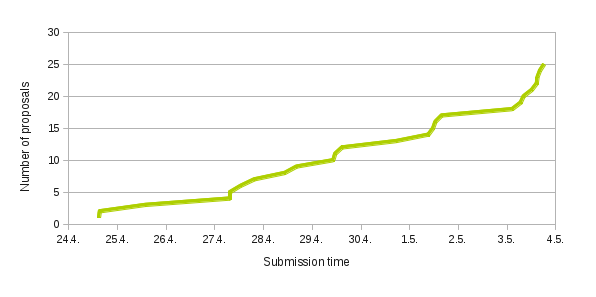
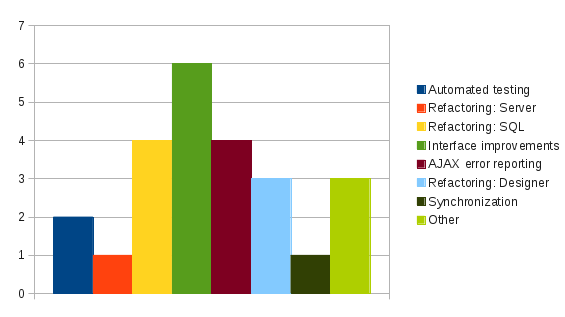
As student application period of Google Summer of Code 2013 is over, it's time to look at proposals we got for phpMyAdmin. First of all we got slightly less proposals than in past years. This is probably related to the fact that we still heavily focus on code cleanup this year and this is definitely not that interesting topic as adding new features. I think quality has also slightly improved and this time we received no bogus or spam proposals. Also as usual, people tend to leave submission for very last date (though not that much as in past years): Number of applications over time Quite unsurprisingly the most interesting topic seemed to be interface improvements, though it is quite wide. You can see how other topics were frequent in following chart: Number of applications for various types Please note that the numbers are not 100% accurate as some proposals really did not fit into above categories. Anyway we're just working on evaluation and will finalize it in upcoming days. Of course you will know the results from Google on May 27th.
Filed under: English Phpmyadmin 0 comments Flattr this!

5 May 2013

Michael Banck: 5 May 2013

Debian 7.0 "wheezy" has been released this weekend!

Quite a few new Debichem packages are now available in a stable Debian release for the first time:

4 May 2013

Joerg Jaspert: Wheezy release

There was Lenny, there was Squeeze, now there is Wheezy. Another major release of Debian where I had the pleasure to do the ftpmaster work for the release. Like the last times, Mark joined to help with the work. But 2 FTPMasters aren t enough for one Wheezy, or so, so Ansgar had his first run aside from point releases. With the whole load of work the release team did in the past to prepare this, combined with all the changes in dak we had since Squeeze, it turned out to be rather easy for us. Again, a few moments and not a detailed log (times in CEST): Right now (that is, 21:08 CEST) I am mostly waiting for the CD build to finish. Current schedule seems to have that in some two and a half hours, after which we can push the mirrors and our press people announce it. Except if Murphy wants to show up, but lets hope that not. Thanks go out to everyone involved in preparing this release, be it in the past by fixing bugs, uploading packages, doing whatever was needed, as well as doing the work today.

Ian Campbell: Taking over qcontrol upstream, releasing qcontrol 0.5.0

Taking over Qcontrol upstream When I took over the qcontrol package in Debian, back in October 2012, I was aware that upstream hadn't been active for quite a while (since late 2009). I figured that would be OK since the software was pretty simple and pretty much feature complete. Nevertheless since I've been maintaining the package I've had a small number of wishlist bugs (many with patches, thanks guys!) which are really upstream issues. While I could carry them as patches in the Debian package they would really be better taken care of by an upstream. With that in mind I mailed the previous upstream (and original author) Byron Bradley back in February to ask if he would mind if I took over as upstream. Unfortunately I haven't yet heard back, given how long upstream has been inactive for this isn't terribly surprising so having waited several months I have decided to just go ahead and take over upstream development. Thanks Byron for all your work on the project, I hope you don't mind me taking over. Since it is unlikely that I will be able to access the old website or Subversion repository I have converted the repository to git and uploaded it to gitorious: I don't expect I'll be doing an awful lot of proactive upstream development but at least now I have a hat I can put on when someone reports an "upstream" issue against qcontrol and somewhere which can accept upstream patches from myself and others. I'm still deciding what to do about a website etc. I may just enable the gitorious wiki or I may setup an ikiwiki software site type setup, which has the advantage of being a little more flexible and providing a neat way of dealing with bug reports without being too much overhead to setup up. In the meantime its been almost 5 years since the last release, so... New Release: qcontrol 0.5.0 This is a rollup of some changes which were made in the old upstream SVN repository but never released and some patches which had been made in the Debian packaging. What's here corresponds to the Debian 0.4.2+svn-r40-3 package. The 0.4.2 release was untagged in SVN, but corresponds to r14, new stuff since then includes: As well as the change of maintainer I think the addition of the daemon mode warrants the bump to 0.5.0. Get the new release from git or http://www.hellion.org.uk/qcontrol/releases/0.5.0/.

Next.

Previous.